


Episode summary
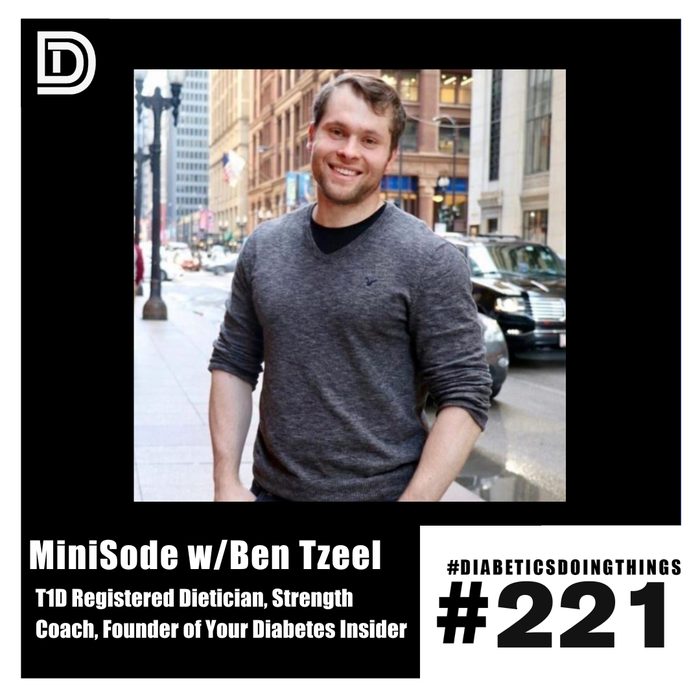
Ben Tzeel, a registered dietitian, CDCES, and CSCS who lives with type 1 diabetes, returns for a mini-sode built around five quick questions from Rob. Tzeel says the biggest misconception his patients bring is that certain foods are off limits with diabetes, and he shows on social media that pizza, barbecue, and dessert can work with the right strategy. He explains his now and later dosing approach for high-fat meals, why he tracks his daily steps and treats 7,500 as his threshold, and how he set new boundaries on his own workload after realizing he was headed toward burnout. He closes with his top recommendation for 2023: review your CGM trends every single week.
Key takeaways
- Tzeel says no food is truly off limits with diabetes if you plan around it, and he posts before-and-after blood sugar demos on social media to prove it.
- He uses what he calls now and later dosing for high-fat, high-carb meals, treating the immediate carbs and the delayed rise from fat and protein as two separate problems.
- Tzeel tracks his daily steps and says falling short of about 7,500 makes him noticeably more insulin resistant.
- He put boundaries on his own workload this year after realizing that giving everything to his patients without limits was leading toward burnout.
- His top recommendation for 2023 is to review your CGM trend report every week and make one small tweak at a time.
Show notes
Friend of the pod, Ben Tzeel, is back with a very special mini-sode of Diabetics Doing Things!
Rob puts Ben on the hot seat with five questions;
What are the most common misconceptions your patients have when they start working with you?
What’s the number one piece of care advice you’d give to someone living with of diabetes (no matter the type or the years living with it)?
What strategy or adjustment has made the biggest difference in your own diabetes?
What resolutions does a CDCES registered dietician and CS S with diabetes have for the New Year?
What should a person living with diabetes in 2023 focus on to have the biggest impact in their diabetes care?
We want to hear YOUR QUESTIONS. Send your questions, comments, queries, and general diabetes concerns to THE MAILBAG at mailbag@diabeticsdoingthings.com!
Questions this episode answers
Can people with type 1 diabetes eat pizza, pasta, or dessert?
Yes. Ben Tzeel says no food is off limits if you have the right dosing strategy, and he posts blood sugar demos after eating foods like pizza and barbecue to show it can be done.
What is 'now and later' dosing for diabetes?
It's Tzeel's term for dosing insulin for the carbs in a meal right now while also planning for a second rise hours later from fat and protein, which he says is common with meals like a big buffet.
How many steps does Ben Tzeel aim for each day?
He targets around 7,500 steps and says he started tracking them during the pandemic after noticing how much his insulin sensitivity depends on hitting that number.
What's one simple habit to improve diabetes management in the new year?
Tzeel recommends reviewing your CGM trend report, such as Dexcom Clarity or LibreLink, once a week, noting what's working and what isn't, and making one small tweak at a time.
Full transcript Searchable, with timestamps
Rob Howe: What's up, Diabetics Doing Things listeners? Special mini-sode for you this week. We had some scheduling conflicts with another guest who I know you're going to be really excited about. But the silent T, the man with the silent T, Mr. Ben Tzeel, who was on the podcast last fall talking about eating disorders and diabetes. He's a registered dietitian. He's a CDCES. He's a CSCS. So if you're trying to get your nutrition right, talk about your diabetes care and get a little lift on a little pump on. He's your guy. Ben, welcome back to the show, man.
Ben Tzeel: Always, always a pleasure, Rob. I'm just so glad I get to be here. We get to chat.
Rob Howe: Yeah, me as well. And, you know, you and I have these kind of scheduled chats. So just behind the scenes, you know, we're we're working together and, you know, supporting each other as friends. And part of that is you were willing to step in for us last minute for this little mini. So what I've got for our listeners today is five kind of hot seat questions for you and I to discuss in a relatively short episode. So it's going to be probably 15, 20 minutes once it's all said and done. And what I want people to get into is just some generic questions that are kind of as we get into Q2, you know, this will be published here in the middle of February. New Year's resolutions are probably fizzling out. You know, the gym is starting to be a little bit less crowded, but we've got a lot of the year still to go a lot of a lot of it ahead of us. So I'm excited to see kind of how we can maybe find some reset options for some of our listeners who might have slipped off of their resolutions a little bit. So here's those questions. Let's put Ben Tzeel in the hot seat. question number one you treat patients with diabetes from all different walks of life and i'm sure you hear a lot of misconceptions from from each of them like as as that as you onboard them and as part of your you know treatment care or just in the community what are some of the most common misconceptions your patients have when they start working with you
Ben Tzeel: oh man i would say where do i even begin but i feel like one of one of the main ones is that there are foods that are just off limits you have diabetes well there goes dessert dessert's gone Pasta, gone. Pizza, gone. Anything that has high fat and high carbs can't be had with good blood sugars. So it's not even just the, hey, I can't eat this. But then it's a, if I decide to eat this, I know I'm going to feel miserable. And that's one of the reasons why a lot of times, and you may have seen them on social media periodically, but I'll purposefully go order something crazy and I will eat it and show here's my blood sugar before, here's my blood sugar after, here's what I did just to demonstrate that it can be done. And I will, I mean, I have nothing is held back on those. So that's, I think one of the biggest things is so many people want to, they want to eat these foods that they like, but they feel like it's just impossible and they'll never be able to do it again. So that's, that's for sure. Number one, I would say.
Rob Howe: I love that. And I think, you know, so much of living with diabetes is just adjusting to that new reality, especially early on, you know, learning how your body responds to certain foods. And yeah, you know, for me, my, my wife makes a homemade pizza from time to time. and that thing is full of carbs and full of fats and full of cheese and pepperoni and is delicious. And I want to make sure that I can eat that and keep my blood sugars in range. And so I definitely have seen and taken some notes on some of your videos on social media in the past, because you are the man that's like man versus food, man. You'll put anything in front and work on
Ben Tzeel: that blood sugar strategy. Well, and there's, like I said, like there's not no holding back. Like I'm thinking, you know, you're out and you're out in Texas. I'm thinking barbecue, right? that's the first thing. You've got tons of fat. You've got tons of carbs. You've got the hush puppies. You've got cornbread, all of that deliciousness. But a lot of people, oh, I couldn't eat that because I have diabetes. When honestly, if you just have the right strategy in place, you're going to use that same strategy, whether it's pizza, barbecue, or a gigantic, you know, warm oozing chocolate chip cookie, which sounds really good right about now.
Rob Howe: I'm telling you, man, a Friday afternoon chocolate chip cookie. Yeah, that sounds great. better okay great answer so yeah i mean you you can eat that and you can eat that with your blood sugar in range yeah that that's the misconception so next like what's one piece of advice what's one piece of care advice you would give someone with diabetes no matter the type no matter the time living with the disease like what is the sort of number one thing that you would want to tell them you know from from the jump oh man i was gonna say there's there's so many things i'm like do i
Ben Tzeel: give an actionable thing? Do I give a mindset side of things? Do I give both? I would say if we go mindset first, right? And it probably sounds cliche, but once you have diabetes, it's a formal diagnosis, type 1, type 2, pre-diabetes, whatever, you know, the key is to recognize that it does not have to restrict you. It can restrict you if you allow it to restrict you, but it does not have to restrict you. It doesn't have to be that thing that dictates your whole life and drives your whole life because, you know, you're the only person that's in control of that. And so that I would say from a mindset perspective, before anything else, you don't have to let it run the show. You run the show. Diabetes is, you know, your co-star. But what I would say with respect to actually actionable things would be activity. The importance of it cannot be understated. type 1, type 2, I don't care how long you've had it. If your body is not moving regularly, your insulin sensitivity is going to decrease in a very, very marked way and pretty quickly. So I mean, I don't know if you've seen it before, but I know for myself if I take three days off in a row. Maybe I'm on a trip or we're in the car for a while or I'm just not moving. I feel like having a lazy weekend. My blood sugar by the end of that starts to creep up slowly but surely despite eating the same food, despite the same everything else because the activity is so much lower. It doesn't matter. You can go up and walk. It doesn't matter to me, but as long as you are staying consistently in motion, your life is going to be a lot easier from a blood sugar management perspective. Love that. I think that applies
Rob Howe: also for people without diabetes. One of the things I've been talking about recently is, and you mentioned this, is like the duality and dichotomy of diabetes where, yeah, diabetes can stop you from doing certain things if you allow it. And it may stop you from doing certain things because somebody won't clear you for a waiver, for example, for scuba diving, or you have to go and jump over some extra hurdles. But if your mindset is such that you would like to do it and like to approach it in a way where it's not only safe and sustainable, but just allows you to do what you wanted to do in the first place, I think that option is out there for you. And that doesn't mean it's not going to be difficult. It doesn't mean it's going to be easy, but that you can build a plan to make it work. And I think with exercise, the same thing we were talking about on the podcast recently, people are looking for any shortcut possible to not just go work out, to not just go for a run, not just go for a jog or not just get in the gym and get some reps in. And something that I found very similar to you is if I'm sedentary for a few days, which A is sort of against my personality and I don't really like it. And so my mental game and my mental health starts to mess up. But also I start to see those blood sugars, those average blood sugars, those fasting blood sugars start to creep up. Insulin sensitivity start to decrease a little bit. So something I did this week was I did not want to work out. It was a long day and I just went in there and messed around for 15 minutes, got broke a sweat, got some good lifts in. And that was enough to power me to the next day where I got a better workout in. So I think, you know, So the consistency aspect, continuing to show up, you're not, none of us are crushing the best workout ever, every single day. Somebody shared that there's like a viral clip. I think Ariana Freyer shared it as well. It's a viral clip right now talking about the thirds of like an Olympic trainer. And the, if you divide your performance into thirds, as you're preparing for a big event, one third is going to suck. One third is going to be okay. And one third is going to be great. And if you just remember that, like, Hey, you have a, you have a sucky workout. Cool. Well, that's just one third. there's still two thirds left to go that some will be okay and some will be great. So just remember to zoom out a little bit and yeah, I'm totally aligned. Motion is lotion too. It keeps your body like ready to move. You know, it keeps you, Greg keeps that blade sharp. So be sure to keep doing that a hundred percent. Okay, moving on. Number three, question three, what adjustment or strategy has made the difference, the biggest difference in your own diabetes management?
Ben Tzeel: Oh, that's a tough beat. I'm still thinking because when you're mentioning the, you know, the limitations of the scuba diving if we just go back to that for just a half a second sure i've had in the past eight months i've had somebody get a commercial pilot's license as a type 1 which was unheard of as i've been like you know within the past couple years that was the first time it ever happened someone go through the fire academy someone else is trying to get into the military which is also unheard of until the last couple years so it's all a mental game and if you're willing to push past those hurdles and willing to not take no for an answer you can make anything happen so i just thought that was important to share because the military and the pilot side, like when I was growing up, that was unheard of.
Rob Howe: You would never do that. Yeah. Same. We've had people on the podcast who were diagnosed when they were in the military and they got an honorable discharge just because they weren't able to do their job anymore. But very recently on Instagram, somebody DM the Diabetics Doing Things account and they're in Germany and they're currently serving in the army over there with
Ben Tzeel: diabetes. So really cool stuff coming. Yes. That's freaking wild. But you mentioned, And, you know, what adjustment or strategy for myself and my own care, I presume I would say, you know, twofold and shockingly, there'll be stuff that I alluded to earlier. One of them was when you have those crazier meals, making sure you're paying attention to not just the dose right now, but what we like to call, you know, the now and later dosing technique, right? You're, you're dealing with it now, but you're also dealing with it later when the fat and protein hit once upon a time, you know, I'd go to, I'd go to some of those, you know, Chinese buffets, or I'd go to, you know, different places where there's tons of food and you nailed the dose. It's been two hours and my blood sugar is doing great. And then you go to sleep and you wake up at 355 and have no idea what happened. Paying attention to the fat and protein has made the biggest difference in my blood sugars when it comes to really any kind of food, but especially with crazy food. And the second thing would be, I didn't even start the second one until really until the pandemic had begun. I didn't pay attention to my steps whatsoever. I did not care. I just like, oh, cool. You know, I got this many steps. Doesn't matter. Once I started paying attention to those, I started realizing how much my body relies on me hitting a certain threshold. So if I don't hit for my body, if I don't hit, I think it's 7,500 is where I set the bar at. I know I'm gonna be way more insulin resistant. And I mean, it's so scary to the point where I can walk in a circle and if I get close to like 7,500, if I have a stubborn high, it'll just start to shift right back to where it's supposed to be. Unbelievable.
Rob Howe: I love that you measured that and you quantified it because if you wear an Apple watch or a whoop or whatever it is that you're using for your steps counter, that lets you know, like if you're in, if you're having a tough blood sugar day and it gives you something to go refer back to, which I like is like, how did I, did I hit these steps threshold? And if not, it's like, okay, well, that's a really easy thing to say. All right, well, I need to increase my movement. Or, you know, for me, my questions I ask, like, you know, did I get a good night's sleep? Am I hydrated? Like, did I go outside? And if the answer is no to a couple of those. If I just check that box to yes and flip that, usually that starts to get me on a momentum path to being where I want to be and feeling how I want to feel. Really great. Well, and measuring that, I don't even have one of the whoops or the Apple watches. I just use
Ben Tzeel: whatever the step tracker is on my phone. So maybe I'm that person that takes my phone everywhere, but it now has a streak for me. And I don't know about you, but with streaks, when I'm competing against myself, I can't let the streak go. So I think I'm at, I got the app, I don't know about I guess six months ago or so I'm at 175 days. I'm like, I got to keep going. But for something like MyFitnessPal, I, you know, I sometimes log my food. Actually, I always like my food, but you know, with that, my streaks at, I don't know, almost 4,000 days, just because I feel like it makes diabetes management for me so much easier for not for everybody, but for me, it does. But
Rob Howe: those streaks help me stay intrinsically motivated too. Well, and you get to see those habits, like, and you get to get to see them unfold in real time. What gets measured gets managed blood sugar or otherwise. You got to measure it. You got to manage it. Exactly. You go. No, no, no. Yeah. I was just going to move to the next question and we're keeping this quickly. Go for it. I mentioned at the top of the episode resolutions and we're in February now. I think the research shows that most resolutions don't make it three weeks. Those of us who go to the gym are starting to see people starting to thin out a little bit. Some of our January folks are missing their workouts a little bit. What resolutions does a CDCES registered dietician and CSCS with diabetes have for the new year? What did you look at to add to your repertoire in 2023?
Ben Tzeel: I really think for me, a lot of it's been self-care and actually, not to say putting myself first per se, but making sure that I am paying attention to sleep, that I am doing the things I need to do with respect to decompressing a little bit and not being so stressed because that can wreak havoc on blood sugars, number one, but number two, you just don't feel good. And I feel like that's something where I love serving this community. I absolutely love it from the bottom of my heart. And so I try to give everything I've got every single day. But I realized if I do too much, then eventually I burn out and then I can't help anybody else. So I've really tried to put some boundaries on, hey, I can give everything I've got, but I've got to stop at a certain point and relax and spend time with, you know, fiance and the dog and, you know, spend time doing occasionally something else to make sure that my mental health is okay. Because as I'm sure, you know, you know, as well as anybody in this community too, mental health and diabetes is something that people don't pay enough attention to. And I figured, Hey, I can talk about it all I want, but I have to actually do it myself. So that's been my biggest thing since the start of this year. And I like to think it's helping. It's definitely a challenge, but it's definitely working. Well, you know, you and I talk a lot
Rob Howe: about, you can't pour from an empty cup. So you got to make sure that you're filling yourself up so that you can share it. And I think as well, you know, you didn't mention this necessarily, but as a business owner and a person operating their business, you don't really have anybody to check on you on your workload. You sort of have to just do whatever is necessary. And so that combined with diabetes, if you're not being mindful of your energy and mindful of your self-care, you know, could, could end up into a bad spot. So good. I'm glad, glad to hear it. And, you know, looking forward to keeping up with that resolution for the rest of the year. Okay. The final question, putting you in the hot seat, my friend, in your expert opinion, you're a registered dietitian, you're a CDC. Yes. You're a certified strength and conditioning coach. What should a person with diabetes in 2023 focus on to have the biggest impact in their
Ben Tzeel: diabetes care? This is such a doozy. I feel like the seat is scorching right now. Okay. So with that, what I would say the number one thing, if someone's going to focus on just one thing, Maybe they take the exercise we talked about earlier to heart. They take the food to heart. Of course, those are going to be the absolute crux. I can very biasedly say food is 80% of your blood sugars. It's 80% of body comp. Focus in on your food, your quality, making sure you got the carbs, all that. Sure. I think the biggest thing someone can do just from a strictly diabetes standpoint is reviewing their trends every single solitary week. If you have a CGM, it's super easy. Pop on the Clarity Report. do the Libre link, whatever you have to do, get that data in front of you, take a look at it, say, okay, what's going well? What's not going well? What can I tweak? And just five minutes, I'm not asking for a lot. You could be, you know, instead of scrolling, stop scrolling for a couple minutes, take a look at it, make a little tweak, make a note of it, revisit the next week. Did it get better? Did it not? Or, you know, if it doesn't, what else can you do to make it potentially better? I think that by itself will have super dividends from just a strictly diabetes standpoint. But I mean, the other option would be if someone's like, hey, I'm just overwhelmed with everything, finding a way to make it a little bit easier, get someone from the outside with an outside set of eyes to be able to help direct exactly what to do so it's not overwhelming and then take it from there.
Rob Howe: I love it. I actually am going to take your advice. I think I'm going to set a calendar invite on Friday afternoon every week and review my clarity reports or, you know, I guess CareLink reports from my Medtronic CGM. So I'm excited to see what those trends look like. You know, I think too often I manage my diabetes, you know, two day to day, like two focused in and not don't zoom out and look at the trends enough unless I'm at an appointment with my endo. So interesting. Might have to keep you guys up to date on how that goes.
Ben Tzeel: Well, I think you totally should. And that's something that we do, you know, every single week with every patient through our practice, we're looking at what are the trends looking like, you know, what things could we consider suggesting to get tweets, you know, whether it's food activity or just something else. You know, there's always something that can improve. And when there isn't, then, I mean, you're averaging 110 all the time and you're moving and life is amazing. So yeah.
Rob Howe: Hey, if you're out there like that, please teach me your ways. Ben, thank you so much, man. Your Diabetes Insider, man of zeal with a silent T on Instagram and TikTok. Man, thank you for continuing to be a friend of the show and we'll see you next time.
Ben Tzeel: Yes, sir. I will see you soon.
Rob Howe: Yeah.
About Ben
Ben Tzeel is a registered dietitian, CDCES, and CSCS who lives with type 1 diabetes and previously joined the show to discuss eating disorders and diabetes.