

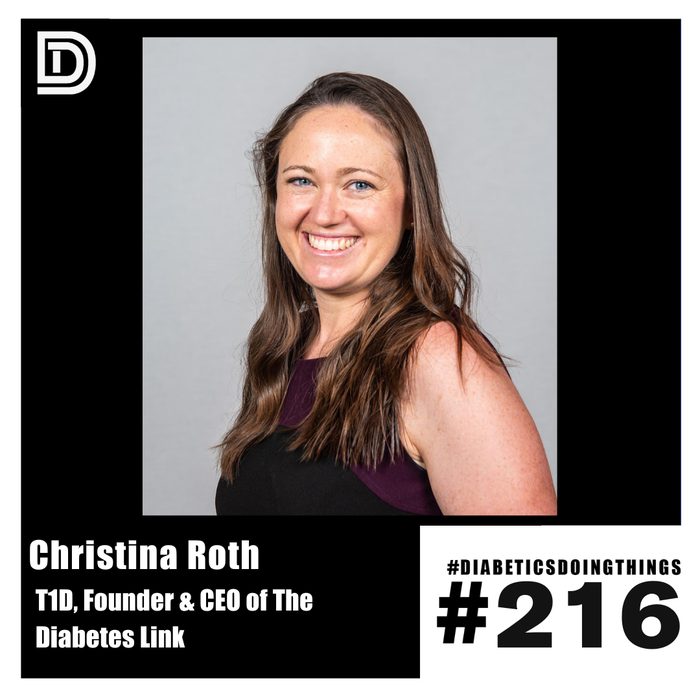
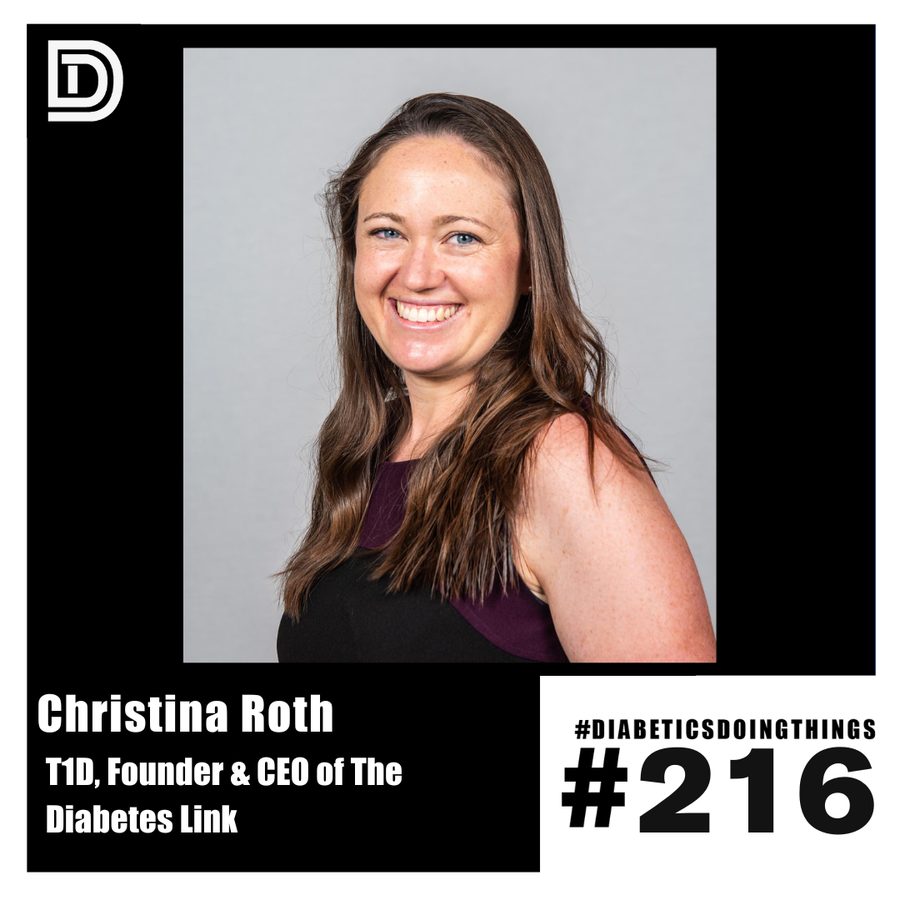
Christina Roth, T1D, Founder & CEO of The Diabetes Link

Episode summary
Christina Roth returns to the podcast six years after her first appearance. She is the founder and CEO of The Diabetes Link, the organization she started in college that recently rebranded from College Diabetes Network to reach young adults with diabetes beyond campus. She explains why the name changed, how the group's Discord community grew during COVID, and how its new Resource Hub organizes content by topic instead of by life stage like college or starting a job. She also talks about being told at diagnosis that she would not be able to have children, and how meeting other women with type 1 through the organization changed her mind. She is seven months pregnant while still running the organization as founder and CEO.
Key takeaways
- Christina Roth rebranded College Diabetes Network to The Diabetes Link in 2022 to serve young adults with diabetes beyond college campuses.
- The organization moved its education resources from print binders to a digital Resource Hub organized by topic, and built an active Discord community during COVID.
- Christina says she was told at diagnosis that she wouldn't be able to have children, and didn't believe otherwise until she met other women with diabetes through the organization she founded.
- She is seven months pregnant while continuing to run The Diabetes Link as founder and CEO.
- Christina's advice to young adults with diabetes: find your community, lean on people who have been through it, and find strength in having diabetes.
Show notes
This episode is sponsored by Gvoke HypoPen® (glucagon injection). Gvoke HypoPen® is an emergency glucagon for very low blood sugar in a convenient auto injector that is available in 2 pre-measured doses for adults and children.
Note from Rob:
I have partnered with Gvoke® before, and I’ve been working with Xeris Pharmaceuticals® since 2018 - I even interviewed their CEO back in March 2020. If you want to hear that interview with Xeris President & CEO, Paul Edick, from March 2020, check out episode 143 of Diabetics Doing Things.
I’m also really careful not to promote products that I don’t personally use and I have used
Gvoke HypoPen® for very low blood sugar before. I’ve told the story on this podcast before and I am convinced that if you are on insulin, you should have emergency glucagon around, just in case of a very low blood sugar, and I use Gvoke HypoPen®. Gvoke shouldn’t be used in patients with pheochromocytoma or insulinoma – visit gvokeglucagon.com/risk.
I also want to address that I will not promote pharmaceutical products without the opportunity to promote patient assistance programs because if my listeners can’t access glucagon, how can they use it to treat their very low blood sugar? So, if you visit the savings and support tab on GvokeGlucagon.com, you can get a $25 coupon for patients on commercial insurance plans, and there is a contact form to fill out for people not on commercial plans.
Now onto the show: Christina Roth has returned to the pod! In this episode, Christina and Rob talk about:
The evolution from College Diabetes Network to The Diabetes Link
Expanding the reach of resources, programming, and community beyond college campuses
Deepening the connections that existed before COVID, but now in a hybrid way e.g. Discord community and digital platforms like The Resource Hub
12 years as a Founder and big family announcements
Tools and technology continue to grow, but so does the need for support and community
Taking the time to digest the impact on the community when there’s so much more to do
Diabetes and motherhood
No matter where you are in your Diabetes journey, remember that you are not alone
For more details and important safety information, visit GvokeGlucagon.com.
Questions this episode answers
What is The Diabetes Link?
The Diabetes Link is the new name for College Diabetes Network. Founder and CEO Christina Roth says the rebrand, announced in October 2022, keeps the same peer support, education, and leadership programming but extends it to all young adults with diabetes, not just those in college.
Why did College Diabetes Network change its name?
Christina Roth says health care providers kept referring young adults who weren't in college, and the word 'college' in the name became a barrier. The rebrand was meant to make the organization feel open to any young adult with diabetes.
Who is Christina Roth?
Christina Roth has type 1 diabetes and founded College Diabetes Network in college. She has led the organization, now called The Diabetes Link, as founder and CEO for 12 years.
Can people with type 1 diabetes have children?
Christina Roth says she was told at diagnosis that she wouldn't be able to have children, but changed her mind after meeting other women with diabetes through the organization she started. She was seven months pregnant with her first child at the time of this interview.
Full transcript Searchable, with timestamps
Rob Howe: This episode is sponsored by Gvoke HypoPen, glucagon injection. Gvoke HypoPen is an emergency glucagon for very low blood sugar in a convenient auto-injector that is available in two pre-measured doses for adults and children. I've partnered with Gvoke before and I've been working with Xeris Pharmaceuticals since 2018. I even interviewed their CEO back in March 2020. If you want to hear that interview with Xeris President and CEO Paul Edick from March 2020, check out episode 143 of Diabetics Doing Things. I'm also really careful not to promote products that I don't personally use, and I have used Gvoke HypoPen for very low blood sugars before. I've told this story on this podcast before, and I'm convinced that if you are on insulin, you should have emergency glucagon around just in case of a very low blood sugar, and I use Gvoke HypoPen. Gvoke shouldn't be used in patients with, and bear with me here, pheochromocytoma or insulinoma. Visit gvokeglucagon.com slash risk for more information. This announcement is especially important now because you may have heard that there are glucagon products being discontinued, such as Eli Lilly's glucagon emergency kit. So make sure that your prescriptions for glucagon are up to date by asking your doctor about Gvoke HypoPen glucagon injection. For more details and important safety information, visit gvokeglucagon.com. I also want to address that I will not promote pharmaceutical products without the opportunity to promote patient assistance programs, because if my listeners can't access glucagon, how can they use it to treat their very low blood sugar? So if you visit the Savings and Support tab on gvokeglucagon.com, you can get a $25 coupon for patients on commercial insurance plans, and there is a contact form to fill out for people not on commercial plans. We've linked gvokeglucagon.com and the savings and support resources in the show notes, as well as the important safety information. So thank you to Xeris Pharmaceuticals for your support of telling the amazing stories of people with diabetes all over the world at Diabetics Doing Things. Let's get to the episode. Welcome back to another episode of Diabetics Doing Things. We're telling the amazing stories of people with diabetes from all over the world. And one of my favorite things recently about this podcast, we've been doing this over seven years now is that people get to come back and they get guests returned to the podcast with updates on the amazing things that they're doing. And today's guest is no different. Joining us for the first time since 2018, Christina Roth. Welcome back to the show. You're on episode 111, and this will be episode probably somewhere in the like 200 teens range. So we're spanning the whole 100 episode arc here. Welcome to the show. Thank you. It's so exciting to be back. It's great to have you. And we have a lot of stuff to talk about today. So in order for us to do that, introducing you for the first time on this podcast as the CEO and founder of the Diabetes Link, formerly College Diabetes Network. So that's the big news. That's the big reveal. Let's just talk about it right away. You guys announced in October that the College Diabetes Network name is evolving and rolling into the Diabetes Link. So tell us about that change and what drove that and all the exciting things over at the Diabetes Link.
Christina Roth: Absolutely. Yeah, that was a big decision and a big undertaking. The team has worked really hard this year on that. And College Diabetes Network, our college network in general, is still the heart of what we do. It's still the heart of our model. And our chapter network continues to grow and flourish thanks to the leaders that run them. Um, but we really found after, you know, working with young adults for over 12 years now, that it isn't just college students that that need the support. And we've been able to grow enough as an organization that we we've been able to take on the fact that we need to serve a wider audience, we need to be more inclusive. And our name was a big barrier to just as an inherent part of our identity. So I don't really programmatically, we're continuing to just deepen everything that we've done before with peer support, education and leadership development for young adults. But now it's really committing to supporting all young adults with diabetes. And through the evolution to the diabetes link, we really are that link for young adults. We commit to being that link to each other, to opportunities in the sector, to education, to really anything you need to thrive as a young adult.
Rob Howe: I love that. And I think one of the things that made me most excited about the change and the transition is that it's based on success. You guys found success and have grown your chapters across the country at the college level. And then just recognize as a part of that, that there's a greater population that could benefit from the same type of programming and the same type of community building, but not necessarily distributed through the university and college landscapes. Because that doesn't apply necessarily to everyone.
Christina Roth: Absolutely. And that was something that has been always a pain point for us because we want to be inclusive and our communities on the ground absolutely are. But as we were able to really publish our education resources, we were hearing so often from health care providers that they just had patients that were in desperate need of talking to someone else or if they didn't have access to talk to someone to at least understand what other young adults experience and to not feel alone. And so even if it was simply being able to make sure that they felt heard and knew that there was a space for them, we wanted to be able to make that possible. So I think in the next few years, it really is around creating that space for all young adults to know this organization is dedicated to you. This platform is dedicated to you. And it's our job to connect you with the rest of the diabetes community and everything that you have available. and then to really be able to bring that and that direct peer-to-peer interaction and have that go far beyond campuses. So a lot of what young adults have been doing throughout COVID is something that we're really hoping to continue to build off of. Well, I definitely want to touch on the changes
Rob Howe: to the chapters, especially, you know, through the pandemic. Obviously, you know, a big change on universities and continuing to change as my camera goes off here. Let me just turn that back on. So it's so interesting to me to hear about the caregiver side of things and when patients are going and caregivers were asking for resources for young adults who weren't connected to the diabetes community. And when you and I met and we ran into each other at ADCES in August this year, And so I had some insider info on the diabetes link transition. And if you guys will notice in the diabetes link video, the voice sounds a little bit familiar to me. So I was super happy to be a part of that because that insight of people who are not connected to the online diabetes community like we are and the community that we have found often don't know where to go. And if their care team or even GP or whatever their support system looks like from a healthcare perspective, they need to know about it as well. And so it's really interesting to hear when someone goes to the doctor and they say, I just really need to talk to someone. I really need to know what it's like and the big questions that young adults ask, whether they're going to university or college, whether they're moving out on their own for the first time, whether they're starting a family, whether they're going out or meeting new friends or looking for career opportunities. opportunities or health insurance questions and like all the things that come along with being a young adult and kind of transitioning into that next phase of your life. But diabetes, as usual, is ever present in every single one of those. And it can be really overwhelming if you don't have information and you don't know where to turn. So I think it's so key to have that inclusivity aspect because you might see I might be a young adult at my doctor or my endos office or my GP's office, and I might see a college diabetes network. But the first thing I see is college. And if that doesn't apply to me, then maybe I don't pursue it.
Christina Roth: Exactly. And that's what we'd heard for many years. And I really appreciated the health care providers advocating on behalf of those young adults because they are the ones that were really struggling the most and not being able to benefit. So I think that's that's just been a really exciting opportunity to be able to to take advantage of.
Rob Howe: It's very cool. It's very, very cool. So let's let's back up a little bit and talk about because you mentioned COVID and the pandemic. That was a huge disruptor on college campuses. You know, even in my professional life, like hiring people fresh out of school the last couple of years, like it didn't look the same. It's virtual classes or, you know, campuses like being basically empty and like campus life going away and kind of now reemerging now as we've kind of come into the third year of the pandemic almost. And so, you know, what changes did you and your team have to make, even at the chapter level, like with everything kind of being in flux?
Christina Roth: Yeah, I mean, COVID turned everybody's lives upside down, but especially for our organization, given the population that we serve and how we serve them. Historically, it really has been so in-person based because of our chapters. Even our educational resources were really hard copy in clinic and nobody was going to clinic. And our leadership development a lot was conferences and mentorship. So we really took an entire step back at the beginning of the pandemic and didn't necessarily try to do a band-aid approach. We just really looked at what young adults need right now at this time. And it was they just need to know that they're not alone. They need to know what safety information is relevant to them. And from a mental health standpoint, everybody is struggling. So how can we help to support their mental health? And that's really where we focused all of our attention. And organically, because so many of our chapter leaders and members are so active in supporting one another, we found that actually discord became very active within chapters and across chapters to help people still feel connected to one another, and particularly given all the fears that came up during COVID.
Rob Howe: I think, too, what you're getting at for young adults is really a holistic approach is needed. It's mental health. It's community. It's dosing information and safety information. It's diabetes we often talk about on this podcast is the disease with too many inputs, and it affects really every aspect of your life. And as a young adult, me fortunately now a few years past my young adult years, I remember the fly by the seat of your pants transition of, oh, hey, I'm an adult now. I've got my job or I've got my classes and I've got my bills that need to be paid and I've got my things that I got to go to the grocery store, do my own laundry. All those things are what normal people experience. And for people with diabetes, you have that entire other piece. Like, do I have an endocrinologist in my new location? You know, when was the last time that I checked in with my GP? Are my prescriptions up to date? Like, do I have enough supplies? You know, all of these things are sort of living rent-free in your mind. So when you guys are approaching solving these problems and providing and building these resources, where do you start? Is it really, it begins with peer support and building on the curriculum that you guys have worked with so well over many years with College Diabetes Network? Or, you know, how are people finding and communicating with the new diabetes link? What is the, and what brings them
Christina Roth: to you guys from the start? Yeah. So I think we continue to deepen everything that we did before, you know, in a hybrid way. So we have the in-person with our campus chapters, but we also So we're doing more with our Discord community and just a little bit more remotely. And all of our, as we launched the Diabetes Link as an organization, we also did up the public release of our Young Adult Resource Hub, which we completely rebuilt on a digital platform and moved all of our content into topic specific. So they're no longer packaged up as off to college or newly diagnosed or off to work. It is very much around, I have a question around drinking with diabetes, and I want to see this video on this topic within that. So it can be much more curated to what question you have right now that's relevant. And so I think that's a really big way that we've adjusted there. I think the other, beyond the deepening our program areas and what we've already been doing and been good at, has really been this is an opportunity for everybody to see how we can help to serve young adults holistically and that we don't just serve college students. So it's become a platform where the relationships that we've built with organizations and companies across the diabetes sector for years now that we've worked with who have been amazing, were really able to help curate the opportunities, the education that they have, the relevant resources that young adults can benefit from. And so that's really where we see ourselves as well is we don't have to actually provide all the services directly or do all of the things ourselves or create them, but we can supplement what doesn't exist already. And so I think that's a really big part of we're both deepening what we do well, but we're also able to use this platform to better connect young adults to everything that they have access to.
Rob Howe: Well, I think it's really interesting because it also lines up with kind of how we're transitioning and growing and kind of folding into our new vision at Diabetics Doing Things, which is practical applications for people with diabetes, right? So you guys have had great success with that information. Like you said, it was mostly print or like binders and like you give it to an in-person. And now the resource hub really is that where it's digital, it's scalable, it's light. You can grab a link and send it. You can search and kind of keyword search and filter through and there's YouTube videos and blogs and, you know, this online library that has been proven to work over years, but is now just a little bit lighter and a little bit more, you know, available and accessible for, you know, different populations kind of throughout, you know, wherever they are in their diabetes journey or their journey as a young adult.
Christina Roth: Absolutely. And that's going to be continuing. We're going to be continuing to really focus in on building out the resource hub too. So we have a very aggressive attempt at really refreshing a lot of that content, adding to it. And the community is a huge part of that. So as questions come up that aren't being answered there, we want to know because we want to be able to help solve that. And we want these individuals help in actually providing that information because that's why we exist. It's for young people, by young people.
Rob Howe: Yeah. I love that. And, you know, we're 60 days in now since the announcement of the Diabetes Link. So I imagine you guys have had some feedback and, you know, there's been a lot of coverage and I've seen, you know, even other interviews and articles. What's the response been like to, you know, opening this up to the larger young adult population?
Christina Roth: It's been overwhelmingly positive. You know, it was a scary undertaking to think about, you know, broadening the scope of what we do as a small nonprofit that, you know, still doesn't have everything figured out, although I'm not sure anybody does. That's a great trick, right? There's a nobody who does it figured out. Exactly. But, you know, we're still, we don't have it all figured out. We haven't reached every campus. Not every young adult that we've worked with is fully, you know, being supported like we want them to be perfectly. But it was so important to us to be able to broaden our inclusion and really be able to be more holistic with our approach to young adults and this generation.
Rob Howe: Just a reminder that this episode is brought to you by Gvoke HypoPen glucagon injection. If you are a person on insulin or sulfonylureas, you should have glucagon. Gvoke HypoPen is a glucagon auto injector for very low blood sugar that can be used in just two steps. Whenever I have a very low blood sugar, I'm glad that I have GVOKE. Talk to your endo or visit gvokeglucagon.com today. Well, I'm curious, I think like when people do come to you guys and like, obviously you're a small team, you guys are also very ambitious. And I think that comes from you as a founder. So I'd love to talk about like 12 years as a founder, like how do you find that energy? And like, you know, a lot of things have changed for you personally and like a very big, very big changes coming for you and your family very soon. But when people come to you guys, what needs are different for young adults with diabetes compared to some of the other patient populations? And I mean, you specifically were the person who you made College Diabetes Network for you, right? Initially, the idea came out of you're on campus, you need resources, you need community, you need someone to advocate for you, and you were able to create that. So are you still seeing that those same kind of triggers that inspired the first iteration of College Diabetes Network, are those still relevant today or are you seeing those needs evolve?
Christina Roth: It's a really interesting question. I think that they are just as appropriate and important today as they were back 12 years ago. Young adults, even from when we started, thousands of young adults go through it every year, but everybody does it in a vacuum. And so College Diabetes Network helped to sort of shine that light and bring some of that wisdom to the surface so that it didn't go away every year. But, you know, it's still the same types of concerns about talking to your roommate and, you know, within your family, just how to talk about being independent and how to share data. So I think, honestly, if anything, it's become even more relevant because of the changes in tools and technologies that are available now, as my phone rings, because it does create, as much as we love the tools and technologies that are available now, it does create more burden. It does create more information and it can make life complicated. So I think if anything, the needs that existed 12 years ago have deepened for this generation of young adults. Absolutely. But it's interesting because we have also seen it evolve because we do have graduates that are now pursuing careers in diabetes or have graduated and moved to a new city and are just trying to figure out life, but didn't want to enter another black hole and didn't want to leave College Diabetes Network behind. And so through the Diabetes Link, We've just seen so much support from our alumni, from those that are like, there's still a place for me. This is still my organization. And we're like, of course it is. It always has been. But now they really feel that. And so that's been really validating to be able to see how that has impacted.
Rob Howe: it's been cool for me to getting to work with and meet other team members on the the diabetes link team both like in person when we were in baltimore this summer and you're working on the launch and working you know in the in the resource hub and and just kind of getting in and working as a partner with you guys it's cool to see the the dna the fingerprints of the chapters and you know people who are chapter you know chapter members chapter leaders who now work in the organization and are continuing to say, this is my community, I believe in it, it helped me and I think that I can help bring it to someone else, it's pretty awesome. It's really like a case study in itself of the power of the program and the power of community when it hits you at the right time.
Christina Roth: Yeah, I think honestly, that's one of the things I'm most proud of is the young adults that have been involved in our chapters, many of them who didn't want to be involved or talk to somebody else previously, which I can definitely identify with.
Rob Howe: You're preaching to the choir there too. I'm right there with you.
Christina Roth: Exactly. And just going through that journey personally and having the organization help to facilitate that, but then seeing them just grow and flourish professionally and really embrace just this incredible strength that diabetes has given them and this incredible knowledge to be able to have been a part of that professionally and to help to support them in their professional development. has really been one of the most validating parts of the past few years, honestly.
Rob Howe: I had a question about this, like 12 years as a founder. Do you have the time? Because speaking from my own experience, I often am so focused on whatever my immediate needs are and also looking ahead that I don't spend enough time looking back. And so I guess asking you, do you ever have the time to kind of take inventory and smell the roses on how far you've come and how many people you've impacted and what that has created in this world that didn't exist before? Do you ever have time to consider that journey? And I think hearing, you're able to see from people that work for you now that are your key team members who, like you said, maybe four or five years ago before College Diabetes Network didn't want anything to do with their diabetes or anyone else's and are now champions for other people, connecting them to these critical resources. Do you ever, you know, have get a sense of like getting able to say like, hey, look at all we've done. And, you know, 12 years ago,
Christina Roth: this was just an idea. Probably really no. And it really, if I'm being honest, that's probably one of my biggest weaknesses. But it's I think that's one of the reasons why it is so validating to get to really see that embodied in my colleagues that have gone through our programs because I do get to see that. And that is just amazing to just have that opportunity. I see that with our NextGen fellows to a smaller extent. And just experiencing it really brings it to life, but actually taking the time to digest it and look back. We did a little bit for our 10-year anniversary, but beyond that, it really is just there's so much more to do and just being focused on that and how we're going to make that happen and how we're going to get it done. And that really continues to be the main focus. Well, and it was cool to be a part of that
Rob Howe: 10-year anniversary celebration and talking to you then and also all of the community members outside who were at one time young adults or college students who are now either leaders in the diabetes community or part of the Diabetes Link staff. It just is the beginning. I think that's what is so encouraging to me about your mission in serving young adults is because it builds a platform early for, Or and I'm sure you guys and your partners have run the numbers on like the actual like impact of a life with diabetes where you're able to early learn more and get the resources that you need and have good engagement with the community and with your health care team. Because a life with diabetes is long and there are a lot of obstacles that will pop up at any given moment sometimes. And so to be able to see kind of like a, it's like a cheat code to get it that early. And for me, I feel the same way about the diabetes online community and like opting in. But now to have a place where young adults who are Googling at home late at night, having a rough night with diabetes and wondering if they're the only person in the world feeling that way and finding out that they're not like opening that up early really is it, you know, gives you an entire new outlook on the rest of your life potentially.
Christina Roth: Absolutely. And I think so many decisions are made during this time around what you want to do, who you want to be, what you're good at, what you want your family to look like. You're actually thinking about all of those things that it can help alleviate anxiety or it can help just open doors that you never knew existed. So I think that that is an incredible piece of working with this age group because it really is, it's the very beginning of the rest of their lives. So everything we're doing, it's not just for today, it's for, it's giving them the tools for the rest of their life trajectory. And that's so much of what we wanted the Diabetes Link and our new identity to be able to really embody is, yes, we serve a very specific group of people at a very specific time, but it's for a much bigger purpose and it has a much bigger impact.
Rob Howe: It's a foundation. Absolutely. And I think that that is what so many young people with diabetes miss and have missed is the foundation as they are learning who they are and what they want and getting to decide it for themselves for the first time versus like, you know, a parent situation or what have you. and say, and as you're learning, and I think in college for you and I, that was our experience. Like you go to college and learn who you are and learn who you want to be. And to now have that opportunity outside of the university, outside of the typical college route is super impactful. And, you know, 60 days in, we're not seeing the full impact of what that's going to look like, but zoom out a little bit, 10 years, 20 years down someone's life, those key decisions can totally alter the trajectory of your life and, you know, leave you open to opportunities that you may not have even been aware of at the time. And for you, changing the College Diabetes Network to the Diabetes Link is not the only change you're going through right now either. So that foundation for you and starting a family is kind of like the next iteration. You've used that foundation of young adulthood and now carrying it into the next phase of your life. Yeah, I know. So
Christina Roth: At this point, I'm a little over seven months pregnant, although I will not be showing you my belly right now.
Rob Howe: That's fair.
Christina Roth: For everybody's own good.
Rob Howe: I also will not be showing anyone my belly today, so it's good. We're equal in that.
Christina Roth: Yeah, I it really I was never anticipating going through pregnancy with diabetes while doing a rebrand or even continuing in this the the same capacity as a. As a founder, but also in a very intensive CEO role. Yeah, I had always sort of envisioned being able to step back a little and maybe focus more on diabetes. And it was very intimidating thinking about taking all of that on at once. But I think what I'm so proud about with the diabetes link is being able to give more young women and even young men the opportunity to see that you can still have a family with diabetes. I know personally, I was told when I was diagnosed that I wouldn't be able to have children. It led me to, you know, really pursue research in the adoption space and look at resiliency and adoption. And it taught me a lot. But it wasn't until I really met other women with diabetes through starting CDN that I realized it was actually possible and that I could actually do it. Being a not perfect diabetic, I could actually do it. And that took me years to wrap my head around. So it's still very surreal, the fact that we're actually starting our own family, but also really amazing to be able to show our young adults that they can too whenever they're ready.
Rob Howe: Yes, they can. And they can also be the CEO and they can also be the founder if they want, you know.
Christina Roth: And all at the same time. Yeah. And, you know, I'll stick you out for a consie.
Rob Howe: I was going to say, if you got enough caffeine, anything's possible with that. But it comes back to the whole core of it, which is everybody has a different level of education or maybe a GP or an endo tells someone because it wasn't that long ago in the grand scheme of things that you were diagnosed. And to see that narrative shift at a macro level, sort of across the board and understanding the diabetes links role in that the diabetes community, other women and people with diabetes who have gone before us and done these amazing feats and, you know, these this living normal life with diabetes and managing that and all that goes into it. sharing those stories and you sharing yours, I'm sure there's somebody out there who's like, you know what? I think I can be a CEO and a mom at the same time and I have diabetes. And guess what? Christina Roth is proof that I can. And so I think that to me is the foundation of this podcast. It's people helping people, it's community. And A, I'm really excited for you and your family in this next journey. But also I just kind of zoom out a little bit and think that there's some maybe parent of a little girl with diabetes out there who's like, you know what? My, you know, my baby girl wants to be the, you know, the girl boss. She wants to be the leader. She wants to be the founder and she wants to be a mom. And there's somebody out there who is doing that with diabetes. And so I'm excited for you and your family and also for the, you know, the Diabetes Link family to continue to grow. It's going to be exciting.
Christina Roth: Thank you. It's an exciting time for sure. Lots of change.
Rob Howe: Yeah, I imagine. And, you know, with that, though, I kind of want to come back to, you know, I went back to our previous interviews and I've asked, you know, I asked the right questions at the time for us. And I'd encourage everybody to go back to episode 111, even though it's been a few years, and just to track the journey that the CDN and the Diabetes Link have been on. But I want to ask you this question, like, you know, if you were, you know, now that you've seen the thousands of people who have gone through the College Diabetes Network and the, you know, potential to help millions of young adults with diabetes through the diabetes link over, you know, the next few years. What advice would you get to a young adult out living with diabetes, you know, whether you're bumping into them at an airport or, you know, just randomly in a coffee shop? Like what if they asked for your advice, what would you tell them?
Christina Roth: oh i feel like i should have a better answer prepared for this there's no wrong answer on this i feel like there's there's very profound wisdom but that i probably won't say it really it's it's you're not alone lean on find your community find be open to talking to other people with diabetes, learn from them, but find the strength in having diabetes, because I think it can wear you down and it can be a lot and it can be exhausting and being able to find the strength and just help stirring a lot of different phases of your life that people will go through. So not articulate, but...
Rob Howe: I disagree. I think very articulate and salient. And, you know, it's so funny because we've heard that before. You and I have heard like you're not alone, right? And we see it in, you know, those of us who are very highly engaged in the diabetes world, we see that. Something that's been really tangible for me in National Diabetes Awareness Month 2022 with our work at Diabetics Doing Things is that that question still is kind of question number one for people with diabetes who are maybe not as involved or new to it is, am I the only one going through this? Am I the only one that diabetes seems really heavy or really difficult? And, you know, I have to check myself sometimes because you can look at me externally and not really know me and just kind of at a high level and be like, wow, Rob's got it all figured out. His diabetes is not a big deal. Wrong. It's for sure a big deal. And, you know, just because I sometimes look like I'm handling it well doesn't mean that I'm not that I am. So, you know, I want to reiterate that and like really reaffirm that if you're out there feeling alone and you feel like you're the only one going through this and that you can't see an end for yourself, there is definitely someone out there with diabetes who's either gone before it, going through it at the same time or will go through it. So you aren't alone and you can connect with the online community or you can find a way to use the resource hub at the diabetes link to get those questions answered, those frequently asked. Because finding and democratizing that information is so important. And I think we're only scratching the surface to the impact that that type of information and that type of presence is going to have for people with diabetes. Absolutely. Well said. Don't be so hard on yourself. But I know, you know, founder, CEO, you're going to be hard on yourself. That's just part of the gig. So where can people learn more? Like if they're listening to this, they want to hear, they want to get involved with the Diabetes Link. Like where do we send them?
Christina Roth: Well, we have everything on our website, thediabeteslink.org. But we are also on every social media platform and love to hear from you, to interact, can always answer a message, particularly for our young adults who have a very, very active TikTok. So check me out. For some entertainment.
Rob Howe: Did I hear you earlier talk about Discord as well? Are you guys active on Discord?
Christina Roth: We are. Yes, our Discord platform really blew up in a good way during COVID. Thanks to all of our chapter leaders. And so it's become a fantastic tool and one that as we are serving a broader, the conversations aren't just about college. And so really being able to make those conversations accessible to young adults on this platform that everybody's already on. So, I mean, check it out, talk to each other. But that's going to continue to be something that grows over the next few years.
Rob Howe: And, you know, I'm sorry for putting you on the spot there. Discord is something that I've only in the last really year and a half kind of gotten into. And I never felt more old than in a Discord server. I'm like, oh boy, I'm lost. I'm lost here. But I got to check out the Diabetes Link Discord server. And spoiler alert for you guys listening to this podcast, there's going to be some Diabetics Doing Things Discord stuff happening in the future too. So we're already using it internally, but we'll do the soft launch here sometime in 2023. So exciting tidbit at the end of this interview for all of you loyal listeners. Christina, thank you so much for being a champion for Diabetics Doing Things over the years. and just being a peer and a friend to me and a supporter of what we do and an awesome leader for people with diabetes. And congratulations on the launch of the Diabetes Link and cannot wait to continue to work closely with you and your team here and now in the future.
Christina Roth: Likewise, I'm so grateful to have you as part of the Link and just, it's an exciting journey and excited to get to share it with you and really appreciate you bring me and the diabetes link on here.
Rob Howe: Of course, let's link up team, thediabeteslink.org. And thank you, Christina, for your time and looking forward to connecting more in the future.
About Christina
Christina Roth has type 1 diabetes and founded College Diabetes Network while in college. She is the founder and CEO of The Diabetes Link, the organization's new name as of October 2022, which she has led for 12 years.