

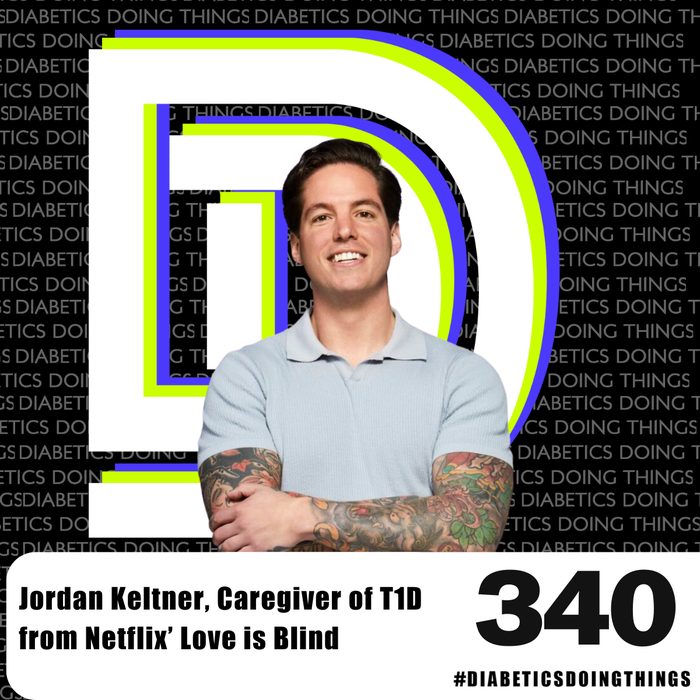
Jordan Keltner from Netlix' Love is Blind
Episode summary
Jordan Keltner appeared on Season 9 of Netflix's Love is Blind, where his son Luca's Type 1 diabetes became part of the show's storyline after a castmate made a stigmatizing comment and Jordan's former partner's father had died of T1D complications. He talks with Rob Howe about Luca's early misdiagnosis, when doctors missed the T1D markers until his blood sugar reached roughly 1,300. Jordan describes turning a viral reunion clip into advocacy for Life for a Child and explains the children's book series he co-authored, Dear Luca, written with his son in mind and timed to Luca learning to read. He also talks about wearing a glucose monitor himself and what caregiving has taught him about patience and gratitude.
Key takeaways
- Luca was initially misdiagnosed; doctors ran every test but the one for T1D until his blood sugar hit about 1,300.
- Jordan says a castmate's stigmatizing comment on Love is Blind came from ignorance, not malice, and the castmate later became an advocate.
- Dear Luca, the children's book series Jordan co-authored, donates proceeds to the charity Life for a Child.
- Jordan says Life for a Child told him insulin is mainly an affordability problem in the US, while test strips and meters are the bigger barrier elsewhere.
- Jordan wears a Dexcom Stelo glucose monitor himself to better understand what his son goes through.
Chapters
- Introduction and Welcome
- Jordan's T1D Caregiver Journey
- Luca’s Misdiagnosis and Challenges
- Public Awareness and Advocacy
- ‘Dear Luca’ Children's Book Series
- Supporting Life for a Child Resources Dear Luca - Children’s Book Series Life for a Child
Show notes
Summary
In this special episode of Diabetics Doing Things, Rob Howe interviews Jordan Keltner, a participant from Netflix's Love is Blind Season 9, who shares his journey as a caregiver for his son with Type 1 Diabetes (T1D). They discuss the challenges of misdiagnosis, the importance of advocacy, and the impact of public awareness. Jordan also talks about his children's book series, "Dear Luca," which aims to spread awareness and support for T1D, with proceeds benefiting the charity Life for a Child.
Chapters
00:00:00 Introduction and Welcome
00:03:00 Jordan's T1D Caregiver Journey
00:06:00 Luca’s Misdiagnosis and Challenges
00:09:00 Public Awareness and Advocacy
00:12:00 ‘Dear Luca’ Children's Book Series
00:15:00 Supporting Life for a Child
Resources
Dear Luca - Children’s Book Series
Questions this episode answers
Why was Jordan Keltner's son Luca initially misdiagnosed?
Jordan says doctors ran every test but the one for Type 1 diabetes, even with classic symptoms like excessive thirst, frequent urination, and a rash caused by sugar in his urine. By the time they reached the ER, Luca's blood sugar was around 1,300.
What charity does the Dear Luca book series support?
Proceeds go to Life for a Child, which Jordan and his co-author chose after researching T1D charities because it gets insulin, test strips, and meters to kids in underserved countries.
What was the stigmatizing comment on Love is Blind about diabetes?
A castmate made a dismissive remark about diabetes during the season. Jordan says he didn't take it personally, believed it came from not knowing rather than malice, and turned the reunion moment into a call for donations to Life for a Child.
Does Jordan Keltner have Type 1 diabetes himself?
No, Jordan is a caregiver for his son Luca, not someone living with T1D. He wears a Dexcom Stelo glucose monitor on his own to get a sense of what his son experiences daily.
Full transcript Searchable, with timestamps
Rob Howe: What's up, podcast listeners? We got a very special episode for you guys today. Every year, at least for the past few years, there is a pop culture moment where diabetes becomes the forefront or at the center of the conversation. And usually it's around some sort of stigma-based moment, or it's someone with diabetes who's interacting with their devices in a way that's very public. And it happens in reality TV. It happened twice this year, in the second half of the year, on major reality TV shows. And today's guest is Jordan Keltner, who is on Season 9 of Love is Blind on Netflix. And what's really interesting about his situation on the show is that diabetes played a role not only in his romantic relationship in the show, because his partner on the show, father, passed away from complications of T1D. And then there's, in the series of the show, conversations with another cast member who makes stigmatizing comments about diabetes. And so throughout the show, there are viewers with diabetes who are actively engaged and following along this storyline. Then when the show goes to the reunion, we have this really big moment where Vanessa, the co-host of the show, highlights this particular incident. and jordan makes that moment which is now a viral social media clip been remixed a ton of times shared all about instagram and tiktok takes that and turns it into a moment for positive and powerful advocacy and raising awareness for life for a child and so i think this is a really special episode i think that jordan is a really special guy and his story about becoming a caregiver with T1D for his son Luca and all the things that that taught him and how that turned him and his family into advocates for people with diabetes is really strong. And I have to say, of all the people who get put in these types of positions, you're put in these positions for a reason. And Jordan, I think, has handled it with extreme grace and has his heart in the right place. So please enjoy this short, quick interview. It was a difficult recording day for both Jordan and myself. And so we made the most of the time that we had. But I wish I would have spent more time with him talking a little bit about the show. But I think he did an awesome job. And I've linked his children's book series, Dear Luca, in the show notes. So please support him. It's the holiday season. He actually fulfills all those orders. So I love that he's an entrepreneur as well. Please enjoy this interview with Jordan Keltner. Hello and welcome back to another episode of Diabetics Doing Things special episode today. Every year, there's some sort of big diabetes moment in pop culture, and I'm very happy to have one of the men behind the central part of it this year on Netflix Love is Blind Season 9, Jordan Keltner. Welcome to the show, my friend. What's up, everyone? Thanks for having me. Excited to have you here. You are a caregiver of someone with diabetes. And I'd love to talk a little bit about that because as a father of someone with T1D and navigating diagnoses and those types of things, what can you share about Luca's diagnosis and you and your family's journey through that? yeah so you know it was crazy i had no really no intentions of really diving into the space and advocating it just kind of happened organically through the how the show played out which i'm forever grateful for netflix on how they kind of told my story and it just i mean it taught me a lot for me and luca is just a part of life and i had no idea the reach because we're the only people that i know personally that have you know that deal with t1d stuff so it was just cool to see you know how the story played out and i think like everyone or it happens quite a bit but luca was initially misdiagnosed at first so we took him to his he just was having the standard symptoms you know the excessive thirst excessive urination he got this very strange rash like in his diaper area because i think the pee was just so sweet it was causing some sort of fungal infection and so yeah we took him to the pediatric doctor and they ran every test but type 1 and like the t1d test My dad was pre-diabetic at the time, so my son's mom took him to their house because they were like, that doesn't sound right. Like, we need to test his blood sugar. And, you know, his blood sugar was so high, he was about to enter a diabetic ketoacidosis. So we took him to the ER, and his blood sugar was like 1,300 or something super, super extreme. So caught it right in the nick of time. But just insane that you put trust into a pediatric doctor, and they just get so easily misdiagnosed. You hear that story so many times. It is, like, no matter the age, right? And it's such a challenge, too, because the symptoms of T1D on their own are kind of, like, normal, you know, like fatigue and dehydration and frequent urination, especially for a young child. Like, you know, in a vacuum, that's not out of the ordinary, but altogether, obviously, can be, you know, lead to a T1D diagnosis. is, man, a blood glucose of 1,300. I know, man, I know he was feeling terrible. Yeah, yeah, he was not doing good. So I'm glad, you know, I guess my parents have, you know, more knowledge than I do because I didn't even think about it, not even a little bit, so. Well, and that's really normal too, right? Until it happens to you or if it runs in your family or you have a close friend with type 1, you know, you're kind of just existing in the background. Even me and my family, like we didn't really know, we knew one other family who were kind of our fringe friends and didn't really know anything about it until I was diagnosed. So, yeah, really interesting how that always happens. And, you know, you talked about not really thinking of, like, becoming a diabetes advocate, but, like, becoming one in real time. Yeah. So I remember seeing early on as Love is Blind was released, there was a stigmatizing comment that Mike, one of your co-stars, made in one of the pods. And then you were able to, over the course of the season, and kind of flip that negative into a positive. So like, how did you kind of come to terms with that or approach that? Yeah, I think I'm just like a forgiving person and I've made a million mistakes. Everyone on this planet has made a million mistakes. So really hard for me to take that personally. I know a lot of people did, but I just know it was a simple mistake. And when you're in the pods and there's a weird love triangle going on, people are kind of letting their emotions run wild. So I don't think he did it maliciously. He just was ignorant to the knowledge. And again, he's he's very informed now, which is great. So just to be able to inform one person, you know, that that does it for me. Yeah, I'm sure his DMs were very informative over the period of time. But you were able to turn that, though, into something like really positive and watching the reunion clip that kind of really made the rounds on social media. like you said, he was able to learn from it and, you know, flip that negative into a positive, which resulted in a donation for Life for a Child, which was really exciting for me to see as a member of the Life for a Child U.S. board. Yeah, yeah. I mean, it was really cool at Netflix to let me put on that speech and then they let me plug Life for a Child, which is even more amazing because they deserve all the clout they can get for sure. Yeah. And, you know, I was working on And as the reunion was airing and like all of that was kind of making the rounds, I was working on the video for the 25th anniversary. So it kind of all happened at the same time. Like the video went live and then the reunion aired and all of this like really positive momentum. So I want to get into this now because you also have a children's book series that you and your co-author are working on called Dear Luca. And there's two books out in the series. and I know you wanted to make a charitable component be, you know, the book is not just to, you know, spread awareness and, you know, help young people, but it's also, you know, with a charitable component. So how did you and your co-author land on Life for a Child to be the charity that you guys support? Yeah, so, you know, I just decided Luke was learning how to read at this time. He was like five and I was like, you know what? Writing a kids' book seems like it would be really fun and easy and doable and super hard and not doable and extreme, but we were very committed to the mission. And I've always felt very strongly about the toxic emotion just not being introduced early enough. And then my co-author has been a teacher for 10 years and she specialized in this social emotional learning system. So we're like, all right, this would be a great place to start. And obviously the book about being brave was inspired by his struggles and treatments with diabetes because, you know, we're having a prick and prod them constantly. And for a little kid, that's probably super traumatic. So we're always telling him, hey, buddy, you got to be brave. You know, you got to be brave. So just very cool that that everything played out that way. But I just knew I wanted to extend the mission just a little bit more and, you know, donate money to a charity that specializes in T1D. And we just did a ton of research. I mean, hours and hours of research because there's so many T1D charities. And then we just landed on Life for a Child because we felt like the money, they make the money go the farthest. And that's really what we want. Yeah. I mean, I think to deliver insulin and test strips to kids in third world and, you know, impoverished countries, underserved communities, no better mission. Yeah. Yeah. And it was crazy, too, because we had a call with Life for a Child. And, you know, it was just very educational for me as well, because they're like, you know, pretty much the only place insulin is not affordable is the states. But they said everywhere else what's not affordable is the test strips and meters and stuff so that's where a lot of the resources go which is you know i guess you never really think about it because you need the insulin but you also need the test strips not to overdose and stuff so it's very they're equally as important in terms of taking care of yourself yeah when you think about like the most important things obviously we we all need insulin and you know there's a huge insulin crisis in this country and you know hopefully that we're able to get on board with the rest of the world and make that more accessible for everybody. I had some good news on the podcast. There's some biosimilar insulin releasing in 2026 that it's going to help people be able to get that for lower cost. There's not a lot of the different kinds available, but it's a step in the right direction. You know, what you're talking about is the next thing is test strips. If you don't know what your glucose is, like, how can you, you know, know, even if you're feeling, you know, one way or another, you know, making dosing decisions. And, you know, that's, we kind of take that for granted sometimes here in the States is Like they give you as many test strips as you can handle when you leave the hospital. And that's not the case everywhere. And another thing that I think Life for a Child does that maybe doesn't get as talked about as much, probably because it's a little bit boring to talk about, is that they also facilitate like how to get the supplies where they need to go in the supply chain. And they've done so, so much work behind the scenes, working with governments and being able to get those supplies where they need to go. So, and, you know, that's a sort of like the behind the scenes hero there of just being able to get those things to the places that they're needed. Yeah, totally. I mean, I think just as someone who doesn't have T1D, I've been wearing just like a Stelo glucose monitor just because I just want to monitor my stuff. And it's crazy to see how perfectly your body regulates insulin distribution and just so perfect. And it's crazy unfair that there's, you know, people take it so, you know, for granted, essentially. And then there's people like my son, like I said, I think he's the most undeserving person to have to deal with all this kind of stuff. So very eye-opening and humbling. And I wake up and I just am thankful for one more thing, which is amazing. Well, I want to ask you, you know, as a father of a T1D and you talked about being brave and like talking with Luca about, you know, dealing with those very real everyday challenges. What do you think, you know, helping Luca with his diabetes and being a caregiver to someone with diabetes, what do you think that's taught you just overall about, you know, I don't know, like you said, another thing to be grateful for. But what do you think the biggest change in your life has been? Yeah, I think it makes you grow up even like super quick. And again, it's such a struggle sometimes. And I'm happy to lose sleep just to help manage his diabetes. But yeah, it's made me very patient and caring. but for sure you just it makes you eternally grateful of the fact that you know you know like you don't sleep the same whenever you're dealing with T1D there's just alarms and sensors and you know right now he's actually dealing with some high ketones so we're working through that so it's just a constant uphill battle you know but he's such a trooper well give him some encouragement from from me and all of us here at Diabetics doing things I know those days are tough but we're cheering for him. And, you know, I think for me too, you know, being able to see you as his dad, like wear a sensor and just kind of normalize that, even though I'm very jealous of what your pancreas does. I know that that makes a big difference for him. And, you know, just being able to see that and know that, you know, there's nothing wrong with him per se. It's just, he has to do a few extra things, you know, to keep his sugars in range. Yeah. He loves putting on the sensor. He loves checking my blood sugar. He's always like, dad, what's your, where's your sugar at, you know, so very, it just kind of, it makes it more relatable. It's very cute. And, you know, that just makes us love each other even more. Yeah, man. Well, I want to thank you because for me, being able to see someone like you who, you know, comes into this spotlight and like builds this platform and has this run to be able to turn that around and do good for people with diabetes. I'm grateful that we're connected and I'm really grateful for all the things that you've done for the community. And man, just gives me hope out there that there's really good people out there behind the scenes that we don't even know who are, you know, really caring for someone with type 1 diabetes. And I just wanted to extend our gratitude for everything that you've done for people with diabetes, man. Yes, thank you. I mean, it's a complete honor and I'm so happy I've gotten, you know, some of my friends and castmates to help advocate. I think for World Diabetes Day, we had five other cast members, including Megan, my ex-fiance, show up and that was just, you know, super special because, you know, her dad passed away from T1D complications. So just to put our differences apart and just be united for the day and everyone wore blue. Very, very cool. It's super cool, man. And I have to say, so I went to college in Colorado. And so I'm very connected in the Denver area diabetes community and like Children's Diabetes Foundation and Barbara Davis Center and all the amazing work they do there. There truly is no T1D community quite like the Colorado diabetes community. So you guys are just adding another like star in the crown of the amazing folks out in Colorado. So I'm glad it was so cool to see all the everybody out on World Diabetes Day, raising money, raising awareness for T1D. Yeah, that was awesome. Incredibly humbling. I get to wake up and do this kind of stuff now. So a true call for advocacy for me personally. Again, I had no intentions of going this direction. It just happened naturally, but everything happens for a reason. You know, I really didn't have any. I never wanted to be on TV. It just kind of happened randomly. And I'm glad how everything is played out. yeah man uh it's it's amazing you say yes to some things it's amazing the impact that you can have so jordan we'll tag your socials in this episode and also link to to dear luca in the series and listeners the you know they're donating to life for a child so not only were you going to get an awesome children's book but uh doing good in the process so jordan thank you again and then if you don't want a children's book just donate straight to life for a child we love that i would rather them get the you know those 12 bucks than me so they're it's gonna go a little bit farther i love it
About Jordan
Jordan Keltner appeared on Season 9 of Netflix's Love is Blind, where his son Luca's Type 1 diabetes diagnosis became part of his storyline. He is a father and T1D caregiver who co-authored the children's book series Dear Luca and advocates for the charity Life for a Child.