

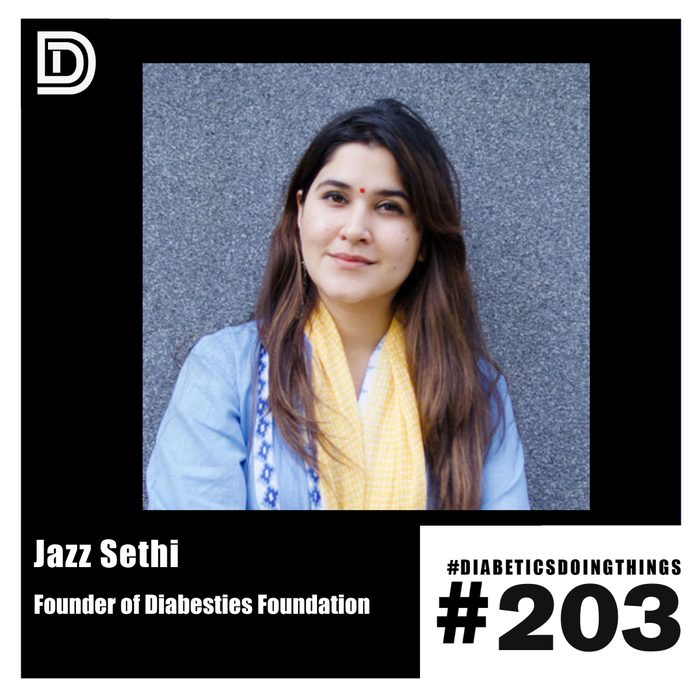
Jazz Sethi, Founder of Diabesties Foundation

Episode summary
Jazz Sethi is the founder of the Diabesties Foundation in India and has lived with type 1 diabetes since age 13. Ten years later she was also diagnosed with diabetes insipidus, a separate condition she manages with a nasal spray. She talks with Rob and Eritrea about her family's support, including her father, a nine-time world billiards champion who linked her diagnosis to cricketer Wasim Akram's. Jazz explains why she hid her devices for years and how she now shows them openly despite stares and judgment in India. She describes the gap between people with no access to insulin and those with full access to technology, and the work her foundation does to supply insulin and test strips to 400 children, with a goal of reaching 1,000.
Key takeaways
- Jazz says she lives with both type 1 diabetes and diabetes insipidus, a rare combination, and manages the second condition with a nasal spray.
- Jazz says her father connected her 13-year-old diagnosis to cricketer Wasim Akram, who also has type 1 diabetes, to show her she wasn't alone.
- Jazz says India has no diabetes insurance, so insulin, test strips and tech are paid out of pocket, which puts care out of reach for many families.
- Jazz says the Diabesties Foundation currently supports 400 children with free insulin, test strips and education, and wants to grow that to 1,000.
- Jazz says she was the first person in India to try a DIY closed-loop system after a UK doctor she met at a conference asked why she wasn't looping.
Show notes
In this worldwide episode, Rob and Eritrea talk to Jazz Sethi, Founder of Diabesties Foundation. They talk about:
Finding the silver lining in any situation
Having a very helpful family dynamic
“Dad is a universal language.”
Diabetes stigma in India
A game of extremes in India: access and expensive tech
The priority of feeding your family over affording insulin
“You focus on getting your family fed, and we will focus on getting your insulin.” The Diabesties Foundation currently supports 400 kids and wants to get to 1000.
For more information, check out Diabesties Foundation website/.
Questions this episode answers
What is the Diabesties Foundation?
It's an organization founded by Jazz Sethi in India that provides free insulin, test strips and diabetes education to children with type 1 diabetes. It currently supports 400 kids and aims to reach 1,000.
Does Jazz Sethi have more than one type of diabetes?
Yes. She was diagnosed with type 1 diabetes at 13, then diagnosed with diabetes insipidus 10 years later, a separate condition caused by low vasopressin that she manages with a nasal spray.
What are the barriers to diabetes care in India, according to Jazz Sethi?
Jazz says India has no diabetes insurance, so insulin and technology are out-of-pocket expenses. She also says stigma keeps many people from showing their devices or taking insulin in public.
Who is Jazz Sethi's father?
Jazz says her father is a nine-time world billiards champion in India. When she was diagnosed, he told her about cricketer Wasim Akram, who also has type 1 diabetes, to reassure her she wasn't alone.
Full transcript Searchable, with timestamps
Rob Howe: What up, what up, podcast fans?
Eritrea: We're back. We're worldwide. We are here.
Rob Howe: Eritrea is worldwide. She's actually recording this episode in Puerto Rico. Our guest is Jazz Sethi, Founder of the Diabesties Foundation. She's calling from India. So we are a fully globally integrated team today. And boy, is this an interview. Boy, I'm hyped. I'm hyped. I was ready to run through a brick wall. jazz is an incredibly inspiring and eloquent speaker. I was like, I was ready to fall right in line and volunteer at the Diabesties Foundation. Count me. I'm going to, I was really just thinking
Eritrea: about that. First of all, I was impressed with her the moment I met her. I've had the opportunity and privilege to hear her speak multiple times at different conferences. And what an incredible gift to the diabetes online and real community that she is to India and to all of us on the because there's just so much we can learn from her and her story and about diabetes. Like this episode, I can't wait for everybody to hear it.
Rob Howe: I think the big the big takeaway for me is if you think you're that different than somebody who's living in India, you're wrong, because I think. We being born in the US, you know, me being born as a white male is like I won the genetic lottery just right off the bat and, you know, seeing the disparities, you know, we have a lot of problems here in the US, especially around our healthcare. But Jazz's and her constituents and the people that she serves in India have way bigger problems. When you're talking about somebody whose household income every month is 40 American dollars, diabetes care comes secondary to food and shelter. And so it's very difficult, the problems that some of her, the folks that she is serving deal with on a day-to-day basis. And so to hear her talk about that and to hear about the impact that she and the Diabesties Foundation are currently having on 400 children and teens with diabetes to supply them insulin and test strips is massive, massive, massive when you're talking about 400 people who may not even be alive if not for them. So I think that's a really important thing to think about. I am fascinated by the continued growth of India and I'm really interested in continuing to serve how the nearly 100 million people in a few years, I think by 2030, they estimate 100 million people in India will have diabetes. I'm interested in helping them out. And I think that we're pretty ahead of the game in terms of a lot of things and we can impart our knowledge and wisdom and money to people in India to help them dramatically. So we've included a lot of links in the show notes and I want you guys to, if you can, find a way to support Jazz and her efforts. I think you'll find it really easy after you hear this amazing interview with Jazz Sethi. Hello, and welcome back to another episode of Diabetics Doing Things. We are telling the amazing stories of people with diabetes from all over the world. And all over the world is the key message here today, because not only is our guest Jazz calling from Ahmedabad, India, but Eritrea is also in Puerto Rico right now. So we are all over, although I guess Puerto Rico technically is the U.S. We are all over the world today at Diabetics Doing Things.
Eritrea: Mr. Pippo, I got to say, all over the world. I'm Mrs. Pippo now because I'm all over the world.
Rob Howe: Ms. Worldwide, awesome.
Eritrea: Yeah, there you go.
Rob Howe: Jazz, welcome to the show.
Jazz Sethi: Thank you so much. I'm so excited to be here.
Rob Howe: Well, we are excited to have you. And I know you and Eritrea got to meet earlier this year at a conference. I believe it was at ADA in New Orleans, or it could have been ATTD in Barcelona. uh so there it is Eritrea is nodding now and you are the founder of the Diabesties Foundation you are also highly involved in diabetes advocacy in india and i'll tell you why i was really excited for this episode because there is a lot going on in india in terms of globalization you guys are you know so many of the indian people have come online and joined the sort of connected world in the last few years. And along with that comes a large amount of people living with diabetes, type 1 and type 2. All the research I found showed that India is the number two country in terms of population right now of people with diabetes behind China with like 77 million people
Jazz Sethi: in India living with diabetes. That's right. That's right. Yeah. I mean, I think we are one of the highest populations just in terms of population and then of course we have a lot of people with diabetes and I think now more and more people are getting aware that there are things like support groups and there are places online that we can come out and ask for support and I'm so glad that's happening like sooner than later but there's still a lot we need to do on a ground level as well because we do have a lot of people who have the capability of coming online and reaching out, but then we also have that segment of the population which cannot come online and ask for help. So I think it's that fine balance of trying to cater to both and make sure that we're giving support to as many people with as many needs as possible. I love it. And I really
Rob Howe: want to dig into the work that you and your team at the Diabesties Foundation are doing. But first, let's talk about you. You live with type 1 diabetes. Let's talk about your diagnosis. How did you come to join the type 1 diabetes family?
Jazz Sethi: So I actually, fun fact, I don't know if many people know this or not, but I live with two types of diabetes, actually. So I have type 1, and then I also have diabetes insipidus, which is not the mellitus family of it. It's the other one. So it's, again, an autoimmune condition wherein my body is not producing vasopressin, which is another hormone. I basically am the anti-hormone class clearly but type 1 happened to me when I was 13 years old and I was I think all the same symptoms that we all go through a lot of weight loss a lot of thirst going to the bathroom and one day just going to the ER because my sugar was like really really high and that's when I was diagnosed and my doctor just came in and said yeah she's got type 1 diabetes and that was when I was 13 and it's been 13 years now living with the condition and just very similarly in 2009 I was diagnosed with type 1 and then 10 years later in 2019 I was diagnosed with diabetes insipidus same symptoms it's so funny because I was still drinking so much water I was so thirsty but my sugars were normal so it was such a bizarre moment for me like it was like 10 years deja vu and um I kept I called my doctor and I was like you know I I'm drinking a lot of water it's the same hyperglycemia kind of thirst and but my sugar is 128 so what's going on and then we did a couple of tests and we were like oh this is and I remember him on the phone being like jazz I think you have another type of diabetes and I was like no way this is not happening but it's all good it's just like a nasal spray that you need to take and that's my diabetes story i wait so i have so much like i so one of the main symptoms of diabetes insipidus is polyuria which is like freaking your attention so my question is throughout the time that you got diagnosed with diabetes mellitus up to diabetes insipidus like that small window i guess a couple years was the polyuria like constant and you were just like having the hardest time it wasn't because i think it was very acute the onset of the di uh so i was fine for 10 years and then it actually happened like um like maybe i want to say a couple of days that the the polyuria began and it was very very acute and i caught it very early um and then i had to like go in for an mri and stuff because they had to check my pituitary gland to see what what the what's up and uh yeah so two types of diabetes no one's complaining so rare it's super super super rare so just yeah and i think it's rare to have them both together
Rob Howe: so quite interesting actually well i was gonna say because i don't know a whole lot about diabetes insipidus but i i listening to you talk about your symptoms and talk about when you got your second diagnosis were you by chance like in euglycemic dka are you familiar with that term
Jazz Sethi: um i wasn't i wasn't i kept thinking i was right because i i remember checking i checked my ketones as well so you know we were doing all the tests possible and then my doctor for some strange reason which is like you need to get your adh test which is an antidiuretic hormone test and um that was super super low and that's when you know we had to go to the er again and then uh get the mri and stuff and then there was an option again that you can take your desmopressin either through a pill or through a nasal spray or through an injection. And I was like, I am not taking another injection. We're going to do this the easy way this time. And I opted for the spray.
Rob Howe: So you're able to then with the nasal spray, that controls your diabetes insipidus. And then, you know, with your type 1 diabetes, you manage with injections or pumps. So the same way everybody else.
Jazz Sethi: Yes, that's right.
Rob Howe: Interesting. Well, very cool. I learned that something I learned today and I didn't even expect. So it's excellent.
Eritrea: yep i feel like i just know about it because camp sweeney so yeah
Rob Howe: yeah Eritrea went to this diabetes camp in texas that's like an intense diabetes camp and they're like very big into the science and they uh they do amazing things for for children with diabetes and there's a lot of people who met at that camp who are listening to the podcast and they're all still like crazy friends today they're their facebook groups and in their group chats so So shout out to the Sweeney alumni.
Eritrea: Oh, wow. Awesome.
Rob Howe: So in reading some of the articles about you, I can tell you are wired a little bit different. You take things in stride. Even today on the call, you were like, you know, two types of diabetes, but I'm not complaining. Where does that attitude of kind of gratitude come from? And, you know, being diagnosed in your teens and then re-diagnosed later, like, you know, how does that, where does that come from?
Jazz Sethi: I don't know. I think it's just I've always tried to be the person that finds a silver lining in the situation. And it's not easy, of course. But I think now I just look at it from a place of saying that, you know, you are gifted this life and you have to make the most of it. And I try to I think because I come from a country like India, I'm constantly seeing that disparity is such a reality. And I've just realized that there is no place for asking questions like why me or being so upset about it, because there are people who just have it so much worse. And I think that's what motivates me so much to just try to be as grateful as possible to be like, OK, yeah, one more diagnosis. It's fine. I'm still living. I'm still happy. I'm still breathing. I'm still privileged enough to be able to afford the treatment I can manage. And I just that pushes me so much to give back. and to try to do more to help others. And it's just that entire thing of seeing that it's not a, it's probably a bad day, but it's not a bad life. And I just constantly remind myself of that. And just like getting inspiration from all of you, from all over the world. I think that the online community has done so much to inspire me as well. So just talking to people and knowing that we're not alone in this. I think that's what makes me happy.
Rob Howe: I love that. I, I, you know, often I think some of the most more negative sentiment gets like, it's easy to let that creep in. You know what I mean? It's easy. It's easy to get on a, like a negative momentum or like a, uh, you know, an attitude where you start to think that everything is bad. Uh, and, you know, fortunately, like you, I'm fortunate enough to, you know, be able to have access and afford the medications that allow me to live. And there are many people that don't, but also like that allows us to, uh, you know, give back and to, you know, provide inspiration, provide information, provide, um, just, just an opportunity to say that, yeah, there are some bad days, some really bad ones. Uh, as I say, uh, you can't, I don't know if you can see video, but I've got like a thing of gummy bears here. Cause I'm having a low blood sugar right now, but, uh, you know, we, we can bounce back and still do the things that we want to do and still make it a great life. We ball. So jazz, I am going to be
Jazz Sethi: honest after I met you in Barcelona I was like okay who is this girl where did she come from because she is incredible and so I started doing the thing that I always do which is creeping and googling and I saw that your dad is actually a little bit of a celebrity and he's because he's like a really well-known billiards player in India so I just kind of wanted to know just culture is so important to me and so interesting to me how did your family handle your diagnosis and what was that dynamic like for you guys it was actually i i have to say that i am so grateful for my parents support because they can't they immediately were like we're gonna do this together and you have our support and the fact that you mentioned that actually so yes my father is a he's a nine time world billiards champion so he's an athlete right by profession so i don't know if you guys know of a cricketer named Wasim Akram from Pakistan. I do. One of the top class. Yes, right. So he's like one of the best fast bowlers in the world. And he's type 1 diabetic as well. And my father, of course, knows him. And, you know, so the first thing he did tell me, my father, when I was diagnosed was that, okay, you have type 1 diabetes, but Wasim Akram also has type 1 diabetes, and he's a top class athlete. And I think in that moment, he was just trying to break down my diagnosis for me in the simplest way possible to be like and try to tell me that I'm not alone in whatever way he knew I think that was the only other person he knew who had type 1 at the point but he was like you're not alone you know and that was so reassuring for me as a 13 year old scared and confused just to be like okay Wasim Akram also has type 1 diabetes for some strange reason that provided me comfort so they were extremely supportive and I have absolutely no complaints with the way they've treated me and raised me and always ready to try new things when we wanted to try the Omnipod which is still not available in India like my mom had gone to Boston to for work and she heard about it and she was like we must try it so we were like okay let's try it so you know they never questioned that when I was like I really want to try the Dexcom there was no questions asked it was just it's just such a beautiful family support I know I can rely on them at any time. Initially, you know, whenever I whenever my parents travel a lot. So even though they were halfway across the world, they would call me at like 3am my time to make sure that I get up to check my sugars. So always there. And absolutely. And that kind of support just gave me so much strength and freedom to do whatever I wanted to do.
Rob Howe: Jazz, I love that you shared what your dad did after your diagnosis, because no matter where you're from, whatever culture you're in, that is the most dad move I've ever heard. Like, I know this guy with diabetes, like, let me connect you to him. And it's just like that. I love that dad is a universal language. Totally. So I know, uh, in reading about you, you were the first person in India in the entire country to receive an artificial, an artificial pancreas system. So, uh, a closed loop hybrid, hybrid closed loop, DIY loop, and you worked with like some of the key opinion leaders in India who were at like the forefront of diabetes care. So what was it like to be the first person in your country wearing, you know, breakthrough technology that, you know, was available to the rest of the world, but was
Jazz Sethi: just coming available in India? I was so I'm very, very interested in diabetes tech as well. And this sort of happened by chance or by accident, actually, because I met with Professor Partha Kar which I'm sure everyone in the diabetes community knows so he is sort of the clinical director for diabetes in the UK in the NHS but I met him at a conference when he had come to India and then I met him again at another conference I believe and he was sort of looking at my graph and you know I was just talking to him about you know I was suffering from a lot of lows and this and that and he was like why aren't you looping and I was like what is that because we hadn't heard about it in India yet like we heard about it very at a research paper level you know but the fact that people were actually doing this was not something that any of us knew so I immediately started googling stuff and went on to github and sort of started seeing what was out there and he connected me to a few people actually from the UK who were my sort of fallbacks and I kept asking them questions and how to do it and I just was like I'm gonna go ahead and try this and then I sort of worked with a couple of doctors in India who were at the forefront of technology and just I just informed them that listen I'm doing this it's gonna be interesting and let me know what you guys think and I set up the system and I was the first person to do it and I'm so glad that the documentation and the sort of hype that we created around it in India has helped more people to begin looping which was the entire point and so it's I'm so I think now I've sort of set it up for a couple more people in India it is still very very rare to see a person looping just because you require so much tech in the first place to start that like a cgm and a pump and things like that but i'm very excited for the future of it and i'm so excited that more people in india are beginning to loop as well so many doctors don't know about it in india like in a couple of weeks i'm speaking at a conference just to explain people what type 1 like what diy looping is so i think we still need to spread a lot of awareness about what it is and just enable people to do more to get their patients onto looping.
Rob Howe: Wow. With that in mind, so like you said, diabetes technology, diabetes care is emerging, and there's a lack of awareness in India about it. How often, it's like a two-part question, how often do you see somebody else wearing a diabetes device or a CGM or injecting insulin or testing their blood sugar in public. And then number two, what are some of the barriers, right? So in the healthcare system in the US, for example, some people have insurance, some people get their insurance through the government, some through their employer, some people are uninsured, and that presents different challenges based on where you live and where you work to getting access to medication, right? So how does that work in India? So two-part question. First part, how many people do you see and how often and second of all, like what's it like to be and to get access to medicine and diabetes tech in India?
Jazz Sethi: Right. So I think the first question, what really affects the idea that people are open about their diabetes in India specifically is the stigma. So I actually running a Diabesties Foundation, I still don't see too many people openly share their devices or openly take insulin we are really trying to work with at least the kids that are in our foundation to get them to that level of confidence but they're okay with doing so and i'll be very honest with you uh like i used to hide my devices way back when i was diagnosed and because i was not too comfortable sharing because it just it wasn't an okay thing to do and when i sort of broke out of that a couple of years ago being like i'm not doing anything wrong by showing my device and let people stay i I mean, you have the stares and you have the questions and you have the judgments. And I was like, screw it. I'm just going to do this. Right. I'm not doing anything wrong. And this is my life. And I'm going to be proud about it. So now I think we're really trying to get more of people living with type 1 to be OK and comfortable with doing it. But it's still it's not where it needs to be. So to answer your first question, I, in fact, don't see too many people out there. And I was so surprised because when I just went to London a couple of weeks ago in July, and I saw so many people with Libres on. And it was such a refreshing change. And I kept thinking to myself, in India, we have way more people with type 1. So I should be seeing more people. But then the other point that actually leads to your second question is not too many people have type 1 diabetes technology, right? So a lot of people are not able to afford tech, which is also why we don't see it out in public too often. It's all on like insured in the UK and as you said, in the US, but in the in india we don't have insurance firstly so everything is we don't have diabetes insurance so everything is out of pocket and it's very expensive for the normal middle class person who's getting a normal income to be able to afford because when you have a family of four you need to pay the other bills and then to have this as an added thing it's just not possible so when it comes to answering your second question uh access is a huge huge issue so we do have government hospitals which do give free insulin but the problem with that is it's all human insulin and it's all mixed insulin so we don't have access to analogs uh diabetes tech is atrociously expensive in india for a middle class person um and we have our below like lower income uh status that can't even afford insulin so a lot of the work we do at the foundation is to provide free incident and free test strips just to give them basic minimum requirement and minimum care so that they're not dying it's it's actually to that level you know so they're not in dka so they can have some semblance of quality of life but then we have the other extreme in india also who can afford absolutely everything um so it's it's it's a game of extremes over here so we don't have too many people who have tech but the people who have tech we need to get the stigma out that they can actually be confident enough to show it off so when we're talking about having access to different things is that because I remember when we you talked in Barcelona how sometimes it can be impacted by like your cast and like what you can access like how much money you have so can you just talk to us a little bit more about like how the caste system can possibly impact a person who lives in India and maybe what they can do to overcome that to try to get the access that they need yeah I don't think it's so much of a caste issue it's more of just an income issue because we have a lot of people below poverty line. So what we do is when the kids that we support from the foundation also, we have an income cutoff. You know, that's how we determine whether we support those kids or not. So it depends on what is your income bracket. And so when we're doing our due diligence about who we're trying to support, just because there are so many people in need, we need to sort of have a standard operating procedure. So the thing is that we've got so many people in India who are below poverty line. or who are in a very very low income bracket who are making x amount of money per month or per year and then we try to figure out what is the family income of that family and then because and so the average cost if i give it to you in dollars is about five hundred dollars a year to support someone in india but the average income is way less than that so it's a it's because everything is like i said out of pocket there's no insurance so you need to go and pay for insulin pay for test trips people are making like maybe i want to say there are some people who are making as little as 20 30 a month you know so it's very difficult and we need to figure out how are we going to break that because this is just not a sustainable thing and that's why there's so many people who are dying in india just because they have zero access to care it's not sustainable care so they might be able to afford insulin one month but they may not be able to afford it the next month because they're daily wage earners so let's say they're out of work where where does the money
Rob Howe: come from. So that's the issue. Well, and I think it's when we talk about access and we talk about, you know, price caps or copay caps here in America have been a very popular discussion this year politically. And, you know, for fortunately for Americans over 65 who are on Medicare now have their copays capped at $35 a month, which in America, you know, seems like a huge win. However, if you apply that to India, like you just said, that is an entire month's income for a household. So it's not, it's not equal the, you know, state to state country to country, but the insulin that you need, you still need the same requirements. You still need the same number of test strips, the same number of syringes, the same number of pump sites. And then you start to look at care and standards of care. Yeah. No wonder not ever, no one is on a DIY loop that they are too busy trying to make enough money to feed the family and their, and diabetes is coming second in pursuit of number one.
Jazz Sethi: Absolutely. I think that's the biggest thing. You know, when your priorities are so different, you don't have time to think about, oh, let me try to get the fanciest tech or the newest tech. It's just as simple as, can I feed my family today? It's not even if I can get insulin, it's can I actually feed them? And that's the type of families that we're actually working with right now because for them, insulin comes second. Their child, whether their child is in 500, 600, it doesn't matter. and I sort of now understand, I used to get really shocked earlier on, you know, when I used to hear these stories, and I used to be like, what, the family doesn't care, this is negligence, and this, that, but now when I'm actually interacting with those families, I understand, I understand that when you are fighting to just feed your family, you don't think about your sugars, you don't have time to think about your sugars, and then that's more deteriorates quality of life, then that kid is going to get diabetes complications later on, so it's a systemic issue, it's not a diabetes issue at the at the core it is so much bigger than that and i can't address those issues i mean i can't solve those problems right now in india but at least we can try to solve that okay you focus on getting your family fed we will focus on your incident that's the partnership that we're trying to have for these families oh my gosh sorry it's your podcast expert oh my god
Rob Howe: I know I was checking my notes and I muted and, uh, but now I know what I was going to ask because you've been doing now, it looks like just over four years since you founded the Diabesties Foundation. So good. My notes are right. Um, I gotta just remember that mute buttons on, but for you, what was the first big, like kind of light bulb moment for you where you said, wow, we, we really can make an impact. And there really is a need for the Diabesties Foundation to have a major impact, in India?
Jazz Sethi: So it was interesting because I started Diabetes as just wanting to be a YouTube channel because as I was growing up, I kept seeing and I was very inquisitive as a child. I still am. But I used to go on YouTube as a kid and just, you know, Google YouTube type 1 diabetes and all I used to see in from India was just like, you know, boring, no offense to anyone, but just boring doctors sitting, two hour lecture, two hour of them just talking about, oh, this is a science and this is the algorithm, this is that. And I was like, this is, Not interesting. I want to know more about my condition, but I'm not sitting and listening to a two hour long, you know, lecture. So in 2018, I just said, you know what, I want to make learning about diabetes fun. I want to make it young. I want to make it a little glamorous because it was so and it was so bleak and dark. And oh, my God, the world is going to end. That was like the vibe. And I was like, no, that's not life, though. So I said, OK, let's just make a fun YouTube channel, which makes learning about diabetes fun. And honestly, at that time, I had really, really terrible diabetes knowledge myself. But I said, you know what, we're going to try. And then how that YouTube channel turned into an all out foundation, a registered foundation with all the projects was when I actually started seeing the reality. I was very much living in a bubble till 2018, where I thought that every one with diabetes was all happy go lucky. And then when I sort of started interacting with doctors and interacting with different networks in India, started seeing the reality that's when the project started coming up the idea started coming up the education which started coming up and I remember very clearly a little girl used to came up to me and said that you know you made me feel less alone after one of our meetups and for me that was enough I was like that is one person's life who we've made better and then from there the entire story of impact started to grow and today the stories that we hear the clinical impact we are seeing the psychological impact we are seeing, the quality of life impact we are seeing post the work we are doing is so, so profound and so impactful that I know that what we're doing is making a difference. And I keep telling my team, we've got 50 people now working at Diabesties, all who are living with diabetes all over India. And I keep telling my team that it's these stories that you need to go back to. It's these stories that are going to push you to do more. So that's the impact that helps me keep going.
Rob Howe: I love that outlook. I think, you know, we started here at Diabetics doing things to try to help one person do 10 episodes of the pod and help one person. And if we felt like we were doing that, we were going to keep going. And, you know, even on the days where, you know, we're doing a little bit bigger things these days at times, but the work is harder and you're and you're marching uphill, you have to remember back to the reason why you started and, you know, the people who have gotten us there. So I totally resonate with that. So for you and your 50 people who are working with Diabesties across India, what goals do you guys have set for yourselves on the horizon? What are you marching towards next? What's the big milestone?
Jazz Sethi: So the big milestone has been one of the flagship projects, which I did speak about in Barcelona as well. It's the Back to Basics project that we are very, very excited about. And we've seen some incredible results. We've done over 700 one-on-one counseling sessions now. we want to like legitimize that a little bit more we want to make it easier for people to access we want to make it like a gold standard for all the doctors to like advise them to take a b2b session so we want to work with industry to partner with healthcare professionals to be like you take care of the insulin prescription we'll take care of everything else so it's a very collaborative approach that we want to do because again like talking about the healthcare sector in India it's overburdened so I understand in India where a doctor does not have more than two minutes to spend with the patient but like I think both of you so clearly know the two minutes is not enough for a person living with type and diabetes to understand about their condition and then we also have a little bit of god complex in India where people are so scared of their doctors so they don't have the freedom to ask them questions so I think lived experience plays such an important role the language plays such an important role and we've seen I'm not talking out of you know just my own want and wishes we've seen the impact of this so we really want to make back to basics much bigger. That's the biggest goal of this year. We have a couple of resources coming out. We want to do something really fun for World Diabetes Day. We want to really open up and widen our access project. We're supporting 400 kids right now. We want to get that up to a thousand. So we're working on that. So little goals here and there. Small successes reap big rewards,
Rob Howe: as I tell all my kids as well. Well, and I mean, you could say it's small, right? 400, you could say that that's small, but when you think about the real impact for providing 400 young people, insulin, that's 400 lives that are, uh, you know, that they take the survival at its very core, like out of their, uh, out of their to-do lists, you know, they don't have to wonder where their insulin is going to come from. And you guys are doing that for them. And ultimately that's, that's back to basics. That's, you know, really providing people with the basics that they need to live and thrive. Uh, so that is a huge measurable impact. So for us, like you're talking to us here on, you know, all the way across the world, how can we help turn 400 into a thousand? What is the call to action that people hear who are listening to this podcast and hearing your story for the first time? You know, what can we do to help? How can we get involved?
Jazz Sethi: Oh, wow. So many ways. I think just support in any way possible, whether it's financial, whether it's resources, whether it's any kind of support, I think always helps. because like I even spoke about in Barcelona with these 400 kids what we're trying to do is not just provide them the insulin but also the the tools and the skills to be able to use that insulin and I keep telling this time and again that it's not just about giving them free insulin because I've seen so many foundations and so many people try to do good but it's doing more harm because when it becomes just a checklist item that oh we've given them free insulin it doesn't work because that kid is still ending up in dk the next month so unless you're giving them insulin and also giving them education about what to do how to manage i don't want a kid to take insulin and still be in the 500s you know then what's the point so the idea is that we're trying to give them a whole 360 degree kind of a measure and it doesn't work all the time we have kids who we have to teach and reteach hundreds of times but then you also have the kids who just recently we So our littlest, he is a four-year-old boy who we've been supporting for three months now. And his A1C has come down by a whole point. He was at 8.5, he's come down to 7.5. Better in range. Because now, you know, the family's been coming every single Sunday and learning how to control diet, exercise, titration, injection technique. So all of this is so important. So anyone who wants to support, whether you've got some fun resources that you think we can use for our kids or you want to support financially to help a child, if you want to adopt a child, in a lot of ways. And I think our website has details about all of those in case they want to get in touch. I love the adopted child option jazz. That is so helpful. I feel like all people with diabetes are so giving of self. And if one person to give to another can just change something for one person, like I said, that like Rob said, that's, I think a lot of us feel that way. So what
Rob Howe: a beautiful thing that you guys have set up. I also think it's easy for us in the West to think of India as this faraway place that, you know, and maybe most of us here in the US won't ever go there. But, you know, the world is shifting back east. And the as the millions and millions and millions of people in India come online, are getting more connected, are getting access to the internet via mobile devices for the first time. That's building community in a way that hasn't been possible in India up to date. The globalization that's happening and infrastructure is massive. And I think we're marching quickly towards English spoken in India as the gold standard for English worldwide because of how many people there are living in India and how a huge global position that you guys hold. And it's easy for us to think of that as so far away or like so foreign. But when you see the face of a kid who has diabetes that you can actively support to have an impact in their life, it really humanizes that gap and really closes that global reach. Not so far. We're not so different as our brothers and sisters in India are, who are living with diabetes. We're all also looking for, you know, trying to live our best life, trying to, you know, find the technology mix and the medication mix to help us live well with this disease and also make friends and, and share experiences and, uh, and just share, you know, tips, tricks, and also just kind of like vent to each other at times. I know that, you know, the term diabetes, like really is a real thing. And, and I think, you know, being able to look across, uh, you know, to the other side of the world and say, Hey, I have diabetes in India as well as the U S as a really important part of our growth. And, um, you know, I just hope that we can continue to provide that support to reach out and connect and use the internet and use social media in a way that allows us to help each other and lend a hand, whether that's information, inspiration, or support financially. I think there's a huge opportunity for us to kind of reach out and grab our brothers and sisters overseas and bridge together.
Jazz Sethi: Absolutely. So well said. And I think what you said is so true because it's never been easier to connect than it has been now and it's never been easier to support as well so i think leveraging that globalization and leveraging that um access to technology and to social media and to connections i think it's the perfect time there's no time that like now so and as you said right support comes in so many ways it's not always just financial if you want to lend your time if you want to educate if you want to have some fun sessions with the kids i mean there's so much possible uh whether you're so at least at Diabesties we try to look at all the stakeholders in the management so we have something called caregivers council as well because we oftentimes forget that the caregivers are such an important part of our journey especially with younger kids so whether there are some caregivers who want to like come in and hop on and do a session for the other caregivers we're all a learning community every day i think all of us learn something new so it's just about using that circle the blue circle to continue to reach wider and grow the circle of influence and connect in ways that hasn't been possible before.
Rob Howe: I love that. It's so exciting. I do want to ask you, I have two questions left and I know we're kind of, I want to be respectful of your time and also like it's early in the morning and I'm sure you've got a busy Friday ahead of you, but you talked earlier about stigma and stigma is something here in the United States. There is absolutely a diabetes stigma, especially around type 2. And on Instagram and such, There's lots of people making funny videos about the things that people without diabetes say to those of us with diabetes. But in India, what do you think are the big barriers to that diabetes stigma? Is it misinformation? Is it cultural? And what would you say to someone who's experiencing diabetes stigma?
Jazz Sethi: So such an interesting question because I think it's so multilayered in India. So I think stigma comes from the first and foremost is lack of information, lack of awareness, literacy and alternate therapies. That's the sort of bifurcation I would put across to it. So the biggest thing is, of course, because diabetes is such a generic word and I don't think we do enough of an effort to mention type. I think, yes, those of us who live with type 1 are very conscious of saying that. doctors if you've seen if you've noticed on twitter or this and that it's always just diabetes so generalizing diabetes first is the worst thing we can do i feel because uh different uh diabetes have different uh pathologies different physiologies different treatments and it's not a it's not a single word it's not a one size fits all kind of a word so then when somebody is talking about diabetes reversal you know and you have a new family who's been diagnosed with type 1 who is desperate for a cure and it's so easy to fall into a misinformation uh to you know be like yeah my diabetes can be reversed and go in for that we see that so so often here that's why we are always telling people to mention the type of diabetes secondly oh my god i think because we are rooted in ayurvedic culture the amount of alternative therapies that have come up for insulin it is shocking it is fatal and now people are using it as clickbait almost because i feel like people are just trying so hard to get rid of insulin and trying and people are ready to try anything and there are these quacks who are taking full advantage of that so i think we're trying to do so much to be like no insulin is the only option second the third thing is insulin has made the villain in india i don't know if it's the same in the u.s but in many times it is right because doctors sometimes give it as a worst case scenario for those with type 2 being like oh if you're not taking care of your diabetes we need to put you onto insulin
Rob Howe: so it becomes the worst exactly i think that there is a lot of rhetoric uh that is held over from earlier days and like uh you know early on and maybe back in the 80s 90s uh of that if you're on insulin as a type 2 diabetic or a person with type 2 diabetes that there that means that you're noncompliant or that you, um, that you weren't adhering to the protocols. So the oral medication isn't working. And what we're learning like every day, it seemingly is that there are tons of nuances within type 2 diabetes. And, uh, we're, we're in a, in the midst of a series here on the podcast, interviewing guests who were all misdiagnosed with type 2 and turns out that they had LADA or, and, uh, and, and live with really type 1. And so it takes sometimes years to really sort that out. And I think, you know, on the back to the insulin discussion, uh, there are people who desperately need insulin and are being told by their healthcare team that insulin means that they're failing. And so they don't want to give themselves a shot to get them back in range because they have that hanging over. And I think it's just a really damaging cycle that they get stuck in because they feel guilty for administering insulin. So they don't. And so they stay out of range. And so they stay non-compliant in the eyes of their care team.
Jazz Sethi: So true. And it's such a vicious cycle and same over here as well. And so then, you know, when insulin becomes a villain, then nobody wants insulin even as a type 1. And that's the worst narrative that we can have. And I think the last bit is also just so much family and social stigma around diabetes so whether it is oh there's just the rumors and the myths about it being contagious or it being passed down uh so girls have such a not even girls i think people type 1 india have such a such an issue getting married i can't tell you how big of an issue this is uh just finding a suitable partner and getting that family to agree it's even in the most educated families i'm seeing this. So, yep, stigma, melting pot or stigma with type 1. Well, thank you so much for that
Rob Howe: breakdown. I, you know, I think a lot of it mirrors what we've gone through here in America, not as much of it today, but kind of where we've come from in the last 40 to 50 years in terms of education, diabetes awareness. And still we're dealing with terrible diabetes stigma. And especially, you know, women and women of color online who just get unsolicited feedback on their life with diabetes seemingly all the time. And, you know, from all different angles. Jazza, I really want to ask you this question. I'm trying to do better on the podcast, asking deeper questions, you know, of my amazing guests. And, you know, for you, starting the Diabesties Foundation, then finding out that you have a second type of diabetes, if you could go back to you know early early in your life when you were first diagnosed that as a young teenager what's something that you would like you know sneak a note to yourself and tell you about the future like what would you how would you go back in time and what would you tell yourself at 13 uh you know that that you've learned since that time so firstly i want to
Jazz Sethi: say you're doing a great job of the questions i thank you sort of applaud you you're a great host um what would i say that's such an interesting question actually i just think i would sort of remind myself that you are not what happens to you you know you are what you make out of it i don't know if that makes sense but i just feel like these are diagnoses at the end of the day they are things that happen to you but you are not what happens to you you know you are what you make out of all the experiences that life gives you and um it was like a day i like i said it was such a deja vu for me but i think the fact that i knew that i had done type 1 diabetes for so long that anything else would was actually a cakewalk and i say this with like a lot of sensitivity for whoever's living out with di but when you've done something and when life pushes your boundaries and it really tests you and and you've had the worst and the best experiences and with that condition you you look at anything now i genuinely i'm not scared i and i don't know if that's a good thing or a bad thing but i am not scared of something because i know that it will hurt it will break me for a bit but i definitely will come back stronger and that's what the di has taught me and i just want to like that message just goes out saying that you are not what happens to you you are what you make out of it and i've tried to make some sort of a more impactful life with so much more gratitude because of my condition so i would just tell my 13 year old self that all is going to work out. Just keep strong, be strong and make others strong. Jazz, do you have space for me to be counseled by you, please?
Rob Howe: Yeah, you've given us so much inspiration today. It's late in the day for us and you're just getting started and you're like, I'm filled up. I could run through a brick wall right now.
Jazz Sethi: I'm going to hit these Puerto Ricans. You guys are too nice. You guys get me in my soul.
Rob Howe: Yeah, I just, I feel... you know, we've never met you and Eritrea got to meet it. And I'm honestly really jealous of that now, but hopefully we'll run into each other in person in the future. But I just feel so, so aligned with the way that you're thinking about helping people in India with diabetes and really people across the world. We need more people like you leading the way. And, and really like everything that you've said, first of all, you're the first person to say bifurcated on the podcast. So I'll send you your trophy. I'll send you your trophy in the mail, but But I mean, just hearing you speak so passionately and eloquently about people with diabetes and helping people with diabetes really just makes me feel like there is hope for a person who's diagnosed today in India because they've got diabetes and the Diabesties Foundation waiting for them to help them out. So thank you for all that you're doing for people with diabetes. And I hope we get to meet someday.
Jazz Sethi: Absolutely. I invite both of you to come to India. Please do come. Visit our center. I'm saying that. I will come and pick you up at the airport. Just come. I'll definitely try and meet you guys when I'm in the US next, for sure. We should try to catch up.
Rob Howe: Definitely. But in the meantime, where can our listeners find you? I know we're going to include links to your website and social media in the show notes, but go ahead and plug yourself. Where can our listeners get in touch with you and the Diabesties Foundation?
Jazz Sethi: Yeah, I think so. Our website is Diabesties.Foundation and all our social media is Diabesties1. So come along, say hi, and would love to connect with all of you. And thank you so much for this invite. It's been such a pleasure talking to both of you. And I'm so grateful that you had the time to accommodate me in the show. And I definitely am very excited to meet you guys.
Rob Howe: Well, the pleasure is all ours. And thank you so much for your time.
About Jazz
Jazz Sethi lives in Ahmedabad, India, with type 1 diabetes and diabetes insipidus. She founded the Diabesties Foundation, which provides insulin, test strips and education to children with type 1 diabetes across India, and was the first person in India to use a DIY closed-loop insulin system.