

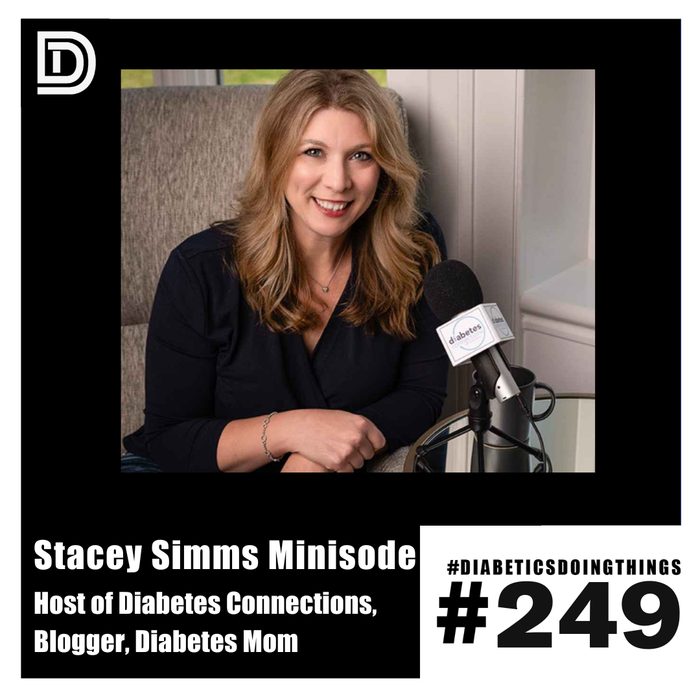
Stacey Simms Minisode Host of Diabetes Connections, Blogger, Diabetes Mom

Episode summary
Stacey Simms, host of the Diabetes Connections podcast, talks with Rob about letting go as her son Benny, diagnosed with type 1 diabetes around age two, left for college. She describes trusting him to manage his own care and worrying about normal college stuff, not just diabetes. Stacey explains how Moms' Night Out started in Charlotte as a planned book launch and grew into in-person meetups where mothers get one-on-one time with diabetes educators and device companies. She and Rob compare her events to his Diabetes Legends Basketball Clinic, agreeing that in-person connection does something social media can't. Stacey also previews Moms' Night Out Frisco, where Rob will speak, and the two discuss Rob's Diabetes Creator Collective pitch and blockchain-based creator payments.
Key takeaways
- Stacey Simms' son Benny left for college at almost 19, after being diagnosed with type 1 diabetes around age two; she talks to him weekly, not daily.
- Moms' Night Out began as a planned book launch in Charlotte and turned into an event where moms get one-on-one time with diabetes educators and device companies.
- Stacey says a newly diagnosed mom learned the real goal isn't to stop worrying, it's figuring out how to get through it.
- Rob says his blood sugar runs high from adrenaline during basketball, then crashes afterward as his insulin on board catches up.
- Moms' Night Out comes to Frisco, Texas in October, with Rob speaking and educators from Integrated Diabetes Services attending.
Show notes
It’s a special minisode with friend of the pod, Stacy Simms! Rob talks to Stacy, the diabetes mom that has got it going on about:
The transition of making the diabetes decisions for your child to letting them grow up and go off to college
Inception of Moms’ Night Out
First started in Charlotte, NC with sometimes two people, sometimes 30 people, it varies.
Stacey planned it originally as a book launch, but it evolved into a place for moms to meet with Diabetes educators, industry, and technology companies.
Upcoming Moms’ Night Out happening in Frisco, Texas with Rob Howe as a speaker, and educators from Intergrated Diabetes Services
Use code “diabeticsdoingthings” at registration for a big discount
We want to hear from you. Send those questions, comments, queries, and general diabetes concerns to THE MAILBAG at mailbag@diabeticsdoingthings.com!
Questions this episode answers
What is Moms' Night Out?
Moms' Night Out is an in-person event series founded by Stacey Simms, host of Diabetes Connections, where mothers of kids with type 1 diabetes meet diabetes educators, device companies, and each other. It started in Charlotte, North Carolina, and expanded to cities like Frisco, Texas and Providence, Rhode Island.
How old was Stacey Simms' son Benny when he left for college?
Benny was almost 19 and a college freshman at the time of this episode. He was diagnosed with type 1 diabetes around age two.
Does Stacey Simms' son Benny play sports?
Benny tried several sports before settling into wrestling and powerlifting, after finding basketball tough because his blood sugar ran low during games.
Where is Moms' Night Out Frisco and how do you get a discount?
Moms' Night Out Frisco, Texas takes place in October. Listeners can use the promo code "diabeticsdoingthings" at registration for a discount, with a few free registrations also available through the show.
Full transcript Searchable, with timestamps
Rob Howe: Welcome back to another episode. I think when I think of people in the diabetes community, and I, you know, this is pretty small podcast world for people who have been podcasting for as long as we both have collectively in diabetes. There's only a few others that have been doing that. And I also just love working with you in general. I think, A, you and I are media people at our core. And so we connect on that. You are, you self-proclaim the world's worst diabetes model. But I think that you are the diabetes mom who's got it going on because you are creating opportunities for other parents, telling stories for people with diabetes. And you really have that caregiver perspective. And I think just talking with you over the years has opened my eyes to everything I thought I knew about caring for diabetes, but through someone else. So I just really appreciate that. And I also love collaborating with you. So let's just like, let's start from there. Welcome back, Stacey Simms.
Stacey Simms: Well, thank you so much. And I feel the same way about you. And it's like the last thing you said there too about how much we've learned from each other. Because when I'm lucky enough to talk to adults like you, I can't tell you how much it's helped my relationship with my son. I don't know anything about living with type 1 diabetes. I know what it's like to be a mom of a kid with it. But to talk to somebody like yourself who's so open about it and honest about it, I think has really helped my relationship with my son who's now, you know, he's almost 19 years old. He's a college freshman. Just went off to college? Yeah.
Rob Howe: How was it? I remember my mom dropping me off, and I only had diabetes for two years at that point. So I think there was a lot of real, you know, looking back, I give her a lot of credit for how she was able to let go, but it was tough. It's tough.
Stacey Simms: It's tough. I think I'm doing better than I expected. Benny says I'm doing fine. We talk every Sunday. I don't text him every day, which surprised me. I thought I would be texting him every single day, like, how are you? How are you? Where are you? but we're, we've got a good system and I'm worried about all the normal college stuff, not just diabetes, which, which kind of sounds crazy. Like, Oh no, I'm worried about everything. But I, you know, my daughter also just graduated from college. So I've been there and I've got like the normal stuff. So I think we're good. I don't know. Ask me tomorrow. This is this, I, I'm not, I wish in some ways I wish he was like five years old still. And I was doing all the work for him, but you know, that's not how it goes.
Rob Howe: it's not anything you know life is challenging it evolves and you know i think when we talk about like the toughest times living with diabetes the teen years are often like the highest bell curve in terms of like a1c outcomes and also stress for mom and also stress for patient so you're almost through those and yet you know there are those those those challenges of you know when you go to college you're obviously going to get an education but part of that education is making your own choices and waking yourself up for class or your job or whatever the case is and making your friends. And I think that's such an important time. And really for me also, like kind of reframe my relationship with diabetes as well, because like nobody else was doing it was on me. You know, mom wasn't there to pack my meticulous carb counted lunch every day like she did. Shout out to Anita. But yeah, just just a lot of fun stuff coming up. Yeah, it's good. It's good. So yeah, you it's.
Stacey Simms: I'm trying to take a deep breath and we shall see, but you know, it's, it's really working out well so far. So we shall see.
Rob Howe: Well, something else that you've been doing that's new, and I believe you did your first event maybe in 2022, but now we're in 2023 and you've been doing these mom's night outs in various cities across the U.S. and continuing to go to new places. and I remember when you first talked to me about it last year, I think we may have been at ADCES 2022, potentially. It was one of those big events. And you told me about Moms Night Out. And I said, I think this is perfect. I think this is great. I think there's a lot of people who are going to be on board. How can we do it? And so now you're bringing it to Frisco, Texas, right here in DFW in October, and I'm going to be able to join as well. So for our listeners who want to know about Moms Night Out, especially those in Dallas, let's talk about what they're going to get in
Stacey Simms: Moms Night Out in Frisco. Yeah, thanks, Rob. I mean, Moms Night Out was an event that I started here in Charlotte where I live. I've been really lucky. For the last 10 years, I've had a group of moms. I mean, I'm lucky, but I put it together, right? So you have to like do all the work. But we go out every month. It's either lunch or dinner. I have a big Facebook group and we get together. Sometimes it's two people. Sometimes it's 30 people. You know, it kind of depends on everybody's schedule. And we always say like, oh, I wish there was more stuff just for us because there are great events for families, right? I mean, like JDRF does amazing events for families. Other groups do meetups. There are diabetes camps for kids. But the experience of being a mom of a child with type 1 is a singular and different experience. And being a person with type 1 is a singular and different experience. And there's nothing that I know of that's just for moms. I've seen a few retreats, right? Like get away and relax. That is not exactly what this is. I wanted to do something where I could still get education. I'm always curious. I always want to learn about technology. I want to hang out and, you know, have a cocktail, do a craft, and listen to some cool speakers. So I planned this. If I'm being honest, Rob, I planned a book launch in Charlotte. That's what the first one was supposed to be, because my second book came out in 2022. And this is supposed to be like a fun night out for moms. I'll sell the book. But then once I sketched the whole thing out, I said, well, this is a conference. And it's not even so we put the book aside. I didn't even have the book at that event. And it became a place for moms to meet with the technology companies, to meet with educators. I really never understood how I went to all these events and I couldn't get five minutes with a diabetes educator. You know, I just I have a quick question. Can I sit down and talk to you? So we do these check ins with there's at least two educators at each event. in in Dallas we've got Stephen Ponder who's the author of Sugar Surfing you can you can meet with him for 15 minutes and ask him all your questions we've got a wonderful woman from Integrated Diabetes Services so you know these are folks that you can meet with and then you hang out with moms and you meet people that are from your area we do some icebreakers which I know makes everybody like kind of cringe but they're super easy and they help you meet people that have children your age So if you've got, you know, a five-year-old child, it's fun to talk to a mom of a teenager, but you really need that connection with the kindergartner. So we try to do things like that. And the Charlotte one was great. I heard from moms all over the country. I mean, I get emails every week, like, come to my city. So we're trying to expand it slowly. But we are in Frisco, Dallas in October. And then later in the month, we'll be in Providence, Rhode Island. And then we're coming back to Charlotte. And then we're going to be announcing, I hope, four for 2024.
Rob Howe: Incredible.
Stacey Simms: I'm exhausted.
Rob Howe: I was going to say, as somebody who at the time of recording, I just got back yesterday from our first out of state event that we did, which was Diabetes Legends Basketball Clinic. And I got to say, it sounds really refreshing because I also did not really know what that event was until like the day before. So I love that yours started as a book launch and now has evolved. You're like, yes, this is a conference. yes, this is something we can do again, because I want to make sure, A, I'm so fortunate. Our event was amazing, incredible. Like I was not just for me. Well, take a second because I'm
Stacey Simms: going to run this on my show too. So take a second and tell me what that was all about.
Rob Howe: So let's talk about it. So you and I were talking before we started recording. There's very few peak days with diabetes that you are prescribed. If you're lucky, you go to diabetes camp. You maybe go to a conference like we're talking about, either a JDRF type 1 nation or a connected in motion if you're very connected. But most of the time, those are either virtual or they're bigger conferences and they're not as just like a fun day. Or in camps, they may be out of state or they may be cost prohibitive in some cases. And so I was like, you know, I love basketball. That's what I cared about when I was diagnosed. knows, can I still do this? And I found out that I could. And so what do I know best? Basketball camp. I'm a kid that went to camp, whether I had diabetes or not, I went to basketball camp. So Diabetes Legends Basketball Clinic was born. And it's basically a two-hour basketball clinic with amazing coaches. We had two amazing med staff. We had the low blood sugar station. We had everybody's devices ready to go. We come in, you check your kid in, they go play basketball for two hours. And then we did a live podcast with a diabetes legend, Gary Forbes, who is one of three people in the history of the world to play in the NBA with diabetes. And either those kids got to do it. And I tell you what, Stacey, I didn't really know what it was until we got to Denver on Friday and we're setting it up. I'm like, oh, this is something we can do over and over again. And so for you to be doing for just a year and a half, really, after you did your first one, first of all, I understand what you mean. You're tired. Like that is a huge expanse and you are one person. I know. Congratulations. I guess this is big for your listeners. You you've hired like a part time staff member to help you with, you know, coordinate some things. But you could look from the outside. Like I'm sure even people in Dallas are like, oh, mom's night out for kids with diabetes. This must be a big organization. This must be a big operation. No, it's one person who had this idea and brought it to life. And now it's, you know, it's, it's getting momentum, thankfully. And I think it really does meet that need, like we were talking about. And I think that's such a huge part of my passion for creators is be in the change. You know, you are making something that would have benefited you as Benny was growing up meeting other moms and you learn, took those insights that you've learned from all of your work over the years in the diabetes community and created something. And that's me too. I realized, you know, what would have really helped 16 year old Rob to know that I could go listen to a live podcast with an NBA player. Or if I was younger and had diabetes, go make a friend with diabetes at basketball camp. One of my friends who was my college roommate was in the area in Denver and was able to stop by the clinic. And he was just like, dude, all these kids have diabetes? And I was like, yeah, there's 40 kids running around the gym. They all have diabetes. They all have different devices on. They're all talking about it. But, you know, I think it was good for the parents to see as well, because probably 12 of the, you know, 40 kids came out of camp and checked their butcher or got a juice box or a Capri Sun and then checked themselves back in. So it was really normalizing, just taking a break, which is, you know, often not the case. And so, you know, I am still riding that high from the weekend. And, you know, but I think even for our staff who don't have diabetes, you know, the guys who are running the basketball side of the clinic, they're like, hey, man, we do clinics all the time. And today was really special because there's something bigger. You're opening up a world of possibilities for a kid. And when they see somebody like Gary and they see other friends, older kids, younger kids who are out there with them making friends with diabetes. And I think it comes back to what you were talking about, about making friends and acquaintances in the mom's night out group with someone who is going through the exact same thing that you are normalizes it. And I think there's also research now that clinically supports better outcomes when you have a friend with diabetes and when you're involved in diabetes, like blogs and social media and community, it really reinforces the importance of that. And so I honestly, like I'm grateful for the sponsorships that we were able to get. And, you know, that allows us to do this. And I was looking at it, I was like, man, I don't know if I could spend better time than to make 35 kids or 40 kids a day on a Saturday in September. That was more impactful to me than, you know, hundreds of podcasts over the years, I felt. But it was cool because it evolved. And it was like, OK, well, what can we do? We challenge ourselves to do these events. And now I think we found one. And that's cool. I'm excited to do more. Yeah. With basketball, it's funny, too.
Stacey Simms: You know, Benny played every sport for three seconds, right? As soon as we would get used to it, he would switch. And basketball was the one. Sorry, I hated. I hated basketball because, first of all, Benny is not built for basketball. He found his love in wrestling. So you can tell different Bobby. He's a big guy. Big dude. But now, you know, powerlifting. So total different set of issues. But all the he was low all the time. I don't know how you play basketball type on diabetes. And obviously you do. But you do. Like, so what were the kids like? What were the
Rob Howe: tips that you gave the kids? So I was intentionally kind of hands off of like giving the advice because everybody's just so different. So what I would say in the podcast, Gary and I kind of talked about managing blood sugars, playing basketball. My problem is the opposite. I go really high. Wow. Because I've learned about myself when I'm when I really like something and I really care about it, which I do for basketball even now for some reason. You know, you get stressed, you get adrenalized and I get excited and my blood sugar goes up, my insulin resistant goes up for two hours and then I crash because my body's been exercising and I've been getting, you know, I've been hydrating and that insulin that's on board finally is able to get absorbed and I crash afterwards. So I think just to normalize that, you know, I don't have the secret sauce to keep a flat chart throughout this, you know, basketball practices and games was also refreshing for some of the parents to feel because I think you start to feel a little bit guilty. You're like, you're doing something wrong. And the reality is like everybody responds to exercise a little bit differently and you just
Stacey Simms: got to be as prepared as you can. Yeah. I will never forget. We had, we had just gotten a continuous glucose monitor around the time that Benny started playing basketball. So he must've been about nine years old and we didn't have share, because it didn't exist yet. But I was sitting in the stands with this receiver going, this is amazing. And then realizing like, oh my God, this kid is going low all the time. It was just a funny mishmash of, you know, confluence of events. It's like he started playing basketball, he got a CGM and he was always low.
Rob Howe: Well, you know, we had a couple of kids who were going low during the camp. They came out. One of them had to have more juice boxes than he was used to. But, you know, right as soon as they felt good again, They pop right back into the drills. Oh, they make it work. And they made it work.
Stacey Simms: They make it work.
Rob Howe: And that was a big learning for me, too, because I think you talked about it. There is no singular experience as a parent that doesn't translate exactly to the patient experience. And I realized that there really is no detail too small when you're dealing with kids with diabetes to help make the parents as at ease as possible. Because, you know, they juggle a lot all the time. And I think they also know their kids and they know their, you know, they know what they need. And, you know, I wanted to give them at least like leeway to do that, but also make sure that there were if they wanted to completely get hands off and like take a breather and maybe have a sandwich that they could do that for the two hours.
Stacey Simms: And that, you know, it's funny. I just was talking with those meetups. I just had one with a newer mom. Her son was diagnosed last December and she hadn't come to any of our meetups yet. So she's coming out of the house now. She's student. And you said like to just go away and have a sandwich. which that's a huge accomplishment, right? For some people at the very beginning of their journey and even further along. So her big question was her son had an overnight field trip and he was 12. And, you know, what was our advice? Like, should she let him go? And she was really willing. She was super nervous, but her feeling was he's 12. He doesn't want his mommy staying in his hotel room when the other kids don't have to do that. And she said, how do I stop worrying and let him go? and I said well you you're the second part of your question is a lot easier to answer like how do you let him go the first part how do you stop worrying I don't know I don't have that answer and just and she just it didn't occur to her and and I may not be telling it in the right way but it was so reassuring to her in a strange way to know that oh she's not supposed to stop worrying she's just supposed to figure out how to get through it and that's what a group like what you just did, like meeting in person, asking those questions, seeing your kid play basketball, go low, treat it, go back in, letting your kid go on that field trip, seeing issues come up, dealing with it, knowing you're always going to worry. You know, I'm, I'm a, I'm an adult. I have adult children and my mother still worries about me. So that's right. Yeah. It's, it's something I think you can't get on social media. You can get some reassurances, but I think that in person, that in-person mix is so important. And I've just, I felt passionate. That's why my show's called Diabetes Connections. I felt passionate about that since day one. Like I needed that. And I want to help other people get it too.
Rob Howe: I'm glad you said and stressed the importance of in-person because I think what's happened to me recently is I got to go to ADA. I saw you at ADA. ADCES, Children with Diabetes Friends for Life. and it feels like diabetes events are back yeah in a way that they haven't been since before the pandemic and i think that's really important because we start to look at these numbers and you said social media is great i love meeting other people online i've actually been doing a cool thing recently in august i met a lot of my friends online that i've known for years in person for the first time. And that's important to me to kind of check that off. That's like a really big threshold to cross, right? But we get this idea that we have to be at big events. We have to reach thousands of people or millions of downloads or whatever the case may be. But 15 people getting coffee together on a Saturday afternoon in Charlotte and just connecting, that is where the real power of community comes out. Because then people who are maybe not as apt to use social media or just who want to have a cup of coffee with somebody and meet somebody new. Those are friendships that you can build that extend out to, you know, that that's was my only task to the campers. I was like, Hey, we're gonna have fun, play basketball today. Your job is to make a friend today that you didn't know before. And because I know then parent parents, the same thing. When you have a question, when something comes up, you have someone now to reach out to. So I'm glad that the momentum is kind of building. And I want to encourage people who maybe have been putting something off in person, go get in person and meet some people and look some people in the eye and meet them because it's just a good skill. It's good practice to get kind of out of your comfort zone. You never know what's going to come back to you, you know, from those things, meeting those parents this weekend, talking to them, seeing them connect with each other, you know, and, you know, obviously you cannot, you're not going to forget about your kid's diabetes. You're not going to completely relax, but you're going to learn how to deal with it. And you're going to see that other people are dealing with it. And, hey, OK, if they're doing it, maybe I can take a little breather. Maybe I can. Oh, hey, I can go run some errands while they're at the camp. It seems like everything is taken under control. And that's that's what I wanted to kind of unlock for some people, because there's been a lot of people who have been diagnosed since the pandemic who haven't had a chance to know about all of these different events.
Stacey Simms: Yeah. And it's interesting, you know, when you mentioned those big events, ADA, you know, American Diabetes Association, Scientific Sessions and Friends for Life. we talked about making mom's night out a once a year blowout right like a huge event for moms and then i thought it's really hard for a mom to get anywhere you know it's hard for me when now it's a little easier my kids are older but when they were in elementary school or middle school like going out on a friday night was so hard so i wanted to rather than try to do it once a year and make it a destination, I thought doing these regional ones might be a little easier. So you can just hop in your car and we're treating it. My husband says we're treating it like a concert tour. So we won't be back in the exact same place, but we'll come nearby, right? We're going to try to cover regions. So I love that. Yeah, that's the idea behind Moms Night Out. You know, and you said something I wanted to follow up on, though. We were talking about other folks, like, you know, doing podcasts and doing creative endeavors and doing, I don't know, there's so much good stuff that's going on right now. Would you talk about a project you're involved with or you're pitching? Yes. I don't remember the name of it. I apologize, but this is so cool.
Rob Howe: Yeah. Thank you for asking. So it's kind of a longer story, but as you get involved in the diabetes community, I sort of continue to learn that I like what I don't know. And what I discovered in at the end of 2022 was one of my friends who I met through the diabetes community got a job at a place called Diabetes Center Berne. And I'm saying it with the Swiss accent because it's B-E-R-N-E, Bern, the city in Switzerland. And it's basically the nonprofit arm of a Swiss venture fund that supports diabetes devices and digital diabetes solutions, totally geared towards living with diabetes. And they have every year an innovation challenge in those two categories, diabetes devices and digital diabetes. So submissions were open and they were like, okay, it's a grant prize. If you win and are selected, your prize gets $100,000 in a grant funded to make it happen. And so I was like, okay, well, what is my idea? I had never really tasked myself with... Diabetics doing things has kind of been... I'm just continuing to say yes to things to find things that I'm interested in. We wanted to do events this year. So we've done now, we've done three events. We've got our pickleball classic coming up during National Diabetes Awareness Month. And that was kind of cool. Like, yes, new things, new events. We're loving this. This is great. What is this going to be? And it came back to what we were talking about earlier, which is creators. And I am a diabetes creator. I didn't realize that when I started, but that is who I am. And there are a lot of other people like me that I've met over the years. And I really have an advantage there because of my marketing background and my business background. So when we were talking about sponsorships, those are my career peers on the other side. I know what they're looking for. I know the language to speak. And I've been fortunate enough to, you know, have other, you know, successful ventures in my life that fund my ability to do those things and a skill set. But on the other side, though, I see other people with diabetes who don't have that background, who have great ideas, more creative than I could ever be. But they don't have that skill set. They don't have those opportunities. And ultimately, they burn out for a number of reasons. Diabetes, chief among them, living with diabetes is hard, hard enough. And people with diabetes need three things. They need money, they need insurance coverage, and they need community. Those are sort of like the core for building the Maslow pyramid. You got to have those things in order to be able to give of yourself back to the diabetes community. So how can I create an ecosystem that allows that to happen? So the answer to that, that I pitched to the innovation challenge at DCB is the Diabetes Creator Collective. And we made the top 20. So I think 50 or so submissions went in the first round and we made the first cut. And it's effectively a creator platform for diabetes creators and brands. So we can connect you with bounties. So if a brand is running a National Diabetes Awareness Month campaign and they need a video about multiple daily injections, you can opt into that as a creator if you meet the criteria and then you can get paid once you create it. And we will serve as the clearinghouse. And that's on the media side. That's really an easy transaction, how we build that business. But on the other side, which is more important, is the bottom up side, which is where if you're a diabetes creator, you can opt into our community and you can also get opportunities like we talked about from brands and from other diabetes creators. You can get support, back end support for events and selling your wares and your items. And you can also get community and mentorship to help bring your idea to life, to get you the support on the back end to say, hey, I have this event, but I don't really know what to do. I'm a painter and I want to bring other diabetes people together. Cool. We can help you make that happen.
Stacey Simms: Oh, wow.
Rob Howe: And so, but the underlying technological side of it is that we do it on the blockchain. And the reason that we do that is to cut out some of the platform transaction fees. So when you're looking at meta, meta subscriptions, take 40% off the top. So, you know, let's just say that you're an amazing creator. You've got $10,000 a month coming through your meta subscription. production, you're only going to be able to touch 6,000 of that. And in the US, you're going to have to pay self-employment tax on that. So all of a sudden, what seemed like really successful is now maybe not as manageable. By doing it on the blockchain, we can eliminate payment terms, which are often also challenging. So as soon as you fulfill, that's delivered to you in your wallet. But we also can create a global payments network for patients with diabetes to get connected to, where in a pinch, $300 for a vial of insulin could be delivered to you anywhere in the world instantly with no transaction fees. And so I think that's what is my sort of subterfuge of what I'm building here is a global diabetes payments network that brands can get connected to, that community members can benefit from, not just from paid advertising opportunities because not everybody wants that, but also to support other creators and get involved in little pods and give back to that community and also receive discounts to the diabetes products that they buy in the community to whether that's diabetes devices, medical device companies, whether that's apparel or any other kind of brand that's listed, diabetes creator brands, or even conferences like Mom's Night Out or Diabetes Legends basketball clinic. By being part of that, you can get exclusive access to those things. And so my job now, in 10 days from the time we're recording this, is I've got to convince this jury of medical device experts and diabetes treatment and therapy experts that diabetes creators are important and that the impact that we could have, because I believe that the next great innovation in diabetes will come from a diabetes creator who currently doesn't have the infrastructure to pull that off. And I don't want to, if I could make that change and create an environment where they're able to be more sustainable, limit the burnout of people who are making things for people with diabetes, that's a huge win for me.
Stacey Simms: Wow. It just sounds so great because I'm thinking about how many people over the last 10 years I've talked to who had great ideas, but, you know, need a full-time job. Yeah. Or they come into the podcasting space, just for example, and realize that it's a lot of work and it's a lot of time and you can't just do it for 10 minutes once a week.
Rob Howe: How many episodes at the time of recording have you put on your feed?
Stacey Simms: I think 590.
Rob Howe: That does not happen by accident. First of all, congratulations. Thank you. We, I think, just went over. We're almost to 300 on the feed. We did like 40 episodes of Tools of Type 1s. But we, yeah, we're inching closer to 300 episodes of Diabetics doing things. And I'm telling you, you got to keep showing up. It doesn't just happen.
Stacey Simms: Yeah. And it's hard, though. I mean, I've been so lucky. I started this show when I was not, I did not need to have a job. I had left my job and my husband had a great job. And I was doing it almost just to keep busy. and it evolved into something completely else. But I had the luxury of that time and of the skill set and of letting it go until I could really make something of it. So Rob, I have to ask you the dumbest question, but it's not dumb because I know a lot of people listening have the same question. And if you can't explain it in three minutes, we'll do our best. Tell me what the blockchain is. Okay.
Rob Howe: Yeah. So that's usually where people's eyes glaze over, right? Because cryptocurrency, especially right now where we find ourselves in 2023, because of bad actors, because of the lack of investment interest, because the market is down and has been very volatile, has driven out consumer interest or in general population interest in cryptocurrency. Which to me is good because it allows me to see who's really serious about it and about building this sort of decentralized financial community. So the reason that I'm so bullish on it is because I'm part of a golf community called Lynx Golf, which raised $19 million. They minted some NFTs on January 1st, 2022. They raised $14 million in one day. And as of today, they bought a golf course for our members, and they're giving membership benefits to everyone who is a holder. So I've learned and seen the power of community building in this space. and what I want to try to do is allow people with diabetes to benefit from that. It's really simple. My word of 2022 was skeuomorphic, which skeuomorphic design is basically taking something that exists and just evolving it a little bit. So effectively, what the Diabetes Creator Collective is, it's a mixture of Spotify, Costco, and Creative Mornings. Costco, from a membership standpoint, you pay a little bit and you get a bunch of membership benefits back. Costco's an amazing company. That's how I know I'm getting older because I love Costco. On the Spotify ringer side, sorry, excuse me, Spotify owns the ringer, but the ringer is content and podcasts and videos and articles about pop culture. So I'm thinking that is like the ringer for diabetes meets Costco meets Creative Mornings, which is a national or worldwide organization that has local chapters, which have little councils that allow monthly events for creatives all over the US, all over the world under the same umbrella. So we want to create that kind of environment, that kind of membership benefits for diabetes creators, because we know the power of awareness that even a person with 112 followers on Facebook has in their community. The more people doing that, that is how we tip the iceberg on diabetes awareness, ending diabetes stigma. Those things have to happen on a one-to-one basis. So the reason we do it on the blockchain, again, is it's transparent. So you're going to be able to see, we'll have a public wallet. You'll be able to see where all the money goes. You also have a governance and voting component. So if we want to change something, it has to be approved with a majority through the membership and the governance. And then again, no payment terms. So when you're talking about doing a sponsorship deal, you might have net 30. Some brands are net 90. The bigger the company, the longer the payment terms. You also are going to get hit with banking transaction fees and, you know, different, you're going to have to pay someone. The blockchain allows you to do that in a really transparent and, you know, believe it or not, very secure and verifiable way. So, you know, what I want people to be able to do through our platform is opt into a bounty, fill out your information, deliver it. And then immediately, once the chain verifies that you delivered it, get paid directly in your wallet and to have a really positive user
Stacey Simms: experience built on that. Very cool. Wow. All right. Great. Well, keep posted on this. I'm very excited to see how this goes. I hope you get into the top three and win the whole thing.
Rob Howe: And that'd be great. Well, thank you. There's a lot of amazing people with diabetes who are creating, you know, things for us. I think that's another thing for me. The things that other people are bringing to market and the ideas and the execution that they have all over the world is substantial. And I think you and I, you know, being very privileged and lucky to get to go see some of the innovations behind the scenes at these conferences. I'm like you. I love to know what's going on in the technology side of things. It's going to be really awesome to get diagnosed. I don't know. I want to be careful how to say this. When you get diagnosed with diabetes now and in the next five years is going to be such a dramatic difference for many people than it was 19 years ago when I was diagnosed or 17 years ago when Benny was diagnosed. And I think Like that to me makes me really hopeful because I know people now, I even talked to some of them this weekend who were using pig insulin 50 years ago. And I see them now and they're living their best life. And so for people who are diagnosed today, life is going to be fine. Life is going to be good. It's going to continue to get better only because there are people with diabetes and people who care about people with diabetes really pushing the envelope forward.
Stacey Simms: Yeah, it's amazing. And that's one of the reasons why I do so many technology episodes, because I started Diabetes Connections to do more news, right? I wanted to hear a podcast that was a new, that's my background is in television and radio news. And I have now, Rob, I have some people who will not come on my show because they don't, they know I'm going to ask them questions. They know it's not going to be like an infomercial. And it's so annoying, but I get it. I get it. It's very hard to get some of these folks to come on because we have questions like, you know, if you talk to somebody with diabetes, they're not going to say like, oh, what do you think the stock price will be? We want to know, like, what's that adhesive made of? How deep is that needle going in? You know, what happens if the CGM stops working? What happens to this integrated pump? We have a lot of questions that they don't necessarily answer when they go on like Motley Fool or something.
Rob Howe: Well, you know, it's very difficult. You know, being a diabetes creator, you know, you think, you know. So I'll give my own story here. That's my perspective. I was super excited to be able to post sponsored content for the first time. Then I learned about, you know, a lot of the content that we share peer to peer in the diabetes community is technically off label or can't be approved. And, you know, you can't they can't legally answer in some cases. And so it becomes a little bit less fun. But then again, you know, that that's part of, you know, learning. And I think that when, you know, within the Diabetes Creator Collective, we can talk about that. Like, what are some of the pros and cons about, you know, turning professional as a diabetes content creator? There are there and there certainly are. But also, I think don't get in the ring with Stacey Simms unless you're ready to answer a couple of hard-hitting questions, you know?
Stacey Simms: A couple of questions. I mean, I do have a quick question for you. I know we're getting long here. Yeah. Tell me about your pickleball tournament.
Rob Howe: Yes. So the Diabetics Doing Things Pickleball Classic. All the information is at diabeticsdoingthings.com slash events. Pickleball's taken over. And it's, I guess, the world's fastest growing sport. And what I wanted to do was, for years, I've wondered how to get my friends and family who don't have diabetes excited about an event that can help diabetics doing things and help support some of the programs that we're running. And over the years, we've asked a lot of cool questions. I try to be like you, I try to ask the hard questions from time to time and really dig in. we identified an opportunity to work with North Texas food bank on totally revamping their diabetes programming. And we need to raise money to make that happen. So it's time to have an event that brings in our friends who don't have diabetes, but care about what we're working on. So we've got the Diabetics Doing Things Pickleball Classic. It's December 2nd. It's at Chicken and Pickle in Dallas, which is a huge pickleball facility with a chicken restaurant in the middle. We're going to play pickleball for a few hours. We've got a fun division for people who just want to come in, show up and have fun. We've got a competitive division for people who want to win a big prize and who want to feel like they want to hold that trophy up and say, hey, I'm number one. And I've already gotten some messages from people who are like, I'm coming for that trophy. I want that thing. So bring your pickleball. If you've got pickleballers that go a little hard in your family, let them know. But again, we're just trying to do something fun with a good cause that's exciting for participants and sponsors and allows us to do the work that we really wanna do, which is help people with diabetes, meet them where they are in a way that we hadn't been able to do before. And we were talking kind of before we started recording, there's been about 500 people in the DFW area who've gone through our North Texas Food Bank program who are over the age of 50. They need information. Health equity starts with information, Stacey, and these people aren't getting as much of it. Some of that is that they're not interested in it, but they don't even know where to look. They don't know where to start. So we're going to help meet them where they are, give them exciting programming, opportunities to learn, and just give them some stuff that they have, you know, they've sort of been forgotten. And, you know, I think people like that often get labeled noncompliant or they get labeled disengaged. And the reality is they just don't know where to look and they have way too many things going on in the rest of their life to be able to prioritize it. So we're going to try to bring some, bring some delight to them. So that's what the funds that we raised through the pickleball class are going to go for. Got a big audacious goal. We're going to raise a million dollars over 10 years. So we're going to stretch it out. We're going to think about how we can show up consistently to do this year after year. And, you know, give that back to people who need it most. You know, food insecure people with diabetes. I cannot think of a better cause.
Stacey Simms: Yeah, that's wonderful. That is wonderful. Do you play pickleball? I do. I do.
Rob Howe: So I will say I have, it's a sport that you don't have to be a super athlete to approach. I think it's like the, you know, I think it's kind of taking the place of pool as like the easiest sport, the easiest sport to like show up for the first time and be competent and have fun and want to come back. It's not like golf where you're going to be out there the first day and like miserable or skiing or something where like, you know, you have to fall a bunch of times before it's fun. Pickleball is fun from like minute one. So I want to encourage you if you're out there like to think of it that way. But yeah, I'm going to be in the competitive division. I'm going to go as hard as I can. That's, you know, I got to show well, too. So that's on me. I got to like really get to training. So, you know, that's, you know, that's something that, you know, I want to make sure that I do.
Stacey Simms: But maybe we'll do a pickleball clinic. You can bring your stuff. We'll do it at Mom's Night Out in October.
Rob Howe: Hey, I'm ready for that. I'm so excited also to come to Mom's Night Out because I want to talk about the patient perspective. I'm like, like you said, I'm a grown up now. the good news is that your kids with diabetes, they grow up and they live a long life and they can live a long life with diabetes and live well. And so I think, you know, I made sure to ask kind of our community on diabetics doing things to, you know, kind of give some things that they would like me to say to caregivers and parents. And, you know, some of them are funny, like, you know, hey, don't worry, mom, if you're getting the Dexcom low alert, I've probably already treated of it. So it's all good. And also that out of range sugars are not your fault, parents. You know, it's not a, it's not a cause and effect always. Sometimes diabetes just is going to diabetes. And like you said earlier, seeing kids go sit and take a seat and go drink a juice box during a basketball clinic, get back up and go back in. It's a great metaphor for what diabetes is like. You're going to need some extra accommodations from time to time. Give yourself a little grace and mom and dad that doesn't reflect negatively on you. So, you know, I think I know there's a lot of people that really care about the kids with diabetes in their life and the people with diabetes in their life. And I'm excited to connect with them and give them a little perspective. You know what? I drank too much in college at a couple of parties and I'm okay. And I, and you know, I, I didn't tell some people about my diabetes sometimes. And, you know, I did tell others and, you know, I experienced all of the, all of the emotions that go along with that. And I'm excited to talk about it because I think, I hope it will open some, you know, have some light bulb moments for, for some moms there who can say, you know what, Hey, my kid, my kid did have an out of range blood sugar the other day and that's okay. That's going to happen. Nobody's a hundred percent time in range a hundred percent of the time, even people with working pancreases. So, you know, I think I'm just pumped to, to be able to have the opportunity to do that and to support your awesome event. I'm excited to connect with
Stacey Simms: those folks. Yeah, it's going to be great. I did have a request. It was interesting. When we had our first speaker in Charlotte, we had a couple of people and they were women. And then one of the women who was attending, one of the moms took me aside and she said, you know, this is so cool, but I need to hear from a grown up boy. That's what she said. I even a grown up boy because she had a son. And I was like, I know a couple of really good grown up boys. I'm going to call Rob. So that was really. So thank you so much for doing that,
Rob Howe: because I know you'll be real and honest. I will. And I am fully admitting that I am a grown up boy. I was telling somebody, I was like, I feel like I'm just 18. I'm just now I know about taxes. That's the main thing. But, you know, I think that that is true. You're you know, your your boys grow up, they turn to grown up boys and they and grown up girls. and that's awesome. And so, yeah, I'm here to, I'm going to spill the whole truth and nothing but the truth. What I told you when you asked is that I've been a big hit with mom since 1988 and that is all true to, are all due to Anita Howe and her amazing motherhood to me. So I'm excited to answer any and all questions.
Stacey Simms: Well, I think, I'm just looking forward to seeing you. I'm looking forward to everybody. So, you know, please come to Mom's Night Out. Yes. And come to Pickleball.
Rob Howe: Yeah, yes. And you know what? Shout out to a couple of people who are just trying to make things happen. And, you know, I think that you never know where a little idea will take you. And I think, you know, we talked a lot about other events and not a lot about podcasting. But I bet if you could go back in time and tell Stacey on episode one, hey, you're going to be planning in 2024 for in-person events, I imagine that would knock your socks off.
Stacey Simms: Yeah, I probably would have said, like, do it now. Let's do it now. Why didn't you have that idea now?
Rob Howe: I'm right there with you. You never know where it will lead you. But thank you for this time. I'm so excited we got to do a little mini-sode.
Stacey Simms: Can I jump in with my promo code or will you put that in later? Yes, please do. Please do. All right. So as you're listening, Diabetics Doing Things is the promo code that you can use for Moms Night Out, Frisco. And we're really excited. We have a few free registrations. There's a little bit of a service fee. It's like $13. But if you use Diabetics Doing Things, we have five, I think, to give away. And that was really cool. That came up thanks to our sponsors. So I appreciate them. And just go ahead. We'll link up the website, blah, blah, blah. But you'll see it.
Rob Howe: Everything will be in the show notes. And I also am going to include this in our email blast prior to this episode because we've got to get there.
Stacey Simms: And if you get there and the promo code doesn't work, email me and we'll hook you up. I've got others. Perfect.
Rob Howe: Okay. Okay, well, Code Diabetics Doing Things. And again, that's Moms Night Out Frisco. It's coming up this October and I will see you there. Thank you so much, Rob.
About Stacey
Stacey Simms hosts the Diabetes Connections podcast and has written books about parenting a child with type 1 diabetes. Her son Benny was diagnosed around age two and is now a college student; Stacey also founded the Moms' Night Out event series for mothers of kids with type 1.