

Episode summary
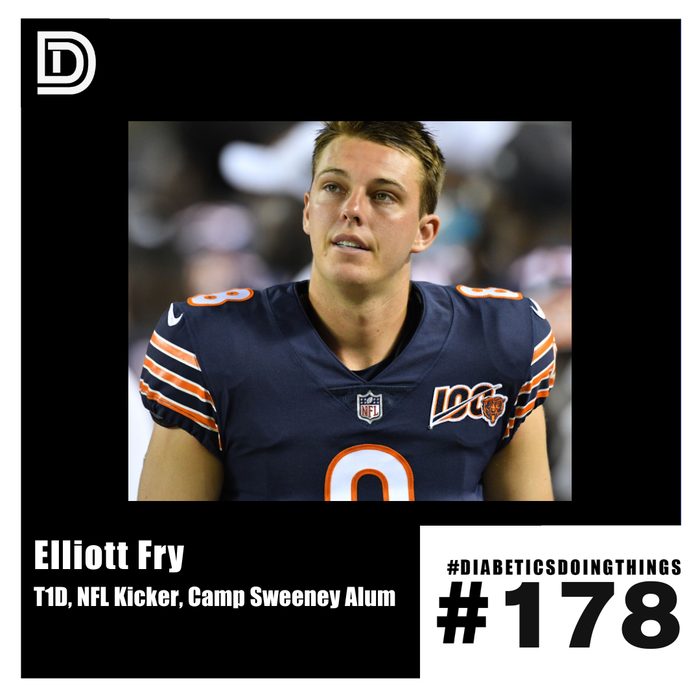
Elliot Fry is an NFL kicker who was diagnosed with type 1 diabetes at seven, after collapsing during a youth hockey game in Plano, Texas. He grew up playing soccer, switched to kicking in high school, and walked on at the University of South Carolina, where he became the program's all-time leading scorer. Early in college he kept his diabetes quiet, worried coaches would see it as a risk. A local news story outed him, and messages from parents of kids with T1D pushed him to be more open. He covers his path through the AAF, the Chicago Bears, Tampa Bay, and the Atlanta Falcons, a scary low-blood-sugar seizure at training camp, and how he manages blood sugar before games.
Key takeaways
- Elliot Fry was diagnosed with type 1 diabetes at seven after collapsing during a youth hockey game in Plano, Texas.
- He kept his diabetes quiet as a freshman kicker at South Carolina, worried coaches would see it as a reason not to trust him.
- After a local news story revealed his diabetes, messages from parents of kids with T1D made him decide to be more open about it.
- Fry says he deliberately lets his blood sugar run a little high before games, since a low is what would actually cost him his job.
- He had a low-blood-sugar seizure one morning during AAF training camp, which pushed him to take his off-field diabetes care more seriously.
Show notes
This week’s guest is Elliott Fry (@elliott_fry29 on Instagram)
Rob and Eritrea drop another intro and Eritrea asks Rob to reveal his full story of the journey to playing professional sports for the first time. Elliott’s story embodies so much of the professional sports grind that many people don’t experience, and Rob’s story while he did not reach the highest level, is very familiar for sports journeyman and women.
After the intro, Rob, Eritrea and Elliott discuss:
Getting Diagnosed after a Hockey game
Playing sports with T1D as a child
Switching from Soccer to Football
Camp Sweeney memories with Eritrea
Kicking for South Carolina on National TV in a stadium with thousands of fans
Preparing for games with blood sugar checks, before and after CGM
The professional football grind
And much more!
SPONSORED! This episode is sponsored by Type Zero Health, a T1D owned business who make exceptional clean exercise products that don’t spike your blood sugar. Type Zero is the official exercise partner of Diabetics Doing Things and you can save 20% on your order from TypeZeroHealth.com by using ROBHOWE at checkout.
Questions this episode answers
How old was Elliot Fry when he was diagnosed with type 1 diabetes?
He was seven years old and collapsed during a youth hockey game in Plano, Texas. He was hospitalized for about a week while doctors ran tests.
How does Elliot Fry manage his blood sugar on game day?
He says he checks his blood sugar around ten times before a game and tends to let it run a little high rather than low, since a low is what would actually hurt his kicking. He now uses a Freestyle Libre to see where his blood sugar is trending, not just a single number.
Did Elliot Fry play college football with diabetes?
Yes. He walked on at the University of South Carolina and became the program's all-time leading scorer at kicker. He was not open about having diabetes early in his college career, worried it would affect how much coaches trusted him.
What NFL teams has Elliot Fry played for?
He has had stints with the Chicago Bears, Tampa Bay, and the Atlanta Falcons, including one regular season game for Atlanta on Monday Night Football against the Green Bay Packers.
Full transcript Searchable, with timestamps
Eritrea: What up, what up? And we're back with another episode of Diabetics Doing Things. I'm Eritrea.
Rob Howe: Nicely done. Nicely done. I like it. I mean, I hijacked it. At least we have like a very similar cadence. Like we've got it down. We're telling the amazing stories of people with diabetes from all over
Eritrea: the world. We got a fun one. I'm really good. It's easy to pretend to be a reporter. Welcome back.
Rob Howe: I can put on that Rob Howe voice. I, you know, I watched the other day, I watched Bob Costas's new show, the goat Bob Costas. And he has an old school newsman show called Back on the Record on HBO. And it's just an old school new show. And I was like, man, I love this. I love, I like being a newsman. I like being a podcast guy. It's fun. All right. We're back after the dog's interruption because of course, diabetes supplies got delivered like they do. So weird. I get the weirdest
Eritrea: diabetes interruptions during these recordings. I've had my endo call. I've had my diabetes supplies dropped off. I've been low. My pump just be beeping because diabetes never stops,
Rob Howe: man. It's always sort of just in the ethos. Uh, so I was saying kind of before the diabetes supplies got dropped, we've got a cool episode today and it's got a personal connection for you and also for me in a roundabout way, but, uh, Elliot Fry NFL kicker and person with diabetes
Eritrea: from Dallas camp Sweeney alumni. Absolutely. Yeah. And to me, he will always, I said in the episode, but he will always be a Elliot French fry to me, just a kid that I met at camp, but you guys really bro it out for a while because of the whole superstar aspect of this episode. And I guess, I just wonder, like, he jumped from team to team. We talk about it throughout the episode. So I guess for you being a pro athlete yourself, how do you resonate with Mr. French fry?
Rob Howe: Well, first of all, I think, you know, Elliot story. He, I mean, he achieved much greater success than I ever did, obviously like, you know, going and kicking at the highest level of playing the NFL. I mean, hats off to him and the work that he's, that he's gone through, but you're right. We do have a lot in common from a mindset perspective and just kind of understanding what that rhythm of life is like. And I've talked about this a little bit before, but I think we're going to go into deeper detail now and, and, and I'll, I'll spill some tea as, as you say. I want all the goss. Yeah. And there really isn't too much. You know, I think like where it would be an issue, you know, my ego when I was younger, maybe felt like too shy about it, but I think now I'm just, I'm fine with it. So being a professional athlete, if you're not like in the draft, right. So every year in the NBA, 60 guys get drafted. So 60 out of all the eligible dudes and as not very many and of the 60 like 10 make it like make it past their first like contract make it on teams because there's like 400 guys in the league and every year not every not everyone like quits you know or retires or gets cut you know so there's not a whole lot of jobs there's really only like 15 so if you're not in that top 15 kind of category you you you know You're probably not going to make it in the NBA. In the NFL, it's a little bit different. They carry more spots on the roster. There's more rounds in the draft. There's a lot more risk of injury, and the rosters are just bigger. So there's a little bit better odds if you're at the highest level of college going to the pros, but the careers are shorter. So there's the tradeoff there. And so I think what was really similar in Elliot and my story is that there are people like for me, for me, for example, what I do on a basketball court is not that difficult to find. I was still good, but there are people in towns in Germany who are just Germans who live in that town and play on the pro team that do what I do. Same thing in France and, and, you know, Canada and England and, and, and everywhere. Um, Elliot is a specialist, but he's a kicker. And when you're a kicker in the NFL, you're only as good as your last make. and also you could go through injuries. So if your kicker gets injured, you usually don't carry a backup on the team because kickers are just available in a talent pool. So if you're a great division one kicker, like Elliot was, you have a chance to make an NFL roster, but usually only if somebody gets hurt or if you are just like the best thing since sliced bread and you're ready to go and you come in and catch fire and you could kick for a team for a long time. You think of guys, like if you know an NFL kicker's name, that guy, like I'm thinking of like Janikowski, like that guy was just a kicker for years and years and years and years on the same team. He never really got hurt. Never really, you know, always did his job and he stayed in that role. And that's pretty rare. Uh, kickers turned over pretty quickly in the NFL. So I don't know. I kind of understand that sort of uncertainty. And I'll tell you like my own personal experience. I graduated from college, the year of the NBA lockout. And there were guys who would normally been in the NBA who were taking a lot of jobs overseas, pushing better guys overseas down to the lower levels, which is where I was going to be playing. So that's, that prevented me from getting a job over there. That and me not being better than those dudes and they were better. So I, I waited a year and I stayed working out. I hired a trainer. I spent all my money and I blew up my car driving back and forth from Colorado Springs to Denver. I was coaching kids. Yeah. Like I didn't explode,
Eritrea: you know, but the engine cracked. Well, the wreck that we talked about, remember, like we talked about the wreck and we couldn't get a new car because of our credit or whatever.
Rob Howe: So that happened during this. That happened like 2012. So I was like, you know, I basketball made me broke really. Like I was spending all my extra time and energy doing that just to try to make it. and I was talking to a friend uh who was also a basketball player uh he played pro in like Mexico and in Venezuela for a number of years and we were talking about camps and like how you have to pay for these camps you got to pay your own way to go even if you get invited like you get invited you still got to pay your own way um and he was like I always felt like those were a rip-off and I was like yeah I agree with you but if you were good enough and you were at those camps, like they would find the spot for you. Like it really is true. Like if you're good enough in front of the right people, it could be your big break. So, you know, I didn't get a break from some of those camps with this one that I went to. I met a guy who was an, who's an assistant coach for the Sixers now, who I got to write me a letter of recommendation from based on my film from that camp that ended up helping me get the globe trotters job, the Washington generals job. So like, I always tried to like, if I'm going to pay all this money and like go to these places, like I gotta be able to show something for it even if I didn't like get a spot so um that's what I did and I that's how I got on the trotters and when when my season was up like we had this break in the tour on our U.S. tour and they let me know like two or three games before they're like hey Rob we're not going to bring you back on the next leg of the show like we're gonna let you play your contract out here but um this is the end for now um and I was like cool I didn't really you know you can't really do anything about it. Everybody's really replaceable at that level in basketball. There's so many other guys that are a year younger or in better shape or doing something a little bit better than you that they're willing to try out on. And so it was my time. And when I came home, I kind of like took inventory of everything and I was like, all right, well, we did this. It didn't last very long. It was a short-lived pro career, but I had gotten a lot better. I had proven to myself that I could do it. and I had had the job and I have the photos and the videos and all this stuff to prove it. And the only other job that I had on the table, one of my friends was living in, uh, Savannah, Georgia. And she was like, you know, I, I found that there was an ABA team that my agent found for me to go play there. I was going to make like 50 bucks a game playing in the ABA in Savannah, Georgia. My friend said that I could crash on her couch. And I was like, damn, if that's my best option, like if I had felt good and I like wasn't injured and like, I felt still like trying to do it, I might've done it, but I was ready to hang it up at that point. I was like, I need to go get a job and, you know, actually, you know, make ends meet a little bit more than 50 bucks a game once a week. So, um, yeah, absolutely. Yeah. So I don't know. That was, that was kind of my journeyman story. And that's where it ended for me professionally. But, um, man, I had a lot of fun, played in a lot of like crazy, like tournaments and weird games all over the country, all over the world. Um, And I wouldn't trade it for anything, but yeah, I mean, it can be, it's a grind. It really is a grind. Anybody that tells you otherwise either is just way better than I was, or, you know, just, you know, didn't necessarily go through all of it. So I think the, you know, Elliot's really, he's really giving with that story, talks about the uncertainty of like getting called up and like kicking in a game the next day that takes so much preparation. And one thing that I really like still maintain in my personal, like approach to things is if you stay ready, you don't have to get ready. And I think Elliot's, uh, you know, he talks about his routine, but he's the definition of stay ready. You don't have to get ready. And that includes diabetes, which is, which is kind of cool. We also talk about like his game day routines when he was at the university of South Carolina, uh, playing at the big time division one, one, a, you know, college football level, hundreds of thousands of people watching you in the stands and on TV and you know what that's like. And so, yeah, I'll never know what that's like. And this is a cool perspective to hear from somebody who has been at the highest level and, you know, doing what he does.
Eritrea: Yeah, no, I mean, first of all, I think a lot of like, OK, so not to gas you, but when people are like, oh, what are you doing pre-time? I was like, oh, I have this podcast and my boss to be in the NBA. And people are always like, who? And then they immediately Google you.
Rob Howe: So like you got to stop telling people that I played the NBA because I did it. But I wish I did.
Eritrea: it's fine i gotta tell them that that's true i guess i'm craig i gotta lie craig was still so no i mean i guess it is a really interesting story i appreciate you sharing it with us especially if you've never you know really been very open about it before how long how old were you when you left the nba i don't even know like uh i was 24 yeah i was 24 yeah you're a kid yeah yeah
Rob Howe: yeah or maybe so tough i don't even think i'd know i was 23 i was 23 uh about to be 24 and man I don't know. It was just like, I, and you know, that was crazy too. Like let's, let's keep talking about it. Like I went to Afghanistan. Like I went on this. Yeah. Run the track back. Yeah. Like run it back. Like we went back to like, I went through all my photos this week after, you know, like, you know, the U S fully withdrawing and the Taliban taking over Afghanistan again. Just remembering like being there and like the country and like the way that people talked about Afghanistan who were from there and this place that it used to be and where people go on vacation there and ski resorts and stuff that used to be there. And now it's just this war-torn country. And yeah, I just felt immense sadness for those people, but also being very grateful that I got to see a place that a lot of people don't get to see, especially from the United States. And so, yeah, I don't know. It was a wild journey. I wouldn't trade it for the world. Uh, and yeah, I was like, I was 23, but man, I felt 45. You know, I was just beat down, uh, after all that time on the road, a lot of time playing hoop, uh, a lot of time working out a lot of time and money and energy. But yeah, when you're a pro athlete, you meet somebody who is a professional athlete and like made that was their job to go out and play sports. Uh, that's a special and rare group. Uh, and it takes a lot of sacrifice and I'm sure. and I think Elliot talks about this a little bit, but you know, people will tell you like, bro, what are you doing? Like, why are you still trying to do that? Like, and in some ways it seems foolish because you get told no a lot or you get told, Hey, maybe next time, or Hey, maybe in this place. And so, you know, I was even going through my emails a couple of weeks ago, like trying to find, cause I'm working with this startup on some basketball stuff and just looking from my emails that I sent to my agent 10 years ago, you know, like, and, and just like, man, come a long way. Um, so yeah, nobody makes it by themselves and man, it takes a lot of sacrifice and a lot of effort and a lot of days of soul searching where you're like, am I just going to go do this workout again? Uh, and like, is the phone going to ring or what else can I do to, you know, to make it? And, uh, you know, all of that stuff happens behind the scenes, but all we see as fans is like Falcon sign Elliot fry. Uh, and yeah, you know, or Elliot fry makes a field goal. And so there's just so much that goes into it. I think a coach one time told me at a camp, it was like, I was 16. I was the summer after I got diabetes and I was at Baylor at a camp and, uh, the coach was talking about Roy Jones jr. And he said that, you know, everybody's a critic, like when the lights are on, uh, and like you're underneath the lights and they're talking about your work. He's like, but what they don't see is like 5.00 AM for eight weeks before that, you were running seven miles in the gym twice a day and like not with your family and like not with your wife and, you know, just really making those sacrifices to try to be the best. And I don't know, I really identify with that. And that was a huge part of my life. You know, I was 22 years old. I stopped drinking for like two months in the summer during my like Olympic internship, which was like the most fun time of like my life as like a young person, because I was trying to be great. I was trying to give myself a chance, any edge I could get to make it. And, um, you know, I'm fortunate that my, I got, I got the chance to do it. I got to put professional basketball player on the resume and I sure talk about it a lot. So that makes sense. I mean, it's just like
Eritrea: listening to both of you guys. It sounds like, yeah, it's a lot of staying ready. So you don't like staying ready. So you don't have to get ready right away. Like in a, in like a slap, you know, a snapshot, whatever I'm trying to say, sorry, my English is failing right now, but I feel like it's only like 1% luck the rest of it's 99% work work work work and like something that you said to me when I started working out is like all work is easy work so I think that when you have been like conditioned to to know that you're investing in yourself and that you're chasing not just a dream but like a potential future like that's amazing and to think that like you're doing it on the chance of a maybe like it's not even like hey I'm gonna do this and I'm gonna get this degree and for sure I'll get this job like you're literally showing up at a gym and putting in work and putting in these buckets since you're like I don't know Rob because like you've posted pictures of yourself being like eight years old holding a basketball so it's like bro like your entire life goes into this dream and it and then for it to just be a maybe like I remember Elliot being a little kid running around at Camp Sweeney with this freaking soccer ball like he was obsessed with kicking the ball so just to think that you like find this love for this sport as such a young human and then it that love carries you all the way into your adulthood
Rob Howe: is really it's very inspiring to see well I I mean I agree and I think you know I hear stories about like Devin Booker there was like videos of him talking about like he didn't go party with his friends or like go hang out on weekends because he was in the gym putting in work and I think those things sometimes like get glamorized and you don't realize like how boring and how like bad that feels sometimes stuff to tell your friends, no, like I got to go work or like your friends are having fun and you're like in the gym. And at the same time, like you said, all work is easy work. Shout out to Gary Forbes. Uh, the last person with diabetes to play in the NBA. Uh, you know, he, he talks about that all the time when he was training, like all work is easy work. And if, if you just say this is easy and I'm just going to do it. Um, I don't know that mindset is it's a wintering mindset it's it's hardcore um but yeah you just you don't know and you know how much goes into just those guys making it to you know being on tv and how many people they had to prove wrong and i that's why i love the draft you get to hear stories about guys like uh guys and girls who you know have made it from you know wherever and it's just so inspiring to me to hear that and you know to see a little bit of yourself in that sometimes and uh just to know that there's somebody else out there like that. But one thing I will say, and you touched on it, if you don't love it, unless you're like the just 1% of the 1%, like just the most talented people, if you do not love it, you will not make it at the next level. Like you think high school, basketball, high school, soccer, high school, football, high school, whatever is hard, go to college, like college. I don't care if you go NAIA or division three, like that is a job. It is a different level. Um, same thing in the pro level. I don't care if you're at the third league Bundesliga in Germany, like you are grinding against grown people who get paid to play that sport. And, you know, anybody who's ever wanted to do that would gladly step into their shoes. So they know that somebody is gunning for them. So, you know, you don't have to make the highest level to be successful. And, um, yeah, I mean, you're right. I love basketball is my favorite thing, my first love. And, you know, when I step out on the floor, when I step out on the floor at 30, almost 33. Uh, I still feel the same way I did the first time I stepped on it when I was like eight or nine. Uh, and you know, for me, that's, uh, that's the best therapy there is, is to go give somebody 20 and I carry my insulin. I wear my insulin pump now. So I get, I get real angry. I talk shit to a lot of people because I'm still wearing my CGM, my insulin pump and stuff.
Eritrea: So you're like, I'm disabled. And I kicked your ass. I'm disabled blowing by Duncan on you. You
Rob Howe: know what I mean? So funny. So anyway, uh, we, we, we waxed a little bit poetic on this one, but, But I don't know, really cool stuff. And obviously, athletes are my people and their stories are important to me and close to my heart. So Elliot Fry coming at you right after a word from our sponsors, which is also sports related. What's up, guys? I got a very important announcement for you today. Not only is this episode sponsored by Type Zero Health, but Type Zero is now our official fitness partner of diabetics doing things. And that's exciting for me because if you can hear, I'm actually mixing up some type zero NO booster in my shaker cup right now, because I'm about to go work out like I normally do late in the day. And what I want to tell you first about type zero is that for people with diabetes, you can get the boost and the pump you need to crush your workout without having to worry about spiking your blood sugar because type zeros and NO booster is clean. It's caffeine free. It uses natural ingredients, no artificial flavors or colors, and it doesn't spike your blood sugar, but it gets you the pump you need. It also doesn't have caffeine, so I can have it later in the day like I am right now. It's about 530. I've just gotten through my workday and I'm about to go hit the gym. I use it when I play basketball, when I go on a run, when I hit the weight room, which I've been doing a lot lately, and I've been using it to help me shift into workout mode while I'm at home. I get that shaker cup going, mix it up. I'm using the cherry limeade flavor right now. You got to check it out. typezerohealth.com for more information. If you use typezerohealth.com, use code Rob Howe. That's my name, Rob Howe. No spaces at checkout and you can get 20% off. Type Zero is a T1D-owned business and you know how I love T1D-owned businesses. Check out episode 132 for my interview with the founder of Type Zero, John Jensen. You can hear his story there. Also check out Type Zero's clean nitric oxide supplement. I've been taking it for a few weeks now and it has really powered my recovery. Again, no caffeine, just beetroot, pine bark, arginine, and citrulline, which are natural ingredients. It helps me recover, which is a big part of how I implement my training these days. I've got to be able to recover. I take on a lot of mental, non-physical strain. And then with my workout schedule, it's hard for me to recover and bounce back. And this has really helped me. I even left a review on Amazon with a photo of my whoop strap where it shows month over month how my recovery increased after I introduced the clean nitric oxide supplement. So check that out. Again, type zero health.com, the official fitness partner of diabetics doing things and use code Rob how for 20% off at checkout. All right, back to the episode. Welcome back to another episode of diabetics doing things. We're telling the amazing stories of people with diabetes from all over the world. And today our very special guest Dallas Fort Worth's own Elliot Fry. Welcome to the show,
Elliot Fry: man. Yeah, thank you guys for having me excited to be here. Yeah, very psyched. We got a little
Rob Howe: bit of like a football football is existing right now in the sort of the diabetes universe. We just had a super bowl champion, Kendall Simmons on the pod. Elliot, you are currently a free agent, but you are playing in the NFL as a kicker. You are a division one athlete at South Carolina. And you've also lived with diabetes for a number of years. So looking forward to kind of diving in and it's rare that we get an athlete who's still in their playing days at the highest level, you know, dealing with their diabetes and the highs and lows of that, as well as the highs and lows of the grind of being a pro athlete. So really excited to dig into that. And thanks so
Elliot Fry: much for spending some time with us today. Yeah, absolutely. Let's get in. Let's get into it.
Rob Howe: Yeah, let's get let's get it in. Let's. So I read some stories about you online as I as I do. I'm a Google guy. So I found a story about your diagnosis happened like right after a hockey game. So why don't you just kind of take us back to the start of this diabetes thing and
Elliot Fry: and tell us a little about that story. Yeah, no, I was a really active kid. So I played like every sport, you know, you could think of, I was seven. And I was actually in the middle of a hockey game in Plano, Plano, Texas, where I grew up, just kind of collapsed on the rink. And they, like in the middle of the game, and they, you know, kind of called the ambulance, everything I woke up in the ambulance, going to the hospital and everything. And yeah, I mean, it was crazy. Obviously you have no idea as a seven-year-old what's going on, but you know, I remember getting to the hospital and then running all the tests. I was there for like a week and you know, I'm sure you probably hear this story a lot with kids with diabetes, but you hear diabetes as a seven-year-old and I'm thinking that I'm going to die. So yeah, not a great time. I know I've built that.
Rob Howe: Yeah. I mean, you know, it's never a great time, right. Especially right off the bat, there's like so much, so many unknowns. And I think, especially for people who are active, like, like you, like me, like Eritrea, like you, you know, there's so much information and you wonder right away for me, at least like, am I going to still be able to do the stuff that I like to do? Am I still going to be able to compete at a high level? I'm going to have to change the dreams that I have for myself. What was that like for you, especially in the early days?
Elliot Fry: Yeah, I mean, I know when I was, you know, seven, you know, I was still, you know, I kind of just ran with it. I really wasn't too concerned about it. You know, it was I learned everything I had to do and I just kind of rolled with it. And not that it was easy or anything, but none of that really kicked in until later. I guess, you know, kind of around high school where you start to, you know, I'm I was really big into soccer kind of growing up. That's kind of what I wanted to do. I was looking at starting to go to college for soccer, starting to get recruited, ended up, you know, started kicking a football and that kind of took on a life of its own. So started doing that. But, you know, you start looking at colleges and everything and, you know, you kind of start to look around you. And I'm at that time, you know, I didn't know anybody kind of in the public eye who had diabetes. And I'm sure there were athletes and celebrities and everything. But like there was no talk to that. there was nothing like I had never heard of that so um I think as a kid that's really tough because it's like we're always looking for people to look up to and stuff and you know I think you definitely start to ask yourself the question of um can I do this I start to think of just I you know I'm about to go play and at least attempting to go play in the SEC you know and how much money is on the line these programs are so big and it's such a big deal um are they going to trust a freshman kicker to come in with diabetes and, um, just trust him to do the job. And so I, I didn't know if it was going to work out. I didn't know if I was going to get recruited. Um, so all that stuff's pretty scary. I was telling, um, I'm a retreat the other day that, um, like the, the only, I remember when Nick Jonas came out with diabetes and I like, everybody was freaking out and like being like a little boy, I'm like, I don't care. Like, like give me like, like, like give me Tom Brady having diabetes, like give me something to work with. Um, but, um, yeah, it was, I, it was just weird growing up, you know, you don't, and it's great now that we have social media and so many other things that can kind of, um, you can reach a lot more kids as a, you know, diabetic, um, in the public eye. So I think that's a great thing, but definitely did not have that growing up.
Rob Howe: Yeah. It's, it's so interesting. Like everything, everybody cares about their, their niche. Right. And we talk about a lot, like, you know, everybody's the protagonist of their own story, really, as humans are focused on what we're doing, not necessarily what everybody's doing. And so, like you said, you're looking for somebody in your lane to look up to or compare yourself to or say, hey, if this guy can do it, then maybe I can too. Or this, this gal can do it. Maybe I can too. Um, for me, it was easier because like Adam Morrison was when I was, when I was diagnosed, Adam Morrison was player of the year that same year. So it was nice to be able to like, that's, that's what they talked about whenever they talked about his personal life was that he had diabetes and his mom sat behind the bench. And I was like, okay, well I've got a mom. She can sit behind the bench. Like this is good for me. I've got this, but like, yeah, for, for, I always felt for other kids and other sports. And at the time, especially, like you said, there's not as much media and there's not as much like coverage of these like sort of small things. And, you know, some people were afraid of the stigma and weren't as open about sharing it as well. So, you know, it's kind of interesting to see even like looking back in retrospect, like Kendall Simmons had diabetes, like four years before I was diagnosed. And I never even heard of that, even when you Google it. So, and like, it's weird to think of Google as a, as like an early thing at that point. So yeah, just way harder to find information. So when did you know, like you also talked about being an asset, especially at the highest level of sports, whether in college or professional, you're an asset and there's a budget at the program and they have money on the line, they're investing in you and they want to make sure that they are minimizing their risk across the board. And so, yeah, those questions you're asking yourself about, like, can I do this? They're asking those too. Like, is it worth the investment in this guy? And, you know, some of those things are just hanging over your head and kind of put you in a funky headspace
Elliot Fry: when you're trying to be an athlete. Yeah, no, definitely. And I remember, you know, when I first got to South Carolina, you know, I walked on there, kind of my thing was I wanted to play at the, you know, the biggest stage, biggest level, or I, you know, that was where the passion kind of led me, like, I didn't really want to go play at a smaller school, it was, it was kind of like, you know, go big or go home, so I walked on there, and I remember, you know, going into training camp, and just, obviously, the school knew I had diabetes, the trainers knew, but like, I was definitely like very, I don't want to say secretive, but like I was not out about it. You know what I mean? Like I didn't wear a pump. I didn't have like, you know, I don't, I probably don't think most of the coaches really knew. And that was something that I kind of, you know, had in the back of my head was just always like, Hey, you know, they probably know at some level, but don't, don't remind them, you know, especially cause you know, I was a true freshman and ended up going in, you know, playing that first year. And there was already all that, like, we have a true freshman kicker. Can he handle the pressure? He went to a really small private school. Now you're in this whole different world than the SEC. Like, I just didn't want to throw another
Rob Howe: kind of thing, thing to that pile, but yeah. Yeah. It's tough, right? Because, you know, on one hand we, and I, and I'm guilty of this as well, because I talk, talk out of both sides of my mouth with it. My parents and I made a decision kind of really without knowing that when we were going through that recruiting process, we're going to be very open about it because you got to make friends with the training staff. They're the ones that get you ready to compete. And on the other hand, it's like, you know, especially when you're going at that highest level or on the professional level, any reason to not sign you, they're not going to sign you. And I didn't want diabetes to be part of that. So in my college life, I was very open about it, felt very confident. I was going to have an opportunity to go somewhere on the pro side. When those opportunities started to slim down, I stopped being as open about it. I started, you know, I put my hands in my gym bag, test my blood sugar, you know, uh, just keep things a little bit on the low. And, you know, I, it, that's a personal decision to make. And I don't think there's one right way to do it, but it's, it's always tough to, to walk that line and have to make those decisions about being kind of isolated with your diabetes. Like, you know, you're, like you said, you're in the SEC, you're nationally televised games, 55,000 people watching you. And you're the only one that's thinking about your blood sugar at that point. Yeah. Besides maybe your mom. Yeah, absolutely.
Elliot Fry: No, but I think it's interesting because I do remember I had like a kind of a shift. And like once I had, I don't want to say like cemented my place, but usually as a kicker, like in college, if you like do well kind of right off the bat, like if you have a not even a terrible, like not even a great season, but just a decent season, you're pretty much going to be the starter there for the rest of your time. unless something really bad happened. So I remember I had played in a few games, kind of started off hot, like hadn't missed a kick yet and everything. And, um, I remember like, there was a big story that broke kind of like in, in big story in the state of South Carolina, just with me having diabetes, kind of like on the big front cover and everything. And I remember like getting so many messages, so many Facebook messages at the time, just from parents and kids of a bunch of kids who had diabetes. And that was kind of when I like realized like wow I I wanted to be more vocal about it because I realized like looking back I didn't have that person to look up to I didn't have all that um and just to kind of be visible to kids with diabetes you know what I mean like just I I talked about it I I definitely like almost you know blasted it over media just just to get more visibility because I just remember being a kid and dealing with that and how hard it was so I do I definitely had like a shift
Rob Howe: kind of through college. Yeah. And I think, you know, life is a confidence game. And I talk about that a lot where, you know, once, once you feel like you belong, you start, things start to open up a little bit for you, start to feel more comfortable, uh, for you, when you kind of came out, so to speak, or were open and that article dropped and you were getting those messages and you were kind of becoming that person that you needed when you were younger. Do you remember anybody reaching out to you or, you know, any connections that you had with younger or, you know, kids who were kickers, kids who were playing football, who were like, man it's it's cool to be able to look at somebody who has what i want and or is in a position to
Elliot Fry: to inspire me to do what i want to do yeah i remember we had a little kid um from my school i think he was a second grader at the time like from my high school um and i told you i went to like a really small private school and he had just gotten diagnosed and um i remember kind of forming a relationship with him and he was similar kid to me just really active loved sports played everything. And so, you know, they would, him and his family, we got them tickets to come out like once a year to come out to South Carolina and go to the games and everything and do that. But no, I remember a couple like pretty, you know, deep messages I got on Facebook from some moms that were just, I, you know, I'll even get kind of emotional, like thinking about them, just kind of parents just saying like I was holding my kids out of sports, you know, and now like I'm not doing that anymore after seeing you. So I think there was definitely like a big shift in my head where I felt like I had to, you know, kind of had to be visible.
Rob Howe: Yeah. I mean, and like you said, you never really know what's going through other people's minds and, you know, other parents' minds. And I think there's such a disparity across the board of how much information people have. We've talked about a lot on the podcast about, um, just about how much information people get at diagnosis. and what, you know, sometimes misinformation, sometimes misdiagnosis, sometimes they get one, one gal on the podcast, got a DVD and another language and just said, Hey, good luck and some prescriptions. And so, you know, and you know, I, on the other hand, got a great diabetes education and felt pretty informed. And so it's kind of a, you know, a very large range of information that people get and, you know, for you to be out about it and to tell that story, just by sharing your experience, you were able to shift someone's mindset that affects somebody's life, whether that's just a simple thing of like being able to sign up for little league or getting to go play in a, you know, dodgeball tournament or whatever on a weekend that their parents may have held them out of. You never know. We never know what that person, you know, what impact that
Elliot Fry: had on that person's life. Yeah. And I think, you know, one thing I've talked about a lot too, is just because, you know, it's always kind of the cliche, like, don't let diabetes hold you back. But I like I found that so many kids, you know, their their parents or them, like they just didn't think they could play sports anymore. They thought it was too dangerous. And, you know, not that it's not dangerous, but just the balance of like you can do whatever you want. But at the same time, like you have to be in control of it. Like I cannot go out and play football if if my diabetes is out of control. Like I will lose my job. Like I will, you know, it just, you have to, you have to be in control of it almost so that nobody can ever notice that there's a difference. Cause the second, you know, I'm playing sports and I tell the coach like, Hey, my blood sugar is low. I can't go kick. Like that's the end of my career. Right. So like, I remember going to, especially in college was in it, it really kicked in for me. Like I have to have, I have to have such a tight leash on this, but as long as you do that, Like it, it doesn't have to stop you from doing, you know, whatever it is you want to do.
Rob Howe: Yeah. And I mean, like you said, there is a risk. I mean, but there's also a risk going to the grocery store. Uh, you know, you can get hit by a car walking across your own street. You know what I mean? So, and that's not to say take unnecessary risks. I think you hit it right on the head. You've got to take care of yourself. You and I could go watch all my game films from college. And I'd be able to tell you what my blood sugar was based on how I played. I just am not as good. Like you said, I, you'd lose your job. I deserve to probably to have my spot to, to have some minutes pulled a few times just cause I was out there and my blood sugar was like two 50 and I, you know, I can't catch as good. It's just, that's just facts. I don't know. I can't explain it any other way, but yeah, I mean like diabetes is such a curve ball, but like you said, if you give yourself, you know, if you take control of that and you give your, take ownership of that and you're ready when your number is called and for you like at the highest level, like coaches just call, Hey, let's go, let's go kick a field goal. You gotta be ready when that, and you know, It's not always predictable.
Elliot Fry: Yeah. Yeah, no, I mean, I would still think in college, man, it would, and not something like, I think the older you get, the more, not that your diabetes is ever going to be like a perfect science. Like sometimes you go high, sometimes you go low. It's just, but it is, I think the older you get, the more in control you are. I just, man, like thinking like in college, like, man, what if, what if I had a game winner? And like, I was like in my blood sugar was low and they're just like, you know, we have no timeouts left. Like, like, what do you, like, what do you do? You know? And, and just knowing that I just could never, just would never put myself in that position just to make sure that that would never happen.
Rob Howe: So how did you approach that? Because I think that's, I love to get tactical with these kinds of things because somewhere out there, there's, there's somebody with diabetes who's on the sideline of a football game wondering, you know, what, what other people are doing. So how did you make sure going into a big Saturday game in college that you were in a position to be ready
Elliot Fry: when your number was called? Yeah, well, it was definitely different in college than it is now. Um, just technology wise, like obviously the technology just every year just keeps getting so much better, but I've always been kind of like old school. Um, I had a pump when I was younger. I didn't, I just, I'm too active for it. I couldn't, I couldn't be connected to a tube. So when I went to college, I was straight pricking my finger and then like insulin vial and needle. Um, and I just felt like I just could do that. Um, but I just remember like, I mean, I would go just absolutely crazy with testing my blood, like leading up to a game, you know, just go out to, you know, get the conditions on the field pregame, go back and check, see where I am, you know, go warm up, kick, do all that, come back, check. So, I mean, I would check like probably 10 times before the game just to make sure everything is perfect. But the other thing with me, just kind of the nature of the job is that not that I try to be high, but I definitely err on the side of being higher. Like if I'm 250, that's not, I don't want to be 250. I'm not trying to be, but if that were to happen, that's not going to affect my job at all. The only thing that's really going to affect it is being low. So I basically just protect against the low. And the good thing is at college and the NFL level, like you have every resource you can need to make sure you don't go low. You have unlimited Gatorade snacks, everything. So So that wasn't, that made it a lot easier. But now with just all the technology, like I have a Freestyle Libre and that makes it, I mean, just so much easier to wear. You know, I've talked about this a lot to just with, you know, people with Freestyle, but just the ability to like see where you're going. Like if I were to check before a game and it says 120, like I could be coming down from 300 and I have no idea. but just with all the CGM technology, like knowing before a game, like where I'm trending, if make sure I'm not crashing or anything like that is so huge. So it's gotten so much easier now.
Rob Howe: Yeah, it has. I think about that a lot. Like, uh, you know, just how many sweaty hands, blood sugar checks I did in, you know, in timeouts or after warmups. And it's like, man, being able to look at a phone or look at a pump screen or, you know, of swipe a reader or whatever you do. I mean, just that advantage alone is like, okay, well, Hey, not, not only am I, is it easier for me to get this number, but it's also, I can look at where I've come from, where I'm headed. And that just helps inform those decisions. And for me, even now, like playing a full game, you know, with a CGM on being able to see what my levels do throughout the game. I always wondered, I felt like I knew, but it's kind of cool to go back now and look at like, okay, like, yeah, I definitely felt that. Yeah, no, definitely.
Elliot Fry: it's crazy how far the technology's come. But I mean, like, it really has, it's changed it a lot
Rob Howe: for me just in the last few years. So let's kind of before I definitely want to talk about your journey, you know, to the NFL as well, and kind of talk a little bit about what that's like as a as a free agent and as a kicker kind of like staying ready and how you do that. But I want to go back in time a little bit because you and Eritrea know each other from Camp Sweeney, the famous camp Sweeney here in Texas for sure. I was wondering, I was wondering we were going to
Elliot Fry: get to the nostalgia part of this conversation. You guys were growing so hard. Oh my God. Yeah. Well, we got right into this. It was, it was interesting. I felt I've never watched a bro session before. So to watch two pros at it, that was nice. No. Um, so Elliot dude, we know each other from a long time ago. So it's really interesting to hear him talk like this big, strong NFL man. Cause in my mind, Elliot, you will always be Elliot French fry to me, little Elliot purple power day Elliot because that's how I know you so like I remember this kid who's obsessed with soccer and at Sweeney we do this thing called purple power day Rob and Elliot would wear all purple like and he had this headband do you know what I'm talking about because you had the haircut Elliot like this long straight haircut thing and you would wear this headband am I crazy am I making this up I don't know that's no I went I went big at camp Sweeney I was all into everything. I mean, I was 100% bought in. I had the worst hair you could ever think of. I had to attempt at it. Like a chili bowl cut, kind of? It was me trying to be Justin Bieber, but it just wasn't anywhere close. And it was so bad. But yeah, I mean, I was just out there living. He was the best kid ever, though, because he was so passionate about soccer. Like, I really remember you being really into it. not only did you take I think you were like one of those kids who like one of the because I remember being one of those kids who would like take paintball all day for a summer and I think you did like soccer and cross-country and stuff like yeah because we had a cross-country class together I remember that so Elliot was really really passionate back then so it's interesting to see him now as an adult to have that same passion for his job but I'm wondering for me knowing you then and seeing you now how you even got to be a kicker because it was soccer when I knew you right so it's like, how did you even get there? Like, what did that journey even look like? Yeah, I mean, no, you're absolutely right. Like I literally growing up, especially at camp, like I just had a soccer ball glued to my foot 24 seven, like I would literally walk around camp just with a soccer ball. Yeah, I was just juggling a soccer ball to dinner. But no, I mean, that that's definitely what I wanted to do. I got into high school and, you know, obviously starting to get geared up towards college. Um, and football coach asked me to come out and kick a few field goals. And I was like, yeah, that'd be fun. You know, I like, I like pressure. I like, you know, to, to, to go into that atmosphere. That would be a cool atmosphere. Um, started kicking, like kind of just from kind of the soccer background, just naturally knew how to kick a ball. And, um, I ended up going to like a, one of the national ranking camps, um, and got ranked initially as like the number one kicker in the nation for my class. So I was like, screw soccer, whatever, I'm gonna go play college football. Like that's like, as a kicker, I don't have to run. I don't have to do anything. I just show up and kick a ball. I was like, that's the dream. And, you know, I, it was probably like, I was looking at somewhere at soccer, like probably smaller D1, potentially like a medium D1 size school. And then it was like, or you go play at like a major top 25 school and be on TV on Saturdays. And I was like, I'm all in.
Rob Howe: Yeah. Easy decision there. Right.
Elliot Fry: So I was like, yeah, screw soccer done with that done with all the running. But yeah. And so then that kind of just started it. It's crazy because I remember at camp, like, so the way it is at Sweden, Rob, it makes me just think about what you're talking about, like with your sports at a higher level, because it's like, we would be outside doing some kind of sports like you know when we play against the other cabins and stuff like that and someone would go low and like literally they would just let you go to the side test and get juice but then you're going back to play like you wouldn't get to just hang out in the air conditioning because I would try to scam the counselors and like hang out in the AC and Elliot knows exactly what I'm talking about because it's so hot but they wouldn't let you so you would just go right back to playing so I wonder if some of that training from when we're kids like with diabetes, some of that educational diabetic treatment that we got at Sweeney really attributes to how you deal with it now, which is like, it's not going to stop me. I'm just going to drink my
Rob Howe: codge and keep on going. Well, I think that's, what's like really important for kids to learn at a young age too is, and it's so nice that it's normalized and a whole group of people with diabetes, because when, you know, occasionally you'll be doing like a physical exertion and something diabetes will mess you up. And, you know, my teammates never like outright said it in college, but you know, I pulled myself out of some hard conditioning drills, like three quarters of the way through where I'm like, I can't like, there's something up. I got to step out. I treat, I treat a low or a high. And then I'd come back in like 10 minutes later. And, you know, at the same time, I probably missed the hardest part of the conditioning drill. So it was always kind of like hanging over your head. Like, you know, is this a diabetes moment or am I just like overexerted? and it kind of messes with you uh especially you know you don't want to be a bad teammate you want to and you want to go through all of the same stuff you want to not be different but at the same time you also don't want to quit if you have a hiccup or you know you go higher you go low so you got to come back in you got to bounce back from that high or that low or that whatever weird
Elliot Fry: experience yeah no i remember specifically like some of our conditioning where like early again it's kind of going back to this but like early on in college less of a cemented position where like I'm like screw it I'm trying as hard as I can then start to get a little bit of seniority and like you know with diabetes like that's something like if you throw up like there was a lot of that like if you throw up I'm like I like I can't I'm going out like I'm not doing the like you know I'm tapping out like that's not safe like I got to go drink something so So, yeah, no, I had the same thing, tapping out of workouts. And then I was just a little, you know, I've always just been a little shithead, you know, just kind of go up to all the other guys and be like, man, that was tough, huh? You know, just. Elliot, you're trolling your teammates.
Rob Howe: Yeah, but that's such a kicker thing, though. That's such a kicker thing.
Elliot Fry: They do so much more. And then that's why you have to embrace it. because if you ever, I mean, that's, you just got to roll with it. If you're ever the kicker who takes himself too seriously and is like, no, I'm like, I'm just as much of an athlete or like I work just as hard as you guys. Like, it's just not going to end well. You just got to own it. Like, listen, I sit and I, I go out and kick the ball. You guys are running for like three hours, just full speed.
Rob Howe: I do love though, when like the occasional special teams mix up or, you know, somebody breaks a tackle or misses a block and you know, the kickers got to get in there and do the dirty work. I just love how hyped the rest of the guys get whenever a kicker makes a play. So fun, man.
Elliot Fry: Absolutely. Well, you know, what's funny is like, especially when you get kind of to the NFL, you see that like a lot of the kickers and punters are like very good athletes. A lot of the punters are like big guys, six, five to 15 people. Like they can, like they can, they could be out there, you know, kind of, and mix it up a little bit. But yeah, no, it's always fun to get in there as a kicker. You almost want it because you're constantly watching everybody else just go and just be doing all that stuff. And you just kind of have to sit there on the sidelines. So when you kind of get a chance to be in it, you kind of go for it.
Rob Howe: Definitely. And let's talk about that. Like, you know, in, as you transition out of, out of college, you know, going to the pros and having an opportunity to compete at the highest level of the NFL and, you know, talk a little bit about to our listeners who are maybe aren't as familiar with the journey of kickers from college to the pros, like what that's like. And also just like kind of shaking your head at some point and looking down and realizing that you're in an NFL training camp and, you know, you've got a chance to play on Sunday. I mean, that's, I gotta be just a childhood dream, obviously. And, you know, what does that feel like for you?
Elliot Fry: Yeah, no, it's, it's, um, it's crazy. It's, it's been an awesome experience so far. I'm still kind of not where I, you know, want to be, you know, I definitely see myself as being in a city for, you know, kind of being a franchise kicker. So being a team's kicker for, you know, years and years. But no, it's very hard to get to the NFL as a kicker. And one of the main things is, you know, you have all the schools from, you know, Division One, right? And then you probably have like five or six kickers on the team. And you go from that to going to the NFL where there are no backups in the NFL. so like as a kicker a punter or a snapper there are one of those on each team so if you are a backup you are unemployed you do not have a job so there's 32 spots and there's no backups like your job is to try to make make it in one of those and really realistically only probably two three maybe four guys can do that each year break in um so when i actually finished college um Um, you know, I had had a good career at South Carolina, um, all time leading point score. Like I, I was pretty certain that I was gonna, you know, who knows what my success was going to be, but like, I thought I was going to have some opportunities and I kind of didn't ever really get a call. Like I just didn't really get much, um, which was frustrating, you know, kind of waited a year and then phone never rang. So I just, you know, gave up. I was just like, you know what? I mean, I've got a business degree. I can go do something else, be successful. So I started, moved to Atlanta, did financial advising for a year, kind of just working my way up through that. And I actually got a call from my coach from college, Coach Spurrier, and they were starting a new spring football league called the AAF. And originally I was like, no, like I'm done. I haven't kicked an ear like I'm not going to do that. Like I'm working towards, you know, a different job and found out like basically just as a financial advisor, you can kind of just you have your own schedule. So realistically, like I could, you know, just stop doing that for three months, go kick a ball. And it turns out they were paying like pretty good money. It was like 70 K for like 10 weeks, which I was like, no, that's like I was like, I can I can make that work. And I didn't really have any like expectations for it. I was just like, you know what, just go in. I almost was treating it in my head like a summer break. Like I just get to go play football for three months, make some cash and then just go back to my job. And if I could even just keep doing that every year, like that'd be fine. But so I went in and was on a really good team and ended up having a really good season, didn't miss a field goal. And was kind of planning on just going back to working. And then I got signed to the Chicago bears like two weeks after the league actually folded, ran out of money. so uh they're paying paying too good money i guess i yeah that yeah that makes sense now they're paying us way way too bears bears like the nfl bears i don't know a whole lot about
Rob Howe: football so after the league after the league folder you got signed by the bears yeah so then
Elliot Fry: i was and that was kind of after a whole i got thrust into the nfl like pretty hard where um kind of a lot of happened the year the year right before that with the bears in the playoffs Their kicker had missed a field goal to go in. So I was like at the forefront of like the media of Chicago, which is like more than I had ever seen in my life. Like, I mean, the Chicago Bears, like that whole city for their football team is like insane. So we were having like, you know, quarterbacks and everybody are getting interviewed. Like they're running over to the kickers and being like, Hey, like what's going on? And I was in this big competition and you know, did well, got there the whole summer, played some preseason games, and then ended up losing out to another guy who kicked there for a year. But then it kind of started, you know, what you were saying, it's kind of this free agent journey, which has been very interesting, very tough. But you basically get cut and you're just kind of waiting for a call and someone will get hurt or someone will be struggling and you'll have a workout with the team. You know, you get a call, go work out, might sign you, might not. And you're just kind of like, if you get called in that week, like you're just kind of going from your house or like the street to playing in an NFL game. So I didn't play any game, didn't play in any regular season games in 2019. Then kind of got signed to a couple of different teams after that, actually Tampa Bay at the beginning of last year, lost out in training camp again. And then three weeks later, got called from the Falcons to go in. Their guy was hurt. And again, all of a sudden, just like that, I was going from just sitting at home waiting to now I'm playing Monday night football versus the Packers in Lambeau Field. So that was kind of crazy, crazy turnaround.
Rob Howe: Big lifestyle change, right?
Elliot Fry: like yeah yeah you're just going from like zero to 100 like like real quick like um but no that was it was a great experience and then I ended up kind of because of COVID last year they actually did keep a a couple teams kind of kept another kicker around just in case uh COVID were to pop up on the team or something and they needed one so um played that game against Wisconsin and then kind of sat out on practice squad just basically as a backup the rest of the year but um no it was it's a great experience, but you know, it's definitely like not where I want to be. I'm still kind of trying to break in a little bit. Um, it's been slow and steady, but no, it's,
Rob Howe: it's been good. Yeah. And you know, I, I don't know how many of our listeners are like really tuned into the sports world and like free agent signings and waivers and things like that. But I remember like distinctly, there were a few years when I was growing up where the Cowboys were looking for a kicker and, you know, kind of going through this cycle. And this guy, the guy that got assigned at one point was like a school teacher. Like he was, you know, similar to you. He was just trying to make ends meet until he got the call and then was the starting kicker for like three years. And I think what a lot of people don't understand about pro sports, we talked a little bit about this, uh, about the WNBA, there's like 140 athletes and there's like six spots that open up every year, you know, that are real legit starting jobs. And even fewer, like as you get down by position, you know, like you said, there are, you know, you know, 32 guys on the starting roster, you know, 55 guys kind of fringe, but there's only one kicker and they don't change very often. So, you know, unless it's a, uh, unless it's, you know, there's an injury or, you know, the team makes a personnel decision, you know, it's kind of like your job to lose basically. And, and then when they do that, you know, you never know where you get called from.
Elliot Fry: yeah well it is it's tough too because you know again like a guy got hurt and i got an opportunity but it was like one game right so it's like and it's tough to like build a resume like i got one game last year it's tough to build a resume and kind of show other teams that you're capable of doing it with such little games and that's where unfortunately like a lot of luck comes into it like if you just end like you could just end up kind of in a good spot and get eight games in because that guy's really hurt but you know and it's like um you know you hate to wish that on anybody right like that's what creates the opportunity and like the guy that i was he was hurt for one week and then he went back in there was another job that opened up like two weeks later and that guy got like eight games in and it's just like it's just this constant kind of like you know it's all just kind of random chance which is definitely frustrating but you just know when you get an opportunity, you know, you kind of got to, got to go, got to go and capitalize on it.
Rob Howe: So yeah. How do you stay ready? You know, mentally, physically, like while you're kind of in the, in that limbo, like you said, you know, not wishing, you know, ill on anybody, but when some, you know, job opens up, how do you make sure that you're, that you're ready to go in and, you know, whether it's one game or more, like, how do you make sure you're ready to go in and
Elliot Fry: contribute? Yeah. I mean, it's, it's definitely a lot easier. I think probably, well, I don't know how it is for other positions really but for a kicker like all I need is like an open field to kick on you know in a weight room so as long as I'm just kind of staying ready um you know I'm good to go but yeah it's it's a lot of just you know just me doing my same routine almost pretending like I'm on a team so you know guys will get hurt typically on a Sunday they'll call that night usually fly you in or on Monday. So, you know, like if you're going to be kicking in a workout, it's usually going to be a Monday or Tuesday, maybe Wednesday. So that you almost like schedule around that, you know, so those are almost like, you almost try to match your schedule up like what it would be, you know, on a, in a game week, because like, you wouldn't want to go, like I wouldn't go on Sunday night and like lift heavy legs because I know that like that could be a call the next day and then I'm screwed. So, um, it's kind of just being smart about it, but there's really not too much to it. And it's, it's kind of like riding a bike, you know, you kind of, you know, I've played enough games now where it's just, you know, you, you go in and kick. And I think also like at this level, um, just the mentality, you either have the mentality or not, like I can kind of create that pressure, just sitting out on a field. Um, you can never truly do it, but like I can get myself pressure reps just kind of in your own head, um, and, and doing it that way. Um, but yeah, no, you just kind of got to stay ready. It's cool, man. And, uh,
Rob Howe: definitely wish you luck. I, and, you know, hopefully some things will break your way and you'll be able to kind of carve out that position that you're, that you're, you know, envisioning for yourself and it definitely possible and definitely going to be cheering you on. I, I want to kind of back up a little bit as well. Like, you know, when you were diagnosed with diabetes, obviously you were very young. Uh, I think you were eight years old, right? Seven, eight years old. And, um, you know, so you, you know, when you're that age, who knows what you want to be when you grow up, but obviously when you like, when things start to become real for you and you start to say, Oh, I really do have a chance to do something. I guess from that perspective, uh, you know, what would you say to a young person who's living with diabetes, who is, you know, in position to potentially chase or reach their dream. Um, and you know, how, you know, how you should, you would encourage them to, to, to do that.
Elliot Fry: Yeah. And, and I think, you know, one of the things with that is like I said earlier, like, I do think it's easier now just because with whatever it is, social media or just media or whatever, like there are guys like Mark Andrews for the Ravens. There's a long snapper for, um, um Miami who's diabetic uh Blake Ferguson like there are guys who are visible and you kind of know about which I just I guess the absence of you know some technology back then was different but I think that's huge to see guys now and know that you know that's just football but there's a bunch of other um people in different fields or whatever that have diabetes and I think it's great that's more visible but I've always um you know kind of told kids you know again I said earlier, but just that you can do whatever you want, um, with like diabetes won't stop you from doing whatever it is you want to achieve. But you know, there, there's a little asterisk there. Like you have to take care of it. You cannot be, um, you know, a lazy diabetic. You, you have, if you want to perform at the highest level, there is no, like, there's no off days. Like you have to go in and be that, that has to be like the number one priority. Because again, like I said, like if you're in college or the NFL, like any pro or collegiate situation, and you go to your coach and give him that, hey, my blood sugar is low, my blood sugar is high, I can't do that. They are not going to put you in again, they lose trust. And I think that's something that you have to be so good at diabetes that they don't even almost don't even know or think about it, that they just think about you as a person, they don't think about you as diabetic. But the second and that you give them that, you know, that fuel, not that they want to use it against you, but it will be used against you. Because everything, when you get to whatever level you want to be, not just sports or anything, but the margin is so much smaller. You know, you look at job interviews, whatever it is, you know, most resumes are exactly the same. You know, it's like there's one or just something little, like a good feeling from person who's hiring is what most of the time probably gives someone a job. Um, but whatever it is you want to do, you don't want that diabetes to be that outlier. Yeah. I remember, you know,
Rob Howe: I had to kind of really come to terms with myself as an athlete at the pro level, because, you know, the reality is there were a lot of guys like me and, you know, there, it wasn't that difficult to find people like athletes at my level, wherever you go, whether it's in Europe or in the, you know, in the United States at the division two, division one NBA level, you know, there are guys that could do what I do pretty much across the board. So it was, it was tough for me, but I remember like feeling really proud to have completed a college career successfully with diabetes. Like, and that was like kind of a badge of honor I gave myself at the same time. If, if all other things are equal and I have diabetes and the other guy doesn't, they're probably going to pick him just, just because it is less potential for something to go wrong. So, you know, I, I do believe, and I, and I'm a hundred percent aligned with you. Like you got, if you take control of your diabetes is the, is the asterisk to, and the kind of gateway to doing whatever you want to do. And I think that was always my relationship with it was, and you know, cause I, the follow-up of like being that controlling and like that on top of everything with your diabetes, like it can lead to burnout and things like that. But for me, like the way that I fought that is that I saw it as the gateway, that it was the, it was the box that I had to check to let everything else be within reach. So yeah, I mean, it's, it's a really tough balance and, you know, I think stigma and shame aside, like if you're chasing a dream at the highest level of sports, you got to give yourself every opportunity to succeed. And, you know, if that means testing your blood sugar 10 times before you, before a game or, you know, keeping, uh, you know, candy in the trainer's box, you know, just to make sure that you're ready if anything goes or keeping your blood sugar a little bit higher as you get closer to game time. All of those things allow you to get those opportunities.
Elliot Fry: Yeah, well, and it's funny. I'll tell you guys a story that one thing that I kind of fell into, especially in college, was I would, you know, because I'm sitting in here talking like I'm a perfect diabetic and like it's everything, you know, everything. You know, I've never been low and all that stuff, But I kind of fell into a pretty bad thing in college where I was just very heavily taking care of my diabetes on the field. Anytime I was in practice, anytime I was in a game, I was on it. I would never be out of control. I was perfect, but I wasn't doing as much off the field. You know what I mean? And like just living my life, you know, and it's tough with college. Like you go out and you drink and wake up the next morning and I would have some pretty bad lows in the morning. and stuff like that. But when I got to the AAF, we were in training camp in San Antonio. And something I had like always struggled with kind of ever since probably since ever since I was younger, but up until about three years ago, when I really like kind of this story, I kind of caught myself and said, like, you need to, like, step it up, like, you can't be doing this shit anymore, but I would always have a tendency to like wake up low. Um, and I, I, for me, it was kind of taking my long acting insulin at night and then I'm just very active. So over that night without eating or anything, I would just trend low. And so I would wake up without, you know, and I have a pretty good feel of whether I'm low or high, but when you wake up, you don't have any of that. So I would wake up very low and sometimes like have kind of, I don't know what you would call them, but I would have these little kind of mini seizure type things where I would kind of wake up and be twitching and doing the shit. And one day, um, in our training camp, I, my, the, we were in room, we had roommates, my roommate had just got cut. Um, and I had, I had a seizure that morning, like a full blown seizure in my room with nobody there. And I, uh, I like woke up well I woke up because my punter and snapper were banging on my door I had missed meetings I had missed breakfast like everything and they're like dude what are you doing and I like scramble out of bed and I have no idea where I am like I don't know what state I'm in I don't know what's going on um and I basically just like roll out of bed and we we had transportation so we basically had our hotel room as a locker room. So we'd grab our cleats and pads and everything. And I just like ran out of my room and just went to go sit on the bus and just like shorts and a t-shirt with all my shit just back in the, like, I had no idea where I was like complete amnesia. And I go and sit right next and thank God it was coach Spurrier who I had a great relationship with. I just sat down right next to him on the bus, just with nothing. And I just had no idea what was going on. and I end up going like to practice and like they coaches kind of saw everybody was like went to tell the trainer like something's up with Elliot and I like go to the hospital and you know kind of go through all the hoops but that was one thing that like really kind of stayed with me where I was like you cannot be doing this if you go to the next like I can't I was lucky enough to be with coach Spurrier and he had like a ton of confidence in me because I was with him in college and stuff, but like, you cannot do that anymore. And ever since then, I've, I've kind of never had it, but, um, that's something I think is, is kind of important too, is just taking care of it off the field. Um, too, because that, that can lead into it and affect
Rob Howe: what you do on the field. Yeah. I mean, I'm glad you shared that story. I mean, first of all, just to normalize that, like, there are scary, scary parts of living with diabetes and weird things that happen, you know, to us because of our blood sugars one way or the other. And you bring up a great point, you know, Gary Forbes, who's the last person with diabetes to play in the NBA at this point, shared a story very similar, had a low blood sugar seizure at training camp. They couldn't get it in his hotel room. They had to like bust down his hotel room door and he was still asleep. And, you know, he had, he mentioned on our podcast, he's like, That led to a little bit of a question for other teams to sign me of, is this guy healthy enough to play or worth the investment, or can we get coverage insurance-wise on his contracts? It was his last NBA job. Whether that's part of it or not, that was the truth. Like you said, it's unfair, but trust is built in drops and lost in buckets, as they say. Like you said, it's great that you had a good relationship with the coach and the staff and that they were able to support you there. But, you know, we, we don't often get those second chances and doesn't even have to be a job at the highest level of something. It can just be, you know, day to day and, you know, or, you know, even worse, like some terrible accident could happen just because, you know,
Elliot Fry: a little bit disoriented. I was just thinking about that. Like people who have like a trucking job or like you're a doctor or like, or just get behind the wheel of their own car, you know? Yeah. Oh my God. Wow. Crazy. I'm so glad you're okay. Definitely.
Rob Howe: But yeah, man, I, uh, you know, I'm really interested to continue to follow your career, man. And, uh, you know, obviously hoping for the best for you. It's, uh, like we said earlier, football is sort of just in the ethos of the podcast right now. We've got a lot of, you know, football start training camp starting here soon. Uh, hopeful that you'll get a call and, uh, and
Eritrea: be able to get an opportunity, man. And we've got more Elliot content coming. Um, he is going to do a takeover. So hopefully we'll get some of that stay ready, uh, routine. I can't wait to see what a regular day in Elliot's, you know, what his life looks like. Uh, I actually don't even know where he physically is right now. Like, I'm not sure if you're here in Dallas with us or where you are. So you're where Charleston, South Carolina. Ooh, love Charleston. Great spot. Nice. Oh, what a romantic town you're in. Well, I'm excited for him to show us around. Last thing before we go, just because Rob doesn't know and I want to see his face when I tell him, did you know that Elliot is a product of the same endo program than we are here in Dallas? Oh, no surprise. No surprise.
Elliot Fry: All three of us went to the same hospital. All three of us are Dallas endocrinology products. And I just think by it's so interesting because it's like, I don't know, it's that same go getter, don't let diabetes stop you attitude. And it always brings me back to, it's crazy to think that this, I hate saying that this white man is right. I hate saying that Rob is right, but sometimes maybe the first moments of your diabetes is really important with how you like conduct yourself for the rest of it. Cause I can obviously see that in Elliot and that it's an amazing, thank you for sharing your story with us. It's amazing. Yeah, man, I, the first 15 minutes
Rob Howe: of your life with diabetes and how it's presented to you, uh, it informs so much of your relationship with it, positive or negative. And I'm just grateful that all of us had a chance to have a better experience. I know Eritrea didn't have the best, the best one, maybe as some of the other folks, but man, Children's Medical Center at Dallas and Dallas Endocrinology Clinic, shout out to both of them. Dr. Mora is my endo. He's, he's an OG and friend of the pod. So big fan. Yeah, absolutely. Cool, man. Well, yeah, thank you so much for, and looking forward to taking over. You got to put, you got to show us like some of the range on the takeover. You got to like, you got to take us out and like, give us a, give us a look at like 50 plus or something, you know, we've got to see, you got to see you put one through the uprights.
Eritrea: I'm so excited and his blog. So that's going to be up soon. As Rob likes to say, I'm going to take it from a, keep it locked. Thanks so much for being here today, Elliot. And yeah.
About Elliot
Elliot Fry is an NFL kicker who played college football at the University of South Carolina, where he became the program's all-time leading scorer. He has had NFL stints with the Chicago Bears, Tampa Bay, and the Atlanta Falcons, and has lived with type 1 diabetes since he was seven.