

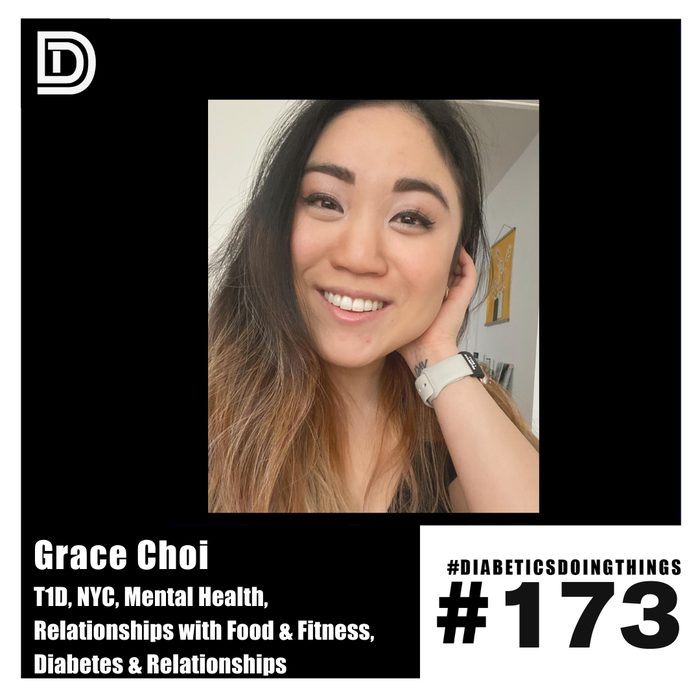
Grace Choi - T1D, NYC, Diabetes & Relationships with people and food, Mental Health, fitness.
Episode summary
Grace Choi was diagnosed with type 1 diabetes in October 2017, at 21, after two years of unexplained symptoms that started following a bad reaction to antidepressants in college. She dropped under 80 pounds before one doctor dismissed her with a racist comment about Asian diets, and a second doctor sent her to NYU Langone by ambulance. Grace, who is Korean American, talks about stigma around illness and mental health in Asian families, her history as a mental health advocate since high school, and an eating disorder she says her diabetes management made worse. A former competitive swimmer, she describes bulking back up to 130 pounds and missing the structure of being an athlete. She also shares how she met her boyfriend, also living with type 1, on a pandemic diabetes Zoom call, and a recent stretch of failed pump sites.
Key takeaways
- Grace says a doctor first dismissed her symptoms with a comment about Asian diets before a second doctor sent her to the hospital by ambulance.
- Grace says she developed disordered eating that she believes was made worse by the constant food tracking diabetes requires.
- Grace says dating another type 1 diabetic removes the awkwardness of explaining her condition and devices to a partner.
- Rob says he used a Gvoke glucagon pen for the first time during a severe low and it brought him back to a safe blood sugar within about 45 minutes.
- Grace says a run of bad pump sites pushed her blood sugar averages near 250 for about two weeks before a new site fixed it.
Show notes
Each week Rob and Eritrea will update you on all the goings on at Diabetics Doing Things, and integrate that into the show prior to our guests.
This week we talk about:
Rob’s first time using Glucagon and his sponsored video for Gvoke
Eritrea asks Rob “where tf do all the hot diabetics store their pumps while they exercise” and Rob plugs Senita, Wolaco and Myabetic for the answers!
This week’s guest is Grace Choi (@gracedwithtypeone on Instagram)
Grace lives with T1D in NYC
Grace, Rob and Eritrea discuss, among other things:
Grace’s T1D diagnosis in NYC as a 21 year old
Finding the Diabetes community
Asian and Pacific Islander Diabetes stigma
Diabetes and Grace’s relationship with Food & Fitness
Missing the structure of being an athlete
Finding love in a Diabetes Zoom
Diabetes and Relationships
And much more!
SPONSORED! This episode is sponsored by Real Good Foods, who has been a supporter and friend of the pod for a number of years. Use code DiabeticsDoingThings on RealGoodFoods.com for $15 off a $15 or more purchase!
Questions this episode answers
How was Grace Choi diagnosed with type 1 diabetes?
Grace was diagnosed in October 2017 at age 21 after two years of symptoms including excessive thirst and weight loss down to under 80 pounds. A doctor at her student health center first dismissed it with a comment about eating too much rice, before a second doctor sent her to NYU Langone by ambulance.
Does Grace Choi talk about having an eating disorder?
Yes. Grace says she developed disordered eating that she believes was worsened by having to constantly track food for her diabetes, layered on top of body image issues she had before her diagnosis.
Is Grace Choi's boyfriend also type 1 diabetic?
Yes. Grace says she met him on a diabetes Zoom call during the pandemic, and that dating another person with type 1 removes the awkwardness of explaining her condition and devices.
What is Gvoke glucagon?
Gvoke is a pre-filled glucagon pen from Xeris. Rob says he used it during a severe low blood sugar and it raised his blood sugar back to a safe level within about 45 minutes, with no side effects.
Full transcript Searchable, with timestamps
Rob Howe: First of all, welcome back to Diabetics Doing Things. Oh yeah, welcome back. This is our show. We have a little show now. I actually really like it.
Eritrea: It's been a really interesting week for diabetes and for us. I was on the gram, like a lot of you the other day, and noticed, I was creeping on Rob, and he was like, somebody in his comments had mentioned, I don't know, I think you did something with Gvoke or something like that?
Rob Howe: Yeah, I had a sponsor post go up with Gvoke, and they asked me to talk to Kenny Rodenheiser, friend of the pod, who also listened to our interview with Noor. And he's like, you and Noor are so funny that he shouted me out. Anyway, shout out Kenny again. We're going to get him on the pod. I haven't even asked him. We'll get him on the pod. Another famous fellow. Another famous guy. So we were on there, and we were talking about using glucagon, because last year, about maybe a year from now maybe a little bit before a little over a year ago i used gluagon for the first time oh wow and i have worked with Xeris, who makes Gvoke HypoPen and gvoke glucagon for a number of years like they brought a bunch of us out to tell us about the product like in 2018 and you know this was kind of before the pharma discussion as well um and i met their team and they're really cool and they're like have this innovative shelf stable glucagon and that's better than what was on the market before and blah, blah, blah, blah. Anyway, I really liked them and the team and the product. And so for the first time I had glucagon, I did an interview on the podcast, uh, with Paul, the CEO, and they were promoting this like pill pack partnership that they had where you could get glucagon for $0 copay if you had commercial insurance. So I was like, cool, uh, I'll do that to see if it works just to make sure it did. And it did. So I had glucagon pens and I had just ordered a bunch of food uh like from like a delivery service because it was like when everything was really locked down and i was watching back to the future and i think erica was at her during covid this is during covid oh my goodness so i ordered some food i'm in the house erica was at her parents house i think um and so i was there alone and i ordered a bunch of wings and like when i go in on wings i go in on wings i mean the man can eat i'm i'm a dude so anyway um my wings are on the way and I stood up and I hadn't gotten any like low alerts and I looked at my pump and it was like I had two arrows down and it was like 60 oh no and then I went and tested and I was 32 I think and I had like maybe had some insulin on board anyway I was like worried and then at that moment I was like okay I'm clearly dropping I'm clearly in a bad spot but I also have wings on the way so i don't want to ruin my appetite with a bunch of gummy bears which is what i have to treat at the time so my god okay or juice or just be full well and i don't think i had juice so it was like okay my only fast acting carbs are food and i'm about to eat a bunch of food i don't want to like ruin that it's like okay here's a urgent low like clearly a severe low blood sugar let me see what i can do with this this gvoke syringe so um the pre-filled syringe is the one that I had. So I was like, okay, here we go. I gave it to myself in my thigh and sort of like two things happened. So immediately, obviously like within the first 10 minutes, my blood sugar jumped like 35 points. Like glucagon is no joke, but also I just felt better. I was like, okay, cool. I can now, my plan to enjoy my evening is not ruined. Um, and I didn't have any, I didn't have any side effects. Were you high? Like high, high? So I went from my, my pump sensor said below 40. I was 32, I think on the test and I ended up 170 within like 45 minutes. And then I came down to like 140 without correcting. So it was actually like pretty good for me all in all. Um, I think on average it raises your blood sugar, like 120 points. I've been learning stuff on this podcast. I know. I don't. And again, this is not, this is not a sponsored episode. This is like probably an off label discussion. Uh, but I did, I gave myself a glucagon and I was able to eat my wings and walked back to the future and I had a great time and it was safe. Wow. That's so awesome.
Eritrea: I mean, it just feels like it's the little things, right? It's those little experiences that you don't get to miss out from that. You can, you know, you still live your regular life. Well, and I think
Rob Howe: too, where G-Boat comes in was previously with glucagon, y'all know like the Lilly glucagon, you had to like put the syringe in the, like in the little vial and shake it up and wait and then pull it back out. It was just like a lot of steps. So this was a lot easier than that. And I don't know it felt good and so i shared that on instagram i did like a story and i talked about it using glucagon because one of the things i discovered during all like the market research that Xeris was doing was that most of the people it was like 50 50 like hadn't used glucagon or hadn't used it since they were a kid and i've never used it i think there's a little bit of a stigma around it because it's like emergency and it's also expensive especially if you don't have insurance it can be really expensive so if you don't always have it around and you're only supposed to use it when you're passed out which is how it's been marketed and like truth truly it will save your life like if you're unconscious yeah yeah but now it's been fda approved to use in case of emergency before you pass out so you can like self-administer that if you need i mean if you're in the 30s man like
Eritrea: why are we about to drink six juice boxes why are we doing that to ourselves it's actually kind of not fair like sometimes uh have you ever had dinner and been low after dinner and you're stuffed
Rob Howe: the worst kill me like and it always happens to me like after uh because like when i eat a nice dinner i'll have like a steak and maybe some vegetables and like maybe some mashed potatoes and like a dessert but like pretty low glycemic index but i'll give myself like uh yeah so your insulin will like lower you and your protein is like later so that you won't come up until later but you don't want to be 20 you know for an hour you know not feeling good so then you got to like drink orange juice and ruin you just feel like trash it sucks i didn't and i didn't even
Eritrea: know that that was an option i guess for me i was diagnosed so long ago i feel like it was a million years ago but back in 2001 it was just a little like you said the shaker upper thing and the needle and it was like this entire kit and seemed i was very overwhelmed by it so i think we kept doing in the house but i would be lying if i said that we got a new one every year like probably the one that we had the crib was like an expired one that we didn't use again and so ever since then i'm like i never used it when i was a kid why do i need it now so now i feel like maybe i should
Rob Howe: have one in my house. Yeah. You know, and if you have insurance and you're able to get it easily and quickly, uh, it's, it's a good option. If you don't have insurance, they have patient assistance programs. And you know, if you go through it and you fill it all out and it doesn't work, come talk to me because I've been working with them really closely to make sure that we cover that on all of our marketing messaging, because not everybody has insurance and everyone who's on insulin should be, you know, should have glucagon close by or have a prescription for glucagon, glucagon, because never know when you, what if you're out of orange juice or you're out of gummy bears and you're in, you're in trouble, uh, home by yourself, uh, or, you know, or something like that, or on the go. I keep one in my travel bag now cause it's small and easy to carry. So like, yeah, I don't know. It just like having an improved product really, uh, it's something that I carry around now. So keep that thing on me, man. I keep that thing on, I keep that strap, uh, in, in there. So, um, yeah, I don't know. So anyway, I shared it on Instagram and Kenny had used glucagon when he was a kid at actually at friends for life. Uh, he told a story on the YouTube video that we did and we can include the link to the YouTube video in the show notes, but Kenny saw my Instagram story and then like three weeks later had a bad low and used his Gvoke because he's like, I saw Rob use it. He didn't have side effects. I wanted to do the same thing. And, uh, he told me that we were like playing Mario cart together or something last fall. And so then, uh, you know, we started that the story started circulating around. I shared it with Xeris just to say, Hey, you know, thank you guys for introducing me to this product because I used it and it really helped me in a tough time. And they were like, Oh, we got to get you and Kenny together to talk about it. So that was really cool. That's awesome. No, especially
Eritrea: because like, like me, how many people probably have no idea. I really thought it was still the antiquated thing. Like I knew G book was a thing. Cause I know you and I've seen the post, but I've never like taken a step further. I think it's that initial overwhelming feeling about glucagon. that's like, why do I need to know more? Hopefully it's just something I never even need, like life insurance. So it feels like a taboo almost, not a taboo, but just maybe like a weird thinking around it.
Rob Howe: Yeah, I think so. I think that's just historical and it is for emergencies and it is, you know, severe low blood sugars are serious. You know, I do the 69 jokes and it's funny and I love laughing about diabetes, but like, you know, low blood sugars are scary. Yeah. And so, especially when you're in a real, you know, severe low spot. So I don't know. It was an emergency that turned out not to be an emergency for me because I had the stuff on. You had the tools. Yeah. Wow. So, yeah, that's my glucagon story. I also then used it again like three months later because I was just like, oh, yeah, you know what would make this really easy? Glucagon.
Eritrea: Dude, you know, wow. Yeah, definitely a tool that I want to add to my tool belt now. So I'm going to look into it. My endocrinologist actually called me five minutes ago before this episode. So I'm going to give her a call today.
Rob Howe: Now you have a note for her, right? That's great.
Eritrea: Yeah.
Rob Howe: So, um, okay. So that's been a little bit of what's going on. That's with the diabetes and the spawn con. I also put in up a Medtronic video this week as well. Five CGM tips in 90 seconds, which was a lot of fun and actually has been doing pretty well on YouTube. So that's been fun to see as well. So doing more YouTube stuff, uh, since Instagram is being whack.
Eritrea: I don't know anything about the sensors. Otherwise I'd ask you a million questions probably,
Rob Howe: but we can do, we can do more about that, uh, another time. We can just Q and A about sensors. You had a question for me in our emails this week. And you said, I'm going to quote you here. Oh, man. Where TF do the hot diabetics store their pumps? Because this is not cute at all. It's V-ghetto. So I just want people to know what our professional communications look like.
Eritrea: Okay, so two things. First of all, I want you to know that that email got sent out like at 8 a.m. one morning, but it was actually written like at 2 a.m. at some time.
Rob Howe: Okay, I got it Sunday at 1 p.m. There you go, yeah.
Eritrea: And I had to schedule it because I was like, man, I don't want Rob to think I'm crazy. Because I've been having these random thoughts where I'm like, man, what do diabetic people do? So the other day I went for a run and my leggings didn't have any pockets. And I was wearing a sports bra and a tank top on top. And I wasn't wearing a hoodie because I live in Texas. We live here. Yeah. Where it is.
Rob Howe: I love all y'all in California. I do. And y'all wear sweats all year round. I see Jerry Lorenzo on Instagram in full hoodie and sweats in July. and I'm like, bro, how do you do that? Because I would sweat so much. You'd melt. I would be awful. Yeah. It would be awful.
Eritrea: It would be very, very thin. Out here, just like sweatsuit, sauna suit.
Rob Howe: Yeah, it'd be sauna suit all day.
Eritrea: So if you're going to work out outside, you have to basically be wearing very little or thin clothing, right? So I'm like, bro, where do I put snacks? Where do I put stuff? I do have a fanny pack. I'll be honest. I misplaced it. Couldn't find it. And I was like, why don't they make stuff with a ton of pockets? Like, where do you put your stuff?
Rob Howe: Well, let's be honest. It's hard to run with a fanny pack. I did my marathon, my half marathon with one, but I had it turned around on the back.
Eritrea: Okay. So it's like your booty has to support it basically while you run?
Rob Howe: Well, then that way it's not like jumping in front of me because you lean forward when you run a little bit. Anyway, so I got two recommendations for you. Okay. If you're a dude out there and you're like, okay, I see. Let's start with the women actually. We'll start with the women and that'll transition it because the ladies, ladies first y'all. Ladies have, Senita has done a lot of stuff with our lady diabetes influencers and they have pockets and sports bras that you can tuck stuff in uh also Myabetic is introducing athletic wear i think and they're they're innovating their product line to be more than just bags okay so i think they're doing the same thing like uh leggings and um and sports bras with pockets in them lululemon has i don't know if they have sports bras i know they have leggings with like tights
Eritrea: are trash dog i wore them today for my run and like i could barely put my airpod case in there Yeah, it does have tiny pockets.
Rob Howe: So for the dudes though, Wolaco, W-O-L-A-C-O, is a company I worked with and did some stuff for back in 2018. And they still make really great running gear. And they do it so that you don't have to hold your phone. And then they have like a pocket that's for other stuff. And my pump, Medtronic pumps, and I think probably like T-Slims, tandem pumps would fit in that pocket. so if you wear a tube pump i wear it playing basketball so i keep my pump on me i keep that thing on me always so um it's just tucked into that little pocket on my Wolaco tights and they are great quality i've had them for years and they work great so definitely support them and uh you
Eritrea: know sunita and my abetic as well i feel like even if i well maybe this is just me being annoying now but if i even if i put the because i think i have seen those bras on the internet like this week once i started looking into it and the pocket's like right here bro how do you how you get to that my guy like yeah i don't know diabetics do amazing things every day yeah for sure uh and the
Rob Howe: woolico i think the men's like tights if you i don't know how the sizing would work but you could you could come up with some cute like biker shorts for the ladies you could rock you ran a half
Eritrea: marathon i did yeah when 2018 okay so it's okay so it's totally doable then so i started running this week because i want to run a marathon next year and um it's hard running is tough so yeah I guess I'm trying to figure out all the tips and tricks that I would don't do what I did. I,
Rob Howe: I, the longest run I did before my half marathon was eight miles. And I did the week of the marathon. Why? Cause I don't know. I'm crazy. Even like one of my, like I was training at this gym, Erica and I were going to this gym called East side athletic club at the time that one of my friends was a string coach there. And I had known him for years and we played basketball together back in the day. And he was like, Oh Rob, you just decided to run a marathon, bro. Like you haven't been training for it at all. I just decided to run one. I was like, yeah, I had signed up for it. Uh, running was something I was just going through as part of the grieving process after my dad died. I do not enjoy long distance running. And I was trying to just do things that I didn't enjoy to take my mind away from my pain. And, uh, you know, I just had this route that I would run that was by the hospital or my dad got sick. And I was just like, I don't know, it was this big, you know, that was part of my process. I don't know. Yeah. I remember crossing the finish line of the half marathon was a great feeling. That was good. And I just felt very close to accomplishing that goal. And I did it in just over two hours. So I was cruising. The last two or three miles, I was crushing it.
Eritrea: What's a half marathon, like 13 miles?
Rob Howe: 13.1, yeah.
Eritrea: Wow. So yeah, the marathon. So I'll say this here. I feel like if I say this here, it's like a big commitment.
Rob Howe: People will know.
Eritrea: No, maybe. Okay, I would like to run a marathon next year. That's all I'm going to say. That's all I'm going to say. And I'm going to keep working really hard to do it. But it seems so difficult. And I'm not going through anything painful right now that I feel like.
Rob Howe: That helped for me. I was like, I had this internal storm.
Eritrea: Yeah, because it's like something to think about, you know, like, I mean, diabetes is annoying, but it's not as deep as like losing your parent. Like, my goodness.
Rob Howe: I will say, though, I had like my fanny pack full of the goose or whatever, like, and I started the race a little bit lower than I wanted to. I was like 80 when I started it. and uh i got through like all my goos before the end like at mile 10 we were running by a 7-eleven i just felt my blood sugar just going through the floor and i said i had walked into the 7-eleven and i like bought uh used apple shout out apple pay bought a couple gatorades pounded one and then
Eritrea: kept that thing i love technology it was great so good it's so not v ghetto yeah it's very like i
Rob Howe: but i because of those Wolaco so back to back to the topic uh i ran the marathon in Wolaco tights and I had money and pump and credit card in the tights just in case and the phone. So shout out, shout out Wolaco for powering me through that marathon. And we've had some runners
Eritrea: on the pod in the past. So I'm going to go back and listen to their episodes. We're having a runner on the pod up soon. I just talked to him, Casey, amazing guy. Can't wait for you guys to
Rob Howe: meet him. We've had some amazing runners on the pod. Um, you know, we, we had Ross Baker did a hundred marathons. He's done over a hundred marathon. He did a marathon in every state,
Eritrea: 2,600 miles.
Rob Howe: The man is a machine. Yeah. We did that interview back in like 2017, I think. This is crazy. His story is pretty amazing. So speaking of amazing people, we have an awesome guest coming up for you. Grace Choi is coming on. Grace with Type 1 on Instagram. Love her. She came on the scene, came into My Diabetes Life as a member of the Hype Squad when I was doing Rob Howe's a live show, which was super fun. And definitely a moment in time in the quarantine.
Eritrea: Oh, my God. I can't wait to get the tea. I just remember there's tea in this episode. Oh, there's tea in this episode. And I'll tell you guys what the tea is. Okay. Let's hear it. Don't tell anyone you guys. Okay. So Grace is dating another diabetic. Oh, that's right. And I know him. Yes. So I'm so excited to find out like what all the tea is there, how that is the real. Cause like.
Rob Howe: Airtray has been asking about diabetic couples a lot lately.
Eritrea: So Sarah started my interest. Like I was kind of like already like, oh, what's going on with them? Like, how do you really like, I won't, I don't think marriages or relationships are codependent, like not emotionally. But when you have diabetes, there are some things that your partner, when you don't have diabetes, does for you. I know that Rob is a superhuman and does not have this problem, according to him. Because I think that's what you said last week, right? You're like, I do all my stuff, right?
Rob Howe: Erica has been very helpful to me recently. Like, she'll go downstairs. If I'm, like, really down bad, she'll give me some low snacks. Yeah, but you're independent. She helps me order my snacks. Yeah, pretty independent.
Eritrea: But I'm not like that. Like, I'm the worst. Like, I literally, like, my blood sugar will be 78. I feel absolutely fine. I'm sitting on the couch, and I'll just look at Huston and stick out my bottom lip and be like, I'm low. He's like, oh, oh, oh, oh. So like, I wonder how that works in a relationship where both people have diabetes. Like, can you still get away with stuff? Do they know what's up all the time? Like, do they call you out on your shit? Like, what? How does that go?
Rob Howe: It's like, oh, you're 75. Oh, get up and get that snack. Stop playing with me, girl.
Eritrea: You know what I mean?
Rob Howe: Yeah, I guess we'll find out. So Grace Choi coming up on Diabetics Doing Things. But before we go, we're going to take a quick break and hear a word from our sponsors. This episode is sponsored by Real Good Foods. Real Good Foods has been a friend of the pod for a number of years now, and they're back sponsoring this episode. They have become one of the fastest growing frozen food companies in the U.S. Everything that they make is nutrient-dense, high in protein, low in carbs, and made from real food ingredients. Instead of using processed flours, everything Real Good Foods makes is 100% grain-free and gluten-free, which is how they keep the carbs so low. And they make food for every occasion. Breakfast sandwiches, which are my favorite Real Good Foods product, poppers, enchiladas, entrees, pizza, and even ice cream. Everything they make is super convenient, which helps when you're trying to eat cleaner, but you're crunched for time. It's easy to prep and you can enjoy in a few minutes. And the best part is everything is super tasty and it's available at Costco, Walmart, Target, Kroger, and in almost every grocery store chain nationwide. Or you can order online and have them delivered straight to you the same day through Instacart, which if you haven't tried it yet, there's a 14-day free trial available. Best of all, we are going to have a code so that you can get $15 off a $15 purchase. So you can get that online at realgoodfoods.com if you use code DIABETICSDOINGTHINGS. So again, for $15 off a $15 purchase, use code DIABETICSDOINGTHINGS at checkout at realgoodfoods.com. Check them out at realgoodfoods.com or at Real Good Foods on all their social platforms. Thanks again to Real Good Foods for sponsoring this pod and being a cool friend of the pod for people with diabetes for a number of years. Okay, now back to the episode. Welcome back to another episode of Diabetics Doing Things. This is the first episode of It's Kind because we got Eritrea and I are in person and then we have our guest calling in, a very special guest, friend of the pod, friend of Eritrea. Eritrea has met her in real life and she's also a very exclusive member of the 2020 hype squad around Rob Howe's a live show.
Grace Choi: Grace Choi, welcome to the show. Hello, hello. Thank you for having me.
Rob Howe: We're so excited that you're here. And I think the other thing that we're really going to we're gonna talk a lot about diabetes today we're gonna talk about friendship and I think one of the things that drew me to you initially as we met kind of during the the live show days I was like man Grace and I would be friends I think we have the same interests outside of diabetes so that's always a fun a fun quirk whenever you meet people online it's usually how it works right it's like
Eritrea: well I personally and so Grace knows but the way she talks online is very like real like it's not sugar-coated. She is not a bakery. She is not here to give you a donut. She's here for the bread. So yeah, like I love it. I love her and I'm so happy for her to be here and share her story today.
Rob Howe: Yeah, I'm excited that you're here. So Grace, as usual, let's introduce yourself and the best way
Grace Choi: to do that on Diabaccine Things is to start with diagnosis. Sure. So it's been about three years ago now, three, four years ago now. Yeah. I was diagnosed in October of 2017. I was 21 years old and I have absolutely zero family history of diabetes in my family. I'd actually been sick for a very long time. I had no idea what was going on with my body. After the fact, I've learned that there's typically something that triggers your body's response to that like autoimmune response. And so what I can pretty much pinpoint that back to for me is actually I started taking antidepressants when I was a freshman in college and I reacted in full body hives. And from that moment forward, I remember having excessive thirst, frequent urination, all the classic symptoms of a high blood sugar. But that actually lasted for two years before we get to like the bulk of my diagnosis. So that went on for a very long time. I was just like miserable for two years. And then it got to a point where I just lost an extreme amount of weight, all the classic signs, but the weight was the thing that made me go into the doctor. I hit like 80 pounds. I started to drop below 80 pounds. For reference, I'm 130 pounds right now. so I was pretty much a skeleton I wanted to get blood work done the doctor I remember said he was like I think it's probably just a thyroid issue or something like that about a week passes he gives me a call he said your blood work came back you have high blood sugar I want you to come in and talk to me so the next day I went and saw this doctor he was just the GP at the student health center um he looks at me and says so you have diabetes and he straight up told me you should probably you know just kind of like get your life together I know you're in college but like just try to eat better and like exercise a bit more you know like a lot of people a lot of Asian people have diabetes because you know you eat a lot of rice and I was like oh no okay the racist racist watchdog um so then he just sent me back home uh he well he told me I have you set up with like our in-house endo um for a few days later and he sent me back home on my way I woke up a few days later to go to the endo I remember barely having enough energy to like roll out of bed that day. Um, and just looking in the mirror that day and I was like, wow, I look like death. And then I was like, okay, out the door, I'm going to ride the train and go to school. And like, um, I ended up seeing the doctor. She took one look at me and she was like,
Rob Howe: I'm sending you to the hospital. Um, and how did that feel like, especially after being in like going to the GP, him like diagnosing you with diabetes and then sending you home, did you feel validated or like relieved when they told you to go to the hospital at all
Grace Choi: I don't know I don't think so I think I was confused because that first doctor had sent me home so when she was like you need to go to the hospital I was like I I asked her I was like how long do you think I'm going to be there I'm I'm seeing a movie with my sister tonight she was like you're gonna have to cancel that I'm sorry do you remember what movie it was I can't remember what it was called but it was that tennis movie about Billy Jean with oh I know you're talking
Eritrea: yeah uh Battle of the Sexes yeah it is Battle of the Sexes wow Rob wow can we go Media Machine
Grace Choi: but yeah they came out in the fall of 2017 and we were supposed to go see that that night um I called her I called my sister I was like I'm so sorry I have to cancel I'm going to the hospital oh great yeah it was just a big shock to me because I don't think I like diabetes was not on the radar at all I had no idea what that even meant I didn't know how sick I was until I learned about it after my diagnosis um and so they take me to the hospital um it's so dramatic they like strap me to a stretcher carry me outside to the ambulance I'm like oh I'm okay I'm okay they're like is this necessary in new york they never know you got to strap you to that is that what it is is it new york is that i don't think so um but it's not like i had to take any stairs it was just an elevator so i was like i can do it uh they took me to the hospital they took me to nyu langone um which is actually a really great hospital in new york city so i felt very lucky in that. They, I just remember they like, I had so much like blood tests done and stuff recently that I just had bruises all over my arms too. And so when they stuck the IV and they were like, what happened to you here? Like, I don't know, you know. I ended up staying in the hospital for only three days, which from talking to a lot of people isn't actually that long. um what I hear most people say is like they stayed in there for like five days six seven a week about that much um but I remember being very adamant about wanting to leave because I had to take a midterm and the professor uh that I had he was like my favorite professor but he was also notorious for not allowing people to take like retakes or anything like that so I asked him for a single day extension. I was like, I leave the hospital on Thursday. Can I take it Friday instead of Thursday? And I mean, he let me do it. I showed up looking like crap. But I remember just the entire time I was in the hospital, I just like studied and refused to think about like my diabetes and like face reality kind of, I think I was in a bit of denial. um I think the weight of my diagnosis didn't hit me until that weekend so like I left the hospital on Thursday um I took that test on Friday and then I had nothing else to really think about except what had just happened to me um so yeah I definitely was in denial for a few days about what was going on um because I don't think my mind could just comprehend it all yeah Um, uh, when I, so like rewind a little bit, when I got to the hospital, I called my sister, she told me I should tell my parents. Um, and I was like, no, they're going to be mad at me. Don't know why that was the thought I had, but it is. Um, I think like looking back on it in terms of like mental health, I think a long time fear of mine has always been like not being enough for my parents or like disappointing them um and I think that I think that's part of like the immigrant mindset too like yeah this is when your parents like they moved to this country for you to have a better life and I'm like part of me feels like getting diagnosed or going to the hospital was in some way failing them so I I was kind of scared of telling them um I finally called them I was like hi dad he's like oh how are you doing what are you calling about I was like they're in the hospital and he was like oh my god we're coming I was like no it's fine it's fine it's fine um I ended up coming up it's about like a two-hour drive from Delaware um and then the first thing my mom said to me when she walked in the room was was it something I did like where did I mess up um and she like asked the doctors that she asked me that I was like no it really isn't if I've learned anything in like the past day since I've been diagnosed, it's that I didn't do anything to cause this. Um, so like there was definitely a lack of information between me, my parents, like honestly kind of everybody around me. Um, but then my, yeah, my parents stayed with me until I left the hospital. And then me being 21 years old was like, go back home, leave me alone.
Eritrea: i'm okay i would have done the same thing yeah i mean so peace out thanks for coming to check on me but i'm good take you in all this that i left there back there yeah you're in that such an
Rob Howe: important part of your life right where you almost completely cut the cords like from being like home and you're far enough away that they can't just like surprise you and make a quick visit you know that was 21 is interesting that's one of the reasons why i went to colorado i don't talk about this very, very often is like, I didn't want to be within like immediate reach of my parents. I wanted to be like, you know, start my own life. It's not that I didn't love them. I do, uh, to the max, but I didn't want to, I didn't want them to drop them by, you know, I wanted to have it.
Grace Choi: Yeah. Like far enough away where, you know, it's like, it's a trip.
Rob Howe: Yeah. And I think, I think too, um, you know, what you talked about with your mom, not being able to accept or, or asking immediately, was this something that she had done or some, You know, that was the thing that my dad, I think, especially initially had a really hard time accepting. And since I have opened up about that on the pod, a lot of other people have both parents and, you know, children of people with diabetes have said similar stories about their parents. And, you know, I think as a parent, you just have ownership over your kids. Like, you know, you, you're responsible for them even after they leave the house and you immediately internalize some of that.
Eritrea: you know like don't let them watch tv this day make sure they do all that like i think especially like in immigrant families um so i'm not sure if it's like this in the asian community i'm sure grace can tell us more about this but i feel like in in my reality it's like you're kind of your parent's retirement plan like they came to this country there's no like a huge amount of savings there right because they're new to this country so they're investing they're making all these decisions these thoughts for you trying to plan for your future accordingly and then if something like this happens they feel like it's their fault because it was their plan for you you know what i mean so that can be tough sometimes yeah if there's one thing that the fast and furious franchise has taught me it's that you never turn your back on family rob thinks that he's uh what's his name uh
Rob Howe: vin diesel now oh no i'm just you know my whole life i wanted to be paul walker i wanted to have the cool car and the hot girls and the great you know blonde highlights you know whatever anyway anyway grace yeah so back to the topic um grace you brought up something like about your diagnosis like and you know stigma about diabetes in asian and pacific islander communities and like that stigma associated with it and also like a lack of visibility and lack of diverse voices especially in the diabetes online community what what has that journey been like i know that on this podcast we have only we've only had a small number of you know asian and pacific islander representation here, a shout out Aya Saruta, uh, who is one of my all-time faves.
Grace Choi: Saira too, South Asia. That's right.
Rob Howe: Um, and so I don't know, what has that been like as you sort of found your way into the diabetes community, you know, plugging into those, those different groups of people?
Grace Choi: Um, I think, I mean, it's definitely been, I think diabetes in itself can be very isolating. I think the fact like factoring in that I do have a Korean American background is even further isolating. I think a lot of times in Asian culture, because of that stigma around just illness in general, especially invisible illnesses. So like something like diabetes or like depression, a lot of Asian communities don't talk about. um and South Korea actually has a really big issue with suicide um because nobody talks about mental health in South Korea um it's just you just don't talk about it and that's kind of what you're taught like your problems are your own and like you figure it out you don't talk about it um but that's just that's so isolating um and I don't think that's like mentally healthy
Rob Howe: and you're like a staunch mental health advocate through your platforms you talk about your
Grace Choi: highs and lows around mental health? I think I've been a mental health advocate before I was even diagnosed with diabetes. It's something I've been struggling with personally since like high school. And in my own struggle, I found that I wanted to like, I found that I wasn't alone and that I wanted other people to know that they aren't alone either. So I started advocating for mental health through various organizations in high school. And I think that kind of just translated into adulthood. And I think diabetes just became kind of like a complicating factor in how I'm like learning how to just navigate my mental health even further. I think mental health just is so important. I've dealt with like an array of different things in terms of like I've dealt with depression since I was in high school um more recently I've dealt with some I think the body image issues have always been there but recently that's like escalated to an eating disorder um and I think that is actually probably catalyzed by the diabetes um and I think like in diabetes you have to be so aware of what you're eating all the time um in order to kind of be in control, especially when I'm only like three, four years out of my diagnosis, that heightened awareness of just food mixed with my already there body image issues led to an eating disorder. So I think like, and that's also like frowned upon talking about in Asian American or Asian culture in general. So it's like all these complex identities of like where I'm coming from and like trying to just navigate that. I feel like sometimes on Instagram, especially, which is like where I mostly like talk to people in the community. I see pages that like look so pretty or like are really targeted and specific about what they talk about. And then I look at my page. I'm like, wow, I'm all over the place. Like I'm just talking about everything.
Rob Howe: Gosh. Yeah. I run into that too. It's like, there's people are multifaceted, you know, and it's so hard to focus on one thing when there's like all these other things that are either interests or you know real things and issues that you're dealing with and and they
Grace Choi: all impact each other too like they all interact with one another it's not like they're all in their own little meat box like they're all like complicating factors in life I guess and
Rob Howe: that's what that's why I think diabetes is so complicated because it has so many inputs and And, you know, it's so closely tied to mental health. It's so closely tied to food and, you know, such a higher percentage likely that you're going to deal with an eating disorder related to diabetes. And it's tied to physical activity and it's tied to everything. There's, you know, like if you don't get enough sleep, you're probably going to be insulin resistant the next day. It's like this, like, oh, well, great. Another thing that I have to worry about, or if I'm traveling or if, you know, stress and cortisol, like I had that, we were chatting the other day on my, on Instagram. I like gave myself 10 and a half units of insulin for a pizza that I forgot to eat while I was watching the basketball game and nothing happened. Like my blood sugar didn't even like, what happened? Where'd it go? I don't know. I want answers. I know just gone. Just gone. Oh my goodness.
Eritrea: I'm suddenly walking a tightrope. That's diabetes. I feel like. And I think it goes the same thing,
Rob Howe: the same way for mental health. Like, you know, how many things do we have to advocate for? There's just so many different things that affect the whole person. And if you're going to share your story and share your journey, it's great to be honest about all of that. And also exhausting
Eritrea: to try to keep up with some of it sometimes. The disorder eating thing is really, I don't, I think we only talk about like usually the same like type of diabulimia or the same type of eating disorder, but I don't think we talk about like just even those tiny little habits that you can develop over time with like your diabetes that could potentially be really harmful. Because it's just like, like Grace said, you just have so much focus on every single meal, know, like calculating, doing math, figuring it out and how it's going to impact your body. Like it's, it's really dangerous. It can be really dangerous. Yeah. Especially you said,
Rob Howe: like you said, Grace, you're only four years in, uh, you know, I say, I say only because like you'll be living with this forever. Right. And, uh, and you know, over the life of your, over the course of your life with diabetes, there'll be different phases and seasons where sometimes things just show up differently or they change dramatically. And, uh, I think that's one of the, also the things that over a long life with diabetes, that strain and like carrying that load, especially if you're isolated and you're doing it on your own can be really difficult.
Grace Choi: I think something else that I've found in like my journey, I guess, is having disordered eating with diabetes. It's really tricky to find someone to actually have the correct experience to help you so I've seen a number of like psychiatrists and therapists and nurse practitioners and things like that um and I'm like I'm actually currently looking for a new one because I I went to a therapist about like my eating issues and she her like advice was like oh then just like eat freely like don't think about it I'm like but I can't I'm like I'm always I can't not think about it. I don't know how to do that and deal with my diabetes. That's like, it's because it's just in your face. Diabetes is just so in your face all the time. So, I mean, I think that's also another tricky part of trying to just figure it all out, but. Yeah. I mean, we're all, we're all trying to
Eritrea: balance and figure this out. No, I mean, especially like with being women, there's so much pressure just from everyone even like you have to look a certain way feel a certain way even if you be are being positive like I think that some people even I I think that there are some people who struggle with their diabetes and disorder eating to the point where like they even think it's positive like there are some people who like sell that coaching stuff online and even have like tips and tricks for people and stuff like that and I just don't think that that stuff I think even that can be harmful because we're teaching a culture of almost not like the food is gasoline it's good for your body instead of it just being like numbers on, on a little scale that you're measuring and stuff like that.
Rob Howe: Well, and I think a lot of that has nothing to do with diabetes. Diabetes is just another layer of complexity on top of that, because like you said, Grace, like eating freely with diabetes, like, what does that mean? You know, and like, that looks differently for somebody without diabetes and somebody with it. And because, you know, we've thought about, we've counted every carb since, since day one, you know, since the jump. and I used to make jokes about that like I would compulsively count other people's carbs like in college and stuff I would just like would you really yeah I would just look at their plate and be like okay boom and just like go down the line and I don't know if that was just me I think at the time I was like well I'm just going to become an expert I did it as a party trick like
Eritrea: I used to tell people that I could tell you that I can tell you the carbs in anything they'd be like what really and then they'd be like they'd quiz me and I tell them like okay and then they'd google it and be like oh my god she's a calculator diabetes coming through so much math involved in
Rob Howe: diabetes yeah absolutely we wanted to talk uh but i know we just had this weird awkward pause but i want to finish this because right now you're you have over the last few months you've changed your training regimen and you've been very open and i've been very interested to follow along like with your journey and how it affects your body image. And you're kind of like working against the way like historically society like has taught you to feel good about yourself, right? Like, because you're bulking right now, if I'm not, I don't know, walk us through the process of like how, how that's been going and like what that's been like for you.
Grace Choi: Um, I think so at the moment, I, I think I'm done trying to ball cause I've hit my weight goal. my wake goal was 130 um I'm also like I'm just so uncomfortable with how much weight I've gained it is like I have to tell myself like it's okay like you're fine but like I often find myself very uncomfortable with how much weight I've gained right now um it's I'm definitely stronger than I was before which I'm super psyched about but then like I think about like oh the weight loss thing again I'm like this is like not healthy for me so maybe I'll just stay here for a while so that's the plan right now um but it is a bit different I've been bulking for about the past years since the gyms have opened up in New York City again um before that when I was quarantined or like during quarantine um and honestly leading up to quarantine I had also started running a lot um Rob I don't know if you remember this but we were supposed to be on the same team for a running event. Um, so I was actually training up for that and also had signed up for a half marathon last spring, which all ended up being canceled. Um, yeah, I think we were going to run
Rob Howe: a Ragnar race. Is that right? Uh, yeah, honestly, I don't know. It's like a team event where you run like three miles one day, seven miles another day, and like six miles another day or like different legs. And then you compete a certain total mileage number over a period of time. And
Eritrea: we were on a team. They're really racist. They're long distance relay races. That's cool.
Rob Howe: I thought you said really racist. I was like, Oh no, no, but yeah, they're relay races. Uh, yeah, they're not really racist. They're really racist. Wow. No, I triggered you. I'm sorry. I
Eritrea: was like, Oh no, I'd be doing that to him a lot. I'm sorry. It wouldn't be surprising, honestly,
Rob Howe: but no, uh, we were on a JDRF. Uh, we were going to run that in Zion national park. It's going to
Grace Choi: be like a pretty cool deal. That sounds wow. I hope they got canceled because COVID just killing our vibes um but yeah i ended up training while i was back in delaware um there's just so much land there so i just ran a lot um and i had i think about that point i weighed about 110 pounds so since then i've gained 20 and for me being five feet tall like 20 is a lot um but i i've always grown up like swimming and being an athlete um and so now being in a different kind of like phase of life where I'm not going to swim practices three hours a day anymore it's like how do I deal with my body when I'm like I want to be active and I want to maintain a healthy lifestyle but I'm not necessarily training to be an athlete so like where does that balance lie
Rob Howe: and like you're speaking to my soul I know you're so like so do you miss the structure of being an athlete? Oh yeah. Oh, me too. I like, I just miss having to go to practice. Cause I just knew the rhythm. I was so comfortable and so familiar in that rhythm of having something to train for. Uh, and you know, I, I have a home, I've kind of built my home gym out and I love it. I'll probably never go back to like a regular gym, but, uh, it's really hard for me sometimes to like motivate myself because I don't really have anything to train for other than being in shape and like being healthy and moving. And I love being an athlete and training like an athlete. I want to be that. And I want to have kids that I chase around when I'm, you know, 40, you know, and be active, super dad, whatever. But man, I just, I don't know. There's something that just really resonated with me. And I, it touches a spot in my heart because I know that there are athletes, no matter what level you played at, who get out of that structure and really struggle to find themselves because they go into a job. Like if you're a college athlete, you go into a job and you just assume that your manager is going to be like your coach and they're going to be invested in your success. And like, they're going to teach you and show you the ropes. And it's just isn't that way. And I, uh, I don't know, you know, I just, I really thrived in that structure and, and I miss it sometimes I miss having a, Oh man, this is where the season starts. It's, it's funny. Like my body runs on a basketball clock. Like in the summertime, I want to like lift weights and get in shape and like work on my game. And in the wintertime, I'm like, okay, we got to go to practice. Like my body will just start firing up at 7.00 PM. Like we got practice tonight. Like, where are we going? It's just super strange. I don't know. You just, you sometimes don't forget
Eritrea: those rhythms. Athlete life, I guess you guys special breed of weirdos. I would like to sleep on my couch and become a piece of it. That would be great. Yeah. I go through that too. I think
Rob Howe: that's for sure. Part of the, part of the struggle now with sizing goes like, so you've bulked,
Eritrea: you're good. Like, I know you're strong as you're strong as shit, grace. Like I know you're super, super strong. Like I start, I honestly, when I started my fitness journey was partially because Cause I used to see grace running. She was every morning. Homie was on the gram. She did not miss.
Rob Howe: She did not. Yeah. I think that's when I followed you when we were running that race and you were like, I was like, man, grace is running. I better like get on my stuff and get out of the house
Eritrea: and workouts. That's all good. Posting it online helps you. Like it helps me like keep myself accountable. So like, that's why I do it. It's definitely inspiring. Like I used to kind of be scared of wanting to be strong. Like I kind of, like you also have struggled with like disordered eating and eating disorders. And I just like never wanted to be like the tough girl. But like, when you see people like Grace, you see like a girl who can really pick up some weight. I'm just like, well, I want to be able to do that. Like that looks cool. That's inspiring. So like,
Rob Howe: thank you for that for sure. Yeah. And even from my perspective, uh, so I was talking with Erica about this cause she was like, Oh, I love Equinox Hudson Yards. And I was like, well, I have a friend who works out at Equinox all the time. Uh, yeah. Grace is, uh, Grace is out there early in the morning on the east coast at hudson yards equinox just grinding respect or swimming i think
Grace Choi: you gotta get out there oh i did i went swimming the other day um they have a swim coach there who like so they have like yoga classes whatever classes but they also have swim classes um and the swim coach there he's my favorite and he writes great sets i think he was a college like d1 swimmer or something um but now he coaches at equinox and um it's really hard to go and swim and motivate at yourself but when someone's like you know when you have a coach it's like it's so much easier
Eritrea: that is new york city for you a d1 swimmer is out here coaching at you this is wild but you know what this is not a sponsored equinox podcast we would be lying if we would not accept an equinox sponsorship no i'm gonna take it anytime but yeah no um that's i don't know it's just amazing
Rob Howe: i forgot what i was gonna say no i know well i think now is a good time to transition we've been like this is throwing our rhythm off a little bit being i'm not in the same or we're usually like
Eritrea: very like we've got our thing going but it's weird because we're trying to like camera it and it
Rob Howe: works i think so now we're gonna talk a little bit about the tea and i'll let eritrea she like teased that she's like oh we got some tea we got some diabetes community because you are an active member of the diabetes community you've opened yourself up when you've talked about sharing your story and how that really helps and we've been big advocates of that on this pod for a long time so but eritrea is on a kick right now about diabetes couples so i'll turn it over but it
Eritrea: It was before this. So, okay. To give everybody who's listening, just a little bit of background. So it was a very lovely fall evening in New York city when grace and I got together for pasta. First of all, this is something like the vibes were immaculate guys. It was something out of like sex in the city, right? Me and grace are getting together. We're going to do tequila shots, maybe some wine chilling. She invited her friend who had diabetes also lovely gentleman who I'll, I won't say his name. I'll let Grace do that. And I thought that maybe he was just like a diabetes friend. Later on in the evening, Grace kind of like hints that not only is he maybe a diabetes friend, but he's kind of annoying. So I'm like, oh, this guy's not going to get very far. He's just, you know, he's just around. He's just the diabetes buddy right now that you complain to, whatever. Months later on the gram, I'm peeping. I'm watching because I don't know if y'all know, but I see all I know all and I see Grace is booed up he has now become her bae that's her man so Grace I need it all how did we get from I want to know how we ended up from you start
Rob Howe: off as like diabetes Carrie Bradshaw and you ended up as like diabetes Wendy Williams
Eritrea: I'm not gonna I'm not gonna compare her man to Kevin Hunter we're not gonna do that on this show but I am very first I'm not surprised he's a sweet guy he was super sweet at dinner his nice to meet him. He's genuine and awesome. A guy from Staten Island, like classic New York dude. It was awesome. But I do want to know the love story. Just going to clarify, he's not from
Grace Choi: Staten Island. He's not really mad. He's from Long Island. Okay. I'm sorry. I'm sorry, New York
Eritrea: people don't hate me. But anyway, give me the tea, give me the love story, the Taylor Swift of it all. I need to know, was it injection at first sight? Like what was it?
Rob Howe: I don't know if it was the tequila shots or the insulin shots, but something that's my carry
Eritrea: bread. And if the tequila is spiking, I wonder like, like, how do you even say it?
Rob Howe: Yeah. So back to grace, how did you, how did you in your diabetes, what's it, what's it like to be
Grace Choi: in a relationship with a person with diabetes? I love it actually. Um, the story of how we met is like, so essentially we were like all these diabetes zooms were happening online at the beginning of the pandemic and so we hopped on a couple of the same ones um and like at the start of every one like everybody's like oh what's your name where are you from um and we had hopped on one together and he was like oh I'm from like Long Island and New York I said I'm from New York but I'm currently not in New York um and then he like slid into the dms and was like when you get back to New York we should hang out um and so like months later I eventually came back to New York I was like I'm back in New York like want to hang out um or rather I said I'm back in New York and he said want to hang out put him on blast um so I we honestly went into it as like friends um and we we like went out to brunch somewhere um with like some of my friends some of his friends um we went out to brunch we ended up getting like really drunk had a blast of a time um but we ended of getting along really well just as like people. I think another thing I've learned is just like just because someone has diabetes doesn't mean you'll automatically get along with them. People are still people, right? But on like just a person level, we got along. So we kind of just kept hanging out. I think at the point that Eritrea came to New York City, things had started to change a little bit, but like not quite. And then, I mean, it took a while to get more serious, I guess. But I mean, I love, I love, I love him. I love dating a type 1 diabetic. I, it's great. Like he has no, there's no awkwardness at all. Like I've dated my fair share of guys, like in New York city. And there's always that awkward moment when you're like, I have diabetes like I don't know like I wear a thing on me all the time like um oh that's like another thing I just thought of that like as someone with body image issues like the fact that you have like a machine on your body all the time that was also like something to deal with um but like there was no awkwardness that you had to deal with there um I've had multiple people tell me like oh I would never date a type I would never date another type 1 diabetic and I'm like well I I don't know why you wouldn't um I guess everybody has their reasons but like at least in our relationship we never judge each other in terms of like our diabetes so if ever like like I was having a really bad week the last week and I like hit 400 300 it was never like what are you doing wrong it was always just like what can I do to help um so it's like it's made it it's made it so that we're very supportive of each other um also if ever I like call him and I'm like I'm low he's like I got juice boxes for you so if he doesn't bring low snacks I'll have low snacks or something like that um I don't know I I personally love it so before we got on uh we we
Eritrea: kind of like talked about it in the intro but so I have this I'm kind of a baby like when my blood up I'm chilling so I'll literally just like look at husband and be like I'm low I don't even tell him how low I am I could be 80 I could not even be low I could be lying and he is running okay he's up quick even if he's in a bad mood even if we're in a fight he'll go get it so it's just like I wonder with two diabetics in that type of scenario is like can you still be as I don't know annoying or dependent or like even just I don't know that bunch of a baby about your diabetes sometimes when somebody else is there to call you on your shit? I think so. Um,
Grace Choi: I mean, when I'm, when I'm really high, I'll get like really irritable. Um, so there was one day I was definitely giving him some attitude and he was like, what's good. And I was like, I'm like 300 right now. He was like, what does that mean? I'm like, you don't get irritable when you're high.
Eritrea: i've been so irritable i know rob is like apparently a monster i'm pretty short anyway
Rob Howe: uh like with people okay scorpio real yeah yeah for sure i'm just like my scorpio gets dialed up to 11 when i'm over 250 yeah and when i'm a little bit low too i just become very like aloof i'm like just just i'll just goes when one in one ear and out the other or i'm just like kind of not paying
Eritrea: attention so can you be goofy when you're low i'm kind of goofy when i'm low like i've had people ask me if I'm like under the influence when my blood sugar is low or like if I'm like zooted or something I'm like no man like blood sugar just 46 dog uh I I grew up in a very like
Rob Howe: my high school was super strict and like it was a Christian school and like if you drank somebody would rat you out and you'd get in trouble and so I was just trying to distance myself from that was very much a goody two-shoots the valedictorian you know I'm saying I you know I'm a big I'm a big rule follower you give me the rules that's all that's all I got to do it's just how I'm built. But, um, I remember like the first few times I got like low blood sugars when I like felt like I wasn't in danger, you know, but I started to feel like the, the sensitivity of being low and I had never felt like I'd never drank or like smoked or anything. And so I was like, uh, like enjoyed it kind of, it was just like a weird, like, yeah, I was just like, I kind of like sat there for a little while. I was like, Oh, this is kind of cool. Like I feel unfamiliar and I feel like very loosey-goosey. Anyway, yeah.
Eritrea: Tell me you grew up like in a strict culture without telling me you grew up in a strict culture. You said feeling low makes me feel funny. I like that. Oh my God.
Rob Howe: Hey, you know, I'm glad I went to state school for college. You know what I'm saying? That got me out of that.
Eritrea: So are there any perks to like, other than like being hyper-aware to each other's like needs, I guess as far as diabetes goes, like are there any other perks? Are there things that sometimes might like get in the way? Have you guys ever been low at the same time? Like stuff like that?
Grace Choi: um we have I actually remember one time we were both going low and we both we just had like a bag of candy open and we're just both like laying there like how you doing that's so funny I love
Eritrea: that oh my gosh we're just like trying to be okay eating some now and laters
Grace Choi: I think I really think one of like the great parts about it is like I never really have to explain like why I'm so frustrated with like a constant low or a constant high like he just he just gets that um just like he's been there he had like he also has that um so I think there's
Rob Howe: just like another level of understanding um so it's super cool I think like whether it's romantic or just friendship or just you know meeting people in a meetup or something you just get to skip so much of the explanation so much of the exposition you don't have to explain why you know what's going on and they've been there in some capacity maybe not exactly but they know you know have some idea what's going on i think it's a cool thing to share it's all good you know what
Eritrea: all i have to say is i can't wait to get like no no pressure but i can't wait to go to the wedding i can see like i was on like i was on a co-date with these people oh my god yeah this has been
Rob Howe: a very sweet turn this is like you came in with a tea and this has like been a very sweet hey it
Eritrea: wasn't it doesn't have to be bad tea tea can be good i'm not a bad witch okay my powers are for good okay no it's very good oh my gosh but anyway i just love how it's like kind of like a love story for me because he he really is such a great person he's such a funny guy i loved meeting him and then see you guys end up so happy together it just seems like perfect um so wow uh diabetes hope
Rob Howe: springs eternal right and you know shout out all those diabetes zooms and like you know lots of
Eritrea: rooms dude i went to a few of those they were i'm so i'm weird about eye contact i'm really weird like like this is hard for me kind of stuff so those those zooms are really tough at the beginning but i actually met grace in one of them that's how we met wow i need to go to more gotta go to more zooms there we go that's what it has to be because yeah it seems like it was really productive
Rob Howe: for you and a lot of people may be in the pandemic bring the zooms back you know i think especially like uh you know like you said diabetes can be isolating we're also in the covid isolation it was just uh it was it was a good time there was like every night i remember one time it was like every night of the week there was some zoom going on uh i popped into one one time on a friday night of somebody's birthday and uh and uh kendall kidder goshhorn and uh sarah johnson the diabetic cactus were in there like hey if this person's birthday and they'd love you you should come in here and pop in and so i did i popped in you were a celebrity i know i get very few i know you loved
Eritrea: for it of course I know what zoom you're talking about it's because Rob is a poor man's Nick Jonas
Rob Howe: oh my gosh oh my gosh don't know I can't wait to take my picture with Nick Jonas and be like
Eritrea: look at my son oh my goodness I'm dead oh my god I want to talk about so last this last so the last episode we had we talked about bad sites I have been experiencing so many of them I know Rob has had some bad pump sites, but this past week for you, like you said, had been really tough. Maybe tell us a little bit more about your experience in this bad site week for everybody. Yeah. Cause we've been having them too. Yeah. And it's like a common.
Grace Choi: Yeah. So if, I mean, so I went on a little pump break some time ago, cause I pulled my pens out of the fridge. And since I pulled them out of the fridge, I was like, I might as well use them. So I went on a little pump break and then I recently started using my sites again. And every site since then until like today, honestly, has been bad. And I thought I was going crazy. I think what happened with the first site I put in after the fact, I think that insulin bile had gone bad because it had been out for a while. It was like the last of it. And, you know, it's been like warm and stuff. And then I put another site in. There was issues with that one. That one ended up getting ripped out of my, my kitchen has these like, handles that like my tubing always gets stuck on so that that site ended up getting ripped out anyway um and then I put a new one on in a spot that I haven't tried before um like a little bit lower like kind of on my butt um but it hurt going in I was like okay maybe I'm just kind of being a baby about this one I just left it in there but then my sugar is just I like I probably averaged at like probably 250 for the week because I was just having so much issue with all of my sites um and when I when I do have really bad blood sugars my defiant self is like fine I'll go get
Eritrea: a bagel then yeah I was like oh my god yeah if they're gonna be high anyway might as well crush
Grace Choi: a bagel hey I'm gonna go I'm going in style I mean it wasn't the best decision because I had the bagel and then I went up like 400 and I honestly felt so sick like I thought I was gonna to throw up, not because of like the bagel, but because I was just so nauseous from the high sugars. And so I was like, okay, last ditch effort. If this doesn't work, I'm going to my endo because I do not know what else to do. I've been making sure I'm sleeping, like eating right, bolusing, pre-bolusing, like sleeping right, whatever. I'm like doing everything right. So I don't know what's going on. And it's been this way with multiple sites. I finally pulled that one out and I just started immediately like bleeding right out of it and I could smell the insulin I was like this is another bad site how did this even happen um so I put a new one in last night things have been good I haven't gone above 200 in the past 24 hours um so yeah I'm like I'm okay now but it was definitely a very frustrating like two weeks it's it's so interesting to me
Eritrea: because like so now we're gonna get to the whole thing that we're gonna find out the secret apparently rob knows he just shout out steven has been gatekeeping it from us since he got the email i'm really mad like yesterday i'm like so annoyed he didn't tell me um but so what so what is it rob like how do we stop it from happening or what did steven say well i'm gonna go into detail about
Rob Howe: it because i stopped to vet it out and like read it read it all like familiarize myself with it but steven gave us some good tips about how cannulas get bent and how sites get occluded so we're going to include some of those and y'all are going to i swear my listeners and you guys are going to think that I like planted all this, but this week Medtronic got FDA approval on a seven day, uh, site. So they've got a site that now will last up to seven days. So that's going to help. But yeah,
Eritrea: I I'm really interested in sponsored content, non-spons, not sponsored here, but I will probably
Rob Howe: do a sponsored episode with somebody from Medtronic who can tell us like how they did it. Like, what are the things that they helped address to help make it last longer? Because as you guys know sites are foreign objects and your body like reacts to try to fight against them and fight infection that's why sometimes they get like inflamed and things like that so really interested to see what they've done but before then we'll use steven's tips that he sent us in the email because shout out our listeners and always being willing to help and trying to i think that's so
Eritrea: dope by the way steven the fact that you listen to anything that me and rob said ever wrote an email. Wow. It was so amazing. I felt so special. Thank you. I can't wait to know what it is, but I didn't know that. I guess I never thought about a pump site as a foreign object. I just thought about it. Something that's like medically necessary, but now it makes me feel like, Oh, no wonder. Sometimes, sometimes they hurt and sometimes they don't. Yeah. Bodies don't know. Just trying to protect you. Different sites for different folks. That didn't work. Oh, well,
Rob Howe: that did not work. Uh, grace. I, I just wanted to thank you for coming on, uh, to the show and, for being your authentic self. And, you know, whenever I was on, you know, whenever we do those events together, you said something earlier, like, just because you have diabetes doesn't mean you're going to really vibe or click with somebody. And it was cool to like, you know, be a part of an event that didn't even happen and then get to stay connected and stay friends through that. You know, thanks for, thanks for being yourself and being you and a shout out to, we'll name him, shout out to Kevin and you guys, great relationship. It was cool to see that, you know, pop up, you know, through the, through the, the Instagram webs.
Eritrea: And no shade to Kevin. I didn't name him. Cause I feel like he's kind of private. And I was just like, I don't want to put mans on blast like that when he's a homie, but definitely follow grace guys. Like if you're looking for somebody who is honest, raw, real, and could probably kick Rob's ass, um, hit her up on Instagram, grace type 1 D right.
Rob Howe: Yeah. And if you just need a friend who's a member at Equinox Hudson Yards, I mean like that.
Eritrea: Oh yeah. The perks, the perks there. Can't wait for upcoming takeover. It's going to be awesome. definitely tune in for that she's going to show us all over new york city grace is going to be locking and loaded bagels yeah i'm ready to see grace's food spots that's for sure oh yeah
Grace Choi: well
About Grace
Grace Choi (@gracedwithtypeone on Instagram) lives with type 1 diabetes in New York City. She was diagnosed in 2017 and speaks openly about mental health, body image, and diabetes in the Asian American community.