

Steven Santoyo, Teacher with Diabetes
Episode summary
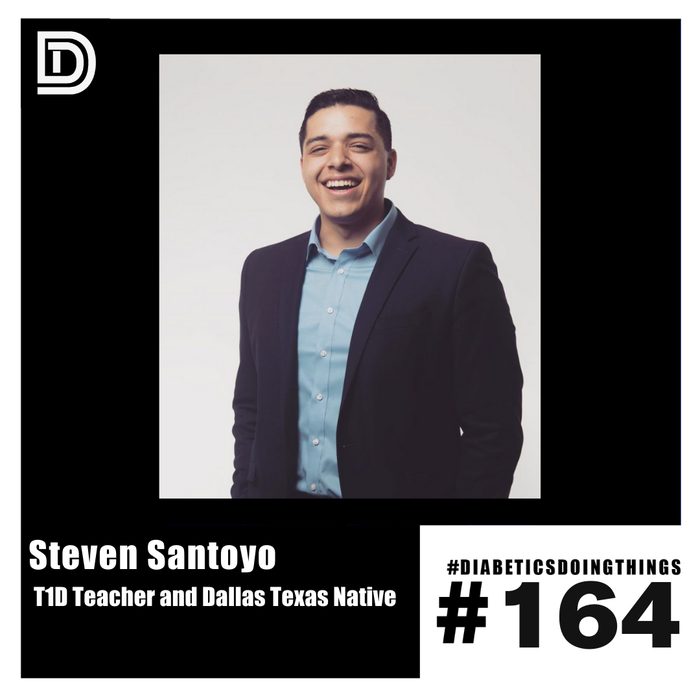
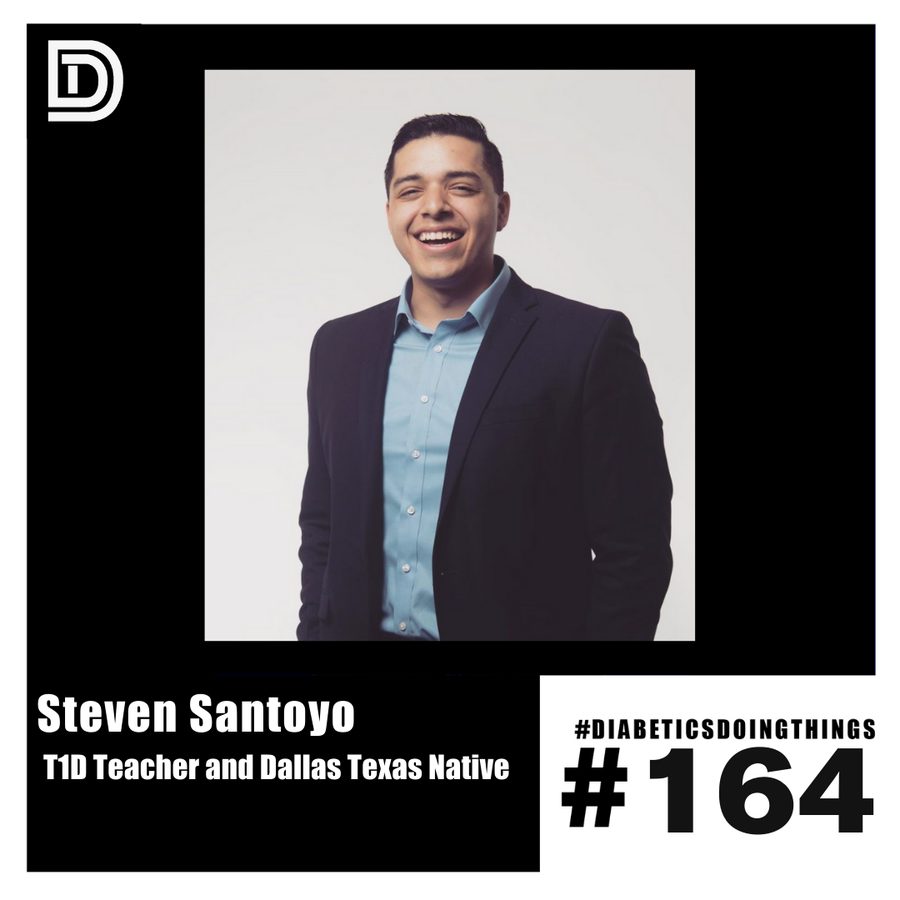
Steven Santoyo teaches eighth grade in the Dallas Independent School District, in the Oak Cliff neighborhood where he grew up. He was diagnosed with ITP, a rare blood disorder, in January 2011, then with type 1 diabetes two months later at age 13. He kept his diagnosis quiet until a close friend died from complications of type 1 during his freshman year at the University of Texas at Austin. Her death pushed him to join the College Diabetes Network, where he helped build a chapter with more than fifty members. He talks about ten years with type 1, teaching through the pandemic as an immunocompromised teacher, and running a private Instagram account where students reach him directly.
Key takeaways
- Santoyo was diagnosed with ITP, a rare blood platelet disorder, two months before his type 1 diabetes diagnosis at age 13.
- He stayed quiet about his diabetes until a close friend died from complications of type 1 during his freshman year at UT Austin.
- Santoyo helped grow the College Diabetes Network chapter at UT Austin to more than fifty members.
- He teaches at a Title I school in Oak Cliff, the Dallas neighborhood where he grew up, and says he sees his own family in his students.
- Santoyo runs a private Instagram account just for his students, which he uses to encourage them and step in when he sees cyberbullying.
Show notes
Steven Santoyo (@stevensantoyo on Instagram) joins the pod for the first time!
Steven, Rob and Eritrea discuss, among other things:
What it’s like to teach 8th Graders while living with Diabetes
Steven’s diagnosis story
How Steven found the Diabetes community
How COVID-19 has radically changed what it means to be a teacher in a post-COVID world.
Questions this episode answers
Why does Steven Santoyo celebrate his diaversary?
Santoyo says celebrating the anniversary of his type 1 diagnosis each March acknowledges the daily work of staying alive with diabetes, not just the hard parts.
What is ITP and how does it relate to Santoyo's diabetes diagnosis?
ITP (idiopathic thrombocytopenic purpura) is a rare blood disorder that lowers platelet count. Santoyo was diagnosed with it in January 2011, two months before his type 1 diabetes diagnosis, and has lived with both autoimmune conditions since.
What is a Title I school, and how does it relate to the students Santoyo teaches?
A Title I school receives extra government funding because it serves a low-income community. Santoyo teaches at such a school in Oak Cliff, where about 940 students attend and most are Hispanic.
How does Santoyo use Instagram with his students?
He runs a private Instagram account for his students separate from his main account, using it to share encouragement, teach digital literacy, and intervene when he notices cyberbullying.
Full transcript Searchable, with timestamps
Rob Howe: What's up, listeners? We're back with another episode. This one has a Dallas-Texas connection, and Eritrea and I are both interviewing Steven Santoyo.
Eritrea: I need some hard Texas rap to play, like either at the beginning or the end.
Rob Howe: You know, let's talk a brief minute about Texas rap. Like, it really begins and ends with Houston, and I think that there are some big time, like, deep cuts of Dallas-Texas rap. i'm talking i'm thinking like dsr i'm thinking even like this from dallas true true crime mob
Eritrea: right that's crime mob Yella Beezy Yella Beezy you forgot about the white man is post malone like
Rob Howe: but he's not like a dallas rapper i do love post malone i saw him at trees i saw him at trees for like 50 people back when his only song was 'White Iverson' that was incredible when trees was a place yo is trees not a place anymore wow that's crazy anyway i was the old i was like one of three people there over the age of 21, a wild time in 2014. Anyway, back to this episode. This episode has nothing to do with music or rap, but it does have everything to do with Dallas, Texas. Steven Santoyo celebrating his 10th anniversary very soon and is a teacher in Dallas Independent School District. And he takes us behind the scenes of what it's like being a teacher during a pandemic. Also a person with diabetes and how living with diabetes and his story tells an amazing story about how his first really diabesti, unfortunately passed away from complications with type 1 diabetes and how that informed his mission to connect with other people with diabetes and really brought him out of his shell. Just an incredible interview, a guy that, you know, I'm just sitting back here nodding my head the whole time. I really love his mindset. An incredible young guy who's having a big impact in his local community for students who he calls family because, you know, he sees a lot of himself there and they're in his local community where he grew up. And I'm just glad that we have people like him who are pouring their lives into the next generation. So I know I would, I wouldn't be here without the teachers who believed in me. And I'm glad that there are people who are paying that forward. So many of us would not be here
Eritrea: without the teachers that inspired, motivated and put us together. This whole interview, just listening to you guys talk, I felt Steven Santoyo for Dallas city mayor, like, man, I'd,
Rob Howe: I'd vote for him. He actually is so much better informed on local politics than I am. I've learned a lot from him. I've written letters to congressmen because of his direction. So exciting stuff.
Eritrea: Yeah. If you don't follow him, make sure you check him out on Instagram, Steven Santoyo. His interview is amazing. Words don't do it justice.
Rob Howe: And shout out to the friend of the pod, Nerds Can Fight Marie Diaz for introducing us about a year
Eritrea: ago. Uh, and you shout outs in this episode, nerds can fight T1D brookie shout out crystal. Love you girl. Um, lots of good shout outs in this episode and then just, and the CDN network.
Rob Howe: Yeah. Good vibes. Good peeps, good partners, good stuff all around. It's all you get in Dallas. Good vibes. That's right. We do some things really well. And vibes is one of them. All right. I hope you guys enjoy this interview at Dallas, Texas. Very local, very fun interview with Steven Santoyo. Okay. Welcome back everybody to Diabetics Doing Things. We were just having a great chat off the recording and decided to turn it on. We're here today with Steven Santoyo. Welcome to the
Steven Santoyo: show. Hello. Hello. Glad to be here. Happy Friday, everybody. Happy Friday. It's Friday,
Rob Howe: February 12th. And all three of us, this is another rarity for the pod. All three of us are located in Dallas, Fort Worth. So we're about to go. I've seen some folks on social talking about snowmageddon in different places we're about to experience that here which is very rare for us and i believe the high temperature for monday is 16 degrees and the low is like one so very outside our comfort zones uh and we were all just talking because we have eritrea here as well it's been about almost a year exactly to the day tomorrow would be a year to the day of a meetup that i had at hosted at Pax & Beneficia coffee shop here in dallas shout out to muyad and the other partners there at Pax & Beneficia. Jewel of Dallas. Yeah, truly in the city by the river, Las Colinas, Texas, in city by the bay. We had an awesome meetup and that's where I met Eritrea for the first time and also Steven for the first time. So I'm excited to just have our little coffee house reunion here at 530 on a Friday. When you edit the episode, will you please add
Eritrea: a clip where you just play throw it up, Dallas, Texas, throw it up, right? I'm going to put a
Rob Howe: whole DSR playlist after this. It'll be very Dallas, Texas. So anyway, Steve, welcome to the show, man. You are a person with diabetes. One of the things I really love about your online presence is how much you bring your audience into what it's like to be a teacher. And we're going to talk a lot about your profession today and your passion for young people and for education. But like we do on the show, man, uh, first of all, just share how, you know, let's talk about diabetes for a bit and, uh, you know, your, your diagnosis story and how you got involved
Steven Santoyo: here in the diabetes community. Absolutely. I'm, I'm so excited because this March, so in less than a month, I will be celebrating my 10 year anniversary. So I'm just so, yeah, it's been a, it's been my first full decade and it was, um, like many of my friends with type 1, I have two autoimmune conditions and I first got kind of aware that something was going on in my immune system when I was an eighth grader, 13 year old here in Dallas, Texas in January of 2011, was diagnosed with a rare blood disorder. Not so rare anymore, but it's called ITP. For any of our listeners out there who are really into science, it stands for idiopathic thrombocytopenic purpura. It's a mouthful. Wow. So our hematologists are listening. Oh yeah, I know what that is. Yeah. Our hematologists are listening. Shout out to all of our hematologists out there. It's essentially a blood disorder that means that my body produces a very low amount of platelets. At the time of my diagnosis, I was bruising very easily. My gums were bleeding. I'll spare you all the other details, but I had very, very low platelets and it was alarming. And then two months later, of course, went through all the symptoms of a type 1 diabetes diagnosis, you know, lost a lot of weight and just frequent urination, all the things. And boom, I was diagnosed on the spring break of my eighth grade year. What a fun spring break. I'll never forget. But it was it was a big awakening because, you know, I don't really remember how great life was before type 1, because I really felt like it, it kind of just pushed me into adulthood before I was ready for adulthood. And any young person with type 1 knows exactly what I'm talking about with a great support system I had in my parents, you know, my mom overnight had every single food item carb counted labeled, and she just really was an awesome person to have, even though she doesn't have it and no one in my family has type 1. We all even 10 years later share it together, which I think is a blessing to have. And it's been a lot of the reason why I'm still going and still still optimistic about, you know, the future of type 1, but it was certainly a scary time. I was a young student athlete. I had no clue what diabetes was. Of course, I was probably perpetuating all the stigmas that I'm now trying to undo. and you know guilty of that right and I just was very kind of young-minded and like what why me like I'm not you know the type that I think would have it I'm super active I would you know play baseball actively around North Texas and I just it just didn't make sense but like all autoimmunes that don't make sense you know we make it make sense with our community and our support team that I eventually would find. So it was, it has definitely been a whirlwind of a 10 years, but it's something where now that I realize, you know, all the greatness that is within our community, I really, people who don't have type 1, they're like, wait, why are you celebrating? Why are you calling it a diversity? And like, I can't, I love having that conversation because we know it's a, it's a hustle. We, we make decisions every day just to stay alive on top of our decisions for personal reasons or work and things like that. So,
Rob Howe: well, I think, I think it's interesting because I, you know, it is a weird thing to celebrate. And at the same time, it's the least weird thing to celebrate because when you're overcoming daily challenges, and I think it really depends on your, how you frame your relationship with diabetes. And I think that people who are diagnosed with maybe not given the right resources or it takes a while for them to find the community or they are misdiagnosed or they don't have a great relationship with either their primary care or an endocrinologist and they sort of have this really tough start with diabetes. It may not seem like something to celebrate, but like you said, when you have community, when you discover this group of people who are celebrating and you sort of acknowledge and accept the diagnosis and something that I had said a lot in the past is everybody's diagnosed twice, once when the doctor tells you and once when you really accept it for yourself and kind of take ownership of it. And, you know, I don't want to spend too much time on that because I think something that you really, that you said earlier really spoke to me and something that I see a lot when I meet young people. And it's crazy. It's been over a year since I've been at events with in person with people. But when I meet young people with diabetes, I just see these amazing little grownups, they're data scientists, they're taking external stimulus and making data decisions and then dosing based on that. even if they don't have a CGM or a pump, they're just making those decisions on their own and they're doing such a great job. And that's so inspiring to me because like you said, you sort of just grow up when you're, when you're diagnosed and you have now a whole lot more impact on your daily life and a whole lot more aware sometimes of your mortality, which has positive and negative benefits, I think. But yeah, I mean, it's a burden and you learn to carry that one way or another. And it's not always perfect, but you know, meeting young people with diabetes and seeing them do what they do. We had a takeover on our Instagram channel from T1D Brookie. Shout out to her and her family. She's a three-year-old or a four-year-old and changing her pump sites and counting her carbs and planning her meals and talking to her school nurse. And I just came away. I was impacted by that because seeing younger people have this amazing capacity to
Steven Santoyo: take care of themselves is just super inspiring. Oh, yeah, I, you know, I shout out to that takeover because, you know, watching it was inspiring for me, you know, as an educator, as a now grown adult in Dallas and seeing how much technology has changed and even the past five years. And it's all it's all of course, progress is slow, but you know, progress is still progress. And I'm so thankful to have people, you know, like you all, you know, here to help and help our community move forward. So absolutely. I agree with everything you said. Well, you mentioned education and I, and I don't
Rob Howe: want to like skip too far over because I think that, you know, we, our context for our interview, we're going to talk about your life. And I think specifically something that I was thinking about coming into this interview was you and I did another interview for college diabetes network a few months ago for their 10-year anniversary. And we talked about the importance of community for you in college. And you're actually a chapter leader at the University of Texas, which Eritrea has a big problem with.
Eritrea: But I went to Texas State and I just remember how annoying the people went to. Go Bobcats. Eat them up, cats, all day.
Rob Howe: Isn't Texas State like the big Texas party school? That has to be it, right?
Eritrea: Be quiet, Rock. Don't slander my campus. I'm not slandering. We love a translation, but I love Texas state. I have some family in San Marcos and I just love the campus. So definitely I, uh, I know what you mean, uh, but you know, there's definitely, there's some nice, there's some nice long. I mean, y'all have some good ones. I still like
Rob Howe: you, Steven. Good, good. I'm glad you guys could get past this, but yeah, you know, like, you know,
Steven Santoyo: I was kind of mentioning earlier, everyone's journey is different, right? Everyone has a different connection. And to be honest with you, everyone can advocate for type 1 diabetes as much or as little as they want. I think that's what I've learned over the years, building that community and finding it in college. When I first was diagnosed, I didn't want to tell anyone. I didn't want to tell anyone. I didn't want to tell extended family members. I didn't want them to worry. I don't know if that's the tourist in me, the stubborn, you know, young person. I didn't really want anyone to think that things were out of control, but it wasn't really until the passing of a close friend of mine from type 1, my freshman year of college, as a first generation college student at the one of the largest campuses in Texas by myself on my own, figuring out type 1, that it hit me, you know, how fleeting life is and how, you know, you know, quick life can go by if we don't really acknowledge it and give space to it and seek out our help when we need it. I don't even remember what my A1C was at the time, but I just was one of those things where it was, there was so much going on. And I'm so thankful that, you know, the College Diabetes Network came when it did, because it was a way for me to honor the life and legacy of my friend who passed away. And she's such a, I, it really brought me on my show. I love talking about her And I love talking about, you know, being a person with type 1 because she was one of my first diabetes. You know, she was one of my first rocks in high school where we would just laugh till, you know, forever and ever. And we, you know, I'm I like to say I'm a positive guy. I love really being kind of positive in a negative space. And she was that for me and journalism back in high school. And it was one of those things where it rocked me, you know, when she was gone because she followed the rules. she did everything right. You know, we, we were, we were super close, you know, and it was one of those things where she went off to another university and was far from home. It's just, it's, it's tough. And, you know, unfortunately she passed away from complications with DKA and, you know, it's, it's just, that was an eye-opener for me because I didn't really know what that was. You hear these things, but you, you really don't start to realize the importance of it until it hits close. And just when I was getting ready to, you know, celebrate five years of type 1, my parents were frightened all over again, right? You know, so that was tough. But I was so thankful to through that darkness, find the light of CDN and really at a campus as big as UT Austin, there's 50,000 or so students there. I said, there has to be at least one other, there has to be at at least one other person would type 1. Come on. And every now and then I'd go into a large lecture hall or walk down Speedway, our biggest tree on campus. And I'd hear a CGM beep or a pump beep. And I would freak out because you can't just tell, you know, a campus with hundreds of people walking by, are you diabetic? You know, or, Hey, what's up? Are you, you know, so I had to find my ways to smoothly, you know, and find my people. It's so funny because especially when
Rob Howe: you're involved in the diabetes community like we are you see something and you're like oh i could just talk to this person they'll be welcoming to it i remember uh those of you who live in dallas i was driving up uh greenville avenue right by um it's more like upper greenville by sundown at the granada and there was this girl she had a mask on she was like but it was in the summertime she had like a sleeveless shirt and her omnipod was like stuck on her arm and i almost was like how do i pull over and like talk to this person um and it was just it was funny i was like oh wait like that's weird. Like we don't have to do that. And, uh, but you know, I think, I think kind of shifting back to a more serious note, like, uh, thank you first of all, for sharing, you know, that, that story. I think sometimes, you know, it's a, it's a struggle for me because I am like you, I like to be positive. I like to make the most out of a bad situation. I really believe in the power of positive thinking and to believe that the best possible outcome can still be within reach, but at the same time, do that in a way that's not denying the things that are hanging over living with diabetes, which is like you said, you can follow the rules to a T and have all the resources that you need. And yet it is still a higher likelihood than any other person that you will pass away. And I think it's so important for us to acknowledge that because so much of the stigma around living with a disability or living with a chronic illness is to not let it affect you and don't let it get you down. Don't let it affect your attitude or whatever the case may be. And I just think that that, you know, ableist talk really is negative and really denies yourself the work that you've been putting in to survive, to thrive, to live beyond. Right. And so, you know, it's, it's a, you know, it, it touches your heart when you hear about someone who is like you, a brother or sister with diabetes, who is no longer with us because it really shines a light on how close we all are to that happening. And I think obviously those are really sobering thoughts and really down, but at the same time, I don't think that we can celebrate those small wins and victories that allow us to be the best people we can be with diabetes without acknowledging as well that there is a high risk and that there are people who don't make it for a number of different reasons. And, you know, that those people are
Steven Santoyo: with us as well. And I think it's important for us to always remember that when we talk about how weird it is to celebrate a diversity, because it is the reality at the end of the day is that we all have this condition that we will never get better from, right? That's the whole thing about chronic illness is that no matter how hard you go every single day and how hard you try, it's the option of failure is, you know, possible for us. So when we do get to celebrate a diversity, I think it's a little bit that more meaningful because, you know, you got to get one more year in. Oh, for sure. You know, and burnout is real. We know burnout is real. But, you know, ever since I read a study, taking grad classes right now towards a master's in education. And I read a study about a researcher was studying the phenomenon of burning in. so as opposed to burning out focus on what your strengths are what you are bringing to the table because every person at t1d is bringing something good to the table either for their family for themselves something so yeah burnout is real we have to acknowledge it we have to you know that's the first step to getting past it but also give just as much if not more energy to burning in And that's exactly what I had to realize through very dark months following her passing is that, hey, hold on, what would she want me to do? What would she do if the tables were turned, right? And I had passed away and she was still here. I started to burn in. I started to really find my people, find my tribe. And it's an addicting feeling. And that's how I became more of a, an advocate, more of a person so comfortable in my own skin and in my own advocacy, but it took me a lot of pain to get there. And that's why I don't I try to not push my, hey, this is what you should be like or do to other type ones, because I've been on the other side of that, too. You know, when you're ready, you will post more about it or you will put a little, you know, something in your Instagram bio. Right. Like everything is a good thing. And, you know, for me, that's just my story. That's just what took me to get there. And I, I, I'm not turning back because I just know how, how, um, kind of what a domino effect it can be for many, many others facing same similar feelings.
Rob Howe: Well, I love that perspective shift of burning in. Uh, I'm a huge believer in focusing on what you can bring to the table, not what you can't. And whether that's a core competency or a passion or whatever the case, I think it's important, but I also want to focus on what you said about somebody listening or a caregiver who's listening or a loved one who's listening, especially parents. I talk to them a lot there. I sort of meant the de facto, if you have a teenage young man with diabetes, your parents talk to me. They do. And they, you know, I think it's, everybody has their own journey. You're celebrating 10 years until, it wasn't until my 10th anniversary that I even considered getting out of my skin and talking and thinking about people with diabetes. I didn't want to be known as a person with diabetes. I wanted to be held on the merits of my accomplishments. I didn't want to be babied or taken special care of. That felt wrong to me or didn't feel natural. And it took me a long time to get over it. So I tell them, hey, it's easy to look at me now and be like, wow, look how open Rob is about his diabetes. But it wasn't always like that. And it's still not like that someday. Some days the struggles I go through or mine. And I just don't need anybody around to talk about it. Some days I have shared them very publicly. Some days I share them privately with my loved ones and friends with diabetes, because that's my choice. And I think everyone's relationship to the disease is different. And you, but at the same time, you never know when your story is going to resonate with somebody. I don't care if you get a million likes or go viral or are in a big ad or, or, or in a big campaign, or you're just sharing a day-to-day struggle that somebody, you know, gives you, you know, aligns with and normalizes. So you never know who your story is going to touch or who your story is going to affect. And I think the next thing I'd like to shift and talk about is right now we're all burnt out a little bit because we're a year into a global pandemic and every day more people are dying and every day there's bad news. And it's so easy to get swept up in the negative momentum there. And that's just everyday life. And that doesn't include anything with diabetes. So a couple of bad days in a row, or, you know, maybe a missed bolus or a miscalculation of carbs that can send you into a negative place. And I just want to acknowledge that it's okay to be there. And, um, you know, even, even the most positive people go through those things sometimes and the most successful people. So if you're out there struggling, uh, that's super normal. Everybody's going through it. And, you know, that's just, uh, you know, where we find ourselves now. And I think that's where I want to focus is you're a teacher and you spend time with students and you have an incredible heart for students and an incredible heart for pouring into young people's lives. And we're dealing with a different type of teaching that we've ever had to deal with right now. So talk a little bit about what it's been like for you the last year, not only as an immunocompromised person during COVID, but also, you know, to interact with students virtually.
Steven Santoyo: Oh, absolutely. There's, you know, I can't tell exactly where I got it from, but I want to say it's because of my type 1 that I am, I am organized, that I'm a problem solver, that I'm somebody who is optimistic in a negative environment. And that's, those are the three main things that have brought teachers across Dallas or across the nation success in the past 12 months. With so much talk of learning loss, there are teachers like me who are saying, no, we're on the front lines. We see it every day. There's learning games. What kind of 13 year old is able to swap between Zoom and another software and another software and another software program all within eight hours. That was never part of me when I was that age getting type 1 diabetes, right? So it's one of those things where it has been definitely overwhelming, you know, and depending on the school type that you're at, there's so many other factors that can make a teacher's job even more stressful. I am teaching two courses right now, and I have over 140 students, And that is a lot to manage in addition to parents and keeping them into, you know, in close communication. And I love communicating with people. So my, I'm here for the students, right? I'm not here for the paycheck. I'm not here for the accolades, the awards, the promotions, climbing any ladders. No, I'm genuinely here, you know, where I wanted to be. where do I want to be in 2020 where do I want to be during the national election where do I want to be I want to be in the room I want to be in the room with kids helping them figure it out because that's what I wished I had when I was 13 as well right so that is uh that has been what it has been like but I am a an uber optimist and I think that has been the only reason why I have survived this teaching um this this during this pandemic because there's just so much to be, it's a mindset shift. It's a mindset of really trying to focus again on, on what, what we have that is there and that is growing and that is a good thing. So I have, um, students who receive, you know, of course that I have type 1 diabetes and that they're such a, they're so, when you build trust with anyone, you start to become almost like family, Right. And that's how I really have tried to treat my profession. When you when you live and you sleep and you breathe it like like teachers do, it only becomes easier when you start to really genuinely show empathy and compassion for those that you work with. So if you come to my classroom, it's not my classroom. It's our classroom, right? It's a vibe. It's a culture. It's a space that they should take as much accountability and ownership for than I do, right? And I think that's what helps, uh, I think that's what helps get me through, you know, those long nights and early mornings, but it's been a hustle, but I've just, I'm so thankful to have structures in place and organization skills and, um, just all of that from type 1 to keep me afloat because it's really easy to sink right now. I'll keep it at that.
Rob Howe: Well, of course. And I, you know, I think people are going to think that I fed you this question as a, as a layup question, because so much of what you're talking about is leadership and culture creation and ownership and, you know, holding space and something that, something that really stuck out to me. I was at a pretty low point in my life, uh, from a, and as with everything, it came around a basketball perspective because I wasn't playing and my coach hated me and my roommates are playing and I felt like I was doing everything I could do, but I just couldn't get on the floor. And that's all I really wanted. And I just remember coming across a tweet from John Calipari, who's the coach of the Kentucky wildcats. And he tweeted something like, you know, in our practice, we focus on staying relentlessly positive because we know that things are going to go bad. We know that things are going to happen that don't go the way that we want. And that stuck with me. And for some reason, the other night I was thinking about that. I was thinking of the practice of being relentlessly positive because it is a practice and it is, you know, holding space and taking ownership and collaborating. And like you said, curating a vibe of inclusive inclusivity and say, hey, you're a part of this. This isn't me dictating this to you. You are as much involved in your learning as I am. That is a profound shift in responsibility because now I'm not just going to give you a grade. We're going to work on it together and the grade is going to be the result of our collaboration. Where did that occur to you? When did you know that that was
Steven Santoyo: going to be the kind of classroom that you wanted to curate? It occurred to me when I reflected on every athletic coach, teacher, public school educator, my sister is an educator, my aunt, who's an educator. And I tried to pull from them what I loved, what made me, what stuck with me, whether it was the baseball coach who was on me as I was bench pressing or failing to hit a baseball you know or was it from um the approach of a of a of a calculus teacher or of a history teacher the love the support so in my mind I'm thinking to myself I need to I need to bring together and mold students in my image of positivity but also in the image of these scores of great leaders and teachers to bring and see if I can create, you know, a person who, like you said earlier, you never really know what sticks with a student. And that's what's so frustrating about teaching. You don't really know if what you're doing is impactful until five years down the line when you see them at the grocery store and they say, hey, I remember you. Remember? I'm sorry I was such a pain. I kept unmuting myself on mute, but I really, really loved when you said this, you know, or those are the things that teachers really love to hear. And, you know, it taught me now that I'm a teacher, as soon as I became a teacher, I went back and I Facebook message, Instagram direct message, texted, emailed every single teacher of mine that I had had who had made an impact on me. And I said, thank you, because I for I just had no clue all the things that go into just making one day's lesson go. And as students, we think, hey, that's a job. They got it together. They went to school for this. Hey, it's wonderful. Look at you. That's awesome. But there's really a lot that could go and get in the way of those things. So, you know, you speak about athletics, you speak about being involved in basketball and you know, and we all know as leaders, it's a growth mindset we have to have. My father would always tell me, son, this life is a marathon. It's not a sprint. So you're expending all this energy to get from A to B when you still have a lot of the race to run, which that's how I try to teach my kids who, to be honest with you, some of the students that I teach are in a system of testing that where they've been over tested during this pandemic, they're being tested every other week. There's things that are happening that are systemic beyond my control as a teacher. But what I try to do as a teacher is to instill in them that growth mindset. you know they they're looking at me crazy when they score a 60 on a test and i'm like hooting hollering like yeah you scored a 60 they're like why are you why are you happy about this i'm like because last friday you scored a 30 and that's a 30 point increase boss you know that is a uh that's that's growth right there and um whenever they're so used to failing in this pandemic or we all feel at times like oh it's another failure add it to the list you need some teachers out there who remind you that, hey, this is a marathon. It's not a sprint. So I try to bring that into my classes and it's tough. It's tough because there's a lot of teachers that maybe don't feel that way, right? They feel like, sorry, buddy, the grade you made is the grade you made. I'm not going to give you grace. I didn't get grace, you know, and it's hard. It's really hard, but I try to be that person swimming against the current because it's what I genuinely feel like we need right now in our schools. And it's, it's, I think another addictive thing that if people catch onto it, it creates that ripple effect we need to just get through another day.
Rob Howe: So we could talk about this for hours. I think this is super important. This is the shit that I love. Uh, and you know, just injected it in my veins, but particularly, and I'm going to shift it a little bit. Your students aren't just any students. And I'd love for Airtray to talk a little bit about what a title one distinction is here in Dallas, Fort Worth. Uh, so that we can talk, we can talk about that. You know, these are not, uh, private school, you know, gated neighborhood, gated community kind of kids that you're, that you're interacting with. These are blue collar, uh, you know, BIPOC kids from urban communities in Dallas. And so Eritrea, like talk a little bit about what Title I means. And then, you know, what is it, what's it like dealing with these kids who have very different problems than the problems that I had growing up as a teen in suburbia, you know? And so, you know, I think it's been particularly hard on these kinds of students in the pandemic, especially. So just to explain what a Title I school is to
Eritrea: all of our listeners, a Title I school is a school that receives government funding because in a very low income community, specifically just for some background information. Stephen's School, which we're not going to disclose which one it is, just to give you some numbers, there's about 940 students at that school and 754 of them are Hispanic. The community is located in Oak Cliff, which is a nice part of Dallas. It is low income. Well, let's talk about Oak Cliff.
Rob Howe: Let's talk about Oak Cliff for a little bit. We're going to pick on Dallas because one thing that we do in Dallas better than anywhere else is we gentrify urban neighborhoods. It's like what we do. And Oak Cliff is the latest of that because when I was in high school, Oak Cliff was very much in a transition. So we're talking 15 years ago. Very much in a transition. There are beautiful historic neighborhoods in Oak Cliff, high income, very close to downtown, then sprouted up Bishop Arts District, which was very artisan and, uh, you know, beautiful, great restaurants and cafes and boutiques and very
Steven Santoyo: high end down there too. We've got plantation houses. We've got old Southern money houses. Like there's some old historical homes there that you can't like bulldoze because they're part of Dallas history and stuff. Oak Cliff country club, I think is the oldest country club in Dallas,
Rob Howe: Fort Worth. Uh, so lots of history in this area, but also, um, you know, and I think another thing, and I'll pick on the city of Dallas city planners again. One of the things that we do better in Dallas than anywhere else is racial segregation. And Oak Cliff, Texas is one of those places that was sort of gerrymandered to exist for lower income communities. So Oak Cliff, Texas, there's a lot of things going on. Still a beautiful place. Oh yeah, an incredible place.
Steven Santoyo: That's my hood. That's my hood. Like don't talk shit on Oak Cliff. Okay, get it straight. I, you know, and I, I've, I have, it's such a, it's such a big deal to me because I went to top tier university in Texas. My peers were signing contracts to, you know, become consultants, going to Golden Sacks, like Santoyo, where are you going, boss? Where are we going? Are we going to law school? What are we doing next? And I'm like, no, I'm going back home. I'm going back to North Oak Cliff. I'm going back to Oak Cliff where I'm from and I want to be a teacher. I want to see, I want to be there. I want to, that's what I didn't want to say. That's what I knew, but that's, that's, I could make it work. I don't know if I could be a teacher in the Bronx or Los Angeles. I love this. I love the places. I'd love to travel to Southern California. I love going around the country. I love speaking to all my other friends in type 1, uh, in the type 1 universe around the United States, but I knew Dallas and I know Cliff. I was born and raised in North Oak Cliff. And it is all of what you said is correct. And I think that it's such a it could be a city of itself. Right. And the students that we that I serve and the students that I it's personal to me, you know, I see them. It's like any other job. It's it's easier. They say you never work a day in your life if you love what you're doing. They say that. They say that, right? And it's one of those things where it's a stressful job. But I'm the type of teacher where it sounds cliche, pretty cheesy. But I see my family when I see my students. I see myself. Speak on it, brother Steven. Speak on it. Right? You know what I'm saying? I don't know if my colleagues can say that to the extent that I can. I hope they can. Right. I hope that's the case. But I just I feel like it is one of those things where you have to understand what is going on in the community or at least be open to listening to it in order to help beginning to fix those problems beyond Instagram story or beyond, you know, signed petition. Right. I love those those moments and those things. But I this the community I serve in is is incredible there's students every day as we speak right now that are facing food insecurity food insecurity I grew up in North Oak Cliff never faced food insecurity in my life right had two hard-working parents they worked at their companies for you know 30 years didn't go to college but there's still great hard workers they face food insecurity right but it's a generational thing of my young, my children won't, right? So now that I'm in a position of influence for my students and their parents and helping provide resources in the city to help them, I see that those problems still exist. And, you know, we talked about gerrymandering, we talked about this concept of racial disparities. And, you know, what I've realized from my students is they are so young. They are 12, 13, 14 years old. They do not know any world other than theirs. They don't. So when I show them pictures of my friends from type 1 from across the country, when I show us at a big event at UT Austin, or when I show, you know, a picture of, I even sent a link to our conversation, Rob, to one of my students who wanted to know more about type 1, the event we did with CDN, you know, their minds are blown because many of them are not what there's a world outside of Oak Cliff and East Dallas. And there's a what, you know, even going as far as Oklahoma or, you know, North Texas or SACC, you know, these places, they love getting out of the neighborhood and it's some, some of them have never. Right. And that's my job too. That's what I'm like. I probably should be, you know, focusing a little bit more on you know what's the difference between a metaphor and assembly but part of my job is also teaching them life skills and communication skills and start dreaming now because if they don't what will those problems you fix will they even see the world around them as a problem and how will they help solve it or how will they help keep it a problem right so i just i get so passionate because I see and I teach from an asset-based perspective. In education, we call that asset-based because when you see your community as having value, it again is a ripple effect that is addictive and that really truly pushes people to the change necessary. But if we view our communities as other or if we view our communities as the liability rather than an asset, that's where change won't happen in this generation it'll continue to be our children's children's problem right and that's just not how I was taught that's not how I was raised that's not what I learned in school anywhere even in Oak Cliff so I think that you know it is it it's exactly where I want to be yes it's a pandemic yes there's so much going on but again that the growth mindset what a what a great opportunity to to make true true learning happen I feel totally I completely just want to agree with Stephen when he says like when you see your own community as serving and then just like a tiny backstory so I used to be at a campus not too far from where Stephen's at so they're kind of sister campuses that feed into each other so we serve the same demographic of students I had those same kiddos at my campus so I completely resonate with what he's saying that those parents that come in you see your parents you see your cousins you see your kids and that's why you're so motivated to try to help that community because if I was able to make it out so can you and you want to give those tools to those kids so when you say that I feel it deep
Rob Howe: in my soul thank you thank you well and I think too there's this there's two notions that kind of came to me one is this notion of home and you talked about you see your family when you see your students and you know I think I took that for granted for a long time I wasn't necessarily I wanted to get out. I wanted to get away from where I was, where I grew up because I just was more trying to see the world and was kind of teen angsty and wanted to go do something else and maybe be a little bit further away from my parents. So they couldn't check up on me all the time when I was in college. Maybe that's, maybe that's true. But, um, you know, I, when I come back and now that I'm, you know, starting to get more gray hair, um, you know, Eritrea knows she works out. She works out with my, one of my like best friends from, you know, high school that is, was my running back in junior high and high school. And my, you know, point guard on my basketball teams early on and my still good friend. And I have, I'm deeply involved now with another one of my friends who was a teammate of mine, who's, you know, working on bringing the game of golf to underserved communities in Dallas. And it's like, you know, for the first time I'm like, well, you know what, these people that I maybe rejected for a while, because I was trying to experience. And I wanted to see the world outside of Texas. And I saw the mountains in Colorado for the first time. I was like, yeah, this is great. I want more of this. But you remember where you came from and having ownership of where you came from and pouring back into the community. I just wanted to big time applaud you for that, for bringing that to the next generation. Because the next thing that it reminded me of is that while a lot of these kids have never left their neighborhood, have never been north of 635 or never been outside the DFW Metroplex or think of Fort Worth as a cross-country trip. Right now, they're virtual and they're joining Zoom rooms and they're joining Teams rooms and they're joining Google Hangouts and they're Googling things and they're searching for this sort of world at their fingertips. Like, yes, we're in the house, but the whole world is through the phone and through the computer opening them up to that kind of curiosity as well. And like you said, growth mindset just applies to so many different things. Have you noticed any kind of different growth or any particular stories or interactions with students during this time that you're thinking, you know what, I am semi grateful that we had to adjust. And you know, this is given an opportunity to a student or an
Steven Santoyo: opportunity to connect with them in a different way. Oh, yes, I think, top of my mind right now as an educator are my students who are special education or maybe autistic or have different learning strengths that sometimes can be hard to differentiate or address during the school year with the quick pace of things. I must say that being an educator who is, of course, I'm aware of what I need to do in order to help students and any accommodations they might have. you know, as a person with type 1 diabetes, I know the world of accommodations. I know how stigmatizing that process feels. And I just really love being able to fight and champion my students who might have emotional disturbances or learning disabilities or anything that they have previously been told will prevent them from learning. And I just love flipping that on its head and helping them one-on-one through Zoom is so much more helpful for some of them because they do get that attention and time they need. Where it is sometimes a negative is with the social interaction of things, right? But teaching them ways that I have learned to make those breakout rooms less awkward have helped them. And I try to remind them that they're not alone in that. I am a grown adult in staff meetings and breakout rooms and my colleagues are awkward, right? So there are some, it's just one of those technology things that we're going to have to get past and get over. But, you know, they're so resilient. And I'm just so genuinely impressed with how they are able to make it work to figure it out. I feel like no one said it, no doctor said it when I was first diagnosed with type 1 diabetes. But I felt like what everyone was telling me, whatever good resource I had was figure it out. Right. At the end of the day, we are the ones pricking our finger or checking our CGMs, administering the insulin doses, keeping ourselves alive. Right. Mom or dad does it or, you know, caregiver does it. But at the end of the day, I had to have that tough conversation with my parents when I moved away from Dallas for four months. Hey, as much as you can read my cgm ultimately you are four hours away and it will be me who takes care of myself and makes that conscious effort to to be my own um you know my own best self to i want to see myself you know live a lot right and i i think that's what at the core of it every type 1 feels And I just, I see that in our kids too. They're figuring it out, right? How amazing our expectations are of them to just figure it out. You said it, Google this, that, and the other, and they're making it happen. And I think sometimes that goes for granted whenever we are only focusing on a test score or a GPA.
Rob Howe: yeah i mean we're raising humans right yes multi-dimensional multi-faceted uh problematic deeply flawed and at the same time you know uh capable of so much uh so i mean i just uh i mean we are big fans of you obviously we we uh would love to you know i just i think of the teachers that had huge impacts in my life had extremely similar approaches and you know i know your your students are lucky to have you. And, uh, you know, you talk about, you'll never work a day of your life. I know you're working, you create a ton of content and I do want to talk. So I have inside information here, sorry, inside the trading, just call me Martha Stewart. So I know you have a private Instagram that is, uh, dedicated to communicating with your students. And, um, where did that come from and how, and what kind of conversations do you feel like, you know, because, because I want to set sort of the context is like, you are an, are an authority figure and, and also a caregiver in a lot of ways and a confidant and advisor mentor teacher you know the teacher sort of encompasses all of those things you know what what was it about you know where you were in the journey of your of your teaching journey or what have you that said i need an outlet for this so that students could have another way to communicate with me that's maybe less formal and maybe more open to these dialogues and then what kind of things have come
Steven Santoyo: from that, from you opening that avenue up? Absolutely. So I, again, there goes me, that's, that was, that was a by-product of me burning in me freaking out saying, how am I going to get this done and burning in on what it was that I was good at, that I knew I had strengths in. I studied communication at the university of Texas at Austin. I helped manage the type 1 diabetes chapter of the CDN there got 50, over 50 members. And a lot of it was because of a social media presence, because of my understanding of advertising, of marketing, of how to get people in the room. And I was able to manage an Instagram account and kind of get my, you know, dip my toes and get my feet wet with what all of that encompasses. What is an eye-catching advertisement, right? You know, we study those things. Many different cool classes I took were just on why, what is the psychology around social media and why it's so addicting and why we can't let go of it. And I tried to take the best lessons of that and pour it into Type Texas. And that was the name of our college diabetes group. And, you know, becoming a graduate and going right into teaching and going into me being honestly about 10 years older than my students, that's not much compared to some other educators out there who've been in it for a long time. I thought to myself, you know what you love designing, you love creating, you love making things fun and interactive. And so do your students, right? Not all of them have social media, but that is another way to teach them lessons, to teach them about digital literacy, to teach them about what to post and what not to post. Because to be honest with you, teenagers are still teenagers. These students are still telling me who their crushes are. They're still telling me in private, you know, what is happening, what the latest tea is, right? Like what all that stuff that happens in cyber bullying is real, right? So as an authority figure, I also use it as I kind of like Trojan horse it as like me being a teacher and giving them incredible, you know, content and encouraging messages and reminders on their greatness and all of that. But I also use it as a way to intervene in the event there is cyberbullying or in the event there is a redirection that needs to happen with the student. So it has been incredible. It has been something that I'd like doing. And it's something that is a passion of mine and they can see it, right? They can see that that's different and unique and one of a kind. And it's just, it's a careful line to walk though, because of course, if you're not really skilled on social media, you can get trapped into posting the wrong thing or saying the wrong thing. So I'm so lucky to have so many fellow educators before I went live with it, give me their fair warnings and say, okay, here's what to do. Here's what to not do. Here's what is appropriate. Here's what's not appropriate. And I think that is, it's a big undertaking, but it's honestly one of those net positives that really can make or break a day for a student who feels like, wow, he gets me. Right. And I think that's always what I, what I try to, to make a student, a colleague, a person with type 1 diabetes, a family member, a friend feel. So if I can do it through Instagram, well then there it goes. It's a good idea.
Rob Howe: Well, and I think it comes back to what you said earlier about burning in, because like you said about social media, it can be an easy way to burn out, but you know i think one of the things that goes sometimes just unnoticed or doesn't get a lot of credit is communities like people with diabetes and communities like the ones you're talking about that are small in the grand scheme of things you know no big brands are not reaching out to students or to teachers with micro student communities and saying hey let's give you a bunch of money and advertise here but that doesn't diminish the impact that it has absolutely yeah you know i i think that that really is, you know, comes back to what you said earlier as well. Like never working a day in your life. I'll give a personal example. I mean, today we started this podcast at five 30. I had a long week in diabetes and at work and I was tired. And at the same time, I'm going to walk away from this interview with my cup full because it's, this is what fills me up, you know, and connection and community and, you know, talking with people who are helping people and making an impact and have that growth mindset. You know, you can say it's woo woo all you want. You can say it doesn't really, you know, it's, it's all sort of in the ether. But, you know, I know that it does have a great impact on people. So, you know, thank you for giving above and beyond just the job description and for being more than, more than a diabetic, more than a teacher. You know, look at that.
Steven Santoyo: And I think, you know, No, thank y'all. I appreciate it.
Rob Howe: Well, you may not see the results today, but like you said, in the grocery store 10 years from now, when you bump into that student, I think those are the moments that I think as leaders, as teachers, you know, I need to go email some of my teachers that I haven't talked to in a long time because they, you know, put me on a path and all of that stuff is super impactful.
Steven Santoyo: I want to say this about Steven's students. I have noticed that on his ID that's private to his students, old students still follow because they like keeping up with Steven. They like love talking to him. There really is something there with that teacher connection. And I just think it's so beautiful because this whole conversation has really reminded me of that quote, be who you needed when you were younger. And it's, I cannot, thank you so much, Stephen. I can't think of a better person to embody that quote. Oh, thank y'all so much. You know, and I can't, I can't, I love it. And I appreciate y'all's words so much, but I can't take any credit for it. I honestly, like I have so many amazing people in my corner. Right. And I think I'm only here able to speak to you on it because of all shout out to the college diabetes network retreat squad from 2017. You know who you are. I know you're listening, like thank every single person that has had an impact on you because I am a byproduct, like I said, of them, of two amazing parents, great coaches, great teachers, a great sister, just like, yeah, I just love being able to speak on that with other people who get it right. And I think we all can connect through that common thread, no matter what our A1C is, no matter what our type is, or no matter what is going on in our world, we can still focus in on the goodness that we felt, right? And it's hard to feel that in a pandemic and with all the headlines and all the news and everything, but it is there. And I, I just, I think about them when I'm alone and I'm planning a lesson and I'm right. I think about my, my friend who passed away. I just, that's what fuels me and that's my motivation. And I I'm just so, so beyond blessed to, to be able to speak on it. So thank y'all for the opportunity. Well, we, uh, this has given me a ton of Dallas, Texas love
Rob Howe: today. We're, uh, you know, just shout out the DFW Metroplex. This is, this is our home. And, you know, I think that there's more opportunity probably for us to do more local things and really make sure that this community is, uh, is represented, uh, and that we're taking care of business at home because there's no place like pouring back into your community, I think. And that's something that I have been slow to learn over the last decade, really. But I did not want to come back here. And when I did, it made a profound difference in my life. This is where my life is, this is where my business is, this is where my friends are. And I think that there's no place like having an impact at home. And sometimes you just have to get outside yourself a little bit before you realize that. But man, thank you for coming on the show. We, you know, I'm continually inspired by you and all the work that you do and by all our teachers who are out there overcoming insurmountable odds. So, you know, during the pandemic. So, you know, I don't wanna focus too much on like what's in the future for you because I want you to come back on the pod. So I'm gonna leave that kind of out there, but I do wanna wish you a great spring and an awesome President's Day weekend. um you know teachers need rest too that's true that's true thank you all so much it's been fun
Eritrea: it's gonna be great uh can't wait for your takeover as well and
About Steven
Steven Santoyo is a middle school teacher in the Dallas Independent School District, teaching in Oak Cliff, the Dallas neighborhood where he grew up. He has lived with type 1 diabetes and ITP since 2011 and was a College Diabetes Network chapter leader at the University of Texas at Austin.