

Diabetics Doing Things FOUNDERS with Robby Barbaro and Cyrus Khambatta of Mastering Diabetes
Episode summary
Robby Barbaro and Cyrus Khambatta co-founded Mastering Diabetes, an online coaching program built around a low-fat, whole-food, plant-based diet for type 1, type 1.5, type 2, prediabetes, and gestational diabetes. Both live with type 1 diabetes themselves. They explain how the diet let them raise carbohydrate intake while lowering insulin use, and why they focus on reversing insulin resistance instead of chasing A1C alone. They describe starting out teaching small coaching groups while dating, the response that convinced them to build a company, and writing their first book together. They also talk about staying in daily contact as business partners, training as athletes on a plant-based diet, why most doctors get little nutrition education, and Robby's habit of flying with a box of fresh produce.
Key takeaways
- Cyrus says switching to a low-fat, whole-food, plant-based diet dropped his insulin needs 10 to 50 percent within the first week, even while he increased carbs.
- The Mastering Diabetes plan caps dietary fat around 15 percent of calories, which Robby and Cyrus say is what allows higher carbohydrate intake with better blood sugar control.
- Cyrus says insulin resistance raises risk for chronic kidney disease, fatty liver disease, Alzheimer's, and heart disease, not just blood sugar swings.
- Robby and Cyrus say insulin timing matters: wait until blood glucose is around 120 and falling before eating a higher-carb meal.
- Cyrus says switching to a plant-based diet made his muscles more elastic and sped his recovery as an athlete.
Show notes
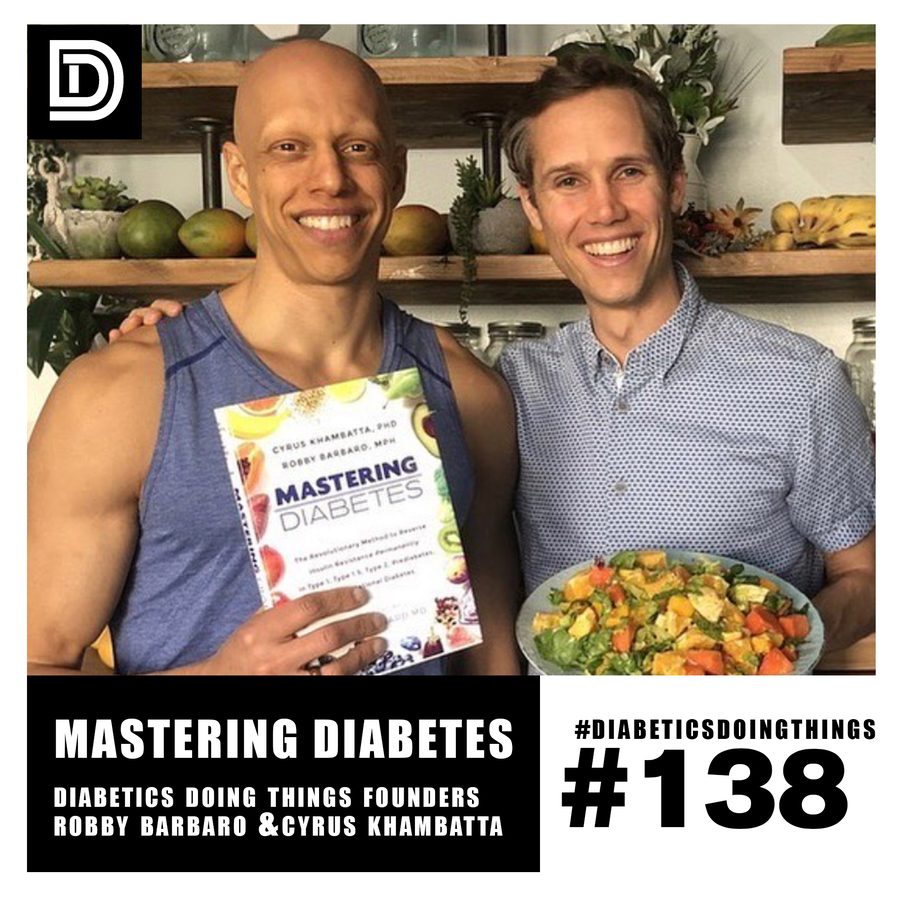
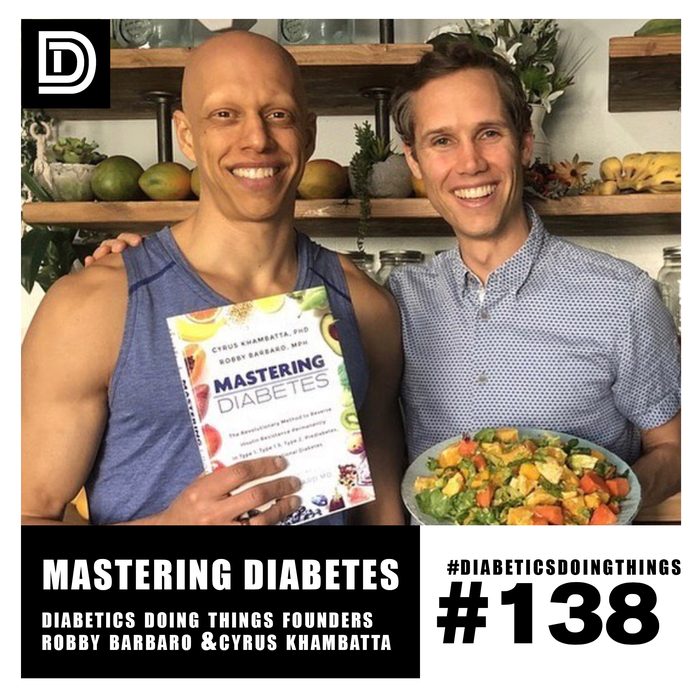
Continuing our amazing FOUNDERS series, I’m very excited to introduce the dynamic duo behind Mastering Diabetes, Robby Barbaro, MPH and Cyrus Khambatta, PHD.
Robby has been on the podcast previously, back in 2017 on episode 061 and it was exciting to talk about the journey of Mastering Diabetes since that interview.
We talk about how their partnership has grown since 2016 and what it’s like to run a business about diabetes as a person with diabetes, alongside a partner with diabetes. Spoiler alert: that’s a lot of Diabetes to deal with. But these two continue to excel and thrive as they help thousands of people with all kinds of Diabetes.
Their book released last week and is called Mastering Diabetes: The Revolutionary Method to Reverse Insulin Resistance Permanently and is available wherever books are sold.
Be sure to check out this interview, and if you want more information on these two, be sure to check out their appearance on the Rich Roll Podcast as well!
This episode is sponsored by Real Good Foods! Be sure to check out their new Breakfast Sandwiches, made with cauliflower cheesy buns with only 2g net carbs! They’re packed with protein (18g) and have no gluten or grains. Available in sausage egg & cheese and bacon egg & cheese flavors and they’re ready within seconds. Order them online or find a store near you today!
Questions this episode answers
Does a plant-based diet lower insulin needs for people with type 1 diabetes?
Robby and Cyrus say many people on insulin see their insulin needs drop 10 to 50 percent in the first week of switching to a low-fat, whole-food, plant-based diet, even as carbohydrate intake goes up.
What foods does the Mastering Diabetes program recommend?
Robby describes a traffic light system where green light foods are fruits, starchy vegetables, legumes, and intact whole grains, eaten with a maximum of about 15 percent of calories from fat.
Why focus on insulin resistance instead of just A1C?
Cyrus says insulin resistance is linked to higher risk for chronic kidney disease, fatty liver disease, Alzheimer's, dementia, heart disease, and cancer, so managing only A1C can miss bigger health risks.
Can athletes perform well on a plant-based diet?
Cyrus says his muscles became more elastic and recovered faster after switching to a plant-based diet, and he calls the idea that athletes need meat outdated 'bro science.'
Full transcript Searchable, with timestamps
Rob Howe: What's up, Diabetes Online community, ladies and germs? Hope you're having an awesome day. Got an awesome episode coming in at you, coming at you, coming at you. Lots of afternoon caffeine coming at me. This episode is all about an amazing, amazing life journey, really, for two guys, Robby Barbaro and Cyrus Khambatta. And they are the brains, masters, masterminds, founders behind the Mastering Diabetes program. They have online coaching. They just published a book, their first book together by the same name, Mastering Diabetes, which as of time of publishing is available on Amazon and wherever books are sold. they're posting pictures on their Instagram in Barnes & Noble. I haven't been to Barnes & Noble in I don't know how long, but they have them there. Also, I used to go to Barnes & Noble a lot when I was a kid. That's another story for another time, but I will get mine on Amazon. It's an amazing book. It's packed with strategies. It's packed with exercise. It's packed with tons of information for people with diabetes of all kinds. I'd highly recommend you go pick that up. If you want to learn more about Robby specifically, he was on episode 61 back in 2018. Um, and we dig into a lot of really cool things about his life and how he, his journey led him ultimately to Cyrus and mastering diabetes. So without further ado, please enjoy this episode. I really, really like these guys. Uh, they are changing a lot of people's lives. They're super positive and getting to meet Robby specifically last year in LA at the Myabetic Awards was just a dream come true. Just a super giving guy. I strive to be like him. One of these days, I'm going to check my luggage and carry on a big box of fruit. So stay tuned for that content. It's going to happen. Without further ado, please enjoy this episode with the founders of Mastering Diabetes, Robby Barbaro and Cyrus Khambatta. Thank you for continuing to listen to Diabetics Doing Things. We've been doing this for four years now thanks to listeners like you and the support of amazing sponsors like Real Good Foods. If you're involved in the diabetes online community, then you have for sure heard of Real Good Foods and their low-carb pizza and enchiladas, which are delicious. But they've really outdone themselves this time with their new breakfast sandwiches. It's just like your typical breakfast sandwich, sausage, egg, and cheese, or bacon, egg, and cheese, except the biscuit is made out of cauliflower, and the whole sandwich has only two net carbs. That's two net carbs. And if you pop it in the microwave, it's ready in seconds. I'm not a big breakfast guy because I don't like having to deal with big blood sugar spikes for a high-carb breakfast. But when I'm really craving a breakfast sandwich, I grab a Real Good Food sandwich out of the freezer and hit the road without having to worry about a big spike in my blood sugar. Check out realgoodfoods.com to find them in the store near you or use code ROBHOW, that's me, to get a discount when you order the sandwiches online. I'm a big fan of brands who continue to support creators with diabetes, and there has been no bigger supporter of me and my friends in the diabetes community than Real Good Foods. If you haven't checked them out yet, give them a shot and let me know what you think. And now let's get back to the episode. Welcome back to another episode of Diabetics Doing Things. We're telling the amazing stories of people with diabetes from all across the world. Got two very special guests today. One returning to the podcast, one on for just the first time, Robby Barbaro and Cyrus Khambatta. welcome to the show the the geniuses behind mastering diabetes welcome guys thanks so much
Robby Barbaro: rob we really appreciate being here it's great to be here well i'm really excited to dig in because
Rob Howe: obviously you guys have a new book coming out february 18th also called mastering diabetes and it's the subtitle the revolutionary method to reverse insulin resistance permanently in type 1 type 1.5 type 2 pre-diabetes and gestational diabetes wow it's a mouthful all those different types of diabetes, as you guys know. But I also am doing this series on founders with diabetes, and you guys also fall into that category. So I'd love to cover as much as we can in the limited time that we have. So first of all, how are you guys doing? You guys are on tour right now for
Cyrus Khambatta: the book tour. What's going on? Yeah, we're having actually a really good time. So for the past, I don't know, maybe like month or so, we have been getting on a lot of podcasts and then also traveling around doing sort of like in-person appearances and, you know, trying to get on television shows and really market this book. And it's been really fun, no questions asked, but it's also incredibly tiring at the same time, right? Because you want to be able to spread the word about, you know, why a plant-based diet is such an effective solution for all forms of diabetes and why it can really help you control your blood glucose with precision for type 1. and it's just like you know that we're humans and in this process of traveling and publicizing the book and really like going at it you know sometimes we're you know we don't pay attention to our glucose as much as we want to or you know quote unquote should so there's like a real human aspect about that about this which I'm actually really enjoying and it's really helping me focus on like you know what you can only provide to the world if you are taking care of yourself and it's a really a good reminder of that. Yeah. The whole journey has been really fun. Just so people know that's Cyrus talking. Now you got Robby talking here. And like Cyrus said, we've been doing a lot of podcasts traveling around. And honestly, we've been on some big podcasts, Rob, but being back on yours, it's like really, really exciting. I mean, you're, we're speaking to honestly, like our people to a certain extent, you know what I mean? Like you have a lot of type ones listening to the show and all three of us on this call living with it. And you just, as much as people want to try, unless you experience it, you just don't fully get it. And we made sure to integrate that into this book, which is something we're really proud of is to sort of serve the type 1 community with information that really does speak to us. And I think you guys can attest
Rob Howe: to this as well. Whenever you meet somebody with diabetes who you may have only tertiary encountered online or may not know at all. It's so cool to just skip all that preamble. You instantly have so much in common, so much connection that you just can't get anywhere else. So super exciting. And it was also great to run into Robby at the Myabetic Awards last year in Hollywood. A great time to finally meet the man, the myth, the legend. He did not have a box of fruit with him at the awards ceremony. So I felt a little bit robbed there, but... Robby, come on, man. I'll fix that next year, bro. Perfect. So guys, I think let's start. I'm going to steal a John Wooden quote. We're going to begin with the end in mind here. Reading some of the results from some of the testimonials you guys had included in the book and obviously seeing some of them over the years online. When did you guys know that Mastering Diabetes was – you were going to go all in on that? That was sort of what you were on this earth to do at this time?
Cyrus Khambatta: Okay. So let me answer that question here. So Robby and I, before we actually created Mastering Diabetes in January of 2017, we had been working together in a more informal context. We were dating, Rob. That's right. Yeah, perfect. They want to jump in a relationship. So we were teaching people. We were running what we consider to be small group coaching. So we had a small army of people living with type 1 and type 2 who wanted to adopt a more plant-focused diet. So we would run small group video conferences with them on a weekly basis. And we would teach people, you know, how we went about this process. And we were, you know, teaching them how to implement a plant-based diet into their life. And we did this for like, you know, the better part of a year. And within the first two months, month, two months, it was so blindingly obvious to us that the approach that we were helping people incorporate into their lives was really, really working for them. And when I say working for them, I mean stabilizing their blood glucose values, reducing their need for insulin, reducing their need for oral medications, helping them lose weight, helping them gain energy. And it was like Robby and I would have these conversations outside of the group coaching phone calls. We were like, oh, my God, did you see what happened to Justin? Oh, my God. And what about Myra? And it was like we knew that this was a powerful approach, but it was a good reinforcement over and over and over and over and over again. And that gave us a lot of impetus and a lot of like motivation to want to create matching diabetes and really become a go to resource for people living with all forms of diabetes. It still never gets old, Rob. I mean, the new testimonials that come in, it just it never gets old. But I mean, the question is like, when did you know? I would agree with what Cyrus said there. I'm also going to throw it in that I think we both knew almost as soon as we saw it happen in our own body. To a certain extent, like this will work for others. And then we went back and saw the research. I mean, I've been doing this for 13 years now. I think it's you for 16? 18. 18. 18 years living with type 1 diabetes. Well, type 1 for 20. And then doing this diet for 13. But anyways, just experiencing your own body every single meal. Like this whole concept is about maximizing insulin sensitivity. And us all living with type 1s, we're just these amazing test subjects for that. and when you just see it in undeniable fashion wait a minute i can eat this many grams of whole carbohydrate i only need that much insulin like that's just incredible and then now the cgm technology like wait a minute i'm not even spiking i'm i have a steady rise and a steady fall just like a normal healthy human and that was just that was the beginning of knowing i think we just kind of eventually knew hey we're going to help people with this down the road but uh you're exactly right once the small group started launching and you see we're getting results. Okay, wait a minute. How can we scale this? How can we give this to more people? There's over 110 million people living with some form of diabetes that can benefit from this. So let's,
Rob Howe: let's figure out how we can help. And that was honestly one of the first things that kind of attracted me to you guys and wanted to get you on the podcast was I think somebody sent me a message maybe hadn't really looked into you guys as much. We're like, Hey, this person says they can cure diabetes. You need to debunk this and have it on the, have it on the podcast. And so I was like, okay, well I did my research and I was like, well, that's not really what they're saying, But so let's have him on anyway. And Robby just came on. And one of the biggest things I have the most respect for you guys about is that if you practice what you preach, right, you guys did the testing on yourselves and your own results are the results of your program. and I listened to Cyrus on another podcast on a part of my pancreas podcast with my buddies Matt and Ali shout out to them and listening to early days when you were first diagnosed with type 1 and the typical American diet that they sort of put you on for you to stay in that you know high carb but but moderation eat the same thing basically every meal and you weren't having results with that. And, you know, then the immediate shifting to the plant-based diet, just like the night and day difference almost right away. Is that the same type of response you see these days? You know, people are following the plan that their doctors provide them,
Cyrus Khambatta: switching to you guys and seeing immediate results? Yeah, I would say yes and no. So if you are living with insulin-dependent diabetes, whether you're a type 1 or a type 1.5, or if you're insulin dependent type 2, meaning that you have a low C-peptide value and you don't produce a significant amount of endogenous insulin. The people who are injecting insulin see the most dramatic results in the shortest period of time. And the reason for that is because when you adopt a plant-based diet, a low fat plant-based whole food diet, the way we described, your insulin requirements can drop between you know 10 and 50 percent within the first week i kid you not 10 10 to 40 10 to 50 percent within the first week while increasing the like we're talking total dosages yeah go down that much while increasing carbohydrate content okay so let's be clear this is great so imagine you're eating a low carbohydrate diet right now because that's what you've been doing and that's what your doctor says to do so typical low low carbohydrate eater, about 100, maybe 75, 100 grams of carbohydrate per day. If you're doing a ketogenic diet, you're even lower, 30, 40, 50 grams of carbohydrate per day. I'm going to put both of those into the low carbohydrate class. Now, in that situation, your average person living with type 1 diabetes or insulin-dependent diabetes is using something like 20 units of insulin, maybe 30 units of insulin per day. We're looking at 20 to 30 units of insulin with 30 to 100 grams of carbohydrate per day. When you switch over to a low-fat, plant-based, whole food diet, people with insulin-dependent diabetes often find that their carbohydrate intake goes from 50 to 100 grams of carbohydrate per day upwards of like 300 grams of carbohydrate per day in the first week. And you would expect that if your carbohydrate intake goes up that high, that your insulin use is also going to go higher. It's going to increase in some way, shape, or form. It's just kind of simple math.
Rob Howe: Your logic would tell you that that's how it would work, right?
Cyrus Khambatta: Exactly. But the exact opposite happens. So you increase your carbohydrate intake. You do it in a very low-fat environment using a low-fat diet. And as a result of the overall diet or the overall approach being low-fat, your insulin requirements fall. That's the incredible thing. So you go to eat 300 grams of carbohydrate per day, and let's say you were using 25 units of insulin to begin with. oftentimes we see people start at 25 and then they all of a sudden go down to 23, 22, 19, 16, 15 in the first week. And that's the beauty is that they're like doubling, tripling, quadrupling, quintupling their carbohydrate intake and their insulin use falls. So those are the people that see the most dramatic results. The second type of, you know, person with diabetes is somebody who is may be using oral medication. They're on metformin. They're on some type of SGLT2 inhibitor. They're on a DPP4 inhibitor, some other type of insulin sensitizing medication. And for them, they definitely see improved blood glucose values, usually within the first week at the very latest. But oftentimes, their medication reductions take a little bit longer to evolve. And that's okay, because it's not a race, right? It's usually the insulin that drops first and then the oral medications that drop later. So let's talk about that. I'm going
Rob Howe: to call it not all carbs are created equal. How do you help people make sense who are listening and say, you know, high carb, low fat, you know, plant-based, not whatever, whatever the case, how do I, how does a person go from a carb ratio of say one to 15, like you were, like you were
Robby Barbaro: There's two things to talk about here. Number one is the quality of the carbohydrates, which you brought up. Most importantly is the total dietary fat that people are consuming. That is going to be the game changer. Then you can eat carbohydrates with ease and grace and better insulin sensitivity. What we're suggesting and we're teaching is that people eat a maximum of 15% of calories coming from fat or 30 grams per day. And once people fit into that criteria, they can eat our green light foods in large quantities with excellent blood glucose control. So we have a traffic light system for what to eat. There's a green light, yellow light, red light traffic system. So green light has fruits, starseed vegetables, legumes, intact whole grains, and then non-starseed vegetables, leafy greens, herbs and spices, and mushrooms. But the first four categories, that's the most important. So fruits, that's bananas, mangoes, pears, peaches, apples, strawberries, you name it. Then we go into the starchy vegetables, potatoes, yams, butternut squash. Then we go into legumes. So we're talking peas and lentils and black beans and red beans and kidney beans. And then intact whole grains, that's farro, millet. You have quinoa in there. Those foods, they're very high in carbohydrate, but they're also full of water, very high water content foods. They're loaded with fiber. They're loaded with vitamins, minerals, antioxidants, phytochemicals. They have this complex package that when consumed actually digests and then absorb at a slow, steady rate because it's a whole food. This is much different than eating maybe white rice or bread, even things like Ezekiel bread, some of these clean, modern breads. You go to a fancy bakery and get just clean millet bread or something like that. they're more processed so what's happened is they have you created a larger amount of surface area so imagine you have a huge block of ice the size of your car sitting on your driveway okay it's a hot summer day you have this huge block of ice it's still going to take all day for that thing to melt okay it's just one block the surface areas you know all the different sides if you take that block of ice and you break it up into a million different charts and it's just like dispersed all over the place, it's going to melt just like that. You've increased the surface area. So that's what happens when people start eating bread. Okay. Bread. So bread is absorbed much faster. This is what happens when you process foods and you basically alter the fiber, alter the composition. All right. So that's the huge distinction. You put those two things together on our program. People are lowering their fat intake and increasing their whole carbohydrate intake simultaneously. It's called the simul switch. It's a simul switch. Well, one thing that I also want to add to this is that the quality of the carbohydrate rich food absolutely matters. Now, the term carb is a misnomer. And I get really frustrated when people say, oh, I'm trying to eat a low carb diet and no carb. I'm trying to eliminate carbs. Carbs are bad for me. Carbs are going to make me fat. Carbs are going to make me use more insulin because the term carb is just, it's too confusing these days, right? And you have a type of carbohydrate-rich food that Robby is talking about, which is, you know, grown in the ground or on trees or on bushes that is eaten in as whole of a state as possible with minimal processing, okay? And then you also have cookies, crackers, chips, sodas, waffles, pastries, right? And those are also technically carbs. Those are refined carbohydrates, right? And what people do is when they say, well, I'm eating a low carbohydrate diet, I think the majority of people are saying, I'm trying to reduce my intake of refined packaged foods. And that's a good thing. But in the process of doing that, they also reduce their potato intake and their fruit intake and their bean intake and their lentil intake because they make the assumption that those types of carbs are acting the exact same way as a pastry would, right? And that's a huge problem. So what I like to teach people is like, listen, it's not the banana's fault. It's not the potato's fault, right? If your blood glucose does happen to go up when you eat those foods, rather than pointing a finger at the banana or the potato, take a step backwards and say, what is the sum total of everything that's in my diet that could be contributing to my inability to metabolize this food? And once you ask that question, you go backwards. And most of the time, people find that they're eating a much higher proportion of fat in their diet than we would recommend. And when they bring their fat content down to about 15%, that's when the magic happens. And since we're talking to a lot of type ones here and we're talking about increasing your intake of whole carbohydrate food we have to talk about insulin timing so a lot of people they'll do everything right they'll lower their fat intake they'll eat a meal they'll see this gigantic spike and they'll be like wait a minute i did everything you guys said and my cgm still went to 300 like what are you talking about and a lot of times it's because there's got to be an adjustment in your insulin timing strategy when eating more high carbohydrate meals so you definitely have to wait until your blood glucose is about 120-ish and going down. So you don't wait for your CGM to say that because the CGM is behind. It's late. So we go into all the details about this in the book. But you got to understand, insulin doesn't work immediately. When you inject it, it's not beginning to lower your blood glucose right away. It's going to take 10, 15, maybe even more minutes. And you might be going up. When you inject insulin, you could be going up. You could be going up pretty quickly. Therefore, you have to wait an extended period of time to actually be able to metabolize the carbohydrates that you're consuming. So it's just an important thing to pay attention to.
Rob Howe: Totally. I think, you know, pre-bolusing obviously is the general term that you see, right? So whatever that timing looks like for you getting into that rhythm. Cyrus, you brought up something interesting. I think the category really is insulin absorption. And you guys obviously in the title of the book, even reversing insulin resistance is the primary result of you guys' program. I've been doing, I do a lot of research on life extension and a lot of people as well, listening to this podcast, feel like they have their diabetes relatively, you know, managed in a controlled way, which is great. Others looking for more information, but a lot of things that come up, at least on some different podcasts and some Stanford researchers that I've been looking into talk about insulin sensitivity and insulin as a, as a number one key for eliminating chronic illness down the line. So that's like cancers and Alzheimer's and things like that. Can you guys talk about outside of diabetes, the benefit of, you know, uh, overcoming insulin resistance with your mastering diabetes program?
Cyrus Khambatta: Yeah, absolutely. I'm super glad that you brought this up because, uh, the mastering diabetes method, the root of the method is to teach people how to reverse insulin resistance in their own body. And in order to reverse insulin resistance, there's many things you can do. Number one, adopt a low-fat plant-based whole food diet like we've been talking about. Number two, incorporate intermittent fasting. Number three, move your body frequently. If you do all three of those, each one of those independent of the other can dramatically improve your insulin sensitivity. Now, the reason we focus on insulin resistance is because there's many reasons. Number one, insulin resistance is the root cause of blood glucose variability. If you find that your blood glucose is difficult to control and or your blood glucose is going high frequently and it stays high and it doesn't necessarily come down, those are telltale signs that you may be insulin resistant. In addition to that, and I would say even more important than just blood glucose control, is that when you increase your level of insulin resistance, you dramatically increase your risk for many chronic diseases, including but not limited to chronic kidney disease, fatty liver disease, Alzheimer's disease, dementia, and heart disease. And actually I will throw in cancer as well. So you can think of insulin resistance as basically just being like the first domino in a whole series of dominoes that can dramatically increase, dramatically decrease your quality of life. And the beauty here is that if you can really determine how insulin resistant you are using some very simple laboratory tests and some simple math, then you can manipulate insulin resistance to your advantage and reverse or reduce your insulin resistance and become very insulin sensitive. And as a byproduct of becoming insulin sensitive, your risk for chronic kidney disease, fatty liver disease, Alzheimer's disease, dementia, cancer, and heart disease also drop. And that's really important, I think, for the diabetes population to understand. Because one of the things that happens in the diabetes population is people get so focused, so tunnel vision focused on A1C, A1C, A1C, blood glucose control, blood glucose control. What's my time and range? And like, those are, those are important metrics. I will definitely, you know, give people credit for that. But if that's your only focus in, in your life with diabetes and you adopt a low carbohydrate diet in order to make sure that your A1C is low and your blood glucose control is good, you may be missing the bigger picture. You may actually be accelerating your risk for chronic disease without even knowing.
Rob Howe: You know, and it's, it's interesting that you bring that up because all those diseases that you listed, uh, a few years ago, I was reading Tim Ferriss's tools of Titans, which I highly recommend to anybody listening. Um, and one of the chapters, uh, one of the researchers was mentioning, like, if you're over the age of 40, you've never smoked in your life. You've had one drink maybe ever, and you eat a reasonably healthy diet by some standard, you have an 80% chance of dying of one of the six diseases that you listed. And that's if you're like a great physical specimen, like, you know, doing all the things by the book. And so I was reading that. I was like, well, whoa, I already have type 1 diabetes. So I'm more susceptible to these than the average person. So what do I need to do today? What do I need to stop doing today or start doing to help minimize my risk. And one of those things that I stumbled across was insulin sensitivity. I need to look at my insulin absorption as a key metric of my susceptibility to these diseases down the road. Not to mention for me personally, heart disease and cancer and high blood pressure run in my family. So I've got another uphill battle to fight. So for people like that, what's the good place to start?
Cyrus Khambatta: Yeah, so I'm actually really glad that you brought this up because insulin sensitivity is so important. It's almost, it's sometimes I find it challenging for me to communicate using words just how important insulin sensitivity is. Because just like you said, you know, it can drop your risk for many chronic diseases and dramatically, dramatically change your quality of life. In addition to those chronic diseases that we mentioned, we also have a lot of other conditions which aren't considered diseases, like low energy. When you are insulin resistant, it's very common to have very low energy. In addition to that, it's very common to have this thing called brain fog, inability to think, concentrate for long periods of time. Maybe your memory goes a little bit wonky. That is an indicator that the neurons in your brain are being starved for their primary fuel called glucose. When that happens over long periods of time, your brain takes a toll. In addition to that, we also have, you know, unclear skin. You know, people often manifest, you know, one of the side effects of insulin resistance is to have sort of like acne or like, you know, blemishes on their skin, on their face, on their back, on their chest, you name it. Another thing is impaired digestion as well. The digestive system can take a serious toll over the course of time when you're eating a nutrient poor diet and when your fiber intake is very low. And so that's almost another side effect of, you know, living in an insulin resistant state. Inability to lose weight? Inability to lose weight. That's another really good one. You know, many people who are eating ketogenic diets or low carbohydrate diets find that they can lose weight at the beginning. And then after six months or a year, fast forward, now, boom, weight loss becomes challenging and or weight gain starts to set in. And that's, again, it's another symptom of living in an insulin resistant state. And I think once people, once somebody, going back to your original question, you know, how did we know that mass pain diabetes was going to become somewhat popular? The reason we knew it is because your average person with diabetes doesn't even know how to measure insulin resistance. They don't know that they're insulin resistant. But then once they change their diet and become insulin sensitive, the look on their face is unmistakable. All of a sudden, they're like, guys, I just lost 14 pounds in a month. I haven't been able to do that since high school. right? I have so much more energy. I don't even know what to do with it now. I used to have gas and bloating that was plaguing me for a long time and I just don't have that anymore. Right? And so it's like one by one by one by one by one, all these symptoms that come along for the ride start to disappear and vanish. And that's something that you won't read in the medical literature. You just won't read it. Right? This comes through like anecdotal empirical evidence And it's something that we see all the time.
Rob Howe: Well, that brings me to my next question, because we've talked a lot about the impacts and the benefits. Why isn't my doctor, whoever's listening, why isn't my doctor recommending this to me? Why aren't they writing me a prescription for this right now, for plant-based, low-fat? What's going on? I wish we had a clear answer.
Robby Barbaro: I really do. And I think, I mean, I'll let Cyrus share his opinion after this. I think in a lot of cases, people don't know. Our medical providers don't know. This is not part of the education system. As a matter of fact, the nutrition information they do get is just mediocre. It's just really not in depth. It doesn't look at the actual research behind this that dates back all the way to the 1920s. It's buried, unfortunately. We're trying to uncover it with this book and bring it to the public. But I think it's literally just a lack of education and people who are sincerely doing the best they can. Like, it's not like they know about it and they're just hiding it. I do think there's a small subset of medical professionals who are aware of this, know that lifestyle change is important, but they don't have the confidence that their patients will actually do it. Therefore, they just give up and don't even try. I think they also are in a system where they don't have the time. Like, even if they want, they don't have the resources. They don't have the ability to take people through the steps that are required to actually implement lifestyle change, which is not easy. Like, we've worked with over 3,000 people in our program, and we know the challenges that come up. And that's why we developed the program in the first place to try and be a resource that the medical community can use because they don't have the time with their patients. Yeah. And another thing I'll add to that, just like Robby was saying, is like your average doctor goes to medical school and then does their clinical rotations and their fellowship. And they spend more than 10,000 hours in that system. Of those 10,000 hours, your average doctor learns a maximum of 20 hours of nutrition. and I don't know if you have ever spent 20 hours trying to figure something out but usually in that time period you're just sort of one of the things that I learned is like wow I don't really know anything about this right what you can try and change a tire in a car they might take you longer than that you know point being is that if you're a medical professional and you want to try and teach people nutrition you got to spend thousands of hours and really invest yourself in learning it Right. So doctors are amazing people. We love doctors. They're very altruistic. And they got into medicine for primarily one reason. That's to make people healthier. They're just not given the tools in medical school to talk food. And what they are given the tools for is to talk about pharmaceutical medication. So if somebody comes to you with any version of diabetes, obesity, heart disease, you name it. The first thing that they do is they say, OK, well, I do have this medication named atorvastatin. I do have this medication named hydrochlorothiazide. And these are things that can help you. And these are things that are going to help control the symptomology, but I don't know how to reverse your condition. Right. And that's the sort of paradigm that we're currently living in, unfortunately. And if doctors honestly had the evidence-based nutrition education in medical school, not just some generic nutrition education, but I really mean evidence-based nutrition education, we would be living in a completely different society that actually acts on prevention, number one, and that uses food as medicine as opposed to
Rob Howe: pharmaceutical medications. Man, retweet. Is there a retweet button on this podcast? How do I do that? How do I do that? Let's talk a little bit about, let's step back a little bit from just like the day-to-day. I've been asking the hard questions. Let's keep it a little bit light. But before we do that, plant-based is on the rise, right? If we could pull up a Google Trends line and it would show like, you know, 2020 where we are today, it's maybe never been more popular to talk about a plant-based diet. How has that helped you guys in conversations? How has that helped, you know, educate the masses or drive more people to you guys' program? Or
Robby Barbaro: have you seen a difference? Okay. I'm glad you brought this up because, you know, the primary place that people get their education these days is Netflix and YouTube, right? And the emergence of phenomenal movies like Forks Over Knives and The Game Changers and Fat, Sick and Nearly Dead and what else am I missing? What the hell. What the hell. Intriguing. Right? So these movies come out and they really like, you know, teach people about the benefits of a plant-based diet. And they also become extremely controversial instantly. Polarizing, right? Very polarizing, right? And, you know, that's just sort of the nature of the beast. Anytime you present an idea that goes against the norm, whether it's in religion or politics or nutrition, it doesn't really matter. That idea gets met with a lot of conflict and tension. And then, you know, but so on one hand, you could put a finger and be like, oh, why does attention need to exist? But on the other hand, you could say, oh, wait a minute, there's a lot of people talking about this now. And that's good because it's starting this global conversation amongst millions, hundreds of millions of people around the planet where people are starting to pay attention. They go, oh, wait a minute, that whole plant-based thing, that's kind of interesting. It seems kind of logical that if you were to eat more vegetables and fruits that your health would be better. Maybe I can do that. And then they just start to do it, right? So I think you're right. As a general, as an overall you know, society, there's more emphasis right now being placed on plant-based nutrition, and we love it. And as a result of that, there's people living around the world with all types of conditions, heart disease, cancer, diabetes, Alzheimer's disease, obesity, you name it. And truth be told, all of these conditions can benefit from plant-based nutrition in some way, shape, or form, no question. And the people who are living with diabetes, whether type 1, pre-diabetes type 2, come to us and they say, hey guys, we know that you understand this plant based thing a little bit better than I do. Could you help me out? And then obviously that's where the conversation starts and that's where we can start to actually improve their life. But the one thing that I would say is that the most important thing in changing your diet is to have an open mind. And the people who have an open mind about doing things differently are the people who benefit it the most. And I'll also add to that, that yes, the plant-based trend has, it's growing. It's certainly helped us, but I think it's worth making the distinction between a lot of the new packaged foods, the, the sort of the, the mindset of, oh, as long as it's plant-based, it's healthy for me. And I would argue that, yeah, it's probably healthier than what you were eating previously, but depending on what your goals are and what you're trying to accomplish, let's pay attention to eating more whole foods, less processed food, whether it's plant-based or
Rob Howe: not. Totally agree. Cause, uh, just a small side note, my fiance and I did two weeks in December, all vegan. Um, and what we found during that time was, Hey, yeah, we felt better when we're eating whole, whole foods, plant-based, like actual plants, like, you know, just filling my salad with fruit. Uh, it was fruit and nuts. It felt great, but also there's a lot of substitutes for things that are meat, uh, that we were like tempted to buy off the shelf cause they were vegan. Uh, and we were finding, Hey, you know, maybe substituting one thing for another process thing is probably not the way to do it. Maybe we just need to increase the amount, uh, of whole foods and vegetables that we eat. And so that's kind of where we're at now. It was interesting though, for me, like being an athlete and Robby, maybe you got some of this early from your tennis days. There's sort of like a, I don't know, predisposition for athletes to eat meat. Like eat meat is like a protein thing. I was like some sort of just brainwashed over years and years of evolution. I don't know what it is. The vegetables cannot sustain a true dominant athlete. Like that's, that's the headline, right? And, you know, Cyrus, when you were talking about, yeah, you know, I haven't lost five pounds in 10 years. This is like, I've been trying to do all this stuff and I'm eating plant-based diet and it's really helping me, me personally. I just thought I had to eat meat. Like I just was conditioned that that was what I had to do. And so recently I've stopped eating a lot of the meat that I wasn't enjoying because it was, it had been prepped in my fridge for four days and what didn't taste very good when it came out. And so I've substituted that for, uh, just more plants, more, and, uh, you know, some substitutes like vegan patties and things like that. But the difference in my, a, my weight, uh, my exercise has not really gone up, but my weight's come down about 10 pounds. I feel great. No inflammation. Uh, and I just, it's like, could it be that easy? Did I like, have I just been eating all this meat? Like without
Cyrus Khambatta: really thinking about it all this time? Yeah. I mean, this idea that you have to eat meat and need to eat meat in order to be number one, a man and number two, an athlete is like classic bro science. It's, it's unbelievable. And I used to believe that too, when I was growing up as an adolescent and even throughout college. Um, and it's, it makes sense. It makes logical sense, But it's not until you actually experience it in your own body that you really start to understand how a plant-based diet not only doesn't impair your athletic performance and recovery, but a plant-based diet improves your athletic performance and improves, drastically improves your athletic recovery. it. One of the first things that I noticed when I had switched over to a plant-based diet was that my muscles became much more elastic, much less inflamed, much less injury prone, and much more malleable. And that's a good thing because it meant that when I went and I exercised, I could push harder than I could before, and I could actually recover noticeably faster such that I could go and exercise again in a shorter period of time. So imagine you could do something to improve your athletic performance by like 2%, right? If you're a competitive athlete and you find some edge that gives you like a 1% or 2% advantage, that's a big deal, right? We're talking like a tiny, tiny percentage, but that can make a huge difference in your ability to compete against to your competitors, right? Imagine now if you could eat a plant-based diet and you could speed your athletic recovery by 30%, 40%, right? Which would mean that you would be able to work out that much more. You'd be able to perform more work, add more volume to your routine. That's a massive advantage that I think a lot of people just don't even, they're not even talking about, right? And that's something that not only I experienced, but lots of people that we coach also say the same thing. So this bro science is slowly dying and I'm glad, you know, I do CrossFit and, you know, one of the ethos in CrossFit, I think like, I don't know if this is their current nutritional regimen or it has over the past couple of years, literally the very first thing says, eat meat. And then a whole bunch of stuff underneath it. And I was just like, you've got to be kidding me. You've got to be kidding me. You know? And like, I love CrossFit as an institution. I think they're doing phenomenal things for the world, but when it comes to evidence, the evidence does not point in the direction of me. And I think people have to
Rob Howe: sort of wake up and start to realize that. It's cool. Yeah. As a former subscriber to BroScience, much in my late teens and my college basketball coach was a BroScience, maybe one of the founders of BroScience. He's deep in the BroScience omerta. I'm just surprised at every turn at how wrong some of the beliefs that I held for many years have been. You mentioned this already, but in the book, you guys have this great quote, you can't out-exercise a nutrient-poor diet. That was something we were talking about before we got on. Going back to my 20s and looking at the amount of junk that I put in my body, but I just wrote it off in my mind because I knew I was going to burn 5,000 calories exercising that day. You know, what kind of evidence are you guys finding for, you know, we've already talked a little bit about it a little bit, athletic performance, but the differences that, you know, a diet like this can have on your performance.
Cyrus Khambatta: Okay. This is another great topic actually, because you're right. You cannot exercise a crappy diet or a nutrient poor diet. There's, you just can't do it. Many athletes have this feeling like, okay, I am going to go swim 3,500 meters in my master's class and I'm going to really put in a hard effort. I'm going to easily burn 1,500 calories during that, right? No questions asked. So afterwards you feel ravenous and you just, your brain tells you, I want calories. So your average athlete is just like, cool, I'll eat whatever. Give me some meatloaf, give me some mashed potatoes for dessert. I'm going to have a banana split. I'm going to eat, You know, I'm going to eat whatever I want and it doesn't really matter because right now the quality of my fuel is less important than the quantity of fuel that I put in my body. I used to feel the same way. Michael Phelps, have you ever seen that guy's breakfast?
Rob Howe: Yeah.
Cyrus Khambatta: It's unbelievable. It's got like, I don't know, eight pancakes, you know, three egg McMuffin sandwiches, bacon, bagels, oatmeal, orange juice. I mean, it's massive.
Rob Howe: 37 pancakes. Yeah, it's ridiculous.
Cyrus Khambatta: Yeah, he eats more for breakfast than your average person will eat in like two days, right? And when I first saw that published in the New York Times, I was just like, man, Phelps, like you're literally the fastest human being in the pool that has ever lived. You could probably be faster if you ate a plant-based diet or if you ate a nutrient-rich diet, right? And that might be a, you know, maybe I'm not right, but maybe I am. Anyway, point being is that when you eat a nutrient-rich diet containing, just like Robby said, fruits, starchy vegetables, legumes, and whole grains, the quality of the food, the quality of the nutrients that you eat goes up by more than 50-fold what you would be eating if you were eating an animal-based diet. There was a study that was published in the last 10 years that actually went to document the antioxidant content of plant-based foods versus animal-based foods. And they found that plant-based foods have 64 times the antioxidant content than animal foods do. So just think about that for a second. Antioxidants are specific compounds which are there to fight against oxidative processes. They're there to repair muscle tissue in the post-exercise state. They're there to decrease inflammation wherever it may exist, even inside of your liver, your muscles, your brain, your heart, your lungs. And so if you're eating a diet that is just more nutrient-rich, containing more antioxidants, more phytochemicals, vitamins, minerals, fiber, water, you name it, it stands to reason that your ability to recover from exercise would go up and that your performance is actually probably going to go up as well because you're treating your muscle tissue with more respect and you're treating your muscle tissue with higher quality nutrients that it's going to use to not only repair itself but prepare for exercise the next time you do it.
Rob Howe: Man, love it. All right, let's lighten it up a little bit because I like you guys and I've known you guys now for some time. Cyrus, you and I are getting to know each other a little bit better, but Robby and I go way back. So let's talk a little bit about this journey as founders, as people. You guys have been joined at the hip, probably thousands of Skype conversations, just like this one over the last four years, like writing sessions, you know, conference calls. Cyrus, I know you live in Costa Rica now. So there's this like remote element to it. How have you guys grown as partners, as business partners throughout this time? And, you know, talk a little bit about your appreciation for each other or what you've learned about each other in the process.
Robby Barbaro: Yeah, I'll just say it's it's been a really fun journey. and I think honestly like that first year of working together like the dating process you've been like hey is this going to work did you want to get in like a long-term partnership here and I can just say Cyrus is just such a chill dude and he's super funny which makes everything really great but also just the the straight up like work ethic and dedication to like this is what we want to do we know we have an opportunity to make a difference and we're just going to wake up each and every day and do that and make it as fun as possible for ourselves and everybody on the team and check in with people and make sure, hey, you're doing stuff you like. So I just think at the end of the day, it comes down to a great match as far as personalities and just a lot of respect for each other and the effort we're putting towards it. And you're right, like we spend a lot of time together. Like there's not a, I don't think there's like a single day that we haven't talked or messaged. Yeah, for like nine years. Like literally, so Cyrus goes on a vacation. He went to like Bali and he told me, he's like, yeah, my phone is not going to work, everybody. I am going to have zero internet access for four days or something like that. I'm like, okay, yeah, fine. No problem. We'll prepare for that. And of course he gets internet and we message every single day. Everybody else still thought I think he didn't have internet access. but like it's literally i we like landed in the airport in bali and i connected to the wi-fi there and robbie was the first person i messaged and kylie looks over at me and she's like are you serious she's like she's like we're halfway across the planet and you're still messaging robbie right now and i was like i love you but i gotta talk to robbie right now
Rob Howe: Oh man, it's fun. All right. Well, good to know if it's not just me, then it's fully addicted to being an entrepreneur and even in the worst times messaging my business partner. Yeah. Yeah. Yeah. You,
Cyrus Khambatta: you know the syndrome, right? You know, I do. I'm, I'm afflicted for sure. For sure. And I think also when you're living with a, when you're living with a condition that you know, kind of not only affects, but like dictates your, your daily experience and then you can pick up the phone and call someone who knows exactly what you are experiencing, there's no substitute for it. Because I can sit here, you know, you can sit here, talk about type 1 diabetes all day long, but to somebody who doesn't have it and live with it, they there's, they're never going to fully understand it. Never. Right. And it's not their fault, but it's just never going to get it. Right. So having Robby here to be able to like talk about interpersonal things and also grow a business together. And then, you know, just like seeing him when he gets like super pissed off about certain things and being able to like try and calm him down, you know, like that's the pure gold, I think in like this, this developing friendship that's like gotten super strong over time. And like, you know, half the times when he opens his mouth, I can finish his sentence and vice versa. And that's just what makes a good partnership. For sure. Totally. I, I, uh, I see
Rob Howe: a lot of my own business partner relationship mirrored in you guys. So thank you for that. All right. Final question. This is the one that's burning. I know a lot of people are wondering, Robby, buckets and baskets full of fruit. Give me your wildest story of having to explain to a stranger why you're carrying a bushel of gourds and squash and peppers and apples and amazing
Robby Barbaro: papaya fruits you know i think it happens every time i fly and honestly i think even more impactful than anything anybody's ever said is the looks that i get in the airport i mean it is as if people have never seen a banana box in their entire life i'm just laughing i'm just walking down the pathway some people they just like like they don't even know how strong like clear they are making their astonishment to me. And I just keep rolling. I mean, so I do, I carry a banana box when I travel. And it's by choice. It's not necessary. It's not required. I just personally, I like it. I find that I enjoy the exercise. I actually find the looks in the airport comical. I like posting about it on Instagram. And I genuinely like having really high quality food when I win. Like, I'm not going to lie. I am, I'm a food, I'm a produce snob. Like I really, really care deeply about the quality of my produce. I care about the farms that it came from. I care about the ripening stage. And it's just a joy in my life. It's something I really, I put time and energy towards because it makes me happy. And so when I travel, I bring the box. And I, for example, we're in St. Louis right now. And so far, I don't think, the only thing I purchased at the grocery store on this trip was greens. I brought the most beautiful, delicious, ripe Thai bananas. I brought blood oranges. I brought persimmons. And I brought Valencia Pride mangoes that are growing in Southern California right now. And that's what I'm going to eat today. And medjool dates from the Bautista Family Farm. Yeah, exactly. Particular dates that are particularly juicy, that are far better than what you can get at Whole Foods. Like, you know, it's just my thing. So it makes my life easy. And so I do it.
Rob Howe: I love it. well guys thank you so much for your time today and for all that you're doing for people with diabetes uh you know your book is mastering diabetes we're going to link to it in the show notes it's out february 18th so when this is published you guys will be able to buy it uh and guys again just thanks for all that you're doing and continuing to innovate and for just being cool guys and cool friends and uh it's my pleasure to have you on the podcast dude honestly
Robby Barbaro: uh it's really an honor to be here and we were talking about this earlier how much we love you man and the work you're doing and like how great you did the Myabetic Awards and you are just a great advocate for the diabetes community and what you're doing with this show um and your personal example and the good stuff you're doing on instagram the 69 hashtag you you make it fun bro you make this stuff fun and as a community we all benefit from that and we can't say thank you enough no doubt rob i i can't wait to meet you in person one day um and we can go chow down on a box of mangoes together. But just like Robby said, you know, it's like the, the attention that you, the, the, the good feelings that you bring to people living with type 1 diabetes is like, it's truly unique because when you talk about diabetes, most of the time, it's like, it's like, oh, it's this disease and my time and range and my A1C is not good enough, you know? And you're just sort of like, you're like, Hey, let's celebrate various aspects of our lives with type 1 diabetes. And like, let's not sit here, focus on all the negatives and let's think about the positives, right? And that's priceless. So you're killing it, man. We absolutely love what you do and we appreciate your having us on the show.
Rob Howe: Thanks again for listening. Please follow us on Instagram. Check out our sponsor, Real Good Foods. We're diabetics doing things on all the major platforms and we also are available on Spotify. So if you prefer Spotify or your subscriber, check it out. I definitely have listened to more on Spotify in the recent years. They've got a lot of great podcasts and it's just super easy to shuffle from music to podcasts and back and forth. Leave us a review if you have a chance and tell a friend with diabetes about this podcast. That's the best endorsement and the best support that you can provide. Thanks so much and we'll see you next time.
About Robby
Robby Barbaro, MPH, and Cyrus Khambatta, PhD, both live with type 1 diabetes and co-founded Mastering Diabetes in January 2017. Their first book, Mastering Diabetes: The Revolutionary Method to Reverse Insulin Resistance Permanently, released the week of this episode.