

#ToolsofType1s - 017 - Brandon A. Denson

Episode summary
Brandon Denson was diagnosed with type 1 diabetes in July 2004, right before his senior year of high school. He went on to play football at Michigan State University and then professionally, all while managing T1D. He now works as an outreach manager for JDRF and volunteers across the T1D community. In this episode he runs through the devices he has used, from early Dexcom CGMs through the G6 and Medtronic pumps, and describes how adrenaline before games would spike his blood sugar with no way to stop it. He pushes back on the idea that diabetes means certain foods are off limits, describes people telling him he doesn't look diabetic, and explains why he treats hard days as lessons rather than failures. He closes on staying hopeful for a cure.
Key takeaways
- Brandon says adrenaline before competition spiked his blood sugar and there was nothing he could do about it, even wearing his pump through games.
- Brandon says people with T1D can eat what they want in moderation as long as they bolus for it.
- Brandon has used the Dexcom G4, G4 Platinum, G5, and G6, along with Medtronic's 722 and 670G pumps.
- Brandon treats hard days with diabetes as lessons learned, not failures, since there's no such thing as a perfect day.
- Brandon works as an outreach manager for JDRF and connects with the T1D community at conferences like ADA and Friends for Life.
Show notes
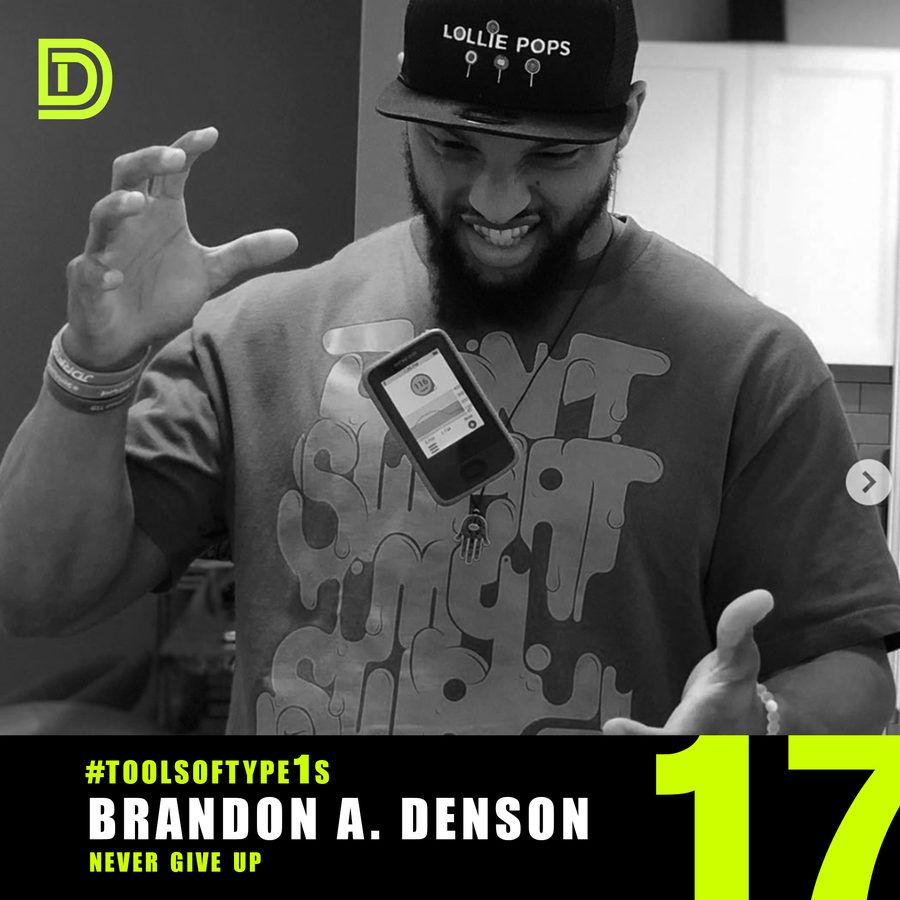
Name: Brandon A. Denson
Hometown: Ypsialnti, Michigan
Date of Diagnosis: July 2004
Tool: Never Give Up
Diabetes Devices/Treatment Methods: Omnipod, Dexcom
Questions this episode answers
When was Brandon Denson diagnosed with type 1 diabetes?
In July 2004, right before his senior year of high school.
Did Brandon Denson play sports with type 1 diabetes?
Yes. He played football at Michigan State University and then professionally, managing blood sugar through practices and games despite adrenaline spikes before competition.
What diabetes devices has Brandon Denson used?
He has used the Dexcom G4, G4 Platinum, G5, and G6 CGMs, along with Medtronic's 722 and 670G insulin pumps.
What does Brandon Denson do for JDRF?
He works as an outreach manager and volunteers in community engagement, connecting with the T1D community at events like ADA and Friends for Life conferences.
Full transcript Searchable, with timestamps
Rob Howe: Tools of Type 1's Podcast, Episode 17, Brandon A. Denson. You've heard Brandon on the Diabetics Doing Things Podcast before. He's an awesome, inspirational story. Diagnosed with Type 1 diabetes right before his senior year of high school. Went on to become a college football player at Michigan State University and then playing in professional football as well as a man with Type 1 diabetes. His tool, never give up. Brandon's a super inspirational guy. I would encourage you guys, if you're listening to this audio, to check out the video. Because Brandon went above and beyond with this episode. And really attacked the format on the video. And just made some funny costumes and some amazing answers. So, without further ado, I'm going to tee up Brandon A. Denson. His tool, Never Give Up.
Brandon Denson: Thank you. Well, hello, hello, hello. My name is Brandon A. Denson, B-A-D. Don't forget the A. I'm from Ypsilanti, Michigan. I've been living with T1D for 14 years. And I would say my expertise in T1D has been my volunteer commitment to JDRF. I had an opportunity to do a podcast for Rob a few years ago. So that's how I know Rob. And I would say I'm connected with the T1D community through social media and community engagement events, anything that's JDRF related. And also just just meeting people at different conferences, ADA, Friends for Life, all these different great conferences to meet so many different people living with T1D. That was easy.
Rob Howe: What is your tool of type ones? And what's the one thing that a person living with T1D could learn from you or your experience?
Brandon Denson: T1D doesn't define who you are or what you're capable of doing. Never give up. Never quit. Never stop. That was easy.
Rob Howe: What is the simplest thing you've done that has helped you with the management of your type 1 diabetes? Where did you learn it, or who showed it to you?
Brandon Denson: I think the simplest thing for me that's been speaking to people that have diabetes is being able to hear their things, the issues, the situations that they're going through, and being able to talk to them about mine, learning their tips and tricks and giving them some of my tips and tricks. I think that's a fair assessment. That was easy.
Rob Howe: What failures or apparent failures with T1D have made you better at living the rest of your life or made you more well-rounded as a person?
Brandon Denson: I honestly don't believe that I've had any failures living with diabetes because there is no perfect day or perfect night or just perfect whatever you want to call it. Because there's always ups and downs. There's always, well, I can do this or I can do that. and then this and that turns into a big old crazy mess. But I have been able to learn each and every day things that work and things that don't work or things that I'll do differently. And I don't look at them as failures or losses. I look at them as lessons learned. That was easy.
Rob Howe: What unusual or absurd opinion or approach regarding your diabetes do you have?
Brandon Denson: Man, this is, uh, get this a lot. A whole lot. And, uh, it cracks me up to the core. You don't look like you have diabetes. What? What do you mean I don't look, what does it look like? Can you show me what it looks like, please? Because I'm confused. I don't know. What does diabetes look like? You have diabetes? Last time I checked, I did. But unless you know something I don't, yeah. I don't know what it looks like, but it just cracks me up to the core. That was easy.
Rob Howe: In the last five years, what new adjustment to your lifestyle has improved your life with diabetes the most?
Brandon Denson: well hey there how you doing i think uh in the last five years there's been a lot of different new medical technology that's been able to help me um deal with diabetes dealing with my diabetes um dexcom g4 dexcom g4 platinum dexcom g5 Dexcom G5 Dexcom G6 Medtronic 722 and the 670G by Medtronic oh 136 pretty good
Rob Howe: What challenges related to T1D did you encounter or have to overcome while you were doing your thing?
Brandon Denson: When I think about the challenges that I've had to face or try to overcome with dealing with diabetes, and I think I speak for everyone in general living with T1D, but I think of athletes specifically like myself and Rob. I think playing sports in high school and in college and then professionally, I think we always run into those challenges of trying to have that perfect blood sugar or have that right balance, whether it's eating meals or kind of having a peak at the, being able to peak at the right time. And I think sometimes that can be like a huge challenge. And then I think you get thrown a curveball. I know for myself, I dealt with the rise of my adrenaline making my blood sugar rise before competition. And there's like really nothing I could do about it other than either bolus for it or continue to wear my insulin pump during competition and game play. So I think that's a huge challenge that was kind of hard to overcome because with the adrenaline making my blood sugar go up, I really had no control over it. Even though I could be calm as ever, I just had no control. So sometimes that posed a huge challenge for myself and I'm sure a lot of other athletes as well. That was easy.
Rob Howe: What bad advice regarding diabetes do you see or hear that you'd like to address?
Brandon Denson: I think some bad advice that I hear a lot is, oh, you have type 1 diabetes. You can't eat that. And it's like, okay, I have type 1 diabetes, so I can't eat a Cinnabon. If I want to eat a Cinnabon, I'm going to eat a Cinnabon. I think that's a huge misconception that I hear a lot. You know, I think moderation is meant for everybody, whether you have T1D or you don't have T1D. But if I'm going to eat a freaking Cinnabon, I'm going to eat a freaking Cinnabon. I'm probably going to take like 10 units for eating a Cinnabon. It's not good for me to eat a Cinnabon every day, but it's not good for anyone to eat a Cinnabon every day. But I think as long as you bolus for whatever you're eating and you take the necessary steps to make sure you're proactively doing things so your blood sugar won't rise, I think you'll be fine, you know? Because I love Cinnabons. That was easy.
Rob Howe: What priority are you focusing on in your own life currently? This can be diabetes related or not.
Brandon Denson: My main priority that I'm focused on right now is pursuing my passion with passion and purpose. Helping others, everyone, motivational speaking, and creating any and every type of art form related to creativity or fun or fulfilling or happiness or whatever it is deep down that I'm feeling just getting truth out and spreading the word of positivity in regards to life and living. That was easy.
Rob Howe: Who is someone that you look up to and what have they taught you? How do you apply that to your life?
Brandon Denson: I think somebody I look up to is myself. And I don't mean that in a cocky or arrogant way. I mean that with full intent of I've been able to learn a lot from myself throughout the course of my life living so far. And I've been able to grow. And I think that if you aren't learning from yourself, which is one of the most valuable people in your life is yourself. I think that you get sidetracked with everybody else's opinions and things that really don't matter. I think as long as you can see self-growth in yourself, which I've been able to see, and I'm continuing to grow, I think on that path, I'll continue to get better as a person. And as I get better as a person, I'm bettering people around me. And I think that's the most powerful thing about being able to learn from yourself and continue on the journey to push ahead. as you better yourself, you better those around you naturally. That was easy.
Rob Howe: What are you most hopeful for? This can be diabetes related or not.
Brandon Denson: I'm sure I'm not the only one that feels this way, but I'm very hopeful for a cure of type 1 diabetes. I'm hopeful because Not only me myself But millions and millions of others That deal with type 1 diabetes On a day to day basis Won't have to go through the things That we go through every single day And I know it will be a huge burden Lifted Off of our shoulders That was easy
Rob Howe: What advice would you give someone who has T1D and is trying to pursue a career in your line of work?
Brandon Denson: Honestly, it doesn't matter what type of line of work you're in. The work I'm in, I work for JDRF, I'm an outreach manager. Whatever you're doing, you just got to go full or tilt at whatever it is. People may say this, people may say that. but you just got to do what feels right for you and what you're passionate about. You just got to go hard. It's not about pleasing anybody else. It's about making sure you're doing your job to your best abilities, and then what happens from there happens, you know, as long as you're putting 110%, and that's all that matters. I just want to, you know, throw my shout-outs out there. You know, shout-out to everybody living with type 1 diabetes, including myself, millions of others, infants, kids, teenagers, adults, everybody going through the struggle. You're not in it alone. I feel you. I feel you. I feel you. You're not in it alone. Hey, if you want to catch me on Instagram, B underscore underscore Denson. That's D as in dog, E-N-S-O-N, or you can catch me on Facebook, Brandon A. Denson, B-A-D, B-A-D. Yeah, my initials is bad. It's not bad. But no, you know, we live with this disease, but it doesn't define who we are or what we're capable of doing. Always remember that. Peace, love, and happiness.
Rob Howe: What's the one facet or trait that you think makes you uniquely you? Explain why.
Brandon Denson: I think the trait that makes me unique is my outlook on life. I always want to spread positivity in any way that I can. On any negative situation, I always want to try to make it a positive situation. I don't know if that comes from living with type 1 diabetes I understand that things will get better Or coming from situations that I've been faced with But I always try to match positivity against negativity And I'd rather be looked at as the odd one For trying to match positivity with negativity Than matching negativity with negativity because I believe that positivity is contagious. And I think it only takes one smile to light up the room and to spread. And I think as we move forward in life, we want to continue to spread positive messages, positive vibes to each and every person because you never know what someone's going through, what they're facing. And I think positivity brings the best out of everybody. it. And I think when you're faced with negativity, you either begin to crumble or don't know what to do. And it's all it takes is that one person, that one smile to make you go on and have a great day. So always remember that positivity is the key to life and your outlook. Your outlook. I'm out. Look.
Rob Howe: Thank you for listening to the Tools of Type 1's podcast on diabetics doing things. I'm Rob Howe, and every Tuesday and Thursday in 2019, we are posting the next Tools of Type 1 episode. So follow us on Instagram, hashtag tools of type 1s, or just on diabetics doing things. We will post those regularly every Tuesday, every Thursday. My favorite type 1s are answering the questions I want to know the answers to. and hopefully you'll learn a few things as well. If you like this episode, be sure to review us on iTunes and if you didn't like it, go ahead and let me know that too. I want to know. All the feedback is good to me. Thanks again for your time. I value that more than anything you could possibly give me. Thanks so much. Bye-bye.
About Brandon
Brandon A. Denson was diagnosed with type 1 diabetes in July 2004, before his senior year of high school. He played football at Michigan State University and professionally afterward, and now works as an outreach manager for JDRF.