

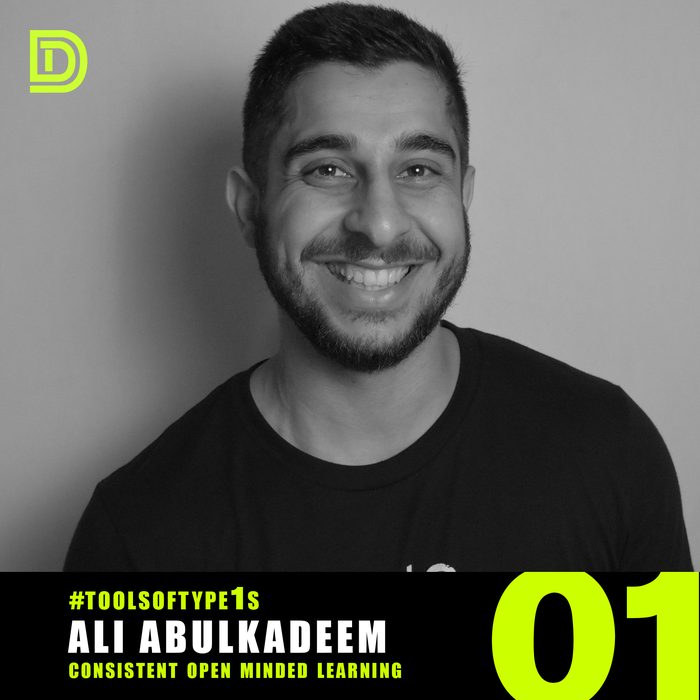
#ToolsofType1s - 001 - Ali Abdulkareem
Episode summary
Ali Abdulkareem was diagnosed with type 1 diabetes in 2015 and has lived in San Diego since age three after his family came from Baghdad. He talks about moving between multiple daily injections and the Omnipod, picking up a Dexcom G5 CGM about six months before this recording, and why he now splits his basal insulin after injecting it all in one spot stopped working for him. He is candid about emotional eating and the mental work of not punishing himself over blood sugar numbers that do not go his way. Ali runs the YouTube channel Diabetes Daily Hustle and the Diabetes Hustle Podcast, works part time as a job coach for adults with special needs, and wants to become a full-time diabetes content creator.
Key takeaways
- Ali says switching to a Dexcom G5 CGM about six months before this episode was a big change in how he manages his blood sugar.
- He splits his basal insulin dose instead of injecting it all in one spot, which he says made his levels more predictable.
- Ali says he still struggles with emotional eating and is working on not beating himself up over bad blood sugar numbers.
- He prefers learning from other people's mistakes over making his own, to shorten what he calls the learning curve with diabetes.
- Ali runs the YouTube channel Diabetes Daily Hustle and the Diabetes Hustle Podcast and wants to make diabetes content full time.
Show notes
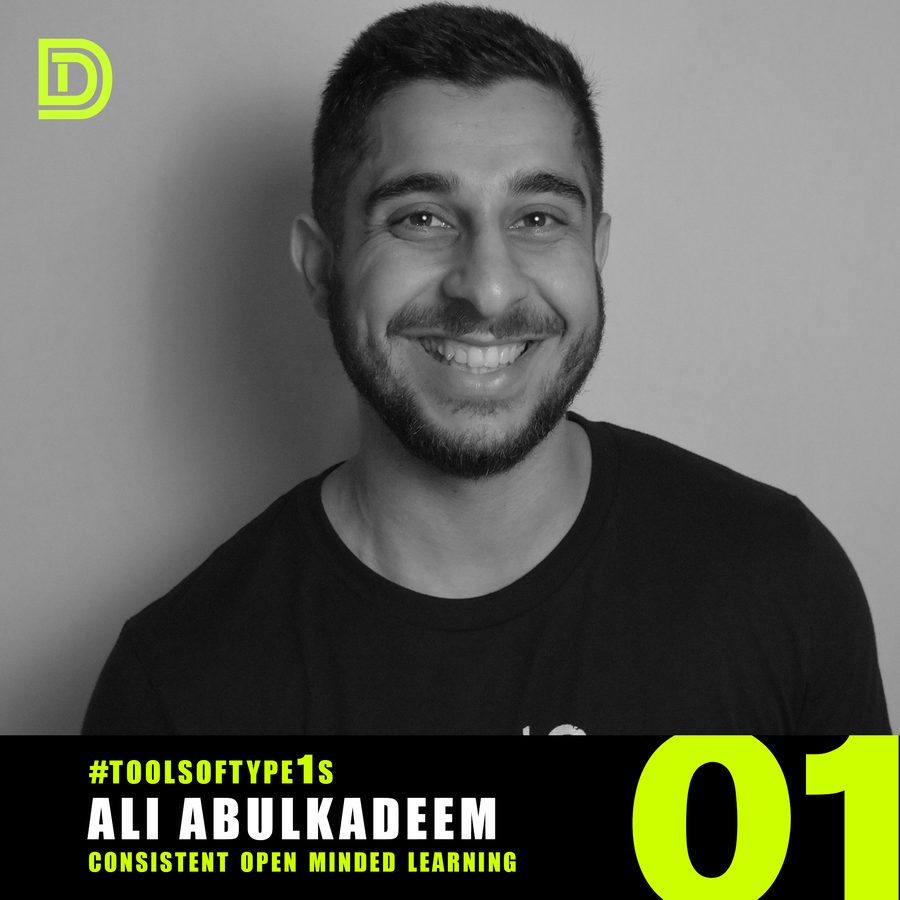
Name: Ali Abdulkareem
Hometown: San Diego, CA via Baghdad
Date of Diagnosis: 11.14.2015
Tool: Consistent open minded learning
Diabetes Devices/Treatment Methods: Omnipod, Novolog. Still on the fence on going back to Novolog/Tresibia/Novolin R using syringes.
Animal Personality: Cheetah
Questions this episode answers
What devices does Ali Abdulkareem use to manage type 1 diabetes?
He uses a Dexcom G5 CGM and the Omnipod insulin pump, after previously managing with multiple daily injections and syringes.
Why does Ali Abdulkareem split his basal insulin dose?
He says injecting all of his basal insulin in one spot, especially in a muscle, made his blood sugar unpredictable, so he switched to splitting the dose for more consistent results.
How does Ali Abdulkareem handle emotional eating with diabetes?
He says he is still working through it and is trying not to beat himself up mentally over blood sugar numbers that do not go the way he wants.
What content does Ali Abdulkareem make about diabetes?
He runs the YouTube channel Diabetes Daily Hustle, the Diabetes Hustle Podcast on iTunes, and is working on turning music into diabetes-focused music videos.
Full transcript Searchable, with timestamps
Rob Howe: Hello, everyone. Welcome to the Diabetics Doing Things podcast. It is 2019, and I told you guys I had something special for you this year, and hopefully you think it's cool. So, I'm really excited to roll this out. This is the first episode of Tools of Type 1s, which is my special project that I started going through last fall, where I wanted to ask my favorite type 1 diabetics from across the world the same questions because they were the questions that I wanted to know the most. So I asked them all in typical Rob Howe slash Tim Ferriss tribe of mentors fashion, the same group of questions because I wanted to know, A, what their answers were individually, but also I wanted to see kind of where everyone landed as a group. So what you're going to hear over the next 50, that's right, 50 or so episodes from January 8th, 2019 from today, I've got them scheduled out through June. Hello, every Tuesday and Thursday. So every Tuesday, every Tuesday and every Thursday, you're going to hear a new person going through the same tools of Type 1's gauntlet. So you're going to hear them introduce themselves. I'll do a short little intro, kind of like I'm doing today. and then I'll also ask the questions in between. So this is a very different, little bit shorter style podcast than the normal diabetics doing things. Some people have been on the podcast before. Others are new. And I think there's a lot that you have been requesting and talking to me either on Instagram or even on Twitter sometimes of introducing me to different people who we want to have on the podcast. So I really am excited for you to get to know these people a little bit better, a little bit quicker and a lot of content and what this is going to help me do as well as plan and build some other really cool things while all these episodes are rolling out. So I'm really excited to share this with you. The first guest is Ali Abdulkareem, who you definitely know if you're on YouTube or Instagram. He's going to plug his different handles later on, but I did want to share this little quick fact before we get into Ali's episode. I sent these emails out I sent like a ton of them It was maybe my most proficient email Afternoon I've ever had Ali immediately responded He's like I got you I'm on this And the next day Not even 24 hours passed Before Ali had his answers back Some people I still haven't gotten answers back from I'm hoping that they'll see these episodes And be like oh yeah I have that thing in my inbox That I owe Rob But if not no worries This is Ali's episode it really changed the way that I look at him. It changed the way that I think about him. And it really made me just love this guy. So I'm super glad he's going first. Really honored that you guys are all tuning into this. Again, hashtag tools of type ones on Instagram. Everything's going to be on the Diabetics Doing Things channel. That's what we've got all you guys. All you guys are subscribers. Thank you. But we're going to be posting all of these in a new sort of creative format on Instagram at Diabetics Doing Things. So be sure to check that out. you can learn a little bit more and interact with some of those people and follow them there. So without further ado, less talking from Rob, more guests. I present episode one, Tools of Type 1's Consistent Open-Minded Learning with Ali Abdulkareem.
Ali Abdulkareem: What is up, guys? My name is Ali Abdulkareem. I am from Iraq and have been living in San Diego ever since I was three years old and I'm 21 now. And I have been living with type 1 diabetes for almost four years now. A couple things that I do for the community is talking about culture and getting diabetes involved with the culture, you know, stuff like, I have a huge passion for hip hop and diabetes, trying to get involved with trying to make music videos and type 1 diabetes, and trying to get rid of the stigma of what people see to essentially, I guess, move the chest piece towards a cure and more awareness. The other part of what I like doing is I like talking about, you know, food and exercise and mental health and sharing my journey as someone who's only been living with type 1 for four years and trying to empower other people. That's probably the main connection I have with the community. What is your tool of type ones?
Rob Howe: And what's the one thing that a person living with T1D could learn from you or your experience?
Ali Abdulkareem: my current tools i use for type of my type 1 diabetes is I got a CGM, the Dexcom G5, about six months ago that was a pretty good uh big game changer for me um mdi multiple daily injections ever since i got diagnosed and then i went to Omnipod and then back to syringes and now i'm back on the Omnipod and i still use syringes here and there i'm fairly new to the Omnipod big fan of multiple daily injections and I'm still trying to learn how the pump game works. A couple of things I guess you guys as the listeners can learn from my experience. I've only had diabetes for four years, which is relatively baby years, but the thing that I've always carried from outside of things I've learned from diabetes is always, always trying to cut the learning curve. You know how people say you need to fail to learn. That's very true. But in our case, in most cases, you don't need to essentially fail to learn. You can learn from other people's mistakes and cut the learning curve there. Because if we learn from our own mistakes, defining that for diabetes, that means high blood sugars, low blood sugars, and basically, I guess, not being mindful of our health there. And we can learn from outside sources, so many things. So trying to absorb as much knowledge as possible with books, videos, going to meetups, and just being involved in that sense is huge because diabetes, you know, when we don't control our blood sugar, everything in our health can essentially collapse. Everything revolves around
Rob Howe: diabetes for the most part. What is the simplest thing you've done that has helped you with the management of your type 1 diabetes. Where did you learn it or who showed it to you?
Ali Abdulkareem: Simplest thing I've learned that helped me manage my type 1 diabetes. The thing is for me was learning to not listen to everyone and not do what everyone says. Now, I listen to people, but it's not necessarily what to do. It's almost what not to do. And I don't want to use certain buzzwords or books that have helped me with my diabetes management, too political. But yeah, picking up certain books about what to eat, how to eat, and essentially remind myself that whatever things that I was taught, I don't listen to standards. It's more about I want to listen to people that have my results. And it's really easy to give advice nowadays. And there's so much information out there. So it's important that we humble ourselves and listen to people that we look up to. And we want results from not that you need to be cocky or ignore everyone and just saying that kind of is pretty hard and people will take that to offense but you know we deserve the best for our health and we should be picky about our health just like we're picky about our phone or clothes or other things that are aren't as a priority
Rob Howe: what failures or apparent failures with t1d have made you better at living the rest of your life or made you more well-rounded as a person?
Ali Abdulkareem: I would say I haven't got over it completely is my mental health with type 1 diabetes. You know, a lot of people know I struggle with emotional eating and not being able to cope with being annoyed for my type 1 diabetes. You know, seeing certain numbers that bother me or I'm not eating a certain way and it's not going the way I like it to be. And I guess I'm trying to teach myself that I can progress, but I don't have to beat myself up mentally in the process of that. You know, so that can go for a lot of other things in the rest of my life as a well-rounded person. You know, if I enjoy making music on beats and before it translated into how I am with my diabetes management whenever I made music or I was trying to get better at playing basketball. is I would beat myself up in the process of not being great at something or getting better at something when it's like I can enjoy it, smile, laugh at it, and not take it so seriously and understand that it's part of the process. Now, diabetes, of course, is not the greatest thing and it's not fun and it's not like an activity for most people, but I have a, I guess I have a liking for health, so I'm trying to learn how to like enjoy the process while trying to learn and
Rob Howe: not beat myself up for every little mistake. What unusual or absurd opinion or approach
Ali Abdulkareem: regarding your diabetes do you have? I really have a huge thing that bothers me is when people think that pumps are the only way to manage diabetes. And for the most part, people know that's not true. my biggest opinion is it's how we use our um our tools you know whether that's a pump a pen a syringe a cgm whatever the case may be it's how we use it is big big big big one
Rob Howe: what's your favorite thing what gets you to smile or laugh almost every time
Ali Abdulkareem: i'm going to give you my diabetes or my non-diabetes answer and then my diabetes answer because I have a lot of favorite things. Right now, currently, I'm obsessed with street pranks on YouTube. You know, people doing random pranks and stuff like that. And stuff like Eric Andre, really absurd comedy and kind of immature stuff. I like that a lot. The diabetes answer to that is my favorite thing is editing a video that has the comedy edge involved with diabetes and hip-hop and like something that I know everyone will laugh and enjoy. Or when I did my meetup interview and I was interviewing everyone with a Sharpie, that was, I was really laughing because I knew everyone was going to enjoy it. It's part of the community and I just love that stuff.
Rob Howe: In the last five years, what new adjustment to your lifestyle has improved your life with diabetes the most?
Ali Abdulkareem: I would say there's probably two answers to this, being that I've only been diagnosed for four years. is eating. Eating has been a game changer for me in terms of my diabetes. And the thing that connects to that is when I learned that I need to teach myself things outside the realm of diabetes, not just blood sugar, just the human body in general and health, then the pieces start connecting. I'm like, okay, so this is how this can lead me up to a hypo or, you know, just stuff and health in general, learning about that and outside the realm of diabetes has really helped me out a lot. And it's given me clarity, not essentially just results, but if I have a certain obstacle with my diabetes that's been bothering me and I'm, you know, prior to the knowledge, I would have been frustrated and annoyed and made a stupid decision. Maybe like an example is taking an extra correction or whatever and not knowing what's going to happen later would bother me. But now it's like, okay, this is why this is happening because we learned this
Rob Howe: recently. What challenges related to T1D did you encounter or have to overcome while you were doing
Ali Abdulkareem: your thing? I guess in terms of this answer for the audience as a whole, because my life is basically based around diabetes, making diabetes content, so everything revolves around that. But when I'm in a place of non-diabetes stuff, like let's say I'm making music with my friend, or I I want to just kind of do something that's non-diabetes related or go out somewhere to a concert. That was at first my big obstacle when I got diagnosed, but I learned how to almost set myself. How would I answer this? Is I have to be in this place where. Oh, sorry. If I were to say, let's say I want to spend the next three hours with my friend and we were making music. and I want to be not essentially checked out of my diabetes, but make sure I'm not having crazy hypos, or I'm just looking at my CGM, I don't need to correct a bunch, is I need to make sure that in the beginning of the day, I have set the intention that I want to deserve a couple hours of being almost on autopilot mode, where I know my blood sugar is going. And to get to that place, I need to have started my day right. You know, if it's having a certain breakfast, and then rolling over to lunch with a relatively stable blood sugar and then working out and then the meal prior or the bolus prior to seeing my friend or that activity is essentially a safe comfort zone for me where I know I'm going to be in a certain range. It's almost like I need to have a cushion, I guess a room for cushion or predictability of where I'm going to be so I can just put my constant checking I'll neglect it, but it's just a quick autopilot mode for me. So getting to answer that is just getting back into routine and things that I know have already worked for me. I, another thing that really bothers me is people take it to an extreme when they say you can do the same thing every day with diabetes and get a different result. I think that's wrong. Of course I can, people can take that really too far and you can not really consider that at all. Of course there's a huge consideration for that. But for the most part, if we do do the same things, we're probably going to get the same
Rob Howe: result. Just a matter of how we do it. What bad advice regarding diabetes do you see or hear that
Ali Abdulkareem: you'd like to address? Of course, I know Rob is going to put in the disclaimer, we are not health care providers. So just take this advice with a grain of salt. This isn't advice that I hear from the community this is more advice I hear from standards of endocrinologists and whatnot is people that are in multiple daily injections we're taught that you inject all your basal in one one place one time once a day and that's it and we're not taught the method of split basal basal dosage even if that whole thing goes about do what works for you whatever works for me doesn't work for you People can take that too far, but injecting all your basal in one area, and especially in a muscle, is defeating the purpose of basal, and it creates unpredictability. And the proof is in the pudding. You basal test a whole day and just guarantee yourself, and you see your levels, it's definitely a game changer. Disclaimer.
Rob Howe: What priority are you focusing on in your own life currently? This can be diabetes-related or not.
Ali Abdulkareem: My priority right now in life in general, I guess there's two parts to it. One of it being that I want to take my diabetes content creation to the next level to the point where in a couple years, I can make this almost full time, you know, whether I want to figure out I want to interview people with diabetes, I want to provide information, I want to provide entertainment, whatever the case may be. The other part of that is my own personal health and well-being, you know, increasing my mindful eating habits. That's been my biggest obstacle just in life, you know, because type 1 diabetes is my life. So that being said, it's my journey with mindful eating and making the best possible diabetes content. Who is someone that you look up to
Rob Howe: and what have they taught you? How do you apply that to your life?
Ali Abdulkareem: Somebody that I really admire is J. Cole. And being that he's an artist and he's very famous, the thing that he taught me is that stuff that we see on media and, you know, Hollywood and being famous and like all that stuff being cool. Ever since a young guy and immigrated to the country, I've always been super ambitious to I was just really inclined to do something with my life. And And part of that, you know, being very vulnerable, I don't like saying this, but was always a drive to want to be somebody and be well known in my space. And I've come to learn from J. Cole that none of that really matters. You know, it really, really doesn't. And I apply this to diabetes content. I just want to be able to make my contribution in the diabetes lane in space and make an impact and not worry so much about who knows me, who doesn't know me, or did I quote unquote make it or am I that person or that guy, which is essentially it's okay. but what really matters is putting my heart and soul and what I care about in this space making it better than when I left it and then you know family and your friends you know the people that love you and people in your home that actually care about you that really matters you know being a better son brother boyfriend girlfriend whatever just being that person what are you most hopeful for? This can be diabetes related or not. This answer is a little bit selfish, but it's okay. Being that I, of course, what went through my head was having a cure or pushing ourselves closer to a cure. But for my personal answer, the most thing that I'm hopeful for is to become the best diabetes content creator. You know, I want to be able to inspire young kids and older adults to just live their best life with diabetes and essentially put a smile on people's face the same way that the world, you know, inspired me through videos and great content. I want to be able to do that for diabetes and give ourselves a name essentially. What advice would you give someone who has T1D
Rob Howe: and is trying to pursue a career in your line of work? I don't know if the audience mostly knows
Ali Abdulkareem: this, I only work part-time as a job coach for adults with special needs, and that's not my career, that's not my chosen career that I want to do for the rest of my life, I obviously want to make diabetes content, so I guess I can answer both, and just give people context of that, the first answer, as someone who works for adults with special needs, and being a job coach there, the beauty of that is you have to take care of yourself first and you have to be responsible for someone and before you can care for someone else so essentially I have to take care of my own management with diabetes before I can step out of my house and care for this person or that person that need that has special needs physically or mentally and essentially is is getting our own act together you know looking that obstacle that we're avoiding in the face and doing it you know overcoming it, whatever in that career you're trying to pursue. The other part of that question is if someone's trying to pursue a career in diabetes content, I don't have a career off diabetes content. I am pursuing that currently. But I would say my best advice is to remember that you are setting the example, you know, whatever you do say where those kids are looking up to you, those adults are looking at you, it's influence. So always remember that you're you whatever words you say put out to the world, it really can shift people's mentality to whatever move they're making
Rob Howe: out in their world. What's the one facet or trait that you think makes you uniquely you?
Ali Abdulkareem: Explain why. I would say as much as I am a very serious guy for the most of my day with conversations and how I am inside, I'm always joking. I've never really taken myself seriously, too seriously and I've always loved to be super random with with my jokes and just trying to make people feel a little awkward or or weird where do you get plugged into the t1d community the most plug myself yeah don't mind me if I do uh for the listeners you guys can find me on youtube at the diabetes daily hustle i am i do vlogs with diabetes you can find me on itunes as well the diabetes hustle podcast and you can find me on instagram which is a very long username so i think rob is gonna put me in the description it's ali of the cream um thank you guys for listening really appreciate it i'm currently up to trying to work on diabetes music videos you know like music's uh songs that are already made and turning them into music videos for the diabetes community some songs that are made from scratch for the community and trying to do that as my next project how did i first get started in the community i would say it was first youtube i'm i've been a huge youtube person and then after that i forced myself to get on instagram because i wanted to build my brand. But along that road, I've met so much people in the community that I was like, whoa, this really is not about me. Selfish man, like there's so many other people. So YouTube, then Instagram, follow a bunch of people, connect with a lot of people, and then going to events as well. Meetups, I would highly, highly, highly suggest you need to get involved with the community. I don't know if Rob, you're going to add this in. But if you think about it, whether you're in school or you're in your workplace for the non-diabetics in your life you don't go to them and tell them about your diabetes questions like hey and hey joe i need to fix my basal rates i just got my pump and they're gonna look at you all funny because they don't know what you're talking about or just in sense in general i'm not saying we need to spend most of our days diabetes conversations but it's nice to have those friends that we love and care for and feel a sense of brotherhood or family. Connect to them, reach out to them, and be a part of that because you're basically charging that diabetes battery. Again, thank you, Rob, Diabetics Doing Things. My name is Ali. Really appreciate you guys listening. I hope you guys are well. Rob, thank you, my man. I appreciate the opportunity. If there's anything I can do in the meantime, man, let me know. Appreciate it.
Rob Howe: Thank you for listening to the Tools of Type 1's podcast on diabetics doing things. I'm Rob Howe, and every Tuesday and Thursday in 2019, we are posting the next Tools of Type 1 episode. So follow us on Instagram, hashtag toolsoftype1s, or just on diabeticsdoingthings. We will post those regularly every Tuesday, every Thursday. My favorite type 1s are answering the questions I want to know the answers to. And hopefully, you'll learn a few things as well. If you like this episode, be sure to review us on iTunes. and if you didn't like it, go ahead and let me know that too. I want to know. All the feedback is good to me. Thanks again for your time. I value that more than anything you could possibly give me. Thanks so much. Bye-bye.
About Ali
Ali Abdulkareem was diagnosed with type 1 diabetes in November 2015. He was born in Baghdad and has lived in San Diego since age three, and he creates diabetes content on YouTube as Diabetes Daily Hustle.