

Episode summary
Erika Arff was diagnosed with type 1 diabetes in 2001 at age eight and grew up in Peterborough, Ontario. She describes years of pushing away her parents and diabetes team as a teenager, which she says damaged her body and her relationships before she learned to accept her diagnosis. Erika talks about finding the online diabetes community, learning about the Omnipod and Dexcom from other people living with the disease, and how sharing her diabetes openly helped her accept her body too. She works in a preschool supporting children with individual learning plans and runs a small accessories business with a partner. Her tool is owning your own disease: building a routine that fits her own life instead of copying someone else's.
Key takeaways
- Erika says her biggest diabetes tool is owning your own disease, because copying someone else's routine doesn't work long term.
- She credits the online diabetes community with teaching her about the Omnipod and Dexcom, things her clinic never told her.
- Erika says accepting her diabetes came first, and that acceptance led her to accept her body too.
- She uses a Freestyle Libre at her preschool job because scanning is faster than a finger prick while watching kids.
- Erika says one bad blood sugar reading doesn't ruin her whole care plan, a mindset she now applies to other setbacks in life.
Show notes
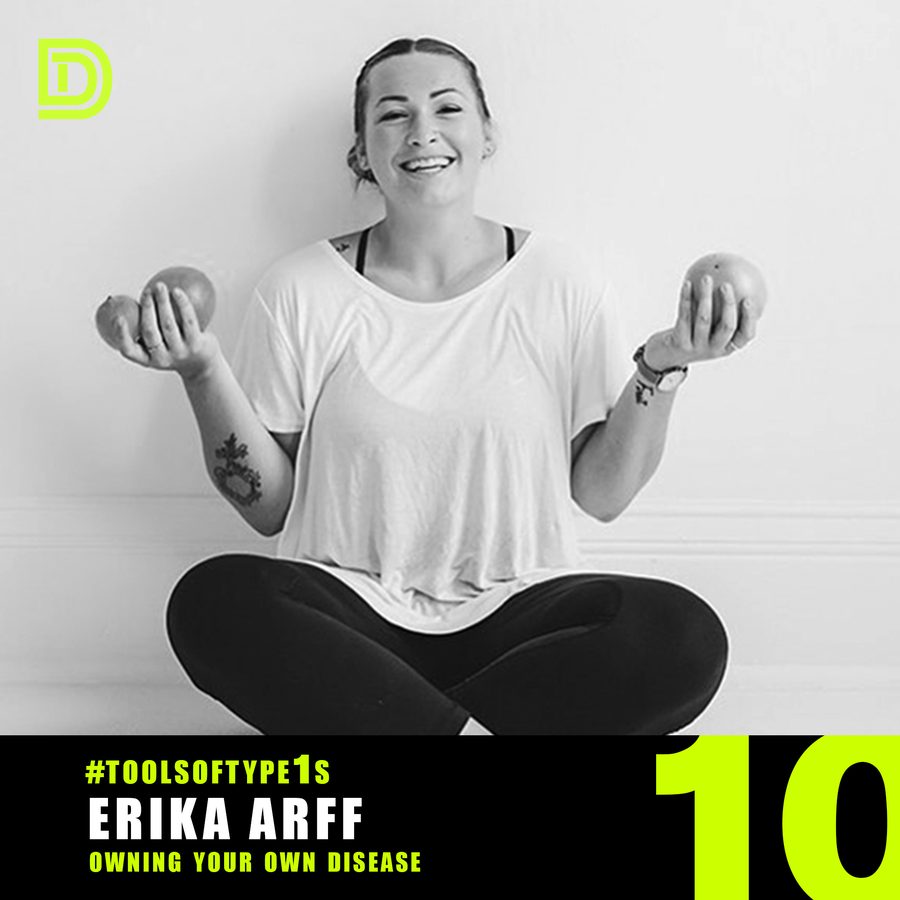
Name: Erika Arff
Hometown: Peterborough, Ontario
Date of Diagnosis: 04.08.2001
Tool: Owning Your Own Disease
Diabetes Devices/Treatment Methods: Omnipod & Freestyle Libre
Animal Personality: Hannah Montana
Questions this episode answers
What devices does Erika Arff use to manage type 1 diabetes?
Erika uses an Omnipod insulin pump and a Freestyle Libre continuous glucose sensor. She says the Libre is especially useful at her preschool job because scanning is faster than stopping to do a finger-prick check.
What is Erika Arff's "tool" for living with type 1 diabetes?
Owning your own disease. Erika says trying to manage diabetes exactly like someone else does will not work, so she builds routines around her own values and lifestyle instead.
How did the online diabetes community help Erika Arff?
She says it taught her about the Omnipod and tricks for the Dexcom that her clinic never mentioned, connected her to people going through the same things daily, and helped her stop treating diabetes as something separate from her everyday life.
What does Erika Arff do for work?
She works in a preschool helping children who have individual learning plans get through their day. She also runs a small business with a partner making scrunchies and headbands.
Full transcript Searchable, with timestamps
Rob Howe: Tools of Type 1s, Episode 10. Very special guest, Ms. Erika Arff. First guest from Canada in this, but not the last in this series. Her tool, owning your own disease. There's a lot of personality in this one, as we can always expect from Erika. She's awesome. Her vulnerability and honesty in her content, I know, is one of the reasons why we all love her and follow her. But just hearing it come from her voice, it's truly authentic. she also I did want to give her a shout out for helping me with some of the cultural appropriation involved with the term spirit animal she and some others have reached out and we've now changed that to animal personality so to make sure that we're not being offensive and making sure that we're representing different cultural groups appropriately so if anyone was offended by that I apologize was not my intent and I think now we're moving forward in a way that is more supportive of those different groups so thank you so much Erika for bringing that up um and also everyone who who also reached out to help me try to find a better way of articulating that okay without further ado
Erika Arff: Erika Arff owning your own disease oh my gosh okay i'm gonna do it i wish i could tell you how many I have had to restart this. Okay, take like 540. Okay, I am Erika Arff, and I'm from Peterborough, Ontario, which is a small town two hours east of Toronto, Ontario. I've been a diabetic for 18 years, and I was diagnosed at age eight. Some of my favorite things to do are bachata dancing, especially in my mirror alone. I love working on my business and crafting and creating and I love photography. It's kind of my escape into my creative side of what makes me me. My type 1 expertise is around body image and how we see our disease and our bodies because there's so much talk about diet and exercise and food and the human body alone. So I definitely think I have a bit of expertise on that. And also maybe how we are, like where we stand with privilege or where we stand as a person within the systems that society has created. So I like looking at even though we're considered disabled, like are we actually that disabled? Where are we on this scale of having privilege? All that kind of fun, juicy gossip stuff.
Rob Howe: what is your tool of type ones and what's the one thing that a person living with t1d could learn
Erika Arff: from you or your experience my tool to my type 1 diabetes would definitely be owning your own disease because i think at the end of the day if you're trying to be a diabetic like someone that you are following or someone that you know it's not going to work out because it's not who you truly are so I always tell people what works for one person doesn't always work for the other and you have to find what matches your values and what matches your routine and what matches your lifestyle because you can only fake it so long until your true self comes out and I think a lot of type 1 success comes from when people are able to tap into what makes it easier for them and what they understand about the disease.
Rob Howe: What is the simplest thing you've done that has helped you with the management of your type 1 diabetes? Where did you learn it or who showed it to you?
Erika Arff: Okay, the simplest thing I ever did for my diabetes was join the online community. And I feel like it's really cliche because I post about it so often and everyone's always like, the type 1 diabetes online community is amazing. But like it genuinely is. And I think without that, I wouldn't have learned about what the Omnipod was. I wouldn't have learned about the Dexcom and all the tricks that it has that makes your life easier. And I wouldn't have those people that I can talk to every day that's going through the same things. And I feel like there's this really cool like movement against like sticking to the rules of diabetes and all those little things that make me the diabetic that I am were things that like my doctors and team could never tell me or have never told me because either it's brand new and it's just like recent research or because it's like things that they're actually like physically not supposed to say as a healthcare professional but they're things that have been astronomical in my diabetes care so that's definitely yeah the simplest thing I could I've done for my for my type 1 management and I remember even too like I started my Instagram and at first it was a fitness Instagram and then I lost my mind over that because it was just abs and like food and macros and everything um all the time and then I thought okay maybe I'll just change it into a diabetes one but the more I became confident in posting about my diabetes on that account I realized that I was posting on my personal one as well um and it gave me like I started adding friends into my personal account and then all of a sudden my diabetes um online community became part of my personal one and it was really neat to see it all kind of evolve because it made me realize that throughout the last few years of adding that into my life it made me accept my diabetes as part of my life it's not just this side thing or this like secret account that I have. It became part of my everyday life and that's okay. It wasn't overwhelming.
Rob Howe: What failures or apparent failures with T1D have made you better at living the rest of your life or made you more well-rounded as a person?
Erika Arff: I feel like every day I have these like little moments of failure and it's not necessarily, yeah, like you said, apparent failures. But it's those moments that I'm that I realized that one mistake won't ruin the whole grand scheme of your care. And learning that and getting rid of my perfectionism and being like, oh, my blood sugar is 14 or, oh, my blood sugar is really high. And just being able to let go of that number and move forward has definitely taught me how to do that in real life. Like sometimes you, you know, my car just recently broke down and I have to pay $2,500. Um, but, but I felt better equipped with dealing with that because it was like, okay, well, it's just another, another thing. And we have these highs and lows and, um, I've had lots of apparent failures with my type 1, but all my apparent failures have led me to like some of the best things that have happened. And I try to remember that when things get rough in my everyday life, like some, not everything's going to be perfect all the time. But one of the, my main failures would just be not trusting my diabetes team and not trusting my parents when I was a teenager to help me get through those rough years. And I really pushed them away and did a lot of damage to the relationships and to my body during those, um, like those times. Um, but because I've done so much damage to my body as a teen. It made me appreciate and love my body more once I got through that stage of purposely hurting my body through diabetes care. So now I love what I do, and I love my body for what it can do instead of being like really upset about what it can't do
Rob Howe: instead. What unusual or absurd opinion or approach regarding your diabetes do you have?
Erika Arff: um I don't think we should okay let me start from the let me make a disclaimer here as much as I think um healthcare professionals are important and they are your gateway to medical insurance and they're your gateway to funding and tech like yes living a better life I really truly think that diabetes is more than just what our clinics teach us and what our healthcare professionals teach us and I don't think it's becoming as unusual or absurd as it used to be but I remember when I first started my diabetes account I was going through this crazy changeover with my clinic and they wouldn't release me into a different one and I was in the hospital really sick and they wouldn't come and visit or wouldn't email my mom back and the nurses in the emergency were kind of like putting me into the ground with my insulin and stuff and um it was then that I realized that you as much as nurses and doctors know there's like a huge library of resources and a huge amount of um yeah resources that we can use and I think people get really wrapped up in the idea of doing what their doctors say and their health practitioners because we have always been conditioned to believe that they are the smartest and that they know best but I recently in the last few years started pushing those boundaries and I am obviously staying within safe grounds but with that being said a lot of my amazing health discoveries didn't really know how to word that there has come from pushing the boundaries on what the my team says and it was funny too because at first like the clinic that I was with before they were really against me doing that and then once I got into my new clinic and they saw how well it was working instead of punishing me for thinking outside the box they supported me and it ended up being phenomenal and it just went to show that like even they know that we can all learn from each other and they took that as an opportunity to learn from me so that they could maybe teach someone else the way that I did it and take their information and my information and make educated suggestions for their other clients. So that was kind of, that's, I don't know. I don't know if it's as absurd anymore. Now that I'm sitting here in my room thinking about it, I think a lot of people are starting to realize that sometimes even though they're doctors and nurses and stuff, it doesn't mean they're always right.
Rob Howe: What's your favorite thing? What gets you to smile or laugh almost every time?
Erika Arff: my favorite thing is how do I word this humor that doesn't upset minorities or groups of people I love when there's something actually really great going on and it's not like hurting someone or it's not offending someone and it's not putting someone in like an unsafe position that like always makes me smile. I also really love to seeing people like overcome something that they were really scared to do because I feel proud of that and it doesn't necessarily make me laugh but it's definitely one of my favorite things to see is like when people have tried something that they were really scared of or that they weren't too sure of and that they overcome like it makes me smile because I'm like, yeah, I could do that too. Or like, that's awesome for them. That's a really cool thing because I know how good it makes me feel. My other favorite thing is just dancing. Like I could just laugh and dance and sing my life away. I wish I could get paid to be like, no, it's not even an entertainer, just to dance and sing around the streets.
Rob Howe: In the last five years, what new adjustment to your lifestyle has improved your life with diabetes
Erika Arff: the most? Oh, this one's so good because there's like a couple things that are, that really stand out for me. But first thing was sharing my, my disease with the people around me. So my supporters. So I think being open to being open. Does that make sense? Um, with the people around you. Um, I used to close off everyone like I close off to my parents and I wouldn't want them to help and then I closed off to my diabetes team because I didn't think they could help and then I actually dated a guy my first boyfriend ever when I was like 17 was a type 1 diabetic and even then I wouldn't even talk about my disease like we just didn't talk about it as a thing. but the more I talk about it and the more I share it with people and ask for help the less I feel so consumed with it and the more I just feel like like easygoing about about my about my diabetes and I also find to like learning to love yourself or even not even love but just like starting on that journey of accepting. I always tell people when I talk to them, like, I accepted my diabetes, which then led to my acceptance of my body. So I was in denial for so long about my diabetes and all this stuff. And I had a lot like a lot of bad memories about being diabetic. And I started gaining this new perspective. And I finally started thinking it like thinking that my diabetes was kind of cool or made me different and unique and then I started accepting that and then all of a sudden I started accepting my body and what it was going through and the changes and stuff as I got older and I mean like this took years and years and years and I make it seem like it just happened overnight but when I started being kinder to my thoughts and my body everything was just easier and I don't think it like scientifically and like statistically based is correlated but I think when you look at other like when you look at your diabetes and you accept that as part of who you are it's easier to start accepting other things like if you don't like your big thighs okay well that's just what you have so like work with it make it the best you can. I'm just using that as an example because that was something that I used to like really struggle with. And then now I'm like, whatever, like, I think I'm great. I think I have a fabulous figure, you know, so acceptance and then also being able to share are, I think, the two best things that I've made as far as adjustments to my diabetes and lifestyle care. What challenges
Rob Howe: related to T1D did you encounter or have to overcome while you were doing your thing?
Erika Arff: So my biggest challenge with type 1 diabetes was really just accepting the fact that it happened and it's done. like I used to be so mad at the world and I would say like why me like out of all people in the world you know I was healthy I was like I'm happy like my parents had this amazing childhood for me and all this stuff and I didn't do anything wrong I felt really attacked by the diagnosis rather than um like really thinking about it as what it was I just thought like that it was the worst thing that could ever happen and um I think overcoming that and that took like 10 years to overcome but while I overcame that it gave me confidence to move forward in my life and I think once I started to gain acceptance of my diabetes and that it happened to me and like not feeling sorry for myself kind of helped me be more confident in taking risks in jobs and having confidence that I can do things in university, which was like a really hard thing for me to do anyways. And I started doing research in diabetes because I thought, you know, well, I'm starting to accept it and maybe I'll put some energy into it for once. And it was kind of cool to see how it all related to each other and how overcoming, like getting rid of that guilt helped me get rid of guilt in other aspects of my life. And like gaining confidence in my diabetes helped me gain confidence in my other parts of my life as well. That's a hard question though.
Rob Howe: What bad advice regarding diabetes do you see or hear that you'd like to address?
Erika Arff: I don't like seeing when people are really strong headed about something that works for them, but making other people feel bad about theirs. one of the things I find is like like for topics for instance a lot of these advice bad advices are like for instance one person who is athletic and doing all this stuff makes a suggestion and then like really is strong headed towards it towards everyone and I think people don't realize that we're not all athletic or we're not all in the same boat and what works for one person doesn't work with the other um but I really I don't like and I've done this maybe once and I realize how crappy it was but I really don't like when people push their their dietary ways on other diabetics because what works for you like I said doesn't work for me and vice versa and I think like there's so much more to what people don't realize behind what they're saying so for instance, like, okay, like, I don't want to attack a certain group, but let's just say someone's saying they want to be vegan. Like, that works for you. You live in Toronto, where there's like amazing vegan restaurants all the time. And you work a job that allows you to be at home to like prepare and cook and stuff like that. And then like, it makes you feel really great. But for me, I have been vegan and I didn't feel that great. My blood sugar suffered because I was eating more carbs and I lived in a town that like I tell you I kid like I kid you not I lived in northern Canada and like that type of lifestyle is not sustainable for for like aboriginal Canadians and people living up north because like they don't have the crop and stuff um and also it's really expensive so I struggle with um the food advice because I think it's great when people suggest what they do and how it helps are like going low carb and stuff like that. But I think people need to realize that there's so many more sociocultural, um, things that feed into why people eat the way that they do.
Rob Howe: What priority are you focusing on in your own life currently? This can be diabetes related or not.
Erika Arff: oh okay okay okay I am currently working on um this really neat dynamic relationship that's going on within my body because I have been working for a couple years now on self-love and learning about um like the myths that the beauty industry has put on us and all these things that we have learned as children to believe about our bodies but I'm also on the other side of like being ready to lose lose weight and get to a healthier spot where I feel better and there's this like huge topic that we shouldn't say like oh I want to lose weight um because like saying that you want to lose weight implies that we like should be smaller and that it's not good for kids to hear that and stuff but at the same time I try to be transparent and I think I don't want to beat around the bush and when people say like oh why are you working out and stuff like I used to say like it makes me feel good and it does and it still does but I'm really trying to um understand and focus on why like and focus on the reasons why I am losing weight and why I want to focus on that rather than it being like about looks and stuff and really having to dial in my thoughts um when my mind goes back to the side of it of being like oh you want to be smaller or like society tells us that we should be losing weight rather than like the actual stats of it of being like okay no I want to reduce body fat and I want to um feel better in my body and not feel the way that I am and it's perfectly fine like some people love being the size that they are and they feel good and that's amazing. I don't, but I also am trying really hard to tone in on the whole body image and self-love topic because it's so big and I want to make sure that I truly am doing that. Doing the things for the right reason. I'm also really focusing on saying no to people. I tend to say yes to everyone and then when I do have to say no to them, people get really up in their grill because they're like, oh, Erica said no, or Erica's not doing this. And I'm always that person. And it like really wears me out. So I'm trying to say no. And I'm also trying to focus on my business because I'm working a job right now and I love it, but it's not what I want to be doing. So I'm really just trying to gain that confidence to go full heartedly into what I would like to
Rob Howe: be doing without the fear of failure. Who is someone that you look up to and what have they
Erika Arff: taught you? How do you apply that to your life? Oh, I have so many people that I look up to. I could literally like go through Instagram and be like, yeah, that person inspired me. Yeah. That person inspires me to do this. Oh, I love that about this person. I get a lot of, um, my motivation and my inspiration from everyone around me and it's sometimes not just one person it's like a characteristic that someone has or it's a skill that this other person has um and I think it's all the things that I see in myself that I'm like oh I want to like improve on that for my own self so um I really look up to the most randomness of people like I look up to one of the little kids that I nanny for. Like she's going through a rough time with a like a divorce in their family. And she's seven. She's working so hard to make to make sense of the world right now. And she is really doing a good job on reflecting and sharing that. And I think that's inspiring. And I look up to her because she's opened herself up at such a young age to those topics, which is really hard and I look up to my partner because he is constantly putting in work for his own goals and has gone through his own amazing journey for himself and I look up to people in like social media influencing that are standing up for what they believe in and like using their voice for good I think that's so awesome yeah I really gather from a lot of different sources there's not I feel really bad saying this but but there's not like one person that I can like picture when I think of inspiration or like who do I look up to I look up to my parents like my parents are amazing I have the best parents ever but other than that I just get so much inspiration from the people around me because I really pay attention to who they are as people
Rob Howe: what are you most hopeful for this can be diabetes related or not
Erika Arff: I hope for a world where minorities are heard and I hope for a world where people feel valuable and I hope for a world where things are thought of and things have processes and acceptances and there's not these like rash ideas and these like crazy acts of hate and things are just more thoroughly thought through and I'm hopeful for okay I'm gonna sound bad I'm like people are gonna be like that's the least uninspiring thing but I really can't be like I have to be honest I'm not like hopeful for a cure for diabetes I'm hopeful for um the movement that we're seeing to continue um whether it be on social media within like the communities and stuff like I really feel like there's so many good things coming out of this fight for a cure um and it might be like cynical or it might be negative however people want to see it but for me like I don't see a cure right now but I'm just like still hopeful for that there's opportunities for people continue to grow so like Slipstream and Beyond Type 1 and Connected in Motion and you doing what you do Rob and like all these things like I just hope that um they can continue to grow because when I read posts and I like think about my own diabetes um journey it's all those companies and people that are doing things that make me hopeful for my happier life with diabetes and I used to hope for a cure but I'm kind of over that now and I'm just hopeful that we can continue to grow this community because it's been the best thing that's ever happened and I don't even know if any other diseases or like groups of people have the type of community that we do so I'm just hopeful that we can keep that going and continue the growth within us
Rob Howe: because I think it's so powerful. What's the one facet or trait that you think makes you uniquely
Erika Arff: you? Explain why. I work with children currently and I am in preschool, which is really cute. My job is specifically to help children that have an individual learning plan get through the day and have successful days while catering to their needs. And it's really cool because um you can have an IEP for like diabetes like you can have one if you um like if you are having a i don't know the proper way to say it but if you are physically disabled or if you yeah anything you're really going through if it's something that um the child needs help with they can get you enhancement which is what i do so i have these amazing kids that I work with and I work with the whole class but my main focus is helping those children um have like the best days that they can and it's really cool um but it does take a lot and it's a lot of thinking of others first so my advice for working with kids is to always be prepared and plan ahead so using your tools so I have a Freestyle Libre because taking out needles to poke my blood sugar takes an extra 25 seconds whereas I can just scan when I'm out on the playground stuff like that and then also just making sure that you take a couple minutes here there and everywhere for yourself because it's really easy to get caught up in thinking about the kids but if you don't take care of yourself something can happen and then the kids are without supervisors. So I always say to be mindful of what's going on around you and to think about what's going to happen in the near future of that day and that afternoon and maybe that night and taking care of yourself first. I also own, well not own, my business partner and I make scrunchies and headbands which has been super cool because on the days that I'm sick from my other job, I could still stay at home and do content planning from my phone or take photos when I'm at home not feeling well or make pieces as well and do some outsourcing as well. I just said as well 57 times in a row, but it's cool. And for that, it's been really nice because it doesn't make me feel as bad about missing work because I'm still able to create that day and still inspire and use my skills. But sometimes diabetes does put you under the weather and it does keep you home from your everyday job. And it's been nice. Like I can change my pod and still email at the same time. So if you would like to be a online business entrepreneur, I would strongly suggest it because you can do it from your pajamas and your bed.
Rob Howe: What advice would you give someone who has T1D and is trying to pursue a career in your line of work?
Erika Arff: I am so outspoken. I push the boundaries in a good way. I don't take no for an answer. I like to think of things in different ways. And I think it really makes me myself because I'm not afraid to voice my opinion, even if it's not what's popular at the time. And I'm not afraid to question people's actions or intentions. And it's not ever in a rude way. It's just to hope that they grow as a person or see how like maybe their intentions aren't actually good, even if they think they are, for example. And I also think like the thing that makes me me is just like being literally being me makes me me I know that sounds so illiterate and like Erica what are you talking about but I just own who I am and I've never been afraid to be who I am and I get backlash every day about being too confident or too loud or too outspoken or too in people's faces and stuff but being all those things has led me to the most amazing opportunities and has made me me and that's the best thing that you can be is yourself
Rob Howe: plug yourself tell us where we can find you in the diabetes online community
Erika Arff: um what am i up to i am moving through a really cool transition I am figuring my shit out. I don't know if you can say shit, but if you can, can you put a picture of it? Anyways, I am living in the 25-year-old life of what is going on. What am I doing? What's my next step? And I'm enjoying it so far. I'm trying to grow my business. I'm having fun doing it. And I'm making sure that I am being equal and loving to all in the process of doing so. You can find me at Erika Arff, E-R-I-K-A-A-R-F-F. You can't find me on Facebook. You can definitely find me on Pinterest, and I have really cute pins up of so many different fun things, so check me out over there. I'm not on Twitter. I'm not on YouTube. I'm not on Snapchat. I haven't been for about a year. Yeah, sorry guys. you can only find me one spot but listen i'm very present there so if you want to pop over and say hey what's up hello i will see you over there thanks so much for listening you guys are amazing thanks to everyone who continuously inspires me to share my true authentic self don't forget to give yourself a big kiss and a hug and tell yourself that you are amazing because you truly are
Rob Howe: where do you get plugged into the t1d community the most
Erika Arff: i am all over the instagram like i just said in my um plug yourself section there above above um i'm not on any other apps or anything but i'm really present on my instagram and that's what I find works best and I think being your true self and sharing your struggles and sharing your happiness and connecting with the people that want to connect with you is so important and people will see that you are there for them and you are there for the right reasons and that is how I started getting involved was just being part of the community so not just liking the photo it was commenting and messaging and being being the person that I would like to see in this community. I love that. I became the person that I wanted when I was, that I needed when I was a teenager. Yeah, that's my final answer. Put me in. Okay, thank you so much for listening, everyone. You're all so fabulous. I'm probably gonna roll my eyes when I hear this. Last time Rob did a podcast with me, I heard my voice and almost, almost shrieked at work because I couldn't believe that I sounded like that. But if you're still listening, hey mom, hey dad, hey Brendan, what's up, what's up, Talia, Rob, Michelle, all my friends out there in the Type 1 community, Yana, Raquel, Eric, Laura, Paloma, Jill, you guys are all amazing, Austin, Ben, you know the drill. Anyways, you guys are amazing. I love everyone. Keep being the true Type 1 badass that you are. Erika out. Hello and welcome to Erika's show. Oh my god. I feel sorry for you having to listen to my voice for 20 minutes. Okay, okay. I'm just reading over your email to make sure that I don't fuck this up. Okay, solid. Okay, I'm ready. I'm ready, I'm ready, I'm ready. excuse me okay that's a loaded question can i redo this i need to oh my god rob
Rob Howe: i've really thought about these but thank you for listening to the tools of type ones podcast on diabetics doing things i'm rob howe and every tuesday and thursday in 2019 we are posting the next Tools of Type 1 episode. So follow us on Instagram, hashtag Tools of Type 1s, or just on Diabetics Doing Things. We will post those regularly every Tuesday, every Thursday. My favorite type 1s are answering the questions I want to know the answers to. And hopefully you'll learn a few things as well. If you like this episode, be sure to review us on iTunes. And if you didn't like it, go ahead and let me know that too. I want to know. All the feedback is good to me. Thanks again for your time. I value that more than anything you could possibly give me. Thanks so much. Bye-bye.
About Erika
Erika Arff is from Peterborough, Ontario and has lived with type 1 diabetes since being diagnosed at age eight in 2001. She works in a preschool supporting children with individual learning plans and runs a small accessories business with a partner, alongside sharing her life with diabetes online.