

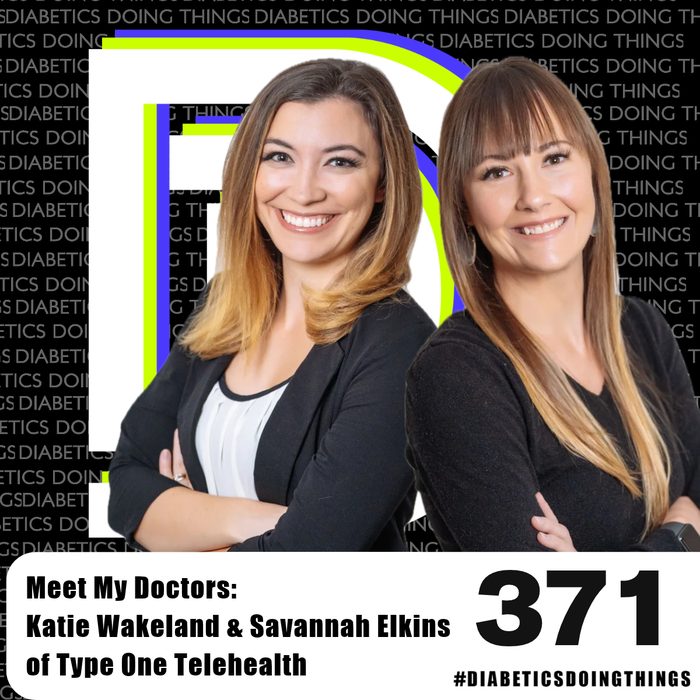
Meet My Doctors: Katie Wakeland and Savannah Elkins of Type One Telehealth

Episode summary
Rob Howe talks with Savannah Elkins, MPAS, PA-C, and Katie Wakeland, MSN, APRN, AG-ACNP, the co-founders of Type One Telehealth and Rob's own providers. Both live with type 1 diabetes. Savannah was diagnosed at nine and Katie at 11. They explain why they left traditional endocrinology, where short visits and insurance rules limited the time they could give patients, and why they built a virtual membership practice in Texas instead. Savannah describes moving to adult care at 22 while pregnant and gives three tips for college students moving into adult care. Katie tells the story of a patient who was told she couldn't get pregnant and now is. Both say patients are never stuck with care that isn't working.
Key takeaways
- Savannah and Katie say they left traditional endocrinology because short visits left no time to teach patients, especially adults newly diagnosed without the education kids get in pediatric care.
- Type One Telehealth sees people ages 13 and older with type 1 or insulin-dependent type 2 diabetes who are in Texas or have a permanent Texas address. Savannah says new patients can usually get in within a week.
- Savannah's three tips for college students: endo visits don't have to fit around school breaks, have an honest talk about alcohol before figuring it out alone, and make sure someone nearby knows you have type 1.
- Katie says the thing that bothers her most is patients being told "you can't." She wants more open options for pumps, CGMs and goals like pregnancy.
- Savannah's closing message: you're not stuck. PAs, NPs, CDCESs, nutritionists and people with lived experience are all options if your current care isn't working.
Show notes
If you’ve ever left an endo appointment feeling rushed, talked down to, or told “you can’t,” this episode is for you. Rob sits down with Savannah Elkins, MPAS, PA-C, and Katie Wakeland, MSN, APRN, AG-ACNP, co-founders of Type One Telehealth, a virtual endocrinology practice in Texas. Both live with type 1 diabetes. Savannah was diagnosed at nine after her dad remembered the symptoms from a fifth grade video. Katie was diagnosed at 11, with a blood sugar of 556, right after a family trip to Universal Studios. Rob met them at Camp Bluebonnet this summer and became their patient this fall. That makes this his first interview with his own care team.
Savannah and Katie explain why they left traditional endocrinology. They talk about 15-minute visits that leave no time to teach a newly diagnosed 32-year-old, insurance companies that shape how care is delivered, and why they chose a membership model instead. Savannah also shares what it was like to move to adult care at 22 while pregnant, and to hear over and over that she was having a “big diabetic baby.”
They share some early wins too. Katie worked with a patient who had been told she couldn’t get pregnant, and that patient is now pregnant and doing well. Savannah has seen patients go from 20% to 70% time in range in a month, and others cut $150 a month off their supplies.
Whether you’re a college student moving into adult care or someone who’s unhappy with your current endo, you’ll come away with practical ideas. Savannah gives three tips: endo visits don’t have to fit around the holiday schedule, have an honest talk about alcohol before you figure it out alone, and make sure someone nearby knows you have type 1. The episode ends with a reminder that you’re never stuck with care that isn’t working.
Resources:
Type One Telehealth: https://www.type1telehealth.com/
The views expressed are not medical advice. Please consult with your care team about the best treatment for you.
Questions this episode answers
What is Type One Telehealth?
Type One Telehealth is a virtual endocrinology practice in Texas co-founded by Savannah Elkins, PA-C, and Katie Wakeland, AG-ACNP, who both live with type 1 diabetes. Katie says they chose not to work through insurance for visits so insurers would not shape how they care for patients.
Who can become a patient of Type One Telehealth?
Katie says they see people ages 13 and older with type 1 diabetes or insulin-dependent type 2 diabetes. Patients must be in Texas at the time of the visit or have a permanent Texas address on their driver's license.
What advice do Savannah and Katie give college students with type 1 diabetes?
Savannah suggests not forcing endo visits into holiday breaks, having an honest conversation with your care team about alcohol, and making sure a roommate or RA knows you have type 1. Katie says care should meet young adults where they are.
What can I do if I'm unhappy with my endocrinologist and don't live in Texas?
Savannah says you're not stuck. She points to PAs, NPs, CDCESs, nutritionists and online coaches with lived experience. Rob suggests searching for providers on the ADCES website at adces.org.
Full transcript Searchable, with timestamps
Rob Howe: Hello, listeners, welcome back to another episode of Diabetics Doing Things. We are telling the amazing stories of people with type 1 diabetes from all over the world, and I'm very excited for today's guests. I met them this past summer at Camp Bluebonnet in the Texas Hill Country, and I became a patient of their practice, Type One Telehealth, this fall. Their names are Savannah Elkins and Katie Wakeland. Savannah is a PA, physician assistant, and Katie is a nurse practitioner, NP, and together they co-founded Type One Telehealth, a virtual endocrinology practice in Texas built specifically for people with type 1 diabetes by people with type 1 diabetes. Both of them live with T1D. Savannah has lived with it for more than 20 years, and Katie was diagnosed at age 11. They left traditional endocrinology because they wanted to give patients more time, more access, and care from providers who really get what they're going through. Today we talk about their diagnosis stories, the origin story of Type One Telehealth, what it's like building a practice as two women with T1D, and why practices like theirs are becoming more common. We also dig into the problems that come with so few endocrinologists in the United States and how patients in Texas can find them and get in touch. So please enjoy this interview with my doctors, Savannah Elkins and Katie Wakeland.
Rob Howe: Katie and Savannah, welcome to the show.
Katie Wakeland: Hello, thank you for having us. Jinx.
Savannah Elkins: Hi, thanks for having us. My twin.
Rob Howe: Very excited to have you. This is an important milestone for me in all of the years of the podcast. I've never actually had one of my own doctors or one of my own HCPs on to talk. We're not talking about me that much, but we may a little bit. So Savannah, congrats, you're the first.
Savannah Elkins: Yay! I'm like, what do you want me to say, Rob? What am I allowed to say?
Rob Howe: We're pulling the curtain back, anything goes. I'm fine with sharing. So you guys together are Type One Telehealth, but I really want to start this podcast this way because I think it's important to frame a practice and the HCP side of things from a patient perspective, which is a big part of your story. So who wants to go first and talk about what they remember about their diagnosis and their life with type 1 diabetes?
Savannah Elkins: I'll go first. I think Katie's diagnosis story is more fun than mine. Mine's really boring. I was diagnosed at age nine. I was having the classic symptoms, increased urination, increased thirst. But the crazy thing is, I don't have family in medicine. My parents are not in the medical field, yet my dad actually recognized the symptoms because he remembered a fifth grade video about diabetes symptoms. So he told my mom to take me to the pediatrician specifically and ask them if I had diabetes. That's what the appointment was for, to see if Savannah had diabetes. Very wild. My blood sugar was, I say this gently, only 300, and I wasn't in DKA. Obviously still honeymooning. We were sent to the emergency room that night, and then I think it was actually an accidental discharge at 3 a.m. So I didn't get any insulin whatsoever. They just said, follow up, your first appointment is at 8 a.m. for outpatient. My parents gave me my second injection. They tell a story that I gave my third injection onward. I was nine, so they really wanted me to take this on independently, knowing it was my disease that I would live with for a lifetime. I grew up in the Texas Children's hospital system specifically. Wonderful experience there. I didn't really recognize any gaps in care, which we'll get into, until honestly I transitioned to adulthood. That's pretty much the gist of it.
Rob Howe: I think you need to give your diagnosis story more credit. Very few people have said that their dad's fifth grade video about diabetes symptoms resulted in their diagnosis. I think you might have a singular experience. That's pretty awesome. Katie, what about you?
Katie Wakeland: So I was in a fun place having a fun time. This was our first big family vacation. We were in Orlando at Universal Studios, the whole family, my first plane ride. My mom had noticed that I was drinking Dr Pepper and 7UP, I was eating everything in sight, and I was asking to go to the bathroom every three minutes, and the alarm bells kind of went up. My mom is a registered nurse. It was right before school was starting. I was about to enter sixth grade. And it was like, you know what, we've got to go to the pediatrician anyway. Let's talk about some of these symptoms and see what they say. They checked my blood sugar in the office and it was 556. I still remember the number to this day. My mom and I disagree at this point in the story. But when the medical assistant left the room and said, hey, you probably have diabetes, my mom turned to me and said, you don't have diabetes. And my mom, I trust her.
Rob Howe: What do you disagree with? What's the disagreement about?
Katie Wakeland: I have no idea. I don't know if she thought it was a false reading or something like that. She says, I never told you that. But I distinctly remember that as an 11-year-old. And lo and behold, I was that nurse practitioner's first diagnosed type 1 diabetes patient in the practice. Congratulations to me. I got sent to Cook Children's and was in the Cook Children's system. I was not in DKA, same as Savannah, or maybe a mild case, but I got discharged that evening after they gave me some insulin. Then I showed up at the outpatient clinic for the half day education class and cried my eyes out because I had to give my first injection before leaving that building. My hand was shaking so much that the needle went in my skin and I didn't even know it. It's been a journey on MDI and pumps and therapies and everything like that. But overall, I think peds gets a whole lot of resources and a whole lot of credit, and they do a fantastic job, at least in our area. And then we come to that bridge where we get released into the adult world, and things change quite a bit at that point.
Rob Howe: Something I've been thinking about a lot more recently, and this is a little bit of a sidetrack, is that the transition from childhood or young adulthood, even outside of diabetes, is really challenging. We don't really prepare anyone for it in a way that's productive. We just rip the band-aid off and send people out into the real world. I was having a conversation recently with some other entrepreneurs who also have diabetes, and we were talking about the seasonality of a business. In your youth and young adult life, you have August to May or June. You go to school, you have a holiday break, then you have the summer break, and then it all repeats. You get into this rhythm. Then after you're done with school, maybe it's college, high school or grad school, you get put into a world where there is no seasonality. It's just all the way on. You have to decide when you're going to take time off, if your job has that flexibility, and especially early on, maybe it doesn't. That can be really challenging, because you see a lot of people talk about burnout, not just from a diabetes standpoint but from an adult life standpoint. Savannah, I think you had alluded to it a little bit as well, the moment in your care where you thought there was a better way, and we can focus on that transition from peds to adulthood. But I want to get into Type One Telehealth first from a lens of living well with type 1 diabetes beyond just the clinical measures, which were A1C for most of our lives with diabetes and, in the last ten years or so, time in range as well. How do you think about the entire person, because you are both people living with diabetes, and not just the dosing or carb counting or test results?
Savannah Elkins: I'll go into a deep dive. I happened to get married young. It's Texas. I married my college sweetheart when I was 21, and we found out I was having a baby within a year of marriage, so I was 22. That coincided with my adult transition, because I kept pediatric endocrinology on board during college. It was challenging, it was an hour and a half drive and all the things. So when I was 22 and newly pregnant, I was just transitioned to adult endocrinology, and that was my first shock. You're talking transition. I took on the transition of marriage, of new parenthood, and of trying to become the medical professional I dreamed of being, all at the same time, because that's how Savannah does life. We just throw it on. Let's go.
Rob Howe: We dive in with both feet. We're going.
Katie Wakeland: Yeah. That could not be more true.
Savannah Elkins: Yes. It just keeps rolling, doesn't it, Katie? Patterns don't change. So I was 22 when all of this was hitting me, and I'm not going to say I didn't have a fantastic team. I did. They did everything in their power to make sure I was very well controlled. This is the year 2016. Pumps are not looped, and we have CGMs that some people use and some people still don't. It was expensive too, I remember that, and not universally covered, but it was approved for adults at this time. So at least I had a CGM and I did have a pump, but the two certainly did not communicate. I can't even recall what my A1C was at the time, but I do recall how I felt as a patient. I was shocked at how many appointments I had. No one had prepared me. Social media wasn't what it is today. Within the last couple of months of my pregnancy, I had four appointments a week: two with MFM for the non-stress test and the fetal ultrasounds, one with endocrinology, and one with my OB. To the point that as a 22-year-old, I had to go part-time at my job. I just didn't anticipate it. And of course, it's a time when finances are critical because you're planning for a child, and that's usually when we're all broke anyway. I also had an OB who, with ultrasound measurements, which we know by science have a lot of variability, can be 10 to 30 percent off. So when they say your child is in the 99th percentile, it truly could be the 67th. For reference, my husband is six foot one and was born at eight pounds seven ounces. So there's genetics in this as well that no one was talking about. But I heard the phrase over and over that I was having a big diabetic baby. That was really discouraging when I was doing everything I could to manage my blood sugars. As a patient, I just felt, one, unprepared. I didn't have the education or the knowledge. I didn't know what was going on. My parents, being great parents, were fearful too. They didn't know how to help me at this point. We were all kind of lost, without a community of support, because I didn't know any other type 1s. I was 22, and all my camp friends hadn't had kids yet, so I was the first. And then too, I felt like everything I was doing wasn't enough. All of that led to the provider and the care that Katie and I aim to be, with the holistic focus of: we're going to provide you with evidence-based medicine, we're going to provide you with knowledge, but we're also going to provide you with the care and the empathy that we know, as type 1s, our patients need.
Rob Howe: And Katie, maybe you can share how the two of you met. Where along your professional careers or your lives with diabetes did you first meet?
Katie Wakeland: Technically, when Savannah was in PA school doing her clinicals in endocrinology, that was my endocrinologist at the time. She was a student, I had just found out I was newly pregnant, and she came in as my student provider. That's the first encounter we ever had. Then, lo and behold, she ended up working for that same clinic when she finished school, and I followed later on. So we met in outpatient endocrinology at the same practice, and she quickly became my diabestie. I still am, but even as a kid, I was so shy. I was a hider. My close friend group and my family knew I had diabetes, but it was not something I would jump up on the table and announce. Even in my adult and professional life, it never came to the forefront until I jumped into the world of endocrinology and realized, my gosh, there is this community. It's such a strong connection to have with those people. It makes a world of difference when you can look at someone in the mirror and be okay with the other side of it.
Rob Howe: It does. And I think that's the experience you knew you wanted to bring to patients, to know somebody who is walking that same path, at least in some capacity. So jumping forward to the origin of Type One Telehealth, how did the two of you decide, hey, it's time to make the jump, we have this idea, let's bring it to life?
Savannah Elkins: It wasn't working. Endocrinology where it was wasn't working. Katie came on board and joined our team, and now we had two type 1 providers, a PA and an NP with type 1 diabetes, and we wanted the absolute best for our patients. She and I both made family sacrifices. We worked 12, 13 hour days and didn't even complain about it. It was truly, we're going to give our patients the time. Our hearts were in it to the max. We just wanted to be the best endo providers we could possibly be. There are so many limitations in healthcare today, and that's a whole tangent for a different day. But the gist of it was the time we had to spend with patients, because unfortunately healthcare is a business, and you can't spend so much time with one patient and push the next seven patients back. Yet we'd get a brand new diagnosed 32-year-old who didn't get the privilege of the pediatric education.
Katie Wakeland: The half day class, right.
Rob Howe: Yeah, diabetes 101.
Savannah Elkins: They're walking in and sometimes they don't even know they have type 1. Sometimes they were diagnosed with type 2, and then you're changing their whole world in 15 minutes. Like what?
Rob Howe: Get a prescription filled, go to your pharmacy, and good luck to ya.
Savannah Elkins: It got to the point where I knew this wasn't the care I wanted to provide, and my heart was out of it. I was already looking at what else I could do with my degree. But Katie wouldn't let me go. What happened next?
Katie Wakeland: Yeah, I tried to hold on.
Rob Howe: You mentioned this is probably an entire episode or more, a series probably, but practices like Type One Telehealth are becoming more popular. NPs and PAs are having similar experiences where they don't have enough time to spend. The doctors or the endos have to see 18 patients a day, and that's what's required to keep the practice afloat. So patients get the short end of the stick, which delivers worse outcomes. Unfortunately, that's just the state of things. Not to mention endocrinology is not a very popular path in the healthcare world, and I think that's primarily driven by the money you can make. It's certainly not that there aren't enough people with diabetes, not even counting the other endocrine disorders. There are plenty of patients to see, but the reimbursement rates are not high enough compared to some of the other paths. So unless people have some sort of personal tie that brings them back, they choose a path that results in the life they want. Even outside of the US, Uganda, for example, has about four endocrinologists in the entire country. So globally we're looking at a real disparity. I imagine we could have every single private practice on the show and they would have a very similar story to you guys. I didn't have enough time to spend with my patients, I was tired of getting stuck in this doom loop of my patients not getting the results they wanted, and so I had to do something different.
Katie Wakeland: I think it all comes down to that human-to-human connection. Even in the professional world as clinicians, we are still humans. We still want to connect, get as much information as we can, and help our patients. That's why most of us went into the field that we did. A lot of it is broken from top to bottom. You have these big insurance companies, these bad guys, that come in and drive a lot of decision making in healthcare, whether that's prescriptions, therapies, procedures, reimbursement, or the time they're going to reimburse. Healthcare is a business in the way we live here in the United States. When your reimbursements are delayed or denied completely, it's hard to keep the front doors open or pay the staff you need. That's when the quality suffers, because the quantity has to increase to provide the income for the clinic, which is highly unfortunate. So that's where we said, I don't want someone determining what my quality is going to be for my patients, how I care for them, or telling me if I'm doing good or bad when I submit a claim to insurance and they decide whether to reimburse it. So we took it out of the picture completely. When we were deciding to do this, we were so hesitant, because we know how expensive type 1 can be for everybody, with insurance or without. It was a hard step for us. We wanted to bridge that gap, because we know you're paying for this, this and this, and we want you to have quality care at a cost that hopefully is not going to be detrimental.
Rob Howe: So when patients come to you, through the Type One Telehealth inbound form or a call or message, what's the most common question or problem they bring to you? What's the unifying factor for people coming into a virtual visit with you for the first time?
Savannah Elkins: I think most common is that they are generally unhappy with their current care. Least common is, I don't have an endocrinologist in my area. Somehow people find a way, and primary care fills the scripts. Everyone's got somebody. But most common is they are unhappy. Either they're talked down to, kind of like my pregnancy story, or they're not given enough time, or they were never given insulin pump options. This was the pump that practice used. And they come in saying, I would really like to try this. And I'm like, okay, great, glad you already have that going, I can save my 45-minute hear-all-the-pump-types conversation. Let's go. I don't know if you have anything more specific, Katie, but generally they were unhappy with where they're at right now.
Rob Howe: And before you answer, Katie, one of the challenges for somebody who has somebody, but it's not a diabetologist, an NP, a PA, or an endocrinologist, is that the provider doesn't know about the pump options. There are so many nuances and so much education to do that your GP, no matter how good they are, is eventually going to run out of knowledge. They're not a specialist, they're a generalist, which is great. I filled my prescriptions through my GP for many years. Then she told me one day, look, I'm not an expert on any of these new technologies. I don't know anything about them. So I'm not going to prescribe your insulin anymore. You've got to go to an endo so you can get the information you need to make the right decision, because I'm out of my depth. Shout out to her. She knew to do that. But there are a lot of real challenges, mostly geographic, with primary care in your area, not having an office nearby, or having to drive many minutes or hours. In DFW you might easily be driving an hour each way to your endo's office, just because they're all spread out and coverage varies. Katie, any other thoughts on when people come to you?
Katie Wakeland: Yeah, the part that irks me the most is when I see these people and they say, well, they told me I couldn't do that. They told me I couldn't do X, Y or Z. And I'm like, well, why? Let's prove them wrong. We can do anything. It's really about having a more open mind for therapies, for how you're managing your diabetes, and for how you want diabetes to be included in your life. And in the pump world, it's rapidly progressing with all of these technologies. There are new things around the corner almost every year now, which is the first time in my diabetes life that we've really seen all of these advances in the technology and the algorithms. A lot of endos get left behind and they say, well, I'm just going to stick with this pump and this CGM, that's all we're going to offer. We wanted to break open those doors and allow for more options, because care is not one size fits all in any situation, diabetes included.
Rob Howe: This is something we talk about a lot, one size fits all. Diabetes affects every kind of person. Because that's true, it's really hard to get to a standard of care that works for everyone. We're all so different, there are so many nuances to being a person, and even if you just take three categories like food, movement and sleep, there are so many variables in lifestyle, priorities and culture. And that's only the tip of the iceberg of all the things we have to consider. So when you think about the amount of time most people are given in the regular healthcare system, there's no way to even begin to cover all of those factors.
Savannah Elkins: I completely agree. There are so many factors, and we could talk about one factor for 15 minutes and that's the entire visit. It's just disappointing that that's the time limit given these days.
Rob Howe: Let's talk about wins, because you've been doing this a little while now. You're growing and seeing more patients. What's one of your first wins that you think about when you think of the story of Type One Telehealth? A confidence builder where you could feel the momentum.
Katie Wakeland: I had a patient early on whose goal was to get pregnant with type 1. All she wanted was to be a mom. With previous endocrinologists, it was a straight up no. You cannot, you will not, I'm not allowing you to achieve this dream of yours. It was heartbreaking for them. And I'm like, why? Why did they say that? Just because things were a certain way three months ago does not mean we can't change your future and accomplish the goals you have for your health and your life. So I started seeing her, working on blood sugar management and pump settings and doing all the things to prepare for a healthy pregnancy with type 1. And I got this call out of the blue one day, and she said, I already told my husband, but I need to tell you I'm pregnant. I was like, my gosh, this is amazing. One dream had been lit up in flames by one provider, and then she got that positive pregnancy test, and her life changed. Now she's going through a healthy pregnancy with type 1, and they're doing great. It's those little wins where you're like, okay, this is what I was meant to do. This is the positive side of the crazy decision we decided to make.
Rob Howe: Yeah, and that decision got to become a person, a living, breathing soul. A person is in the world because you were able to answer that question and accomplish that goal. It's really special. Savannah?
Savannah Elkins: I think it's also the accessibility, and how quickly we can change outcomes with telemedicine. I just love that piece of it. I've had multiple patients come to me on multiple daily injections. And you'll hear me say this over and over: I am the patient advocate. If they want to stay on multiple daily injections and they're doing fantastic, let's do it. No problem. But these were patients who specifically wanted a pump, or patients who wanted a CGM again. Katie and I also hyper-focus on understanding the best financial plan for every patient. We have the inside knowledge. As of today, we don't have medical assistants. It is truly just her and me, and we do our best to keep up with the cash pay price of everything, since that's sometimes more affordable than the insurance cost. So when it comes to accessibility, I had patients crossing state lines to get good care. We're cutting out the geographic piece, and we're also cutting the financial burden in a sense. For some of the patients we've seen, the membership is almost free by the time we've looked at what they're paying. I'm not saying it's for everybody, but we were able to cut $150 off their monthly supplies, because what they'd been told and what they were paying is just not what they should be. And then there's literally blinking your eyes and going from 20% time in range to 70% time in range in a month, because that patient was finally able to get the care, education and technology they had wanted for a very long time. They just couldn't get in. As of today, Katie and I can get patients in within a week. So there is absolutely no reason for a patient to wait three months, newly diagnosed or not, to get excellent diabetes care. That's what helps me sleep better at night, knowing the difference and the true objective outcomes we're reaching.
Rob Howe: I have a follow-up question. You mentioned patients crossing state lines, which in certain areas is unfortunately normal, just to get to the closest provider. Rural areas don't often get discussed in diabetes care, but they're a real challenge because of the lack of health infrastructure. Then there's the knowledge piece. One of the people I interact with regularly doesn't have diabetes, but because I've interacted with the healthcare system so much, I know where the manufacturer coupons are. I know they'll replace things that don't work. So I get to help them skip a lot of steps: just go to this website and fill out this form, they'll email or call you right away. And they're like, my gosh, this was really good. Or, what pharmacy should I use? Well, this pharmacy works really well, and I was having a bad experience with this one. You can just change pharmacies. And people are like, how do you know all this stuff? It really helps to have somebody who knows where the coupons are, what questions to ask, or how to prescribe something. That's why my number one piece of advice to people with diabetes is make a friend with diabetes. You get to be the provider and that community member friend for people. It's hard to show that on an impact report or in a medical file, but it makes a huge difference. So, Type One Telehealth is virtual, it's in the name. What patients can you serve, and how can they find out about the practice? I know there's always some complexity with states. For people listening who are thinking, I need to try this, what areas do you serve?
Katie Wakeland: We tried to make this as simple as possible. We are licensed to serve patients with type 1 diabetes or insulin-dependent type 2 diabetes in the state of Texas. That means either you're in Texas at the time of the visit or you have a permanent residence in Texas on your driver's license. We see ages 13 and older. We wanted to build up the person during that transition from pediatric to adult care, before it's just, you're 18 and you're cut off. So that's who we're able to see here in Texas at the moment.
Rob Howe: Can we talk about the transition for a moment? It's always a very popular question I get, mostly from parents, but also when I go speak places, because I've been saying this a lot: an idiot in motion goes further than a genius at rest. My mom and my dad and I were like, you know what, let Rob go to college a thousand miles away and play basketball. What's the worst that could happen? I was very fortunate to have a lot of structure in my life as an athlete, so I didn't have to make it all up on my own, which really helped me and still does today. But in the transition from pediatric care to adult care, what are the typical challenges you see, especially for people 18 to 21? They're learning who they are. They're trying and sometimes failing at different things, and diabetes is no different. What are two or three tips you'd give a parent or a patient in that age group who's having a tough time?
Savannah Elkins: I love the college students. They're my baby, my bread and butter. I love having the opportunity to provide monthly memberships to these students, because if we build up a little piece of education month to month, I think that's actually more helpful. They'll present me with the challenges of the month, and they're never the same, kind of to your point. My number one piece of advice is that you don't have to make the endocrinology visit fit around the holiday schedule. We have this option now, at least in Texas, and this is a huge thing for me. It was very inconvenient. What should have been restful time was scheduled around when are we going to see the doctor, when are we going to get the labs done, how am I going to get the prescriptions while I'm there. So that piece of the transition is new, but it's available. The second thing is we really need to talk about alcohol before you just figure it out. That really bothers me. You can choose to drink or not to drink, and that is completely your choice. Obviously, for all medical purposes, we recommend waiting until you're 21. But if you choose not to, can we have an honest conversation about what to expect? Because the most dangerous stories I've heard are from type 1s who just had no one to ask and no one to talk to. Those are the conversations that really need to be had. We need to discuss the liver, glucose before you eat, during and after, and how your roommates should be looking out for you. And the third piece of advice is right there with the roommates. You might not have your parents there, but someone should know you have type 1, even if it's the RA down the hall who would handle an emergency. Someone should absolutely know that you have type 1. It doesn't need to be a big conversation. You can make it as casual and natural as possible. Those are my three tips.
Rob Howe: I love it. I love my pediatric endocrinologist and I love my parents. But at the time in my life when we were having those discussions, it was like, drugs and alcohol, you're going to die, don't do them. And of course I was like, will I really? I'm kind of a control freak, so I tried my best to manage my glucose during those times. But once I realized I in fact wouldn't die immediately, I had to learn on my own. I wish I'd had more open conversations and been more curious and confident having non-judgmental conversations with my care team about what alcohol does to my body. I later learned I'm allergic to alcohol. That would have been really nice to know when I was doing flip cup tournaments in garages around Colorado Springs. There were some really tough nights in there, and one trip to urgent care because I was going into DKA. Those things can be avoided if we're willing to create an environment where they can be discussed without judgment.
Katie Wakeland: And I think it's also meeting that population where they are developmentally.
Rob Howe: Hard to do.
Katie Wakeland: Hard to do. This is the most high-risk population for anything and everything, and diabetes is not immune to that. A lot of the challenge is just getting you to take your insulin. Just take it, just do it. The nice thing is, if we have the technology available, we can keep a lot of these kids out of the hospital and out of DKA with pump systems we can adjust, because we know you're a human, and we know how you dose or don't dose. So a lot of it is meeting the person where they are. And my advice to parents is they do grow out of it. They really do at some point.
Rob Howe: Even parents ask me to encourage their kids or talk to them at that age, and I'm probably the least cool person they've ever met. They don't want to talk to me. So don't put me in that situation. It's tough. Later they'll come around.
Savannah Elkins: I wanted to add to what Katie said. We really do meet our patients where they are. And this is not general advice, please. There's no medical advice given on this podcast today. But twice this week with college age students who weren't bolusing at all, I've asked them to put in 10 to 20 grams of carbs for every meal they eat, flat out. That little piece of, I see where you're at, a little bit from you would go a really long way. If you do that, you're going to go from 60 to 90 percent. You just need that one simple number. Katie and I are not the providers who say you must carb count down to the nutrition label and understand the fat and protein. We're very realistic about what our patients can handle and do. So to Katie's point, it's saying, I see where you're at, I see how busy you are, I see that there is no time. Do you think you can put in 10? That would be so beneficial for your overall control.
Rob Howe: It's incremental steps, right? Getting comfortable, then opening it up to taking action and seeing the results of that action. Positive reinforcement loops.
Savannah Elkins: Yes.
Rob Howe: Well, this is a great time to disclose: I'm a patient of Type One Telehealth. After I met you this summer, Savannah and I have been working together, and Katie on a couple of occasions too. So we're going to remove the HIPAA veil for the podcast. What's something about being my doctor that you think would be funny or interesting for the audience to know?
Savannah Elkins: I watch your stories. I watch your stories and I'm like, he might be calling me later today. We'll see how this goes.
Rob Howe: You had to see my Waffle House day, right? Where I had over a thousand carbs.
Savannah Elkins: Yeah. You do you, right? At the end of the day, you do you, and I'm here for you if you need me. But I just kept watching that, like, I can't stop watching, but I would really like to, because this can't end well. And I was like, we'll just see how this goes. If he needs me, he knows I'm here. I think that's the greatest part about being your provider, how public you are, and me watching everything in the background like, okay, we'll see what happens here.
Rob Howe: The final result from that day was being 90% time in range while eating nearly a thousand carbs. I don't know if I've told you this, but I thought I was having a profound spiritual experience. What I realized is no, I was just having a sugar high, a real sugar high. I hadn't had one in a long time. My sugars were in range, but the amount of sugar I had eaten was going straight to my brain. I was like, man, maybe 500 carb days are good every now and then. I was really feeling myself. So, sorry for the stress I put you through.
Savannah Elkins: No, entertainment. Entertainment.
Katie Wakeland: Yeah. You've got to get your dopamine hit however you need it.
Rob Howe: Shout out to my pump. I didn't give it any warning that day was coming, and you know what? We made it through. Any other thoughts that would be helpful for our listeners before we say goodbye?
Savannah Elkins: We always say you're not stuck. You're not stuck in the endo care that you have. Even if you're not in Texas and we can't be your provider, you still have other options. There is always something different. Even if you have one endo in your state, you probably have a CDCES who can give you amazing advice. There are people outside the world of physicians: PAs, NPs, nutritionists, CDCESs. There is somebody. And of course, there's all the online coaching on social media, people with lived experience. So if you're unhappy, I would take that momentum and make a change, because I feel the people who are ready to make a move are the ones saying this isn't okay, and you're probably right. Find the care that best fits your life, because it is your life with type 1, and you'll have it for a very long time.
Rob Howe: I love that. No notes. There's always a move. You can always make a move. If you don't know for sure, but you think you're probably not getting the best care you could get, or you're not getting what you need, I'd say trust your gut. Have courage. You've learned so much already about living with diabetes. Don't forget or negate all the challenges you've already overcome. You can overcome this one too. Give yourself permission to look around, find that online coach, or go on adces.org and start searching for other providers. Really allow yourself permission to advocate for yourself. We talk a lot about advocacy, and a lot of things get lumped into it, especially on social media. But self-advocacy is one of the most valuable and important parts of living with a chronic illness: when you really need something, being able to say it, follow through, and find a way to get it. I had a need for a new care team, and I met you at the right time. You meet people at the right time when you need them. I'm glad we met, and I'm glad you did the scary, challenging and a little bit delusional thing and started Type One Telehealth and are helping people as a result. So thank you.
Savannah Elkins: Yes, thank you. This has been a lot of fun.
Katie Wakeland: Yeah, thank you.
Savannah Elkins: We're in it for the long haul. It's been an amazing journey.
About Katie & Savannah
Savannah Elkins, MPAS, PA-C, has lived with type 1 diabetes for more than 20 years, and Katie Wakeland, MSN, APRN, AG-ACNP, was diagnosed at 11. Together they co-founded Type One Telehealth, a virtual endocrinology practice in Texas built for people with type 1 diabetes.