

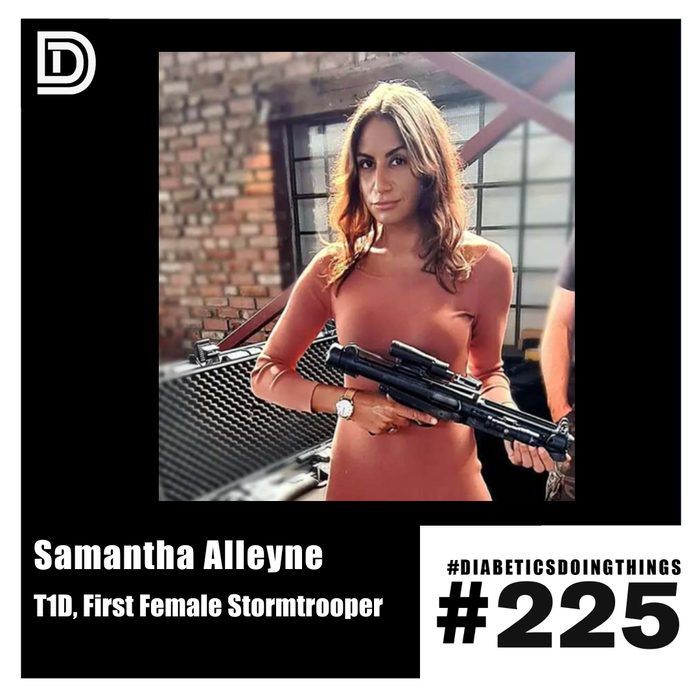
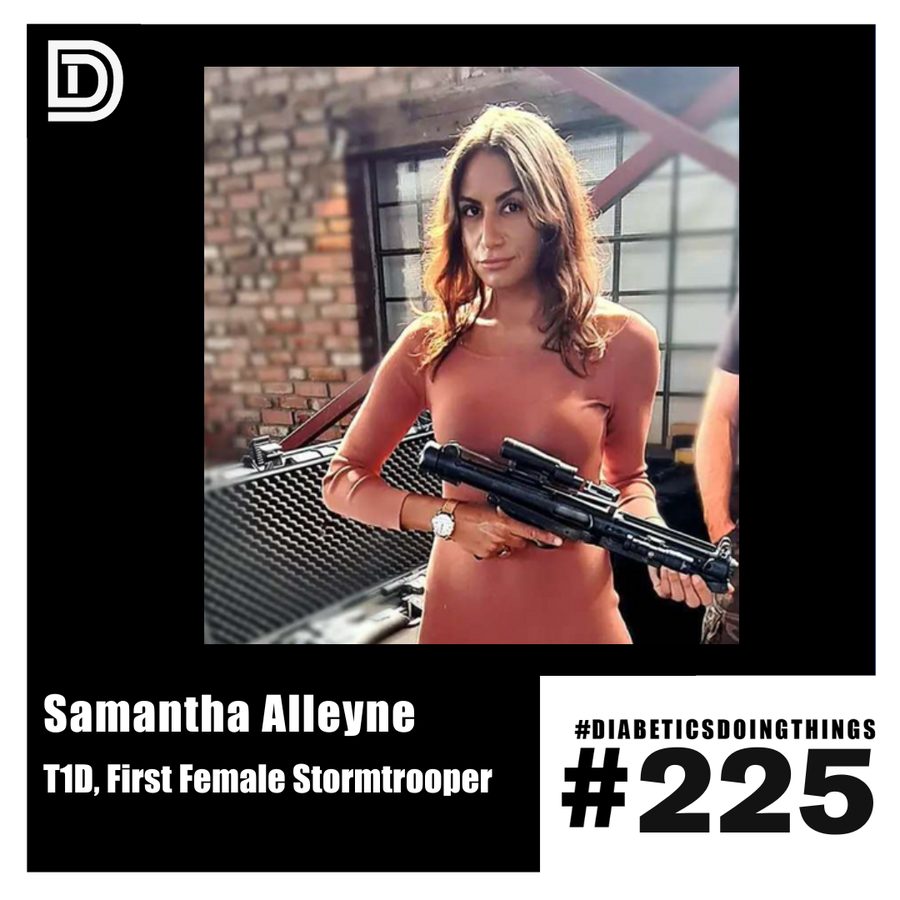
Samantha Alleyne, T1D First Female Stormtrooper


Episode summary
Samantha Alleyne is a UK-based actor known as Stormtrooper Sam, the first female stormtrooper in Disney's Star Wars films. She has appeared in all five Disney-era movies and in season one of Andor. Diagnosed with type 1 diabetes at age nine in 1989, she spent nearly three months in the hospital learning to manage the condition. She describes working on massive film sets while handling injections, a Libre CGM, and glucose supplies kept near set, plus the planning behind costume changes, meal timing, and speaking up to crew about her needs. She also talks about finding the diabetes online community, sending spare insulin to a stranger during the pandemic, and pushing for universal access to insulin and CGMs.
Key takeaways
- Samantha Alleyne became the first female stormtrooper in Disney's Star Wars films after JJ Abrams asked why no women were in the suits for The Force Awakens.
- She was diagnosed with type 1 diabetes at nine years old in 1989 and spent close to three months in the hospital learning to manage it.
- Alleyne says the costume department cuts small access panels into her stormtrooper suit so she can inject insulin, and she carries a labeled kit bag with snacks, insulin, and her meter on set.
- She says a CGM alarm went off during filming and taught her to always double-check it's silenced, and she keeps spare sensors after once running out mid-shoot.
- Alleyne says she anonymously sent unused insulin to someone in need during the pandemic and now speaks publicly for free, universal access to insulin and glucose monitors.
Show notes
For those of you that don’t know, Rob is a huge Star Wars fan, which makes this episode extra special! Samantha Alleyne has been in all five of the Disney Star Wars movies as the first female stormtrooper. She also appeared in Season 1 of Andor which premiered in fall 2022 on Disney+. In this episode, Rob and Eritrea talk to Sam about:
Her diagnosis story
Sam’s time with Star Wars
Life on set
Talking to the cast and crew about diabetes
Insulin access advocacy
Finding the Diabetes Online Community
Fan interactions
and so much more!
We want to hear from you. Send your questions, comments, queries, and general diabetes concerns to THE MAILBAG at mailbag@diabeticsdoingthings.com!
Questions this episode answers
Who is the first female stormtrooper in Star Wars?
Samantha Alleyne, known as Stormtrooper Sam, is the first female actor cast as a designated stormtrooper in Disney's Star Wars films, starting with The Force Awakens in 2014.
Does Samantha Alleyne have type 1 diabetes?
Yes. She was diagnosed with type 1 diabetes at age nine in 1989 and has lived with it for more than 30 years while working as an actor.
How does Samantha Alleyne manage diabetes while filming in a stormtrooper costume?
She says the costume department adds small access panels to her suit so she can inject insulin, and she keeps a kit bag with glucose, snacks, and her CGM reader as close to set as possible.
What has Samantha Alleyne done to support insulin access?
She says she sent spare insulin to someone in need during the pandemic after learning how many people in the US struggle to afford it, and she now speaks publicly about free access to insulin and CGMs.
Full transcript Searchable, with timestamps
Rob Howe: Hello and welcome back to another episode of Diabetics Doing Things. We're telling the amazing stories of people with diabetes from all over the world. And today I think is a first on the podcast. I am on the West Coast of the United States. Eritrea is in Dallas. And our amazing guest, Sam Alleyne from the UK. She's Stormtrooper Sam. She lives with diabetes and she's here on the show. Sam, welcome. So glad to have you. We've been talking about doing this.
Samantha Alleyne: I know. It's been a long time, years even, I think. But yeah, it's been amazing. And it's amazing to be here, finally.
Rob Howe: And Sam, you know, we're going to talk a lot about your career today. But you, like, it's just such a cool thing for me to say as a person with diabetes, because not only are you, we're going to talk about your life as the first stormtrooper with diabetes, but you're the first female stormtrooper in Star Wars. so you've been in all five of the disney star wars movies you were and our season one which was amazing and and premiered last fall on disney plus like what what is it like for you to like when you hear somebody say that out loud that you are the first female stormtrooper like what what
Samantha Alleyne: is that like to just to live that life um i still to be honest it's still quite quite a lot to get my head around I still pinch myself that it's even true so um I think so there's a bit of contention over over the over the title but basically before me there was no designated female soldier but there was a lady which may see the stunt lady back in '77 and she wore the suit but in terms of there being a designated female Stormtrooper who had a female and being an actor actually in the suit, that was me so yeah, like I said it's still a lot to get my head around, I still pinch myself we've had a few more ladies over the years but it invariably is just me on set with lots and lots of men so yeah I still pinch, I've got JJ Abrams to thank, he came along for episode 7 The Force Awakens in 2014 and started shooting stormtroopers and realized that there were no females and was like quite rightly why not and let's do something about that so yeah jj is the
Rob Howe: reason and i'm still here oh so cool and can't wait to see you i love your hashtag on social media spot sam when you know in the episodes and in the movies that was that was and all because
Samantha Alleyne: So like a lot of people ask, how do you know, you know, how can you plot yourself? You all look the same. So basically it's quite easy really because usually there isn't too many of us in a scene. Quite often there's only two of us in the scene or, you know, maybe four or five, whatever. But it's very rare that there's lots and lots of us. Obviously there's that huge scene in Force Awakens when we're at the rally and General Hux is giving that speech, which was largely CGI because they're on a scanner, so then they'll replicate lots and lots of troopers. We don't have that many troopers available. And then the same in The Last Jedi, there's a big scene with Benicio del Toro where there's lots and lots of us. But anything, it's quite often quite small scenes, so I'm very good at remembering where I'm standing. So I've always been quite good at playing Spotsam, But the thing with Andor, which was really nice, was we knew that we weren't going to be really featured until the end of the series. Because we were told that when we got to... So for the first few episodes, I was just like... Because usually you have to remember, when I go to the cinema, I'm waiting for me to pop up on the screen. Because I don't know how they fit all of the story together. So at any given moment, I could be on the screen. So I'm constantly in anticipation and I'm not really concentrating on the movie. I'm just waiting to see myself, which sounds a bit egotistical, but you know, you would too. So anyway, it was so nice to finally be able to just relax and watch. And that's what I did in Angle. And then I was like, oh, because I'm so relaxed and enjoying it, I'm like, oh, that's my little game. So yeah, we invented Spot Sound, which was, I think you guys call it Where's Waldo. We call it Where's Wally, which is the stripy guy. So yeah, that was my version of Where's Waldo, Where's Wally, Where's Sam, Got Sam. And yeah, it was really fun. I think we started on like episode six or something. If you guys go to my social media, you can see all the little bit of me through Andor. But it was really fun. And of course, it culminated. I got some really cool shots. I finally after eight years you know seven six projects I finally got the money shot of the holding the blaster with a laser coming out the end which I gotta tell you that was amazing it was super cool
Rob Howe: and we get to see it in that big you know culminating scene in that big you know action sequence which was
Samantha Alleyne: amazing and then there's another scene with I forget his name he's like one of the officers and he's looking out of the windscreen of a spaceship and looking out and then you just see two troopers behind him and there's such an epic scene. I think it was at the end of one of the episodes. And that, I think I'm going to print that and frame it. So I've got two really amazing shots that I love. You can see all those on my social media. But yeah, Spot Sam was a lot of fun.
Rob Howe: Well, it's very cool. And we're going to talk more about your career as an actor and what it's like to be Stormtrooper Sam on set. But let's go back in time a little bit and let's talk about you joining the type 1 diabetes family and tell us about your diagnosis and what that was like for you.
Samantha Alleyne: So I have been diabetic for 32 years, I think. Basically, it was 1989. I was nine years old. I have been really quite ill for like a long time. and my mum had taken me to the gp then the local doctor so many times and he kept saying that i had the flu i know a lot of people get sort of especially back then it was the 1980s you know stuff wasn't as advanced sure we are now i was incredibly thin um to the point where i was a ballerina and i nearly went pro but you know i got too tall and stuff but i that's my that's
Rob Howe: That's what happened to me, T. I was too tall to be a ballerina.
Samantha Alleyne: And Princess Diana had the same problem, actually. She got too tall to be a ballerina. Anyway, I digress. I was so thin that I remember, and I was nine, but this is one of those memories that really sticks in my head. I was doing the show, and I came out on stage, and it was in, like, a big local theatre. And I came out on stage to do a ballet solo, and I had this tiny little white tutu on and the audience just went, yeet, and gasped in horror because I've had the kind of how thin I was. I think I have a photo somewhere, but I was sort of skeletal. I was tall, so that made it look worse. I was just bones basically, arms and legs. You could just see you're my bones. So, yeah, I remember that's when I thought, there was something wrong of course i was like people know the symptoms you know i was thirsty this time going to the bathroom a lot but yeah the weight loss was terrific but yeah i rich i remember that feeling of positive thirst and always needed to go to the bathroom but i was yeah i just i looked ill i was extremely thin and just sick a lot you know like cold blue and you know infections and whatnot so yeah and she just kept on kept on taking me because she knew something was out and then finally she took me to the hospital to the emergency room and yeah they were like if you'd left it a week later she probably wouldn't be here anymore so yeah it's a bit sad but thank god we my mum took the initiative and so yeah I went we went to the A&E and I remember the doctor he was lovely and you know they was quite quickly realized what was wrong because my ketones and my blood sugar and whatnot and then i just remember because i don't like to talk about all this stuff so i like i'm very much positive person and i like to see the humor in the diagnosis it's important to find joy in everyday situations but i just remember um i'm a big foodie i love food i realized yesterday that i spent most of the day thinking about what i'm going to eat next and my mum used to be a chef, professional chef. So she's a very, very good cook. And I just remember when the doctor was explaining to me that I was diabetic now and that I would have to do, change things and watch what I eat instead. My mum was in tears and I was looking at my mum and I was looking at this doctor and then the first thing I said was, can I still eat my mum's lasagna? yeah and i was like my mother and you know it made her laugh which is nice because she was really upset sure so yeah that was what i was most worried about is he and so you know after that i was in hospital quite a while actually because i was so ill and they i was very lucky i don't know I doubt they do this now, but I think because I was so ill, I literally was like diabetes boot camp. I had lessons every day. They were giving me an orange to inject. They gave me a high-powering purpose to see how it would feel, but it was under provision of all these doctors and nurses. So I kind of was, because I was in hospital for about three months because I remember I was going to school in hospital. I had a school room. Oh, wow. I was there for ages. Yeah, I was there for like three months. But I think because I was there, I was very lucky to get that sort of crash course in diabetes. And my consultant back then, he's a very famous doctor, Dr. Allgrove, Jeremy Allgrove. He was like a leading diabetic consultant. So I was really lucky. I had really good care. And I learned, you know, all the basics, which now probably don't even apply. You know, it's back in the days of the vials and the ringes. But yeah, I had this crash course in the hospital. And yeah, it was... I remember like... I don't feel like I was sad or upset. I just remember kind of just getting on with it. I think that's what we have to do in diabetic. You just get on with it. It's a period of adjustment. and as I think because I was young I was nine I wasn't I wasn't a teenager yet there was a pubie I wasn't I wasn't feeling that peer pressure that all came later but at that point I don't want to say I had a good time in what you know it it was it wasn't I I even remember my nurse's name her name was Anna she was Irish and my uncle gave me no my auntie gave me a little dog a little and I named it that olo after my nurse there's lots of little memories and my uncle gave me a pink walkman and the batman bobby brow soundcheck or ghostbusters anyway I remember all these weird
Rob Howe: things that happened isn't that funny how you know it's such a core memory and like such a big moment for you and and you know I think that listening to your story it's very similar in some ways to you know, my story in Eritrea's as well. We were diagnosed at the same hospital, not very far apart and still had very different experiences. And, you know, to hear that, you know, even something as simple as can I eat my mom's lasagna? And the answer was yes. You know, you mentioned finding the positive in, you know, the, in the difficult situations. That's such an important thing, just giving you permission to be normal and do something that you like. And I think that early on, especially in the first like, you know, days, weeks that you're introduced to this disease, the way that people introduce topics to you can make a huge difference in the rest of your life because you start to, you know, oh, I can do this or, you know, or I have learned how to do this or even like, you know, what a hypo feels like. And, you know, I kind of remember, you know, my, my hospital stay was really only about three days, but it was very similar diabetes boot camps every day somebody came in and taught me something new and and yeah i mean it sets you on a nice foundation and and it's amazing how much like in those traumatic experiences that we all remember just because it was such an important part of you know of our lives so let's
Samantha Alleyne: sorry no it's fine go ahead if you say like even now if you say to somebody oh i'm diabetic the first thing they'll say is oh does that mean you can't do this or does that mean you can't So often people associate diabetes with, you know, things you can't do and what the limitations of it. So, yeah, it's nice to, like that guy said, the doctor said, yeah, of course you can do it. It's not always about what we can't do. It's about, you know, learning to find what we can.
Rob Howe: And I'm a big believer in that, you know, the constraints, everybody has constraints, whether they live with a chronic illness or whether they have a job that limits them to a certain amount of time or whatever the case may be. And I think where we find success and joy is just by taking those constraints and having as much fun within them as we can and really exploring the boundaries of the constraints. And that is real creativity to me. And I'm just excited to see that we have so many people living with diabetes. And that means that there's a lot of different personalities and a lot of different outlooks and i love finding those common threads of people making the best of what they've been given and and taking it as as far as they'd like to so i mentioned this earlier we we've had working actors on the podcast before but you know you are often part of the extended cast especially as stormtrooper sam so i'd love to know you know a huge production these these star wars films are massive massive productions what's a typical day in the life on set like for Stormtrooper Sam?
Samantha Alleyne: Well, okay, so yeah, they are huge productions. Quite often I've been in really huge scenes, so there can be like, I think the most we had is like 500 extra scenes in scene. So that's a lot of people to get ready. So we have to start very early. we don't obviously need hair and makeup but they like to get they like to get us there early so that we can get you know into our costume we're quite lucky though they'll most they'll often just get us in our base latest and then when we get nearer to the time then they'll put the rest of the costume on so yeah very early start we usually have our morning meal breakfast before costume so it can be quite difficult because I don't usually eat breakfast like at four or five but now I know that usually around eight o'clock when I was we're gonna be on set filming so it's not just having to kind of shifting and forward planning forward thinking much like every other diabetic but there are some you know some has not so like yeah basically i'll try and have like a carb pre-breakfast so i'll have just like the bacon and the egg and some coffee lots of black coffee to keep going and usually won't take my because yeah i because i'm not eating carbs that early and then if i do bollis then i know i can take it before i've got my costume on because i'm still in my my normal clothes because i said to you earlier once you get that costume on it's not easy to inject. I've had a customized bit of costume over the years. Costume department are amazing. Everyone's amazing and so we're like a family and they can do whatever they need for me to get through. So quite often I'll have a special jumpsuit that's got like a hole here or a hole in the thigh so that I can end clip my leg at one thigh piece of the sydiana and then inject in my thigh or in my album so yeah i'll i'll usually yeah so usually if i'm hungry or what is in the morning before i put my cushion in if not then i'll just just eat yeah carbs sorry just the protein bacon eggs coffee and then get on set and then i have a bag a kit bag we're not usually allowed personal items on set because there's a lot of us and you know they'd just be stuck everywhere but I have a I have a bag that's trans-foured like a makeup or its bag with my name on it a type 1 diabetic and I have all of the snacks all of the chocolate bars all of the glucose insulin everything in there um can warm and stuff like that just to keep me comfortable and safe and you know they're really good about me taking it as close to the set as possible if we're if set's like a little bit away from the holding area then i'll take it with me and then it will be hidden somewhere just because you never know and it it the time it takes for me to go back to where you know it's just nicer to have it there well i want to talk about that too
Rob Howe: because you mentioned you know the costume department has made like custom cutouts for you and you know that you're you're allowed to bring your bag there it sounds like you manage on multiple daily injections and i think you wear a libre cgm right yeah yeah i see i do my research
Samantha Alleyne: yes well done i i have yeah i have the libre too actually got a message from them this morning from abbott to say that i can't update my phone because there's a problem just for anyone listening don't if you're on android don't update to 13 because Libre won't work anyway so I never used to have the Libre so it's quite difficult to get it here on prescription I think they've changed the walls now so everyone is starting to get it but they're gonna I think it might they might be getting the Dexcom not the Libre but I eventually got it because I as talk about that later but I have been having some problems with my diabetes because of the length of time so I finally got it and so you're not allowed to take fun onto the scenes we as soon as you get to work you give your phone in they give you a number because obviously security phone scrolls you've had problems over the years with people doing naughty things and it was only on and all yeah and all supplies time that i've had to use you know the loop rate so that was like interesting in itself because I had to say to the AD like, I can't surrender my phone anymore. I need it to test because with the two, you can't use the meter and your phone. You have to use the reader. Sorry. You have to use the phone. But then you're amazing. You know, I put it on airplane mode mostly and the AD will have it. It can be a little bit troublesome because the AD is in charge of a lot of us. and so in Ferric the set was so big it was like a life-size town that you could walk around for hours and I'd need to scan or I'd feel a bit unwell and he would be like somewhere else and there'd all be radioed for him and no one so yeah it can be its own unique challenges but then you know I always have my blood test kit just in case so you know I find my way back to where I'm going to do that But the one thing that I forgot about was the alarms because I don't know, for you non-diabetic or for people that don't have a CGM, the default alarm on that thing is horrific. It will make your ears bleed. It's so loud and so piercing. And literally, I think I forgot the first time that I'd overridden the system to go off in spite of being on silent or doing all this stuff away. And it went off and that's not good for anyone to make a noise when you're making a film or TV show. Like to disturb what they're doing is horrible. As anyone with a cough will tell you, especially now after COVID. Anyway, I learned very quickly after that to make sure that it was completely off. And I've managed to now.
Rob Howe: You bring up a good point, though. And I'm sorry for interrupting you. Some of our connection is a little bit laggy today. But, you know, those are those like kind of moments where everybody's looking at you because of your diabetes. Those are very difficult, especially in like professional settings where you like don't want to cause a disturbance. Like you don't want to be, you know, difficult to work with or anything like that. So how do you how do you approach like discussing your diabetes with other cast and crew on set? Like even like wardrobe, like do you do you bring it up ahead of time? And like how do you advocate for yourself in those moments?
Samantha Alleyne: I don't like to like go around and you know broadcast like no Benson but you know we've all got to deal with and with like things like the phone making a noise and things like that I have to I do say very quickly you know sorry because I don't want people to see oh she's just got on the phone and you know she's just got a text message or something Because that looks awful and nobody wants to be that guy that keeps their phone on during work. Also, the other extras aren't allowed their phone. So when they see me with my phone, they're like, why is she getting special treatment? That's not fair. And I have to say, sorry, I'm diabetic to use this to scan. and again like jumping the line to get my lunch fast before anyone or we can give an extra time because quite often we'll have we'll be and they'll be like guys because we get continuous days so we don't actually get a lunch break they're just gracious enough to give you five minutes to sit and eat whereas i need to if i've boiled up already i need to eat everything that's on the plate and so i'll be sat there i'll be sat there by myself when everyone's gone back just quickly shoveling this food down because i have to eat all because i've already taken my insulin so there's all these different things i like i said i don't go around abadons i will explain it to other extras if need be or to staff i like i always like to tell the medic every day because we have different medics because obviously they need to be aware and my AD, the person directly in charge of me will know. So yeah, I think it's very important to let people know the case of the medical emergency. But other than that, I don't really let people know. But unless I have to because they're like, why is she getting extra treatment? But I do think it's very, very important to not feel embarrassed about things like that because at the end of the day, you're going to get yourself into trouble and I think I was on Maleficent 2 and there was a young boy with a diabetic type 1 and he wasn't being very good about it and he was like not doing what he should because he was worried about what they'd say and I was like no no no no don't do that because you're putting your life in danger you're going to end up ill and I said they're amazing speak to them give them your meds do what you need to do because at the end of the day like you said we all have issues whatever they may be and our health comes fast so don't ever feel embarrassed or like ashamed or like you know oh it makes me different to go and put yourself forward and say like I need I have no shame in going like no i will not because i've had like people shout at me and say why are you still doing sitting there eating we're taking and i'm like diabetic i need to finish this and i have no shame in doing that because i get it you're doing your job this is my health and that's right
Rob Howe: yeah i think it's really important and thank you for sharing that story about working with you know a co-star and and helping helping him advocate for himself too because i think it's really important for adults who are already in these situations who you know are these amazing people like yourself who were celebrating your accomplishments but I think it's also super important to talk about the work that happens between the time you get on set and the time that we see you on screen and it doesn't look the same every day and you're having multiple conversations with medics you have multiple conversations with ADs you're advocating for yourself and I think it's just important to know that even even though we have a couple of extra steps or we need it we need a few extra accommodations that that's not a burden and you can and people will accommodate you and it's important for you to advocate for yourself in those conversations even though it feels like the most embarrassing the most difficult thing to do in the moment once you do it I think you you really do get a like a muscle memory for advocating for yourself and it becomes more comfortable. And then, you know, even when somebody's in a high stress situation and maybe yells at you or something, you're able to say, Hey, I'm just taking care of my health. I'm just taking care of my diabetes. And, and then, and for the most part, at least in my experience, most people, even in those kinds of high stress situations, when you're able to communicate that they take us, take a breath, take a step back and kind of let you do your thing. So thank you for, for advocating for yourself and, and, you know, and others and in those little moments. You also online, I would categorize you as like as a fierce advocate for rights for people with diabetes and costs of treatment and insulin and, you know, access to CGM. You know, how did you find the diabetes online community and, you know, get involved and use your voice to, you know, to talk about things that everyday diabetics are going through and are struggling
Samantha Alleyne: with all across the world so things are quite different i think for people here in the uk versus you guys in the us invariably it's like insulin is free and we actually have free prescription medication because of all the complications that are associated with diabetes and all the knock-on effects, you know, we get a lot of infections, so we'll need antibiotics, for example. So they're aware of the fact that you don't just need free insulin, you need free this and free this and free this. And I'm very, very grateful and very lucky. And, you know, I'm aware of how privileged I am to have that. But I also am aware of how many people don't have that. And I find it actually incredibly upsetting. some of the story like basically I think once once I joined sort of Instagram and things Twitter and things and you you write one post about so then you'll get someone follow you and then there's that like you know domino effect and I think that's basically what happens with me finding these different accounts such as yours and then Beyond Type 1 and things like that and so I'm Once I started to see these accounts and stuff, and obviously I was already aware of the disparity of the variable experience for diabetics, but I was aware of the ins and outs and the nitty-gritty of it. And I remember that I changed insulin a couple of years ago from NovoRapid and Levemir to Fiasp and Tresiba. And so I had a lot of insulin that I wasn't going to use. And I obviously reached out while I went online and did some research. And there was a charity that usually collects insulin that's non-expired for third world countries, etc. But unfortunately, they weren't collecting because of COVID. and I happened to find an Instagram account where I think it's called Diabetic Dad and he basically had, you're not supposed to do this, it's against the law, but he'd sent insulin to the States to somebody who needed it. And he'd written a blog post about his experience and how he did it, et cetera, and keeping it cold. And I didn't do that, but I'll be straight with you. I really wanted to because who wants to throw away past the insulin? And so because of his reading story, I spoke to him. I reached out to him and I was like, look, do you know any other way I can utilize it? So we had this chat and he told me about these groups or Facebook where people would like say I need insulin. And again, don't do this. It's not allowed. I'm just explaining what I found. I spoke to a young girl in the States who had sold all her belongings. And I'm not exaggerating. She literally sold nearly the clothes off her back. she sold her television she sold her cane she sold furniture just to buy insulin and I was reading more and more stories like this and it just broke my heart because it's that oxygen to us that's like I don't know like without insulin then it's a very short amount of hours before, you know, something bad would be very sick or dead. So it's horrible to, you know, the United States is not a poor country. I know that there's a huge, you know, gulf between the rich and the poor, but invariably it's not a third world country, so this shouldn't be happening. I know it happens all over the world as well, but I think for some reason in the US it just seems and especially with the markups of the provinces of internet that the companies do and yeah it's well it's and there's a lot more to
Rob Howe: I think I think it's just so it's a such a different picture from what the way that we talk about America externally you know you know we're look at us we're we're going you know we're going to the moon or we're building everything bigger we're moving everything faster in our technology and everything is so great and and then you really dig into it and you find stories like the one you shared of people who are who are who are sick and and having to decide between paying rent or buying insulin and or you know sending their kids getting their kids to school and you know having to work multiple jobs and sacrificing their health you know for whatever they have to do in their life. And yeah, I think it is totally backwards. I think we should be embarrassed as America to continue to parade ourselves around the world the way we do without taking care of our people who need the most help. And I think when someone from another country, especially like the UK, who certainly doesn't have everything figured out from a healthcare perspective, but is miles ahead of us, and you look at that and you say, oh my God, I had no idea that in America it was like this for for people like me and yeah it's it's funny when you were you mentioned that charity like during covid because we were all learning so much at the time it weren't sure what was safe to you know interact with from different places you know we were trying to to send insulin one of my good friends was trying to send insulin to another a similar charity and she had her son had been diagnosed with type 2 and he had worked to get off medication but she kept filling his prescription so that she could donate the insulin to people who needed it just a literal walking angel. And then, you know, she came to me and she was like, hey, I can't, I have all this insight. I can't get it to anyone. And Eritrea and I, a friend was going overseas to some people who were in the humanitarian crisis. And we were able to kind of on the slide, I agree with you. It's like, you don't want to, you don't want to break the rules, but sometimes you got to break the rules in a good way. And, you know, so, you know, even in small, in small increments, like little, little bits can help people. And I think that's what community really means to me is that You find people who you connect with and, you know, who are willing to help each other. And I think that's, you know, even in the midst of all of the things that are all of the health disparities, all of the greed and all of the bad things that are set up about our health care system. What you find are the people who are willing to help each other out no matter what. And that is that's really special. Thank you for sharing that. I know that can be. Thank you.
Samantha Alleyne: I just want to mention quickly Victor Garber, the actor, he made about this very thing. And I shared that on my social media. And again, we just had the Super Bowl on Sunday. And I know Nick Jonas secured a slot during the commercial break. And I saw a lot of people, even just my friend is talking about it on social media. So not just about insulin for all, which is like the hashtag, but also tech, diabetes, tech. And I think he uses the Dexcom system. He's a rep for them. He's our ambassador. And I think it's just like this has two examples, those two, but we need just that whole universal approach that everybody should have access, especially to insulin. but and just add to the tech as well and i'm in france all type 1 diabetics have some cgm system that is the law even in the uk it was all pregnant women with type 1 or gestational diabetes and then they just recently as i said earlier they've just recently changed the rules that all type well so basically it's about you know and obviously it's difficult to to say there should be one blanked global rule but what what we do need is insulin to be accessible for everyone i think it should be free for everyone that's my opinion i know that's not as easy as as as as saying it but either free or the very low cost you know but for how much it costs to reduce, not the market. And yeah, access to tech because we all know how much this tech is helping people to manage their diabetes and also saving lives because the amount of money that is spent on looking after diabetics that are unwell in hospital and the amount of money that is saved in the long run because people were lowering their HbA1c with this tech and having less complications and less hospitalization. Sorry, getting very positive. No, you're spitting.
Rob Howe: You're spitting. I like it. Yeah, you're speaking my language because they talk so much about the cost of diabetes and you're absolutely right.
Samantha Alleyne: They're like, oh, well, this cost, this, this cost. Yep, we're saving money online. I know the NHS have saved, like the amount of money, like you say, I've seen the data because when I first got my Libre, you know, you have to do like some online courses. it's very easy but I read the data and the you know the average person once they get a cgm drops like and the old the old way from like an 8 hb1c 8% to like 6% within like a year or something and I know that a lot of people some of my friends have had such fast improvement that it's damaged their eyes because they've gone so quickly then having a high-grade BRD to go to a better one that it can damage your eyes if you come down quickly so that's how much it can improve your diabetes and that is saving a lot of money so yeah this all needs to be looked at and as much I wish I could do more and I am going to look into what else I can do I'd love to be like a slow person for this set sort of thing and do whatever I can because something needs to change people are dying every day because they don't have insulin and she's
Rob Howe: heartbreaking I think it's really cool though that so first of all I agree with everything you said say it three times but one it's so cool that your introduction to the diabetes community was through mutual aid because that was like I have found my community of people like who also need the same life-saving liquid. But also just on another note that you mentioned when you're talking about CGMs, I think it's a little crazy. And I'll just say this one thing, but the NHS is so much better than what we have in the United States. But the way that they give CGMs is still based off of one severe hypo a year. So they're like, oh, we won't give it to you unless you had an emergency. So it just makes me think like all people with diabetes deserve access to their data. And it shouldn't just be those of us who are on insulin. So I just wanted to say that. I will also say the UK is one of the highest people. They have a lot of key opinion leaders in endocrinology that are fighting to change from HbA1c to working on time and range. Because if we all were looking at our time and range, then we all need access to CGMs. So I think it's really cool that the UK is one of the leaders in that. So yes, we should be embarrassed as Americans. And Eritrea is doing a lot of in her professional life on this as well. It's very, very good. sorry go ahead Sam
Samantha Alleyne: I can tell like you got the you're spitting the facts here like I don't know you know I'm very busy and like I said I wish I could do more but I don't know all of this stuff like even what you just said about the NHS and once once this is another interesting point that will be I've never heard that they never said that to me they have different rules for different which is so weird right so in my choice it was if you do if i do you know what i'm trying to remember there was just like loads of different hoops you'd have to jump through and there was a form and you have to tick which it might and you people keep trying i have a friend who is and he works in construction and he physically cannot prick his finger i've seen his fingers his bit his skin is so thick from working with his hands and he can't physically draw Blavotte and they give him a CGM and he just had a really bad DKA and now he has a CGM and I'm like should not take him a DKA for you to get this thing and other places like I know to get a pump you have to give yourself more than free correction jokes in a day and it's just ridiculous like you said but yeah it's a it's a postcode lottery I still have friends that still can't get one and even though they've
Rob Howe: changed the rules it's still a bad and it's shit it's a slow progress and hopefully the world will all adopt CGM for everyone because that is my life mission but it's really cool that your mutual aid and your advocacy still shines through with all the work that you're doing being Stormtrooper Sam because that's I mean also just to see a woman on screen like when I heard you say like oh to test like I just have to take off a piece of my armor and like stab myself like I'm imagining you on the set like just where's my bag okay there it is like it's just a lot that you're juggling and you make it seem so easy but I just want you to know you're doing incredible things you know
Samantha Alleyne: what do you know what I I'm about to just get over with it to help a person like I said when I was diagnosed I don't when I look back probably was really hard but I don't remember I just remember all the fun stuff the the cuddly toys and the walkman because that's that is why and so I am like we could sit and we could cry or we could just get on with it and see what happens and that is how I am but actually I do stop and think yeah you're kind of a bit of a badass because being a stream trooper is not easy it's tough it's uncomfortable it's painful it's hot it's cold I have permanent injuries from being a stormtrooper. I have to get regular treatments from an osteopath and a chiropractor. Because I have damage because I've worn that thing for so long, for such extended periods of time. It's not an easy job. Being on a film set for anyone, not just a stormtrooper, is not an easy job. It's not nine to five. You don't get regular breaks. I'm not going to have my lunch at 12. And to do that, and to be diabetic, it having a hypo on set and then having to go back like straight away even though your your sugars haven't come up yet but you're in that seat so you have to be there and you're shaking going here and needing to pee but you're in a soldier costume like just that's for a woman it's difficult anyway I have a few weeks but because you're high and you need to go um I was filming recently and I for the first time I lost my internet guys don't ever and it was horrific it was awful and I very nearly just asked to call 911 luckily I had my facial, my lung acting and so I took some of that and I just drank a lot of water and it started to come down. But yeah, I always have spares before anyone asks me. But I just changed the cartridge the night before to the spare one. And yeah, anyway. I think we've all been there. Well, this is the first time it ever happened to me. Yeah, it was so scary. But I have to carry on filming because I was very important to that scene. So, yeah, it is tough. And I think I take for granted. I'm strong. I am very strong. I know that. I have had a lot of adversity in my life. And I just, to me, impossible is nothing. Like, I don't like the one, no. I don't like to be told, no. I don't like to be told that I can't do something, especially if it's because I'm a woman or a diabetic or a person of colour so yeah I'm just gonna get on with it and yeah I should probably tap myself on the back more because of what I do but my thing is just carry on doing it and maybe if I inspire people for whatever reason that's a great see because the higher you grow the the more people you have access to speak to like you guys and then you know we can just keep spreading the love and inspiring people to to do good things and be great and to make change affect change where it's needed like with diabetes and insulin
Rob Howe: well sam i can i can absolutely 100 confirm that you have inspired me and and i know eritrea as well and many many others just to learn like learning that there's a stormtrooper with diabetes you know star wars i'm a huge star wars nerd i grew up on star wars it's one of you know the things that's brought a ton of joy to my life and being able to see somebody on screen behind that mask is living with diabetes just made me feel like a million bucks i could have run through a wall when i heard that so thank you so much for for the time and you know i want to be conscious of your time as well but you know you took for the listeners you took this interview right in the middle of a very demanding shooting schedule and we're super accommodating with your schedule so i just i'm very grateful for you and your time and i can't wait for people to hear this episode
Samantha Alleyne: it's just gonna it's gonna be amazing thank you thank you so much for having me like i could i have so much more to say as you know i like to speak but yeah maybe we could chat another time but it's really important for me to do stuff like this and thank you so much for having me. I've been a huge admirer of what you guys do for a very long time. So when you reached out to me and said let's chat, I was so excited. So thank you so much. And yeah, anytime.
Eritrea: I am not a Star Wars fan. I'm not a Star Wars fan, but I am a Samantha fan. So I, Rob, write down a movie she's in and all of the scenes because I will go watch it. So for everyone else who's not a Star Wars girly, join me. We can become them. Like, let's do it. I love it. We have a friend. You guys are making me emotional. Thank you so much.
About Samantha
Samantha Alleyne is a UK-based actor known as Stormtrooper Sam, the first female stormtrooper in Disney's Star Wars films, appearing in all five movies and in Andor. She has lived with type 1 diabetes since age nine.