

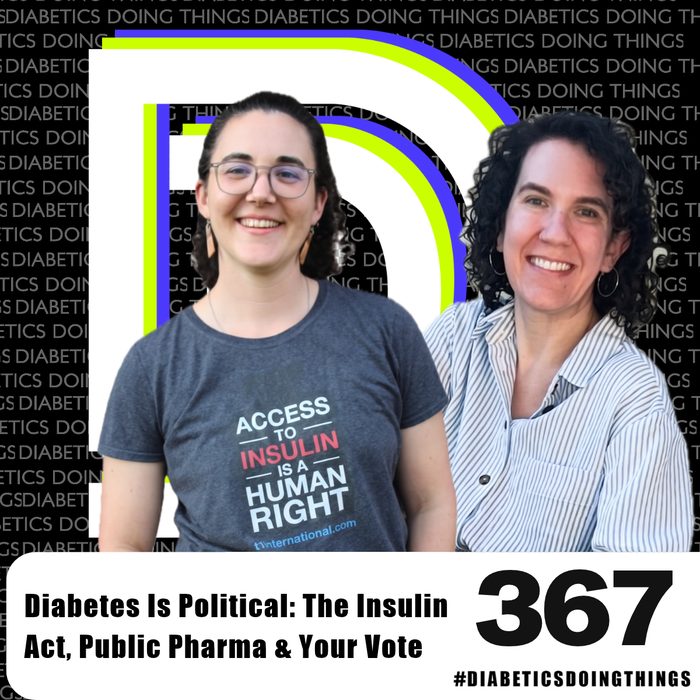
Diabetes Is Political: The Insulin Act, Public Pharma & Your Vote with T1 International


Episode summary
Shaina Kasper and Kristen Whitney Daniels both live with type 1 diabetes and have each rationed insulin because of cost. Kasper, executive director of T1 International, was diagnosed through a clinical trial after her sister's diagnosis. Daniels aged off her parents' insurance at 26, started rationing soon after, and turned that crisis into advocacy, founding the Connecticut Insulin for All chapter in 2019. Together they break down the Insulin Act of 2026: the gap between a copay cap and a true price cap, and how the House and Senate versions differ on coverage for the uninsured. They explain why T1 International endorsed the bill for the first time, how to talk to legislators, and state-level public pharma efforts in California, Vermont, and Connecticut.
Key takeaways
- Kristen says a copay cap is not the same as a price cap: insulin still costs hundreds of dollars and someone else absorbs that cost.
- Shaina says T1 International's 2024 survey found 36% of respondents were rationing insulin, double the 2016 rate.
- The Senate version of the Insulin Act funds a five-year pilot program for uninsured patients in 10 states; the House version dropped that provision.
- Kristen says personal stories move legislators more than statistics, since many congressional staffers know little about what living with type 1 diabetes requires.
- Shaina points to California's CalRx insulin glargine at $55 for five pens, and Vermont and Connecticut's ArrayRx discount card, as reasons T1 International calls 2026 the Year of Public Pharma.
Chapters
- Why the Insulin Act matters before midterms
- How T1 International became a global movement
- Copay cap vs. price cap, explained simply
- Why people think insulin is already fixed
- Who the Insulin Act helps and misses
- Insulin rationing has doubled since 2016
- Senate vs. House: the uninsured pilot program
- Insurance gaps and the 2027 coverage squeeze
- What lawmakers don't know about diabetes
- Storytelling lessons from Magic Johnson
- How to call or email Congress
- Why 2026 is the Year of Public Pharma
- Discount cards, GoodRx, and pharmacy closures
- ArrayRx and a tribal-nation manufacturing study
- Patent reform and the December 11 deadline
Show notes
A lot of people think the $35 copay cap fixed insulin. For most of us, it didn't. In 2024, 36% of people responding to T1 International's out-of-pocket survey said they were rationing insulin, twice the rate in 2016. With midterms weeks away and the Insulin Act up in both the House and Senate, we brought in two people who have been in the room for this fight for years.
Shaina Kasper, Executive Director of T1 International, returns to the show alongside first-time guest Kristen Whitney Daniels, who co-leads T1I's federal working group with Shaina. Both live with type 1, and both have rationed insulin themselves. Kristen walks through the Insulin Act in plain language: the difference between a copay cap and a true price cap, why the IRA only covered part of the Medicare market, and how the House and Senate versions differ. One of the biggest differences is only the Senate bill includes a pilot program for people without insurance, which is why T1 International endorsed the bill for the first time.
From there, Kristen and Shaina explain exactly what to say when you call or email your representatives They explain why your personal story matters more than any statistic, and why 2026 is T1I's Year of Public Pharma: California's CalRx glargine at $55 for five pens, Connecticut's ArrayRx discount card, and a tribal nation studying generic manufacturing. We close on patent reform, maybe the least flashy but It's what gives public manufacturers and biosimilar makers the legal room to compete and bring prices down for the long haul.
Diabetes is political, which means your story matters. Email your representatives about the Insulin Act, because your story could be the one that moves the right person.
Chapters
00:00 Why the Insulin Act matters before midterms
04:20 How T1 International became a global movement
08:15 Copay cap vs. price cap, explained simply
11:47 Why people think insulin is already fixed
13:13 Who the Insulin Act helps and misses
14:33 Insulin rationing has doubled since 2016
16:12 Senate vs. House: the uninsured pilot program
18:29 Insurance gaps and the 2027 coverage squeeze
22:38 What lawmakers don't know about diabetes
25:53 Storytelling lessons from Magic Johnson
27:47 How to call or email Congress
31:54 Why 2026 is the Year of Public Pharma
34:08 Discount cards, GoodRx, and pharmacy closures
36:34 ArrayRx and a tribal-nation manufacturing study
39:07 Patent reform and the December 11 deadline
Resources:
T1 International: Take Action: Email your House rep and both senators about the Insulin Act
CalRx Biosimilar Insulin Initiative
T1 International Access Survey: over 30% of people rationed insulin due to cost in 2024
ADA 2026 National Access and Affordability Survey: 41% rationed due to cost last year, and 2 in 3 reported higher out-of-pocket insulin costs in 2026 than in 2025
Health Affairs research: a quarter of adults with type 1 have experienced a lapse in insurance coverage
KFF: Key Facts About the Uninsured Population
Questions this episode answers
Does the $35 copay cap already cover everyone's insulin?
No. Kristen Whitney Daniels explains the existing $35 cap only applies to part of the Medicare market. People with private insurance, Medicaid, or no insurance can still pay hundreds of dollars per vial.
What is the difference between a copay cap and a price cap?
A copay cap sets what a patient pays at the pharmacy counter, while the actual list price, often $300 or more, gets subsidized elsewhere in the insurance system. A true price cap would lower the drug's real cost.
What does the Insulin Act of 2026 do?
The Senate version sets a $35 copay cap for people with private insurance and funds a five-year pilot program in 10 states for uninsured patients. The House version includes the copay cap but drops the uninsured pilot program.
How can I help get the Insulin Act passed?
Shaina Kasper and Kristen Whitney Daniels say to call or email your House representative and both senators, share your personal story, and ask them to support the Insulin Act before the end-of-year legislative package due December 11.
Full transcript Searchable, with timestamps
Rob Howe: Hello podcast listeners, I have a very exciting episode for you. It is October 2026 here at Time of Publishing, which means that it's near midterm election season in the United States. And over the past couple of years, we've had guests from advocacy organizations coming on to talk about diabetes is political. And with the Insulin Act up this year in the House and the Senate, I thought it was really important to bring some of those experts here for you to learn what we like about the Insulin Act, what needs to be done. and what you can do as a patient. So as you know, and you may not know this, but more than 30% of people with diabetes have rationed insulin because of cost back in 2024, which is double the number from when T1 International started tracking it. A lot of people think the $35 copay cap fixed insulin, but for a lot of people, it didn't. And today we're talking about the bill that's trying to fix that, the Insulin Act. Our returning guest is Shaina Kasper. And if you've been listening a while, you know her. She first came on the show back in 2023 when she was T1 International's Policy and Advocacy Director. On that episode, we're asking, where is the $35 insulin? She came back in November 2024 as the organization's new Executive Director, taking over from founder Elizabeth Pfiester. Shaina lives with type 1. She was diagnosed through a clinical trial she joined after her sister's diagnosis, and she herself has rationed insulin. And that experience is a big part of why she does this work. Today, she leads T1 International's global hashtag insulin for all movement that covers chapters across the US and around the world. And this year, it includes what they're calling the year of public pharma, which we are discussing in depth in this episode. Joining her is someone new to the show, Kristen Whitney Daniels. Kristen has lived with type 1 for about 20 years. And at 26, she aged off of her parents insurance and ended up rationing insulin. And that crisis pushed her into advocacy. In 2019, she started the Connecticut it insulin for all chapter. And today she co-leads T1 International's federal working group, which is the team pushing the Insulin Act in Washington. And she is our Insulin Act expert. She breaks it down really clearly here for you. She's testified at the U.S. Senate and attended the State of the Union as a guest of Congresswoman Rosa DeLauro. She's been featured by NPR and Teen Vogue. She also works on NIH-funded research at Yale on the social determinants of health in type diabetes, and she contributed to the WHO's report on diabetes stigma. Before we get into the episode, one thing about T1 International matters a lot for this conversation. They don't take money from pharma or from device makers. They don't accept funding from anyone who could limit their ability to advocate freely. That is rare in the diabetes world, and it's why they can push on drug policy without worrying about who's funding them. That independence depends on community donations. I We promise you it is harder to do that. So that's where we come in. This November, around World Diabetes Day on November 14th, T1 International is running a peer-to-peer fundraiser. You can set up your own fundraising page, share it with friends and family, or just donate directly. Every dollar goes toward patient-led advocacy with no pharma money involved. Head to t1international.com to donate, start a fundraiser, or email your representatives about the Insulin Act. And we talk about what you can do in this episode, and we've included those links for you in the show notes. So please enjoy this interview with Shaina Kasper and Kristen Whitney Daniels. Diabetes is political.
Unknown Speaker: Guys, who was MVP of the chat? Rob Howe! Rob Howe! What were you on? We need more of that.
Rob Howe: Okay, we're recording this in October 2026, which means midterm elections in the United States are right around the corner. And I'm very excited for today's interview because I've frequently relied on my friends at T1 International to help me interpret for our audience of people living with and caregivers of people with diabetes, how to interpret policies and how to think about the things that are happening in our political landscape in the United States ahead of election season. So Shaina Kasper, Kristen Whitney Daniels, welcome to the show. Thanks for having us. Yeah, thanks for having us. This is great. Yeah, we are going to have some fun today, a wide ranging conversation really about policy. And I'd like to just talk about some of the things that I know we were talking before we hit record that are changing even in the past couple of weeks, things that are really accelerating as we head into election season and early voting starts like really in the next 10 days in some places. So Shaina, do you want to lead us off and start the conversation?
Shaina Kasper: Yeah, I guess just to take a few big steps back here, T1 International got started in 2013 as a space for people around the world to share their stories of living with type 1 diabetes. And what began as a small platform just quickly grew into an organization that has really been rooted in the leadership of people most impacted by the insulin price crisis. We have a real commitment to authentic relationships and solidarity across borders, and our refusal to take funds from pharmaceutical corporations and device manufacturers has really guided us every step of the way in our political activism work to make sure that everyone with diabetes, no matter where they live, has access to everything that they need to survive and achieve their dreams. So in the lead up to World Diabetes Day in 2014, we launched the Insulin for All campaign with Pensley Trust. That was Liz, who's our founder and former executive director. When the price of insulin really started to skyrocket, we were able to put into place some chapters and policy programs to be able to try to stop some of those things. What we are finding is that a lot of people have been left out of a lot of those policies that were initially passed to try to solve the insulin price crisis. We passed these co-pay caps in different states that really only impacted about 20% of people who needed insulin to survive. And so as we've been constantly evaluating and reevaluating our work, we really found that we needed to take it even bigger and to really address this corporate monopolization of the insulin and other access to essential medicines and diagnostics. We just did a strategic plan in 2025. It's available on our website, where we We really heard from our community that insulin is still vitally important. So many people around the world are reliant on donation programs or other ways to get their insulin access that we really still have a lot of work to do to get dignified access to insulin for all. Also, there's other things that we need to be working on to really change the structures and the programs that have allowed for this to happen. And so we've been working on some other things that hopefully we'll get to talk about too. But really the biggest thing that I think a lot of folks are thinking about, what I want to make sure Kristen was on today to talk about as well, is the Insulin Act. So we historically did not endorse the Insulin Act. It was a copay cap. Hopefully Kristen can talk about that too. Part of the Insulin Act originally passed in 2024 to get $35 insulin copays for all Medicare beneficiaries. But that left out a lot of people living in this country. In the United States, this has really been a big rallying cry. A lot of different organizations have been working on trying to pass the Insulin Act to get the $35 insulin copay cap for people with private insurance, and then figuring out how can we also make sure that there's coverage for people without insurance. And again, as we're going into 2027, a year where a lot of people are going to be taken off of Medicaid because of work requirements, where cost of insurance premiums is skyrocketing. And so employer-sponsored plans and ACA plans are going to become untenable and affordable for a lot of people living in this country that we're going to really see a lot of folks needing some of the services that we're hoping the Insulin Act can cover.
Rob Howe: Yeah. And I think something that in our conversation leading up to this interview, you talked about was that in years past, you might describe the work that you did at T1 International as working on insulin access, like at a party, a social gathering. And now it's much more than that. It's insulin access plus all of the other things that we'll hopefully touch on today, including CGM, which just popped right in.
Shaina Kasper: I'm right in front of my mic. I just left it right there.
Kristen Whitney Daniels: No, it's great. Beeps and alarms are welcome. So, Kristen, let's talk a little bit in plain language, because I think it's a really great name because people with diabetes immediately see insulin and we pay attention, right? We're paying attention to that sort of legislation. So what is the Insulin Act and what problem is it trying to fix? And what is this version or iteration compared to the initial version in 2024? Yeah, the Insulin Act has a bit of a storied history. And you can sort of trace its roots all the way back to some people may remember Build Back Better into 2021. And the original iteration was the $35 copay cap for Medicare that we now have. Those with private insurance, again, same thing as a $35 copay. And I will keep using copay cap. I just want to sort of delineate the differences because I think this is really important. A lot of people call it a price cap. If it was a true price cap, that means that the entire cost of insulin would be $35. Instead, this is asking for copay caps, meaning that at the point of sale, the person would pay $35. But there is this difference between how much the list price is and how much the person is paying at the counter. That price has to get paid for somewhere. And we know that insulin costs between three to six dollars to manufacture. So between that and a $300 price tag, there's a lot of money that has to get subsidized. Now, we have this whole opaque system that I won't get into too much because that could be an entire episode on its own of PBM, pharmacy benefit managers who are negotiating the prices between the insurance and the employer and all this other stuff. But just know with the copay cap, typically the price gets spread amongst the other people in your insurance. Now, this particular bill that we're working on, the Insulin Act of 2026, they have a provision so that it should not be spread amongst everyone, that this should be something that is absorbed. But people do what they got to do to make money. So we'll see how that actually plays out. So getting back to the long storied history, we see it go from Build Back Better. We see that turn into the unfortunately named IRA bill that eventually does get passed. But I know me and Shana were talking. We're watching this happen in real time. We're messaging with the people who have driven this bill. We're going, OK, so is this going to happen? Are you going to be able to get the help for those in the private insured market? And right at the last minute, the vote goes down. And while some Republicans sided with the rest of the Democrats to really push it over, it eventually got struck from the bill. So I think a lot of people think that the IRA solved the insulin pricing crisis, but it really just applied to the Medicare market and only a portion of the Medicare market. There's still a lot of seniors that are paying more than 35. I mean, the programs themselves are horrible to navigate. And we've done some awareness of trying to get Medicare patients to know that there is this program, but you have to really be on the lookout for it. So then this keeps trickling on. We've had different iterations of this bill. Some people might remember Senator Shaheen and Senator Collins who released the bill. That had a focus on PBMs as well. Then Senator Warnock and Senator Kennedy also came out with a bill. And eventually they combined their superpowers to create the Insulin Act of 2026. That has been many, many, many years in the making and many, many iterations. But to just sum up what is actually in this bill, man, this gets so convoluted because even the House bill and the Senate bill are different. Well, and I think, too, it's like just to put myself in the audience's seat for a moment is like, OK, let's say six months ago, roughly, was when I think there was a groundswell of grassroots support and excitement about the Insulin Act on social media, for example. And advocates and content creators and just regular people were doing their best to read and interpret this policy and turn that into content to share with their networks. And, you know, the information gets spread. And I think a lot of people responded because it is complicated to know the difference between a price cap and a copay cap. And your average person who is not purchasing prescriptions on a regular basis has not been to the pharmacy and had that sort of rug pull experience where it's like, well, no, this is supposed to be $35. And then another price is quoted. They think that it's already solved. There's also rhetoric about it already being solved. And so it can be very confusing. or you remember back to those bills, whether it's Build Back Better or IRA, and you're like, oh yeah, remember we did this. But then you say, okay, well, it's only Medicare, and then it's only a portion of Medicare. And so that leaves out most of the market, most importantly, the uninsured, but also people on commercial insurance plans who expect, because they are reading these headlines, that $35 insulin is what they're gonna have to pay. So let's break in for 2026, because I stepped in and cut you off. I'd love to know, where are we now? And like if it was past tomorrow exactly as written, what is included and maybe what is not included? I think thinking about it maybe in terms of who this will help and who this won't help is also a good framing of it. Because I think at the end of the day, we just want to know how are we going to be able to afford our insulin at the pharmacy counter? And I think it is so important that people are armed with that awareness because I just can't think of anything worse of somebody going to the counter and expecting they're getting their insulin for $35 and being told it's $300 and that person having to walk away from the counter. I've been that person. I've had to ration my insulin in the past. And it is such a lonely, desperate feeling. And this is what our hopes and dreams are with any sort of legislation. shed. And I want to pause really quick there because the survey and research that T1 International published, this is not a singular experience. This is very common. Myself, I shared a story on an entrepreneurial panel the other day that the runway for my business was exactly the number of days of insulin that I had stocked up. I didn't know at the time that is insulin rationing. And so like all of us are, have experienced that I think it's the one in four people are in the United States at the time of the survey or rationing their insulin or experiencing insulin rationing. This is something that everyone with diabetes will likely have to encounter at some point in their life. And this is why it's so important that legislation like this is implemented. Even studies that are more recent are even more dire, which is really disheartening. T1I did an out-of-pocket expense study in 2024. 36% of people responding said that they were rationing insulin. And that's twice what we saw in 2016. And then the ADA recently came out with survey responses and they said 41% ration due to cost in the last year and two thirds reported out of pocket costs increasing in 2026. So this crisis is not over. And I know we'll get to how do you talk to your legislators about it. But it is so critical that people who represent you know that because let me tell you, there's very little knowledge of what diabetes entails. on the hill. All right, back to the bill. So who is this bill helping? There's a Senate bill, there's a House bill. The Senate bill was introduced first, and that sort of included the people who have been working on this, what I would say, the longest publicly. And so it would be a $35 copay cap for those on private insurance, all private insurances. So if you're in a state that did pass a copay cap, chances are you probably weren't covered under it. But this would cover that huge swath of markets. And that's really great. It would cover one of each type of insulin. So you would get your long acting, your short acting. There are some intricacies about how that would be covered. And of course, it depends on your insurance, what your insurance covers. So it's not like you can just get whatever insulin you want. Choices are yours. We're not quite at that level in health care.
Shaina Kasper: Sounds great, though.
Kristen Whitney Daniels: It does sound great. Let's make our own bill. And I try to really, that is some of the questions I usually get about this particular bill. And the other huge piece, I think for Shaina and I, is that the Senate bill includes a provision for those who are uninsured. It is a pilot program that 10 states for five years would receive extra money from the government to fund either their pharmacies or to help pay for the insulin so that people who are uninsured have what we hope is unencumbered access to insulin. Obviously, 10 states is not all 50, and five years is not forever. And we would love to see that extended to everyone. But somebody who has been uninsured, I just think every one person that we can cover with this net is worth it. getting into the House bill, and I think this is really important, it is just listed as the copay cap for those with private insurance. That portion for the uninsured had been struck. Moving forward, we hope that this will be included in a year-end bill. The chances of it passing in the schoolhouse rock way are probably close to zero because of where we are in things and voting and elections. But our hope is that this gets included in a year-end package. And we know there are people who are shepherding this bill forward with that provision for the uninsured. Thank you for laying that out. And I think that's also done in a way that we can, when we publish the episode, include a helpful graphic of House bill, Senate bill. Who does this help? So when we talk about things that are getting struck, as bills sit on the floor, in order to get them passed or strike the bills down completely, there are concessions being made? Again, I'm in lay terms trying to express this. So that's how we find ourselves in the position where in the House there is no clause for the 10 state pilot program or including the uninsured. And it's only for commercial plans, which does help a lot of people. But as we're looking at the hierarchy of needs of people who need it the most, the biggest impact is going to be obviously on that uninsured side. So is that a right interpretation of how the bill differs from one legislative body to another?
Shaina Kasper: Yeah, I think that's the main difference here. And I think I can just say why we care so deeply about the uninsured provision is because so many people experience lapses in their insurance coverage. Research from 2017, 2018 showed that about a quarter of adults with type 1 experience an interruption in their health insurance for at least a month, right? And so you're counting how many days of insulin do I have left? This is a very common experience. And as we know, as people living with type 1 diabetes, insulin is like oxygen. You know, we have to have it. We really cannot, you know, skip a dose here and there like I can do with my allergy pill, for example. And that means that if you don't have insurance, you have to pay that full list price, which as Kristen was explaining, it is still hundreds and hundreds of dollars a vial for many insulins. And so this lapse in insurance coverage can cover people between jobs or during life changes. You return to paying that full price the day that your insurance coverage ends. And what we're really scared about for 2027 is that a lot of people are going to be losing their health insurance. Medicare is getting more expensive. Health insurance is getting way more expensive across the board. Like every plan. I'm sure everyone has their story of getting these notices in the mail November 1st or October 15th, wherever it is for the insurance plan you're on.
Rob Howe: I'll double down on that. Our overhead, our number of staff at Recreation Dallas, the company that I co-founded and run, our monthly costs for health insurance for, we have 50% fewer employees than we did at this point two years ago. And we are paying 10% more per month for our private insurance. And I'm looking at them just like scratching my head of, oh, that's way higher than I remember. And I think about even if that number of full-time employees was higher and we pay 100% of premium because I'm a patient and I understand what that does to someone when their price goes up every month. But I just looked at that and I'm like, oh, well, this is why people are losing their insurance because they can no longer afford to pay for the plan that they thought was locked in. And guess what? They're not getting more benefits for the money they're paying, probably less in some cases. And so, you know, you're paying more for either the same or maybe worse coverage than you got before. And that's the reality for many people.
Shaina Kasper: We're also going to be seeing Medicaid work requirements going into effect in 2027. And obviously, most people on Medicaid are working or, you know, are able to fulfill those work requirements. but it's going to be really onerous paperwork. You know, us living with type 1 diabetes, we're very experienced in filling out a lot of onerous paperwork to get our prior authorizations that we need. And yet we're really scared that just because this is new, newly running, rolling out, folks are going to, there's going to be mistakes and people are going to be cut from the Medicaid insurance because of paperwork issues. So just wanting to say one of those, if you're in line, stay in line. And if you have insurance, don't assume that this $35 copay cap bill is going to pass and that you're going to be able to get insurance. If this bill passes, that means you're going to get that $35 insurance because of having private insurance. And that's also why we really need to be doing everything that we can to support people without insurance. And that's why at T1 International, our federal working group, which Kristen and I co-lead, has endorsed the Insulin Act for the first time is because it covers this provision for the uninsured.
Rob Howe: You really nailed it of why it's important and what the message is. And for, I believe, you guys put out a page on the site to email your representatives. And what should someone say? Because, you know, there's that little box, right? And you put in your name and address. It gives you the representative to email if you don't have their information saved in your inbox like I do. How many automated emails have I received from my Texas senators? I will not labor you with that information. But when I write my representative or my senator, what should I say? Do I need to tell my personal story? Do I need to say why it's important to me? Should I cite statistics? What should somebody do in their own state? Some of the states have COVID caps, some don't. What should our listeners do who are passionate about the Insulin Act and this type of legislation getting passed? Like, what should they do? I think personal story is so important. I really want to stress how little legislators really know about the disease and its intricacies. We often go into meetings and we do a little show and tell of, this is what an insulin pen is. This is what a vial is. Here's an insulin pump. This is how they're different. I mean, really basic. Some people do have very personal experiences with diabetes. Senator Shaheen and Rep DeGette both have personal experience, and that's really why they've been shepherding these bills forward. But so many people don't have an inside look at it. And not to mention, especially in the House, those legislative aides that are reading your emails are probably covering six different areas besides health. And then even within that one category, health is just so wide and varied and there's so many bills happening. So first, they may not know why diabetics need insulin. They may not know that for type 1, we need it constantly, without fail, forever. Forever. Forever. That's also a thing. So just for a little bit and you're like, no, no, no. Every single day. Right. Without fail. So I think education is important and telling people that this is not over. A lot of people we've encountered thought that the IRA fixed things. They also think that the promises from the insulin manufacturers, which I think was around 2024 when they were called in front of the HELP Senate committee. And a lot of them made promises that we're only going to charge patients $35, which I also think has led to some of the confusion about why people's insulin is already $35. A lot of people are saying $35, which seems to be a very popular price to say. And so... Where did that number come from? Nobody has been able to articulate that. So a lot of people have this false sense of security with it because we've seen, even with Novo Nordisk, the insulin that they said was going to be $35. They ended up discontinuing that insulin, pushing people onto the other insulin. That is $300. There was no promises made. So the legislators need to know that. And then I think personal story is just so critical. Whatever people feel comfortable sharing with their legislator, it puts a human face to the issue. And I will say we get comments from senators teams about whether or not they're hearing from their constituents. once. We had one senator say we have never had a type 1 uninsured patient say they need help. And I was just I'm like, no, there. Come on. We're in the year. We're in 2026. You had to have heard from an uninsured patient somewhere. And if not, we will find you one to share their story. And hopefully I'll throw a rock and hit one. You know, let me just put this out on social media. I'm sure we'll be able to find one at the end of the day. So make sure that when your legislator is voting up there, before they say something like that, they will have to see your face coming up and your story and remind them about why this is so important. I was just going to reinforce that because, you know, we talk a lot about storytelling on this podcast. This podcast is built on people sharing their stories and being vulnerable about their stories, especially ones that are challenging and uncomfortable to share. And I heard recently somebody was speaking they had been on with another diabetes organization on advocacy day on Capitol Hill. And they felt like they weren't getting through that. Whatever the by the book statements just weren't connecting with, you know, the legislation, the legislative body. So they kind of zagged and went off book and went and just said, hey, you know, and explained what a severe low blood sugar is like and the situations that you can be put in on a day in day out basis living with type 1 diabetes that we know all too well and probably don't have time or capacity to really understand how brutal they are. We're like saving our lives with glucose tabs and then jumping on another meeting. And 15 minutes later, acting like nothing happened. And I just think of, you know, something it's kind of catalyzed something for me. And again, everything in my life comes back to basketball. But I think of in 1991, six days after being diagnosed as HIV positive, Magic Johnson was in the White House. The power, if you look at that moment and the treatment options available for patients with HIV and AIDS at the time to where we are today, that type of storytelling and use of power in that way and use of media in that way to connect with the right people flows downstream. It's like the true trickle down of helping people and lift those people up to where now there's better opportunities for people living with HIV and AIDS. You can look at the numbers. That all started with storytelling from the right person. So I think you may be listening out there. I'm not clearly not Magic Johnson for a lot of different reasons, but I do believe that that person is out there for type 1 diabetes and whatever that story may be, we've got to tell it first. And you could be the person that the the aide sees a story that really connects with them and runs up the chain and says hey this is actually important i remember this so i just wanted to you encourage people out there who are like maybe cynical by all of this i really do think those personal individual stories
Shaina Kasper: are the ones that stand out i was just going to jump into saying more than cynical it can also just be really scary and vulnerable to share your personal story and so just getting a little bit of more of an understanding of what the call will look like or what you know and also share my our email tool as well. But just also to say is that sharing your powerful, personal, political story can take some practice. And to figure out, you know, if it's really vulnerable and if it's like a deep wound, you don't need to share that. You can share something that happened a long time ago and you feel comfortable sharing that story. But just sharing, you know, who you are, what happened, the cost, and that you want them to support the Insulin Act. Keeping it simple is really, really easy. So if you call your member of Congress, whether that's your House representative or one of your two senators, it's probably going to be an 18 to 22-year-old intern who answers the phone line or a very low-level office manager person. And they are going to be sitting behind a computer with their database up, taking calls all day. They're probably going to ask you where you live because being a constituent is really important because you are their boss. If you're calling your senator, your member of Congress, your representative, they are responsible to you voted them in you can vote them out you are their boss so you want to say that your full name they might ask you to spell your name for you i always get that as Shaina Kasper uh say where you're from and say that you live with diabetes or that you care for someone who does or love someone who does and then you can just dive in sharing that story and being sure to say please support the insulin act please co-sponsor the insulin act before this Congress ends, getting it into that end of year package is really important. If you're leaving a message, you can ask for them to write back with that position as well. So if you're calling outside of office hours, you're probably just going to be leaving a message saying all the same thing, sharing your name, where you live, your story, and that you want them to vote for the Insulin Act. You also don't have to call. We have an online portal on our website where you can just fill in your name and your address. And we have some draft language that you can edit to put in your personal story and it will send the emails for you. You'll get an email response within like a week or two from your member of Congress. It's really very easy. And so if you just go to t1international.com slash take action, that's where you can just fill out the form and send all three of your members of Congress a letter pretty easily there. I will say I've used it
Rob Howe: and it is easy, especially if calling someone on the phone gives you major anxiety, which is, you know, I understand it's relatable. I will include that link in the show notes. So if you're driving in your car and you're trying to take the notes, like, don't worry about it. We've got it in the show notes. You can click it and it'll take you straight to the form. I'll also just say that
Shaina Kasper: this bill, again, 200 International launched the hashtag insulin for all movement back in 2014, because we know as diabetics, insulin is the most important. We need to have insulin and we need to get it into our bodies at the right dosage, at the right time. And so the rest of all this diabetes care, blood glucose to strips, continuous glucose monitors, pen needles, pumps, appointments, lab work, none of that is included in this bill too. So that's really why we want to pass this bill. This is really important and it does not go far enough. It doesn't cover everything that every people living in the United States need. And of course, it only covers people living in the United States. T1 International, we are global. We have a number of different chapters and partner groups and advocates all around the world who will not be impacted at all by this policy passing here in the United States. But where, you know, list prices and patents do shape some of that access globally as well.
Rob Howe: There will be more bills and we will be having more podcasts explaining them and we will be calling our senators and representatives about them. Let's talk about patent reform and let's talk about public pharma because I think this is a really important thing. Specifically, we had at the end of last year some coverage on the podcast about what's going on in California, California making its own insulin. There's information we can talk about Vermont's discount card programs on the state level. There's a lot of things happening. Why are you calling 2026 the year of public pharma?
Shaina Kasper: We can just take a moment to imagine what it would look like if insulin belonged to us. That's really why we're focusing in on 2026 being the year of public pharma. World Diabetes Day is coming up right after midterm elections, and we're really focusing all in for public pharma. We have seen public pharmaceutical manufacturing, public pharmaceutical procurement work in different areas, and we are seeing it happening with insulin now. So California, back in 2020, passed a law that would make insulin really affordable through public pharma. So CalRx is like the name brand that they have in California. And CalRx insulin glargine pens are available in California for $55 for a box of five pens. As we've been talking about, this is the price of insulin. This is not a copay. You can go to any pharmacy in California with a prescription for insulin Lantus, which is the name brand of insulin glargine. So it's the most commonly used long-acting insulin. And California is working with Civica Rx and Biocon Biologics under a 10-year deal to have these interchangeable biologics, these insulin Lantus similar. you know, it works exactly the same way. It's just a different package. It's a different looking pen available at this really affordable rate by doing bulk purchasing. So while the state is developing through Civica Rx its own labeled Glargine and Aspart, this is kind of the first product to hit the market under this white label made by Biocon. It really shows that public buyers can set their price. Like own label manufacturing is still in progress and hope that really, you know, changes some of the power dynamics where we're not reliant on these private corporations, but that we can see how it's going to make it have this lower price actually accessible. I live in Vermont and here just this summer, Governor Scott signed a bill to join this multi-state ArrayRx discount card program. So this is with like, it's a free discount card. So let me actually pause for a second and just say a few words about discount card programs because if that's okay. Yeah, please. Because the Insulin Act also includes a phone line and a website to help patients get access to affordable drugs through using these manufacturer-sponsored cost-sharing programs. And these programs are still being run by the corporations. Programs like GoodRx, they don't have to do anything about your data. You know, if you sign up for a GoodRx coupon, they can sell your data wherever. They're also really hard for pharmacists. Pharmacists are losing money when they run a GoodRx coupon or some of these manufactured sponsored cost sharing programs through their system. They're providing you with the drug, but they're losing money and distributing these drugs to patients using some of these discount card programs. So on that note specifically, that
Rob Howe: That becomes a challenge because they're then not going to fill those prescriptions, right? Or what is the response for them? There's no incentive, I guess, cost or revenue incentive for them to do that. What are the downstream effects of that type of thing?
Shaina Kasper: The downstream effects that we're seeing all across the country are pharmacy closures and just pharmacy deserts. And so I think pharmacists are amazing. They want to be serving their communities. They do it through a lot of school to be able to serve their communities in this really important way. Pharmacists are incredible. I just got my flu shot from, you know, it's like you can get anything at the pharmacy. It's amazing. They provide such great, valuable advice. And the pharmacies, if they're losing money, they're going to close in communities. And that's what we're seeing as a wave of independent pharmacy closures, due in part because of these manufacturer-sponsored coupon programs. And so by having ArrayRx is kind of the example that we know the most about, that is a card that is through the state. So the Vermont Pharmacists Association agreed that this is such an important thing to have this pooled purchasing tool because this allowed Vermont to sign on with Connecticut, which I'm hoping Kristen can talk about in a moment, and with Oregon and Washington and Nevada and all these other states to be able to get patients affordable drugs at the pharmacy counter, not using these manufacturer-sponsored programs. They don't actually usually work with insulin for whatever reason. They're not added into some of these programs, but for things like GLP-1s and we're on all sorts of other drugs, they're really, really valuable. So we're really proud of the passage of that bill in Vermont and really excited about it going into effect in January.
Kristen Whitney Daniels: In Connecticut, we are a couple years into the ArrayRx program. And I think I saw about 24,000 residents are signed up, which is a lot for Connecticut. We're working with a little bit different of a population than Texas. But it's starting to get out there. I think I saw like an average of $200 in savings per prescription, which is really huge. Speaking of public pharma more broadly, I'm really excited by this happening in Connecticut. We're home to a couple different tribal nations, and one of them is the Mashantucket Pequot Tribal Nation. And back in 2024, they were actually awarded a grant from the federal government to look into generic manufacturing. It works around some of the federal barriers that we have to public pharma right now. It's just a study. It's to see what the feasibility would be. But we're really excited because we don't have a ton of data on this of what it could look like with a state partnership, a state partnering with a tribal nation. And we're excited to see what happens and what comes from it. We've been able to have conversations with them. And it brings up a few, I think, what are maybe considered federal hot topics right now, like bringing manufacturing on shore and making sure we don't have shortages, that we would hopefully have some FDA control over the efficacy of some of these prescriptions. You know, some real problems that are known in the pharmaceutical chain of production and manufacturing. We're really excited to see it. That is really interesting, right? Because, you know, it's sovereign land, so it's technically not governed by the U.S. government, right? There's some gray area there, right? Up for interpretation, and it, I think, varies by state. But a really, really interesting thought experiment. I'm going to be now interested in how that study comes out, like what comes out of that grant will be really interesting to follow. There's a lot of awesome creativity, I think, in the public pharma space of people trying to think of this whole spiel differently. We've seen what has gotten us to this point and how we've ended up rationing insulin. We see it with all different medications. I think of inhalers, EpiPems, really any medication could be put up as a poster child at this point. And this space really gives me some hope and optimism for what the future can bring.
Shaina Kasper: Public pharma is so transformational and like reimagining the system and really posing the question of what could it look like if we actually had control, if we really treated health as a human right and we treated access to insulin as a human right. And if our government was responsible for our community's health, really, what could that look like? Which is just a really exciting thing to think about. And there's a lot of barriers standing in the way from really making that a full reality. And one of those that we've been working on for a long time is patent reform, because that is actually something that states can't do themselves. Our patent system is supposed to help our corporations and inventors find new and novel developments, find new drugs and new inventions. And unfortunately, our patent system has really been designed to support raising prices and to be able to have companies buy out other innovation rather than making it more accessible to everyone. And the famous story is, you know, over 100 years ago, insulin was sold, the patent was sold for a dollar so that it would be made available for the world. And instead, it's just become this poster child of pharmaceutical greed. So public manufacturers and biosimilar makers need legal freedom to be able to operate, to create the competition that's really going to lower prices across the board. And patent exclusivity decides who can make a product, when, at what price. And so we've been working for years on passing federal policy to stop some of these patent evergreening policies to help expand opportunities for other market entry. And what would happen here if we pass these, hopefully when we pass these patent reform measures, isn't going to actually impact prices for many years because patents take a long time to expire. But that we were seeing a lot of movement and success last Congress, two years ago. And we're hoping that some of these policies can also be put into this end-of-year package that would also include the Insulin Act that is due December 11th. So we feel very hopeful and we have been working. We've had over 100 lobby meetings this two-year congressional session on patent reforms. And while it's way less exciting and sexy than just about anything else, it's quite a legalese topic that it is one of the most important things we can be doing for access to affordable medicines across the board for the long term.
Rob Howe: A couple of important dates coming up for us, right? We've got the midterm elections in November and then December 11th, if I heard you correctly, is that due date for that end of year package. So that's between now and then we've got to email those representatives, email those senators, and you can do that via the link that's in the show notes. I want to extend some gratitude to both of you, not only for your time today, but also for that work that you get excited about, because I know it is very iterative. It does take a lot of patience and it takes a lot of nuance and a lot of tireless passion. And so I want to applaud you guys and all the people behind the scenes at T1 International and across the globe who are advocating for insulin access for all and even beyond that to extending to things like CGM's access for all. So thank you all for your time today. I know this is going to go live this month in October. So we'll have really important dates that we've talked about to get out and vote because diabetes is political. and also to keep in mind to email those representatives about the Insulin Act so that we can hopefully get that included in that end of the year package and have something to celebrate over the holiday break before we start working on what that next bill looks like.
Shaina Kasper: Thanks so much, Rob. It was really lovely to have you. Thanks for having me.
Rob Howe: Of course. Thank you, guys.
About Shaina & Kristen
Shaina Kasper is executive director of T1 International and lives with type 1 diabetes; she was diagnosed through a clinical trial after her sister's diagnosis and has rationed insulin herself. Kristen Whitney Daniels co-leads T1 International's federal working group, founded the Connecticut Insulin for All chapter in 2019, and has testified before the U.S. Senate on insulin access.