

The Insulin Sensitivity Playbook: The Breath and Diabetes with The Breathing Diabetic, Nick Heath

Episode summary
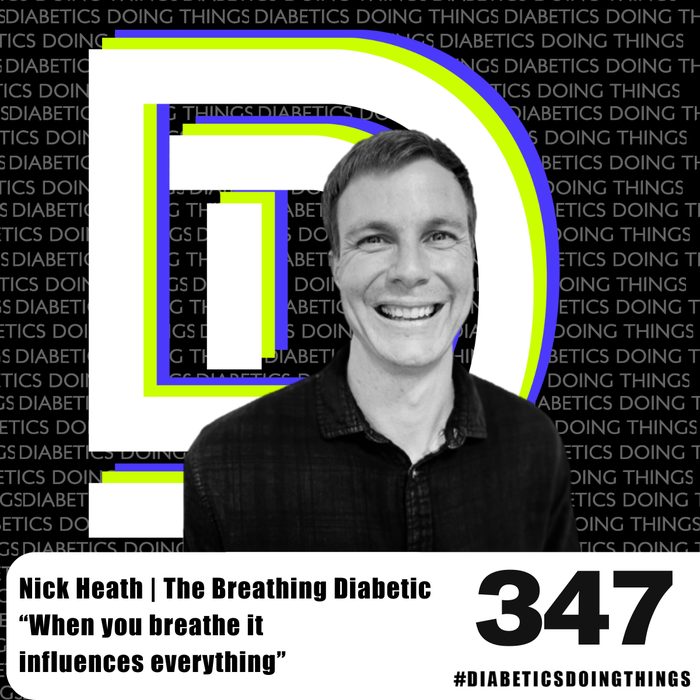
Nick Heath, PhD, is an atmospheric scientist diagnosed with type 1 diabetes at 11 after going into ketoacidosis. A nutrition book in his mid-20s improved his blood sugar and opened him to breathwork. He tried the Wim Hof method around 2015, then found Patrick McKeown's The Oxygen Advantage, which introduced nasal breathing, slower breathing, and CO2 tolerance. Within months his blood sugars improved, and he began posting as The Breathing Diabetic. The conversation covers why breathing is both autonomic and voluntary, how nasal airflow affects brain waves and calm, and how slow breathing raises heart rate variability and baroreflex sensitivity, often reduced in diabetes. He recommends short daily sessions, an app, and nasal breathing with mouth taping at night.
Key takeaways
- Nick Heath says breathing through the nose and slowing his breathing rate, learned from Patrick McKeown's The Oxygen Advantage, improved his blood sugar within a few months.
- Heath explains breathing is unique because it runs on the autonomic nervous system but can also be consciously controlled, giving people a direct lever on stress.
- He points to research showing slow breathing can raise heart rate variability and baroreflex sensitivity, measures often lower in people with diabetes, in as little as two minutes.
- Heath calls nasal breathing "the 1% that allows the other 99 to occur" and says taping his mouth at night, done safely, has been the biggest change to his sleep.
- He recommends starting with five minutes a day of slow breathing using an app to guide pacing, rather than chasing a perfect ratio.
Chapters
- Insulin Sensitivity Playbook + Meet “The Breathing Diabetic”
- Diagnosis Story: Age 11, DKA, and the “Diet Coke” Moment
- The “Second Diagnosis”: Mid-20s Wake-Up and Lifestyle Control
- From Air Quality Scientist to Breath Nerd: Discovering Wim Hof
- The Oxygen Advantage: Nasal Breathing, CO₂, and a Breakthrough
- Breath Goes Mainstream: James Nestor Validation + Confidence to Share
- Why Breath Is a Superpower: Autonomic + Voluntary = A Lever
- The Brain Angle: Nasal Airflow, Brainwaves, and Calm States
- Diabetes Physiology: HRV, Baroreflex, and Slow Breathing Benefits
- Practical Protocols: 5-Min Minimum Dose, Apps, Ratios, Mouth Tape
Show notes
Rob welcomes Dr. Nick Heath—an atmospheric scientist living with type 1 diabetes for 27+ years and known online as “The Breathing Diabetic”—to explore how breathing can become a practical lever for living well with diabetes. Nick shares his diagnosis at age 11 and how his “second diagnosis” moment came in his mid-20s when nutrition changes improved his control and opened his mindset to other tools within his control. That curiosity eventually led him into breathwork, first through Wim Hof and then more deeply through Patrick McKeown’s The Oxygen Advantage, where the science around nasal breathing, slower breathing, and CO₂ tolerance clicked—followed by a noticeable improvement in his blood sugars after a few months of consistent practice.
From there, the conversation gets tactical and evidence-driven: why breathing is uniquely powerful because it’s both autonomic and voluntary, how airflow through the nose can influence brain activity and calm states, and how slow breathing can improve markers tied to autonomic function (like heart rate variability and baroreflex sensitivity) that are often reduced in people with diabetes. Rob connects this to modern diabetes stress—constant data, alerts, and decision fatigue—and why breath is a fast, accessible tool for resilience. Nick addresses the “woo vs. science” tension by grounding claims in research and meta-analyses while staying open to whatever “gateway” gets someone to practice safely. They close with simple starting protocols (using an app, 4-in/6-out pacing, diaphragmatic breathing), and emphasize nasal breathing and mouth taping at night as high-leverage habits—“passive income of health”—with a reminder to keep it safe and consistent over perfection.
Chapters:
00:15 Insulin Sensitivity Playbook + Meet “The Breathing Diabetic”
01:27 Diagnosis Story: Age 11, DKA, and the “Diet Coke” Moment
02:48 The “Second Diagnosis”: Mid-20s Wake-Up and Lifestyle Control
03:58 From Air Quality Scientist to Breath Nerd: Discovering Wim Hof
04:51 The Oxygen Advantage: Nasal Breathing, CO₂, and a Breakthrough
08:52 Breath Goes Mainstream: James Nestor Validation + Confidence to Share
11:50 Why Breath Is a Superpower: Autonomic + Voluntary = A Lever
15:11 The Brain Angle: Nasal Airflow, Brainwaves, and Calm States
18:06 Diabetes Physiology: HRV, Baroreflex, and Slow Breathing Benefits
35:52 Practical Protocols: 5-Min Minimum Dose, Apps, Ratios, Mouth Tape
Resources:
The Breathing Diabetic Instagram
The Breathing Diabetic Website
Questions this episode answers
Who is The Breathing Diabetic?
The Breathing Diabetic is the online name of Nick Heath, PhD, an atmospheric scientist with type 1 diabetes who reads breathing research and shares practical breathwork for people with diabetes.
Can breathing exercises help blood sugar in diabetes?
Nick Heath says slow breathing has been shown in research to raise heart rate variability and baroreflex sensitivity, measures often lower in people with diabetes, and he saw his own blood sugar improve after adopting slow, nasal breathing.
What breathing ratio or rate should a beginner use?
Heath recommends starting around six breaths per minute, such as four seconds in and six seconds out, and using a breathing app to keep pace rather than searching for a 'perfect' ratio.
Is mouth taping at night safe for people with diabetes?
Heath tapes his mouth nightly to encourage nasal breathing and says it should be done safely with the right product; he describes it as the biggest single change to his own sleep.
Full transcript Searchable, with timestamps
Rob Howe: Hey podcast listeners, we are continuing the series on the Insulin Sensitivity Playbook where I bring guests with research-backed protocols for increasing insulin sensitivity in interesting ways. Our guest today is Nick Heath, PhD. You may know him as The Breathing Diabetic on Instagram and from TheBreathingDiabetic.com. Nick has lived with type 1 diabetes now for 27 years and for the past 8 years has researched how the breath influences all aspects of health, from brain activity to nervous system functioning, and as a result, impacts living with diabetes. He and I have a great conversation about our various journeys discovering breathwork, Wim Hof, and even dive into his morning breathing protocol that Nick used every single day for 8 years. So please enjoy this episode with Nick Heath, the breathing diabetic, and how breathing can impact your life with diabetes. Hey podcast listeners, we are continuing the series on the insulin. Guys, who was MVP of the chat? Rob Howe! Rob Howe! What were you on? We need more of that. Welcome back listeners. Diabetics Doing Things is telling the amazing stories of people with diabetes all over the world. And you guys know I'm working on this insulin sensitivity playbook type of content where I'm digging in with researchers and experts on topics that maybe get overlooked for one reason or another. And I'm very excited to introduce my very special guest today. Nick Heath is a PhD. He also lives with type 1 diabetes, and he's calling in today from Florida. You might know him on Instagram as The Breathing Diabetic. So, Nick, thanks so much for joining the show.
Nick Heath: Thanks for having me, Rob. I really appreciate it.
Rob Howe: Well, we were talking a little bit about this before we hit record, but I'd love to start your interview where we often start with your diagnosis story. I know you've been living with diabetes for 28 years or so. And then I really want to dig into the fascinating world of breathing because for me personally, I can verify I've been breathing for longer than I've had diabetes, as have most of us. And it's also something that is it's not magical, as you say, on your site, but it is really interesting because it's autonomic and it's intentional and it's something that's very powerful. So thank you for being willing to share your expertise today.
Nick Heath: Yeah, yeah. Really excited. And yeah, I nerd out on this stuff.
Rob Howe: This is a safe space to nerd out. So let's let's do it. So tell us a little bit about your diagnosis and your early life with type 1 diabetes.
Nick Heath: Sure. Yeah. So I was diagnosed at age 11. So I guess it's actually 27 years, a little over 27 years I've had diabetes and kind of a standard diagnosis where I was peeing like crazy, always thirsty. I would come home from school and ironically, just like chug sodas, just making it that much worse. And eventually I went into, you know, basically into ketoacidosis. I was throwing up blood and just out of it. And my parents finally said, let's take him to the hospital. Yeah. And found out there that I had type 1. I think my first, literally the first thing I said when they told me was, well, can I have a diet Coke, please? Because I was so thirsty and I was so obsessed with my sodas, I guess, as some 11 year olds are. So, yeah, after that, I kind of didn't pay attention to. I mean, I had to, you know, I paid attention to my diabetes, but I didn't put together how much control I had over certain things. I kind of just, you know, I ate whatever I wanted. I tried to do the right bolus. If it didn't work, oh, well, that's just part of living with diabetes. And it was it wasn't until I was about 24 or 25 when I was in starting graduate school, actually, that I read a random book about about eating and health. And it, you know, I realized there are these green things called vegetables you can eat and like fruits. You know, it's like I've heard of that. Yeah, I never paid attention to those. And it really transformed my control. And that kind of opened my eyes to other things like there are things I can do within my control that can help my diabetes. Of course, you will never be perfect. And that's part of having type 1, but that I can have a better A1C or I can have less less emotional reactivity and things like that. And so that's what I think ultimately led me down a path that would allow me to even be open to this kind of different approach of using breathing to help manage it.
Rob Howe: Yeah. So I guess in that way, we all sort of have, and I've been quoted on this before, and I say it on the podcast often, everyone's kind of diagnosed two times, once when the doctor tells you, and then once when you make it part of your life. So it sounds like, you know, in your mid-20s, like many of us, you know, we're growing up, our brains are starting to be fully formed, and we are more conscious of what we need to do long-term to manage and live well with diabetes. And so how did how did you like at that point get led into what you're doing now as like a researcher and, you know, using I'm paraphrasing here, but using breath as a way to regulate things, regulate things like stress and anxiety?
Nick Heath: Sure. Yeah. So it's kind of I mean, there's a lot of pieces. I'll try to make it kind of condensed. But I in my professional life, I'm a scientist. So I read papers a lot and I'm very familiar with reading scientific literature and using it in my day to day life. So I'm an atmospheric scientist, though. So I actually study air quality. So it is related, but but not directly related to the breath. And at some point I was introduced to Wim Hof through a podcast. And this was in 2015 or 2016. I think most of us, yeah, as many of us are, right? Right, right. It's a pretty common thing nowadays. You know, Wim's been around forever and making the podcast runs. And he was very charismatic and he gets you excited. So I started trying the Wim Hof approach and I liked it. It was great. It made me feel good and things like that. But I didn't notice anything with my blood sugars. However, it opened the door to like, oh, this breath thing is really powerful. And then it was about a year and a half later, sometime in 2017, I stumbled upon a podcast with a guy named Patrick McKeown, and he wrote a book called The Oxygen Advantage. And he was talking about things I had never considered, like you need to breathe only through your nose. We actually need to breathe less and not more. We need to breathe slower, not faster. And he was explaining the science behind carbon dioxide in the breath and the nervous system in the breath. And all of this was just like exploding in my mind. Like, oh, this is the science I've been looking for. I was kind of doing my breath stuff on the side as like my kind of personal escape from the world. And then now I was like, oh, this is actually rooted in scientific literature. And so I started like doing the mouth taping, breathing through my nose 24-7, doing slow breathing. And it was about two or three months later, my blood sugars had just been so good. And the only thing I had changed was this breathing. And so I then just became a complete nerd about it. And I started reading papers and I found out that there was like a lot of scientific literature. There was one paper in particular, it was published in 2017 in Nature Scientific Communications. And it was basically saying slow breathing could be a simple beneficial intervention in diabetes was like the last line of the abstract. And it was like at that point where I was like, okay, I need to start sharing this stuff because it's in really reputable journals. focus not only just like there's a lot of ways it helps, you know, bringing up diabetes, talking about diabetes. And so that's where I began with the breathing diabetic and like trying to read science and translate it into something useful for for people who are interested.
Rob Howe: I love that. And, you know, when I was searching for a breathwork and a diabetes expert, like obviously I found you as the breathing diabetic. And I think it's interesting. I want to go back because I also in 2015 or 16 discovered Wim Hof, I think probably through the Tim Ferriss podcast. And I was like, wow, who is this guy? He's this Dutch madman. And I had benefited from cold immersion and cold ice therapy when I was an athlete and had, you know, when your ankles or knees were sore or what have you, like getting in and soaking your joints. Even as a kid, my parents had experienced contrast therapy. And so I was big into the cold plunge side and the breath work, as I discovered more about Wim Hof came alongside that. And then going through whether it was different meditations or different schools of thought. And what really, for me, as I'm trying to calm my mind down while I'm meditating, counting my breaths became sort of the most effective way for me to kind of center myself and not get distracted or thinking about too many things going on in my mind. And to me, I kind of wrote it off as, oh, this is too simple. Well, what is meditation? if I'm just noticing that I'm breathing. That's my sort of guru moment where I was like, yeah, I mean, yes, that's actually all it is. And so, you know, as I learned how to do that and like whether it's processing stressful situations or whether it's slowing down, those things I think I had experienced more just as my life has gone along through experience. But then this fall, and I think really over the past two or three years or so, nasal breathing popularity and like mouth tape, I get more mouth tape ads than probably your average person. And I'm sure you'd get a ton of them. But over the holiday, I read a book, Breath by James Nestor. And I believe the researcher you mentioned is a significant portion of that book. And kind of like you, I was just lit up by this thing where I was reading about scientific research about something that I had experienced, but couldn't really put words to. And it seemed really simple. And now for the last three months, I've been taping my mouth every night and looking at some of my whoop data and my glucose as a result and my physical fitness. I am just so much more conscious that breathing through your nose is the only way to breathe. And so I guess like for you, like as you're seeing breath become more popular or discussed more widely, like what has that done for you in your either your content or the conversations that you're having within the diabetes community?
Nick Heath: It's a really great question and awesome story you have with it, too. So I just want to know that's that's the fact that you found Wim around the same time and then that James Nestor's book was such an influence. I do remember when that book was published thinking like, this is the best thing ever. Like, finally, this is mainstream and feeling really excited about it. And I think it's been potentially the most positively impactful book ever published on breathing simply because it became a bestseller and he ended up on all the major podcasts. And for the most part, you know, every principle he describes in there is accurate to my knowledge. You know, a lot of times when books become popular, they're not always correct. and his seemed to be, you know, spot on with just about everything. I can't speak to some of the more ancient Pranayama stuff, but from everything I understood it. And so for me personally, it just gave me, I guess, confidence. You know, I kind of felt weird if I can be like honest with you. I'm talking about breathing a lot. I have a PhD. I work a day job. Like I don't want my work to find out I'm posting on Instagram about, you know, breathwork techniques. And so it's almost like it was a permission slip to like, OK, the science is out there now. It's published. People know it works. And so I was able to basically speak with more confidence. I think I've never really thought about it until you just asked. But I do think it gave me a lot of like I have a mainstream book I can point to that is huge now. And plus, you know, hundreds and hundreds of studies I've read at this point. And so it really just kind of validated everything. I will say I'm a terrible marketer, so I did not take advantage of it like I should have. Like there was a big opportunity and I just let it slip by because I was like, I can't be cheesy. I just got, well, I don't know that you're
Rob Howe: a terrible marketer because some of your breathing memes are hilarious. So I definitely laughed at more than, uh, more than a couple of them. So I also, I think when I discovered your page, I had a similar, you know, I think when we find, we find people and I'm sensitive to this most places when I find someone who I agree with, it always gives me like a surge of dopamine or confidence. It's like, Oh, there's some, there's someone who's content I'm resonating with. And, And that gives me confidence that I'm on the right track or that I'm in good company, at least. And so, yeah, I think that I probably started getting the mouth taping ads around the same time that Breath was published a few years ago. And, you know, I do want to talk a little bit about this. This is, I think, where it becomes so simple, because like the book, like you said, it doesn't overpromise. I think it's very fairly straightforward and, you know, backed in research. And it's maybe one of those things, and I think this happens a lot in fitness, sometimes in diabetes, where the solution is so simple that we just can't get past how simple it is, like breathing through your nose or box breathing or breathing slower. And I wanted to talk just from your experience, like breathing is both autonomic, like we all breathe from the day we're born, we all breathe. But it's also intentional and in that meditative way, like, you know, you're conscious of your inhaling and your exhaling. Talk a little bit about the relationship between something that we all do, but also may not always notice that we're doing.
Nick Heath: Sure. And I think that is the thing that makes breathing not only like unique, but so powerful is that because we have to breathe when we're asleep, right? We have to be if we had to consciously keep track of every breath we took, we could never live a life, right? We breathe like 20 to, well, let's say between like 18 and 25,000 breaths per day. And so it has to be intricately tied to the autonomic nervous system so that it can happen without us thinking just like our heart beats. You know, we just sit there and we breathe. But for some reason, nature decided to give us control of it, too. And so it's one of the only maybe besides blinking, I think, is the only other function of the body that you can that happens automatically, but that you can control whenever you want. You can take control of it. And since it has that connection to the autonomic side, it gives us a like an sort of almost a direct route to functionings that typically would be considered out of our control, like our heart rate or, you know, different aspects of heart rate variability and things like that, blood pressure. And so because of its tie to both voluntary and involuntary systems, it gives you a lever. And this lever is under your control whenever you want to influence your emotional state, your physical state, your physiological state, psychedelic states, all sorts of crazy things people can do with the breath. But the biggest one is just that that act of the agency it provides that, hey, you have something now you can control. We know it's tied to your nervous system very intricately. And if we want to talk about it, it's really tied to your brain, too. And so there's like so many different ways that when you breathe, it influences everything. I'm just going to rant for a second because that's what I do. I'm sorry. But like a lot of times I struggle with what you were talking about. Like, it's just so simple. It's so easy. But that's when you think about every single cell in our body, in our brain needs oxygen. Every organ needs oxygen. Every single part of us, it kind of you're like, oh, it just makes sense that the way you breathe would be tied to everything. So since oxygen is number one, every organ is looking for oxygen. There's a connection to your breath to everywhere in your body. And so when you do it in specific patterns, specific ways, of course, it's going to influence your pancreas. Of course, it's going to influence your heart. Of course, it's going to influence your blood pressure or the circulation to your feet or whatever it might be. And so it becomes a little less. I feel like the used car salesman a lot of days, but that starts to go away for me. I'm like, it's not magic. It's not a pill. It's just that everything needs oxygen. And so the way you breathe affects everything in a slight way. And and it turned out that there are certain aspects of it that are really powerful for diabetes and stuff. But but in any case, I kind of went on. Sorry for the tangent, but that picture of the simplicity plus like the power.
Rob Howe: And I want to talk about that power. And you mentioned like your brain. And, you know, that's kind of where I wanted to start is like when it's nervous system regulation, right? Maybe calming down. So what are the things that you do when that happens? Even when you're a kid, I think about teachers, coaches, my parents, take a deep breath. It's like you're really worked up. Like that would be something, hey, slow down, take a deep breath and then compose yourself. And, you know, I think at that time, it's one of those things that you don't necessarily believe that that's the lever, but it's more of the gateway to allowing you to express yourself more succinctly or to calm and reach a tone that maybe will be well received. But what's happening in your brain when you breathe?
Nick Heath: So when you breathe, let's go through the nose. So the air going into the nose actually communicates with the olfactory system, the piriform cortex and the olfactory bulb. And that information can then be translated to other parts of the brain. And what it ends up doing is altering the brain waves, like the electrical activity of the brain. And depending on the rate at which you're breathing, it can slow them down into a more calm or focused state. It can speed them up. And it also tends to increase connectivity amongst different brain regions and different brainwave frequencies. It's kind of a lot going on. For example, there was a study where they took cannulas and put it up people's noses. And they just like mechanically forced air into it. So not even breathing, just like they were actually, they had their mouth slightly open. They were just kind of breathing normally through their mouth. And then they would push air in for eight seconds and then let it go for 12 seconds. Push air in for eight to mimic this really slow breathing rate of about three breaths per minute. And they measured their brainwave activity. And it really reduced the power into the slower brainwave frequencies like those alpha and things like that. I'm not a brain scientist, so I just read it and relay what I find. I can't speak too intelligently to it. But it also enhanced the connectivity amongst the different brain regions. And this is what was really important. The people felt calmer and more relaxed after this air was just puffed through their nose. So there was no mechanical stimulation, like no big diaphragm movements, no deep breathing, no vagus nerve activation. It was just the air going through their nose at a slow pace influenced the brain in a way to send calming signals to the rest of the body. And so a lot of things you'll hear about the breath are nervous system regulation. And it's a really popular term and it's correct for the reasons we were just talking about. Like it's tied to the autonomic nervous system, it's tied voluntary, involuntary, all these really interesting things. But the part that gets overlooked a lot is the brain and insane changes to brainwave frequencies and brainwave connectivity, pushing it toward a state of calm and more efficiency.
Rob Howe: It's fascinating. And I think it makes sense. Like, of course, your breath powers your body. Of course, the more you breathe, it's going to increase your connectivity. It's going to help stimulate your brain signals. But even like you're saying, just the air passing through your nasal passageways, you know, is having an effect. I think Wim Hof talks about how important it is to breathe. That's the one thing he would say to people, you know, is breathe. And I thought like when you dive into the cold water, like that's the deepest breath you'll take that day, probably like just instantly. And when I think of what's really happening when you're exercising or you're exerting yourself is your heart rate is going up and your breathing increases or, you know, the depth of your breath increases. So, of course, it would make sense that breathing is important for diabetes management. But what is your research or meta-analyses and experience kind of taught you about that connection between the breath and diabetes management?
Nick Heath: Yeah, there's a lot of interesting routes in which it helps. And it kind of gets back to that. It helps everything a little bit aspect. But let's start with the nervous system because this one is really probably the easiest to quantify. So the autonomic nervous system is generally split into two branches, the sympathetic and the parasympathetic. So the sympathetic is that fight or flight stress response, which we need, but most of us have too much of it, right? Yeah. And then the parasympathetic is the rest and digest calming branch of the nervous system. We measure this through a couple of different measurements, mostly heart rate variability. But there's also another one called the baroreflex sensitivity, which is essentially your ability to regulate tiny changes in blood pressure. And when they take people with diabetes like yourself and I and they sit them down and they measure them, their heart rate variability and their baroreflex sensitivity are generally statistically significantly lower than those of non-diabetic counterparts. And so what they say is this is a dysfunctioning nervous system due to the just excessive stress of having diabetes. There's a lot of oxidative stress. There's a lot of things going on that basically reduce blood flow, all the things we know about with diabetes. And a lot of it comes down to that excess stress. And so when they have people do a slow breathing technique, it activates that parasympathetic nervous system and it restores the balance. So it actually brings us up to the same levels as those seen in non-diabetics or even much higher than the non-diabetics during the time you're doing the breathing. So, for example, there was one study was people would type 1 for like 30 something year. It might have just been 30 plus years. maybe was the threshold and they had them do two minutes of slow breathing and they saw that their heart rate variability and baroreflex sensitivity went up to levels seen in non-diabetic counterparts. And so kind of the take home is that like what we think of as like damage, like, oh, our nervous system's damaged, is actually just dysfunction and it can be relearned. So if in two minutes your numbers can skyrocket, you're showing like it's still there, we just got to activate it. And so regular practice over, you know, weeks and months and maybe years, I don't know if there's ever been any studies of years of it, but definitely like several weeks to several months tends to increase that baseline heart rate variability. And that's going to, again, counteract some of the stress response associated with having diabetes. So that's a big way. Yeah, it's one of the big ones.
Rob Howe: Well, and I think, too, that the nervous system dysregulation, I think, will really resonate with a lot of people, especially on the stress profile, because, you know, I think there's a lot of really good things happening in diabetes technology. And I'm a benefit to, you know, the increases in CGM and insulin pumps and the technology that helps us live without so much activity from us or so much like, you know, oversight. And, you know, I also think it can swing the other way, which is that we have so much access to our data all the time. And there's alerts and there's, you know, you're able to see what your glucose is at any time that you want. And that can negatively affect like what you're saying, chronic stress or in that parasympathetic fight or flight nervous system. And on the other side, you know, our nervous system has evolved so fast over the past hundred years. Like we don't really we're not really in danger very much compared to like our great grandparents. Right. Like the. We have, we all live in mostly air conditioned homes. We have three meals a day. You know, we drive a car that's dangerous, but our body's not processing it the same way. Say like if we walk down the path and a snake jumped out at us, that would kind of clear that palate. We'd be breathing very strong. Our body would go into a true fight or flight, but instead we're getting those types of alerts all the time from whether it's email or text messages or social media or our diabetes devices. And so it truly is like from a chronic stress standpoint, a difficult time to manage all of those things at once. And having a way to clear that or get back in balance, even for a short time, can bring a ton of benefits.
Nick Heath: And that's really where it thrives. The diabetes itself has a lot of physiological stress from the blood sugar changes, but also what you just mentioned, the psychological stress that comes along with having diabetes, whether it's from your gadgets or your blood sugar not doing what it did yesterday with the exact same food, exact same insulin, you know, all these little things we deal with that people could never imagine, you know, the amount of, you know, stress it could cause on you emotionally, having a tool that can help you regulate that. And a lot of times it's just you do it in the morning, right? You do your breathing in the morning and that sets you up to be more resilient throughout the day. And I think resilience probably the most important word when it comes to how breathing helps with those like psychological stressors of diabetes is this kind of like being able to bounce back quicker, you know, accepting when things do go wrong and saying, okay, I'm not going to like, if I beat myself up and ruminate on it, it's only going to get worse. Like I have a tool, I'm going to take a couple of deep breaths or a couple of slow, easy breaths, and I feel calmer. And then what can I do now? Like, let's move on. So that kind of agency is
Rob Howe: critical. I want to talk really quick about resilience, because I think it's something that we may not give ourselves enough credit for all the time living with diabetes, because it is something that's very hard and it's a heavy burden. But I think also it's something that we improve at. And so it's a skill almost like anything else where the more that we do something, the more that we return to the work or whatever that may be, we improve at it and resilience is no different. We process things better as we practice. And it's interesting to hear how breath can be a part of that. I also love the idea of starting your morning with a breathing exercise and kind of a slow start to the day. But I want to go back to you personally and like in your journey on this, what do you think breath work or your journey studying the breath has brought to
Nick Heath: you and your diabetes management? Let's see. That's a really good question. I think it's a combination of agency, which I've mentioned. Resilience, definitely resilience. And this one's harder to quantify, but I've been practicing eight years almost every single day, whether it's slow breathing or some sort of meditation. Once I got into this life and studying it and kind of a lightness, like a lightheartedness of not taking myself so seriously. And that helped. I mean, you saw some of my breathing memes. I laugh a lot more now and I don't really take. So even when my blood sugars don't do what I'm hoping, I'm able to kind of like not take it too serious. Like, yes, it's very important. Right. It's my health. It's my wellness. But also, like, it's OK. Just, you know, take a breath, laugh a little bit and things are going to be OK and try to do better next time. Whereas like previously, there's a lot more rumination and like, you know, know, beating myself up. And I still do that occasionally. I'm not going to act like I'm perfect. Right. But definitely that like lightness has been a huge one. But more like, you know, concretely, it's that resilience, like it's the ability to bounce back. I love that. I think,
Rob Howe: you know, maybe that's the reason that we're having this conversation today. I'm kind of going through that in my own life right now. My I think my safe space or my like comfort zone is like grabbing the bull by the horns, like, you know, a very hard like, you know, acting like I'm in control and trying to control every variable like I have that ability, right? And whether it's even just appearing to myself as a person who's got it all figured out or master of the universe or never makes a mistake. And, you know, I'm learning like that's not a human experience and I don't have that power. And I think, you know, as just a type A person with diabetes and a, you know, a firstborn son and every stretch of the word, every explanation of the word, I'm learning like, hey, you know what? I'm not perfect and that's okay. And if I can still love myself in spite of that, then I have some place to go. And I think there's been a few Olympians more recently who've been quoted on like, I don't think anything bad is going to happen. I just go and I do my thing and I express myself as an artist and I just trust that it's going to work out. And I think that type of output is what I'm striving for. Something recently, and I'm a little bit down on tangent here, but I wanted to focus on this because I think it's really important to me, is one of my favorite poems is If by Rudyard Kipling. It starts off by saying, if you can keep your head when all around you are losing theirs and blaming it on you, and it goes on. And each of those passages throughout that poem have at different times in my life resonated more and so on. But I realized it never says like, hey, when you've got it all figured out and you're a millionaire and you don't have to worry about anything, then you'll be good. That's not anywhere in the poem. And so I felt kind of this relief sort of that I was experiencing those things that are going on in that poem and to that protagonist. And I'm like, oh, you know what? Like, this is just a human experience. Like, there's going to be problems. There's going to be stress. There's going to be shortcomings. And, you know, if there weren't, it wouldn't be the same. You know, it's just part of that experience. So finding a way to be able to center myself, finding a way to have to practice what I preach. And, you know, I joke with my wife, like, unfortunately, all these things that we're talking about really work. So you have to breathe. You have to meditate. You have to go outside. You have to exercise. You have to eat well. You have to hydrate. You have to sleep well. And even then, like, there's still going to be things that pop up in your life that are outside of your control. And that's just the human experience.
Nick Heath: I love that. And that's the saying you use with your wife is amazing. I'm going to steal that for sure. Yeah. It's like, unfortunately, everything they say to do, you have to do. Right. You have to go out. You have to walk. OK, you got to you got to breathe. You got to exercise. Yeah, it's a great way of looking at it.
Rob Howe: Yeah. And, you know, like, oh, I felt bad. So I journaled. Now I felt better. Great. Now I got to do that every time I feel this way.
Nick Heath: One thing I do is I've gone so far down this rabbit hole of like contemplative science and reading. And sometimes I force myself to allow a little anger or a little jealousy. Like, it's OK. That's human. If I try to suppress that with some technique I learned online, like, am I? Yeah, I don't want to go down too far a rabbit hole here. But there's a world in which you learn that accepting your emotions is OK, too. And that can be really powerful from these practices.
Rob Howe: Yeah, because I think we think maybe regulation is like this restrictive word, but I don't know if it always is, right? I think it's like noticing. And that's something in like the meditation practice is like, okay, I don't feel good today. Like, okay, well, I noticed that. Or, you know, I'm angry about this. And like, allowing space. I was in a meditation one time where they talk about like, just imagine looking at and touching all the feelings like with a soft feather. Like, you know, and and then you can kind of take away some of the power of, OK, I am angry today or I'm frustrated today or I'm anxious today. But I'm that doesn't make me an angry person. That doesn't make me I'm not going to be angry forever. And, you know, I'm not also not going to explode. You know, this is like I can I can just accept myself. OK, here we are. I'm noticing that. And we can and we can keep moving.
Nick Heath: Maybe look at a fun meme and laugh a little at yourself. And, you know, so you made a meme.
Rob Howe: One of your memes was with Adrien Broner, who is for those listening, this is a deep cut. he was a boxer, a pro boxer for many years. And I worked with him directly at my first job. And so that caught my eye when you shared an Adrien Broner meme, a classic kind of problematic. His nickname was literally the problem, very problematic quotes sometimes, but just the thing that really made me laugh. Like you said, just, Hey, this, this stopped me. I
Nick Heath: laughed about it and we can keep moving. Small world, small world. So I want to talk one more
Rob Howe: thing. We've mentioned this a couple of times, but you know, something that like breath work or, And I've mentioned meditation a number of times, and we've talked about immune system regulation or nervous system regulation. And these things are sort of like crunchy or woo-woo topics in some circles. And I think a lot of folks rightly may question them. So, like, what about you from a scientific perspective? Like, how do you overcome those types of conversations or what do you use to help reassure yourself or something when you have a doubt about something or when you're when you're looking into something like that? Because I think people, we see these results and like we're kind of N of one in some of these things. It's like, is this placebo? What's going on here? And I just want to know from your perspective as a researcher, like how you how you think about that.
Nick Heath: Sure. And it was tough at first. It was really challenging to know where to draw the line, essentially, of like what's acceptable to say or what am I crazy? There was a lot of like, am I crazy? Like this just seems too good to be true. And I mean, I struggle with that a lot. And really, it's just the data. Like it's just every single paper I read, it does something powerful. It helps. It doesn't heal all your woes. Right. But it really does have almost across the board, like, for example, with stress, stress and anxiety. There's now several meta analyses, which, you know, pool together data from tons of studies and then do additional statistical analysis. And they'll see that it has effects, you know, the same or even greater than like cognitive behavioral therapy, something that's, you know, gold standard in any, you know, psychiatry clinic that has all this research behind it. Here's here's something as simple as breathing for five minutes a day doing the same exact thing. And so really, it's the data and the numbers that basically remind me almost daily, like, OK, I'm not crazy. I'm not a charlatan or some snake oil dealer because I have a real problem with that. Like I try to practice everything I talk about. I try to be an example of like like this, like I'm not perfect. Right. I mess up all the time, folks. Like no one's perfect. I'm a recovering perfectionist. Like you. And like and so living that message involves like me needing to justify it. And like so sometimes when I'm having a bad day and I'm like, well, who am I to teach someone how to breathe if I can't even control it today? And then I look at the data and I'm like, OK, this does work. It's just that we're also humans. And so like that's the messaging. Hey, this won't heal everything. I'm not going to scream at you and say if something goes wrong, it's your fault and you just didn't follow the protocol. It's that this is going to help you a lot, but it won't fix everything and that's okay. And it's not, nothing's supposed to fix everything. And so just one other thing I'll mention, that's not, it kind of goes against what you were just saying, but I also am, I tell people like, look, if you're in, in it for the woo-woo side, you're still getting all these scientific benefits. Like, so be woo-woo with it. If that's what you want, like if that's your cup of tea, you want to, you know, do incense and breathe, like that's amazing. And I am jealous and I wish I could get to that point. And so I have no, So, yeah, nothing against the woo woo side of it, but it's really like finding ways to go around people. Because what's interesting is people on the more like spiritual side of things love the science. You know, I find a lot of the people I become really good friends with, they're more into the spiritual side and they just think it's cool as hell that I do the science. And they're like, oh, this is so neat. Whereas the other way around, we think we're too good. You know, we're like, oh, I do. I study science. I don't want to hear your woo woo story. But I kind of like to try to keep the avenues open and just respect everyone and do it for whatever makes you feel good as long as you're safe. Right.
Rob Howe: Yeah, I'm very much in that camp. I think how you arrive at the advantage or how you, you know, whatever message kind of cuts through to you is the right one. You know, I think, you know, and as long as it leads you to, you know, what we're talking about, which is making sure you have whatever tools at your disposal that meet you where you are to help you in your life with diabetes. And, you know, it's something as simple, like I don't need to see the research in front of me in this moment to know that stress negatively impacts my insulin resistance or negatively impacts my blood sugar short term. I have plenty of lived experience and shared lived experience with others to know that that's true. So then immediately, if there's something that can help me regulate my stress, then I know it's going to have an impact on my glucose because I know the impact that stress has on it. So I think, you know, even then when it's not, I didn't have to do a meta-analysis there to understand that. They are available. And I also didn't have to do a workshop at a monastery or a temple somewhere in a remote part of the world. I think that we share so much information that's useful in the diabetes online community. And that's what I'm trying to get out of this is whether you see yourself as a little bit more granola or a little bit more spiritual and a little bit more, you know, and that's the way that it informs your breathing or it's mouth taping and research. And like, I don't care what church you go to, so to speak, as long as you're understanding like the benefits of the breath.
Nick Heath: Right. And I'll tell you, that's not a good marketing perspective. And I tell people that, you know, I'm always like, well, do whatever you want, you know, as long as you're safe. Like if someone's because like, you know, I spent a lot of time on Wim Hof and it kind of hurt me. Not that the Wim Hof method is bad, is that I'm kind of an obsessive person by nature. I was doing it way too much. And I still to this day, I'm like, well, if that's what interests you, start there. As long as you're doing it safely, like whatever the gateway you need to get to this power of the breath is OK. Let's just make sure we're not being dangerous about it. And because certain for the most part, like every slow breathing study I've ever found or like more meditative, calming type breath work. There's never any side effects. There's never an issue. If anything, people just get too relaxed. But with some of the more fast breathing and breath holds, you got to be careful. So there's disclaimers on some aspects of breath work. But for the most part, yeah, come at it with whatever perspective you're interested in is the right one if it'll get you to do it. Just like if you ate broccoli because it connected you more to the earth, you know, and then another person ate it for the vitamins and minerals. Like, that's OK. It doesn't matter. You're still getting broccoli and that's good.
Rob Howe: Yeah, I like it. And this goes down a lot easier than broccoli, I would say.
Nick Heath: I'm just carnivore. I don't know, Rob. You're not carnivore, are you? Then I'll use a different analogy.
Rob Howe: Yeah, I think, again, like you're saying, making things accessible to everybody and not having a strong stance, not always the best way to spread a message in today's social media environment. But nonetheless, that's the way we're going about it here. Maybe I'll do a video where we're like, don't do this. And it'll be something related to that. Nick, I'd love to, if you would humor me and our listeners, I think for people who are listening to this and are interested in a simple breath work or breathing exercise, what would you recommend maybe for yourself? How do you start your day? What kind of you kind of set yourself into a breathing routine? And would you mind even just leading us in a few breaths for the listeners?
Nick Heath: Sure. I'll answer the question first. The past seven or eight months of my life have been strange personally. So I've adopted, I meditate every morning right now, which to me is still a breathing exercise because my breath is slowing down and stuff. But it's not that conscious, deliberate control that I practice for probably almost seven years every single morning. So I'm going to talk about that, that more deliberate, just control with the backdrop of what I said is like I practice what I preach. I just want to be upfront and transparent that right now I do a meditation practice. I write about it. There's all sorts of stuff about that, but most people find the breath work the most powerful, and that's where I always recommend people start. But on a normal day, I would sit down, usually on a cushion, but a lot of times in a chair, and I would do about 10 to 15 minutes of slow breathing. Now, that might be too much. The minimum effective dose based on research is five minutes. So I liked a little longer, so between 10 and 20, but I would say usually around 15 minutes. and it would be at a rate of about, you know, four to six breaths per minute. For someone starting out, I always say start at six breaths per minute because it's like the most common starting point, but I had done it for a long enough, for around four felt very comfortable for me and very relaxing. After that, sometimes I would do a little meditation, some sort of gratitude practice, just something from that clear state, I would put words to it, like, thank you, I'm so grateful for this or that. And that was really it. And I do that, it ended up being about 20 minutes every single morning of my life. and it was life-changing. So that's kind of the basis of what I've done for most of my life with the breathing world.
Rob Howe: So on a tactical standpoint, so thinking of somebody who's listening to this podcast, doing the math in their head, are you counting your breaths? Inhale, are you pausing? Are you exhaling? What's the method?
Nick Heath: Beautiful. I would use an app. I loved apps. There's one called The Breathing App. If you really want it, there's The Breathing App for Diabetes. Great name. Oh, there you go, yeah. I helped create. So it guides you have to listen to me some, you know, but it guides you to the science and the practices. There's another one called it's just called breathe. And that's that's my favorite one because it has a lot more flexibility. But I would do usually like five seconds in, seven seconds out or six seconds in, eight seconds out. And I would have no pause between. It was just in, out, in, out for, you know, again, like 10 or 15 minutes. Getting into pauses and slight holds is a whole can of worms. Try it, you know, just try, see what's comfortable. Some people like, there's one I did practice at night a lot. It was called the 4-4-6-2. So you inhale for four seconds, hold for four seconds, exhale for six, hold for two, and then start over. The 4-7-8 is a really popular one from Dr. Andrew Weil. So that's four seconds in, hold for seven, and then exhale for eight. The different ratios are less important than the act of just doing it and slowing down your breath. As you and I probably have got, you know, perfectionist mindset, like, oh, I need to find the perfect rate. I used to wear my heart rate variability monitor and go through every single rate possible until I found the one to optimize my low frequency heart rate variability. That's all for not, you know, it didn't matter. In the end, you just need to calm your breath down for most people. So I would recommend a four second in, six second out. Use an app so that you don't have to think or count. and just let the tones guide you through it. For someone who was like, well, I want to do it right this minute, Nick. What can I do? I would start with the most simplest exercise. And if you want to do it, you can. We don't have to do it together, but I'll just describe it for the listeners. I would put one hand on my chest and then the other one on my stomach, maybe right on my belly button or just above it, and simply breathe in through your nose so that the hand on your chest remains still, but the hand on your belly goes out with each in-breath and then back in on the exhale. So you're just trying to breathe where only your belly is moving and the hand on your chest is relatively still.
Rob Howe: Yeah, it gives you something, another piece of feedback to keep you on track.
Nick Heath: It's a little feedback. And if you're new to diaphragmatic breathing or deeper breathing, this is a nice way to feel it. You can also lie down and do this. It's a lot more comfortable. You could put a book on your stomach. But the idea is just to teach yourself to breathe through your belly and slow it down as slow as you possibly can. That's comfortable. You never want to feel stress. And the other tip I would give is to make your breathing quiet. There's a lot of stuff with over-breathing and slow. So just the simplest tool is to say.
Rob Howe: You can open up a can of worms pretty easily if you're digging in on Google trying to find, you know, again, if you're type A or you're a perfectionist like me, like sounds like you are. You're like, oh, what's the best way to breathe? And I'm only going to do that.
Nick Heath: Right. Yeah. And it turns out that changes day to day. Even your heart rate variability, like your perfect frequency based on that changes based on your stress levels and things. So it really comes down to consistency. I always say consistency over intensity. I think a lot of people say that. Slow, below like 10 breaths per minute, but usually is slower than seven. Anywhere in that range, that's comfortable for you. As long as it doesn't cause you too much stress or anxiety and just, yeah, consistency. At least five minutes a day for four weeks to see really noticeable changes. you'll notice it your first session. It's so simple. And breathe through your nose.
Rob Howe: I think that goes without saying. Well, it does. But I don't know that we said it enough on this podcast. So that's a great place for us to close. I think I'll say one more thing for the overachievers out there. I know there are many of you who listen to this podcast and I am one of you. You cannot transcend. You are not going to levitate. Trust me, I tried. You're not going to become the best breather possible. But I think, again, getting into the routine, sticking with it, it's more important that you sit down and dedicate the time to do it. And even on days where you don't feel like you did it very well, it's still a really important step in that progress. And just to reinforce the nose breathing piece, I'm not someone who identified as a mouth breather, as somebody who breathed out of their mouth primarily. And I did not realize until I read Breath by James Nestor how much, because just because when you're reading a book, you're very conscious of what the book's talking about in your day-to-day life, how much I was breathing through my mouth. So I do tape my mouth at night and it has made, I have the data to show it. I'll share in the, maybe the outro to this episode, just the difference in the last 90 days compared to the previous, where really the only market change is taping my mouth at night. And it's such a simple, small thing, but I know that, or I now know that when I was falling asleep and my mouth would fall open, I would breathe out of my mouth. And that's a normal thing, but now I don't do that. And the difference in my heart rate variability, you know, as accurate as a consumer heart rate variability monitor can be, is very different. And the recoveries are better. And I think, again, understanding how important the nose is. And when you skip the nose and breathe through the mouth, like what all gets skipped in the process is really important to read about. So yeah, let's breathe through the nose. Like that's priority one. And it's a muscle too. You learn, start learning that, like the more you breathe out of it, especially if you feel like you're not very good at breathing out of your nose right now, just can continue to show up. And I think if you did that four weeks, at the end of that four weeks, you would notice a big difference in the way that you're able to breathe. Definitely.
Nick Heath: There's two things I say about that. One is I always say that the nose is the 1% that allows the other 99 to occur. So like if you change nothing else, just breathing through your nose more consciously throughout the day is huge. And then I like to say that taping at night is the passive income of health. Like you don't, you just throw it on there. You don't have to do a breathing exercise. You don't have to do anything and it will significantly improve your well-being. Some people are non-responders, but for me, that was the biggest change was the mouth tape and the depth of my sleep. And I do it safely, be smart, but there's tons of products out there to make it easy.
Rob Howe: I love the way that you describe it as the passive income. For me, it's kind of like it's the lazy man's hack for extreme benefit. It's such an easy thing to do and set it and forget it. And like you said, do it safely. if you're listening to this podcast, you're probably going to get a lot of mouth tape ads.
Nick Heath: So do with those what you will. We apologize in advance. A quick humor for you. Just as we talked about being humbled by the world and like diabetes and things is I tape every night and I've been doing it for like seven or so years. I don't know if it's necessary anymore. I'm not sure. But last night my tape fell off the night before this podcast. Right. So the irony. And yeah, I slept pretty poorly and I woke up sort of with a dry mouth and I was like, you got to be kidding me. So life will always humble you, but try the mouth tape and it could be life-changing for sure.
Rob Howe: I love it. Nick is The Breathing Diabetic on Instagram, thebreathingdiabetic.com. Thank you so much for a really fun interview, not just about breathing. I appreciate your openness and all that you shared and looking forward to the next time we can connect.
Nick Heath: Likewise. Thanks a lot, Rob.
About Nick
Nick Heath, PhD, is an atmospheric scientist who has lived with type 1 diabetes for more than 27 years. He researches breathing and shares it online as The Breathing Diabetic.