

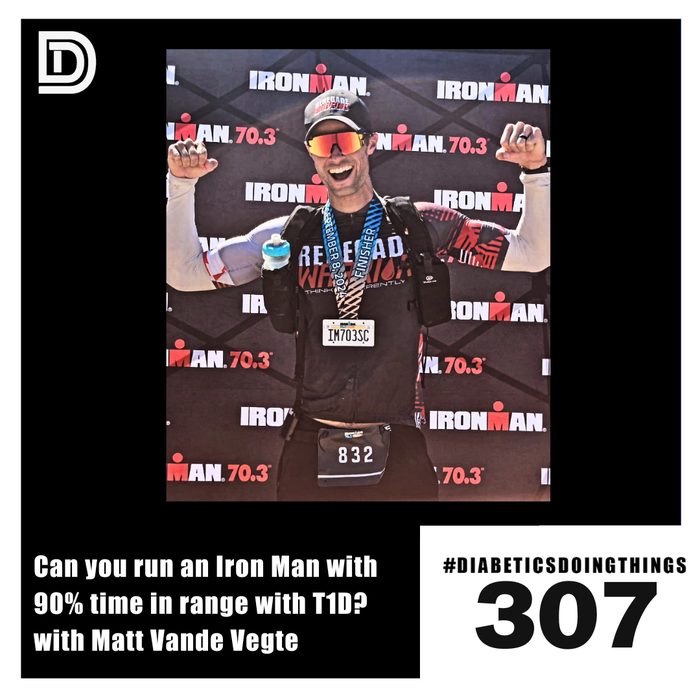
Can you run an Iron Man with 90% time in range with T1D? with Matt Vande Vegte

Episode summary
Matt Vande Vegte, known online as FTF Warrior, returns to the show days after finishing his first full Ironman. A type 1 diabetes coach, he started triathlon on impulse after a pastor invited him to a sprint race at a volunteer event, then progressed to a half Ironman and the full distance over two years. He talks about the lifestyle sacrifices his family made, the difference between proactive and reactive blood sugar formulas, and a history of depression and suicidal thoughts that hard physical challenges help him manage. He walks through the race itself: hypothermia after the swim, a pump site hit that forced aggressive insulin dosing, a stomach shutdown during the marathon, and his decision to let his blood sugar run high rather than chase a perfect number.
Key takeaways
- Matt says a kick to his insulin pump site during the swim left him unsure if insulin was reaching his body, leading him to stack an extra six units during the bike leg.
- Matt splits diabetes management into proactive formulas, the planned insulin-to-carb math, and reactive formulas, the adjustments made when real life does not follow the plan.
- When his stomach stopped absorbing food at mile eight of the marathon, Matt says he turned off his pump and let his blood sugar sit at 180 to 190 rather than risk a crash.
- Matt finished the Ironman with a 91% 90-day time-in-range average, down slightly from his usual 94%, and says that trade-off was worth finishing the race.
- Matt says he has dealt with depression and suicidal ideation, and he deliberately takes on hard physical challenges to keep perspective on everyday difficulty.
Show notes
While you’re listening to this episode, be sure to check out Matt’s new book "The Blood Sugar Freedom Formula" which just launched and is available on Amazon. It is currently listed as a best seller, so don't miss out on Matt's breakdowns of the complex management of insulin-dependent diabetes into a simple manner to make it not only manageable, but finally possible to master.
In this episode of Diabetics Doing Things, Rob reconnects with Matt Vande Vegte, also known as FTF Warrior, who shares his incredible journey from training for triathlons to completing his first full Ironman. Matt discusses the lifestyle changes and mental resilience required to balance diabetes management with rigorous athletic training. He shares insights on proactive and reactive blood sugar management strategies, lessons learned from his experience, and the importance of community support. His story emphasizes the power of adaptability, the value of mental health, and the inspirational possibilities for those living with diabetes.
00:00 Introduction and Guest Reintroduction
00:41 Matt's Triathlon Journey Begins
02:41 Lifestyle Changes and Sacrifices
04:51 The Power of Hard Challenges
10:44 Diabetes Management Strategies
15:49 Lessons from Ironman Training
21:52 Faith and Learning from Blood Sugars
23:53 Connecting with Fellow Type 1 Diabetics
24:07 Challenges During the Swim
24:47 Managing Insulin on the Bike Ride
25:38 Unexpected Obstacles and Adaptations
32:45 The Marathon and Final Push
35:06 Reflecting on the Ironman Experience
37:26 Balancing Mental Health and Diabetes Management
43:55 Concluding Thoughts and Gratitude
Resources:
Matt’s Instagram
FTF Warrior
Youtube Channel
Questions this episode answers
Can someone with type 1 diabetes finish a full Ironman?
Yes. Matt Vande Vegte, a type 1 diabetes coach known as FTF Warrior, completed his first full Ironman and says only a small number of people with type 1 diabetes have done so.
How did Matt Vande Vegte handle insulin dosing during the Ironman bike leg?
He gave an initial dose to cover 70 carbs, then had to add about six more units when his blood sugar would not drop, which he attributes to a kicked pump site during the swim plus added insulin resistance from poor sleep and cold.
What are proactive and reactive blood sugar formulas?
Matt describes proactive formulas as the pre-planned insulin-to-carb ratios used for predictable situations, and reactive formulas as the real-time adjustments made when stress, illness, or exercise throw the plan off.
Did Matt Vande Vegte keep his blood sugar in range the whole Ironman?
No. He intentionally let his glucose run at 180 to 190 during the marathon after his stomach stopped tolerating food, prioritizing finishing the race safely over his usual tight control.
Full transcript Searchable, with timestamps
Rob Howe: What's up, podcast fans? Hope you guys are enjoying your holiday week. And if you listen to this close to the time of publishing, happy Thanksgiving in the US. This episode started as an inquiry into our guests' amazing journey into triathlons, culminating with a recent finish of a full Ironman. and Matt Vande Vegte has been on the podcast before, but I really wanted to dig into the preparation and transformation of him as an athlete and active person living with diabetes to full-on transformation into an Ironman finisher. It also coincided with the release of his recent book, which is the Blood Sugar Freedom Formula, which just launched and is available on Amazon and it's currently listed as a bestseller. So congratulations to Matt on reaching the bestseller list on Amazon. So check out his breakdowns of the complex management of insulin-dependent diabetes into a simple manner not only to make it manageable, but finally possible to master. And Matt breaks down his own path to completing an Ironman with 90% time and range on this podcast episode. So that's what you're going to hear now. Matt and I dig into how he was able to complete the training and adjust his lifestyle. We also dig into a little bit of spiritual and ethereal self-talk during the race. So thank you, Matt, for really reaching deep. Only a few days after completing the Ironman to give us the full breakdown. You can follow him on Instagram at FTFWarrior. and I'm really looking forward to your thoughts and feedback on this episode with Matt Vande Vegte. Welcome back to another episode of Diabetics Doing Things. We're still telling the amazing stories of people with diabetes from all over the world and occasionally we get the privilege to revisit some guests who've been on before and connect on where they've been, what they've been up to. And today my very special guest is Matt Vande Vegte. You may know him online as the FTF warrior. He is coaching. He's helping his clients take control and take charge and take ownership over their blood glucose and their diabetes management. But most recently, something that I've been following from afar and I really have been appreciating the updates on is over the past, I guess, two years or so. Is that about right? That's correct. So two years you've been training for triathlons, a half Ironman, and as a time of recording, over the weekend prior to this interview, you completed your first complete full Ironman. So first of all, congratulations
Matt Vande Vegte: and welcome back to the show, Matt Vande Vegte. Thank you so much, Rob. A lot has changed. The last two years have been a wild ride and I can't wait to dig into it on the diabetes side, but
Rob Howe: also just wife's side. Yeah, man, because I'm making this judgment without any sort of like actual knowledge of this, but you seem like, like me, someone who does really well when you just dive in with both feet and you kind of maybe even get a little bit overwhelmed and have to sort of sink or swim and make sense of it on your own. So does that sound right?
Matt Vande Vegte: A hundred percent. I mean, the start to my whole triathlon journey was made on an impulse. My pastor at a Thanksgiving volunteer event, we're all feeding the homeless was like, hey, you seem like an athletic guy. Do you want to do a triathlon sprint with us, which is the shortest distance? Right. Like what's a triathlon, but sure, I'll do it. And then
Rob Howe: here we are. I love that. The power of yes, man. Because I also like you, you've been an athlete your most of your life and I think you've been an awesome athlete and you know, you have shared your fitness and workouts. I think I even did a group workout with you like over the pandemic. I remember that doesn't seem like that long ago, but wow, like been a while. But the sprint aside, like Like as you're starting to explore this world of triathlons, like it's probably the most demanding sport in terms of preparation and overall physical fitness, swimming, riding, running extremely long distances. Like you had to make a ton of lifestyle changes. Like forget about diabetes for a second. Just like your typical person who isn't living and managing a chronic illness. Like you got to make a ton of changes from in your training and your lifestyle just to get the journey started.
Matt Vande Vegte: it. So how do you feel about those changes now looking back? Rand, you know, one of the reasons I wanted to have our interview so close to race is so that it would be fresh. And I'm going to be honest, I'm still processing a lot of it. So for sure, the lifestyle changes, there's two sides to it. One is mine and one is my wife's. So I want to really add this in there. My wife made a ton of sacrifices to give me space to train. So especially as I got into the longer distances, Uh, I mean, most Sundays I'd be gone for 10 or 11 hours straight working out. And so she takes full control over our daughter, who's almost three and doesn't really get any space for herself. So the spouses or significant others, they have a lot of sacrifice. My parents, I called on favors. Hey, can you babysit while I go swim a few miles and then I'll come back and pick her up, you know? So everybody just pulling for me, you know, and, and making it possible. I mean, I almost broke down in tears during the race, recognizing how grateful I am to have this community around me who made it possible. It's not a solo event. The race, I'm by myself, right? But the effort is from everyone. And it was so special to see how many people cared about me to get me through that journey. So that was a big part of it. The lifestyle changes for me forced me to really take a second look at my time management. because every day minimum workout time is like a couple hours. So, you know, figuring out how to start waking up at four and five o'clock in the morning. And I'd never done that before. Blood sugars behave very differently. We work out at different times of the day. You have, you know, delayed peak of insulin sensitivity. So you might have a low at three in the morning and it's just a whole thing. So planning was a big step in this journey, but overall they're all positives. So yeah, it's like what's been like, but the lifestyle changes, they've all made me a better person, more mentally tough, better with my schedule, my physical fitness, doctors have been tracking it too, and they love what they're seeing. You know, it's insane, resting heart rate and vitals, VO2 max, all that. It's just super fun to see, but certainly comes at the result of some sacrifice.
Rob Howe: I love the idea, though, like looking back, like you're able to see those results, but the capacity for change. Right. And there's a Japanese principle called Misogi where you take on some sort of really difficult task every calendar year to expand and break down these sort of limitations in your mind as to what you're capable of or what is possible. and you know to me that's where I kind of came through with this of like your capacity for change because I would say from the outside and knowing you a little bit like you were a very disciplined guy you're already physically fit you already have your diabetes management compared to the rest of the general population like really down to the point where like you're coaching and helping other people find freedom with their diabetes so like you had done all this stuff already and like this challenge for you to like take it up to another level like that doesn't come lightly and like I see how you basically made your life more difficult by choice and you know seeing those positive results now is excellent and I applaud you for it but like were there tough moments at the outset or like during where you're like man I don't want to wake up at three o'clock in the morning to treat a low blood sugar I used to have my diabetes like down and my routines down And why, you know, why did I go to change it?
Matt Vande Vegte: That is a really good question. Opens up the big part of, of my journey, looking back on what I'm most grateful for. Going through life, I recognized this probably five years ago, every stage, you realize that you had it easy and now it's hard. And I realized if I got one step ahead of that, I could have a completely different perspective where I could look at it as now is the easy time. It's going to get harder. and so with each stage of life you know you're both in high school oh i'm so busy i can barely hold down a part-time job and like high school was easy you know in college i have all these and then you have a college you're like oh i have a real job now and i'm married and then you have a kid and you're like oh gosh life was so easy before i had a kid you know every step of the way so that's been really helpful but with diabetes i like you said was very disciplined and always have been but i think my discipline got in the way in some cases where i i wet the pursuit of perfect blood sugars because obviously i i'm the formula guy right so i got blood sugars down to a science of this is the math behind it i can predict i'm going to be at 94 when i finish a two mile swim and it ends at 95 i'm like oh darn like come on no one's perfect but i had to let go of that and Ironman training forced me to have more fluidity with my diabetes management and that was the challenge for me was to let go of perfection and to learn how to adapt more and so it was more of a reactive formula or responsive right the numbers are now this so now I must do that and that was something that I'm really grateful for because Ironman showed be how difficult blood sugars can be. And now by comparison, everyday life's a piece of cake. I say that kind of jokingly because diabetes is not a piece of cake, but compared to training days, it's like, oh, that's how hard it can get. I can handle this, you know, and I've purposely introduced hard things in my life to give me that perspective of like, oh yeah, life can get way worse, you know, you can get way harder if you want it to. Today's not so bad. And that's helped me as somebody who used to struggle with some pretty dark thoughts growing up. I don't know if I shared this on our last podcast, but I, growing up, I was diagnosed with depression and have dealt with suicidal ideation at different points in my life. And so it's, it's almost like a mental practice that I choose to pursue to maintain a neutral mind.
Rob Howe: Yeah, well, thank you for being open about that, because I know, especially living with diabetes, we're more likely to suffer from anxiety and depression. And if you come into diabetes with a history of anxiety or depression or depressive thoughts, that can cause tremendous challenges. I love the perspective of curiosity as well, where, you know, you were talking about having so much of your life formulaic and dialing in what you're starting and eating blood sugars would be after an activity. And then just saying, hey, I'm just not going to be as I'm going to throw these like basic activities out and I'm going to see what's on the other side of that and getting out of that comfort zone. because I've learned a lot more recently about doing hard things as skill acquisition because we can do hard things, but we have to remind ourselves by practice, by continuing to show up and do them, whether it's something like, you know, checking your sugars or planning ahead for a physical activity or a travel trip or going off on your own if you're a kid on an overnight trip or something like that, or even non-diabetes related like running Ironman or, you know, even just doing some sort of physical activity or taking that step and applying for a new job, something difficult, right? We get better at it with practice. It's like strength training. And so the more you challenge yourself to continue to show up and do those hard things, then you can end up crossing the finish line at an Ironman, you know, as an example. So I think it's really healthy to, even when you have things dialed in and having that perspective that you shared about when we look in the rearview mirror, we're going to remember how easy it was and things always sort of progressively get harder. So I'm going to do hard things in response to that,
Matt Vande Vegte: I think is a really cool and fresh approach. Thanks. Yeah, it's a downer intuitive, right? Yeah. So I'm going to make it harder. I guess that doesn't feel normal, but I promise it helps.
Rob Howe: Well, let's talk a little bit about the tactics. You know, you're the strategist. So just on the diabetes side of running an Ironman, I have talked to some folks over the years from Diabetes Sports Project. Cliff Scherb was on the podcast back a few years ago. You know, there's a short list of people with diabetes who've completed Ironmans. You know, they exist and you're now one of them. But it's not like you can just go flip open the apps and find somebody doing it. It's very difficult. So how did you prepare for the first sprint all the way to the half irons, all the way to the full Ironman? And what was that process like? And how did those sort of smaller steps prepare you for the big race?
Matt Vande Vegte: Believe it or not, I think I was more fearful of the sprint triathlon than I was of the Ironman. It's because it was completely unknown. I'd never done something like that. I was never an endurance athlete. I want to mention this too. people were like oh you were always in shape like i lifted because i was insecure and wanted muscles to look cool you know like that's pretty much it i was i was an athlete in college but i didn't take it super seriously so when i started training to do a sprint triathlon i went to go for a one mile run and i didn't even make it a half mile before i had to sit on a curb so i was still out of breath. Like I thought I was going to die and I was a half mile. Anyone can start their journey. Everyone's got a leg up on you and everybody's so much more fit. Everyone starts somewhere. But the journey, I was terrified of this sprint triathlon. Didn't know what to expect and so much so that I had trained up until the race itself. I did the full race by myself. So I was like, if I can do it by myself beforehand, I can mentally check it off that I've done it and it won't be as scary. And that did help. But the progression has brought new challenges with diabetes. And you mentioned Cliff Scherb. I did. I ended up chatting with him about strategies as well. It's a very short list, but I'm pretty sure I found like 95% of the type ones who've done Ironman because I wanted to get perfected. And I thought, you know, if somebody else has done it, I'd rather talk to them first and, you know, get some thoughts on what might work, what might not. And unfortunately, as you might imagine, everybody had a different answer. Everybody had a different strategy.
Rob Howe: Isn't that just like diabetes to make it super individual?
Matt Vande Vegte: Exactly. Everyone was like, well, you know, it's not going to be the same for everyone. All of my races are different for me. And I'm like, what? Like, I've done 10 Ironmans and every race had different blood sugars. I'm like, oh gosh, dang it. There's no formula. You know what am I going to do? but that within that chaos there are patterns and i'd say that that was the biggest aha for me was just recognizing patterns my race day my plan that i had perfected over the last few months where things were dialed in with a formula everything was exact i knew the exact carbs to take the exact insulin and adjustments and percentage calculations for basal and on race day everything got flipped upside down and I made some incredibly aggressive decisions with insulin that said they've landed me in the hospital but praise god they worked yeah he literally was like do this and then start praying because god's the only way you're gonna get through this and it was scary at a few times so yeah the sprint much more doable and I would say for anybody listening who's like I wonder if I could do a triathlon you can sprint distances are super fun the total race time it was like an hour and a half and they joke but it's a serious thing that if you can make it to the run section you can walk it and you'll still finish in time so yeah it's a great way to enter into the sport of triathlon
Rob Howe: well i i think first of all thank you for sharing that because i think there's a lot of self-limiting beliefs that we can have as people with diabetes it's like oh well i don't want to invest all this training time to do a sprint and then not be able to finish it or scratch on the race day or what have you. But I also like to hear what you were saying about, A, the different types of responses that people's blood glucose have on race day. You know, like you said, 10 Ironmans and 10 different experiences. Right. But also for you, like in the middle of the race, having to treat something diabetes related and not be certain of the outcome and still go forward, because I think that also So can, you know, whether you're a caregiver or whether you're a patient or whether you've tried something or maybe had a bad experience or you feel some sort of shame around your diabetes, like making you do one thing or another. To know that you can prepare as much as you want and you can still run into those obstacles and it'll still be OK. It'll work out. That's just nice for me to hear, especially from a blood sugar guru like yourself, because sometimes we don't see all that. Like we see your videos or we see the achievements of people in the community and we don't see those highs and lows. We just see the sort of end result and the very small actual lens that we get through social media. So I just love the vulnerability there.
Matt Vande Vegte: Yeah, absolutely. Well, and something you touched on, I think is important to note, like with me being the blood sugar formula guy, one of the things that I teach in my book that's coming out soon and we've taught in our challenges and our programs is that everybody is using blood sugar formulas already. most of what you use are basic right like an insulin to carb ratio like oh yeah that sounds similar that's a formula but outside of that there's two sides of formulas one is proactive and that's more what we customize for our clients like how do you calculate the exact insulin needs changes and outcomes the other side though is the reactive side and that's required for everyday life because it's not going to go according to plan all the time and even if you're not doing Ironman, you can live the same day, three days in a row and have three different outcomes. There are reasons for that. And that's what people I think miss is that there are underlying factors like how did I sleep last night? Okay. Like the night before my Ironman race, I got two hours of sleep, which is not ideal for a 14 hour race, but that had a big impact on my insulin needs. I'm more insulin resistant as a result of lack of sleep. So how do we respond to those things? So I think that if we can organize all of diabetes management into those two camps, proactives and reactive formulas, then we're able to identify and adapt a lot faster with less frustration.
Rob Howe: Do you feel like your experience, and you may have already answered this, but so forgive me, I just gotta, I have to dig into it as the podcast host. Do you feel like those two proactive, reactive, those two camps became more, like you can sort of crystallize that idea more as a result of your training and as a result of you taking on this big audacious goal of going through and finishing this Ironman?
Matt Vande Vegte: Oh, 100%. There's different levels of clients that I work with. Some are more group oriented, like me just teaching the masses and some are more one-on-one. Every, I mean, it was like every two weeks with my private clients, I'd come back and be like, guess what I learned this week with Ironman? It blew my mind, you know, and I'd come back with some new strategy and I'm like, okay, so the first 30 minutes of aerobic activity have a different blood glucose impact than the following five hours. It's completely different, but it changes at 30 minutes and then they'd go home and try it. It's cool because we're always learning. First of all, diabetes is so complex, which can be frustrating until you start to remove some of the mystery behind it. And then it's like that you're the diabetes detective, just trying to find the breadcrumb trail and figure out what's going on. But there is a lot to learn. And I think And that's where a lot of people get maybe burnt out is that they're, it can feel hopeless if you don't know where the breadcrumb starts, where it ends, if there's a gap in the breadcrumb trail, you know, and you start losing the clues that it's, it's confusing.
Rob Howe: What changed for you that you've passed on to your clients? Obviously like the insight that you gave, like, oh, your insulin sensitivity needs are different after 30 minutes of exercise for the next five hours. You know, unless you're going that full duration and sort of using yourself as the test experiment, you can just read about that. Or, you know, unless you have a client who's going through that particular thing, you would never necessarily know that. And then, you know, proactive versus reactive. How do you change your approach if you only get two hours of sleep and you don't have the ideal conditions or you have a bunch of insulin on board or something like that? I think what I was getting at more is like, did your journey open up ideas, open up experiments, open up insights that you've been able to pass along to your clients?
Matt Vande Vegte: Yes. One thing that I mentioned, because people ask me this all the time, they're like, well, I'm not an athlete. And I'm like, that doesn't matter. I'm a psychopath right now. Like, who does this stuff, right? I don't just work with Ironman athletes. I don't think I ever have. and most of my clients are just trying to live a normal life where blood sugars don't get in the way right but there is a lot of crossover with the lessons that i learned because everything that i do surrounds food exercise and blood sugars same thing for you right so the question that is what are the outcomes that we're optimizing for so if you're optimizing for playtime with your kids you you don't know how to be more spontaneous. Cool. Well, I had to learn how to be more spontaneous in my dosing when the plans changed, when my sight failed mid bike ride, you know? So those are the lessons that I bring back oftentimes are the concepts instead of just the calculations on how to ride a bike for seven hours, you know, it's like, okay, but what needed to change? How do I need to think differently? Actually, that's right there. That's on my t-shirt, right? Think differently. So that's the entire core of managing diabetes is we're all different. We all have to have this unique perspective on our diabetes and how it's different. So the lessons that I learned while they are most beneficial for me can be applied across the board as concepts and frameworks.
Rob Howe: I just love the idea and this is something after over 300 episodes and like almost 400 recorded conversations with people with diabetes and like trying to condense down for myself like what makes a person who is living well or doing well with diabetes different from everybody else is learning and lessons and growth mindset and understanding that this information is just information. I can use it to make myself better or improve my outcomes or my experience down the road proactively, reactively, and sometimes both. And I just think that it's just a really good reminder that no matter if you're a triathlete training for an Ironman or you're a person who works a nine to five and wants to just be able to run around in the park or the yard with your kids after work that's going to take the same type of approach and it's also not going to be perfect every day and you're going to have to learn and adapt based on the you know the things that life throws at you I think it's just a really good metaphor for living with diabetes well no matter
Matt Vande Vegte: what your interest is. Absolutely. And recognizing too, that you're not going to have perfect days. We already kind of touched on this, but I mean, the amount of times, well, I'll tell you this. So we may have talked about this before. I'm a Christian and I spent a lot of time in the Bible and praying and all that. In fact, a quote that I gave my parents after the race was, I earned my spot in the Ironman, but God carried me through it. Because there were so many things that should have either taken me out of the race or potentially killed me. Like the race itself was actually very
Rob Howe: dangerous. If we can talk about that if we want to. Yeah, let's talk about it. It was crazy.
Matt Vande Vegte: But I used to say this prayer every morning of, God, please just give me a stable blood sugars. And I realized, I was like, why would he give it to you and not everybody else? That's such a silly prayer. And so I started asking, God, help me to learn the lessons I need to learn from my blood sugars to not repeat the mistakes that I've experienced. And that has been just a new perspective that I took on in life with diabetes is like, oh man, had insulin on board for that swim and I had an urgent low. Okay, don't do that again, you know, or what can you learn from it? So instead of just asking or demanding of God, of the universe, whatever you believe in, that you have perfect blood sugars, asking that you learn the lessons you need to learn so that you're not ignorant to those problems and don't have to repeat the lessons.
Rob Howe: It's kind of like a diabetes take on the serenity prayer, right?
Matt Vande Vegte: Right. Understanding the wisdom to know what to learn from the blood sugar and what you can control versus what you can't and things like that.
Rob Howe: So you mentioned it. I got to double click on it. Race itself was very dangerous. So what did we not see that you ran across the finish line? You hugged your wife. I love that post. And, you know, I think the gratitude for the people who are with you on the race emotionally, supportively and in your training, like was very clear for that. And I was very excited to talk to you about that. but what did we not see on the actual course that you've talked about a little bit but
Matt Vande Vegte: has been the the dangerous side of running an iron man yeah well first of all there were three other type ones that ran that race as well so that's super cool i only got to see two of them face to face but we connected all three on the internet i'm like oh my gosh we're type ones and we're doing iron man right but during the race so a number of things can throw your plans off I obviously stress is part of the equation and blood sugars were just a touch higher than I would have liked but I was still happy with it going into the swim but coming out of the swim I was experiencing some mild hypothermia and my entire body was convulsing so much so that like my hands are shaking I couldn't hit my insulin pump correctly I was hitting the wrong buttons and I was like forget I'm gonna dose like 10 units on an accident so I just chill right and And my coach asked afterwards, why did it take so long for you to get out of your wetsuit? It's like, I was convulsed. It's just a difficulty, but it was fine. Getting into the bike ride, I have to deliver some insulin, which is a strategy to enable you to start eating earlier on. Because in a 14-hour race, you have to get three meals in while you're moving. So you have to figure out how much insulin to give while exercising, which is very complicated by itself.
Rob Howe: I'm shaking my head because it's like, isn't dosing for meals hard enough without having to exercise at the same time?
Matt Vande Vegte: Well, then the timing of the insulin completely changes because you're moving. So blood flow is faster. Working muscles are going to absorb some of the glucose, but you're burning glucose at the same time. It's all these different calculations I'm running in my head. So I settle on a calculation of 2.4 units, which sounds like a lot. And it is. It was enough to cover 70 carbs to get me rolling. months and then over the next six hours consuming carbs and with a reduced basal rate and all these things. So there's a lot of different moving pieces, but I took my first glucose gel. I don't have any next to me, but it's low packet of. Goo basically and blood sugar shot up. And I was like, I have so much insulin that should have taken care of it. It didn't work. And I was like, okay, time to adapt, right? Gave a little bit more, cause I'm like every additional dose we're overlapping timelines, which is, I didn't realize that's a complicated word to bring up. It's in my book. You guys just go read it. But the timing of insulin, every time you give a new dose, there's a new effective tail that you have to consider of how long that dose lasts and which ones are overlapping. So I'm giving my third dose, my fourth dose. I'm like, I've got so many different stacks of insulin right now. And it's just, my blood sugars are not moving. And so I I've increased my basal rate in addition to bolus. It's not reckless. I'm doing calculations in my head. I've got the emergency exit plan where I know how much to consume and what to do if it goes south. But long story short, I ended up, between basal and bolus, I ended up taking on an additional six units of insulin, which for me is a lot. And during my training, when I was playing with insulin dosing, just for context, I had given a 10th of a unit and dropped 100 points in training. So a 10th of a unit dropped me 100 points. I'm now six units deep and it's working, but I'm playing with fire. And it's a time bomb, right? Because you're continuing, you know, some of your muscles are burning glucose. Your insulin sensitivity is sky high.
Rob Howe: What did you track? I'm getting really into the minutia now, but that's why we got the long form podcast. Was it a little bit of insulin resistance because of the lack of sleep? Was it adrenaline? What do you, what do you chalk it up to?
Matt Vande Vegte: Yes. A couple of things, right? One, two hours of sleep before the race. That's just bad for anybody. So increasing cortisol is already the best foundation of the formula. So increase of insulin resistance. Take that into consideration. Hypothermia. When I get colder, blood sugars run higher, you're slower circulation and just a stress response. I've got a ton of adrenaline. Of course, to my veins, I'm feeling good, but that body with blood sugars is a whole new consideration. And during the swim, triathlon is, it's infamous for body contact in the swim because you've got 3000 people in the water with you. So I mean, I got punched in the nose. I thought for sure somebody broke my nose. I was feeling for blood. I got punched in the mouth. I probably elbowed somebody else in the face. I couldn't tell what I hit, but I hit somebody.
Rob Howe: We got to pause because I have a unique perspective on this because early in my career, I worked for USA Boxing and we had insurance as part of our events. So like a company came in and insured our athletes who would register for events. And they told us that the hardest or the most expensive insurance for events is for triathlons because of that swim where all of you guys are jumping in the water at the same time, arms and legs kicking and pushing, which you have to do to swim. But often people get kicked, noses get broken, people have heart attacks, like in really severe cases. Like, so that's not you getting into a fight on this triathlon. It's
Matt Vande Vegte: more of just what happens when you're in the water on the swim. Absolutely. Yeah. And I mean, that was shocking my first couple of triathlons and now it's just part of the sport. You know, you're like, I know they're not maliciously attacking swimming and arms are flailing. Right. But I've been kicking the stomach and it's gnarly. But during the swim, somebody had kicked me where my insulin pump site was. And so one of my thoughts was the site's busted, right? So I'm going to have to change my site if insulin's not going in. Because that's what it was behaving like. I was like, keep a bunch of insulin, nothing's happening. So I was considering going to a med tent, medical, and switching my sites out. Thought maybe the insulin's bad, I don't know, this is weird. And so there are a couple of what-ifs like that. And then the certainty ones of lack of sleep, added stress, this kind of stuff that led me into being very aggressive with my dosing strategies and got to a point where I was like one more big trust fall with a big dose if this one doesn't work I have to stop and change my site because something's wrong and that was the one that finally pushed
Rob Howe: it over the edge and it was like oh you know oh shoot great sugar sugar so yeah so then what how many did how many gels did you have on you I guess at that point because you're then you're eating strategy or your fueling strategy becomes you got to get that catch that wave to keep you
Matt Vande Vegte: in range right well and somebody excuse cliff so i had a chat with ques months ago about the strategy and he mentioned a phrase that was perfect for this said you're catching a falling nice right when you give that much in there's a knife falling you got to kind of perfectly to grab the handle you got blade ouch you know yeah so the timing of the glucose because you don't want to overshoot and go back to being high, but I do carry a backpack. So I have a, a slim sitting backpack that I stuff gels through my shoulders, my back, my sides. So I've got, I mean, probably 600 grams of glucose on my body. Right. So I'm good. And that's important because they're the med tents and the aid stations are like 15 to 20 miles apart sometimes. So you're out there for an hour plus like, okay, where's the helpers? you know right but was able to get the the blood glucose levels down and start taking gels in which is good my plan with my coach is i'm supposed to take in around 70 grams of cards per hour when i'm on the bike and so i was a little bit higher than that and ended up taking in about 80 little maybe more than that which is good for energy because you need that for the marathon you have to run after the 112 mile bike ride but not good if you haven't trained with it so my stomach had not had a chance to to play around with high volume of sugar like that before and i mean it was necessary because i stacked insulin i had to feed the insulin essentially to get through it but uh paid for it on the run so it was necessary but that was the first i guess second frightening moment of like i'm breaking some big diabetes rules right now i'm stacking insulin aggressively while exercising Oh boy. You know, and saying some prayers after each of those bullies.
Rob Howe: Yeah, because I think we all, and I'm sure our listeners are just kind of sweating or shaking in their boots at the idea of being in the middle of a 112 mile, you know, multi hour bike ride with six units of insulin on board and a marathon to run afterwards. There's just a lot. That's a deep hole figuratively that you're building, that you're putting yourself into that you've got to recover from. And for those of us who have worked out while our blood sugar is coming down, even if it's good, right? Like your blood sugars are high, you're working out and you're feeling better as your sugars come down. Your body also feels different as your sugars are dropping compared to if you're on a flat line or your sugars are going up. So, you know, your performance also becomes an issue and a challenge to overcome at that point.
Matt Vande Vegte: Yeah, absolutely. Well, you mentioned like the K-Land, right? So a marathon afterwards, traditionally when I go from bike to run the first 30 minutes of the run, I need enormous amounts of sugar, like 90 grams in 30 minutes just to not go low. And so now I'm thinking, great, I've got all this insulin on board. That's still going to be active going into the bike ride because insulin on board can last from four to six hours, right? So looking at that as, I guess, just an issue waiting to happen was a little stressful. looking forward into the, okay, okay, well, I'll figure out the bike ride first. We'll get to the run when we get there. But that was the next issue. So the run at the beginning of it took in all my fuel. Everything was going great. It was maintaining my pace for a sub four hour marathon. Like, all right, cool. We're going to hit it. And at the eight mile marker, my stomach flicked and would not take anything else. It's like, great. You know, I've got this residual insulin So I'm bored, hanging out at 134, my blood sugars, which is beautiful for me.
Rob Howe: Love that.
Matt Vande Vegte: That was my target for the whole race. And up until this point, I think I was like 98% behind the range. Still pretty good about it. But I was like, I got to push blood sugars high because I cannot take in food. So the strategy flipped again. Like, okay, I can't eat. So I have to push blood sugars high, turn off my pump completely. And with my pump off, I still stayed at 134, right, for a while because there was no fuel going in. Yeah, that was a whole thing. And then when you're not taking in fuel, you're more at risk for injury and cramps and all this. So by a mile, I think it was 17 of the marathon, my whole body was like on the edge of injury and just second round of prayers during the run was like, all right. If I'm going to finish this gracefully, I'm not crawling across the finish line.
Rob Howe: That didn't lead your help.
Matt Vande Vegte: so it worked obviously but the strategy had to shift again and was able to get in minor amounts of food your bananas chicken broth some electrolytes and they've got some weird food by the way in iron i came across grapes and chips and chicken broth and pizza at one point i was like
Rob Howe: who was eating this stuff you know that there were people that were stoked about it yeah fueling looks different on mile 17 of the marathon of an iron man for sure.
Matt Vande Vegte: Absolutely. All of it, it worked out and I'm still in shock, still trying to find the right words to describe the experience other than, and this people might disagree with this on the, on the listener side, but for me, in my experience, it was a God thing. there's no way I should have made it through multiple sections of that race. And my parents came across me at mile eight when my stomach flipped and they were like, what's wrong? Something's wrong. You're like, why is he walking? And I was like, I can't take in food. My stomach's messed up. And I found out afterwards, my mom had sent out a text blast to all of her friends and was like, pray for Matt, his stomach's not doing well. And we checked the timing. it was two minutes after she sent that text blast out that my stomach returned to baseline i couldn't consume a lot of food but i was able to start eating bananas again and like that's a miracle
Rob Howe: you know i think too like the idea that you can have it all planned out you can overcome challenges you know you can have multiple miracles throughout a race and still need to take off your pump and trust, you know, running a higher blood sugar strategy. Like you're still going to have to throw the kitchen sink at some of these problems and be willing to, oh man, I don't want to do this. It's not part of my original plan, but I'm going to go forward and trust that I'm prepared to do this. And, you know, you get to have the, you know, thankfully the nice straight line, even though you're not able to take in fuel or put any insulin on board. And like, that's a huge win. That's such a, you know, that in itself, you know, a miracle right there. And I think
Matt Vande Vegte: I'm not here to litigate the existence of higher power and influencing our things. Like that's not my place. And I have seen too many times in my life evidence that there's something that binds us all together that's watching out for us where we find that momentum and that ability to push forward collectively and get other people on board. And I'm grateful for it. So, you know, I don't know. I think I'm sure there's our fair share of listeners who are, who sense that presence in their diabetes management at times too. How did I make it through this crazy situation? We're thinking about. Well, and I want to add something to what you just said. So stable line, yes, it looked good for a while. I need to add a moment of that is also a human as well. I pushed my blood sugars higher. That didn't look like, oh, he was at 150, right? I got it up to like 180, 190, I was like, I'm sorry, I have relief. It's staying there. I'm not touching it. So at 180, 190, I resumed and it was like, we're keeping it at that point because if it plummets, I can't take in enough sugar to save the love. Right. So intentionally went out of range and sat there and this was part of my training as well, many months ago. And this was just a real moment with me. I was on the edge of a mental breakdown. Like, and I told my parents, told my wife, it's like, my mental health is not good right now. Training for his Ironman, doing diabetes stuff, trying to maintain this, you know, beautiful public image of stable blood sugars. I was like, I can't do it. I'm done. And so I made the sacrifice. To me, at least it feels like a sacrifice. Like I'm going to give up the perfect blood sugar pursuit while training for an Ironman. And during the race, that's what it was, was like, need to have this story of, I was a hundred percent time in range for the whole race. He was like, you need to finish the race first. And so that for me was a difficult thing to do during training and necessary for my mental piece was maybe you don't need 95% time in range. And for context to frame listeners who don't know my stuff, I've been above 90% time in range on average for the last five and a half years straight while doing all this stuff. Right. so I was like I gotta maintain that through the Ironman and and you know it'll it'll look cool for the book launch and all this stuff so I had to let it go but the day after the Ironman I was like oh boy sweating bullets I gotta check my clarity reports see where the time and range
Rob Howe: landed for this yeah I'll just pull it up right now we'll get a live I love it so let's see the
Matt Vande Vegte: 90 day average we get the big picture as well yep so blood sugars on average higher than they used to be, which I expected and I planned for my A1C is probably a little bit higher as well,
Rob Howe: but I'll put it on this game. We've got a 91% average. Wow. So anybody who's just listening and not watching, I'll read the whole report. Average glucose is 142, right? So I'm happy with
Matt Vande Vegte: it, but not stoked with it, right? Standard deviation was 30 and I'm pretty happy with that but it shows 91 it is a three percent less change so i was at 94 so there was a sacrifice there for me right but in the race i wanted to be clear i i hit 200 i hit 207 or something you know it was not perfect even with the formulas and all this stuff there's still hiccups like you said you gotta throw the kitchen's tank at it like we're shutting off all the insulin and that's on the back end of adding all of the insulin you had during the bike. So man, it's been crazy. The whole thing.
Rob Howe: First of all, thank you for the background information on, on you and your story. And the last five and a half years, like you've said of, you know, seeing the benefit of your blood sugar strategies pay off for yourself and for your clients. But I also love the idea of not sacrificing your mental health and having to prioritize because I think what diabetes does, whether right when you're diagnosed or at any time in your journey, it can shuffle the deck of your priorities as to, you know, what you chase, what your goals are, all of those things, you know, being sick, any kind of chronic illness changes your priorities. And it reminded me of a story, a guy named Derek Sivers, who's a entrepreneur and an author that I really like. He used to ride his bike from, he'd just go on a, on a loop, a two hour bike loop. And that was his time to try to beat two hours. And it was like from Manhattan Beach to, you know, up somewhere else on one of the boardwalks on the west side of Los Angeles. Yeah. And he would come back and he would always obsess over like that time, try to beat two hours. So he'd wake up, he would, you know, get on the bike and he'd have like all this kind of like pent up, you know, aggressive energy. And he'd really attach himself to that value. And one day he decided, you know what, I'm tired of this. Like I'm burned out. I don't even enjoy this ride anymore. I'm just going to go ride and enjoy myself and see what happens. And he goes on this ride and he sees the people on the boardwalk and he's looking at the ocean and he sees this bird that's like following him on the bike and he's enjoying nature and he's having this blast. And he gets back and he looks at his watch and it was two hours and two minutes. And so he was making himself miserable over those two minutes. And so what I love about your story is that you still did what you wanted to do. You had 90 over 90 percent time and range. You had the variance of two percent. You had maybe a little higher standard deviation than you like, but you did the thing. You did the Ironman. And that, you know, I assume that your mental health recovered as you gave yourself permission to be outside of your normal range and you accomplished the goal. And then when you look back, that 2% that you were really obsessing over, you know, in the grand scheme, maybe doesn't seem so, so big or something to get so defeated over. So I want to see how that lands for you.
Matt Vande Vegte: Oh, 100%. I'd heard that story before. I saw this shot claim. And I'm like, yeah, that's it. Right. Where I've got clients who come in and they're like, I want 100%. And I'm like, that's cool. I mean, I've done that sometimes, but it's, it's, you, you sacrifice quality of wife to maintain 100%. hundred percent. You take one or the other. So a lot of the discussions that I have are let's find the blend of happy and healthy, right? Where you can maintain 80%, 90% time and range while living your best life. And you're right. As soon as I made that shift, you know, my workouts used to be, I go for a 70 mile bike ride and my blood sugars would be between 95 and 110 the whole time. but I'd be sweating bullets, stressed out of my mind. Like what if it goes low? And now mental health, so much better. I actually enjoy working out and being at peace and, and there is still healthy blood sugars. You know, I'm not at 0% time range doing that. It's a little bit of sacrifice, but like you said, the two minutes thing or the 2% thing, stressing out over barely
Rob Howe: anything. You know, once you get the formulas in place, you can, this, I think is a great place for, for us to end today. We're coming up on time. But Ben, I just wanted to give some gratitude back to your way. You were talking about immense gratitude to your team and your family and for how well the race went. Wanted to say just thank you for sharing that journey and for challenging yourself to do something very ambitious and making it look graceful and for being willing to share with our listeners. Just appreciate that and appreciate you being in the community. It's been far too long and I'm really glad we were able to reconnect and for you to come back
Matt Vande Vegte: on the show. Absolutely. I appreciate that. And I mean, if it's something that will be helping the listeners, I'll send you a link on where people can check out more in. So, but it's really fun to get, to tell these stories and hopefully show others what's possible with diabetes because I didn't, if there was any hope when I was first diagnosed, I know that your show is fantastic as a resource to show people that there's people doing all sorts of cool stuff, you know, diabetics doing things. So thanks for having me back on Robin. I love what you're doing here. It's fantastic.
Rob Howe: Well, thank you, man. And yeah, as long as there's people out there with diabetes doing things, we got ourselves a show. So thanks for being a big part of that. And we'll definitely include a link when your book comes out as well, your new book comes out. So be on the lookout for that in the show notes.
About Matt
Matt Vande Vegte, known online as FTF Warrior, is a type 1 diabetes coach and author of "The Blood Sugar Freedom Formula." He recently completed his first full Ironman after two years of triathlon training.