

Perfection is a Myth, with guest Stephanie Ratcliffe (Doing Well with Diabetes)

Episode summary
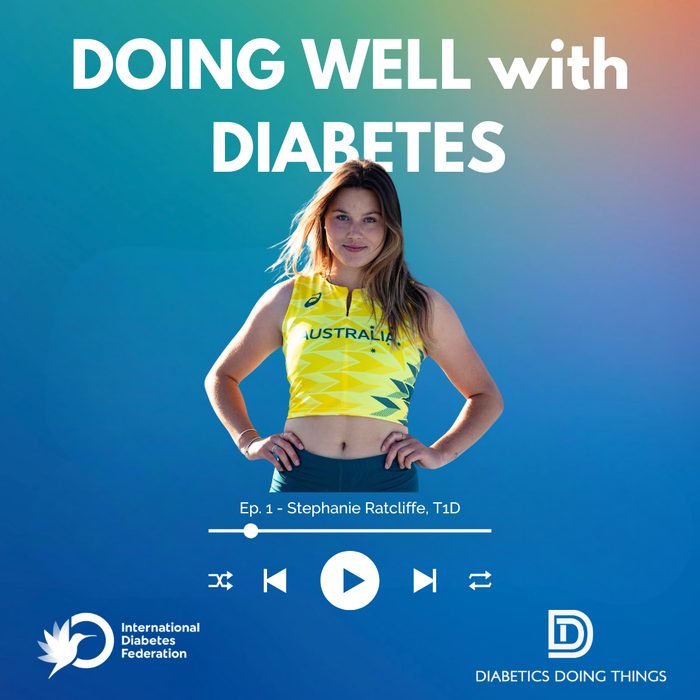
Stephanie Ratcliffe, an Australian hammer thrower who competed at the 2024 Paris Olympics, was diagnosed with type 1 diabetes at age six. She talks about her early fear of needles, growing up without feeling limited by diabetes, and the slow shift from hiding her pump and CGM to being open about her condition. She describes balancing elite athletics with a neuroscience degree from Harvard and graduate study at the University of Georgia, and how a disastrous blood sugar swing at a 2023 NCAA meet taught her to build pre-competition routines. She and Rob discuss why chasing perfect blood sugar is unrealistic and often harmful, and how accepting imperfection let her refocus on time in range and self-compassion.
Key takeaways
- Stephanie was diagnosed with type 1 diabetes at age six and was terrified of needles, requiring her parents to hold her down for her first injection.
- She says adrenaline during hammer throw competitions reliably spikes her blood sugar, with no way to fully prevent it, so she builds her routine around managing the swing afterward.
- A 2023 NCAA meet where her blood sugar stayed critically high for hours taught her to prioritize sleep and a controlled breakfast before morning competitions.
- Stephanie says the idea that blood sugar has to be perfect all the time is the worst advice she associates with type 1 diabetes, and that time spent in range matters more than avoiding every high or low.
- Her mother's advice to always put diabetes first, ahead of any commitment, became the guidance she leans on most, especially after under-prioritizing it during college.
Show notes
Doing Well with Diabetes is a podcast series collaboration between the International Diabetes Federation and the Diabetics Doing Things podcast. During this series, host Rob Howe interviews athletes living with diabetes from around the globe to help inspire the next generation of athletes with diabetes to continue to work towards their dreams while doing well with diabetes.
Doing Well with Diabetes is part of the Kids and Diabetes in Schools programme. Diabetics Doing Things has donated all production and promotion in-kind.
In this episode of Doing Well with Diabetes, host Rob Howe interviews Stephanie Ratcliffe, an Olympic hammer thrower living with type 1 diabetes who was recently part of Australia’s 2024 Olympic Team. Stephanie shares her journey of managing diabetes while excelling in athletics and academics, including her experiences at the University of Georgia and Harvard University.
Stephanie and Rob discuss the unrealistic expectation of maintaining perfect blood sugar levels for people with type 1 diabetes. They highlight the dangers of striving for perfection, likening it to general life pressures that can bring about stress and negativity. They emphasize the importance of managing diabetes to the best of one’s ability without demanding perfection.
Stephanie also discusses the challenges and strategies for managing diabetes in high-pressure situations, the importance of a positive mindset, and her hopes of inspiring the next generation of athletes with diabetes. The episode highlights Stephanie growth in embracing her diabetes identity and connecting with the type 1 community.
Resources:
Questions this episode answers
Has anyone with type 1 diabetes competed in the Olympics?
Yes. Stephanie Ratcliffe, an Australian hammer thrower with type 1 diabetes, competed at the 2024 Paris Olympics.
Does adrenaline affect blood sugar during sports competition?
Stephanie Ratcliffe says adrenaline reliably spikes her blood sugar before she competes and then it drops afterward, something she has learned to anticipate and manage rather than prevent.
Is it realistic to keep blood sugar perfect with type 1 diabetes?
Stephanie Ratcliffe says no. She calls perfect blood sugar an unrealistic and even dangerous goal, and says what matters more is minimizing time spent in high or low ranges rather than avoiding them entirely.
What pump does Stephanie Ratcliffe use?
She wears a Tandem t:slim insulin pump and has used a pump since shortly after her diagnosis at age six.
Full transcript Searchable, with timestamps
Rob Howe: Welcome to Doing Well with Diabetes, a collaboration between the International Diabetes Federation and the Diabetics Doing Things podcast. I'm your host, Rob Howe. Doing Well with Diabetes is a series interviewing athletes living with diabetes from around the globe to help inspire the next generation of athletes with diabetes to continue to work towards their dreams while doing well with diabetes. Doing Well with Diabetes is part of the Kids and Diabetes in Schools program from the International Diabetes Federation and is supported by Sanofi and ISBAD. Diabetics Doing Things has donated all production and promotion in kind. To learn more about the Kids program, visit kids.idf.org. And to hear more from Diabetics Doing Things, visit diabeticsdoingthings.com slash subscribe. Now give it up for our next guest on Doing Well with Diabetes. Hello and welcome back. This is part of our collaboration series between the International Diabetes Federation and Diabetics Doing Things. This is a podcast called Doing Well with Diabetes as part of our Doing Well with Diabetes series. And I'm very, very excited to introduce our special guest today. Stephanie Ratcliffe is one of the few people who have been able to represent their country in the Olympic Games living with type 1 diabetes. But not only that, she is a hammer athlete as a track and field athlete at the University of Georgia and previously graduated from Harvard University with a degree in neuroscience. So she is really a person with type 1 diabetes doing things. Stephanie, welcome to the show. Thank you very much. So excited to be here. It's very exciting to have you. And we were chatting a little bit before we hit record. You've been living with diabetes for almost 17 years. So I want to ask you kind of two questions. Like, what do you remember about the early days? And also, where are you from? And then also, this is, you're starting to become getting comfortable being more outward about your story of your life with diabetes. So I would love for you to share a little bit more about that as well.
Stephanie Ratcliffe: Yeah, no, for sure. So, I mean, I was diagnosed at six, which is obviously quite young. I personally don't really remember life without diabetes. It's always been a part of who I am, what I have. and my diagnosis is actually the memories are a bit patchy of course like I was super young but I was lucky I caught it super early I went to the GP the doctors and they said go to the hospital there you have diabetes I was in there for a few days and like those first few days were a lot just from the little bits I remember from what my parents told me I was absolutely petrified of needles like so scared and my mom actually told me like she had to hold me down and nurses had to hold me down for that first injection. And like, I think my parents were absolutely mortified when they heard that this is going to be an everyday thing. Now, this is my life. Another thing that comes to mind that I really struggled with was hypo food. I didn't like lollies or candy. I didn't like chocolate. So trying to get me to eat something when I was low was a bit of a feat. The only thing I ate was sour worms. That was it. Just one thing. So yeah, there was obviously like a few difficult things getting diagnosed. And honestly, I think the big picture stuff might might have been a bit more scary for my parents and those around me than myself like we're so young you don't really realize all the complications that can happen one day until you're older like you're kind of sheltered from that but no I'm very thankful for the people I had around me to get me through that and like to this day they're my biggest support is my family so forever thankful for them and I guess one thing that I I was told very early on which I think has kind of changed the way I go about life with diabetes is that I was told, I can't remember who told me, and I don't even know if this is actually true, but someone told me that there's only three things that I wouldn't be able to do with type 1 diabetes. It was to be an astronaut and I'm like, that's fine. I don't want to be an astronaut anyway. It was to scuba dive. I'm like, fine, I can live without that. And to be a pilot, but someone had actually already been a pilot. So I'm like, it never really crossed my mind that type 1 would ever stop me from anything. And I know that's not the case for everyone. But for me, I never had to consciously decide whether to pursue a dream or not pursue a dream because of type 1. So I'm also very fortunate in that regard. And then back to just like getting more involved with type 1 and the type 1 community as an athlete, as an older person now growing up, I actually, I always kind of tried to hide my type 1. I didn't want to be different. I didn't want to stand out. I didn't want anyone to see my CGM, seen my pump. And so kind of crossing that barrier to being proud to being diabetic, being thankful and positive for all the lessons that it's taught me. It's a really huge step. And it's exciting. I'm like, this is, there's this amazing community out there. And I'm like, if I can help just one other person, one other girl, one other boy to go and achieve their dreams or just be proud to be type 1 diabetic, to not be embarrassed of it, then like I've done
Rob Howe: my job then. So, yeah. Well, it's, it's amazing. And you really are an inspiration to, to myself and many others living with diabetes. And I think having the courage to share your story happens at different times for everyone. I used to, I used to think like, as I've been doing these podcasts now for almost 10 years, I've said like, everyone's diagnosed twice, like once when the doctor tells you, and then once when you make it part of your identity and you, and you really accept that, you know, that responsibility of, of kind of advocating for yourself and others. And you do that in a huge way. And I also want to go back to those things you said, it may not be true. I know that there are people who aren't necessarily astronauts yet, but they work for NASA and that a CGM has recently gone to space. So we may be approaching like the first type 1 astronaut. And I know certainly that there are a lot of people with diabetes who are certified in scuba and we've had many of those pilots with type 1 on the show. So that list is rapidly getting
Stephanie Ratcliffe: checked off. So pretty fun. Yeah, no, for sure. Very exciting. And the opportunities are endless
Rob Howe: type 1 or not. Absolutely. And I think, you know, just to, just to focus in on that, like you said, diabetes, you know, there are some things, and for some people, diabetes can stop us from, from chasing some of the dreams that we have. But for you, you are one of the very few Olympians with T1D. So summer 2024, Paris Olympics, what did it mean for you to be able to put on that Australian Jersey and then participate with your team? And now I'm doing my research for the show. All the Australian national teams have like different names. So yeah, I think the track and field team are the flames. Is that right?
Stephanie Ratcliffe: I don't think we actually have a name for the track and field team, Australian track and field.
Rob Howe: Awesome. So for you, like putting on that Jersey, you know, getting to walk under the flag, like at the highest level of your sport, like what was that like?
Stephanie Ratcliffe: Yeah. Well, I mean, being an Olympian has been my childhood dream. Like since I first started sports, like since I was five years old, I think it's a lot of people's dreams actually. And like, I guess at the start, you never really think it can become a reality. Yeah, you dream about it. So actually like making that team, I definitely had like a pretty stressful year with injuries. So definitely doubted that whether it was even possible to make that team. So that definitely made the reward even more like just enjoyable and that moment even more special after everything. I think like representing your country, representing Australia, wearing that green and gold uniform like that's why we do this sport like that's why we love it so much it's the it's the biggest honor and it's why we we train every day I think that that competing on that world stage whether it's Olympics whether it's worlds Commonwealth Games whatever major championships it is like that's not only an opportunity to strive for and achieve success in our sport but but it's also an opportunity to inspire other people to go after their dream. For me, a big part of that is reaching that type 1 community specifically, whether it's a kid wanting to pursue sport or go to a university or travel the world or someone newly diagnosed or just anyone at any point in life. Just if you have a dream, like you can never dream too big. Just go for it. So it definitely, the whole experience meant so much for me on so many levels.
Rob Howe: Well, it was certainly exciting to watch you. And again, like keeping an eye on all of the articles that came out about people with type 1 diabetes from all over the world competing at the highest level. You know, I think you had a lot of fans from a lot of different countries just because you know, you're in that type 1 community, but you're not just an Olympian. I think you are obviously a very multifaceted person and you kind of also have a, like a type a personality. Does that sound right? Like if you're very go for it, see it and go for it, which I find a lot of people with diabetes actually kind of develop as well. But you recently graduated from Harvard with a degree in neuroscience and you're currently a graduate student at the university of Georgia. You got to go dogs. So how do you balance all of that with the Olympics and with diabetes? Like how do you
Stephanie Ratcliffe: find balance? Yeah, honestly, sometimes I don't even know how I do it. Definitely very busy, sometimes pretty stressful, but I guess that's just life no matter what you're doing. then sometimes you go through phases where like you kind of lighten up on something like you have a break between semesters or you're having a little time off training and like I step back and think like how on earth did I fit everything in at once like when I was trying to give a hundred to everything like so but I mean for me some big things that I like to do is I schedule I make a lot of lists and I prioritize like love absolutely love making lists like I just write everything down and then I have to go through and prioritize okay what comes first obviously there's non-negotiables you've got your classes you've got your practice times like I can't move them they're set and then next most important for me is my health you know like sleep comes next like no matter what's going on I have to sleep I have to eat well I have to drink water just like look after my diabetes just like minimum life requirements and then becomes the real battle it's like I think for me usually I kind of prioritize track side of things at this stage of my life. I'm making sure I'm getting all that rehab treatment, any extra stuff for track. And then I fit my study around that. But there are also times where I have a big exam, I have a big assignment that like, that has to take priority. So it really comes down to just being super flexible, being adaptable, being willing to change that schedule to just adapt to what's there. And I guess, like you mentioned, type A personality that's me up to a tee so I'm trying to be perfect at everything all the time and it's like it got to a stage where this got really stressful I put myself under a lot of pressure just like from myself not even from everyone else and it just like I just wasn't happy it gets a lot sometimes and I was talking to someone and they told me it's like well you're trying to give a hundred percent to track and you're trying to give a hundred percent to school like that doesn't work Like you've only got 100% to give to everything in the first place. So that kind of helped me accept that we are human. We're not robots. Like we can't be perfect at everything. Like that's just not realistic as much as we want it to be. And I really learned just to be kind to myself in those times. You know that I have to take time to fill up my own cup. You know, do some things just for me. Not for sport, not for school, but just to make me happy. So I can keep being as productive as possible in all parts of my life.
Rob Howe: So that's great advice and like great wisdom for, for someone as young as you as well. You know, like, you know, only being 23 and being able to have that perspective, I think is really important, especially I joke. I'm a, I'm a real psycho about just getting stuff done. I love, you know, I try to do my best in everything. And I kind of joke about being a recovering overachiever, but I love lists too. My, I use notion for like everything, like all every, every, if I can write it down, I can manage it. Like what gets measured gets managed. And, you know, I'm a huge believer in it. If you can write it down, if you can speak it, if you can see it, you can do it. And so, yeah, I definitely see a lot of myself there, although not quite at the level of you for sure. But I think, you know, for something that really stood out to me and was actually advice that my sister gave when I was kind of going through a period of burnout in my life, because you know, whether it was work or sports or, or diabetes, my sister told me this thing that I'll never forget. And it was the brightest candle burns out the fastest. And so sometimes you have to really be careful of what you're, what you're giving your energy to. Like you said, you can't give a hundred to everything, but for people like us, that's kind of feel uncomfortable not to like give a hundred percent all the time to something. So a daily, a daily challenge for sure.
Stephanie Ratcliffe: Yeah, no, definitely.
Rob Howe: So for those of us who are less familiar with some of the field events or who are track and field casuals, tell us about your event, the hammer throw and like, how do you prepare for meets and how do you think about your diabetes management when it comes to competition?
Stephanie Ratcliffe: Yeah. So yeah, I guess I'll start with what hammer actually is. I know a lot of people might not know what it is. Basically it's a heavy ball, like a shot put it's four kilos or around nine pounds for the Americans on a meter wire with a handle. And I basically spin around on the spot four times and try and throw it as far as I can. My like for reference, my best at the moment is 73 and a half meters, which is around 240 feet. So yeah, that's my event. In terms of how diabetes plays a part in meat, it plays a big part. I think definitely the blood sugar levels, that's a big thing. If your bloods are too high, your bloods are too low. I'm trying to spin in circles and throw the furthest I've ever thrown before. It's not exactly a good combo. So managing that is like priority for competitions. I also know and have come to find that adrenaline makes your blood spike and no matter what i do to try and prepare for that to try stop it and control it i can't without a doubt my bloods are gonna spike and then they're gonna drop through in my competition and so yeah that's just something i've had to accept and kind of learn how to do with that on the fly there's not really there's not a formula there's no one way no one size fits all it just like you've got to just make that up on the spot once you've done everything you can
Rob Howe: to prepare, of course. I've actually, sorry, go ahead. No, you go. Well, I I've heard from other track and field athletes, whether they're sprinters or they're jumpers that meets are a real challenge because you're there all day. You may have a session or a heat in the morning and then you wait a few hours and then you have another one and then you have to eat lunch or something like that, or you wait all day and then your event is at the end. So like the challenge is like, you know, managing the adrenaline spike, making sure you're fueling your body, making sure you're hydrated so that you can perform well at a, at a point in time that is sometimes like not, not structured and you have to wait for other things to happen and, and can be really challenging. Like, how do you,
Stephanie Ratcliffe: how do you work through those? Yeah, for sure. And I mean, I guess I'll first start with like, for me, morning competitions are so hard. I like tend to have a bit of a spike after the first meal of the day and like I have to make sure that I wake up you know at least three hours before just to get over that spike so I can at least separate that spike from the adrenaline spike so that's definitely a really big thing I guess I just make sure I have all the different foods on hand you know like I have my bananas I have my muesli bars I have pare just like liquid sugar just to get it in fast easy to drink through a competition I think also for me like usually I know what time my competition is it's not too bad about waiting for some I think only like the NCAA regional and national rounds that have actually kind of played that too much but for me my competition is an hour long and or can be up to an hour long but I only throw six times in that so it's it's a lot of sitting down and okay that might sound good at first because you think okay cool you have all this time to like manage your bloods get it on like get on top of it if something happens but I find I just like tend to absolutely micromanage it and fixate on it and I'm trying to like just make sure I'm not too high give myself insulin or go low give myself and I think like it just gets too much and then you get in your head like you start to doubt yourself because like going into that circle and like you know exactly what you are because you've had time to check it and you're like oh I know I'm this high or this low or whatever I am and that definitely plays into you mentally. So I've definitely learned that like, you have to kind of accept, like you do everything you can, but then you have to, you get to a point where you just have to accept that you've done everything you can. And then kind of just shift your mindset to like, what's going right that day. Maybe your blood's out right that day, or like, maybe your body feels really good. Like you just have to focus on those positives and take that into you, like into the circle when you, when you throw or compete, whatever it is. It's such a good like
Rob Howe: mirror for life with diabetes. Like it's compressed down to one hour, but you know, there's so many lessons that, you know, can be applied, whether you're, you know, throwing a hammer or not, right. Not fixating, staying relaxed, like staying in the moment, you know, managing things as they come. So, you know, this series is called doing well with diabetes. You've talked a little bit about competition, but how does diabetes show up in your day-to-day life as an athlete or as a student, you know, or, you know, going to the Olympics and preparing for, you know, many weeks overseas and what steps do you take to continue to do well with your
Stephanie Ratcliffe: career alongside your diabetes? Yeah. Well, I mean, I guess as a diabetic, like, you know, your type 1's always there. Like, you know, it's always going to be there. It's not going anywhere. And I guess that can be something big on your shoulder sometimes. And I definitely know that sometimes I do get frustrated if I'm having a bad day I'm like I don't want to deal with my diabetes right now like I've already got enough that's going on in life or sometimes I get mad at it if it if it causes something negative in my life if I'm like have a bad session because my bloods are just out of control or like I have to wake up and change my side in the middle of the night I'm like no I'm tired I just want to sleep like of course there's going to be those times I feel like when I was younger as well I mean we talked a little bit about this at the beginning Like I definitely had a bit more of a negative focus towards diabetes. I honestly, there was times I like, I hated it. I hated that it made me different. I hated that I had to be connected to an insulin pump all the time. I'm like, I just want a break. Like, I don't want to wear a CGM where people can see it. But I think the biggest step I've had in like, like transitioning to living with diabetes and like a more, like a better way is to kind of shift this into a more positive life. Look at the things that diabetes has helped me. I think that being different can be good I think we should be proud to be diabetic I think that end of the day what does it matter what someone else is thinking about me that's not affecting me and if they are thinking about me negatively and it causes anything like I don't really need them in my life anyway so I think putting my health first and putting our health first is like the most important thing I also think that recently I've kind of stepped back and I've been able to see all the positive things diabetes has brought me all the lessons it's taught me like I definitely I'm mature I'm matured at a very young age and while yeah maybe that did take away from some of the like take away from some of the carefreeness of childhood I think that it's turned me into the person I am today I don't think I would have been able to do everything I have so far without diabetes and as an athlete specifically like like watching out for your blood sugars like it's made me way more in tune with my body and not just for my blood sugars I can feel like when And it's time to stop a session. I'm like, okay, maybe I'm putting myself at injury if I keep going or really trying to focus on that quality instead of quantity from those body signals. Maybe a normal person wouldn't be able to kind of like perceive. So I think there's definitely a lot of positives. And I think this positive light has allowed me to do all these things, even with type 1.
Rob Howe: I'd be interested in your perspective on that as a neuroscientist, because, you know, I think you mentioned something that really resonated with me is, and I think about a lot. even when we're diagnosed very young and even younger than you in some cases, diabetes forces you to have a relationship with your own mortality in a way that people who are not chronically ill or have maybe experienced a death in the family early in their life don't understand. And like being sick, positive or not, shuffles the deck and rearranges like how you think about priority in your life. And in recent years, I've come to the conclusion that, you know, we're both all of us on this call are on borrowed time. Like if we were born in any other time outside of the past 100 years, you know, we may not be alive at this point. And so I feel very lucky and like able to contribute and find energy in that, but it does reframe and change you because you're thinking, you think about things differently. You know, you, you didn't like chocolate as a kid or, or, or lollies or candy, like, which may sound really weird to a lot of people because it's like, you know, kids love candy, but you needed to, you had to like overcome that in order to survive and like learn that at a very young age to do things that are difficult in order to survive. And I just, I wonder if you've ever considered that, like, as you have continued to do difficult and challenging things regarding diabetes, like how that's maybe created pathways for you to, to overcome adversity in other parts of your life.
Stephanie Ratcliffe: yeah well I mean I guess it kind of just shows what you're capable of and the mind and the way that you're capable of changing your mind when you're given a challenge you know I think diabetes is a very extreme example you like you're given these things that you have to do and of course you have a choice whether to do them or not but you don't really like you say it's like kind of to survive you have to do these things that's your cards are kind of forced for you and I think just that when you're given that and it forces you to do that I think it makes it easier when you're given something else that may be a little bit more of a choice but then you realize like how strong like the human body is like what you can do with your mind and I think that that definitely strengthens that for like future challenges for sure and maybe they're challenges that people might not even consider taking because we're like okay we've done this before okay that's that's nothing compared to this, but not everyone has had that shift in mindset.
Rob Howe: Yeah. It's interesting. Like how we don't really know how much we're capable of until we try and we try to go above and beyond ourselves. And the idea, like once you accomplish something, like your mind expands to the possibility that bigger things could happen. And I would encourage people listening to this, who are living with diabetes and kind of have that thing in the back of their mind that keeps them from taking action or keeps them from trying something new. you know, sometimes that voice can protect you, but sometimes it's, it's, it's important for you to continue to try to think bigger and think differently about, you know, what your life could be, you know, if you live above and beyond that voice, this is kind of like related to this, but do you, and you, you talked a little bit earlier about, you know, the good advice, like you can only, the only things that you can't do are three things, but what do you think is the best diabetes advice that you've been given? And then also, you know, what's the worst advice?
Stephanie Ratcliffe: yeah I guess I mean there's a lot of good advice I've been given but if I have to pick one I probably say something that my mom actually told me so I guess context to the story I moved to college to the U.S. from Australia when I was 17 by myself didn't know anyone in the U.S. I didn't know how the health care system works so I was like obviously that was a very steep learning curve and kind of threw me in the deep end there. On top of that, I went to Harvard University. The academics there are kind of crazy, pretty intense on top of being a student athlete. So I just like had so much going on. I was super busy, super stressed. And I was like, there were times that maybe I didn't prioritize my diabetes as much as I should have. And it's not like I ever ignored it or did anything bad, but it just, it wasn't in the forefront of my mind. my mom was always on top of me she's like no you have to make diabetes a priority it doesn't matter what's going on like your health comes first like it doesn't matter any commitment like diabetes first and so I say that's definitely like the biggest advice uh going forward because yeah no sometimes diabetes it feels like this additional uh responsibility that we don't want to deal with but end of the day like if we don't deal with it it's going to make us less productive anyway way. So like, let's just deal with it. Like helps you feel better and be more productive anyway. So I think that's definitely the best advice. I'm definitely way better about that now, but like when you're in college and you're by yourself and you've got everything going on, it can be easy. Like it wasn't even a conscious thing. It's just that, that shift. And then just like bringing it back to priority is so important. I often say, I'm so glad that there was no CGM
Rob Howe: share with my mom or care team when I was in college, because there would have been some, some questions for sure. That's so important what you're talking about because, and for me, it was framed that way by my care team at diagnosis. So diabetes and my diabetes management was presented as this sort of gateway to whatever I wanted to do and like gateway of my dreams. If I could manage my diabetes well, almost anything could be possible. And so, yeah, I mirror that
Stephanie Ratcliffe: back to you. It's excellent, excellent advice. Yeah. And I guess the worst advice, I wouldn't necessarily say this was advice actually given to me but I would definitely say it's probably a common perception of people with type 1 diabetes is that like your bloods have to be perfect all the time and I just think like that's not realistic like there is no way we're avoiding all highs all lows like we're human and I think like that can be a very dangerous mindset to have is like striving for perfection with this like it's kind of similar to just life in general it's just like you put all this stress and pressure on on yourself to do this unrealistic thing it's just going to bring negativity when like you don't need that so I think of course we want to control it as best as we can but again like perfection isn't realistic and I guess good advice relating to that was like it's not necessarily about having a high or a low but it's how much time you spend in that high range or in that low range so like if you do happen to go high like that let's just try to bring it down as soon as possible. So, yeah. Yeah, I totally agree. And, you know,
Rob Howe: there's some of that in diabetes, social media as well. It's like, if you think if you're seeing a chart, that's always flat or someone only sharing the high moments, like it's just a snapshot. We're human, there are highs and lows. And I think, you know, again, you have to examine your relationship, like you were talking about, not hyper fixating on those moments and not, you know, just focusing on those, but to give yourself a little bit of room to be human. do you have do you have a favorite story about managing diabetes at a track meet or a practice
Stephanie Ratcliffe: or a road trip or you know traveling yeah I mean I have a story it's probably not I mean it's a good and bad story it was a competition I remember super clearly because I think that was the point that I kind of started to realize how important or how much diabetes could impact me as an athlete at this level it was two years it was like 2023 NCAA season and basically I had just broken 70 meters for the first time which is like quite a big barrier and the hammer throw and you know I just I was going into another meet and I just had like probably the best training session of my life the day before this meet I was so excited so ready to go like I'm like we're gonna throw so big the next day anyway I've I've woken up I've had breakfast and by the way this was before I learned all the things I have to do as an athlete. So all the things I said earlier that I do now, I did not do those things. Like this is kind of the competition that started that learning process for me. So basically I used to prioritize sleep before a competition for morning comps. Cause I'm like, I need my sleep. Like it's too early. So I kind of wake up as late as I could. I would have breakfast, but I had a really bad breakfast spike this day and I've gone to the meat and then I've had my adrenaline spike and I'm just like HI, like not even a number on my readings. It was just like, right at the top of the limit and it was not coming down. I was giving myself so much insulin and it was just not changing. And I was, I think the girls are out there warming up and I was like, went to the bathroom, tried changing my style. I was like, what am I going to do? Like, like this competition is about to start. Like I have to go. I don't have a choice, but I felt terrible. Like my head was just all over the place. So I've gone, gone out there, course halfway through the competition, blood's come crashing down, start eating all those lollies, candy and then they start coming up so I was on a roller coaster ride definitely not a fun experience and I just I remember after that comp I was so upset because I was like as an athlete I felt so ready to perform that day and then it just felt like I mean anything can happen on the day but for me at the time it felt like diabetes took that away from me so that was definitely kind of the negative stuff but I think from that that was such an important competition for me probably one of the most important in my life because it made me realize like all the things I was going to have to do as a type 1 diabetic athlete. So it really helped me kind of develop these competition routines, all these little things I have to do the day before a comp on the day of the comp and really just be prepared for that. And I guess, I think I also spoke about it earlier. It's not just preparing for it, but it's also accepting. It's accepting that our bloods aren't going to be perfect. We can't always control what our bloods are going to be going into a competition. So accepting that what happens happens and just working with it on the
Rob Howe: fly once you get to a point. I'm glad you said that because that's one of the things that I've noticed as a characteristic of people who are living well with diabetes is the growth mindset. And you took this situation that was a negative or a difficult situation and use it as an opportunity to learn and to grow and improve. And I think that's so essential for anyone living with diabetes, because especially if you're an athlete, you're going to encounter situations where your site is, is your site fails, or your sensor falls off, or you're experiencing, you know, you react to food differently, or you didn't get enough sleep on a road trip and you have to, you know, have a competition the next day. And it's all about how you respond to that. And that can inform, Like you said, you, you prepare totally different for meets now because of this moment. So if you didn't have that adversity, you wouldn't be more prepared now, but in the moment, it's hard to see that. So, yeah, I think that's just so essential for, for people, especially young people who have a dream with diabetes and you, you encounter a difficulty or a low moment. That's okay. Like everybody, even Olympians and, you know, Harvard graduates and NCAA champions with diabetes have encountered those low moments.
Stephanie Ratcliffe: Yeah, no, for sure.
Rob Howe: Okay. Are you ready for the rapid fire questions? We've reached the, like the, the quick response part of the interview. I guess so. All right. Well, you're in the hot seat. So I know you talked earlier about like not really loving candy or chocolate. So this'll be funny. So what's your favorite hypo snack? Sour Patch Kids. Not sour worms anymore. Okay. So you graduated from Sour Worms to Sour Patch Kids? Yes, we did. That's an important. All right. Favorite thing to do on an off day?
Stephanie Ratcliffe: Spend time outside, whatever that is.
Rob Howe: Favorite memory from the Olympics?
Stephanie Ratcliffe: Oh, 100% like the competition itself, like competing in front of that crowd was insane.
Rob Howe: Who's your favorite athlete?
Stephanie Ratcliffe: Sally Pearson, not an athlete anymore, but growing up she was.
Rob Howe: What are you currently listening to?
Stephanie Ratcliffe: Old version of Taylor Swift. So like the first albums.
Rob Howe: the the deep cuts i love it are you a homebody or adrenaline junkie
Stephanie Ratcliffe: oh a thousand percent adrenaline junkie like anything with adrenaline i'm there cats or dogs dogs sorry cat at home pump or pump or mdi pump for sure and what therapy are you currently wearing i'm wearing a pump i actually i was only on manual injections for less than a when I was diagnosed and a pump ever since.
Rob Howe: And what pump do you wear?
Stephanie Ratcliffe: Tandem T-Slim at the moment.
Rob Howe: Okay. And last one, movies or TV show?
Stephanie Ratcliffe: Definitely TV shows. I'm way too indecisive for movies.
Rob Howe: I love it. Okay. Well, as we kind of reach the end of the interview, I do want to go back to something that's really important that we talked about at the beginning, which is you have been an athlete most of your life, but only recently have you really decided to tell your story and connect more on the type 1 diabetes side. So what do you think was the catalyst that kind of opened you up to sharing your story with
Stephanie Ratcliffe: diabetes more publicly? I honestly think it was becoming more confident in myself as a person. I think growing up, especially as a girl, a female athlete, I do hammer throws, so I'm a throw. oh, there's a lot of stereotypes that come with that as well. Certain body image. I think the body image stuff is definitely portrayed like so strongly in social media these days. And I know, I mean, they're trying to make a shift, but growing up in that, it's hard. And I think only recently I found confidence in who I am and who I am is who I am. And I'm proud of that. And I think kind of diabetes came in that acceptance. I think also just hearing the impact that I was having on some people, like being a type 1 diabetic and doing the things I have done, I think that really kind of made me realize, I'm like, oh, wow, I can help people. And I think I said earlier too, like if I can just help one other person, then it was worth sharing my story. So, yeah.
Rob Howe: That was actually the entire reason I wanted to start the podcast is to help one person. So I relate to that a ton. For people who are listening and they want to get connected with you and follow your journey. What's the best way to do that?
Stephanie Ratcliffe: Instagram for sure. That's what I'm most active on. So yeah, it's steph.ratcliffe, I think.
Rob Howe: Perfect. And we'll include and tag you like in the show notes. So we'll make sure that the links are right. So much for joining us with this series in collaboration with the International Diabetes Association. International Diabetes Federation. And thank you so much for being a great example for people everywhere about doing well with diabetes. Really appreciate your time today.
Stephanie Ratcliffe: Thank you so much for having me. It was a pleasure.
Rob Howe: Doing Well with Diabetes is a series interviewing athletes living with diabetes from around the globe to help inspire the next generation of athletes with diabetes to continue to work towards their dreams while doing well with diabetes. Doing Well with Diabetes is part of the Kids and Diabetes in Schools program from the International Diabetes Federation and is supported by Sanofi and ISBAD. Diabetics Doing Things has donated all production and promotion in kind. To learn more about the KIDS program, visit kids.idf.org. And to hear more from Diabetics Doing Things, visit diabeticsdoingthings.com slash subscribe.
About Stephanie
Stephanie Ratcliffe is an Australian hammer thrower who represented Australia at the 2024 Paris Olympics. She has lived with type 1 diabetes since age six, graduated from Harvard University with a degree in neuroscience, and is now a graduate student and track and field athlete at the University of Georgia.