

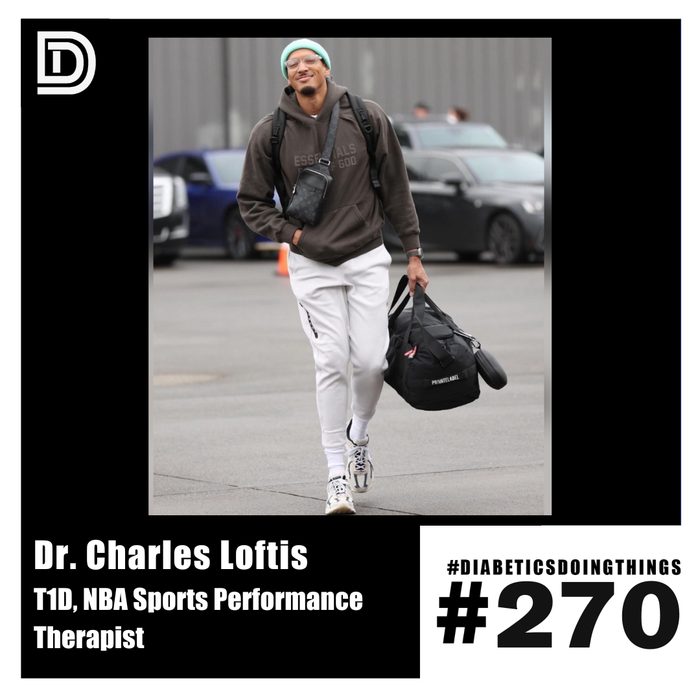
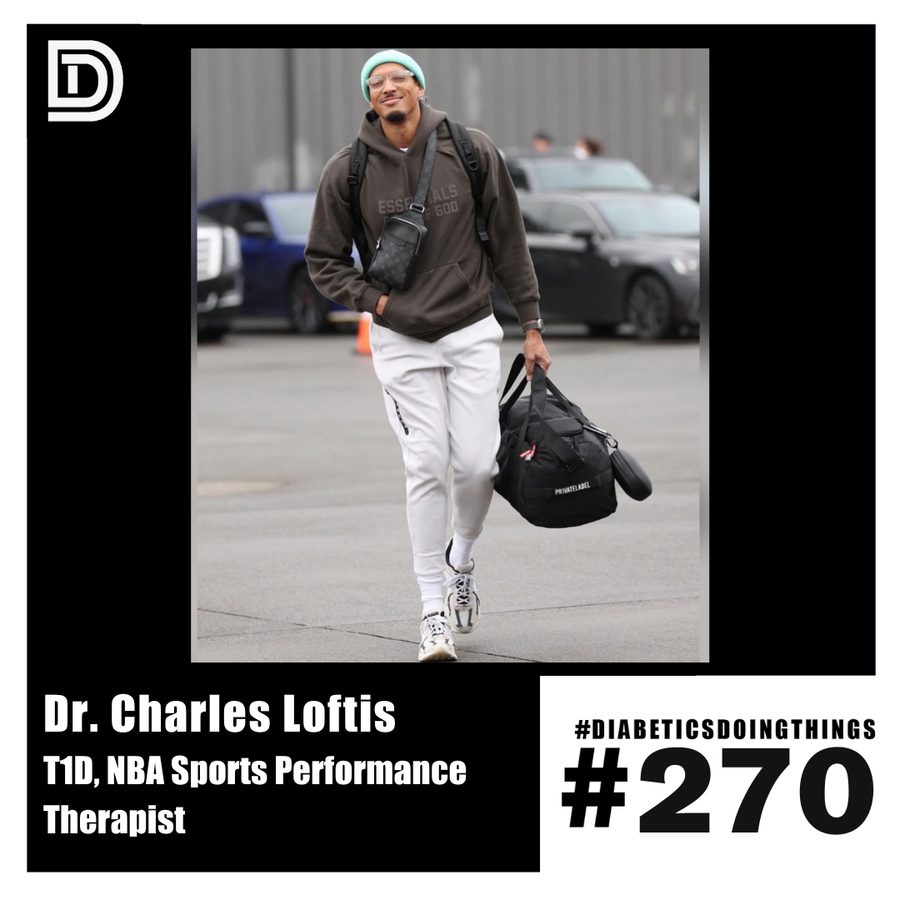
Dr. Charles Loftis, T1D, NBA Sports Performance Therapist


Episode summary
Dr. Charles Loftis is a physical therapist and sports performance therapist for the Portland Trail Blazers. In 2019, while traveling with the Minnesota Timberwolves' G League affiliate, he noticed extreme thirst, constant urination, and sudden weight loss. Blood work showed type 1 diabetes, specifically LADA, diagnosed in adulthood despite being fit and health-conscious. He describes the emotional toll of accepting a lifelong condition, learning carb counting and insulin dosing, and later going public on social media, which connected him with other people in his life living with diabetes. The conversation covers managing blood sugar during NBA travel and treatment sessions, telling his team and head of security about his diabetes, and advice for athletes with diabetes pursuing high-level careers. The episode closes with a mailbag segment on perspective and chronic illness.
Key takeaways
- Charles Loftis was diagnosed with LADA (type 1.5 diabetes) in 2019 while traveling with the Iowa Wolves, after extreme thirst, constant urination, and rapid weight loss.
- He says preparation is his biggest strategy for managing diabetes on the road, packing extra CGMs, pods, and insulin for every NBA trip in case of delays.
- Loftis told his Trail Blazers director, head athletic trainer, and head of security individually, then told the full department at a team meeting so they'd know how to help if he had an episode.
- He says he can often keep working through a mild low by grabbing juice and pausing briefly, but will stop and sit down if symptoms like shaking or sweating get serious.
- Loftis says the diabetes community helped him process his diagnosis, and going public with his story has since helped other people with diabetes, including parents of newly diagnosed kids.
Show notes
This episode is supported by Thrivable. Thrivable’s mission is to create a better future together. They achieve this by making it easy for healthcare companies to include the patient's voice in their decisions so they can create transformative treatments and products for you.
And for listeners of Diabetics Doing Things, Thrivable has multiple opportunities for you to earn money for sharing your story, your insights and your lived experience for companies who produce and design products for people with diabetes. You can participate in online surveys and earn up to $75 per hour and join in-person studies to earn up to $800 per study.
To sign up, just go to thrivable.app/rob and create a profile. It only takes a few minutes. Then, just wait for study invitations, participate in a paid diabetes research study and get compensated for your time.
—————
In this podcast episode, Dr. Charles Loftis, a type 1 diabetic and sports performance therapist for the Portland Trail Blazers, shares his diagnosis story and the challenges of living with diabetes. The conversation covers topics such as diabetes diagnosis, lifestyle adjustments, emotional struggles, the impact of technology in diabetes management, community support, managing diabetes in a sports team, traveling with diabetes, and balancing a career in sports performance coaching while dealing with diabetes.
This episode also includes the opening of the Mailbag! If you want to submit your question, email mailbag@diabeticsdoingthings.com.
Topics discussed:
Diabetes Diagnosis and Lifestyle Adjustments
Doc shares his diagnosis story and the challenges he faced despite being fit and health-conscious.
Importance of nuanced diabetes diagnosis and understanding insulin dosing and carb counting post-diagnosis.
Emotional and practical challenges of accepting the diagnosis, lifestyle changes, and educational aspects of managing the condition.
Community Support and Awareness
Sharing a diabetes diagnosis publicly and receiving support from the community.
Importance of connections within the diabetes community, using personal experiences to educate and raise awareness.
Impact of technology in diabetes management and societal perceptions of wearing devices.
Managing Diabetes in Sports Performance
Challenges of managing blood sugar levels during physical activities.
Recognizing symptoms, handling medical emergencies, and communicating about diabetes within a sports team.
Strategies for managing diabetes while traveling with a professional sports team.
Career in Sports Performance Coaching with Diabetes
Balancing a demanding lifestyle as a sports performance coach for elite athletes.
Importance of personal routines, sacrifices made for success, and advice for individuals with diabetes pursuing careers in sports.
Understanding the individuality of athletes and the impact of personal experiences on inspiring others.
Perspectives and Empathy
Reflections on how living with diabetes has shaped perspectives and empathy.
Valuable life lessons learned from dealing with a chronic condition.
Gratitude for growth and insight gained through unique experiences with diabetes.
Key takeaways:
Acceptance and positivity are crucial in facing the challenges of living with diabetes.
Community support and connections within the diabetes community play a significant role in managing the condition.
Understanding the individuality of athletes and the importance of communication in sports teams are essential for diabetes management.
Personal experiences with diabetes can inspire and support others facing similar struggles.
Gratitude and growth can be found in the unique experiences and challenges posed by living with diabetes.
00:00 Unlocking the Story of a Type 1 Diabetic NBA Sports Performance Therapist
09:05 Navigating the Emotional and Practical Challenges of Living with Type 1 Diabetes
14:33 Embracing the Diabetes Community: A Journey of Support and Inspiration
20:43 Navigating Life with Diabetes: Challenges, Awareness, and Acceptance
28:38 Navigating Diabetes in a Sports Performance Team
31:45 Managing Diabetes and NBA Travel: A Pro's Guide
36:57 Navigating Life as a Sports Performance Coach Working with Elite Athletes and Diabetes
46:57 Exciting Basketball Clinics and Heartfelt Conversations: A Peek into Diabetes Community Connections
48:33 Rob & Eritrea Open the Mailbag
Questions this episode answers
What is LADA, or type 1.5 diabetes?
LADA stands for latent autoimmune diabetes in adults, a slower-onset form of type 1 diabetes often diagnosed later in life. Charles Loftis was diagnosed with it in 2019 after being misread as possibly dehydrated or sick for days.
How does Charles Loftis manage diabetes while traveling with an NBA team?
He calculates and packs extra CGMs, insulin, and pods for each trip in case of delays, and keeps drinks and candy in his hotel room for overnight lows.
Did Charles Loftis tell the Portland Trail Blazers staff about his type 1 diabetes?
Yes. He told his director and head athletic trainer one-on-one first, then told the full department, including the head of security, at a team meeting.
Can someone with type 1 diabetes work in professional sports performance?
Loftis says it's doable and points to others who have done it, stressing the importance of a support system and being open with coworkers about the condition.
Full transcript Searchable, with timestamps
Rob Howe: This episode is supported by Thrivable. Thrivable's mission is to create a better future together. They achieve this by making it easy for healthcare companies to include the patient's voice in their decisions so they can create transformative treatments and products for you. And for listeners of Diabetics Doing Things, Thrivable has multiple opportunities for you to earn money for sharing your story, your insights, and your lived experience for companies who produce and design products for people with diabetes. You can participate in online surveys and earn up to $75 per hour and join in-person studies to earn up to $800 per study. To sign up, just go to thrivable.app slash rob and create a profile. It only takes a few minutes. Then just wait for study invitations, participate in a paid diabetes research study, and get compensated for your time. We're always excited to provide people with diabetes opportunities to earn from their lived experience, and this is a great opportunity for you to get paid for your diabetes insights. Sign up today at thrivable.app slash rob. That's thrivable, T-H-R-I-V-A-B-L-E dot A-P-P slash R-O-B. You can also check them out on Instagram at GoThrivable. Okay, let's get back to the episode. Hello, welcome back to another episode of Diabetics Doing Things. We are telling the amazing stories of people with diabetes from all over the world. Very excited to introduce you to our guest this week. He has given us his time while on break from the NBA All-Star break. For those of you guys who know, you're probably watching All-Star Saturday, probably watching the All-Star game, but for the staff and the coaching staffs of all the teams, it gives them a weekend off in the middle of a really grueling 82-game season. So Dr. Charles Loftus, the sports performance therapist for the Portland Trailblazers and a type 1 diabetic, a person diagnosed with LADA in 2019. Welcome to the show.
Charles Loftis: Thank you very much. Appreciate it.
Rob Howe: Very excited to have you here, man. And for this show, we typically start off on diagnosis story, just to kind of frame for all of our listeners, you know, how you came to join the type 1 diabetes family. So I know from our, from our buddy, Dub Ellison, we checked out your interview with him a few years ago. He, you shared your story with him. So why don't we start on that crazy day in 2019? And you tell us a little bit about what was going on in your life at the time.
Charles Loftis: Yeah, so 2019, I was in the G League at the time with the Minnesota Timberwolves, their affiliate, the Iowa Wolves. And I mean, I remember, I still remember this day, you know, like it happened yesterday. And, you know, it was one of those things would get up early, call to go to the airport, get ready to go to. It's our last road trip of the season, our last couple of games. and I think we were going from Iowa to Arizona and then from Arizona to Salt Lake City for our last two games and I just remember that morning being at the airport and I was just like extremely thirsty not thinking about it and I mean to a point where you know I felt like I could take a straw and just stick it in a large body of water and just keep on going and I'm like man this is it's unusual, but I thought maybe I'm dehydrated. Maybe I'm just not drinking enough water. And so it's really still not clicking for me. But while at the airport, I mean, I think I finished a gallon within a matter of some hours of just drinking water like that, which a gallon in a day really is tough for myself to do and many others. But in some hours, I'm just like, yeah, this is unusual. And then after that, it just hit me where I had the symptoms of, you know, having to go to the restroom, like, or the urge, like every 15 minutes, 12 to 15 minutes, I just felt like, I'm like, all right, I just went to the restroom. Now I got to go right back. But, you know, not much was happening there. So I'm like, okay, I really don't know what's going on now. But I know this is unusual. And, you know, just what my health background of being in the medical field as a physical therapist and working at different hospitals and things and outpatient clinics and whatever, but I knew the symptoms. I knew what they were, but in my head, I'm like, I know I'm not type 2 because, you know, my lifestyle, like I'm pretty, I was pretty self-conscious of, you know, what I ate, very active, working out, just staying fit, staying in shape. And a new type 1, you know, typically happens in, you know, your younger years, you know, between five to 10 or something like that. So I was very unaware of type 1 LADA in your adult years. And so I still wasn't clicking that this is potentially something that's going on for me. You know, I'm starting to think the worst of things. I'm like, yo, is this like some cancerous type stuff? It's, you know, what's going on? I'm like, I have no clue at all. Then the next big clue for me was usually on a flight, you know, having to go to the restroom, I was like, I can probably get through going one time, but yeah, I just kept popping up, having to go. And then whenever I landed and think one the next morning or something, I always like to step on the scale list to check in. And I noticed I was down from like 215 to 185. And I was like, OK, this is crazy. I lost a lot of weight unexpectedly. So finished up with the whole trip. When I made it back to my hometown, Oklahoma City, I immediately made a doctor's appointment. and I was like the end of March and did labs, blood draws. April 1st comes around, April Fool's Day, April 1st comes around and I get this phone call. Mind you, no one has contacted me yet about my results or anything. I just get this phone call from a nurse and they're like, hey, your prescription's ready. And I'm like, prescription of what? I just went to the doctor yesterday and I haven't heard it. And she was like, no one's contacted you. I'm like, no. So she was like, oh yeah, we might need you to come in. So I went in and spoke with them and yeah, that's when they made me aware of type 1 LADA. And so LADA, for those that may not know the acronym, it's just latent autoimmune diabetes in adults or type 1.5, you know, there's so many names for it, but so yeah, you know, that was kind of, you know, my first time ever hearing about that form. And that was the realization of basically a new start within life for myself. So, yeah, I think,
Rob Howe: you know, for, for our listeners, you know, we are, you know, we made a point over the past year to really dig into some of the more nuanced, you know, and not as discussed types of diabetes and a lot of, I think, chief among those. And, you know, it's interesting, this is 2019. And, you know, when this happened for you, and, you know, we've had a lot of people on this podcast who were first misdiagnosed as type 2 and some who are in like very similar to you who are super fit, very health conscious. One guy, you know, Dex Gerald, shout out Dex is a personal trainer and he was misdiagnosed as type 2 for multiple years. So shout out to your care team for, you know, checking out, checking your antibodies as well, because, you know, especially in black and brown communities often are misdiagnosed because of how prevalent type 2 can be in those populations. So at the same time, it's so interesting for me to hear your kind of symptoms you were experiencing because it was very similar to me. You know, I was in high school, you know, and my coaches were always honest about staying hydrated. So I felt like as I was going back, refilling my water bottle, I'm like, man, my coaches are going to be psyched. I'm taking water down. I could like, I think you described like, you know, you could put a straw in a swimming pool and like drink it all up. And I felt the same way. I was like, man, I'm unstoppable
Eritrea Musa: right now. This is so good. And the symptoms of polyuria, polyphagia, polydipsia, the three poly,
Rob Howe: The three polys.
Eritrea Musa: Yeah, but I mean, they're not that uncommon among diagnoses. I think the interesting part here is that this man was flying from state to state and then back and forth. It's so crazy to me. I think that in childhood when you get these symptoms of urination and thirst and diabetes, it's immediate hospitalization. But when you're older, you guys are like, I'll just go to the doctor. So it's so interesting to me how it's like on some scales, it's like you need to be hospitalized immediately. If you're a child, if you're an adult, we can just wait till tomorrow. and then we'll just write your random prescription.
Rob Howe: Yeah, we'll just call you, just tell you to come pick up your prescription. What do you remember about your diabetes education from that point on? Because obviously you need to learn all the different ins and outs of insulin and dosing and carb counting. What was that like for you?
Charles Loftis: Sure. Man, it was just grasping the concept of what I had to do. First, my doc did a great job of setting me up with a good endocrinologist here in Oklahoma. And although like Oklahoma City is my hometown, I don't live here per se. I still use her back and forth. And Andrea. So like I, you know, like a message when I come back in town, she makes time for me to be able to come in. But she did a wonderful job of the education part. And but at that time, it's still early. So for me, it was just understanding why. And I was just like, you know, what, like how in the heck, what did I do? you know that was the biggest thing that was still going through my mind and then on top of now I got to do these formulas and then like hey she sent me up with a dietitian a registered dietitian as well and with her I had to like do a journal of everything I ate and estimate card counting for the days so just still trying to understand all of that and the tedious amount of work that you do to start to figure out through the honeymoon stages. I mean, it was a lot, you know, but the biggest thing was just mentally, you know, that, that part of it was, was really hard for me to really grasp because it was like, okay, I mean, I got to do this for the rest of my life now. And what could I have done to avoid this from happening? Was there something that, you know, I did to, you know, cause the insult of, you know, of the pancreas for this to happen? Like, what was it? You know, so it took me a long time to really grasp that concept. But you have from the education part, man, that learning the carb counting. I mean, I knew that once I get it down like this can actually I can be beneficial for me and also the population I'm working with to be able to understand what I'm eating, how much I'm eating and just be able to kind of like I sub and estimate. But, you know, still, it was a good adjustment to get to.
Rob Howe: I want to talk about the why for a second, because you had mentioned this on, you know, another interview that you had done. And Eritrea and I have talked a lot about it with our parents, specifically our dads, who had a difficult time accepting that there was nothing they could have done to prevent the onset of diabetes or that there was nothing that they did that caused it. So for you, is that similar for you? And I guess like with your background as like a medical professional and like your background in science, like, did you struggle with that because of the knowledge that you had? Or, you know, talk a little bit about like the emotional kind of struggles that you were going through in those early days.
Charles Loftis: Yeah, I think it was a combination of both, you know, you know, it was just, you know, like, how did this happen? Why did this happen? And what could I have done to maybe prevent that? But, you know, speaking to my endocrine and, you know, my registered dietitian, you know, they just assured me and, you know, just gave me the affirmation like, look, there's nothing you did. This is it. So then for me, it was like, okay, how can I turn this situation around? I just started trying to look at the bright side and the positives from this and still not knowing anything about like device management using the technology and devices yet at this time it's still early for me so I'm just getting used to just the manual injections and the finger sticks you know but later as time continue to go on and then starting to get into the the technology and understanding that like there are kids younger than me that have to go through this and also like you said the parents for them to understand too that you know it was nothing that they've done, nothing they could have done differently. And, you know, it was just one of those things are like, okay, maybe I can use this as a platform, you know, for friends, family, anyone out there also just to educate. Because I remember going around, matter of fact, my first year in the G League, we had a team photographer that he always had the devices on the back of his arm. At the time I saw it, didn't know what it was, but come to find out it was Dexcom and his Omnipod. And so then after, you know, this happening for me, the transition, that's when it opened up my eyes like, oh, this is what this individual is wearing. And then after that, it's like, you know, whenever you get a car and this is a car, you know, you never see it. But then we talk about this all the time. You know, now I'm like everywhere I turn around, I it's just instantly able to spot, you know. And so, yeah, for me, it was just, figuring out how I can use this as a tool to be able to help. And not only that, just to educate those individuals that may not have nothing to do with it, but they see it and they're just like, what's that device? And kind of just like, I don't know, not necessarily like a body shame, but almost just like, you know, it makes people uncomfortable sometimes when you have to wear this new device. And so I felt like, you know, this is something that I should maybe get comfortable with and then I can be able to share my experience and help others get comfortable with being open with, you know, giving themselves an injection in front of people without having to get up. Cause that was the thing I excuse myself, get up and go to the bathroom just to do injection stuff. Cause I didn't want to, you know, just do it right there at the table. Nowadays I'd be at dinner with people. I'm like, Oh, hold on one second. Boom pop. And they're like, Oh, is that hurting? I'm like, nah, it's all good. You know, and just keep it moving. But, but yeah, you know, like recently I've had a colleague, one of our player development coaches and he just approached me recently and his son was literally like a week ago hospitalized for a couple of days. And he was like, yo, I just found out that, you know, you're type 1. And I'm like, yeah. He was like, yeah, you know, like I want to sit and talk to you because the biggest thing for them, the husband and wife was the mindset. You know, this is your child, seeing them in hospital bed, seeing them extremely fatigued and weak. And now knowing that this is a lifestyle change for their child for the rest of their life, it was really, really hard, I think, on both of them as well, too.
Rob Howe: Well, I think that kind of flows into what I was curious about for you, because you talked a little bit about when you sort of publicly announced and put on your social media that you had type 1 diabetes or you're living with LADA, and what came back from that? And you had shared that there were people that you already knew who you hadn't had that discussion with before, who were either had a friend or themselves were living with type 1. So, you know, we discovered you, I think Omnipod posted, you know, you did a post with them in 2022. And I think that was probably where we discovered you at the time. And like, what was that like when you're, you know, you publicly put yourself out there. We talk about it on the podcast a lot. Everybody's diagnosed twice, kind of once when the doctor tells you and once when they feel comfortable enough to let everyone else in on that. It's like coming back from that announcement, like, you know, what do you remember about the interactions you were having in the community? I mean, the love was,
Charles Loftis: it was wonderful. You know, everyone, you know, they, they emphasize with myself and the sympathy was there and it wasn't something that I necessarily did for that. It was just more so like, Hey, this is a big change, but now like I want other individuals to be more comfortable and being able to share their experience. But yeah, like people popped up that I had already known, but I didn't know that either themselves or one of their family members, you know, had type 1. And so then they're reaching out to me, you know, just because of, you know, like my background in general, I would get a lot of individuals to pop up with different questions and things. So then that became more now of another platform and topic just to kind of share and talk and help educate within my scope. So, I mean, the love was real and it was just it was a surreal moment. But yeah, you know, then a lot of other people, you know, we get messages like thanks for the transparency. I feel comfortable talking about this. And even those that were like type twos, you know, there were some individuals that really struggled with the management and keeping up and they felt like they want to give up on life. You know, I've actually heard a couple of cases like this and being able to share my experience and be open about it and show that I could continue to live almost basically like a normal lifestyle. I think, you know, help inspire some of some of them to be able to keep their stuff well contained and under control.
Rob Howe: And it's pretty documented, right? And we talk about it a lot here of the mental strain. of living with diabetes or just any chronic illness. And like you talked about the adjustment to realizing you're going to have to live with this for the rest of your life. And there's never going to be a day off. And that can be really overwhelming. You talked initially, even just about your mindset and it kind of adjusting to, you know, rolling with the punches, so to speak. And I want to talk about like, for me, my background in athletics has formed how I respond to everything in my life. And I think it's such a, I'm such a staunch advocate for participating in sports because it teaches you how to fail. It teaches you how to overcome challenges. And like, you know, even the best shooters, and we're going to talk about you working with some of the best athletes in the world, but like the best shooters in the league only make four out of 10. So, you know, if they, if you get down on yourself after every miss, you, you don't know what's on the other side of that. And so do you think that that background in athletics, like as an athlete and like in sport performance helped you like make that adjustment to living with Lada?
Charles Loftis: You know, I don't know if it necessarily helped me with the adjustment of it. I think the background, it was definitely a challenge with, you know, the travel and being able to be comfortable working with my athletes. They get through work at the same time now. But, you know, I don't know if I could say it necessarily helped me with that, that, that challenge of living with it. But I mean, it was definitely there's some inspiration there for sure. And then specifically some of the athletes prior to me going pro, I had my own business in Oklahoma. I had a sports performance facility and I had an athlete whose name was Nate that was a type 1. And that was my first time actually like working with the performance side of an athlete, you know, with type 1. And he educated me a lot at the time. This is way before I even, you know, way before I was diagnosed. And so it just gave me an insight of things to prepare for and to have for, you know, like individuals, not only athletes, but just in general being around, like having snacks around or anything with sugar just to prepare for any type of low moment. And so, you know, it helped me with understanding that and, you know, just knowing that looking at athlete performance, I notice a day to day from one day they're, you know, perky and very energetic. And then another day they're kind of, you know, like dealing with something and makes me think deeper than just like emotionally what they're dealing with, you know, like just to make sure systemically that they're OK, too. So, you know, it gave me a few insights of how to help manage and what to look for. And then also just, you know, like just to take care of myself.
Rob Howe: But did you connect with Nate or reconnect with Nate after you were diagnosed?
Charles Loftis: Oh, yes. Yeah. I still talk to him to this day. I just reached out to him recently just about some questions. Some, you know, my endocrine wants me to kind of switch from one device to another. And so I was, you know, picking his brain on like, hey, are you familiar with this one? Are you still using this? And so on. So, yeah, we still keep in touch every once in a while. So, yeah, yeah.
Rob Howe: What do we say about a friend with diabetes?
Eritrea Musa: A friend with diabetes is a friend indeed.
Rob Howe: Yo, the easy way to level up is to have a friend, man. That's so key.
Charles Loftis: Yeah, no, for sure. It's a community, you know what I mean? Like once you meet someone with it, it becomes a close-knit community. And I'm always, you know, like this is our first time really meeting here. But I feel like this won't be, you know, the last time that, you know, we ever hear from each other. or, you know, even being, when I travel a lot, popping into a city and things like that. The same thing with Dub, you know, I met him first. And then when we played out in Indianapolis, I was like, hey, met up with him. He came to a game and, you know, just showed him love. But, you know, it's just one of those things that, you know, the community, it's important, it's needed. But yeah, once, you know, once you meet those individuals and, you know, they're long lasting friends forever. For sure.
Eritrea Musa: It's interesting that you mentioned the community because I mean, in my head, community can mean so many different things, right, especially since the pandemic. So I wonder if you knew, excuse me, before the Omnipod post that you were like stepping onto this huge diabetes online community scene, because it's a bit of a monster if you're not familiar with it. So did you know that it was this plugged in when that post went crazy viral?
Charles Loftis: No, you know, no, I didn't, I didn't realize all the different platforms, you know, I never, you know realize that individuals have their own individual platforms like that and not only that like like camps and things you know i mean like back in oregon there's a basketball camp yeah chris dudley yeah the chris dudley camp the type 1 diabetics and you know just the different you know awareness you know marches and and things you know i wasn't wasn't really familiar you know with it. But after, you know, meeting a lot of individuals, it's really opened up a lot of light
Eritrea Musa: to me. You guys talked a lot about also like your why and how you felt at the beginning of your diagnosis. And I just, I wanted to say it, you were diagnosed in 2019. That means you've only had diabetes for four years. And you're like, it took me a really long time to get over that feeling. And I'm like, do we measure time differently? Because to me, it's not been very long. So it's like, what, how, how much time did it take you? Like, and also like, what did that process, I guess, look like as far as like processing being a totally healthy adult to now living with a chronic condition while having to tell other healthy people how to best optimize their like physical strength. So what does that all look like? So for me, like the biggest thing
Charles Loftis: was like emotionally and also just figuring out my system of my body, how things operate. For an example, like something small as in I'm very active, like working out. One of the most frustrating things is when you get ready to start a workout and then your blood sugar starts to go down and then you're like, you have to stop in the middle of that. At those times, I would just get up and I would just leave the gym a lot of times because it was just very frustrating. So dealing with the frustration of things, the highs and lows, waking up, your blood sugar is high throughout the night and then you just feel, it's an emotional rollercoaster being able to channel that and understand it. But once I was able to dial in on those things and then know like, okay, this is happening. Let me just sit back. Let me, you know, relax a little bit and wait till this balances out. So those were the things where I say it was kind of, you know, like the timing for me to flip that over was a little bit earlier, but you know, there's still things that I deal with. And I think it's going to continue to happen no matter what, what, what balancing out those highs or lows or just activities and whenever you have to stop and you know the preparation you know the preparation is always going to be there and so now it's just becoming kind of second nature for me though but those honeymoon stages at the beginning of you know knowing what my ratios were and making sure that you know plugging these things in but now like the technology's helped
Eritrea Musa: out so much more to really okay so like how do we just change a mindset like what like in three years you're totally like come back to being this positive perfect nba man and it's just like no
Charles Loftis: like how how do you people do that i don't believe that help people friends you know communities and just understanding that what what we're going through is it's okay you know and it's not the end of time and you know that's it's you know there's so many other things out there that could be diagnosed with that are terminally you know and so you know i talked about my why is it being like the chosen one? It's like, okay, well, I was chosen to do this. Now, how can I flip over and look at it as more positive thing? And so that was, you know, the why for me was just like, all right, just felt like I was one of those chosen ones that, you know, even with my knowledge and the background that I've had in the medical field, it's like, okay, there were still some adjustments with that, some things that, you know, I wasn't aware of, bolus, basal, and, you know, the lingo. Yeah, and all the different, the lingo and whatever else, you know, but now it's you know it's once i got a good understanding of it it changes your mindset it's not to like
Eritrea Musa: throwing shade on anybody but i hope he listens to this gary found out that mdi meant manually delivered insulin four days ago because i told him we were doing this other project for diatribe and he was like wait what's mdi and i was like dude manually delivered insulin that's what you're on and he was like i didn't know he's had that for way longer you don't say mdi is it multiple
Rob Howe: it's not multiple daily injections to you is it i thought it was manly delivered insulin interesting I'll have to see who's right.
Eritrea Musa: Oh, we'll have to bite. Yes.
Charles Loftis: This is new to me too. You know, I've never really heard the term.
Eritrea Musa: So yeah, I think lots of random lingo that you learn throughout the course of diabetes.
Rob Howe: I have this entire like PhD level thesis of like living with diabetes and like how it changes your perspective on certain things and like things that were exciting at one point and then you get burnt out on them, then you come back. And, you know, so it's interesting having, so me for 19 years, you for four years and Eritrea for 23 years, just celebrated your 23rd anniversary. So like, as we go through these different phases, like how things show up, it's, it's always interesting. I do think though, it is refreshing to me because you're right. It is difficult to go to the gym and like work out. And that's one of the most common challenges that a lot of people with diabetes face is, and they at least voice and share because you're doing this thing that's positive for yourself. Like you're motivating yourself to go to the gym and then you're in a class or you're at the gym and then you have to stop and drink a juice box or like eat some snacks. And, you know, if you're trying to, you know, lose weight or gain muscle or whatever.
Eritrea Musa: The after, like for girls, a lot of us will be finding the workout and then you have to drink a juice box after. And you're like, I just burned these calories.
Rob Howe: Yeah, and then you have to return them with calories. So it's like, but I think it's good to hear somebody who like is literally at the peak of their field, sports performance therapist, who also deals with those things. And it's just like, yeah, that's life with diabetes. That's just, that's the trick.
Charles Loftis: Yeah. Yeah. No, it's it's it's just life, you know. And I mean, there's times that I might have a guy on the table and treating them. And and, you know, also just for them to understand, I've had to educate a lot of them of like, this is what this is. And, you know, they might feel a device on my body when they brush up against me. They're like, yo, what is that? And I'm like, oh, this is X, Y and Z. Or they might see it and they're like, hey, what is that? I know when I first had my Dexcom, a lot of them thought it was a tobacco patch for like smoking and stuff. And I'm like, no, I was like, no, it's just, it measures my blood sugar.
Eritrea Musa: That is a really big tobacco patch.
Charles Loftis: It is almost. It's just a disconnect, you know, like it is. And that's the first thing I'm like, no, that's just way too much. You know, it's just, you know, a lot of the unawareness of it. It's just, this is what it is. It's out there and exists. There's a lot of individuals that, I mean, I was, you know, in pools before out on vacations and I've had other, you know, like adults randomly think the same thing, that it was like a tobacco patch. or something when they saw my Omnipod or something. I'm like, no. But yeah, you know, like working with the athletes in the middle of treatments and things. And I mean, they've understood and they're very patient. And, you know, I might have to take a break real quick or ask a colleague like, hey, my hands are tied, but can you grab me like a little orange juice real quick? And they know, they understand. And, you know, it might take, depending on how low it is or how fast to drop, and it might take a little time for it to come back up. But just to be able to balance that out. And it just, you know, it happens. And, you know, nowadays I'm very conscious of, you know, where things are, what my numbers are before I start activity. And because I know it's a lot of moving around and it's almost, you know, whenever you give yourself the, you know, a dose of insulin plus moving activity on top of it, it can almost be like a double negative where it just makes your blood sugar drop so much quicker, too. So being just aware of little things like that. But, I mean, they still happen in the middle of treatments, in the middle of, you know, packing equipment, moving things around. I mean, it's just they're just there.
Eritrea Musa: So when you are so like, let's say you have Kawhi Leonard, he's laying in front of you, has a terrible situation and you are low. OK, he's on this team. He hasn't been for a long time. That's just who I wanted to say. Stop shaking your head at me, Robert. OK, anyways, you're just working through the low. Like you're not someone who has to like, cause I, if you feel low, some people very strongly have to sit down and stop what they're doing. But you are Charles Loftus at your service, continuing through this low powering through while someone hands you a juice box. Like a surgeon when they're just like dabbing their forehead, like you just continue to operate.
Charles Loftis: Like it depends. I think it really depends. And one thing, like I've got to be very familiar with my symptoms and what I feel and at those different types of levels. So if I know if it's at the early phase and I'm starting to feel it come on and I'm like, how much time do I have or what do I need to do, then I might be able to work through it. But if I know that it's like if it's, you know, I'm starting to quiver a little bit, shake and then, you know, my forehead starting to sweat and things like that, then I might have to stop really quick. If it's a, you know, if it's a triage moment where it's like we have a full team, you know, so I'm always have other staff members and coworkers around that we're all we pitch in and everyone helps out. So if it's one of those things and like a true medical emergency, most likely we'll have people helping around. But if it's just like, you know, a training session or treatment session or me assessing someone and the priority is not that high. Sometimes I'm able to work through it or I just might be able to say, hold on one second. Let me let me take care of this, you know, one minute and I'll be right back and do that and then come back. And then it's no big deal. But I'm not just working through it all at all. There are times that you just have to sit down and you're like, hold on, let me, let me breathe real quick. And let me, let me balance back out because I feel like.
Eritrea Musa: I would just pull myself. I got to bench myself. Anyways, I know Rob. Rob, Rob is just going to drink this juice and make this slam dunk or whatever the hell it is he does.
Rob Howe: I think though, like, you know, if I'm sweating and like, I feel that I have this like sort of like hot flash feeling and I feel that sweat on me. I'm like, uh-oh, I'm in trouble. Especially if I've been sitting down. I'm like, uh-oh, I'm in deep water. Better, better figure this out. You're in danger, girl. Yeah. Yeah, just get my alarms start going off. But one thing like, and we haven't necessarily mentioned this explicitly, but this is another, you know, thing that many people face is how do you let people know around you about your diabetes? Like, obviously, you're in the sports performance staff. So you have your whole team. Is that do you have like a signal or do you have just like that line of communication where you kind of, hey, I need to tag out for 10 minutes and treat this? Or, you know, how do you talk about your diabetes like in the organization?
Charles Loftis: initially before everyone knew it was a thing that we had our department meeting i just well for one i spoke to some people individually my my director at that time i spoke to him individually and then maybe like the head athletic trainer spoke to them individually just let you know like hey this is something that because you know during the interview that's nothing that's discussed in the interview until you know after you get there and get settled but whenever we had a department meeting, I felt like it was time for me just to open up and let everyone know like, hey, I'm also type 1, this is what this means. So there's moments, there might be moments that I might have to stop or I might need help or something like that. But just in case someone, they didn't hear from me one morning or I showed up late because I might have an episode, it was important to let them know, to let my head of security know as well, because those Those are things that, you know, we're always we're traveling as a unit. So, you know, they always need to make sure and know what's going on. So I just, you know, waited for the right time and, you know, got everyone together and, you know, just explained it to them. And they were open arms. And, you know, there was obviously at the time a lot of questions and things, too. And I'm still trying to figure out because a lot of it, yeah, they might hear, but they still don't quite fully understand what that fully means. I mean, even, you know, when they see me, you know, a lot of people think that like, oh, you're, you're type 1, so you can't eat any sugar or anything like that. And I'm like, no, that just means my body doesn't produce this. So now I just have to supplement myself with this to help balance that out. That doesn't mean I can't eat carbohydrates now. And you still need carbs for fuel for your brain and for your muscles. So, you know, it's just still like giving them that little education piece. But yeah, I just found the time.
Rob Howe: So it's an interesting, like you have to advocate for yourself like all the time, whether it's day one or day a thousand or day 10,000, you know what I mean? Like you're always kind of educating and telling people, but you just mentioned the travel word. So many of our listeners probably don't know this about the Portland Trailblazers, but no professional sports team travels as many miles in a year as the Portland Trailblazers. and we've one of the things that well i'll tell you why because uh they are in the pacific northwest and there's no other nba franchise the closest one is sacramento so i believe sacramento is the travel partner girl learn your learn your geography vancouver yeah vancouver is close but like there's no nba team there anymore so if you got to go to you got to go play a back-to-back back-to-back in orlando or miami just going back to Portland, you're flying all the way across the country. So the amount of miles is like 30% higher than even the second place team, even Sacramento. So we've had people and Gary Forbes, shout out Gary, talking about travel with the NBA because it's six months of rigorous, like 41 road games, 82 game season. And that's not including playoffs, not including now the in-season tournament. So, you know, you're getting to a city sometimes at four in the morning, going to the hotel, sleeping for a couple hours and then right to work. Back to it. How, how do you, and so diabetes management in different time zones, traveling, not sleeping well, all of those things affect our blood sugar. So how do you, you know, how do you encounter that or manage that on the road?
Charles Loftis: So number one thing is preparation. So, because it's, you don't ever want to go somewhere, get stuck and you run out of medication, you don't have enough. So I usually, I have, I have a board on my wall at home. Then I have like days and then it says CGM and then it says pods. So I will go and estimate how many days I'm going to be going for. And then I also add a few just for air. So who knows? Say there's a plane. Something happens if we just get stuck somewhere. I have to spend extra nights there. You know, you never know what can happen. So I always calculate that. So that means how many CGMs do I need to take with me? You know, mine lasts for 10 days. So most of our trips are 14 days or less. So I still usually take an extra one just in case there's an accident and I rip one off. And then my insulin and my pods as well, too. So I always prepare like that and make sure I have everything that I need for the road. Managing on the road, I think the devices help out a lot. But, you know, there's always we always have snacks and like, you know, food around and drinks. So I always make sure that in my room at night that I take stuff from, you know, whether it's from the plane or at the hotel that I always have, like maybe a couple of Gatorades and some little gummy candies or some, you know, just to have if I have a low in the middle of the night. But, yeah, you know, you know, we have we're pretty taken care of with food. There's always food around, you know, breakfast, lunch or dinner. And but, you know, you still have to find the time like to get into the gym just to help balance things out. And yeah, but the preparation for me is like the biggest thing. It's just making sure I have what I need around me and making sure that I have some spare things just in case there's an emergency. I mean, there's times that I've traveled somewhere and ran out of insulin pen and I've had to go pad a pocket, you know, just for one pen. And then, but now, you know, I make sure that all my stuff, my pharmacies are, you know, nationally. So if something does happen, I can just find the local, you know, pharmacy and go get my stuff from there.
Eritrea Musa: Or find a local person with diabetes. You can also follow Mutually Diabetes and let them know something happens so that, you know, we can help each other out through our community. But you know what? Being the NBA sounds so glamorous, and I'm sorry, parents listening to this, but that schedule sounds like ass. Like that sounds horrible.
Charles Loftis: No, it's tough.
Eritrea Musa: Rob was asking all these questions about how you live with diabetes. And I was like, how do you even have a life? Like, how do you have a home or a dog or a relationship or friends? Like, how can you manage any of those things when you're consistently living out of a suitcase is what it sounds like?
Charles Loftis: No, it's as tough as hell. You know, obviously, I'm in it for the passion of what I do. And I love, you know, team dynamics. I love working as a former athlete myself. So it's just one of those things that I don't really think you ever really get used to it. I mean, it's exhausting whenever you're, you know, in the middle of the grind. And also you got to take into consideration winning versus losing. When you're losing, the vibes, the positivity is not there. You have to try to make sure, you know, just staying positive and things. But, you know, the travel sucks. I mean, you miss out on really important dates and activities and events with family, holidays. You really have to plan, you know. Well, for one, it's really hard to plan because the schedule is unexpected. You know, what are we doing tomorrow? We really don't know what we're doing the next day until the night before because anything can switch up. Coach could switch up and say like, no, we got practice tomorrow. He could switch up and say, there's no practice. So like trying to plan out ahead of time, it's, it's ass. It's really hard.
Eritrea Musa: So personal routines are probably what keeps you really like, that's the Rob Howe factor. I'm just going to be quiet now. All you NBA people are the same.
Rob Howe: You know, I remember in his documentary, I think it was called Muse, Kobe, rest in peace, was talking about how when you're in pursuit of being the best, you have to sacrifice things that other people get to do. Like, you know, and he was talking about specifically like being a good son, being a good brother or cousin, like, and sometimes father and husband, it's like hard to do both. And so I guess that kind of like flows into my next question. Like, Hey, like I never heard anybody talk about it like that until that point. And so even to hear somebody who like, obviously like reach the highest pinnacle of greatness, like saying it comes at a cost was just like refreshing. Cause it's like some of it, we've all been there where we're working towards something that we want and having to say no to things that other people get to do. And it's unfair, but I guess for, for you kind of flowing into that question is like, you, you get to work with some of the top athletes in the world. Like these are like the cream of the cream of the crop. And, you know, people have dreams, people with diabetes have dreams of doing their career or competing at the highest level or reaching the highest level of their career. And so what advice would you have for somebody who either has just been diagnosed or is living with diabetes and has dreams of competing at the highest level of their career?
Charles Loftis: It's doable. I mean, there are other people doing it. So they're not the first one to ever be diagnosed with this and to pursue that type of level of activity or sport or whatever it is that they're trying to pursue. Most likely there's someone else that has done it. It's very doable, but, you know, just knowing that there's a great support system out there, you know, just, you know, being vocal about it and allowing people to know, because if no one knows what you're dealing with and what's going on, then, you know, no one knows how to be able to help from that standpoint. But, you know, it's just, it's, it's very doable. There's so many different things that have have changed in the industry, the medical industry, to help people continue to pursue the life that they want to pursue. Staying active, swim, hike, run, whatever it may be, and just playing your sport, your sport of life. I mean, everyone's an athlete, but everyone's sport is just completely different. So I always live by that motto. And it's very doable. But the biggest thing is just staying positive about it and, and, you know, just being in the community and keep branching out to individuals that can help with that support.
Rob Howe: For sure. Great advice. And I think, you know, for people who are listening, hopefully, you know, we're going to plug your Instagram and things and hopefully there'll be people who are able to have questions for you and reach out to you and connect with you within the community. And, you know, I think that's one thing for me that, you know, Eritrea talked about earlier, you're like, you don't really know how big or how like, how impactful your story can be for someone. And, you know, it isn't always like a viral moment or millions of views or anything like that. But it's those conversations with, you know, a parent who has a son or daughter playing basketball with diabetes who reaches out and says, Hey, you know, I'm, I have this question or, you know, thank you for sharing your story because we're able to look to you as somebody who kind of in closing though, I had a question for you because I, one of my good friends who I was an intern with when I was at the Olympic committee, it's been now almost 15 years, but used to be the sport performance coach at the Phoenix Suns and now works for University of Texas. But he talks about Corey, Corey, my guy, my absolute guy, just like great dude. You guys got the same haircut too. So shout out to you guys. But he, you know, he talks about, you know, these are Ferrari level Lamborghini level athletes. And like, you can't, you don't just take them to the same, you don't prescribe them the same thing that you would for just a truck. And so from like a sports specific performance perspective, like how has worked working with the best athletes in the world, like change the way you think about sport performance. I think like, you know, I, I love hoop. I've played basketball my whole life. I'll never be able to do anything close to what shade and sharp can do. Like we don't, we're just not even basically even the same physiology at all. And it's like to see somebody like that and to see guys who can do the things they can do, like, how has that changed your perspective as a sports performance coach?
Charles Loftis: Well, I think the number one thing is that realizing that these individuals are still just normal people day to day. I mean, great personalities, wonderful spirits, you know, just warming hearts. Like they're, they're really wonderful individuals alone. So just taking it from looking at a professional athlete that's capable of doing this, you know, that's the first thing I look at is looking at them as just regular individual people. Because, I mean, they are, you know, there's a lot, especially we get a lot of young guys coming in. And a lot of times, you know, me helping them may not even be about sports performance. It's just some of the stuff is just daily life things like teaching them, you know, just life things, checks, you know, about checks or, you know, how to cook. Like, bro, do you know how to cook? you know, like maybe you should start learning how to cook a little bit just to help take care of yourself. I know you have the money to, you know, afford a chef, but you know, what if you, what if you're dating? What if you have a girl and she just wants something romantic, she wants you to cook or something like that. Like, you know, just those little basic little life skills and things outside of that is, you know, we find ourselves helping with that more than anything, but these individuals are very talented and they got to this level without without my help, I'm only there as an extension, as a resource to be able to help complement them in some form or fashion. So taking the ego out of being like, oh, I'm a performance coach, I'm a physical therapist, this is what you need for your body versus that, just taking that stuff out of it and learning about them, knowing that some of them that have been in the league might know about their bodies a lot more than some of them that have not, like your CJ McCollum's and you know your dames like they know about their bodies and so you have to be careful of what you say how you say it because i mean they'll call out fluff when they know it's fluff you know yeah and so just being very transparent being very you know having humility about things if there's something that you're unaware of it's like you know what bro i don't know about that but i'm willing to if you know more about it than i do i'm definitely here to to listen and also i'll go find someone else that knows about it and then I can bring back the answer that we're looking for or that you're looking for or whatever, you know? So I think, you know, just knowing that these intervals got here one way or another without my help, they're going to see so many different people throughout the level of their career that are coming in and out of the industry. So just realizing that understanding and just, you know, being an extension of some type of resource, you know, form. It's basically like we're like librarians, like they're coming in, they're looking for a book. were there just to help, you know, support them and find that.
Rob Howe: It was interesting too. You kind of answered a question from earlier about like, how do you manage life on the road? Like you're a team, you know, you're, you're talking about, you know, very young guys, like learning how to cook, you know, like that's something that we don't think about. Like when athletes are portrayed in the media, that these guys are 19 years old, you know, they talk about the contracts there, the amount of money they make is public for everyone in the world to see. And, you know, they're still learning how to live in the, they're on their own for the first time, you know, and how to manage all of the different people in their lives and like businesses and also showing up and be the best, best players that they can be. But that's really cool to see. Like, it's not just, you know, sport performance is not just on the court, you know, it's really, you know, all, all those things plugging into it. So man, this was an awesome interview. I really loved having this conversation. And I, again, from a schedule standpoint, you know, you talked about it, but getting time with you, I'm just really fortunate that we were able to work it out over the all-star break and thank you for coming on the podcast and sharing your story. No, man, I really appreciate
Charles Loftis: both of you. And it's an honor anytime that something pops up and we want to do another one. I'm always game for these types of things, but I love it. And this is, like I said, this is part of the why, to be able to help share experiences, share stories, and hopefully influence some others out there that are dealing with the struggles for themselves, whether it's the individual themselves or whether it's a parent or significant other, because it's, it affects everyone, you know, it really does affect everyone, but you know, there's, it's changed. There's so many different things I can help out with it. It's not the end of the world. So yeah. And I really appreciate it.
Rob Howe: One, one idea I got from this conversation is we got to bring diabetes legends basketball clinic to Oklahoma city and bring you in. I was about to say that. We did our first clinic last year. We're doing two of them this year, one in Dallas and one in Denver and just a half day basketball clinic for kids with diabetes. And the only goal is to leave with a friend with diabetes. So yeah, man, we're going to be doing some cool stuff. Anyway, well, thank you again for the time. It was great to chat with you and kind of get to know you a little bit. Anything you need, anytime you need anything, just reach
Charles Loftis: out, man. We're happy to help. I appreciate that. Same, same. You know, if there's anything that pops up, anything that I can help with and you know, if I'm around, you're both in Dallas.
Rob Howe: Yeah.
Charles Loftis: Yeah. My family's from Dallas. My dad's from Jacksonville, Texas. So I have a lot of family in the Dallas area.
Eritrea Musa: What part of Dallas? Actually, Dallas? Are you one of those people?
Charles Loftis: Dallas, Grand Prairie, Lancaster, all over. Okay. Yeah, I grew up in DeSoto.
Rob Howe: So that's awesome.
Charles Loftis: Yeah, my family's from DeSoto.
Eritrea Musa: Yeah, let us know if you're ever down here.
Charles Loftis: For sure. I definitely will. I definitely will. So keep in touch. I really appreciate the opportunity again. And if I could ever, you know, come back and be a guest again, I would love that. So I appreciate you.
Eritrea Musa: When we're looking for sponsors next year, we'll definitely hit your inbox. For our basketball camp.
Rob Howe: No, I'm serious. We start the conversation now. We're doing Lauren Talks.
Charles Loftis: Dear Adam Silver.
Rob Howe: We got Gary Forbes back in Denver. Why not take it to Oklahoma City? Doc Loftis is the special speaker.
Charles Loftis: Yeah, yeah. During the summertime, we set that up during the summer or something like that. Get after it. Big fun. I appreciate it.
Rob Howe: All right, man. Have a great rest of the weekend. Enjoy the time off. And good luck the rest of the season, man.
Charles Loftis: No, thank you very much. Take care.
Rob Howe: Mailbag.
Eritrea Musa: Mailbag, mailbag, mailbag.
Rob Howe: I feel like we, like none of these have even really reached anyone yet. And we've done a lot of them, but I think we're, this is mostly for us, I think. But for now, but right now we are, we're going through the comments and we're, you know, trying to find ways to discuss them. And one of the comments on TikTok was from a type 1 mom of a type 1. And she was sharing that she wouldn't trade the perspective that being a mom of someone with type 1 as a person with diabetes and a caregiver with diabetes has given her. And I wanted to flip that on you and ask, like, has diabetes given you or changed your perspective on things in a way that you wouldn't want to change? so like for example we we just had a conversation with Chuck Loftis and we were talking about travel and adding the extra step and like preparation and you know i know that i would for sure not be as prepared or as thoughtful about living if i didn't have diabetes and so i don't know i wanted
Eritrea Musa: to know if that resonated with you at all sometimes but i also think that we're we're all intersectional in our own ways or we're all standing at our own intersections, you know? And so part of being a black woman in America, there's like a bunch of stuff that I have to think about all the time. Like I remember like I'd go to a grocery store and like grab a snack and like just start randomly eating it. I remember once being with a friend who's darker skin than me and being like, don't do that. Someone's gonna think we're stealing stuff like that. So I think that there's different experiences that you have in life that add lessons to you. I do want to say this about diabetes though. I'm glad I learned the lessons that diabetes has taught me when I was supposed to, because I think that the lessons diabetes teach you are lessons we're all going to learn in life at some point, because we're all just one diagnosis, one phone call, one family member event from becoming a part of a, you know, marginalized community, be that disabled, mentally unwell, et cetera. So I don't think there's anything to trade back here. I think if anything, think it's just like a certain time point that I would have gotten the lesson anyway. Does that
Rob Howe: make sense? Stop traffic. Stop the rotation of the world because I totally agree with Eritrea Musa. The hell is freezing over. Look out guys. You finally crossed the threshold. No, I agree because for me as a, as a white male in America, we've talked about this, like I could pretty much go anywhere and people think I belong there. And so I never really thought of what it was like. outside of that. And not to say that diabetes gave me that much of a perspective, but you were talking about relative to other disabilities. I think it made me so much more accepting that, you know, it just, because someone is different doesn't mean that, you know, you treat them differently and there's still people and we all want to be seen. We want to be loved. We want to be heard. And I think now I have greater capacity to see people as they are, not just how they want
Eritrea Musa: to be? Yeah, it's easy to other people. And I think I learned a long time ago that I am other, I am other, and I will always be other. You know, I was, it's interesting. I'm a person living with diabetes, but I was born other because if you think about it, I am very uniquely positioned where I have two parents where neither one of them looks like me. So I was born other and I already knew I was different from the people in my household. So I'm different from the people in my school. So I was already like feeling really different. So then getting diagnosed with diabetes and like not speaking English for a long time. For me, it was really normal to just always be other. So it's very interesting to me that you, a person on a completely other side of the spectrum of that, right, belonging mostly in every room that you've ever walked into, including the room you were born into, that you still also have a similar experience where you're like, no, I think I would have learned this at some point one way or the other.
Rob Howe: That point you made too about learning it early, and I think I've said this a bunch on the podcast, It's like diabetes sort of grows you up really quick because you're very aware of your own mortality. And if you don't eat enough carb-y's, you might die. And it's like, oh, what's the cure to your death? Gummies. It's like, you know, it's all funny. It's hilarious. Diabetes is hilarious. And so, yeah, I think I'm grateful that I got that early, you know, and I'm kind of aware of that. And I also have tremendous empathy for children like you who were born or like had to do that at age seven or at age three.
Eritrea Musa: But it's not that, you know, I feel like that about other kids. You know, I was watching this and maybe we're getting off subject, but I was watching this TikTok this week. That was like this guy talking about how when he was eight years old, he helped his mom graduate from college. And I was like, that's me. Like, I remember writing my mom's like senior college thesis paper for her English thing so she could get her bachelor's because my mom's a teacher. and I was like I was a young scientist English literature major like you can't tell me shit when you diagnose me like I had already helped my parents pay their taxes the last eight years apply for citizenship where you know what I mean so I think that it's very unique to me that I was already like what's one more thing um so no I don't think I would trade it but I'm also notoriously the girl who would not take a cure for diabetes so that's a different mailbag for
Rob Howe: another day when when you do take the cure i'm gonna be there i'm gonna be like you said you'd
Eritrea Musa: have to like literally you would have to like literally have me like like i there's why we got a ride and why i gotta die because i want to know like you're kind you're you're kind of in you're
Rob Howe: kind of in your bravo girl era i don't know if it's probably for your close friends or don't make me call porsche but like you know i'm gonna be your andy cohen i'm like you said on episode 300 of Diabetics Doing Things in 2024. How are you going to be my Andy Cohen when I
Eritrea Musa: am your Andy Cohen? I'm the one who goes back. This is a great mailbag to tie you into. Make sure you listen to Neil Greathouse's episode and write into the mailbag at DiabeticsDoingThings.com if you hear me say something and then lie about it, which right now I think that's running a marathon in 2024 because I said that in 2023. So we got to get on it. You better get to running.
Rob Howe: She's a runner. She's a track star. She's going to run a marathon in 2024.
Eritrea Musa: Don't call Porsche. No one call Porsche.
Rob Howe: See you guys next time. Mailbag at DiabeticsDoingThings.com.
About Charles
Dr. Charles Loftis is a physical therapist and sports performance therapist for the Portland Trail Blazers, previously with the Minnesota Timberwolves' G League affiliate, the Iowa Wolves. He was diagnosed with LADA (type 1.5 diabetes) in 2019.