

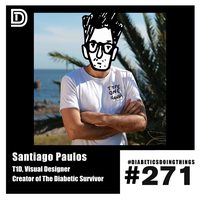
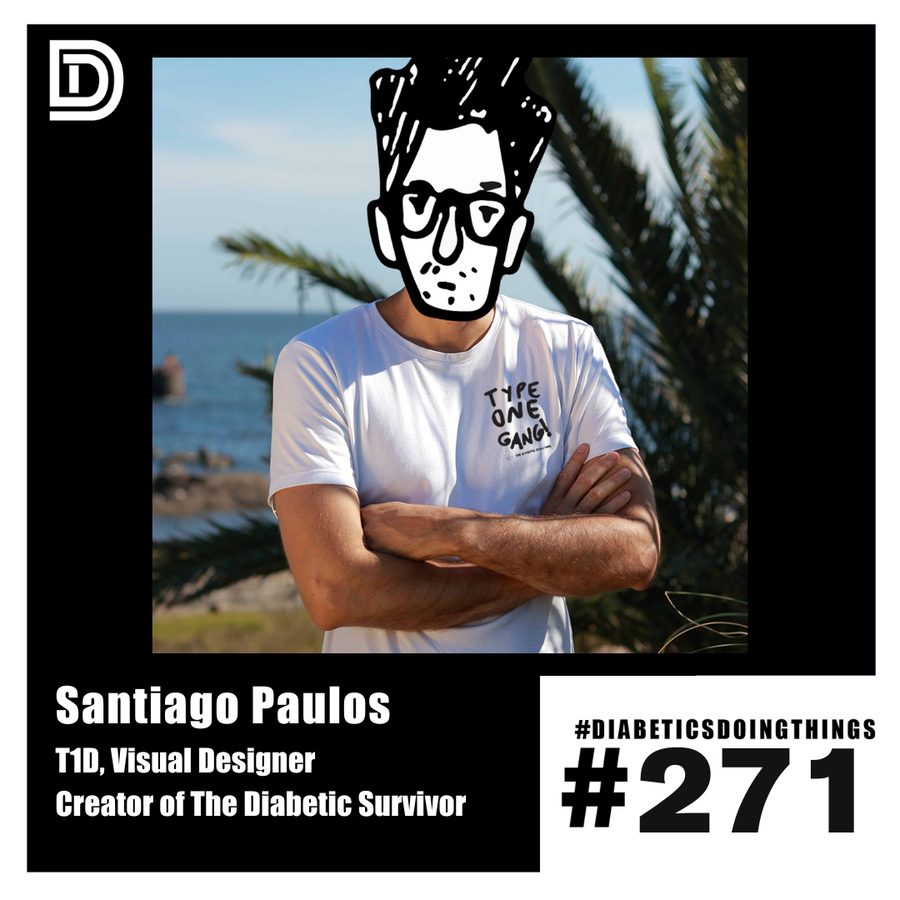
Santiago Paulos, T1D, Visual Designer, Creator of The Diabetic Survivor


Episode summary
Santiago Paulos was diagnosed with type 1 diabetes in Uruguay in 1997, at almost 15, after a scooter crash sent him to the hospital where doctors found his blood sugar dangerously high. Trained as a painter and graphic designer, he later moved to Scotland for a master's in contemporary art and created The Diabetic Survivor, an anonymous Instagram persona that uses cartoon art and humor to talk about diabetes. His design work includes the Insulin for All campaign for T1International, projects with Diabetes UK, diaTribe, DiabetesMine and Medtronic, and his current job building a diabetes app for a healthcare company in Scotland. He and Rob talk about diabetes stigma, becoming a new father to his son Tiago, using a hybrid closed loop system, and noticing how most diabetes content centers Western experiences.
Key takeaways
- Santiago was diagnosed with type 1 diabetes in Uruguay in 1997 after a scooter crash led doctors to find his blood sugar was dangerously high.
- He created the anonymous Instagram persona The Diabetic Survivor because he felt shy about sharing his own image and wanted humor, not his face, to lead the conversation.
- Santiago designed the Insulin for All artwork for T1International and has also worked with Diabetes UK, diaTribe, DiabetesMine and Medtronic.
- Santiago says a hybrid closed loop system helped him feel more in control after his son Tiago was born in December, though lack of sleep still raises his blood sugar.
- Santiago says most diabetes awareness content is built for a Western audience, something he noticed after meeting people from different cultures at the ISPAD conference.
Show notes
This episode is supported by Thrivable. Thrivable’s mission is to create a better future together. They achieve this by making it easy for healthcare companies to include the patient's voice in their decisions so they can create transformative treatments and products for you.
And for listeners of Diabetics Doing Things, Thrivable has multiple opportunities for you to earn money for sharing your story, your insights and your lived experience for companies who produce and design products for people with diabetes. You can participate in online surveys and earn up to $75 per hour and join in-person studies to earn up to $800 per study.
To sign up, just go to thrivable.app/rob and create a profile. It only takes a few minutes. Then, just wait for study invitations, participate in a paid diabetes research study and get compensated for your time.
—————
In this episode of Diabetics Doing Things, Rob, Eritrea, and guest Santiago Paulos share their experiences and stories about living with diabetes from different perspectives. Santiago talks about his journey of being diagnosed with diabetes, his work in the diabetes community, and his recent experience of becoming a new dad. Their conversation delves into topics like encountering the diabetes stigma, using humor to navigate diabetes challenges, and balancing life as a new parent with diabetes. This episode also includes the opening of the Mailbag! If you want to submit your question, email mailbag@diabeticsdoingthings.com.
Topics discussed:
Meeting Santiago and their initial interaction at a diabetes conference in Abu Dhabi.
Santiago's diabetes diagnosis story and how he was diagnosed during a road trip to Argentina.
Santiago's journey in creating the persona of The Diabetic Survivor and his background in art and design.
Collaborations with organizations like T1International and creating designs for diabetes awareness campaigns.
Exploring the intersection of art, design, and diabetes advocacy.
Addressing the diabetes stigma, challenges faced in public settings, and the importance of communication in relationships.
Santiago's experience as a new dad with type 1 diabetes, the impact of diabetes management on parenting, and finding a balance in routine.
Using humor and the "diabetes card" to navigate diabetes-related situations and advocating for self-care in relationships.
Key takeaways:
Navigating the diabetes stigma: Santiago shared experiences of encountering the diabetes stigma, particularly through jokes and comments made in social settings, highlighting the importance of addressing and standing up against such behavior.
Balancing diabetes management with parenting: Santiago's journey as a new dad with diabetes showcases the challenges and adjustments required to manage diabetes effectively while caring for a newborn, emphasizing the need for open communication and support.
Using humor and communication: Humor can be a coping mechanism in dealing with diabetes challenges, and effective communication, both in personal relationships and professional settings, plays a significant role in raising awareness and advocating for diabetes rights.
Awareness and cultural considerations: Being mindful of cultural differences and digital literacy challenges can help in creating inclusive content and messaging that resonates with diverse audiences, fostering a more understanding and supportive environment for people with diabetes.
00:00 Exciting Opportunities for People with Diabetes to Earn Money and Inspiring Stories from International Guests on Diabetics Doing Things Podcast
03:31 Unveiling a Multicultural Friendship and a Diabetic Survivor's Journey
06:34 From Scooter Crash to Diabetic Survivor: A Unique Diagnosis Story and Artistic Journey
16:34 Exploring the Intersection of Diabetes, Art, and Community through Design and Advocacy
26:34 Navigating the Complexities of Working with Diabetes and Stigma in the Industry
36:34 Navigating Age-Related Content Preferences in a Diverse Audience
37:13 Breaking the Stigma: Navigating Diabetes Conversations and Digital Literacy
41:06 Navigating Parenthood and Diabetes: Santiago's Journey
45:57 Diabetic Dads' Secrets and Challenges: A Candid Conversation on Balancing Parenthood and Diabetes
49:40 Inspiring Conversation with a Diabetes Dad
Questions this episode answers
How was Santiago Paulos diagnosed with type 1 diabetes?
Santiago was diagnosed in Uruguay in 1997, just before turning 15, after a scooter crash. Doctors treating the crash found his blood sugar was extremely high, and he learned he had type 1 diabetes during that same hospital stay.
Why does Santiago hide his face as The Diabetic Survivor?
Santiago says he is shy and wanted to separate his personal image from his diabetes content, comparing it to how Daft Punk used helmets so people focused on the work instead of the person.
What is the Insulin for All design Santiago created?
Santiago designed artwork for T1International's Insulin for All campaign after the organization's founder, Elizabeth, reached out and asked him to create assets. He calls it the project with the most impact he has made, because of how widely it has been worn.
How does Santiago manage diabetes as a new parent?
Santiago says a hybrid closed loop system helped him feel more in control before his son Tiago was born in December. He says lack of sleep with a newborn still raises his blood sugar, and that open communication with his partner about low blood sugar episodes has been key.
Full transcript Searchable, with timestamps
Rob Howe: This episode is supported by Thrivable. Thrivable's mission is to create a better future together. They achieve this by making it easy for healthcare companies to include the patient's voice in their decisions so they can create transformative treatments and products for you. And for listeners of Diabetics Doing Things, Thrivable has multiple opportunities for you to earn money for sharing your story, your insights, and your lived experience for companies who produce and design products for people with diabetes. You can participate in online surveys and earn up to $75 per hour and join in-person studies to earn up to $800 per study. To sign up, just go to thrivable.app slash rob and create a profile. It only takes a few minutes. Then just wait for study invitations, participate in a paid diabetes research study, and get compensated for your time. We're always excited to provide people with diabetes opportunities to earn from their lived experience, and this is a great opportunity for you to get paid for your diabetes insights. Sign up today at thrivable.app. That's thrivable, T-H-R-I-V-A-B-L-E.app. You can also check them out on Instagram at GoThrivable. Okay, let's get back to the episode. Welcome back to Diabetics Doing Things, and today we're telling the stories. Wait, wait, wait, wait, wait. You got to do the intro better than that. You got to do the intro better than that. Okay. Sorry. Welcome back to Diabetic Doing Things, where we're telling the amazing stories of people living with diabetes all over the world. And today, our guest comes to us from a place very far away, somewhere in the world. Santiago Paulos, my good friend, my amazing, amazing, amazing co-worker sometimes. I'm so excited to have you. Bienvenido a Diabeticos Haciendo Las Cosas.
Santiago Paulos: Thank you very much. Thank you for having me, Rob, and Eritrea. Pleasure to be here.
Rob Howe: and we're excited to have you go ahead rob now you can be the host yeah i was gonna say like it's a pleasure to have you but also you know the key word that i always want to focus on when we have international guests is from all over the world and i think navigating even just the time zones and booking many of our international guests have encountered those challenges and so thank you for making the time for us this morning our time but obviously in the early evening for you cheers yeah yeah dark in edinburgh and so because i want to be a little spicy usually we start the stories with we start these interviews with how did the person like get diagnosed with diabetes but i i want to skip over diabetes for just a second so we can do one of my favorite things and speak spanish but i want to talk about when me and santiago met so i don't know if you remember santiago do you remember how we met if you remember you tell them
Santiago Paulos: um well my memory is not my best it's not my forte let's put it that way i mean it was definitely
Rob Howe: in abu dhabi wasn't it yeah it was so it already started off sounding like a spy movie but so we met at our at ISPAD which is a diabetes conference that takes place in a sometimes uh i think it's like an arab country because it's a pediatric endocrinology uh conference and that specific year it took place in Abu Dhabi and I went with D-Doc shout out to D-Doc for having me and the people over there and I sat at a table where Santiago was and I think that sometimes when I'm talking really fast I'll drop a word in Spanish here and there you know just like throw some salsa onto my tacos and conversation and I can't remember what it was I said that Santiago turns to me he's like ah in his very cute little Uruguay accent but he's like he just said it so cavalierly and i was like kind of stuff and he was like oh it is mexicana and he's like you're a mexican and i was guessing and i think me and santiago really interact now i do remember and
Santiago Paulos: you're right i think it was quite confused because you shunned quite quickly to you know a very like an american accent to a very mexican accent and then you were speaking arabic as well so uh yeah but yeah that was when we met and this was two years ago
Rob Howe: 2022 yeah time of lives unbelievable yeah September 2022 and now we've done so many things together and we're going to talk about that during the episode because it's kind of why we're here but yeah
Santiago Paulos: yeah
Rob Howe: all right so we we've all been very polite so as far for like we not all of us get to a be a global citizen like like Eritrea and be able to kind of switch in and out languages. But I think it's one of those things where, as I think about family planning on my side is like, oh, okay, yeah, that'd be a really nice thing for someone to be able to speak Spanish, to speak Arabic, to speak some of the other romance languages, because it basically gives you not just a passport, but it gives you a way to connect with people cross-culturally, like in different places. And you can, you know, uncover conversations and relationships like this one, where if that doesn't, if she doesn't speak Spanish or, and you don't hear that, maybe we don't even have this conversation today. So I think it's really interesting, like when you're thinking about global citizenship and like the world is shrinking and, you know, digital, you know, we were talking, Santiago and I, before the recording, like we've followed each other and seen each other's work for years, but we've never met in person. And so, you know, really does kind of give you that, that lens. And so I think that's really exciting. And again, that's one of my sort of never ending to do items is to polish up my foreign languages. So it gives you, you know, the ability to move in and out in different places much easier, but But for the podcast, Santiago, why don't you tell us about your diagnosis story and tell us how you became, and then we're going to kind of get into your story as the diabetic survivor.
Santiago Paulos: Yeah, yeah, absolutely. So I was diagnosed 26 years ago. This was 1997. At the time, I was living in Uruguay, where I was born, actually. And I remember that, actually, I was in a road trip with my parents, my sister, and a friend of mine. And as I said, I was living in Uruguay, but we went to Argentina, which is next to Uruguay. And we went to the south. So this was the first time I saw snow in my life, actually. And at the time, I think I already had the symptoms, but I was in my teenage years, so it was kind of confusing. You know, those years, I was always a bit chaotic anyways. But I remember vividly that I was inside the car. and in a moment in the middle of the of the of the road i say hey please stop i need to i need to eat snow i really i was super thirsty i just went straight to the to the snow and i started eating snow of course i was peeing everywhere usually it's the case and anyways the long story short what happens is that we went back from holidays to uruguay and a relative of mine said, hey, you should go to the hospital. Maybe they will do like a test to you, like a blood sample. They will ask for a blood sample to you. And at that time, this was a tiny town in Uruguay, the blood sample result will take a month. Results to come back to you. And what happened was that actually at that time, I was almost 15 years old. I used to have a scooter, so I was riding around the town in a scooter. I had an accident and I had like a bad crash with a van I think it was and I remember that all the accident was happening the police and they were trying to find my parents they couldn't find my parents because my parents were not at home because they just had received the call from the hospital saying you should take Santiago to the hospital immediately because he has super high blood sugar levels. So what happens is that I went to the hospital because of the crash, and then I was notified that I had diabetes. So I stayed longer in the hospital to, well, to understand how to inject insulin and, well, all the stuff that you both know very well. So yeah, I would say in that sense, it's kind of a funny story now after many years, but it might be not the usual diagnosed
Rob Howe: story. Hey, you know, in the U.S., we call it like a two-for-one. You had a two-for-one hospital admission, you know, got in for the scooter accident, got to stay for the diabetes. Yes. Well, actually, years after, I thought that, you know, maybe the crash was related with my
Santiago Paulos: blood sugar levels because, as you know, I was completely out of control. My reactions, you know, probably slow. Maybe I was having a hype. I had no idea. So, yeah, that's my diagnosis
Rob Howe: story i always remember the crash i've heard the story a bunch of times because we so we've met at other conferences i've hung out a lot and so i hear the story and i always remember the scooter crash and i just think like it's so latino-american parents to be like kid is sick still riding around on a scooter in the town like a motorized vehicle it's just very funny i'm gonna be any parent i don't know but it just really reminds me of like he'll be fine it's fine like it's that i want to
Santiago Paulos: Sorry, by the way, I was not wearing a helmet.
Rob Howe: Yeah, I didn't expect that. That was the problem. I think, too, you mentioned something like it took a month to get the results back from the health system. So in that amount of time, you go through the tests and then you're sort of playing the waiting game. And I immediately thought that, too, when you were talking about your accident. I was like, oh, I wonder if whether it was hyperglycemia or hypoglycemia related incident. We don't know, right? But, you know, knowing what we know about the symptoms now, it's possible. Yeah. Yeah. Yeah. Absolutely. I'm also just lucky because I just think that you're exactly where you're supposed to be all the time. Like really leaning into that this year and you needed to go to the doctor, man. So, so God, so cute there. That's where you went. No, but I've got to work down more than anything. Nobody expects to get diabetes, but I am grateful that you do have it because it's cool. Getting to know you has been really, really cool. I want to keep going, not get too sentimental. Rob, you mentioned that you were going to get into how Santiago became the diabetic survivor. So I want to. I knew about Santiago and who he was, but I didn't know what the man looked like because the diabetic survivor was like this diabetes page that had like graphic design and these really funny, like very meme oriented diabetes jokes. well and you'll also see on the episode the artwork for the episode the photo submission santiago's face is is animated yeah always or like he's holding a towel over him like himself but then he'll like point and be like these are not my feet so like i guess what i want to understand is how did you how did this get started santiago well a separate thing in my life is
Santiago Paulos: quite random actually um so i think in a way i'm a bit shy so that might be part of it to be honest and i know this might sound bad but i'm kind of skeptical about social media and many things so i think i wanted to create something that will remove myself in a way in terms of just my image which might be kind of my alter ego or something like that. But sometimes I like to think about it as Daft Punk, for example, like the music band, that they use the helmets. So you focus more in the music or maybe in the show itself, but not in how they look like, like the face. And I do appreciate many, well, as you, Retrea, well, Rob, as well, you use your image. There's many influencers that they're showing and sharing their experiences. but in my case I really wanted to remove myself from there and also maybe create a space where everybody could be potentially at the end I think that never happened but it is this idea actually of putting like a filter between me as an image and how to communicate and maybe also help to more like a laugh or I wanted this cartoony feeling to it as well so I have not reflected very much about this it just happened to me but i think that that then there's some uh clues there
Rob Howe: yeah for sure maybe you're shy but i think it's great that you use an alter ego for good we all know i'd be mega mind in this bitch i will be so evil i mean an alter ego i'd be a villain i'm super one at that but i just it's interesting it's still like so i i did some stalking of you of course because like like i did to everyone and i noticed that you were like an artist artist like with not like a real artist know what i mean like you've always been an artist but i found like real canvas like art like paintings and like collages and like all this intense Santiago Paulos artwork from like 2014 and 15 and 16 i was like wow like is this part of the diabetic survivor inspiration because that's when you kind of started the diabetic survivor around the same time are you
Eritrea: sure you typed down well my name your picture shows up in the in the gallery i think so my
Santiago Paulos: background is in in in design my ba was in what was known graphic design at that time and then i i did a master's in in in contemporary art specifically in painting actually in contemporary painting and that was the reason why i came to scotland where i live now and going back to to To the previous question, I think that because of that background where when you're an artist, all the time you have to do whatever you're doing. Plus, you have to work a lot of your own image because you have to promote yourself. You have to, as any freelancer, I guess. I think also I wanted to move away from that because I think I didn't want to, I don't know, to feed my ego, if that makes sense. I wanted to stay away with a little bit of that.
Rob Howe: you had mentioned something earlier and sorry to cut you off there but like you mentioned something earlier about like some of the like the downsides of social media as well like giving too much access to you as a person and i'm sort of paraphrasing there but like creating a separation between the art and the community and like the and the vibes from your own personal self you know from your from your space and i think like to me i always am fascinated when i talk to designers because they design their life as well. And they're very intentional, even outside like the way they put their furniture or whatever the case may be. It's like your education and your persona and like so much of your life is designed. And I think like it's really interesting to see how that makes its way into like different media.
Santiago Paulos: Yeah, absolutely. Completely right. Yeah, even I will say that there's like an unconscious curation of things because it's just the way that you were trained, how you see life. It's the lens that you have. Yeah, so that was part of my life. It's not something I do anymore, to be honest, but for many years I was quite into painting, and that was what I did, and I used to go to art fairs, and I used to teach as well, to be a guest tutor in some institutions, and that was my full-time thing. It was later on that I kind of aligned this idea of making images and diabetes. That is something, of course, that I live with. And that will be probably diabetic survival, the consequence. I mean, so, yeah. Thank you for being a stalker, Eritrea.
Rob Howe: Yeah, I think Eritrea's internet sleuthing is always interesting. I was just like, I always knew you were so talented, but then I was like, I saw some of the paintings and maybe I was just like in a very like crybaby phase that week i don't know but i like cheered up at some so like these are so good my friend is so talented and i just think people should see them i don't know that
Santiago Paulos: was when i was young it's not that anymore i think though like let's shifting back to that like
Rob Howe: sharing the experience through the visuals and you know coming through and expressing your own diabetes experience or diabetes perspective through art through visuals when did that when When did that become an outlet for you? Like, I know like creating the persona of the diabetic survivor allows you to maintain that space. But like, how did you, I think I'll back up a little bit as well. I think many projects in the diabetes community like this one, like, like diabetics doing things. Some people do podcasts. Some people like to write. Some people design, you know, they make t-shirts and whatnot, maybe videos or content. Like, how did you start to share your perspective through your art? And what was that like for you?
Santiago Paulos: Yeah, it's a very good question, actually, because I know when was exactly the moment. So at that moment, we were living in London. And I went to an exhibition that was called How Graphic Design Can Save Your Life or something like that. A collection that is called the Wellcome Collection. It's a very interesting collection in London that usually has exhibitions about medicine, design, and art. And the connectivity between those three elements. And I mean, this was a big show, but I remember that one had like different sections. And one of them was a provocation, how to provoke things through design. And I quite relate with that. And I think that there was, you know, when you see this something, suddenly you are exposed to something, could be a film, could be a song, could be a painting. And I can trace back that something changed in that exhibition. Suddenly I clicked. And I would say that after that, I started to do some doodlings about diabetes. But actually the idea of creating, let's say, the Instagram was a bit through my partner. So she saw the drawings I was doing and she said to me, hey, you could do something about it. And that's when I opened the Insta account. And then from there, everything was quite organic, actually. People started reaching out. Maybe it happens to you with diabetes doing things that you get these amazing messages. People say, oh, wow, maybe you don't realize what you have done. And, you know, this really touched me or I have been there. Started getting messages of moms in hospitals with, like, my child has been recently diagnosed. You made my day, you know? And I was kind of in shock, you know, because, of course, I never thought about that. And also, you have to suddenly to go through all these feelings that you had never experienced before. Wow, I kept helping somebody, you know? like be something that to me was i don't know not so important if you know what i mean yeah so i think that from there things started to shape in in the in the place that they are now but it was super super organic and always like a back and forth between the people and the channel so my point here is that was not like a conscious decision or like a plan of how to do it no so was very spontaneous in a way.
Rob Howe: I relate very much to all of what you just shared. I guess I think at the beginning of the podcast, we started this to do 10 episodes. And if any positive feedback came through, I was going to continue to do it. That was kind of my goal or bet with myself. And yeah, I think we talked about some of the downsides of social media earlier, But like one of the positives is that these things can be discovered by people who are looking for connection or looking for inspiration or, you know, just can attach themselves to a similar relatable feeling. I think that's even with some of the podcast clips that we share, the ones that, you know, the most people see and the most people, you know, engage with are ones of just real lived experience and real emotions about living life with diabetes or encountering challenges or, you know, things like what low snacks do you keep around or, you know, sharing stories about people going to, you know, the gym and having to sit, take themselves out of a class and, you know, treat their hypoglycemia. or whatever the case may be, there's an overwhelmingly positive community aspect to that. Because I think what most people want is to just feel seen. And people feel seen in different ways, whether it's podcasts or influencers, like you mentioned, or creators, or in art or in design or even just in writing. And I think that's what's so exciting, I think, about living today, where the world, like we talked about earlier, is smaller, is shrunken. you can find you can sort by diabetes and you can filter by art and you can filter by you know
Santiago Paulos: video yeah and it has grown so much like in the last five years i would say it's unbelievable so it's yes super in that sense social media is great as you said before i mean the sense of community i would say that before doing all this i i think i had met people with diabetes in my life but maybe two or three and now well i even know where it's rare so you can imagine yeah i mean i i think
Rob Howe: that's isn't it interesting how like you know you were at a conference separate from you know you you weren't intending to discover this like you said it just clicked you heard people talking about you know medicine talking about art talking about design and the intersection there and then And you say, oh, that's me. Like, I want to contribute to that. And, you know, now you have, you know, friends globally where, you know, you're able to connect with people from all over the world with diabetes just because you opted in to do that. I think that's something that when I talk about, you know, not everybody's dream looks the same. Not everybody's contribution looks the same. Everybody's different. but being able to opt into your own version of whatever that looks like whether it's advocacy whether it's awareness whether it's art or whatever your contribution is just do it because you never know what'll come back with you to you you may end up even being friends with someone crazy like eritrea so i mean all those things i mean yes but also like i think it's so interesting because so many of our stories are so similar like and what santiago said about how like you You can go through an experience and it kind of changes you forever. It might change the trajectory of your life forever. It's so my vibe. It's so what happened to me when I met Rob Howe. It just happens to creators, I think, is where you stand in an absurd place and you're either influenced by someone. Look at that. You're an influencer, Rob. Or you get it from a conference, but something changes your trajectory. And that's just such a, I don't know. It's just such a human thing. And it's interesting to see other people be in their diabetes career because not only is Santiago my friend, but before he was my friend, he was already like world renowned. Like he's worked with the IDF and all these other diabetes nonprofits to make graphic art. So you heard that one thing at that conference and then you were like, okay, let's turn it into a career. Yeah, I want to talk about that for sure because like, you know, I think I got introduced to you for the first time through the Insulin for All t-shirt. Like you, your design, your insulin for all design is the main insulin for all t-shirt. So like, you know, take us through a like starting to do your, like you said, talking to your partner about doodling diabetes things and sharing them. And then fast forward to, you know, there are people in every continent wearing your design on their t-shirt.
Santiago Paulos: Yeah. Well, thank you for touching on that project because actually I would say it's like the most, yeah, like the best projects that I have ever made in terms of the impact. I mean, of course, I do align with all that campaign. Just to back up what I said before, the reality is that I just got a message from Elizabeth, the founder of T1International, so the angel behind the Insulin for All campaign. And she reached to me and said, hey, would you like to collaborate with us? Can you help us? I like what you do, and can you create some assets for us? And that was literally like the first thing I did in the diabetes community online. That is something that still goes till now. And well, I just decided to apply the design in different merch products, which I sell in my shop and things like that. That, of course, there's no profit behind it. It's just the idea to bring diabetes awareness, no? So a few things actually happened that way. Completely. yeah i mean i don't know if it is like a casuality thing i don't know in english the word but it's just something that just happened no so and and as you said before like the idea of seeing something that you have done in different parts of the world that's quite a nice thing to do especially if it is for a good cause so i would say that that that that was actually the first project indeed was the first one then i did one for for a summer camp in the states which is called chinook I think maybe you know it oh yeah I've heard of it which was quite nice they were doing like a new I think was like a new room to treat the hypos so they wanted like some artworks for the world so it was quite nice to to explore that site it was more like what we can do the resources that we have just hanging things or in walls or these sort of things and then what happened as well that some people from from the industry started to contact me I remember like the first one actually was ever since that they were looking to do some things for their social media. And that experience that actually was the first one was super interesting because it was the first time that they was working with a marketing team. I think they were in New York. And then is where you get, you know, I have seen a little bit of the third sector or the NGOs, how they talk about diabetes and how things are moving forward. but suddenly you're in a completely different framework where you're talking about, it's a business, no? So they're talking about objectives, like the vision of a company that of course they're trying to help people with diabetes, but there's a profit behind. And I found quite enriching this, and I really appreciate that they could have seen both sides and also because I do have diabetes, so you're trying all the time to make the most of it. and try to create something that is really, that works for everybody. So, I mean, something I think important in my profession or my professional career is that I work for a few years for Diabetes UK, which is like the NGO, like the biggest NGO here in the UK. And that was a really eye-opening, you know, to work like an institution of more than 300 people that, I mean, they do research. They have sections there about policymaking, having an impact in society, and suddenly being like a little gear in a massive structure there and how we can work together to make things happen. So, yeah, I think, I mean, there's many other projects. Of course, I have worked with diaTribe, with DiabetesMine. I have worked with Medtronic, more on the commercial side of things.
Eritrea: D-Doc, your favorite.
Santiago Paulos: D-Doc, of course. Then I have some interest about technology. So I have worked with some diabetes apps and these sort of things. I'm afraid some of them, they were startups and they never made it. But that brings me to what I do, my full-time job, which is in a healthcare company here in Scotland, that we do have a diabetes app that works locally here. let's say I mean to sum up I mean I do things related with branding identity and communication but then there are things that are more related with interfaces and user journey and all that stuff but something that I really I find super useful about trying to connect the community to the commercial side of things or I don't know if commercial is the word but let's say they're really developing a product is that for example recently I was in San Francisco in this diaTribe workshop that was around diabetes stigma. And suddenly you take some elements there that could inform maybe the wording or the messaging that you're trying to apply in an app. So everything connects at the end. And I'm a big believer that we need to change things from the inside. So I think that working in the industry and having diabetes is a good match, at least for me. Of course, there's a risk that you can burn out because it's all day. about diabetes and sometimes it's too much but i think i don't know you you can relate with that
Rob Howe: too oh man we we talk about it a lot with creators and because you're right you live with diabetes you're creating content about diabetes and you're working in diabetes it's just it can be overwhelming and we know about yeah like you said internally we understand in the community how burnout manifests itself and it can be really challenging something we don't talk about ever this isn't in the questions this is me leaning in and interrupting but because i've never thought about this before really but we work in diabetes we have diabetes and then we have to have these conversations with people don't have diabetes in the professional space and sometimes those conversations are like awful like they're about complications which is like one of the worst that i hate talking about it or like it's about mortality rates or giving birth or stuff like that like i don't think we ever think about that additional layer of like catastrophicism of diabetes that we just kind of have to like casually navigate through as other people put their stigma and conversations around us even in a space where it's like health care because that still happens all the time does it happen to you or is it just me it's not the other oh that's a tricky one i mean of course that
Santiago Paulos: happened to me um i mean i will reframe the thing for for example something that is happening to me or had happened to me before is that, you know, being in places where everybody has diabetes and we're trying to do a work around diabetes and suddenly there's somebody that has no diabetes. And which is super important, should be people in the teams. It's not like a company about diabetes or people that should, you know, be working, that should have diabetes. That makes sense to me because we really, you know, it should be like a diverse, I don't know, workforce or whatever you want. And also diabetes...
Rob Howe: Yeah, it's not partners with experiences. Yeah, I got you.
Santiago Paulos: Because if not, it's like we are seeing the big picture. Also, diabetes to me is a lot about parents. It's about healthcare professionals. Diabetes is like something that impacts the whole society. So we really need those voices as well. So we need to be careful. When I jump into my, with my advocacy hats, you know, it's this thing, oh even if there's somebody that has no diabetes it's like what what are you doing here no but but i think it's that people are important as well no i think there's there's so much that goes into
Rob Howe: diabetes other than your own personal management like interpersonal relationships like your like you said friends family co-workers and all those things like i think we're something we think about a lot when related to stigma and i want to stay on this for a second is like most people who don't have diabetes, have no interaction with diabetes content, maybe they see a high-level statistic, maybe from the WHO or from the American Diabetes Association here in the US, where it's like one in three people are living with some sort of diabetes. And I saw one today. It was like 90% of people with pre-diabetes don't know that they have it. And so they're seeing these high-level statistics or they're seeing something related to stigma. So it's like a comedian making a diabetes joke or it's a an out-of-date fact or like something from you know an ad from 20 30 years ago and that unfortunately is reinforcing these negative stereotypes and stigmas for people who don't know otherwise so i guess for you when you are thinking of how to how to educate people on stigma or how to how to you how to uh advocate for people with diabetes through your art and design related to stigma like what how do you approach those things um it's yeah i'm just
Santiago Paulos: thinking about this let me think about this because you know something about social media or any of the digital news that we are consuming nowadays is actually we just see the same in again and again because we are in this kind of a vacuum know of whoever we are connected so you're completely right in terms of that. I don't know if a person that is, you will not get any information about diabetes if you don't have diabetes. I completely agree with that. And if not, you will get these like high numbers or whatever that are more like report or things. So I think, I mean, trying to think about what I do in Instagram in particular. So when I'm not working with, when I'm doing things for myself, I'm afraid I do many things that are only understood internally so they're only understood by the community and that could be kind of fun for us but actually will have no impact for somebody that has no diabetes but when I try to to touch things in in a different level let's say let's put an example when we do create things in a visual way or we we do like some messaging or whatever first it will have like a shallow reading level that everybody will understand, but you could fit different layers of information. So things that are more subtle, let's say I do a joke, every thing you can understand because you have diabetes, but then it has like a super layer that could be understood by, I don't know, a mother with a child with diabetes and so on. So I think that's something that sometimes I try to do consciously, but specifically about stigma. And to be honest, I find it quite difficult. I mean, I try to do my best, but sometimes I realize that I, you know, sometimes I might be reinforcing stigma sometimes. You know, I know it sounds terrible, but, you know, all the time trying to check yourself from where you're creating things, because, of course, we are all biased and, you know, or certain things. Well, something quite eye-opening when we met in Ispat with Eritrea was, I mean, I mainly have explored the Western world. So I realized, especially, you know, about stigma, it's a good example, that some things that I thought that applied to me and I was quite open-minded and so on, maybe only applies to the Western world, but maybe not to other cultures. So I think that there's an element of that, that being conscious that we're creating objects, we're creating combs, we're creating images, mainly for the Western world, no? And that's something to bear in mind as well. But I mean, sorry, I'm just thinking. It's just something that maybe something that we need to think more about.
Rob Howe: I'm glad you brought this up, actually, because we had a similar discovery, not necessarily geographically last year, but many of the people. So we started our partnership with North Texas Food Bank in 2022, which we're working to reach food insecure people with diabetes. So people who are living on a fixed income or on Medicare, Medicaid here in the United States. And what we discovered is like most of those people are over the age of 50 and sometimes like a high percentage of those are over the age of 65. And we don't make a ton of content for people who are 65 plus. and yet there's still a lot of people out there who are looking for the same things that we're looking for just in a different format or a different media. So instead of virtual meetups, they want to do in-person meetups. Instead of an internet or a digital experience, they want a print experience. And so that was something for us that, like you said, you have to be careful not to be too hard on yourself because we're small and we don't have unlimited resources. So we can't reach everybody exactly where they are. But it is really interesting to think about the differences in Western world versus Eastern world or developing nations and old versus young.
Santiago Paulos: Yeah, yeah, absolutely. Well, you touched on something quite important, this digital literacy, which is a massive problem. Actually, recently there was an article in The Guardian here in the UK where it was about diabetes care and how the NHS, which is like the health system here, was giving sensors, FreeStyle Libre sensors to the population, but because many people, they don't have a smartphone, they were not having the impact that they should have. So, you know, talking about the stigma, I don't know, maybe I do a joke about, you know, closed-loop systems, that the reality is how many people do have closed-loop systems.
Rob Howe: Although it is exciting because NHS just approved closed-loop systems in the UK.
Santiago Paulos: In England, in particular. In England, right? yeah that's super exciting actually super super ahead of time so yeah i mean going back to what you said i think it's you know it's very sometimes it's very difficult also being conscious about the stigma with without stigmatizing something else as well so it's difficult to fall into that section but i always say that the most important thing is just to be up to date with what is the last conversation for example in terms of language in terms of different realities it's just a process So what is right now will not be right probably in a few years. And also being conscious about the resources and the audience that you have, because you have to speak to the people that are close to you as well, without forgetting of all the...
Rob Howe: I think conscious is the right word. Just being aware and understanding context and the people that you're able to reach now versus the people that we want to reach. And, you know, like you said, being aware of the latest conversation that you've had and, you know, how everyone experiences that differently. I do want to touch because I think it's always interesting for our most of our audience is U.S. based. So, you know, when we encounter guests who were diagnosed in other countries or have lived in various different countries, this is always, I think, really interesting. Do you remember a time in your life where you encountered diabetes stigma or stigma around your diabetes, whether that was like injecting or dosing insulin in public or fielding kind of stigma-based comments or feedback?
Santiago Paulos: So I would say that I realized later in life that I had that, and especially the word jokes. So the word comments, and usually from very close friends, you know, the classic comment on, you know, you're in a, I don't know, in a birthday party and they're like cutting the cake and somebody will do the joke like, oh, Santiago cannot have one because if not, he will die, you know? And I mean, I have these memories of like, you know, me laughing or, you know, saying, yeah, yeah, sure. But then it was like, why I didn't stand up and say, hey, what are you saying? You know, this makes no sense. So I guess that there was a little bit of, you know, internalized stigma in terms of, you know, maybe I thought that was my fault or, you know, why I deserve that comment. And it was not something that was, you know, I was not conscious about it till late, you know, many years after. But I think that has like a residual element that, you know, builds inside you and you just think that it's fine it's fine but actually it's not fine and
Rob Howe: but it's not funny like get a new joke jokes are supposed to be funny this one isn't it's just lazy at this point it's lazy yeah but but they don't know that right like so and i think sometimes it puts us in a weird position to have to say that and you know sometimes i think too we take the comfortable route versus uncomfortable where we're like we can just laugh and move on or you You're sharp and you open the conversation. I'm like, you know, why?
Santiago Paulos: You know, what are you saying? Yeah. I would say in the rest of areas, I have been quite lucky in terms of, you know, my family was always very supportive. In the workplace, I never had any problems. Of course, I had somebody like, you know, watching you when you're injecting in public and these sort of things. But I always have been quite talkative about it. So I always will explain and things like that. I remember once when I was in public in a restaurant, actually, and there was a child, you know, and the child was watching me. And that was a very interesting situation because how you explain, you know, to the mother that the child is in some, you know, you never know exactly which sort of movies have seen the child, you know? Right. If you're like six, seven years old, I don't know. Well, maybe later.
Rob Howe: It's like you have the opportunity to be the first introduction to that child. Yeah.
Santiago Paulos: that's a very positive way of seeing it
Rob Howe: I think I always tell them I'm a robot and they really like that that's usually what I say I'm like a cyborg from Teen Titans you know like that and they're like what so that's usually what I tell kids because I think that it's hilarious I love that we're here though because as we wrap the episode there's something that we have to have to have to talk about we cannot skip over it must let Santiago speak on this it's coming in December yeah Santiago became a dad which might surprise all of you because everyone's always surprised to find out how old he is but I just want to touch a little bit a little no seriously I it's so funny Keisha I'm gonna shout out Keisha here she's like girl why don't you tell me Santiago was so fine I was like ew but people always you know to me they're just like I just thought he was like you know some 30 year old kid like us but actually Santiago's he's a grown-up he's a father and he had a baby in December also I want to clarify being 30 is grown up if you if you're 30 and so you're not grown like we gotta have a conversation thank you Rob I like that comment yeah no if I get married next year I'm a child bride no I'm a child anyways the time you had a real child Santiago had a baby with his partner can I say your baby's name is that okay Santiago sorry say that again Can I say your baby's name?
Santiago Paulos: Yeah, it's called Tiago. Tiago.
Rob Howe: His name is Tiago, which is so cute because it's like a mini. Oh, I love that name. Thanks. But when I saw him, he had been going through the process of his partner being pregnant. And then we've since spoken since she had the baby. And I just wanted to give him a quick moment to talk a little bit about his experience as a new dad with diabetes. Because, oh my God.
Santiago Paulos: Well, hopefully my partner, she will not listen to this. so to be honest I mean having type 1 diabetes and being a dad yeah it's something that it took me a while to to process the idea of to be honest because I well as you know sometimes some days are not very smooth when you have diabetes so I think there was an element of self-doubt about it having said that the child is super healthy and well but to be completely honestly with you I I think there was a shift in changing my mind since I got the hybrid closed loop system earlier last year. No, this year it was. Sorry, last year. So I have been way more active and I have been kind of taking back the control, I guess, in many situations. And that allowed me to think that was doable. of course already happened that i'm changing a nappy and suddenly you know the sensor starts beeping and you're like oh god all this pull around and my sensor you know beeping well what is she doing but i mean i don't know it's just you have to go i think you're forgetting the lack
Rob Howe: because last week when we talked you were like air chat i don't sleep and i was just like
Santiago Paulos: the lack of sleep is is is real and that as you know the lack of sleep impacts the blood sugar levels so i mean that's something that we we really need to think about it and to see how to manage it's definitely also i mean the diet or many things know that the first weeks probably they're difficult to stick to a routine and in my case diabetes and a routine is like a must to cope with many many things but yeah i mean definitely definitely an extra layer but i mean
Rob Howe: we're super happy and i think we will come to do it maybe i always hear like oh like the post care of the mom and the post care of the mom and the mom is the most important i want to make sure our listeners understand not taking the shine away from your partner shout out hayley she's amazing but i do wonder how do you support self with diabetes and partner and baby and do job and man build house and build fire and provide you know what I mean yeah go out and hunt yeah yeah
Santiago Paulos: I think in my case I'm very lucky in terms that you know this is a very I think communication is key in a relationship and we had a very open conversation like before having a child saying hey you know I do like the idea but and you're aware that you know I have diabetes and there are some days that if I go low and you know maybe I'm two hours completely off but this doesn't mean that they want to help but sometimes i come first because you know if i'm not okay i will not be able to help i will be able to supporting you or you know even the classic situation where you know you're preparing breakfast and maybe she's hungry but it's like hey i already injected my my insulin sorry i have to do before you i'm not rude it's just this is the way so i think yeah it's is that maybe in another interview you can make these questions to her and
Rob Howe: honestly i would i would love that like how to and i may have to do that down the line of like interviewing diabetes like diabetic dads like what excuses have your have your diabetic partner
Santiago Paulos: used while they're to get out of changing a diaper or something many many for sure oh we all have yeah
Rob Howe: I like that. We won't tell Haley that. We'll keep that all. That'll be our diabetes secret that a hypo can get you out of a diaper change every now and then.
Santiago Paulos: It's more like using diabetes. That's how you say in English, like a wingman.
Rob Howe: I just call it the diabetes card. I'm like, I'm playing the diabetes card today. Here you go. That's the ace in the hole. Can I tell you guys a secret? Me, Rob, I rarely use the diabetes card. I think I've used it twice in my life.
Eritrea: Really? Why?
Rob Howe: I don't know. I'm working on it. I just, I try to be as prepared as possible. But I think I remember the first time I took myself out of a meeting was in 2019. And it was because I had my tubing, my insulin had like crystallized in the tubing. And so I hadn't been getting insulin for maybe like eight hours. And my blood sugar wouldn't come down. I had been, you know, in the 300s like for hours and hours. And I was like feeling terrible. I almost went to the hospital because I had ketones. But I remember like I stepped up in the middle of the meeting. I was like, I have to leave, guys. I'm sorry I'm going to take care of my diabetes. So that was like one of the first times I ever played that card. And that was only like four years ago. So I'm still learning. Wow. I haven't done it that many times, but the last time I did it, I cried. It was awful. I was just like, I was like in a work meeting and my blood sugar was low and been low for a while. And I was like, had started sobbing to myself because I am a baby, but I thought I was muted and I wasn't muted. I was like. That's a low brain with the mute button. I don't know though. I think like to your point though, Eritrea, like other people around me were really afraid because I never do that. So they're like, oh my God, what's happening? And so I think like it helps to play the card like a few times just to get people comfortable with the idea that even though you're playing it, you're still okay. So I don't know, I'm learning, I'm learning.
Santiago Paulos: Just make the most of it. And I think also because if not, in my experience is that we, people with diabetes, sometimes we're very good actors. So it's not that you're not going low. You're going low, but you're there and, you know, I'm still fine. I'm still fine. I'm still fine. I'm still fine. A little bit more, a little bit more. But then you just cry.
Rob Howe: Yeah. And it's like, you don't want, you know, for me, I identify with that. It's like, oh, yeah, I'm still having these issues. You're just not noticing it. I'm dealing with it either in the background or popping gummy bears in the middle of a call. So you don't see me.
Santiago Paulos: Totally.
Rob Howe: We must all suffer with me. You must all know I am suffering. Anyways. Well, Santiago, I first of all, I just want to thank you for making time for us today. I know as a new dad and, you know, being overseas as well, like making the time work. I really appreciate you coming on and sharing your perspective. This is amazing. We'll definitely have you back and maybe use you as like a co-host for like the diabetes dad work. Maybe we'll figure that out. But this was really cool. And it's lovely to meet you face to face after many years of seeing your work online and looking forward to continuing to connect. And hopefully, I don't know if you're going to be at any of the European events this year, but I will be in Florence later in March for ATTD. So if you're going to be there, maybe I will see you. But if not, I look forward to the first time that we can cross paths. That would be great.
Santiago Paulos: I'm afraid that I'm not going to Florence, but I'm sure next time it will be great to meet you. And yeah, guys, thank you. Thank you very much for having me. That's.
Rob Howe: We will tag your accounts as well in the show notes just to make sure if our listeners aren't already aware of you that they can find your work. And thank you for being an awesome example for people with diabetes everywhere.
Santiago Paulos: Thank you very much.
About Santiago
Santiago Paulos is a Uruguay-born visual designer and painter based in Scotland, living with type 1 diabetes since 1997. He created The Diabetic Survivor, an anonymous diabetes art and design project on Instagram, and has designed campaigns for T1International, Diabetes UK, diaTribe, DiabetesMine and Medtronic.