

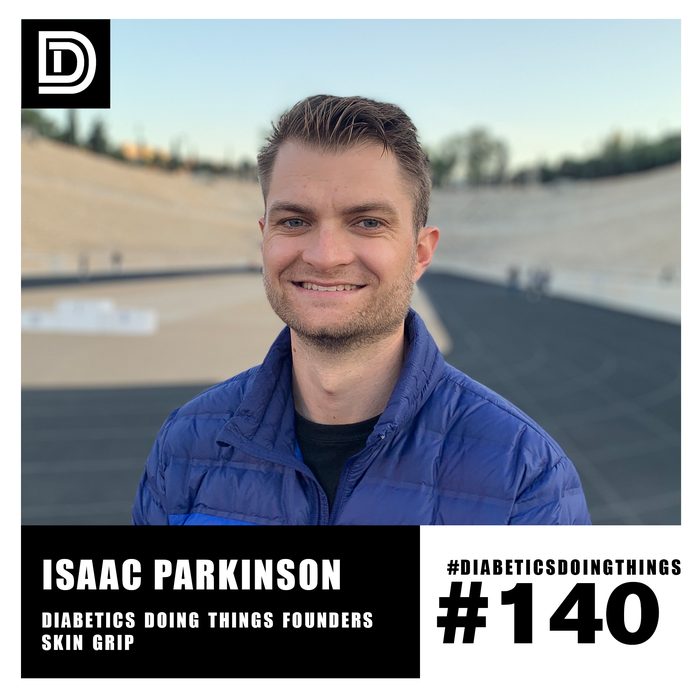
Diabetics Doing Things FOUNDERS with Isaac Parkinson CEO of Skin Grip
Episode summary
Isaac Parkinson does not have diabetes himself, but his younger brother was diagnosed with type 1 in 2013 at age 14, after weeks of weight loss, constant thirst and exhaustion led to an ER visit with a blood sugar around 800. Watching his brother adjust, including struggling to keep devices on during sports and swimming, led Isaac and his family to start Skin Grip, an adhesive patch company built to help type 1 diabetics stay active without worrying about their CGM or pump falling off. He talks about building the brand around customer feedback rather than marketing gimmicks, the emotional messages customers send about regaining confidence in the water or on a bike, and the company's monthly "All for One" charity donation day.
Key takeaways
- Isaac's younger brother was diagnosed with type 1 diabetes in 2013 at 14, after a month of worsening symptoms and a blood sugar reading around 800 at diagnosis.
- Skin Grip grew out of watching his brother's CGM and pump adhesives fail during sports, swimming and other active moments.
- Isaac says the company's messaging shifted after customers described feelings, not product specs, like a mom who cried on the beach because she finally felt safe swimming with her kids.
- Skin Grip donates all website profits to a type 1 diabetes charity on the 11th of each month, a program they call All for One, picking the charity through an Instagram poll.
- Isaac says Skin Grip plans to add more colors, including additional skin tone options, while staying away from flashy patterns.
Show notes
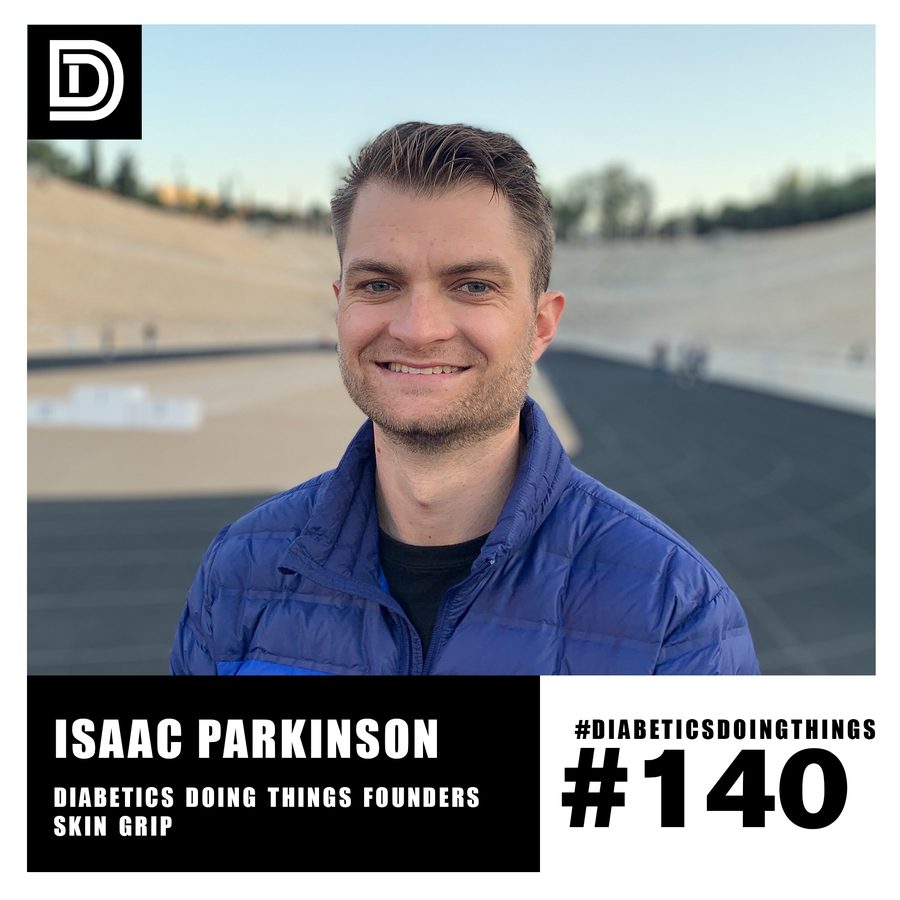
Continuing our amazing FOUNDERS series, I’d like to introduce you to Isaac Parkinson, CEO of Skin Grip (@SkinGrip on Instagram).
Many people featured on this podcast live with Type 1 Diabetes, but occasionally, we feature guests who live with other types of Diabetes as well as people who are creating companies who make an impact for people with Diabetes, and Isaac for sure meets that criteria.
Diabetes came into Isaac’s life when his younger brother was Diagnosed as T1D in 2013, like many of us Isaac had a surface level awareness of Diabetes, but once it came into his family’s life it became much more real to him.
The idea for Skin Grip came from Isaac and his family seeing their younger brother struggle to keep his Diabetes devices on while he was playing sports, swimming and living an active life. They thought there was an opportunity to improve life with Diabetes for people who live active lifestyles. But Isaac is firm in his stance that “Skin Grip is about improving the lifestyles of people with Diabetes” and if that’s all they do, they’re doing a good job. I wear Skin Grip, it works great to cover my sensor and keep it safe even while I’m playing basketball, running or just living my generally crazy life.
Be sure to give Skin Grip a follow and if you’re looking for a more durable patch for your CGM or pump site, give them a try! Not only is it a great product, but it’s made by great people as well.
This episode is sponsored by Real Good Foods! Be sure to check out their new Breakfast Sandwiches, made with cauliflower cheesy buns with only 2g net carbs! They’re packed with protein (18g) and have no gluten or grains. Available in sausage egg & cheese and bacon egg & cheese flavors and they’re ready within seconds. Order them online or find a store near you today!
Questions this episode answers
Who founded Skin Grip and do they have diabetes?
Skin Grip was founded by Isaac Parkinson, who does not have diabetes. His younger brother was diagnosed with type 1 diabetes in 2013, which led the family to start the company.
What does Skin Grip's All for One program do?
On the 11th of every month, Skin Grip donates all of its website sales profits to a type 1 diabetes charity, chosen through an Instagram poll with their followers. Isaac says they have donated to JDRF and T1International so far.
What problem does Skin Grip solve for people with diabetes?
Isaac says Skin Grip makes adhesive patches to help CGMs and insulin pumps stay securely in place during sports, swimming, and other active lifestyles, so people don't lose readings or have to replace devices.
How did Isaac's brother's diagnosis happen?
Isaac says his brother, then 14, lost a lot of weight, was constantly thirsty, and was urinating frequently for about a month before the family took him to the doctor, where his blood sugar was around 800 and he was sent to the ER in Salt Lake City.
Full transcript Searchable, with timestamps
Rob Howe: Welcome back to another episode of Diabetics Doing Things. I don't know if I stutter during that or not. I'm not going to go back and record it. It's Diabetics Doing Things. It's me. It's Rob. Hope you're doing great, ladies and gentlemen. We have an awesome interview for you today. Most of the people on this podcast have type 1 diabetes. There are a small amount who have type 2 diabetes, but we're getting that number up. In today's episode, the guest does not have diabetes at all, but he's the founder of a company that is specifically for people with diabetes. And we've worked with him. They've sponsored this podcast before. It's called SkinGrip, theskingrip.com. And the reason I call out that Isaac doesn't have type 1 diabetes is that it's important for us to see the people who do not live with diabetes and the impact that they're having by thinking about people with diabetes. Diabetes became a big part of Isaac's life when his younger brother was diagnosed. and he and his family have made big adjustments ever since. But the biggest one has been this company, which has been their passion and labor of love and is ultimately geared towards people with diabetes to try to solve a problem for them and to make their life a little bit easier. So I'd really enjoy if you would support Skin Grip and Isaac and his family and their awesome business at theskingrip.com. You've all got sensors to tape. You've got activities coming up. It's starting to get warmer in some parts of the country. It's February right now where I am in Dallas. But maybe in the future it's the summer. Keep those devices. Keep those sensors in place, waterproof and otherwise. With the skingrip.com skin grip tape, I wear it. It's black. It keeps me moving. It keeps me locked down when I play basketball and when I jump in the ice cold tub. And I love it. I really use it, and it's part of my life with diabetes. So for sure, listen to this episode. Let me know what you think about Isaac's story. And if you want to support them, visit theskingrip.com. All right. Well, we got one more ad coming your way. And then enjoy this interview with Isaac Parkinson. Thank you for continuing to listen to Diabetics Doing Things. We've been doing this for four years now, thanks to listeners like you and the support of amazing sponsors like Real Good Foods. If you're involved in the diabetes online community, then you have for sure heard of real good foods and their low-carb pizza and enchiladas, which are delicious. But they've really outdone themselves this time with their new breakfast sandwiches. It's just like your typical breakfast sandwich, sausage, egg, and cheese, or bacon, egg, and cheese, except the biscuit is made out of cauliflower and the whole sandwich has only two net carbs. That's two net carbs. And if you pop it in the microwave, it's ready in seconds. I'm not a big breakfast guy because I don't like having to deal with big blood sugar spikes for a high carb breakfast. But when I'm really craving a breakfast sandwich, I grab a Real Good Food sandwich out of the freezer and hit the road without having to worry about a big spike in my blood sugar. Check out realgoodfoods.com to find them in a store near you or use code ROBHOW, that's me, to get a discount when you order the sandwiches online. I'm a big fan of brands who continue to support creators with diabetes and there has been no bigger supporter of me and my friends in the diabetes community than Real Good Foods. If you haven't checked them out yet, give them a shot and let me know what you think. And now let's get back to the episode. Welcome back to another episode of Diabetics Doing Things. We're telling the amazing stories of people with diabetes from all across the world. And my very special guest today, Mr. Isaac Parkinson, who does not live with type 1, but runs a type 1 focused company, Skin Grip. I'm sure you guys have seen it. It's all over social media and they've been a sponsor of this podcast. Isaac, welcome to the show, man. Hey Rob, good to be here. Yeah, really excited to have you. As you know, we're doing a founder series here on the pod and so it was a no-brainer when I was like, okay, I got to get Isaac on the show. We got to talk about people who are creating products in the diabetes space for people with diabetes, thinking about people with diabetes. And for me, like a big part of that as an entrepreneur is like there's got to be some sort of personal attachment. There's got to be something that really fuels you behind the scenes. Otherwise, you know, when you're running a business, there's just a lot of things to cover. It requires a lot of energy and there's something behind the scenes that's got to keep you going. So I'm really excited to kind of dig in with that with you today.
Isaac Parkinson: Yeah, me too. Let's do it.
Rob Howe: So let's talk a little bit about your experience in your life with type 1. Uh, when was the first time you remember having a conversation or, or diabetes being involved in your life?
Isaac Parkinson: Yeah, that's a great question. I mean, you know, for much of my life, I had obviously known about diabetes. Um, and like most people, I didn't know the difference between type 1 and type 2. Um, and so it didn't really have a, you know, there wasn't a big effect, uh, in my life from diabetes until my brother, my younger brother, was diagnosed with type 1. And that was back in 2013. So for me, that was a turning point where, you know, I learned, okay, what is diabetes? What is the difference between type 1 and type 2? And it really opened my eyes to a lot of things,
Rob Howe: you know, concerning the disease. So, you know, going back just really almost seven years now, we're in 2020 at the time of recording brother, you know, younger brother goes in, you know, what was the response and like, how did you and your family kind of have those conversations of like, Oh, what, what's going on with, with our little brother and how can we, you know,
Isaac Parkinson: be there to support him and what does this mean for us? Yeah. So, you know, at the time he was, 14 years old. And obviously, we didn't really know the signs. Because no one in our immediate family, or even, you know, my extended family at the time, had type 1. So, you know, we began to see that he was losing a ton of weight. He was just always chugging water. And he's going to the bathroom five or six times a night. And so, you know, there was these things going on. We didn't really understand what it was, you know, my mom thought it was a urinary tract infection or something like that or you know some weird form of the flu um and over time you know over about a month a month's time uh things just kept getting worse and um you know he he was still participating in outdoor activities and things like that we live in utah so you know we do a lot of camping hiking uh you know mountain biking those types of things um and he just wasn't you know able to even really get up in the morning some days. He was just so tired. Um, and so we, you know, not knowing what was going on, it was, it was kind of scary. And so when we finally went to the doctor, I think his blood sugar was around 800. Um, and they immediately, you know, sent him to, um, you know, the emergency wing of the hospital in Salt Lake, uh, where they started, you know, working on him. And that's where we really started to figure out, you know, what type 1 diabetes was and how one could live with the disease. So, you know, beginning from there, you know, over the course of the next few years, you know, we started, you know, just watching him and learned how to help him manage it so that, you know, his life was a little bit easier. And like I said, it was just really eye-opening to see, you know, all the decisions he had to make in the day because of, you know this new diagnosis and the type 1 diabetes um and so for us um it changed the way we treated him you know obviously we wanted to um you know let him do his best to control it on his own but at the same time we had to learn how we could be there for him to help him out
Rob Howe: and i think it's a big adjustment and a lot of times on this podcast specifically we don't necessarily talk about the effects that the diabetes has on a family and just like the general education and the general day to day. And a lot of times it's like fear and lack of understanding. And, you know, how do we, what do we do from here? Because a lot of those times on this pod, especially it comes from the first person perspective. So my, my relationship with diabetes and the things that I go through, but I think it's fair to say like type 1 diabetes affects the entire family, no matter if you're, you know, 13 years old or 21 years old or, uh, or 25 or, or two years old, whatever the case, you know, everybody in your immediate surroundings
Isaac Parkinson: are affected. Oh, for sure. And, you know, when it all happened, you know, it was really scary for all of us because we didn't know, you know, how serious it really was, right? Like when you don't grow up, you know, exactly what type 1 diabetes is and, you know, some of the things that come along with the disease, it's hard to know right off the bat, you know, how that's going to change a person's life. And so, you know, being on, you know, this end of being his brother, it worried me for him because obviously he's my younger brother. I love him. I want what's best for him. And I didn't want him to have to, you know, um, completely, you know, change, you know, his lifestyle in terms of the things he did, um, like play sports and other things like that, because, you know, obviously I want him to be able to do what he loved. Um, and it was really scary for all of us because, um, you know, right after that happened, the, the doctor said, okay, you know, know, the whole family should go get checked for diabetes. We don't know if this is something, you know, in the genetics or whatnot. And so we all went in and, you know, got checked. And we were just something new for us, right? We didn't know exactly how serious it would be. And over time, you know, we've learned how to how to how to live with it in our family. And honestly, it's been a huge blessing in many ways. And it's hard to say that about diseases, but it's really brought a lot of perspective to our family.
Rob Howe: well i think it you know i mirror a lot of that experience i mean i would not have this podcast uh without diabetes and i think i say that with a caveat like if if i'm sure as you guys would as well if we could give it back we absolutely would but in some ways it gives your life a lot of purpose and like perspective and um you know gives you something to focus on and um you know for you I think now shifting kind of gears to, to present day, um, it's shifted a lot of the ways that, you know, your, your day to day goes about if I'm not mistaken, right. With skin grip.
Isaac Parkinson: Yeah, for sure. I mean, you know, skin grip is, is, is, you know, obviously a company that's, that was started to help diabetics. And, you know, our mission truly is to help diabetics feel fearless because we believe that when diabetics feel fearless, they can accomplish the extraordinary. And, you know, obviously, you know, at SkinGrip, we create adhesive patches and it's something that if diabetes wasn't around anymore, you know, if there was a cure, we'd obviously be out of business. And, you know, people sometimes ask me that, you know, what if there's a cure or this or that? And I say, well, great, like that would be awesome. You know, honestly, we would love for there to be a cure and we'd love to go out of business if that was the case. That's, you know, that's totally fine. But, you know, while there, you know, still is the challenge of type 1 diabetes, we want to make sure that whatever we do, we're helping those that are affected by it.
Rob Howe: Oh, totally agree. Yeah, there's nothing more I'd love than to go to a conference full of a bunch of people that used to have diabetes. Oh, yeah. That'd be sweet. So let's talk a little bit about the early days. You mentioned that your little brother was active and interested in sports and athletics, and obviously as a 13-year-old, being active is just part of the gig. Where did the idea for Skin Grip come from?
Isaac Parkinson: Yeah, sure. Skin Grip wasn't really an idea for us until a few years down the road after he was diagnosed. it wasn't until I was in college that my brother actually started using a CGM and an insulin pump and so you know once he switched over to using those obviously his life was a little bit easier with those awesome devices but he still struggled with a few things you know he had a CGM coming off from time to time and you know just getting accurate readings was kind of a challenge and so you know it we we definitely weren't the first adhesive patch on the market and you know we always tell people that like we'll admit that for sure we saw there were other adhesive patches out there um a lot of them you know just were being sold on you know amazon and things like that but um whenever we tried them we just we just weren't impressed really with the quality um of what you know we were getting so it was as simple as really just seeing the need for a better product and also realizing that a lot of companies, you know, they're making products, but maybe they weren't connecting with their consumers, right? We really wanted to create something that was not only going to work well and, you know, be awesome performance-wise as well as just, you know, a simple product. We wanted something that, you know, we could create a conversation around to really inspire and motivate other type 1 diabetics.
Rob Howe: Yeah, and I think, you know, you talked about being fearless and, you know, the impact that I can have on someone's life with diabetes. And the confidence, I think, is a big part of that, too. Because, you know, we've got a lot of devices attached to us. The confidence of knowing, like, hey, if I go jump off this, like, I don't know why I'm thinking of this, like, summer camp, big blob in a lake, that my CGM is not going to go flying off, you know. or that if I go swimming on vacation that I don't have to worry about the, you know, medical adhesive that's not very strong coming off and then having to change it and, you know, just all the frustrations that come with that. So you guys are obviously providing a product, but it also gives like a peace of mind, confidence and a lifestyle component.
Isaac Parkinson: Yeah, for sure. I mean, I think there's a lot of brands in the world, right, that push lifestyle. and we're definitely you know a brand that also you know promises a better lifestyle and you know we don't do that for gimmicks um or for show you know like we truly are um built you know for the lifestyle of type 1 diabetics that's our whole purpose i mean um obviously you know as a business you have to focus on you know so many different things you know revenue things like that, you know, new customers. But I mean, for us, we feel that if we're continually improving, you know, someone's lifestyle, and they're writing into us telling us about, you know, this new lifestyle they're living because of our product, we feel like we're doing a good job. And so, I mean, it's super important for us to, to, you know, use that sort of messaging, when we're talking, you know, whether that's on social media or emails, we want to help people realize that this product, you know, while it will protect the CGM and things like that, what it's really doing is it's going to give you that peace of mind, right, to make your life a little bit easier. Because we all know that, you know, type 1 diabetics already have to make so many decisions every day. They have so many things to worry about. And so we just want to be able to help them worry a little bit less and to just, you know, have a little bit more freedom to do what they love without all the stress of, you know, worrying about the CGM coming flying off when you're, you know, wakeboarding or whatever it is you might be doing depending on where you live.
Rob Howe: And I love that perspective. I think that's really easy for a person with diabetes to understand. Talk about how you guys and you specifically, you know, honed in on that, like that feeling that you were trying to create or that confidence you were trying to inspire with someone with diabetes, because it's not something that just occurs to you one day, right? Like you had to have some experience like seeing your brother and like looking in the community and saying, hey,
Isaac Parkinson: this is an opportunity for us. Yeah, for sure. And, you know, it's really, it's really kind of a lesson on, on business in general, you know, what I'm going to share. So obviously, you know, when we first started, we didn't use this type of messaging per se. We just, we just launched a product, right? We launched a product that we knew was going to work better for a type 1 diabetic. And, you know, when we first launched, we didn't have this big plan of, oh yeah, we're gonna, to launch on all these channels and we're going to make a worldwide type 1 diabetes brand. We didn't think about that. We just launched a product really with the hope that we could just help people out. And as we started getting feedback, we really learned that one, we had a product that was working because some of the feedback we got was just amazing. And then two, we started seeing comments and messages and we had DMs just kind of telling telling us on, like people were telling us how they felt about the product. And when they told us how they felt, they didn't say, you know, oh, it's the stickiest patch I've ever seen. Or it's, you know, it lasts so long. They usually said like, hey, like I cried because I went in the ocean with my kids for the first time. Or, um, I just felt so fearless as I was able to, you know, go mountain biking and the sweat didn't, you know, the sweat and all the activity didn't, you know, rip my CGM out. And so, um, we, we kind of caught on to that, you know, how people were feeling about the product and we knew we needed to really kind of push that a little bit more and, and help people understand the feeling that they're going to get from, um, using the product. And like I said, it's, it's kind of less on business because when you listen to your customer and you hear their needs, you hear the words that they're using, the feelings that they're feeling, you can understand how to better position your product. And obviously that increases sales, which is great. But the thing is, when you have a product that truly can help people, if you don't use the right words, then they're never going to find it or they're never going to understand what it does for them. And so we want to make sure that the words we use are words that resonate with our audience, with, you know, the type 1 diabetics. And we want to make sure that they understand how it helps
Rob Howe: them. And I think that's a really important thing to focus on, right? And like, you know, being careful of the words that you use and being considerate. And I think you've approached and really built the brand around, you know, being very considerate, very thoughtful about, you know, what you're really providing. Do you remember maybe the first, like, you know, email that you guys got back, you mentioned, you know, you know, hearing from customers or Instagram message or something that was shared with you guys that you thought, wow, like this is really making impact. This is why we're doing what we're doing. And would you mind like sharing those things,
Isaac Parkinson: you know, that that particular message? Yeah, I mean, we've had so many now that it's hard for me to keep track of them. But you know, every single time we do receive a message like that, it just fills my soul honestly because um i mean building a business isn't easy and you know there's a lot of risks involved um but when we receive a message like that that just you know outlines how the person feels and how it's made their life better it just keeps us you know going keeps the fire burning um one in particular is one i kind of already mentioned but i can go more into detail with it. Um, there was, there was a mom who, um, she, she, she was pretty active and, um, she had only had type 1 diabetes for, um, a number of years, but she lived in California and, um, her, her two boys liked to go out in the ocean, you know, and, uh, surf to, you know, all these other things, you know, boogie board, things like that, you know, the things you do in the in the waves in California sure um and she wrote she wrote this email to us that was uh it was it was a pretty long email and it just said you know for the last few years you know since I've had type 1 diabetes I've just been really nervous to do a lot of things I've been nervous to um you know be as active as I used to be I've been I've been nervous to go in the in the ocean with my kids because you know the the Dexcom that I wear I'm worried to lose it you know and Um, and you know, those things are costly and whatnot. And it's also scary, you know, when, when you don't, um, you know, if you lose those types of things and you, and you, and you can't manage your, you know, blood sugar as well. She just was nervous for, you know, a variety of reasons, but she mentioned that she bought our product, she put it on and for the last week she had been going in the ocean with her sons, um, that the product worked well and, and that, you know, after she had been using it in the ocean, she, she told us of a actual time when, um, you know, she went back to the beach, she was sitting there on the sand, watching her kids. And she just, she just started bawling. She started crying because, um, she didn't feel like she could have done that before. Um, and she felt like she was, um, somewhat free, you know, from, from those fears that she once had. And so that was something that, you know, was, was mind blowing to me. I couldn't believe that we created such a special experience in someone's life. And honestly, I started tearing up just from reading the email. And so that particular message is one that has always stuck with me. It's one that I have in a special place on my phone for when I just need to remember why we're doing what we're doing.
Rob Howe: And that's so, so important to have that, where you know where that is, right? Because like you said, running a business isn't easy. and it takes a lot of emotion and there's ups and downs and you know just day to day can be very tough and you know there's just a lot of things that are not always super enjoyable when you know you have that in your back pocket you know that that opportunity is around the corner uh that's super super cool um oh yeah and i you know and i'm sure as we were kind of talking about before we got on the phone or before we got on the pod rather you you have been like influenced and and super encouraged by what you guys have found in the community at large. Um, talk a little bit about that. Just like, not just the, the big mountaintop moments, but what you've learned as, you know, being part of the type 1 community. Yeah. I mean, it's been amazing being a part of
Isaac Parkinson: this community, you know, even though, you know, I personally, um, I mean, I don't talk a lot about it, you know, on my own social media, my personal social media, I don't really talk about it much. um but you know just being a part of the you know the skin grip team um i've learned so much um from this community because there's so many good people out there um like i i kind of mentioned before you know i've been a i've been a part of a lot of communities well you know whether that's you know because of personal interests or or you know other things you know college and stuff like that. And I've honestly never, I've never been a part of a community that's just so motivating and inspiring, like the type 1 diabetic community. You know, I've been able to talk to really, you know, awesome people, you know, such as yourself, and a lot of other, you know, a lot of other people who are, you know, quote, influential, you know, in the type 1 diabetic community and ones who maybe aren't quote influential, you know. And from all of those interactions, I've just learned that, you know, type 1 diabetes, you know, as tough as it is, you know, especially with that first diagnosis, it's not something that has to hold you back. And I've just been so inspired by the people I've been able to talk to and the things I've been able to see them do because, you know, I don't live with type 1 diabetes. And, and sometimes I wonder, you know, if I, if I had type 1 diabetes, would I be doing the same things that some of these people are doing or, you know, would I be speaking out about these issues as, as much as, as they are and, you know, things like that. And I've just been so inspired to see how people come together, um, and they support each other. Um, you know, I've, I've seen people, you know, posting about, you know, extra insulin they have and how they can help. And, and it's just so inspiring to see that, you know, people who don't even know each other can come together in the comments, wherever it is, and they can, you know, really show the best of humanity.
Rob Howe: It is really cool. And I think it's not something that you know about until you get to experience it. You know, you can talk about, you know, hey, there's this place where, you know, people with diabetes are celebrated, and it's really positive. And there's a lot of great information being share, but until you experience it, it's, you know, it's just sort of, it doesn't really become concrete. Uh, do you remember like, as you were learning about the community and kind of coming in, uh, you know, coming into your own as, uh, as skin grip, like what were those, what were those moments like when you're like, Hey, you know, like I think that we were really part of a big
Isaac Parkinson: community here yeah i mean um you know early on we we started reaching out to um certain influencers just to just to really ask them to use our product we didn't you know we've we never started off by saying hey would you post about us and you know begging for posts necessarily we we always wanted to just give away our product for free and just you know we always ask people hey just try it out and tell us what you think um so we started doing that you know andrew sly fox is one that i know you've interviewed and yeah he was one that we sent stuff to and you know he you know we were just cool with him we just said hey like you're a cool dude like you know try this out like what do you think um and he gave us some really good feedback and we've had other people who gave us some really good feedback too you know i could i could if i I had named all of them. We'd be here, you know, all day. But, I mean, really, they just gave us good feedback about the product and about the packaging, the messaging. And so we really knew that we were on to something because it struck a chord with so many people. And we had a lot of people start reaching out saying, hey, I talked to so-and-so. They said that you have to try SkinGrip, you know. And we found that, you know, our product was, you know, beginning to kind of just move across the community because of word of mouth. And so for us, we wanted to double down on that. And we said, hey, like, you know, we're not trying to be salesy. We're not running ads on Instagram or anything like that. We just are, you know, having real conversations with people and saying, hey, try this out. Like, does it make your life better? If it does, like, you know, let us know how it made your life better. or if it doesn't, you know, tell us why, you know, we, we really, uh, just try to listen to everyone and, um, and we make our decisions based on, you know, what we hear from, from people on Instagram.
Rob Howe: Well, and I think there's nothing quite like real feedback that's like, like you said, not from like a sales or like a customer, like a focus group, but it's like, Hey, like, I really like this and it would be cool if it did this or, you know, I used it and I was doing this. And, You mentioned Andrew, just a cool guy, just a guy that really cares and wants to give back. I think that's something that when I think of type 1 entrepreneurs, obviously as an entrepreneur myself, it has a special place in my heart. But also to see people who are putting it all on the line to develop either products or services or things for people with diabetes, that's something that um you know i never thought would be something that i'd be involved in and just to see how many cool creators there are out there how many passionate entrepreneurs there are to make things that make a better life even just a little bit uh just like a little bit less worrying for people with diabetes such a cool thing for sure yeah totally agree so as you guys are you know kind of you've you've been out in the market for a little while you're finding this momentum, you're hearing positive stories, you know, you're making an impact. What's, what's next for you guys? Uh, you know, what do you want to continue to keep doing? How can, uh, you know, how can we continue to support, you know, you and skin grip and the story behind it?
Isaac Parkinson: Yeah. So, you know, we've always been focused on making simple products, um, that perform well and, you know, help people live fearlessly. Um, obviously type 1 diabetics live fearlessly, fearlessly. Um, one thing we don't ever really want to do, um, is, you know, get into, you know, making, um, you know, adhesive patches that have, you know, fancy patterns or designs and are, um, really, you know, flamboyant, um, just in design and stuff like that. We already know that there's, there's great companies out there who do that. Um, you know, there's a lot of great adhesive patch companies that do a lot of cool designs and things like that. But we always try to stay true to who we are. And that's just simplicity. Because our number one focus is, you know, if you can, if you can simplify, you know, your life, you can live a better life in a way. And so, you know, for us, obviously, we have people telling us all the time, hey, do more colors, you know, do this or that. And we will be launching a few more colors we know that you know a lot of the kids out there who use our product are really keen on some of those brighter colors and some of those fun colors and so we are we are launching a few more colors really soon we also have a few more skin tone colors we're going to be releasing we want to be really inclusive when it comes to skin tones. And, you know, for us, we're just going to focus on products that will make type 1 diabetic slides just a little bit easier. So, you know, we have a few things in the works and we're super excited about that. But overall, you know, when it comes down to it, we want to make sure that we're also giving back to the community in a positive way. And so we've started a new thing where we donate actually all of our website sales to a type 1 diabetes charity every 11th day of each month. So we call it All for One. It's all with two ones for 11, all for one, which for us means we're giving all of our website profits to a type 1 diabetes charity. And so we've had a lot of success with that. We've seen a lot of people ordering on our website every 11th day of the month to support that. And we just want to make sure we're giving back in a positive way. We've so far donated to JDRF, T1 International, and some other diabetes charities. And we're doing different ones every single month. So however we can give back is what's important for us. And also just telling stories of type 1 diabetics. A few months ago, we released a video that kind of shed some light on some of the false things that people think about diabetes, such as type 1 diabetics being lazy or diabetes being limiting and things like that. We had a lot of good feedback about that video. It's become one of our brand anchor videos. And so we want to make more content that dispels some of these falsehoods about type 1 diabetes, but also spreads the message of empowerment and motivation to type 1 diabetics all around the world.
Rob Howe: I remember seeing that video. Man, it was, A, the production on it was super great. I think it was just really a scroll-stopping moment where somebody like me who sees a lot of diabetes content, it still stood out kind of head and shoulders above everything that I had seen at that particular time. And, yeah, it was just a really eye-opening. And I think for people who don't live with diabetes or not as involved in the community, I think it was a moment like, hey, this is really what's going on, and this is who we are, and this is what we stand for. I'll include it in the show notes just so that everybody can see it if they haven't seen it already. So, yeah, go ahead and check out that video that will be in the show notes. But I really love also, and I think I'm going to try to post this on the 11th, the next 11th that I can, so that we can try to drum up as much, you know, sales for you guys on those days that go back to those diabetes nonprofits because it's a really cool idea, you know, with the all for one, you know, tying in with the two ones and the all. So I'm a big fan of companies that are trying to give back. And it's a challenge, as you know. Diabetes is expensive and there's a lot of fundraising that goes on and there's a lot of just costs that go into the day-to-day management. So for you guys to give back as a company on those days, that's really inspiring. And thanks for doing that.
Isaac Parkinson: Yeah, I mean, we really started doing that because we wanted to feel like you know we were giving back in some way um you know there's a lot of companies out there who will do you know a percentage of proceeds um to a certain charity or you know buy one give one type deal and um you know we just wanted to do something that was a little more unique to us um and so you know the all for one you know kind of started from that and uh you know we tell everyone like we're not we're not taking you know we're not making money on that day um all that money is going straight to whatever charity that really you know our our followers or our customers choose and so anyone that's listening you know if there's a charity that you would like for us to donate to please you know you can dm us on instagram you can email us at contact at the skingrip.com or just you know send us a message and let us know that you want us to donate to a certain charity because usually what we'll do is every, every, you know, ninth or 10th of the month, we'll usually do an Instagram poll and we'll say, hey, like we're thinking about these two charities, which ones should we donate to this month? And we honestly just choose whatever one, you know, you guys tell us to. So we're going to, we're really excited to keep doing that. And we'll be looking for other ways as well to support other charities and other groups that are related to
Rob Howe: type 1 diabetes. It's awesome, man. And I, uh, you and I were talking before the pod about, you know, you feeling a little bit, maybe self-conscious of being a person that doesn't have diabetes and coming on the pod. Uh, but I just want to kill you, man, you, you crushed it. Uh, and cause you're doing it for the right reasons, right? You're, you have the right perspective and the right context. And, uh, I just wanted to give you a big pat on the back because, uh, you know, if we all as people with diabetes have advocates like you, family, friends, people who are leading companies, who are thinking about things in the way that we think about them, we're going to be better off. So, you know, definitely want to support you guys as much as possible. Yeah. And yeah, I don't, I don't say, I don't want to say that just to like blow smoke or whatever. I, yeah, I mean that. And that's a, you got, you don't have diabetes, but you're held to a higher standard because you care about people with diabetes and you've really taken the time to, you know, to learn as much as you can. And I just, I'm glad to be able to work with companies like
Isaac Parkinson: you. I really appreciate that, you know, and yeah, I mean, I was a little bit nervous coming on. I've always been nervous to talk about, you know, much about what I do just because I don't, I don't want people to see me as, you know, I started the face of SkinGrip. We do, we do actually hire other type 1 diabetics. And so, you know, we're working at trying to show more of our, just our small company culture. I mean, we're really just, you know, really small family owned business. Um, but I, I mean, I'm intimidated by you guys, you guys are the real life superheroes to me. And so seeing what, you know, all of you were doing, uh, sometimes honestly, I feel inadequate just cause, um, I mean, there are so many, uh, strong and smart and amazing people that are part of this community. And, uh, I just hope that, um, you know, I can do my best to, to, uh, you know, fight for, for this cause and, um, you know, really just be an advocate of those with type 1 diabetes.
Rob Howe: Well, you're doing it the right way, my friend. And, uh, you know, for those who want to learn more about, uh, about skin grip, I believe you guys are at Skin Grip on, uh, the URL is the skin grip.com. If I'm not mistaken, that's right. Yeah, that's right. And, uh, on, on Instagram, you guys are skin grip. Yeah. Perfect. Yeah. So I'll include all those links in the show notes and, uh, Isaac, man, I, you know, you and I got to know each other, you know, just via email over the last couple of months, but man, you totally blew me away today. You told you crushed this interview. I'm just glad that you were able to get the time and, uh, and come on and share your story and your vision for the company. And I'm just, uh, I'm just glad to
Isaac Parkinson: know you. Yeah. So happy to be here. And it's, it's been a pleasure talking to you, Rob.
Rob Howe: thanks again for listening please follow us on instagram check out our sponsor real good foods we're diabetics doing things on all the major platforms and we also are available on spotify so if you prefer spotify or your subscriber check it out i definitely have listened to more on spotify in the recent years they've got a lot of great podcasts and it's just super easy to shuffle from music to podcasts and back and forth leave us a review if you have a chance and tell a friend with diabetes about this podcast. That's the best endorsement and the best support that you can provide. Thanks so much and we'll see you next time.
About Isaac
Isaac Parkinson is the CEO and co-founder of Skin Grip, an adhesive patch company for people with diabetes, started with his family after his younger brother was diagnosed with type 1 diabetes in 2013.