

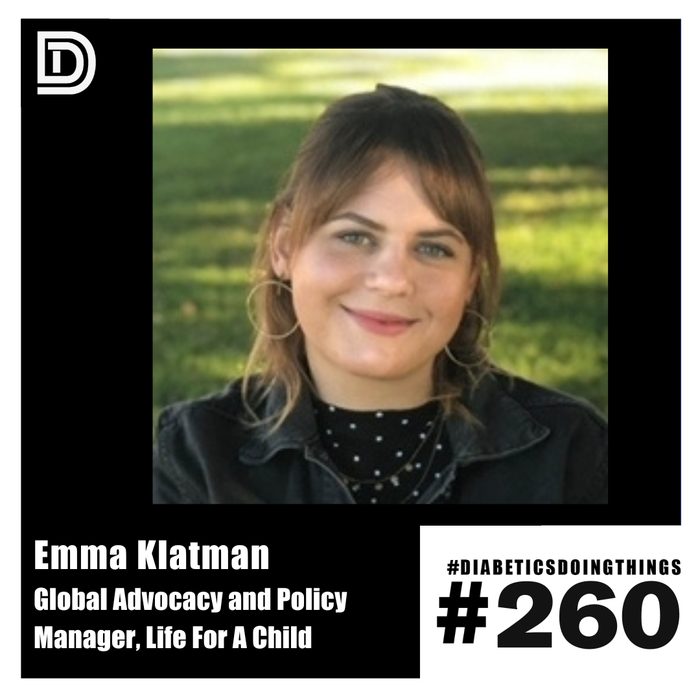
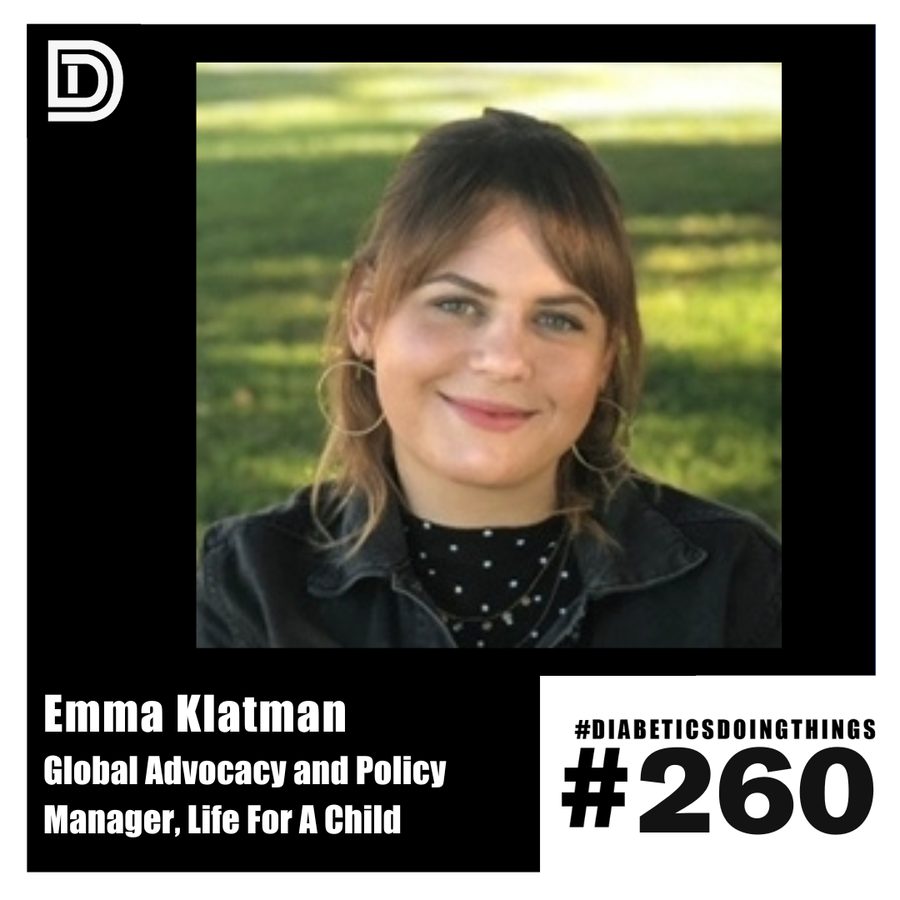
Emma Klatman, Global Advocacy and Policy Manager, Life of a Child

Episode summary
Emma Klatman, who has lived with type 1 diabetes since age seven, works as Global Advocacy and Policy Manager for Life for a Child, an organization supporting young people with diabetes in low and middle income countries. She and Rob discuss why type 1 diabetes is not the same experience everywhere, how advocacy priorities differ between wealthy and under-resourced countries, and how test strips can cost a family more than insulin in places like Burkina Faso. Emma describes stepping away from advocacy and later returning to it, the discomfort of being the only patient in a room full of decision makers, and her problem with toxic positivity in diabetes messaging. She also talks about Life for a Child's Change Maker Projects and building new advocates in Africa and Latin America.
Key takeaways
- Emma says type 1 diabetes is not "the great equalizer" because access to care depends heavily on where a person lives.
- Emma cites a 2012 Life for a Child study showing two test strips a day cost one family in Burkina Faso roughly 327% of their annual income.
- Emma was diagnosed with type 1 diabetes at age seven and later became a National Youth Advocate for the American Diabetes Association as a teenager.
- Emma says Life for a Child recently extended support from age 25 to age 30 in low-income countries, with help from Eli Lilly and Direct Relief.
- Emma says she avoids toxic positivity in advocacy because telling a patient in a strict doctor-patient culture to "stand up for your rights" can put them in an unsafe position.
Show notes
Emma Klatman, who has T1D herself, and is Global Advocacy and Policy Manager for Life of a Child, joins the pod.
She and Rob discuss:
Her work with Life of a Child
Global advocacy
The difference between advocacy focuses in the west vs. in other parts of the world
There is no single organization doing all of the work
Type 1 Diabetes is not equal everywhere
The different rungs on the advocacy ladder
The cost of diabetes management varies by the country’s infrastructure
Technology and the gaps between the haves and the have-nots
Having diabetes and becoming a policy manager
Getting more comfortable advocating for yourself and for others
Being uncomfortable being the “token patient” voice
The resilience and problem-solving skills that people with diabetes have
Questions this episode answers
What is Life for a Child?
Life for a Child, managed out of Diabetes Australia, provides diabetes supplies and care to young people in low and middle income countries. Emma says that as of late 2022 it was supporting around 45,000 young people in about 40 countries, with a goal of reaching 150,000 by 2030.
Why is type 1 diabetes harder to manage in some countries than others?
Emma says the cost and availability of basic supplies like test strips and insulin depend on a country's infrastructure and income level. In some low-income countries, test strips are proportionally more expensive than insulin, the opposite of the pattern in the US.
What are Life for a Child's Change Maker Projects?
Change Maker Projects is a Life for a Child initiative that launched about a month before this episode. It gives six people affected by type 1 diabetes in Latin America and Africa funding, a mentor, and networking support to run community advocacy initiatives.
What does Emma Klatman mean by toxic positivity in diabetes advocacy?
Emma says telling patients to simply stand up for themselves or assume they can do anything they want ignores real barriers, especially in cultures where doctors hold strict authority. She says advocacy works better when it meets patients where they are.
Full transcript Searchable, with timestamps
Rob Howe: Hello and welcome back to another episode of Diabetics Doing Things. We are telling the amazing stories of people with diabetes from all over the world. And today, all over the world is, I think, a really key term because we are talking with Emma Klatman. And Emma, you are in the UK. You're from Los Angeles and you work for an organization, Life for a Child, which is based in Australia. So you live a global life, to say the least. Welcome to the show.
Emma Klatman: Thank you so much, Rob. Thank you for having me on the show. I've been admiring the show from afar for quite some time, so it's wonderful to bring the global perspective onto the show.
Rob Howe: Well, I'm excited to dig into that with you today because I think early on, I think maybe one of the first internet social media advocacy challenge is not the right word, but like campaign would be the right word that I was invited to and Diabetics Doing Things was invited to is in like 2018, we got invited to the Spare Rose campaign. And that was to, you know, I think it's still going on. It's the Spare Rose on Valentine's Day in favor of a donation for Life for a Child, which I think we're going to talk about is one of the more creative patient advocacy organizations who kind of comes with these really out of the box solutions in places where there really isn't a lot of diabetes innovation, education, or advocacy, like kind of are forgotten. And I think in the West, we talk a lot about insulin affordability and patient advocacy, going to the doctor and, you know, and making sure you advocate for yourself with your employer and these types of things, which are very important and critical issues. But when you're talking about just getting access to test strips or just insulin in general, without having to, you know, walk or hitchhike 40 miles outside of your town or something in in West Africa, for example. These types of things we don't always think about because they're not as, you know, as close to our day-to-day life here in the U.S.
Emma Klatman: Yeah. Just on the Sparrow's side of things, Sparrow's is an incredible community-led initiative that had supported life for a child for a significant amount of time. But When the Ukraine war broke out, they shifted focus and started fundraising for insulin for life, which we at Life for a Child have a very strong relationship with. And when it comes to, I don't want to use the word solve, but when it comes to utterly inadequate provision of very basic diabetes care in low and middle income countries, there is no one global group. There is no one even local institution that can solve everything. And that's why, you know, when Sparrow shifted to insulin for life, you know, we were, of course, you know, saddened to lose out on the community awareness raising and of course fundraising, but Insulin for Life is, you know, a phenomenal, phenomenal group. And it's the ecosystem of, you know, global networks that devote their time to increasing access to the basic components of diabetes care. That collaborative approach is really, is really key and crucial.
Rob Howe: It is because I think there's so many hurdles and barriers and regulatory and, you know, even, you know, in the U.S., simple things like shipping insulin. And, you know, during the pandemic, I know that there were challenges as well with making sure that with Insulin for Life, like that donations could be cleaned adequately and were, you know, didn't sit too long and in the wrong condition. So anyway, lots of lots of hurdles to get through to get patients what they need. And like you said, there is no one single governing body that can distribute those things. It really is a network of community members.
Emma Klatman: And I wanted to, sorry to interrupt, but I just wanted to pick up on one thing you said earlier about, you know, when the COVID-19 pandemic was as proliferative as it was and in the height of everything. I think I'm not sure if it was the head of the WHO who said that COVID-19 is sort of the great equalizer or maybe non-communicable diseases are the great equalizer that unite us, you know, no matter where you live. And I think there's merit in saying that. But at the same time, I do not think that type 1 diabetes is the great equalizer. I think it can be within, you know, certain environments and contexts. You know, I'm sure you and I, you know, have a lot of common ground and relate to a lot of the same things. But, you know, having type 1 diabetes in Los Angeles, you know, and of course taking into account like, you know, different, different, you know, socioeconomic, you know, conditions. But having type 1 diabetes in, you know, Los Angeles is not the same thing as having type 1 diabetes in Accra, Ghana, or, you know, so many other places. And I think that, you know, when you look at the numbers just of how many people have type 1 diabetes globally, you know, the large majority of folks are living in those low income settings in low and middle income countries. So I think that, you know, we kind of want to rethink a little bit that whole great equalizer perspective. Yet at the same time, there, I think, are different, you know, there are different rungs to that advocacy ladder and there are different rungs to, you know, advocating for yourself within the clinic. And I do believe there is commonality there, but it's about, you know, what existing capacity, you know, is at the starting point in the first place.
Rob Howe: I'm glad you brought up this point. And I do want to talk about your life with type 1 diabetes as well. So we will get there. I promise, listeners, we will get there. But from that perspective of type 1 diabetes not being the great equalizer and it being very different for a person in Los Angeles or in a developed city in the West versus, I think you said Ghana. We also have talked about Eritrea herself is very passionate about Eritrea, the country, and making sure that we see people there as well, because in third world or emerging nations that are war torn or just do not have the infrastructure, there are people with type 1 diabetes there. You know, I often think about, you know, when I'm, you know, I just do thought exercises thinking and acknowledging that there are people with type 1 diabetes in places like North Korea, where we don't really have visibility into what their life is like. And I want to layer that on top of what we know and have discussed a lot of in this podcast, calling type 1 diabetes the disease with too many inputs and acknowledging location, socioeconomic status, government as some of those inputs. And it's different than just, you know, GDP per capita or whatever the case may be. It is, you know, truly, you know, what infrastructure does my location where I was born, you know, those of us in the West really don't acknowledge very often, I don't think that we won the genetic lottery in terms of where we were born at a particular time. And so I just want to acknowledge that as well as that, like, there's so many other inputs that even though we see a host of, you know, 185 or so inputs in the West, that there are more that we just take for granted on a day-to-day basis,
Emma Klatman: this basis simply from infrastructure. And like that brings up another angle to this, which are the social determinants of health, of course. And just when you're speaking about this, a past International Diabetes Federation president, Jean-Claude Mbanya from Cameroon, he said that accidents of geography and like, you know, like you were alluding to, they are indeed accidents or it is kind of an exercise of a lottery, but accidents of geography should not determine whether someone with diabetes lives or dies. I would say that that disturbing, awful, avoidable situation is lessening today. It's not like how it was 10 years ago. Things are getting better. Deaths from misdiagnoses or a lack of diagnoses, that is narrowing. Education is growing, you know, around public awareness and DKA prevention. So I think things are getting better from a survival perspective, but it's about, you know, life for a child's vision and mission is around no child should die from diabetes. And while, you know, that is a destination that we are getting closer and closer towards, I think, you know, the next kind of frontier is, you know, children become adults. Of course, that's not life for a child's, you know, part of life for a child's mission. We are focused on children and adolescents and young people under the age of 30 in low-income countries. But I think the next frontier really is, you know, how are we addressing all of these advances in glucose monitoring and ensuring that that gulf and sort of that two-track system, unfortunately, between high-income settings and lower-income settings, how are we working towards, you know, making sure that gap isn't going like that and instead narrowing that gap more so. Just a few, you know, when I first started at Life for a Child, one of my first research projects was on scoping the global market for meters and strips, because I know in the U.S., access to insulin is the more expensive component of care, comparing that to, you know, access to your traditional meters and test strips. But in low-income settings, ironically, it's sort of the inverse. And meters and strips are just, you know, utterly cost prohibitive. You know, I could dig out some figures, but in 2012, Life for a Child did a study on the financial impacts of type 1 diabetes management. And I think two test strips a day in, You know, I think it was in Burkina Faso, it was like 327% of a family's, you know, annual income. It might not be exactly that amount.
Rob Howe: I remember reading a similar study about Ethiopia, and it was like the cost of diabetes management was 50% of household annual income, and that was one test strip a week, like an extremely low quality of care.
Emma Klatman: Exactly. And we haven't yet solved globally since the marking of the 100-year discovery of insulin. You know, there's been a lot more momentum, and I'll give credit to the, you know, global health community on the advancements that have been made in terms of setting the global health agenda when it comes to advancing, you know, provision of diabetes care in these, you know, invulnerable populations, which are the majority of populations if you think about it. but test strips not so much of a priority and so one of those early papers that i wrote was on you know global access to meters and strips and at the time the pervasiveness of cgm provision and access to cgms like it was a completely different time and now you know jump to 2023 That's now standard of care. But at the time when we wrote the paper, we had a line in there that said, we're not worried about the sustainability of, you know, folks being able to access meters and strips because type 2 diabetes will kind of always provide a safety net. But as we see, you know, CGMs being used more and more widely within the sort of holistic diabetes population and in the wider, you know, general population as well. It is one of those things that keeps me up at night worrying about, you know, technological phase outs and how can we really, you know, ensure that people with diabetes in these settings continue to have access to not just insulin, but test strips and all of the other things that, you know, keep them afloat from day to day and not just surviving.
Rob Howe: Well, that I think speaks directly to that gap between haves and have nots that you were talking about earlier. Even just a personal anecdote, I wear a CGM that no longer requires daily calibrations. And so my test strip usage has dropped off compared to pre-CGM is, you know, I use one test strip a week compared to 10 a day sometimes. And so that multiplied over time is a significant decrease. side you know i feel maybe one prescription of test strips now per year compared to you know 12 every year or so and so then i start to extrapolate from that on the market implications and so you know in in the u.s we just do everything is a business so we think of it that way but the market cap of test strip companies has dwindled significantly because of the rise of cgm and on On the have side, you might say, okay, well, that's just the creative destruction of the economy as we know it. That's innovation. That means that we're moving forward. But on the opposite end of that spectrum, for people who've never had adequate test strips and don't have access to the cost or the money to get a CGM or even a cell phone that would need to link to make it usable, those people sort of get left in the wake. And I think when we think about health equity, something that we've learned at Diabetics Doing Things in particular over the past year and a half is that health equity starts with awareness and information and then moves into, like you said, there's fewer people dying because of misdiagnosis. that's because of information share and top level awareness. But that's just the first step. The next step is, okay, well, what is the access question to the standard of care that we're very comfortable with here in the West? And we sort of take for granted of eight to 10 test trips a day, CGM every two weeks or 10 days and, you know, pumps and, you know, smart insulin pens and like the very top end of the technological spectrum. Whereas our brothers and sisters in Burkina Faso and Sri Lanka are still very much on Lispro and syringes and maybe a test strip.
Emma Klatman: yes i think perspective is i mean just kind of changing changing track a little bit um perspective is kind of you know from i think actually up until recently a lot of people that i work with globally didn't maybe even realize that i had type 1 diabetes because i wasn't having just a smart 25 years of living with it because I think I kept it, you know, I, I kept it maybe under wraps or I was very professional about it. I'm not really sure what the terminology is for
Rob Howe: that one, but I think, you know, I don't, I don't want to interrupt you, but I, I identify very much with that. Um, most people I interact with that don't, that aren't, you know, my Instagram community or, you know, my close friends, like they, they would have no idea that I have diabetes, even people that I play basketball with on every Saturday and my insulin pump is always on me and my CGM patch is on me. I think, you know, they, they don't know that. And I, and I think being a professional, you know, professional diabetes decorum where, you know, I don't know. I want to dig into that because I think it's interesting. Like my first 10 years with diabetes, I wanted, the only thing I really wanted people to know is that I was going to take care of it. And I think that, yes, Hey, I have, I have this thing, but it doesn't have me. I'm going to, you know, whatever we need me to do, I'm going to be able to, to meet the needs for that. And I think it wasn't until this podcast where I kind of raised my hand and said, Hey, you know, I am a person with diabetes and, and, you know, I want to share that part of myself that more people started hey hey like I didn't even know that any of this was happening this is really interesting and so yeah I I want to dig into that because you are your life is in advocacy your life is is in awareness and you are actively advocating for people with diabetes all the time but that manifests itself for you in different ways I think like this is so
Emma Klatman: multifaceted and I've actually never like really publicly talked about this with anyone, let alone a stranger you, which hopefully one day I can call a friend. But I think for me, you know, when I started out with Life for a Child, I came to the role having just completed a master's in health policy reform. And I think I felt really scared. And I felt this fear that this first really serious job of mine wasn't based in merit. And it was just because like, oh, she has diabetes. We need that value add. And I don't think that was a real external voice. I think that was just an internal voice coming from myself, just to give a little bit of background. So I was diagnosed when I was seven. I started advocacy very early on in my life. And, you know, like advocacy has a bajillion different meanings. I think that's what makes advocacy so honestly beautiful. But I started like a lot of public speaking advocacy, like poster child advocacy. At a young age, I had a doctor, Dr. Francine Kotzman, who was. Oh, I know Fran. I know Fran. Everyone knows Fran. You know, she was just so utterly connected. And I was a very like fiery, vivacious, kind of snarky little seven year old with diabetes. and I like it was my greatest dream to like be an actress one day that was never going to work out for me but I think she saw that I had this um like I like to be on the stage and I like to convince people of things and I was very gobby like I like to talk a lot and I think she saw in me that I could do something with that skill or characteristic of mine. And eventually I became the National Use Advocate for the American Diabetes Association. And rest in peace to Senator Dianne Feinstein, who passed away. But I was just looking at a photo on my phone, you know, sitting outside her office in Washington, D.C., and I was doing a lot of speaking to politicians trying to increase, you know, funding for at the time, you know, the big thing was around funding for a cure. And I did that type of advocacy probably, you know, throughout high school. And then I went away and, you know, went to college, did a little bit of work and, you know, pursued this master's. And I really just pulled out hard from the whole diabetes advocacy stuff. It really wasn't of interest to me anymore. I honestly felt like I just kind of washed my hands clean a bit. And so when the, you know, I became very interested in global health and policy from that perspective. And when I realized there was, you know, an intersection between diabetes policy and global health, you know, I jumped at it. I didn't come at my role in life for a child as this sort of like advocacy angle and advocate that I am now. I very much feel like I'm like returning to my younger self. Okay, I've learned a lot more. I'm, you know, a bit more pragmatic and strategic and I've just experienced some more life, you know, as you do getting into your 30s. But I feel really good coming back to that, you know, younger advocacy self and the kind of Emma advocate that existed in the interim. You know, I think she was just learning her place. And, you know, when I joined Life for a Child, you know, engagement of those with lived experience was not super common. I think, you know, from my perspective, that was something that I saw more in the U.S. That's only becoming more and more common kind of in global access. And that's something that I've been pretty unapologetic about in terms of not just inviting or involving the lived experience as a sort of window dressing exercise, But to keep, you know, people with lived experience at the forefront of the decision making process, not just, you know, placing them at the beginning of this sentence or as a period or exclamation mark at a global stakeholder meeting, but actually meaningfully engaging them. And I think, you know, I've really advocated for, you know, real people to be represented in those meetings, not just someone like me who's, yeah, I have a good advantage. But I'm very privileged, you know. And so I think I've done quite a bit there. And I've also, and this is something I'm still working at, is, you know, getting health care professionals that I work with. to really empower the people that they care for. And that is a really hard process.
Rob Howe: I love this topic because what comes up for me recently is we're in this age of patient empowerment. And I think we're sort of in globally this empowerment of the individual. You see it in other areas as well, sports, commerce, business. you know individual rights and with patients i think it's so important because like you said in the u.s we we i think take it for granted a little bit that like you know patients are more involved but like you said globally especially on issues of policy health care providers are and researchers are are leading the way but there isn't necessarily that person with lived experience there. And if they are, they're someone like me or you. And, you know, I think it's funny, I identify with younger Emma being like a poster child for, hey, you know, diabetes, you can do whatever you want with diabetes. You can, you know, it doesn't have to stop your dreams or whatever the case may be. And I think as I've gotten older as well, you know, being more careful with my language of making sure that that doesn't exclude people who are more disabled by their life with diabetes and who have been stopped at times by things and who don't have the same privileges that I have. And I think that inclusive language and that sort of has really changed how we do things around here. And I'm sad Eritrea isn't here to add to this because I think she was a big part of it as well is making sure that our good vibes don't exclude people who don't feel that same way. And on the other side, I think I was at a board meeting for, I'll say it, I was at a JDRF board meeting a few weeks ago, and I was the only patient in the room. And I felt really uncomfortable. Very rarely do I feel uncomfortable in a big room full of people, especially around diabetes. But it occurred to me that the decisions being made on behalf of patients are happening with or without us in the room. And at first I felt uncomfortable. And as I started to think through it, I'm also in my 30s. I'm going through, it sounds like the same thing that you are of like just learning and growing and getting older and like learning from a lot of life experience. And I was able to kind I grow through in the 30 minutes processing these feelings and say, okay, well, if these decisions are happening anyway, I have asked to be here. I need to live with and become more comfortable with the fact that this is why I'm here. It feels uncomfortable because if I wasn't here, no one would feel uncomfortable. And now, okay, well, as a patient, how do I get more people through here? Because I think a common feeling for patients at, specifically in the nonprofit world around fundraising, is that they feel like the most important people at the fundraiser are the people who are giving all the money. And, you know, we kind of, some of us get paraded around and are amazing stories and pull heartstrings and, you know, help people donate to the orgs. But what I want to encourage people who are in those situations, who are patients and feel like they're uncomfortable or feel like they're maybe not in the right place. I would say that you are in the right place, that we still are very early into this. And since those decisions are being made with or without us, shouldn't we do our best to get as many of us in those rooms as we can? and over time more of us will be there and therefore our voices will become more unified and we'll be able to get some of these issues that people who don't live with diabetes will
Emma Klatman: never really understand or may just forget. Yeah I just resonate a lot with what you said and you know like I was saying earlier I'm not sure if this was being recorded but But, you know, it's only recently that I also have these feelings of discomfort. And they're really uncomfortable to sit with. And I know that this is a tall order. And sometimes when you're like flooded with emotion during, you know, really, you know, these uncomfortable moments where you feel like you're the token voice or the only one. and you know you hear something and you scratch your head and you go is that really you know the way that we're talking about people who live this day to day I know it's a tall order and you know I have been trying to do it a little bit more but voice that discomfort I think voice that discomfort like to the room that you're in because I think there's no this is this is going to be I'm going to talk about positivity a little bit more after I finish this point, but at the risk of sounding overly positive, I think there's no shortage of goodwill amongst like the global funding network for type 1 diabetes. Those that I work with, stakeholders, funders, they're some of the like most empathetic people that I know and real problem solvers. And I think that a lot of times people who don't live it day to day don't, you know, can over, they can miss points and they can forget certain things. And I think I'd like to think that all of these wonderful, you know, stakeholders and funders would appreciate, you know, the honesty. I'm not sure everybody would agree with me on that, but I have been trying to do that more. It's scary. It does make, you know, does give a little cortisol dump for me that my glucose levels don't thank me for later. But I'm just trying to, in this kind of new era of my diabetes advocacy, just like go forward as fearlessly as possible. Like be, you know, the old phrase, be afraid and do it anyway. Just check my fear at the door. I'm always going to be scared about something, but deep down I know what I'm standing up for is the right thing. And I can go to sleep at night knowing that I've tried that day. But on the whole, like not being overly, you know, optimistic about or painting advocacy as just like this cheery, wonderful, you can do anything you want to kind of narrative. You know, obviously that's important and young people should be told and encouraged to do, you know, what they want and go for things in life because young people are like sponges. You tell them, you know, You tell them you believe in them and they believe in themselves. So I think that that's important. But at the same time, you know, personally, and we at Life for a Child, you know, we're very conscious of that whole like toxic positivity stuff. And I have to say that's one of those things that, you know, sometimes can be injected into, you know, diabetes advocacy in the context of resource limited scenarios. And it really does my head in. Like, it really annoys me because it's just so irrelevant. And so I think, you know, recognizing, you know, where people are at and meeting them where they're at while, you know, tapping into other kind of options for being positive and hopeful about life with diabetes, like peer support, not necessarily you're going to, you know, be able to do what you want to be, you know, a doctor, an astronaut or get married. you know those are not all things that people with type 1 diabetes are going to be able to have and that's just a fact so I think like leaning on facets like peer support can be really important and I think you know on the whole toxic positivity stuff that sounds like a really bad and dirty word And it sounds like, you know, that would include like sinister kind of activities and behaviors. But even like toxic positivity to me is like telling a patient who lives in, you know, Southeast Asia, for instance, where that sort of dynamic between patient and doctor is very strict. And it's very like they're like the doctor is, you know, a figure of authority and deserves respect, you know. So to be able to, you know, to hear someone tell a patient, an advocate tell a patient, you know, stand up for your rights. Like hire your doctor. I mean, it's just it's just totally unrealistic. And I think ultimately, like you put the person with lived experience, you know, in an unsafe place and like a very lonely place. So I think just the whole like meeting them where they're at, that's that's something that we at Life for a Child have always kind of been guided by, whether that's in like. Whether that's in the clinic or whether that's an advocacy. it's hard and no two situations or countries are alike but different cultures plus diabetes you're always going to get different really differing scenarios i want to talk about a
Rob Howe: little bit of the of some of the projects that you and life for a child have have done that really stand out for you in in that same context because the way that i was introduced to life for life for a child i guess in like the professional or like industry background so my my dear friend tom sheer you know rest in peace introduced me to the life for a child team and you know we're i think it was 2021 we're looking for young ambassadors i guess i call i i checked the young box still at that point i feel like i probably don't anymore but and like you know how do they get more into the community and that type of thing? And so I had a conversation and the way that he presented the work that you do at Life for a Child was just getting very creative about solving, you know, problems in places that most people don't think about. And so I'd love to hear from your perspective, you know, how some of those advocacy efforts manifest themselves. And, you know, when you think of some of your, you know, most impactful or favorite advocacy efforts from Life for a Child, like what comes to mind?
Emma Klatman: So I will just preface my answer in this and saying that like advocacy isn't sort of the main dish that Life for a Child serves. You know, primarily it's about getting supplies to where they need to be at logistics and coordinating, which I guess you could classify as advocacy as
Rob Howe: well. I do. I think that's, I consider that advocacy in its like most, I guess, grassroots form is like just getting people what they need. Okay. So let's, let's go from there then.
Emma Klatman: You know, life for a child is managed out of diabetes Australia. and but at the same time life for a child is you know we're a very small team we're a team of 11 people and somehow you know we are able to you know have such a fantastic phenomenal large reach actually impacting lives at the end of 2022 we were supporting around 45 000 young people with, you know, intermediate level of diabetes care in around, you know, 40 odd countries. And we have pledged by 2030 that that number will increase to 150,000 young people. Part of that increase in number will be, you know, increasing our reach within countries and countries where there is a high incidence and there is a big population. So like Ethiopia, Eritrea, Bangladesh, and then also commencing support in countries where we are not yet providing support. So I think, you know, just thinking about some of like the biggest, the biggest kind of program moves for life for a child in the last year, we have always only been able to provide diabetes care to those age 25 and under. It's not a perfect scenario, but young people, you know, people with type 1 are, you know, typically diagnosed in their younger years. And we all know just how important it is for young people to get a good start in life. But earlier this, you know, I'd say about six months ago with the support of Eli Lilly and also our logistics partner, Direct Relief, we were able to expand support to those under the age of 30 in low-income countries only now. It's a little bit confusing, but the World Bank, you know, they're high-income countries, but then there's upper-middle income countries, then there's lower-middle income countries, and then there's low-income countries. and for life for a child that means you know about 17 countries we support our low income so that means that those up to the age of 30 are now you know going to be able to continue the support that we provide to them and again like it's not a perfect solution but for you know countries we in clinics we support in countries where there are fallback systems. Like, for instance, in Rwanda, there is a health insurance fund called the Mutuel de Santé. And the Mutuel provides human insulin. 90% of it is covered by the system. And just put to the side for a second, You know, not a large majority of the population can't even afford enrollment fees. But for the ones that can, it is, you know, a sliver of diabetes care that you can count on. And so those extra five or six years, you know, gives young people supported by, let's say, the Rwandan Diabetes Association to be supported in vocational training programs. so that they can afford enrollment fees. And then I'll just say on the like pure advocacy front, the thing that I'm most excited and most impacted by is something that's super topical actually. And that's, I'm not sure if you've heard of them, but they're the change maker projects that we launched about a month ago. And the change maker projects are This is an initiative that Life for a Child introduced one month ago, and six people affected by type 1 diabetes in the countries we support in Latin America and Africa will receive funding, a mentor, and networking opportunities to be able to push a high-impact community advocacy initiative forward. But also, you know, it's rooted in a systems approach, too, because we want to be able to, you know, build capacity, advocacy capacity in countries and in, you know, contexts where the advocacy capacity isn't that strong. Just to give you an example, you know, in East Africa, the sort of non-communicable disease type 1 diabetes advocacy network is it's not, you know, mushrooming, but it's built up a bit. But in West Africa, in, you know, North Africa, in certain pockets of the continent, not in sub-Saharan Africa, you know, there are no sort of known advocates. And, you know, we believe, I truly believe that change starts with individuals. And we really underestimate, I think, the resilience and natural problem-solving skills that people with diabetes have in terms of driving change forward in their settings. And I don't think that sounds too toxically positive to kind of go back on myself because, you know, we're really meeting young people where they're at. And that's our approach there.
Rob Howe: I agree with you. I don't think it's toxically positive. I think it speaks to the potential of the impact that someone with diabetes has. And I think that is something that I don't want to lose even while critiquing and in some cases condemning some of the toxic positivity language. The idea that a positive mindset with diabetes can serve you better than the opposite, I think there's for sure clinical outcomes to support that. But I think, you know, even just emotionally, holistically, there is potential for people with diabetes to do whatever they want, even if what they want to do is change the world for other people with diabetes. So I would encourage people to not, you know, it's at the fringes where things get crazy. And I think the truth is more in the middle is that, you know, you can have a positive outlook and advocate for people who are suffering from diabetes in a different way.
Emma Klatman: And I think that that can look like different in so many different ways. Like for me, the biggest, the most at home and rewarded and sense of community I've ever felt, you know, when it comes to diabetes is when I'm when I have put, you know, my efforts into trying to build other people up because it always comes back to you. and the feeling that you get building others up, at least for me is, you know, that makes me feel like the cards that I was dealt with diabetes are like, you know, we all have bad days, but on most days it makes me feel like the cards, you know, I was dealt are kind of worth it. Even if it's just like someone responding to a question I have in Omnipod Reddit when I feel like throwing my PDM out the window or, you know, saying at a global meeting, why do you have me, Emma, a white chick here? Please get someone who actually has lived experience in the context we're talking about. Give them the stage, you know, and and it's just about, yeah, meaning. And that's how I take meaning from it.
Rob Howe: I also think that just building others up, like forget diabetes, forget advocacy, whatever, like that outlook building others up is will serve you so much better so many more things will come back to you if you do that and if you have that sense of collaboration and teamwork and that's that's the thing that i like is sort of non-negotiable for me in my professional and personal relationships is i have to have a shared because if we have that shared value then you know what can't we accomplish together i think is is is the way i look at it i i want to ask you something because this is something I've been thinking about and you strike me as a thinker. You're right. We are strangers, but this has been really good. I look forward to hopefully continuing to develop a longer term relationship in the advocacy world. But insulin, it's a hundred years. We've heard it. We're in year 101 now or whatever the case may be, which strikes me as two ways. The first is that if you and I were born at any other time in the So like how lucky and how fortunate, like what a weird juxtaposition that is from how, you know, difficult a diagnosis and a life with diabetes is, is that the only other alternative up until 100 years ago was death. And the second piece being that we're only 100 years into life with diabetes and that there are only a handful of advocacy organizations and only a handful of podcasts and advocates because there has not been an opportunity for that, that we really are in the early stages of breaking new ground. and in that way I feel that we've accomplished quite a bit yes there's a long a long way to go but the people that I see and the projects that I see coming forward right now are the first of their kind and they sort of don't exist without the people behind them being the change and so just want to know your perspective on both of those things and you know and then we can kind of
Emma Klatman: wrap up sort of the interview today? That is honestly a lot of food for talk for me because I don't know, for me, just on a personal note today, I haven't had the best diabetes day. I just switched on to an Omnipod 5 and the algorithm is learning me and I feel very much like why aren't things better? But then I hear you say, okay, well, it hasn't actually been that long. It's been a hundred years. And then the grand scheme of things, a hundred years is like just nothing.
Rob Howe: I have to just interrupt because I think this I'm super nerdy. So I read this idea that, you know, if from the time of recorded history was a 200 page book, that the last 100 years, the last 200 years would be one page. And you think of all that humanity has come through in that amount of time from 1820 to 2023. And, you know, would diabetes even make the list of all the things that we've accomplished? you know and in that time and I think that again like it really hasn't been that much time
Emma Klatman: so anyway I'm a nerd sorry to interrupt you no no well I'm gonna I'm gonna up your ante in the nerdness because sometimes especially at night if I'm like stargazing and stuff and I like look up and I like you know I've had this happen you know a number of times this year I don't think about this all the time, but I look up and I realize, gosh, just how, you know, small I am, just how small earth is, just how small this solar system is. And anyway, it's just kind of part of the same sort of thing. So, you know, when you going back to it, like when you look at, when you look at just how much has been accomplished, like even in the last five or 10 years, when it comes to diabetes. I mean, I'm sure a lot of people, young adults can relate when I say this, but like diabetes management and technology has, it's unrecognizable today as opposed to how it was when I was growing up. And I think you change. Oh, I've changed a lot in that time. Like every young person, I can remember like asking my dad in the hospital when I was diagnosed, like, when is there going to be the cure, dad? When is there going to be the cure? And he gave, you know, the sort of normal answer, 10 years, maybe 15 years, maybe 20 years. And honestly, Rob, I don't really spend much. I know some people do and I respect it, but I don't really spend any time at all wishing for a cure with a capital C. I spend my time thinking about like that sort of lowercase c cure, which for me, I see that as, you know, continual access to all of the incredible technological advancements and interventions that are coming out, that will come out. I feel, you know, as, you know, sometimes harrowing as it is to kind of really look deep down at, you know, access globally. I think good things are on their way for many different contexts, different environments, different socioeconomic settings. I have to kind of remain positive about that because, you know, from a survival perspective, But also, I think it's true. I think that good things are coming. And do I think that the, you know, two track kind of access gap is going to, you know, fully narrow overnight? No, I think it will always be there. I think it will always be there. But I'm just concerned about what are our plans for tomorrow and how sustainable are our approaches? How thoughtfully are we thinking about sustainability here? And I think just to bring it back to what you said earlier, I think I am always going to sort of live a double life having diabetes and working in diabetes in the context that I do. And there's nothing wrong. There's nothing wrong with, you know, having being able to live in a country or a city or a setting where you have access to care. But then you also work in a context about, you know, just keeping, you know, survival guaranteed. I think that does strengthen your approaches if you come at them empathetically and are thoughtful and question things. I think that that kind of two world thing can actually strengthen, you know, our perspectives. And there's room. There's not just room for your context of how you live with it. Think about other, think about other perspectives. And, you know, it will, it will help your own. And I think vice versa.
Rob Howe: I think you're totally right. And I think that awareness and that curiosity makes you stronger. And I think we can all do better to think about what it's like to walk in someone else's shoes. And that doesn't negate our own experience either. You know, our, you can live in the most well equipped, well outfitted, well resourced country and still struggle to live with type 1 diabetes because it's hard. And I think, you know, just acknowledging that you're not alone either. And, you know, we have brothers and sisters in under-resourced, you know, terrible situations that they unfortunately were born into by no, you know, by that terrible luck, like you talked about earlier, unfortunate lottery. But remembering them and bringing them up and giving them access to the table and platforms in these discussions, I think can, you know, have broad sweeping change. So thank you for the work that you do, you know, even walking those kind of double edges as a person working in diabetes and living with it. And, you know, for those who want more information on Life for a Child, it's lifeforachild.org and some really amazing stuff going on all over the world. So Emma, thank you very much for your time today. It was great to meet you. I'm disappointed Eritrea wasn't going to be here because I know she was so excited for this interview. So we'll definitely have you back. But this was, I also did not have the best start to my morning and this kind of really turned it around for me. So, so thank you for your time. And yeah, this episode was produced by Eritrea Musa. It's edited and published by Ashley Bright and XSale creative dj and cory do an awesome job on our social media clips so we'll see you guys next time
About Emma
Emma Klatman has lived with type 1 diabetes since she was diagnosed at age seven. She is Global Advocacy and Policy Manager for Life for a Child, based in the UK and originally from Los Angeles, and previously served as a National Youth Advocate for the American Diabetes Association.