

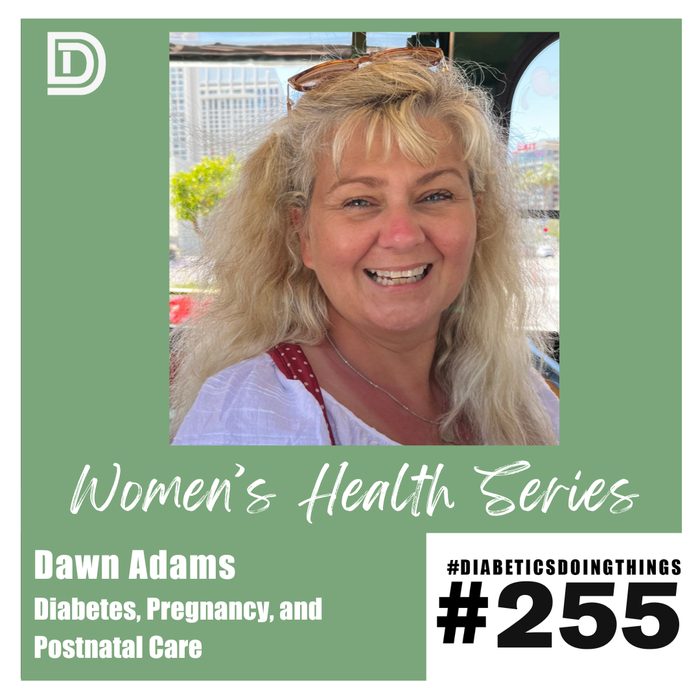
Dawn Adams, Women's Health Series: Diabetes, Pregnancy and Postnatal Care

Episode summary
Dawn Adams was diagnosed with type 1 diabetes in 1993 at age 22, after her boyfriend recognized symptoms he remembered from a childhood friend with diabetes. She was told she would likely never get pregnant, and later warned to have no more than two children if she did. She went on to have four. After years of frequent hospital visits during her own pregnancies, she trained as a midwife in Belfast to support other women with diabetes through pregnancy and became a PhD student. The conversation covers her diagnosis, including bleeding palms caused by severe dehydration, how diabetes technology and insulin have changed since the 1990s, the gap between social media portrayals of pregnancy and reality, the isolation of the postpartum period, and advice for partners caring for a spouse with diabetes after childbirth.
Key takeaways
- Dawn says she was told in 1993 that she probably couldn't get pregnant, and should have at most two children if she did; she had four.
- Her boyfriend recognized her symptoms, including an acetone smell and extreme thirst, because a childhood friend had type 1 diabetes.
- Dawn says her blood glucose meter in 1997 took two minutes to give a reading, compared to today's near-instant meters and continuous glucose monitors.
- Dawn calls the period after birth the 'fourth trimester' and says it can feel isolating because frequent pregnancy checkups stop right when support is needed most.
- Dawn advises partners to limit visitors, handle the baby and nappy changes without being asked, and check in with their spouse during calm moments, not when the baby is crying.
Show notes
It’s another National Diabetes Awareness Month, so you know what that means - A NEW SERIES. Over the next four episodes, Rob and Eritrea will have conversations with women's health experts in Diabetics Doing Things’ Women’s Health Series.
For Episode One of this series, we were thrilled to chat with Dawn Adams, PhD student, midwife, diabetes advocate, and mother of FOUR! The team talked about
Dawn’s diagnosis in 1993 with a symptom we hadn’t yet heard of: bloody palms
Being told she would never get pregnant because of diabetes
Getting pregnant unexpectedly and being told that pregnancy with diabetes would probably not result in a good outcome
Being warned to only have two children; she had four!
A career shift into midwifery after becoming a mom with T1D
Understanding why women with diabetes have to see their doctor much more often than women living without diabetes
How far we’ve come: meters used to take five minutes to give a reading!
Diabetes and pregnancy isn’t neccesarily the pretty picture Instagram and social media paint it to be
BEATING THE FINAL BOSS: The fourth trimester and the challenges that come after baby arrives, even when baby and mom are healthy
What support looks like from the community around you
Life after baby arrival can be hard: make space for the difficult moments as much as we cherish the good moments
Advice for Partners: How can you better care for your spouse who is living with diabetes after they birthed a child?
Mentioned: The HAPO Trial - https://www.2minutemedicine.com/the-hapo-trial-hyperglycemia-and-adverse-pregnancy-outcomes-classics-series/#:~:text=This landmark study demonstrated that,risk of adverse pregnancy outcomes.
Find Dawn on IG @T1dawnie
Questions this episode answers
Can women with type 1 diabetes have healthy pregnancies?
Dawn Adams says she was told in 1993 that she likely couldn't get pregnant and was later advised to have no more than two children, but she went on to have four successful pregnancies.
What is the 'fourth trimester'?
Dawn Adams uses the term for the weeks after a baby is born, when a mother is still recovering physically and hormonally but no longer has the frequent medical checkups she had during pregnancy.
How has diabetes pregnancy management changed since the 1990s?
Dawn Adams says blood glucose meters used to take up to two minutes to give a reading, compared to today's much faster meters and continuous glucose monitors, and that insulins have become far quicker acting.
How can a partner support a spouse with diabetes after childbirth?
Dawn Adams advises putting a 'no visitors' sign on the door, taking the baby out so she can rest, making sure food and drink are ready, and checking in on how she's really doing during a calm moment.
Full transcript Searchable, with timestamps
Rob Howe: Welcome back to another episode of Diabetics Doing Things. We are telling the amazing stories of people with diabetes from all over the world. And our guest today is from across the pond. So, Dawn, thank you for working through the scheduling challenges that come with international interviews. But this is also a special episode as part of our Women's Health Series that we're launching for National Diabetes Awareness Month 2023. and Eritrea has sourced amazing experts and opinion leaders from around the world in women's health with diabetes because as a person with diabetes who's a man I didn't realize how many more hoops that are and how many more challenges that our ladies with diabetes encounter that many of us don't know about and I think it's really important to center those conversations and to learn more about them so Dawn thank you so much for being here today ladies and gentlemen I'd love to introduce you to Dawn Adams. Dawn is an incredible advocate and person living with diabetes. I had the pleasure of meeting her through the DDOC program and I got to hear her speak. I want to say it was at ATTD 2022, maybe last year. She is at a large teaching hospital and provides care for pregnancy in Ireland. But then I also found out that she's a mom, a type 1 diabetic and a midwife. She's also a PhD student. So it's like Dawn is all of the things. And we had to have her on the show. Yes. So Dawn, welcome to the show. Thank you for participating in Diabetics Doing Things. And I want to make sure like I am usually the host, but for the Women's Health Series, Eritrea is going to be stepping more into that host role so I will turn it over to her. So I want to start I've told the listeners how we've met but I want to start back back back back back before you became Dawn Adams and you just were little Dawn Adams little Donny which we call you Donny all the time. How did you get diagnosed with diabetes and join
Dawn Adams: this type 1 diabetes family? So yeah my invitation to type 1 diabetes came after I had been away for weekend in England. I was 22. I was finishing off my training as a primary school teacher. So yeah, I've had a number of things that I've done along the way. I came back from British Youth Council. I was a girl guide and I was a delegate to the British Youth Council delegation. My then-bold friend picked me up from the airport and he said, oh, I've lost an awful a lot of weight over the weekend. He said, I knew you'd been listening. What do you weigh? I was like, I have no idea. And he said, you smell of whiskey. Were you drinking whiskey on the plane? I'm like, no. He said, but could we please go and get something to drink? I'm so very thirsty. So he got something to drink and he said, you know, last couple of weeks, you have been drinking. A huge amount of slurred. and he said you're just you're really sleeping as well he said every time we get into the car you're unconscious so yeah I was almost unconscious anyway and they were back from the airport and I think it was the thirst was keeping me awake he said I think you need to speak to the doctor so back in that point in time it was very easy to get a GP appointment here I rang the doctors the next morning I thought then I can type 1 I can have diabetes I don't know anything about diabetes. So anybody with diabetes, this is like, who even are you making this diagnosis? So I went in to see the GP the next morning and she said, so why are you here? And I said, well, my boyfriend thinks I might have diabetes. And she went, oh, he's a doctor, is he? No. No, but I said, I've lost quite a lot of weight. I am probably tired. I said, I'm really thirsty. I'm running to the loo all of the time. I said, like, literally I drink something and I'm running straight to the bathroom. And I have had thrush treated by yourself three times. So she said, and what exactly do you do? And I said, oh, I'm studying for finals at Stranmillis University. yesterday and she went so basically you're telling me that you're just a normal student you're studying you're out all weekend partying you're doing all the normal things you're running to the lube because you drink yeah well that's quite normal you know that's basically how this game works and she's saying you've lost weight well that might be because your concerns so at that point I was thinking, maybe I might be overreacting here. But in the back of my mind, I thought, something else. And I said, well, actually, while I'm here, if it is that, I said, could you maybe explain why the palms of my hands are bleeding every time I open them? I said, because when my fingers are curled up, it's okay. When I open them, I said, look, fresh blood across my palm lines, across my fingers. the colour left her face and she said could you maybe give me a urine sample so I was like yeah how much do you need so she sent me off to the bathroom and I came back tiny amount of urine but you know I hadn't already managed to get rid of to the bathroom and the nurse checked it and when she dipped the glucose thick in it just turned black instantly it wasn't even having to wait for 60 seconds it just went black all right don i gotta step in i don't know if you saw eritrena's
Rob Howe: face when you when you talked about the hand symptom because neither of us have ever heard of that symptom before and obviously we we know that diabetes affects you know your micro you know blood your your follicles i don't know i'm i'm obviously not a scientist i just play a podcast host on the internet so like what is happening there in your vascular system that that you know
Dawn Adams: talks about or how does that happen how does that work i was so dehydrated my skin just broke anytime i bump into anything even if it wasn't particularly sharp i had scabs and they were just weeping because i was so very dehydrated my hands had gone like that the back of my knees had become like that and by the time I got into the hospital later that day it was starting to happen around my wrists as well because there was just no moisture in my body I think if I was being diagnosed at this point in time I probably would have been admitted to an ICU ward. But at the end of the early 1990s, the GP said, oh, your boyfriend might be right. So she checked a blood glucose sample. And the glucometer read up to 26 in uk numbers which is probably about 400 450 in the state and the meter just said hi i was like you i thought i was really funny and i said yeah your glucometer is really that that machine's really friendly saying hi and i'm like smiling waving back at the machine with my oozy fingers my very dry very paper thin skin and she just looked at me sternly and said i'm going to ring the local hospital you meet straight the local hospital but why you told me it wasn't diabetes she said it is it's diabetes i think it's type 1 diabetes that's weird so she said i'll ring for an ambulance but you can't my mom's in town waiting I remember going to meet my mum for breakfast. It was really early morning appointment. I said, no, can't do that. I said, I'll go. We head up to the hospital afterwards. I have nothing with me. I said, I can't go looking like this.
Rob Howe: It was probably ridiculous. Just to get proper nice for the hospital. I can't imagine being like makeup, lights, action. No, so first of all, it sounds like there was a lot of not believing you there at first. And if you don't mind asking, Dawn, what year was it that you were diagnosed?
Dawn Adams: 1993.
Rob Howe: Okay. So. It was 1993. So I was going to ask that too, because, well, A, it's, I love that you remember the day, the exact date, because I know we've talked to many people who don't exactly remember. And it's just over 30 years living with diabetes. And, you know, there was no internet at the time. And your, like you said, your boyfriend wasn't a doctor. how did he know the symptoms for for type 1 diabetes what an interesting thing
Dawn Adams: his best friend when they were at primary school had been diagnosed with type 1 whenever they were about 10 or 11 years of age and when he picked me up at the airport that night and i'd said had not been drinking whiskey because i didn't drink alcohol he said you smell like my friend did before he was diagnosed with type 1 and he had remembered his friend that that acetone smell of his friends right he had remembered the tiredness he had remembered thirst and he had remembered the frequent bathroom trips as well so it triggered that memory for him and was like this is what it is for him it was just like step back in time so this was maybe 12 years later he He was going through exactly the same thing with his girlfriend as he had witnessed with his best friend. Which is probably as well that would happen because otherwise I would have just been running around trying to finish off dissertations, going for job interviews, living my usual.
Rob Howe: I mean, and that's the perfect segue into what my next question was going to be. so this is going to sound like so we're going to time travel through time and from diagnosis at 1993 i wanted to ask if you could share your personal experience of becoming a midwife and researcher while still managing type 1 because i know that's been a big chunk of your career and
Dawn Adams: what you've done for a long time yeah well i graduated 11 12 weeks after diagnosis with a Bachelor of Education I taught for the next 13 years and in the meantime same boyfriend proposed to me a fortnight before graduation and I said yes so we were in the Lake District on top of the second highest peak in England getting engaged 10 weeks after diagnosis and when we got married One of the things that had really terrified me, this does, this is for them. Whenever I was diagnosed, I was told that I probably would never get pregnant. I was told that I probably wouldn't have, if I did get pregnant, I probably wouldn't have successful outcomes. And a conversation in the hospital with him had been, I don't think I can have children. if you want to call this relationship off now and find someone I'm able to have. And I completely respect that. But he stayed with me anyway. So we got married two years later. And by the time I hit 2006, whenever I applied for midwifery, I had four small children aged between two and seven and a half at home. So there were no sets of twins in that. I think just once my body discovered how to actually get pregnant and maintain a pregnancy, it wasn't overly challenging. But the advice around diabetes and pregnancy back in the 1990s, early 2000s, was no more than two children. to the extent that whenever I was pregnant with number four, because I was in the clinic so often, the staff asked me, when was this baby actually due? I was like, well, which baby? Do you mean this one? And I went, yeah, this is your first pregnancy. I was like, no, no, this is pregnancy number four. I was like, that's why you were here all the time, I was like, yeah, sorry about that. I said, I know I've broken all the rules, but you're... You're being me if I didn't. Aww. The school that I was teaching in was closing in 2005 to amalgamate with another small school nearby. I had been given job share, so I was only working two and a half days a week. And I was told that when the new school opened, that wasn't going to be an option for me. So my youngest was two. and I thought right this might be a time to consider a career change so my husband had said about one of his colleagues had applied for a post in direct entry midwifery so it meant he didn't need to train as a nurse first which had never been to me but the idea of going into midwifery really came from my experiences of my four pregnancies and midwives that I had encountered along the way who had either been incredibly supportive or not as the case may be the support that I had received from the hospital because I was at a different large very large much larger teaching hospital in Belfast and there were a number of pregnancy studies completed for women living with type 1, type 2, interstitial diabetes. So anybody who's familiar with the HAPO study, that was pioneered by my lead endocrinologist in pregnancies. And I thought it would be really good to get into midwifery and be able to support women with diabetes coming through pregnancy, potentially because of background of education, down the line of being able to do parent classes to normalize a very abnormal pregnancy journey because there isn't anything normal about attending a hospital every two weeks for scans attending every two weeks for blood pressure attending two weeks for urinalysis attending every two weeks to see what was potentially about to go wrong and when i compared my experiences with my friends who have any type of diabetes i couldn't understand why they were only being seen at a booking visit at the big scan again around 28 weeks again around 36 weeks and when they have the baby so i was there like i was basically living in the hospital i'm just clean fortune and car parking charges and that's it but i thought well if i can do that it gives me more of an insight into what the concerns are about pregnancies that people with diabetes of all types have and say it allows me to provide support potentially education and hopefully a wee bit of encouragement but yeah this is a really abnormal journey but it's worth it in the end it's a long work whenever you're spending that amount of time out of your life, going to clinics and having those concerns, especially alone. So 2006, I was accepted for a midwifery degree at Queen's University Belfast. And three years later, I qualified. Why?
Rob Howe: I have a question for you because I love the story and like the journey of, and we've talked a lot about and we've taken a pledge at Diabetics Doing Things to end diabetes stigma. And there is a stigma around still lingering around pregnancy and diabetes. But going back 20 years or so, 30 between, you know, 20 and 30 years, it gives me a lot of perspective on how far we've come globally in the way that we view diabetes and living the life that you would want, living a quote unquote normal traditional experience because many women, I think, diagnosed at that time and before were told that they may not be able to have a family. And I think, obviously, your story, even before you became a midwife, was very different than that. And like you said, it is a different experience. You have to go every two weeks. And for many people today, I think listening, type 1 moms would resonate with that experience. It's still very much like that are very tightly managed and there's a lot of like you said a lot of gas and parking spent on the way to the to the doctors and your care team is very involved in that pregnancy but it's still possible and i think now the narrative has shifted more to where yeah hey there is a protocol and like you mentioned a study like those studies have only been in place for the last 25 20 years or so and we're still learning more and more So for you now, you know, fast forward again, like Eritrea said in sort of the time dash of our discussion, what is it like for you knowing all the things that you and other pioneer women with type 1 diabetes went through having, you know, managing your pregnancies to now be able to look at a young woman with the diabetes and say, hey, you know, yes, we can manage your pregnancy with diabetes and here's how we're going to do it.
Dawn Adams: I think that women coming through the services now or people coming through the services now are in a much stronger position when it comes to them having greater ownership of their diabetes. because it was 1997 when I was first diagnosed as being pregnant. And the glucometer that I used, so I stick tests a day for a start. And the glucometer that I used took two minutes to give a reading until I was actually recruited into a study which led to the development of the HAPO study that I've already mentioned. So whenever I went into that cohort, I was in the control arm of the cohort, I was given a glucometer that only took 60 seconds to read your blood glucose. And I just thought, this is so fast. Oh my goodness.
Rob Howe: It'll never get better than this.
Dawn Adams: Which was, you know, looking back now, it's absolutely hilarious where you think how many people's glucometers read in five seconds, how many people have access to flash monitoring or continuous glucose monitoring. Because it was a very, very different time. But it's also the fact that there's been such a change in the insulins which are available. So when I first became pregnant, I was on Humulin Zinc, which apparently was contraindicated in pregnancy and it's actually the insulin that most people's pets are now given whenever they develop diabetes so delighted to say I was a pioneer for pet insulin and diabetes treatments yeah and my son came out okay so it's all right he came out okay but even by the time I got my fourth pregnancy there'd been a change I was on humulin S which is very similar to your insulin, I think it is. And I then found an two when I was pregnant for the third time, I was using NovoRapid. So even the speed of action of the insulins had increased phenomenally. the advancements in that short window of time were something phenomenal so when women are coming into clinics now and they're concerned about the regular blood glucose monitoring and the insulin administration a lot of what people my era having children experience just doesn't exist anymore anywhere in the world it's not that long you know no matter where you live in the world if you have access to a glucometer it doesn't take that long if you have access to insulin the insulins are still a quicker onset of action time when i look back yes for example i think it was 90 minutes before it started door so it could be pre-bolus in for it you would have been needing to think you know an hour and a half what am i oh my goodness on today so a lot of the a lot of People do get very anxious and very concerned about time commitment to that. But the landscape for diabetes management tools and devices, medications, has changed so very rapidly. And I think that in itself is something to be, again, really excited about. Because women have access to data set, but I just don't have access.
Eritrea Moussa: Absolutely.
Dawn Adams: So in the case of the online community and diabetes information, any phone pick up any social media platform, put in your keywords, diabetes and pregnancy, and there's a plethora of information and advice out there. My information and advice was a book printed by the hospital.
Rob Howe: That's wild that there was just not very much available back then, and I'm forever grateful for the internet. I love that you brought up the unique challenges of that time period. So now, when you're in clinic now, what are some of the unique challenges that women with diabetes are facing during and after their pregnancies?
Dawn Adams: I think for all women, regardless of whether you have diabetes of any type or not, the biggest challenge is actually a psychological and mental challenge because we have so many Instagram and so many TikTok accounts of influencers from all fields of life who become pregnant and they make it look like it's an absolute breeze. It's a walk in the park and you've got to be totally Instagrammable at every point in your pregnancy. And the reality is most of us aren't. most of us just like very normal people who have bad hair days but i see a lot of anxiety worry and distress tied around that side of what a pregnancy could should look like should in verticomis because there's a belief that you won't be tired that you won't have morning sickness or hyperemesis that you've blood pressure issue nobody who posts their stories regularly on social media channels really talks about the cold hard reality of what pregnancy is like and they also don't take into account the fact that so many women with again any type of diabetes or any history of gestational diabetes in a former pregnancy or women from ethnic minority backgrounds or women coming from other communities will have medications that they're taking to improve their pregnancy outcomes which women who are white European don't have to worry about this and there's I think that yeah I think the reality of pregnancy actually is and actually looks like you see online and in social media doesn't actually reflect what so many folk do face and what so many people struggle with or have to adapt to the adaptations that you're making and it was certainly one of the things when i was doing my midwifery degree and they were talking about how pregnancy exacerbates asthma for example or how it exacerbates anyone who has pressure issues if you have skin conditions it may exacerbate your skin condition if you're someone who tends to be more prone to fatigue pregnancy will make you feel much more fatigue and if you don't have fatigue you'll still discover a whole love for nana naps in the mid-afternoon that you never thought you would ever imagine before you were 80 and sitting on a bench in front of your house with a blanket around your knees reading to your grandchildren there's quite a lot of misinformation about what pregnancy action involves and it's trying to untangle a lot of that and make the reality of this phenomenal experience that you're going through like you are growing a person does anybody think that that doesn't come with a cost to you physically when you change the decor in your home you're tired after when you're moving furniture and you're deep cleaning in the springtime you're tired after a day of doing and that tiredness doesn't even begin to come close to the reality of going one two or more small people because you are just one person and you are actually doing that alone on your own i kind of i do wish that that was maybe a disclaimer that was put on social media
Rob Howe: posts yeah having a baby is hard and some of us try to have a baby and don't even get through the whole thing that hard. I love that we got to touch a little bit on pregnancy. I think that you're an incredible voice and champion of women who have diabetes and can have healthy babies because as you said it's an incredible misconception that if you have diabetes you cannot have a child. But I want to and again for our listeners it's going to seem like time traveling but we're going to have two other episodes where we talk fully about pregnancy and what I really really wanted to pick your brain about and get more into is the after of having a baby. Because I think for so many people, that pre-planning and getting ready and how do we do this and then getting through those 10 months is great. But that's still not even the whole battle. They call that last trimester when your baby is already born the fourth trimester because you bring them home and there's still a bunch of growing and things that has to happen. So can we maybe dig into the long-term effects of diabetes on a mother's health post-pregnancy and how that could better be managed? Maybe your
Dawn Adams: advice and take on that would be great. I know for myself and friends who have been experienced pregnancies in the last five years, they've had access to things. that first trimester has been a different level of challenge there is a significant amount of grieving because there's a sense of loss because your pregnancy if you've been pregnancy planning and you've been seeing a team in the hospital for regular gluteus management checks health and fitness checks when you come home with that baby in your arms don't have those two weekly four-week-day appointments nobody's checking up your glucose variability nobody's asking about your insulin requirements nobody's asking you how you're feeling again you're you're left high and dry with this miracle that you have against literature would say against all the odds you as someone with type 1 diabetes have come home with and you go into a free fall and there is that grief because you don't have that same support network behind you I know I find that I find that particularly challenging and I'm hearing it increasingly from friends from peers other women who've been through a pregnancy with any type of diabetes that it's very lonely afterwards and it's as if you, you know, mission accomplished you had your baby, you and your baby got home safely put in the hospital goodbye, we'll see you next time I think it's like when you've been to a really active holiday and you come home there's that slight grieving for the busyness and there's a grieving for the interactions that you've had and the excitement of each day you're tired you're still having significant amounts of blood loss up until three weeks afterwards your back's sore your breasts are sore because you're producing milk and if you've decided that you're not breastfeeding you still get that engorgement, that swollenness your hormones are very much all over the place but you have sole recurring responsibilities you are your child's primary carer and you're doing that completely independently of anyone else even if you have a partner or you have family close by necessarily they're 24 hours a day seven days a week to support you in that and again that's quite often down to what your employer or their employer is willing to facilitate. It will depend on how close you are to your immediate family circle, what your relationships like with them. And when you throw blood glucose levels into that mix and the monitoring and the adaptation back to pre-pregnancy or lower levels of insulin, trying to make sure that you have time to eat that you have time to attend to your own hygiene let alone feeding a baby, changing nappies, changing vests changing baby grows, changing boobs, changing bed that in itself brings a very different level of meditation and it is hard and i don't know that we've yet found an appropriate way
Rob Howe: to prepare women for that stage i i love that perspective i i think it speaks to so much about life with diabetes and and i think one thing that i'm really taking away from this that I think, like you said, social media and sort of the highlight reel that we see of people's lives on a daily basis and have become used to is that we start to believe that everything's going to be easy and that, you know, even outside of diabetes, that your relationship is going to go well and your pregnancy is going to go well and you're buying a house or your job. And like, we have this idea that, and I do believe that everything is going to work out and I do believe in having a positive mindset. But one thing I've learned is, and I, and I believe is that life is sort of one set of insoluble problems, one after another, after another, after another. And when you give yourself the space to not be perfect is when you can find a little bit more balance. And what I'm hearing as well that, you know, our friend of the podcast, Dr. Mark Heyman, his book is titled Diabetes is Tough and Diabetes Sucks, but You Can Handle It, you know, and I think that's where, you know, this idea that, oh, well, now I've had the baby, so my blood sugars are going to be perfect. And it's just not realistic. And so like relieve yourself of this burden that you are perfect and And everything has to go exactly the way that you plan.
Dawn Adams: I just, on that, I was recently told by hospital staff that I'm definitely a type A personality. So for me, when I look back over my four experiences of fourth trimester, it nearly killed me, except in a dinner of somebody called at the house. whenever they arrive with castrels and they said made you a dinner look at them going do you think i can't make a dinner do you think because i have diabetes and i have a baby i can't make a dinner like quite determined very independent but definitely was number one i would have been much more like that by the time we got to number four heck if you had turned up with a hand nothing you'd find on the street i would have like bitten your arm off to have it was just so glad that someone actually cared enough so i think it's like as you're saying it's very much about that change in your expectations of yourself and it's about thinking what way can i what what help am i prepared to accept what support when it's offered am i not going to point blank go no I'm fine thank you very much and that's one of the things that I do say to all of the women coming through postnatal worldwide work if anyone arrives at your house and they don't have something for you to eat something for you to drink chase them if they come empty-handed you do not have them your baby for an instagram snap right facebook post chase them if they're not there to see you and give you a bit of care even if it's just going into your kitchen and making you a cup of coffee while you're breastfeeding or saying I'll hold baby for half an hour so that you can go and get a shower they should not be in your house it's not about them coming to visit you it's about what they can actually bring you and not everything that people bring has to be food doesn't have to be things quite often it can just be 15 minutes to get to the bathroom and it can just simply and purely be a time slot for you to have time to go and run a question with your face and brush your hair right so a little kindness goes a
Rob Howe: long way. Oh man. And it's free. It is free. I would, I see like a lot of the emotional labor of emotional and physical labor of having a baby taking care of yourself after so much of that is put onto the person living with diabetes. Like the person who just delivered a baby now is responsible while not having not slept, barely eating, feeding another person from their own body to advocate for themselves. And that sounds really difficult in itself. So for maybe a partner who might be listening to the episode and their spouse has diabetes, right? I'm going to pretend I'm a man right now. Dawn, tell me what to do. How do I better care for my partner
Dawn Adams: who just birthed our baby? You put a sign on the door saying, no visitors welcome at this time. mum and baby are sleeping that's number one that was what I then had my husband my husband actually did that at one point with ours the next thing is if she asks you for five minutes peace let her have five minutes peace if the baby's crying take the baby out for a walk in the stroller put the baby into the car and go for a drive, making sure that nappies are clean, that you have cleaned. Change the nappy before you go. Making sure that baby is fed with something, breast milk, formula milk, whatever your choice is. At the end of the day, that's a very personal choice. And making sure that she's actually okay. Taking time as well in the course of the day to just check in and see yourself is okay. you also need that as a partner to check in because you've been set to the side in the midst of all these antenatal appointments you haven't been there 24 7 in the hospital and a bit of you will also be grieving for the couple that you were even though you're absolutely delighted to be part of this new family unit. It's a change. It's like any change in life. Talk to each other through it. Don't talk whenever baby's hungry, roaring, when she's crying. That's not a good time to sit and have these conversations. But when baby's settled, after a feed, bring her a cup of tea, a glass of milk, whatever her favourite snack is. Because again, you've got to look after those blood glucose levels and sit down and chat and just say how are you doing and also sharing some of how you're experiencing that as well because she will be conscious of the fact there has been a chain in the dynamics of your relationship but she needs to know that you still value her as the woman you fell in love with, that you still are very much at the center of her universe and that you're both there. You're a team. You're going to work through this together.
Rob Howe: Rob's face. He's so beautiful. He's like, he's hearing all this. He's a sponge and he's absorbing it all. Erica, I did this for you. I just believe in that. Like everything that you're talking about, Don, like, you know, I'm not a father yet. I hope to be one day. But just that connection and that space to be human and grieving, you know, it's okay to grieve the past dynamic while embracing the new one. And I think the only constant is change. And you really said this earlier too, what a miracle it is to be able to grow a human life. And yeah, if you feel exhausted that if you feel tired and you feel frazzled, that's super normal. You would do that if you just had a long day out shopping, like you said. And just the miracle of life happening comes with a sacrifice. But at the end of the day, you can look at the family that you've grown and you can look at and say, wow, it was all worth it. But I also love the idea of not bringing up those conversations when the baby's angry. It's like, you're not you when you're hungry and neither is the baby and neither of the person who doesn't birth your baby because she's not her anymore now she's a human in recovery mode i think so many times something don said earlier and now that i've gone through the majority of my questions we can touch back on is the social media perspective or point of like having a baby like you just see the lady in her bed all smiling holding the baby or you see like a couple days later she posts the baby and it's like oh everything was great but like Like, labor is carnage. This is quite literally a horror movie. Like, I do not know how else to explain it to people. But, like, my experience with labor is that I saw my brother be born when I was 11. Like, my mom took me to the hospital and was like, this is the best birth control I could ever give you. And literally, I swear to God, Edna Musa lives. You guys can ask her. And I just remember seeing my brother be born. And my mom had a really easy pregnancy. to deliver my brother in 26 minutes flat, like marathon runner of a person. And I remember her pulling my brother out from her body and like looking at him for seconds and her chick, come here. This is your baby now. Here you go. And I was just like, what is this? Right. I'm holding a bleeding human being, which is not something that you see on social media or television. You just see the wiped off, clean, happy baby. And so I think that's when I first learned, like, actually, guys, this is quite literally supernatural. activity. So the fact that people do it on this planet every single day and they're just like, it's fine. No big deal. And we just move on from it is kind of mind boggling to me. So I love that we got to talk about it today because it's like, it's scary. This is terrifying. Yeah. Don, as someone who lived it four times, what would you say to someone who's done it once and maybe is scared of doing it again? Or yeah. Why did you do it so many times, dude? Like what?
Dawn Adams: I had no idea what was causing it. I'm just firmly of the opinion that because I had been totally in my hospital then, in April 1993, that getting pregnant probably wasn't going to happen. And if it did, I probably wasn't going to leave the ward with a live baby in my arms. yeah I just I never really I never took it under it was something that I think I avoided the reality of it each time and even going through each of the pregnancies there were a number of bumps along the road with every one of this it makes it sound like I had you're a very textbook perfect friends I totally didn't they They were, some of them were a complete mess. But there was no preconception information. There was no preconception advice. There were no preconception clinics. You couldn't just post a question on the social media platform of your choice and have a million people from around the world answer it with their experiences. So I think, you know, if you've had one baby now and didn't have the opportunity to do the pregnancy planning because you were very much in the mindset that I was in all four times. If you're thinking about it, if you're sexually active, if you're going to be trying for a baby anytime soon, do speak with your healthcare team. There are certain medications that women with diabetes are given, such as statins, for example, or some blood pressure medications, which can impede your chance of becoming pregnant or can have a negative effect on the unborn baby. Look at the things like folic acid. You know, as women with, again, pre-existing diabetes or previous history of diabetes, the advice is to take 5 milligrams of folic acid rather than 400 micrograms that people thought diabetes take so start taking that it's not going to do any long-term harm but it means that you're getting your body to a place where you know conquering sperm beat that feisty egg and there's a baby resulting out of that you're giving yourself a significantly better chance of getting through the coming months and your baby a significant better chance. By the same token, if you don't do those things, it does not mean it will not happen. Let's say 1997, I didn't even know what folic acid was. I think they just started adding it to breakfast cereals around that time and I had no idea why you happened to take it as a tablet. It was already a breakfast cereal. But, and obviously I wasn't on statins, there's a, there can be a negative effect from those. If you're using diabetes treatments like Ozempic and Toza or Empagliflozin or SGLT2 inhibitors, you really should be going and having a conversation with your healthcare team about changing to something else, which is going to have a proven track record of not doing any harm. Unfortunately, a lot of the medications that are out there at the minute, everybody's very excited about, and rightly so, haven't been trialed in pregnancy because you can't do trialed in pregnancy. You can't use pregnant women as a research population for new medications. And we don't know what the long-term effects of those medications will be on any babies who are born to mothers using them. so yeah forward thinking is always a good thing so yeah if you're if you're in a relationship you think it's a possibility if you're sexually active the relationship again bear in mind that it's a very very real possibility because more relaxed you are the higher your possibility of conception happening actually is and if you're quite stressed about it those stress hormones can be the thing that are the only barrier to you becoming pregnant. Again, one story from a friend was she and her husband had been trying for baby. She also has type 1. She'd been trying for baby. She was being reviewed regularly at the regional fertility clinic going in Belfast. And her husband broke his leg in a motorbike accident and she decided that, no, she wouldn't be able to get pregnant now that his leg was in a plaster cast. and before he was out of the cast she was pregnant with her son because she had eased the levels of cortisol adrenaline and stress that she was carrying with her all of the time she just thought no you can't get pregnant when your husband's got a plaster cast you know from his thigh down to his toes so again if you're if you're in a very stressful post or a very stressful job or living in a very stressful environment. It's about trying to find those glimmers of things that will ease that stress as well so that you're physically, mentally and hormonally in a better place. So yeah, having a look at medications, having a look at lifestyle stressors, having a look at diet, I'm not entirely convinced about. You know, I know we've put There's increasingly more evidence being put on the benefits of a healthy diet. Yeah, I believe that. But I do think that the best diet is one that you can afford, that you can enjoy, and that is going to make you feel full. So, small changes. Yeah. Adding one apple a day. You can eat fruit. Having one apple a week is already a massive increase on your fruit intake. Doing small things that are sustainable. is a big on that journey.
Rob Howe: I love what you were saying about the brain too and stress and cortisol and how things, how life can throw you a curveball like your husband getting in an accident and that allowing you to relax. My dad used to say, the mind is a terrible thing and it must be stopped. And I think more often than not as I get older I find that that's true. Dawn, I wanted to thank you for coming out and obviously sharing your expertise, but also sharing your lived experience as a person with diabetes who has brought four children to term and for being, you know, when there was very little information out there, there were no social media posts, there were no blogs or forums where you could post to and sharing your experience there and how pregnancies are not perfect and And they're not easy, but that you can successfully bring a baby to term living with diabetes. And I just think that that's going to be a really important message for somebody out there to hear. I know life with diabetes is not without complications. And we talk about that a lot on this podcast. But there are a lot of things to be excited about and be hopeful for in a life with diabetes. So thank you so much for your perspective today.
Dawn Adams: Thank you very much.
Rob Howe: This was fun. It could be good for women. And that's what we care about this Women's Health Series, November Diabetes Awareness Month. That's what we're focusing on. There's a lack of information for women. And there are incredible women in the field like Dawn Adams who are available to help us fill these gaps. And I think that what you're doing is just incredibly important to people who might not have thought about it. Like, I just don't think people think about the post-pregnancy enough. And it's important that we highlight it. And then we're like, hey, pregnancy doesn't end when the baby shows up. Pregnancy ends like eight months after the baby shows up. Or 18 years. She got you for 18 years, you know. As the great Kanye West said. Dawn, for people who are listening to this podcast, women or men who have questions for you, where is it? Where's a good place to find you? Are you on social media where they can reach out?
Dawn Adams: Yeah, I'm available on Instagram is probably the best one because I share a lot of information from my own healthcare trust here and from our globally recognized resources as well. So I'm on Twitter as well. Sorry, I meant to tell you what my Instagram handle was. Sorry about today. We'll put in the show notes for you also so you can mention it, but I'll still put in the notes. T1Dawnie. So T1D with an A-W-N-I-E at the end, basically. and you'll know it's me because it's a I call it a big picture I drew of me with mad crazy hair which is basically me all days and done grease and on Twitter I am at moodwife
Rob Howe: well Dawn thank you so much for all that you do for people with diabetes and thank you so much for coming on the show today I just had a wonderful time this episode was produced by Eritrea Moussa edited and published by Ashley Bright. And our videos are brought to you by XL Creative with DJ and Corey. We'll see you next time.
About Dawn
Dawn Adams is a midwife and PhD student in Northern Ireland who has lived with type 1 diabetes since 1993. She is a mother of four and provides pregnancy care for women with diabetes at a large teaching hospital.