

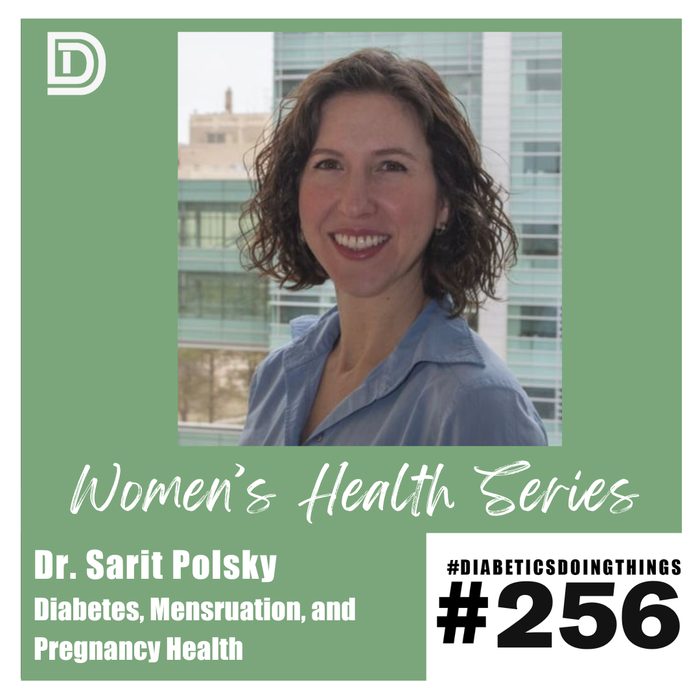
Dr. Sarit Polsky, Women's Health Series: Diabetes, Menstruation, and Pregnancy


Episode summary
Dr. Sarit Polsky directs the Pregnancy and Women's Health Clinic at the Barbara Davis Center for Diabetes. She trained in internal medicine and endocrinology, earned a master's in public health, and now researches how diabetes care changes across a woman's life. The conversation covers how the menstrual cycle affects blood sugar, including luteal phase hyperglycemia from rising progesterone, and how puberty, contraception, PCOS, and menopause each shift insulin needs. Polsky explains how to plan a pregnancy with diabetes: get A1C under 6.5 percent, review medications, and build a care team with an obstetrician, dietitian, and eye doctor. She also covers pregnancy risks, how partners can support a pregnant person with diabetes, and hyperemesis gravidarum, a severe form of pregnancy nausea that can turn dangerous for someone with diabetes.
Key takeaways
- Dr. Polsky says rising progesterone in the luteal phase can raise insulin resistance, a pattern she calls luteal phase hyperglycemia, though only about half of women show the same pattern every cycle.
- She recommends tracking symptoms and glucose for about three cycles in a row to find your own pattern before changing insulin doses.
- Dr. Polsky says the most important step before pregnancy is planning ahead: aim for an A1C under 6.5 percent (under 6 percent is even better) and review all medications with your provider first.
- She says partners can help by learning to use a glucagon kit, keeping unexpired ketone strips at home, and watching shared CGM alerts for lows.
- Dr. Polsky describes hyperemesis gravidarum, severe pregnancy nausea, as especially dangerous with diabetes because it can trigger starvation ketosis and sometimes requires IV fluids or feeding support.
Show notes
On this special episode of Diabetics Doing Things, Rob and Eritrea tackle episode two of our Women’s Health Series for National Diabetes Awareness Month. The team interviews Dr. Sarit Polsky, Director of the Pregnancy & Women’s Health Clinic at the Barbara Diabetes Center for Diabetes. This episode explores: -
How she became a subject matter expert in Women’s Health and Diabetes
The research and experiences that fueled her passion to Women’s Health and Endocrinology
Eritrea’s experience having her period for 18 days
How menstruation impacts blood sugar levels with Type One diabetes
The phases of menstruation and how they impact diabetes as well as temp rates that can be set with CGM/Pump technology
How your body’s insulin needs can change based of what phase of life you are currently in (menstruating, pregnancy, menopausal, etc)
Defining what the goal of your life is while menstruating, whether its trying to get pregnant or avoiding pregnancy
The most important thing to do in pregnancy with diabetes can be planning ahead
All the important planning and work that is valuable when considering pregnancy with your healthcare care provider.
Your diabetes pregnancy team and what it should look like
The main diabetes pregnancy message being that you can do it, but you need help
Pregnancy and Diabetes Stigma; how modern medicine has debunked much of it
How to best support your partner if you are someone without diabetes
Hyperemesis and Diabetes, how difficult that can be
Dr. Polsky article links - https://diatribe.org/managing-your-glucose-and-using-continuous-glucose-monitor-during-pregnancy https://diatribe.org/need-automated-insulin-delivery-systems-during-pregnancy-women-type-1-diabetes
Questions this episode answers
How does menstruation affect blood sugar in type 1 diabetes?
Dr. Polsky explains that rising progesterone in the luteal phase, after ovulation, can increase insulin resistance, a pattern she calls luteal phase hyperglycemia. Not everyone has this pattern, so she suggests tracking glucose and symptoms across a few cycles to see if it applies to you.
What A1C should I aim for before getting pregnant with diabetes?
Dr. Polsky says the general target is under 6.5 percent before conception, with under 6 percent being even better, along with stopping any medications that could harm the baby.
Can an insulin pump automatically adjust for the menstrual cycle?
Dr. Polsky says most automated insulin delivery systems don't adjust for cycle-related changes on their own, though Tandem's Control IQ can use a manually programmed alternate basal pattern during automation.
What is hyperemesis gravidarum and why is it risky with diabetes?
Dr. Polsky describes it as a severe, continuous form of pregnancy nausea that can stop someone from eating, which can lead to dehydration and starvation ketosis in people with diabetes, sometimes requiring IV treatment or tube feeding.
Full transcript Searchable, with timestamps
Rob Howe: Hello and welcome back to another episode of Diabetics Doing Things. We are telling the amazing stories of people with diabetes from all over the world. This episode is airing during National Diabetes Awareness Month 2023 as part of our Women's Health Series, which Eritrea has put together and sourced some of the leading experts in women's health and diabetes. And our very special guest today, I'm super excited to introduce to you, is Dr. Sarit Polsky from the Barbara Davis Center for Diabetes. She directs the Pregnancy and Women's Health Clinic at the Barbara Davis Center. So she's also the co-director of the EPIC conference, which is Empowering Patients for Individualized Care for People Living with Diabetes and Their Supporters. And we're very happy to have her here today. Welcome to the show. Thank you so much for having me. So this is, you know, again, part of our Women's Health series. And I'm very excited to dig into this because I think as many of our listeners with diabetes know, we have an amazing group of community members who are women with diabetes. Managing diabetes for women does not look the same as it does for men. And I'm very excited to kind of talk a little bit more about hormones and menstruation today, which is not something I say very often as a man living with diabetes or just a man in general. So I'll let you guys kind of take it away. But Dr. Polsky, thank you so much for your time and for your insights that you're going to deliver to our listeners. Yeah, I'm happy to join. And hopefully this is an informative session for everyone.
Eritrea Musa: So I was very, very lucky to hear Dr. Polsky speak at ATTD 2022, I want to say. And we got to write an article with her over at diaTribe. Actually, Dr. Polsky has authored an article herself. We will tag it in the show notes for pregnancy and diabetes. And we also wrote an article about CGM usage and pregnancy that Dr. Polsky helped us write over at the diaTribe Foundation. So definitely we'll link those. But when I was thinking about experts around pregnancy, women's hormones, Dr. Polsky was top of my list. I feel very lucky that we were able to get her here. I don't want to brag about you, so I'm going to let you brag about yourself a little bit. And can you tell us, can you tell us and our audience a little bit about your background and what inspired you to specialize in women's health and its intersections?
Dr. Sarit Polsky: with diabetes? Well, first of all, thank you so much for that kind introduction. So I actually had sort of a circuitous route in terms of getting to where I am today. Originally, when I was in medical school, I thought I was going to do primary care. And I was thinking I would do family medicine, which is treating adults and children and pregnant women. And so that's what my intention was for all of my pre-med studies and then even into medical school for the first couple of years. And then I realized, I think that this is a little bit overwhelming for me. Maybe I'll just focus on internal medicine, which is just adults. So I went into internal medicine and I actually did already have an interest in women's health at that time. And so I was fortunate enough to find a residency program that had a women's health track. So we had sort of this special little unit within our residency where we got this extra training on women's health issues. And during the course of my residency, I noticed that every time I had to do a Grand Rounds presentation or a journal club, it was always an endocrine topic. So then I said, you know, I think this is telling me something. So then I went into endocrinology, diabetes and metabolism. and I maintained this interest in women's health. And so it just seemed to be the perfect fit when I came to the Barbara Davis Center as the director of the Pregnancy and Women's Health Clinic and was really able to help individuals through glucose dysregulation, through the menstrual cycle, pregnancy, and menopause. And that's kind of how I got to be where I am today.
Eritrea Musa: What a journey. I think it's really cool how life kind of tells you who you're supposed to be treating. It sounds like something in your brain was just like red flag, red flag. And so you went in that direction.
Dr. Sarit Polsky: I think so. It's great to have that awareness too. I think sometimes you have to stop and take inventory and like measure and like be aware of like, oh, like, yeah, all of these papers and all this research is pointing me towards endocrinology. If you don't have that sort of noticing, like that's such a huge part of, I think, finding your purpose. And there's so many different options to choose from in life, especially in medicine. And often, I think I've heard many endocrinologists say that it can be difficult to choose endocrinology unless you have a personal tie to diabetes because you don't even know what necessarily goes into it. And there are so many other options at your disposal. So yeah, very cool. Very good awareness there.
Eritrea Musa: And now you're like an expert, right? So I think it's like you start, that's kind of where you got, how you got here. And I feel like we always, in my last episode, I talked about time traveling and I feel like that's what we're doing again. We're just kind of dashing through your entire career. But were there any experiences or research that really led you to become an expert in this particular field? Like, were there any significant turning points that fueled your passion for women's health with diabetes management, other than just noticing those talks in the endocrine
Dr. Sarit Polsky: field? Well, I think I've always had this desire to help people. And I realized that it's extremely powerful to work with one individual at a time, and you can have a profound effect on that person's life. But on the other side of things, research helps you to potentially do something that affects not just an individual, but a population as a whole. So I actually got a master's in public health. And in addition to my medical degree, because I wanted to expand that ability to serve others and do it through research. In terms of how it came to be that I sort of focused more and more and more on the pregnancy and women's health care. You know, I noticed when I got the NPH, hey, there's a lot of studies that never included women, didn't include pregnancy. There's a lack of information in this field. And I wanted to contribute to that, to maybe help people who were in that sort of bucket of society so that we could have better health outcomes. And then I think, you know, I learn from my patients every day and I come up with questions every day because I see something's happening and I say, why is this happening? I don't like that. What can we do to make it better? And a lot of the times it's, you know, focused on a women's health issue of some sort, which is why I do the research that I do. It's very clinically applicable research and it's stuff that I hope will, you know, be immediately accessible to other practitioners and patients. And I think it's really important for people to educate themselves
Eritrea Musa: about what's going on? I think the reason I asked if there was a specific experience is because I recently went through something that was like, why don't we have more content? So recently, and we talked about this on a previous episode of the Rob Manier Treya show, I went through an experience where I had menstruation or my period for 18 days and I was freaking out and I was Googling it and just looking for information. And there really wasn't anything in regards to it being, you know, a change for my diabetes. Like, of course, there was things like, oh, you should go to the hospital. You could be bleeding out. It could be a cyst. It could be this. But in terms of my diabetes and what I could do to better control it while having that amount of blood loss in a week or 18 days was basically non-existent. And that's what really turned me into being like, OK, we need a women's health series where we talk a little bit more about menstruation and diabetes. And that's kind of why we're here today. So that leads me to my next question because you're the expert, but I really want to ask, how does menstruation impact blood sugar levels when a person has type 1 diabetes? Yeah. So first of all, I'm so sorry that you had
Dr. Sarit Polsky: that experience. It sounds really uncomfortable. And you're not alone. It does happen quite a bit, more than you would think. Menstruation does affect individuals in a lot of different ways. So one of the things that I think that's important to keep in mind is that things that can affect women who don't have diabetes can also affect women with diabetes, like premenstrual symptoms. But there are some specific unique situations when that person also has diabetes. So, for example, that fluctuations in the hormone levels across the menstrual cycle can actually affect insulin requirements and insulin resistance. So there's actually, the important things to know about the menstrual cycle is when the menses, the bleeding starts, that's the start of what's called the follicular phase. And then around halfway through is ovulation. When an egg is released from the ovary and it can get fertilized and lead to a pregnancy, that always occurs 14 days before the next menstrual cycle starts. the next menses starts. From the time of ovulation until the next menses, it's called the luteal phase. This is the point when the corpus luteum actually sort of grows to support a pregnancy if there is. So what happens is, is that in the luteal phase, there's an increase in progesterone. And progesterone can actually induce insulin resistance. And in some individuals what this means is that they have a higher insulin requirement and their glucose levels are elevated. So a few things that can occur are that someone may need to change their insulin dosing if they're dependent on insulin by either giving a larger amount of an injection if they're doing injections. If they have an insulin pump, they can actually program an alternate basal pattern that delivers more insulin during the course of the luteal phase. But another thing that I think that's very interesting is that not everyone has this pattern, which is luteal phase hyperglycemia. It's the most common pattern. So you have to first find out if you're in someone who has diabetes, if you have that pattern and then you can decide, okay, this is the best way
Eritrea Musa: that I can treat it. Wow. But it's like so much information all at once. I'm like, there's this phase and there's that phase. And also I just want to mention, cause you brought up how you can set a temp rate basically for the luteal phase well guess what if you have an aid system you can't do that so if you have like like for example the tandem program control iq will not allow you to set a temp rate because basically the system does it for you but it doesn't basically there's not enough research for menstruation and so the pump can't do it for you but i think it's very interesting that that could be a solution if that is available to you on your insulin pump is to set a specific rate for your luteal phase. Wow. Right. Yeah. No, I mean, it's a good point. So,
Dr. Sarit Polsky: you know, the Tandem is unique because it does actually take into account the user inputted basal rates. So you could have an alternate basal pattern and Control IQ will actually use that. And so, you know, for example, someone may require 20% more insulin during the luteal phase hyperglycemia that they're experiencing. So they can switch to that pattern and still be in automation. But for the other times, it's true that they don't actually use the user inputted basal rates unless you're in manual mode. So in that case, you could either turn off automation or you leave it on and you might have to bolus with larger boluses. And so that's how you can kind of get around that. If again, if you're experiencing this phenomenon, which not everyone
Eritrea Musa: does. I'd never heard of this phenomenon. Like I knew it was a thing because I'd posted on Instagram, people would comment, but I'd never heard like luteal phase hyperglycemia. Boom. Now I know what
Rob Howe: it's called. I am smart. Yeah. I was going to say too, like it is, I think it's common to see. And I think when you're in the diabetes community, it's one of the things that maybe you notice for the first time, especially as a male who doesn't deal with those hormonal fluctuations, the same way that our, our female community members do. And you say, okay, well, it's different during your different cycles, but you don't understand the different levels. And to your point, Eritrea, like some of the AID systems don't allow you to customize that. Others take 24 hours to readjust your basal or your carb ratios as well and are taking that into account. So there's always sort of a little onboarding piece there. And we talked about on the last episode of the Robin Eritrea show as well, like sometimes you have to let your numbers be a little bit out of range so that the algorithms can adapt to whatever your insulin needs are at that time. And that can also be really frustrating. And so, you know, I imagine, especially, you know, throughout a woman's life, the insulin needs at the different phases of the cycle also change. So I'd love to know a little bit like as you, you know, age and, you know, as your life changes, as well as like pregnancy and things like all of those affect your insulin needs at different times in your cycle. So how does that how does that sort of or what do you see, you know, in your patients and in the research that you guys do to give our audience a little bit of insight into those changes? Yeah, that's a really good question. So first of all, I would say there's more than 20 things that affect glucose levels. but if we could sort of take like a large overview picture you know then there are certain time periods when these adjustments are more dramatic let's say so one of those is during puberty so during puberty boy both boys and girls experience an increase in insulin resistance and much larger requirements for their insulin dosing if they are insulin dependent. It can also trigger diabetes in a lot of individuals, that pubertal stage. During the childbearing years, reproductive potential, whether someone's using hormonal contraception, non-hormonal contraception, they're cycling regularly, they might not be cycling regularly. For example, women with diabetes are an increased risk for polycystic ovarian syndrome. So they might have actually more irregular periods. All of those things will affect their insulin requirements. And then during the menopausal transition, this too will change their insulin resistance. So there are definitely certain blocks of time in someone's life where we can see that there's in general changes that we expect. But that being said, everyone's an individual and they might not experience the things that other people experience. So we have to individualize our care and treatment plan,
Eritrea Musa: depending on what's going on in someone's life. That is insane. Because it's like, well, I mean, because you get used, like right when you're getting used to a certain life phase, it's time to change it again. And I can't imagine, I guess for some life phases, there's more time, right? Like after you have your kids, maybe there's a little bit more time there. But it sounds like as your lifestyle also changes, like maybe you become a runner, maybe you do. Oh, wow.
Rob Howe: well even just like the initial like headline that she said there's like more than 20 factors that influence your glucose as part of that like just knowing that and i think i think that's what's so really important about community and connecting with information like this is all of a sudden you're not alone saying what is causing my blood glucose excursions to be the way that they are oh, this is normal, normalizing difficulties with your blood glucose during your menstrual cycle or during the teen years. You were talking about just puberty alone causing so many challenges. Well, what do we see in the data is the bell curve of A1Cs are typically highest during the teen years. So how much of that is patient noncompliance versus just the natural occurrence of biology? Those are the big questions that me, not a scientist, are asking. And still, like it's it's just challenging like there's so many inputs and we talk about that a lot with diabetes but the more you dig into it and the more you explore you know the real sort of patient qualitative you know research and findings you know meshed with the quantitative of all of these different statistics it's really interesting how they line up yeah i totally agree i mean that being said, I always feel like when I'm working with people, I want them to feel empowered. And so one of the things that someone can do who's maybe wondering, hey, do I experience some of these things that are being discussed right now? And one of the things that you can do is, if you are having cycles, is you can document symptoms that you're having, depending on what day it is and where it is in relation to the start of your menstrual cycle and what's happening with your glucose levels. And you may identify a pattern. So, you know, in some studies, they've had women wear a continuous glucose monitor, a CGM, for multiple cycles. And they've seen that about half of the women had a reproducible pattern. So every cycle they saw the same thing happen, but about half of them had no pattern that was discernible. So you can actually take some of these matters into your own hands and say, hey, am I experiencing this luteal phase hyperglycemia or something else? I mean, some women have extremely low glucose levels during menses. You know, everybody can react differently to the changes in the hormones. So you can document what's happening in three cycles in a row and then see, hey, does there look to be something that's happening over and over again that I can address through my medications?
Eritrea Musa: I think providing practical advice like that is so important. I want to just take that entire clip and be like, this is what people need to listen to. Wear a CGM and look at it with your doctor. But other than that, is there something else that healthcare providers and women themselves can do proactively to manage their diabetes? We hear the tracking your menses sounds like a really, really big one, but is there something else maybe there that we might not have thought about?
Rob Howe: as well. That's a good question, Eritrea. I'm sorry to interrupt, but I also want to give, I want to dig into that a little bit more because I think a lot of our listeners and as CGM becomes more widely accepted and widely accessible, more people are able to go into their appointments with their care team with more data. But I also, I don't know that we always know as patients the right questions to ask. And so for me, you know, early on in my life with diabetes, I just assumed that, you know, if my doctor had access to the right data, they would know, you know, they would know what questions to ask. And in many cases they do, but for somebody who is looking for a little bit more tactical, you know, adjustments that they can make in real time or looking at the data, but don't know where to start, what would be some good, like for you, if you heard from a patient, some questions, what would be questions that you could hear that would direct them to more actionable, you know, treatment methods? Okay. So I, so I think there's a few things and there's maybe a lot of different ways to interpret the question that you're asking, Rob. But what I would say is, first of all, any person who has a chronic health condition, and of course, today we're talking about diabetes, should consider what their intention is for pregnancy or not. And the reason I say that is because that can affect a lot of the things that are going to come next. So if someone is sexually active and that person is not intending to become pregnant, then one of the first things that that person should do is discuss with the healthcare provider options for contraception. And we, first of all, want to address that. And those options for contraception can have hormones in them or they cannot have hormones in them. And really, it depends on what that person's health status is, what their preference is, and what they can tolerate because of course there are side effects for medications. So the first thing I want to say is that that's really super important when we talk about women's health and what should you bring up with your provider. Secondly, don't ignore symptoms that you have. So some women have premenstrual syndrome and that has some uncomfortable sensations and they're relatively mild. And even though they're relatively mild, it can cause stress or discomfort that can raise glucose levels. So bring it up with your provider and talk about ways that you can address those. Some women have something called premenstrual dysphoric disorder, which is essentially like PMS on steroids. It's like the number of symptoms has to be at least five. And one of those has to be sort of related to mood swings or depression or some sort of like mood ability. And that is really extreme in a sense and can definitely affect glucose levels in a negative way. But if you don't bring it up with the provider, the provider has no way to help you because they don't know that it's going on. Right. So identifying, hey, I do see that like there are certain times of the month and I feel pretty badly and my sugars are pretty high and this doesn't feel good and I need some help with this. I think those are some things to come to your appointment with if you know that you're experiencing those things. And sometimes we won't have the answer, but hopefully you're working with someone who's willing to listen to what you're saying and work with you to try and find the answer. And I think that's the best that we can do is work together as a team and hopefully, you know, whether you're tracking your symptoms or we're measuring glucose levels at certain time points and seeing a pattern from cycle to cycle, we're identifying something that helps with your quality of life and with, you know, improving your overall health by controlling that A1C and those glucose postprandial spikes.
Eritrea Musa: That was a lot of information.
Rob Howe: good information i you know i think i think that's we have to make sure like not just to dig into it conceptually but also like how to talk to your doctor about it because me i i always have to look through my lens as a patient and i have to say oh my doctor knows what's going on i know my body but i don't know how to translate that necessarily and get the help that i need from
Eritrea Musa: my care team we went through a lot right so it was like first of all what is the goal of your period. And I think that that's such a great way to look at it because not everyone's goal is to either not have a baby or to have a baby. You could just be like, just manage my diabetes while being on my period. So that's a really great way to also shift gears for us to talk about managing diabetes during pregnancy, because that's a whole different and separate goal. So when we're talking about diabetes in pregnancy, what are some of the things to keep in mind if you do have diabetes and are considering getting pregnant in the future or trying to
Dr. Sarit Polsky: get pregnant now? Yeah, that's a great question. So first thing is, one of the most important things that someone can do to improve her health and the health of her child is to plan ahead. So with diabetes, sometimes it is the case that someone's taking medications for, let's say, for blood pressure control or for high cholesterol that can be dangerous in pregnancy. So talking to your healthcare provider ahead of time, hey, I'm thinking in about three months, in six months, I would like to get off my contraception and start trying to conceive. What do I need to do? Oh, hey, yeah, let's talk about that. Your A1C is or is not at goal. Let's try and get it to goal. This medication is not safe. Let's switch it to this one or let's just stop it and we can just go without it during the course of the pregnancy. So one of the most important things is planning ahead. Now, that being said, things happen. In fact, 48% of pregnancies across the world are unintended or unplanned. And that can be for a lot of different reasons. So the second thing I would say is, whether you have planned the pregnancy or not, when you first find out that you're pregnant and you know you have diabetes, is contact your diabetes provider as soon as possible. and try and get into clinic so you can see that person very quickly. So we can check labs. We can check glucose levels. We can check medications and really get you in the best possible health as early as possible. Now, pregnancy is... So let me start by saying this. One of the first things that I say to my patients who come in for their very first pregnancy visit is, A lot of this stuff that I'm going to tell you sounds scary and overwhelming. I'm not trying to scare you and I'm not trying to overwhelm you, but I want you to understand what the risks are so we can best mitigate those risks. The fact of the matter is that the reason that we want really tight glucose control in pregnancy is because there's a risk for adverse pregnancy outcomes. So things like losing the pregnancy with a miscarriage or stillbirth, having birth defects So a hole in the baby's heart or a small brain or only one kidney develops. Developing hypertension or preeclampsia, which is hypertension plus damage to another organ like the kidneys. Also, it increases the risk for an operative delivery. So there's a lot of different things that we worry about and we want to intervene early. We want to control things early and we want to work together throughout the whole pregnancy so that we can optimize health for both mom and baby. So planning ahead and then getting into clinic early are super important. Nobody expects you to have all the answers, but you should have a good team. That team should be an experienced diabetes provider. It should be a high-risk obstetrician. Hopefully there's a certified diabetes educator in your diabetes clinic, a registered dietician. We also recommend getting eye exams each trimester. So having an eye specialist on board. There's a lot to think about. and all those things require a multidisciplinary team. So know that you don't have to do it alone and you should try and just do your part, basically. You know, work with that provider, do the best that you can do in your circumstances to optimize your health and the health of your child. And I think the other thing that I would say is what I tell women in my clinic is you can have a happy and healthy pregnancy but you're just going to have to work hard in someone who doesn't have diabetes. And keep that message in the back of your mind. You can do it. You just can't do it alone. You need help. Isn't that sort of the main diabetes headline for almost anything? You know, I think it's so good to have that like candid conversation of like, yes, you can. But let's like really make sure that we're committing to something that we say, hey, yeah, this still is risky. And like pregnancy in general, it is the magic of nature. You know, you're growing a human inside of you, but it's major surgery and you have to take time off work and your body has to recover and heal. And that's don't even doesn't take into account the diabetes. So, you know, it's just it just takes more work. And I think there's a lot of classifications, you know, I think in particular, like high risk pregnancy, which make which cause a lot more fear. But and I think, you know, listening to what you're saying, yes, that's true. It is higher, higher risk than average, but you live with diabetes. And so you kind of have to everything that we do is high risk. That's why they ask if we have diabetes when we want to go scuba diving or snorkeling. But this is different.
Eritrea Musa: This is different, Rob. I don't know why that even the way you describe it. And I'm sorry, it's not to say that you're mansplaining pregnancy, but you're just like, oh, it's like a high. I'm just like, dude, this is carnage. I feel like I said that in our last episode, but it is straight up horror movie, scary stuff, which I know we're not supposed to be scared and that's supposed to be overwhelming. But to me, to fear something and respect it is still OK, because that's how I feel about pregnancy. Do I fear it? Yes. And do I also absolutely respect it? Yeah. So it's like, take our hats off to women with diabetes who have done this because it seems like an entire you're taking on a lot. And it is a very long mission, right, of staying in that healthy zone, not just for yourself, but also for your baby.
Rob Howe: And I think I think, too, like the misinformation and the stigma from years and years ago, like pregnancy and diabetes was one of the original stigmas around type 1. And like to see the amazing women, like you're saying, who have had families and generations of families with type 1, even without CGM or even without a hybrid closed loop or even without insulin pumps or even without the modern insulins that we know.
Eritrea Musa: On Dawn's last episode when she told us that she was on Humulin. So, OK, I want to go back. I want to ask a specific question because I it's just how my brain works. You said the most important thing is to basically get ready. talk to your doctor, prepare for this. Say I'm the perfect human. That's not true. But if I were, what is the ideal amount of time to have this conversation? Is three months okay? Is six months okay? Is a year the best thing to do too? Like what's the ideal here for planning a pregnancy?
Dr. Sarit Polsky: Yeah, Eritrea, that's a really great question. I think I can't answer it because it depends on the person's circumstances. So this is what I would say. We would optimally want the A1c to be under 6.5% at the start of the pregnancy, but under 6% is even better. But that doesn't mean just having that A1c goal. We don't want excursions up to 200, 250. We want to also control the glucose variability over the course of the day. We don't want to be on any medications that can harm the baby. We don't want to be using any outside things that can harm the baby, like tobacco products or, you know, other substances like cocaine or drugs, right? So, you know, if someone has their A1C goal, is not having post-prenuoglucose excursions, is not on medications that would hurt the baby, is already taking the prenatal vitamin, is already using the technologies that we recommend in pregnancy, for example, a continuous glucose monitor, CGM. You know, if, you know, that being said, they have their weight at the optimal weight, like all these things taken into account, then they don't need that much time, right? If someone else on the other hand is having some struggles, but something that's related to one of those things that I just mentioned or something else, maybe they need three months, maybe they need six months, maybe they need a year to sort of get things in order before they try to conceive. We are in the era of individualized medicine and we should keep that in mind. You know, we can't treat every person the same as the next person. So every person's circumstances dictate what is that optimal amount of time that they need to prepare for the pregnancy. That tells me everything I need to know.
Eritrea Musa: Thank you. So the more time, the better. Basically, the minute you start thinking about it,
Dr. Sarit Polsky: go do something about it. Talk to your doctor. Yeah. I mean, I think, you know, is there any harm in going in like a year ahead of time if you're really ready to start now? No, absolutely not. So yeah, have that conversation a year beforehand and maybe you and your providers say, hey, things are actually looking good. You know, as far as I'm concerned, you can go ahead and try whenever you want versus like, eh, have some work to do. If you don't know, go in a year ahead of
Eritrea Musa: time. I think that's a good plan. So getting ready, preparing sounds like super, super important. I want to talk a little bit about that pregnancy period of time already, like just maybe kind of to get some advice for our listeners who are not a person with diabetes. For a partner, spouse, mom, family member who is supporting a person who has diabetes, during that pre-pregnancy stage and throughout the pregnancy, what does that support really look like for them? Yeah. So
Dr. Sarit Polsky: here's kind of how I think about it. I'm not a pediatrician, but pediatricians care for the person with diabetes and the person's family in a sense, right? Everyone is involved to a degree. And pregnancy is a very vulnerable time in someone's life and it can be stressful for a lot of individuals. And many research studies have shown that, you know, individuals who are carrying a pregnancy, who have diabetes, feel a tremendous burden and stress. So for someone else who's a loved one of that person, I think there's a few things to keep in mind. Ask the person who's pregnant, hey, how can I help you? That's the first thing. Second thing, There are sort of extreme glucose levels that we get very concerned about in pregnancy. So women with diabetes can have a severe hypoglycemic event at any stage in pregnancy, but particularly in the first trimester. What I mean by a severe hypoglycemic event is that they have loss of consciousness, confusion, seizure. for some reason, that person cannot take care of that low glucose alone. Needs the help of a third party. Someone to give them juice or give them glucagon or whatever it is that may be. So people around that pregnant person should know how to use a glucagon kit. You should make sure you have an active, unexpired glucagon kit at home. Second thing, we worry a lot about diabetic ketoacidosis in pregnancy. That can occur at an elevated glucose, but not as elevated as outside of pregnancy. So some people call it euglycemic DKA. It's not actually a normal glucose, but outside of pregnancy, maybe someone has DKA and glucose level 400, 500. In pregnancy, this can happen at 250 or 300. That can threaten the life of the mother and the child. So have active unexpired ketone test strips at home. And if you're supporting that person and make sure that person is hydrating, is calling the provider is deciding, you know, should I go into the hospital or can I manage this at home with the help of my provider over the phone? You know, what is the circumstance and how seriously do we need to take this? Always take it seriously, but, you know, is this at the level that we need to go to the hospital or can we work on this together? I think the other thing that can happen is it's really helpful if it's not too cumbersome for the relationship to share CGM data with somebody else. So, you know, in that sense, like if somebody's having a low glucose trend and somebody else is getting that alert, that person can call the pregnant person. Hey, how are you doing? I just saw your glucose is trending down. Are you okay? Do you need something? Or I just saw your glucose level went to 30 and I got alert on my phone. What's going on? You know, to just sort of be that extra person and relieve some of the fear of fibroglycemia because you know that there's always a backup for you there. So I think that those are some of the ways that you can support that person. And then, you know, it can be uncomfortable. Pregnancy can be uncomfortable. It's a beautiful time, but it can be physically uncomfortable in a lot of ways. So just helping them or whatever that means, hey, your legs are kind of swollen. Let me grab a little step stool here so you can elevate them. Or I see that you're having trouble sleeping at night. Let's talk to your doctor about that? Is there something we can do to help you with that? You know, sometimes that person is so concerned with the glucose that they're forgetting other parts of the pregnancy that needs to be addressed. So that support system can help them with that as well.
Eritrea Musa: While you were talking, I got, this is not a question on our sheet. I have to say that. So if you don't want to answer, you don't have to, but I started thinking about pregnancy and people have hyperemesis and diabetes because, oh my God, that is. So for those of you who don't know, hyperemesis is when you have morning sickness, but you have morning sickness 24 hours a day. And so when I was pregnant, because I was pregnant once, and I'm going to talk about that on a different episode of this women's health series, I had hyperemesis 24 hours a day, nonstop. Like I lost a ridiculous amount of weight. So for people who are going through that, what does that, what does the support look like for that? Because I know for me, it was insane.
Dr. Sarit Polsky: Yeah. So hyperemesis gravidarum is a very severe form of nausea in pregnancy. And unfortunately, there are some things that can help, but really you require expert guidance on that because every person's situation may require different things. So I'll give you some examples. So let's talk about sort of the run of the meal nausea. So some people have just typical nausea in pregnancy, which tends to happen if there's long stretches of time without food. So one of the things that can help is having small frequent snacks or meals throughout the day that can help keep that nausea at bay. Vitamin B6 can help with nausea and pregnancy and is safe to take. ginger capsules of 250 milligrams at a time can help with nausea and pregnancy. And then sometimes we actually get to the point where we need medications that are prescribed by a provider. Those can help with immediate relief of nausea and pregnancy. What we hope will happen is that if someone is experiencing that, it's really predominantly the first trimester, though it can continue beyond that. hyperemesis gravidarum is so severe that there's nausea, vomiting, and it's continuous, as you said, erudrea. And it also can be at the point where it severely impacts someone's ability to eat. When we talk about someone who has diabetes, okay, and that person can't eat, that is dangerous on so many levels because you can get severely dehydrated, which is not good with or without diabetes in pregnancy, but also you can get starvation ketosis. So when your body is not get any carbohydrates. It looks for alternate sources of fuels, which are ketone bodies. And that's not a good situation to be in. And this can require emergent medical intervention. So you might have to go to the urgent care or emergency room and get IV hydration, IV dextrose, IV anti-emedics, which are anti-naugure medications. But we don't want to be going to the emergency room every week, right? So then we really need to think about preventative medications, medications that you take every day that hopefully keep your symptoms at bay. Now, in the most extreme cases, and I have had this happen, unfortunately, I had a woman who had to be on tube feeds, essentially. So, you know, they actually had to put a tube in her stomach so she could get nutrition that way because she was just not able to eat without vomiting. And there are sometimes women who have to be hospitalized for weeks at a time because of hyperemesis gravidarum. So take it seriously, talk to your provider, be transparent about the symptoms that you have, and hopefully the medications, the smell-frequent meals, the changes in the insulin requirements over the course of gestation because of insulin resistance will hopefully cause that hyperemesis gravidarum to shift and not be as severe in the second and third trimester. But you know, just I think the main point is to talk to an expert in that field and get the care that
Eritrea Musa: you need to support yourself. I think that people with diabetes don't talk about hyperemesis enough because maybe it's just not a conversation because when it happened to me, there was no content online. And also I'm a little ashamed of myself for not putting it on the list of things to talk about today because it sounds like an entire episode in itself when we're discussing hyperemesis because yeah, it is absolutely a crazy wild ride. Thank you.
Rob Howe: Yeah, I feel like nobody knows what it is. Yeah. It's just not a popular, I think we could look up right now on Google Trends and see how many searches there are for it monthly. It would be a very low number. So I think that's, again, one of those things where you don't know about it, maybe until you hear somebody talk about it and you see that mirror of someone else and sort of normalizes those things that people are going through. So, you know, I think it's important to have that conversation. Sorry, I stepped on you. We were thanking Dr. Polsky for coming. Yeah, basically. Awesome. Banger episode.
Eritrea Musa: Yeah. Thank you so much, Dr. Polsky, for being here today. I feel like I could sit here and I originally was very ambitious and I tried it to get you down for a two hour episode, but maybe some other time because I really could just talk to you forever. I just feel like these topics are not expanded upon enough because there's just not enough women in the field who do the work and you are here doing the work. And I'm just so grateful for you today and always.
Rob Howe: Thank you so much for having me, guys. And I so appreciate that you're focusing on women's health this whole month. It's really an important topic. It's something I'm extremely passionate about. And I think it's amazing that you're helping people educate themselves. Well, thank you. I learned so much from today's conversation. So, you know, I think it's the more we can talk about it and give our platform to these important topics and issues and highlight experts like yourselves. I think we're going to really benefit from it in the long term. So thanks so much again for your time. You're very welcome. This episode was produced by Eritrea Musa as part of our Women's Health Series 2023 National Diabetes Awareness Month. It was edited and published by Ashley Bright. And thanks to XL Creative, DJ and Corey for the video clips that you guys see on social. We published 111 videos so far this year on social media on Instagram alone. So be sure you're following us on TikTok, on Instagram and on YouTube Shorts as well. See you next time.
Dr. Sarit Polsky: Bye.
About Dr.
Dr. Sarit Polsky directs the Pregnancy and Women's Health Clinic at the Barbara Davis Center for Diabetes and co-directs the EPIC conference for people with diabetes and their supporters. She trained in internal medicine and endocrinology, holds a master's in public health, and researches how the menstrual cycle, pregnancy, and menopause affect glucose control in women with diabetes.