

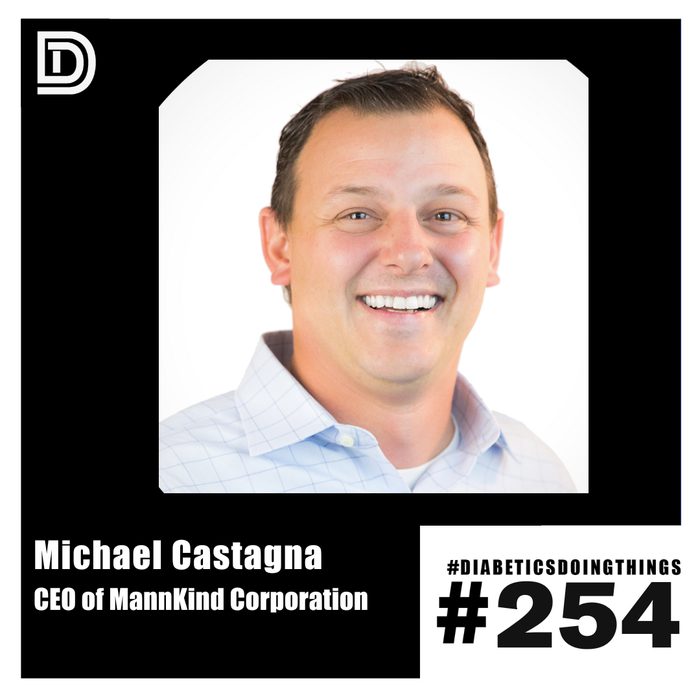
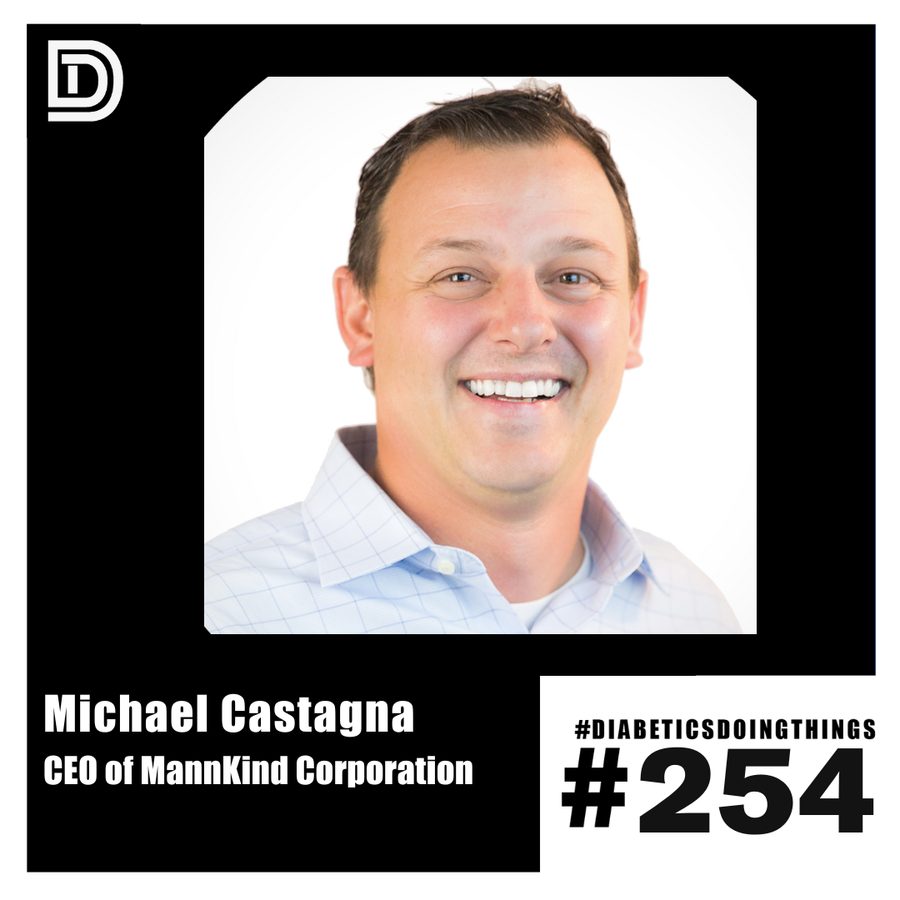
Michael Castagna, CEO of MannKind Corporation

Episode summary
Michael Castagna is CEO of MannKind Corporation and a pharmacist by training who later earned an MBA from Wharton. He describes his path from a HIV drug internship at DuPont to running a pharmaceutical company, and growing up in poverty while doubting he belonged at a top business school. Castagna has type 2 diabetes himself, caught early because he was testing a Dexcom sensor for work before his official diagnosis. He explains why mealtime insulin is usually offered to type 2 patients only as a last resort, how Afrezza's inhaled delivery differs from injected insulin, and why he thinks doctors rarely mention it as an option. He also covers drug pricing, middlemen, and MannKind founder Al Mann's legacy, plus a pediatric trial and pump-switch study due to read out in 2024.
Key takeaways
- Castagna says mealtime insulin is usually the last option doctors offer type 2 patients, even when it's the piece missing from their treatment.
- He says Afrezza absorbs through the lungs in about half a second and, for him, causes less weight gain and fewer hypoglycemic episodes than injected insulin.
- A Dexcom sample he was testing for work caught his blood sugar spike before he was formally diagnosed with type 2 diabetes.
- Castagna says 40 cents of every dollar MannKind makes on Afrezza goes to middlemen, which he says drives up what patients see on the price tag.
- MannKind is running a pediatric trial and a 120-patient pump-switch study, with results expected in 2024.
Show notes
It’s not often that we get to talk to the partners that help us to be able to create this podcast. On this episode, Rob talks to the CEO of MannKind Corporation, Michael Castagna. They discuss:
Being a doctor of pharmacy and then getting an MBA at a top-tier school
Working on the HIV drug that became the first once-a-day one pill regimen
Becoming a CEO of a pharma company could expand his ability to help more people
Having doubts in self-confidence from being a kid who grew up in poverty
Being an expert in two fields
Inhaled insulin still not being widely known
Becoming a patient himself
The legacy of Alfred Mann and the continued mission to help patients
Mission to help patients vs. the money going to middlemen
What’s coming up for MannKind in 2024
More tools and options for patients
Like he said in the episode, if you have access issues - you can get help here to find a doctor or you can email him directly at mcastagna@mannkindcorp.com
Questions this episode answers
What is Michael Castagna's background?
He is a doctor of pharmacy who earned an MBA from the Wharton School at the University of Pennsylvania, then spent his career at pharmaceutical companies before becoming CEO of MannKind Corporation.
Does Michael Castagna have diabetes?
Yes, he has type 2 diabetes. He says he caught it early because he was testing a Dexcom sensor for work before his official diagnosis, and he uses MannKind's inhaled insulin Afrezza to manage it.
Why don't more doctors prescribe inhaled insulin like Afrezza?
Castagna says Afrezza has been on the market for nine years but is poorly marketed, and doctors often default to pumps or injections without mentioning inhaled insulin as an option.
What is MannKind working on for 2024?
Castagna says MannKind is running a pediatric trial for Afrezza and a 120-patient study on switching patients off insulin pumps onto Afrezza, with results expected in early 2024.
Full transcript Searchable, with timestamps
Rob Howe: Welcome back to another episode of Diabetics Doing Things. We are telling the amazing stories of people living with diabetes from all over the world. And we have a very special episode today. It's not often that we get to be behind the scenes of some of our partners who help us produce this podcast and help us create opportunities for other diabetes creators. But the CEO of MannKind Corp, Michael Castagna, is here today on the podcast to talk a little bit about what it's like behind the scenes at a pharmaceutical company like MannKind.
Michael Castagna: Thank you for having us today, Rob.
Rob Howe: your doctor of pharmacy degree that you're a PharmD, but then you immediately went and, you know, pursued an MBA from a top business school, which makes you pretty, that's a pretty rare case. I feel like it doesn't happen too often. So what made you, you know, decide that
Michael Castagna: as a career path? You know, I was in pharmacy school in 1997. I got a summer internship company called DuPont Pharma. I started working at HIV at 95. It's a pharmacy. Wind up working on drug-advocation care for HIV, which became the first once a day walk over eight years later. And I felt that the way, how could I impact the world the best? Was that being a community pharmacist, a hospital CEO, CEO of a pharmacy chief? I knew I wanted to do something to make a difference in the world. And I felt that focusing on trying to become a CEO of a pharmaceutical company would best enable me to help the most people. And I had to look back on my career, It's been 26 years since we changed the standard of care in hepatitis, diabetes, HIV, cardiovascular arthritis. It's been a phenomenal opportunity. And taking things like Omnipod, for example, as one of the things I did at Amgen, brought it over to cancer. People used to come back to the hospital the next day after clinical therapy, and we would put an Omnipod on them for delivering to last of the next day. Changed their life for millions of patients a year. It was great. So small innovations can make a huge difference in people's lives. And I feel like, you know, we spent so much money in drug development. Getting an MBA from a top-tier school at that time, I went out to run at Bristol Myers or Amgen. So I thought getting the best MBA I could, great. Coming from a kid of poverty, I think I could get in. Did I have that self-confident? Was I that smart? I didn't think I would get in. Unfortunately, I did get in. So I had to start over. I'd already had my first-year MBA done at Drexel. But when I got into Penn, I actually had to redo all my classes. I just said a second time I was a little bit smarter around the courses, but it really helped me get a great scientific foundation, great business foundation. Ultimately, in the job I took here at MannKind, I was not the CEO. I was dropped in front of public company. And I would say those skills I looked at my MBA 15 years ago definitely came in handy. I don't know where we are without that background.
Rob Howe: It's very interesting. I think I heard years ago, like when you're an expert at two different things, and I think of a guest that we had on our podcast many years ago now who was a pilot, a commercial airline pilot, and was diagnosed with type 1, got his wings taken away, and then went back to medical school and ended up now just got his class one medical back in the past two years as pilots now are able with type 1 are able to fly commercial aircraft again. But when you become an expert in two fields, like you really become like a force to be reckon with within these different conversations because you can look at things from different perspectives. So it's really fascinating. I think because you have that pharmacist background, on the business side of things, you're able to see things a different way than maybe some of
Michael Castagna: your peers in the C-suite. Yeah. I think I can't name another pharmacist running a pharmaceutical company today. Rarity in that one. I care about the science. I care about patients. I care about customers we serve more than anything. And that comes first. We do take care of the end user of the product. The rest works out well. We provide great products that work for lung disease as well as diabetes. And, you know, I'm really proud of the work that we serve like yourself and others. You're coming on the pilot. I don't know if you know this. One of the very first pilot who got his license back at Southwest for losing it because he had like one diabetes was the president of the patient. oh really i didn't know that he when they passed the law he could not get his time and range under control so he couldn't pass the medical exam and use the Afrezza to help bring him down a little bit tighter so that he could not have the hypoglycemia which is one of the big requirements to be
Rob Howe: certified so the very first pilot that you rule was at a Afrezza patient so pretty oh wow you know for so let's talk about that because you know compared to the other especially you know insulin manufacturers in the diabetes space, like mankind is very small. So when you're able to like see the impact of such a small company, you know, and being able to say, hey, the first pilot who got his class one medical to be able to fly with type 1 diabetes uses your product. Like, you know, how does that galvanize the team and you specifically? For me, it just gives me motivation
Michael Castagna: pushing, right? We don't help anywhere near the upper people we should. And, you know, having a voice to shows like this that help reach more people with diabetes, help us get the awareness to say out, right? Because I think the number one thing for a friend is, I love when I meet somebody and go, inhaled insulin, when's it coming out? I go, it's been out nine years. And they go, what do you mean? And I go, that's how poorly it's been marketed. It's how much doctors don't offer to patients, right? It's a shame that self-care, myself and you include, we should be offered every option, right? There's no reason, whether it's an MDI, a pop-up pod, inhaled insulin, we should be told, hey, any of these can help you, which will best fit your lifestyle. And then that option is often not offered to patients. It's often, hey, I want to put you on a pump. Pick one of these two, and that's all they deal with, right? You don't even know there's three other options. And that's hard because we don't have $100 million to go spend on TV advertising. That's about what it would cost. So for me, we've spent $3 billion to bring Inhaled and Salt to market. It's just mind-boggling how much we still have work to do. We have a lot of work to do to help a lot. but our pharmaceutical industry we're a small company but we're very focused on control if that's the biggest need challenging outcomes better in that case this conversation here is so casual but i it's just okay so i'm remembering a time i was walking in the streets of egypt with my friend who also has type 1 and i pulled out my Afrezza inhaler because i just didn't i just felt like it i was like i don't feel like bolting for this i'm just to take my insulin through my little inhaler and she stood there and was like what are you doing and when i told her she was like this exists and it really brought to mind how like this product seems like science fiction to some people like not even possible so really it blows my mind that not enough people know about it or that it can be accessible to them yeah i was in a comedy club this weekend inhaled by insulin because i was pretzels and the guy goes you can't vaping here and I go, I'm not vaping, it's made, but he goes, oh, I'm sorry. You know, so it's always fun. Like, even on the airplane, I love it. I was flying home and I'm like, I'm going to inhale just to irritate the stewardess. And I know he's going to say something. I'm like, it's my insult, buddy. Get off my case. Well, so it's kind of fun. It raises awareness, but, you know, I was going to be on a flight for six hours and my sugars were 180. Let's get these things down while we're sitting.
Rob Howe: I actually, you know, love to use Afrezza on planes because you're sitting down for so long. And, you know, it doesn't require you as much to as much as some of the other insulins to like get up and move around. People typically frown upon lunging up and down the airline hallway pathway. So yeah, that's, that's when I like to have it as part of my diabetes toolkit. But you also live with diabetes. So let's, let's talk about like your diagnosis as well. You know how it's very rare that we get to have conversations with patient led, you know, because you talked about like, you're a pharmacist, you are, you have your MBA and you're a patient. So what kind of perspective does that give you as a CEO? But also tell us how you came to join the type 1 diabetes family.
Michael Castagna: So I just needed a doctor, and I could prescribe my own medicine. I could fill my own medicine. I'll be all concerned. But no, I unfortunately did not have a father growing up, as many people as all. So by the time I found out who he was, he passed away from complications. So for me, I actually did not want to work in this disease unless I thought I was divided every day. So I finally just got to meet my dad's children, grandkids, and diabetes is rampant in my family, type 1. And so I knew, unfortunately, I was predisposed to get it at some point. I was prediabetic for many years. And I was just fine. Then I got COVID last January. I had my annual physical. I had one for a couple years because of COVID. And my A1C spiked up. So I was like, oh, I guess it's here. And so for me, what I've learned in this field of type 2, the very first thing that goes, type 2 diabetes, is your mealtime control. But the very last thing we give you is your mealtime insulin effect. We try every oral medication, every basal, every GLP, and then you finally fail another 7 to 10 years, and we say, oh, by the way, here's mealtime insulin. You ask yourself, any other hormone disease I've worked in pharmacy, you usually replace that hormone with what you're missing to get back your ecosystem. for type 2 we save it for the very last resort when you ask doctors why is they give you every excuse well it's injectable it causes weight gain it causes hypoglycemia well these are the benefits of a fresa right we don't have as much weight gain we don't have as much hypo and so when you push back on them they don't understand they don't understand the difference around administration what that does to how insulin actually works and changes everything monomerics you inhale it's working where it injects both hexameric. There's all these nuances that doctors have no idea. So my endo literally was trying to get me off of a press. I didn't tell her who I was. And so it was a fun experience when I heard her talk about, I'm like, well, since I started, I lost six pounds. Look at my time and range. It's 90 plus percent. What more do you want from me? The average patient is about 50 percent of the rate. And she's like, yeah, I guess you're doing okay. But this is the problem with the endo community. You as lipid type 1 know more about your body. more about what you need than any doctors that were going to tell you. You need a doctor to get access to the tools. Then with type 2, I find, unfortunately, people are just told they're failures. They're told to change their diet. They're told that you're paying three to five co-pays, and you're not getting anywhere, and your A1Cs aren't. And that's what I told my doctor. I need my A1C to drop a line, dropping Januvia, dropping Metformin. What's that going to give me, 0.2, 0.4 A1C reduction? I need over 1%. What's going to give me there? Real-time insulin. because you can see gym, right? That's kind of how I was pre-diabetic. I was actually working on integrate Dexcom into one of our Blue Health platforms. And I got to Dexcom, I got some samples, and the doctor put it on. And every morning, I take my kids to breakfast and I would get like a bagel and arched. I saw my sugar spike up to 250 and I'm like, whoa, that doesn't seem normal. And that's how I realized, like, wow, I'm not going to do that again. So, C-GEM was very helpful. It diagnosed me before I was diagnosed a couple of years early because it's coming. that's so when i swanked up i wasn't shocked okay i knew it was that's so interesting and
Rob Howe: like so fortunate that you're that you know you were just experimenting on a product that you guys are working on and you know able to sort of self-diagnose yourself i do want to go back on one thing and you brought up a couple of really good reasons but stigma around type 2 people with type 2 diabetes taking mealtime insulin is that just historical from like you know years of bad information from from years past and hasn't quite you know reached the the tipping point of of acceptance now? Or is it the injections? Is it just the weight gain you mentioned? Because obviously many patients with type 2 are trying to target the weight gain or weight loss as one of their KPIs that they're looking to do. Or is it just a combination of all those things?
Michael Castagna: I mean, look, I think, Jack, welcome around 100 years, right? We really got fortunate for us in mankind but but you know we're the only real innovation the last 25 years 100 years of blood slot so fortunately people just never had good control and type 2 and there's a lot of negative halo patient post-changer city communities they're like oh yeah well but he was on it he lost his leg or he went blind and so you know and i had that little uncle i watched you know go blind but he didn't take care of himself right and he's taking his insulin he's testing and a sugar. So there's just a negative perception that, oh, I must be really sick if I need that. And I think we've got to change that attitude, right? About what are you missing in your body? What hormones are you missing in your body? How do you just give that back? How do you really focus on control? When I look at 80% of the population on insulin, type 1 or type 2, are not a goal. Think about that. Four out of five people are not a goal. And that means we're doing something poor because this is this is over 20 years of analog insulin fios pumps sensors all this innovation yet the number has not changed and why is that you're so afraid of hypoglycemia right you're not pushing your dose of insulin and it's a risk of life and death i'm not blaming anybody i'm just stating the obvious which is you know that people are so afraid of inject blitzel because of that balance of overdose and causing hypo and underdose go high you're just a yo-yo all day you know i sold myself i used the i use ghost all times our other product i've used it so you know you can see both and how slow it works how fast things work what i've learned is it's about the raid tools cool box to help you deal with this disease at the very moment to your point on an airplane is one way for me at a company shows different so you know it's really about having all options available to you get the best do to give yourself
Rob Howe: best chance. I like that approach. I think it's unique. I have it. That's the approach that I take is like, just like any consumer product, I'm going to use whatever the best thing for me to help me, you know, live the life that I want to live. And I think applying that to, you know, to pharmaceuticals and, you know, med device is, is sort of a unique perspective these days. But, you know, what can you talk about? Like the, you know, how do we overcome that lack of awareness. Like you said, you know, Airtre mentioned like her friend had never seen something like that. When I, one of the reasons when the team approached me to work with mankind, you know, one of the challenges that I often found when I was sharing, you know, just using Afrezza on social media is that people would talk to their endo about it, but their endo didn't feel comfortable prescribing it for one reason or another. But, you know, what do you think some of those challenges, you know, stem from and how are you guys addressing those?
Michael Castagna: Yeah, I think number one is pivotal trials were done. You know, when you do clinical trials, a lot of the patients come from outside the U.S. for rules, regulations, or on that need. And so a lot of patients in our trials came from outside the U.S. And so there was not a lot of fault leader support. There was not a lot of academic centers experience. And so when you launched the drug, you had no advocate. And then the launch, unfortunately, happened to another company who underdosed the patients. He asked me like the number one flaw in Afrezza is those people did not understand the difference between an injectable insulin and an inhaled insulin. And that's the biggest standing out there, including in our trials. I did a trial specifically to look at proper dose, showing you how we're better than the standard of care. And one of the sites actually underdosed the patients. So they screwed up my trial. When you only got four sites and one doesn't follow direction, you don't get it. You got an OK result. It was going to get a healthy result. and that's a lot of what to me what's the gap in doctors we are now doing our pediatric trial for example 40 centers in the US there's no XUS sites so now we will have every major center participating in our pediatric we're now running a pump switch trial 20 of the top centers in the country that will have the top KOLs behind so now we're able to finally have money and do the proper trials and do the proper dosing and show you how can I get off or did a trial last year. How do I add it for a second? So we are trying to drive the scientific and the nail amongst thought leaders. And those studies are set to read out next year. I spent over $30 million roughly on these two trials just to give new data out there so that U.S. thought leaders actually have the clinical experience, knowledge, real-world evidence that we need to really help continue to grow and help more patients. And so I think next year, We're finally, yeah, we lost money for 32 years as a company until this year. So finally we were hopefully breaking even. We had an operating profit in the last quarter, but if that keeps going, you know, we'll have more money. And then the question is how do you deploy that capital? Do I spend more on a Fresnip or consumer advertising or, or an investment in R&D, right? Make those choices. If I get really good data, like we expect, I think we'll be able to help a lot more people raise awareness better than we ever have.
Rob Howe: Yeah. Thank you for that, that like kind of input behind the scenes. You mentioned, you know, the company not being profitable for 32 years, which brings me to a question of like Al Mann, right. And the founder of mankind, I go basically, you know, and I'm paraphrasing here, but like one of the found, like founding fathers of insulin pumps and diabetes devices, like a man who lived with diabetes and only passed away, you know, a few years ago, you know, when you're a patient yourself running a company with Al Mann's name on it, like, how do you like, How do you bring that infusion of his spirit and brand into the company?
Michael Castagna: Yeah. So I've had the luxury when I started my career, I was at DuPont Pharmaceuticals, which was still, DuPont was a family company, even though we're publicly traded. And then I worked for Serono and then I worked here, and I worked for Merchermann. So working for family-founded companies is very different than working for CVS Pharmacy Part-Time or Amp. They're just different companies. but we have Al Man's legacy his entrepreneurial spirit his can-do attitude his ability to overcome obstacles you know is in our DNA this team has overcome so many challenges this team has almost died three times now we're 1.5 billion growing every year we went from 1 million dollars revenue to 200 million dollars revenue to 200 million dollars after this quarter unfortunately most of us it's not diabetes but we are committed to keep the president of the market we've all been going last year we've all been So we're committed to diabetes and Al Mann, you know, spent $1 billion. I don't know if people realize. We spent $3 billion to get a fresnel on the market. But Al Mann spent $1 billion. You know, he sold the insulin pump in the late 90s. Billionaire. He knew that no matter what you did to the insulin pump, the input was too slow. You know, the insulin can't make it go faster. It's got to be stabilized. There's nothing but anybody can do it. so all the pump logarithms all we're trying to do is manipulate the slow profile we don't fundamentally change which is when it inhaled versus that's why I tell people I can give it a pen, a vial, a pod it doesn't matter, it's the same insulin profile it's the same insulin when you inhale Almea knew that the only way to get faster absorption, faster activity was through the loss there is no way, 100 years at least 50 years there get it through the skin paste it's just not going to work where you get scarring tissue you got adipose tissue resort hexamer breaking out monomer you got so many issues happening that's probably the biggest disperception drop is that i gave a half unit injection my pump or i gave it one unit your your dose is off because of the heat of your skin the scarring skit that close right there's nowhere near accuracy in insulin dose or carb count but that's a lot of people confused by and I think Al-Man was trying to just take away car counting, take away the inaccuracy, just to, you know what, give it, get your sugars under control, not there, give it another hour from now. That's real-time control. I know that 30, 45 minutes, they take enough. You don't know that. I need a heart. Then you worry about stacking going low five hours later. So that's the difference to me about Al-Man's vision. he could see things 20 years ahead of the market he knew in 98 and see jam went like this all day before we had figure six telling us that right so that that's why that guy was so smart such a billionaire the family still owns trustees of the estate still part of mankind so we're still giving back to society all the money we pay them back here they sell they get back to charity chronology, diabetes, cures. That's the city of Hope. Now, I'm managing the pharmacy school as his trustees at USC. So I think, you know, his legacy is so important to what we do. Really drives our mission to help patients. That will never change.
Rob Howe: So I want to talk about that, about the mission to helping patients, because I think, especially in patient communities, the perception of a pharmaceutical company categorically has like a bad public reputation. And I think they see like big, big executives on Senate Judiciary Committees and their ivory towers, you know, hitting PR talking points. So two questions on that. Like, how are you building a culture at MannKind that challenges that status quo of what a pharma company can be? And how do you strike that balance between, you know, that mission and providing value to shareholders and like meeting patients where they are?
Michael Castagna: Yes. I think, look, the first is industry did really dump things in the late 90s, early 2000s that got a bad reputation. And then insurance companies, I think, did not help from mid-2000s, 2005 to 2022 with the PBF market. And so, you know, unfortunately in healthcare, we as patients have to pay co-pays every month. We're reminded about the cost of a drug every month. If I get a knee replacement once in my life that it costs me $1,000, I don't think about it. I got a doctor visit four times a year to get my prescription. I don't really think about it. And so, you know, why don't we have prescriptions that are filled every three months and you only got four copays a year instead of one every month, right? We're reminded every month we pay more and more cost of our health care than ever before. And that's what's happening. You know, if you look at insulin, 70% off the retail price to the middleman, patient paying 20% copay until this year, we're at $35 cap with Medicare. But if the patient was paying 20% and the pharmaceutical company giving away 70%, you're saying, well, I'll pay 20%, I'll call them 200 bucks a month or 100 bucks a month for insulin. Well, what you don't realize is that that price may be $600. We're giving $400 to the insurance company, and you're paying $100 or $200. There's no insurance coverage in that model. You're paying cash, basically, and they're all a little bit of making money. And that's why you saw insulin companies really lower the price of some of these legacy insulin, because all that money was going to the middleman. Right now today, 40 cents of every dollar for Afrezza goes to middleman. You know, 60 cents of V-Go goes to middleman. You know, we don't make any money on the device at V-Go, barely. We make, barely break Steven. Fresa, we've lost money for 30 years. investing. And so that's what people don't realize. You only hear about the AbbVie Humira that makes $20 billion. Well, yeah, that's a fluke. And it's helped lots of people. But it's $75,000 a year in the U.S. and it's $50,000 a year in Europe. You say, how can the same drug cost 5x outside the U.S.? Well, you don't have all the middlemen. And that's the difference, right? And so that's, you know, people don't realize, for example, Medicaid for pharmaceuticals is basically free. We wind up giving almost 90 cents back on the dollar to Medicaid in five years. Once the drug is law, just go that way with the formula. And so who pays for all the Medicaid scripts? We do as commercial insured patients. Our insurance pays. So we got to subsidize the cost of the government insurance when it's basically free for 10, 20% of your sales. The only way you give it for free to the government is because you're worth commercial. So drug pricing is so confusing for everybody. We just try to, as society, we say, why pay the pharmacy? It's expensive. The drug companies are, I get it. I'm a pharmacist. I've seen it. I've had patients come to me saying, which drug do I take? I can only afford two this month. Well, you're on five. Yeah, I know, but I can only afford two. So much of compliance is related to the co-pay, the call share. We saw it this year when the president became $35 on Medicare. We had a huge jump in sales because our Medicare patients were getting hit with $100, $200 a month in cost. We couldn't do anything about it. And we saw that bet. Now our market share of Medicare is the same as it is for Jeff Blitzel. It really caught up three quarters. So we do see that cost does hold back refills, does hold back patients. And that's why the industry gets a bad rep, but it's a combination of the insurance industry, the nature of the healthcare system in the U.S. The industry did a bad thing, but I think the industry's really picked up its act and it doesn't deserve of the reputation. You look at COVID, how many people, lost a lot of people, but because of this industry, we also saved a lot. I think about cardiovascular disease, hypertension, genetic, rare diseases. I mean, you know, done a tremendous amount of work. Now, I will be the first to tell you on insulin, it's a 100-year-old product. I used to spend it for $20 a month at CVS 95, and that same vial was $450 a month 20 years later. Why? There was no more innovation, right? That is why we got a bad reputation. So I was really happy to see that those prices were being reduced. That is the right thing to do. And hopefully it starts to change to another percent. People play about drug stockouts. Why are they always stock down? Well, part of that is because when things go generic, generics only care about making a hard job. They don't care if the patient lives or dies. They just care about making money. And so brand companies, we live, say, every patient every day. I have another drug that we make for another company called It's a rare disease. People need it. It's a high blood pressure and if they don't get it, they die. Literally, they die that day. So we can't stock out. We've got to make that drug reliably consistently. They depend on us to live. If that drug goes generic, the generic company says, well, it's also making it cheaper. I'll just stop. And then they stock out. The other one stocks out. Who's left? right that sucks we're seeing that cancer today right so many people not get proper cancer unbelievable my mind is richest country in the world we can't get stock cancer that's hard that that's just nature of the system people don't realize in the u.s 80 percent of your sale 90 percent of your sales when a drug loses patent go away 90 days think about that you may build this market you spent two three billion and once you lose your patent, within 90 days, you lose 90% of your sales. In other countries, that doesn't happen. You have a lower price. Generics compete with each other. The brands compete with generics. The generics have sales forces, believe it or not. No, it's a completely different healthcare model outside the U.S. than in the U.S. And today in the U.S., unfortunately, wholesalers make money. The pharmacies make money. The PBMs make money. That's the freedom of beauty of the U.S. It's also the curse of the U.S. People come here because they've got an entrepreneurial spirit. We like our freedoms. We don't want to control. Other countries have socialism and other things. I don't know what the right answer is. I wish I had. What people don't realize is there's $300 billion discounts off drugs to middlemen. That is not profits, of course. That is employing nurses at hospitals. That is paying for pharmacists in pharmacy. It's paying for the distribution of the drugs around the country. Subsidizing the entire U.S. medical infrastructure. And if those 300 billion rebates go away, we got to make up that money somewhere else. Right. And doctors don't want to pay cut. Labs don't want to pay cut. I don't know what the real answer is, unfortunately, because it's not an easy one. But the way the U.S. health care system is built is honestly all of drug pricing.
Rob Howe: That's unfortunate.
Michael Castagna: It really is.
Rob Howe: And I think it is challenging, you know, so much of our identity here in the West and the United States is, you know, you come here with, you know, pennies to your name and, you know, find a way. We have all these American dream stories that are well-documented, yourself included. It sounds like where you can be your own man and make your own way. And at the same time, both things can be true. It can be really difficult and rigged. And also, the opportunities are still there for some as well.
Michael Castagna: I love this country because you can literally come here, come with nothing, make sense of yourself. I also see the deficit. You get lost in the ecosystem of government or mental health. You can't get out. You can't get out sometimes. It's really hard. It sucks. People struggle and they can't get through those struggles. My uncle lost his license. I was talking about it. The number of fines he got just to get back his license at 67 years old. He doesn't come up with $10,000. This guy doesn't have money. He's all disability. He doesn't have 10 grand. Now he can't go to the store. He can't get his food. He's got to rely on people. He's just stuck in a negative rut. It's really hard. He made bad choices on his life, but he's a good human being. But fortunately, the system penalizes you. It's hard to get out.
Rob Howe: Yeah. I didn't anticipate quoting Tupac Shakur, but he said, America eats its babies. And I think that's well documented. So, well, thank you for that perspective. I think, like you said, the healthcare system is confusing. And I think there's just so many elements to it that even people like myself don't fully comprehend or understand, but it's nice to hear somebody who really has a unique perspective and insider track on what's going on there. So I think as we kind of wrap the interview, I really want to know what's exciting to you from mankind and what can we share with patients and our listeners about what to keep an eye on from Afrezza or V-Go and otherwise. You mentioned the studies that are happening currently, pediatrics as well as pumps. And what should listeners, be on the lookout for for mankind in 2023 and beyond?
Michael Castagna: Yeah, look, I'm super excited. We don't have the results of our pediatric trial, but my dream is that we know most type 1s are diagnosed at 8 to 12 years old. I have a vision that one day a newly diagnosed child will start to heal insulin and hopefully be on it for their life, right? Show that they have to be subject to injecting three or five times a day or the highs and lows that their parents worry about. Now we can really get the great control because a lot of kids today, you see, A1Cs are worse today and kids were 20 years ago. That's crazy. These are the top centers of the country. We have horrible A1Cs. Children, I think as much as we love technology, I also see that people are waiting for their alarm to dose their insulin. They don't want to go low, so now they're going high for it. And we're seeing A1Cs go up. We got to teach good habits for age. So hopefully we see these results in the kids' trial. And we know that there's a huge barrier around bias towards, hey, you must only start with a low pump. really want to provide more patient choice. That's our hope. It started with kids. We look at Al Mann, right? He built a pump market in the 80s, 90s of kids, turning the 2000s into adults, really helped bring in new innovation around Medtronic and Tandem, iPod, you know, all those amazing tools for patients. If Al Mann didn't make those investments in the 90s, we're where we are today. And so I think InnovationXCOM is another one. Started with kids. CGM was throughout 10 years before it became popular and boom, everyone, you can't imagine life without yourself. So I think for me, it's really showing the innovation of children getting started, scaling up the stealth. V-Go, we bought last year. It's a great device if you have type 2. We actually have about 10% of people who are type 1 on it. But for type 2s, it's a main device that just, you set it, it's on you, just click. You don't have to worry about carrying your insulin, you don't have to worry about click it a couple times and because it's a more efficient way it delivers the basil over 24 hours one bowl is all at once which actually makes your overall insulin down because when I used insulin I actually salt myself I was on a diet this year no carbs no carbs, like nothing and I lost about 7-8 pounds and then I went on injectables and I gained like 6 pounds in 3 weeks like whoa what happened and i just i didn't i can't explain why we just know injectable causes weight gain and doctors always get their mind boggled like why does their present not have that effect i was always on Afrezza i was never on injectable insulin so i won injectable insulin I switched to V-Go i would never notice anything but because i added injectable i noticed that weight gain right away and then i came off and i lost the weight right away it's kind of the
Rob Howe: weirdest thing in the world but well it's it's it really is i think we're we have another interview you later today talking about type 1 and exercise and how, you know, diet culture and specifically around women with diabetes, it can be a very challenging relationship with insulin because trying to keep your numbers in range, you need more insulin. And in the back of their mind, they're thinking, well, if I take more insulin, I might gain weight and I don't want that. And that can lead to really challenging eating disorders. And, you know, just balancing those things again, back to the mental health strain of diabetes. It really is a tricky situation.
Michael Castagna: If we have a patient who used to work for us, I won't say her last name, a person who was Cynthia, you might know her, she's out there. She had suffered from diabulimia for many years and the Fresa really gave her a cure alcohol for her. She was so worried about eating and gaining weight and it was a negative cycle that the Fresa made her not gain to weight and make control and eat healthier. And she went from that stage of really depressed to success to having a baby, which was so great to, you know, watch her go all the way through that journey. And that's really where I want to get to next is how do we get to gestational diabetes? And we know doctors are using it in pregnancy to help for a population. You know, the variability that happens in pregnancy is very dangerous to the child. That's what's there. Then we got the, we're doing the pump switch trial this year. So last year we did a trial, adding Afrezza to your pumps, switching off your pump with just Afrezza, but we're staying on your AID system. and in that study we showed you can use it any which way you want to stay on your id you want to switch to a fresa you want to add a fresa you've got the same outcome regardless there's a short study small plan but we we show that you don't need to be attached to this right that was our first thing how do you do it how do you dose it and what we learned in that study was people they get the basal right and so that's a big change they're so used to your pump getting insulin all day that basal become the different ratio of mealtime control so we learned from that study. Now we're applying that. We're doing 120 switch study this year where we're going to show you if Afrezza versus best standard of care you want is hopefully as good or better. That study will be out early next year. We've kicked it off in July. We're already one third of all the first five weeks. It's going really well. People are super excited or super excited because it'll be done by this year. We'll have those results early next year for ADA. That will be the largest pump switch trial ever done by the lining. I've been looking for data. you find it let me know but there's very little data showing you how to switch off the puppets a lot of they show how to use a pop so we want to show you how can you safely use traseba president hopefully do you have better time and range do you have better a1c do you have better freedom or watch quality so those will be the two big data sets next year is the switch trial and the peak both one we've done a lot of data in type 2 i'm not sure how much more data we'll generate there. But otherwise, we'll be over the next 20 years. We got lots of patents and IP. Amazing product, as you know. Thank you for your support and having me today. Anything we can do to help patients, anything, questions people have. You know, one of the things we always know as we close out here is people worry about lung safety. It's delivered that way. And I just want to close on, you know, it goes through the lungs like your oxygen. These are micron particles. They don't, you know, there's an old inhaled insulin years ago that was a sugar-based mannitol formulation, the lungs get absorbed. It's a very different profile. Just because something is inhaled doesn't mean it's the same technology. Our technology is to inhale in a half a second, it goes from the inhaler into your blood. People think, oh, what if I'm sick? I remind people, if you have tar-covered lungs, you still get nicotine, you know, still get your Afrezza even when you're sick, you know, of a respiratory infection, etc. So it's really important. Yeah, she may need more insulin if you're sick. That's not for all of us. But you still get your dose. you still get very consistent delivery. People just don't realize your lungs are hamptesized with tennis courts. So you're spreading all that it's, or a large surface area versus you inject in one little spot, you can absorb, display it. And so that's getting your blood very rapidly and the lungs are just a wonderful way to treat certain. It's just a new way to think about drug targeted delivery. So we have five drugs all delivered through lungs. We have to do where a lung-based delivery company and people should feel good. It's been on the market nine years. that let us go to kids and it wasn't safe. And there's three ingredients in the product. It's water, which I know we pay a lot of money to purify. It's FDKP, which gets excreted 100%. And the third ingredient is human insulin. I always joke and say, which ingredient are you afraid of? Because the human insulin the body likes, the water we know, and the other one is 100% excreted. It doesn't get absorbed. So it's a relatively pretty doculous product, I'll say. It's how we change delivery. People say, well, how does that work? If you're in a dip and dial ice cream, probably have the largest big dot maker world we we freeze dry that insulin environment as soon as you do long it disassociates it goes right into the blood so it's all about how do you stabilize it form so that if you get into the blood it cause issues right in terms of breaking down it's like that it's stable yeah i've i've heard
Rob Howe: patients who have been on insulin for you know 20 plus years and struggle with you know insulin absorption, really high insulin to carb ratios, and they're able to get much better absorption and much better ratios on Afrezza just because of that absorption.
Michael Castagna: So any questions you have here on the inside, reach out, public on LinkedIn. People can find me. We're happy to help as many people. Anyone who has an access issue, email me personally, mcastagna@mannkindcorp.com. Or I think MNKD is our stock symbol, but we want to make sure that we're here to help but for patients, access issues or a doctor issue. There's a find my doctor on our website. We found that many docs have never prescribed more than one or two people. They don't know how to write it. And so it becomes a challenge. So we have that on our websites, find doctors who actually know how to write. And so we try to go every weekend to help as many people as we can. This is a good, seamless experience. And just to close out this year, one of the things we did is we lowered the price. So if you don't have insurance or you're over, you're high deductible, it's $100 a month. So as you know, you pay more than that for your insulin supply. So, you know, we don't want that to be the excuse. We know 80% of people get covered in partial Medicare, but there is about 10 to 20% that do have problems. And so we lowered the price cash pay for $10.
Rob Howe: And I'll actually, you know, piggyback on that. So I have commercial insurance, but my insurance won't support more than one rapid-acting insulin. And I use that cash pay program and it is really straightforward to use. and the pharmacy that delivers it. They called me. They said, hey, this is what it's going to cost with your insurance. It was pretty high. Then they said, hey, we've got a cash pay program. When do you want to do that? I said yes, and I had it the next day. So it really does work.
Michael Castagna: Great to hear that. Thank you for that. It's working. We've determined the price of a Starbucks today is a fair price per Afrezza. It'll fall before that. We spent a lot of money to bring this innovation to patients, but that's what we've determined. We think it's a fair price. We've also lowered the price of V-Go. We'll need to buy that for cash. five hours a month. So, you know, we're not making money on those programs. Patients have access.
Rob Howe: Well, Michael, thank you so much for the time today. It was really great to just to hear your perspective, both as a patient and as, and as a leader, you know, in the pharmaceutical space. So thank you as well for your support of Diabetics Doing Things. You know, we're, we did two in-person events this year because of the support that you guys brought for the first time. So we're, you know giving back to the patient community and just appreciate you guys believing in us thank you keep
Michael Castagna: doing what you're doing get the word out raise awareness break these together keep doing it
About Michael
Michael Castagna is a doctor of pharmacy with an MBA from the Wharton School, and CEO of MannKind Corporation. He lives with type 2 diabetes and uses MannKind's inhaled insulin, Afrezza, himself.