

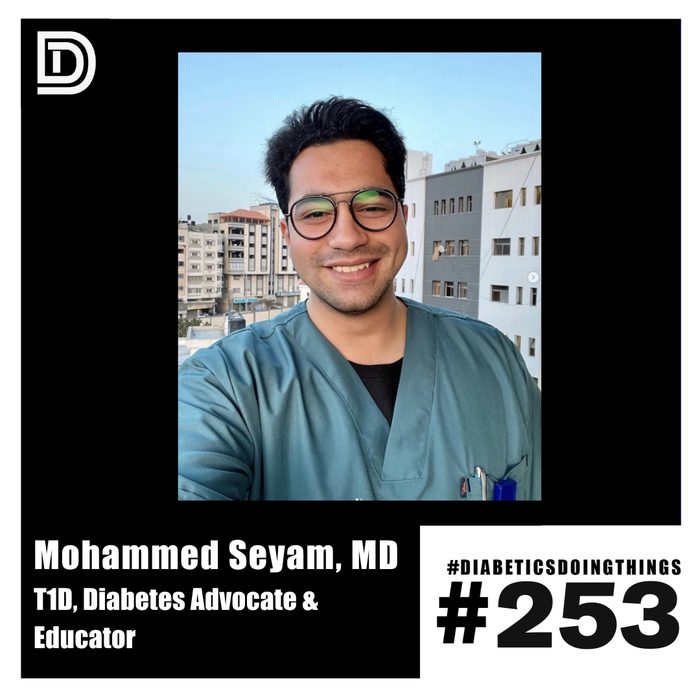
Mohammed Seyam, MD - T1D, Diabetes Advocate & Educator

Episode summary
Mohammed Seyam is a medical doctor from Gaza who has lived with type 1 diabetes for 13 years. He talks with Rob and Eritrea about diabetes stigma in Arab and Islamic communities, growing up without steady access to insulin, test strips, or electricity, and the choice families sometimes face between food and medicine. He describes managing his blood sugar through the 2014 and 2021 attacks on Gaza, and explains how stress itself becomes part of diabetes management during crisis. Recorded on October 18, 2023, during the current siege of Gaza, the conversation also covers humanitarian aid blocked at the border, the scale of civilian deaths, and concrete ways listeners can act through the Diabetes Humanitarian Aid Coalition.
Key takeaways
- Mohammed says Gaza has typically had only 8 to 10 hours of electricity a day, making it hard to keep insulin refrigerated.
- Mohammed says families in Gaza have sometimes had to choose between paying for food or buying insulin out of pocket.
- Mohammed says stress itself raises his blood sugar, so staying calm during attacks is also a way to conserve insulin.
- Eritrea says the Diabetes Humanitarian Aid Coalition's action platform lets anyone email their representatives in a few minutes.
- Mohammed says the World Diabetes Foundation estimates more than 300,000 people are living with diabetes in the Gaza Strip.
Show notes
We are lucky at Diabetics Doing Things to have friends all over the globe. We are very lucky to have friend of the pod, Mohammed Seyam, on this episode. Mohammed has previously done an IG takeover for Diabetics Doing Things, and has written a blog, which you can read here for a perspective of Gaza in 2020.
With Gaza under siege, we felt it was important time to bring him back.
Rob and Eritrea talk to Mohammed about:
Diabetes in the Gaza Strip with limited resources and limited support
The perception of diabetes in the Arab community
and the pledge to end diabetes stigma and misinformation
The fear of being a burden that happens to people in all cultures
The connection of the diabetes community that transcends culture and background
His diagnosis story
Finding the passion for advocacy, changing systems, and not just being a “normal clinical doctor”
Growing up in Gaza without access to diabetes technology or supplies
The challenge of storing insulin with frequent power cuts
The choice between food and medicine
Stress and lack of consistency when managing diabetes
Understanding that anyone of us could be in a moment of crisis, and compassion is crucial
The current situation in Palestine and how to help
http://www.diabeteshumanitarianaidcoalition.org/
Thank you to Mohammed for reminding us that positivity shines in the darkest of moments.
Questions this episode answers
What is it like to manage type 1 diabetes in Gaza?
Mohammed Seyam says Gaza has limited insulin access, frequent power cuts that make storing insulin difficult, and typically only about 8 to 10 hours of electricity a day.
How does war affect people with diabetes in Gaza?
Mohammed says that during the 2021 attacks, the main primary health care center in Gaza was bombed, cutting off access to insulin and supplies for weeks, and that stress from the bombing raised his blood sugar.
Why is there stigma around diabetes in Arab communities?
Mohammed says diabetes is often treated as something to hide, especially for girls, with misconceptions that it affects marriage prospects or children, and that cultural norms around modesty discourage talking about it openly.
How can listeners help people with diabetes in Gaza?
Eritrea points to the Diabetes Humanitarian Aid Coalition's action platform, which lets people email their representatives directly, and notes that thousands of letters and petition signatures had already been sent.
Full transcript Searchable, with timestamps
Rob Howe: Hello and welcome back to another episode of Diabetics Doing Things. We are telling the amazing stories of people with diabetes all over the world. And when I think of all over the world and I think of the global reach that we've been privileged to have access to at Diabetics Doing Things, one person in particular stands out to me as just very different than the rest. both because of his positivity and kind and giving heart and also his story. And that's Muhammad. So Muhammad Sayyem is here. He's today. We're going to talk a lot about his life in Gaza. And as we are recording this on October 18th, 2023, obviously the Gaza Strip is currently under siege. And every day there are, excuse me, and Dr. Muhammad, I didn't even give you your proper credentials, but Gaza is currently under siege. And, you know, we're seeing, you know, the terrible reports coming out every day. So we felt it was especially important to invite him back. Some of you may remember him from his takeover in 2020 and his blog in 2020 as well. and just talking a little bit about what it was like to live in Gaza with diabetes. But Mohamed, welcome to the show. And it's lovely to see you. And thank you so much for giving us your time. Thank you so much for having me.
Mohammed Seyam: Thank you for the introduction. It's absolutely a great pleasure of mine to be here, to talk to you, of course, and meet you for the first time. I met Eritrea. Thank you, Eritrea. I would love to meet you again. and hopefully I'll meet you all very soon in person, of course. So yeah, thank you for mentioning the doctor thing. I don't really like being called a doctor. That was that. Because I'm not really into the clinical side of medicine, especially when people now listen to the story of Mohammed, the story of me with diabetes and advocacy. I'm not really into the clinical side of medicine anymore, but yeah, it is. It is where it ends. So yeah, I'm Seyam. I'm from Gaza, Palestine. And I've been living with type 1 diabetes for almost 13 years now. And as Rob mentioned, I've graduated med school. I am a young leader in diabetes. and I do like representing my country in anything related to diabetes. And since my diagnosis 13 years ago, I was lucky enough to find enough support from my family and from my surroundings to lead a comfortable life living with diabetes. That's on the family side. But it's also important, or it was important for me to educate people about me to understand my situation and to help me if needed. And that kind of bloomed when I got into med school. I thought of myself as a doctor and I thought that it would be really important for me to tell my friends, my fellow medical students, how they can support me if I have diabetes or if I have any emergencies. And lucky me, the first person I was talking to, who seemed was also a diabetic. And the story behind him telling me about his diabetes also inspired me to move more forward, of course, with the advocacy, because I was the first person outside of his family to know that he has diabetes. And for me, him telling me that or him having the enough courage and pray to tell me this made me think that, oh, it is important for me to be a voice. And it is important for me to understand others, to understand how they feel. How can I support them? And that's how I became a young leader in diabetes. And slowly into it with my journey into med school, I kept doing and supporting the student association with a lot of activities related to diabetes. And yeah, it's not just a normal journey, as anybody would say. Diabetes in the Gaza Strip is different. Diabetes in an occupied territory is different. And diabetes with limited resources and limited support is different. The Arabic society in general and the whole Middle East is known for its kind of discrimination against diabetes and not understanding diabetes. And that also gave it an extra burden for me because I had to not only educate myself, but I had to educate the whole community, even doctors themselves about diabetes and about living with diabetes and how important it is for people with diabetes to do different things in their lives.
Rob Howe: in order to stay healthy, to stay fit, and to manage their condition. I'm glad you brought that up. It's not something we've talked about too much on the podcast recently, is the cultural differences of acceptance of diabetes within different parts of the world. And so, if you don't mind, I'd like to just, for our audience, kind of talk about what the perception of diabetes in the Arab community is like and how much education we all have to do. Because as Eritrea knows, we took a pledge to end diabetes stigma. And as part of that, we've got to talk about some of the uncomfortable things throughout the world.
Mohammed Seyam: Well, if you don't know, but I'm ready to paddle the responsible for the pledge to end diabetes stigma. So yeah, it's really important to talk about it, especially again in an Arabic culture. So generally, people think that diabetes, of course, in some countries, such as Egypt, where people think that diabetes can be contagious, which is really bad. But in my culture, in Gaza, it's not. But yet still people think that diabetes is a symbol. That's something that you can't talk about. It's something that you cannot share. and the general view of diabetes especially with women or with girls is just on a different level that oh you can't get married because you have diabetes your children are going to have diabetes because of you having diabetes and this makes it really hard for people with diabetes to talk about their diabetes or or just to you know mention just the hinge of positivity about their diabetes because everybody's going to attack them for their diabetes nobody's going to support them And when we can't find that comfortable zone with our doctors, with the people who are supposed to be supporting us, then we'll never be able to find it with the community. and also same level if we can find it with our families if our families are not supportive sometimes you don't know how to be supportive and sometimes cultural barriers play a major role in how your family can support you when you have diabetes then I'll definitely not be able to talk to the community about my diabetes because nobody wants me to talk nobody's supporting me And that is something that, of course, negatively affects people living with diabetes and the Arab culture in general, especially in Gaza. People can't talk about their diabetes. People can't do anything about their diabetes. So they just keep it to themselves and have worse management. And that's something that we can assume maybe nobody in any story when somebody talks about diabetes. I went to a restaurant with my friends, but I can't take my insulin around them. So I just go to the bathroom to take my insulin, which is like, why would you do that? It would be, instead of us thinking this way, it would be a great opportunity for you to educate your peers about your diabetes. If you took your insulin shot in front of them and told them, why do you take insulin? How proud are you for taking that insulin in front of them? because that's what's making you alive. And you have to share your story in that way.
Eritrea: I think in Islam, there's a thought process of modesty because I didn't grow up in an Arab country. I just have a baba. And I remember in restaurants, if I was going to take my insula to the table, I'd be like, take this to yourself. Go to the bathroom. Don't put the rest of it. I think there's a thought of, especially in Islamic culture or even just Arab culture, if something's happening with you, you're supposed to kind of just keep it to yourself. and that's just kind of how it seems like we're groomed in our society in our culture to me kind of just give to yourself be quiet Allah will take care of you I'll dig it even deeper I don't
Rob Howe: think it's totally unique to to Arab or Islam I think being a burden to other people is something like a deep-seated fear that many of our you know families and parents kind of like put on us as kids or we just adopt from their behaviors because that was something, you know, there's a couple things I want to hit on from what Muhammad shared just now about advocating for yourself. I was speaking at an event over the weekend to mothers of kids with diabetes and talking about, you know, self-advocacy. And, you know, and I remember for the first 10 years really of my life with diabetes, my entire viewpoint was to not be a burden on other people and for people to not worry about me and just treat me normally or allow or let me do what I wanted to do and so I think everybody grows at that at a different level and I think it's what's interesting to me about your story in med school Mohammed is that that that's also in a classroom was the first time that I publicly in a small setting talked about my diabetes. And then what that led to was someone in the class who had a younger, I think he was a nephew with diabetes who had just been told he couldn't run a triathlon by his doctor. And then I don't know if I've ever told you this Eritrea. So this is a big reveal for the pod, but, um, I was on the basketball team and he knew that. So I sent an email to his, um, to his nephew. And then like a year and a half later, I get this random email of this with no like subject line or anything. And it was just a photo of him with a participation medal running a triathlon. And so like, you never know, like the one like, and I think about that still, I had forgotten about it recently, but I remembered the other night. And so when you find somebody and when you're open and you advocate for yourself, and then there's someone else there, you empower them to open up about themselves as well. And that's, I think, where you start to really build momentum. And that's something that I think is across cultures, across language, that's a connection of diabetes community, not in the way that we think about it online, but like true connection and acceptance. And that is really where I think some of the magic happens of seeing other people in the rooms, ideas of what life is like with diabetes
Mohammed Seyam: start to open up and start to expand. Yeah, yeah, I totally agree. And I think this is one of the core things that makes the diabetes community around the world one of the strongest ones and the well-connected and united ones. Because it would be really easy for you to understand each other, even if you're from a different culture, from a different point in the whole world you've never met before, but you still understand, you still support, and you still be able to give because of how you feel towards the other person.
Rob Howe: I totally agree. So we talk about this on this podcast quite a bit. Like, let's talk about the 13 years ago, you were diagnosed with diabetes, like leading up to your diagnosis. And also, you know, we have heard a lot of diagnosis stories from around the world, but we haven't heard one about from Gaza and being diagnosed with diabetes in Gaza. So talk to us about what that was like and, you know, how your what your diagnosis experience and your sort of onboarding to the world of diabetes was like.
Mohammed Seyam: Yeah. So I was 11 and for an 11 year old, it's kind of hard to understand what diabetes is. And I did not understand what diabetes was for back then. I started losing weight, of course, going to the bathroom a lot. And in one of my classes, I've asked my teacher to use the restroom twice in like 30 minutes. and he was like, Mohamed, you're supposed to be one of the brilliant students here. Why would you leave the class? Because usually the norm, you'd think, oh, you want to skip the class. But I don't want to skip the class. I have to do it. And it was really weird for me because I also used to bring that big bottle of water with me to the school where other students would just get the small ones, the half a liter one. And it was like, how can this be enough for you for that whole day? It was just really weird for me. And when he asked me, when my teacher asked me that, I don't know, I really need to go. And he said, get yourself checked. And I went back home to my family that day. And lucky enough, my uncle was visiting. He was a doctor. He's an orthopedist, nothing related to diabetes, but he still understood what's happening. And he was a little bit worried when I told him the story. and he told me you should get yourself checked first thing in the morning. And next morning, very early, I went to do a lab, a very close lab, so I got myself checked and I was diagnosed with diabetes. And the technician told me they have a phone with you so you can talk, so you can talk to your mother. And I was like, yeah, can you just talk to me instead? And she was like, no, no, that's okay. Don't worry, you're fine. I just need to talk to your mother. And I gave her the phone and I could literally, like I could hear her from the other world telling my mom that your son has diabetes and you need to do something about it.
Rob Howe: So you went to the hospital without, just by yourself? No, I went to a lab next to us. It was just a private lab.
Mohammed Seyam: But then, so my mom told me just to go get dressed to school. I was going to school later. So my mom told me to go get myself dressed to school. I did not understand what to do anything. I went to school at like half an hour into the first class. The first, yeah, first class. My dad came to school and he told me, you need to come with me. What's happening? And he's like, well, we need to see some doctors at the hospital. We need to do some tests and we need to make sure that how are you feeling? Because there are a few problems happening. and he still did not mention diabetes to me. And when we went to the hospital, we saw the doctors and I vividly remember how things were. The doctors started to talk to me about a healthy lifestyle, giving me a glucometer, but still without, you know, teaching me about diabetes or I did not really know what, again, what's wrong with me. and it kept happening this way and I went back home without again understanding what diabetes is and I think I think my family because both of my parents really don't have a medical background or something to understand diabetes deeply through through their profession but they still wanted to help and that's the good thing about how I grew up with diabetes my family wanted to support even if they didn't know how to, they would still ask, what exactly do I need? How can we support? They would still ask people living with diabetes for their experiences. They would still be with that they know from a medical background and understand from them, how is it to live with diabetes and how can we support our child with diabetes? And that is something that made my life much better. And it made me understand in a younger age, what diabetes advocacy means and what it means to support others with diabetes. And I think it took me like two years to start getting my immense and a child's benefit. So they really helped and supported with that a lot.
Rob Howe: So I want to, I want to talk a little bit about that, like finding that community. And like, is that just like, because what we talked about earlier, there is a stigma and there is a cultural choice really to be, to hide or bear the burden of diabetes in private and keep it private. Was it just friends of your parents that they knew and they said, hey, this person has diabetes?
Mohammed Seyam: And very close friends. Yeah. It was not that public back then. Yeah. They were so following, they were really being cautious with, you know, are we going to tell people about our son's diagnosis and all this stuff. So it was really close friends back then. But they did not make me feel like they're kind of hiding something. Especially that when, because the people are visiting your home are mostly your relatives and your close parents, friends or your close friends. So I kind of felt supported because those are the people who are visiting us. They know that I have diabetes. They talk to me very well. So it was kind of normal for me to grow up thinking that diabetes is normal. and I can talk to people about diabetes. But the turning point was, again, joining med school. Because at that point, I thought that, okay, I'm going to be the voice of this. I'm going to be someone who supports. And I'm going to be a doctor. So I have to understand my condition way more than I used to so I could actually support myself. Because, you know, I felt it from a different perspective, from that perspective, and also from the perspective that, oh you're going to be a doctor how are you not understanding your condition your own condition and was seen sorry earlier it kind of influenced me to keep going to make a wider and way more positive impact to to the people around me to my community to to the point then yeah i'm
Rob Howe: currently not even in gaza yeah so how did you choose medicine how did you land it or did your
Mohammed Seyam: diabetes definitely not diabetes no a lot of people think that i get to medicine because of diabetes but no mike isn't with an ortho and i loved him he was kind of my role model in life and he still is and and and i loved him to the point like oh i want to be a future also and i want to mix ortho with with diabetes and it came this way until 30 years of medical so back home is six years so halfway into my med school i still wanted to be an ortho But when COVID kind of hit so hard and we got introduced to the online community and we started talking about online support systems and online support sessions and started talking to Serene, you both know Serene, and the positive of the glucose community. And I was like, oh, I love diabetes and advocacy and I love what I'm doing. I don't want to be an author. And Serene was like, oh, it's okay. You could be an author, but kind of not mixed with your profession and your passion. But later on, I did not want to mix. Diabetes is my passion. Healthcare generally is my passion. And I want to do that. I don't want to be just, sorry, but just a normal doctor in the hospital and treating one patient with a salim. I want to be something way more than that. I want to change systems and I want to influence people to lead better lives instead of just being the normal doctor in the hospital. So that's my story behind not being a clinical doctor.
Rob Howe: But yeah. I do think, you know, the name of this podcast is Diabetics Doing Things. And we've had a lot of diabetes educators, endocrinologists, and just doctors over the years who were inspired by their diabetes. But I also think it's important to, you know, follow your, whatever path you choose for yourself with your diabetes because that way someone in the future with diabetes knows that there's an ortho with diabetes out there who you know is doing what they want to do and if that's possible for them i do want to dig in though a little bit because you were diagnosed i'm just doing the math here 13 years ago 2010 11 from 2011 so february 11 so between now and then things have not been consistently safe in Gaza. And there have been, you know, 2014 in particular, and also just various times throughout the years. As you are growing up with diabetes, it's not a predictable schedule. And there, it's also, you know, the unforeseen, you know, challenges and with the occupation and weather attacks and other things. Talk to us for our community members who don't really know what it's like to grow up in a, grow up in a place like that, but then also navigate that with diabetes. Because, you know, we think in the West, it's annoying to go to the pharmacy where there's a long line, but we don't have any roadblocks. We don't have any checkpoints. We don't have, you know, military police preventing us from running our errands or harassing us. So, you know, for those of us who don't know what it's like to live under occupation, help us understand.
Mohammed Seyam: Yeah. So yeah, living, generally living in Gaza is tough. And Gaza is really known around the world for being an open-air prison. It's been under siege for the past 16 years. That means that Israel controls everything going in and out of Gaza. That's literally everything. food, water, supplies, people. And if you want to leave Gaza, you'd need a permit to leave Gaza. That's what, that's the problem. For example, in my case at the moment. But yeah, living, the idea is the community down there is really well-connected and supportive. And it would make you feel like you're always welcome. You always have friends and you always have people to play with. You always have people to share your time with. And that's really supportive. that that's why i gotta miss my childhood because i really enjoyed my childhood and whether it was in gaza or in any other place in the world i think that i have had um a good childhood despite the fact that uh it was really hard because of different escalations attacks in gaza and even the fact that maybe somebody's gonna go for example anywhere in the weekend uh you would be able to do that because you just can't leave the city you're you're there and you can't leave and And to put it into complex, Gaza is just, where the whole Gaza Strip, not only talking about Gaza, because the Gaza Strip has five cities. And the whole Gaza Strip is 365 square kilometers. And that's really small. That's even, the whole strip is smaller than, I don't know. I'm in London. It's like London is six times bigger than that. So it's really small. So you can't go anywhere you want to go. So it's really kind of, again, hard to do that. No, yeah.
Rob Howe: I think for our U.S. listeners or even Texas, it's like the size of DFW Airport.
Eritrea: It's approximately twice the size of Washington, D.C. So like the city, like the city, Washington, D.C. One city, guys, times two. That is the size of the Gaza Strip.
Rob Howe: And District of Columbia is a very small area. Yeah. And you've got 2.2 million people living there at the moment. I think third or fourth most densely populated urban area.
Mohammed Seyam: Yeah. And one of those who has really high unemployment and poverty rates, unemployment is around 52% around the Gaza Strip. And that's definitely higher among the youths because older generation used to be, used to have jobs. And when it comes to poverty, more than two or a third of people in the Gaza Strip live under the poverty line. So it's really hard. And that would give us some context when we talk about diabetes in specific. But living with diabetes in such circumstances and such a problematic phase is like constant stress. You need to cope with everything happening so you can manage your glucose levels. And we have limited access to resources. And that's the norm. I'm not even talking about times of crisis such as the one we're experiencing right now. The normal thing is that, okay, we've never had access to CGMs. We've never had access to technologies. And until 2021, when we actually made something through advocacy, we all used to have vials available for free in the governmental clinics or the other clinics. We have two main healthcare providers. That's the Ministry of Health and the United Nations Relief and Works Agency. Because 70% of the people in the Gaza Strip are actually refugees. Those people... They accused their homes in the occupied territory in the Gaza Strip 75 years ago.
Eritrea: So for context, what that means is, sorry for our listeners, what that means is that people have slowly been being removed from their homes by Israeli settlers, some from the West, some from Israel. and when they're removed, what that means is they are forcibly taken from their home. They have nowhere to go, so they run as refugees to the Gaza Strip within the five cities. Is that right, Mohamed?
Mohammed Seyam: Yeah, but it's not only the Gaza Strip. We've got refugees in the West Bank, refugees in Jordan, Lebanon, Syria, Egypt, and across the world. Yeah. But yeah, one of the main places they're effused to was the Gaza Strip. yeah so i was talking about the healthcare providers so it was only insulin buyers if you want to buy if you want for example insulin analogs you want pens because easier for you is if i want to get to use pens and to try to go around with pens you need to buy them out of your own pocket and they're relatively expensive compared to again we're talking about the gdp we're talking about how how much people get paid it was so we kind of at risk and some people would Leslie Jabba Daw is getting food for their family or getting insulin for the children.
Rob Howe: We're talking about the norm. Right. This is, and this is during normal times. And I think during normal times, this is how I lived my life with diabetes. Both of my parents worked.
Mohammed Seyam: So they were able to get me insulin analogs when they need. They were able to buy me test strips when I need, because you can't get test strips from any healthcare provider. And there are, for example, some charity organizations that provide children with diabetes test strips. On the road, can get insulin analogs for children under the age of 18. Some test, sorry, some insulin analogs. But generally, it is hard to access these things. And it's hard to destroy them, for example, because we don't have constant, that's again, the norm. We don't have constant electricity in Gaza. You got power cuts, It's all every day you've got, because you only have like eight to 10 hours of electricity per day. That's the best you could get. So you need a generator, some sort of energy so you can have, so you can store your insulin in the fridge. And that's, again, an important aspect of managing diabetes, because you don't have electricity, you also suffer because you don't have enough insulin. Your insulin will be just misused or you can't use it.
Rob Howe: Well, and I think it's such an important part of diabetes management to have consistency. So whether that's consistency of medication, you know, consistency of supplies. And when you're talking about only having two options for healthcare and two places to get your treatment, if there's a supply shortage or if a supply line is cut off or if there's, you know, some other interruption. you're talking about having to make a decision on, like you said, people paying their rent or buying their kids insulin. And I think we've heard stories like that from across other countries of people making those decisions. I think Ethiopia, we had early on, T1International talked about, the cost of diabetes is almost half of the household income. You were talking about 52% unemployment. The sprawling effects of that are lack of access to you know, affording life-saving medication. And I just, again, like we, diabetes is hard. I think we, we have talked about that here on the podcast quite a bit, but one of the things that we in the West, I think need a mirror to is how privileged we are to have in many cases, a pharmacy that we can drive to. And if that pharmacy is out, they can refer us to a pharmacy down the street that we can drive to and get what we need. That, you know, Eritrea, in preparation for this episode, mentioned, like, we talk a lot about technology on this podcast, and we're both very fortunate to get to go see some of the future of technology. But the present for people in Gaza is no automated insulin delivery, no CGM access, just insulin syringes and tests and glucometers, which, you know, in the US and most of the developed, you know first world countries in in europe and asia those are those are considered things of the past those are you know the the old we call it old school diabetes management very manual and you know you're talking about like insulin analogs being the really only option you know so the the you know lispro what we would consider like the the basic generic insulin is the best that you could possibly get in Gaza. Exactly, exactly.
Mohammed Seyam: And that was kind of the same problem. Until 2021, when we again were attacked, Gaza was under attack, of course, by the Israeli occupation. And it is the kind of, let me say, the memory that I have compared to any other memory. because in 2014, I was still a child, although it did be war in 2014, lasted 51 days. And it was really rough for us to live that life. And I remember in 2014, one thing about my diabetes, because my parents are always prepared and they love to be organized. We have enough insulin, like for example, for a month. But now being able to go to a primary healthcare clinic to get my insulin means that, oh, how are we going to treat our trial? And we unfortunately had, my mom's aunt who worked in hospital, where it was, were able back then to get me to a vials of insulin. And again, I was back on vials back then. They gave me to a vials of insulin to, to continue my life. But in 2021, it's, it was just different. I was a mature medical student, understanding what's happening about me. And it almost lasted three weeks. and yes, I had enough diabetes. I had enough diabetes supplies for myself. I had enough insulin and I've had enough stress strips. But the main problem for me was how am I going to manage my condition with all that stress? Now I'm aware that diabetes is not just insulin and food. Now it's stress. And how am I going to react to everything happening? Because even right now when I'm out of the Gaza Strip, my stress and my own anxiety towards how my family are doing is making my readings really kind of miserable.
Rob Howe: And- Well, we talk about it all the time, about how important sleep and a routine and hydration and stress and all of these factors. Diabetics really appreciate routine. I love it. My life is just plain white.
Mohammed Seyam: It's just plain white. I don't care. So routine is important. And the stress, the worrying, and the bombing happening in 2021, it was so much. And it was one of the rough times as well, because we had really loud bombings and we would not be able to sleep, especially at night. Because the Israeli Air Force kind of focus on targeting things at night. So they make sure that they wake people up. They don't want people to sleep. They don't want people to have a good night's sleep. and but yeah shortly after after the attack we were able to because throughout the attack i was able to contact a lot of my friends with diabetes around the world and again it's it's one of the privileges that we have is is that we already were connected on united diabetes community across the globe and i was talking to them about my access to diabetes how i talk to people with diabetes at the gaza strips how i try to support them how to try to support myself and and how to you get them through such times. And if somebody, for example, can't get insulin, how could they get insulin? Because in 2021, the main primary health care center in the whole Gaza Strip got bombed. And so it was really, really kind of not safe for people to leave their homes, to leave where they are at the moment to, at that moment to go to, yeah, for example, the medication from a primary health care center. Or for a pharmacy, because pharmacies are all private and you can just go to a pharmacy during war time.
Rob Howe: I think that I want to focus on that for just a second, because I think a city under siege, we don't I'm sure that many of the people who listen to this podcast, myself included, don't know what that's like because we've never experienced it. And, you know, I don't know that we are often grateful enough for just being lucky to be born in the United States, which is luck on our part, because we've never felt like what it's like to have our health care centers bombed so that we don't, you know, so that the city surrenders. And the brutal tactics to, you know, torture a population include things like blowing up hospitals and blowing up and bombing at night to keep people awake and the psychological trauma of that type of experience. We just don't have any idea what that's like. And I think it's important for me to at least expose our audience to what people with diabetes are going through in every situation. Wherever there is a humanitarian crisis, there are people with diabetes. We talked about this with our North Texas Food Bank work. Wherever there are large numbers of people being reported, we talked about this during the pandemic as well, there are large percentages of people with diabetes because, you know, the statistics show that one in every three or four people has diabetes. And so we can't ignore the fact that in that 2.2 million people, there are quite a few people, I think close to 70,000 people living with diabetes. And yeah, way more. Right. So that's just what's reported. And so, again, you know, I think our our day to day, like you said, if we could all just have a really predictable schedule, we would choose that because it makes our diabetes easier to manage. And we talk about the stress and anxiety that people with diabetes in the West have when they're traveling. And imagine that same stress, but you're packing all of your belongings in a grocery bag with no notice and putting everything that you own on your back and walking out of your family home that is then decimated. And so I think context is so important and, you know, being able to center people at the, at the, at the, in these moments of crisis is so important for us to understand that it could, it could be one of us. It could so easily, just if not for luck, it could be me or Eritrea or anyone else who listens to this podcast could be in your position and having to make decisions on going into unsafe areas or going all the way across the city or losing their job to go get the medicine that they need. and or during a time like right now under siege, having to ration. We talk about insulin rationing in the United States for cost, but rationing because of supply is also, you know, during this time, the decisions that people with diabetes are having to make.
Mohammed Seyam: Yeah, well, I'm sort of saying, or by praying that hopefully none of us, none of our listeners experience such hardship ever in their life. And hopefully we pray for word peace. but yeah it's it's it's kind of when you're talking again it's a lot of emotions it's a lot of feelings that i just had regarding it so because i've been through that i've been through crashing insulin because i'm under attack and i've been through 30 hard times trying to keep myself a little bit calm to understand how it is to to be at a hip i think keep myself calm for now because I don't want to be stressed because I don't want to. I don't want my glucose levels to get higher. So I needed to take more insulin. And this was kind of the main reason behind me not wanting to be stressed. It's not that I'm supposed to not be stressed and I'm going through this, but no, I don't want to be stressed because I don't want to use more insulin. Therefore, I lack insulin by the end of the week, for example, I'd need more insulin. It was an important kind of, cost that I had to pay out of my own health just because I'm living in the Gaza Strip.
Eritrea: It's a different kind of rationing, right? It's like an emotional rationing. It's like a don't allow, God, this is going to sound so lame, but it's in like in that movie Frozen when Elsa's like don't feel, like literally, like literally you're just like don't feel anything, don't feel
Mohammed Seyam: anything, don't feel anything, suppress the feeling. And I believe like I kind of drew up being that kind of, I'm not that person who's really an emotional guy. I trade much as I can to, okay, I'm not a robot, of course, I'm kind of a realistic type of person. And I think it grew up with me through such experiences, because I have to be that type of person in order to be able to just deal with how my life is going. And yeah, it's definitely a total different experience, not being able to access the supplies that you need, not being able to see your doctors, not being able to talk to your doctors. And when I was in med school, I was still an indicator. I was kind of the person who has responsibilities towards others. And a lot of people with diabetes back then, and still to this day, contact me constantly, asking for help, sometimes asking for supplies, and asking for advice. Because, okay, if my doctor is not replying, then I shall say Muhammad because Muhammad is a doctor who understands diabetes so yeah it was it was it was just nonsense and even if I want to just put some stats on well according to the World Diabetes Foundation I don't think 50% of Palestinians are living with diabetes if you want to put that into numbers in the Gaza population that would be more than 300,000 people living with diabetes in the Gaza Strip and of course we don't have an registry we don't have a database for diabetes is in palestine but if you want to put that into context you just imagine how many people with diabetes are suffering through this time and through many times in their history just because they're under occupation just because they're under siege they can't just move freely you mentioned that a lot of people are stressed because of the diabetes when they travel but imagine if people are not even allowed to travel freely they're not allowed to move freely even at their own land because they're under activation, they're under siege. And one blessing that Gaza has, because yeah, you just said that I'm positive and I like mentioning positive things. One blessing that Gaza has is that Gaza is a Mediterranean city. We're just, we have a beautiful beach. We have a beautiful sea. And a lot of people just go to the sea to express their feelings, to sometimes shout, to just look at the waves and the movement of the waves, just to the seashore and how things are, how nature would just calm them a little bit. And I think if it was not for the sea itself, a lot of people would think Gaza would have just gone mental because of the amount of stress we suffer and we go through every single day. Because it's hard. Living in Gaza is hard. and we had to adapt, we had to cope with everything as people with diabetes and also as people who are not with diabetes, just normal people. We're normal, yeah, but you know, undiabetes people.
Rob Howe: But I like that, undiabetes people, I love that.
Eritrea: We're talking a lot about the experience of living in the Gaza Strip, growing in the Gaza Strip, living with diabetes there and how you navigated that. I kind of want to shift our focus here and talk a little bit more about what's happening in Palestine right now and what we can do to help our friends living in Gaza. For some numbers and statistics for everyone listening, at time of recording, today's Wednesday, October 18th, it has been 10 days that has started the escalation of violence between Israel and Gaza City. at this time, this number is killing me to say it, 4,200 people have died. 60% of those people have been children. That is a ridiculously staggering number. The amount of people that are injured, they can't even get like an accurate toll of those numbers. When I tell you that they're putting bodies in ice cream trucks because there are no morgues to hold the dead, it is horrific what is happening and so i think we need to touch a bit on what we can do now for palestinian people as an advocacy society as a diabetic online community of people who are constantly advocating for the equal and fair treatment of people living with diabetes so
Mohammed Seyam: i'm gonna just go back to the end of 2021 to put a few things into context especially that advocacy actually helped us get insulin analogs into the Gaza Strip. International diabetes community has supported in getting insulin analogs into the Gaza Strip and putting insulin analogs as part of the essential drug list in Palestine. And our work has made people's lives better. And of course, it can, again, make their lives better and at least make it more livable for them in such terms of crisis. Currently, people with diabetes in Gaza are experiencing way worse than what I've just mentioned about my life with diabetes in Gaza, because it's been more brutal and the attacks are just non-stop at the moment. I'm not going to talk about stress. I'm not going to talk about worrying. I'm not going to talk about fear, but I'm going to talk about them actually not having enough insulin and their providers, the Ministry of Health and other ones, not having enough supplies to provide. And especially with the humanitarian aid just waiting at the Egyptian side of the crossing, and that's the crossing between Gaza and Egypt. And Israel not allowing it to enter for, I don't know what inhumane reason would that be, but not allowing humanitarian aid for people in actual need of it. Like hospitals, at the moment, we've got no electricity or no food, no access to food, no access to water. And people are actually kind of being, you know, in an unlivable condition, trying to live, trying to survive. But you will not allow them to do so by even by attacking hospitals is just is just mental.
Rob Howe: I also saw a report from a doctor who said that they they're running out of gloves. They have to wash their gloves in water with soap out of everything.
Mohammed Seyam: And they've just declared that the problem with the hospital is at the moment, because even if there's no electricity, sometimes hospitals have backup generators. And now their generators are stopping. And that would literally affect every patient in that hospital. Imagine a patient on a ventilator in an ICU or something. He's literally going to die if you got electricity from him. And that's the same. We're talking about diabetes with insulin, soaring, and we talk about cancer patients or any type of patient, anything that you could imagine what's happening is literally an email. And the first thing that we need to do is keep supporting online, keep talking about it, because we need that humanitarian aid to enter the Gaza Strip right now. and countries need to push forward, push Israel forward for accepting and for allowing that humanitarian aid to enter the Gaza Strip so people can actually benefit, so it can actually work. And I know this could sound political, but the problem is without political action, without us calling our leaders, we will not be able to actually support the people in need because Israel is still threatening to bomb the humanitarian aid if entered Gaza without their... of course, allowance. So we need to talk to our leaders. We need to raise our voices to advocate. This is what advocacy is all about. Using our voice, using what we have in our powers to support the people in need to support, to understand their feelings and try as much as we can to kind of give an issue, give somebody, talk about it to anybody
Rob Howe: we could talk about it with. So I 100% agree. I also want to, to people out there, because I know Eritrea has been leading the charge on the Diabetes Humanitarian Aid Coalition, and they have updated the link to a new action platform, which allows you to directly email your representatives and take action that way. And I would encourage people who are out there thinking, well, my voice doesn't matter. What is the point of doing that? I think we've, you shared the first story you shared when you advocated for yourself in about your diabetes in med school, you found someone to connect with and were able to, you know, a difference was able to be made in your life. And I think that that is also important for our global advocates and our people in our community who say, hey, diabetes, humanitarian aid is needed. Insulin is even bigger than just the base needs of power and access to health care and access to medical care is needed immediately. And so I think if you're frustrated by not being able to do something that makes a difference, every voice can be potentially the one that allows the right people and leadership to advocate for people. So I think the link is going to be in the show notes. It's going to be in our Diabetics Doing Things link tree today as well. So just go click that link. And it's very simple, very easy. It won't take very much time at all. And it could make a huge difference.
Eritrea: I will add that at time of recording, just to give you guys the numbers, 1,574 letters have been sent from the Diabetes Humanitarian Aid Coalition. And I am proud of every single letter that we've sent. 208 people have signed the Action Network petition, while 350 have signed our Change.org petition as well. Those numbers are going to make a difference, guys. It's how lawmakers are going to pay attention to what's happening. The United Nations is calling for a humanitarian quarter. Many countries are calling for a humanitarian quarter. There are countries that have pushed Israel out of their space now because of what's happening, because what is happening is a war crime. There is no cutting around that. cutting off access to water, electricity, medical aid. Mohammed touched a little bit about how difficult it is in a hospital to get electricity. If you're a normal person in Gaza who has had any kind of cuts on your body, there is no clean bathrooms left because there is no water. Those cuts will get infected. Disease is spreading. This is a genocide that we are watching happen in real time. And it is important that as advocates for people with diabetes, we stand up we do not allow this covert message of anti-semitism to disempower us and to literally paralyze us into not speaking up anti-zionism and anti-colonialism is not anti-semitism semitism point blank period the people of palestine are semitic as muhammad has reminded me over and over and over again and i just feel like someone needed to say it and so i'm gonna say it with my
Mohammed Seyam: whole chest and that's what i yeah thank you thank you for saying it of course yes every every voice matters everything that we can do matters and it can definitely support people in the future or hopefully very very soon or hopefully we get this humanitarian aid entering the closet very soon and um it's also important to remind that access to health care access to humanitarian aid access to food electricity and water everything that you need to live is under the geneva convention is international law is human right. And right now what's happening is, yes, a violation to human rights. And it's important for us at least to do the least that we can do to support people who are being erased from the face of the earth.
Rob Howe: Well said. Mohamed, I want to thank you for coming on the show today and for using your voice to help center this humanitarian crisis within the diabetes community. I think your voice over the years has helped me to grow and understand and learn more about what our human brothers and sisters in Palestine are going through. And at this point, 1.1 million of them being displaced and, you know, not just walking out into the streets that they normally see, but decimated infrastructure and buildings erased. I think erasure is the term. And, you know, again,
Mohammed Seyam: my neighborhood is wiped out. My own street is wiped out at the moment. It's just, again, mental. And they don't refuse to a safer place, even if they go to the south where they were forced to to leave there they're so get bombed
Rob Howe: they'll still get killed there and like you like you mentioned the borders are not open there's there's no place for for the refugees to go and you know at this point no end in sight so the you know again this is a humanitarian effort and and a humanitarian problem we could all be in the situation, but for the grace of God. And so I think we need to remember our people who are there in Gaza and continue to lend our voices to create awareness about what's happening there. Because I think I can confidently say that in the U.S., especially here in Dallas-Fort Worth and in Texas, people have no idea what's really happening to people on the ground. And so thank Thank you for sharing your story. And thank you for being positive on glucose. I think to shout out to Serene, I think your positivity shines through even in the darkest moments. And I just appreciate that display of strength. And for someone only 24 years old, you project much stronger and you're a great leader. So thank you so much for your time today.
Mohammed Seyam: Well, first, thank you so much for your words. And yeah, thank you for having me. And yeah, it's not just Gaza. As part of the international community, it's always a commitment for us to help each other, to support each other all the time, everywhere. Whenever somebody is in need, we have to help. And Gaza is in actual and crucial need of our support. And they rely on us. And we have to use our voices. as we had to use whatever we have to support them. Well said. Thank you so much, Rob.
About Mohammed
Mohammed Seyam is a medical doctor from Gaza, Palestine, who has lived with type 1 diabetes for 13 years. He is a young leader in diabetes and a diabetes advocate who previously did an Instagram takeover and wrote a blog for Diabetics Doing Things in 2020.