

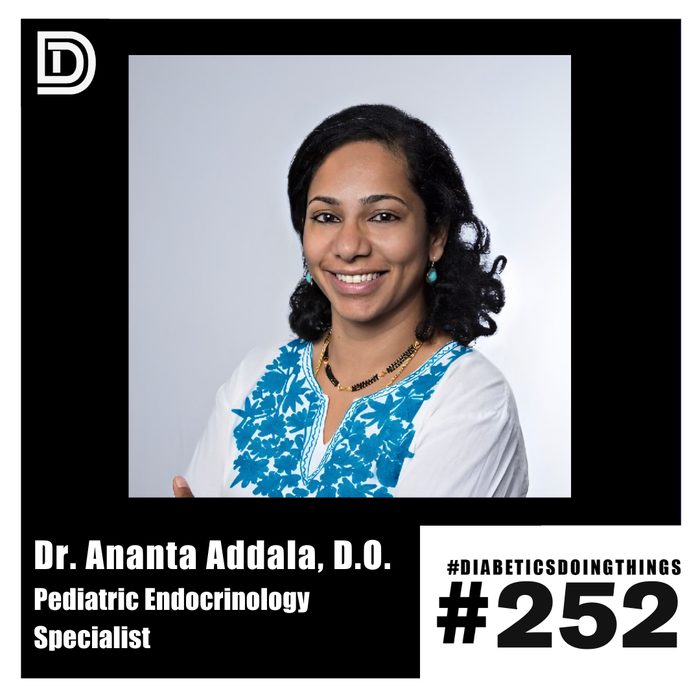
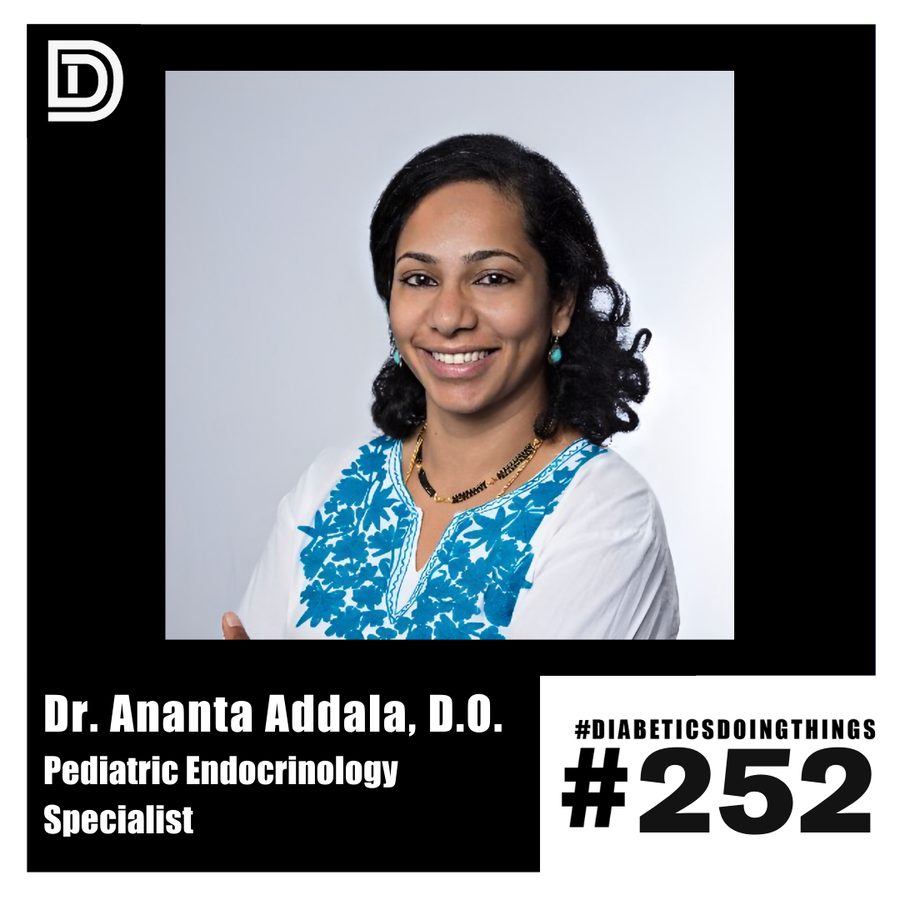
Dr. Ananta Addala, D.O. - Pediatric Endocrinology Specialist

Episode summary
Dr. Ananta Addala, a pediatric endocrinologist and physician-scientist at Stanford, joins Eritrea and Rob after Eritrea recalls their first meeting at a diabetes conference years earlier. Addala traces her path from a childhood in India, through immigrating to the US, a public health degree, and medical training at a safety-net hospital in LA, to choosing endocrinology because it let her address inequities directly. She explains how she documented unequal access to insulin pumps and CGMs by race, language, and income, and how closing that gap could lower average A1C for everyone, not just the families who gained access. She describes her BEAD study, built with minoritized families to find the real barriers to technology, and offers advice for patients negotiating with a care team that doesn't fit their life.
Key takeaways
- Addala says that when minoritized families got better access to diabetes technology in her modeling, the average A1C improved for the whole population, not just those families.
- In her pilot study, English-speaking and Spanish-speaking Hispanic families had almost opposite views on discrimination and technology acceptance, which Addala says shows the risk of treating one ethnic group as a single block.
- Addala tells parents she doesn't need 100% time in range, and that chasing a perfect number usually just means the parent is working too hard.
- She encourages patients to tell their care team their actual priorities and hold the team accountable, rather than assuming they have to adjust to the provider's terms.
- Eritrea says her mom switched dietitians on the spot, even while on Medicaid with limited English, after one tried to tell her she couldn't eat tortillas anymore.
Show notes
While we often feature the stories of people living with diabetes, our guest for this episode Dr. Ananta Addala makes a big impact on the world of diabetes. Dr. Ananta Addala is a pediatric endocrinologist and physician scientist at Stanford University addressing disparities in pediatric type 1 diabetes management and outcomes.
Eritrea and Rob talk to Dr. Addala about:
Dr. Addala and Eritrea’s first meet
Being an inspiration to Eritrea as a woman of color who can be and do all the things
Her origin story and path to becoming a doctor
Studying inequities and social barriers especially to communities of color
Choosing endocrinology as a focus
Working in public health
The system-level differences in care for black and brown populations
BEAD Study: Building the Evidence to Address Disparities
Building resilient systems so people don’t have to be
Advice for building relationships with your care team
Find out more about the studies @AddalaLab on X and IG.
To participate in BEAD-T1D, fill out the Survey. Para participar en BEAD-T1D, complete la encuesta.
Questions this episode answers
What is the BEAD study?
BEAD stands for Building the Evidence to Address Disparities. It's Dr. Ananta Addala's study at Stanford that recruits minoritized families with type 1 diabetes to identify the upstream barriers, like insurance paperwork, clinician assumptions, and perceived discrimination, that keep them from diabetes technology.
Why do Black and Hispanic patients use insulin pumps less often?
Addala's research found it isn't about patients refusing technology. She says barriers upstream of the clinic visit, including bureaucratic insurance paperwork and perceived discrimination, determine who even gets offered a pump or CGM in the first place.
How can someone take part in the national BEAD-T1D study?
Addala says the national study is open to youth ages 12 to 21 with public insurance, starting with a short screener survey, with options for focus groups or an advisory board. Participants are compensated, and a Spanish-language version of the survey is available.
What does Dr. Addala tell parents who feel guilty about their child's blood sugar numbers?
She tells parents not to aim for 100% time in range and says chasing a perfect number usually means they're overworking themselves. She reminds them the care team can help manage diabetes, but only they can be their child's parent.
Full transcript Searchable, with timestamps
Eritrea Musa: Hello and welcome back to another episode of Diabetics Doing Things. We are telling the amazing stories of people with diabetes from all over the world. And I'm very excited to introduce our guest today, but I'm actually going to do something that I don't do too often. And I'm going to pass the torch to Eritrea to introduce our guest because this episode starts with where they met and how we got to this point today. So I'm just going to do that. I'm going to pass the mic. The rare time that I shut my mouth for a little bit and pass it to Eritrea, here we go. Oh my God, hell is freezing over, but I'm so excited for today's episode. Welcome to the podcast. I know usually we have people with diabetes, but today we're so lucky to have Dr. Ananta Addala of Stanford University. Ladies and gentlemen, the prestige of this episode today. I'm so excited for you to be here. Welcome, Dr. Addala.
Ananta Addala: Thank you very much for having me. I'll try to live up to that excitement.
Eritrea Musa: We always have the best conversations and I definitely do want to start at how we met just because as a young woman, as a woman of color, that first meeting for me was so impactful. You meet a million people. So if you forgot about it, it's totally fine. But I did want to ask you,
Ananta Addala: do you remember how we met? I remember. And so now that I feel like this is, you know, back in the day, there was that like newlyweds game where you have to make sure you answer the same okay so classic no matter what just just you know count me in on this one but but i actually remember meeting you first at attd in barcelona if i remember correctly okay yeah and i i remember a particularly dynamic young person who was very excited and but specifically had a had the ability to say what needed to be said and be pretty transparent without really mincing words and that is what i remember that tracks just so you just for those listening i was like that seemed on point and and somebody wasn't particularly shy which was also nice to nice to see so and yeah that's what i remember be curious that's your turn the newlywed
Eritrea Musa: wed game for you remember we've had an associate at dive travel at time shout out arvin so me i know he listens to the pod he's in med school now and he was like i really want you to meet dr doll i feel like you guys would really get along and he walked me over and introduced me to you and the first thing we started talking about was just how like how many pots your spoon is in and just how much you actually do and i remember walking away from the conversations at the time i was going through a really hard time and in my marriage it's like no longer a thing but i you gave me so much advice and i was a stranger and you were like you can do all the things like all of the things. You can be mom, wife, girlfriend, awesome person, hot lady, doctor, whatever you want to do, you can do it. And I just feel like I was walking away from the conversation from a stranger just so empowered about what I was already doing in this space. And to meet a counterpart who also cares so much about disparities in diabetes and getting access to communities of color and is a person of color, I was like, wow, this is a superhero in real life. So I am so grateful for the relationship and just so excited to have you today and to talk more about your work.
Ananta Addala: That was really nice to hear. I had no idea I did that. I also think I got the conference wrong. I think I was actually ADA.
Eritrea Musa: There you go. New Orleans. New Orleans. But I think you spoke at ATTD for diaTribe. Either way, thank God for conferences.
Ananta Addala: The point is, I was like, well, let me get my, but yeah.
Eritrea Musa: The thing about diabetes is you're going to have acronyms, whether it's clinical, whether it's conferences, whether it's day-to-day management. it. We're all balancing as many of those as we can at a given time. So I feel like we're in a hero origin story. And it's like, I really want to know where it kind of started for you. So if you could tell us a little bit more about your background as an endocrinologist and how you became one of the key opinion leaders in this crazy space. Like, how did you get there?
Ananta Addala: How did you become Dr. Addala? Yeah, well, thanks for kind of creating a space to tell my story and also highlight some of the things that I think really matter. And hopefully, like it resonated with you, resonate with others to feel empowered and really, really have the choice to live their life how they'd like to without structural things determining it for them. So I think if you want to call it my origin story, it probably starts with actually when I was seven. I pretty clearly remember being a nuisance to a lot of the adults in my life because I would ask them questions like, hey, why are you treating me differently because I'm a girl than somebody else was a boy? or I would say, hey, it looks like you're doing things differently to certain people based on their skin color, based on their gender, based on their, I lived in a small village in India at the time. So based on their caste where it was still, and it just didn't, it didn't gel with what I was learning as a young person of how you should be in the world. And so then, you know, fast forward a few years, I found out I was moving to America and it was land of opportunities, et cetera, et cetera, which in many ways it is, right? But because unequal treatment or inequitable treatment and discrimination was so front and center in my little person brain, I expected that to not be a problem in America. I remember that being one of my expectations, along with, I also thought I heard Americans drank a lot of soda, and I thought if you turned the faucet, soda would come out and not water. So I was very pleasantly surprised that that didn't exist, but I, which is a favorite of mine, I thought actually they built that house specially for people who immigrated in so they could feel comfortable. But I was really disappointed to hear that although the soda through the pipes thing wasn't a real thing I had to contend with, actually discrimination was, and I was feeling it even more so because I was an immigrant, because we didn't have a lot of money. And it just, it came to odds with everything that we as humanity really try to do, right? That's the problem with discrimination. So then I kind of forayed through things as part of why I got an MPH and why I worked in the public health sector for a little while before transitioning to medicine. And that's kind of a longer story than not. But I think if I really come down to it, it's trying to reconcile why we do things structurally and as a society that don't actually align with what we really want to do as humans and trying to get at the crux of that, what's the systemic drivers is really why I do a lot of the work that I do. And I picked endocrinology, one, because I like the science of it. I find it very stimulating mentally. But it's also one of the few fields where if you're missing something, I can give it back to you. So it's not a lack of it not existing. It's a matter of how I deliver it back to you and how the structural and societal supports exist so that it can be delivered back So it actually seemed like the best place to study inequities, best place to study barriers and best place to study the human and societal factors that determine whether a person gets to be healthy and healthy in the way they'd like to be. So that's kind of the reason why I ended up where I did. But the drivers have always been trying to get at this rub that we seem to have as a society.
Rob Howe: I really love that answer about selecting endocrinology for that reason. We've had other endocrinologists on the podcast in the past. I believe most of them who have been on the podcast, I don't want to speak 100%, but most of them have lived with diabetes of some kind. And it's often, at least the way it's been explained to me, that is a popular or a common choice that drives the decision to choose endocrinology over another field of medicine. Because I think I'm okay to say this, and correct me if I'm wrong, but endocrinology is not the most popular choice. for med school students. It's also not the most profitable or doesn't have the highest opportunity for growth. So it's interesting for me to hear you, not as a person living with diabetes, but as a person who's passionate about addressing inequities and also helping and meeting people and delivering them something that they've lost, that that still was an emotional pull towards endocrinology versus another field.
Ananta Addala: Yeah, no, I think you have it spot on. And I think there's a really rich family history. And so like, and I have very, you can't be South Asian without having at least 1 billion members of at least type 2 diabetes. And so I think I saw, and that was the other pieces, I remember as kind of a younger person in my teenage years, when I was actually very sure I didn't want to be a doctor. I was actually unequivocally sure about that because I just didn't, I just saw it as a system that perpetuated disparities. And I remembered seeing how care was delivered. And that's part of why I ended up in this public health sector first. But in the end, the thing that brought me in is that you get to be a little bit personal and you really have the ability to, yeah, you can have a chronic disease, but be healthy. It doesn't have to stop you from
Rob Howe: being, you know? So. Well, I, first of all, totally agree. I think we also have done maybe too much work, even walking back some of the sort of toxic positivity movements around, like you can do anything, but also still addressing the fact that those things are possible as long as you address the challenges and the sort of other side of the coin there as well in terms of obstacles that you'll face. And it won't be easy, but you know, that you can live the life that you want. I want to touch on the, because, you know, Eritrea has put your credentials here for us to read off and they are substantial and amazing. And I want to talk about one of them in particular, but before that, you have touched on now twice, like how your MPH and your work in the public health sector informed your decision, what specifically, like in terms of like health inequities or is there, was there a particular moment where you were like, I have to dig in deeper and address this or things that continued to come up for you? Like what did that work teach you and how did that lead to your, you know, to your decision to practice medicine?
Ananta Addala: Yeah, I focused primarily on barriers to access. So I tried when I was in high school actually to help start a free clinic, which we did. But I was like, oh, just having a free clinic doesn't actually address the structural drivers. So what I intended to learn in my MPH was really understand what the upstream drivers are. A ton of choices, and you'll hear me say this because I can't help myself over and over again, I'm sure. A ton of choices are made for individuals who hold one or more minority-type identity or are marginalized in any way. And those choices don't sit with them. They sit kind of in this. So I wanted to understand how do you structure that? How do you think about it in a way that it can be operationalized, so it can be measured, so it can be addressed. And so the way that I went about that is by getting a pretty solid foundation in epidemiology so I can think about study design and variables, which I do every day now. And then I spent a fair amount of time understanding the behavioral, like sort of the behavioral health aspect, right? We're not computational logical creatures. We don't say this is good, that is bad, here's the risk, here's, but a lot of our health and the way that it's discussed is done that way. So a lot of what I tried to understand during my impeach was what else, what are the other drivers? What are those, what feel like illogical, but are in fact just human nature, or are things that make us feel good, or are the thing that we can't live without. So I don't want to give it up. So I'm going to do this thing that appears illogical, but it is in fact part of who I am. So there's a lot of health behavioral models that really try to get at understanding peer relations, the family relation, the nested nature of what healthcare delivery is. So I'd say those two things specifically, and that's where I, and I'm going to say that because that's where I spent all of my efforts while I was getting my MPH, was focusing specifically on that. But that's why I got it. It's so I could operationalize measure and then address in a data-driven fashion, because
Rob Howe: that's how policy change comes about. And we're going to talk a lot about the data later on in our conversation, specifically around some of the studies that you have been undergoing recently. My last question, I guess, about your background before we move forward is in 2021, you won an advocacy award from the Stanford University Department of Pediatrics. And I think we talk a lot about patient advocacy here on the podcast and the importance of, A, being an advocate for yourself, especially when you encounter systemic or just authoritative barriers, years, you know, sometimes with your practitioner, sometimes with your pharmacy and in other places. What is what does advocacy look like for for someone like yourself who, you know, is in these positions to affect policy? And I just found that to be like, I think, a really unique perspective
Ananta Addala: that we hadn't heard on the podcast before. Yeah, I I think there's lots of ways that people who hold privilege, right, which you gave me, you gave the introduction about what I do right now. Right. I'm an assistant professor at Stanford, like there's some inherent privilege to all of that, which means that, and I work with colleagues who also hold some inherent privilege. And so the way I've chosen to go about advocacy, and this gets to some of the things we might talk about later, but truly science, study design, data analyses, they make me happy. You can already see the smile on my face, a little nerdy, can't help, but the truth is it makes me happy. And so what I try to do is ask those policy-relevant questions. So I think part of the reason why I was nominated and got the advocacy award is because the specific kinds of study questions that I asked did, again, coming back to how do we operationalize so we can address. So one of the studies is on the fact that interruptions to CGM utilization results in a higher A1C for kids who have type 1 diabetes and public insurance. And that helped change some of our local public insurer policies so that the paperwork got streamlined so that it wasn't so cumbersome. And then now that's part of the diabetes standards of care and it's part of our statewide policy. So it's the fact that I've used a lot of the data I generate. I try to generate data that are policy relevant. And then I try to make sure it doesn't just stay with me or in some medical journal that we just like, oh, yeah, good job. Good job, me. But it goes to where it needs to do the work. And where it needs to do the work is for people to know that individuals living with diabetes, their parents, their families to know, yeah, you're not alone. Other people have the same issues you do. To, hey, person with the ability to make policy changes or make policy anew, here's where the issue is. Here's where the barrier is. Here's where the widening of disparities is. And here's the action you can take. So I think that there's a few studies that come when they come together, kind of help the diabetes world realize, one, there is a problem with disparities. And two, here are some of the drivers. So as I, you know, I mean, I think that's part of the reason why. But that's what advocacy looks like for me is to give people the data so that that way they can't look away or say, oh, Ananta, I know you've been angry about inequity since you were seven. And this is just you annoyed and angry again. No, it's not. There's data to back it up.
Eritrea Musa: but yes I'm also annoyed I'd like for it to end I the receipts like that it kills me that she's so skilled to the point where it's like I'm just gonna make them like I'm gonna go find these receipts for people who don't believe in it it's mind-blowing we've talked a lot on like about how your expertise and that is about addressing disparities in pediatric type 1 diabetes management and their outcomes for you like when you started endocrinology was there a specific case or family that you looked at and you were like this this is it this is where I'm going to
Ananta Addala: find the receipts that I need yeah so for for me it was actually I came I trained in my pediatrics residency I trained at LA County which is a safety net a large safety net hospital in LA County it's in the heart of Boyle Heights and we see families that you know nobody really would see there are folks who fall through the crack, they're undocumented. I mean, they're just our kind of, and I remember, and, you know, and I did a lot of endocrine there because I had a feeling I'd want to be an endocrinologist. And what I, I remember the care and how it was delivered there. And it was, it was excellent for what county could do. So I don't want to like, I don't, I definitely am in no interest in knocking it. These are system level differences. And I remember coming to Stanford in my first fellow clinic, noticing two things, noticing one that like a lot more people had technology than they did at county. And I went back and I asked, I said, how come more people aren't on? Oh, there's a ton of bureaucratic paperwork that we have to go through in order to become a specific or accredited site. And they're already overworked clinically. There's already only one or two endocrinologists, right? So, and that's since changed because, you know, we've been working together. And then the second thing is I noticed that although a lot of folks were using, I had, I only, your first day as a fellow, you get two patients and only two. And I couldn't be more thankful for the two that happened to self-select it or found themselves in. And one was an engineering family who had their own algorithm that they had made. And the other was a very Silicon Valley, I know, was a family that had actually come in all the way from Monterey and sort of the farm working area, which is where I find a lot of my interest in California. And I remember those are the families I've always wanted to serve. and Spanish speaking, lived with type 1 diabetes for at least eight years. And they were on MDI and finger-stick blood glucose. And I just couldn't get over the contrast there. And it made me wonder, hey, Ananta, who tends to see inequities? Is this just something that you happen to happen upon? And then as I kind of looked across, there was a clear trend that had emerged. And I wondered whether that really existed nationally as well. But it was these two families, but specifically their contrast and the fact that I came from a safety net hospital, like all of it coming together. And the reason to hone in on diabetes technologies, I see it as a modifiable risk factor. And there's very few modifiable, right? I can't change my gender. I can't change my ancestry, but I can change, you know, whether I get to have access to diabetes technology or not. So to me, it was a modifiable risk factor that was disproportionately available. And I just needed to, but I wasn't sure if that was the case yet. I had a feeling, but, And then that's what the next two to three years were, was documenting, yeah, yeah, it's exactly what we think is happening. It's inequitable.
Rob Howe: Wow. It sounds like that.
Ananta Addala: I think, too. Sorry, Rob, go ahead.
Rob Howe: Yeah, I think, too, like a few things I wanted to touch on. Just, A, you're talking about the safety net hospital and not seeing as much technology there, but also the demand that the endocrinologists were under on a daily basis and how many patients that they see. I think there's a recent stat I heard, I'm paraphrasing, but there are effectively like 8,000 practicing endocrinologists in the United States. And we know, based on some of the nonprofits that put the data out, that there's somewhere between 1.5 million to 1.75 million people with type 1 diabetes and close to 60 to 100 million of people with prediabetes and type 2 diabetes currently. so you do the math there and there's just not enough minutes in the day if there was one minute per patient much less you know the actual time that it takes to connect someone with the information and resources they need to to live live well with diabetes take a you know take out all of the you know social and class and language you mentioned like spanish speaking versus english speaking and you know income levels and and you know geographies i think there's there's also the studies that say like, you know, the number one factor in the United States that determines your life expectancy is your zip code and things of this nature. So like, that's just all other things equal. There aren't enough practicing endocrinologists to treat everyone. And then you go into the challenges that you've mentioned and that I just kind of breezed over. I remember during the pandemic, there was a study and correct me if you know the name of it, but I believe Medtronic participated in it and they shared it about the disparities between different races and of technology usage, like insulin pump usage specifically. And just the disparity between the average of the total population using insulin pumps is something like 40%, and in black and brown communities is below 10% in some cases. And so you see the A1C outcome differences between those two groups too. And you start to say, okay, well, is it noncompliance or
Ananta Addala: is it access? Well, I think you'll probably know where I lead in that one, which is, right, which is, and I think, and I actually don't think it's just me either. I think the data actually are there, right? The data are, and so one of the studies, this was from the type 1 diabetes exchange data. And when we compared the U.S. and Germany, because they're two kind of economically comparable countries, or us and our German colleagues sat and we looked at our, and this was socioeconomic because of a myriad of reasons in germany they don't collect race ethnicity and so what we what we found is that yes diabetes technology cgm and insulin pump the use has increased between say 2010 to the end of which this paper was from 2019 data so it was 2018 is what the year wrapped up to so yeah everybody increased a little bit but it's clearly and disproportionately in those people from the highest socioeconomic quintile and you don't see that in Germany, though, because they have a different payer system. And then when we, and then to get at your point, Rob, when we said, okay, let's remove the effect of diabetes technology, what we were noticing is that when diabetes technology is around, the A1C actually preferentially worsened for our poorest youth. But once you remove the interaction and sort of the contribution of diabetes technology, suddenly that preferential worsening didn't exist. So I think, I think there is a lot of, that's a fancy way. I mean, there's a lot of statistical modeling out there, there's two separate studies, three separate studies I can think of where about 0.3% A1C difference between the minoritized individuals versus another versus not. And there's one study that came out in the search from search data, which is like youth pediatric data through mathematical modeling by Anna Kokoska, who's a researcher down at UNC. But what's interesting is they said that actually if you give minoritized individuals access to diabetes technology, the total population A1C improves. So not just for those individuals who are minoritized, but actually the mathematical improvement is about 0.3% for the total population. So I think it's one of those things where it's not just the right thing to do or the good thing to do, but it's also the thing that has a better outcome. Well, I think too, we are so conditioned
Rob Howe: to feel like if we put in 50% of an effort, we're going to get 50% of the outcome. And then you find those sort of imbalances in nature that are extremely impactful, where you say, okay, well, 20% of this population, just as an oversimplification, is driving 80% of these positive or negative A1C outcomes. And if we address that, the whole entire system gets lowered without any change to the rest of it. I think those imbalances are what's exciting about looking at data and also can be, I'm sure, in many positions, and myself included, maddening about, well, why has it taken us so long to address these?
Ananta Addala: Yeah. And, you know, many times it's that those communities have been sort of had that disproportionate burden placed on them. And so once we sort of take some of that off, you see a leveling a little bit more across the board.
Rob Howe: We have a note in here to talk about your study, the BEAD study. And, you know, to talk about those, like addressing those disparities in type 1 diabetes. What can you tell us about your study in particular and the participants and like some of the data that's coming out of that?
Ananta Addala: Yeah. So we're I mean, I'm extremely pumped about this study because that is what I do. Right. If you have a convey nothing else, I only do things that get me worked up. And so what's what's nice for so it's the stands for BEAD stands for building the evidence to address disparities. And so there is a BEAD pilot study that just wrapped up and we just finished a lot of the analysis. And now that pilot study occurred just here at Stanford. And it's important to gather an initial set of data. And I'm excited about everything we're learning from our families here. But we'd love to not stop there. And so there is a national study that's launching now that the pilot has closed. and I think that there'll be availability on kind of how to tap in and contribute to that because we've learned so much from the families that we have spoken to. And I think, so there's some things that I'm really excited about and really proud of. And there's, we've talked a lot about diabetes technology disparities and sort of my work in there. And if there's another leg I stand on professionally, it's around making sure that clinical research is available to individuals who've historically been excluded. And so the goal of BEAD was to preferentially recruit minoritized families and then understand what I mentioned that there's upstream drivers of whether somebody gets to use diabetes technology or not. The very last thing, in my opinion, that happens is you're sitting in a clinic and your clinician says, hey, how about you try diabetes technology? That is that is to me the very tail end. There shouldn't be any gatekeeping there. Absolutely. That goes unsaid. But there's so many things kind of upstream. And I had planned to look at insurance, clinicians, interpersonal relationships with technology in general, diabetes technology in particular, to really understand what are all these upstream factors. And so the thing that's come out pretty clearly, at least from the pilot data, is that that specifically perceived discrimination seems to play a key role in how people how ready people are around diabetes technology. And what was really interesting, and it's a reminder, it was a really healthy reminder for me to be really thoughtful about how much we group people, because especially in research, we tend to group. And sometimes we group people who are very diverse. And that's actually part of the issue with a lot of research and the way it's run. And you can come to some faulty conclusions. So I actually found that individuals who I, so it's a predominantly Hispanic as the minoritized race ethnicity group here in the Bay Area. And so individuals who identify as Hispanic but speak primarily English versus individuals who identify as Hispanic Latino who speak primarily Spanish essentially had opposite views on everything. so far more discrimination that was endorsed in our hispanic english-speaking families than our hispanic spanish-speaking families and then a lot less technology acceptance for our english speakers than our spanish speakers and i think you know there's a what that to me nods to is level of acculturation and sort of where the different generational priorities are depending on your immigration generation i think i mentioned i'm i'm technically i think first gen right because i came here. And so, but even still, I came at a young age, but my priorities are different than my parents. And that tends to be the case. So what we're doing in this next sort of national study is to really understand a lot more of these nuances so that we don't just say, oh, a minoritized community. And you just leave and you just wrap everybody into that because there are some nuances. There are some, that way, the sooner we can, again, operationalize and understand the heterogeneity, then we can start coming to targeted solutions for individuals. And then the other myth I think that I was really excited we could dispel was that we had an extremely diverse cohort. We recruited, everyone had at least public insurance, 65% were exclusively Spanish speaking, 72% identified as Hispanic or Latino. And something like 60, I can look up the exact number, 66% or so, maybe 70%, made less than 50K in the Bay Area, which is almost, it's not a lot. And we had excellent survey participation rates, like 98, 95% survey completion, really rich focus group data. They all participated in an advisory board that helped us build an intervention moving forward. And I think it dispels the myth that communities who have been historically marginalized don't want to engage in research because they did. and they came in and they were really excited to contribute. And so I'm trying to do my part by making sure they get the results as soon as we finished. So it's a two-way street. I don't just take from them, but I say, hey, here's the results. And then when the intervention is ready, I'll let them know what it looks like, you know. But I think it was, I think the perceived discrimination component and showing that you can, they're happy to engage in research were probably the two key take-homes. And so I'm excited to see where the national study is going to go and learn from an even more diverse set of individuals and really understand what it is that we can do as a medical system and as a research entity, like all of us speak for the globe here, to try to make technology really the choice of the individual living with diabetes only, really, and their family. So, and I think we're a ways from that right now.
Eritrea Musa: I'm just like still crossing off. This conversation is, I'm sorry, I'm like sitting here just having fangirl moments. I also think it's so cool that a part of the study is like that people with diabetes work with you. So I want to shout out to my friends, Noor Al-Ramahi and Lauren Figg. Noor presented a similar topic over like access to CGM at ISPAD last year, which was incredible. And I hung out with Lauren multiple times and she tells me all about these studies. And so it's just so great that people who serve those communities, farm workers, brown and black communities, and also live with diabetes are a part of this. It's so huge to me that those people are there in the room helping collect this data, helping to prove this information. Something I was thinking about while you were talking was just like this access to technology because I was diagnosed when I was nine and I didn't get on a CGM and a pump until I was 25. And I was a part of clinical trials all over the world. so it's just like already like a lived experience for me so just hearing that there's people out there creating like i said earlier receipts of this information so we can hold it up and be like this is a real problem is just incredibly moving i want to talk about the specific word in this in the pilot study which is address because i think a lot of times we collect data but it's like okay now what like what do we do with this right so for people like for For everyone in the regular community, is there anything that we can do to help this forward other than participating in the studies themselves, obviously?
Ananta Addala: Yeah, so I think I think the study participation is helpful. You all actually talked earlier about about advocacy. And and it's really interesting. I when when you ask this question, because I spend so much of my effort and energy and thought around how to make sure that actually individuals don't have to do the work. Right. Like the whole point is to build a resilient system so that individuals don't have to. Right. Like so it's, you know, because then we commend individuals for their resiliency and then we say, ah, you weren't resilient enough. And that's why it didn't happen. But really, if we just built a system that was resilient, then the likelihood is that it will carry everyone forward with it. Right. That's that's the point of a lot of where I tend to sit. So this question of what can an individual do, I think actually maybe some accountability helping kind of feeling, you know, the point of your care team, your medical care team, your research care team is to help you have the kind of diabetes life, right, like related to your medical management and things like that that you want. And so I think that I feel, and this might be on an extreme, but I actually feel like the person living with diabetes should do nothing more than state their opinions. And then the rest of the world can work to make it happen. And so in the meantime, I think making sure that you voice some of those, because I think that actually the medical community and the research community is a lot more attuned to inequities now than they were, say, six years ago when I first kind of really started hammering away at some of this stuff. people, they're amenable now. So I think asking and then sort of saying, hey, this is something that I need and then holding your team accountable for it is probably where I would draw the line,
Rob Howe: making sure you speak up. I love that. I think you're right. I think that's how I feel as a patient. I will say, though, I think sometimes in the community, I think we're quick to say, and even in like conferences and research and on those types of things as well, is that we agree like in principle with, yes, the patient, whatever they want for their life, we should optimize towards that. But then I think there's also a cohort that's more of, well, yes, but you also have to adhere to this exact way of doing things in order to get this life that you want. So how, like if you're, you know, to a patient who's out there, like maybe having a challenging relationship with their care team, or has experienced, whether it's barriers or whether it's just lack of support or lack of direction or lack of interest from their providers, but they still believe that. They're listening to this podcast and they're like, yes, this is the type of relationship that I want, but my experience has been something more towards the opposite. What would you tell that patient?
Ananta Addala: Yeah, I think that's a great question. And I think what I try to do with the families that I take care of is, you know, there's some things that I can't really negotiate, right? Like I kind of need to know your blood sugar and I need to know that you're getting your insulin in. Like those are, but how we do that, we've got, we got room. We can discuss stuff. And so sometimes, sometimes if the issue is that I just can't be on the same page as a family on what that underlying assumption is, I take it as my responsibility to sort of explain why I need this to happen. And so I think so flipping that is I often ask my families where there is a disconnect if that happens. So what what are their priorities trying to help, you know, kind of just ask the ask the provider, I'd like to share with you what my diabetes goals are. I would like to be able to make sure that I can. OK, I don't know, like dance for five hours and not go low, whatever that is. Or I want to make sure that I can meet my work requirements and I need to be out. And this is a common conversation with a lot of our communities. I need to be out in the farm and I can't stop for breaks. I can't have hypoglycemia. And so if we can understand where the underlying crux is, then now I understand that that's idealistic and sometimes clinic visits are 15 minutes and people don't feel like they can change it. So what I would say is this is where a little bit of like reflection on the person living with diabetes. What do you think is the most important thing? Where do you need the change to happen? And where did you need to have it happen like five days ago or a month ago or a year ago? Starting with that so that you're and then and then explain to your clinician why you have that that priority and say this is where what you're saying doesn't gel. And I'd like to come to the same page because I think we're both about the same thing, which is my health. And that type of an approach can help bring that's that's actually a shared decision making conversation. conversation that's a specific model that clinicians are supposed to use, but I don't see why it can't go the other way and say, here's what I, you know, here's where my priorities are. Here's where I'm not, I'm not understanding where this fits in. And so, and many times I think that that type of an approach tends to work, but I can also understand that. I mean, I told you, I didn't, I didn't want to be a doctor for a really long time because I wasn't impressed. but also the other thing is you know there's there's lots of providers clinicians out there you know i mean so if you really don't have a helpful or toxic you know or if it's a toxic relationship it's helpful to know that you don't necessarily have to endure it right as long as you've kind of advocated for yourself and i don't know you you two might have some pretty good
Rob Howe: answers to that actually i i really like the relationship like framing it as a relationship and like kind of having a dialogue there and just like, hey, let's agree that we're both here to get the best outcome for my health. I think just starting that as the foundation, I think even a provider who's seen 12 patients who maybe haven't had the same approach and they're tired, maybe they're dealing with something in their personal life. I think they hear that. I think right off the bat, you're probably nine out of 10 going to be aligned there. I think creating that momentum in a relationship, it's like anything else. Like there are going to be people who are for you in this world. And there are people who are not for you. And you can, you know, hopefully have the resources and the time and the energy to find somebody and replace the ones that are not for you. I like that. I think like you're really treating it as a team effort. I'm a big team guy. I'm kind of nauseating with my love of teams. But yeah, I think, you know, when you have that shared, like, what are we optimizing for? What are your problems? How can we help work together to solve them? Because that's really what we're both after. Do you agree is a great way to start. Eritrea, any thoughts on that?
Eritrea Musa: Well. Besides my nauseating love of team building? I mean, because when you have, when it's like, I make this example all the time, but it very much sometimes can feel like Tom Hanks in Castaway. Noah Wilson, like, you know, when he's just like alone on the island. So having the right team makes all the difference. I don't know, 2011 Dallas Mavericks reference here as well, but it just can really change the entire experience for the patient, right? Like, so you have to make sure you've got the right players so you can succeed. That just seems very, duh, to me. But yeah, but I think one thing that we've learned from this podcast over the years, and like, just in general, diabetes content online is like, I think you can never overlook the basic concepts and how important they are. And, you know, I think now, because we get to be in this, you know, we're having these conversations, we've been doing it for years, we get the privilege of talking with people like yourself, Dr. Addala. So like, oh, we're so advanced and we're, you know, we don't have to ask those basic questions, but it's really important because I know there's somebody listening to this podcast who is either recently diagnosed or is having an issue. And we need to make sure that they don't feel like just because they're not asking deep questions about disparities in research, they're just worried about how do I address my own care today with my care team? Like, that's totally fine.
Ananta Addala: Yeah. And I think, and I think the, a lot, the care team more or less exists, right? As the reason why diabetes has become a multidisciplinary care team in most places is because there are multidisciplinary needs that an individual has. So there are very reasons for having a job and for more or less existing is to make sure that we overcome whatever the barriers are or that we make sure that the needs of our families and our individuals living with diabetes are met. So I think asking and then it goes a long way. But that's, I don't know, I find that nobody's going to disagree with you they're there to help make sure that you know that your health is first and foremost and so if there is a disconnect on what you think is healthy versus what they think then even if that's the only conversation that happens in that clinic visit and no dose changes or number runs or all that boring stuff happens that's still meaningful because it builds that builds that relationship yeah i think to just add because now i've thought
Eritrea Musa: about a little more than rob's like do you have something to add i feel like maybe this has been a general theme of my life the last couple weeks but there's like this especially black and brown people with the care team that they get, just because that's the care team that you have access to doesn't mean that you don't have to resist what they're saying to you if you don't think it's right for you, if it doesn't fit your diet, your lifestyle. I remember when I was a kid, we met with one dietitian when I was first diagnosed and she tried to tell my mom that I wouldn't be able to eat tortillas anymore. And my mom was like, well, we eat tortillas at every meal. So we need a new dietitian. And I was on Medicaid. Like I was on state government assistance, But my mom, with very little English and her education that she has, was like, no, simply immediately, no, you do not fit our needs. So we will find someone who will, which is probably part of the reason I have the attitude that I have as a human being. But I learned from early age that even if all you have is state and government assistance to get the access that you need, you are still a human being deserving of respect and deserving of filling the needs that fit you culturally. So if that dietician doesn't fit you, that endocrinologist doesn't fit you. resist, find options, look for what you can for yourself. And I think that does come back to that self-advocacy that we were talking about. And I think too, you know, like I was just gonna say,
Ananta Addala: speak up. Cause I tell my family all the time, I was like, I can make plans till the cows come home, but I am not. I was like, nor do you want me hanging out with you at home. You don't want me there. You don't want me to see how you work. What I do want you to do is tell me what will work. You would tell me how will you remember? I have no idea. And so, and I think, so that's the other piece of this too is sometimes people just truly do not have the perspective that you do into your life like and when i say it that way it seems pretty obvious like yeah no one's going to know your life's day-to-day is quite like you do so so i think i think yeah speaking up is is going to be really helpful for that but i i'm like just don't let me make a plan that i'm going to work because wasted both of our times yeah sorry robbie you're about to say something no no i was i was basically
Rob Howe: going to say the same thing. So I love it. No, I, and I just think we talk a lot about using our voices. I think you, you nailed it, but also I feel now in this age is why I continue to sort of die on the hill that this really is the best time to live with diabetes because I see comments and conversations in Facebook groups from between parents all the time. Hey, my dietician said that we can't eat tortillas. What do you guys do? And then immediately there are a host of comments and recipes and blogs and tactics and engineering algorithms to help eat tortillas, which are challenging to eat with diabetes from time to time, but it can be done if you develop that plan. And I think that's where the power of community really comes through. Okay. I do want to shift a little bit because this is my podcast, so I get to sort of do what I want sometimes, but I do want to, I have, I love high performers like yourself. And I'm fascinated with, especially groups of high performers, which over the years, we've been very fortunate and privileged to interview multiple staff members and students from Stanford University. And two in particular, Dr. Jonathan Tijerina and Dr. Roy Collins. And then shout out my all-time homie, Corey Schlesinger, who used to be the strength and conditioning coach. And there's something different about what they call, all of them call the greatest university in the world. And they like, and my belief is that, you know, it really is like an iron sharpens iron type of scenario. There's people from diverse backgrounds from all over the world there to, you know, pursue the best in whatever field that they're looking for. So I guess for you, like coming from your background and also being in like safety net hospitals and then coming to Stanford University, like how can you, you know, characterize like that experience of, you know, working, you know, with your peers at Stanford?
Ananta Addala: So it was interesting because I don't know that I would have thought Stanford would be my long-term home, especially given that I'd always wanted to do disparities and the optics are not one of that. And what I, yeah, I know you like this there, Trey. That will be the only thing you use in the promotional videos, I'm sure. Which is, but I think the optics are such that this is not the place that you might expect to do research. and specifically to actually meaningfully advance and address disparities. And so for me, you're right. I like this iron sharpens iron thing that you're talking about because the iron that I think I kind of slowly was working with for myself, and there's a ton of skills I've gained from being here. And what I can see is that it's such a reciprocal relationship that even though I was quite a junior person coming in and saying, hey, I really think we need to consider whether implicit bias that clinicians have impacts diabetes technology. So rather than saying, hey, you're fresh off the frying pan, what are you doing here telling us that we have systemic inequities? The response was, I don't know if it exists. Nobody's looked at it. Let's study it. And so what I found is that my experience here is that even if, at least within the Department of Pediatrics and in my division, so I'll speak for that sort of, right, so So I've already siloed myself down. I found that if I can demonstrate that it's a problem, there's an interest to make a meaningful change of it. So what that meant for me is I don't have to fight local. I don't have to fight at home, so to speak. And I have bandwidth, energy and reserves to go out into the world and kind of like do the advocacy where it needs to happen rather than convincing my local people here, hey, this is something we really need to do. and spinning my wheels locally. So what I found actually is that Stanford is a surprisingly, and I, sorry, Stanford, surprisingly, right? But just again, to break the optics, it's actually a very conducive place to do research that's innovative in any way, including when it comes to addressing diversity. So that's been kind of my experience. And then what I'm able to do, especially because my interest has been in being extremely systematic about documenting disparities so that people can't wriggle out and they can't just say Ananta's angry and that's why she's doing this. By making the science absolutely as precise as it possibly can, the ability to wiggle out starts getting smaller and smaller. And then the need to address it becomes more and more obvious. And so that technicality with the flexibility and the ability to kind of like really dive into your niche, I can think of very few places where you can do that.
Rob Howe: You mentioned this a couple of times, but I like how you have really framed this awesome story of being angry and being annoyed and being aware and turning that into really productive research that can't be, you know, it's so obvious it can't be ignored and it has to be addressed. And so, you know, for type A personality folks all out there, thank you for representing us at the highest level. So, yeah, go ahead, Eritrea. I kind of want to zoom out a bit because I, first of all, I would have killed to have an endocrinologist like you as a child, like given it all. And I have been very lucky to be in a room where you've discussed this before, but for parents of children with type 1 diabetes, is there something about dealing with their child and their diabetes that as a pediatric endocrinologist, you would urge them to remember or to keep in mind? Oh, there's a lot, right? I
Ananta Addala: I think one of the things I say to families and to parents, especially like, you know, I joke that if I had known how potent mom guilt was before I had babies, I might have done some like mental preparation, right? I mean, like being a parent, you really do try to do your darndest and like do your very best. And one of the issues with diabetes is it's very numerical. It feels very objective and measurable. And so it's really easy to measure your worth as a parent across numbers. And so one of the messages I try to really drive home is, you know, there's a reason we have 70% time and range. I don't need it to be 100. Okay. And also don't, because probably you're working too hard.
Rob Howe: Definitely.
Ananta Addala: Like, don't do that. Nobody wants that. I don't want that. And I'm, you know, I know the data. But the second piece is, there's a whole team there to support your kid's diabetes, but there's not a whole team there to support them as a mother or as a father or as a parent or as a guardian or as a grandmother or as a whatever caregiving role you have. That is really unique. And there is insight, like I was saying earlier, the insight that you have to your kid that I never will. Right. And that's obvious, again, very obvious. But what I'd love is for people to feel really empowered in their relationship, in their parenting or caregiving relationship with their child, to say this is what is best for them. And I'm not just thinking about this because I want them to have 100% time and range or 99% time and range. It's because this is who they are as a child. This is their temperament. Okay? This is just how they're externally motivated. This is how they're internally motivated. These are all things that parents tend to pick up. And so much of it is lost while parents try to become pancreases. And I, you know, it's that parental relationship has so much more depth to diabetes management alone. And like the team has got you for the diabetes management piece. Ask us, let us help you. And then you enjoy your kid. You know, like, and I like that is such a heartfelt plea because I, I want my families to have that strong bond that isn't grounded solely in diabetes. Because it's a, it's, it's, I know it's a huge, I know it's a huge aspect and I can't even begin to wrap my head around it. And I understand, but I just don't want people to assign their value or their worth as a parent based on their child's diabetes because there's developmental variations, there's changes, there's so much more. Right. And so that's probably what I would say to families. And I say it often, but yeah, it's, you know, your kid only has you to care give.
Rob Howe: We probably don't talk about it enough. We, I think we mentioned, you know, don't hold yourself accountable to a number, but we don't often address that, the parental connection as well. And, you know, I think that there are, I'm starting to see, and maybe it's just because I'm, you know, getting a little bit older. So I'm starting to see more like parental content as well. Like I see some of that messaging coming out, but I think it's just, it's really well said and just bears repeating, you know, that your worth is not tied up in your, in your child's A1C or time and range a hundred percent. Dr. Addala, thank you for the time today. I know, you know, we talked about, you know, the demands for endocrinologists and, you know, I think just it doesn't go like, yeah, doesn't go unnoticed that you gave us this time today. So thank you very much. And for, for all the work that you do for people with diabetes. I know we also want to plug, you mentioned the study is going national and I assume you're probably accepting applications or how does that, I don't know how that works sometimes selections, all those things. I'm an
Ananta Addala: idiot. There's a, there's a really simple screener that people can fill out. And then as long as you're eligible, we will, you know, that that's the plan. And so we're trying to find, you know, youth who are 12 to 21, I think right now. And thank you. I was like, I thought I was going to say 25. I was like, not 25. So 12 to 21. And at least who have public insurance. And then ideally, we're trying to start with families of color from our pilot data. We learned that really families of color have a slightly different ask and the intervention that we are going to design than other families. And so just kind of in the interest of trying to meet more minoritized families first and then roll it out. So trying to preferentially recruit families of color and truly that's it. And it's surveys and or some focus groups and or, I mean, an advisory board. I mean, it's really just you pick what you want. So I think that the material will be made available
Eritrea Musa: to anyone who wants to click on a link. Yeah, we're going to include it in our show notes. I do want to mention that it seems very accessible as far as time, where it's the survey is about 15, 25 minutes. The interviews are about an hour and a half. And ladies and gentlemen, there's compensation for the participation and for your time. So definitely include the link in the show notes. I'll be hitting up all my, you know, people of color, friends and family all over the country so they can take part of it because something like this, if it would have existed when I was a child, could have changed my life. And that's something I think about all the time. Dr. Addala, thank you so much again for being here. I am honored. I respect you. I'm so excited for people to read this, to hear this. And I just, first of all, I can't wait to hug you the next time I see
Ananta Addala: you and just jump up and down in a circle. So I know we finally did it. We've been talking about for way too long and I'm, and yet, but, but truly thank you for, I know you have a lot of amazing individuals that come onto this. So it's, it's nice to be in the ranks, but it's also specifically nice to spend this hour with you both and really get to know you Rob for the first time and have a chance to hang out again, Eritrea. It's been, it's been really nice and talk about stuff. It's
Rob Howe: me. I look forward to meeting you in person for the first time. And hopefully I'll be lucky enough to hear one of your talks as well. Thank you. Okay, awesome. Well, this episode has been produced by Eritrea Musa, and it's been edited and published by Ashley Bright. And XL Creative does our awesome social media videos. So thank you guys all for your work. See you next time.
About Ananta
Dr. Ananta Addala is a pediatric endocrinologist and physician-scientist at Stanford University who studies disparities in type 1 diabetes technology access and outcomes among Black, Hispanic, and lower-income youth. She won a 2021 advocacy award from Stanford's Department of Pediatrics for research that helped change local insurance policy on CGM access.