

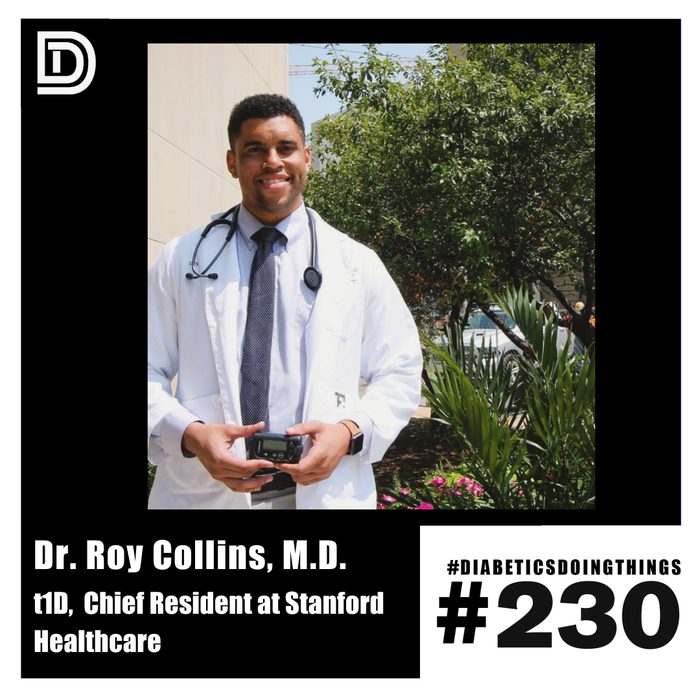
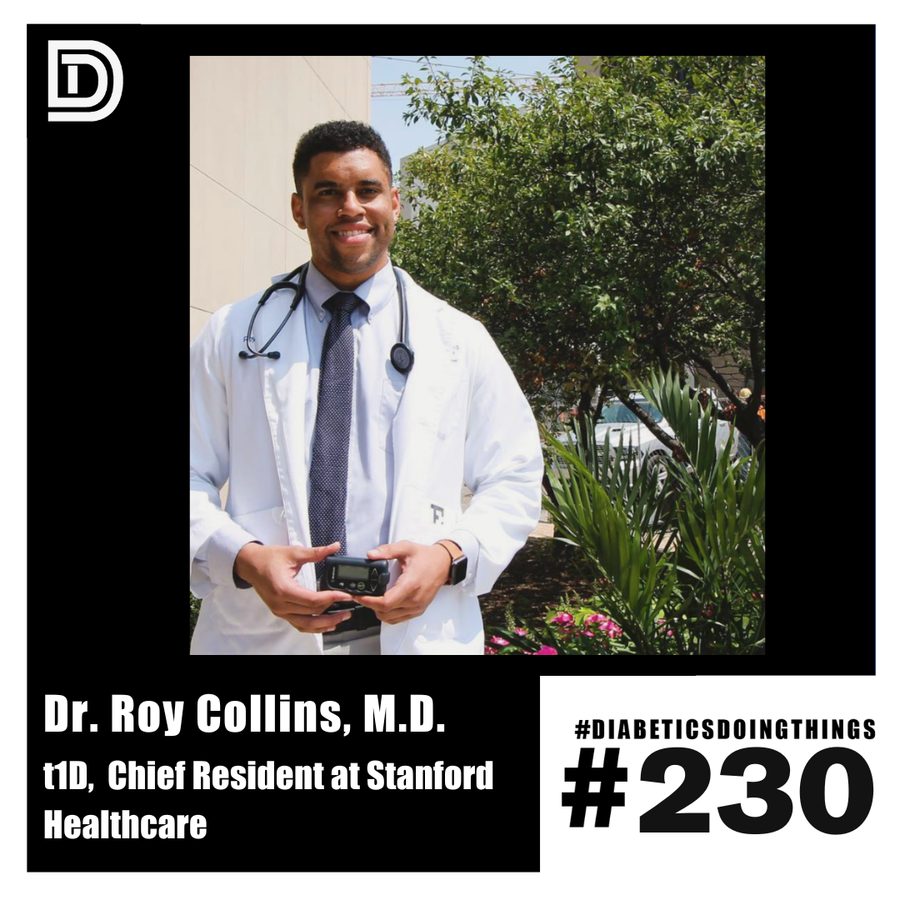
Dr. Roy Collins, M.D., T1D, Chief Resident at Stanford Healthcare


Episode summary
Dr. Roy Collins returns to the show to talk about life after competitive sports. Diagnosed with type 1 diabetes at 13, right as he was getting serious about football, he went on to play at Yale before becoming a Stanford Healthcare chief resident, MD, MPH, and sports psychiatrist, now recovering from Achilles surgery. He and Rob compare notes on recruiting while managing diabetes, the jump from high school stardom to college-level accountability, and imposter syndrome among elite athletes. Collins explains how he coaches student athletes and people with diabetes on staying present, preparing ahead of high-pressure moments, and responding to setbacks without spiraling. The conversation covers identity loss after retiring from sports, comparison culture online, and treating failure as information rather than a final verdict.
Key takeaways
- Collins was diagnosed with type 1 diabetes at 13, in the fall of eighth grade, just as he was getting serious about football.
- He played football at Yale, then became a Stanford chief resident working in sports psychiatry after his playing career ended.
- Collins says imposter syndrome often comes from comparing yourself to an unfair composite of other people's best traits rather than to a real person.
- He recommends planning the week ahead, like visualizing schedule and exercise on a Sunday or Monday, so diabetes management runs in the background during high-pressure moments.
- Collins says deliberately doing the opposite of the urge to withdraw during a high or low blood sugar helps regulate the emotional reaction, based on his clinical work with patients.
Show notes
Dr. Roy Collins returns to the pod! He was a part of our series in 2020 “More Than a Diabetic.” Dr. Roy Collins is a Stanford Chief Resident, M.D., M.P.H., and Sports Psychologist. We are so excited to have him and his expertise back on the show!
In this episode Rob, Eritrea and Roy dig into:
Getting comfortable with Diabetes while simultaneously being recruited by Yale
Thriving as a young athlete regardless of limitations
The transition from high school athlete to the accountability of being a college athlete
The transition from being a lifelong athlete to a regular person in the real world
Overcoming imposter syndrome and unfair comparisons
Staying present and in the moment even with Diabetes always running in the background.
“You’re not going to be successful all the time, but if you miss a bolus - failure is not final. What can I do better next time?”
The inevitable interruptions that come with Diabetes.
Being open to doing hard things and stepping outside of our comfort zones
Keep up with Dr. Collins at www.roycollins.com and follow him on IG: @dr.royc
We want to hear from you. Send your questions, comments, queries, and general diabetes concerns to THE MAILBAG at mailbag@diabeticsdoingthings.com!
Questions this episode answers
How old was Dr. Roy Collins when he was diagnosed with type 1 diabetes?
He was 13, almost 14, in the fall of his eighth-grade year, right as he was starting to get serious about football.
What does Dr. Roy Collins do now?
He's a chief resident at Stanford Healthcare with an MD and MPH, working in sports psychiatry and counseling student athletes on performance and mental health.
Where did Dr. Roy Collins play college sports?
He played football at Yale, where he also received his diabetes care through Yale's diabetes center.
What does Dr. Roy Collins say about overcoming imposter syndrome?
He says people often compare themselves to an unfair, made-up composite of other people's best qualities. He has them break down specifically what they feel they lack, and they usually realize the comparison wasn't fair to begin with.
Full transcript Searchable, with timestamps
Rob Howe: Welcome back to another episode of Diabetics Doing Things. We're telling the amazing stories of people with diabetes all over the world. And today we have an amazing returning guest. He was part of our More Than a Diabetic series back at the end of 2020, Dr. Roy Collins. He's also the fourth. So we got two fourths on the podcast today. This podcast is about Texas excellence. We got Houston represented here from Dr. Collins, from Roy. you are a Stanford chief resident. You are an MD, MPH, and a sports psychiatrist. And we're going to dig into the psychology of performance. We're going to talk about your career as an athlete. You're a Yale man and a Stanford man. This is a resume that is envied, bro. I'm psyched to have you on. And man, just shout out to you for representing what people with diabetes can do. I also wanted to shout you out because I know you're dealing with a little bit of an injury setback as well. So I want to wish you well, make sure everything's good on your recovery from the Achilles. It hurt my heart when I saw you post that. I was like, oh, my guy's down. But you know, hey, it's a long road back, but hopefully all is well. Appreciate that, man. Yeah, we're recovering.
Dr. Roy Collins: Surgery was in mid-February. PT has been going well. Follow-up performance has been going well. So hopefully I'll be on the court there with you soon. I love it. I love it, man. Well,
Rob Howe: Well, let's kind of start where we normally start because obviously, you know, we have been linked up because of diabetes. And I think it was even like end of 2021. It was the first like virtual beyond type 1, JDRF type 1 nation kind of gathering virtually that where we met and obviously just, just clicked right away. And, you know, real excited to kind of see what you've been up to since then, but give us your diagnosis story. And also like you, you and I are one of the rare people that were on the game plan T1D podcast. I discovered. So shout out to early diabetes podcast days. Early diabetes podcast. Absolutely.
Dr. Roy Collins: Yeah. Thanks for having me on. It's great to connect with you and Eritrea as well. The diabetic online social media community has been really cool to kind of dip in and out of. And, you know, it's always a pleasure to talk to y'all. So my diagnosis story, just real quick, I was 13, almost 14 years old. I had the very familiar week long of being really thirsty all the time, going to the bathroom about every hour or so. We were really sure what's going on. My mother is a pediatrician, so she did kind of catch on. Something might be happening here. So we went ahead and got checked out after a few days of that and got the diagnosis. So it was a real shock to my system. No one in my family has type 1. I do had my grandfather who was fast, did have type 2. So I used to see him, you know, checking finger sticks at the breakfast table. And there's a lot of kind of sugar-free things in that house. And so I remember that a little bit. But otherwise, it was, you know, fairly random up in the air. And so it was the fall, actually, of my eighth grade year. And I was really getting into sports. So I remember the first thing I asked my pediatrician is, can I still play football? And when they said yes, I was like, cool. I don't really need to know really anything else. No further questions. I'll get to that whole insulin and carb counting thing a little bit later. But it's been interesting that that happened as I was getting into sports because sports performance and diabetes has always sort of been interlocked with me and really kind of driven my passion to learn more about how the body works and how we can kind of improve upon the ways in which we want to get better and improve better.
Rob Howe: It really is interesting how parallel that can be with preparation, because we talk about diabetes really adding an extra step to everything that you do. And something that sounds very familiar, and I've talked a lot about on the podcast is very similar to you. Like when they said that I could, there was a path where I could still play basketball. That was kind of all I needed to hear. And I treated it as like a filter to get what I wanted. Like my diabetes management was just another step in that performance hierarchy of, you know, how I get to my goals. So, you know, 13, 14 years old, eighth grade, like that's a tough time to, to get diagnosed. And often we see, you know, sort of the bell curve of, of diabetes outcomes, like difficult times from an A1C outcomes perspective in those teen years. How did you, you know, did you have any trouble with that? Or, you know, did sports kind of like allow you to really, again, like set that foundation of like what you were looking for, what you were trying to achieve and diabetes just kind of became a part of that?
Dr. Roy Collins: it was really difficult because i that's a lot of life to have had already a lot of bad habits to have had but there was time you know my favorite foods or waffles for breakfast and drinking a lot of juice and sodas like a lot of kids do at that time so it was difficult to then try and fit diabetes into all of that when you know i kind of knew what i wanted to do that's also a tough time because i'm a rebellious adolescent and i just want to kind of go off my own and and to do whatever and so to try and be regimented and calculated wasn't nearly as important to me at that time as just kind of hanging out and doing what i like to do especially when it came to sports so you know it's interesting at that time you know i've like i'm fairly physically large and athletic and all that kind of great stuff a lot of stuff sports like kind of come naturally to me and i tried to have that same kind of laissez-faire my approach with diabetes at the same time so it wasn't until I got to college where you know all of a sudden those those margins get real thin and you got to be really regimented about what you do and and take real heart and in time to to get well at your craft that I got better not only in sports but also in managing my diabetes and there were also real stakes at that time too so when I was in high school you know the the coaches I had the you know minimal kind of athletic training staff I had they didn't really they weren't as well versed in diabetes and so they really kind of left up to me to sort of say hey, you know, are you good? Yes or no? I would always say yes, even if I wasn't really good and just kind of leave it on me. But at the college level, they were a little bit more well-versed. There was a lot more bodies, a lot more staff that could, you know, sort of focus in on me. They would test my blood sugar. And if it wasn't a good number, they would pull me. So there were real stakes, again, into whether or not I could participate. And that really gave the onus to sort of hone in on what I needed to do, be a lot more regimented, like I said, prepare a lot more, be a lot more thoughtful about what my schedule is, what my day was. So I could stay in the field
Rob Howe: and participate as much as I can. Talk to me a little bit about like the recruiting process and the diabetes role in that. I sort of lucked out my parents and I just decided if I was going to go spend four years somewhere that we should be upfront and kind of transparent with the fact that I was living with diabetes and very similar to what you said. Like I made it clear to the training staffs and coaches that I talked to that I was managing it well, and it wasn't going to be an obstacle, but it was something that we would have to deal with on a daily basis. Are you comfortable with that? That was kind of like the starting point. How did you guys approach that from a recruiting standpoint? And was there anything about Yale other than the obvious things that made you feel like that was going to be a better place for you and your diabetes?
Dr. Roy Collins: Yeah, to be honest, there was definitely some fear around being upfront about it. I didn't want anyone to see it as a weakness, to see the reason why they shouldn't recruit me. and so just my general attitude with diabetes at the time was like very much internalized I didn't really talk to a lot of people about it you could ask me about it right I would have an insulin pump and people ask me you know while I was not yet a doctor care on an actual beeper whether or not it had a beeper on me when I would say no you idiot that's not a beeper that's my pump and and kind of go along but otherwise it wasn't really something that I was very upfront about I would say what was really you know beautiful and serendipitous is that I went to Yale that has an amazing diabetes center, juvenile diabetes center, and was able to kind of maintain my care there and get tuned in there. So it really did work out. And like I said, I think I really lucked out again with just having a brain nod of the staff. But as I already got to college and was sort of talking around with other athletes, just kind of getting a sense of who these other destinations, what the coaches of the destinations that I could have ended up in were like, I also think I lucked out there too because there were dealt with some coaches and some teams within my league even where I felt like it would have been really held against me if I needed to take time to deal with a low blood sugar or if there were any issues I was dealing with. I never, in my experience in college, had it held against me. We wanted to make sure that he's ready to play as often as he can and I felt like I had a fair opportunity at every moment and was able to kind of progress and start roles and whatnot, but I don't think that would have been the case if it were at that time. So It kind of worked out so differently, but I remember at the time of recruiting being, being a little bit nervous about it for sure.
Rob Howe: I think you hit the nail on the head, right? Like, especially as an athlete where you're trying to not hide, but you're trying to thrive in spite of your limitations and weaknesses. And I think as a young athlete, especially, you know, you start to become just a number and it's like a little bit of a cattle call in terms of there's so many athletes from all over who are competing for these limited number of spots. And there is a healthy fear and anxiety of, is my diabetes going to be held against me? when all other things are equal. And, you know, my perspective on that was to try to just get ahead of it in the conversation and say, Hey, like, yes, this is part of it, but look what I'm still able to do. And, you know, I'm still, I'm managing this and I'm still on paper just as good as the rest of these guys. And so, you know, you can trust me to be part of that. And, you know, similarly though, like at the next level, going to the next, like next level, I did not tell people because I, you know, there's plenty of reasons why Rob, how the pro could, could get cut. And most of them were just, I don't play defense, but the other parts of them were like, I didn't want diabetes to be a part of that. So yeah, it's interesting. And, you know, I, I'm glad that it worked out serendipitously for you. Was there anything like in that adjustment, I think like, and we can talk about this more as we get into the sports psychology, like your actual work today. Cause I know you're, you talk with like the freshman classes that come into Stanford, you know, you, you're part of their sort of onboarding. Do you remember a time where, you know diabetes sort of got in the way or you had like a learning experience about like when you go from high school where it's kind of just laissez-faire you get by on talent you think you're working hard then you go to college and it's like oh this whole system and all these guys have been doing it for a long time and are a totally different level yeah so yes and yes um definitely
Dr. Roy Collins: from a just a strictly like a playing perspective i i always i'll always remember that first day walking into the gym so before we've had a practice we were we're lifting and just seeing all these grown adults throwing weights around and grunting you know way bigger than than anyone in my you know small high school looked like and just sort of saying like okay no this this is real this is a different level from where I came and yeah again my approach was was just really sloppy and just kind of unregimented at that time and so as I either sort of got hit by the whirlwind of what college sports could be you know and again I was able to sort of own in on my craft and sort to get better diabetes is a big part of that and so it went from trying to just you know eat sort of whatever i want to kind of hope for the best on insulin front to being really thoughtful about okay like this is what my needs are this is what my schedule is going to be i need to think about all folks i'm a religious student athlete so not only what class or not only what workouts and practice are going to be but what class is going to fit in there too do i need to walk across campus and maybe up a hill like they were at yale with a kind of pre-med science classes um how is that I'm not going to work in, you know, what sort of, you know, macronutrients and carbs, fats, and proteins are going to help me kind of get through the day and be regular. And, you know, I'm sure we'll get into it, but the cook notes version is I just ate very similar things when I knew that the takes were important because I didn't want to take those risks.
Rob Howe: Yeah, I totally, I think, I mean, I think like minimizing those variables and trying to plan around it. And at the same time, you know, like college, I don't know, we can talk about this too, like that transition from, I don't know, I'm just trying to try to put you guys as listeners into the like mindset of an athlete. And we've talked about it before, not as many of like, not as many episodes about this more recently. But when you're in that mode where you're trying to get recruited, you have this sort of apex alpha mentality where you kind of have to not be denied and just show up and perform on a regular basis with pretty thin margins. Like you, you know, it's either succeed or fail in a small period of time. And then, you know, you've got the success, you get on, you get a spot at the next level. And during the recruiting process, they're so happy for you. They're excited. They're going to get you in. They're going to make it work. And then it totally flips on its head on day one, where you have to now make it work according to, you know, the demands of your schedule, not only for coursework and being a good, a good student and having people checking in on you, making sure, you know, at least for me, like freshmen, we had to sit in the front row of the class and my coach was a psycho, a real sicko. He would walk around peeking the door. And if you weren't in the front row, like that would be like, he would just like look at you. And then you'd know that it was on later that day. And then, you know, going to the physical aspect and kind of balancing that, you know, it's, it can be, it's really tough. And like you said, like you just named four or five things just right off the top of your head that you had to keep in mind and balance. So all of that is going into your sports performance and you're having to balance that just as a student athlete, but also the diabetes is ever present. Anything you remember?
Dr. Roy Collins: I just want to talk about that change in the coach's mentality. So I had a real showman of a coach. You know, he would like, you know, kiss my mom on the cheek and be all cuddly and friendly. And then the first time I didn't run to the line, I got cursed out so hard. And I was like, oh, what happened to Mr. Cuddly over there who was just telling my mom, we're going to take care of your boy. All of a sudden, you know, now I'm the worst person on the planet.
Eritrea: So, you know, funny how things change up. That recruiting process and our coaching process are two completely different personalities.
Rob Howe: Well, and it's tough because at that point, you know, you're kind of just one of the guys, they've already got you where they want. And now you've got to maximize that potential. And there's sort of a fear, you know, ruling mentality where it's like, because, you know, there's 100 guys out there who are just as qualified that can take that spot and take that scholarship. And you're, you know, especially, you know, at an Ivy League school at like a school and institution like Yale, where, you know, how many people would say they would want to go there? Like, there's a long list of people who couldn't be there. So that's also hanging in the balance. And, you know, they play with that emotion. They know that, you know, they got, they got you right where they want you. They hugged your mom, kissed your mom on the cheek. And then, you know, Hey, there's a bus ticket waiting on you. If you don't do what we say, if you don't get on that line and run with like your life depended on it. But for you, how did you respond in that kind of culture? Did that get the best out of you as you look back? For me, my coach was very old school. As I look at some of these amazing leaders and coaches today and these philosophies and organizations that have and employ guys like yourself who are invested in that holistic approach, is there anything like positives, negatives that you take that you took out of your experience that you can pass on down to the next generation?
Dr. Roy Collins: yeah i would say that style it was it was stern but it was fair you know i did feel as though at least in i you know i can't speak for everyone's experiences over 100 guys on the team but you know for me and my journey and even doing two different coaching regimes i feel like i always had a fair opportunity to showcase myself and i didn't mind you know a harder kind of straighter edge approach you know because it's direct it's kind of no nonsense and that does i do respond really well to that but you know something that very interesting that was passed along from there was there would be a drill that we would do in the middle of practice where you know in the middle of uh either some kind of individual drill or kind of like maybe half a team drill our head coach would blow the air horn three times it's a sudden change like all of a sudden we had to you know run to wherever kind of both the offense and defense were and then we'd have some sort of you know like an event so it's maybe fourth and one for the game and you know loser after some kind of punishment usually running or something like that right and it definitely would wear on you when you're in the middle of something important or you're just tired it's been a long day and also you hear those three horns and you gotta you know you have a little bit of response all of a sudden i'm activated i'm looking around for what's going on but to be honest that that amount of training really did help. And that being able to not be focused on whatever I'm doing in the moment and kind of adjust to what's happening next, I think applies really well to diabetes, to medicine, to all aspects of life where, you know, you think it's going to go one way and then all of a sudden you need to suddenly change and adjust your mindset and show up for whatever kind of adverse situations happening next. So I think that's something that I definitely really appreciate from that time that I definitely carry with me my life now.
Rob Howe: that's a really like tangible metaphor right for for life with diabetes because like just when you think you got it figured out or just you know something typically will go crazy right and you have to manage that change and you know that sort of like holistic term change management like how do you respond when things don't go the way that you plan and this is actually a really great segue um into talking about your professional life as well and and talking let's dig into like sports performance. I'll share a little bit of a personal anecdote. After my freshman year of college, I had totally lost my confidence. I had been through it like that. I hadn't necessarily responded in the way that, looking back, I just might've not been ready. I might not have been mature enough to go in. I think I had expectations where going to a division two school, I was like, okay, well, I was recruited by these D ones. I'm going to go in here. I'm going to dominate from day one. It's not going to be a big deal. Then I show up and I've got four teammates who were in their early twenties. So they're just physically six, five years older than me and have that life experience as well. They were just tougher guys. And, you know, my college trajectory ended up taking like your typical, you know, take your lumps your first couple of years, and then you finally, you know, get to, you know, be a junior and senior and do really well. But in those first years, I ended up going to, you know, being a training partner down at IMG Academy for some pre-draft guys. And I got to experience a mental strength and conditioning coach at the time. And to shout out to Josh down there. He's no longer with IMG, but he was there at the time and really introduced me to this concept of like the zone. And I saw a couple, maybe a year or so ago, you had posted that you were reading a book called Mind Gym, which my dad had bought for me at the time. And anyway, talking about like the, just the mental performance aspect of like hitting a game winner, or, you know, you hear the quotes from Michael Jordan and such where, you know, the reason that I'm able to be successful at the buzzer is because I've seen myself do this time after time after time. I've put in the reps. I trust the work that I've done. And I think that was a change for me where in high school, you put in a little bit of work that you think is hard work and you're better than everybody else because everybody's pretty much not putting any work in. Then you get to the next level and there's those real psychos who are the first in the gym and the last one to leave. And they're really driven by that opportunity to be better. So understanding that and unpacking it and learning how that preparation can make you more successful in performance and understanding just even trying too hard might be interfering with your ability to perform. How did you come across sports performance and sports psychiatry and sports psychology as part of what you wanted to do
Dr. Roy Collins: with your career? Yeah. I would say that there's also some serendipity there as well. I knew that finishing so when you when you stop when you retire quote-unquote from sports but you know they say after it's kind of died through death right like it's a major change in your identity and it was definitely a difficult one because on the one hand I didn't have that same physical outlet for stress that I did before so I found myself especially those in that initial year just like having all this just kind of pent up energy I didn't know where to go you know lifting wasn't quite fulfilling it. Basketball wasn't quite fulfilling it. I got into boxing for a little while because that kind of did scratch the itch a little bit. But the other part was just like, I just have this brain full of knowledge and experiences and I don't know where to put it, right? It's hard not to be like old, you know, glory days guy, you know, talking about wearing this fancy letter jacket and, you know, talking about scoring four touchdowns for Polk High,
Rob Howe: right? I did rock in high school. Want to check tape? You know, like, yeah, you never want to be that guy. I think like that's, and I'm so glad you brought this up. This is something that I have talked a little bit about on the podcast, but in my personal relationships is more important because guys like us, I think it's easy to look at former athletes and people who are successful outside of the sport, but for every story like yours, a, you know, a real success story, there are stories of people who were great athletes and got out and didn't know what to do and didn't know what to do with themselves. Some of them get into trouble. Some of them go soul searching and you just never really find that that pleasing to kind of bounce around for a while and part of what i have come to realize is as an athlete for my own story was hey from the time i was 13 to the time i was 23 there was somebody in my life whether i knew it or not who was responsible for my development whether that was a coach or a teacher or a tutor or a trainer or whatever the case may be and then you get done with that and you go into the real world and your first boss is is not your coach. They're not your team manager. They have their own life and their own career. Hopefully, they're helping you along the way, but their number one priority is themselves. That's the truth of the real world. I find that a lot of guys just aren't used to that, especially if they weren't conscious of it. We just thought that, hey, there's always going to be somebody there to tell us where to go and try to help us be the best version of ourselves that we can be. Anyway, that was a little bit of a detour. It's good to hear even people like yourself who are you know men of yale men of stanford you know masters of their own domain still also struggle with that and like or look for that outlet and even you know experiment with whether weightlifting or boxing or another sport and just doesn't really scratch the itch for you yeah yeah and
Dr. Roy Collins: i would say the other piece of that too was just like the individual nature like was and and be kind of be able to be creative so like being a self-starter didn't come as naturally to me because as you mentioned, I was following someone else's plans, someone else's orders, someone else's direction for the most formative years of my life. And so kind of going out there and it's like, now what do you want to do? It's like, what do you mean what do I want to do? You mean there's not some sort of way I need to hit or some sort of play I need to learn or do whatever. It's something that I still to this day have to be a lot more deliberate and intentional about because again, I was kind of a perfect soldier for all those years. And so getting out of that has been interesting and I had to use a different kind of part of my brain. so you know to kind of get back to my story a bit so i i knew that just because of this wealth of experiences and knowledge that i had if there was an opportunity to apply it into some sort of athletic or sport context i would definitely you know thought about doing so being like a endocrinologist a diabetes doctor but what i really found was mental health was just so interesting to me and my dad gave me some great advice as i was trying to kind of pick my specialty he said what would you be thrilled about reading into the into the night like one two o'clock in the morning and that was mental health for me and so i actually initially really enjoyed working with veterans because kind of working in that context reminded me a lot of the locker room and so i was like okay these guys and i even though we have wildly different experiences i did not serve right but we kind of talk in the same way they have a camaraderie in the same way that i can really appreciate football and the military are purposely you know very aligned and then it was when I was starting to look at different programs I started looking at Stanford I found the sports psychiatry program that said okay this is it this is perfect for me and luckily that's been my experience so it's been a great outlet for the wealth experiences I had as I talked to not only football players but varsity athletes you know all throughout Stanford um who really appreciate that I have literally gone through what they what they've gone through right so I went to a top notch school where I had to be both a student and an athlete you know while I was trying to perform to be my best, you know, I say now that just having taken organic chemistry while I was playing football is worth way more than anything I actually learned from organic chemistry. Um, so they, they definitely appreciate where I'm coming from. And I get to sort of relate, you know, not make it about myself, but just kind of understand what, you know, meet them where they are and then help them help them improve.
Rob Howe: Well, I think too, like being able to say like, Hey, just what you shared, it's not what you're learning in organic chemistry. It's that you just continually have to, you have two giant challenges happening at the same time, intense demands for your attention and time. And you've got to be successful in both ways. I often say like, you know, I'll never have a boss as hard or, you know, as tough on me as my coach was, who knew me intimately enough to do that. And so as a result, whatever challenges I come across, like, I'm so grateful to have that context, because, you know, I see people all the time, like dealing with this adversity, and they don't have a foundation like I had a preparation to succeed in that way. And, you know, you know, prepare and rely on, you know, and recover and and then get back up and do it again. So I'm sure that's like an incredible resource for your athletes. When you're talking with your athletes, like, you know, what are some of the sort of common anxieties or, you know, common, maybe even fears or struggles that you're encountering
Dr. Roy Collins: in your work? Yeah. So, you know, one of them that comes up is what we were talking about earlier. So intimately about that shift from high school to college, right? So everyone I worked with was that guy or that girl, wherever they came from, and then having to get that sometimes more harsh reality check of coming to college. And so, you know, that's one that comes to mind right off the bat. Definitely performance anxiety is one that's very kind of common in this space. Again, these are student athletes who are trying to manage their schedules and their days. They're trying to manage a really intense full-time job when you think of the hours that go into varsity sports at the collegiate level, as well as their kind of academic pursuits. And so sometimes it's as simple as just helping them, you know, manage their schedule, telling them to use the calendar, not try to keep everything up here like you think you want to do. Because again, these are very high performing folks that, you know, have a lot of ego to keep everything up there. And then it can be also, you know, interpersonal things, self-confidence things. So, you know, the gambit of issues that really affects a lot of people in the world, right? These are folks who, you know, the stakes are such that they need to regulate themselves in a way where they're going to perform on so many fronts at the same time. And they're, you know, so new, young and so new. So it's been really exciting to help them.
Rob Howe: Well, and you said it, man, like, and especially at Stanford, like, I can't even claim to know a tenth of what's that, what that's like in terms of people coming from being Mr. that guy or Mr. That girl, both in the classroom and on the field or court, and then coming to a place where literally that like everybody is that. So it's like, right, you know, and you know, when you think about, you know, iron sharpening iron, something I really do believe in. And, you know, a close friend of mine who was a coworker of mine at the, an intern with me at the Olympics at my, at my time there went to Stanford. He's like, man, my first day on the job, I walked into my first staff meeting and Condoleezza Rice was leading it. And he's like, I just realized then I'm in a different place. Like this is just different. So like, you know, the, the, the struggles like are, I think across the board of athletes and like making that transition is just even, even more magnified. So I think it is important to talk about, like, even these people who are, you know, top 10, everything are, you know, still dealing with those same very human transitional difficulties. Yeah. I'll, I'll even lend some game right now.
Dr. Roy Collins: Something that comes up a lot is people playing the comparison game and feeling like an imposter because they feel like they don't compare and they don't measure up to the very skilled people around them. And so oftentimes I'll sort of hold them to it a little bit and say, OK, well, describe exactly what it is you feel like you don't measure up in. right and they'll describe you know someone is so good at at maybe this class and this person is really good at their sport in this way and this person has a lot of friends and this person you know is actually uh maybe deeply religious or spiritual right and they kind of feel like they're not any of those things and so i'll say right are you making this kind of voltron megazord you know singular person that you're not because that's not fair right but i bet if you were to compare all the different traits of yourself to them i bet you find some things that you actually you might be maybe better or more comfortable kind of where you're at. And you're kind of only thinking about the best part of that person and the best part about a collective of people rather and making kind of an unfair comparison to yourself. So once you sort of actually go through the reality of the situation, instead of just the insecurity that you feel, you realize, actually, I'm doing pretty well. I'm not that bad.
Rob Howe: Is that just awareness and recognition? Is that just something that I think is learned and the environment like that just sort of breeds? because I feel like let's tie it back to diabetes in the online community. I think it's really easy to follow a bunch of accounts who share the blood sugars that they want to share. And then you're like, well, this person has, you know, seemingly has great blood sugars all the time. And I'm not even doing half the things they're doing. And you start to really build that like sort of negative thought flow, because I also want to talk about, you know, your work, like, and the idea of the zone, which is this high performance area where you're solely focused and you're not thinking about those anxieties and those things like that. But we've talked a lot about this podcast about comparison being the thief of joy, but it's nice to see that it's not just outside of diabetes. It's sort of holistic. Yeah, most definitely. I think social media
Dr. Roy Collins: lends itself to exactly that. So you show the best side of yourself and then you who have a holistic view of your own self then or comparing yourself to others who are only kind of showing the highlight reel. And so if everyone had to wake up and show their morning blood sugar every single day, I bet you feel a lot better about your own self and your own control when you got to see everything that was going on in somebody else's life, all the different scars. And so one thing I've actually appreciated about the diabetic community is there being a push to be kind of more forthright and more sort of open and honest. I think that is helpful. And so yeah, comparisons is a piece of joy, certainly. I think it's very natural for us to, as we're kind of self-assessing, to maybe inappropriately look elsewhere for what we're kind of comparing ourselves towards. But I think kind of being real and folks being upfront, which again, I really appreciate, is helpful. And then I think internally, as someone who may have a propensity to compare themselves, you know, need to be honest about, hey, I shouldn't compare myself to the highlight to somebody else.
Rob Howe: I do think too, it's just a natural human thing to compare yourself and to want to be better, want to improve. And like you said, sometimes that imposter syndrome is really just us not looking as closely at our own accomplishments or our own resume as close as we look at other people's and really taking that internal journey. You recently spoke at a JDRF type 1 nation summit in Northern California. How do your talks from in the sports world with your athletes kind of differ from your talks with people with
Dr. Roy Collins: diabetes luckily they're starting to merge together so i i would say you know one one way in which they have started to kind of be the same you know i am the same person right i'm the same diabetic i'm the same athlete and so i i lean heavily in my own experiences again it's a way as we talked about earlier to use the wealth of experience knowledge i have in a way that i think is positive and so on the diabetes front right i talk about a lot of the mental exhaustion the burnout that comes, you know, with dealing with another full-time job, which is managing diabetes. On the support side, right, I'm trying to get people to manage all of the factors that can affect their psyche, affect their performance. And I think as I continue to do this, those talks will be very similar and kind of go along the same because they utilize a lot of the same tools. So again, not comparing yourself to others, sort of, you know, stopping vicious negative cycles, you know, that make you feel really bad about yourself and really kind of objectively be looking at the facts of the situation and then emotional regulation, you know, comes up in both. So we are again, moving very closely to the same point and that's exciting and honestly a lot easier
Rob Howe: for me. I'm with it, man. I, I, I think sometimes it takes a while for us to like accept our experience as like really relevant to a lot of different areas. And, you know, for me specifically, I just had to remember ultimately I'm an athlete and like that is in my DNA and that is what makes me happy. And, you know, like you were talking about after your, after your career, your retirement, you sort of the athlete part of you dies. And I tried to kill that part of me hard. I was like, I don't want to rely on this. I don't want to be just the jock guy that everybody, you know, knows used to play sports and rocked in high school. But then I kind of came back around. I was like, Oh, I can't just close off this part of myself. It is who I am. And it's part of what makes me relatable to people. And, you know, I think like over, over time, I've become more comfortable with it. And it's benefited me to connect with people like you and, and others in the community where, yeah, that shared experience makes us who we are. And there's no sense in us denying it because we just have to accept it as true. And ultimately, I think it can lead us down a path where we're connecting with people more authentically.
Eritrea: Yeah.
Dr. Roy Collins: I don't have to tell you about all of my high school glory stories, but I will try to beat you in every sport that we play. So if you go bowling, like I'm trying to win. We play ping pong. I'm trying to win. We play putt, but yeah, I'm trying to win. So I think we can never exactly kill those, you know, aspects of make us what we are.
Rob Howe: Shout out Herm Edwards. You play to win the game, baby. You play to win the game. If we're going to play, we got to try to win. Now I'm with you, man. Can we chill on the winning? There's also just enjoying. I'm sorry. Like, it's just, I've let this go on for long enough. Like two star athletes. I get it. But there are some things we can just also enjoy. You don't have to win everything to enjoy it. Can that also be fair? Actually, I do want to talk about that a little bit because I'm a little, I'm getting long in the tooth. I'm a little bit older now. So, you know, I'm not, I'm not living and dying with every men's league basketball game. Like, you know, I got more important shit to worry about. Pardon my language, parents and caregivers. So like I said, sometimes I was like sitting there on the bench the other day. I was like, man, my, all this like mental health work that I'm doing is really affecting my like killer instinct on the, in my men's league games. It's like, I really, you know, just, I don't live and die by this anymore. At the same time, I'm still mad upset when we don't win. So, you know, just a nice little balance there it's weird imagine being happy that being unhappy that you're less toxic about like i don't know i just feel like you can win at life and still lose at bowling on your date you know like it's okay i don't know i and it's just i suppose i guess i'll just never know because i'll be trying to win yeah yeah so i have a friend like anytime he goes on a date with a girl he's like i don't give a single crap like i'm still gonna beat you every single time i'm like do you not realize that that makes girls not want to go on dates with you he's like I don't care like I'm a winner and I need you to know that hey you just gotta find the right date because my wife washes me at bowling every time we go because she was shout out Erica you know she worked at a bowling alley when she was in high school and she's put in the time and I'm just fraud you know ultimately she just oh my god now we have to set up a time to go bowling together because I need to watch you lose at something dear god it's all I want for this Ramadan but yeah uh so i do want to talk about like performance in general so you know softening the edges we're talking a lot about mental health i think we're finally sort of as a society seeing the mind-body connection more holistically and broad awareness so for you like as you're preparing your athletes and you're you know working you know with your you know in your talks like how do you what are some of the steps and some of the like tactics that you give folks to, you know, to be successful
Dr. Roy Collins: in those high performance scenarios and situations. Amazing segue from our very previous conversation. I think it's all about sort of being present and being a certain way between the lines, right? So not being toxic and letting past experiences affect you, your present performance, not being too worried about the future and not kind of carrying what happens between the lines, you know, into your personal life, knowing, you know, your arteries in the world when you're trying to be competitive all the time and not stop, right? But being who you are and being focused in that quote unquote zone that we talk about. So, well, a lot of the different techniques from sort of breathing and being kind of grounded as well have to do with kind of being here in the present, right? So when you think about anxieties, right, you're sort of worried about the future, right? When you think about, you know, sort of slumping and then kind of not being who you are, you're thinking about the past and you're not being able to kind of concentrate, be here in the moment. So we can definitely get more into it, but I would say, you know, very briefly being present in the moment is something that we focus on. And I think that
Rob Howe: is something, you know, not to be, you know, the, the old guy yelling at technology, but it's like, there's so many things taking us out of the present moment in our day-to-day life. We can get a work text or like teams or Slack or email late at night, right before we go to bed, that can trigger us or send us into a cycle of negative thinking or, you know, make us upset, And I think like setting boundaries is really important, but, you know, you know, we really are sort of in this societal time where there's a war on our attention. And, you know, for me, when I think of the, the, the best moments of my life where, you know, even not even outside of performance are the moments where I was the most present. I try to remind myself on a daily basis to just be where my feet are and remember that my life is happening now. It's not something that's going to happen in the future. And the experiences that I have also matter. So just life is this very sort of long, holistic, weird experience that we're in all the time. But we got to remember that we're there. and I remember this quote well two examples I remember reading a quote from an interview with Matthew McConaughey right in the heat of the McConaissance like right when he was like you know about to win best actor and he was on True Detective and they were like wow where was this guy doing rom-coms you know where did he come from and he talked about being present as a talent and like growing your talent for being more present in every situation and you know that really stuck with me because I'd never seen it as a skill or a talent that could be developed. And I think like that, that really helped me. And then it just reinforced it when the last dance came out during COVID and somebody on the, on the show said that Michael Jordan was just the most present person they had ever been around. And he, wherever he was, he was a hundred percent there all the time. And so you think about that type, that is a skill of being present and being in, in the flow, in the scenario, like not distracted, full attention. And when I think of those moments of my life where I felt the most successful, I got the most gratification out of what I was doing. Those where I'm solely focused, I'm not distracted. I'm not multitasking. I'm just solely focused on that moment. I love that you guys are saying this, but, and we have Roy here, so I'm just going to poke at it a little bit, but is that actually possible when you're living a life with diabetes? Because I feel like we're in the background running so many scenarios, like, or I could be in this meeting right now on this awesome recording and getting so much knowledge, but my pump is beeping. So how, I guess where can one stay super, super present, even though diabetes feels like it's like impending doom at all times in a way.
Dr. Roy Collins: Yeah. So the other piece is preparation. So I think that when you were talking about, you know, in an exact moment, how can you bring yourself from a very activated, from a very fearful, from a very anxious place, right? Coming back down will help. But what will also help in the background is being prepared for the moment. So whether it's diabetes or whether it's sports, that's where sort of preparation, getting the reps in early, kind of concentrating on the front end so you can just kind of be present in the back end is the way that comes into play. So on the sports side, right, we talk about visualization, kind of being thoughtful about, you know, details, right? Like what is the arena going to look like? That's why you do a walkthrough on the field before you actually play the game, right? You want to kind of know, okay, you know, this is where my bench is going to be. This is where the lines look like. This is how far I am from the stands. this is what the air above me is going to look like during the game time right and the diabetes is something very similar so you know i i recommend people take time to be thoughtful about their week right so for me kind of at the beginning maybe sunday or monday i'm thoughtful about what the week is looking like what i want to get done as far as exercise as far as my schedule am i doing you know anything kind of late in the evening early in the morning and i'm kind of setting i'm visualizing what that what that will be and i'm kind of you know setting the agenda and setting myself up for success there. So again, a lot of similar ways in which we take time to prepare, right. So that in the moment we can kind of focus on what we're going to focus on.
Rob Howe: I love that. And I also want to make a connection back to kind of performance and diabetes is you're not going to be successful all the time. You know, you in basketball, the best shooters shoot 40%, meaning they miss six out of 10. And so I think we got to have a little bit of a short memory on some of those like diabetes mess ups. Like, obviously, we got to be careful because it's life, it really is life and death. But if you missed, if you miss a bolus, or you miscount some carbs, failure is not final, is not fatal, you know, and I think we can like be we can say, Hey, what can I learn from this? How can I prepare better next time? And you know, just if we're going to keep in the sports world, like john wooden that talks about, you know, the The will to win is only exceeded by the preparation to win and setting yourself up. So whether that's traveling and bringing extra supplies or taking a look at your battery at the beginning of the week and wondering if you're going to have to change that pump or charge that pump in Eritrea's case. All those things, I think, are as my pump goes off and trying to be present in this because my sensor is updating. Yeah, there are these inevitable interruptions. how can we address them and then get back to you know stay keep the main thing the main thing so to speak whether you're juggling a lot of meetings or your class or classes or you know anxieties personal or professional you know i think like trying to keep that main thing the main thing is
Dr. Roy Collins: is key definitely all right so go ahead i was gonna say and you know acting an opposite of maybe what your intention may be. So, you know, if you are someone who, like you're having an adverse event, right? You're having a high or a low blood sugar that's causing you, you know, a lot of fear or making you want to withdraw and making you quit, right? Sort of purposely doing the opposite. Well, you know, the science kind of shows that will make you sort of feel better in motion bug situations and be able to kind of take it on easier. So, you know, not kind of following that very primal kind of animalistic urge to just like rage and quit, right? Doing the opposite.
Rob Howe: kind of staying with it is helpful as well let's let's dig into that a little bit because i think you know so much of that is like you said primal animalistic is like part of our dna and so talk a little bit about like doing the opposite like so when we feel bad or we feel like tired for example and maybe instead we go for a walk is that is that a good example of like being able to reverse that thinking course and and our emotions will change
Dr. Roy Collins: along with our actions. So we're kind of faking it until we make it on that front, but eventually we'll, at the very least, kind of mitigate that really stronger emotion that we're feeling and on the positive side, even feel better about it and feel differently. So just really kind of, you know, swimming upstream a bit is, again, an opportunity where kind of putting energy in the front end will be helpful in the back end. So making sure that we're not just totally giving in to, you know, the insecurities and the negative emotions that we feel, but we kind of act an opposite will bring opposite results and better outcomes. Well, I think too, and this is something
Rob Howe: that we've talked about previously on podcasts and I've been thinking about just in my personal life as well, is like your brain and your body are part of one thing, but your mind is separate, but they're connected. And so in sports, you would talk about during a difficult practice, your mind is telling you to stop, but your body has the ability to keep going. And so you're doing the opposite, right? You're going and pushing your limits. So it is really interesting how sort of one follows the other. And, you know, just you feel tired, you feel like my blood sugar is high, I'm having an adverse reaction. Okay, cool. But I'm going to walk, because I know that if I walk, then, you know, I can become more insulin sensitive. And maybe that'll affect my mood. And maybe I can get that, you know, momentum started. So it's forcing yourself to do things you don't want to necessarily do. This is like the epitome of stuff that I'm bad at. And I'm sure other people with diabetes can relate. Like, I don't know. It just I feel like we're making it sound really easy, but it can be hard for some folks. Says easy. Says easy. Does hard. You're just very in your same same but different vibe today, Rob. And I don't know what to do with it. I'm just like trying to I'm just trying to be Phil Jackson. I'm just trying to wear wild outfits and still be respected. I think that's my that's my That's my ultimate goal. But no, I mean, we're kind of in this, and I obviously am a huge proponent of this, but we're sort of in cold shower, cold plunge culture where we're willing to do hard things. And we're trying to extol the virtues of getting outside your comfort zone and doing things that don't really make logical sense so that when we encounter hard things in our lives, we have a framework of how to overcome those things. If you're Phil Jackson,
Dr. Roy Collins: I think Eritrea is Rick Fox. What do you think? I like it. I like it. It's the hair.
Rob Howe: i hate y'all we're gonna have to fight now oh i'm ready this is so good he's such a d-list
Dr. Roy Collins: celebrity at this point that's multi-champion rick fox to you that's right that's right
Rob Howe: i'm gonna keep my lakers landed to myself anyway i could do a whole other podcast on rick fox's like post post show interviews from winning time i don't know that's a very niche reference but uh yeah my man is out there thriving just know that just know that yeah yeah that's a compliment. So Roy, like what's next for you? Where can people find you? I know you're on the speaking circuit. Definitely want to have you back here on the podcast and talk about, continue to talk about, you know, performance and diabetes and want to support that. Where can people find you?
Dr. Roy Collins: So I kind of keep my website as like a living CV of kind of what I'm up to. So you can find me there, roycollins.com on the socials. I'm sure we'll post my socials on here. You know, I will, likely be sticking around here in the California and in this space. So definitely follow up with next last few cool things from the junket that I'm excited to talk to you next time you brought me on.
Rob Howe: Well, absolutely, man. We will be happy to have you. And man, I do want to encourage you like that. That injury is going to be, it's going to be in the past very soon. And if you're anything like me, man, I used to, after my ankle surgeries, I just wanted to be able to get out there and do something again and feel like, feel like myself. And so that's back to that point. Like I'm not as, I'm not as hardcore crazy about winning as much as I used to be because I'm so grateful just to be out there. So I know that's coming for you, man. I can't wait to hear about it.
Dr. Roy Collins: Yeah. As we age, a lot more work is going to go into, you know, just maintenance, you know, and recovery and all that great stuff. So we are not, not just popping up as we, as we fall down, like we used to, but I do feel very in tune with myself right now as I'm getting back into things as well. So, you know, good things are going on coming up.
Rob Howe: Well, good, man. We're cheering for you and looking forward to seeing what you're up to. And hey, thanks again for the time, my friend. And give him a follow, dr.royc on social, and we'll see you next time.
Eritrea: All right. Y'all take care.
About Dr.
Dr. Roy Collins is a Stanford Healthcare chief resident with an MD, MPH, and background in sports psychiatry. He played football at Yale and was diagnosed with type 1 diabetes at 13. He previously appeared on the show's 2020 "More Than a Diabetic" series.