

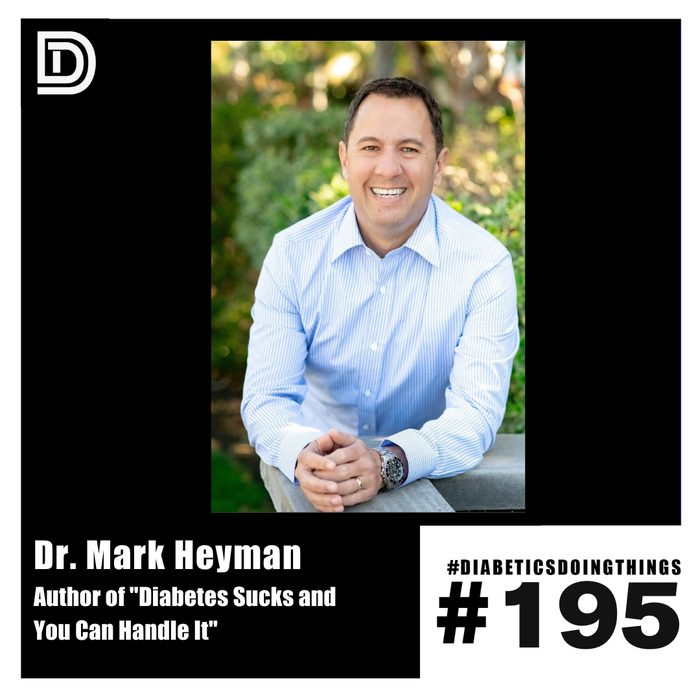
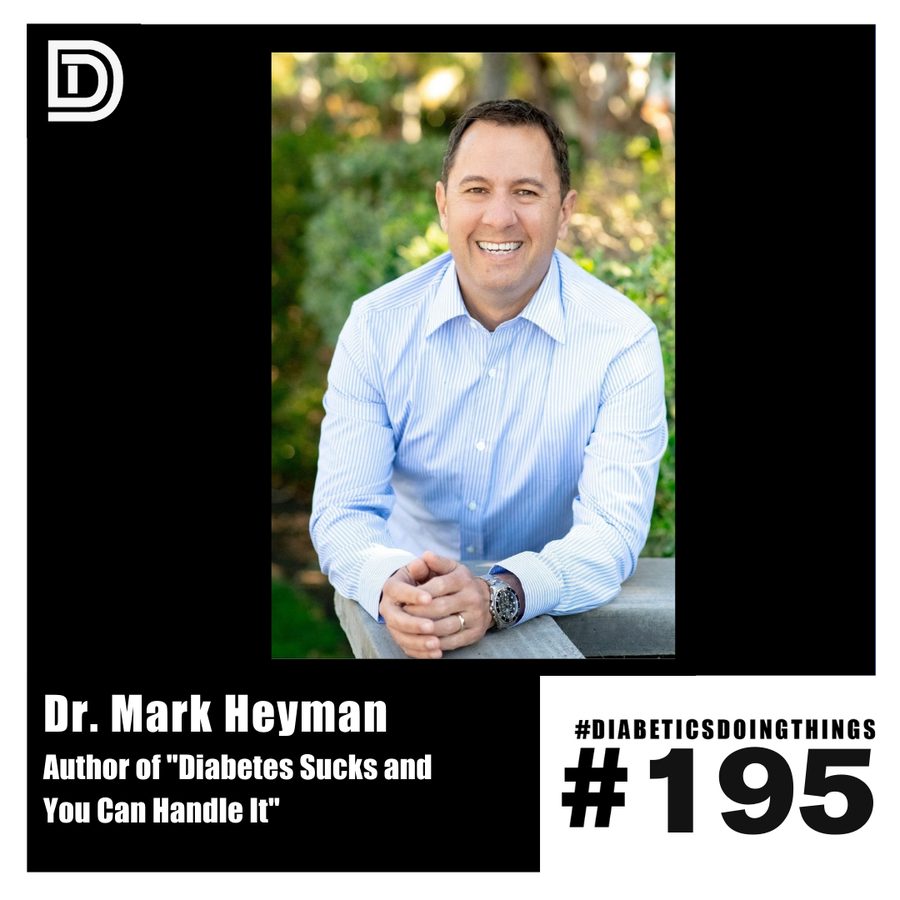
Dr. Mark Heyman, Author of "Diabetes Sucks and You Can Handle It"

Episode summary
Dr. Mark Heyman, a clinical psychologist, CDCES, and person with type 1 diabetes since 1999, joins Rob to discuss his book Diabetes Sucks and You Can Handle It. Heyman explains why people with diabetes report higher rates of anxiety and depression symptoms, and argues a healthy dose of anxiety actually keeps people safe. He and Rob trade stories about low blood sugar thought spirals, and Heyman teaches a way to label intrusive thoughts to create distance from them. They cover stress management, the difference between what you can control, influence, and not control at all, diabetes burnout, and why average blood sugar over time matters more than any single high. Heyman closes with the advice he wishes he had gotten at diagnosis: set boundaries with food.
Key takeaways
- Heyman says diabetes is inherently stressful, so higher symptoms of anxiety and depression in people with diabetes are a normal response, not a personal failing.
- Heyman recommends labeling intrusive thoughts with the phrase 'I'm having the thought that...' to create distance from them instead of treating them as fact.
- Heyman teaches that you have control over your behavior, influence (not control) over your blood sugar, and no control over your emotions or random thoughts.
- Progress with mindfulness means catching a negative thought spiral a little sooner each time, Heyman says, not eliminating the spirals entirely.
- Heyman says research shows sustained high blood sugar over time causes complications, not a single high reading, so an occasional treat is fine if you manage it.
Show notes
Rob is joined by Dr. Mark Heyman, the Diabetes Psychologist and author of Diabetes Sucks and You Can Handle It. Order your copy today.
In the episode, Rob and Dr. Heyman discuss:
The stress of diabetes
the avalanche of feelings from low blood sugar
Healthy levels of anxiety with diabetes
Stress management
Avoiding avoidance. Diabetes will not hold you back.
Keeping it 100 with yourself
Handling the reality in front of you
Labeling your thoughts as thoughts
Just getting 1% better each day with mindfulness
Managing diabetes vs. managing the stress of diabetes
Double edged sword of control
Normalizing the struggles
Questions this episode answers
Why are people with diabetes more likely to have anxiety or depression?
Dr. Mark Heyman says people with diabetes make hundreds of decisions a day and deal with highs, lows, and misunderstanding from others, and those stressors naturally raise symptoms of anxiety and depression. He notes it's unclear whether diabetes causes these symptoms or the reverse, but he sees it as a normal response rather than a flaw.
Is anxiety about diabetes a bad thing?
No, according to Heyman. He says a baseline level of anxiety is helpful because it prompts people to check blood sugar and take precautions, similar to looking both ways before crossing a street. The problem is when that anxiety spikes and doesn't return to baseline.
How do you stop racing thoughts during a low blood sugar?
Heyman suggests pausing, treating the low first, and then labeling the thought as a thought by saying 'I'm having the thought that...' rather than accepting it as true. This creates distance and makes it easier to decide whether to act on it.
What does 'Diabetes Sucks and You Can Handle It' mean?
Heyman named his book this because he wants people to be honest that diabetes is genuinely hard, while also building the belief that they can handle whatever it throws at them. He says believing you can handle it is what allows you to actually take action.
Full transcript Searchable, with timestamps
Rob Howe: What's up, podcast fans? I hope you guys enjoyed that zine that we released last week. Recording this, this episode drops April 22, 2022, 4-22-22, and last week on 4-15, we dropped the Creator Zine. It's live at DiabeticsDoingThings.com slash zine if you haven't checked it out yet, and you can get it for free as well, or you can support Diabetic Creators. And that's what we're all about here at Diabetics Doing Things and what the zine was focused on. So speaking of diabetic creators, we have one joining us here on the show today, Dr. Mark Heyman. He's the diabetes psychologist on Instagram, and he's the author of Diabetes Sucks and You Can Handle It. His new book, which is now available on Amazon, the link is in the show notes. And he joined us on his press tour throughout the diabetes community. You can also hear a great episode of Stacey Simms podcast from Dr. Mark Heyman earlier this week was published. So Diabetes Sucks and You Can Handle It. Dr. Mark Heyman takes us through what drove him to write the book and the anxieties and stress around diabetes. I know we feel that a lot. We talk a lot about the decisions that we have to make as people with diabetes. We talk about healthy levels of anxiety with diabetes, stress management, and keeping it 100 with yourself. I really enjoyed this conversation with Dr. Heyman. He and I connected in the middle of a work day and Eritrea was not able to join. So it's just us one-on-one and we're reviewing what was behind the book, Diabetes Sucks and You Can Handle It, and also just all the things that you can do to make yourself a little bit better, a little bit more mindful and help manage the stress of diabetes. So with that, enjoy this interview with Dr. Mark Heyman. Welcome back to another episode of Diabetics Doing Things. We are telling the amazing stories of people with diabetes from all over the world. Very special guest with you guys today. You have probably seen him in the diabetes community. I know I have run into him at events and conferences and panels over the years. Dr. Mark Heyman, welcome to the show.
Mark Heyman: Thanks so much, Robert. I appreciate it. Good to be here.
Rob Howe: Excited to have you, Mark. And I'm not going to call you Dr. Heyman anymore because I've already made that mistake one too many times today. We're going to keep it light. And Mark, you not only are a clinical psychologist, you are also a CDCES and a person with diabetes. You were diagnosed as T1D in 1999. Man, you're the triple threat. You have diabetes, you, you know, the clinical psychology piece is so important, especially, you know, as the conversation around mental health and awareness of mental health and diabetes continues to rise and that conversation continues to happen. And you also live with diabetes. So you handle it yourself and can speak to it as a patient. That's, that's incredible. And I think, you know, you leading the way you and others on the online community in the past couple of years really opened my eyes to, you know, what life is like for somebody with diabetes from a psychological perspective. And I think where we can start today, because we're going to talk about your new book, which I love the title, it's called Diabetes Sucks and You Can Handle It. So it's like a big truth that we all know, diabetes sucks, but I love the and there, that there's something that we can do about it. The thing that for me, the foundation I'd like for us to start in is it's often circulated through the community and it's a headline that's come out over the years of research supporting that people with diabetes are three times as likely to suffer from anxiety and depression compared to our counterparts without a chronic illness. Let's talk about that. Like all of those things that kind of go into our life with diabetes also contribute to anxiety and depression. Yeah. You know, diabetes is stressful.
Mark Heyman: And when you have stresses in your life, whether they're diabetes or whether they're school or work, that can impact your mood and that can impact your anxiety. And so as you know, people with diabetes, we're making decisions hundreds of times a day. We're having to deal with highs and lows and people not understanding us and all kinds of other stressors. And so of course, those types of things cause anxiety, they cause depressive symptoms. And the big question that we have sometimes is, are those, is diabetes the cause of them or is diabetes a result of them? And that's kind of a question that's up in the air. You know, we talk about these statistics about, you know, depression, anxiety being higher. And I want to counter that by saying symptoms of depression and anxiety are higher. And I want to say that's a natural thing. I would expect people to have people with diabetes to have symptoms of depression, anxiety, just because of the stress of what we have to deal with on a daily basis. However, given that, and given that there may be a reason for that, we have ways to be able to navigate that. And that's not a really good place to be. It's an empowering place to be because we're not, we're not, we're not a hostage to our symptoms, but we're empowered to be able to take control of them and to be able to manage them and navigate them and live the lives that we want to live. Love that. I love that message
Rob Howe: of hope because it's like, it's reality, right? Like it is, it's normal that we're experiencing increased levels of anxiety and depressive symptoms because what we're dealing with is anxiety inducing. And, you know, there's a lot of numbers that go along with it, a lot of fear of the unknown. Um, and you know, I, I think that it's really important to give people a pathway and to recognize and normalize those things. And, you know, I think, uh, the other day, I'm glad that you brought this up because the other day I was, I was having a, a low blood sugar and it wasn't particularly low from a numbers standpoint, but you know how not all lows are created equal. And you sometimes feel, uh, like a heavier burden sometimes with a, with a hypoglycemic incident. And I started to have this sort of avalanche of negative thoughts of like other stressors from my life. And, you know, people, whether it was, uh, you know, people that owe me money or whether it was hard decisions at work or, you know, you know, challenging, uh, you know, just things in my regular day-to-day life. And then I had to stop for a second and have like a little mindful moment. I was very proud of myself. And I talked to my therapist about it. Uh, I was like, Oh no, this is just a low blood sugar. This is just like what happens when you have a low blood sugar and like what can come along with it. And once I had that recognition, I had a lot more power of like, Oh, there is something I can do about this. I can sit here for a second and give myself a break, treat this low blood sugar and then move forward. And once I recognized that it really helped that sort of avalanche of feelings.
Mark Heyman: Yeah. And with low blood sugars, that's a funny one because it lets down your inhibitions in a way. It kind of lets those thoughts snowball a lot quicker than they would otherwise, because your mind isn't quite in the right place. And so I think I love the thing that you said about being mindful, but also treating the low blood sugar, taking a step back, allowing your blood sugar to come up and then assess the situation and seeing whether or not your thoughts were actually
Rob Howe: realistic. Yeah. Cause, because, you know, like you said, your inhibitions are limited. And I think there's been, you know, lots of discourse about explaining what a low blood sugar, a hypoglycemic incident is like to a person who's never had one. Uh, you, you use comparisons like drinking alcohol, like, you know, having a couple of drinks and just feeling a little bit unfamiliar and your decisions feeling a little bit strange. So yeah, that totally makes sense. Yeah. I also
Mark Heyman: want to say, you know, depression, depressive symptoms and anxiety are not fun. And I don't want anyone to experience them if possible. However, I think we have to look at them also as being helpful with diabetes, especially anxiety. If you weren't anxious about your little blood sugar the other day, or if you didn't have that sense of anxiety, even though you may not have been aware of it, you may not have treated it. You may have gone for a run or gone for a drive. And just like if you didn't have anxiety about crossing the street, you wouldn't look both ways. And all of a sudden you get hit by a car. So we want people to have some level of anxiety with diabetes. We don't want it for that anxiety to be unrealistic and to be able to, and to hold them back unnecessarily from the lives that they want to live.
Rob Howe: Well, you know, I think that anxiety is, has a lot of connotation with it, right? Like immediately you think of a negative connotation, but it's interesting having a healthy anxiety, like, in terms of safety and in terms of preparation can actually go a long way for you.
Mark Heyman: Yeah, it's helpful. It has to, it has to be there at a, at a baseline level. It's when it gets, it's when the baseline goes up, it doesn't come back down is when we have an issue. So I'll tell you, for example, using a personal example, I've had a couple of very, very scary low blood sugars. Thank goodness. They haven't happened in a long, long time, but you know, 10, 15 years ago, I had a couple of really scary ones. And my anxiety level went, it skyrocketed for a little while. And that's to be expected. You know, I was very hypervigilant about my blood sugars, making sure I was maybe I was probably I was under bolusing for a little while just to make sure I was safe. But once I had my feet back on the ground, I was able to come back down naturally, and, and be able to manage my diabetes effectively without that overarching anxiety there. You know, the challenge that people have is when that anxiety level goes up, whether it's because of a diagnosis or because of an incident and it doesn't come back down. And we want to help people be able to bring that anxiety level back down to a baseline place where they have a healthy level, but not one that's holding them back. I think that balance is really important.
Rob Howe: And, you know, I want to start because you, in your new book, diabetes sucks and you can handle it. You start off in a really interesting place around stress management. And that's something that I think about a lot in our sort of modern day life outside of diabetes is that people today, uh, we're working remote, uh, we're online more than we've ever been. We experience a lot of chronic stressors quite a bit. And then we add on top of that, uh, stress from a chronic disease and living with, uh, you know, whether it's a healthy level of stress, like we just talked about where you're concerned about your blood sugar and your diabetes management and also unhealthy levels of stress, like, you know, whether it's rage bolusing to react to a, to a meal or it's, uh, you know, trying to, you know, think about where you're going to, you know, how you're going to treat a hypoglycemic incident on the, on the go. Um, how do you think about it? How do you approach stress management for people with diabetes? Yeah. So I think you have to ask yourself
Mark Heyman: as you're managing stress, when you're doing behaviors to manage your stress, what is the function of that behavior? How does it help you? So for example, if you are going for a hike and you're feeling stressed out because of the hike, because of what may happen to your blood sugar, having, you know, paying attention to your CGM and watching it is probably a healthy thing to manage your stress. Also having snacks available to be able to treat that low, treat a low if it happens is a great way of managing your stress. Telling your wife that you're feeling stressed and getting support from her is a healthy way of managing that stress. There are other things that we do that aren't healthy. So to use a very, you know, outrageous example, you know, drinking, you know, you've been drinking before you go for a hike is as a way of reducing your anxiety, not particularly healthy for lots and lots of reasons, but avoiding going on the hike, because you're worried about what might happen there. And you say use avoidance as managing the stress. That's not a healthy place to be either. So we want to be able to differentiate between, healthy and unhealthy ways of managing stress. And the way to do that is ask yourself, what is the function of what I'm doing? How is it helping me? And also, how is it holding me back? So carrying some smarties in my pocket is helping me because it's making me feel safe. It really is making me safe. And it's not weighing me down, literally or figuratively. But not going on the hike is weighing you down because it's stopping from doing something you really want to be doing, even though we can say rationally and logically that activity, while there's a little bit of risk there, um, it is generally in general, a safe thing to do. So, um, you know, finding ways to navigate the stress by managing it in healthy ways is extremely
Rob Howe: important. You mentioned not going on the hike. And I think that a lot of people who are caregivers of a young person with diabetes will understand that sort of healthy stress, healthy anxiety of wondering when it's okay to let their newly diagnosed, uh, you know, son, daughter or relative or, uh, or, you know, steward go do what they're doing. And for you early on in your journey with diabetes, you were given permission to go on a big trip, uh, from your care team. And in your book, you talk about how that set you up for future success about planning those things. So why don't you talk a little bit about your, your trip to Paris and some of the questions that you and your family had early on in your life with diabetes?
Mark Heyman: Yeah. So I was, I guess, diabetes at the end of my third year of college. And it was June the 1st in 1999. And on June 18th, I believe, I was scheduled to go on a three-month trip to Paris that I've been dreaming about forever. And I was so nervous to go to the doctor because I knew I was sick, but because I felt like that may prevent me from going to France. But it finally got to a point where I didn't have a choice. I was so sick. And, um, long story short, the next day I talked to my new endocrinologist and I asked her if it would be okay if I go to France and she said unequivocally, yes. And that mindset, that empowering mindset has set me up for success ever since I've had my challenge with diabetes, but the message that I got from her was diabetes will not hold you back. Yes, it may be scary. Um, it may be challenging, but it doesn't mean that you can't do things. And so often with people with diabetes, their mindset gets in their way of actually taking action. Their mind tells us something is dangerous and they withdraw. They avoid it as opposed to leaning into it. Now we want people to be safe. And so doing things that are unsafe, like driving without glucose in the car with a low blood sugar, not safe. But with taking good precautions, having good communication with the healthcare team and And allowing yourself to lean into some discomfort, because it will be uncomfortable sometimes in a safe way is so important. Because if we don't do that, you can't learn. You can't learn what you can and can't do. If you stay home and don't go on the hike, it reinforces your belief that you can't hike. And then it makes it even harder to go next time. If you go one time and realize, oh, wow, that was really challenging, but I got through it, then you can make a better decision next time about whether or not you go on the hike. I don't care whether you want to hike or not. What I care about is that you making the choice rather than your fear or your thoughts, making the choice for you.
Rob Howe: I love that. I think, uh, you know, there's plenty of bulletin board content about, uh, you know, life begins at the end of your comfort zone and, and, you know, you know, you don't want fear to control your decision-making and, you know, at the same time that there's still that healthy dose of fear that is important to managing a life with diabetes. Um, but you're right, you know, until you go and do it and prepare to make something happen, how will you know it's possible? And also, you know, you don't want diabetes to dictate your, you know, your decisions, even though you should have like a healthy level of adding an extra step, whether that's, you know, preparing for a trip at the beach, like I'm going to the beach soon. And I know I've got to have a system to manage my insulin and keep it cool while I'm out in the sun. So, okay, now I've taken that step, but that's going to allow me that preparation is going to allow me to do what I want, which is to have fun and kind of keep diabetes, uh, in the back of my mind, uh, at the, you know, at my trip. So I think that's really important. And what you mentioned in the book, which I think is also important is having an honest assessment of when to, and like, I kind of wrote it as a note, keeping it 100 with yourself, because, you know, that's as people with diabetes, we love that. We love to see those unicorns, those 100 blood sugars, but when you're honest with yourself about preparing and asking the right questions and getting ready to go on a, uh, a trip to Paris or a trip to the beach or, uh, and a sleepover at a friend's house or whatever, whatever the, the situation may be honesty with yourself and your care team, uh, is,
Mark Heyman: is definitely the best place to start. Yeah, absolutely. And really the book is called diabetes sucks because let's be honest, diabetes is challenging sometimes. And some people even would say it sucks. I do more often than I want to. Sure. And the thing is, if we're not honest with ourselves about the fact that diabetes is challenging and be very specific about what challenges we have, and each one of us has different challenges, but having to think all the time, not being able to feel like you're not, can't be spontaneous, feeling like you're anxious. All of these things are challenging, but you can't navigate challenges unless you're honest with yourself that you have them. I know a lot of people who they say diabetes is no big deal. And they're lying through their teeth, not on purpose necessarily, but they're sweeping under the rug, kind of pushing it away and trying to ignore it. And when you do that, it may feel good in the moment or may make you feel better in the moment, but it doesn't give you the opportunity to actually deal with and address the challenges that you have, the very real challenges that you have. And so we have to be honest with ourselves in that way. But at the same time, we have to be honest with ourselves on the other side. Because just like you talked about your low blood sugar a while ago and how your minds aren't racing about how challenging it was and how no one understands you and all the other things, if we let our minds go like that and we're honest with ourselves about the fact that diabetes is challenging, but we may be making it more challenging than it has to be in our minds, then we put ourselves in a place where we also can't handle it. because you can't handle something that you're making up. If you're saying my life is over because I have diabetes and I can't hike because I have diabetes, those are all, none of those things are true. And so if that's what you're believing and you're going off that end of the spectrum, then you can't handle that because you're trying to handle something that's actually not grounded in reality. And so what we want to do is be grounded in reality and handle the things that are actually in front of our,
Rob Howe: faces. I really love that. And I'd like to, you know, from a psychology standpoint, and maybe you can give us some, some tips that you work with, with your patients and in your research, when you find yourself in that position. And I think that there is, uh, and I have also contributed to in the past, and I'm trying to do better of, uh, not contributing to a toxic positivity mindset, uh, with diabetes, like you said, not to minimize the burden, um, but also present it as an opportunity to, as an, and like in your, in your book title is diabetes sucks. And, uh, it's not diabetes sucks, but, uh, you know, it's diabetes sucks. Yes, that's true. It's going to take management. Good news is you can handle it. So when you're in that sort of mindset, like I was the other day where kind of thoughts are flooding and avalanching and I'm, and I'm having a low blood sugar, um, is there a framework or steps or tools that you work with, with your patients to say, okay, if you find yourself in this situation, step one is to do what?
Mark Heyman: Yeah. So first of all, it's a, when you find yourself in the situation, not if, because you're going to, our minds are wired to do that. And so we have to normalize that. But when you notice that, notice that it is doing that, the first thing to do is take a step back and notice it and, and stop that train from moving. The next thing to do is to label your thoughts. and one of my favorite ways of doing this is by using five simple words. I think it's five. I'm having the thought that. So you can say, because when you, when you experience these, these stresses, you know, that my life is over because of diabetes. That's one pretty extreme example. That is what you are experiencing. That's what that, that is a thought in the experience you're having. I don't want to minimize that at all because it's, it's what's happening for you right now. But if you grab onto that and you say, my life is over and you buy that, like it's a, it is the truth. You have made that part of you. And now it's going to be really hard to get rid of it. It's going to be really hard to push that away. What would happen if you were able to acknowledge that thought as a thought by saying, I'm having the thought that my life is over. There's a big difference between that phraseology and my life is over. One is, you know, I'm putting my flag, my flag in the ground. And one is I'm acknowledging the fact that there's this, thing swimming around in my head that may or may not be true. And I can choose whether or not I want to buy it. And so labeling your thoughts for what they are or labeling your emotions for what they are. First of all, they bring them to light for you because you may not actually be aware of what you're thinking and what you're feeling, but then it also gives you some distance from it and allows you to make a choice. Do I want to buy that thing or do I want to put it back on
Rob Howe: the shelf and walk away? I love that. And I think the, you know, that, that doesn't just happen by, you know, overnight either. I think like, uh, and we're going to talk about the work required to manage diabetes. Like the work required for mindfulness is also significant and just acknowledging and noticing and separating yourself from your thoughts, uh, and being able to say, Hey, this is just a thought coming through my mind. Um, you know, for me, I I'm, uh, I'm very fortunate. I, you know, from really from 2016 to now have, uh, gone on a pretty extensive like mindfulness and therapy journey. And I've been very forthcoming with the, with our audience here about at one point having two different therapists and, you know, because I just needed tools and needed help to sort out, you know, some of the issues that I was having in my relationships and some of the issues I was having with myself and accountability and learning about mindfulness and learning to view my thoughts as independent and not part of me, because like you said, thoughts become words, words become actions, and you can quickly convince yourself that, you know, in this case that your life is over because you have diabetes, even though there's a lot of examples of people whose lives aren't over people like us and like people in the community who have lived incredible long lives now with, uh, with diabetes. Um, so, you know, I, I think it's just really important to make sure that we, we focus on like that mindfulness isn't always just sitting cross-legged on a floor in a yoga studio, uh, on a meditation retreat. It's recognizing that I am separate from my thoughts in this moment. Exactly. And I want to
Mark Heyman: say that I want to make sure people send their expectations about mindfulness and their ability to do it appropriately. And we can all be mindful. I can't tell you people I teach mindfulness too. And they come back to see me a week or two later and they say, I'm a horrible, I'm horrible at mindfulness. Almost everyone does. And I say, I am too. I do it every day and I'm not great at it either. Although that's a thought as well. But what we have, what I want to say is if you're able to get 1% better, if you're able to get 5% better, if you're able to catch yourself on your thought train five seconds sooner, that is a huge, huge measure of success to say your thought, my thoughts are never going to leave my, leave the present moment. That's, that's a farce. It's not going to happen to any of us. That's not how we're wired. Ask, ask any Buddhist monk who practices mindfulness every day. Like it doesn't work that way, but to be able to say, I caught myself earlier this time than I did last time, even if I went down that train of negative thoughts, that is a huge thing. And to be able to catch yourself, you can't bring yourself back until
Rob Howe: you catch yourself. You can't stop the train until you recognize the train is moving. And you know, it's kind of a big, you know, it's a little bit of a mind trick because just recognizing it is mindfulness. You don't even like not, you don't even have to do anything else. Just stop yourself. Like, Oh, I recognize this. Oh, I'm on a, my path of thinking is going down a path. I don't want it to go down and ka-ching. You've done your job. Like now that
Mark Heyman: now you're present and that's mindfulness. And with diabetes, I mean, we, we judge ourselves so much. And my big part of mindfulness is not judging yourself or observing your experience without judgment. So I look at my blood sugar and it is, you know, two 50. Okay. Well, and then all of a sudden I feel, I started having thoughts about my blood sugar. Shouldn't be too fit or I shouldn't have eaten that pizza yesterday and all these things. Right. Um, and just notice those things. There's not, there's no good or bad about your blood sugar. There's no good or bad about the pizza. Sure. You could have done something differently to change your blood sugar, but you know, what, what happened in the past happened. And so just experience what you're experiencing right now, notice it, and then allow yourself the, the privilege and the space to be able to make a choice differently next time. If you want to, I love that. And I, I call it in my
Rob Howe: personal life, it's a very stoic approach, but when you're making decisions, like give yourself space and grace, like, and it's like, Hey, you're not going to make the right decision every single time. Like you said earlier, you're a human, uh, for, you know, you can never be 100% mindful, 100% present 100% of the time. Uh, it's not a realistic measuring stick. Um, now I want to shift the gears a little bit to like with people with diabetes, you're managing numbers quite a bit. So like you said, your blood sugar, like earlier, I had a two, my blood sugar hit 200 for the day. And, uh, my response was to, you know, give myself a correction bolus, but then I made the mistake of going a little further and judging myself for it. Like, you know, uh, bolus with a little bit of judgment. And I thought, you know what, next time I'll count the carbs differently. Let's not, this is not a reflection on me as a person. This is just a thing that has happened in this small moment and we will recover. We will rebuild. Um, people with diabetes typically, in my experience can become very type a where they're like really holding on tightly to their control and they often can develop unhealthy patterns or unhealthy, uh, communication with themselves as a result. You know, what is that sort of double-edged control, a sword of control and how, uh, how do you approach that with your patients and, uh, you know, in your practice?
Mark Heyman: Yeah, it really goes, it goes back to mindset and recognizing what you have control over and what you had influence over and what you have no control over. So I like to use the metaphor of Imagine that you're driving down the street right now and you get a flat tire. What would you do? Most people would call AAA or call the tow truck and have them come and change their tire. Or if they're handy, they would change the tire themselves and go to a tire shop and buy a new tire. And you may be out a couple hundred dollars and some stress and some time. But in the end, you had a problem that you were able to solve. And now the problem is solved. and we oftentimes look at our diabetes and our stress around diabetes in the same way. And that's not always helpful. So if you have a blood sugar 250, that's that we call that a problem. Although we could argue about the words, but let's call that a problem for a minute. Um, how do I solve that problem? I take some insulin and will it be successful eventually? And to some degree, not, not exactly, but you know, we'll, we'll get, we'll get the blood sugar down at some point. If you're feeling burnt out with diabetes or anxious, how do you solve that problem? Well, you can do all kinds of things to avoid the problem, avoid feeling burnt out. You can, you know, put your insulin away and not think about it. You can, you know, pretend like you're not anxious, but our emotions and our thoughts are not things that we have complete control over, at least in this moment. And when we try to have control over them, we try to pretend like it's a tire that we can fix, we end up banging our head against the wall. We end up trying, we have to try to control things that you can't control. It's like, imagine you're trying to push over a brick wall and your only measure of success is if I can push over this brick wall, I will be successful. Well, you're going to be pushing for a very, very long time. And so with diabetes, it's a matter of recognizing what you have control over, what you have influence over, and what you have no control over. So let's start with what do you have control over? You have control over your behavior. You have control over what you eat, how much insulin you take, when you exercise. And I recognize there may be some exceptions to these things, but for the most part, you have control over in your relationships. You have control over who you tell you have, who you tell that you have diabetes. You have control over how you communicate to people, how you make your needs know, What boundaries do you have? What do you have influence over? You have influence over your blood sugars. You have no way of controlling your blood sugars exactly. None of us do. But you can certainly, I can say, I can't say, Rob, I want your blood sugar to be 125 in half an hour. You can try, but if it happens, it's random luck. But you can say, I want your blood sugar to be lower in half, 45 minutes to an hour. And more likely than not, you can do some things to make that happen. How much lower? It's kind of a, it may be a guessing game, but it can happen. And then there's some things you have no control over, like how you feel right now, because you can't go to the past and like change what happened five minutes ago to make yourself feel differently. Trust me, I've tried. And you can't control what thoughts come in your head. You know, we have this belief that somehow we can control the thoughts. Man, if I could control the thoughts, I would develop a pill and like sell it for millions of dollars. But the reality is, is we all have all kinds of crazy thoughts go through all the time and we can't control them. If we think we can, we actually end up spending all of our time and effort trying to control that thing rather than living our lives. And we do that with diabetes burnout all the time. I want not to feel burnt out. What can you not feel burnt out? I'm going to think about not feeling burnt out. And what do you end up doing? You end up feeling more burnt out because you're focused so much on getting rid of the burnout. What would happen if you let go of control? And recognize, be mindful, and notice the fact that you're feeling burnt out, but then decide to take action and do something differently anyway. Because you can still do things even if you're feeling burnt out. It may not be fun. It may not be easy, but it doesn't have to be a big barrier. It doesn't have to be that brick wall on the way. Well, it actually comes
Rob Howe: back to kind of like we were talking about with the title of your book. It's like, I'm experiencing diabetes burnout and I'm going to go to my job or, and I'm going to, I'm going to find a way to exercise today, or I'm going to, uh, do better to influence my blood sugars today as a result, or I'm going to take a break from my technology and go on, you know, a little bit more manual management for whatever, because, because I re I need that now. And I think that part of that is recognizing your needs as a person as well and not denying. And I think often with diabetes burnout, in particular, the way that we talk to ourselves about those things, like, oh, I'm not a person that, uh, that has diabetes burnout, or I can't be having diabetes burnout. Look at all these great things in my life. Uh, or, you know, uh, I'm not like this person, they have diabetes burnout, not me. Uh, and I think that that type of, uh, you know, those types of things are awful, almost compound the burnout when we like finally accept them. Exactly. No, I, I,
Mark Heyman: agree 100%. We don't want to be held hostage to our emotions. Because if we're held hostage to our emotions, we wouldn't do anything. I remember when I was in high school, I wanted to ask this girl to a dance. And I was terrified, terrified to do it. And long story short, I ended up doing it. But it took me like three hours dialing the phone, trying to get the courage to ask her. And I realized in the end, it didn't matter whether she said yes or no. What really mattered was that I was able to ask her. Because I had no control of whether she said yes or no. She said
Rob Howe: yes, by the way. But yeah, you guys can see, but I'm like, I'm cheering here. But I had no control
Mark Heyman: over that. But what I had control over is moving through my anxiety and asking the question. And if we're held hostage to our emotions, then we are basically allowing our emotions to drive our ability to act and our behavior. There's a chapter in the book called lead with action. and lead with action is my way of saying, you may feel all of these things and you may think they get in your way, but do they really, can you, can you still do that? Can you still ask the girl out? Even if you're feeling anxious, can you still go on that hike? Even if you're, even if you're anxious about your blood sugar going low, can you still manage your diabetes? If you're feeling burnt out and the opposite of that is leading with emotion. I cannot manage my diabetes until on not feeling burnt out. Well, all of a sudden you've lost control of your ability to manage your diabetes and you put that control in the hands of your burnout, whoever, wherever that is.
Rob Howe: I want to talk a little bit about, I want to go back because you hit on something that I really, really liked, which is what I'll call analysis paralysis. So, you know, you are the only person stressed out about calling that girl to ask her to the dance. She has no idea. nobody else who's walking by you to the left or the right. That's totally internal. And you might be stressed to a measure of 10. You might be all the way maxed out, but you don't know. Nobody else knows. And your fear, and I think I come back to one of my favorite guilty pleasure sports movies, Coach Carter, where they integrate a quote from Marianne Williamson. I'm paraphrasing a little bit here, but our deepest fear is not that we are inadequate. Our deepest fear is that we are powerful beyond measure. And I, and I feel that a lot with people with diabetes is that, yes, it's true that diabetes sucks. And it's true that it makes your life extremely difficult. And there are obstacles that you would not have had to face otherwise that you now have to face every single day. And that experience is a hundred percent valid, a hundred percent true. And you're all, you are three times as likely to suffer from anxiety, depression. You are likely to face burnout. You are likely to face challenges with access and medication and insurance and all these things that you wouldn't have to necessarily deal with otherwise. But you are still capable of being the person that you want to be and that you still are powerful beyond measure. And oftentimes the obstacles that we make up for ourselves in our head in isolation that we don't share are not quite so insurmountable as we imagine in our head when we take that.
Mark Heyman: I think, I think back to this incident when I, that I had in high school and what would have happened if I knew I was confident that I could handle whatever came my way, whether she said yes, whether she said no, what, no matter how anxious I was that I could handle it. And that's where this idea of handling things comes from. What would happen if the minute you believe that you can't handle diabetes, you set yourself up for failure. What if you believe that you could handle it? Yes, it sucks. Yes, it's hard. Yes, it's stressful. But, or not but, and if I believe that no matter what it throws my way, I can handle it, it's going to make it so much easier for me to handle it. And that's what I want to say. That's the message I want to send in the book is that, yes, it sucks. Yes, you can handle it. And I want to make you believe that you can handle it. Because the belief is the only way you can actually start taking action and handling it.
Rob Howe: I love that. It actually really aligns with one of the principles that I try to manifest for myself in my life on a regular basis, which is no matter where you are, no matter where you find yourself, the best possible outcome is still on the table. You could be, whether it's sports behind on the scoreboard with no time remaining, you could be in the worst possible situation and you could have gotten yourself there from your own actions and, you know, and whatever failures you had, but it could still work out for the best. It's the best possible outcome is still on the table for you. One of the things I see a lot of
Mark Heyman: my practice is people who have fear of low blood sugar. And I asked them what's so bad about having a low blood sugar. And I reckon, I know it's not fun. I have them all the time. I don't want going to have low blood sugar, but what's so bad? And we dig into it a little bit or a lot. And we realize that they have a belief that if they have a low blood sugar, they won't be able to handle it. The symptoms will be too uncomfortable and it'll paralyze them. But I asked them, if you're low, will you have the ability to get up out of your chair, walk to your drawer, pull up, pull the drawer out, get some smarties and eat them? And they say, yeah, I think I can do that. And can you feel, is it, can you have the ability to feel some uncomfortable things in your body? Yeah. Can you have the ability to handle being a little embarrassed because maybe you said something stupid to your boss when you're low? And they say, yeah, I've done that before. And you handled it? Yeah. And you give them the sense that, wow, yes, I don't want this to happen, but it may. And if it does, I'm going to be okay. I have the cognitive ability. I have the physical ability and I have the emotional ability to deal with it. And when that happens, it opens up the whole world for them to see, wow. Yeah. I don't want to have a low it sucks, but when it happens, I can take care of myself. I'm going to
Rob Howe: be safe. I love that. Yeah. Uh, you know, that burden you can handle, I think. And I think that when you break it down like that, uh, you know, a low blood sugar, even, uh, you know, extreme low blood sugar, uh, it's when you deal with it, the whole problem it's, it can be overwhelming. But But if you say, can I, can I sit, can I walk over to my drawer, get my smarties, get my gummy bears, uh, and sit down and treat my blood sugar? Oh, I think I can do that. Uh, or can you reach out to somebody who can help you? Like there is a way, uh, whatever that path looks like for you. Uh, you know, I think, I think that yeah, diabetes sucks and you can handle it.
Mark Heyman: Well, what people don't realize is that they have been handling it all their lives with diabetes. I mean, you say, I say, I haven't been handling it well. well, you were diagnosed with diabetes, you know, let's say 15 years ago, and you've had some challenges ever since. Sure. So maybe, maybe your challenges are bigger than other people's challenges, but you're still here. You're still talking. Um, maybe there's some work to do and you have some improvement to do, but you've been handling in your own way and you've survived. And that's a huge accomplishment to be able to survive with diabetes for 15 years. So that shows that you have an internal strength that you can do it and you can do more.
Rob Howe: Totally. And like, you know, a hundred, if you were born at any other time or born a hundred years ago, like you would have no option. You'd be dead, you know? So what a huge accomplishment you've already, we're already on borrowed time. Uh, you know, you, you 23 years now, uh, 17 years for me, you know, that, that, what a, what an awesome opportunity, but it takes that mindset shift. And, you know, for me, something recently I've been, uh, really thinking about and spending a lot of time with is, you know, life is really just a series of insoluble problems, one after another, after another, your entire life. And what a relief it is to acknowledge that no matter who you are, you'll never have it all figured out. And whether it's diabetes or otherwise, there's always going to be something else. And once you just kind of sit back for one second and let yourself, allow yourself not to have it all figured out and not to have all your ducks in a row, uh, whether it's diabetes or otherwise, uh, you know, that's where that, you know, to me, that's where I start to find a lot more peace, a lot more mindful moments. Uh, and, uh, as the, as the Danish say, uh, the secret to happiness is low expectations. So, uh, you know, I think that there's a nice balance kind of between those and, and really recognizing that even people who look like they have it all figured out with diabetes still have low blood sugars, still have high blood sugars, still catch their pump sites on doorknobs, uh, and still deal with those things and normalizing them and sharing them, uh, sharing that work that goes into that day-to-day work to manage your diabetes and manage your life in general. Uh, we're all going through it in some
Mark Heyman: way. Yeah. As a psychologist, social people with diabetes, I certainly have some boundaries, but my diabetes management and my current blood sugars are not one of them because I want to to show people when I'm having a rough day, not to make anybody feel sorry for me, but I want to show them that I'm a professional. I have, I'm a triple threat, right? I have a PhD, a CDCES, yes. And I had diabetes and my blood sugar is 300 every once in a while, or actually more often than every once in a while. And I use for a living. And if I use for a living and I can't, and I have trouble maintaining perfect blood sugars or not even trouble, I cannot maintain perfect blood sugars. Then why should you be able to, and I want to give you, I want that to give you permission not to? I've been doing something recently where I've been sharing. So on my,
Rob Howe: on my app, my Medtronic CareLink app, I'm able to see my like real-time blood sugar chart for my CGM. And I'm also able to see like a 24 hour summary. And the other day I flipped over to my 24 hour summary and I was 98% time in range. But when I flipped back over to my chart, my chart was up and down, like all within that range. So, you know, not all 98% sounds great, but it was hard. I was having a tough day, a tough diabetes management day. And again, like, I don't say that to say that, uh, you know, Oh, 98% time and range. Like I'm so good. But I looked, I thought about what you just said. Like I have diabetes. Of course I don't have a flat blood sugar line all day. Like what, one of those is honestly preventative to the other. Like, so, uh, and you know, it's, comparison is the thief of joy. It's easy to look to the left and the right, uh, and add a snapshot of somebody's numbers on the internet and say, Oh, well, I'm not as good as them, or I'm a bad diabetic, quote unquote, bad diabetic. And, um, that's just, I think you can allow yourself if you're out there feeling like that, allow yourself to, uh, relax and lose control over that because you don't see every minute of every day with them. And if you have, or live with diabetes of any kind, you're going to deal with highs. You're going to deal with lows, even when you're a triple threat, like Mark and you're a PhD, a CDCES and a person with diabetes, you have every reason to have it all figured out. And yet you still deal with the same challenges as the rest of us.
Mark Heyman: Yeah. I love telling people this story when I, and it's a true story. A couple of years after I was diagnosed, I was going to see a doctor, a endocrinologist, and this is before CGM. And she watched, and she asked me to bring my blood sugar logs in. And I didn't keep, I didn't keep blood sugar logs. I checked my blood sugar, but I didn't keep any logs of it. So I sat in the parking lot before my appointment and I had a piece of white paper and I made this chart on my, on the paper, you know, Monday, Tuesday, Wednesday, before lunch, before dinner or before breakfast, lunch, and dinner. And I made up blood sugars, made them up complete bars. And of course I had put a couple highs in a couple of lows in that chart. And I went in to see her and I was very proud of it. And I handed it to her and she looks at it and she says to me, Wednesday afternoon, after lunch, your blood sugar was 250. What happened here? I'm like, oh man, I got to make up a story. So I made up a story about how I probably had a French fries for lunch and couldn't, didn't bolus right and all this stuff. And I walked out of there and I realized like, first of all, it's not a fair question. But second of all, my answer was not very good either. My answer should have been, I have diabetes and people who have diabetes have high blood sugar sometimes. And that should have been enough. I don't need to explain myself as to why my blood sugar was high last Wednesday afternoon. I don't know. But I do know, well, I do know the reason why it's high because I have diabetes. Not because I ate french fries and ate a cookie after lunch and didn't bolus right. That may be the explanation, but that's not the reason. Right. Man, sometimes it's just great to
Rob Howe: relieve yourself of that burden of having to be perfect. We're making a lot of decisions on behalf of a, of an organ that no longer functions. And, you know, we've got, uh, you know, there's a lot of inputs that we can't control and there's some that we can. And even when we control them, uh, it's diabetes still throws us a curve ball. It's just that, uh, sort of impossible to solve
Mark Heyman: the equation. And the most important thing is your averages. You know, there's no evidence, no research that shows that high blood sugar, even one high blood sugar every day causes any kind of complications. What the research shows is that sustained high blood sugar over time does. And so if you are enjoying a cookie or a piece of cake or a beer or whatever it is, it's going to send your blood sugar high. Enjoy it. Just make sure that you are putting in the input, the things you have control over to be able to manage that. And if you do that, you're going to be just fine.
Rob Howe: Trust me, I am a carb enjoyer. And that is true. Yeah. And you know, don't deny yourself those, you know, don't let diabetes rob you of the joy in the rest of your life either. I think that, like you said, you don't have to be perfect. Enjoy your life. Be present with that. That's an easy thing to be present with how good a cookie tastes. Okay. We're almost to time, but I want us to just plug your book. When is it on sale? I know we're going to include a link in the show notes, but tell us about diabetes sucks and you can handle it. And you know, what really drove you to, you know, to dig into this text and, uh, you know, what do you hope
Mark Heyman: people get out of it? Yeah. So the book will go on sale on April 19th. It'll be available on Amazon. Also my website, the diabetes psychologist.com forward slash book where you can find it. And it's about, uh, it's a 12, a 12 chapter book that really takes you on a step-by-step journey to one being honest with yourself about diabetes, recognizing kind of how it sucks for you and be able to really identify those things in an honest way, but also see where your mind may make it suck even more than it has to and bring yourself back. And then giving you some really tangible tools that you can use, mindfulness being one of them, about how you could handle it. I really want people to take away from this book some tactical skills that they can use in their lives to recognize, one, that they have some very real challenges, but two, empower them to be able to handle those challenges with grace and with ease and to be able to do what they want in their lives without letting diabetes hold them back. And then at the end of the book, there's some chapters about dealing with some tougher stuff, things like complications, financial stress, sexual dysfunction, things like that, and giving you some tips about how you can use the skills that we've learned in the book to apply them to even bigger challenges. And then at the end of the book, talk about when And you need therapy because my way of thinking about mental health and diabetes is if we had 100 people with type 1 diabetes in a room, there may be two or three of them who really need to see me or see someone like me in my office or over a video for therapy. But there's 97 people out there who need something, and that something is not me one-on-one. And that's not because I don't want to see them or they can't see me, but because they don't need me. They need the book. They need, you know, let's know podcasts like mine or like yours, they need something. And I, and this book is really a, fills that gap of part of that. Something that people need, um, to be able to be a tool, to be a reference guide and to empower them to live the best life that they can, even with diabetes along for the ride.
Rob Howe: I love that. Dr. Mark Heyman, the diabetes psychologist.com. You're the host of the diabetes psychologist podcast. You can find that on Apple podcast and Spotify, wherever podcasts are, are listened to, uh, Dr. Heyman, Mark, thank you so much for your time today. Before you go, I do want to ask you just a quick put on the spot, uh, question, uh, that we've asked, uh, recently on the pod, which is, uh, if you could go back to 1999, uh, when you are, uh, you know, like you said, a junior in college, uh, and give yourself one piece of advice or one encouraging word, what do you think you would tell yourself?
Mark Heyman: I would say set boundaries with yourself in terms of what you eat. I was given some double-edged sword advice from my doctor when I was first diagnosed. And she said, you can eat whatever you want to. And I think that for me, that was, it was empowering, but it also has held me back. And I realized for myself that, for example, if I eat carbs before noon, the rest of my day is going to suck. I'm not going to feel well. I mean, forget about my blood sugar numbers, but I'm going to be sluggish. And so I wish I had that advice to be able to take the heart to like, you know, choose my battles with my carbs or choose my carbs, I should say. And for me, it would be, you know, learning that before noon, not a good idea. Afternoon, go to town. But really, you know, setting boundaries is actually a freeing thing with diabetes and in life. And if we can recognize that for ourselves, as opposed to going full out and doing whatever you want to, or holding back completely, you're going to be a good place.
Rob Howe: Oh, I love that. I love finding, you know, creativity within constraints. I think constraints are so, you know, such an important part of our life and sometimes frustrating, but you can really find, uh, you know, a lot of good in those, in those boundaries and in those constraints. Mark, thanks for your time today, man. I, I, I'm so excited, uh, to have your book hit shelves. Uh, again, we'll include all the links to purchase here in the show notes. Uh, and thank you for, uh, for coming on diabetics, doing things. We've got to do a podcast swap. We've got to get a, got to get on the, uh, and plug your pod some more, uh, here,
Mark Heyman: here very soon. Sounds good. Thanks, Rob. All right. Thanks.
About Mark
Dr. Mark Heyman is a clinical psychologist, CDCES, and person living with type 1 diabetes since 1999, known online as the diabetes psychologist. He is the author of Diabetes Sucks and You Can Handle It and hosts the Diabetes Psychologist podcast.