

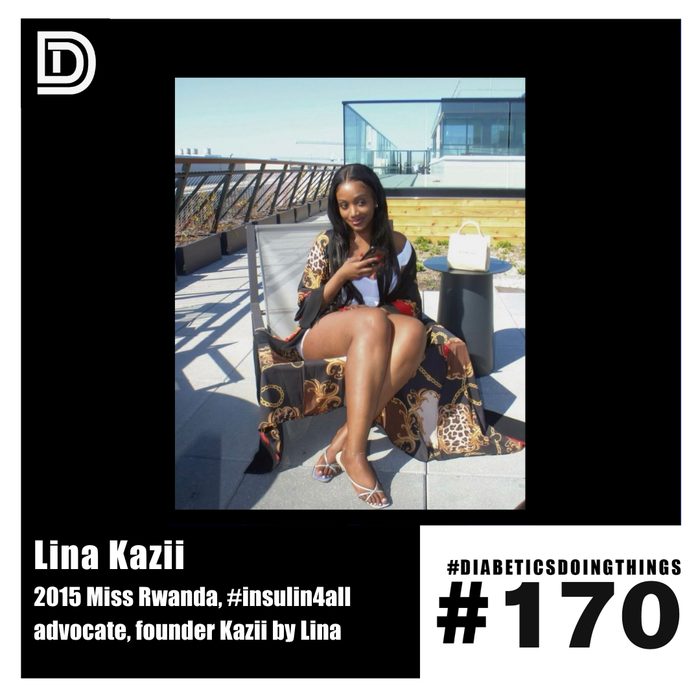
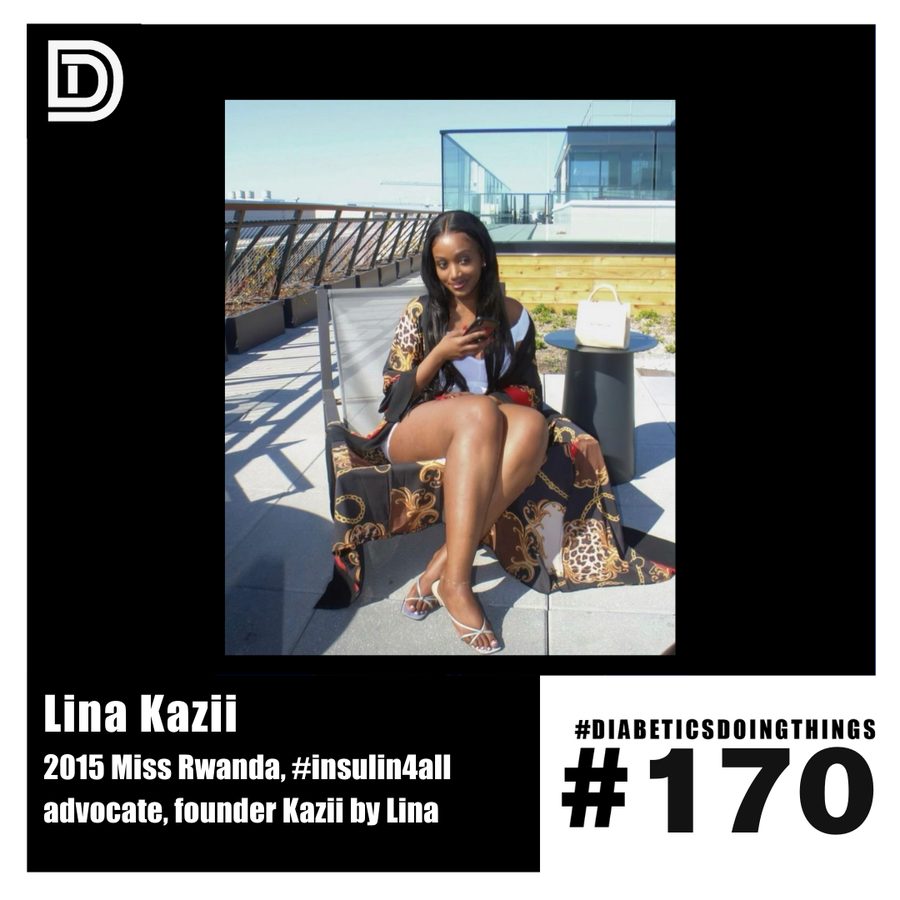
Lina Kazii 2015 Miss Rwanda, Advocate, Influencer, Entrepreneur
Episode summary
Lina Kazi grew up a Rwandan refugee whose family fled the 1994 genocide before settling in the US, living in Miami, Frisco, and Washington, DC. She was diagnosed with type 1 diabetes at age 10, after her father pushed a doctor who had refused to run blood work. She describes relatives bringing aloe vera juice from Rwanda hoping it would cure her, and a nurse explaining she needed insulin for life. She competed as Miss Rwanda USA in 2014 and built a maternal health task force inspired by her own birth during the genocide. She also discusses stigma between type 1 and type 2 patients, rationing insulin before getting insurance, protesting with T1International at Eli Lilly headquarters, and launching her robe and kimono brand, Kazi by Lina.
Key takeaways
- Lina was diagnosed with type 1 diabetes at age 10 and ended up sharing a hospital room with a childhood friend who was diagnosed the same week.
- Lina says relatives brought her gallons of aloe vera juice from Rwanda, believing it could cure her diabetes.
- Lina competed as Miss Rwanda USA in 2014 and started a task force for prenatal and postnatal maternal care, inspired by her own birth during the Rwandan genocide.
- Lina says she once paid over $1,300 for a 30-day insulin supply without insurance, which led her to advocacy work with T1International and a protest at Eli Lilly's headquarters.
- Lina's brand, Kazi by Lina, sells robes and kimonos; she says 'Kazi' means feminism and womanhood in Kinyarwanda.
Show notes
We’re back and with a new format and new partners! Each week Rob and Eritrea will update you on all the goings on at Diabetics Doing Things, and integrate that into the show prior to our guests.
This week we talk about:
Trouble with infusion sets and what to do about them
Eritrea digs in on a recent laser treatment for her retinopathy
This week’s guest is Lina Kazii (@linakaziii on instagram)
Lina lives with T1D in Washington, DC today but we spend a good amount of time discussing her home country of Rwanda, which Lina represented as Miss Rwanda in 2015.
Lina, Rob and Eritrea discuss, among other things:
Lina’s T1D Diagnosis
Growing up with T1D in an African household in the US
Returning to Rwanda as a young adult
Dealing with family members who want to “cure” your Diabetes
Diabetes and its relationship to trauma
Advocating for #insulin4all and protesting at Eli Lilly HQ in 2019
What it’s like to be a popular woman with Diabetes online
Lina’s brand Kazii by Lina and her robes
and MORE
SPONSORED! This episode is sponsored by Type Zero Health, a T1D owned business who make exceptional clean exercise products that don’t spike your blood sugar. Type Zero is the official exercise partner of Diabetics Doing Things and you can save 20% on your order from TypeZeroHealth.com by using ROBHOWE at checkout.
Questions this episode answers
Who is Lina Kazi?
Lina Kazi is a Rwandan-American woman who lives with type 1 diabetes, was Miss Rwanda USA in 2014, and runs the robe and kimono brand Kazi by Lina.
How old was Lina Kazi when she was diagnosed with type 1 diabetes?
She was 10 years old. She had been losing weight and urinating constantly, and an ER test found her blood sugar was over 600.
Why did Lina Kazi protest at Eli Lilly's headquarters?
She joined a T1International insulin-for-all protest at Eli Lilly after struggling to afford insulin without insurance, at one point paying over $1,300 for a 30-day supply.
What is Kazi by Lina?
It's Lina Kazi's clothing brand focused on robes and kimonos. She says the name comes from a Kinyarwanda suffix meaning feminism and womanhood.
Full transcript Searchable, with timestamps
Rob Howe: What's up? We're going to continue this awesome, a little bit more casual weekly updates from Eritrea and I before the pods. I really liked last week's. It's like a real podcast. What do you know?
Eritrea: We're a real show, Rob, with real people, real things. Real feelings? Trying to be organized. Yeah.
Rob Howe: God, you know what? I'm not super organized, but we're working on it. We're getting there, people.
Eritrea: Is that shade?
Rob Howe: No, I don't know. I shade it myself. I mean, it's just radical honesty. You know, that's the big thing. big content creator term radical honesty, man. Like I'm disorganized. Okay. Um, we're gonna talk about two things this week before we get into our incredible interview. The first is like what's going on diabetes wise with, with us, uh, me, I'm actually, I've been experiencing and you know, this is a low key flex. Like I'm in better shape than I've been in, in some time. I'm like working out shout out type zero, who's also sponsoring this episode, which is great. Um, but I really use their stuff if and you know i would still use it if they weren't paying me shout out them they're great the other thing is though i'm in shape now and so i've used silhouette infusion sets shout out all my silhouette users uh y'all know if you know you know where it's like a long cannula and it goes in at an angle and like a 30 degree angle and it can be pretty painful but it's for you know generally build for people who are slim muscular and don't have as many like good places to put infusion sets. And, you know, a lot of infusion sets go in straight down like a 90 degree angle. And these go in at a very like flat angle and they're kind of long. Anyway, I've used them my whole pumping career and they're fine. You know, they can be painful. They create a lot of scar tissue. So anyway, lately I've just been getting a lot of kinked, like occluded sites and I hate that, you know? And I think it's just like, I don't know about you about like what your mood gets like when you have a high blood sugar, but I think it's just like indicative of my whole personality is like when I'm, when I bump up against an obstacle that I can't move and like, I just get really pissed and I get kind of, I bow up at it and like, you know, attack the obstacle, which sometimes, you know, in that case leads to like a rage bolus or like I'll immediately change the site. And like the other day I changed, I felt like I had a kinked site. I could just, you know, it was one of those things, right? I didn't really eat that much. My blood sugar spiked for no reason. I was like, okay, here we are. Sure enough, pulled it out. It's like kinked. So I'm going to go through the process with Medtronic, not even on a sponsorship, not even on a sponsored level, but like, I'm going to go through because you can call the Medtronic 24 hour helpline and request samples of other sites if sites aren't working for you. So I'm going to try, I'm going to try one. I think it's called the Sure-T and it's a metal, uh it's like a steel cannula and it goes in straight but it has like another anchor on it so anyway i'm gonna try that because that's what i've in the research i've been doing has been they say it's like the next level up from silhouette so i'm gonna try that to try to see if i can limit some of those occlusions i guess i just learned something so and i mean
Eritrea: so i i i don't think i've ever been like this crazy athlete like you are or just you know like fully muscular but in the last year i started working out and i am much more muscular than I'm used to like just you know the amount of fat to muscle that I have has changed and I've noticed that a lot of my infusion sets are also kinking so is that maybe why do I need to switch oh my god I had no idea like I didn't know this could happen to you look at how weird is that like yeah I've been having the hardest time I think last week I had three kinked infusion sets with that within like a couple hours like I couldn't get it to stick and I literally last week was just talking to hustling about switching the shots because i was like what if i just can't be a pumper anymore like what if i just don't have the real estate for it that's what i call my side chain is real estate but um yeah i just don't have the like i just can't get them to stick places so now i guess i'm gonna look into some steel infusion sets i wonder if tandem makes them
Rob Howe: i'm gonna call it i think they have i think the interesting thing about infusion sets i don't know how this works but like i think most of the pumps have the same they even have the same names so i I think it's like the pump supplies are universal across, across the board. In some cases, I think reservoirs are very different between tandem and Medtronic, but I think the actual sets are mostly the same. Anyway, don't quote me on that. But yeah, I think, I think like the end of it is the ending, like where it goes in your body are, are pretty much applicable across all brands. So yeah, I'm going to be trying that. I'm going to do like some videos on it as well on YouTube. I think just to, you know, again, talking about those ins and outs of diabetes and like, you know, when your body changes or your life changes or whatever, you're, you know, whatever you're doing, different priorities, gotta be able to adjust with it. I'm excited to watch the video
Eritrea: so I can learn something. I'm serious. I had no idea fam. Like I was over here tripping. So I'm excited to see you put out this content. So maybe we could all learn something. Um, I honestly haven't even heard anybody else ever talk about it. Uh, so this is new information to me. I
Rob Howe: appreciate you sharing. Yeah, of course. You know, if I do it for, if I do it for you, uh, you know,
Eritrea: we could do it for everyone. So diabetes stuff about me, I guess I don't mind sharing. Um, so a few weeks ago I went to the eye doctor, Rob knows, but I'll tell you guys are friends on the pod. And, uh, so I'd gone in January. I'd got, had to get a shot in my eye in January, uh, because of some inflammation that I was having. I went to get into the doctor a few weeks ago and my eye doctor told me that I had some diabetic retinopathy and just some bleeding in the back of my eye. If you wear glasses or contacts and you have diabetes and you know that this is like taking time bomb anxiety feeling that just kind of lives inside of you. Because you know, it's coming, but you just don't know when. So when he told me, I absolutely panicked. Like I absolutely was like, this is it. I am blind now. From now on, I will not be able to see even though he was like, Eritrea, you can see just fine. Please calm down. We got to figure this out. Long story short, I went to my eye specialist a few days later, still freaking out, still telling him that, you know, I was prepared to be blind. I think for like the three days before going everywhere I'd go, I like take a mental snapshot and be like, I'm so sorry, God, like, I was not thankful before, but now I am. So when I went to the eye doctor, the specialist, he was like, actually, this is just super simple. Very lucky. You're a good diabetic. Like he even told me I was a good diabetic, which kind of made me feel weird. Like he said it to be nice to me, but I was just like, even if I was a bad diabetic, I wouldn't deserve this. You know what I mean? Nobody deserves this. So then I thought it was going to be like a very long and extensive surgery. He was like, do you have anything to do for the next hour? And I was like, well, I have to go to a work meeting. I think it was maybe a meeting with you. I don't know. And he was like, just put it on speaker and mute it. We can do this in five minutes. And he seriously put a laser in my eye and like, I couldn't see anything but green for five minutes, but it didn't hurt. He did numb my eyeball beforehand. It was super quick and it has really fixed my vision. So go to your eye appointments. I got super lucky. You know, I just went in to get glasses and my doctor was like, Hey, you've got this going on. And I was like, okay, great. And we were able to nip it in the bud. So if you can, please make sure you're going to the eye doctor every year, every six months, because it is super important. I was so scared, dog. I was, your girl was tripping.
Rob Howe: Hey, you know, our greatest fear is lie in anticipation, right? You go like, that's what keeps us from going to the doctor for a lot of things. We're going to be talking about that coming up soon. I had a great conversation with the cool, great Carrie Lane on Instagram earlier this week. She has a colonoscopy this week. So wishing her the best there. But we're going to talk about colon health because, you know, colonoscopy stigma is one of the reasons why my dad got colon cancer that was undiagnosed for a long time. So if, you know, don't miss those appointments, those are important things. And whether it's the eye doctor or colonoscopy or a mammogram or anything else, like go to the doctor, get yourself checked because you never know what would be there. And sometimes like in your case, it might be easier to fix than,
Eritrea: than you think. He absolutely said that too. He was like you coming in and staying on top of it, like coming in in January, immediately coming in again, like to get checked. Like it's, it's really great that you did that. So that made me feel good. That was great. But other than that, I was still, you know, it's just scary. Diabetes complications. I think they're scary for
Rob Howe: everybody. Yeah, of course. And we don't talk about them that much, you know, like we're always kind of on the other side of like, you know, push beyond and, you know, do whatever you want as long as you take care of yourself but you know complications are real and you know scar tissue
Eritrea: is real and retinopathy but even if this happened we would still push beyond i remember yeah i'm just gonna tell them what you said to me i told rob that this was happening y'all know what this man said to me he was like you'd be even scarier with an eye patch girl i yeah you're like uh
Rob Howe: like that what's that politician in texas uh dan dan crenshaw or something he's like this crazy the Jewish cowboy lunatic guy you would be like the anti-dan crenshaw with the ipad you'd be like
Eritrea: his nemesis i mean i appreciate our ability to always find the joke and the humor but i mean complications are real so i'm glad that we are able to even push beyond and there are so many people who have the complications and they push beyond so absolutely big shout out to t1d dan i definitely spent a lot of time on his site just reading so much inspirational content that made me feel like even if this was happening to me i'm gonna be fine we need to get dan on the pod um
Rob Howe: sure he's an awesome podcaster just a cool cool giving kind man so we need to have him on um okay let's do that let's get him on the next few weeks that uk time change will be a little bit
Eritrea: tough you know um i actually i'll be in london in november so i'm hoping to meet him and a few
Rob Howe: other t1d diabetics while i'm out how fun we'll have to make like a official meetup or something that'd be cool yeah maybe i'll just drop in come um guys so uh you you mentioned something earlier good diabetic, bad diabetic. And I think that's a good place to talk. We were having this conversation that you ran into a woman in the mall yesterday or this week or whenever who had diabetes and works at American Eagle, which if some of you guys remember the American Eagle and Aerie campaigns of the last couple of years, showing girls with devices, showing girls with disabilities, really, really great shit. And you told her about the podcast and she had never heard of it. And you were like kind of surprised by that because of how much time people spend on the internet. And I just was, I wanted to remind everybody of like, I remember 10 years, I didn't want to know anybody with diabetes 10 years in, I was, I didn't want to think about it. I didn't want to, um, sorry, I had to say goodbye. Um, I didn't want to think about my diagnosis. I didn't want to think about, you know, being treated differently because of my diabetes. I just wanted to live my life. And I think a lot of people are in that place. And specifically, you know, you think about something that you don't have a great relationship with like diabetes potentially. And you're like, well, I don't want to be reminded of that all the time. I don't want to follow a bunch of people who are talking about diabetes, or I don't want to be actively involved in that. And that journey is different for everyone. For some people like right off the bat day one, they're ready to share. They're ready to embrace it. Some people like me, it takes them a little while. Some people never come around, but I think what the important thing is, is like helping one person connect the dots, like, and say, Hey, Oh, well, what do you like to do? Maybe we have a podcast about that, you know, with someone who you could get something from and, you know, Hey, there's this community of people here opt in as you choose, you know? So, uh, remember it's everybody's journey is different. I'm sure there are people who would listen to the podcast and consume a lot of our content who have never made a single post about their diabetes before. And that's okay too. That doesn't make you good or bad. There's no such thing as a good or bad diabetic. I've never seen that diagnosed in someone. So, uh, your, your journey with diabetes is your journey. And I want you guys to, you know, feel empowered with that. Um, and advocate for yourself. I think too, like we talked a lot about, or we're talking a lot about advocacy and how it manifests differently for some people it's, you know, working on policy reform with their local state, national governments at the same time, advocating for yourself with your doctor, then the way that they speak to you or the way that, you know, your treat, your treatments are asking about things, you know, or just getting involved in the community. So, you know, that's, that's an interesting thing all right we're at time here we got excited yeah we've got this episode extremely extremely cool guest um and also like good friend of yours so uh yes can i do the intro
Eritrea: oh my god of course let's do the intro okay so bad bitch extraordinaire lena kazi is gonna be on our pod today um i'm really excited for this interview she is an amazing human being uh she was born in rwanda so she's that that east africa love is already there with me um we're really good friends. I'm excited for you guys to hear her story, her diagnosis, the things that she's done, the policies that she's created in the world. She was Miss Rwanda in 2014. So, you know, my friend is gorgeous. And that's all I got to say inside and out. I'm lit. I'm ready.
Rob Howe: I'm excited as well. I'm really excited to dig into some of the advocacy as well as like international travel. And, you know, just she lives a dope life. And, you know, I love her content as well, since you introduced me to her. So after the sponsor read, please enjoy this interview with Lina Kazi. What's up guys? I got a very important announcement for you today. Not only is this episode sponsored by type zero health, but type zero is now our official fitness partner of diabetics doing things. And that's exciting for me because if you can hear, I'm actually mixing up some type zero NO booster in my shaker cup right now, because I'm about to go work out like I normally do late in the day. And what I want to tell you first about type zero is that for people with diabetes, you can get the boost and the pump you need to crush your workout without having to worry about spiking your blood sugar because type zeros and NO booster is clean. It's caffeine free. It uses natural ingredients, no artificial flavors or colors, and it doesn't spike your blood sugar, but it gets you the pump you need. It also doesn't have caffeine. So I can have it later in the day. Like I am right now, it's about five 30. I've just gotten through my workday and I'm about to go hit the gym. I use it when I play basketball, when I go on a run, when I hit the weight room, which I've been doing a lot lately. And I've been using it to help me shift into workout mode while I'm at home. I get that shaker cup going, mix it up. I'm using the cherry limeade flavor right now. You got to check it out. TypeZeroHealth.com for more information. If you use TypeZeroHealth.com, use code ROBHOW. That's my name, Rob Howe. No spaces at checkout and you can get 20% off. TypeZero is a T1D owned business and you know how I love T1D owned businesses. Check out episode 132 for my interview with the founder of type zero, John Jensen. You can hear his story there. Also check out type zeros, clean nitric oxide supplement. I've been taking it for a few weeks now, and it has really powered my recovery. Again, no caffeine, just beetroot, pine bark, arginine, and citrulline, which are natural ingredients. It helps me recover, which is a big part of how I implement my training these days. I've got to be able to recover. I take on a lot of mental non-physical strain. And then with my workout schedule, it's hard for me to recover and bounce back. And this has really helped me. I even left a review on Amazon with a photo of my whoop strap where it shows month over month how my recovery increased after I introduced the clean nitric oxide supplement. So check that out. Again, typezerohealth.com, the official fitness partner of Diabetics Doing Things and use code ROBHOW for 20% off at checkout. All right, back to the episode. Welcome back to another episode of Diabetics Doing Things. We're telling the amazing stories of people with diabetes from all over the world. Welcome to the show.
Eritrea: Hi guys, it's me, Eritrea, and we've got a very special guest. My good friend and amazing human, Lina Kazi, is here. I'm so excited for this interview. Welcome, Lina.
Lina Kazi: Hi, thank you guys. I'm so excited as well. I love you guys' podcasts.
Rob Howe: Oh my gosh, thank you.
Lina Kazi: Yeah, no, you guys touch on so many different topics and just a variety of people, and I love it. It's great. We aim to represent.
Rob Howe: we're trying to tell you know like diverse stories and we all i think it's overstated sometimes in the diabetes community at least like you know diabetes has so many different faces and so many different experiences but too often we just don't see all of those so uh you know i think today we're definitely going to get into your story and how unique it is and uh yeah i'm super excited to celebrate you know finding some cool and some good within a diabetes diagnosis in the face of you know trauma. And I just love the way that people with diabetes kind of channel that into whatever it is
Lina Kazi: that they do. Definitely. And I think also social media and just being able to connect with so many different people has definitely helped with that in the community that we've built. Like that's
Eritrea: how Eritrea and I have met too. Yeah, absolutely. That's how I found you. I remember I was just literally looking, this is exactly what happened. Okay. I'm just gonna be honest. I was looking for bad bitches with diabetes. I was running around the internet and I was like, cause we all are bad but I didn't see any from my homeland I didn't see any like habasha I didn't see any East African women I was like right where are we in the diabetes representation if it's not just my light-skinned self right so then when I found you I was like jackpot jackpot so I was so excited to find someone that I could just yeah not just vibe with because Lina and I really vibe we're very similar in a lot of ways but also just be able to have those conversations that you can't always have with everybody so I'm so happy I found you and you know just for our listeners what is that Google
Rob Howe: search look like for bad bitches with diabetes is that what you is that what you put in the search
Eritrea: bar okay i hate you i think i was just searching the diabetes tag like t1d looks like me and i was like going through just looking on yeah and looking for someone who looked like me or like a cousin of mine or like somebody who looked like they were a part of my family so when i ran into you and you're just so very very east african i was just like here she is there that's who i needed that's
Lina Kazi: Right, right. Yeah. Coming through Allah. Okay. Yeah, no, I thought the same thing too. I was like, yes, another East African. I love it. Yeah. Well, I love it. Well, Lina, why don't you start
Rob Howe: kind of with, you know, a little bit of your East African heritage. I know you, you moved to the U.S. as a young, as a young lady, really a child. Tell us a little bit about your background, where you're from and what it's like there. And, you know, and then we'll dive into our diabetes
Lina Kazi: portion? Yeah, sure. So I moved to America when I was like three and a half, almost four. I'm originally from Rwanda. So I was born in the midst of it, of the genocide against the Tutsi in 1994. We fled. I was literally like born while we were trying to flee the country. So I didn't spend much time there as a kid. We were refugees, moved all around East Africa until we were granted asylum in the United States. And then once we moved over here, I grew up in Miami. I lived in Dallas, Frisco. You guys? Yeah.
Rob Howe: That's where my wife is from. What a world.
Lina Kazi: Yeah. So I lived in Frisco for a little bit. And then my family relocated back up here to D.C. So I ended up going to university here and I've been working here as a professional for since.
Rob Howe: Very cool. And, you know, I, I would say, you know, probably, you know, I remember when I learned about the genocide in Rwanda, it was through mass media, through hotel Rwanda.
Eritrea: Uh, it was like that movie in middle school, right? Is it middle school that made us watch it?
Rob Howe: I mean, I think I'm a little, I'm a little bit older than you, but yeah, it was sometime, sometime in like high school. Right. for me. And yeah, Don Cheadle, one of the goats, obviously. But tell us a little bit about your heritage and what it's like to be Rwandan and move to a different place early in your life.
Lina Kazi: Yeah. So I love where I'm from. I'm always putting my country on the map whenever people asked where I'm from. I'm always very proud to say where I'm from. Rwanda has came so far. I love my president, Paul Kagame. He's definitely completely changed the country around. The economy is doing great. It's one of the top tourist places to visit in Africa. And we're the number one country with the most women in parliament. So I'm really proud of the strides that Rwanda has made. And growing up, it was always just interesting for me because I was a refugee. We know my family were immigrants. And so going to an American school and then coming back home, it's like African household. So my parents, you know, are speaking a different language and it's just a completely different world. I'm sure Atria, like you, you understand where I'm coming from. And so I went back to Rwanda for the first time, you know, since I was a baby. I went back when I was 16. So just seeing, you know, where my family grew up and going back to not just the city, but the villages and seeing kind of where all of the traumatic experiences that, you know, my family went through, that was, that was, it was really life-changing for me to actually go back as a teenager and seeing, you know, where my family is from. It was very interesting. So, yeah, I'm definitely proud of my country and I'm, I'm, I'm so proud of where I come from,
Eritrea: my bloodline for sure and you're proud of like a proud adult about Rwanda because so when we were talking you told me that you actually were Miss Rwanda in 2014 so you are nationally a fine bad bitch everybody know you fine the universe knows that you're fine
Lina Kazi: it's like on record right right yeah I actually love gasping me um yeah so I did Miss Rwanda USA day in 2014. And while I did that, I was, I was, I was like so cool back then. So fun. I spoke a lot on genocide awareness. And then during that time, I also implemented a task force for women for prenatal and postnatal care. So that was inspired because of my mom and in the way that she had me and the way that she gave birth to me in 1994, I implemented that task force then. So yeah, that was a really fun time in my life for sure.
Rob Howe: And you know, it's always, I think we've had a number of women on this podcast who have been on stage in competitions representing their state and if they're on the US side or we've got Miss America on the pod, a woman competing in Miss Universe. And so now we've got Miss Rwanda. so you know what a cool we're just continuing to stack up you know look at the people with
Lina Kazi: diabetes representing on that stage yeah period exactly can you imagine like i remember the adrenaline because you know when your blood sugar is like when you're nervous and then like your blood sugar starts to tank so like being on stage talking in front of all those people you're like just yeah gotta push through so yeah it was a really fun time for sure that's very cool and
Rob Howe: uh, yeah, I, when I'm nervous and my adrenaline goes, my blood sugar goes way up. So just, just another example of like diabetes is different for everybody. Exactly. Yeah. Yeah.
Eritrea: I really be keeping diabetes in my back pocket. Cause when that happens to me, I always look at my pump, like diabetes, you rotten bitch. I didn't ask you to be here. Nobody asked for your presence, like leave disperse. But anyway, yeah.
Rob Howe: Uh, so, you know, anyway, I, I, my brain went off on a tangent there for a second. You mentioned something earlier about, you know, coming home in the U S to, uh, you know, uh, an immigrant household or an East African household here in the U S how did that manifest itself? You know, you were diagnosed with T1D at age 10. How, how did that manifest itself during that diagnosis process and during the, you know, education process as well, like learning about diabetes
Lina Kazi: and having your family as part of that? Um, it was interesting because my parents definitely tried to be as supportive as they could. But the rest of my family, especially some of my family members who would come and visit, they would bring like gallons of aloe vera juice and be like, this is going to cure you. Just drink this. Let's test it. Don't take your insulin for like a few hours. Let's just test how I'm like that. That's not going to do anything for me. Like, yes, health wise it's great to drink aloe vera juice for sure but they just had this that stigma that if I went on this strict diet and drink all these gallons from Rwanda of aloe vera juice that would be cured so it was very hard I even had like a nurse like come and like speak to my family like no this is it like she has to she's on a strict regimen she has to take insulin for life that's
Rob Howe: how it is. And I think it also brings up, you know, when you're, people are trying to help, you know, they're like, you know, I think especially with family, it's always so complicated because, you know, they're leading with love. And at the same time, like with, as we know with diabetes, like we were just talking about diabetes, I didn't ask you to be here at my family interaction. You know, I didn't, I didn't ask for somebody to bring a gallon of aloe vera to try to cure me. You know, it's like, and you get it and I'm like, oh, what do I do? What do I do with this now? Do I just continue living my life? But also, I think years of insulin stigma among, you know, people hearing about type 2 diabetes and the sort of conversation of the good kind of diabetes or the bad kind of diabetes. And that, that entire narrative that's just sort of like manifested itself, I think by word of mouth over, you know, 50 plus years. And I think that, you know, it's really difficult in the type 2 population as well, where people really need
Lina Kazi: insulin and there's a big stigma around it. Yeah, for sure. Yeah. There's a huge, huge stigma, um, for type 2 diabetics because they, for them, it's like, they have all of this blame put on them. Like it's your fault, you know? Um, and sometimes like, I'm not going to lie. A lot of it comes from the, the, the T1D community too. Big time, big time. We all should definitely work on that because you know we're all suffering from the same disorder the same within all
Eritrea: communities though we tend to other people and so i think that you nobody ever wants to be a loser right nobody ever wants to be the the person at the bottom of the barrel so i don't know what it is about toxic positivity culture whatever toxic culture i want to talk about right now but it's specifically looking down on another type of diabetic because we are the superior diabetics
Lina Kazi: which is bullshit. Like we all have diabetes. We all need insulin. So.
Rob Howe: And I think too, it's like, it's a little bit of fear and it's also a little bit of like distraction and trying to justify it like to ourselves first in a lot of ways. So for me, you know, when I see, we've tried to be as vocal as we can about this issue of people with type 1 diabetes in the way that they explain it, not, you know, unnecessarily or, you know, unknowingly throwing people with type 2 under the bus when really they need to be lifted up and people need to be educated about them as well. And I think there is a way to do it, but the first, I think it starts maybe in the hospital. It maybe starts with, you know, your first few experiences with diabetes where they say, this is type 1 and here's how it's different from type 2. And then we immediately just like diverge there and it becomes like a finger pointing. It's kind of like the Spider-Man meme where like everybody's pointing fingers at everybody else.
Eritrea: right maybe but i just think that the and we can have this conversation in a longer time rob because i have a lot of ideas around this but it's mostly like the ethos around the word diabetes like the the feeling around it of creating a bad guy like we've talked about before there has to be a person to blame there has to be somebody whose fault it is when really we all have diabetes and we just exist on the spectrum of diabetes in different realities right so i think that again conversation for another time. But it's very apparent to me how that bleeds over into type 1 diabetes with our parents and their lack of information, especially in the immigrant community, because in the immigrant community, there's this huge belief, which is true around food being able to cure you. There's this huge belief. I know for me growing up, specifically my mom, she made everything from scratch before I was diagnosed because American food has bad stuff in it, has preservatives in it. That's how you're going to get diabetes. That's how you're going to get cholesterol where's the lie though right so in our types of families when we still get the disease our parents are like similar to your dad not wanting to believe it how can i fix it how can i make my child better that's why they bring the aloe vera juice lena it's not just the east africans the mexicans be doing it too so it's just they just want to help but they don't know how
Lina Kazi: they don't know how yeah it's the entire immigrant community i feel like well and i think even for
Rob Howe: non-immigrants, like when we, when we try to understand things that are complex, it's easiest for humans to divide down the middle of good and bad. And like, you know, what is, what is, what can we accept? And what is the, and you know, if you can point at an enemy and we were talking about this last year during COVID, how difficult it was for people to fight and unite against an invisible thing that we don't know that much about when it's something visible. And I think the most tangible examples, unfortunately for the U S are not like nine 11, where there was like this tangible thing that happened and you can point at this group and the media pointed this group as you know al-qaeda is the enemy and everyone was united against that um it's different with disease because you it's hard to explain it's much more complex and it's invisible for the most part so but as humans flawed as we are we have to like make that dividing line of like well it's okay for me because i didn't cause this not like these people over here who did everything wrong and i think that's just such an oversimplification and oversimplification is dangerous but to bring
Eritrea: you back to Lina, there is a thought, a school of thought within immigrant communities that trauma causes diabetes. And I know it's a thought like in the science world, but like me specifically, a lot, I think we've talked about it before. We felt nine 11 was like the kickoff for my diabetes. So Lina can, I can maybe tell me a little bit about, did your family have any idea or did they think maybe there was some trauma associated with the kickoff of your diabetes? Yeah, for sure.
Lina Kazi: Like my mom definitely thinks this is just like a theory that we have just from what we know and understand. There's no one in our family who has it. So we believe that when she was pregnant with me because of all of the trauma she was experiencing, again, the post the prenatal care. Right. That's super important when a woman is bearing a child. So definitely that's something that she believes that caused my diabetes for sure. And then was just triggered in my early childhood.
Eritrea: Yeah. Can you tell us a little bit more about like your exact diagnosis story? I know you've told me before, but I want everybody else to hear it. Like, I want to hear all of it. The intricacies, your dad yelling at the doctor, all of it.
Lina Kazi: Okay. So basically when I was 10, okay. And it was crazy. I thought, okay, so I had lost my uncle in 2004, February 4th, I remember, to cancer. And so a few months after that, I would say, so I was diagnosed a year later, exactly a year later, around January, February of 2005. So I remember towards the end of that year, I just started drastically losing weight. I was vomiting. I was like peeing every second like asking the teacher like can I please go to the bathroom and she would really just make me feel like you're gonna go socialize like why do you keep having to go to the bathroom like no I really have to use the bathroom you know how it is right when your blood sugar is super high and so um never peed more in my life so um my my dad was in the medical field. So he was like, okay, something's not right. So first we went to my primary care doctor and he was like, we don't have to run any blood tests now. It's just a stomach virus. And so he gave me some type of medication and I did feel better or at least decent enough from what I remember for maybe like two weeks. And then it started happening again. And we went to the primary care doctor and he was just like refusing to do blood work on me. It was weird. My dad went crazy on him in the office and then took me to the emergency room. And then from there, they were like, oh my God, like, I think my blood sugar was like over 600. It was really bad. You know, they were like, oh, you know, you, you, this is like great that you came in because you could have fell into a coma. And so I was in the ICU for about a week or so. And I actually ran into my best friend at the time, my childhood friend, who also became a diabetic at the same time I did. She had moved away. And they were like, oh, we're going to move you downstairs to the child um the children's like center um and I was there's another young girl who just got diagnosed and so I was like okay well that's nice like I'll have a friend I guess and I go downstairs my dad's like pushing me in the wheelchair to go downstairs and they're taking me into the room and it's my friend I haven't seen in over a year because she moved and we were just screaming because what is going on so we stayed in the hospital for like four weeks together in the room and so um at first I was really scared because when I was in the hospital in the beginning and so my parents would alternate to like stay with me when they were trying to figure out what was going on um and then once I was with her like I felt comfortable we both felt comfortable like staying overnight without our parents. And it was fun. Like we, we made it better for us, you know, given the circumstances, how does that like looking back? I mean, that a that's,
Rob Howe: I think the craziest story of, of diabetes friends that I've ever heard, uh, you know, no, being best friends before you have diabetes and then being diagnosed at the same time. I don't know, just my mind kind of exploded, but what was that like for you guys spending like four weeks in the hospital is a long time. You're spending it with each other. You're learning together,
Lina Kazi: normalizing it together. Did that help? Yeah, it definitely helped. And I remember at first I didn't understand what, cause at first they were trying to make sure I had diabetes, right? So they were doing a bunch of tests and so on. And so I vividly like remember when they were teaching me how to inject myself. And like, my dad was like sitting on one side of the bed and then the nurse was on the other side. And I like looked up, like, am I going to have to do this every single day forever? And they just look so heartbroken. And they're like, yes. And this was back when it was just MDI, finger pricking, like it wasn't, you know, no one really used pumps yet. So I was just so taken aback. Like, I don't understand how I'm supposed to do this multiple times a day forever. It was, as a kid, it was just weird just realizing that. And yes, having my friend there definitely helped just because we were able to go through the same experience together and kind of just lean on each other for sure.
Rob Howe: I, you know, when you said inject every day, test every day forever, it just hit, it just hit different today for me. I don't know.
Eritrea: I was just like, yeah, I've been thinking about that for a while. One of the girls that we had take over our, um, our account, Brookie shout out Brookie and her mom, Crystal Brookie is four. And she recently asked her mom that. And when her, her mom texted me, like my personal number was like, air trail, what do I do? And I just burst into tears because like this thought that like as a baby, like as a baby, you're asking, hey, like, why is God doing this to me? Like, why is this happening to me? Like, when do I get my break? Because like, imagine like, oh, man. So it's just like we have the same disease and still our heart is breaking for you, Lina.
Lina Kazi: Like, it's so wild. Yeah, no. Yeah, for sure. Like imagine, and I see little kids whenever I read stories online, like two, three-year-olds, and they have it down. And it's so inspiring. It's so inspiring. But I definitely like vividly remember being so confused. Genuinely, I was like, huh? I was so confused. Like how is this even? Because, you know, sometimes when you talk to people and they're like, I couldn't do that. I'm like, well, you would have to if you want to live. You know, like.
Rob Howe: why are you lying girl you know you would tell tell that again and again like well like bro i don't want to do this i don't have a choice you know that uh tiktok sounds like and you would do
Eritrea: it too for a check i hear that in my head was like and you would do it too to be alive like shut up
Rob Howe: and i'd do it again right yeah well and you know like this is a good transition i think like you know you're talking about tiktok talking about sharing talking about you know talking about diabetes, you know, forever and ever, you're not just a person with diabetes, you are you are an influencer with diabetes. And also, you know, I'm quoting your tray here, bad bitch with diabetes, and you know, really, you know, putting on for like living your best life with diabetes. And, you know, what was that journey like for you? And you know, what do you what kind of questions
Eritrea: do you get in the way? Wait, wait, wait, not yet. I want to know how the account blew up, first of all, because I'm trying to get on that level. How much booty cheek do I got to show?
Rob Howe: Oh my gosh. Well, I mean, like, let's be honest, like Eritrea, Miss Rwanda is not on your resume. You know what I mean? Like, so there you go. I don't know.
Lina Kazi: The influencer thing. I just feel like I'm, well, first it started blowing up. I, in like 2014 to 2016, I was doing a lot of work surrounding like Mr. Rwanda USA and stuff like that. I have a lot of people that follow me from my country who just love to see and everywhere just in general um and I just be I'm myself so like I I love to talk about diabetes but it's not just about diabetes I love to look good you know what I'm saying like and as you should right you should yeah and I'm just myself I love to travel um and I feel like you can find your I'm like multifaceted you can see that when you go on my Instagram page it's not just one um dimensional it's just I'm just myself really and so um definitely a combination of the pictures the diabetes like the traveling people are like oh how how are you able to be because there are diabetics who because you know it's we get depressed you know like diabetics we go through so many different ranges of emotions every day so there are diabetics who wonder like how are you able to do this how are you able to when you travel how do you travel um right just you know i get so many different
Rob Howe: types of questions like that so well i think it's important to be like people with diabetes sometimes get bad information or they start believing things like or they they set things early in their relationship with diabetes, maybe when they're kids like, Oh, I'm never going to be able to do X, Y, Z. And it becomes truth, like the self fulfilled prophecy in many ways. So it's so important to see somebody like you like traveling or living their best life or whatever it is that you do doing the things, diabetics doing things, you know, it doesn't, that's not mutually exclusive. Like there are all types of different things, no matter what you're interested in. I think that there's somebody with diabetes who you can connect with in that way. And that's, that's why I like your account as well. It's great.
Eritrea: yeah definitely thank you i do want to know about the dms though so i think rob was starting to ask before i very rudely cut him off go ahead rob i'm so sorry i was like well i i she answered my
Rob Howe: question for the most part i think you're asking like when when you post like some of the when you post a little thirst trap like are there like people with diabetes sliding in the dms yeah
Eritrea: yeah wait what do those diabetes pickup lines look like are they like the nick jonas ones when they're like sugar slow down my blood sugar blah blah blah or like is it like damn you got so much sugar girl like what tell me what the tell me what the dms look like lena i'm trying to experience it through you as not a baddie i don't be getting them kinds of messages so i want to know yeah the
Lina Kazi: dms are all over the place um i would say the latter though like it's so funny like people will really try to use like that because they see the diabetes right like there's like those people who would try to use that. I'm like, uh, don't buy after it's like the first question about diabetes. And then it's, you want to know this, this, and that I'm like, okay, conversation over.
Rob Howe: We have nothing else to talk about. Yeah. So, yeah. You know, when you open yourself up to people on the internet, you, uh, you, you know, you never know what'll come back sometimes.
Eritrea: Yeah, exactly. Yeah. So you've got to have boundaries for sure. But would you say that like with your account blowing up, that's really what inspired you because as we, and this is another perfect transition, look at me learning from Rob finally inspired you a little bit about your, uh, your clothing brand, because first of all, I'm lit for my package girl. Oh yeah. I got you for sure. I know I'm lit for my package,
Lina Kazi: but tell us all about Kazi, please. Yes. So I, I've always wanted to, to start a brand. I didn't know exactly like my particular niche that I wanted to, um, that I wanted to focus on, and so I remember sitting with my friend and she was like I think I was I was actually doing another podcast interview um and we were staying at a hotel she was with me and she was going through my things just because she likes to look at my clothes sometimes I don't know what it was but she started pulling out all of these robes because I love robes and kimonos and I was I had my laptop and I was actually like just brainstorming ideas about my brand and she was like why don't you focus on kimonos and robes and I was like see that's why you need good friends because I was like that's it and it was like light bulbs in my head and so um I first started with the name shop finding which was nice at the time but it didn't really align with the vision that I had for my brand and so I changed it to Kazi by Lina so Kazi is the suffix in Kinyarwanda which is the native language in Rwanda for feminism and womanhood and so I just kind of am rebranding now to that so super excited about that um it's Kazi by Lina that's the name on all social media platforms
Eritrea: tell me all about your robes tell me about like are they like for the everyday occasion like what
Lina Kazi: like why why am I gonna buy a robe girl because they're so first of all when you walk down the street in one of my robes like people are just like what is she wearing where is that from I'm telling you everyone asks where it's from you can't find it anywhere it's true yes they're beautiful um I designed them um I it took me so long to even come down to like the perfect material that I I wanted um and it's just quality high quality comfort and you can wear it indoors as well you can you can also dress it up however you want I'm so excited to get mine yeah I'm so jealous
Eritrea: like you guys you guys should all be very jealous of me I'm getting a customized package for myself to have a rose and I'm excited and she's gonna show it off yeah watch the stories y'all gonna
Lina Kazi: see me and some Kazi but anyway um so yeah that's my baby my first baby and um I'm really excited to see the journey that that it's that Kazi's gonna take me on for sure well I'm excited to see
Rob Howe: Eritrea gas you up uh on social with your with your rope so Kazi by Lina get ready because uh Eritrea is going to be strutting around in her Kazi this summer.
Eritrea: Light skin assassin in the robes.
Rob Howe: Oh my gosh. So I want to talk a little bit, you know, about advocacy. And I think, you know, obviously with your position as Ms. Rwanda, you know, you already talked about the prenatal and postnatal care and advocating for care for women in Rwanda. And, you know, you mentioned your mom, but you also a few years ago went with, you went to a T1 international or insulin for all protest at Eli Lilly headquarters in Indianapolis. So talk a little bit about your, your journey with insulin for all, and also like, you know,
Lina Kazi: affording medicine and treatment here in the US. Yeah, sure. So I really advocate on insulin for all because first of all, I've been in a position where I struggled with obtaining insulin. And I I think at that point, that was when I realized the issue with insulin affordability in this country, especially when traveling to different countries because pre-COVID, I traveled a lot overseas. And it's just astonishing to me to see the differences in insulin prices here. and let's say in Rwanda or in Spain because I've been to Spain a few times and my best friend lives over there and the insulin crisis here for me started when I you know when I at a time where I did not have insurance and my mom and I we went to the pharmacy and I forgot what the price was It was definitely like over 1300 for a 30 day supply. And so we, I'm just looking up at my mom, like what, I don't know. I don't understand like what we're going to do. So thankfully I was able to get insulin and, you know, I was able to, to get insurance again shortly thereafter, but that's kind of what sparked my interest in advocating for insulin for people here in this country. And so I did some work with T1 International. And so I don't do as much work with them now, just kind of took a step back from the co-leader position that I had with their organization. And so now I kind of just do advocacy through my own page and just speak on the issue as much as I can.
Rob Howe: What was it like being being like in person at at that protest with with all the other folks that were there?
Lina Kazi: It was really heartbreaking because there was so many parents who lost their kids to rationing for insulin. And I don't know if you guys have ever been in that position, but it's really it's really tough. And so it was really heartbreaking to see that. To see that actually in person and to actually hear all their stories and talk to to all the parents there.
Eritrea: the amount of people who ration their insulin in america is crazy i absolutely have been in that position there was a time where i used to have to like line up with the homeless people at parkland to get my insulin and it is wild so i mean the fact that we have so many homeless in dallas with diabetes so it's just i can only imagine the feelings of being in a space like that so i'm
Rob Howe: so thankful to you for sharing yeah the amount of like unhoused people here i mean like one in four people in the u.s like ration their insulin is the is the stat right so that i think crosses over socioeconomic lines, like race, age, all the, all of those things. And, you know, even, even me, like, uh, starting my business, I had to ration it. I had like a six month supply, stacked it all up and said, all right, well, this is the amount of insulin I have to eat. I'm going to eat as low carb as I can to not lose it. And, you know, those types of things are preventing people with diabetes from doing what they want to do. And most importantly, from like just being able to
Lina Kazi: live their life. Right. Exactly. Like imagine like the amount of people with diabetes who want to become full-time full-time entrepreneurs you know well how can you how can you do that if
Eritrea: you don't have health insurance not even entrepreneurs doctors lawyers like even right you any kind of professional field like it requires money and if you can't afford the medication you need to be alive like how do you do that yeah and I think it's it's really important
Lina Kazi: for podcasts like this and just all of the discussion and conversations we have surrounding insulin for all because that's the only way it's really like the grassroots workers the
Rob Howe: advocates that are the ones making a difference yeah yeah and I think like we're as we continue to have the conversations of like advocacy looks different for everybody depending on where they are in their journey. So it's like, sometimes you got to advocate for yourself at your job. Sometimes you got to advocate for yourself with your doctor. Sometimes you need to write your congressman and advocate for other people for insulin affordability, like all of those in your
Eritrea: family. It's like with the aloe vera juice. So exactly. Yeah. Yeah. It's not a level,
Lina Kazi: it's not aloe vera for all, you know? Yeah. Yeah. No, yeah. I just, I think it's a, it's,
Rob Howe: it's one of those things where it's such a weird position to be as well. Like, you know, influencer culture is so much of flexing, you know, and like showing where you are and like showing this, like, you know, this perfect, you know, ideal life. And I think for a lot of people, the authenticity is what sets them apart, but it's a tough line to walk in diabetes, you know, it's because not everybody, you know, at the baseline level, not everybody has, can afford the medicine that they need to survive. And we talked about it earlier. This is not going away. We are, you know, we're going to have to afford this insulin for life. So, you know, it's not just one vial one time. It's multiple vials a month forever. So that is the financial, that's the real financial burden of diabetes. It's not the one time cost. It's every week, every month for the rest of your life. You know how many Rolls Royces I bought
Eritrea: with this diabetes? How many Rolls Royces I have purchased? Sorry. No, for real facts. That's so true. That's so true. One Rolls Royce. Those are pretty expensive. My diabetes would be in a
Rob Howe: bag if I didn't have to buy all this shit all the time. I'd as well be multiple. I mean,
Lina Kazi: during the span of a lifetime, it's multiple rules prices, to be honest, for sure.
Rob Howe: Yeah. So, you know, and you don't think about that when you're, when you're 10 years old, your parents can't know that, oh no, my, my career, my child's career choices are going to be impacted by this. My child's travel opportunities are going to be impacted by this. My child's dreams are going to be impacted by this. No matter what we say, no matter how we try to live beyond no matter how much we try to continue to do things there's that baseline level of care that needs to be provided for people with diabetes because like we talked about at the beginning nobody did anything nobody chose to have diabetes no one chose anything exactly yeah and as
Lina Kazi: a kid like i didn't obviously i was a child so you know i didn't have to worry about that i really just worried about oh i have to inject myself oh like playing with my friends like i have to make sure my blood sugars are okay. It wasn't. So now as an adult, it's also the financial burden.
Rob Howe: Well, we are so grateful to be able to connect with you, like such a well-rounded, such a cool person from, you know, multiple different angles. And obviously like just a cool friend, you know, for all of us to, to connect with and want to be like in many ways. And I'm so excited for your takeover. I know Eritrea is going to gas you up on the promos. Like, uh, so, and which I'm super stoked about and you know we all should have hype a hype woman hype man like eritrea to just keep
Eritrea: that gas i've been gassing a lot of people the only person i don't gas is rob that's why he's sitting here like because i do not gas it at all but my gas is on f all the time Eritrea got that so anyway what i'm saying is lita thank you so much i know i have like one laugh because i really as black women in america as immigrants as diabetics i feel like the expectation is on us to work not just twice as hard, but three times as hard. And as a person who is so accomplished, because to me, you're such an accomplished human being. What is your advice to other girls who might look like you or be like you or be coming from a background like yours to really still push those boundaries to still try to accomplish to do amazing things like you have? I always just say
Lina Kazi: just to be confident, even if you may not feel confident, just act the part, honestly, because it's going to just put you so it's going to just put you ahead um in so many different ways it's just being confident in who you are and just being who you are like for me I am who I am I don't try to make it seem like oh I'm not going to show off no like this is who you this is who you're gonna get you know um so I just say be confident take up the spaces that's the only way especially as black women, we are not only black immigrants, we have a disability also, you know what I mean? And just show up for yourself because if you don't, then nobody else will.
Eritrea: Wow.
Rob Howe: Real talk.
Eritrea: I'm a good student. This is my friend. Anyway, sorry. I'm too happy.
Rob Howe: Yeah. Lina, thank you so much for coming on the pod. We're excited to be connected with you and excited to follow you on what you're going to do next as well. So drop your, we're going to put all of your stuff in the show notes. We're going to tag you on social media. Any other place that people want to, if you want people to reach out where they can find you?
Lina Kazi: Yeah. So my, first of all, follow my brand. It's Kazi by Lina. And my personal Instagram and Twitter is Lina Kazi with three I's at the end. So Lina, K-A-Z-I-I-I.
Rob Howe: Perfect. And we'll tag you in the show notes. Easy enough.
Lina Kazi: yeah um thank you guys for having me i really appreciate it and thank you eritrea um i really appreciate you such a dope individual um love her just so raw and real and i and i really love that about you so thank you and then the spider-man meme um thank you rob i appreciate you as well for having me on your podcast
About Lina
Lina Kazi is a Rwandan-American advocate and influencer who lives with type 1 diabetes. She was Miss Rwanda USA in 2014 and founded the robe and kimono brand Kazi by Lina.