

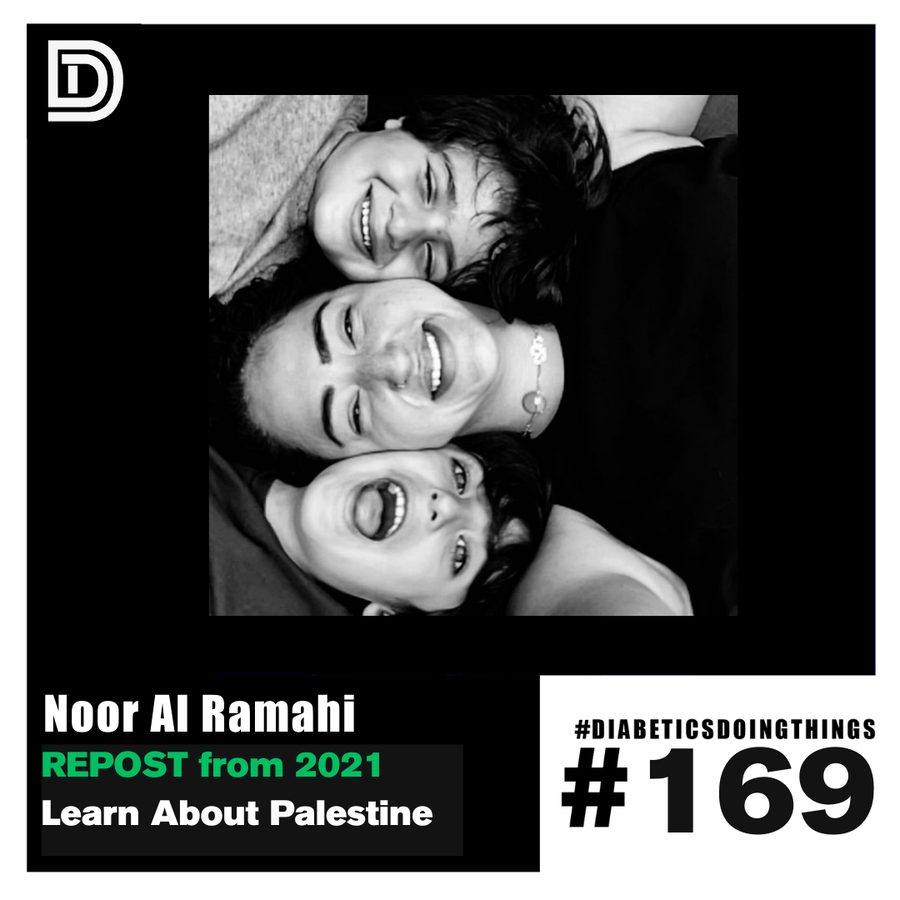
REPOST - Palestine Edit - Episode 169 with Noor Al Ramahi

Episode summary
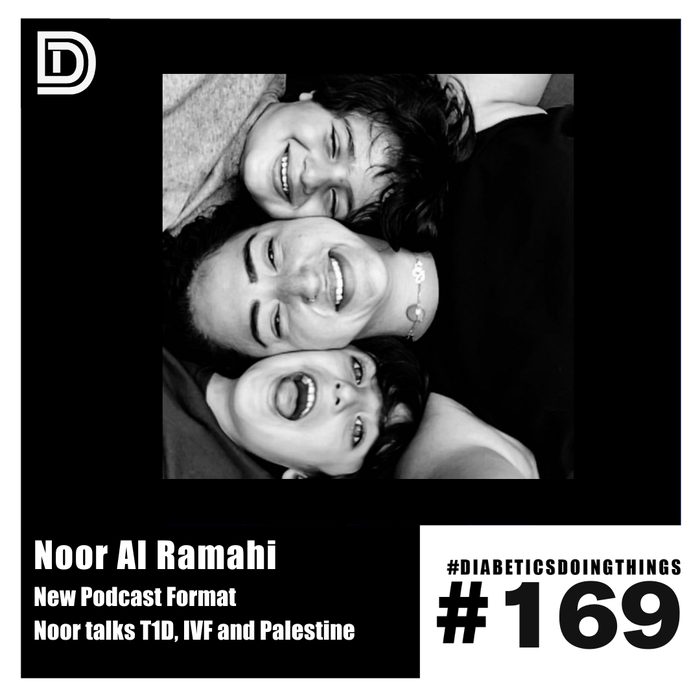
Noor Al Ramahi, a Palestinian woman living with type 1 diabetes in California, joins Rob Howe and co-host Eritrea Musa to discuss her family's displacement from Palestine in 1948 and 1967 and her upbringing in the UAE. She traces her family's history through the British mandate, refugee status in Jerusalem, and generational trauma passed down through her grandmother. The conversation covers the Gaza blockade's effect on insulin and supply access, checkpoints and movement restrictions in the West Bank and East Jerusalem, and the diabetes community's limited response to Palestinian suffering. Recorded in 2021 and reposted with a 2023 introduction after the Israel-Hamas war began, it closes with Noor's reflections on guilt, grief, and sustained advocacy.
Key takeaways
- Noor's family was forcibly displaced from Palestine twice, during the 1948 war and again in 1967, before settling in the UAE.
- Noor says contacts in Gaza told her only three people in the entire territory had working insulin pumps because of the blockade on medical supplies.
- Noor says Gaza households often have just three to four hours of electricity a day, making insulin storage difficult.
- Noor cites a 2018 figure of 1,050 registered type 1 diabetics among Gaza's refugee population, and says UNRWA cut test strips after US aid cuts reduced its budget.
- Noor says international law requires an occupying power to ensure the population's right to healthcare, including access to insulin.
Show notes
CONTENT WARNING: Death, Displacement, War, Occupation, Dehumanization
This episode is from 2021 with an updated introduction and edit for 2023.
We felt it was important to revisit and repost our episode on Palestine with Noor Al Ramahi from 2021, shortly following the 2021 Israel-Palestine crisis. This conversation was especially relevant during the days immediately following the 2023 humanitarian crisis in the wake of attacks on Israel and Israel’s military response bombings and evacuation order in Gaza and Palestine.
Petition for Humanitarian Aid in Palestine: https://www.change.org/p/diabetes-humanitarian-aid-coalition-call-to-action
Our guest is Noor Al Ramahi, (@n_ramahi on Instagram).
Noor lives with T1D in California, US.
The episode includes references to the following:
Intro from 10/13/23 from Eritrea and Noor
Lending the platform to Palestinian voices
Evacuation order for 1.1 People to travel 30 KM
Bombings on the evacuation path
Friends in danger
Discussion on life in modern day Palestine
The Ethnic Cleansing of Palestine by Ilan Pappé
Except for Palestine by Marc Lamont Hill and Mitchell Plitnick
Russell Peters interview with Gabor Mate on his podcast Under The Skin: Episode #187, here
Noor's reference to international treaties and laws, here - the Israeli's responsibility that people with Diabetes have access to healthcare.
Questions this episode answers
Who is Noor Al Ramahi?
Noor is a Palestinian woman living with type 1 diabetes in California. Her family was displaced from Palestine in 1948 and again in 1967 before settling in the UAE.
How does the Gaza blockade affect people with diabetes?
Noor says contacts in Gaza's medical community told her only three people in the whole territory had access to insulin pumps, and that intermittent electricity and supply shortages make managing diabetes extremely difficult.
Why did Noor's family leave Palestine?
Her family was forcibly displaced during the 1948 war and again during the 1967 war. Her grandfather later took a job in the UAE and became a diplomat, which is how the family ended up there.
Does criticizing Israeli policy toward Palestinians mean someone is anti-Semitic?
Noor says no, speaking up for Palestinian rights is not anti-Semitic, and she describes Jewish and Israeli people who have joined her in opposing the occupation.
Full transcript Searchable, with timestamps
Rob Howe: Hello, welcome back to Diabetics Doing Things. Before we get into this special episode of Diabetics Doing Things where we are amplifying Palestinian voices, I wanted to issue a content warning for discussion of trauma, death, displacement, and loss. This is a very important episode, but it's not one to listen to unless you're ready to process serious information. Thank you. Links to humanitarian efforts to aid the people in Palestine can be found in the show notes.
Noor Al Ramahi: Welcome back, friends, to Diabetics Doing Things. This is Eritrea Musa. We're opening this episode up in a really different way. We've never done this before. Coming back onto the podcast is Noor Al-Ramahi, who's here with me today, a Palestinian person, a person living with diabetes, who I love very much. This is going to be a really hard episode and a hard intro for us, guys. I don't want to over speak, but this last week has been absolutely horrific for people living in Gaza and living in Palestine, and especially for those who are living with diabetes and any other type of disability. So we're here to open up the episode. Noor, I'm going to hand it to you. Thank you, Artre. I just want to say thank you and thank you, Rob, for giving Palestinians a voice, for giving us a platform to speak on what's been going on. There's been a lot of not accurate information going around. And I think I also speak from a place of privilege, as hard and devastating and horrific as it's been for me and everybody living in diaspora. It's. I also recognize that I am considered, quote unquote, one of the lucky ones and the privileged ones. And I say, quote unquote, because we didn't choose to leave. We were forcibly displaced. My family was forcibly displaced twice, not once during the 48 war and then again during the 67 war. And to consider myself lucky that I am safe and not in imminent harm in itself is a huge struggle. survival guilt is really real and yeah I just watching watching your friends and your people and not it's not just my people they're straight up innocent people from behind a screen just losing their lives and receiving messages every morning with your friends saying goodbye I don't know I don't know how to process this kind of pain and hurt and I keep trying to think diabetes wise but then I keep going back to diabetes is not a priority right now it is they are trying to stay alive I received a message from one of my friends who's a psychologist in the U.S. today asking me if there's any way that they can support the people in Gaza with mental health services because there has been a couple of organizations that have been providing free mental health support for the Israeli citizens being impacted. And I'm like it's straight up Maslow's law of hierarchy you know this is not right now this is considered an ultimate luxury the people on the ground don't have access to the very basic needs they have no access to water no access to fuel no access to internet in most places and the ones that do have internet are operating on 2G. Last night, the Israeli government gave them 24 hours to evacuate and go to the south. You're talking about 1.1 million people that were asked to evacuate and move about 30 kilometers. I don't know, but roads are bombed. There's no way to get there. And when they did try to move, they attacked them on the way. They dropped bombs on them. It was, I don't know what it was. It was a trap, but that's the reality that they're living right now. And it has been their reality. This hasn't, this hasn't been an issue that came out of a vacuum seven days ago. I actually was on this podcast. What was it? two years ago and even then it wasn't a new war it wasn't a new situation occupation this occupation has been going on for 75 years so i think this would be a really good moment to talk about people who are in our group so we we know a lot of good and dear friends that are currently living in gaza we've been trying to get as much updates from them as possible but given the situation we're not able to get all the all the immediate updates that we've been with the lack of electricity to Gaza has been cut off hospitals are operating on very intermittent electricity if even they have gone for hours with no power or electricity and we are talking about a population of 2.2 million people that have been intensely bombed there were the bombs that were the bombs that were dropped in the past week alone have been more than the ones dropped on Afghanistan in a whole year and we're talking about a space that is half the size of New York, just to give you a perspective and understanding of what we're talking about. When the government asks the people of Gaza to leave and people believe that they have an option to leave, that is not an option. Where are people going to go? literally at this point our friends are hopping from from building to building shelter to shelter they have no bomb shelters when i talk about shelters i'm talking about cement houses these are tents these are people with diabetes who are carrying their supplies and plastic bags trying to get from one place to another at time of recording the policy and health ministry has listed 1800 people who died 60 of those people are children i don't know how to explain what's happening in palestine to you other than there's a massacre and a genocide of people who look like nor and people who i love yeah i i have never ever felt this helpless and hopeless and in my life it's a kind of anger I've always been my friends always joke that I'm a peace-loving hippie but I'm at a point where I'm so angry I I don't know where to go with my anger I don't know who to channel my anger towards and as I can't even I don't have the words to explain what the people in Gaza are going through and still I'm considered lucky and privileged. I am going through a whole bag of emotions that I don't know how to process. Feelings of guilt, anger, sadness. I just don't know what to do. I feel like I failed the people. I failed our friends. How do you say goodbye while still giving them hope that no you this is not the end for you and I don't I don't know diabetes wise I we have been in contact with some major global organizations trying to mobilize diabetes supply on the ground and they have lost hope too they're like there's no way for things to go in. We don't know. We're just using whatever stock we have on ground right now. And we don't have the plan with moving forward. We don't have that luxury and privilege to raise funds or collect supplies. I don't know if that will change in the future, in the near future. I'm hoping, and I'm really hoping that it would. But our hands are tied right now. It's not to say that we're not trying. We're trying. We're exhausting every avenue we have. But it's not up to the people anymore. The governments are playing an assy game. And the innocent people are getting stuck in the middle. And people have just, the Palestinian people have just lost all hope. And so we speak for them. While their voices are being silenced, we are appreciative of the people who have given us a platform. Over the last couple of days, Noor and I have been able to organize a coalition that we can link in the show notes to help bring humanitarian aid to any place that is being cut off from water, electricity, insulin, and basic human supplies. We don't know if this is going to do anything for the people of Gaza, but we have to try. I know the Palestinian people, and especially the people of Gaza, are some of the most resilient people you'll ever meet. And even throughout this whole struggle, they keep saying thank God for everything. And I'm sorry, I'm really struggling to find the words right now. I just don't know. They've all asked us. The only thing that the people of Gaza have asked us to do is to speak up, to not be silent. Please don't let other people being uncomfortable make you be silent. Anti-Zionism is not anti-Semitism, and our friends don't deserve to die. If you're able to listen to the episode giving you the information and the history and the background that is the land of Palestine, please listen. Please say something. we don't hate Jewish people everybody deserves to be alive I don't know what else to say guys this is absolutely not my religion this has nothing to do with religion it is completely political and it's an occupation, it's a genocide right now basic human needs have been denied and continue to be denied And as somebody living outside of Palestine, I think one of the biggest struggles for me right now is I don't get to mourn our losses. I don't get to be sad in quote unquote peace. I have to justify my existence and my right to exist every single day. I get to see emails, read emails and hear people standing up and condemning one side, dehumanizing Palestinians and dehumanizing me, my kids, my family. like we have no right to exist like we're not humans i think that's been one of the most devastating parts for me living outside unfortunately unfortunately as horrible as horrible as this may sound we've become used to the death and watching our people die every single day but when you see the whole world just show up and act like this all came from vacuum and that we weren't dying for 75 years and now suddenly only some people's lives matter and the rest don't? Where were you for the past 75 years? Where were you when we were speaking up and telling you that we've been we've been denied our basic human rights we've been oppressed we've been slaughtered and massacred now suddenly all humans lives matter now I'm so angry even when friends reach out to me right now telling me they're there for me I get so mad as much as I appreciate it and I understand that the media has done an amazing job at whitewashing the situation and giving a biased narrative but I'm so angry where were you when I tried to educate you? Where were you when I spoke up? I don't know what to do anymore. I'm just, I'm not giving up. I'm not throwing in the towel. I'm going to keep fighting and I'm going to keep resisting in whatever way I see you as right. The following episode is proof that we diabetics doing things talked about this in 2021, but it's something that's relevant and important to us on this platform and we won't be silent in the space of death and massacre and we invite the rest of you to also speak yeah i know it's i don't know what the future holds but if you can educate yourself that's going to be the biggest the most helpful weapon for us right now um use your voices contact your government officials this is our tax money ironically our tax money is going there when we don't even have universal health system when people don't have access to resources health care resources in the U.S. and Israel has a universal health care system this is why your voice matters this is why you need to have make an educated vote even though you think international matters don't impact you, they do impact you. They impact us all. Nobody's free unless all of us are free. And when I say all of us, I mean all of us. You can't dehumanize some and humanize other people. That's not how it works. Selective morality is straight up hypocrisy and being complicit to occupation and massacre and apartheid and genocide yeah i think that's all i have for now i hope i've done the people of let's get justice in what i've said and if i didn't i'm sorry it's just a lot right now and there's so much to process and i did my best i just want to add that this is for muhammad and his family and for abdullah and lay in and touch we will ever stop and I remember like my first appointment when I just unpacked everything and you you guys are just getting the diabetes part of it you're not getting you know just the other life and she just looked at me she's like wow how are you still here you know she was like I don't think you realize how much trauma you've endured in your life. And I'm like, well, now that I've said it this way and you're, to paraphrase it, I'm like, yeah, but still, I feel like I don't have the right to complain because I do acknowledge my privileges, you know? I do acknowledge whether it's my light-skinned privilege, whether it's my having a financially stable family, you know, all these things, access to healthcare, I'm not living in a war-torn country. You know, I do acknowledge, and I feel like I have no right to complain about these things. So that's another thing that I'm dealing with currently and working on in therapy is kind of acknowledging my privileges and also realizing that other people's struggles, which I perceive as more worthy, don't undermine mine.
Rob Howe: So. Retweet. Big max. Yeah. Hopefully we don't have the same therapist because they would have a lot to deal with between the two of us. Three. Yeah. Three of us really too. Right. So I also, okay. So I want to shift you, you brought up, you know, being thankful, being grateful for, you know, not living in a war torn country, acknowledging your privilege and also giving yourself space for living a tough existence and having a hard time. I think that's, for me, I have a hard time admitting that too. Like, why should I have depression? It doesn't add up, you know? And at the same time, you don't want to skip over the people who are really suffering and the places in the world where there are injustices and terrible things happening to people who you know or look like you or you have something in common with and have shared an experience with. So I know you are from UAE, but you're Palestinian. And I'd like for you to kind of walk us through not just what's been going on over the past three and a half weeks or so, but also just historically what that's like for a Palestinian person to exist in today's world and talk about the injustices
Noor Al Ramahi: that are going on back home. Yeah. First of all, I'm going to start off by saying, speaking up for Palestinian rights does not does not mean that you're anti-semitic or standing against the Jewish population they are not opposing beliefs or missions they actually go hand in hand nobody's free until all of us are free so in saying that so my personal story is my my grandfather well I'm going to start with my grandfather because that's that's as far as information as I have, but my every generation before that has lived on the land of Palestine. And my great grandfather was, was pretty well off and we lived, he was the leader of the tribe in our village back then. And he had a lot of land and property and all that stuff. So at the time the Palestine was under the British mandate, it was colonized by the British Army. And when after World War One, the Jewish population needed a space, a safe space to call their home that protects them from the outside world after the horrendous things that happened to them during the Holocaust. So the British people were like, hey, here's the land, you can have it, you know. And in doing so, they claim that this land is for them and there was no people on it, which from personal experience, we know is not true. You know, it's like my whole family lived there. And there are a lot of also documents, historical documents that prove that there were people on the land. So anyways, the only way that they were going to get this, that this only Jewish state is to erase the people that were there. And that's when the ethnic cleansing started in 1948. In 1948, our village, which is called Mzera, now there's a huge Israeli settlement on top of it, was seized and they were forcibly displaced. My dad's family, so my grandfather and my great-grandfather moved to Jerusalem at the time. And in Jerusalem, they were made refugees in Jerusalem. We actually have the Unarwa refugee card. I have a photo of it. My dad sent it to me a couple of days ago. and in Jerusalem because of again privilege because my grandfather because of his wealth and his connections my grandfather was able to get a job in Qatar to provide a life and like money for his family so they don't live they so they don't have to live in refugee camps and then he came back he got married to my grandmother and and then had kids they had five kids at the time And then the 1967 war happened and my grandfather was still working outside Palestine. And my grandmother had to leave Palestine with her five kids with literally rockets and bombs dropping on them. And I posted on my personal page, the story, my grandmother, like till now, oh, did I mention it about the leggings? I know, but you can tell us, please tell us. So my, like a couple of years ago, I've noticed like my grandmother's always wearing, well, they're not technically leggings. They're like pants underwear, but I don't think they have them in the Western. Long johns. Yeah, pretty much. She always wears them no matter what she's wearing, no matter what she's wearing. So I asked her once, I'm like, why do you always wear these? You know, it's like, it's clearly not for decency because you're wearing a long dress, you know, and it's not transparent. And she was like, like, you can see, you know, this glassy look in her eyes and like sadness. And she was like, well, when we had to flip out Jerusalem during the war, we didn't have time to get prepared. So we just left with the kids in the middle of the night. And at some point, she was like, there are missiles and rockets and all that shooting going on. So they had to crawl on the ground and on rubble and bushes and all that stuff. and her knees were just like all cut up and scraped and everything so till now she feels like her subconscious brain is telling her that she needs to be prepared for everything you know it's like and i'm like but trauma it is trauma it's trauma and and that's the sad thing like there was this there's this palestinian psychologist who said we actually don't have post-traumatic stress disorder because we don't have the post we're content like the post never left. We're still living that trauma. And it's become generational trauma. We've never had the space or the time to even process that trauma. Even the people who had left, like, I've never been to Palestine. I like up until last year, I did not have the right to return. You know, I had no rights of being there, even though I'm Palestinian, you know, it's like my whole family is Palestinian. So anyways, so that's how they lift. They left the goods, which is Jerusalem and they settled they moved to a couple of places before they ended up settling in the UAE and my grandfather got the UAE passport because he was a lawyer and he helped establish the the country so they gave him the passport and they made him the ambassador of the UAE in Jordan so that's why they ended up in Jordan so for me as a Palestinian like as an Emirati with Palestinian origins, it's very hard because, and I never struggled with this topic growing up in the UAE because over there, everybody was on the same page in terms of what's happening. It's like, I didn't have to explain it to anybody. I didn't have to defend myself or justify my existence to anybody. And it wasn't until I came here where I really struggled with that. And I think that's actually also was one of the main forces behind my depression is I was tired of fighting. And it was, it's very interesting because when, during like the Black Lives Matter movement, when you would hear Black people saying, we are tired, or you'd hear them telling us, don't tell us how we're supposed to feel or how we're supposed to express our frustration or anger, it resonated with me, you know, but at the same time, I wasn't allowed to say that because I knew if I said anything, I would be labeled anti-Semitic. And I knew that the way that the media portrayed the whole oppression and apartheid and ethnic cleansing was very whitewashed, you know, and the whole Western world, even not the whole, like in in their defense there are some people who have been privy to this uh to the reality from the beginning but still like the majority viewed us as the problem you know and it's like i am i am the victim here for like lack of better words you know it's like we are being oppressed we are being subjected to police brutality, you know, to the militarization of the police, to stealing our land, stealing our house. And this is like not even going into details of what happened during the war of 1948. You know, there are historians, Israeli historians who have wrote books on this topic about like, there's a whole book called Ethnic Cleansing of Palestine. And it goes into details about everything, the horrendous stuff. And it's interesting because the Palestinian people, the older generation did not, don't talk about this. There's like so much trauma. And I think part of it is also they view it as shame or failure to have protected their land in a way. And they also, they're super proud that they don't want to play victim. They don't want to be victimized. You know, it's like, yes, throughout this all, we're still resilient. We're still fighting. We're still going through it. We don't want your pity party kind of thing.
Rob Howe: well and i think too like you said being tired and like you know reaching a certain point where you just avoid those types of things just because you don't have the energy anymore to continue to
Noor Al Ramahi: try to fight for that yeah there you have that on one hand and then you also have on the other hand where you know that speaking up you're gonna pay a price for that you know being like we've already seen like yes there's been a huge shift in the narrative where we've seen a lot of people speak up for Palestinians, but we've also seen how they tried to hijack the whole narrative and make it seem that this is anti-Semitic. It's gaslighting. It's literally 83 years.
Rob Howe: So when you guys were like, we're tired, when you say tired as a Black person, as an Arab person, we're tired of being told that nothing's happening. 83 years of gaslighting, homie? Like, because I mean, the whole conflict or not even conflict, war, ethnic cleansing has been happening now for 80 something years. And it's like also this thought process of this has been happening forever and it's always going to happen. And it's like rooted in the in religious history when really it actually has nothing to do with religion at all. And it's all about land, space, people. And that's it.
Noor Al Ramahi: But you know what, even at this point, it is it's just about basic human rights. You know, it's like literally like people are just asking for their basic human rights. You know, it's like but we don't even have that. We don't have whether we're talking about whether we're talking about Palestinian on the land of Palestine or Palestinians outside the land of Palestine. We don't have basic rights. Like even in the U.S., people talk about freedom of speech, freedom to protest. We don't even have that right. The BDS movement is literally like a protest. This is your right to protest, to spend your money where you wish to be. And it's already like by the in the U.S. it is labeled a terrorist organization.
Rob Howe: It's banned in the U.S. We can't. So I was thinking about doing this. I was like, I should put stickers on the food that says like they support Israel. And so I started Googling it and was like, oh, no, if I do this, I'm going to jail. It's super illegal here. I had no idea.
Noor Al Ramahi: The anger and the frustration is really about like the double standards and like the impunity when it comes to this matter. Like there was, I forgot his name, blanking out his name. So he's actually a Holocaust survivor and he was like a mental health specialist. I believe he's a psychologist. And he said, he's like, you can clearly see the double standards. He's like, why is it when in Hong Kong, the protesters throwing rocks at the police in the media, in the Western media, that's portrayed as heroism. But when children, children are throwing rocks at like one of like the strongest militaries in the world on tanks, you know, they're viewed as terrorists. Like, why is there that double standards? And you know what? I think I just got really into the conversation and I can talk about this like for hours and hours because it is a 73 year long occupation. it's complicated and goes way beyond that but I think to just kind of keep things relevant at this point I think a lot of what a lot of people don't realize or don't want to realize is this is not and this is not a both side situation because it's not an equal fight it is one side who's the oppressor and the other side just resisting the oppression you know we are just fighting for basic human rights and in doing so a lot of people innocent people have suffered and a diabetes community has suffered suffered a lot you know we and right now we have like two different situations where you have Gaza which is basically the world's largest open-air prison you know it's like yes it's controlled by Palestinians it's even though it's Palestinian territory it's it's still controlled by Israel there there's been I think it's 15 years now 15 year blockade where blockade like land, air, and sea. Nothing is allowed to go in. Nothing is allowed to go out without permits. And permits are almost impossible to get. I was listening to an audio book today. It's called Except for Palestine by Marc Lamont Hill. I love him. And he was talking about a story of this lady who is from Gaza. She got married to a guy in Jerusalem and they moved there. And she applied for a permit like a couple of times over the span of like three months to go visit her family. She kept getting denied. And then they gave her permission. And then when she went to Gaza, she was applying for two years and they kept denying her permit to leave, to go back home. And then they issued her husband a permit and not her. And now they've been separated for four years. They're not allowing her permission to leave. Now, okay. So this specific scenario is not related to diabetes, but let's for a second, just for a second, say that this lady did have diabetes. Okay. As diabetics, we prepare and we over-prepare. We go on a trip, we double our insulin. You're going for a trip that's supposedly a month or two and you end there for six years with no end in sight. How are you supposed to prepare for that in a diabetes sense, in a place where there's a blockade, where there's very extremely minimal access to healthcare. Like even we know, we know friends in Gaza who are in med school. So they're very into the healthcare scene. They told us because I had extra pumps and I was like, I'm willing to help. Like if there's a way for us to find, like if, if there's, if we can find a way for us to get this to you, I would gladly get this to you. And I collected a lot of supplies. So they had enough supplies to easily last them a year. First of all, there was no way to get it to them. Secondly, he told us, he's like, we have in all of Gaza, the population is 2 million people in a very tiny overpopulated, like a strip of land. There are 2 million people, only three, only three people in all of Gaza have insulin and pumps. None of them are on their insulin because they have no access to supplies. That's how bad the situation is here. And I know sometimes I get frustrated that, you know what, I don't know, Dexcom took more than four days to send me my sensor or my pump site failed or whatever. But again, that's a privilege.
Rob Howe: Or there's like a 60-car line at Walgreens, you know, it's like how...
Noor Al Ramahi: Exactly. And then you say that, okay, what about the Czech... Let's move out of Gaza, okay? Let's go to Occupied Jerusalem. The checkpoints. They're claiming that it's not an apartheid. Well, what do you say when there are checkpoints only for Palestinians and roads only for Jewish Israeli people to roam as they please without being stopped? what if I want to go and a lot of these checkpoints were built intentionally to inconvenience people you know it's like they're checkpoints and there is the apartheid wall there's like a whole wall that's like more than double the size of the Berlin Wall that is just like they just decide okay let's put it here a lot of families have been separated from each other like imagine you and your brother I don't know if you have a brother but decide to have a house in front of each other you know to raise your kids together and then in comes a wall and now it takes you like five plus hours with the checkpoints and everything to just get to your brother's house but anyways think that you're trying to get to a pharmacy how how are you how are you going to get to a pharmacy with the checkpoints a lot of like even like from a from a medical you know so many
Rob Howe: people have died at these check oh yeah so most of them there's like this whole problem with freedom of movement like it's an entire and i i want to say a specific case that was like very important to like everything that's happening right now but rest in peace to omar yagashi a baby who was supposed to have a surgery on israeli land and that was denied going onto israeli land because they were palestinian so this was a baby like an infant who had scheduled a surgery to survive this family got like held up at a bunch of different checkpoints on june 18th and they like their child literally died in their arms like this is this is what's happening this is what's happening when people are like we need to see like both sides like what is the other side to that make me understand make me understand why an infant needs to be lost to a cause that like this
Noor Al Ramahi: and like even like like in terms of diabetes so UNRWA what's called sorry UNRWA is the united nations relief and works agency for palestinian refugees and a lot of the residents in ghazza are actually refugees that were displaced from what we now know as Israel. So they, as of 2018, they said that they have 1,050 T1Ds registered with them. Keep in mind that that's not always accurate because first of all, that's only the refugee population. You also have the Gaza population that is not listed under UNRWA. And they only have, they don't have any public diabetes specialist physicians. So they have the private clinics for these physicians, but you're talking about a city that has 55% unemployment rate. So the poverty in the city is through the roof. People in Israel controls their water, they control their electricity, they control everything. So these people have absolutely no resources in terms of just everyday living needs. So how do you expect them to have access to diabetes care? We know that diabetes care is very expensive. Now, UNRWA provides for the refugees insulin, syringes, and just like medical checkups. Because of aid cuts from the US, they had to, they don't have the budget that they used to, so they stopped providing strips. Imagine managing your diabetes without strips. so that's that's like another it's just like one crisis after the other after the other and even like in west bank as an east jerusalem 15.3 percent of the population has diabetes whereas the whole world has six percent and they think they think that 4.4 out of these out of the 15.3 percent have type 1 but based like on resources on the ground doctors physician all that they actually think that it's higher it could be like between 18 and 21 percent and like we it's just the small things as well so these are like the big things but like the small things as the person with diabetic that we take for granted it's like imagine living in a in a house that has an average of three to four hours of electricity every day what's going to happen to your insulin you know like we freak out when we go to the beach for for an hour or two imagine like living with no no power it's just like all these things and like even when the bombing was happened and i kept thinking i'm like everything is closed like literally everything is closed there is the there's like a food crisis happening because again israel controls what they think is enough food coming in or what what is enough and what types of food are going in and going out and i'm like okay what happens if we are i'm stuck in my house hiding from these bombs and my blood sugar goes low and i don't have access to gummy bears which israel might think that you know what doesn't need gummy bears it's not an essential like things like that it's it's gone beyond a political stance and i know when i took the takeover when i did the takeover a lot of people very upset that a diabetes page was talking about politics but at this point it's not about politics it's about human rights and you know what politics and politics has become a health care issue you know it's like even today I was the human rights organization had a live on Instagram and they were talking about the environmental the environment environmental what's the word factors that affect health and specifically like maternal health and I kept thinking again i want kept going back to the situation of ghazza and the situation in palestine you know what even even the whole the whole country let's include israel in the in the situation too these bombs that keep dropping this the toxic gas the phosphorite gas all that this we don't know the extent of damage that this does in relationship to our diabetes and we have friends in Gaza who said like it wrecks havoc on their blood sugars. I think early on, we were
Rob Howe: hearing stories about people couldn't sleep because the bombs were going off at night all night by design, like as a war tactic to drive you insane. And we know what lack of sleep does to our blood sugar. We know what dehydration does to our blood sugar. We know what stress does to our blood sugar. So, you know, multiply that times, you know, the worst stress that any of us here in the U S have ever had to endure by a million. And of course you have those types of
Noor Al Ramahi: outcomes. Yeah. And it was like, I'm not in, I'm not in Palestine, I'm in the U S safety is not a concern in that sense. And my blood sugars were still through the roof because of this stress and the anger and the frustration and it we go back to talking about I felt guilty that I or I felt like I didn't have the right to complain about that because what do I have to complain about you know bombs are not dropping on my head you know it's like and then at the same time I was just so exhausted because I knew I had to take care of my mental health and I had to take care of my physical health as well. But I couldn't walk away because I felt like that was my responsibility to be the voice for the voiceless and speak to the injustices happening. And by the way, I just want to say that it's, Ertree, you know me. So this is not that, oh, she's passionate about Palestine because she's Palestinian. I'm an intersectional activist. I believe in speaking up for everybody at press, you know, whether it was during the BLM movement, LGBTQ, a community, the Asian population, Syrian, anybody that needs a voice. I was there, you know, I've always been there, the immigrants. But right now, the Palestinian people need us. And, you know, for the longest time, I wasn't able to speak up because I was, I don't know, I knew that I would be gaslighted and because I felt like it's just going to be me against the world, you know, at this point, at that point.
Rob Howe: Let me ask you this because, and it might just be because of my friendship and, you know, business relationship with Eritrea that I'm more exposed to Palestinian, Palestinian people, but I also have a close friend and business partner associate that is his family is Palestinian. And, you know, so I'm more because I have diversified those friendships, I'm more exposed to these things. And so I do have a personal connection to it, at least just one person removed. And at the same time, people are upset that I am talking about it. And on the other hand, I've never I don't think that I've seen as much support globally. It's very similar to Black Lives Matter where there was like that specific day where there were a million millions of protesters globally protesting the murder of black people by police in the United States. And I'm seeing a little like not not as large, but a similar start to, you know, that movement. And I was talking to Eritrea about it earlier. How much of that is just because the democratization of access on phones and being able to show what's really happening, because what's really clear to me as like a marketing guy and communications guy is the gaslighting that Eritrea mentioned earlier, is that there's a really pro-Israel, anti-Palestine narrative that's fed to the US media. And for me in particular, like a white guy growing up in evangelical South Dallas, Texas, I remember, and I've told Eritrea this before, I remember an announcement going out at my school when Yasser arafat died in like celebration of an enemy you know you know that type of narrative and that's how people who grew up where i grew up where that entire relationship is framed so it is a deep
Noor Al Ramahi: seated misinformation battle yeah so yeah there's definitely been a shift in the narrative and i I feel like I think also the Black Lives Matter movement that we've experienced in the past couple of years, two, three years, in a way prepped people for how to deal with this. But you still have a lot of people, like you said, that have already been brainwashed and are scared. They're scared to speak up for Palestinian rights, thinking that that's anti-Semitic and that's going to harm the Jewish population. And this is where they're trying, like the Israeli government, Israeli propaganda is trying to shift the focus and shift the narrative into making it seem that anti-Zionism and anti-Semitism are interwined. We've seen a lot of people who are either Jewish Israelis or just Jewish from different countries speak up for the Palestinian people against what's happening from what's happening from the Israeli government. And it was actually interesting because I've, like, I've had this, I've struggled with this situation for the past, like, 11 years, if not longer. And two weeks ago, we were at a protest, and there were these two women carrying signs. One said something along the lines of another Jew in support of a free Palestine. And the other one said, not in my name. So I walked up to them and I was like, thank you. Like, thank you so much. I really appreciate it. And then one of them asked if she could hug me. We're both fully vaccinated. We have masks. I did ask if he was vaccinated. And I said yes. And we hugged. And out of nowhere, I just started bawling. Like, I just, I had all this bottled up emotions that I just let it go. And she like, she clearly saw me like crying and upset. And she just kept like whispering. She's like, I am so sorry. I am so sorry you're going through this. Like, and I told her, I'm like, you know what? And I'm sorry you guys had to go through what you went through too. It was not okay then. And it's not okay now, you know?
Rob Howe: and that's what gets me though isn't it exactly the same it is it is and this is why so there's this amazing well and and before i want to clarify that before before i let you continue like the the beginnings of nazi germany and the stories that we hear about the holocaust and world war ii it starts with the state claiming property and moving the people into ghettos and to me i think that's what's most shocking about what's happening over the past 75 years and learning about the true history of it because we did not cover this in my world history class in ninth grade in high school but is how similar they are and how quickly like they turned heel and and did the same thing to another people group that they that happened to jews and like the murder of six million jews it was not that long ago and i it was awful and horrific but it doesn't two wrongs don't make a right and i think exactly that's what i've been saying like
Noor Al Ramahi: i had two wrongs and i make right like i that's that's just what i keep saying and it's really frustrating when the the whole but both like both sides or the hamas excuse gets thrown in like just to put it out there i do not agree with what hamas does but at the same time you need to understand that first of all this this ethnic cleansing has started has started in 1947 okay the war happened 1948 but it started in 1947 hamas wasn't established until 1987 so and then what happened in these latest events like i don't know what to call them but it's like it just keeps everything just like everything explodes and then it calms down for a while and then so in the in the past couple of weeks, it had not like every yesterday, we were with a friend who was completely oblivious to what was happening. She's like, wait, but didn't Hamas throw rockets? I'm like, yeah, that's where you came in the middle of the conversation. You know, there was land that's being stolen for years and years. And Israeli settlers walking around with weapons backed by the military, when we don't even have access to things like water, health care, freedom to move, just walk in the streets you know we can't live in our own homes without it being stolen by illegal israeli settlers you know and it's like and i'm not i'm not personally using the word illegal that's internet by international law and condemned by united nations and human rights watch and and what do you expect when people are being oppressed you know well i think i think that's
Rob Howe: where you know i think hamas is is weaponized by the media and certainly they're you know because it's easy to point at like a group and say these people are bad and but then you like you said they weren't established in 1987 and i can't claim to be an expert on hamas but what it strikes to me is that in when you there's all those old memes that i feel like a lot of the guys i went to high school used to share when they were trying to like show that they were manly you'd be like if you're caged up, you turn into a lion, you know, and you turn, you know, I don't know, like, and I feel like that that like environment, when you're sequestered, and your rights are taken away, and you have to become a person that, you know, by any means necessary to get your freedom and represent your people that you do things that a person who, like us in the US, we've never had to take up arms in defense of our home, and, you know, or have to do things in the name of that. And I think that That's why war is so complex. But at the same time, Hamas is not an army and are not funded by a government. So again, like when we when we talk about why we're having these conversations, whether it's Black Lives Matter, talking about police brutality, whether it's Uyghur Muslims in China being taken away from their homes and put in concentration camps, whether it's Palestinians being forcibly removed from their homes and put into an open air prison and denied basic human rights. all of those are like you said earlier intersectionality part of the same issue which is you know it's racism it's human rights it's treating people differently because of who they are and where they're from and you know we talked about this before we started recording I feel like and it's kind of taken a lot for me to unpack this like as a as a white guy in America colonialism and sort of the spirit of conquering was celebrated in in my in my life in my culture And like, that is, you know, you mentioned like real Christopher Columbus shit. You know, it hasn't been that long since we used to sing songs about Christopher Columbus, you know, like, and, you know, pilgrim. Yeah. And all those horrible things that he did to the Native Americans and, you know, people talking about stolen land and like, you know, everywhere we are, you know, everywhere my skin goes is stolen land from somebody who. Talk about it. Talk about it. Talk about it. And so, you know, I didn't do that, but I benefited from it. And, you know, people died who I'll never meet and I'll never know about because they've been whitewashed from history. And I think now that's where I go back to the democratization of media, where people like us can just create content that is on the ground with our phone and tell and speak truth to power in ways that haven't been able to be done before.
Noor Al Ramahi: yeah it's like it's like if if if the liberation of a group of people is uncomfortable or intimidating to you it's one of two things one is you're benefiting from it two you probably need to sit with yourself a little bit longer and ask yourself why you know it's and I I have like major respect and seriously hats off for all the Jewish and Israeli people who have spoken up against the Israeli government's ethnic cleansing, appetite and brutality. Like I know it takes a lot of guts and I know it takes a lot of courage. Like we've seen Bernie Sanders. He's like, he's been called self-hating Jew since the very beginning, you know, just because he's standing up for injustice. And it's, I don't know if you guys have seen it, but there's a video circulating around by interviewed by Russell Peters. He interviewed a guy called Gabor Mate. And he actually spoke about like a couple of things that really stood out for me. It's first he said, you don't have to support Hamas to support Palestinian rights. Being pro-Palestine does not mean you're anti-Jewish. And I feel like that needs to be screened from the top of every building. And more so to people who are new to this whole topic, especially Americans and quote unquote liberal Americans, because in their fight to make sure that the Jewish people are given the respect and dignity that they deserve, which we all agree with, me included, I think they're scared to talk about the Palestinian the Palestinian occupation in fear that they're gonna oppress the Jewish community, which again, it's not Palestinians versus Jewish. It's- I don't think that's the fear, Noor. I don't think
Rob Howe: that's the fear. I think that's you being really nice. I think the fear is colonialism. I think that Americans are afraid to say that this is wrong because then it turns around to us also being wrong being this country like it's real it's really i think i think that's too complicated for them no no like it's serving it's serving very apple doesn't fall far from tree like they are literally like part of that state being part of its existence is that our government funds
Noor Al Ramahi: its existence so yeah you're talking like you're talking on like a government level as a no as an
Rob Howe: American community like I think that a lot of politicians or even commentators or even the way that questions are being asked on CNN and MSNBC like it's very around the framework to be pro
Noor Al Ramahi: Israel because if you see I don't think it has anything to do with like falling the apple falling far from the tree I think it has more to do with the Israeli lobbyist being super powerful you know and trying to control the narrative and all that big money yeah it's it's really about big money at this point it's really and like if you look at if you look at the the the people who are like it wanting to fight for the government in israel majority of them don't care about religion you know it's it's not about religion but yet they try to make it about religion because they know that's the weak that that's the weakest link you know that's where they're gonna get it enrages
Rob Howe: the mob it gets it does it's that that tried and true propaganda tactic that i would say the republican party in the united states is really good at they do an awesome job of distracting from the real issue and hitting you with really like some of the best pr people in our in our country work for lobbyist groups because that's their job is to control the narrative to keep the money coming in to keep the candidates in power. And, you know, when people during the presidential debates, when people were saying Joe Biden's one of his big weak points in the Democratic Party was his was his stance on Israel. This is what they were talking about, because he and Kamala Harris too, like, she's the police. You know, I think that they're, we're learning a lot. And again, like, I think you're right, Nora, like most people have no idea about how they, you know, our global allies and governments work together and also also a lot like this is i don't think
Noor Al Ramahi: this is a very well-known fact even amongst palestinians but actually hamas was really the doing of the israeli government so and they funded them yeah Gabor Maté, who was a Holocaust survivor, talked about this and he like i will quote exactly what he said he was like it was Hamas is an Islamic organization encouraged by Israel as an as a counterweight to the secular PLO which Israel didn't want to deal with during the elections they wanted the shock of everyone but psychologically speaking like people tend to more no that's my me saying I interpreted psychologically speaking people tend to go for extremist leadership when they are hopeless and deprived of any possibility and basic human rights so it's not justified I'm not justifying their actions in any way possible. I'm just stating like matter of fact, facts kind of thing. And he also talks, he also, so this is a direct quote from him. Again, a Holocaust survival, who said, the disproportion of power and responsibility on oppression is so markedly on one side. Take the worst thing you can say about Hamas and multiply that by a thousand times, and it still will not meet the Israeli repression, killing, and disposition of Palestinians. And you know what's the sad thing in this whole situation is if I had said that or a Palestinian person had said that, nobody, they would have lost the battle right off the bat. But acknowledging and saying that this is coming from a Jewish person gives it that much weight and it's like we've seen all these people talk about how we need to elevate black voices you know allow them to share their story to speak up to it's it's their story you know this is what they went through and we need to just sit back, shut up and listen. And that same rule doesn't apply to Palestinians. And that's pretty frustrating. And I've also experienced that firsthand when I talk about it from my perspective. Nobody, like, it doesn't carry that much weight. But when I say, oh, this Jewish person said this or this Israeli person says this or this ex-IDF soldier said that, then suddenly everybody's like, oh, let's listen. And that's frustrating.
Rob Howe: Yeah, I mean, I think even, I can't imagine what you guys are experiencing from commentary from people, when you share content, because it's like, I've had people accuse me of sharing propaganda, one-sided things. And I think you're right. The Palestinian perspective is just so easily dismissed by people as completely one-sided. And then I see these people and the stuff that they share, because I'm a big believer in like studying the both sides just to see how they communicate with each other. And I, all I see is erasure of culture. I see gaslighting. I see recrafting narrative. I see Hamas weaponizing Hamas as, as like, Oh, look at these bad Hamas people. So we're justified to do whatever we want to Palestine because of this. And, you know, it reminds me, you know, a lot of, you know, it's, it's very top of mind for me because during COVID, I read this long article or like a sort of tweet storm from someone who was saying, the reason that COVID-19 is going to wreak havoc on the United States is because it's invisible. And you can't point to a singular source to say, this is the enemy. And it was this way of life that changed and we weren't able to adapt before it really hurt us. And he contrasted that with 9-11 where he said, okay, well, the Al-Qaeda is the bad guy. We are going to go get Al-Qaeda. And everyone was united behind that one idea. Al-Qaeda attacked us, we're going to go get Al-Qaeda. And the Islamophobia that has spilled out from that, I think it really affects Arab Americans and Palestinians and is deeply rooted also in why the media is portraying this in the West like they are. but at that time i think like that's where that's how the media is using hamas in in the u.s is they're saying hey hamas is bad so then and they're launching rockets and they don't they redact all of the other information from the headlines that says hey this is in response to you know the Sheikh Jarrah and all the other events but like you said most people and i think like this is something that my dad used to tell me a lot and it's kind of a really weird right-wing Republican idea, but you'll never go broke underestimating the intelligence of the American public. And that's what you said earlier about most people have no idea. They don't really care. And they just take what they're fed and they just on moving. And I think that's what the movement and, you know, the, you know, what social media, the impact of social media is having where we can hear from Holocaust survivors and say, who are addressing this directly and, and people who you know are not Palestinian and are and are Jewish and are saying hey this is wrong this is and I think that's where you know what I was looking for early on was like some sort of source of of information that could cut through the people who are very resistant to what's
Noor Al Ramahi: happening yeah I don't know how we're going to get there but like even I think it's just kind of really humanizing us where we were always viewed as by the media as terrorists or the enemy, you know, as like, yeah, just like humanizing us. And even like from a diabetes point of view, we've seen so many diabetes advocates talk about access to insulin, but nobody said anything when it came to the Palestinian people. It's like, okay, we understand that you don't want to get into the political situation, but we're still humans we still need insulin we still need access to insulin and even from just the legal stand of point from like international law it says in international law it mandates that occupying powers must ensure that that the right to health is upheld during the term of the occupation so it is the Israeli government's responsibility to ensure that health care in in specifically in our situation right now in diabetes that insulin and access to health care is provided which we clearly know is not yes legally maybe we can say that the people in jerusalem have access to these but when it when it comes like push comes to shove when it's applied they they're they're they make their lives miserable intentionally so they can willingly they leave Palestine, you know, they're subjected to humiliation, hours at checkpoints, horrible treatment at hospitals, if even, you know, making them pay up front, all in cash, knowing that a lot of people don't have that kind of money. These tactics where it's not written, you know, that you'd be like, oh, hey, you know this, but this is where we need to elevate the Palestinian voices and really understand the struggle of what's happening. And a lot of people, majority of which are Jewish people, because they're the ones who have freedom of movement the most, who have visited occupied Palestine or who have visited Gaza before the blockade, have talked about the horrendous circumstances they live and how they were in this bubble where it's like, oh the only democracy in the middle east beautiful you know vacation destination beautiful beaches beautiful amazing food blah blah blah all that great stuff you know that really is appealing to the western world but they're like if any zionist would go and live there or just visit for a couple of weeks and not come out a different person that's like virtually impossible that that means like you're a psychopath there's something wrong with you like you cannot walk in and see the things that they've seen and be okay with it it's it's just the dehumanization the humiliation that trying to strip us of our dignity it's just next level you know and it's it's exhausting it's exhausting trying to justify like explain to people why you deserve to live it it's basically that bottom line and i just keep reflecting of all the privilege as a person with diabetes living in a place where i have access to all that you know it's like i don't like my endocrinologist or he, I don't, I don't know. He doesn't believe that dairy is going to raise my blood sugar. I'm going to go find another endocrinologist. Well, reality check, you know, there are no endocrinologists or they don't have access to the information we have. Like Eritrea, you've seen the conversation, like some of the things that we consider basic resources and basic information that we just know in the diabetes community, a lot of them don't have access to that from their healthcare providers. Yes, some have access to it from like social media and from us, the link to the outside world, which is also somewhat sometimes controlled by the Israeli government. But like, imagine the level of care, or how are you able to manage your diabetes under those circumstances? And it's not an equal fight, you know, it's like, oh, both sides. No, don't tell me both sides when we talk about the the israeli side they have the leading technology in health care yeah and they have some of the most advanced technologies and advancements when it does come to diabetes as well and they have universal health care which is another topic that we need to ask ourselves as as people living in america i'm not an american but i live and i pay taxes but as as Americans living in America, is we don't have access to healthcare, to universal healthcare. One in four people who have diabetes are rationing their insulin because they can't afford their insulin. Yet we continue to pay $3.8 billion every year to fund this war, to fuel their economy. What about our economy? What about our people? People who have no access to insulin, to basic healthcare. And this is just in the healthcare realm, not to talk about the homeless people who have no, like most of the reason why they end up on the streets is because a lot of them are war veterans and have no access to mental health resources or people who live in horrible, like socioeconomic situations due to underserved communities, due to the systems failing them. Why is this happening in the world, quote unquote, world power country of the world? Aren't the American people more justified in that $3.8 billion every year? That's our tax money. We pay that money. We should be voicing our opinion, telling them that we want that money. why are people like people are dying because they can't afford whether it's chemo whether it's insulin whether it's anything you know that shouldn't be happening especially not in america
Rob Howe: yeah when i read copy when i read you know stats about you know one in three americans don't have five hundred dollars saved one in and then i'm okay well one in three americans live with diabetes so what's going to happen if they lose their job or if they get in a car wreck like they've got to decide between insulin or and even if they get insulin then it's pump supplies or syringes or test strips and the cost of diabetes in general and you know what if they have to decide between their kids eating lunch for the week and them living in and their medical supplies like those are decisions that people are forced to make. These are important conversations to have. We represent people with diabetes. And I think about all the time, people in other countries that we don't hear about, people in China, people in North Korea who live with diabetes. I know that there, I mean, the people in India who we don't know how many people live in India with diabetes at this point. And the people in Palestine and people in Gaza are no different. And I think for us, we got to continue to tell those stories we got to continue to speak truth to power even when it's uncomfortable even when it means that people get upset because I think that's what advocating for human rights is all about yeah absolutely I think it's really something Nor said that was like just because other people are struggling doesn't really minimize minimize your struggle it's important to just you know kind of remain grateful she was talking about how we're kind of in the same group and we see the same conversations like the people she's talking about are friends with both of us so something I recently did just to be grateful was like I went to the gym because one of my friends who lives in Gaza like and you know him like he loves going to the gym it's his thing but right now he can't go safely because of everything that's going on and so like I went to the gym and I like I felt that I honored him that day and every time that I go now I'm like I'm doing this because I have the privilege of being able to so it's just I think it's important in our daily lives to just like acknowledge our struggle but also acknowledge where we don't have a struggle where we are super lucky to have what we need and to just definitely like keep that type of outlook because it can be the worst i feel lucky i don't feel proud i feel lucky to live here i don't feel super proud it's tough i think i was also i feel lucky to live here because i and i say this in our group nor knows but like you can't just have a big mouth for a fun time like you gotta you gotta use that american citizenship when you can homie use that privilege to open that big old mouth of yours, that Republican Democrat mouth, whatever, and speak up for people who can't speak up for themselves. Speak up for people who do live in open air prisons or even in countries like Kuwait where you're not, or in places like Kuwait, where you're not even allowed to talk about this at all. Yeah. A lot of places like that. Yeah. So welcome back. Freedom of speech. And I think something that I heard early on a couple of weeks ago was like, especially in, you know, in the Middle East and a lot of places that we've talked about democracy as we know it, it's hard to come by and free speech and those, those types of rights that we enjoy here in America, many people in Palestine and elsewhere don't enjoy those and don't have those rights. And so we are very privileged. Nora, we were just saying what, we were thanking you for coming on the show today and for, for sharing your story and for, for shining light on so many important issues. But yeah, we, you know, again, can't, can't thank you enough for coming on and being so vulnerable and for sharing your knowledge and where can people find you? Plug yourself. Let people reach out to you
Noor Al Ramahi: online. Where can we direct them? That's a very good question. I'm on Instagram. That's like my most active platform, but in all honesty, there's not a lot of diabetes content on my Instagram. It's a lot of social justice work. I volunteer a lot in the diabetes space and also with underserved vulnerable populations. So a lot of my content is that, and then my kids, they're a trade. Do you have my handle? I'll put you in the show notes for sure.
Rob Howe: We'll tag her in the show notes. I'm so grateful to you. I just want to say, Nora is the person who taught me to open up about my stories, my things. She's an inspiration to me, a light to us all. And I'm so grateful for you. Thank you for telling us your story. I love you. And thanks for taking the extra time. This was a long episode and we, but I, you know, every,
Noor Al Ramahi: at every step was riveting. So thank you. Thank you both. Like I really, I really admire your courage and also for being teachable, you know, that's also a huge step. And I really appreciate that.
About Noor
Noor Al Ramahi (@n_ramahi) is a Palestinian woman living with type 1 diabetes in California. Her family was displaced from Palestine in 1948 and 1967 before settling in the UAE, and she volunteers in diabetes advocacy and work with underserved communities.