

Yoga Therapy for Diabetes with Evan Soroka
Episode summary
Evan Soroka is a yoga therapist in Aspen, Colorado, diagnosed with type 1 diabetes at 13 after a wilderness education trip where she first recognized the thirst and exhaustion of untreated high blood sugar. She describes a period of rebellion afterward, drinking, smoking, and pushing people away, until a friend's changed demeanor after a yoga class drew her toward practice. An injury from overdoing intense postures led her to retrain as a yoga therapist under Gary Kraftsow at the American Viniyoga Institute, where she began linking specific breath practices to specific diabetes challenges like highs, lows, and anxiety. She talks about writing her book, Yoga Therapy for Diabetes, during the pandemic, reading science journals to back up the practice, and what it felt like to finally hold a finished copy.
Key takeaways
- Evan Soroka was diagnosed with type 1 diabetes at 13, during a wilderness survival trip in Aspen, Colorado, after days of unexplained thirst and leg tremors.
- She says a friend's calm demeanor after a yoga class drew her toward practice during a period of drinking, smoking, and binge eating.
- An injury from pushing extreme postures led her to retrain as a yoga therapist with Gary Kraftsow at the American Viniyoga Institute.
- Soroka says breath-centered practices help her navigate hypoglycemia and anxiety by calming an overactive nervous system, not by curing diabetes.
- Her book, Yoga Therapy for Diabetes, pairs science with lived experience and is written for people with any type of diabetes, plus clinicians and yoga teachers.
Show notes
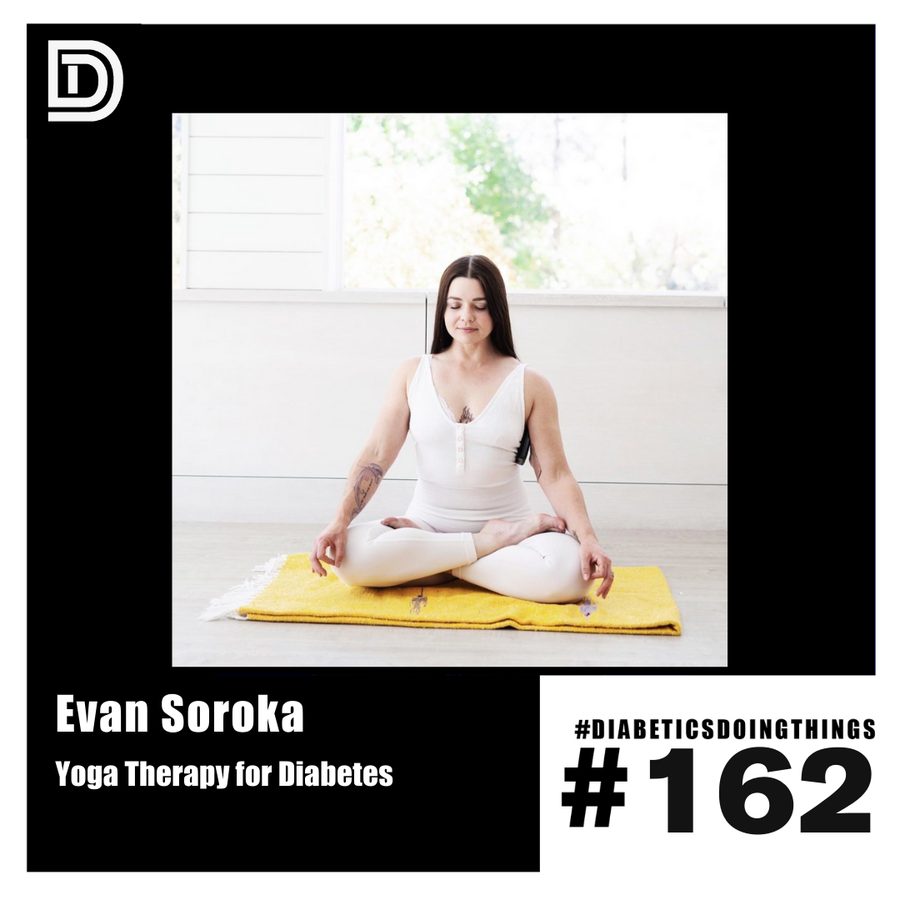
Evan Soroka - @evan_soroka on Instagram joins Rob and Eritrea on the pod to talk about her new book Yoga Therapy for Diabetes.
She takes us through her journey as a Yogi with T1D and we have an incredible discussion about the importance of practice as it relates to Diabetes.
We’ve had a number of people with Diabetes on the podcast who employ a yoga practice to help manage their Diabetes and I think Evan is an incredible resource for people who are looking for the science behind their yoga practice and how to use the transformative power of a yoga practice in their Diabetes management.
Enjoy!
Questions this episode answers
What is Yoga Therapy for Diabetes about?
It's Evan Soroka's book pairing the science of diabetes physiology with yoga practice and her own lived experience as someone with type 1 diabetes, written for people with any type of diabetes as well as clinicians and yoga teachers.
Who is Evan Soroka?
A yoga therapist based in Aspen, Colorado, who has lived with type 1 diabetes for 23 years and trained with Gary Kraftsow at the American Viniyoga Institute.
Can yoga help manage diabetes?
Soroka says specific breath practices helped her respond to highs, lows, and anxiety and return to balance, but she frames it as a support strategy and self-awareness tool, not a cure for diabetes.
How did Evan Soroka get diagnosed with type 1 diabetes?
She was 13 and on a multi-day wilderness education trip in Aspen when intense thirst and night tremors tipped her off that something was wrong; she lost weight and was diagnosed shortly after returning home.
Full transcript Searchable, with timestamps
Rob Howe: All right, what up everybody? Welcome back to Diabetics Doing Things. It's Rob and I've got Eritrea here with me.
Eritrea: I'm here, even though it feels like I wasn't here for the episode, but I was just so, I'm here.
Rob Howe: Yeah, you're very present with yourself. And that's a great intro to this episode because we had Evan Soroka on the pod. And she, when I tell you that like, I just feel better, I feel energized, I feel present with myself, I feel like I understand myself better. she's promoting her new book yoga for the yoga therapy for diabetes god i cannot for some reason could not get that out of my mouth correctly throughout the entire interview yoga therapy it's available now and we have a link in the show notes to to the book that you could purchase highly recommend it eritra and i both got advanced copies and we were able to go through it and hearing evan talk about how it came to life we talk a little bit about creativity talk about how it's not linear she shares about her early life and diabetes and how she wasn't always this very centered, very present, very put together, uh, yoga instructor and how the practice of yoga kind of led her there. But we start really at the beginning and she goes deep with us on, you know, how it wasn't always perfect and how one interaction with a close friend of hers, uh, pointed her in the direction of yoga that really changed her life.
Eritrea: Yeah. And it's just such an interesting story. I think that, um, there's levels to this ish and And Evan really tells her story in such a beautiful way. It's, we had a great time. She's amazing.
Rob Howe: We did. And I, you know, it was one of those interviews where I felt like it could have lasted a whole lot longer. And it's about an hour. I think you're really going to enjoy it. And it's, I think the thing that stood out for me the most is her approach writing the book from a, not just the perspective of lived experience with diabetes or a yoga practice perspective, but also applying a lot of science and what goes on in your body because of diabetes and how yoga also impacts your body and the physiology behind that. So I think that's a really important differentiator for the book. And I'm excited for people to read it.
Eritrea: As a non-yogi, I'm going to start yoga-ing. She really inspired me. I don't know. She's kind of a badass. So I think that if Evan can do it, I can do it.
Rob Howe: Yeah, no kidding. And I think it's interesting. If you had looked at my training that I do on a regular basis now compared to what it was maybe five, six years ago, where I am not a yogi by any stretch, uh, probably because it's, it, I just don't really have all the patients, but I go through a stretching routine every day, uh, that helps me move better and, uh, and helps me, you know, live pain-free and get centered in my body. And, you know, I could always do, and the people that really know me and Eritrea, I'm sure can speak to this as well. People that really know me know that I could do it a little bit more present in my life, a little bit less scatterbrained. So definitely something that, you know, looking forward to doing some more breathing breath work and some more mindfulness work because I know how important it is and I've seen the benefits, even if I don't practice them on a regular basis. I mean, yeah, we could all stretch a little bit
Eritrea: more, but I mean, if anything of this point, someone to the direction of yoga, you never know where it could end up. It seems like yoga wasn't really what she was looking for. And then it just came up and it put her on a totally different path. How interesting how one interaction can
Rob Howe: completely change your life, huh? Pretty wild. And with that, I think I'd love to introduce you guys to Evan Soroka. Hello, and welcome back to another episode of Diabetics Doing Things. We're telling the amazing stories of people with diabetes from all over the world. I have a very special guest here that I'm going to introduce you to, but I'm also with my co-host Eritrea. So we're going to have yet another sort of tag team interview, which I think is going to be really fun today. But before I forget why we're here, I'd love to introduce our very special guest,
Evan Soroka: Evan Soroka. Welcome to the show. Thank you for having me. I'm excited to be here.
Rob Howe: I'm excited to have you because you and I have talked about doing interviews in the past and we've been sort of friends in the diabetes online community for quite some time. We're both Medtronic wearers, which is another fun, you know, subset in the community. But you have a very special announcement. And obviously, I want to tell your story with diabetes, but you have a book coming out soon. So I'd love for you to hear a little bit more about that, as well as just hear about your journey with diabetes. So we can learn a little bit more about how we got from that first
Evan Soroka: day of diagnosis to where we are today. All right. Well, I'm a yoga therapist. I'm based in Aspen, Colorado, and I've had type 1 diabetes for, it's going to be 23 years this year in the fall. Yeah. So I guess that's dating me, but I was 13 when I was diagnosed and, you know, I think everyone has a unique story that is also very similar to others in terms of a diagnosis of not necessarily knowing what's going on. And then this discovery that something is in fact going on. And for me, it was rather fast. I knew something was going up on in my body. I felt at 13 that there was something happening. I had all those usual symptoms of intense thirst, tremors at night. I would like wake you up out of bed. I remember just like having to get out of bed because my legs were shaking so intensely and painfully. And, you know, I think at that age for so many of us, it's a time of transition anyways. You're going through puberty. You're becoming an adult. There's all these different changes that are happening. And it's really hard to discern what are these changes. And are they wrong? Is there something wrong happening? Or is this just a natural part of the process of getting older? Because remember, I don't know, you're pretty tall. I'm sure you had growing pains, like literally growing pains to get tall. I remember growing pains.
Rob Howe: I don't know how much time you have to go into that, but like I would wake up a different height than I went to bed sometimes. It was just a lot.
Evan Soroka: Bizarre. And so you feel all these sensations in your body and it's so hard to know, is this, you know, is this something that's bad or is this just a natural part of the process? And I think for me, I had this sixth sense that there was something going on, but it wasn't until I was taken out of my normal environment that I was able to really experience that and truly recognize that there was something going on. So I live in Aspen. I grew up in Aspen, Colorado. And one of the things we're very fortunate to have is like an outdoor education program. And so in eighth grade, there is this like rite of passage where you do this five day, three pass loop with your group, classmates or whatever. It was all different grades together, but they put you in a group together and and they give you a tarp. And you're supposed to have this 24 hour solo with this tarp. and they give you a candy bar and a water bottle and you're like supposed to put up your tarp at you know past tree line and figure it out for 24 hours and so I had pitched my tarp up next to this stream it was overlooking the stream and within the first hour I drank my Nalgene completely and I just remember the next 23 hours being one of the most painful experiences because of that thirst that just will not go away. It's so painful, right? It's like nothing will slake
Rob Howe: that thirst. I remember like I would drink like water would taste so good. And I would drink like an entire, cause I was at a, like a lock-in type thing on New Year's Eve. And I would just chug, chug, chug water, and then immediately go to the restroom and then be the most thirsty I've ever been in my life. Again, it was just such a crazy cycle to be stuck in. Totally. And it's just so
Evan Soroka: bizarre and it's so hard to explain that feeling but if you've been through it you know it it consumes you completely consumes you and it was the first time that in my life you know this is before cell phones it's funny to say before smartphones but you know we think we've got enough distractions now but you know even then plenty of distractions at 13 the first time I really heard that inner voice that, you know, Hey, something is going on. This is not right. This is not normal. And after that trip, um, I think I had lost, I don't even know how much weight, but I lost a lot of weight and my mom saw me and we looked at each other. We're like, something's wrong. And so I went to the doctor and it's the usual story. Like they smelled me and I smelled like I smelled like diabetes. And, uh, you know, that was the beginning of the rest of my life.
Rob Howe: And you've mentioned this already a few times, everyone's story has some sort of similarity. And then there's also like the different subsets, uh, and Eritrea and I have been talking about this very recently, uh, on the podcast and even as, as much in our newsletter, the drip, it's never surprising. Uh, but I think always like you, you just feel that weight and that familiarity of, we all go through these same things, but everyone's experience is so nuanced and so different. Like you were on a wilderness camping trip. Uh, and I was like, you know, at home over, you know, on a holiday weekend, you know, so, you know, there's so many different, uh, examples. Uh, we early on in the pod, uh, we had, uh, Oren Liebermann who is a CNN correspondent. and he and his wife were in like Nepal and they were hiking and they were, he was tired and thirsty, which is side effects of hiking, you know, like going on a wilderness survival, uh, weekend, coming back with some weight loss and some fatigue seems pretty normal sometimes.
Evan Soroka: It does. And, and so I guess this is why part of the reason why we say it's invisible in many ways, because so much of the symptomology of diabetes is imbued in our human experience. right like if we're experiencing a low how are we supposed to discern necessarily that hypoglycemia is any distinct there's is any different than exercise or being hungry or all these other symptoms that we feel in response to our normal everyday life yeah so interesting
Rob Howe: like when you when you lay out the symptoms they they're fairly normal they're you know they're uh they're very human. And I think one of the things that you said early on, even at age 13, that you were very in touch with your body and you knew something was going on. And I think in hindsight now, you and knowing you, I could say like, yeah, you're a person who's very in touch with your body, very in touch with how you're feeling, very in touch with the intersection of diabetes and health and exercise and kind of that holistic look. And I guess, you know, know, in your book, you call it multidimensional. When what I want to know, before we kind of dive into yoga therapy for diabetes, how did you discover your yoga practice and talk a little bit about your journey from, from starting to, you know, becoming a teacher and, you know, continuing to discover the benefits that yoga brings to your life in general, but also your
Evan Soroka: life with diabetes. Wonderful. I could talk about this all day. A little bit of my background is just personality wise, I'm a rebel. I don't always go with the group think. And I think imbued in that personality was some of these struggles after diagnosis to find balance and acceptance of the changes that were happening. And that innate rebellion in me was really to say, hey, guys, I've got this. I don't need anyone's help. Where that was partially a benefit, it was also a detriment to me because I pushed everyone away and said I was going to carry this burden for myself. Like I wouldn't even let my parents inject me or anything like that. Like I didn't even want them knowing what my blood sugars were because there would be a question of it. And I didn't need that questioning because it felt like an attack upon my being, right? Like there was no trust in my own ability to manage it on my own. And so I think that rebellion came out in different ways, not always positive ones. And just a few years after diagnosis, I was getting into a lot of trouble, just like hanging out with the wrong crowd, finding inappropriate ways to cope for the emotional burden. And even that physiological burden that we're experiencing of the roller coaster ride, right? So I had stopped doing my sports. I grew up riding horses. That was like my thing. And I completely stopped. And I just didn't have an activity. I didn't have a way of connecting with something that was beyond this thing that I was dealing with every day, rather than just numbing myself. So one of my friends at the time, who we got into a lot of trouble with together, she had gone to a yoga class. And when she came to meet up with our group or whatever, after this class, she had this whole different demeanor. Her face was different. Her whole being was different. And I saw that. And I just remember thinking, I want that. I want that. You know how as an athlete, when you're with people that are better than you, that are just a little bit stronger than you, it makes you strive as well to be better. It was the same kind of thing. It was like, I want to strive to be better. I see this change and I'm going to go there for myself. And so I just went to a class. I just started going to classes on my own. And, you know, yoga is something that's very progressive. There's an immediate effect that one experiences after a practice, but there's also this long-term transformation that happens very quietly and subtly. And so we are not always aware of how the practice is changing us until we're put into situations where we're being challenged and we respond differently.
Rob Howe: It's so interesting. And I do want to talk about the subtleties of a daily practice in general, even if it's outside of yoga, if it's meditation, if it's reading, if it's just getting out and taking a walk, positive self-talk, these types of very micro adjustments that can have a macro impact over a long period of time. But first, I do want to, and I hope you'll be okay with this. You mentioned early on that you were getting into trouble and that you were dealing with your trauma in a way that wasn't necessarily productive, but it's very human. And I think it's easy for people like you and me now to be like, Oh, let's talk about the tools that got us to where we are and everything's great. But I'd also, if you're open to it, want to talk a little bit about some of those things that didn't get you where you were today that you had to leave behind, but that you were going through as part of your trauma and just acceptance of diabetes.
Evan Soroka: Absolutely. I'm happy to talk about it. I'm very transparent. So, you know, I was drinking a lot and smoking cigarettes like a pack a day. And I was smoking a lot of marijuana, completely honest with you. And that's how I was rebelling in a way because I knew that it was unhealthy, but there was a part of me that didn't care.
Rob Howe: well and i think like we we turn as people to substances for self-medication right we're looking for something to help with the pain or help with the stress or anxiety and especially when we're young we don't necessarily you know it's it's things can go quickly from you know trying a cigarette for the first time to smoking a pack a day i mean that stuff moves fast it does
Evan Soroka: move fast and suddenly you're in it, you're caught in it. And it's really hard to see that there's a
Rob Howe: way out of it. Well, and I think too, it's just important for us now to connect with people who, cause I know there are people listening who are likely going through, or I've gone through this in the past and it's so normal to, and so human to not know exactly what to do and to try things that don't work and are harmful to yourself. Um, and you know, for you, you know, it's so interesting that one of your friends who was sort of in your life with you doing these things, the difference, you know, you saw in her was what drew you to yoga, which was ultimately, like you said, subtly over a long period of time changed the path of your life dramatically.
Evan Soroka: Absolutely. No, it was so, I just remember being so uncomfortable in my body, so overwhelmed by my emotions, explosive at times, that I would have preferred to be numb than to be present if I had had a choice.
Rob Howe: well being present is hard work right i mean and i think um i everything comes back to michael jordan in my life but uh if you'll humor me for a minute but like so watching the last dance uh this year last year uh one of the episodes they were saying like people talk about live in the moment be present and michael jordan's greatest skill was he was 100 exactly right where he was and never thinking about anything else. And I, one of the, one of the folks who is talking about this in the documentary is like, how exhausting is that to be so on and so present all the time. And I think now even like, even myself, like I'll be on calls or do, and I'll see something on my phone and it's easy to just kind of like, just step, take a step away, maybe not be as present, just be somewhere else for a little while. And what starts as like just a little bit of a release can turn into a bad habit so quickly that you're no longer present in anything that you're doing and you're trying to do way too many things at once and kind of lose sight of what's happening in the moment.
Evan Soroka: Absolutely. And we lose our potency. Let's just say our potency, our capability to achieve at that point. I, when I, I love that documentary, you know, that story is just so inspiring because you see this with the top athletes, this ability to zone everything out, zone out all the noise and be in that flow state, right? Where every action within the body and the breath, everything is united, right? That is yoga. That is that fluidity. I mean, And the highest step of yoga is something called samadhi. And that is the union of subject and object. And that's what he's tapping into innately, right? And so the purpose of practice is to find ways to do that in our own lives so that we can achieve our own greatness. and we can recognize that pull of distraction before it happens and then have a choice. But as people with diabetes, we're constantly bombarded with distractions in addition to all of life's distractions, whether it's this thing buzzing at you or like right now, like I just kind of feel like my blood sugar is getting on that lower threshold before low, but I feel that. And so there's a part of me that has this response of, oh, I've got to do something. Right. And so maybe there's a part of me that can't even be as present as I'd like to be with you. But then there's also a part of me that is able to witness all of this stuff happening at wants, but be centered in myself. And so I think the goal is to extend our ability to do that.
Rob Howe: Well, and it was something in my, and I've talked a lot about it on the podcast, not as much recently, but in 2017, I think I did 260 days straight of headspace meditation. And it was my first experience with mindfulness and breath work and understanding how the mind works, I was always somebody who said like, you know, meditation is not for me. I don't, I can't turn my mind off. And, you know, and what it really came down to is I didn't know anything about meditation and what it, what it really was and how the practice worked. And, you know, I, I don't practice daily as much anymore, but I learned the tools. So like you said, uh, and, and I remember a few years ago, uh, you, you had posted something and, and forgive me for not being more prepared with it, but we, you're having a conversation about being present with your body and using your breath to, uh, you know, to help stabilize your mind and to, you know, uh, whether it was blood sugars or distractions and, you know, here goes my pump going off, uh, buzzing me again as well. Uh, so it's, it's perfect, But being able to calm down and say, there are a lot of things going on. I'm having a lot of thoughts. And just noticing that and saying, okay, this is happening. I'm present with the situation that's happening. And for a long time, because I'm sort of an achiever brain person, I didn't realize that that is the solution. Just being present with what's happening in your mind and your body, that's it. That's what you're looking for compared to how to fix it. And, you know, I'm also sort of a fixer by nature anyway. So if there's a problem, I look at it and like, okay, well, how do we make this right? And with your body and with your mind and with your breath, there's sometimes nothing to fix except to just recognize that it's all happening.
Evan Soroka: You nailed it. It's, it's learning how to be. And, you know, I think a lot of people struggle with the word non-attachment, but essentially that's what it is. It's this ability to witness without being identified with a cause and that effect. It's just being.
Rob Howe: So, you know, being in diabetes, uh, and we talked a lot about the balancing of, you know, feeling a little bit low and we've got technology buzzing at us and, you know, technology that it's like on one hand I'm annoyed by, on the other hand, I'm grateful for. And, you know, finding that balance too. how, you know, being, taking that practice and taking that learning to be, when did you connect that to diabetes therapy? And I, and your book is yoga therapy for diabetes, but you've, you've had programs for a number of years now, uh, to help people with diabetes become more connected to themselves. Uh, when did you realize that that was going to be the, the, the path that your life took?
Evan Soroka: um so I have to go back a little bit further in order to get there I was obsessed with moving my body and achieving very intense postures in my early years of practice like I was the person bringing their foot to their head and um I hurt myself like I really hurt my back um really badly and essentially crippled myself and I couldn't walk for over a month. And it was at that point where I realized that I had no idea what I was doing, despite having received trainings and having a consistent practice. I realized that I didn't know what I was doing. And I realized I was practicing for the wrong reasons. That this like compulsive need to push my body into these different positions, it wasn't really benefiting me. So I started to look for other ways of getting that feeling, that feeling of peace that one receives at the end of an intense practice, or even like after a long run or something physically intense, you feel a sense of calm and peace and gratification afterwards. I wanted to find another way of achieving that, that was sustainable. And I was lucky that this happened in my early 20s. And I was able to search for it before I hurt myself even further. So I went on to study with my teacher's name is Gary Kraftsow and the American Viniyoga Institute. And they're, they're basically the top of their game in terms of yoga therapy, educational experiences, and it's a five year program. so during this program and during a lot of self-study you know really that what we're doing becoming a therapist is working on ourselves that's the first step of it is you're the you're your patient you're the student but you're the one who's healing themselves and so often it's for self-edification and so it was through this process of not only healing my back but also learning so much about what is yoga actually so much more than just you know these postures that we naturally associate with the yoga practice that I began to look at diabetes and see diabetes in a whole different light with a different kind of lens and so much of the practices that I was learning were breath-centric, so really focused on breathing and using the different types and styles of breath to elicit unique physiological responses. And I was able to start to notice a correlation with different types of breath and different energetic qualities to practice and how that would create a different energetic experience afterwards. And what I was noticing is that I could apply a certain practice to a certain diabetes challenge, let's say just like generically high blood sugar or low blood sugars. And there's a different qualitative experience to it. And even within that, there's a different qualitative experience to hyperglycemia that it's like insulin resistance versus a post-prandial spike that's just a couple hours how can I use a practice to help support me returning to balance so that I have more energy for the rest of my day so that I have that potency that we referred to before to be present and to use my power towards the things that matter so that's really where it started to gel with me that there was so much potential for people, not necessarily as a pill that will cure diabetes, but instead something that would be a support strategy so that people would have greater self-awareness, understand how to adapt and respond. And in turn, the outcome of this would be trust, trust and self-efficacy, that that would be the cumulative result is that it wasn't just the numbers. It's not just the A1C. It's this feeling of self-empowerment that no matter what happens, I have tools to help myself feel better
Rob Howe: when I need to. And I think it's that toolbox that, and like you said, like there's so many different scenarios within diabetes, especially that like, so, you know, at the base level, hypo and hyperglycemia. And even within those, you talked about a couple of different examples of hyperglycemia. There's so many nuances to, you know, whether it's insulin resistance or it's after a meal or it's after a workout, how do I work my way through this? So those tools that you're talking about, you know, and being able to apply something like yoga, mindfulness, meditation, breath work to those, and then saying, okay, well, not only do I have a clinical treatment for my diabetes responses, but I also have a holistic personal health, um, you know, I guess, you know, physical, emotional, psychosocial response as well. Like adding those tools to your toolkit. We talk a lot about tech. We talk a lot about CGM, uh, and we talk a lot about the hybrid hybrid closed loop and closed loop insulin pump, you know, technology. We talk about exercise, but sort of in the middle of all of those is mindfulness, breath work, present, you know, and, and yoga sort of encompassing all of those things. What kind of, you know, when you were, when you were discovering these for yourself, you know, what were some things that stand out as, you know, breakthrough moments for you when you knew it's like, oh, well, these, these are clearly making a difference for me and I need to, you know, be able to give them and open them up
Evan Soroka: for other people? For me personally, greatest challenges are hypoglycemia. I was a binge eater. You know, I was waking up in the middle of the night and eating the whole kitchen kind of situation. So that ability to de-link from the feeling of hypoglycemia and then the adequate response is it's really like this challenge to navigate experiencing the feeling and then responding appropriately and then sitting and witnessing yourself get back to normal without freaking out that the breathing practices really and meditation especially helped me be in those moments without giving into these very deep biological survival responses. So that was one hypoglycemia, but two, for me, it's, um, it's the emotionalism. It's the anxiety that comes with diabetes and learning how to tame those emotions through practice, learning how to, let's call it downregulate my nervous system when it's in sympathetic overdrive. And, and that is, that was huge, huge for me.
Rob Howe: All right. Well, we made it through some technical difficulties there, but I think this is a good opportunity for us to talk about your book, which is coming out as a publishing. This book will be live, Yoga Therapy for Diabetes, and we'll include links to purchase in the show notes. But I'd love to talk about the journey, first of all, of writing a book. That's the thing that everybody says they're going to do. And that fewer people, I think it's like 90% of people say at one point in their life, they want to write a book and less than 3% of people do it. So obviously like a tremendous labor of love and just labor in general, but I'd love to talk about the origins. And once you sort of knew that this was going to be a journey that you went on and how you feel now
Evan Soroka: that it's come to life. So I got the book deal because I posted about the rise above type 1 diabetes program that I offer on a yoga therapy website. And what I think a lot of people don't realize is that publishers are actively looking for people to write about themes that they want to hear about. And so I was approached by a yoga therapy publisher based in the UK and they approached me, it was right when I was getting married a couple of years ago. And I was very unsure if I wanted to undertake such a big task because they had asked for 70,000 words and I had a year to do it. And this is pre COVID. So, you know, I had a lot going on still with my pro I had a private practice in Aspen, a clinic. And I worked with all types of people with different chronic conditions. So I just didn't know if I had the time for it. But a friend of mine kind of laughed at me and said, why would you turn something like this down? You know, why wouldn't you want to take on this challenge? So, you know, it's challenged. And I said, why not? I wanted a new challenge in my life. And this was certainly a challenge. And so the first several months within that year, I was plagued by procrastination. I didn't know where to start. And because of that, I just kept putting it off and putting it off. And then it started to feel very uncomfortable, and I had to do something about it. So I just started reading research journals, I didn't know, I didn't really didn't know where it was going to go. I knew I was going to base it off of Rise Above program. But they I also knew that they wanted me to address yoga therapists, therapists, and even medical community to write it for people without diabetes. And they also wanted me to incorporate work regarding all types of diabetes. So not just type 1 specific. So I just started reading, and reading and reading and reading, just immersing myself in science journals and becoming fluent in the language of science and understanding exactly what is happening biologically in a person with diabetes and without diabetes. Because it was very important to me that this was not just like yoga, here's a posture, this could potentially be beneficial. I really wanted to back it up with as much science behind it so it could reach a greater audience and be viewed with more seriousness, so to speak.
Rob Howe: How did you find that process? Sorry for interrupting, but you're a teacher and you have practice, but I wouldn't at face value, I guess I should have maybe asked this, but you don't have a background in scientific research and going through medical journals, I imagine, can be tedious and I would even say disheartening at times just because it's so dry, it's so scientific. And, you know, imagine it takes a lot of time before you find the right studies.
Evan Soroka: Definitely. So I have a little bit of a background. One of my majors in college was anthropology. And so I worked on lots of like archaeological digs and it's very meticulous and there's quite a bit of science involved. So I had a slight background in it, but I wouldn't say it was nearly, you know, the depths of what I needed. Really, it's just, just, I'm searching for the word, but determination and stubbornness. Like, I'm going to do this. And honestly, it's very interesting to see and learn what is actually happening in our bodies and what is diabetes doing to us both biologically and impacting how it's impacting our physiology and also how that in a way influences our psychology, the way we see the world, our attitudes about diabetes, our behaviors surrounding diabetes care. And that trickles into our quality of life and our perceptions of ourselves. So it just became this like deep dive. And there were times where I just like did not think I could do it. but I kept going back to my practice and meditating on it. And in a way, praying for the, those, I know it sounds kind of silly, but for those answers to come to me or move through me in a way. So I had both a scientific approach, but a very spiritual one of just allowing myself to be this vessel that it moved through and letting go of the need for perfection, because this is my first book. And I'm not going to, at least in my mind, you know, I think this is an incredible book, but I didn't have to be Eckhart Tolle in one session. Right. And like not comparing
Rob Howe: you're resisting the there is to compare yourself to more established, more experienced authors.
Evan Soroka: Absolutely. And I think for me, one of my greatest challenges is just trusting that I have something to say that's meaningful, right? And that it doesn't necessarily have to be corroborated by someone else saying that before me in order for it to be valid. so I just kept sticking with it and I would go away on writers retreats I put a lot of my money into doing that you know it's quite an expense to write a book especially if you're an unpublished author because they're not they're not helping you out really there's no support system you have to do it yourself and so I would go away for five days at a time to an area, maybe two, three hours from where I live to this farm. It was actually a yak farm. It was all these yaks and it was in the middle of nowhere. And this is the most Colorado thing I've ever heard. Just this yak farm. And so I'd sit there overlooking the yaks and they were like, they're funny creatures, man. And I would just focus and I had a routine. I would get up, I would practice, then I would have my coffee and I would write for a few hours and then I would do like my hit, you know? And, and so I would intersperse writing with self-care and then go back into writing. And it was almost like a marathon, but you have to, you have to give your brain these kinds of breaks. So I don't know if you're familiar with the Pomodoro method. I am actually. Yeah. So I did Pomodoro like the whole time. It was like 25 minutes on five minute break where I'd go like sweep or something. And then I would give myself like three structured breaks throughout the day. And I would just go like all day.
Rob Howe: And for those, for those listening who aren't as familiar with Pomodoro method, I believe Pomodoro is Italian for tomato. Uh, and it, the Pomodoro method typically, uh, I believe it gets its name because you use like a vegetable timer or like a, you know, that looks like a pepper or a tomato. And it's basically chopping work into 30-minute productive blocks so that you're hacking your brain, so to speak, to its most productive state. And you're giving yourself the rest and you sort of block your entire day. And a lot of people, authors especially, use it for deep work. So deep focused work. It's very top of mind for me right now because I just read the book Deep Work in January, talking about different strategies that people use, high performers use for curating deep work in their lives. And a lot of it is researchers and authors are often the people who employ these techniques the most. But yeah, so sorry for the sidebar there. But the Pomodoro Method, I use it for the first time, actually, when I was working on this podcast for the first time, when I first discovered it. And so, yeah, what a fun little
Evan Soroka: what a fun little nugget yeah it worked for me so you got to find what works for you you know we can't like lock ourselves away in some remote tower and just close the door and have to slip our food under the door you know you can't do that anymore so deep work is very challenging but it was really one of the most gratifying experiences and I must say COVID was a blessing because I've been teaching group classes for a very long period of time for over 12 years now. And that that's always been a large subset of my energy and my focus and everything stopped. Everything stopped. And I just had to, I just immersed myself the last three months I immersed myself in this. And so my book was due June of 2020 and I turned it in and it was shocking actually, cause I turned it in and I had, I don't think I had coped with everything that had happened. I turned it in and I was like shocked. What is going on right now with everything?
Rob Howe: And I mean, I think, uh, one thing I learned from meditation is recognizing the end of things and being present with when something is over. And so like that process for you, like what an emotional response is like you, this labor that you had to do on your own. And like you said, first time authors, first time publishers or authors who've never been published, it's sort of a test to see if you can do it, right? Like, you know, hey, we've set you up. This is when it's due, like good luck. And, you know, I guess, you know, when I study or read books written by authors about writing, They're like, yeah, you know, your first book is basically you're proving yourself. And then it's, then the question is, well, do you have more and what more can you bring me? And then, you know, the, the challenges in kind of reframing your mind, uh, like that.
Evan Soroka: Totally. And, and you learn your process. Everyone has a different process of creation. And so some people are more linear. I'm like all over the place. I like start at the beginning and the end and then somehow I bring it all together. But that's just how it works. And I think for so many, I think all it's ubiquitous for humanity is to want to find meaning and purpose in our lives and to have a legacy of some way that we're touching others and leaving an impact in this world. That's how I felt about this. And so in those moments of doubt, that fervent desire to leave an impact and to help some people and, you know, that non-attachment of, I don't really know who this is going to help, but I know that I have to share this. Really, you know, it helped fuel the fire, so to speak, because you need a lot of fire to get these things going and continued.
Rob Howe: Well, and there's no motivation like a real deadline, right? You start to see, and there's some anxiety is a little healthy, like real anxiety. It's like, oh, well, I have to get this done. And that's a motivating factor, kind of like you said, fire. But man, I'm always fascinated by how unique everyone's creative process is. And then you get to see, all we get to see really as consumers is the end result. And we sort of assume, and you guys can't see me, but I'm like, the chart going up, that progress is always linear and it goes forward and you gain all this momentum. And the reality is it's so much more fragmented and maybe more inconsistent or infinitely more frustrating. But what we see is the end product of this beautiful book bound with your name on it and all of your work combined into this tangible, physical, tactile thing. So how does it feel? Now you're on the book tour, you're doing interviews, people are reviewing and giving you feedback on the book. How does it feel?
Evan Soroka: it feels gratifying it really does and that's something that I have to work on is celebrating my wins I'm kind of like I'll get something done and then I'm on to the next thing so part of my practice right now is really celebrating this making sure it's getting into the right people's hands and and and really you know just enjoying the the this after effect of it which is it's like, wow, I'm holding it in my hands right now. You know, it, I can't believe it's here. Um, like I'm a, I'm a published author and this is the first book that I think unites the science, the philosophy and the lived experience of diabetes with yoga, you know, the whole thing. um so i i feel i feel very proud um to be contributing that and i hope that it sparks interest for others and inspires others to do their own work with this because there's a lot of people with type 1 diabetes and lada that are part of the yoga community, they're part of this holistic community and they're finding their own ways and paths with this so um and i hope it's it's helpful to educate those yoga teachers out there that want to, that not only have diabetes, but want to work with people with diabetes that gives them, um, a wonderful scaffolding that they can create their own practices from. Well, and I think it's really interesting because
Rob Howe: one of the subsets, especially online of the diabetes community is the, the yogis. And there's a number of different teachers and instructors, all which have, you know, their own programs, their own practice, but you, you all, I think we could probably learn a lot from this community because it's not like a competition. It's, it's more of a, Hey, this is also available and seeing actually some of the groups that you guys have done over the past few years, where it's a lot of different instructors contributing to a holistic program that uses yoga as sort of the introduction. Uh, it's cool to have, uh, like you said, the marriage of lived experience, yoga and science and diabetes all together as a, as a new perspective, as a, as both an introduction to people who may not be as familiar and also just to reinforce lived experience that there is science behind it. And there is healing that can take place due to the yoga practice. Exactly. And I hope that some people can read it that maybe
Evan Soroka: don't have a lot of experience with yoga and they can start to see it in a different light and practice both yoga and diabetes because I see them as both an intersection of practice right just like we were talking about before it's all of life is practice and however we want to view anything it is a practice unto itself and that they can start to practice and to use this as a means to become their own best science experiment so they can see that what works for them because type 1 in me is very different than type 1 in you. Everyone's different. So we've got to find a way to work it for ourselves and to recognize that there's, there's not a one size fits all
Rob Howe: format for this kind of thing. I totally agree. Well, I'm excited. Uh, you know, we have the advanced copy of the book. So, um, you know, if you ever want to know what kind of benefits you get from being a diabetes podcaster. I mean, like previews of the, of, uh, of, of books is one of those, uh, which is kind of cool. Uh, and I always kind of like pinch myself to be like, is this, do I deserve this? Or am I just like a person that, you know, we're just podcast hacks over here. It's, it's always fun. But, um, the, the book is on, is available, uh, at time of publishing. There's the link in the show notes, yoga therapy for diabetes. Thank you so much, Evan, for coming on the show today. It was lifelong. I can't believe it took this long, uh, for us to actually sit down and have this long conversation because you and I have chatted over the years and I knew this was gonna be very simpatico, very aligned in what we were talking about. So thank you so much for your time.
Evan Soroka: Thank you, Rob. You know, everything comes at the right time. So this is the right time and it's really wonderful to chat with you.
About Evan
Evan Soroka is a yoga therapist based in Aspen, Colorado, who has lived with type 1 diabetes for 23 years. She trained with Gary Kraftsow at the American Viniyoga Institute, runs a private yoga therapy practice, and is the author of Yoga Therapy for Diabetes.