

Think Like A Pancreas Book Club with Gary Scheiner
Episode summary
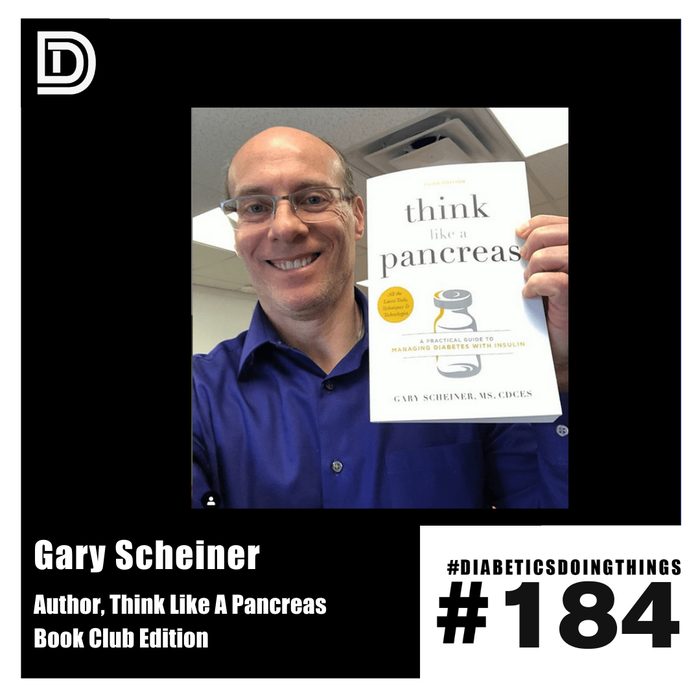
Gary Scheiner, MS, CDCES, has lived with type 1 diabetes since 1985 and founded Integrated Diabetes Services. For National Diabetes Awareness Month, host Rob Howe and co-host Eritrea read Scheiner's book Think Like a Pancreas and brought him on to go through it with him. They cover how the book changed across three editions as tools improved, from urine test strips and animal insulin to CGMs and hybrid closed loop systems. Scheiner explains his three T's of management (tools, techniques, attitude), why he avoids judgmental terms like bad diabetic, and why hybrid closed loop systems still need active user input. Eritrea shares her own history with diabulimia and a caught-early eye complication. Scheiner also answers questions on reading glucose data without guilt and finding a good care team.
Key takeaways
- Scheiner says everyone who takes insulin should use a CGM regularly, a line he put in all caps in the book.
- He compares a hybrid closed loop system to a small rudder on a big ship: it nudges blood sugar in the right direction but doesn't manage diabetes on its own.
- Scheiner says managing diabetes reasonably well, not perfectly, keeps serious long-term complications rare, and catching problems early, like Eritrea's eye issue, usually means they're treatable.
- He avoids the terms good and bad diabetic, preferring above target and below target instead.
- Scheiner recommends starting a care team search with a CDCES, ideally one who also has a personal connection to type 1 diabetes.
Show notes
This week’s guest is Gary Scheiner, MS, CDCES and founder of Integrated Diabetes Services (@Integrated_diabetes_services on instagram).
For National Diabetes Awareness Month 2021, we wanted to read what many say is the best book on Diabetes Management, “Think Like a Pancreas” and bring Gary on the show to ask him questions from our trip through the book. Gary also gives Rob great advice to stay retired from basketball in the first minute of the show.
If you want to purchase Think Like A Pancreas, you can get it on Amazon or order a signed copy at IntegratedDiabetesServices.com
On this special episode, Rob, Eritrea and Gary discuss:
When did it become clear that there was a huge gap to fill in broader diabetes knowledge from someone who actually lived with the disease?
What’s changed between the versions of the book
The 3 keys to diabetes management
Hybrid Closed Loop Systems
Long term benefits of bg control
Discussion about Diabetes Complications
How to talk to your doctor/care team
bonus: Gary talks about this song on YouTube called “think like a pancreas”
Questions this episode answers
What is the book Think Like a Pancreas about?
Written by Gary Scheiner, MS, CDCES, it's a guide for people with diabetes (not just clinicians) on matching insulin to the body's needs, covering nutrition, exercise, emotional health, and fine-tuning with tools like CGMs and pumps.
Should people with diabetes on insulin use a CGM?
Scheiner's book states, in all caps, that everyone who takes insulin should use a CGM on a regular basis, since it gives a far more complete picture than periodic finger sticks or A1C alone.
Does a hybrid closed loop system manage blood sugar automatically?
No. Scheiner describes it as a small rudder on a big ship: it nudges glucose in the right direction, but the user still has to manage food, activity, and dosing for it to work well.
How do you find a good diabetes care team?
Scheiner suggests starting with a Certified Diabetes Care and Education Specialist (CDCES), and says he personally prefers providers who also live with type 1 diabetes because they understand it firsthand.
Full transcript Searchable, with timestamps
Rob Howe: What's going on listeners? Rob here. I wanted to wish you a happy World Diabetes Day. This episode is going live on November 14th, 2021. And Eritrea and I wanted to do something different for National Diabetes Awareness Month and World Diabetes Day. So we decided to read Think Like A Pancreas, A Practical Guide to Managing Diabetes with Insulin. And the author, Gary Scheiner, joins us on this episode. And Gary's been on the podcast before when we were talking about founders. but he rejoins the podcast to really review the book, Think Like a Pancreas, because Eritrea and I read it, took some notes, and found some really interesting topics that we wanted to cover with Gary. The book is available on Amazon. I will link that in the show notes, but Gary also says, if you order it through Integrated Diabetes Services, that's IntegratedDiabetesServices.com, he will send you a signed copy. So if you want a signed copy, order it through Integrated Diabetes Services. I've got a signed copy, and I'll tell you what, it is pretty nice to see Gary's signature there in the front page. So I want you guys to really enjoy this episode. It's three people with diabetes talking about the intricacies and challenges that people with diabetes face managing the disease. We also talk about what has changed through the different versions. I really think you're going to enjoy one of my favorite people in the diabetes community. So please enjoy this interview with Gary Scheiner. Hello, and welcome back to a very special episode of the Diabetics Doing Things podcast. We're telling the amazing stories of people with diabetes from all over the world. And we've got a repeat guest for National Diabetes Awareness Month 2021. Gary Scheiner, CDCES, is in the building and the author of Think Like a Pancreas, which has been Eritrea and I's sort of book club of two over the past few weeks, revisiting it for me and Eritrea reading it for the first time. Gary, welcome to the show, man. It's always a pleasure. Hey, thanks for having me, Rob. I would like to talk some basketball with you if you get a chance. We can talk about that too. I think the voice of this book and just the way that we think about exercise and all the things that we have to take in consideration, I think are super relevant. And also, so for, for your information and also for Eritrea and for anybody out there who cares, I did have like my best basketball game performance in like eight years the other day. And should I dust off my, you know, should I cash in those retiring papers? Should I send the I'm back facts? It might happen. It might happen. Keep the day job, Rob. Okay. Yeah. Thank you.
Eritrea: I'm with Gary. I'm with Gary. Just nah, fam. Keep it. But, um, I'm excited to hear you guys talk about basketball i think mr shiner just wants to drag us here in dallas but i'm not sure well
Rob Howe: one thing that you don't know eritra is that at the AADE conference there is a basketball tournament and gary is always a uh he's like the vip celeb of that tournament you got to stay out of his way because he is maybe the most competitive of all the CDCESs out there i i would say that's that I hurt somebody. I accidentally elbowed somebody in the head. It's a very small court. There's not much room to navigate. It's a small court. It's a small room. It's a small world of diabetes educators and diabetes companies. But man, I got to be the official, which is in 2019, they asked that I got to be the referee, which is not usually the place that I like to be, but it was so much fun and can't wait for that to, uh, to come back in, in subsequent years. So big shout out to Scott for putting that on breaking ankles out here, playing ball and orbital bones. I love it straight up. Okay. So let's talk about things like a pancreas. I, I want to talk about like you were diagnosed in 1985. When did it become clear to you? And like, as, as this book is materializing the first edition. And this is obviously like today we're on the third edition. When, when was it clear to you that there was a big gap to fill in like just diabetes knowledge from somebody who actually lives with diabetes, but also can approach it from a clinical side? The idea really sprung up about five years after I started working at the Joslin clinic. That was My first job at a grad school was at a Joslin Diabetes Center. And I realized that there is this enormous gap between what people with type 1 diabetes need to manage on a day-to-day basis and what they're able to get from their providers. Just the level of skill and expertise and guidance just is really lacking. So it's on us as people with diabetes to really learn and master some of the nuances of the fine-tuning process. I just saw too many people being misled and misinformed by their health care providers. And so we need to kind of pick up the slack and do things the right way. So what I try to do is take what's a fairly sophisticated and complicated subject and present it in a way that I would hope just about anybody can understand and apply. And do it in a way that's not like lecturing. Do it in a way that's more like a partnership, having some fun along the way and making it work. It's so accessible. And, you know, Airtree, I mentioned this before we hit record, but it kind of sounds like you're talking to yourself. You're answering a question like you've encountered this problem and you're wondering how to get through it. And there's somebody who sort of speaking to you in your own voice, very colloquial, very accessible. Um, and you know, for me, even revisiting it and feeling like, and I'm sure your trade feels this way as well. I feel pretty informed about most things, diabetes, and still there was so much information that, uh, you know, was beneficial for me to learn. And, um, I want to ask you as well between version one or edition one and the third edition, which is out now, what has changed the most between the versions? And, and I, and I know technology will obviously be a big component of that. And I think I love to align, I highlighted a line, um, early on in the book that says, quote, everyone who takes insulin should use a CGM on a regular basis. And I thought that that was like, obviously wouldn't have been in inversion or in addition one, but it was in all caps as well, which I also liked. Yeah. I mean, that first edition came about, uh, I met a guy in New York city who had his own little small publishing company. He had type 1 diabetes personally. So I talked to him about this concept I had about a book called Think Like a Pancreas that is for the person living with diabetes, not for the healthcare provider. And interestingly, the book is very popular among healthcare providers also. It shows the level of expertise that is out there now. The whole fine tuning of type 1 diabetes is not really, it's not intrinsic to med school and, and nursing school and all that. So they have to learn it somewhere. But I, you know, I met this guy and, and, you know, we just outlined some of the basic components and, uh, you know, then all we had was finger stick glucose monitoring, um, rapid acting, I always use quotes, rapid acting insulin was first coming out. It was, it was very new. We were using mainly regular insulin meals up to that point. Pump therapy was also not in its infancy, but a far cry from what it is today. It's much more sophisticated than what we have today. So a lot of it was about matching your insulin program around your lifestyle and helping control your glucose properly. So there's focusing on the nutrition end of things, the physical activity part, the emotional part, and how to really think like a pancreas, just how to match your insulin to the body's needs. And that hasn't changed. That's still volume third edition, 12th edition. That's always going to be what it is, is doing what your pancreas would do if it was working as closely as possible. The tools we have now for achieving that allow us to approach a normal functioning pancreas much more closely than we could 20 years ago. And we're still a ways off from doing it completely right. But the strides we've made, they've made our lives easier and it's made diabetes a bit easier to manage. And I think when I talk to newly diagnosed families as well, I try to remember putting myself in that seat almost 17 years ago now and the tools that are available to not just kids, but adults who are diagnosed today compared to what it was 17 years ago. And it's significantly different, uh, you know, CGM and closed loop. And obviously there are, you know, big issues at hand, like with education and access, but all other things equal life with diabetes today is, is better than it was, you know, 15, 20 plus years ago, obviously. And, you know, Rob, we're going to look back in five years. We're going to look back at 2021 and just laugh our asses off because what we're doing now is going to seem completely archaic. I think about that a lot. And I think that's also like a good transition into your keys for diabetes management that you, that you include in the book. And I think that they are applicable at any point in history and sort of at any juncture, but like, there's a big caveat on that first one, because, uh, the, the first key that you list and I, and I'll list all three of the first is the right tools. second is the strong self-management skills and number three is the proper attitude and the right tools I think now means something different than it did 20 years ago and and obviously like those tools are continuing to get better and you know that's something that I look forward to a conversation with a young person with diabetes or a person who's been newly diagnosed and said well back when I was diagnosed it was like this but today like it you know this is your path forward and it's a whole lot easier. Yeah. I go, I call it the three T's now tools, techniques, and to attitude. I love it. I love it. Wow. Yeah. Oh, no. I was going to say like for me and Rob,
Eritrea: we were both diagnosed. So yeah. Well, not even that long ago and it's completely a different ball game. So it feels like even for you, like when you read the book, that was actually archaic, like the actual things that you were doing at the very, very beginning, what me and Rob were doing was actually kind of advanced, like the cloudy insulin, the Humalog. It's cool. But I mean, when you were doing this, you literally had to start from scratch. So it's really interesting to hear it from someone who's still around and can have like a fully nuanced conversation throughout the entire book of like, Hey guys, I started with no tools, like the bare minimum and look at where I got now. And I have this full understanding of the disease that I've
Rob Howe: been living with for so long. So it's awesome. We built a museum here in our office, going back to the original discovery of insulin. We've got all kinds of stuff from the 1930s and 40s onward. And I look at that, it makes me feel lucky to have what I had, even when I was diagnosed back in the eighties. And we've got syringes that you had to sharpen on a rock, got insulin that came from animals and the stuff is cloud. You know, it's not just cloudy. It's, it's weird colors. And the concentrations varied from vial to vial. Uh, we had clinic test strips where you had a pee into a, into a, a vial or a beaker and put drops in and then stick a dipstick. And it was, and I think that would give you your, your glucose from like two hours ago, you know? So, you know, the delay was significant and, and you know what back before, you know, pre COVID when there were diabetes events, I would meet people who had had diabetes for 75 years. And I, those are always the most encouraging conversations because they lived through all of that and, and, you know, and lived amazing lives, like live complete lives, like a normal person. And, um, you know, they had grandkids, but they came to the events to, you know, to see and learn and hear and support people and say, Hey, it's going to be okay. I, you know, I was able to do it and you guys can too, which I always get, you know, it sounds corny sometimes, but I get really gassed up by that. Yeah. I mean, it's credibility. Those three kind of pillars. Yeah. The tools obviously have evolved considerably and that's been the bulk of the changes in the book for the first three editions. The attitude part I feel is not changed. I mean, it's still an important part, just having the right mindset and the right approach. But the techniques have changed also the skill sets that we're developing. You know, when the book first came out, the only thing we talked about in nutrition was carb counting. That was it. You know, now we're talking about glycemic index and delayed digestion. We're talking about the effects of dietary protein and fat. Now that affects digestion and it affects insulin sensitivity. We're talking about gut microbiota. And there's a lot more of the nutrition part than we knew 20 years ago. Even the physical activity part, we know a little bit more now than we did then. My training is as an exercise physiologist. That's always been a passion of mine. And we're getting better at figuring out some of the nuances of sports and exercise and glucose management. the hybrid closed loop systems have been a big help with some of that and kind of cleaning up all the little messes we leave behind day in and day out. I really want to focus on, because I know, and sorry to cut you off there, I do want to talk about hybrid closed loops or HCLs as we, as they're abbreviated in the book, because that's a significant, you know, developments in the third edition compared to the others. And I think even today, like, you know, Eritrea and I both wear hybrid closed loop systems, um, and from different brands, but we, you know, virtually have like, you know, the same type of interaction, uh, from a technology standpoint, but something that you hit on in the book. And I think you were going to touch on here as well is the third T, which is the tood the attitude. And, you know, you've seen so many patients over the years and had so many conversations, like what, what is the right attitude? What is the right approach for somebody with diabetes to take, if they want to take that next step in their management. And I, I, I love what you talk about and, and how you frame complications and how you frame a, a successful life or a healthy life with diabetes, like is really centered around control. But the first thing that you have to control is that attitude. Yeah. And a positive attitude is, is very important in so many things in life. If you dwell on the negative, it doesn't do anybody any good. It's like that Bobby McFerrin song, don't worry, be happy. He had that great line. It was like, if you worry about your troubles, all it does is make them double. It's a great line. It's brilliant. But having a positive attitude, things like keeping a sense of humor about things can really get you through tough times. It can make difficult things bearable. All of the and exactness and the frustration we have with our glucose and, and, you know, the pain and exhaustion of living with this disease, having a sense of humor really goes a long way. Surrounding yourself with positive people, I think really does help also. So in having real, reasonable, realistic expectations matters too. The first thing I do with every new client I work with, I do an assessment, but the first thing we work on together is what are the goals? What do we want to try to accomplish? And often they'll tell me, well, I want my blood sugars between 80 and 120. That's when I just have to kind of smack them in the face and say, no, let's think realistically here. You don't need to be in that range to feel good, to perform well, and to prevent long-term health problems. Maybe that's the textbook definition of normal glucose, but that's not what we need to do here? So having realistic expectations for yourself, and that way, you know, if you're approaching what you want to accomplish, and you're also not beating yourself up needlessly and striving for things that aren't necessary. We actually, in our practice, we see so many intense people who want to manage their glucose, you know, as well as humanly possible. We have to talk these folks down. You'd think most diabetes clinics, they're trying to help people manage better. In a lot of cases, we're trying to talk people down from the intensity of their management and live a quality of life, be happy, enjoy things, and manage the blood sugars reasonably well. It doesn't have to be perfect. Do it reasonably well and enjoy the rest of life that life has to offer. I, over the years, have kind of developed this sort of joke where type 1 really turns people into type a personalities because they, you know, just take full control. They dive in with both feet and they want to do, do well. And I think it's human nature to want to do well. And most people, you know, in whether it's careers or sports or anything like want to do a good job. And the problem is they often don't know how, or they have the wrong measure. And so, you know, for you, like, of course you come in and you're like, Oh, I want to manage my blood sugars really well. I want to stay within 80 to 120, because that's what I've read as normal. But to your point, like we still have diabetes. So we're going to have blood sugars that are not in that range. And how do we make sure that what we really want? And I think it's, you said as much is to feel good, to be able to do what we want to do. So what do people, what do you find? Like after you back people off of those first goals, like a day to 120, what do you find is like the most common, you know, when we really dig into what they really want, what do you feel like is the typical response? Yeah, that's another key consideration is I try to get away from the numbers part of it and get more towards what do you want to get out of life? What do you want to accomplish? And it might involve running a 10K. It might involve having a baby. It might involve doing well in school and pursuing a professional career. But then, then we circle back and talk about how managing your glucose can help you get there. So it's, there's always a personal, uh, something that's personal to each per each individual that they want to try to do. Uh, like Rob, what would you say is yours? What, what do you, why do you manage your diabetes? It's not to have a number. Why do you manage it? So oh man, I'm glad you asked because then I was going to have to work my way back into figuring out a way to tell you. But like, I think the reason that my diabetes management resonated with me so early in my diabetes journey and my life with diabetes is that there was a clear want for me. So I wanted to play basketball. I was basically at 16, all I really cared about other than girls probably. But, um, and for, you know, so for me, diabetes became the pathway to exactly what I wanted. And they, and my doctors and care team were like, Hey, if you take care of your diabetes, everything that you want for your life is on the table. And so for right then I was like, cool, well, that's what I'll do then, because this is what I want. And, you know, now it's a little bit less intense, but you know, I want to go to work. I want to feel good. I would like to live a long time. I'm, you know, that's the thing that's, that's important to me now that when I was 16, certainly wasn't really in the back of my mind. Um, and I would prefer to do that complication with, you know, as few complications as possible, you know, with what I can control, uh, so that I can, what was your motivation or what to call it, your tackling fuel to borrow that phrase from the
Eritrea: water boy. Um, so I was a really, really bad diabetic for a long time. Like I went through diabulimia. I've had different eating disorders and I got diagnosed before Rob, like I started at like seven. So I just never thought that I was even going to get to my twenties. And then when I did get to my twenties and I met someone really awesome who wanted to get married and have kids and have this life, I was just like, Oh, well, I don't know if I'm gonna be able to be here for that. Cause I got diabetes. And so, um, I had a really great partner, a really great husband now who really motivated me to go to the doctor and figure it all out. And from there, I kind of decided like maybe being alive isn't so bad I should figure this out it doesn't have to be as stressful as it's been for the last million years and uh I think I got motivation after I started to feel better like I saw the effects of taking care of myself instead of just constantly feeling bad and it's really weird but I started taking care of myself like ironically like I ironically would take my insulin because I needed to be here to go on a date with Hassan. Like it was it that sense of humor thing that you're talking about does help a lot. So if you can kind of like salesman your way into it with yourself, then you can kind of convince yourself that this is worth it. And then after some time built up and I had a few months under my belt, we're feeling 200 and no, no longer felt well, like it didn't feel good. I just kind of grew from there and just kept building onto it, you know, man, that's
Rob Howe: powerful.
Gary Scheiner: Yeah.
Rob Howe: yeah let's I want to focus on the sense of humor thing for a second because here I think you do such a great job of this not only in the book but you're just a cool funny dude so uh which is why you're back on the podcast uh like having celebrating those small wins and like like Eritrea was talking about like kind of gaming yourself into like oh well go I want to be alive on this date later so I'm going to give myself my insulin for this like what kind of psychology or like what kind of practices do you try to implement for people to celebrate those small wins and create that sense of urgency or, or what have you like in their day-to-day diabetes management. It's interesting. You think I have a good sense of humor. My kids say I have what they call dad humor. Yeah, but I'm the target audience for that. I just love really jokes. So, I mean, like just, you're not alone out there. These brilliant little quips and puns and they say, Oh, that stopped with the dad humor. They don't go for it. Isn't that part of just evolution of like them wanting to get out of the house and like move on. Right. That's just like a natural thing. Well, no, we try to have a little bit of fun with the diabetes wherever we can. Our clinical team, I've got eight clinicians, all have type 1 diabetes. And every month we have a public food challenge. I love these by the way. Yeah. I mean, we, we pick a food type as a group and how much we're going to have, et cetera. And then we go and have it and we publish our results and the strategies that we applied to try to manage our glucose during that. And, you know, you can tell by the CGM graph and the face of the person, how well we did. But it's a fun thing, you know, and some of us are better than others with certain food types. We've done pizza, chocolate. Recently, there was a Chinese food, I think, and Mexican food as well. Mexican food, cereal, I mean, simple things like that. So, you know, we have fun with that. A lot of people enjoy competition. Competition sometimes brings out the best, but it keeps things interesting too. So I encourage people to look at their own data weekly, biweekly, whatever, and just see how they're doing. If you've got a CGM, you can track how much time you spend in your target range and how much time's high and low. So if you look at it this week and you've had, let's say, 55% in range, hey, for the next week, just try to build that. Try to go up from there. However much it is, it's an improvement. So getting that time in range better is really nice. And that's another, you know, the metrics we're using now is another thing that's really evolved. We've become much less A1C centric. In fact, at this point, I don't even care what people's A1Cs are anymore. The fact is the A1C is an indirect way of measuring average glucose. We can get a more direct measure off of our CGM systems. So that's a more, to me, more valid. There's a lot of variables that influence A1Cs. And for that matter, the A1C and the average doesn't tell us the detail we need to know to evaluate what's really going on. I'm sure both of you have seen this with sugars bouncing up and down, up and down. The A1C looks wonderful. It doesn't mean you're managing well.
Eritrea: It doesn't mean you feel good on a day-to-day basis.
Rob Howe: And it brings up something that you mentioned in the book. And I think it is much easier now, obviously with CGM, but it was essentially like, if you keep track of your data, you get better outcomes. Like you, there's people who track their, their glucose data have better outcomes. And so I think you can apply that to CGM or whether you use a Dexcom Share or a CareLink upload, uh, or whatever Freestyle Libre has. you know, you can, you can look at that sort of bigger picture, zoom out a little bit and identify with your care team opportunities to, like you said, just marginally increase or take something out or adjust the level or, and I think even kind of as we shift back to the hybrid closed loop systems, which you apply a metaphor in the, in the book to a big ship, like diabetes is a big ship and the hybrid closed loop system is a small rudder. So you can make, you know, adjustments and it helps you a little bit, you know, but there's still, you know, a management aspect to it. It's not completely hands-off. That's right. I mean, the hybrid closed loop systems is the perfect marriage between the user and their technology. You've got the technology that's trying to help the user and you've got a user that needs to support the technology to make it work well. So people who think they're going to go on a hybrid closed loop, whether it's, you know, a Medtronic, a Tandem, the new Omnipod 5, or something like Loop or OpenAPS, if they think they're just going to go on this and it's going to manage their blood sugars for them, they're in for a rude awakening. It's not going to do that. The user still has to stay on top of the majority of the management. These systems just sort of nudge the blood sugars in the right direction. Like the big ship with a small rudder, it can steer it in the right direction, but it's not going to fix it on a dime. It's not just going to get you on target right away. So it's a partnership between the user and their technology. And if the user doesn't hold up their end, they're not going to get the results they're hoping for.
Eritrea: It sounds like it's a lot of looking at data really to see patterns and try to figure out what's going on with yourself. But so for people like me who have terrible anxiety at all times, all the time, how would you, or do you have clients like that who are overwhelmed with the amount of data? We've interviewed a few people on this podcast who are getting, who are managing, not just their diabetes, but also their husbands and their two kids who all have diabetes. So that's a lot of information to be getting all at the same time as like social media, emails work. How do you advise those clients? How do they manage?
Rob Howe: All right, alleviate the guilt because almost nobody with diabetes looks at their own data. Our practice has, we have probably the most elite patients out there. They're engaged and motivated. They've got all the tools and technology and hardly anyone looks at their own data. My theory is that living with this diabetes day in, day out, it's a pain already. Why do we want to spend our free time? Oh, let's go look at our blood sugars. No one wants to do that. That's the last thing we want to think about. We're also not very good about being objective and critical of ourselves. So that's why there's people like me. You know, you got to work with your health care team, provide them with the information. And Rob, what you were saying also about the kind of data that can be presented off these systems is phenomenal. compared to what we used to do. I was pretty high tech, but I would plug in someone's meter and print out lists and numbers. That was high tech, but it's next to useless compared to a CGM report. We can see the full story with a CGM. Absolutely. The context comes in. For me, and I promised you I was going to work some basketball into this interview. So here we go. Some of the most painful moments in basketball that I remember are watching game film. because you can't edit it. It's there. Like, and you can't, you know, there's no excuse. Like, and I just remember my coach would like rewind it, play, like rewind it and play over and over and over about this one mistake. And I, you know, I feel like people with diabetes can be very critical of themselves. And also it feels a little bit like, uh, for me, for example, uh, I was at the ADA conference and Tidepool was there. So they took my pump and generate a report, uh, to, to upload to their data and they reviewed it with me and it was just my CareLink report, but you know, they circled some of these glucose excursions that I had. And I, and I was like, well, I was on a plane. So I couldn't, like, I was just getting really defensive. I was like, I couldn't get in the, I couldn't get into my stuff and like change my side at the time. So promise you, I'm not bad. I'm not bad. And they were like, dude, don't worry. You're fine. So, yeah, I mean, I guess it's just a little bit like when you're looking at yourself, it's hard to be objective and you feel a little bit defensive. Yeah. If you've got a good team, a good diabetes specialist to work with, they should understand that we work hard at this. It's not like we're lazy. It's not like we're purposefully trying to sabotage our glucose levels. We got lives to live like everybody else and stuff happens. We can't manage our diabetes. Right now, I mean, I had one slice of pizza for lunch and I'm still struggling with these high readings. Let's do a diabetes check. I was gonna say I had pasta for lunch which I just wanted fine examples to set yeah I finally
Eritrea: won I never beat Rob I have my 94th yay good for you I love it see they're celebrating I never beat Rob like ever every time we do this pod I'm always low I'm always high something but today I'm gonna take it so I have sorry I didn't mean to cut you off um I have a question though so not all care teams have diabetes. A lot of them are just normal people who don't get it at all. So do you have any like maybe red flag questions for some of us out there who are like getting to know our care team better? Something we can really ask for if they answer it weird, it's like, oh, need to go somewhere else or anything like that, maybe tips or tricks. Well, two things that I think are important to
Rob Howe: find out about is, is there a certified diabetes care and education specialist? because unlike a physician, the CDCES, used to be called just the CDE. The CDCES is somebody who's trained in listening, assessing, evaluating, and coaching. They're not there to dictate and they're there to coach patients, to help them learn what's going to be helpful to them and help them navigate their management. They're generally good listeners. They're generally good at customizing, individualizing plans for people. And they usually have a good diverse set of skills so they can discuss lifestyle in detail. They can discuss medication in detail and technologies in detail. So a CDCS is a great place to start. Now, a step beyond that, and it's just personally, if you can find a clinician in your diabetes team who has a personal connection to type 1 diabetes, I think it makes a difference. I prefer working with somebody like that because they get it. They've got the direct experience under their belt. They can relate well. Now, I know some excellent, excellent healthcare providers who don't have type 1 personal. So this is not an exclusive type of a thing, but it's rare to find a diabetes specialist with type 1 diabetes is not amazing at their job. They're very passionate about it. I would say like that. I think that's probably one of the things that jumps out to me the most about the book is how seen I feel as a person with diabetes reading it. Like, oh, I have encountered that or, oh, I haven't noticed that before. or like something that jumps out to me. And I apologies if I butcher this, but it was a little blurb about talking about breakfast. And if you only eat protein, like eggs and bacon, you might see a big rise, like a big spike compared to if you included a carb and bolus a little bit, you wouldn't see that same, you know, spike. And I was like, Oh, wow. Like, I didn't know exactly why that happened, but that's definitely happened to me. And so just to kind of normalize like, oh yeah, like a cup of black coffee sent me into the 200s this morning. That's normal. That happens is just such a reassuring thing for, you know, somebody with diabetes who may not be plugged into the community, who may not have other friends with diabetes or a care team that's, that's super, you know, active or like you called your patients. And the listeners of this podcast are like among some of the most educated people with diabetes in the world. And, you know, not everybody is like that. When my patients bring up things like that, whether it's a slowly digesting meal or caffeine or stress or whatever, I always ask them back, simple question, what would your pancreas do if it was working? That's what you need to do. That's thinking like a pancreas. Man, there's just so many, so many awesome just sound bites and thinking like a pancreas and like applying that across all of these crazy diabetes. Think about basketball, any sport. If you get involved in a highly competitive game and the adrenaline is flowing and you're like this, what would your pancreas do under those conditions when your liver is dumping glucose into the bloodstream? It's going to make some insulin for you. If you're out on a long jog or a bike ride or a walk and your glucose is gradually trending down, how would your pancreas handle that? That's what you got to think from that perspective. The answer usually is pretty obvious. It doesn't take me or any health professional to figure it out. If you think about it and think of the tools you have available, the solution is usually pretty
Eritrea: clear. Sorry, go ahead, Rob. We've been stepping on each other so much in these recent episodes.
Rob Howe: I'll take the blame. For me, think like a pancreas as a concept. I think back to goal setting because this is National Diabetes Awareness Month. And something that I've been really focused on this year in particular is that kind of reversing that one in 10 people have diabetes in the US and say, well, that means that nine out of 10 don't, and they need to learn what it's like. And that's where we can create the awareness, right? And something that I pulled from the book really resonated with me, which was you said, if you take good care of your diabetes and manage it reasonably well, you have a good chance to avoid long-term health problems. And I think that diabetes complications, and I have a few here listed from the book, are typically taboo to talk about. And we, as the people with diabetes, don't want to think about what could go wrong. We're focused on the day-to-day, and I think that's good. At the same time, it's really important to talk about how diabetes affects the rest of your life and how a chronic illness, you know, can make you more susceptible to other illnesses. So, you know, for you, you know, A, as a person with diabetes, like how do you frame and think about complications sort of in your management? And then also how do you talk to your patients about, you know, being two to four times more likely to develop heart disease or at more risk of stroke or something that's been very topical lately, like mental health, anxiety, and depression being three times is likely to suffer from symptoms of those. How do you approach those conversations? Well, I'm going to try to phrase it in ways that each patient can relate to, but it's almost like if you drive a car, you got to maintain it. If you don't maintain your car, there's a good chance your engine's going to blow up on you. So I phrase it, I try to put it that way, that if you manage your diabetes reasonably well, your chances of developing complications are minimal. And if you practice good self-care, in other words, if you get your lab work done in a timely way, you see your doctors for your various exams and screenings in a timely way, even if you do develop health complications from diabetes, they shouldn't have a negative impact on your life because you catch them early when they're still very easy to treat. Sometimes they're reversible. So I try to put that positive spin on it because you're right, Rob, at this point with what we know and the tools we have, there's no reason to be concerned that you're going to develop complications. Just manage your diabetes reasonably well and take care of your health. See your doctors, get your lab work done. And if you do, if the problem does develop, you catch, you nip it in the bud, you catch it early and you treat it quickly. And I go through a lot of the details about that in the book, the various health complications and, and what early screening, early detection can do to minimize their effect on your, on your quality of life. There's a big difference between, you know, maybe having a leaky blood vessel in your eye and going blind. Leaky blood vessel in the eye, you catch it early, there are lasers that can coagulate, it doesn't get any worse. But you know, 20, 30, 40 years ago, we didn't have those capabilities. Those blood vessel leaks would spread and grow and eventually you lose your eyesight. It's not the case anymore. So yeah, you can minimize the risk to begin with, but there's no guarantees. You can still develop these problems, but if you catch them early, treat
Eritrea: them aggressively, you can go on living a high quality life. So we were already reading the book. So Rob had already got me the book. This is kind of like off topic, but still on topic with what you just said. And I read stuff about complications in here. And I was actually going to the doctor because I have a leaky blood vessel in my right eye and they nipped it in the bud. Like I had three lasers, well, two shots, one laser. I just got the other one and I'm done and I'm not blind. And I really there was like a month that I told Rob that I was just like taking mental pictures of things because I had this understanding in my mind that it was a wrap, homie, like it was over. I had bad diabetes control and they were coming to collect. Right. The diabetes gods were showing up. But there's options, like you said, because I stopped doing bad things like being a bad diabetic a few years back and started keeping up with my labs and going to the doctor all the time. And like you said, if you can just nip it in the bud and be there for yourself, you can even maybe you can change the story for your own self.
Rob Howe: That's part of the attitude. It's the attitude of, you know, I'm not going to hide in a corner. I'm not going to stick my head in the sand. I recognize these things can happen, but I'm going to do what I can to make sure they don't affect me. You know, and at least if they do happen, you can't be kicking yourself because you did everything within your control. you do what's within your control, your chances of having serious complications is like one in a gazillion. It's, it's very unlikely. Well, and I think having been there kind of on the, on the front lines of Eritrea's, you know, emotional swing and, you know, also just fear of the unknown. Uh, and now to, you know, as she's been past that, you know, hearing what you're saying about engaging with your doctor, like going, you know, going for your checkups, like, you know, if there's a problem, let's nip it in the bud. Let's catch it early. I think knowledge is power there. And I also think I want to, I want to focus on two things as you've said it twice and the phrase bad diabetic, which you know, I think in, in the past in the past, it's been like non-compliant is another like clinical term. And I struggle with that because, and I'm just interested to hear your thoughts. Like clearly there are things that you can do better as a patient always. And, you know, whether it's carb counting or any, you know, technology or prescriptions, whatever the case may be, exercise, diet, all of those things play a part. Diabetes is so holistic. But for you, like when you think of people or when you think of the phrase bad diabetic or non-compliant, what are, what have been in your experience, like the biggest sort of light bulb aha moments for people who found themselves or identified like that or felt that they were bad or non-compliant and moved towards sort of maybe a growth mindset of, of becoming a more proactive person with diabetes and really taking control of what they can control. Yeah. I'm glad you mentioned it, Rob and Eritrea. I wasn't going to pick on you. I don't like those terms either. Uh, I don't even use the term high or low blood sugar anymore and language matters. The verbiage matters. And I'll describe it as above target, below target. I try to use nonjudgmental types of terms when describing things. If you were not managing your diabetes, just say that. I wasn't taking care of my diabetes. Doesn't mean you were good, bad, or ugly. You're not ugly. But you know what I'm saying. I do. Unfortunately, for a lot of people who are not taking care of their diabetes, the, that, that turnaround point is often when they start to develop complications. Some are lucky and there'll be someone who inspires them. In your case, it was your, your future husband, right? Others, it might be a coach. It might be another person with diabetes who maybe is taking care of themselves and inspires you. But finding that inspirational person is certainly much better than waiting until unfortunate things start to happen with your health, because sometimes that's irreversible. You know, there's a cure coming. We'll have a cure at some point. I think we all want to look back without regrets and say, you know what, this was a tough mother of a disease and I dealt with it for a long time. And no, I did my best. You know, we don't want to look back with regrets and say, you know, I just, I should have done better and I'm suffering now because of it. And not just me, the people around me end up suffering because of it. So I guess that's one of the reasons I, the book for me is a way to spread the word to a lot more people than I can do with one-on-one consultations with our patients. We can only see so many individual patients. The book helps me get the word out to millions, hopefully, of people that can benefit and try to start it out at a very basic level and then build to a crescendo, starting with basic understanding of the terminologies and the physiology, and then discussing the basal insulin component, and then building the bolus insulin component. And then, you know, some of the specific nuances of adjusting each of those in a step-by-step way. So that if you, if you read it cover to cover, I mean, it's a miracle because you'd probably fall asleep 10 times, but there's a logic to it. It's not just throw you out there into a lot of stuff. It builds up into that crescendo. Well, and I think you hit on something really important too regarding HCPs and care teams and endocrinologists. Time is of the essence and there are a lot of patients and they've only got a certain amount of time that they can spend. And so sometimes you sort of default to drinking from the fire hose from an information standpoint. And so, like you said, to have the book where, oh, I remember reading something about this. Where is it? Let me just go back and revisit it rather than having to guess or stress about it or make a phone call. It's such a, like you said, sort of logarithmic journey. I really love when in a chapter you focused on switching from multiple daily injections to a pump or switching from a pump to multiple daily injections. And I found that to be, you know, because I think that's a lot more common today than it was 15 years ago. Super just informative, just to remember how basal rates work different from injections compared to a pump. And, you know, just giving people more flexibility, more options, more information. Yeah. Even things like real-time dosing, it might just seem simple. You just take a dose of insulin. There's a decent amount that goes into it. You've got the food component, the insulin you give for the food. You've got the correction part of the bolus dose. You've got the insulin on board adjustment that has to be made. You have the adjustments for physical activity, either upward or downward, depending on the level of activity. And then there's the timing of it. So there's a fair amount of thought process that goes into making a bolus dose work. It's not just a matter of taking six units. It's figuring out the optimal dose, timing it properly, and making sure that you've thought in advance about what you're going to be doing and what you're going to be eating so that hopefully it'll work out about right. But even people who do all the right things, if we can hit that target 70, 75% of the time, that's darn good. I will use the word good there. That's nice. It's pleasant to see and that's desirable for most people. With hybrid closed loop systems, we can sometimes do a little bit better than that. so that that is beneficial you know having something in the background that's tweaking on your behalf it's also kind of like a butler that just follows you around just cleaning up your little messes he can clean little messes but if you're a complete pig he's going to quit so you've got to you got to work with your butler yeah this this butler comes with alarms that uh that are difficult to deal with in the middle of night sometimes. Uh, Gary, I want to thank you so much for your time. Um, I know, I know, like you just said, you, you spent an hour with us today, uh, was an hour that you didn't spend helping somebody with diabetes. So I greatly appreciate it. Uh, the book is think like a pancreas it's available online and on Amazon and on IntegratedDiabetesServices.com. Uh, thank you also to Catherine, who is an intern, uh, for, I guess she's not an intern anymore. She's full-time staff at Integrated Diabetes Services. She's a longtime friend of the pod and she's been instrumental the last couple of years with us working more closely together. So big shout out. If anybody orders the book for my practice, I'll send a signed copy. It goes down in value, but it's nice to have. Yeah, I've got the signed copy right here. I said, you know, the value, you know, I'll take that risk. You know, I'm playing the long game here.
Eritrea: I'm going to play longer than you. I'll wait till I meet you, Mr. Scheiner. You can sign my book in person. So see about that, Rob.
Rob Howe: I look forward to that as well. Cause I used to bump into Gary every now and then at, at diabetes events throughout the country. So looking forward to, uh, when that's available for us again, but, uh, again, thank you. Eritre, thank you for what you do. And this was not a wasted hour. I mean, this is going to reach a lot of people and, uh, the work you do is benefiting so many of us. So thank you. I greatly appreciate it. Thank you. And if you're out there reading, along with us, think like a pancreas. Let's, let's get it. And throughout the month, air tray and I will be answering questions on the diabetics doing things Instagram. So until then, we'll see you guys next time.
About Gary
Gary Scheiner, MS, CDCES, is the founder of Integrated Diabetes Services and author of Think Like a Pancreas. He has lived with type 1 diabetes since 1985 and trained as an exercise physiologist.