

Diabetics Doing Things FOUNDERS - Zack Schreier - Quevos Egg White Chips
Episode summary
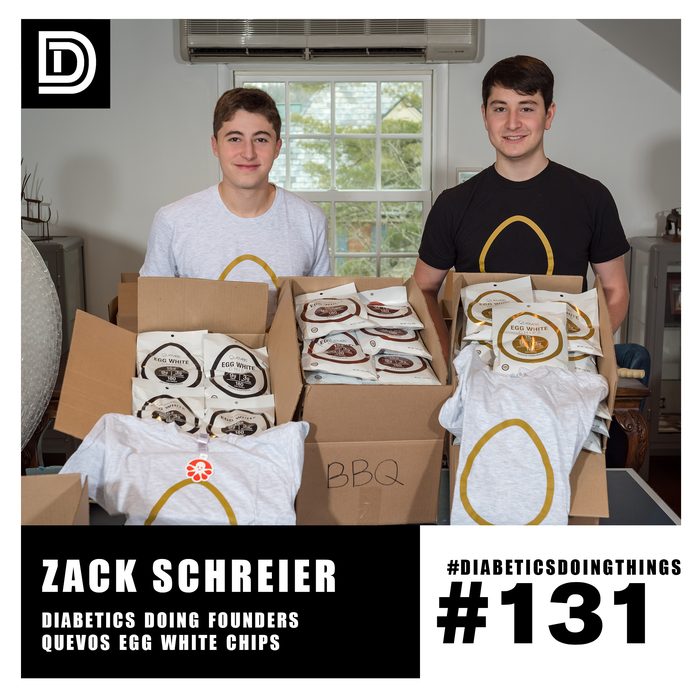
Zack Schreier was diagnosed with type 1 diabetes in sixth grade, just before turning 12, after losing 25 pounds and a hospital blood sugar reading of 666. He responded by checking his blood sugar dozens of times a day and keeping detailed notes, a habit he still uses. Years later he turned his love of crispy egg white snacks into Quevos, a low-carb chip he co-founded with his college friend Nick. Both took a year off from the University of Chicago to run the company full time, won a startup competition, and joined the Kraft Heinz Springboard incubator. The conversation covers his diagnosis, how data tracking shapes his diabetes management, the product's development, and splitting responsibilities with a co-founder.
Key takeaways
- Zack Schreier was diagnosed with type 1 diabetes at 12 after a blood sugar reading of 666.
- He managed his diabetes early on by checking his blood sugar 20 to 30 times a day and keeping a detailed food and insulin journal.
- Quevos started as egg flakes Zack noticed sticking to a pan, which he realized tasted like low-carb chips.
- Zack and co-founder Nick took a year off from the University of Chicago to build Quevos full time after winning a startup competition.
- Zack says clear communication and complementary personalities helped him and Nick avoid major conflicts as co-founders.
Show notes
We are continuing to highlight founders with Diabetes on the podcast. The newest founder is Zack Schreier, of Quevos!
Zack and his business partner Nick are the co-founders of the breakthrough egg white chip, Quevos, which they developed based on Zack’s love of egg white snacks because of how easy they are to enjoy with Diabetes. Quevos are the low carb, high-protein snack with 5g net-carbs, meaning that Zack doesn’t have to give himself a shot to enjoy a delicious snack.
We discuss his diagnosis with Diabetes at as early teen, and how his passion for Quevos (and the response of consumers and investors) inspired Zack and Nick to put college on hold and pursue their business full time!
Also, Quevos are delicious and can be ordered via their website!
This episode is sponsored by Real Good Foods! Be sure to check out their new Breakfast Sandwiches, made with cauliflower cheesy buns with only 2g net carbs! They’re packed with protein (18g) and have no gluten or grains. Available in sausage egg & cheese and bacon egg & cheese flavors and they’re ready within seconds. Order them online or find a store near you today!
Questions this episode answers
What is Quevos?
Quevos is a low-carb, high-protein chip made from egg whites, created by Zack Schreier and his co-founder Nick.
How was Zack Schreier diagnosed with type 1 diabetes?
He was diagnosed in sixth grade after losing 25 pounds and vomiting. A hospital test showed his blood sugar at 666.
Why did Zack Schreier start making egg white chips?
He noticed the crispy flakes left behind when frying eggs tasted like salty chips and realized they let him snack without taking an extra insulin shot.
Where can you buy Quevos?
Quevos is sold on Amazon, on the company's own website, and in roughly 200 retail stores, with more locations planned.
Full transcript Searchable, with timestamps
Rob Howe: We are back with more content for 2020. It's the fourth year of the podcast. We launched our first episode in 2016. That's 17, 18, 19, 20. I guess this is the fifth year. How does time work? Anyway, I just want to thank you for listening. Right now we're doing a special series on founders with diabetes, and today's episode is no different. I'm interviewing Zack Schreier from Quevos, which is a egg white based snack out of the Chicago area. So I'm really excited to share with you Zack's type 1 diabetes journey, as well as parts of the diabetes that went into building his business, as well as some of the challenges that he faced along the way. My goal for this series is to A, talk about what I know, which is entrepreneurial endeavors with diabetes and how that sometimes plays into the background, as well as the foreground of the business. And B, just to give you guys some inspiration of some awesome people who may not be exactly in the forefront of some of the brands that you may know and love, but are up and coming and are really setting the stage for a world where people with diabetes can do anything. It doesn't necessarily have to be running a lot of marathons or climbing big mountains, but just everyday victories, which I think are super inspiring. So I really hope you enjoy this interview with Zack Schreier. But first, a word from our sponsors. Hello, ladies and gentlemen. Thank you for continuing to listen to Diabetics Doing Things. We've been doing this for four years now. thanks to listeners like you and the support of amazing sponsors like Real Good Foods. If you're involved in the diabetes online community, then you have for sure heard of Real Good Foods and their low-carb pizza and enchiladas, which are delicious. But they've really outdone themselves this time with their new breakfast sandwiches. It's just like your typical breakfast sandwich, sausage, egg, and cheese, or bacon, egg, and cheese, except the biscuit is made out of cauliflower and the whole sandwich has only two net carbs. That's two net carbs. And if you pop it in the microwave, it's ready in seconds. I'm not a big breakfast guy because I don't like having to deal with big blood sugar spikes for a high carb breakfast. But when I'm really craving a breakfast sandwich, I grab a Real Good Food sandwich out of the freezer and hit the road without having to worry about a big spike in my blood sugar. Check out realgoodfoods.com to find them in the store near you or use code ROBHOW, that's me, to get a discount when you order the sandwiches online. I'm a big fan of brands who continue to support creators with diabetes, and there has been no bigger supporter of me and my friends in the diabetes community than Real Good Foods. If you haven't checked them out yet, give them a shot and let me know what you think. And now let's get back to the episode. Okay, sounds good. Welcome back to another episode of Diabetics Doing Things. We're telling the amazing stories of people with diabetes from all across the world. And in this series, we're focusing specifically on founders with diabetes. So my very special guest today, Mr. Zack Schreier, calling from, I believe, Chicago or the Chicago metro area, and he is the founder of Quevos.
Zack Schreier: Welcome to the show. Thanks for having me, Rob. Really looking forward to it. Me as well. So
Rob Howe: Zack, why don't you give us a little bit of background for people who aren't as familiar with your story. How did you become a part of the type 1 diabetes family? What's your diagnosis story?
Zack Schreier: Sure. So in sixth grade, I was just growing like a normal kid, and all of a sudden, I got really, really lanky. I lost about 25 pounds over the course of a month as I was growing in height, and my family was friends with a few doctors who said, basically, this is just what happens. Kids get wiry at this age. Don't worry about it. And then I started feeling a bit weak, nauseous pretty frequently. And then one day I just started throwing up. And so the next morning my mom took me to the hospital and my sugar was 666. And so doctors knew immediately that I was a type 1 diabetic.
Rob Howe: That's kind of obviously high blood sugar is never funny. But of all the numbers to get, 666 is a pretty funny one.
Zack Schreier: Yeah, right. Yeah, absolutely.
Rob Howe: So from there, obviously being like sixth grade, so you're like 12, 13 years old, maybe. What do you remember about the next few years or adjusting to your life with diabetes?
Zack Schreier: Yeah, so actually I think I might have been just about to turn 12 at that point. And I was always pretty analytical. I liked strategic games and that kind of thing. I love math. And so I think, you know, of all the people that get diabetes, I was actually not a bad pick. So I remember actually on the way home from the hospital, my mom had reminded me that the nurses at the hospital suggested I take a food journal where I write down my sugars and what food I'm eating and track my insulin needs and that sort of thing that way. And I remember saying, you know, Mom, I really don't have to do that, do I? She said, of course you do. This is a really serious illness, and you need to be as responsible as possible. And so I took that to heart and immediately started running experiments. So I would check myself 20 or 30 times in the morning just to see how quickly my sugar fluctuated when doing different things. And I think I pretty thoroughly annoyed the nurses I was supposed to be working with because I would call them daily and, you know, report on my findings and ask a bunch of questions. But I found that was actually a very good way to learn how to manage the disease because I discovered a bunch of things pretty early on that I've used ever since. So at that point, I had discovered that, you know, in particular how sensitive I am to every gram of sugar. I recognized my insulin sensitivity. I discovered a few things about like morning syndrome, which I know it's not called, and that was especially applicable to me. My sugars would rise pretty astonishingly in the early morning. And then also discovered things about, you know, my baseline fasted sugar movement, correction, all that sort of thing. And I used many of the same numbers or at least the same intuitions that I developed at that point. So it was maybe three months of really rigorous note-taking, and then I sort of had it mostly figured out. and then fast forward a few years I became a cross country runner because that was a whole new set of concerns and all sorts of new trends in my sugars and so I guess at that point I started figuring out again using the same sort of tactics just being really thorough with my documentation so it was I'd say it was certainly an adjustment but it wasn't as terrible as it could have been had I not thoroughly embraced the need to understand what was going on.
Rob Howe: And, you know, you bring up a good point. Your personality sort of fit the needs and the management aspect of what diabetes brings to the table. It's interesting that you're talking about when you're adding something new, like a new activity or a new hobby like cross-country running or a new type of exercise. Whenever people ask me about those things, I always recommend. What you're talking about is journaling. and just, you know, taking into that sort of now cliche entrepreneurial type slogan of like what gets measured gets managed. So do you find that that sort of systems thinking has served you well, you know, in other diabetes exploits or as your life has changed since diagnosis?
Zack Schreier: Yeah, I think so. So, you know, documentation is always, it's got like a, it's got pros and cons, double-edged sword, because obviously you can get pretty analytical to a point where it's useful and then to a point where it may be cumbersome. And so I think probably for me, because of the diabetes and because of my personality, just trended towards accumulating more and more information over time. And so I track a bunch of different things. And I'm sure it started with the sugars. But I track sleep and exercise data, heart rate, heart rate variability. I track supplement consumption, that kind of thing. And I even write down thoughts pretty consistently pretty much every day. And I found it's very nice to be able to look back and see what certain things did to my sugars or how I responded to exercise in the past or how my heart rate responded to different daily activities or bedtime. But it's also sort of a hassle to always be documenting things as I go. So I think I have to continue to find a balance there. But certainly that has been helpful in many of my entrepreneurial exploits. So in particular, I'm sure we'll talk about this in a few minutes, but in particular, when formulating my low-carb chip product, it was very, very helpful to be formulaic and document every result. And I'm sure that made the R&D process much smoother.
Rob Howe: Well, let's go ahead and talk about that then. And so Quevos, like you said, is a low-carb snack. Really, I guess I would describe it mostly like a chip. And I have heard you and your co-founder talking about that on some of the different interviews that you guys have done over the past couple of years. You and Nick, when you're going on TV and things, talking about what Quevos is. Why don't you give us a little bit of a backstory on where the idea came from? And then I'm also really curious about the name. So how about you give us the, I guess, the 10,000-foot view of where Quevos came from and what it is.
Zack Schreier: Yeah, absolutely. Yeah, I'll happily talk about both those things. So on the back story, I'm sure I'm like many diabetics, and then I discovered eggs and cheese. Items like that were really pretty nice for snacking because they're nutritious enough, but you don't have to worry about counting up the carbs in eggs or things like that. So I had a habit of just frying cheese on a pan or a microwave or cooking eggs every night just so I could avoid the extra shot. And I realized that those flakes that sometimes stick to a pan after making eggs, they were sort of like chips. They were crunchy, and if you salted your eggs, they were sort of like salty like potato chips. And this was pretty early on into being a diabetic that, you know, that struck me. I've heard from a lot of people that they've had similar experiences. They love those flakes. And, you know, many diabetics have discovered that sort of thing, too. And so, you know, initially, probably in seventh or eighth grade, I had thought about these as like low-carb chips, great for diabetics. And then the keto diet started taking off a couple years ago when I was a sophomore in high school. And I was thinking, huh, you know, those low-carb chips are like seem like slightly more universally appealing. And my best friend agreed with me. He had tried the chips back when I was first playing around with them. He thought it was a good idea then. And then, you know, it struck him that it was an even better idea now. And so he actually took it to an incubator at his university, the University of Chicago. And he applied with a couple of friends. And I was at a different university at the time. And so I was, you know, talking with them and working on the pitch with them on the side. And they actually walked away from that incubator with a victory and a big check to get the company started. And so after that semester, my co-founder Nick and I both decided to take the next year off of school. And so we spent what would have been our junior years just working on this company. And my job was primarily the R&D role and then also strategizing with Nick. And Nick was more focused on the raising money and, yeah, I guess raising money, setting up manufacturing. but we spent the whole year working on that and now we have a product that's selling really well on amazon we're in 200 stores on the east coast uh we will be expanding into healthy natural grocery stores across the country over the next couple years that's exciting and i think
Rob Howe: you know obviously you know you talked a little bit about you and nick's you know dividing of responsibilities as founders um so i have a lot of questions there i think first of all talk to me about what the conversation was like with your parents um when you were you know you and nick have obviously been working on this and they i'm sure were aware of you guys putting your time and effort into this when you guys sat them down for that conversation of like hey we're gonna drop out of school and pursue this opportunity what what was that like and were there any challenges or did you feel like your parents sort of knew uh you know that your heart was set on this
Zack Schreier: yeah great question um first uh i uh forgot to address your question about the name so i'll just touch on that briefly sure sure um so basically you know eggs in spanish are poivos and you see a lot of chip companies with uh o's at the end of their name you know doritos focitos um even something like nachos lots of lots of different uh uh facts have that kind of uh rigged to them and uh so we're thinking about Quevos. And then I guess the idea came to Nick, like quick Quevos or eggs on the go. And so, you know, lots of companies just use sort of a twist of normal words. And so we decided to go with that. And that was in the running with a bunch of other names. And we just asked a bunch of people and took some surveys and that came out the clear winner. So we went with it. And then on the question about the parental support, both of our parents, or rather both sets of parents are extremely supportive of things like this. Our fathers are both business people, and our mothers are, well, my mom was trained in law, and Nick's mom is a psychologist, and, you know, they've always been supportive of all the sort of entrepreneurial things we wanted to do, and so it really came as no surprise that we were pursuing an idea. Now, of course, you know, parents want their kids to finish college. So I think they really just needed to see that we had a game plan, that we were committed and interested in, you know, really running with this. And then it also helped that we had had some successes, like winning the business competition and then being accepted into the Kraft Heinz Springboard incubator. Um, and, uh, so just, just being on, on, uh, sort of already in some startup circles, uh, already seeing some early successes, convince them that it would be a year well spent.
Rob Howe: Yeah, totally. I think obviously, you know, showing that commitment and showing that external feedback that's not biased, right? It's not just your friend saying this is good. Hey, we've gotten into these programs. It's time for us to pursue this full time. Um, you mentioned a game plan, uh, and sharing that with your families. I'm curious, obviously you're 22, 21 years old at this point. So obviously a young entrepreneur and really, you know, killing it in terms of, you know, getting your career started. For you, what diabetes, in terms of that game plan, what diabetes line items were there for you to consider in terms of, hey, I'm going to start this company. You know, where does my diabetes fit into this entire equation?
Zack Schreier: yeah um so i guess uh at that point uh my diabetes was certainly under control and well managed i really not had an issue there um but the the real tie-in was that i was actually making a product that would help me out so uh you know a crunchy low-carb snack that i wouldn't have to do a shot for was something i had been looking for and uh making eggs is great but it's also a bit the hassle. And so this was just a really natural product to add to my life. And so I had that additional motivation of, you know, I'm making something that's good for me and it's good for other people. And I can certainly empathize with and share the experience of discovering a stack like this and really benefiting from it. So that was probably the primary way that the diabetes was related to the company. But it certainly also helped the story. You know, people want to understand what sort of personal story goes into a product like this. And I had so many people listen to this story and really resonate with it because they had a similar experience, you know, needing, whether they were diabetic or not, needing foods that worked for them that were convenient and available that maybe they didn't have until a product like this came along.
Rob Howe: Yeah, and I guess talk about that a little bit because I've tried the product. You guys sent me a box last summer and it's pretty awesome to just crack open a bag of chips, essentially, eat the whole bag and not have to worry about dosing insulin or a large glucose excursion as the endocrinologists call it. And also the snack tastes great. And for me, I love salty snacks. So a salty, crunchy snack with no insulin requirements, that's going to get a thumbs up from me. What is that kind of feeling as an entrepreneur, as a person with diabetes, when people give you positive feedback about, uh, either the, you know, processing of the, of the food or the taste, like what is it, how does it feel to get that positive feedback
Zack Schreier: from the diabetes community? Oh, it's awesome. Um, it's, it's really exciting to have other diabetics that, uh, you know, really enjoy the snack as much as I do. Um, and it's, it's worth noting uh the it's very difficult to make a chip out of eggs and so we've dealt with all sorts of uh issues um perfecting the formulation again manufacturing to work and so not only is it nice to hear that uh you know the chip uh tastes good and somebody's appreciating it and it works for them but it's it's great given our history of you know really struggling to to get a chip that worked and that was uh manufacturable so um i guess there's there's there's two parts to it you It's really nice that it's a good product, but it's also nice that we've made such progress on the products. And so I imagine if you tried it last summer, then it was a good salty snack then, and now it's a really delicious salty snack. So we should send you another box.
Rob Howe: Hey, looking forward to it. Anytime I can get some more Quevos, count me in. um talk a little bit about you mentioned some of the challenges uh you know with r&d or with manufacturing um i think in the u.s especially we typically glamorize entrepreneur and entrepreneurship and entrepreneurial endeavors as like you know hey i'm owning my own destiny and starting my own company and you know we see all the success but we don't see a lot of the challenges and early maybe failures even. What challenges or early failures did you encounter that helped you get
Zack Schreier: to where you are today? So the biggest one was actually making a product work. And that's a month and months of experimentation. We went down a few different paths and did not start so meticulous with the formulation process. We were pretty rigid about what sort of ingredients we were willing to use. And so we thought there were only a few things available and then basically just mixed a bunch of stuff together, tweaked a bit and thought we had something that was close to like a local peak or local optimum. But basically we got pretty consistently mediocre feedback on those early versions. And that, you know, that was certainly disheartening because we thought we were, you know, close to optimal given the constraints that we placed on ourselves. So the R&D process was really figuring out what kind of constraints were really essential and which ones could be relaxed a bit, what sort of things consumers were really looking for, which consumers we would have to sort of underserve in order to maximize their experience for our main target. So I think a lot of entrepreneurs struggle with that sort of thing. They want to make something that works in every situation for everybody. But they realize that you really have to occupy a niche. You know, there's no animal that works on the land, the sea, the mountains, the heat, the cold. You know, if you're going to proliferate in any sort of environment, extended environment, you need to figure out what niche to occupy. And so it was a, you know, sort of an adaptive process. And we started thinking, you know, we wanted 20 grams of protein and zero or one net carbs. We wanted three or four ingredients, all natural, gluten-free, dairy-free, nut-free, all that. And we mostly stuck to many of those constraints and spirits, but realized, you know, maybe our target customers have enough protein, and really what they care about is a delicious low-carb experience. and uh you know maybe they don't need three or four ingredients maybe eight healthy ingredients uh is good too and so um it was it was a lot of iteration um a lot of reconsideration and uh so it was i think um the most useful thing was to to make something uh that we thought was good and then go to people and see what they thought um and collecting feedback was
Rob Howe: was an essential part of that process. Totally. I want to, I want to shift a little bit because I, in my business, Recreation Dallas, which is my ad agency, my business partner and I started it just over three years ago. And we've spent basically every day together in some capacity since then. Talk to me a little bit about being, you know, your business partner with Nick, who is, from what I understand, like one of your lifelong friends. um what's that been like for you guys and uh what have you you know being involved in a business at an early stage with another person um you know spending a lot of time together what have you what how have you guys grown as friends and as business partners throughout that process
Zack Schreier: yeah i think um you know the shared struggle of uh just of all the uncertainty that goes into running a business has been fruitful it can also be really challenging um but luckily nick and i I think the essential thing is that we're good communicators and we are comfortable talking to each other about any differences or difficulties. And so we've rarely had any conflicts or disagreements that we couldn't settle just by thinking through what it was that each of us thought was important. um you know a couple times uh as will naturally happen with that in any partnership uh you'll have some some core disagreements about um a direction and uh nick's strategy is typically to go and just ask a bunch of people and at first i thought you know we should just work this out we should just talk about our our individual thoughts about this and then we could you know resolve it that way but i think i've taken the next uh approach of of just sort of crowdsourcing feedback um that's that's been very helpful um and then i think probably something that nick has gotten for me is a a more um cautious approach to add new uh parts to the business or to a plan um i've got sort of a status quo bias when it comes to uh uh you know how to move forward with something and i i think uh nick is much more of the um sort of like you know add it to my plate type of mentality Like I'll just take it on. And I guess I'd say maybe I'm a bit more lazy and economical. I really would sort of select against new things that are coming onto my plate unless I think there's a really a need for them. And so I think a mix of our personalities has been useful for getting the sort of right amount of new ideas and development into our business and our flows. um so i think i guess um it's not much advice but uh you have to find somebody that uh will balance you out um in order to really make a lasting relationship like this uh fruitful
Rob Howe: yeah i couldn't agree more i think something that i tell when people ask me about entrepreneurial ventures or whatever is finding the right partner whatever that means uh it sounds like, do you guys thrive really in your differences? And also, you know, because when you're with somebody for that amount of time, like every day, really working on solving problems together, your weaknesses and strengths can both be magnified at times. And so it's nice that you have the other to either bounce the other perspective off of or learn from, or like you said, pick up different ways of thinking from the other, but then also trust that, you know, you both know each other and know how you're going to respond to something and that's good um so it's cool to see you know how different founders work together um yeah it's been a oh sorry to interrupt oh no not to worry um i was gonna say you know it's been an exciting journey for you guys up to this point over the last few years um 2020 uh what are you excited about what are you most excited about for quavos um and you know what's next what do you i I know you guys, I'm sure, have other products long-term in your pipeline, but what can you share with us about the direction of the company?
Zack Schreier: Yeah, so, yeah, it's been a really exciting 2019. We went from basically only sales in a small market test in 2018 to really taking off in 2019. We had a few great months at the start of the year where we sold out all of our version one products much quicker than expected. And then we did a Kickstarter that went fairly better than expected and then had a few solid months at the end of the year of distribution to about 200 retailers around the country as well as on our own website. And then finally in December, we launched on Amazon. So it was a really exciting year. obviously lots of challenges from product refinements to manufacturing process refinements to some you know branding considerations and all sorts of things like that but we've worked out many of the kinks in terms of distributing the product from our facility online and to retailers and so we're excited to use this infrastructure that we've built to now get the product out to many more stores across the country, as well as expanding on Amazon and our own website. We are, I can't say much about it, but we are in the process of signing with a really exciting retailer, and we think the channel is ideal for the product. So check our website come May and June to figure out which store we've added, and I'm sure there's going to be some near you. and I guess in terms of other developments just looking forward to sort of adding a retailer a large retailer every quarter or two quarters from here on out. We have to pay something big at the end of the year as well although it's still in preliminary stages. So yeah it's really going to be a process of just gradual expansion and expanding our manufacturing capacities and our distribution.
Rob Howe: Well, it's really exciting. I know that when people listen to this podcast, one of the things they'll want to know is where to find Quevos. So we'll for sure direct them to you guys' website for now, but also looking forward to you guys sharing the new distributors and new places where you can buy them and hopefully being able to walk into a store here near Dallas at some time in the near future and walk out with some Quevos.
Zack Schreier: if i if i remember correctly uh we will be in a few new stores uh in the dallas area in about six months with this new retailer but uh people in dallas and around the country don't have to wait that long um or long at all uh in fact if you've got prime you only have to wait two days because we are selling all of our flavors on amazon right now that's exciting well uh we'll
Rob Howe: for sure include a link to, uh, to the Amazon, uh, link in the show notes of this podcast. Um, of course. Yeah. So Zack, um, kind of, as we start to wrap up the interview here, um, for people with diabetes, I know, like we've talked a lot about the benefits, um, when, you know, you guys are putting all this work in this, uh, into this product and you understand deeply, like, obviously you're working on taste, you're working on product development, But when somebody with type 1 diabetes picks up this product or puts it in their cart on Amazon, what do you want them to think about Quevos?
Zack Schreier: Yeah, that's a good question. I guess from the business side, the most important thing is consumers really do want to resonate with the products they're eating. People are much more product conscious than they ever have been before. and it's important to note, I think, as a consumer of our products, that we really do care about the customer experience, and that's the first thing. And so we've designed this product cutting no corners. We use the highest quality ingredients at a cost to our own margins, and we've taken care every step of the way to formulate the product with diabetics and other low-carb dieters in mind. So reach out. Let us know what you like. Let us know what you don't like. Let us know if you want another flavor. We're very responsive. And Nick or I or one of our other employees will get back to you that day or the next day. And we'll be super excited to hear from you. And then I guess the other thing is keep your eyes peeled for more developments from Quevos. We're going to be launching new products in the coming years, all with egg white at the base. and low-car focus. So this is, it's an awesome product, but it won't be the only one.
Rob Howe: Well, I'm looking forward to seeing what you guys come up with and the continued growth and success of Quevos. And yeah, I'm going to be on the lookout for announcements to where I can get them here in Dallas. And I'm going to be adding some to my Amazon cart here in the meantime. So Zack, before we head off, obviously you guys are online and on social media. Where can you find Quevos to reach out or to learn more about you guys. And anything else that you'd like, any closing thoughts that you'd like to leave for the listeners of the podcast?
Zack Schreier: Yeah, awesome. So you can find us at Quevos.com. Quevos is Q-U-E-V-O-S. If you go on Amazon, we'll be the first listing for Quevos. I think at this point also for Egg White Chip. And then we're on Instagram. we post pretty much daily and the tag is at Eat Quevos and we've got a minor Facebook presence and so you can type our name in on Facebook and find us there and then you can find me or Nick on LinkedIn as well and then in terms of other things that I would want somebody to know I guess generally about diabetes. I'm sure you've had a lot of guests talk about developments and progress, technological changes in their lifetime. But I guess as far as being a diabetic goes, it's a really exciting time to be a diabetic because it does seem like a lot of things are changing pretty rapidly. And so I guess I share the excitement of the community. I think it's going to be an exciting few years for all of us.
Rob Howe: I couldn't agree more, my friend. Yeah, this is a great time. I think, you know, it's easy to say, but if you really dig into it, I think it is the best time to, if you have to live with type 1 diabetes, now is the best time to be alive with it. So I'm glad that things like the internet and friends can connect people like us and, you know, add a lot of value back to that community. So thank you for your time today. thanks again for listening please follow us on instagram check out our sponsor real good foods we're diabetics doing things on all the major platforms and we also are available on spotify so if you prefer spotify or your subscriber check it out i definitely have listened to more on spotify in the recent years they've got a lot of great podcasts and it's just super easy to shuffle from music to podcasts and back and forth leave us a review if you have a chance and tell a friend with diabetes about this podcast that's the best endorsement and the best support that you can provide. Thanks so much and we'll see you next time.
About Zack
Zack Schreier is co-founder of Quevos, an egg white chip brand he started with his University of Chicago friend Nick. He has lived with type 1 diabetes since he was diagnosed at age 12.