

Diabetics Doing Aviation Reform with Jeremy Robertson

Episode summary
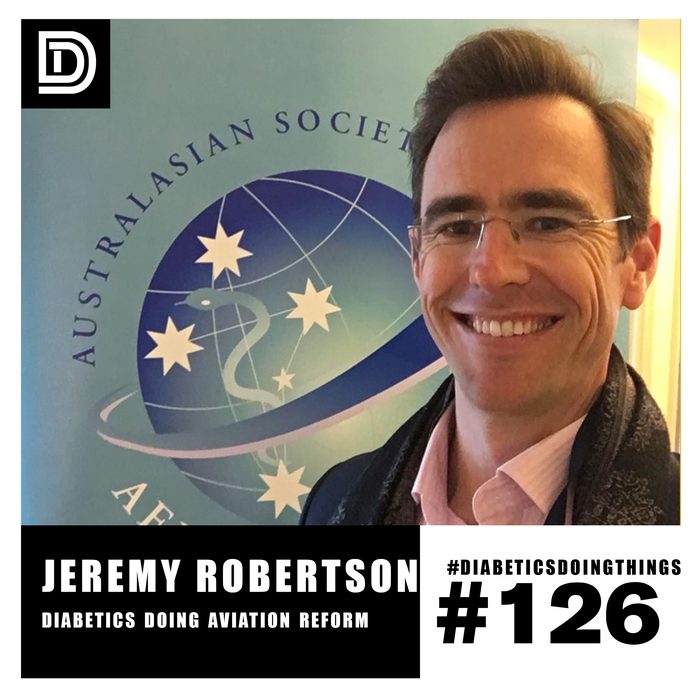
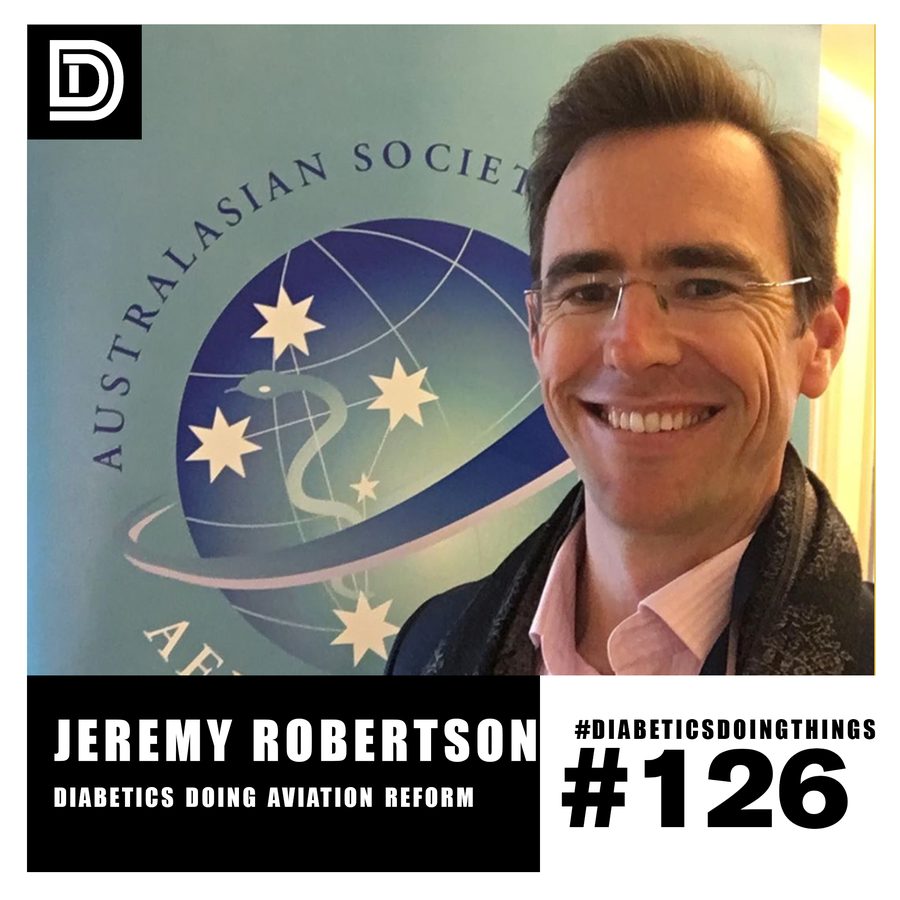
Jeremy Robertson is a commercial pilot who lost his medical certification when he was diagnosed with type 1 diabetes in his early 30s while training for Qantas Airlines. He later became an emergency medicine doctor and an aviation medical examiner in Australia, flying skydivers and traveling to remote towns to give pilots their medicals. Rob and Jeremy discuss the FAA's October 31, 2019 ruling allowing insulin-treated pilots to fly commercial jets in the United States, the incapacitation-risk framework aviation medicine uses, and how CGMs changed the calculation. Jeremy explains why the new protocol leaves pilots to manage blood sugar their own way, what the change means for type 2 pilots moving to insulin, and his own push to get the rule changed in Australia.
Key takeaways
- The FAA voted on October 31, 2019 to let insulin-treated pilots fly commercial jets in the US, reversing a decades-old ban.
- Jeremy says aviation medicine ranks conditions by incapacitation risk, and a clean class one medical generally requires under 1% risk per year.
- Jeremy says the new FAA protocol does not dictate in-flight treatment steps, trusting pilots to manage diabetes the way they normally do.
- Jeremy expects the rule to help more type 2 pilots than type 1 pilots, since it lets type 2 pilots move to insulin without ending their careers.
- Jeremy has logged over 750 flying hours with type 1 diabetes and submits a full year of blood sugar data for his own medical renewal in Australia.
Show notes
Last week, Oren Liebermann broke a story for CNN that the FAA is set to allow pilots with Diabetes to fly commercial jets so I asked my friend Jeremy Robertson, former commercial pilot and Av Med Doctor to come explain what it means for pilots with T1D around the world.
It’s just the beginning, but Jeremy believes this ruling by the FAA will set the standard for other aviation associations across the world. Check out the interview for more!!
This episode is sponsored by Companion Medical. If you are on multiple daily injections, but want the data and analytics pump users have available to them, then you need the In-Pen by Companion Medical. Learn more at Companion Medical’s website!
Questions this episode answers
When did the FAA allow pilots with type 1 diabetes to fly commercial jets?
On October 31, 2019, the FAA voted to let insulin-treated pilots hold a class one medical certificate and fly commercial jets in the United States, as Rob Howe explains in the episode intro.
How does aviation medicine decide if a pilot can fly with a medical condition?
Jeremy Robertson says authorities rate conditions by incapacitation risk per year. In Australia, a risk above 4% rules out any medical, 1-2% usually allows flying with a co-pilot, and under 1% allows an unrestricted class one medical.
Does the new FAA protocol tell diabetic pilots what to do if blood sugar drops in flight?
No. Jeremy says the protocol is noticeably silent on specific in-flight steps, trusting pilots to manage their diabetes the way they already do day to day.
Can a type 2 diabetic pilot who needs insulin still fly commercially?
Under the new US rule, yes. Jeremy says this change may end up helping more type 2 pilots than type 1 pilots, since it lets them move to insulin without losing their careers.
Full transcript Searchable, with timestamps
Rob Howe: Welcome to the Diabetics Doing Things podcast. We've been telling the amazing stories of type 1 diabetics all across the world since 2015, and we have over a thousand years of living with T1D on the podcast. The interviews range from incredible feats to everyday victories, and we celebrate them all just the same. Thanks for listening, and if you want to get involved even further, just send me an email at rob at diabeticsdoingthings.com. Hello, everyone. It's Rob Howe here. Welcome back. Now, you guys all know that I love all my episodes, and I often say so in these intros, but this one is especially, especially, I forgot how to talk, too many cups of coffee this morning, especially important to me because it's my good friend, Jeremy Robertson, who first appeared on this podcast in 2017 on episode 38, Diabetics Doing Aviation. Definitely one of my favorite interviews. I remember coming away from it just feeling like I was better off for having met this person and talking to this person. And Jeremy has since become a friend, stayed with me in 2018 with Erica and I here in Dallas coming to an aviation conference. And Jeremy is also one of my favorite stories. His story is one of my favorite stories to tell when I go speak at conferences during my talk, Tools of Type 1s. So if you're coming to see me at a conference in 2020, expect that you're going to hear more about Jeremy because he's just an awesome guy. So here's kind of where the worlds all come together. So last week, Oren Liebermann, who was also on the Diabetics Doing Things podcast, who was on episode 60. He's the CNN correspondent, and he's actually based in Jerusalem, but he is a recreational pilot as well. and he released a story on October 31st on Halloween that the FAA was going to allow pilots with diabetes to fly commercial jets. Now, up until this point in the U.S. and many other countries, getting type 1 diabetes as a commercial pilot would not let you qualify for your class 1 medical, which means you could not fly if you were insulin dependent. And last week, October 31st, 2019, the FAA voted to allow pilots with diabetes who are insulin dependent to fly commercial jets. That is incredible. So Jeremy joins the pod to talk a little bit about what he's been up to and also what this means for pilots with diabetes and how he feels about the FAA's ruling and if other governing bodies overseas, if he expects them to follow suit in the relatively new future. So, I hope you enjoy this conversation. Jeremy's one of my favorite people. He's super insightful and just one of my favorite, favorite, favorite people to interview and just be friends with. I'm so fortunate. So enjoy this conversation with Jeremy Robertson. Hello again, ladies and gents. Today I have a very cool diabetes sponsor I'd like to tell you about, Companion Medical. Specifically, the Companion Medical InPen. When I talk to people who use multiple daily injections to treat their diabetes, one of the things that often comes up is the lack of data they're able to see about dosing, daily insulin totals, etc. In fact, Companion Medical discovered that only 7% of people who use insulin are using insulin pump therapy to control their diabetes. So Companion Medical decided to bring pump benefits to insulin pen users with the InPen. The InPen is an FDA-cleared smart insulin pen and app that gives patients the tools to manage their multiple daily injections. The InPen is compatible with the Lilly and Novolog pre-filled insulin cartridges and single-use disposable needles. Those are not included with the InPen, but that is what is compatible with it. Using the information transmitted from the pen itself, the Companion Medical app can track insulin therapy, calculate doses, share data with your doctor and family right on your smartphone. The best part is the InPen is covered as a pharmacy benefit under most insurance plans. Currently, you pay no more than $35 for the in-pen with a special co-pay assistance program. So if you're on multiple daily injections or just thinking about taking a break from your pump therapy and don't want to lose all the features that come with using a pump, talk to your doctor about Companion Medical InPen and visit companionmedical.com for more information. Okay, so we are live. Welcome back to the Diabetics Doing Things podcast. I have an awesome, awesome guest today, one of my favorite people that I've met, and I'm putting you on the spot right now while we're on the air. Jeremy Robertson, who is from the first episode of Diabetics Doing Aviation that we did back in 2017. Seems like just yesterday, I remember recording it at my parents' house, which was uncharacteristic of most of the episodes. And then Jeremy, you came to visit Erica and I in 2018. Got to meet our little brood of animals that we have in Dallas. And then we have some really exciting news to cover today, which is rare for the podcast. But Jeremy, what's up, man? Are you tired of me hyping you up at JDRF events throughout the U.S. or what?
Jeremy Robertson: Well, I've just got big shoes to fill. I think if I'm lucky enough to meet any of those people, I hope I live up to the picture that you've built in their minds of me.
Rob Howe: Hey, no hyperbole, but I do. Hey, I just call it like I see it. And, you know, you're just you're one of my favorite folks, really. I mean that. So I'm excited to get you back on the pod. If that's a good excuse, if that's what it takes to to get you on the phone, that's that's a great excuse.
Jeremy Robertson: Absolutely. Well, I must say, I'm very excited to be here. I mean, it's always a pleasure talking to you and and staying with you guys and getting to bond with your cat last year was a real highlight.
Rob Howe: Well, Erica told me to tell you That we have new bedding in the guest room And that the cat, Michael Has not vomited on that bed Since you left So we got a good streak going
Jeremy Robertson: That's very uncharacteristic for a cat
Rob Howe: Yeah, just trying to make you feel welcome That's all it was So, obviously Give us a little bit of background Of what you've been up to I know that obviously you are practicing medicine, but you're also flying and flying some skydiving flights, if I'm not mistaken, throughout Australia.
Jeremy Robertson: Yeah, well, I think since I saw you at the beginning of last year, my main job has been working three days a week in the emergency department at one of my local hospitals. and so I'm an emergency medicine resident which is you know a very junior doctor in the scheme of things and you know the emergency medicine work is always interesting it runs at a pretty fast pace and the shift work is pretty rough but that's been a that's been a good test for my diabetes you know gives some some good data on showing that sleep deprivation various stress levels various activity levels etc you know i can still keep on top of it with the help of a good cgm um so that's definitely been one busy aspect of my life uh yes i still fly once a fortnight for one of the local skydive companies and for those of you that follow me on instagram that's uh the beautiful photographs of the lake macquarie area that's about an hour and a half north of sydney that's all the fantastic photos that come from that part of the world and that's just a great fun job so you know everyone at work is there to have fun and the people you meet the screams that come out of them never a dull moment so that's you know that's good fun that keeps my hand up with some flying and and the other thing that I think I've really picked up since I saw you last was I've started work as an aviation medical examiner and that kind of segues into what we're going to talk about today and that's pilots require a medical to maintain their pilot license and depending on what type of pilot license they hold that dictates how frequently they need to see a doctor and what I guess what depth that medical exam goes into so I qualified to do that here in Australia and I've been working in that I just set myself up a little business just a one-man band so I've been doing that on a regular basis and once a month I actually fly myself around four country towns in regional New South Wales because all those country towns have lots of pilots living there, but they don't have a local aviation medical examiner. So I kind of provide a fly-in, fly-out service for those pilots once a month. And that's fantastic because it sort of combines all my professional skills and knowledge, gets me out flying, gets me out of the big city which I love and yeah it gets me meeting a whole bunch of interesting people so that's you know that's been my professional life for the last 18 months and life at home carries on you know two little kids are growing up fast they're five and eight and my wife yeah she works like me she works multiple jobs part-time so we're always juggling work and children and family life and that sort of thing. But no, on the whole, life is interesting and varied and going well.
Rob Howe: Well, I love to hear that. And I also, you know, when I give my talks at JDRF events or, you know, other summits throughout the country, you're one of the people that I highlight, mostly because I love your story. And it's so cool that you're getting to use your two professions and your two passions, obviously practicing medicine and flying, and then also able to do good for some country pilots who, you know, don't have anybody to, you know, do their medical.
Jeremy Robertson: Yeah, it's, I mean, it really is a win-win. There's no bad thing about it. It's great fun.
Rob Howe: Gotta love it. So, all right, I guess we can kind of get to the matter at hand here. our mutual friend, Oren Liebermann, who has been on the podcast. I believe he may have referenced that he, you know, enjoyed flying in his spare time, but I did not classify him among the type 1 diabetic pilots that I knew until this week. But he broke the story for CNN that the FAA, Federal Aviation Association, is set to allow pilots with insulin-treated diabetes. So we'll make that distinction is type 1 and type 2 just insulin treated to fly commercial airliners
Jeremy Robertson: which is a huge deal it is um you know there have been a large number of pilots in the u.s that have been pushing for this change for years and i guess the background to this is that um 20 years ago anywhere in the world any type of uh diabetes that required insulin therapy meant that you were unable to hold any level of aviation medical. So that precluded you from private flying and commercial flying. And in the late 90s, that changed in, I guess, it was all about the same thing. Late 90s through to the early noughties, changes started to happen in Canada, in the US and in the UK. Canada was actually the first country to allow insulin treated pilots back into a commercial flight deck And that's been happening for almost 15 years now If not longer actually The UK followed suit with that six or seven years ago and Australia and the US have allowed private flying for pilots requiring insulin treatment. So it's been gradually changing, but the big news is the US has published a new protocol which allows insulin treated pilots, as you say, back into the cockpit of commercial jets. So the and that's class one certification really is the language and And it's really exciting. It's I mean you and I know that the rate of change in the technology around the management of diabetes Has been phenomenal in the last decade. I love your phrase the T1D Renaissance And what the FAA is that's the the Federal Aviation Administration, which is the US government body that makes the rules for anything to do with flying what they've recognized is that with cgm use that diabetes can be managed to a point where your incapacitation risk is low enough that it meets the standard required for commercial flying and i guess i should probably talk about aviation medicine a little bit and and the reason why insulin treatment has never been allowed in the past. Yeah, absolutely. Really, aviation medicine just, it boils down to incapacitation risk. You know, you don't want your pilots to become incapacitated. That's kind of common sense. I guess I've never thought of
Rob Howe: it that way, but yes, that's what I want from every flight I've ever been on. Yeah, that's right.
Jeremy Robertson: And it's, you know, you can't make an absolute rule. Pilots will become incapacitated. You know, it's humans. Things break. People fail. But, you know, the only way to make the risk absolute is to not have people in the cockpit. And that doesn't work yet. I mean, maybe one day, but not at the moment. So with any medical condition, what aviation medical authorities are looking for is that the risk of incapacitation is low enough that it meets an acceptable threshold. Some countries will actually look at specific percentages. Others look for specific medical literature on various conditions. I'll speak about Australia because they usually quantify the risk. and if you have a medical condition, and that's any medical condition that has more than a 4% per annum risk of incapacitation, generally you won't be able to hold any form of aviation medical, be it for private flying or commercial flying. If your risk falls in the 2% to 4% per annum band, you'll probably be able to hold a medical certificate that allows you to fly privately, but they may put a condition on it like they may want you to fly with another pilot if your medical condition has a you know a one to two percent per annum risk of incapacitation generally you'll be able to get a commercial level or a class one medical but again it'll probably be restricted to flying with another pilot like in most big airlines there's always two pilots and if you want to have a you know a clean class one with no restrictions on it you generally need to have a medical condition with a less than 1% per annum risk of incapacitation. So that's how it works in Australia, and that's broadly applicable to most countries around the world.
Rob Howe: So when we're talking about percentages and the associative chronic conditions or medical conditions associated with losing consciousness or being incapacitated, what are the most common I suppose that you would see in pilots?
Jeremy Robertson: Well I mean pilots mirror the general population. Sure, sure.
Rob Howe: When you're doing airline medicals I suppose.
Jeremy Robertson: Yeah, the things that get screened for very closely are cardiac risk, so the risk of heart attack. So pilots who have their annual medicals, I looked at very closely from a cholesterol, a weight, and ECG or EKG point of view to try and quantify what their cardiac risk is. And above a certain age, your risk increases with age. So as pilots get older, they get looked at more closely. So that's one example of things that I looked at closely. but in my work as an aviation medical examiner, one of the things I love about it is you see everything. And it's very interesting to see how the authorities manage the risk associated with just about any medical condition. And I know that when I'm in capacitation, everyone thinks straight away of a pilot passing out or dying at the controls. but incapacitation can be anything that means that you can't function at your optimum. And an excellent example with diabetes is, you know, you and I know that when our blood sugar level is a little bit low, we start to get irritated, we start to have difficulty focusing, you know, mentally focusing, but we're not unconscious. So that's a form of subtle incapacitation. so that that's the type of incapacitation that needs to be uh considered when you be thinking about any medical condition not just the you know the overt incapacitation
Rob Howe: certainly so and i think many you know people who are behind the wheel of a car for example would identify with you know sweaty palms uh you know feeling a little bit drowsy irritated you know inability to focus feeling a little bit of that sort of vertigo I guess is a is a good way to describe it so obviously like when you're flying that that can be that partial incapacitation I suppose clearly like puts you at you and the crew and passengers potentially at risk so they want to mitigate that and I think I'm quoting the the FAA statement in the in Oren's article where They said advancement in technology and diabetes medical science have allowed the FAA to develop an evidence-based protocol on the risks associated with people with diabetes flying. And then I also, just kind of reading some articles, the FAA, I suppose, lists instructions on how to deal with diabetic episodes in flight. So they have protocols on what to do. In some cases, I saw even recommending what kind of candy to treat your blood sugar with. Does that sound familiar to you?
Jeremy Robertson: Yeah, it's interesting looking at the new protocol versus the one that's been in practice for the last few years. Because it's only been for private flying, yeah, they make recommendations about what to do in flight. but the new protocol is actually it's noticeably absent that they tell you what to do in flight and I think that's one of the things I like about it is that the the thrust of it is that if you can jump through all the hoops to get certified we feel that the day-to-day way that you manage your diabetes means that your risk is low enough that you just keep doing what you're doing and do it while you're flying an airplane. So they don't actually specify what to do in certain scenarios if your blood sugar level is too high or too low or what candy you should eat. Whereas previously they did do that and in contrast to here in Australia the protocol that I fly under is very prescriptive. It provides very clear instructions about what I need to do should my blood sugar level be above or below a certain threshold. And, you know, there are aspects to that that I disagree with because it's not how I would manage my diabetes normally. So, and again, as diabetics, we know that we are more stable if we do things the same way or the way that we're used to. You know, that makes our diabetes more predictable. So that's a change in this current protocol that I'm very pleased with.
Rob Howe: So for you, give me your response. I think this was for, and this is just my own understanding and I think like observation from afar, but it seemed like this announcement and change, especially the speed of it, was a big surprise to the community. so what was your response when you heard the news?
Jeremy Robertson: I was ecstatic I guess it's a huge step forward for a body as aviation medicine is notoriously conservative so for a country the size of the US for their authority to feel that this is appropriate is a fantastic step forward and hopefully it serves to lead the rest of the world in this area.
Rob Howe: And that's fairly typical of the FAA. I'm sorry to interrupt you. That's fairly typical of the FAA governing body in the U.S. to sort of become the standard statute of limitations, I suppose, or the standard of care by which the other associations eventually adopt the protocols?
Jeremy Robertson: Sometimes yes, sometimes no. The US does do some things differently in aviation medicine to the rest of the world. But generally, most, all countries are generally signatory to one of the UN bodies that governs aviation. And they have a standard. But each individual nation is allowed to have variations. variations. So yeah previously the UK and Canada have had variations from the international standard and now the FAA has a variation from the international standard. So it will be interesting to see if this drives a change to the international standard because the three countries actually their protocols are very different. So it would be nice to see some unified change eventually. and I think the US is a big country when it comes to aviation so they do get listened to so hopefully yes it makes some change internationally. But going back to your previous question about the speed of it I think yes it was a surprise how quickly it got from the FAA through the Department of Transport upper echelons are meant to be released. But it's been a work in progress with the FAA for many, many years. You know, the initial indications from the FAA that they would be making a change in this area, I think, came over five or six years ago. And there have been a lot of pilots that have been very frustrated about the lack of progress in this area. So, yeah, there was a large number of people have been very happy about the change, feeling that it's long overdue.
Rob Howe: I'm proud to introduce Companion Medical as a sponsor of this podcast, and I have just a few questions for you. Are you on a regimen of multiple daily injections, but want to automatically record and store insulin doses? Keep track of active insulin? Calculate mealtime and correction doses? Get reminders about dosing? Have robust reporting you can share with your doctor or family? Integrate your CGM data via an app? then you need the InPen from Companion Medical. The InPen is available in the United States and is covered as a pharmacy benefit under most insurance plans. Currently, you pay no more than $35 for InPen with a special co-pay assistance program. The InPen is only available through a prescription, so be sure to talk to your doctor. Or for more information, visit companionmedical.com. Okay, let's get back to the episode. Well, and I know you had mentioned kind of before we got on the air, like some of the Facebook groups of other type 1 diabetic pilots that you're in, you know, give us a sense of the sentiment around, because, you know, there are organizations like Pilots with Diabetes, for example, who have been really vocal in advocating for type 1 diabetic pilots to get their wings back. Seeing this type of news, give us a sense of what that was like within that small, you know, very tight-knit community of T1D pilots.
Jeremy Robertson: Oh, you know, quotes like, oh, I must be dreaming. Or, you know, I've just woken up to this news. Is this real? This is, you know, this is incredible. You know, Instagram posts of pilots that have been not flying for over a decade with their, you know, their current study notes up saying, yeah, I'm getting back into it. It's, yeah, it's amazing. It's really amazing. This is one of those life-changing events for this very niche community of pilots requiring insulin.
Rob Howe: Well, and for you, and I apologize if I put you on the spot with this, but it's an understatement to say that your life changed from the time you were in your early 30s, diagnosed with Type 1, flying commercially for Qantas Airlines. Your life took a drastic turn, and that's an understatement. And so now... Absolutely.
Jeremy Robertson: Yeah, I mean, reliving it, it was... Yeah, my diagnosis story, I was actually in Los Angeles. I was in Riverside when I was diagnosed over there doing a training course. And yeah, I knew that my entire professional life had just stopped. You know, everything I'd worked for since the age of 15 and everything I'd achieved had just stopped. And, yeah, I had no idea. You know, it's just everything. Everything's thrown into uncertainty. And I can only imagine that that is an identical experience for any of the pilots in the U.S. that had the same thing happen. if they were diagnosed while they were established in their career. And I guess there's two distinct groups that this change benefits. There's those that were kicked out of their flying career because of type 1 diabetes. And there are those that have always wanted to fly, people that are born with a passion for flying who have type 1 diabetes, for whom it's never been an option to even get into their career. both those groups of people this is a life changing real change
Rob Howe: well and I know this is obviously like you know clearly important to you and I think that's when I give my talks I try to try to put people in the shoes of the person who's always dreamt of being a pilot who has a passion for aviation and then to be told that that can no longer be a part of their life at the scale that they wanted it to be, or in your case, like your career. And now, not only for, you know, people like you who will be diagnosed after their pilots in the future, and for people who are diagnosed young and have a passion to be pilots, for that prognosis of their, you know, dreams to be changed, I think the, obviously the ripple effects from that are very drastic. um yeah for you though i and i think i may be misquoting you or i may be uh paraphrasing that's all right but from a conversation that we've had sometime in the past i remember you saying you know you at least had some hope of of being back in the cockpit again on a commercial fight is that does this kind of uh allow you to see that as a possibility it does it it i've always
Jeremy Robertson: seen it as a long-term possibility just just watching the technology change and the management change going on with diabetes i could see a point in the future where it just becomes so manageable that the the incapacitation risk becomes managed away almost entirely so that it becomes part of the background noise of your incapacitation risk from any medical condition um so i've always known it was i've always felt strongly that it was going to happen but this announcement certainly brings the time frame much closer in my mind. So for me personally, you know, I live in Australia so I don't hold an American pilot's licence and, you know, the FAA change doesn't apply here in Australia. So right now the only way that it would serve me any benefit is if I came over to the US, converted my air transport pilot license to an American air transport pilot license, got myself a FAA class one medical, and then that would allow me to fly commercially any airplane that is registered in the US. So for those aircraft spotters out there, you know that those little numbers and letters painted on the back of the airplane. In America, they always start with the letter N. That's the national code for the US. And there are a number of business jet operators that keep their airplanes registered in the U.S. but base them in other countries around the world. And there are some based here in Australia. So that would allow me to fly in a commercial sense again. But that's a pretty big change to make to my professional and personal life at the moment.
Rob Howe: Sure. Or maybe not in the plan for now.
Jeremy Robertson: Yeah. I mean, I have to have a serious think about what I'm going to do going forward. But obviously, this is a change that I am also advocating strongly for here in Australia. And whether this change in the U.S. impacts the rate of change here in Australia, I don't know yet. But if it does, being able to get my class one medical back in Australia with my Australian pilot license certainly opens up more options to me. And then I've got some big decisions to make about what I do with my life.
Rob Howe: No kidding. Not the least of which is like what do you do with your medical schooling that you've spent the last part of your life enduring and excelling at?
Jeremy Robertson: setting up this new career what do i do with that you know i can't walk away from that sure
Rob Howe: well i'll make you a i'll make you a deal uh if you decide when this legislation takes place in australia and if you decide to do another flight another commercial flight i will buy a ticket on that flight guaranteed so whatever part of the world that it's in just let me know and I'm on it. I will let you know. So that's just a, you know, uh, that's a, those are bold words from a guy sitting in a hotel room in Minnesota right now. But, uh, that, uh, that's something that, uh, you know, I, I would want to celebrate with you if that time ever comes.
Jeremy Robertson: Yeah, no, that'd be fantastic to have you on board. That'd be my pleasure.
Rob Howe: Uh, speaking of on board. So, um, the, the type 1 diabetes pilot community is one of my favorites. I think it's small, but you guys are mighty, and also you just love flying. I recently got to take a flight with Jerry Brzezowski from Dallas to Houston and back, and I know you've also been in that seat.
Jeremy Robertson: Yeah, Jerry was very, very kind enough to fly me from Austin back to Dallas early last year, and that was just an absolute highlight of that trip. So, yeah, a big shout-out to Dr. Jerry for making that happen. That was fantastic fun.
Rob Howe: And I think for me, just going through that pre-flight checklist and then seeing how the blood sugar checks and the CGM checks work into that, it was cool to be a part of. And also, when you're flying in those small planes, it's just you and then the plane and then the sky. It was a totally different aviation experience.
Jeremy Robertson: Yeah, it's not like you're in a big building that's moving through the air. You're actually, it's a much more visceral experience in a light aircraft. So, yeah, it's fantastic fun.
Rob Howe: And it was good. I got to fly both ways with a plane full of people with diabetes. So that was a really cool experience. And so I got a little taste of how you guys get the aviation bug. You mentioned that you are advocating in Australia for similar legislation change, I guess I would call it policy change. for people who you know want more information on that or or want to get involved somehow what what are the resources that you can point them to or you know what can you tell us about the
Jeremy Robertson: conversations that you're having well i guess uh the conversations that i'm having here in australia at the moment um so unfortunately the the civil aviation safety authority here in australia that's our equivalent of the FAA, their medical department has undergone a huge turnover of staff in the last 12 months. So they just haven't had the capacity to do anything other than their core business, which is processing the medical renewals. So 12 to 18 months ago, I was receiving some moderately positive feedback about the change that I was proposing. But all that just grew to a halt unfortunately um they're now back at full staffing strength and i'm due to submit my annual medical renewal in january so i'm just going to start the conversation again and we will see where we go but in the meantime you know that that delay i guess i mean number one it's allowed the faa to release their protocol which is fantastic but number two here in australia it's allowed me to get in touch with the Australian Diabetes Association, who are working on a position paper on any safety-critical occupation and how diabetes can be managed in that. So that position paper will have a section on aviation, and hopefully that will be released in the next few months. And that's a pretty powerful recommendation to have when you're requesting any change. Because the endocrinologists that I've been talking to in the association are fairly clearly of the viewpoint that hypoglycemia risk can absolutely be managed with a CGM and definitely with the newer generation insulin pumps. So that's been one positive that's come out of the last 12 months. And it's allowed me to gather another 12 months of my own data. As part of my submission for my annual renewal for my private license, I have to actually submit every single blood sugar level reading for my entire year, not just while I'm flying, all day, every day, as well as my data whilst I've been flying. So since I started flying again, I think I've clocked over 750 flying hours with type 1 diabetes So that's you know, that's starting to get to be a very useful data pool to support You know my personal case So and as far as getting in touch You know my people can always find me through Instagram. That's probably the best one type 1 pilot There's actually there's a bunch of type 1 pilots on Instagram. Yeah, it's fantastic but I'm the one that's in Australia so that's how you'll differentiate me from the others and I'm always happy to talk to pilots with diabetes so if anyone's got any questions please get in touch and actually I just want to go back in the conversation a little bit when we were talking about the groups of people that are going to benefit from this kind of rule change
Rob Howe: of course
Jeremy Robertson: and you know one of your fantastic posts recently was about you know all kinds of diabetics uh you know looking out for each other doesn't doesn't know what type of diabetes you've got so you know you and i everyone knows that type 1 diabetics we're kind of a minority group in diabetes we often stand in the shadow of type 2 diabetes and pilots with type 1 diabetes again are a very very niche subset of that and as I was saying earlier, pilots tend to mimic the general population with the prevalent health problems. Type 2 diabetes is on the rise in the pilot population and at the moment, the way you treat type 2 diabetes, initially lifestyle changes, then moving on to oral tablets and then eventually progressing to insulin if those two previous treatment regimes don't work. So for the professional pilots out there, progression to insulin isn't an option because that would end their career. And this rule change in the States means that that's no longer the case. So what that means is there are a subset of type 2 diabetic pilots out there who are probably pushing the limits of how effectively they can manage their disease without insulin. who can now receive insulin treatment or receive insulin treatment earlier, which is going to better manage their disease and hopefully keep them healthier and give them a longer flying career. And my gut feeling is that this rule change is actually going to benefit more type 2 pilots than type 1 pilots, even though it's the type 1 pilots out there that have been making the noise and advocating for the change, simply because of the numbers.
Rob Howe: well like you mentioned it's got to be better for their long-term health outcomes
Jeremy Robertson: yeah absolutely absolutely so and that's it's going to be interesting getting this change you know the news of this change out to that group of pilots um because they're not they're not generally uh linked in with the pilots with diabetes groups because generally it's the type ones. So I think that's, you know, the rule change is going to have to be advertised some other way to get, you know, get publicized to that group of pilots. You know, you bring up a good point,
Rob Howe: kind of reaching the, what I call them, like the silent majority of people with diabetes. And it applies in a sense to type ones as well. I think there's, you know, a very active, very informed, very engaged group on Instagram that maybe makes up a hundred thousand people worldwide. Yeah. And, you know, you look at the numbers and that's significantly lower than the total number of people. Absolutely. And then, you know, on the type 2 side, I think it's even more of a gap between the people who are involved on social media versus the people who are not. And I thought, you know, when this, this news was released on CNN, which, you know, obviously a major worldwide media outlet from a person with diabetes in Oren Liebermann. And I thought, you know, what a great announcement, A. But then also what a great way for diabetes in general to be featured on a major news outlet. In a way that it's typically, that's not a story you hear very often.
Jeremy Robertson: Yeah, there's very rarely good news stories when it comes to diabetes of any form. It's usually the doom and gloom, the diabetes epidemic, et cetera, et cetera. So, yeah, I agree. Fantastic, fantastic, positive news. I forwarded that article to my wife, and she asked me what on earth the Jerusalem correspondent for CNN was doing, writing about flying and diabetes, until I pointed out that, yeah, Oren's a private pilot with type 1 diabetes.
Rob Howe: Yeah, it's kind of like right in his wheelhouse.
Jeremy Robertson: Totally.
Rob Howe: Well, Jeremy, man, it's great to talk to you again. Of course. You come on the podcast and you just hit home run after home run with soundbite after soundbite. So thank you so much for coming on. Any parting thoughts or, you know, things that we should be on the lookout for or things that you got coming up that we should know
Jeremy Robertson: about um no i don't really have any huge exciting plans at the moment uh there's always i'm always plotting and scheming to do interesting types of flights to promote the fact that you know type 1 diabetes is not uh an impediment to me flying safely um but but yeah no no real massive announcements. I mean, World Diabetes Day is only a few days away, so I'll be taking some friends up over Sydney for a scenic flight. So yeah, trying to get a plane load of people with type 1 diabetes to go for a scenic flight, because that's always fun. How fun is that? Yeah, it's great fun, because I love sharing flying with anyone, but in particular, fellow type 1s, it's extra special. So that's probably the most exciting immediate thing that I've got going on in that space. But then otherwise, yeah, it's just chipping away at getting the rules changed here in Australia. And if and when that happens, I will – well, I promised Oren that I'd give him the scoop on that. But I'll certainly be letting you know as well.
Rob Howe: Well, I appreciate that. And if it's another excuse to get you back on the podcast, I'll take it.
Jeremy Robertson: Absolutely. I'm always happy to be back. and I'm always happy to watch my Instagram go berserk when you mention me at a presentation.
Rob Howe: Well, this won't release until after my next talk, but I just hope you get 10, 15 new followers or so every time that I plug you in my presentation because it's a great story and obviously you're a great friend and I'm happy to do it. You make me look good by telling your story, so I very much appreciate it.
Jeremy Robertson: yeah it's always the timing always works out that you you must be speaking sort of in the wee small hours of the morning here in australia because i wake up and uh you know my phone i can see all the notifications that have come in and people sending me messages and stuff and it's yeah it's always fantastic to connect with other people with type 1 diabetes over there and you know have quick conversations with them and uh yeah it's it's the wonderful thing about social media just that connectedness we have for this funny, obscure disease that can otherwise be so isolating. It's a wonderful thing.
Rob Howe: It's a great way. It's a great excuse to get together with friends online. And for the first time, you mentioned the time difference. I was on the West Coast of the U.S. And normally I speak in sort of the mid-morning hours at Type 1 Nation events. This one was more in the afternoon. So West Coast combined with afternoon. so the first person you know I made a joke about you always message me when I'm giving these talks and joke about how people are following you and someone from the crowd was like hey Jeremy says hello so that made my day that was super funny I was glad we were able to make that happen in real time
Jeremy Robertson: yeah me too that's fantastic
Rob Howe: alright my friend well hello to your family and thanks so much and I can't wait to see get you back on the pod when Australia follows the FAA's lead and gets those type 1 diabetes pilots or insulin dependent pilots back on their class 1 medical.
Jeremy Robertson: Indeed. Fantastic, as always, to talk to you. And I will definitely let you know.
Rob Howe: I have a lot of really great stuff coming up in the future. So I'm going to do something that I haven't asked before. Or if you're listening to this podcast, A, I would love it if you would subscribe to the podcast just so you get the notifications whenever we publish new episodes. Because if you've been listening for a while, you know I don't always publish them consistently. Sometimes I'll publish five in a week. Sometimes it'll be only a couple in a month. And you need to know when these episodes drop. So be sure to subscribe. And if you like the podcast, be sure to go to your preferred platform like iTunes and leave a review. I would love to boost my reviews and I've never asked you guys to do that before. So I figured you don't ASK, you don't G-E-T. I would love a review from you. So I want to hear from you there. Also, we are now available on Spotify. Turns out I was just submitting it to Spotify incorrectly, but I corrected that. So now we're on Spotify. So if that's your preferred listening platform, be sure to subscribe on there. Also, just want to let you know that in 2019, we have an awesome new program coming called Tools of Type 1s. It's going to be on this podcast, so you don't have to subscribe anywhere new, but it's going to be an entirely new form of programming with some of your favorite type 1 personalities. So they're going to be two a week starting January 8th. Be sure to tune in and I'm going to blast all the messaging I can all around. So be sure to listen to Tools of Type Ones launching January 8th. And thank you for continuing to listen to this podcast.
About Jeremy
Jeremy Robertson is an Australian emergency medicine doctor, skydive pilot, and aviation medical examiner who was diagnosed with type 1 diabetes while training as a commercial pilot for Qantas. He first appeared on the podcast in 2017 on episode 38.