

Episode summary
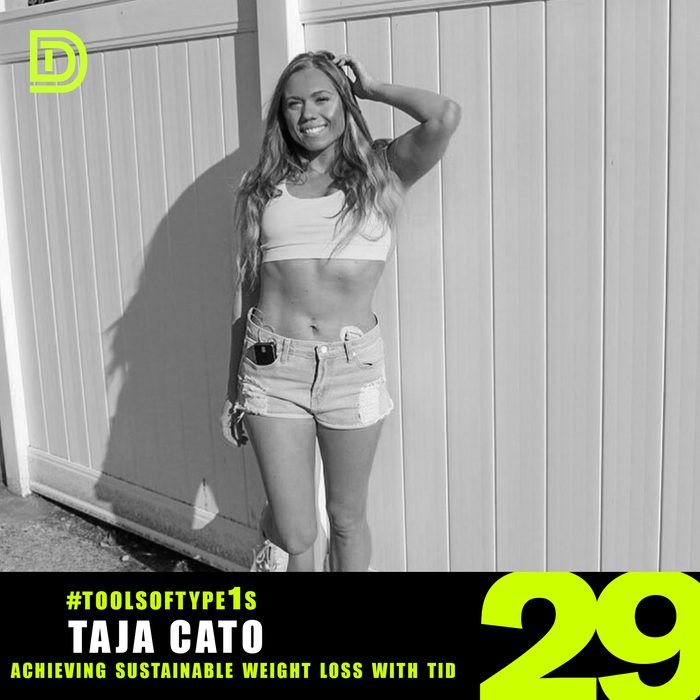
Taja Cato, a type 1 diabetic fitness and fat loss coach in Los Angeles, was diagnosed at age 9 in 1999 and spent years struggling with body image, a juice cleanse gone wrong, and an eating disorder that sent her blood sugar out of control. She describes how she rebuilt her health through macro counting instead of fad diets, how strength training improved her insulin sensitivity, and how she finally got a Dexcom CGM after a year of hesitation. She also pushes back on the idea that insulin causes weight gain, talks about dating with low blood sugar fears, and shares how she built a coaching business and podcast around fitness for people with type 1 diabetes.
Key takeaways
- Cato manages her weight by counting macros and tracking a caloric deficit rather than following a specific diet like keto or low carb.
- She says insulin itself does not cause weight gain, and that weight gain comes down to eating in a caloric surplus.
- Progressive strength training made her more insulin sensitive, she says, as she built muscle and got leaner.
- She let her first Dexcom prescription sit at the pharmacy for a year before she felt confident enough to wear it.
- An extended juice cleanse in her 20s wrecked her metabolism and blood sugar and led to an eating disorder before she found stability.
Show notes
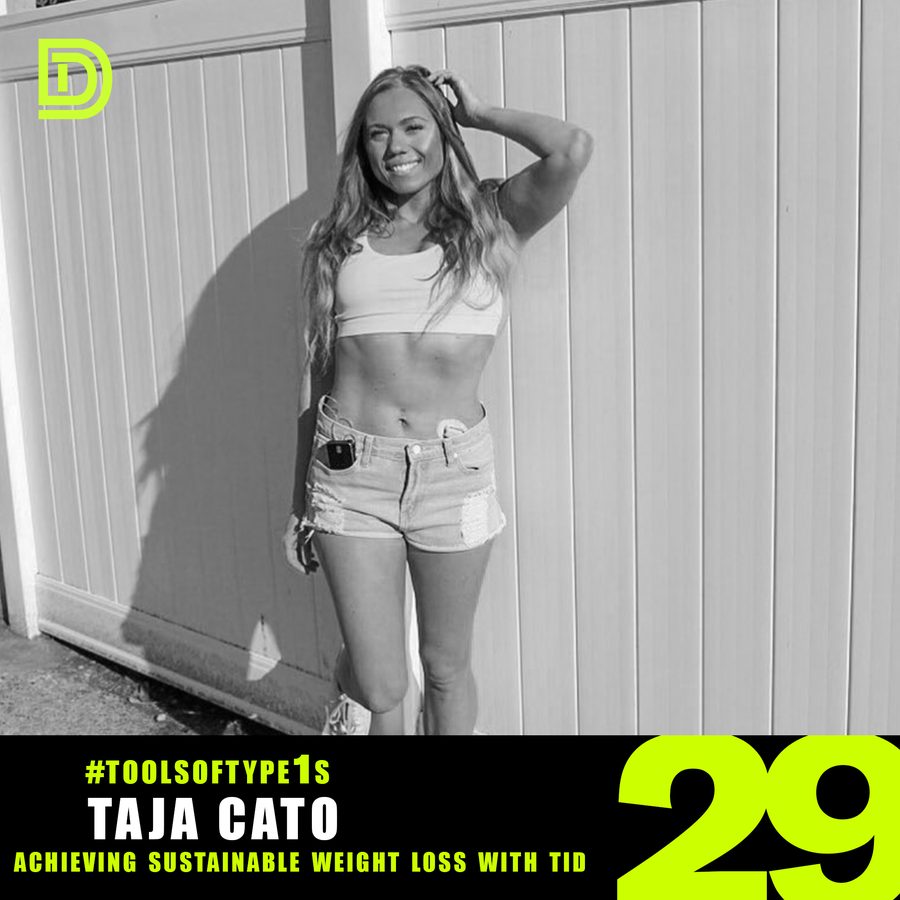
Name: Taja Cato
Hometown: Los Angeles, CA
Date of Diagnosis: 7/11/1999
Tool: How to achieve sustainable weight loss with Type 1 Diabetes
Diabetes Devices/Treatment Methods: Dexcom G6 & Tandem T-Slim
This episode is sponsored by Companion Medical. If you are on multiple daily injections, but want the data and analytics pump users have available to them, then you need the In-Pen by Companion Medical. Learn more at Companion Medical’s website!
Questions this episode answers
Does insulin cause weight gain, according to Taja Cato?
Cato says no. She argues that weight gain comes from eating in a caloric surplus, not from the insulin itself, and that an active person in a caloric deficit will lose weight regardless of how much insulin they take.
How does Taja Cato approach weight loss with type 1 diabetes?
She counts macros (protein, fat, and carbs) and focuses on hitting a caloric deficit rather than following a fixed diet plan, saying this gave her more flexibility and less fear around food.
What diabetes devices does Taja Cato use?
She uses a Dexcom G6 continuous glucose monitor and a Tandem t:slim insulin pump.
Why did Taja Cato wait so long to start using a CGM?
She says she was self-conscious about wearing a visible diabetes device on her body, so her first Dexcom prescription sat unfilled at the pharmacy for a year before she started using it.
Full transcript Searchable, with timestamps
Rob Howe: Tools of Type 1s Podcast. This is episode 29. It's me, it's Rob. We're back with Tools of Type 1s. I told you we would. There's a few episodes left. This project started at the end of 2018 and we're stretching it out as far as we can in 2019 due to my lack of discipline. Our guest today, episode 29, Taja Cato. She's a type 1 diabetic fat loss and fitness coach. You can find her on Instagram at Taja Cato. She also is a podcast host on the More Than Just a Type podcast, which I'm glad that we're publishing this now because I don't think her podcast had come out when we originally did these interviews. So really excited to promote that. Definitely check it out. It's got great reviews on iTunes. And in each of the short episodes, you can actually get one actionable tip to help you on your diabetic fitness journey. So I'll leave it to Taja Cato. Hello again, ladies and gents. Today I have a very cool diabetes sponsor I'd like to tell you about, Companion Medical, specifically the Companion Medical InPen. When I talk to people who use multiple daily injections to treat their diabetes, one of the things that often comes up is the lack of data they're able to see about dosing, daily insulin totals, etc. In fact, Companion Medical discovered that only 7% of people who use insulin are using insulin pump therapy to control their diabetes. So Companion Medical decided to bring pump benefits to insulin pen users with the InPen. The InPen is an FDA-cleared smart insulin pen and app that gives patients the tools to manage their multiple daily injections. The InPen is compatible with the Lilly and Novolog pre-filled insulin cartridges and single-use disposable needles. Those are not included with the InPen, but that is what is compatible with it. Using the information transmitted from the pen itself, the Companion Medical app can track insulin therapy, calculate doses, share data with your doctor and family right on your smartphone. The best part is the InPen is covered as a pharmacy benefit under most insurance plans. Currently, you pay no more than $35 for the InPen with a special co-pay assistance program. So if you're on multiple daily injections or just thinking about taking a break from your pump therapy and don't want to lose all the features that come with using a pump, talk to your doctor about Companion Medical InPen and visit companionmedical.com for more information.
Taja Cato: My name is Taja Cato and I am originally from Vancouver Island, British Columbia, Canada. I drove to LA when I was 24 years old. I packed up my little car and moved here solo, didn't know a soul, and I have been living here ever since. I've had type 1 diabetes for 19 years, and I think it was in July of 1999 that I was first diagnosed when I was 9 years old. I am a health and fitness coach, and I help other women with type 1 diabetes lose weight with type 1. growing up I struggled with my weight a lot and people would tell me a lot of the time that I would never be fit because I had type 1 diabetes and so I really struggled with body image and just how I felt about myself and a few years ago when I first moved to California after struggling with eating disorders I dedicated my time into bettering my health and my fitness and I became an expert in macronutrition and fitness so I am dedicated to helping other women with type 1 diabetes achieve their fitness goals and feel confident again through their diet and their health and just making it fit their lifestyle.
Rob Howe: What is your tool of type 1s and what's the one thing that a person living with T1D could learn from you or your experience?
Taja Cato: My tool of type 1 is how to achieve sustainable weight loss with type 1 diabetes. There are so many different diets out there and so much information within the fitness industry that it can be difficult to know where to even start and how to apply it being type 1 diabetic. And the one tip that I could say, I know like when I first started my fitness journey, I was beyond overwhelmed. And I think the most important thing is just to never mind the fad diets. Don't even worry about low carb or keto. Just find what works for you. Don't copy what anyone else is doing. We're all so different and there's not one set diet that works for one person. So what works for you might not work for me. And it's just about taking all the information and finding balance within your own life and learning how to apply it to fit your lifestyle. And at the end of the day, it doesn't matter what diet you do. There's no good or bad foods when it comes to weight loss. It comes down to the amount of calories that you're consuming each day. So you really need to figure out how many calories your body needs, which is so individual because it depends, first of all, how much you weigh, what your activity level is. And then when it comes to dieting, the foods that you eat each day to keep your blood sugar stable are going to be completely different than someone who even weighs the same amount as you do. And this is why I love counting my macros because once you know how much protein, fats, and carbs your body needs each day, then you're able to maintain a caloric deficit and lose weight so much easier and it allows you to be more flexible with your diet, which coming from me, like I used to be so afraid of food because I felt like no matter what I ate, my blood sugar would be crazy and I was gaining weight. I felt like nothing worked. So counting my macros kind of gave me more flexibility and more freedom with my food so that I no longer had to be afraid of my food anymore. Now, there's so many tips that I want to give you right now to help you lose weight. But let me just start super simple because I don't want to overwhelm you. So the first step that you want to do right now in order to lose weight with type 1 diabetes is screw the diet. Don't even worry about the diet. Figure out how many calories your body needs each day to be in a caloric deficit. And that's what you need to focus on. That's the most important step. And that is going to help you lose weight.
Rob Howe: What is the simplest thing you've done that has helped you with the management of your type 1 diabetes? Where did you learn it? Or who showed it to you?
Taja Cato: the simplest thing that has helped me with the management of my type 1 diabetes is diet and exercise but I want to dive a little bit deeper into that so for my diet the one thing that has helped me out a ton is being more mindful of my calories each day and how much food I actually am consuming and number two is when it comes to exercise it's not just exercising it's following a progressive strength training program where I'm progressively growing stronger because the more muscle you have and the leaner you are, the more insulin sensitive you become. The other thing that I have to include that has helped me so much with the management of my diabetes is getting a Dexcom. I was on the fence for so long. In fact, when I first ordered my Dexcom, it sat at the pharmacy for a year before I even picked it up. I just did not have the confidence to wear a diabetes gadget on my body. But listen, I'm so happy I made the decision to get one because it has helped me so much in controlling my blood sugars, especially around my workout. So that has been a lifesaver for sure. A lot of the information that I've learned that has helped me has been a lot of trial and error. Let me tell you, I've taken all of the information that I've learned within the fitness industry and from other fitness professionals and just spent a lot of time trying to learn how to apply it to fit my lifestyle and keep my blood sugar stable and finally achieve my fitness goals. I knew that getting a CGM was going to help me a lot with getting to the next level of my fitness, just fine tuning my blood sugars. So that's what made me finally feel ready to get a Dexcom. And if it wasn't for my diabetes educator, her name's Helen. She lives in California. I wish I could remember her last name right now, but she's an angel and she really helped me, um, finally feel ready and confident to make that step.
Rob Howe: What failures or apparent failures with T1D have made you better at living the rest of your life or made you more well-rounded as a person?
Taja Cato: I love that this question states in brackets or apparent failures because I really feel like even though it felt like a big fail at the time, I think it's what propelled me forward into taking control of my life and my health and just achieving my fitness goals and becoming a better version of myself. So at the time, I, like for my whole entire life, basically, I struggled with body image. I remember looking in the mirror and literally hating my body. And hate's a very strong word, I never use it, but I hated my body. I was so unhappy with how I looked and I just didn't feel confident and I did not feel comfortable in my skin at all. So I was living in LA, I was 24 years old and my roommate at the time was like, hey, let's try a juice cleanse. So long story short, I did a juice cleanse that lasted far too long. I was going to auditions and castings and I lost a whole bunch of weight. but I didn't even care. I was like, I just want to be skinny. So my metabolism got really messed up. I ended up, my hair was like breaking off. I developed hormonal issues. And then as soon as I started eating properly again, I gained over 20 pounds. So this was the lowest point. I'm living in LA. I'm all of a sudden just feeling so not confident at all. And I'm like, something has to change. So in the process of trying to lose all the weight I had gained, I ended up developing an eating disorder. And it not only took a toll on my body and my mental state, but also my health and my blood sugars. My blood sugars were absolutely insane. And they were so high that I would wake up in the morning, they'd be super high. And then I'd go off to a training class. And I'd just be end up being like sick, like almost to the point of like throwing up. And Of course, my trainer didn't know really much about diabetes or anything, so at that time, I also wasn't aware that my blood sugars need to be within a certain range in order to actually get the benefit of that workout. This period of my life is what really propelled me forward into taking control of my health and my life and doing the research that I needed to do and finding balance again. I think overall, it definitely made me a more well-rounded person. What unusual or
Rob Howe: absurd opinion or approach regarding your diabetes do you have? I guess you could say it's baby boo
Taja Cato: eat the dang cupcake. That might be something that a lot of people disagree with but I think that it's far better to just eat the dang cupcake and if you end up high then you'll know how to bow for it more correctly next time. I think that it's all just a learning experience and we're all learning as we go and I think that rigid eating habits can actually lead to more issues down the road. I I think it's better to have a more flexible mindset around food. And I think that it's important not to limit yourself from foods that you love. I think it's just good to make more mindful food choices when you are deciding on, obviously, what you're going to be eating.
Rob Howe: What's your favorite thing? What gets you to smile or laugh almost every time?
Taja Cato: If you're quirky and you're not afraid to show your silly side and you have a sarcastic sense of humor, then let me tell you, we're probably going to be best friends. I love people that can find light in the darkest corners. They can use their weaknesses as a strength, and they're not afraid to make fun of themselves. I think that that's a really important trait to have. And if you're that kind of person, then you're making me smile right now, and I really admire you.
Rob Howe: In the last five years, what new adjustment to your lifestyle has improved your life with diabetes the most?
Taja Cato: Really honing in on strength training and nutrition and learning how to make it fit my lifestyle so I don't feel like it's dominating me anymore. I don't feel controlled by my diet. Those two things alone have helped me manage my life with diabetes so much as well as getting a CGM. The CGM has literally taken away all the anxiety of just not knowing my blood sugars. I used to stress so much about being in range and now all I have to do is look at my phone. So it's really helped with that. And not only has it helped with the control, it has made me feel a lot better overall.
Rob Howe: What challenges related to T1D did you encounter or have to overcome while you were doing your thing?
Taja Cato: Fear of judgment and just being able to accept my diabetes. Those two things alone were very challenging for me. growing up, especially when I was probably in my early teens, I remember being scared to even let any of my friends know that I had diabetes. I remember going to birthday parties and the kids' parents would be like, oh, no, you can't eat the cake. And it was humiliating. I would be just the only kid there that felt kind of alone. I wasn't allowed certain things. I remember one time my boyfriend in, gosh, I think I was like 16 and we were looking at pictures from a Mexico trip and I was wearing a bikini and I was already like super self-conscious of my body. And I remember her being like, oh, you're a little chubby. That's because you're type 1 diabetic. And it was just little things like that that were accumulating. And I felt like, you know, people didn't really understand diabetes. And I felt like there was no one that I could relate to. You know, I had all these dreams that I wanted to do, but no one that I felt was like me. I felt like I was the only one. I still feel that feeling deep down in the very pit of my stomach of being on a date with someone and my blood sugar going super low. And then I'm like, oh my God, what am I going to do? What is he going to think about me? And I think it took me, it took me a really long time to overcome that, to be honest. I mean, I only got my Dexcom a year ago, people, a year ago. So it's definitely something that takes time. And this community has helped so much. When I first, you know, started getting involved with the community, I'm like, oh my gosh, she gets it. Like, I was like, oh, I'm not alone. So I think if anyone is ever feeling that way, it just takes time. And now, you know, I'm like, who am I? I'm wearing my pump. And I'm like, well, you know, I might have that little feeling at first. I'm like, well, where am I going to put it? I don't want people to see. And then I'm like, well, fuck it. I guess I'm just going to be rocking it. So I think it just definitely takes time and just knowing that you're not alone and we all have those insecurities still. I'm proud to introduce
Rob Howe: Companion Medical as a sponsor of this podcast, and I have just a few questions for you. Are you on a regimen of multiple daily injections, but want to automatically record and store insulin doses, keep track of active insulin, calculate mealtime and correction doses, get reminders about dosing? Have robust reporting you can share with your doctor or family? Integrate your CGM data via an app? Then you need the InPen from Companion Medical. The InPen is available in the United States and is covered as a pharmacy benefit under most insurance plans. Currently, you pay no more than $35 for InPen with a special co-pay assistance program. The InPen is only available through a prescription, so be sure to talk to your doctor. Or for more information, visit companionmedical.com. Okay, let's get back to the episode. What bad advice regarding diabetes do you see or hear that you'd like to address?
Taja Cato: I really want to address the fear that insulin causes weight gain. This is a fear that is really real, and many of us have this fear. Now, I'm not a doctor by any means, but this is what I'm certain to be true. This is what I know. If you are an active individual and you are eating in a caloric deficit every single day, then you're going to lose weight no matter how much insulin you take. Let's just think about it for a second. If there is an individual who is sitting on the couch all day, watching Netflix and eating chips, and they are constantly bolusing for the food that they're eating, and over time they're consuming in a caloric surplus and they're gaining weight, then I don't necessarily think that has to do with the insulin itself. That's more of the lifestyle. If you are the kind of individual who's active and you're maintaining caloric deficit every single day, then automatically your insulin requirements are going to be less. So in order to achieve sustainable weight loss, you really need to make your blood sugars your first priority. And the only way to do that is to give yourself the right amount of insulin every single day. And if that's the truth, if you're going to lose weight by eating in a caloric deficit, you're probably not even going to require as much insulin to begin with. So I really, this fires me up so much, but I really don't think insulin has anything to do with whether or not you're going to lose weight. is really a lifestyle. And if you're doing the right things necessary and if you're eating the right amount of food for your body and fueling yourself properly and really making your blood sugars a priority, then you are going to lose weight and achieve your fitness goals regardless of the amount of insulin you have to take every single day.
Rob Howe: What priority are you focusing on in your own life currently? This can be diabetes related or not.
Taja Cato: Building my coaching business in a way that I can serve as many people as possible. I think there is so much information out there on fitness and not a lot of it is related to fitness and type 1 diabetes. And I think that maybe everyone has the tools, they just don't know how to apply them properly. And I really want to provide the tools for people and empower people to take control of their health and their life and not only transform their bodies, but transform the way that they live their life with diabetes. And I think that everyone has that power. Everyone has the ability to transform their life and all they need sometimes is a little help. And I really want to support people in just living their best life.
Rob Howe: Who is someone that you look up to and what have they taught you? How do you apply that to your life?
Taja Cato: This is going to sound a little bit cheesy, but it's my parents. They have taught me, okay, so for starters, I grew up in a not very traditional family. My parents named me after the Taj Mahal, my middle name is Star, and my mom teaches yoga. My dad's a neuromuscular massage therapist and growing up, they were very, very admin about just doing, do what you want, like think outside the box and anything is possible. So I really believe that. And I believe that whatever you do in life, no matter, no matter if you have type 1 diabetes or not, don't let anything hold you back from, from being the person that you want to be. I think that anything is possible. And I think that you can be afraid. You should like fear is a natural emotion. We're all going to be afraid at times. So be afraid. You don't even have to be confident. Doubt yourself, but do it anyways. Don't let, don't let fear hold you back and don't let your diabetes hold you back from doing anything that you want. And I believe that everything happens for you. It doesn't happen to you. So if it doesn't work out, you, it happened for a reason. You learn from it, you move on and you learn from your failures and that's how you grow and you become a better person. oh gosh I can think of so many different ways I've applied this uh to my life one was moving to California when when I didn't know anyone I was 24 years old two was starting my own business uh three getting diabetes gadgets and I even remember being a kid and going into my acting auditions and being like shaking because I was so afraid that people were going to judge me and my dad just pushing me forward and I think that it's all of those times kind of propelled me into the person that I am today. And I really believe that it's not luck. And I believe that everyone has the capability to do anything they want in life. They just have to do it. What are you most hopeful for? This can be diabetes related or not. Honestly, I know that the fitness industry is so wide and there's so much amazing information out there. But what I really hope for is just to have a small corner of that industry related to type 1 diabetics. Just a corner where the science and the application makes sense for those with type 1 diabetes so that we no longer feel alone and we feel supported and motivated instead of defeated and confused. I think that there is just so much mainstream information and none of it really makes sense for those of us living with type 1 diabetes. and you can completely tell me if I'm wrong, but that's how I've felt. And I really just want to dedicate information that's accessible for everyone and that everyone can benefit from.
Rob Howe: What advice would you give someone who has T1D and is trying to pursue a career in your line of work?
Taja Cato: There's so much that I want to say on this topic, but I think the most important thing is if you are passionate about getting into the health and wellness space as a type 1 diabetic, then our community needs you and I don't believe there's any such thing as competition I think that you just need to do you be your true authentic authentic self and attract and then you'll attract the people that are best suited to work with you I think that there is so there's just so much stuff out there and I believe that as long as you are committed and willing to putting out value and helping other people then you are going to get to exactly where you need to be and I think think of it as this. Think of it as like a fitness journey in itself when you're building a business. I think that it takes a lot of time, hard work, and consistency, and eventually your results will pay off. And I think that the most important thing is that you don't need to know the how. You don't need to wait until the right time. You don't need to wait until you have the degree. You don't need to wait. Just do it. Do it messy. Go all in on yourself and make the people that you are wanting to help, make everything about them. Don't make it about you. And you are going to of go so far and I'm so excited for you. If you've just started pursuing a career in this line of work, I just want you to know I'm so proud of you. And I also want you to know that consistency matters. So you just want to keep pumping out value consistently every single day and be willing to learn from those that are already one step ahead of you. Constantly be learning. I know that as a type 1 diabetic, our bodies are constantly changing. Every single day is a completely different science experiment. But when it comes to fitness, I also think that everyone's so different. So it's really important just to stay open-minded and continue learning as well as you
Rob Howe: go. What's the one facet or trait that you think makes you uniquely you? Explain why.
Taja Cato: I'm definitely a very devoted individual and I don't just want to inspire people, but I want to empower you. I want people to feel empowered. And like, I think that everyone has the ability to do anything that they want in life. And I, if I can only have five clients a month and really put all of my time and effort into working with those people one-on-one and really helping them get the results that they want, then that is so much more fulfilling and rewarding to me than working with like 20 clients a month. There's nothing that excites me more than helping you achieve your highest level of success and fulfillment in life. And I just, if I can impact one person a day in a positive way, then I know that I'm on the right track.
Rob Howe: Plug yourself. Tell us where we can find you in the diabetes online community.
Taja Cato: I'm most active on Instagram. So my Instagram is Taja Cato, T-A-J-A-C-A-T-O. I know very original. And I'd love to hear from you. So send me a message. Don't be shy. I'm really trying to create a safe space on my Instagram page where we can all connect with each other. So I'd love to hear from you. I also have some weight loss freebies that you can check out on my website at diabeticfitnessworld.com. And if you're interested in one-on-one fitness coaching with me, there's an application form on there that you can fill out as well. My programs are for those ladies who are just looking for some extra support and guidance towards reaching their fitness goals. My programs include personalized macros and calories, as well as a customized training routine. And I work with ladies one-on-one each week to make sure that you're continuously reaching your fitness goals. My programs do not include a set diet plan. So if you're looking for a set diet plan, then my program is probably not the right fit for you. My programs are strictly macronutrition and training only, but either way, just send me a message or shoot me an email. I
Rob Howe: love to connect with other type ones. Where do you get plugged into the T1D community the most?
Taja Cato: I would say Instagram is a has a fantastic community and I know that Facebook does too I'm not really that active on Facebook but I know that Facebook has a lot of different diabetes groups that you can join and in regards to hashtags and stuff like that definitely if you go on Instagram and type in like type 1 diabetes or beyond type 1 even diabetics doing things there's so many different people that will pop up and then you can kind of go through their followers or chat with their friends. There's a lot of different communication going on with different people's posts and stuff like that. And Instagram has such a great community. I didn't even know it existed before I became super involved with it. So definitely check that out. I think that would be a great place to start with connecting with other type ones.
Rob Howe: Thank you for listening to the Tools of Type 1s podcast on diabetics doing things. I'm Rob Howe. And every Tuesday and Thursday in 2019, we are posting the next Tools of Type 1 episode. So follow us on Instagram, hashtag toolsoftype1s, or just on Diabetics Doing Things. We will post those regularly every Tuesday, every Thursday. My favorite type 1s are answering the questions I want to know the answers to. And hopefully you'll learn a few things as well. If you like this episode, be sure to review us on iTunes. And if you didn't like it, go ahead and let me know that too. I want to know. All the feedback is good to me. Thanks again for your time. I value that more than anything you could possibly give me. Thanks so much. Bye-bye.
About Taja
Taja Cato is a type 1 diabetic fitness and fat loss coach based in Los Angeles, originally from Vancouver Island, Canada. She was diagnosed with type 1 diabetes in July 1999 at age 9 and hosts the More Than Just a Type podcast.