

#ToolsofType1s - 027 - SCRIVEN BERNARD
Episode summary
Scriven Bernard was diagnosed with type 1 diabetes at age nine and spent part of his teenage years with an A1C around 13 to 14, which left him with mild retinopathy he still monitors today. He grew up in Amarillo, studied biochemistry at West Texas A&M, and moved to Dallas four years ago for a job at the SaaS company YourCause, where he now leads a department. Outside work he performs improv comedy with his group Tabooze and performs in drag as Miracle Monrova at Dallas Comedy House. He talks about finding community after years of isolation, treating mistakes as part of the process instead of failures, managing his blood sugar before going on stage, and relying on his Medtronic 670G and CGM.
Key takeaways
- Scriven says community made the biggest difference once he stopped trying to manage diabetes alone.
- He spent years of his teens with an A1C of 13 to 14 and now lives with mild retinopathy as a result.
- Scriven treats diabetes mistakes as part of the process, not failures, to avoid burnout.
- He says a CGM matters to him even more than his insulin pump because it gives him data he can act on.
- Before improv or drag shows, he plans his food and insulin ahead of time to keep his blood sugar stable on stage.
Show notes
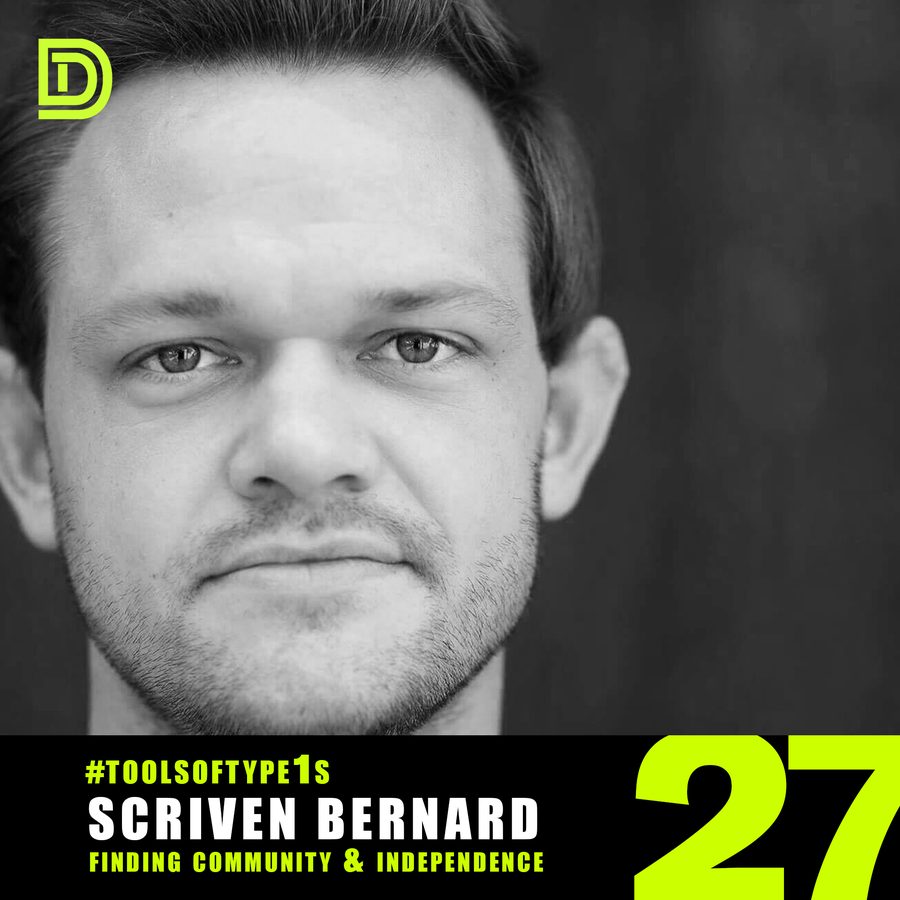
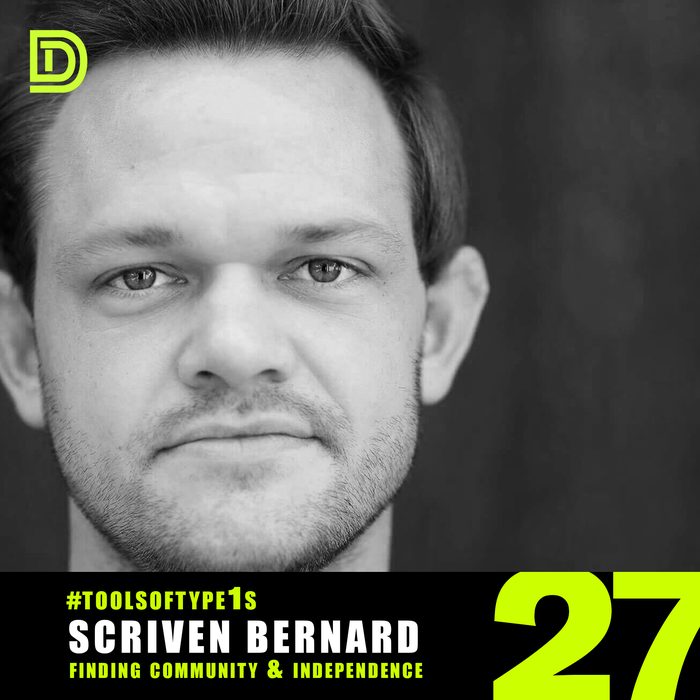
Name: Scriven Bernard
Hometown: Dallas, TX
Date of Diagnosis: 10.09.1997
Tool: Finding Community & Independence
Diabetes Devices/Treatment Methods: Medtronic 670g & Guardian Sensor
Questions this episode answers
What devices does Scriven Bernard use to manage type 1 diabetes?
He uses a Medtronic 670G insulin pump with a Guardian Sensor CGM. He says the CGM is the device that has helped him most because it gives him data he can act on.
How old was Scriven Bernard when he was diagnosed with type 1 diabetes?
He was diagnosed at age nine, on October 9, 1997, and had lived with it for 21 years at the time of this episode.
How does Scriven Bernard manage diabetes while performing improv and drag?
He plans meals and insulin ahead of a show to keep his blood sugar stable, and has upfront conversations with castmates so they aren't caught off guard by a pump alarm or a low blood sugar backstage.
What does Scriven Bernard say helps most with diabetes burnout?
He says burnout is normal for every diabetic, and the key is recognizing it and leaning on your support system, like telling a doctor or friend you're burnt out and asking for help.
Full transcript Searchable, with timestamps
Rob Howe: These Tools of Type 1s episodes are shorter than my normal podcast episodes, usually about 20 to 30 minutes, sometimes in that sweet spot, 20 to 25, which is perfect because Real Good Foods pizzas take about 20 to 25 minutes to prepare in the oven. So, if you're trying to get your pizza on during this podcast and maybe you want to even add up the ambiance with some smells of some delicious pizzas, pop a Real Good Foods pizza in the oven and set that timer for 25 minutes. and listen to this podcast. They are a sponsor of the podcast. And if you use code ROBHOW at your checkout online, you can get 20% off and free shipping. But most importantly, you can get a delicious low-carb pizza option for you to enjoy. We had a pizza party with Real Good Foods pizzas for the Game of Thrones premiere earlier this year. And let me tell you what, it was delicious. And I didn't have to worry about my blood sugars afterwards because I counted my carbs for the chicken pizzas, 16 carbs that's four carbs per serving delicious real good foods real good foods pizza real good foods.com use code rob how check out and save 20 and get free shipping tools of type ones podcast one of my first adult type 1 friends scriven bernard he was the first in-person interview ever done on diabetics doing things he was episode two he is a good friend of mine. His tool, finding community and breaking independence. I'm glad that he's a voice in the community. I rely on him for so much support, especially locally in Dallas. And he is just a great, amazing friend. We also had a great talk last year when we walked the JDRF One Walk here in Dallas. And I'm just really glad that I can rely on him for so many things. Scriven, thank you so much for doing this episode and for all of you enjoy tools of type ones with Scriven Bernard
Scriven Bernard: I'm Scriven Bernard I was born in Louisiana but when we were or when I was four we moved to Amarillo and I grew up in Amarillo for pretty much all my life and then I moved to Dallas when I actually about four years ago and I went to school just south of Amarillo in a town called Canyon. I got a degree at West Texas A&M University. Go Buffs! I got a degree in biochemistry and math, and I did a lot of research through that, kind of while I was getting the degree and a little bit after. I did primarily research in, so I did some diabetes, I did a lot of cancer, and a couple other random things like pesticide resistance, and there's actually quite a few links between those things, which sounds crazy, but would be happy to explain it one day if you want to ask. But I learned that research was not really for me. I recognized that with that degree, like that's where I was headed. And I was like, you know, I want to go out and see the world. There's not enough people involved in this. Like I was very closed off in a lab all the time, and I'm pretty outgoing. And I really needed to be around people more. So a friend of mine from high school posted about a corporate job in Dallas, and I applied and accepted the position and moved to Dallas four years ago. So that job, I am an implementation manager for a SaaS company called YourCause. We work in corporate social responsibility. And I'm actually head of that department now, which is super fun. And so effectively, I'm an internal and client-facing project manager. And it's, you know, project management has its ins and outs, but overall, all I enjoy the job. So that's what I do in the day. And then at, well, in my spare time, I perform and teach improv comedy, primarily at Dallas Comedy House in Deep Ellum in Dallas. And that's where I met Rob. Rob teaches and performs there as well. And the primary group that I'm involved with is called Tabooze, which is T-A-B-O-O-Z-E. And that consists of me and my friend Brian. And we do a show which is long-form improv, if you're familiar with that terminology. So we basically just do a show on stage. It's a whole bunch of scenes, but we incorporate the word-guessing element from the game Taboo in our show, and it's super fun. Audiences love it. We love it. It's super fun. And I'm actually in Nashville, Tennessee right now for a festival that Brian and I are performing at tomorrow, and that's going to be really fun. Festivals are big parties, great ways to just network and meet other comedians. And also, and this is a very, very big also, I am an amateur drag artist, and I perform in drag shows as Miracle Monrova. And I think you'll meet her in a future episode, but I primarily do that at Dallas Comedy House, but also at other smaller venues. I do a lot with the theater's LGBTQIA plus group, which I kind of co-lead with Miracle and Brian. And so I'm super passionate about that. I've helped start an LGBT ERG at work. I'm a big advocate in that world. Love bringing all that together. As far as expertise goes, my degree actually helps quite a bit when it comes to research talk and talking to scientists and speaking the language of it. So I am pretty at least fluent in that language, not that I'm an expert in any of the diabetes research, but it makes it a whole lot easier to figure out what's going on and how they're approaching what they're, you know, what they're doing when it comes to research. And also just my general understanding of the body's like metabolic processes helps me to kind of figure out what impacts diabetes has on me. And that's really cool. So it's not just a doctor saying like, don't do this because I can actually kind of sort out why. And, you know, you can do that with your own research as well, but there's some shortcuts I've been able to take just because of the knowledge I already have. I'm on the Dallas JDRF's Young Leadership Committee, or YLC, and I work with Miracle to try to boost her presence in the diabetes world. I'm wanting her to kind of become an advocate, you know, for diabetes and drag and everything, although I'm learning more and more that it doesn't matter what I want. She's going to do whatever she wants, but she happens to want the same thing. So that's good. So I'm also like through that, I'm trying to make the hashtag dragabetes into a thing, which I didn't coin it, but I discovered it and was like, that needs to be bigger.
Rob Howe: What is your tool of type ones? And what's the one thing that a person living with T1D could learn from you or your experience?
Scriven Bernard: Community. Duh. We can't do this alone at all. It's so important that you find a community and talk and share and get educated because none of us has all the answers or in some cases even many of the answers. And sometimes those answers that we have are misguided or wrong, and it's important that we connect with people to get to share all that information and kind of figure out the truth together. I didn't have community at first, and that's, I think, the case for a lot of people. I was diagnosed when I was nine years old and as a kid you know I didn't have any friends who were diabetic and the friends that I did have like not necessarily my closest friends but a lot of people at school would make fun of me for it just because nine-year-olds make fun of you for anything you can tell them you breathe air and they'll make fun of you for that but um so I I kind of didn't have an outlet in that way and then all the adults in my life were the ones telling me what to do and they didn't understand what it was like to go through it. So I just felt very isolated. And it led to this just independence that I had where I felt like I have to do this alone. No one else can help me. I mean, if I don't do this well alone, then I'm failing at it. And it was just a very negative headspace to be in. And as I grew up and I started to meet other diabetics, Like, I remember the first conversation I had with a diabetic friend, like, that I met in school. And she and I sat down and she'd had it most of her life. And I think since she was like four or so. And I, you know, started talking to her and realized that I could just be super honest about a lot of things. And she would just get it. She wouldn't say, like, oh, well, then you need to do this or whatever, which is what I was used to. she would say, I get it, you know, we screw up sometimes. And that was really important for me. In improv, we teach the concept of taking care of your scene partner and taking care of the other people on stage with you. The way to be like a veteran, like super amazing improv performer is to be very selfless and to take care of all the other people on stage and make them look better than you do. when you can get to that point then an improv performance becomes more successful because everyone then is being taken care of and they're not doing it alone and that's the same concept that is involved in the diabetes community and while there's certainly a balance there that you have to you know you do have to take care of yourself obviously but if you are there willing to help out and willing to share information and building other people up as much as you can And then in turn, if everyone's doing that, you get built up as well. And it's just a very, very powerful concept.
Rob Howe: What is the simplest thing you've done that has helped you with the management of your type 1 diabetes? Where did you learn it or who showed it to you?
Scriven Bernard: I learned to stop seeing my imperfect diabetes moments as failures. I had to realize that we're all human. we are doing the job that a very complex very intricate biological process carries out on a normal basis and that process is a pretty foolproof process in the human body with the exception of when your islet cells die but and the process itself is pretty finely tuned and so to expect us to be able to pull that job off when we are limited in so many ways, like, for example, the timing of insulin and how long it takes to absorb in the body. We're so limited and we're human. We make mistakes. And you just kind of have to accept that. You do your best and you just have to accept that you're going to screw up. But what's important is to not see it as a failure. Like, okay, so I made a mistake or I didn't do this in the best way that I could have done it. But the more that you see these things as failures, like the more that it consumes you. And the other thing with that is don't hate yourself for getting burnt out when it comes to diabetes or like not wanting to take care of it or even for choosing to not take care of it in some moment. That happens to every diabetic. We all go through burnout. That's very normal. I don't know that I would say healthy, but I feel like you have to vent. and you know it to you get that tension out you get that stress out for a minute you vent you let yourself burn out for a second you get back into it what's important is to recognize that the burnout is going to happen this is a 24 7 365 days a year thing and it's not possible to do something like that that can bring you so many of the little stresses like i have no idea why my blood sugar was high today and not get burnt out by that so what's important to do is recognize when you're burnt out and engage your support system in that moment. Talk to your doctor. Talk to trusted friends and loved ones and the people around you who are willing to help. I mean, just be honest. Say, I'm burnt out. Can you just remind me to do my blood sugar for the day or something? Whatever it takes, engage that support system.
Rob Howe: What failures or apparent failures with T1D have made you better at living the rest of your life or made you more well-rounded as a person?
Scriven Bernard: so like I was just talking about a minute ago failure is just a word I think it's first of all before I address this question important to recognize that you've got to have the right attitude about all of this and you've got to see it as less of a failure and more of a oh this is a this is a part of the process that you know I didn't do as well as I could have and just see it for that because when you it's kind of like the difference between shame and guilt shame is when you see yourself as a bad person and guilt is when you recognize that you did a bad thing to make that very simple. But it's kind of the same with that. You are, it is not failure. You messed up one part of it. That's the, and this seems trivial to address, but that's incredibly important because there's so much more emotion tied to the concept of failure or shame that it spirals itself downward. So you've got to start by seeing it as that. But as far as answering question, and I would say that it was, so in my teenage years, I was pretty, with the independence that I was trying to, you know, exert, I made a lot of mistakes at the time. I didn't care. I didn't try a lot of the time. And I think for a portion of my teenage years, I'm not sure how long, probably three or so years. And my A1C was probably a 13 or 14. And some people listening to this are probably like, yeah, me too. And some people are like, what? But it exists. And it caused damage to my retinas and I'm sure my kidneys, because usually what happens to your retinas is what's happening to your kidneys. But I had, I was diagnosed with mild retinopathy. And so I still have it because it's, you know, I think I'm not a doctor. I'm, I think to some degree it's reversible, but, um, you know, if your blood sugars are good enough over time, but I do think it takes a long time. Uh, but either way, every time that I go into the, um, optometrist these days, you know, they run their checks and they tell me, Hey, this looks pretty normal you know for a diabetic that's you know been diabetic for 21 years which is how long i've had it and it's still every time i see those scans and i see the little tiny like microaneurysms and the tiny bleeds and all of that it just it you feel trapped in your own body and i feel like man i have wrecked this temple i have done damage to this and this is like i'm seeing it like i guess the irony of that is I'm seeing the damage to my eyes with my eyes, but I'm seeing this right now, and it's a real thing to me, and that's scary, and so that makes me, well, there was a moment when I first saw that that was like, man, I'm in control of this. I'm the one that can reverse this. I can do better with this, so that was the moment that I committed to having a good diet and to exercising and taking care of myself, and I'm not always perfect at that. I don't think anybody is, but I try. I'd say at least 80% of the time I'm really good with all that stuff. And I think as long as you're hitting that, then you're, you know, you're probably okay. What unusual or absurd opinion or approach regarding your diabetes do you have? So I will not usually let anybody see my blood sugar. And if it's perfect, and I kind of want to brag, then I might show it to like a fellow diabetic or something, or if it's number 69, if we're being honest, every single time I show that number to everybody, I go, look at this. But it's a very private thing to me. And I think probably most diabetics understand that, that it's a report card of how you're doing. And maybe it's acute in that moment, and it can mean different things. So in that moment, let's say that my pump site kinks and my blood sugar goes to 400 or something, and I'm looking at it in that moment, it looks terrible. It looks like I am bad at this. And I don't show it to people because people don't understand that. And the more that, you know, if somebody sees it and goes, oh, my gosh, you're terrible at taking care of your diabetes, the more that I try to explain to them, you know, this is an acute moment and here's how this works. It sounds defensive and I get a lot of anxiety about it. So I just don't share it. I'm like, you know, that's my business. Not something I share. Share it with my doctor. And so I and I think that sometimes people get weirded out by that because, you know, they haven't had to live that experience.
Rob Howe: What's your favorite thing? What gets you to smile or laugh almost every time?
Scriven Bernard: I don't know that laughter is my reaction here. But my favorite thing about diabetes is waking up in the middle of the night with a low blood sugar, which is obviously scary. But when my fridge is fully stocked and you can just and, you know, you've woken up, you address that it's low, you're ready to treat and then getting to eat. It's oh, it's the best. I could do that all day long. It's food is so much better. you satisfy that craving of a low um it's it's wonderful um the the most like the craziest thing that I ever made was back when I was probably a teenager I was still living at home with my parents and I made a Fruity Pebbles peanut butter banana sandwich which sounds like a stoner's dream and it probably is but it was I still remember that to this day it was a great sandwich had the crunch had the peanut butter banana, which is a classic combo. It was, it was, I don't regret that decision. I think my blood sugar was 550 or something when I woke up the next morning, but yeah, it was, that was a beautiful moment. In the last five years, what new adjustment to your lifestyle has improved your life with diabetes the most? Continuous glucose monitoring, hands down, even above the pump, even above the Medtronic 670G, which is what I'm on, which includes CGM. But CGM itself, man, that's a game changer. Like I said, background in science, I live in data, and that gives you data. You need data. You can't take any action on something without enough data to know how to take that action, and that's exactly what a CGM does. I consider the CGM to be required for diabetes, even above a pump. You can do shots all you want, but you've got to have a CGM. It's a life changer.
Rob Howe: What challenges related to T1D did you encounter or have to overcome while you were doing your thing?
Scriven Bernard: So the biggest challenge is what's related to performing. So I'm on a stage a lot, and typically, depending on the show, they can be 25 minutes to an hour. It depends on what it is. And when you are on stage, especially with improv, or even when Miracle's on stage or whatever, you've got to be in a very good headspace. You have to have a clear mind. You have to be energetic. You have to feel good. Because the less that you feel like that, the easier it is to get in your head, which is the enemy of improv. Improv is about spontaneity, and we don't want to involve thinking too much in that. and you get in your head and you feel bad and you don't you start to feel emotions toward the other people on stage like not the characters but the improvisers and it just whenever whenever you're in your head and when your blood sugar is high it really exacerbates that so when my blood sugar is high you know i'm not supportive to other people i feel bad you know i it just any we all know those of us that have had a high blood sugar like we know how that feels just imagine trying to enjoy anything when you feel like that um so and then lows are even worse for the stage because obviously you have to immediately treat those and um even if i were low and trying to do improv i couldn't do it i you know it'd be like trying to do it drunk um and so i have to make sure to prevent that so i have to do a lot of preventative stuff and just you know for the several hours before the show just know I have to have a plan I have to know what am I going to be eating and you know stabilize my blood sugar so that I know that it's good going out into the stage and then on top of that is the feelings that the other people that I'm performing with have sometimes when it comes to performance normally I'm very vocal about diabetes but sometimes I'll keep it a little bit under wraps because people will freak out a little bit. And so, um, like, for example, there was, um, a woman that I performed with recently. And when we were in the green room before the show, my blood sugar got low. And so I asked one of the, um, bartenders to bring me a Coke and I treated the low and I was good, but she had, you know, she didn't know enough about diabetes and well i mean it's still a scary thing to see a friend going through what is a medical emergency even though you know i was like hey i'm good and so she was panicking about it well i calmed her down i explained it a little bit and she felt better and then of course we get on stage and my insulin pump alarms and so in the middle of this show you know i silence it real fast and i know what it's telling me and and i think at the time it was probably a reservoir our alarm or something but um it's just bad coincidence and she hears it and of course gets in her head and she's thinking I'm about to die on stage in front of her so the show suffered because of that and you know you can't blame her but it's there's just you constantly have to prove yourself to people and you have to build that trust and that's true in all of our lives but those are the kinds of things that I have to consider for performing so I usually just have conversations with the people I'm going to perform with. With Brian, who I'm performing with this weekend in Nashville, we've been friends for so long that it's not a big deal. I say, oh, I'm fine. And he just walks away. But if I say, I'm not sure, then he'll come help or whatever. But for other people, it's just a matter of having that conversation and setting those boundaries.
Rob Howe: What bad advice regarding diabetes do you see or hear that you'd like to address?
Scriven Bernard: I don't know that there's specific advice, but I think the important thing is just know where to go for info. I see a lot of people getting medical advice from online forums or they'll hear some piece of advice from somebody and they don't really ever question it. I just think it's important to recognize what advice should come from a doctor and what should come from peers. if it's like about how to live your life as a diabetic like oh how do you do sports or whatever then yeah talk to your peers talk to people talk to real diabetics and ask them don't listen to you know somebody telling some old wives tale or whatever um and when it comes to anything medical like what you should dose or how you should change your basal rate or something absolutely be talking to a health care professional um a nurse a doctor somebody um and like for example I had a friend that a long time ago that for some reason got the message of how to do injections confused. Because I think he confused what his doctor had said. And so someone else tried to help him figure it out. And so he thought he was supposed to inject everything into the exact same spot. Like for a long time. So all of his shots into the same spot. So we had this horrible, like, it was like a three-inch wide, like, callus on his abdomen. It was this huge race that, like, it looked like a tumor. I mean, it was, and it was a hard spot. And he, his blood sugars were horrible. His A1C was like 15 or something, or I don't know, 14-ish. And he just hadn't gone back to the doctor in that time. And he was just doing, and I was just like, you've got to talk to your doctor. It's that kind of thing. That sounds crazy, but that kind of thing is a little bit more common than we'd like to admit. And the other thing with that is like, and so anything else, like talk to your doctor about. But with that, if you don't feel comfortable talking to your doctor about something or if your doctor, like in my experience, I've had several doctors that like made me feel guilty a lot. If you have that experience, get a new doctor. Like life's too short. Talk to a diabetics. Like I love my endocrinologist. She's here in Dallas, and she's fantastic. Her name's Dr. Abramowitz, and she is amazing, has a great bed-type manner. I like working with her. She's really good at what she does. Talk to people. We can always recommend people. And, you know, like I said, have a doctor you can work with. You should have a good relationship with your doctor.
Rob Howe: What priority are you focusing on in your own life currently? This can be diabetes-related or not.
Scriven Bernard: At the moment, I'm a little bit out of balance. Outside of diabetes, my blood sugars are fine. Slightly, everyone sees, I think, a couple tenths of a point over where I want it to be or where it's been, probably related to the rest of me being out of balance. And I'm referring to things like exercise, meditation. I haven't been as good about some of that. And I can just see it. I see when that balance breaks. I can watch it ripple through my life. And so I feel like I'm very busy right now with a lot of stuff, and I feel unfocused. and I start to lose control of some of those things and it's all just because of that. And I feel my mood shifting. I'll be a little bit more negative and that's what it's all from. So my goal right now is let's get back in balance and get that all sorted out.
Rob Howe: Who is someone that you look up to and what have they taught you? How do you apply that to your life?
Scriven Bernard: Emily Gee is a very good friend of mine and she performs and teaches at the same theater as Rob and me. she is a brilliant performer she's a joy to watch on stage everybody loves her she is single-handedly the most positive person i've ever met in my life she brings joy into every room she walks into um she like it's plague levels of infectious how like her positivity um she like she's taught me so much that positivity is a choice she's always choosing it like if you can always be positive is because you're always choosing to be positive. Sure, she has bad things happening in her life just like the rest of us, but she's always choosing to be positive, have a good outlook, and to spread that joy to others. And it's, man, I can't describe it. It's just such a refreshing, powerful feeling to be in her presence. And so what I learned from her is I channel her and I just remind myself positivity is a choice and that it's important to love who I am because that's another thing she does well. She's just in love with who she is, and we should all be in love with who we are.
Rob Howe: What are you most hopeful for? This can be diabetes-related or not.
Scriven Bernard: I am most hopeful that people will continue to learn to understand and validate each other's experiences. I think it's important across the board. So this is semi-diabetes-related, semi-not, But I think it's important that we read and ingest, you know, material produced by a diverse variety of creators in all manners of diversity. And that we're just not listening to only like our peer group or only, you know, the people we've always listened to. Listen to everyone in the world. Listen to every experience and validate every experience. They are all valid, whether you want to validate them or not. And I think we can apply that pretty well to diabetes. a lot of the times we feel like our experiences are invalidated when somebody's like oh should you be eating that or are you okay do you know what you're doing things like that it's like hey i've had this for 21 years i'm not perfect but i have an idea of what's going on and i feel like i can make my own choices and that's what that's what i would like to see more of across the board not just with us um but you know and and the world is getting there i'm definitely seeing change in that direction. But I think that's something that we can all always be trying to do.
Rob Howe: What advice would you give someone who has T1D and is trying to pursue a career in your line of work?
Scriven Bernard: Just plan ahead, over-prepare, and talk to people about diabetes, the people you're around, let them know what you need and don't need, set boundaries. If you, sometimes it can be kind of weird to figure out how to do that. But it can be very simple. You can just walk up to somebody and say something like, hey, we're going to be working together. I've got diabetes. I think that knowing that might be important to you. And I kind of want to talk through it. You know, I've got a good handle on all of it. But do you mind if I just kind of run through the basics with you, like just in case? And then you can catch them up on whatever you can say, hey, we're gonna be doing the show together. I'm going to need you to basically never worry about me. I'll let you know or look for these signs and have those conversations and let people know what's going on because then the more and show them how you do it. It's not that we should have to prove this to people, but as long as that exists, like show them how you live your life and they'll see that you're in control of it.
Rob Howe: What's the one facet or trait that you think makes you uniquely you? Explain why.
Scriven Bernard: Empathy, probably. I tend to feel what other people feel probably too much sometimes, but I definitely use it to my and others' advantage is I think that it's just important to walk in someone else's shoes. And I'm certainly not perfect at it or even, you know, super great at it, but I try. And I'm constantly asking myself what someone else is going through. And part of that may be from improv. I think part of it existed since I was a kid. but it's just caring about other people and caring about their experiences and caring about what they're going through. And that applies to anyone and anybody's experiences. And just before you react to something, you can often curb the emotion of that reaction a little bit by just going, you know, what is this person going to and what led to them doing or saying this thing? And that can help. And so I feel like I'm pretty good at that. And that helps me resolve conflict a lot,
Rob Howe: honestly. Plug yourself. Tell us where we can find you in the diabetes online community.
Scriven Bernard: cool um you can find me on facebook you can just search for scriven bernard i promise you're not going to find anyone else um i'm probably the only one that pops up my dad's not on there he's not allowed um you can also find me on instagram my handle is scriv forever s-c-r-i-v forever the word and you can also find Tabooze on facebook and instagram on both of them the handle is TaboozeImprov, so T-A-B-O-O-Z-E-I-M-P-R-O-V. We have some festivals coming up. We have the one this weekend, and we have several more coming up. We have a whole bunch of local shows, I think six at Dallas Comedy House in the next month or two. And you can also find info there at DallasComedyHouse.com on when we're performing. You can find Miracle. she is currently working on the next drag pageant that she'll be hosting and she's working on some online content as well her handle on facebook is miracle monrova m-i-r-a-c-l-e m-o-n-r-o-v-a and on instagram she is a type 1 miracle with the number one and then i'm also part of the dallas ylc you can find us on both facebook and instagram as jdrf greater dallas ylc where do you get plugged into the t1d community the most talk to people uh listen to call or listen to podcasts uh listen just listen to people connect network um look up social media accounts message people that you're interested in Like if you, you know, are fascinated by someone's take on something, if you're listening to a podcast and that person's talking about it, message them. And pretty much all of us that are doing these sorts of things want people to reach out to us. And it's not weird if you do. Just, I mean, worst case, they won't reply. But just message if you have a question or if you're like, hey, we're in the same city and you seem cool. I want to get to know you. Let's hang out and talk about diabetes. And it happens all the time. I was wearing a diabetes sweatshirt the other day in a Starbucks, and a guy walked up, and we just had a two-hour conversation about diabetes in a Starbucks. It's super cool. Also, the JDRF has a ton of events. There's all sorts of diabetic organizations that do, but the JDRF is a really good one to get involved with because they have them in a lot of locations throughout the year. You can get on their website to find more information. and if you go to those events like type 1 nation and all these other things uh you just introduce yourself to people and if you're not so much a people person you can kind of identify who's running these things you can even figure that out online message them talk to them they can connect you with people well thanks so much it's been a blast and uh yeah as always we together can turn type 1 into type nine so everybody have fun thank you for listening to
Rob Howe: the Tools of Type 1's podcast on diabetics doing things. I'm Rob Howe, and every Tuesday and Thursday in 2019, we are posting the next Tools of Type 1 episode. So follow us on Instagram, hashtag toolsoftype1s, or just on diabeticsdoingthings. We will post those regularly every Tuesday, every Thursday. My favorite type 1's are answering the questions I want to know the answers to. And hopefully, you'll learn a few things as well. If you like this episode, Be sure to review us on iTunes. And if you didn't like it, go ahead and let me know that too. I want to know. All the feedback is good to me. Thanks again for your time. I value that more than anything you could possibly give me. Thanks so much. Bye-bye.
About Scriven
Scriven Bernard is a Dallas-based improv comedian and drag performer who lives with type 1 diabetes, diagnosed at age nine. He works as a department head at the SaaS company YourCause and serves on the JDRF Dallas Young Leadership Committee.