

Episode summary
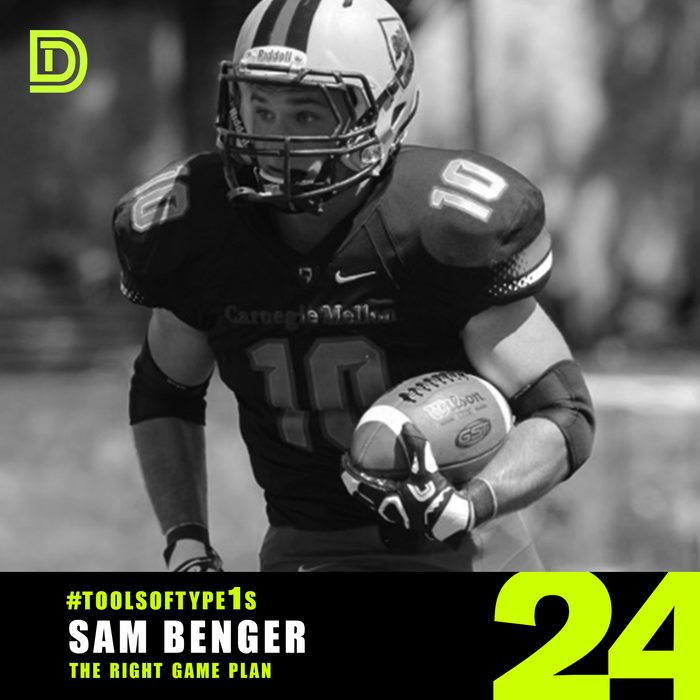
Sam Benger was diagnosed with type 1 diabetes at age five in 2000. He played football at Carnegie Mellon University, pursued a shot at the NFL, and now runs Gameplan T1D, a platform collecting stories from diabetic athletes. He describes a severe hypoglycemic episode during a college football game his senior year that led to him having a seizure in his sleep days later, an experience he calls a wake-up call about daily diabetes management. He talks about using a Dexcom G6 CGM, lowering carbs to manage blood sugar, the influence of Pat Tillman on how he thinks about loyalty and passion, and his plans to turn Gameplan T1D into a nonprofit that helps cover insulin and supply costs for people who can't afford them.
Key takeaways
- Sam Benger had a seizure in his sleep after being pulled from a college football game for severe hypoglycemia, which he calls his biggest wake-up call about diabetes management.
- Sam says switching to lower glycemic index foods, cutting back on pasta and pizza in favor of vegetables and salads, was the simplest change that helped his blood sugar.
- Sam says his Dexcom G6 CGM made the biggest difference to his diabetes management in the last five years.
- Sam built Gameplan T1D to collect stories from diabetic athletes and plans to turn it into a nonprofit that helps cover insulin and supply costs for people who can't afford them.
- Sam says a pump and CGM don't replace a healthy lifestyle; diet, sleep, and exercise still matter.
Show notes

Name: Sam Benger
Hometown: Hingham, MA
Date of Diagnosis: 03.10.2000
Tool: With the right game plan, T1D can make us better people.
Diabetes Devices/Treatment Methods: Dexcom G6, Omnipod, Humalog Insulin
Questions this episode answers
What diabetes devices does Sam Benger use?
Sam uses a Dexcom G6 continuous glucose monitor and an insulin pump, which read to his iPhone and Apple Watch.
What is Gameplan T1D?
Gameplan T1D is Sam Benger's platform for stories from diabetic athletes, from Olympians to recreational runners. He says it is working toward nonprofit status to help cover insulin and supply costs for people who can't afford them.
What happened to Sam Benger during his senior year of college football?
He became severely hypoglycemic and had to be pulled from a game in St. Louis, then had a seizure in his sleep later that week. He says it taught him to stay engaged with his diabetes management every day, not just rely on past experience.
What diet change did Sam Benger make to help manage his blood sugar?
He says eating fewer high glycemic index foods, like pasta and pizza, and more vegetables and salads was the simplest thing he did to improve his blood sugar.
Full transcript Searchable, with timestamps
Rob Howe: Tools of Type 1s Podcast. Today's guest, Sam Benger from Gameplan T1D. Sam's become an awesome voice in the community and just a cool guy to get to know. His tool, The Right Gameplan. The Right Gameplan. So stay tuned for more from Sam. I'm turning it over to him right now. Now, these Tools of Type 1s episodes are shorter than my normal podcast episodes, usually about 20 to 30 minutes, sometimes in that sweet spot, 20 to 25, which is perfect because Real Good Foods pizzas take about 20 to 25 minutes to prepare in the oven. so if you're trying to get your pizza on during this podcast and maybe you want to even add up the ambiance with some smells of some delicious pizzas pop a real good foods pizza in the oven and set that timer for 25 minutes and listen to this podcast they are a sponsor of the podcast and if you use code rob how at your checkout online you can get 20 off and free shipping but most importantly you can get a delicious low carb pizza option for you to enjoy we had a pizza party with real good foods pizzas for the game of thrones premiere earlier this year and let me tell you what it was delicious and i didn't have to worry about my blood sugars afterwards because i counted my carbs for the chicken pizzas 16 carbs that's four carbs per serving delicious real good foods real good foods pizza realgoodfoods.com use code rob howe check out and save
Sam Benger: 20% and get free shipping. What's up everybody? My name is Sam Benger. I have type 1 diabetes, and this is my tools of type 1 episode. Uh, really excited to tell you guys a bit about myself and a little bit about my story and what I'm doing on the diabetes advocacy front. Um, so I was in, so background, I'm 23 years old and just graduated college. I've had diabetes for 18 years now. I was diagnosed when I was five years old in 2000. A few things about myself. As I mentioned, I just graduated school. I went to Carnegie Mellon University in Pittsburgh. I played football there. I pursued a career in the NFL. After my college days were over, it didn't work out. And I've been taking some of the downtime after that football career was over to launch my own diabetes advocacy platform called Game Plan T1D, where we have and try to serve to be a centralized platform for all different stories relating to diabetic athletes. I'll get a little bit more into what we're doing with that later on. I have a career with Deloitte Consulting starting in January, so I'm hoping to be able to balance Game Plan T1D and also that consulting career as well. um and yeah as i as i mentioned in terms of the advocacy front rob and i um we're connected through a jdrf mutual friend and we've been on each other's podcasts and it's just been awesome to be part of that t1d community and the advocacy community especially within the t1d community alongside Rob and diabetics doing things.
Rob Howe: What is your tool of type 1s? And what's the one thing that a person living with T1D could learn from you or your experience?
Sam Benger: So my tool is, and really my advice is that with the right game plan, diabetes makes us better people. Diabetes teaches us so many things and it's taken me a long time to understand that and really the full 18 years of my type 1 diagnosis to understand that. so right off the bat it teaches us accountability we have to be accountable for what goes in our body what we're eating how much sleep we're getting everything that affects our diabetes we need to be aware of and cognizant of and really accountable for also it teaches us mental toughness so you know and I'll admit I have it easier than a lot of people in terms of diabetes care because I have access to a CGM I have access to an insulin pump but at the same time everyone with diabetes no matter what you're dealing with from a technology standpoint to assist you in your treatment goes through tough spots and has rough patches and I've certainly had mine and being able to bounce back from those has definitely ingrained in me a lot of resiliency and then also it teaches us empathy I think to understand the challenges that come with having a chronic illness teaches us to be a little bit more empathetic and be able to walk in someone's shoes who's dealing with an issue like that and just to know how tough it is. What is the simplest
Rob Howe: thing you've done that has helped you with the management of your type 1 diabetes? Where did
Sam Benger: you learn it or who showed it to you? The simplest thing that I've done to help me with my type 1 management is just better eating, better diet. Basically, eat less carbs. It sounds really simple, but eating lower glycemic index foods and for those of you that don't know, all the glycemic index is, is basically how, or the ability of a food or the characteristic of a food to jack up your blood sugar. So a Coke is really high glycemic index because you chug that thing down and you're spiking up to three or 400 right away. Whereas, um, you know, a salad, you're hardly going to see an impact on your blood sugar as a result of eating that. So a little bit less pasta and pizza and eat a lot more vegetables, more salads, more things of that nature, things that are green. It's not only good for your diabetes, but it's good for you overall. I would say that is the simplest, not necessarily the easiest, but the simplest thing that I have done to improve
Rob Howe: my blood sugar. What failures or apparent failures with T1D have made you better at living the rest of your life or made you more well-rounded as a person? Failures with T1D that I've had. So as I
Sam Benger: mentioned, I was diagnosed when I was five years old and, you know, I got into my college career. I got my CGM, I got my pump, and I was kind of under the impression that, you know, I know what I'm doing. I've learned everything that there is to learn about this disease and how to manage it. And then we were on the road in St. Louis for a football game my senior year of college. And I got so hypoglycemic that I had to be taken out of the game. And later that week, I actually had a seizure in my sleep. And it was really just a wake-up call for me. As I mentioned, I thought that I had kind of learned all the tricks of the trade. But basically what that experience taught me was that I need to be learning every day about type 1 diabetes. And every diabetic knows a little bit about something with regard to treatment that can probably help you. and just to always be aware about what other people are doing, what technology is out there. Because no matter what, no matter how good you think your treatment is, if you're not dialed in every single day with your T1D, bad things can happen. But yeah, I would say that was a huge wake-up call for me. And like I said, T1D doesn't take any days off and neither can we.
Rob Howe: What unusual or absurd opinion or approach regarding your diabetes do you have?
Sam Benger: I am really CGM obsessed. So I'm lucky enough, as I mentioned, to have access to a CGM. I wear a Dexcom G6 and it reads to my cell phone, my iPhone, and then also my iWatch. And I don't even want to know how many times a day I check that thing. It's got to be in the hundreds. basically with it reading out my bloodshake every five minutes. I want to see as straight and as flat of a line as possible. I really like to obsess over, you know, where my levels are at. If I'm at a hundred and I'm start taking up to into the one twenties, I'll give myself a dose and I'm just really striving to stay as close to that, you know, a hundred target level as I can.
Rob Howe: What's your favorite thing? What gets you to smile or laugh almost every time?
Sam Benger: my favorite thing and the things that thing that makes me smile or laugh the most every time gotta be the dynamic duo of Will Ferrell and John C. Reilly they're a little bit crude but at the same time they always always always make me laugh I'm also a huge office fan I've probably watched that show in its entirety four or five times Michael Scott's awkwardness is probably one of you know, the best things on this planet. So check out all of those guys. They're super,
Rob Howe: super funny. In the last five years, what new adjustment to your lifestyle has improved your
Sam Benger: life with diabetes the most? That is easy. It's got to be my CGM. Um, if you're in a position financially and from a health, from a healthcare standpoint to have access to a CGM, no other piece of diabetes technology out there, not a pump, um, you know, not insulin pens are will even come close to the benefit that it's done by having a CGM. That is my opinion. Knowing where your levels are at, I don't know how I did it for the 10 or 15 years that I didn't have access to a CGM, but being able to understand how your body reacts to different levels of sleep, different diet, you know, the food that you're putting into your body, different exercise, different activity levels, you understand all of that by having access to the CGM and it's reading every five minutes, at least that's the case with the Dexcom, excuse me. Um, those, you basically become a data scientist and you, you get a really strong understanding of how your body reacts to different things in the environment. Um, as I mentioned, sleep, food, stress, all of those things. So if you can and have access and are lucky enough to be able to get a CGM, go get one. it'll change your world with diabetes. What challenges related to T1D did you encounter
Rob Howe: or have to overcome while you were doing your thing? The challenges that I've had relating to
Sam Benger: T1D are basically all about my athletic career. As I mentioned, I played football at a fairly high level in college and then pursued the NFL and dealing with the stress that came with that. was super difficult and it was only after a lot of trial and error that I found a system that worked. With athletics and with diabetes, you can only control so much, but you do have to really strive to control the things that you can and introduce as much predictability into the process as possible. I'd like to have a really consistent pregame routine and I feel like that enabled me to have a good deal of success because ultimately so much of your athletic performance is tied to your diabetic performance and how well you manage your sugars. So that was the biggest challenge that I faced, and I think I've done a pretty solid job overall of controlling what I can and in doing so ensuring a high level of athletic performance.
Rob Howe: What bad advice regarding diabetes do you see or hear that you'd like to address?
Sam Benger: I would say it goes hand-in-hand with what I was talking about earlier with great technology. So it is fantastic that we're seeing so many improvements. And I'm sure when this is released, there will have been even more great technology being released to the diabetic community. And that is fantastic. But by no means is that a way out of trying to live the best and most healthy lifestyle outside of technology as possible. I think a lot of people think that you slap on a pump and a CGM and you're good to go. That is not the case. as a diabetic we still need to be so cognizant and accountable for what we're putting in our bodies how much sleep we're getting and how much exercise we're getting as well and how active we are just because you have access to a pump and a cgm does not mean that you get to be a couch potato get up get outside go for a walk go for a run bike find a workout routine workout you should break a sweat every day and that is going to do wonders for you and then the pump and the cgm will only propel you to even, you know, better A1C, better blood sugar levels. So don't rely overly on your pump and your CGM. You still need to have a great healthy lifestyle outside of that
Rob Howe: technology. What priority are you focusing on in your own life currently? This can be diabetes
Sam Benger: related or not. The priority that I'm focusing on, on my life currently, um, is just to always be learning. Everyone can teach you something, no matter where they're coming from, that you didn't know. And I want to be able to use that information and that knowledge to, you know, have a better, basically, I want to use those things that they teach me to be able to serve others better in the future than I would be able to today. Additionally, I want to continue to draw the align between what I can control and what I can't and being okay with those things that I can't control and not being overly stressed about those. And that's in diabetes and outside of diabetes. I think a lot of people these days are very type A and very perfectionist. And I consider myself one of those people, but you know, at the end of the day, there are only so many things we can control and there's definitely a lot of overlap with diabetes care. Know what you can control and let the rest slide and don't stress about it. And that's just the way it is.
Rob Howe: who is someone that you look up to and what have they taught you? How do you apply that to your
Sam Benger: life? This is a really important one to me. So Pat Tillman is a name, um, that, you know, you either know his story or you don't, but if you don't go read about him, there are books about him. There's one by Jon Krakauer called Where Men Win Glory. Um, Pat Tillman is a guy I found out about, I didn't really hear about his story until my college days, but Pat was a American hero. He played football at Arizona State. He was a scholar, you know, incredible academic, all American, incredible intellectual, and a hell of a football player to boot. He wasn't the biggest guy in the world. He was about 5'11", 200 pounds, but he was one of the hardest hitting safeties in college football and eventually in the NFL playing for the Arizona Cardinals. There was so much about his character that is tied into loyalty. At one point in his NFL career, he was offered a bigger contract to leave the Arizona Cardinals, the team that drafted him late in the draft, and he forgoed that larger contract to stay with the team that had offered him the original opportunity to play in the NFL, the Arizona Cardinals. You can learn a lot about loyalty from Pat, but also passion. Where the passion comes in is Pat was playing in the NFL during the September 11, 2001 attacks, the terrorist attacks in New York. Pat was at a point in his career where he had led the NFL in tackles. He was really excelling, and he had a lot of opportunities to make a killing, essentially, by staying in the NFL. But he ultimately decided that there was a bigger purpose for him and a more important cause, and he left the NFL really in his prime to go serve in the military. And he was eventually killed while serving overseas, and he really made the ultimate sacrifice for our country. But that's not, you know, the story of Pat Tillman. The story of Pat Tillman is that he did everything he did, whether it was, you know, talking with someone else or, you know, learning about a new person or studying, you know, his academic career or playing football. He did everything until the end of his life with incredible selfless passion. And that is the biggest, he is probably the biggest role model in my life. And if I can try to live up to the passion that he exuded and how much he cared about other people, I'll consider myself well to have lived a good life.
Rob Howe: What are you most hopeful for? This can be diabetes related or not.
Sam Benger: Definitely a closed loop system. So if we can come up with a mechanical replacement to what a pancreas does, I think that technology is not too far away. And automating that system, having a closed loop system that's automated will change diabetes. So essentially we would have something that is acting as a bionic pancreas. And as I mentioned, I think we're close to that. I would expect to see it in the next five to ten years. And once we have that thing up and running, man, that's going to be a game changer. So I'm really excited for that.
Rob Howe: What advice would you give someone who has T1D and is trying to pursue a career in your line of work?
Sam Benger: So I will answer this question as a diabetes advocate, philanthropist, podcaster. My advice is just ask. If you want to try to be a diabetes advocate or an influencer in the space, and you have to start trying to build relationships with other people, So as a podcaster, getting guests to come on my show, diabetic athletes, you just have to ask. Example of this, my second episode was with a four-time Olympian, almost a five-time Olympian, Kris Freeman. He was an Olympic cross-country skier, and I sent him a Facebook message because that was the only way I could think of contacting him. And one day I was going about my business, and I got a message back from him. And he said, hey, would you want to come up to my house? I live in New Hampshire and Chris is living up in New Hampshire. I'm based in Boston and I was just blown away. And I went up there, met his wife, had dinner with them, got to interview Kris. And you'll be shocked by how many people are just willing to help, especially within the diabetes space. But otherwise, just ask and you'll never know. Really, what's the worst that could happen? And someone says, no, they don't want to be part of the opportunity. But if you never ask, you'll never know.
Rob Howe: What's the one facet or trait that you think makes you uniquely you? Explain why.
Sam Benger: I'm, you know, incredibly handsome now. I will say my parents raised me to be very empathetic. And I think in the world today, there's certainly a lot of self-absorption. And that's really compounded by things like social media. but there are people out there that need help and there are causes that need to be addressed and issues that need to be addressed and we are at a stage now where we have so many tools from a technology standpoint that can actually help us provide meaningful solutions to those issues and help those people that are in need and I know if I want to live my life the right way it will be in serving those people that need help and that can't help themselves.
Rob Howe: Plug yourself. Tell us where we can find you in the diabetes online community.
Sam Benger: I've kind of alluded to, I have my own diabetes platform called Gameplan T1D. You can find us on Facebook, Instagram, and also Twitter at Gameplan T1D or search our website GameplanT1D.com. You can find us on YouTube, the podcast app, iTunes, SoundCloud, Spotify, really anywhere you can find podcasts by searching Gameplan T1D. we are trying to be the centralized platform, really a destination for stories of success from diabetic athletes. Ultimately, at Game Plan T1D, we're trying to do two things. We're trying to inspire diabetics, and we're trying to empower diabetics. The inspiration comes from these athletes who are doing amazing things, and we've, as I've mentioned, talked with diabetic Olympians, world champions from a number of sports, record holders, all the way down to more recreational athletes, people that are doing 5Ks for the first time, high school level athletes. All these people have T1D and they're just crushing it, not letting their diabetes hold them back whatsoever. We're also trying to empower diabetics. So we're in the process of filing to become a nonprofit. And once we have that status, we're going to do our best to fundraise and do our part to alleviate the financial burden of diabetes for people that don't have access to basic diabetic supplies like insulin. We're really trying to do our part to level of playing field because no one should go without access to basic diabetic supplies. It is insane to think that at the state we are at now with people who have, like myself, are very lucky to have CGMs and insulin pumps that people are going out there and can't afford insulin. It drives me insane. I can't stand to think that there are people out there dying from diabetes. It is just unfathomable to me. So we want to do our part to empower diabetics on that front and improve accessibility to insulin.
Rob Howe: Where do you get plugged into the T1D community the most?
Sam Benger: I went to JDRF first because they were the biggest resource or sort of platform that I knew out there for diabetes. And I made a connection, a few connections there actually. And that's actually how I got connected to Rob Howe. And, you know, find other diabetics and talk to them and they'll know other diabetics. and it just, it all branches out from there. So, you know, make friends with other diabetics. It's an amazing community and you'll be blown away by the people you meet and just what those relationships can be like. But that's me. I'm Sam Benger. Go check out Game Plan T1D right now. And yeah, it was a pleasure talking with you guys. Take care.
Rob Howe: Thank you for listening to the Tools of Type 1's podcast on diabetics doing things. I'm Rob Howe, and every Tuesday and Thursday in 2019, we are posting the next Tools of Type 1 episode. So follow us on Instagram, hashtag Tools of Type 1s, or just on Diabetics Doing Things. We will post those regularly every Tuesday, every Thursday. My favorite Type 1s are answering the questions I want to know the answers to. And hopefully, you'll learn a few things as well. If you like this episode, be sure to review us on iTunes. and if you didn't like it, go ahead and let me know that too. I want to know. All the feedback is good to me. Thanks again for your time. I value that more than anything you could possibly give me. Thanks so much. Bye-bye.
About Sam
Sam Benger is a diabetes advocate from Hingham, Massachusetts, diagnosed with type 1 diabetes in 2000. He played football at Carnegie Mellon University, pursued a shot at the NFL, and founded Gameplan T1D, a platform for stories from diabetic athletes.