

#ToolsofType1s - 025 - Neil Greathouse
Episode summary
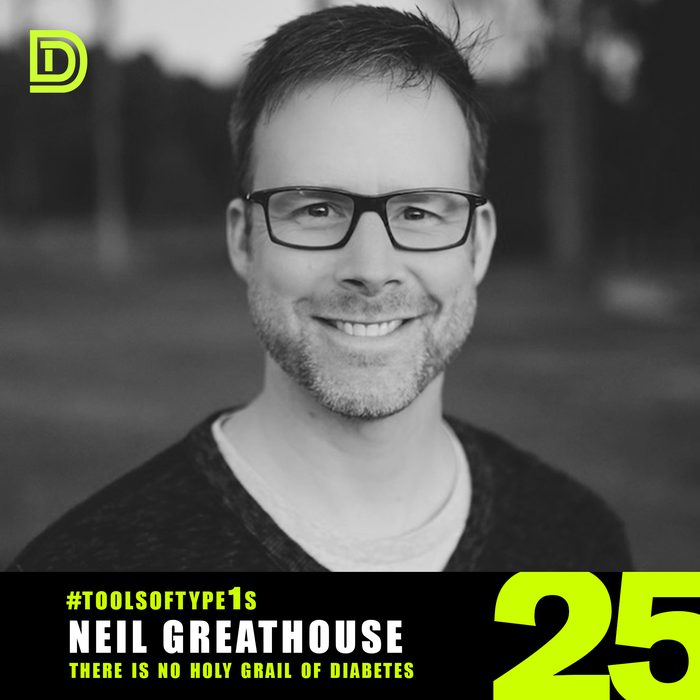
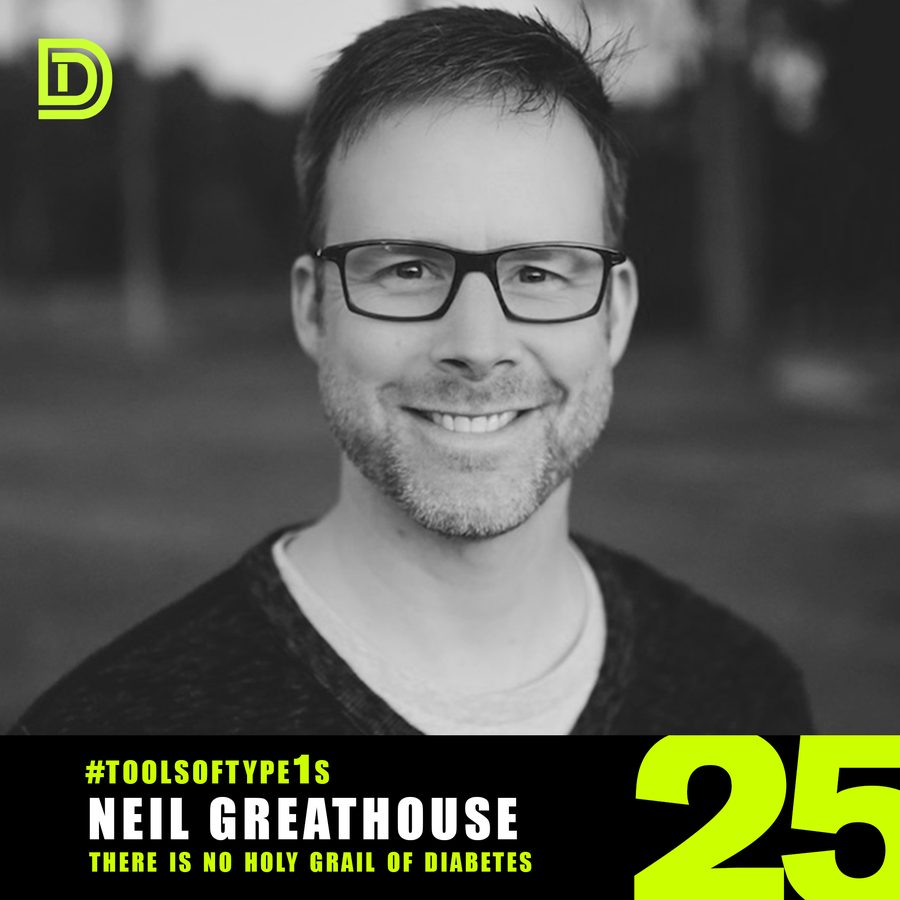
Neil Greathouse, known on Instagram as The Beaties, has lived with type 1 diabetes for over 26 years. He tells Rob Howe there is no single fix for diabetes, and that food, exercise, devices and the people around you all matter together. He explains how he calculates protein into his carb counts using a formula from cyclist Sid Sharma, why he eats low-carb, high-fat despite pushback from some clinicians, and how switching to a DIY closed loop system with RileyLink, a Medtronic pump and Dexcom changed his management. He also discusses hiding his diagnosis as a kid, his yearly outreach trips to Peru, the documentary Bike Beyond, and his role with Beyond Type 1.
Key takeaways
- Neil Greathouse says there is no holy grail for type 1 diabetes; devices, food, exercise and people all have to work together.
- He calculates protein into his carb counts by multiplying protein grams by 0.6, adding that to his carbs, and spreading the effect over four to five hours, a formula he learned from cyclist Sid Sharma.
- Neil eats low-carb, high-fat and says he's faced pushback from clinicians for it.
- He credits looping with RileyLink, a Medtronic pump and Dexcom with dramatically improving his management after he started about two and a half years before this interview.
- He leads yearly outreach trips to Peru to screen people for diabetes and share supplies and education.
Show notes
Name: Neil Greathouse
Hometown: Akron, Ohio
Date of Diagnosis: 2.14.1994
Tool: There is no Holy Grail of Diabetes
Diabetes Devices/Treatment Methods: LOOP, Medtronic Pump & Dexcom
Questions this episode answers
What is Neil Greathouse's "tool" for managing type 1 diabetes?
He says there is no holy grail. Good management comes from combining devices, food, exercise and the people around you, not any one thing.
How does Neil Greathouse calculate protein into his carb counts?
He multiplies his protein grams by 0.6, adds that to his carbohydrate count, and accounts for the effect over four to five hours, a formula he learned from cyclist Sid Sharma.
What devices does Neil Greathouse use to manage his diabetes?
He loops using RileyLink with a Medtronic pump and a Dexcom CGM, which he says changed his management for the better.
What is Bike Beyond?
It's a documentary Neil worked on about a team of cyclists with type 1 diabetes who rode across the United States, released around World Diabetes Month.
Full transcript Searchable, with timestamps
Rob Howe: These Tools of Type 1s episodes are shorter than my normal podcast episodes, usually about 20 to 30 minutes, sometimes in that sweet spot, 20 to 25, which is perfect because Real Good Foods pizzas take about 20 to 25 minutes to prepare in the oven. so if you're trying to get your pizza on during this podcast and maybe you want to even add up the ambiance with some smells of some delicious pizzas pop a real good foods pizza in the oven and set that timer for 25 minutes and listen to this podcast they are a sponsor of the podcast and if you use code rob how at your checkout online you can get 20 off and free shipping but most importantly you can get a delicious low carb pizza option for you to enjoy we had a pizza party with real good foods pizzas for the game of thrones premiere earlier this year and let me tell you what it was delicious and i didn't have to worry about my blood sugars afterwards because i counted my carbs for the chicken pizzas 16 carbs that's four carbs per serving delicious real good foods real good foods pizza realgoodfoods.com use code rob how check out and save 20% and get free shipping. Tools of Type Ones podcast, episode 25, Neil Greathouse. You guys may know him on Instagram as The Beaties, which he goes into a little bit of detail about in this episode. Neil claims to be a member of the Rob Howe fan club, but I think charter member even he claims, but I'm going to have to revoke that because I was in the Neil Greathouse fan club first and I think in terms of fan club and the way that things align that makes his claim invalid because mine was first. I'm a huge fan of Neil Greathouse. All the work that he does is super creative, innovative, and authentic. But then my favorite thing about him is when I finally actually got to meet him in person face-to-face he's just as cool, just as giving, just as energetic, and just as good a guy as he is in his awesome, hilarious, prolific videos. So I'm going to turn the mic over to Neil here in a bit, but I just wanted to express my gratitude for his support from day one. I remember hopping off of our first Diabetics Doing Things interview way back in 2017, just feeling super empowered about what I was doing, and I had Neil to thank for that. So without further ado, Neil Greathouse, his tool is there is no holy grail of diabetes.
Neil Greathouse: Coming right at you. Okay, Rob, here we go, man. That's like nine questions. You've hid a lot of questions right in there. Okay. My name is Neil Greathouse. My Instagram name is The Beaties. I've thought about changing that about a thousand different times, but I just haven't for some reason. I live in central Arkansas. I've had type 1 for 26 years and 259 days. No lie. I have one of those countdown apps on my phone, you know, where you can count down to a graduation or a birthday or something. And I have mine counting up because one of the first things that my endocrinologist told me was that it was going to shorten my life and that I would probably not have the same quality of life as someone who didn't have type 1. And I didn't have this app way back then, but man, I do now. So practically every day, I see that 26 years and 259 days and counting. And it's just affirmation that I'm still here, man. I'm alive and kicking. I am a filmmaker. I'm a vlogger. I'm a creative guy. I'm a pastor at a church. And I am the charter member of the Rob Howe fan club. I'm probably not the only member. People just don't know they're in the club and that I started it years ago. I'm seriously, I'm a huge fan of diabetics doing things and everything that you're doing out there, man. So I'm also on the leadership council for Beyond Type 1. That means that I have to wear a sash and a crown and I have a scepter and I make rulings on things. It doesn't, but leadership council sounds very impressive. Just means that I get to be in meetings in a room with a lot of people who are smarter than me and we get to share ideas and just talk over what's next. What is your tool of Type 1s
Rob Howe: And what's the one thing that a person living with T1D could learn from you or your experience?
Neil Greathouse: Well, there is no such thing as the holy grail of type 1 diabetes. But I think it's a combination of finding what works for you and what makes your life easier. It took me a long time to realize this, but a Dexcom by itself, a CGM, isn't going to change your whole life. It's going to change a portion of it. but it's more important how you use it. The pump, the insulin pens, the insulin that you take, the food you eat, the exercise, the people that you're around, all of that cumulatively makes a bigger difference. There's never going to be, at least until a cure comes, there's never going to be a moment where you get to pull a sword out of the stone and do this King Arthur thing where you tell everybody that you got it figured out and you get to hold this sword up in the air because there is no silver bullet to managing type 1 diabetes, I don't think. And for years, I've tried to find it. I actually called my first few years of Instagram posts back, gosh, four years ago, was hashtag hack the beaties because I felt like it was my responsibility to, you know, be determined to figure out a way to beat this thing. And looking back on it now, I realize that it's a process. And next month, that process will change. What I did last month to manage type 1 may not work next month, but it's not all about the numbers. It's more about the quality of my life along the way and cumulatively, all of those different areas, getting them to work together to be able to manage it. And everybody is different. There's no one set thing that will work for everyone. What is the simplest thing you've done that
Rob Howe: has helped you with the management of your type 1 diabetes? Where did you learn it or who showed
Neil Greathouse: it to you? The simplest thing that has helped me is the way that I calculate the food that I eat. And for years I was reading through medical journals and diabetes research, and I didn't even understand these words that I was reading because I'm not a doctor, but I play one on Instagram. And I was trying to figure out how do you calculate protein into the actual carbohydrates that will impact my body? Because I started noticing when I wore a CGM that even if I was eating something low carb, but it had high protein, I noticed an increase in my blood glucose levels down the line. And I just could not figure out how to do the math on it. And Sid Sharma, he's one of the cyclist that rode his bike across America for Bike Beyond, he helped me with a very simple formula of multiplying your protein by 0.6, adding that to the carbohydrates in what you're eating, and then just calculate that over a slow release of four to five hours. That was a game changer for me because I finally got to figure out how much of that protein converts over, I think it's called gluconeogenesis, how much of that converts over to carbohydrates. What failures or apparent
Rob Howe: failures with T1D have made you better at living the rest of your life or made you more well-rounded
Neil Greathouse: as a person? You know, I would walk into the doctor to get my A1C tested. I would always hope for a good number. And when I would get it, I would get the results I wanted, or even if I would miss it, the walk back to the car was one of the worst things ever because I would feel this great sense of accomplishment. Like I finally got it. You know, I got the number I wanted, but I wanted to go eat an entire Dairy Queen ice cream cake. And the irony is there was one right next to my endocrinologist office. And I would get in the car and I would look over there and I realized I want to celebrate and I can't because I have to do this again in three months. And it became a long game. And it was like this failure so many times, time and time again, But it helped make me better because it's a marathon. It's not a sprint. And I'm never going to be finished or probably won't ever be finished, but it helped me to have balance. And I'm an all or nothing kind of person. I'm 100% in or I'm 100% out. And this has brought a lot of perspective that I'm going to do this again in three months. It's not about hitting the tape at the finish line after three months, but it's a marathon. thought it's a lot longer than what I want it to be. What unusual or absurd opinion or approach regarding your diabetes do you have? Oh gosh, Rob, you probably don't want to hear this. I eat low carb, high fat. And I, the only reason why I think it's unusual or absurd is because I realize it's a bad word. There are so many people that think that keto is bad. It is negative. It is detrimental. I sat in an office with a bunch of nurses at an endocrinology clinic at a children's hospital, and I briefly mentioned that I eat keto, and they about lost their minds. I thought I was going to get strung up or drug out into a... It was bad, but I realized that everybody eats differently. Everybody has different mindset, and I understand it might be an absurd approach, But for me, eating low-carb, high-fat, not just low-carb, but low-carb, high-fat, and that word, keto, has been extremely helpful to me.
Rob Howe: What's your favorite thing? What gets you to smile or laugh almost every time?
Neil Greathouse: I love watching people police me for what it is I eat. And a lot of times, they don't have any clue what type 1 diabetes is. So the awkwardness that ensues at a large gathering, at a family function, it has really helped me to realize I don't know what it's like to go through chemotherapy. So instead of being awkward about it, I usually ask somebody to help me understand. Seeing people police me or eyeball me or stink eye or whatever, they'll kind of side eye you while you're putting something on your plate. And they're trying to calculate out, like, should you be eating that? I love it. I love the awkwardness of it. It makes me laugh. And I actually want to make it even more awkward because I just want to say, like, just ask me or don't judge or whatever. But it's given me this perspective that there are probably things that other people are going through that I don't have a clue. I don't understand. And I probably look weirdly at them. And instead of just being that way, I just ask them, like, hey, man, help me understand what you're going through. I don't know enough about this.
Rob Howe: In the last five years, what new adjustment to your lifestyle has improved your life with diabetes the most?
Neil Greathouse: Looping. The closed loop system or loop kit with RileyLink and my Medtronic pump and the Dexcom that I have. Katie DeSimone, about two and a half years ago, introduced me to this concept. And this whole OpenAPS, this whole open source closed loop system has dramatically changed my life for the better because of what technology has done. And I love seeing different communities of people come together to figure out how to do something that maybe a large corporation can't do. However, I do have to say this, it doesn't matter if you're looping, if you don't eat a certain way, or if you don't have exercise, or you don't have balance in your life. There's no one technological thing that is just going to drastically change all of it. But I would definitely say looping.
Rob Howe: What challenges related to T1D did you encounter or have to overcome while you were doing your thing?
Neil Greathouse: No one in my family has type 1. Growing up, I didn't know what it was. So I was very much on my own and I had this stigma of hiding it versus embracing it. And that was very hard. I typically don't tell most people that I have type 1. You know, I'm not, I know a lot of people wear their Dexcom with pride, you know, and they'll have it on their arm, but I'll see some people or it's like on their calf or there's on their, you know, it's like, why are you wearing your Dexcom on your neck? Like that's, you, you may as well have like a neck tattoo or a forehead tattoo. too. It just seems so crazy to me. But I think that that stigma of me trying to hide it because I didn't want to have to deal with the questions, it kind of took me the wrong direction. And I had to overcome that and just say, listen, I've got this thing. And if you want to know more about it, you can. But it wasn't being surrounded by a lot of other people who had type 1. I was kind of isolated. Now, getting around a community of people like what you're doing with, You know, the podcast and social media, I think is extremely helpful. So it's created this community where it's okay to be like this, to have this and to embrace it.
Rob Howe: What bad advice regarding diabetes do you see or hear that you'd like to address?
Neil Greathouse: This is a soapbox, Rob. I got to be really careful. Do not wear type 1 diabetes like a badge. because no one is against you. And what I see is a lot of people get so angry and so irate, and if they could protest march and if they could parade around town, they would do it when people get it wrong because that drama doesn't help any of us. So what if somebody's making a joke about it on a late night talk show? Like Jimmy Fallon doesn't hate you, but a lot of people get so irate about diabetes misconceptions or jokes and all that kind of stuff. I would say spend your energy helping people understand, not just complaining about it. And as far as I know, complaining has never accomplished or changed anything ever. And I would say that diabetes has not made me a victim. Don't think that you're a victim just because you have type 1. That's bad advice.
Rob Howe: What priority are you focusing on in your own life currently? This can be diabetes related or not.
Neil Greathouse: But for me, going to Peru and doing outreach every year and helping to screen people for type 1 or type 2 diabetes and helping them has changed my perspective on all of it. Because for about 10 to 14 days, I get to be with people who would give anything to have my outdated and expired medicine, to have my used syringes, to have access to the things that I have access in the United States. And so that's something I have been focusing a lot of my life around is helping these people who are definitely less fortunate than me, but it's not something that I need to have pity on them for. I can just do what I can do and help them. So we raised some money to go to take supplies, to take education, and to continually continue going back to the Amazon, to the rainforest. We're going to be putting together a short film here about 20 minutes long. It'll come out in November, just showing people what it looks like over in Peru. That's one thing I'm focusing on in my life.
Rob Howe: Who is someone that you look up to and what have they taught you? How do you apply that to your life?
Neil Greathouse: This is going to sound so cheesy, Rob. Honestly, I look up to you. And I think what you are doing with advocating and educating people on type 1 and drawing people together who normally wouldn't have a chance to cross paths, you don't have a negative bend toward anything that is type 1. And that's very refreshing. So I do look up to you and I'm trying to do the same thing myself. So good job, man.
Rob Howe: What are you most hopeful for? This can be diabetes-related or not.
Neil Greathouse: I am very hopeful in this community. Seeing the collective power of answers and advice and help and connections through YouTube, through Instagram, through Facebook is one of the strongest things that I have seen. I've gotten better and faster answers on something that I'm dealing with, diabetes-related or sometimes not, through social media than I have my own caregivers or own doctors. And it's not a slam against them. It's just when a community rallies around something like this, it's incredibly powerful.
Rob Howe: What advice would you give someone who has T1D and is trying to pursue a career in your line of work?
Neil Greathouse: I would say whether it is my line of work or any others, do not let type 1 diabetes be an excuse and don't use it as an excuse ever. It can be easy to show up late to an appointment or a meeting and say, hey, I just had to check my blood sugar or I had to change my pump or I had to do this. But it undermines your ability to stand up for what you believe in when it comes to type 1. Don't say that. The moment that we use type 1 as an excuse, we give everyone else with type 1 a black eye because of that stigma that people think about it. And it kind of becomes this caricature of what type 1 really is. If it's hard, if you're having a difficult day, tell somebody that it's hard. There's nothing wrong with that. If you have to go get carbohydrates or glucose because you're low, then go get it. But don't use it as a fake excuse. Don't use that as a way to get out of something else. You know how if you didn't want to go to gym class because, I don't know, they were going to be doing track and field. I don't know. But sometimes we can use things as an excuse. Don't use type 1 as an excuse in any area of your life, especially a career, because I think it'll hold you back.
Rob Howe: What's the one facet or trait that you think makes you uniquely you? Explain why.
Neil Greathouse: Well, I honestly, I might be too humorous or maybe too positive about type 1. And that's OK. I think that's what makes me me. I just don't think it's all doom and gloom. There are days I look in the mirror and I've got bruises and I've got scars. I'm not proud of them. but most of the time I can laugh and I can find a reason to laugh. I can find something that is humorous in it and I can encourage somebody else. I'll pick on myself. I'll make fun of myself because I do not take myself so seriously. I like to laugh at this thing. I tend to laugh more at type 1 diabetes. It's very serious and there are complications from it and I understand the stress level of it but my goal is to bring some humor, bring some light, bring perspective, maybe even a little bit of hope to that world of living with type 1, because a sense of humor is a major defense against minor troubles.
Rob Howe: Plug yourself. Tell us where we can find you in the Diabetes Online community.
Neil Greathouse: One year ago, we made a documentary called Bike Beyond, and I was on a team full of people that filmed a group of cyclists who all have type 1 diabetes that rode their bikes across the United States. It has never been done before. a team of people that are all amateur cyclists cycling together. And it was unbelievable. It's going to be available for digital download and streaming this November, World Diabetes Month and Day. And it is extremely powerful. This could be one of my favorite projects ever. And the side benefit of doing that documentary is I feel like I got 20 best friends along the way. We still stay connected, but these people from five different countries all came together and did something that inspired me. And I love seeing people watch this movie, whether they have type 1 or their family does, or, or somebody that they know. So you can go to Beyond Type 1 and see any details, just search for Bike Beyond. There's a trailer and documentary
Rob Howe: stuff all over YouTube for it. Where do you get plugged into the T1D community the most?
Neil Greathouse: Beyond Type 1 is where I get plugged in. I don't spend every day of my life talking about type 1. I'm a dad. I'm a husband. I'm a pastor. I'm a filmmaker. First, diabetes comes after that, but the YouTube and Instagram community have taught me so much. I actually think that the cure could be this community. Until we actually get a physical cure or I inject myself with something that makes my pancreas kickstart back up or whatever, I got to jumpstart my pancreas. Until that actually happens, I find my community with Beyond Type 1 and social media and YouTube. And I think that group of people is what motivates me and challenges me, sharpens me and encourages me more than anything else. because those people get it. You know what I mean? They just get it. They understand. I don't have to explain a lot to those people. So I think that is where I get plugged in most is through Beyond Type 1.
Rob Howe: Thank you for listening to the Tools of Type 1's podcast on diabetics doing things. I'm Rob Howe. And every Tuesday and Thursday in 2019, we are posting the next Tools of Type 1 episode. So follow us on Instagram, hashtag tools of type 1's or just on diabetics doing things. We will post these regularly every Tuesday, every Thursday. My favorite type ones are answering the questions I want to know the answers to. And hopefully you'll learn a few things as well. If you like this episode, be sure to review us on iTunes. And if you didn't like it, go ahead and let me know that too. I want to know. All the feedback is good to me. Thanks again for your time. I value that more than anything you could possibly give me. Thanks so much. Bye-bye.
About Neil
Neil Greathouse, known on Instagram as The Beaties, is a filmmaker, vlogger and pastor who has lived with type 1 diabetes for over 26 years. He serves on the Beyond Type 1 leadership council and leads yearly diabetes outreach trips to Peru.