

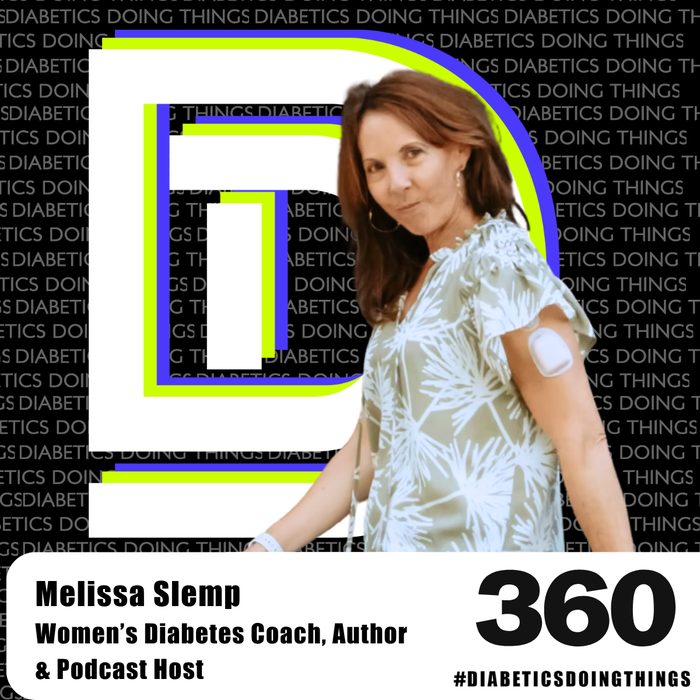
Highs, Lows, and Hormones: Aging with Type 1 Diabetes with Melissa Slemp


Episode summary
Melissa Slemp has lived with type 1 diabetes for 44 years, since her diagnosis in 1982 before glucometers existed. She describes early management with vials, syringes, and urine strips, a high-risk pregnancy in the 1990s, and her recent switch to an Omnipod after more than 40 years on injections. She and Rob discuss how she met her husband, who also has type 1, after he responded to her low blood sugar as a paramedic. The conversation centers on what happens to insulin needs during perimenopause: Melissa explains how falling estrogen and rising progesterone drove her basal insulin needs to nearly double, with no diagnosis from doctors at the time. She talks about hormone replacement therapy, self-blame, and the gap in diabetes research on women, which led her to write 'Highs, Lows, and Hormones.'
Key takeaways
- Melissa was diagnosed with type 1 diabetes in 1982, at 14, with no glucometer and only vials, syringes, and urine strips to manage it.
- She stayed on injections for more than 40 years before switching to an Omnipod about a year and a half ago.
- During perimenopause, her daily basal insulin need rose from 9 units to 15 within a year, driven by falling estrogen and rising progesterone, with no explanation from her doctors.
- Hormone replacement therapy stabilized her blood sugar and helped her feel like herself again after years of frustration.
- She wrote 'Highs, Lows, and Hormones' because most endocrinologists and OBGYNs aren't trained in how hormones affect blood sugar.
Chapters
- — Cold open and introducing Melissa Slemp
- — Welcome, and 44 years living with type 1 diabetes
- — Diagnosed in 1982, before glucometers existed
- — Reframing: the best and hardest time to have diabetes
- — Growing up rural with limited access to healthcare
- — Early management: injections, mixed insulin, urine strips
- — A high-risk pregnancy in the 90s
- — Switching to a pump after 40+ years on injections
- — How Melissa met her husband, also living with T1D
- — Introducing the hormone and diabetes connection
- — Rising basal needs and insulin resistance in perimenopause
- — Community stories and menopause's hidden career toll
- — The gender gap in diabetes research
- — Hormones, GLP-1s, and insulin as hormone therapy
- — Advocating for yourself with doctors and specialists
Show notes
Melissa Slemp has lived with type 1 diabetes for 44 years — since she was diagnosed in 1982, before glucometers, before CGMs, back when insulin came from vials and syringes and "boiling your needles" was still a recent memory for a lot of people. In this episode, she and Rob trace that whole arc: what early management actually looked like, the high-risk pregnancy she navigated in the 90s, and the moment — after more than four decades on injections — she finally switched to a pump. If you've ever wondered what it's like to hand over that much control after that much time, this is the conversation.
But the real heart of this episode is the part almost nobody is talking about: what happens to blood sugar when a woman with type 1 diabetes hits perimenopause. Melissa walks through her own experience of watching her basal insulin needs climb for no obvious reason, the years she spent without an explanation, and what she eventually learned about estrogen, progesterone, and insulin resistance — knowledge she says she had to dig up herself, because most endocrinologists and OBGYNs simply aren't trained in the overlap. That research became the reason she wrote Highs, Lows, and Hormones, a survival guide for women navigating diabetes from their monthly cycle through menopause.
Along the way, Rob and Melissa get into hormone replacement therapy, why so many women blame themselves before they ever think to blame their hormones, and the bigger pattern underneath it all: how much of diabetes research and care has historically centered men, and what it costs women when it does. There's also a genuinely great story about how Melissa met her husband, who also lives with type 1 — on the side of the road, of all places.
This one's for anyone managing type 1 diabetes as a woman, anyone who loves someone who is, or anyone who's ever felt like their body changed the rules without telling them why.
Chapters
00:00 — Cold open and introducing Melissa Slemp
01:21 — Welcome, and 44 years living with type 1 diabetes
02:24 — Diagnosed in 1982, before glucometers existed
04:03 — Reframing: the best and hardest time to have diabetes
04:59 — Growing up rural with limited access to healthcare
07:09 — Early management: injections, mixed insulin, urine strips
07:46 — A high-risk pregnancy in the 90s
08:13 — Switching to a pump after 40+ years on injections
10:24 — How Melissa met her husband, also living with T1D
13:06 — Introducing the hormone and diabetes connection
20:14 — Rising basal needs and insulin resistance in perimenopause
25:25 — Community stories and menopause's hidden career toll
29:44 — The gender gap in diabetes research
33:04 — Hormones, GLP-1s, and insulin as hormone therapy
36:03 — Advocating for yourself with doctors and specialists
Questions this episode answers
Does perimenopause affect insulin needs for people with type 1 diabetes?
Yes. Melissa Slemp says falling estrogen makes the body more insulin resistant, and rising progesterone in the back half of the cycle adds more resistance, which combined during perimenopause to make her blood sugar unpredictable for years.
How much did Melissa Slemp's basal insulin increase during perimenopause?
Her daily basal dose rose from 9 units to 15 units within about a year, with no clear explanation from her doctors at the time.
Did hormone replacement therapy help Melissa Slemp manage her blood sugar?
Yes. She says it stabilized her insulin resistance and has remained a key part of her management for seven to eight years.
What insulin pump does Melissa Slemp use for type 1 diabetes?
She uses the Omnipod 5, after more than 40 years of managing type 1 diabetes with injections.
Full transcript Searchable, with timestamps
Rob Howe: What's up, podcast listeners? I'm on the road, on my way to Friends for Life, where I will be this week, enjoying the 2026 Friends for Life conference. Our guest this week is Melissa Slemp. She's a longtime type 1 diabetes advocate, the author of Highs, Lows, and Hormones, and the host of the Type 1 in Midlife podcast. So be sure to check that out. The book is available on Amazon, and we will include that in our show notes. Melissa shares with us today what it was like to live with type 1 diabetes for more than 40 years, from her diagnosis in the early 1980s to navigating today's technology and the changing realities of aging with diabetes. So this conversation goes deep into women's health, hormones, perimenopause, menopause, and how those shifts in your life can affect your blood sugar in ways that are often overlooked and understudied and under-discussed in the diabetes community. Melissa opens up about the frustration of searching for those answers and finding them in the community, which is why she turned her experience into the book and a mission to help other women feel validated and supported. Later in the interview, we also talk about Melissa's husband, who also lives with type 1 and the support they provide each other in their relationship and how they found each other, which is a really good story. So please enjoy this interview with Melissa Slemp. Guys, who was MVP of the chat? Rob Powell! Rob, what were you on?
Melissa Slemp: We need more of that.
Rob Howe: Welcome back, podcast listeners. Very special episode for you guys today. As you know from the intro, my guest today is Melissa Slemp. And Melissa has lived with type 1 diabetes for 44 years and is also the author of Highs, Lows, and Hormones, a survival guide for women with diabetes from monthly cycles to menopause. And I think that's what I really want to start this conversation in. And Melissa, first of all, welcome to the show.
Melissa Slemp: Thanks for having me, Rob.
Rob Howe: Well, it's my pleasure. And I want to hear more about your life with diabetes. I think specifically myself living with diabetes for 21 years. As we continue to age, it's important for us to remember how far we've come for people today. You know, they may be prescribed a CGM or an automated insulin delivery pump on day one with diabetes. And 44 years ago, it certainly was not the case. But I also want to focus on a really important topic, which is women's health with diabetes, which I don't have to manage myself personally, but it's definitely something that we want to highlight on the podcast for our female listeners as well as our caregivers. So welcome. Let's talk a little bit about your diagnosis and what you remember from 44 years ago.
Melissa Slemp: Well, I was 14, almost 15. So this is in 1982. And things like this right here, the technology wasn't, the audio, video, all of that. It's interesting when you can think back. I'm assuming you were born. I'm not even sure.
Rob Howe: No, I wasn't. I was not born yet.
Melissa Slemp: Okay. Six years until I was born. Okay. Let's put it in perspective. Again, 1982, there wasn't much. I had the typical signs of DKA, basically. And it's interesting because at the time, DKA wasn't even a term. You can fast forward and say right now, it's definitely talked about that extreme state. And I don't even know what my blood sugar was upon diagnosis, which is even stranger, But a very strong disconnect. Both my parents, where we lived, our access to health care, very minimal, no glucometer. I didn't have a glucometer for years. Just doing the vials of insulin and the syringes back then. At least I wasn't boiling my needles because, as we know, there was times when that was happening.
Rob Howe: And not too long prior to your diagnosis, that was the reality for many people.
Melissa Slemp: Yeah. And I think that's the relative term, too, is the fact that you do what you can with what you have. And even now in this very modern age that we have and the technology we have, I think still sometimes we wake up and we're wishing we had this. We wish this was better. But when it all comes down to it, we are thankful for what we have at this particular time. So there's no better time to be a diabetic diagnosed. I guess now is the time.
Rob Howe: I used to say that actually in some of my speeches and it's top of mind for me this week. I went down to a diabetes camp in central Texas earlier this week. And similar to you, I was diagnosed with diabetes before every single kid at the camp was born. So that was a new one for me. And I used to say, and I was going through my various presentations that I give, and my audience normally is adults or young adults or caregivers. And so how do I adapt that for elementary school children to where it's accessible and also entertaining enough for them to not fall asleep in their seats? And one of the slides that I found from an older presentation is, you know, this is the best time to live with type 1 diabetes. And I think where I was presenting that was from the holding new things in both hands where, yes, it is the best time. Also, it's still really hard and there's still all of the challenges that we focus on and have to overcome on a daily basis. But like you said, going from 1982, you had mentioned access to health care. Did you grow up in a small town or a rural area?
Melissa Slemp: Yes, I sure did. I don't even remember doctor visits. We were in the process of moving from New Hampshire back down to Florida. I was actually born in New Hampshire. A lot of moving around as a kid, which did not make it easier. I think it's another example of adaptability. I kind of grew up in that environment. where I just learned to survive and adapt. And I think unfortunately, maybe fortunately, I used those same tools for many years with my diabetes. It was just black and white, cut and dry, do it, survive, you know, do what I had to do. So I was not as connected with it emotionally. I was very practical with it. So it's interesting that years later, I turned this into an opportunity to walk alongside other women and coach. And I've learned a lot about my own just trying to get more emotionally attached, which sounds funny, but it's true because we've got to pay attention to how we're feeling with this disease in order to, I think, to have a better relationship with it. So I always say I learned a lot along the way with the women and the people that I've met, you know, that also, yeah.
Rob Howe: I feel very connected to that idea as well. The difference of like 23 years from between our diagnoses. But I was also very practical at the beginning. To me, the diabetes care was the gateway to my athletics career and pursuits where if I could keep the numbers in the right place, then it opened up the opportunity for me to be who I wanted to be. And it wasn't until later that I understood like all of the, I actually am sort of grateful that I didn't understand all of the inputs to my glucose at the time. Maybe I wasn't ready for it. Emotions are a huge part of glucose management and affected in a myriad of different ways. So to learn that down the line is really interesting. And I think at the same time, there are days where there are emotional challenges outside of diabetes and I have to still turn on and activate that practical side of my brain just to be able to kind of manage everything going on at once. And I think now, again, back to the, this is a great time. I have a lot of help from the technology side and from the rapid acting insulin supply side of things to help me where back in the early 80s, folks did not have that. So let's talk a little bit about your journey. What do you remember even practically, but what do you remember about your early years with diabetes, giving those injections, mixing that insulin, not having a glucometer? I assume you were doing the urine strips to see if you were in range. Absolutely. Yeah.
Melissa Slemp: Yeah. Well, you know, I just kind of went through the motions for 10 years. And when I was 25, I was just married. So this was my first husband. And the great news about this is that we can go on. And we're all examples of this as far as, you know, women. And in those days, we were even told that having children was going to be something you'd have to do delicately. I successfully had a daughter. She was, again, it was very, a lot of tests, a lot of ultrasounds, a lot of, you know, you're put in that high risk category, which I completely understood at the time. And again, this was 1996. So no CGMs. Okay. I was still using insulin pen. So I'm just newly on an insulin pump, which is something maybe you don't realize, something I haven't had a chance to tell you, but I just got on a pump a year and a half ago. So I did injections for 42, 43 years. Incredible, right? I figured it out. It wasn't broke. So I didn't take that step to fix it, but real happy to be on a pump now. But let me pause on that for a second, because I think it's really important.
Rob Howe: I also had the idea, you know, 10 years in, if it ain't broke, don't fix it. I'm fine. I don't need a CGM, all of these things. And I was wrong about those. I learned and continue to evolve. After 40 years, I imagine that you had to relinquish quite a bit of control to the insulin pump and going through that transition. What was that like for you? Just going from something that you were so familiar with managing on your own for so long and kind of giving up a little control to try something new.
Melissa Slemp: It's definitely a surrender for sure. I don't think I would have done it if I wasn't as secure. And I think this goes for any sort of management. I don't think a specific pump or tool is going to solve your blood sugar woes. I really think it is our relationship and our understanding of whatever it is that we are using that we can figure it out. So I was at a really confident place using MDI. I used the smart insulin pen. I don't know if you're familiar with that. So that had a lot of cool tools. It spoke to my CGM and had a lot of data feedback that really helped. So I was really close to being on a pump sort of kind of a feedback system.
Rob Howe: Was that the InPen?
Melissa Slemp: Yes, yes. Great, great tool.
Rob Howe: Yeah, I used that for about six months. I took a pump break and it really helped me to be able to see like insulin on board and the reminders for your long acting insulin. Because after so long on a pump, I, you know, my muscle had atrophied a little bit and reminded myself of that.
Melissa Slemp: So I think it was a good time because I was assured that I kind of knew my settings and then I could kind of let go and just let the pump do the thing. I'm on Omnipod. So and that's another thing, too, because I'm very active. I'm sweating most days. I cleaned up pretty good, I guess, for the interview today. But we're real athletic. My husband, he also lives with type 1 diabetes. And we manage this disease with exercise and good, healthy foods. So a tubed pump wasn't an option. So I had an opportunity to learn more about the Omnipod 5 when I saw them at a conference. And I just kind of went for it.
Rob Howe: I want to get into your expertise really quick, but I got to talk about you. You mentioned you and your husband both live with type 1 diabetes? How did you guys meet? I love these questions.
Melissa Slemp: And they're all these long, long answers. So I don't want to have to put you. No, he this is really interesting. He's been living with type 1 for about 40 years. He was diagnosed when he was in medic fire school. So he spent over 30 years as a paramedic and a fireman also managing type 1 diabetes. So that, you know, that just takes a whole other scope of a human being. Right. Yes. Yes. And yeah, the talk about an unpredictable job when you're sleeping in the firehouse. You don't know when you're going to be woke up for a call. You're trying to maintain your own health while you're helping somebody else's. So, yeah, needless to say, he's got stories to tell. So I was actually low on the side of the road. I had my daughter in the car when he came to, you know, he was a medic. So he came as he was doing his job. And that's how we kind of met. That was kind of the run in.
Rob Howe: That's like a diabetes meet cute. It's like you never know.
Melissa Slemp: That's his favorite story, though, of course. I'm sure. I'm sure it is. To this day, that's the story he loves to tell. So, yeah. But fast forward, I actually divorced my husband at the time. He had nothing to do with that. This was just a pure coincidence. And about five, six years later is when we kind of met and fell in love and got married. So, yeah, we've been married about 13 years now. So, yeah.
Rob Howe: What's it like for the both of you? I'm sure there are days where either your sugars are out of whack or you've had a difficult day and you maybe say things that you don't mean, but how does diabetes show up for both of you in your relationship? You talked about you manage it together with exercise and healthy food, but having that alignment, I'm sure, is really helpful. But how else does diabetes show up in your relationship?
Melissa Slemp: You know, I think it's how we're responding to highs and lows, and we can all relate to that. If this is a life that you're living as well, I think there's the understanding of why we're maybe responding or acting different with a high or a low. Some days it can be really bad, depending on where we're both at with our blood sugar on that day. But I think over the years, it's just kind of learning who we are with those responses and how we kind of bounce off each other. So in theory, I think it does help because there's an inborn understanding of what it's like. So nobody gets it more than your spouse does, right?
Rob Howe: Right. Yeah. I think that level of understanding, you know, until you really live with something day in, day out for as many years as the two of you have, like, you know, there's basically no scenario with diabetes that you would have to explain to the other person at this point, right? Been there, done that, yeah. Okay, well, I want to shift the conversation a little bit to benefit from your area of expertise. It's really important to me this year to highlight research and strategies for managing type 1 diabetes as a woman, and specifically the challenges of hormones and navigating cycles and phases, and your particular expertise as the host of the Type 1 in Midlife podcast, where we're talking about the intersection of diabetes and hormones and menopause. And it's not something that we have talked about enough on this podcast. And I think my listeners would really benefit from a little bit of overarching discussion around hormones and type 1 diabetes for women, because I've said it before, I'll continue to say it. One of the best life hacks in type 1 diabetes is to just be a man and not have to worry about those hormones. So that's a long question, but I'd love to just start sort of with the basics and tell Tell us a little bit more about type 1 diabetes and the Type 1 in Midlife podcast.
Melissa Slemp: I'm going to start at the beginning because I think I stumbled for years not knowing that it was something that I couldn't get help with. And I'm talking about just a hormonal impact on blood sugar. Basically, that's really what this connection is. So, I mean, again, it goes back to the practical things that we mentioned. But on top of that, it's the emotional attachment of what happens to a woman, especially as she's aging. And the disconnect from, well, and you probably know this, just the medical environment and the system, unfortunately, it's getting better. I mean, it's very, very slow, but there is more awareness. And we are talking about menopause now. And perimenopause now is something that's a little bit more known as far as what that is and what that means and when it happens. But the diabetes community, we've kind of had to figure this out on our own. It's just nuanced, isn't it? We're not necessarily hearing it from our OBGYNs. They're actually the ones that are least to know about this, which is unbelievable because you would think they would be more attached to the hormonal system, but they really aren't. They're not even trained in this. And then endos, and you think endocrinology is the study of hormones, right? You think about all the hormonal systems. And I think the most important thing is for, again, this is the research and the reading I've done. Again, this information is not hidden. It's just not talked about. It's like one of those things where you've got to kind of pull it out from, you know, underneath a rock. And I think as women over the years, we see the difference, we feel the difference as we are having our monthly cycle and how that looks and feels with our blood sugar and emotions and all of that. But as we're getting older, it's still not recognized because perimenopause is really, really where the chaos really begins and ends. And it can last up to 10 years. Again, different for every woman. And it's a different experience for every woman. But guess what? Diabetes is a different experience for every woman. I was just going to say that.
Rob Howe: I was just going to say that. I was like, what a, you know, really it comes down to like such a different slice of the same pie, right? Right. Like diabetes affects everyone is affected by diabetes. It doesn't discriminate. We love to say that. And because of that, every different type of person can get diabetes. And then every different person has a different response and ages differently. And so there isn't a this is how it's going to be exactly for anyone for both of these things, which I think, you know, obviously lends itself to chaos and inconsistency. and I'm sure many years in trying moments of frustration for women. And then, like you mentioned as well, no direct specialist in your typical healthcare team or your endocrinologist or your OB. And then you think, okay, well, who do I talk to here and how do I find this information? And it sounds like your journey was just to continue to look and search until you were able to find the information you need. And not everybody has that sort of determination or curiosity.
Melissa Slemp: Exactly. So I consider that my reason. And I think you found this as well as somebody who's turned your disease, your diagnosis into a purpose. And it's interesting because when you're in it and you're experiencing it and you don't realize that this is so important, that this is not something that we need to keep to ourselves or stop learning more about so that we can help others. And that really is what my podcast is about. and the reason I've decided to write this book, it needed to be put in print. It needed to be a reference guide and available. And I purposely started, you know, the whole model of it. It's funny because when I was writing it, I was, I'm in post-menopause now. So I got through the chaos. I'm on the other side. And trust me, ladies, there is hope on the other side. And if you read the book, you will figure that out and you will find ways that you can do it as well. I'll just do a shout out to Ginger Vieira. She's a great friend and a big inspiration for me. And she, we've been back and forth for years. She's been on my show. And she's like, Melissa, you just got to write a book. This is so needed. You've got the stuff. You know what you're talking about. Put it down. And I had to sit in it for a little while, which I think is a good thing. I don't think being impulsive about a decision like that is always good. But I just rolled with it. And then she introduced me. She's like, I just met this doctor. And I'll do a shout out because she's one of my contributors to the book. Dr. Vanessa Severo. She has a practice in upstate New York. And she's like, well, she lives with type 1 diabetes. This is Dr. Vanessa. She is an OBGYN and she's a menopause specialist. She's undoubtedly even more excited about this book than I am, if that's possible, because she sees the need. She's experiencing it herself. And then she understands the disconnect in the medical environment and how much this needs to be. Again, it needs to be available for
Rob Howe: us women. So, yeah. Well, a couple of things I want to touch on there. First of all, props to you for sitting down and writing a book, because as somebody, you know, I don't talk about this a lot. I did write a book in 2024. It's about basketball. It's not about diabetes. But I had always imagined myself as a person who wrote a book, but I had never actually finished one. And so I set that as a goal to finish it. Whether I publish it or not, I don't know if I will, but I have written it. It does exist. So I think that checked the box in my brain. So So thank you for turning your passion, insight and discovery into something that can be used. It's tangible. That's in print. And I think Ginger's advice on that is really solid. And she's written a number of books of her own. And I think at time of recording, at least today, I've noticed I haven't quite dug in all of it. I think she's having a difficult day on social media. So I do want to give a shout out to Ginger for all the content she creates and all the opportunities she creates for people with diabetes. her willingness to give of herself and really dedicate her career and her life to diabetes education is excellent. So shout out to you, Ginger. I hope you hear this. So then I guess the question for me becomes like tactically, let's get back to practical because you and I are both practical people. So for the person who's listening and has no idea, either they are a parent of a young person with diabetes or they're a man like me living with diabetes or they're just getting started on their diabetes journey as a woman, like what are some of the things that they need to know regarding their hormones and their monthly cycle and their diabetes
Melissa Slemp: management? Yes. And a lot of women are starting to notice this as they're aging. And again, if they're close to their cycles and in their blood sugar kind of trends, I guess. And, you know, I always say lucky us, us women, because there's a lot of women who are in menopause and going through all these changes and other diagnosis come along with hormonal changes. Things like cholesterol goes up. You know, a lot of women without diagnosed diabetes become insulin resistant. I don't know if you're aware of that. I mean, that's statistically. So guess what? That's happening to us as well. So in theory, we're becoming more resistant to the insulin that we've known to dose and to rely on for most of our life. You know, we always know that there's some variables kind of mixed in there. So that's what's happening to us. But lucky us, we have graphs, right? You've got all that data that's confirming the changes. I think one of the most profound ones is that some of the ladies that I work with is, and this is not a judgment of how much insulin we should be taking or what we're taking per day. But when you start to notice that, you know, if you're looking at your pump reports on a monthly basis or how you're just kind of looking at your trends, that you're slowly needing more insulin over time. And that's what I noticed specifically because I was on MDI at the time. So I was in my mid 40s. And again, I'm pretty, I'm really routine. I'm routine, routine, routine, which is a kind of good advantage when you're living with this disease. Routines always help me out. So suddenly my routine was not adding up. So, and just to put it into context, my basal insulin. So my daily basal insulin at the time I was taking Tresiba. I loved it at the time. It worked nine units every morning. Then suddenly I needed 10. Then I needed 11. And then within a year, I was up to 15 units of basal. Again, for somebody who's in tune with nothing else has changed and for your basal to suddenly almost double. And this wasn't a cycle thing where I needed it more, it was a pretty consistent thing where, and then of course, I was having to kind of correct with more bolus just to make up because again, certain times of the month, you're more resistant. But overall, my basal just suddenly went up and it stayed there. And nobody could explain why the doctors, you know, nobody could. So I did my own digging. And I realized that again, that key hormone, and I know you're digging for this, and it's a great question. Estrogen is that hormone. Okay, so when our estrogen drops, which happens gradually, and it does happen throughout part of the cycle, that is when we are becoming more resistant. But in the same token, progesterone, which is in the luteal phase, again, I don't want to get too scientific or about the whole phases of the cycle, but those last two years or last two weeks of the cycle is when our progesterone can go up. And that is what spurs resistance as well. So we do tend to need, again, in theory, we're requiring more insulin in those last two weeks. So what happens in perimenopause is that there is no predictability with rise and falls. We are a roller coaster throughout the month. And some months are a little easier. Some months you want to just pull your hair out. And, you know, I think that is the number one thing that I experienced, but I didn't even have a diagnosis for it. So I just went through it not knowing that it was
Rob Howe: hormonal. Yeah. I imagine that's the frustrating part is like you're describing this thing and, you know, maybe you're going to your GP or maybe you're going to your endocrinologist and you're describing this phenomenon. They don't have a name for it. They don't have a diagnosis for it. And they say, you know, in your case, you're increasing your basal, you're taking action, you're getting a result that is working for you, but you don't have an answer as to why it's happening. And your basal insulin is up 50% per dose. And, you know, you start to wonder like, well, what's happening to me? What's going on? And, you know, not having an answer, I think, is props to you for not being defeated. I'm sure there are people listening who's like, yeah, I've experienced that. I didn't even really know what it was. And I just knew I needed more insulin. Yeah. And then you tack on
Melissa Slemp: all the other symptoms. So again, the average woman is looking at the other symptoms a little more closer. They may not be as in tune if you're not pricking your finger or getting your blood test done. Met the doctor twice a year just to see what your fasting insulin or if they're looking at even an A1C. You know, these are for women not living with a diagnosed disease of diabetes. It's the poor sleep. So it's the intermittent sleep. It's the weight gain. It's the low mood. It's the hot flashes. You know, we all think hot flashes, but it's much more than hot flashes. But so what it does is it tacks on all these other symptoms that impact a woman, but really impact a woman who also has to manage a chronic disease. So if that's not a tough road without any sort of guidance, I don't know what is. We deal with the emotional burden. We deal with the day-to-day burden. And if we didn't have community and great resources to kind of tap into to kind of help us get through it, I don't know what we would do. Yeah.
Rob Howe: Well, let's talk about that a little bit, because I imagine starting your podcast and taking this discovery and turning it into advocacy and turning it into a community project where you're helping lead others along that direction. I imagine that has brought some people who had very similar experiences and feelings that you were having to you. What stands out to you as maybe one of your favorite stories going through this journey, sharing this information, this journey that you've been on? And what has returned back to you from your community, you know, within that time frame?
Melissa Slemp: Yeah, that's a great question because there's, I've met a lot of women and, you know, we're brought together for a purpose. There's one lady that came to me, it hasn't even been a year now. And she, again, she was very in tune with her diabetes. She reminded me a lot of myself because I think we're wired the same way. Very ambitious and practical and in touch with her data, but not obsessed with it. but enough to know that, hey, something is going. So she found me and, you know, we started to work together and she literally had to step away from her job. So she was in a very high, high position job. She had the resources that she could do that. So, you know, she was thankful to be able to do that. But she said, I just can't think and do what I did at the level I was based on the state that I'm in right now. So her blood sugars, again, were extremely predictable. And, you know, the poor sleep and all those other symptoms that she was feeling, she literally, she needed it, she just needed to step aside, take a sabbatical, care for herself and try to figure this out. So that's when, you know, her and I started to work together. And it's just, it's incredible. I mean, that's an extreme example. A lot of women tend to just figure it out. They can just, you know, they have some help maybe within the home and some other ways that can kind of kind of carry the load when things start to get a little heavy like that. But I think that's it's a story that needs to be shared that this it's life changing. And we know menopause for women, for the average woman, it does impact corporate America, you know, the bottom of line, just the productivity, the morale in the office. It impacts relationships. It's such a difficult time for everybody if we don't understand what's happening and really what to do about it. Yeah.
Rob Howe: You touched on this earlier, and I'm not sure, let me know if this lands the right way as a question, but I think that we are having more open discussions about menopause, like you mentioned, in corporate America. There are women in leadership positions who, whether it's political or whether it's in corporate America or whether it's even just in community where we're saying, hey, this is what I'm going through. And it's taking very similar to how we see in type 1 diabetes, where it takes someone sort of being in the public eye enough and saying, I'm managing this disease. Here's what I'm going through on a regular basis. And here's what you can know as part of this, that's sort of de-stigmatizing the conversation around menopause. Because I think it was considered, at least up until the last maybe 15 years or so,
Melissa Slemp: very taboo to discuss. Absolutely. Which is how we grew up. You know, in my generation, our mothers, grandmothers, it wasn't something that they talked about. Not to any great lengths, at least. It was just like you say, taboo. Yeah. Something that we just kind of got through,
Rob Howe: right? Or we swept under the rug, maybe. It's like, you know, it was more of the, and I think we went through this with diabetes as well and with other chronic illnesses. I think we're more open to sharing what's going on with ourselves and each other now than we ever have been. I think social media is a big part of that as well. But like this was something that was just, hey, we're not going to talk about this. We can talk about everything else, but we're not going to talk about menopause because it was uncomfortable or because for one reason or another, it just wasn't accepted. And I think that's something as we are learning and we are seeing now in diabetes research. I know there's been an announcement about Tidepool and Oura Ring are working on a partnership with a health system to help increase the amount of research that's going to women with diabetes, because a lot of the times the clinical trials that were core to diabetes management were all men or were disproportionately men. And so, you know, I think there's still a huge gap that we need to cover, not only for menopause and diabetes, but also just women and diabetes in general. Totally agree. Yes. Working with your team and with your co-authors, what is something like through the process of putting pen to paper and returning to that pen and paper every day, which I know is very difficult and like, you know, it's a long process. What's something from the process of highs, lows and hormones that you took or something new that you learned or like something that you applied or discovered that kind of like powered you to the finish line?
Melissa Slemp: I think the mission of the book, I keep going back to the word validate because I think, and that's one of the, a lot of the feedback I've gotten is like, oh my gosh, I thought it was just me. And it's not that women don't realize their hormones are changing. They didn't realize it was this bad Or they realized it was a SPAP, but they didn't realize it wasn't just them that was experiencing it the same way. They really thought it was just, you know, again, it's the self-blame. I'm doing something wrong. You know, I'm not trying hard enough. All those self-blame things that we tend to do with diabetes anyway, you know.
Rob Howe: So often we're the only people in our lives that we come across on a daily basis that have diabetes. So, you know, we see this at our basketball clinics where a kid, the first time a kid comes out to treat a low blood sugar and then goes back in, then the next kid comes out and does the same thing. And all the parents sort of like breathe this collective sigh of relief because they thought it was all them, that they were doing something wrong. And they didn't realize that how this is just managing diabetes and playing sports.
Melissa Slemp: It's very affirming, isn't it?
Rob Howe: It is when we see each other. So that's why the community aspect is so crucial. I'm not the only one having this problem. And oh, by the way, there are other people who I can speak to who have gone through what I'm going through, can validate that experience, can make me feel like, oh, I'm actually not doing a bad job at this. This is just a hard job with a lot of obstacles.
Melissa Slemp: Yes, it is. It is. Yeah. And, you know, just bringing women together and to be able to just get through it. Everybody's road to what that's going to be, whether it's their therapy settings. A big part of the book, too, you know, I talk through all the different lifestyle things that I think, you know, we can't necessarily get through it easy. We do have to be a little bit more intentional with, you know, again, our diet, exercise, sleep, all the things that we know we need to do that's going to help better manage not only blood sugar, but also those fluctuating hormones. But I'm also a big advocate and a big part of the book is educating on hormone replacement therapy. And this is, again, this is getting a lot more attention now, too. But it is life-changing for myself. I've been on it now for seven, eight years. That was when my basil was, it was just a hot mess. And then I realized that that was really what was going to help. And it did. It immediately turned all that around. It doesn't replace the habits, but it does, it gives you that, it gives you that assistance in order to kind of get things more stable. And then with that, we can continue on to do the best we can with our, you know, with those pump settings that we're, you know, that we're used to using and all of that. It's a great aid and first step. A lot of women are getting on therapy in perimenopause, which is much advised. And Dr. Vanessa in the book advises about that too, sooner than later. It's going to eliminate a lot of the frustration. And hey, we want that, don't we?
Rob Howe: I mean, we're sort of in this interesting time. Not only, I mean, I think we could maybe separate it into two different categories, but like hormones and peptides, like I've probably never been more discussed online, whether it's on label or off label in many cases. But there's also this, I think we talked about this a little bit when I went to the ADA conference in 2025. And one of my guests who was a leader at one of the high up medical device companies and founded one of the bigger pump companies maybe 20 years ago, he mentioned that this pendulum sort of swings. And where we're swinging right now is that diabetes will be managed not only with insulin as the hormone, but it will be insulin plus another hormone. It may be right now there's a lot of discussion around GLP-1s, about GIP. There's a lot of clinical trials going on to be able to prescribe some of those things to help people with diabetes. So to me, it makes sense that when you're looking at hormone replacement, I mean, insulin is hormone replacement therapy in a way. It technically is. It technically is, right? That's right. So anything, like you said, to help with that diabetes management to ease into that, because what you're saying, what you said earlier about when you go into that perimenopausal state, what causes the insulin resistance is the lack of the estrogen.
Melissa Slemp: Lack of. Yes. Yes. It fills in a gap very nicely in the perimenopausal stage, again, when the hormones are fluctuating. It's it just it's a it doesn't solve the problem, but it does make it a lot smoother and more predictable. I have countless examples of that. I share a lot of the stories in the book, which I think is important, too, that other women kind of read stories and kind of experiences that other women have experienced. And it's real important. It's real important to share that and to know that there is a, you know, this is where you are. This is what you're learning. This is what you're observing about your body. I'm big about symptoms and tracking things and utilizing that to have that conversation with the doctor. It's again, our reports are great, you know, depending on what kind of system you're using. Use that to our advantage. You know, we have the data. And, you know, one of the things that's funny, one of the most common things that we hear ourselves saying and other women saying is, I just don't feel like myself anymore. But that's a hard thing to, you know, measure on a blood test, right? Right. How do you get that blood work back telling me you don't feel any good? But a woman knows, a man knows, a man knows when, you know, we know when we're not feeling ourself. We know when things are off. We know when it's harder. And that's a big initiative with the book is just to be aware and to honor those differences. It's what your body's experiencing. It is going to happen at some degree to another. Again, everybody's experience is a little bit different. But just being aware of it and being cognizant of it and to be able to track it and communicate it again back with your health care team to find what's going to work for you. What's your next step? because suffering with it is not something that we have to settle on.
Rob Howe: Answer me this, because I imagine, and it may be Dr. Vanessa may have offered some of this wisdom in the book as well, but I imagine not everyone's doctor has knowledge about hormone replacement therapy or may not even be supportive of it in some cases. So I guess my first question is, for the people who are maybe detractors of this type of approach, what is the typical argument against this, if any?
Melissa Slemp: Yeah, good question. And I guess it depends on what doctor you're talking to and what knowledge or lack of knowledge that they don't have at this time. And this is another part of the book, too. It's really, it walks women through all of these hormones, what they are, how they work. And in some cases, and Vanessa even shared this, she's sharing it. This is actually a funny story, and I'm sure she wouldn't mind me saying it. she's in a medical practice in a building where she's got a whole team of endocrinologists. And she's like, I got my books. I am taking them to the endos. So yeah, she's like, it's going to take a village. I mean, we've, you know, we're going to have to, we're going to have to educate them. We got to inform them, you know? And I think that's really what it is. It's, it's just kind of loading, you know, all those resources up and knowing what you know. But hormones themselves, Well, being, living with a diet, you know, living with type 1 diabetes is not a contraindication. You know, there's a lot of diseases that can come along as women are aging that can just exasperate those same disease states. You know, things like when we talk about heart disease, you know, they're, you know, they're quick to put us on a statin and don't get me going on that. But, you know, all the things, but we've got to understand what's happening in the body in order to make a shared decision with the doctors. You know, we need to walk through this with them, you know, and even if that is bringing a book in or bringing your symptom tracker in or whatever it is, starting the conversation. And it's like we say too, and Vanessa agrees with this, always start with your practitioner, giving them a chance and say, hey, this is what I know. This is what I'm interested in looking into, learning more about, seeing if this is gonna work for me, giving them that chance. to say, okay, you know, let's try this. They may be educated on it, right? You never know. But somebody's got to bring the subject up and hey, sometimes it has to be.
Rob Howe: Yeah, I was going to say it is a challenge. I think it's a uniquely, you know, when you live with a chronic illness, you get really practiced in speaking medical language and insurance language. And I think, you know, my wife and I were going through a similar thing and I was just helping her talk to her insurance company and ask the right questions because we've gotten really good at it over our time living with diabetes and asking questions and making sure that we're utilizing the time that we get with our health healthcare providers, because that time is limited and it's easy to forget. I've got to write it down. Let's just have a list. Let's go on this list. And I'm not embarrassed about that. Like I was the first time I did it because I get what I want. I get better outcomes as a result. So I guess for me, the question I was leading to and you really answered it was, you know, what if your doctor isn't giving you what you need or maybe isn't capable or doesn't have the bandwidth or the experience? And it sounds like, you know, give them a chance, tell them what you want. And if not, you know, connect with your, the type 1 and midlife community is probably a good place to start to find a practitioner who is maybe more well-versed
Melissa Slemp: in that process. Yeah, absolutely. Yes. The Menopause Society is an amazing resource. yourself. And again, you can just search by zip code and kind of drill down into what kind of specialist you have. And that's definitely something I can help and kind of help women, you know, just kind of kind of navigate that search for sure.
Rob Howe: I love this conversation. I want to include links to your podcast and your book in the show notes and also to the Menopause Society so that we can get anybody who's looking for this information in our community. And I think that's what's so cool about the diabetes community is that because it affects so many different kinds of people. There's all these different stages that we're all having to go through. And by helping connect each other to those, you never know, somebody who has been a part of my community and just maybe isn't in that midlife phase yet will hear this podcast and years later know where to go when they're facing this. When the time comes. That's right. Absolutely.
Melissa Slemp: Your book's available on Amazon? It is. It is. It is out. I appreciate you bringing this conversation here to your listeners. It's real important. It's important to me as well, because
Rob Howe: you talked about we're all aging and I'll be 38 this year. I'm not the same person I was athletically, cognitively, physically that I was at 26. In a lot of ways, I've improved. I've learned a lot, but I also know the feeling of, man, I am not right. And like, even though I'm, even though I am not who I was 12, 10 years ago, I still feel like I should be able to do this. And And I know that that struggle and I know that feeling. And I hope that, you know, someone listening to this episode who feels that way now has a little bit of direction and confidence of who to talk to and where to go. So thank you for bringing that, as Ginger mentioned, putting it in print and bringing that knowledge and experience in a way that people can access.
Melissa Slemp: Thank you, Rob. I appreciate your time.
About Melissa
Melissa Slemp has lived with type 1 diabetes for 44 years. She is the author of 'Highs, Lows, and Hormones' and hosts the 'Type 1 in Midlife' podcast.