

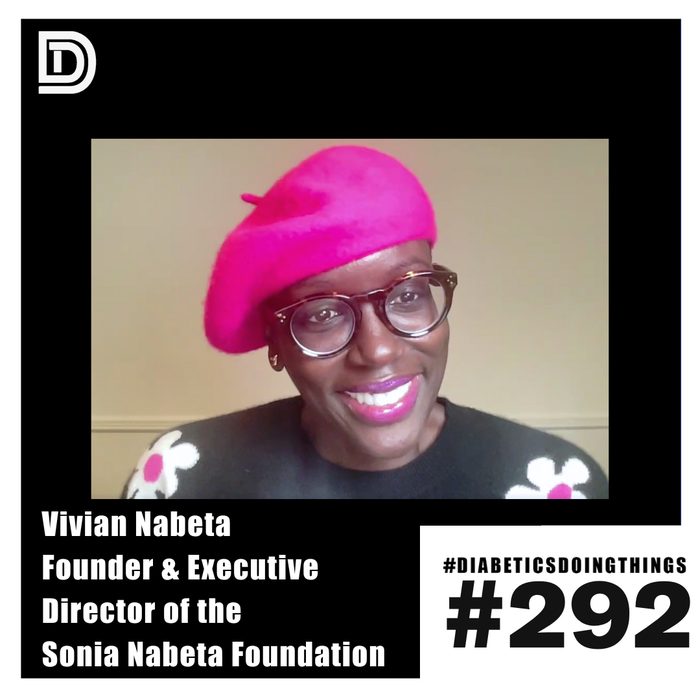
Vivian Nabeta Founder & Executive Director of the Sonia Nabeta Foundation

Episode summary
Vivian Nabeta runs the Sonia Nabeta Foundation, started after her sister Sonia died of type 1 diabetes in Uganda in 2015. The foundation now runs 33 clinics in Uganda, one in Ghana, and camps in Malawi. Vivian describes diabetes care in rural Uganda: people traveling tens of kilometers to reach a clinic, no electricity to charge an insulin pump, and only four pediatric endocrinologists in the country. She explains the warrior coordinator program, where people with diabetes are trained to support nurses and mentor patients at clinics, and plans to get that training certified so coordinators can work as educators elsewhere. She and Rob also discuss what advocates from low-resource countries face at international conferences when treated as token speakers, and what real support should look like instead.
Key takeaways
- Vivian Nabeta says the Sonia Nabeta Foundation runs 33 clinics in Uganda, one in Ghana, and partners on diabetes camps in Malawi.
- She says warrior coordinators, people who have lived with type 1 diabetes for at least five years, support nurses and mentor patients at each clinic.
- Vivian says Uganda has only four pediatric endocrinologists in the whole country, so nurses and clinicians run most diabetes care.
- She says some patients in rural areas cannot keep insulin pumps or CGMs charged because they have no reliable electricity.
- Vivian says the foundation is launching a certified education curriculum this November so warrior coordinators can work as diabetes educators beyond Uganda.
Show notes
The Sonia Nabeta Foundation was founded in 2016 to support people with type 1 diabetes in low-resource settings, particularly in Africa. The organization currently operates 33 clinics across Uganda, 1 clinic in Ghana, and partners with organizations in Malawi to host diabetes camps.
Main Topics Discussed:
Overview of the Sonya Nevada Foundation's work and mission (00:03:13)
Challenges faced by people with diabetes in rural Uganda, including access to insulin, syringes, and healthcare providers (00:05:42)
The role of "warrior coordinators" - community members with diabetes who support the clinics and educate others (00:06:34)
Efforts to build sustainability and ownership within the local communities (00:08:34)
Importance of highlighting global patient stories and experiences at diabetes conferences (00:32:04)
Ways for the diabetes community to support the work of organizations like the Sonya Nevada Foundation (00:53:06)
Where to Find:
Sonia Nabeta Foundation
https://www.instagram.com/sonianabetafoundation/
Credits:
Produced by Eritrea Mussa
Questions this episode answers
How many clinics does the Sonia Nabeta Foundation run?
The foundation runs 33 clinics across Uganda, one clinic in Ghana, and partners with organizations in Malawi to host diabetes camps, according to founder Vivian Nabeta.
What is a warrior coordinator?
Vivian Nabeta explains that a warrior coordinator is someone who has lived with type 1 diabetes for at least five years, is over 21, and supports the clinic nurse while mentoring and educating other patients.
Why was the Sonia Nabeta Foundation founded?
Vivian Nabeta's family started the foundation in 2016 in honor of her sister Sonia, who died from complications of type 1 diabetes in Uganda in 2015.
What makes managing type 1 diabetes hard in rural Uganda?
Vivian Nabeta says patients can live 30 kilometers or more from the nearest clinic, often lack electricity to charge devices like insulin pumps, and the country has only four pediatric endocrinologists total.
Full transcript Searchable, with timestamps
Rob Howe: Hello and welcome back to Diabetics Doing Things. Really excited to introduce you to today's guest and I wanted to give a little background information about the Sonia Nabeta Foundation prior to the interview. The Sonia Nabeta Foundation was founded by the Nabeta family in honor of their daughter and sister Sonia Nabeta who fought a valiant fight against T1D until she joined the Angels on August 5th, 2015. And our interview today is with Vivian Nabeta, the founder and executive director. And our aim for this interview is to talk about patient advocacy organizations who are having an extreme impact globally for people with diabetes who do not have the same resources that we have here in the West. So I really want to create awareness about the privilege that we have living with diabetes in the United States and other developed countries by offering the perspective of what it's like to live with type 1 diabetes and type 2 diabetes in places like Uganda. So please enjoy this interview with Vivian Nabeta. All right, hello and welcome back to another episode of Diabetics Doing Things. We are telling the amazing stories of people with diabetes all over the world. I want to focus on all over the world because we're going to have a very international lens to our conversation today. And I also want to talk about the amazing work that our diabetes advocacy organizations and patient advocacy organizations throughout the world are having. And that was really the impetus which led us to this conversation today with Vivian Nabeta, the founder and executive director of the Sonia Nabeta Foundation. Vivian, welcome to the show. Thank you so much for being here today.
Vivian Nabeta: Thanks for hosting me, Rob and Eritrea. I'm so glad to be here. It's been a long time coming, this conversation, so I'm glad to sit
Rob Howe: with you today. We're so glad that you're here as well. And it has been a long time coming. And I want to at least add a little bit of color commentary for how I was introduced to SNF via social media. It's probably been six or seven years now. And there was some work that you guys were highlighting about camps in Uganda. And I really would love to give this opportunity for you to introduce our listeners to who Sonia Nabeta Foundation is and the work that you guys are doing in Uganda and globally for people living with diabetes. Because what we know is even though diabetes is difficult and challenging, no matter where you are, there are specific challenges for our brothers and sisters with diabetes overseas and in less developed countries that we in the West just do not have, that we don't face. And while healthcare costs and being in line at the pharmacy and stigmatizing comments certainly are difficult to navigate. There are very real challenges that our brothers and sisters face that we don't have to face. So why don't you just
Vivian Nabeta: give us the overview? The overview, I guess, of the SNF. We are probably in our eighth year of existence. We were founded in 2016 legally. However, our work didn't really take off until 2020. And we at SNF believe, I think our vision is very colorful. It's one that we believe in a world where children with type 1 diabetes in Africa have an equal chance of long, healthy, productive, and gainful lives. I mean, it's simple, but getting there, the journey there is really hard. We currently work in three countries. Uganda, we run out of 33 clinics all over the country. And in Ghana, we have one clinic that we work out of. And then in Malawi, we partner with partners in health to host camps there for children with type 1 diabetes. We are yet to brick and mortar over there, but really we are community builders and our work really does focus on the clinical aspect. Sure, that's what we believe is 20% of the outcomes. The good health outcomes come out of access to insulin, access to a syringe and all the clinical pieces. However, the other 80%, which is the socioeconomic piece, psychosocial piece, the social determinants of health is where we really want to make a difference. Because as you said, the struggles of diabetes worldwide are there just from having the condition. However, if you're faced with abject poverty, that's a new dimension that needs to be addressed for you to have a chance at long, healthy,
Rob Howe: productive and gainful lives. Well said. I think starting with the basic access, you mentioned syringes and or test strips, things where in the US, we're talking a lot about insulin access or CGM access. And in the UK, automated insulin delivery is now the standard of care. The rest of the world is further behind. And I want to applaud you. First of all, you said, from 2020 to now, to be in 33 clinics across Uganda is just dramatic amount of work and impact. So will you tell us a little bit about as you've been involved with life with diabetes in Uganda? Let's start with Uganda specifically. What is the day-to-day diabetes management or even just lifestyle like for a person with diabetes in Uganda? And how has the presence at these clinics really impacted those populations in a very short time?
Vivian Nabeta: Okay, that's a big question. And I think I'd like to break it up into or maybe just spotlight the fact that Uganda, like any country, has an urban setting, perhaps a rural setting. And I think the difference would be a rural setting in Uganda or Ghana or Malawi is like it's, you know, 80 percent of the country is rural. And so that a warrior in the rural setting fundamentally faces different challenges than one in an urban setting or peri-urban setting. So that distinction is actually important. So there's disparities at the global level, country level, right at the local level. And these are tricky to address. But we do understand that broadly speaking, the challenges are at the very least related. So for a warrior that's in a rural part of Uganda, let's say Lira. Today, right now, we're hosting a camp in Lira, a four-day camp. And some of the things are emerging out of there, Lira is in North Uganda. It's rural. And it's basically a town that was ravaged by a lot of warfare and all of that. So poverty is endemic. And so a warrior that hails from Lira, the closest clinic that they have to get to is probably like 30 kilometers from that, which is the Lira. Our clinic there is at the Lira Referral Hospital. So there is the challenge of actually getting yourself to the clinic. And that's why SNF, when we talk about the socioeconomic piece, one of our programs, one of our largest programs, Project Boda Boda, which is anchored at these clinics, is literally aims at addressing just getting to the clinic. First and foremost, get to the clinic. So this is the socioeconomic piece that I'm talking about. So of course, when you get to the clinic, the way the clinics are set up, we very much believe in the lived experience being a core part of our care model. So you have a nurse at the clinic. All our programs are nurse-led or clinician-led because I'm sure we're going to speak about this. The capacity of diabetes experts at the doctor level is virtually non-existent. So we do have to, we live and die around the nurses and the healthcare workers and clinicians. So anyway, each clinic is at the helm is a nurse or a clinician. And that nurse or clinician is supported by job description that we call the warrior coordinator. Now, what's a warrior coordinator? Warrior coordinator is somebody who has lived with type 1 diabetes for at least five years, is over the age of 21. They've gone to school so they have basic English education, understanding of English, but also speak a local language. So their role at the clinic is really to support the nurse with mundane tasks, but also to educate. So we're hoping that the lived experience and the disease proficiency at the warrior coordinator level does pass down to the warriors that come to the clinic. But also more than that, the mentorship, the inspiration to want to be a role model at the warrior level and all other peer support is really anchored in this warrior coordinator. Moreover, I think what's important to understand is that there's a lot of non-profits and donation environment in low-income countries in Africa, Southeast Asia, whatever, but we're not going to exist forever. So you do want to build into your programs a level of ownership. And we believe that with warrior coordinators right at the clinic, they're invested in the clinic succeeding. And so with that, if it comes down to we're trying to mobilize the local government to then support the clinic going forward, organizations like potentially CDIC, the Novo Nordisk Insulin Program, or Life for a Child, which brings Eli Lilly Insulin into the country, when they go away, we at least have a galvanized and an activated community at the clinic level to really ensure that care continues, even if it's in a shaky way. So that warrior coordinator role at the clinic is exceptionally important. And we find that it does galvanize the community and we have high engagement at the clinic level, which is great. I am really good friends with one of your program warriors. Hamida is a good friend of mine. She is amazing. I met her in Abu Dhabi. And I think that is what really why I was like Rob we have to have them on the program because there was just so many things that she made a room of people who had never had to consider these types of disparities before like when she was talking about load shedding which I thought was so interesting when she was like think about having to charge like me I constantly never have my pump charged like notoriously I never charge my insulin pump because whatever and when she was standing there at the front she was explaining to us how you can't even keep your devices charged in some areas because there is no electricity literally so the option of technology even if your family could afford it which most of them cannot is not even on the table for you so that to me was so unbelievably perplexing and also just like very like it put your feet on the ground you know what i mean like come back to reality which is that most people don't have the access to these things or to
Rob Howe: providers at all. Well, I also, I want to reiterate too, like when we think of developed countries and there's some sort of principle and I'm paraphrasing here. So if you're out there listening and you have the principle, please message me. But it's like when you experience technology so frequently that you begin to take it for granted. And the talk that I was listening to, he was talking about Amazon Prime's like buying with one click button. At one point that was a tremendous innovation. And now we take it for granted here in the West. So when you think about infrastructure, we take for granted in the United States, electricity, plumbing, air conditioning in Texas. You know, if you were born in the last 50 years, you just take as part of the way of life. So to translate that to Uganda and these rural communities throughout Africa, that's just not
Vivian Nabeta: the case. That infrastructure doesn't exist. No. And if you think about some of the basic necessities of living with type 1 diabetes in Uganda, Ghana, Sub-Saharan Africa. I mean, you have to take it right from, not to be philosophical, but Maslow's hierarchy of needs. We're still very much at the bottom of the pyramid. Your physiological needs are hardly met. Food, water, clothing, shelter. These are the basic needs at the bottom of the pyramid. So we're still struggling with those. Then you think about the next level of the pyramid, safety and security? Do I live in a safe environment? Am I secure? Do I have family? So I think these considerations on this global stage are very important to highlight because, like you say, Rob, taking these things for granted, we're still very much behind on many things. And these considerations are very important in conversations like we're having today.
Rob Howe: I also want to go back to specifically the warrior coordinator role. And you talked about sustainability of this impact. Like you said, this may not last forever. We can't guarantee that the infrastructure will always be in place. So we've got to build, at least at a grassroots level, a sustainable and just have these warrior coordinators meeting with these healthcare workers to at least establish some sort of network of knowledge, share, and community support. And what you're also describing is like community support impacting public health outcomes, on honestly one-to-one basis, which is something that Airtray and I talk about a lot in terms of a friend with diabetes is a friend indeed, because they can give you information that otherwise you may not have ever found, even if you have access to the internet or other resources. So how do you and SNF identify these warrior coordinators? You listed the criteria, where do they come from? And how have you built this framework in these, just in Uganda, for example, the 33 clinics to leave a grassroots framework for impact long term?
Vivian Nabeta: That's a very good question. Initially, so when we set out in 2020, it was COVID that really jolted us into, geez, what's happening? There's a humanitarian crisis. We got to do something. So when we started out back then, during COVID, there was an access to clinic issue. Uganda, having been a record holder, the longest and most strictest, you know, COVID regulations, we really suffered. And so because of the community we had built before 2020 through the camp program that we had, when COVID happened, we were getting jammed with, oh my God, we can't get to the clinic. Oh my God, how do we get insulin? Oh my, it was a humanitarian crisis. And so how do you intervene? And so it was in that COVID crisis where the older warriors are sort of emerging. Oh, I can ride a bike and go here. Oh, I can do this. Oh, my father is a boda-boda driver. Boda-boda, by the way, FYI, is a motorcycle taxi, a local term for a motorcycle taxi in Uganda. So we were coordinating through those boda-bodas to deliver insulin, whatever. So a program was developed out of that, but it was really seeing that it's the older warriors that are willing to do this extra work. So it was like, ding, ding, ding. We have a resource here. And so now with the clinics that were being established within the hospital network in Uganda, it was a question of, okay, so insulin comes in Uganda, there's two insulin programs. The CDIC program, which brings insulin from Denmark, Novo Nordisk insulin, and Life for a Child, which brings in Eli Lilly insulin. So insulin access technically is there if you can get yourself to the clinic. So it was just a matter of now organizing around this insulin delivery system. Okay, how do we then dedicate a nurse? How do we then get support from the warrior coordinator, put a warrior coordinator They're there. What's their role? How do we recruit them? So we already knew the nurses exist because these facilities, we have a memo, an MOU with the government. So this government hospital, so they give us the mandate. You can go and whatever. So the nurse is provided by the government. However, their mandate is not type 1 diabetes. So you got to sort of figure out a way where you can cordon off their already strained capacity to give us a day or two to focus on type 1 diabetes. So you see, so there's really that. So we build a program on the nurse. Now, we know that on that day, for example, we have a clinic in Arua, north of Uganda, close to the Congo and South Sudan, 250 warriors. How do you see those in a month? So basically, how is capacity managed given these constraints? So you're like, OK, maybe that nurse out of their community can identify. So initially it started with them identifying people who met this criteria over 21. They can galvanize the community, whatever. So they needed to tell us we're not going to impose or do whatever you tell us as first order of business. So and also for buy in. So in other words, for the program to be successful, you want to make sure that the nurse, they feel involved in the decision making. So that's basically how it all started. We knew there were warriors in the community. We got recommendations and appointments from the nurses that were running the clinics. And then off we went. And so this is 2020. And initially, it was a one-year program. We're like, oh, we'll renew your engagement at the clinic. And so four years later, a lot of those warrior coordinators are at the clinics because it's a source of economic gain because some of them, after they finish school, there's nothing to do. And so this is like a job. And so the way we're looking at it in terms of how do we grow this warrior coordinator initiative so that it has lasting power beyond the work that we're doing. it's like okay perhaps we need to build an education learning curriculum leadership curriculum that is certified so we then have diabetes educators right in the diabetes community can we do that and so this year matter of fact in november is going to be the launch of this initiative we've put together a fairly comprehensive education curriculum which of course the goal is to have disease proficiency. Type 1 diabetes proficiency is everything. I mean, you got to understand the math, the decision that's all around understanding the condition. So we have the disease proficiency piece down pat, but also the leadership, the ethics, confidentiality. This is a medical space. So it's going to be a pretty solid program, which we're excited about and thinking that once we get it certified, perhaps with the African Society of Pediatric endocrinologist certifies it, then actually provides our warrior coordinators with skills that they can use outside SNF. So for example, if San Pontier calls and they have a diabetes crisis in Haiti and they need some warrior coordinators, they just come from this pool of certified educators and they fly them out and they do whatever. And that's an extreme example, but even like locally, next door Kenya might need something. So I think building this where You put it out there in terms of inviting people who qualify to the program. I think that's going forward going to be the way that we strengthen this initiative and put it in a sustainable space, I think.
Rob Howe: It's grand and ambitious, and it's really interesting because it starts with warriors. And we've talked a lot about warriors on this interview, but what I want to talk about is where they come from. I've seen via being connected with SNF on social media over the years. You see the camps, you see the stories, you meet the faces of the people who are living with diabetes. Talk about the warrior program, because like I see the end goal. To me, it's so exciting that these people who have come through the program could end up being certified diabetes educators in a place that doesn't even have one single certified diabetes educator and can have a lasting impact on the community, not just there, but elsewhere. So let's talk about like, where do these warriors come from? How do they come to you at SNF?
Vivian Nabeta: Okay, so then maybe we'll go back into the history of SNF and how we all got started. First of all, you know, when you're faced with a sudden unexpected loss, you can be sort of quite reactive. I mean, and so with my sister, this is why we're here for her short life. It was like, you know, what do you do? So you want to honor her. And then what she used to say back then, it was like, oh, how do people who live below the poverty line manage. This is such a financially and emotionally demanding condition. So back when we started, it was more of a, she used to say this, we should put a foundation together. We can figure it out later. You know, it was sort of like, just go, you know what I mean? And so with that background, and we thought the only thing we could do at that time was, let's see if we can build a community of people who share in this condition. So that's really the little mandate that we had grand vision nothing just that little get community going so we had our first camp august of 2016. so we pulled together again because of this insulin donation schemes that existed there were sort of warriors here and there so it was easy to get those first 65 warriors of which by the way hamida was one of them then hamida shone right off the bat you You couldn't miss her at that camp. Too amazing. She's a serious human. So they all came together. And I think Hamida is a great example, but I'll also give one Patrick Peck, Okema. He's now a certified nurse. So they came to camp as campers. Literally, let's just see this community. We were not even, I actually cringe almost, you know, back then. We were just getting them together. We didn't even have like a real organized, the way it run and how it runs right now, it's like night and day. Now we have teams. Now you have follow up after camp, whatever. Back then it was just like, let's just hang out. It was a hangout for four days. You know, we didn't have policies. So that was a lot. So that's how basically we started in 2016. So we host that camp and it was through camp experience that, okay, something is going on, community is building and they were from all over the country. So they go back to the clinic. Oh, have you heard of this? Then we set up a WhatsApp group actually as well, unmoderated. Again, this was all just build community. We didn't, it was no big vision at that time. It was really very, very emotional more than it was strategic, if that makes sense. Let's get people together, people together, people together. You know, my sister's life has to have meant something, kind of a thing, if you know what I mean. And so that's what it was in 2016, 2017. 2018 is when Chris Ruden, I think you know Chris, came to one of our camps in northern Uganda. And again, very community oriented, no clinics, nothing. And so it was through this community of camps that we started to put structures around one were identifying people that have potential. Like I said, Hamida is one of them. Peck is another. All these warrior coordinators that you see today, camp counselors, emerged out of clear talent at the camps. And so it was a question of how do we nurture them and how do we build around their potential? And so from there, we were off to the races. And when I mentioned Patrick or Peck, as the community knows him, he came from warrior, camp counselor. counselor, camp counselor. He's like, I want to study nursing, understand the disease better. Okay. Become a nurse. We need capacity. We know that's an issue. The healthcare system has none. Yes. Become a nurse. So he goes through the nurse training. We recommend him for the ADECA. I'm not sure if you know the ADECA training program with ISPAD. It was, I think, developed by ISPAD and a couple of other partners. And so he gets that. He gets the certification. Now he runs a clinic in Gulu. It's like, what? You know, over the course of eight years. So a lot of this stuff is, it happened incidentally, but now it's because we're now sort of focused, we know what we're doing. We understand the lay of the land. We're off to the races, I think, you know? It's incredible.
Rob Howe: I want to compliment you because what you're describing, you know, you say we didn't have a grand vision. We didn't have a really strategic plan. We didn't have milestones. It wasn't grown up, but you saw the opportunity and you followed your passion. And I think it's the be the change you want to see is sort of maybe taken for granted or over editorialized or whatever you want to say, but you don't necessarily need a plan to get started. And to see just in terms of Peck's story, he may have found that path on his own, but it took that community aspect. It took the gathering of those 60, 65 warriors in that first camp to just hang out, just to just meet each other to, and I mean, you couldn't have known the impact that it would have had, but it led you to the next thing. And I think that's something when we talk about community and when people reach out to me and they say, well, Hey, I want to get more involved, or I want to find community in my life. I sort of always respond with, well, be the change. Like you, you can have a coffee shop meetup. You can say, Hey, I want to meet other people in my area with, with diabetes. I want to start something, but you have to get started. And I think that fear of the blank page is, or that maybe judgment of, well, this is just a community meetup, or this is just an opportunity to meet people. You don't know how impactful that can be in the longterm.
Vivian Nabeta: Like Martin Luther King said, just take the first step. Just the first step. It's so funny that you gave us a quote, because I was about to give a Rob Howe quote, which is if it's a Rob Howe quote, but he used to say, because people would be like, oh, I want to start a podcast too and Ra would just be like do it like just show up take one step in whatever direction you're going are you gonna go where you want to go the Rob Howe part is I don't know but you're gonna go somewhere I think you said to me once just like just start because I think like you said with one gentleman it shows that it really that became a journey but man I didn't even wow
Rob Howe: wow well I think that's like you couldn't have known what it would become and it was an outpouring of love and grief and striving to remember someone close to you. And I don't know, there's some sort of inertia in the world where if you put your heart and spirit into something, and if you find that alignment, and you find that momentum, you don't know maybe where it will lead, but it will lead somewhere unexpected. And that could be the difference in someone's life. And so I think the 33 clinics and however many warrior coordinators have dramatically improved the lives of their communities around them. Without that first meeting, it would not have happened. And so I think like never underestimate what you're capable of and with a shared mission and vision and finding momentum and relying on the community and people showing up and people saying, hey, I want to be part of this. And people saying, oh, I want to do more. And like you were talking about some of your warrior coordinators, you know, becomes their job. It becomes their career. It becomes their, an opportunity for them to go have an impact globally. Even those types of things, you can't start with that as the end goal always, because you may not, you may not get there that way,
Vivian Nabeta: but when you focus on the role, if you're like, wait, it's going to be this big thing. You're like, no, I'm going to go under my blanket, sleep and never wake up. You know, you can't, you know, you got to start with bite-sized stuff. Unless you, you come with your trust fund and things just work out for you. It's a different kettle of fish when you're a normal human being, just trying to have your little contribution in the world. You got to take it bite size, is my opinion, because it's easier to chew when it fits in the mouth.
Rob Howe: That's right. My dad used to say, how do you eat an elephant? One bite at a time.
Vivian Nabeta: Now, by the way.
Rob Howe: I do. I know. That's how I remember him with his quotes. That's just part of it.
Vivian Nabeta: I want to ask about something. When people hear about Swenny Nibeta Foundation and they want to help and they do platform some of the warriors and then maybe don't do a great job of following up. I will not name any names. How can we help with that kind of social awareness? Like we are a larger community. The way that you guys did community in Uganda and now it's 33 clinics. How do we do that worldwide? How can the diabetes community do more things with social awareness and help to some innovative foundation? Fair question. Oh, look, I think the first thing that one has to remember is that at the end of the day, we're legally constituted as a nonprofit. And so therefore, generating income is always a big part of our objective because we want to be sustainable and do more. And so I'd say with all these platforms and people wanting to get engaged without sugarcoating it, fundraising is a huge one. It's a big one. Sustainability comes from funds. So we welcome support there. I think, too, what you're doing now, Eritrea and Rob, I think allowing, giving us this space. You're not just speaking to me, you're speaking to Hamida, Peck, and all these people that we really should connect you with. So you put a spotlight on it. Raising awareness for type 1 diabetes in low resource settings is exceptionally important. Because I might give an example. We went to, I was invited to speak on a panel, a technology-oriented conference. But really, when I was there, everything at that conference was focused on the Western world. There was no, it's like regular blood glucose monitors are extinct. And I was like, actually, if you think about the population of people with diabetes, CGMs are top notch, but there's like 1%. Like that's, even here in the US, honey, I hate to say, access to a CGM is this thing. So you can't have that be a standard of, you can't come to a conference of that nature and say that this should be the standard of care when you're like, no, that's 1%. That's their standard of care. The rest of us are just asking police, can I get three strips a day for my blood glucose monitor? That's all, that's all.
Rob Howe: I wanna double down on this because I also attended ATTD for the first time. And while I found the sessions, especially the ones on access and healthcare disparities, extremely illuminating, there were some terminology across the board, like sort of at the top, at the high end of the conference and Eritrea and her team at Diatribe have done amazing work on the time in range coalition and working to adopt time in range as the standard for diabetes care. But there was another term that was introduced this year called time in tight range. I'm doing it. I'm doing it because I, you know, I was sitting there, I'm thinking, wait a minute, we just got time in range figure onto the table. And now we're already going to compress that down. So there's more opportunity for people to feel like they're left out. And it just felt like a very, okay, folks, let's read the room here. Let's really look at what people are going through on a day-to-day
Vivian Nabeta: day. That's what I'm saying. The room that those people are in is not the room that Hamida and other Americans are in. They are in a different room. It's very the Capitol Hunger Games District level 12. Like it's all so, I don't, yeah. And it's hard to watch because of course the, the ATD, the mandate of the conference is fantastic. Missionary's goes fantastic. Bringing people together. Amazing. I just think in terms of how these global platforms are organized, it can be done in a way that is sensitive to the world as the world, not the world of the 1%. Because even at that conference, I feel like the conversation, actually Hamida was on a panel. She only participated digitally on the panel. But that session, this is a four-day conference in a country which has all sorts of touristy things that might be interesting to the participants. But the panel happened on the last day, in the afternoon. People are done. They want to go see the Dave Museum or whatnot. You know what I mean? So you can't even get engagement from the participants that came for this thing. It's just based on how you can do it in such a way that you're slotting these important conversations. The Madsen Square Garden, you know what I mean? Like give us some Madsen Square Garden space. We will do it. And to their credit, I will say that at the conference where I got to hear Hamida speak in person, it was the primary focus of the event. is fat it was one of the largest rooms it was jam-packed i was there for ISPAD and abu dhabi and hamida was the second speaker and she got a standing ovation like i'm talking the room was it was full so i will say that some conferences are different than others and that and it does suck sometimes when that happens on a european scale but my and my thought my only thought can be just because i am at diatribe is that if we can get time in range to be the metric and to be the standard, then it will become a thing where everyone in Uganda will have a CGM because they will have to have one. Right. So I'm hoping that that is the goal that we all have. And that's, that's how I cover my eyes and sleep at night. Everyone. And it's not, it's not at all a bad goal. I think that, you know, there's a lot of research that's going on right now. One of our partners, Dr. Terry Pilloia, one of the four pediatric endocrinologists in Uganda, there is only four, you know, Faso has zero, Malawi has one, Ghana's So these are like rare commodities. Anyway, Dr. Terry Pilloia, in partnership with Dr. Tony Moran out of the University of Minnesota, they've led our leading, currently ongoing, a study on the applicability of CGMs in a low resource setting. So, of course, the conversation is happening. And as it should happen, we do want it to be a standard of care. But those conversations have got to take into consideration what are the barriers for adaptation and how can we address those barriers to adaptation? It doesn't take away from the conversations that are happening to even advance the CGM into something even better. Not at all. That should happen. It's just allow us to speak about how we get there as well. That's all.
Rob Howe: Of course. And I think, too, it just speaks to the need for more conversations about what life with diabetes is like for the majority of the world outside of the U.S. and first world countries and Eurocentric countries where we take democracy for granted, to be frank. And we take infrastructure and we take health care for granted. Just hearing so many ideas. You can fit all of the endocrinologists in four countries in one SUV. like that idea is so tangible to me. You know, we have a problem here in the US, but our problem is we have 8,000 endocrinologists. You know, it's like the scale of the problems is dramatically different. And that doesn't make one problem more important than another, but it just really highlights to me the need for more patient stories to be at these conferences and on these panels to share what it's really like, because until you hear it from someone, you have no idea. We're just kind of sort of live ignorance is bliss, as they say. So, you know, I think that's part of why we want to have these conversations. I'd like to have the discussion about the importance of highlighting these community members and telling these stories, but doing so in a way that sets them up for long-term success and is not a check the box type of situation where we're signaling that we're very much highlighting these stories and we're very much on the same page and then sort of nothing happens and there's really no support or there's no ongoing collaboration. because when I think of sending or spreading awareness or in the U.S. we have the don't eat a dollar to support a family overseas type of messaging and it feels very inauthentic. So how can we support in a way that A, is humanizing and actually helps move these causes forward and support these people and make sure that we're not doing so in a way that is inappropriate?
Vivian Nabeta: See, this is a big conversation and we could speak all day about it. I do think that tokenization thing is a very sensitive issue and just addressing it, it takes a lot because I know even myself as somebody who speaks on diabetes and, you know, I've been tokenized a lot. So it's a very tough thing. But if we say, for example, bringing global voices from sub-Saharan Africa, let's take that as an agenda, for example. It is a huge agenda. I think if we can figure out a way to do that in a way that is meaningful, we will have gone a long way because it starts with realizing exactly what Eritrea said, realizing that let's speak about warrior coordinator X, John. Let's call him John. John comes from Lira. We have a camp right now in Lira. He's never left Lira, the greater Lira area. You know, we facilitate him. He gets a passport. First time he's having a document that has his name on it. Okay. Imagine that person. Now you're getting John who's just got a passport for the first time. Yes. He speaks English and can communicate and he's a powerhouse in his community contextually, culturally, he gets it. Now you bring John to travel from Lira to Entebbe. How many miles is that? He's now coming into a whole other district, probably never seen a plane ever. Now you're putting him on a plane and you're dropping him in Amsterdam. He doesn't even know he needs to get to the airport two hours before the flight. He doesn't realize this document is the want nothing there is no facilitation that gets him from lira to the airport making sure that they understand he doesn't have a clue no and i want to say one more thing and wherever he's going i'm gonna cry he's black yeah he is with an accent a heavy accent can hardly be him like shit and i'm just i don't know like i remember as a little kid and i've seen it before but like i remember thinking to myself as a child like my dad is so smart in arabic like i just remember thinking you know and like thinking like how he came to this country with nothing and couldn't figure it out because he didn't speak the language so i think about the people that are asked to platform snf and it frustrates me to no end it really really does yeah so that that consideration exactly what you said they then land in amsterdam you know and they're black so but no one is even holding them at the airport, you know, taking them to the hotel. The train signs are somewhat in English, I guess, but you're not even sure you're looking for a train sign. So basically that acclimatization and planning around that just at the conference level, that consideration doesn't exist at all. I haven't seen a conference yet that considers that, you know? And so, but it's interesting because there is, you know, I came from a conference in IA. They were willing to, they wanted to bring a warrior coordinator with short time frame to get a visa going but then i said you know if you're doing this please make sure that we have somebody escorting this person every stop of the way so that when he's there he can he's set up to succeed but more than that after he leaves there's a community he's engaged and he can do whatever actionable items he can follow through whether it's a small little stipend or xyz that allows him to put a project together then you follow up with that project i think all of that at the conference level has to be considered if you're bringing advocates from low-income countries please set them up for success right at the right from home to the conference and post-conference i think that's important and i think when we think about platforms like yours for example here social media where you know warriors are plucked from social media to come have these conversations and everyone knows about engagement and likes and all of this. You know, you plunk them on a discussion and you know for sure all you're doing it for is checking off the fact that we had a person of color from this other country, whatever. But there is no real follow through after that. So it becomes frustrating. So I think it's just a hope that, you know, you, for example, when you reached out to me, we had a friend and you guys are open and hear you're, you're listening and understand that I don't want to come on to the conversation. If all I'm doing is checking off a box and nothing else. And I think together your partnership has probably achieved that. And I'm thinking that, you know, over time things will be less words and more action. I don't know, but it's hard. It's a hard thing to own in terms of people doing it and doing it incorrectly and owning that they're doing it incorrectly and then listening hearing and then doing it correctly trying to do it correctly or at least as correctly as possible as thoughtfully as possible we had so the episode that we published with mila clark on it we had a really great conversation where we talked about how sometimes in the industry there can't be more than a certain number of us in the room because once you get one in the room, then they check the box and they're like, okay, we don't need any more of them. And that can feel really like upsetting and just wrong. But I think also like what you just said is that our partnership really helps, but looking the way I look helps a lot too because I did talk to certain places that did do what we just talked about and was like, this is fucked up. You can't do that. And it sounds crazy to me that colorism is such a problem to the point where like I can say things that darker skinned girls can't say because it's palpable coming out of my mouth. It's adorable hearing that white people suck when I say it. But when someone darker skinned says, you're the angry black girl. So it's so interesting to me that, not interesting, but it's hurtful to me that this is still going on. And I hope that the conferences that we are privileged to go to will start to think about not just the patient, not just their perfect patients, but all of the patients of the world, all of the people living with diabetes in the world, not just the ones that fit a certain socioeconomic gap or in a certain Eurocentric place, but the one everybody will. That's what those conferences are for. Yeah. I think in time, like I said, IATA, you know, for example, is willing to listen, Vivian, help us design this conversation, you know? And I think more like that, we operate like that. I think it's really nice though. And I feel like I don't have to be so nice. You know what I mean? I can see crazy stuff. And then I watch like some of my counterparts do the work and they have to be so nice and polite and like buttoned up and perfect and three times as good as I am. And it just makes me feel rage in my heart. Yeah. Yeah. No, it's, it's a lot. It's a lot, you know? And so you can imagine the work that's ahead is intense because of some of these idiosyncratic. Yeah. Yeah, for sure. Pieces.
Rob Howe: I think too, it, and we've talked about this a lot more recently as well. It takes such little effort to wonder what it's like to walk in the shoes of someone who you're putting in these positions and to think about them first. And, you know, when you talk about advocacy, like to me, it's advocating for other people. First of all, you can't have advocacy if you're not thinking of it this way. You can call it advocacy if you like, but it doesn't, to me, measure up if that's the case. And, you know, again, back to kind of what we talked about earlier about being small, but intentional and not knowing where it's going to grow to, but say, hey, you know, I don't have the ability to change this on a global scale, but I'm going to do this one thing right. That sort of momentum within whether it's organizations or whether it's conferences or whether it's personal projects or it's social media, I'm going to do this one thing right. And I'm going to change the way that I operate in this because I've learned something different. I think that is what we need more of, not just in diabetes, but just the world in general, is the willingness to look across at someone whose experience is different than yours and say, all right, well, this is important for me to highlight and for me to celebrate and for me to support, not just because it's convenient, not just because we have demographic numbers to check, that we have an initiative to make sure that we're compliant in, because it's simply the right thing to do. And for no other reason than that, no monetary benefit, no extra gain, no extra reach, whatever the objective may be.
Vivian Nabeta: What the world looks like, right? How can we get a better world if the room that I step in doesn't look like the world all around us? You know what I mean? It just looks like what the world looks like to them because they surround themselves with people like them. So I'm just like, I'm lost. By the way, SNF is headquartered in New York simply because, you know, fundraising purposes, five ones, whatever. So we're here in New York. So it's a U.S. organization. However, our work is in Africa. Africa, we are all Black. You know, this conversation is where you're not, you know, we're just like, whoo, you know, what is going on? Just let us in. Allow us to be in. It's a very different, the audience that I'm going to be listening to this, they're probably like, oh, wait, what are they talking about? You know, what? That's an issue. You're Black. You know, so it's interesting that they globally population wise, people of color outweigh people of not color. But then we were.
Rob Howe: I think we have we have this very unique ability to make ourselves the main character in the United States. I mean, for example, like, you know, New York is the center of the universe. You know, Madison Square Garden is, you know, right there. And I think when we think about, oh, like, yeah, everyone in Africa, you know, for the most part is black. Like all these rooms and like you, that is for somebody who lives in the rural United States, they've never even considered that. And so, you know, I think our ability in the West to get outside of our own perspective and realize that there's some shocking statistics. You were talking about passports and documents with someone's name on it for the first time. A shocking number of U.S. citizens don't even have a passport. They have no interest in leaving the United States borders for whatever reasons. and I think that speaks to you know again this sort of very insular very not inclusive culture
Vivian Nabeta: on the scale like you said okay I'm gonna say something crazy you don't look at me like I'm crazy you said most U.S. people don't have a passport most people in Africa don't know what they were day they were born because most of them weren't born in a hospital so they make up their birthdays like my dad's wedding that day it was could have been maybe my grandma said it was raining and so because it only rained on the second tuesday of every other april has to have
Rob Howe: been this day how many people have we had on this podcast who got cgms on the first day they were diagnosed you know like meanwhile people across the world the same age the same you know the same condition the same symptoms are maybe they get three test strips a day if they're if they're extremely lucky and the insulin that they're given is donated from a program from a country that's never, you know, people have never been there, you know, so it's, it's just very, very different. And, you know, I think we, as U S based people with diabetes, we have our problems. Diabetes is difficult to manage, but we have to get outside of our everyday to think about what our brothers and sisters, and that's what I call them because they are, you know, we, if we're talking about diabetes community, there's no exclusivity in, in community. There shouldn't be. And so when you think of that, it's like, oh, well, they don't even have syringes. They have to walk 30 kilometers to get their supplies, sometimes through areas that have conflict. And it's not safe or it's not consistent. And what if the supply chain breaks down? What do they do? They don't have a phone that they can go to the next Walgreens.
Vivian Nabeta: There's a flood. It rains too much in the village and they can't get in the tuk-tuk. And what if they can't get there? Because do you know how long 30 kilometers is? that's a four-hour walk yeah that's crazy but okay so what fun you said fundraising was really important talking about our social media platform is really important is that the is that all we can do i think the the two the fundraising piece of course and this this uh social media raising awareness is important because that's when we start to break down some of these equity issues on the global scale at least perspective then also we welcome volunteers i think you know When Chris Ruden came, oh my God, he came with his own special skill set. You know what I mean? People looking at this guy who understands them in a way that they never thought they'd be understood. So coming and motivating, because not to, again, use Chris as an example, we've had several volunteers come, but he's one that is known on the platform. He is from Coconut Grove, Florida or somewhere, but he was able to just figure out a way to not be the white guy in the room. and still be understood. I don't know how he does it, but he was able to do that. And I think that level of, of understanding where you step back, you absorb, and then you deliver. Cause nothing like coming in and you're the all American guy. Oh, I got it. You know, you're motivating these kids who can hardly understand what you're saying. So I think volunteering is important. There's always a lot of roles at the camps. And now as we're growing through the clinic network and, And, you know, we're trying to set up a center as well for type 1 diabetes. So I think that there'd be a lot of volunteering opportunities, which eventually in time, we don't have a capacity on our website to populate it as frequently as we'd like. But coming in and doing research around perhaps, you know, insulin that doesn't need a fridge. So you don't need a fridge to store insulin. So there's a lot of opportunities around volunteering, which might not be as technical as I just mentioned, but just coming and making sure we follow things correctly at the camps and making sure consent forms are signed properly, like little things like that, that you're sitting in your corner. You're not necessarily opening your mouth to speak as a volunteer, but you are observing and understand contextually what's going on and you're not doing it for social media likes and so on. You see what I mean? You're doing it out of a genuine, authentic reason. I do it for both. Can I come and be in the corner and also do it for social media likes? No, you can't. Social media has a very important thing, but it's like we've had a volunteer before. I'm going to mention names. Who came and you could see they're sitting, you know, with everything that we're doing was for social. We could not get them to do our work. We have no issue using social media, but please help us. You know, we really, we call, we want you here on camp because we have all these files that need to be filed away. Make sure we're compliant with X, Y, Z. Just do that. It's a small task. We couldn't even get it. Not just get your selfie and leave, girl. Exactly. So that's one thing. I have no issue with social media at all. Come do. It's helpful to SNF. But do your work as well. Don't, you know, don't come and, again, tokenize us. I mean, sometimes, no, I get, listen. And I am a certified hater of people who go on mission trips. So certified hate me. So yeah, no, I'm with it. I want to figure this out. Okay, now I want to come to a camp.
Rob Howe: I think though, like I definitely understand. And I think people who go on mission trips for the wrong reasons. I think you have to like look inwardly at like, what am I going to do? Why am I doing this? The best way to get social media likes is to do something impactful is what I think. And so whether it's views or whatever the case is, and you know, we can get into another long diatribe about the modern media landscape and what it rewards and the negative signals that it sends back and forth. But, you know, again, back to examine your heart. Why are you asking this person to come to your event? Why are you highlighting these stories? Is it for personal gain or is it really to, you know, help support a mission of an organization or a specific people? And, you know, again, like brothers and sisters with diabetes is not something that I say, Again, we are all people and we are all dealing with this horrible disease that none of us asked for and none of us can get rid of. So what we do in between the times that we have identified that we've been part of this cohort, this community, and the time that we check out is really how I will measure the impact of each other's lives. And to your point earlier, Vivian, even if it's just to get a couple of people together, that type of impact can grow. that momentum, those ripple effects start to happen where we're having people's lives being changed, more diabetes educators in a place that desperately needs them because one person or a group of people came together and said, all right, we need to do this. And that's, I think, where I'd like, as we kind of wrap up the conversation, the call to action to, yes, to follow and help support the message, tell your rich uncles to open up those pocketbooks and donate.
Vivian Nabeta: Open your purse.
Rob Howe: and, you know, like get kind of out of that consumer mindset and say, what can my, how can I sub out maybe a purchase for an impact donation for somebody that I'll never meet, but that desperately needs it. I think that's where community activation and activism and advocacy look different for everyone. But that I think is something that can really connect with people. And I hope that they can view as a, as a way to be a true partner to these community members overseas so that we're not having this same conversation 10 years from now. We're talking about a thousand clinics and we're talking about hundreds of diabetes educators because of one small spark. And I think that's my hope for the future of diabetes care global.
Vivian Nabeta: Same here. Same here. I mean, if I have to just add to that, I think you've capped it up pretty well. I think that really comes down to just do one small thing. And that small thing will just, you just never know because you're starting something and the effort to start, once you break that, you're off to the races, regardless of the outcome. You could fail on that first step, but you get back up and then you try again, again, bite size. You've basically captured it. And I think that what you're doing here, diabetes doing things, you're really doing things in all honesty, not to be corny, but you are doing things. I think- I love corn. Corn.
Rob Howe: And you know what? I love that because if nothing else, we're doing things like you're right. We may not be successful in the way that society wants us to be successful all the time, but we're doing something and we're leading ourselves somewhere. And like you said, I love what you said earlier about we're not going to be able to do this exact thing forever. But what I hope we do is to leave a sustainable framework to lead us to somewhere else. Last year, we were working on a project where the impetus was there's a diabetes creator out there somewhere who doesn't have the support that they need currently, who could change the world of diabetes for everyone around them. We've got to find and support those people. And that's probably, it may not be us. I know it could be a person who's going to be a future warrior. It could be somebody who's already a warrior. It could be somebody who's already been going to a conference or is just waiting for the right opportunity to speak up. So if that's you and you're listening to this somehow, let's keep it going. Let's get started. Let's take that blank page and turn it into something. We summed it up. Well, Vivian, thank you so much for coming and chatting with us today and for being, you know, again, I think last year when we had our first kind of initial conversation, I came away with that just feeling so confident that we were aligning with the right people and that we had a shared vision of what this conversation was going to be like. and I think it just speaks to the universe, sometimes provides really interesting and funny and amazing synchronicity for us to be having this conversation on this day. And so thank you to you and your family for all the work that you're doing globally for people with diabetes. It's been a real pleasure to have you on the show.
Vivian Nabeta: It was an honor being here and speaking with you guys. I'm happy to be back whenever you need and I also have some names of you people to speak about, speak with on this platform. So I'm looking forward to more. Thank you for inviting me.
Rob Howe: We are as well.
Vivian Nabeta: Thank you.
About Vivian
Vivian Nabeta is the founder and executive director of the Sonia Nabeta Foundation, started with her family in 2016 after her sister Sonia died from type 1 diabetes complications in Uganda. She leads the foundation's clinic and warrior coordinator programs across Uganda, Ghana, and Malawi.