

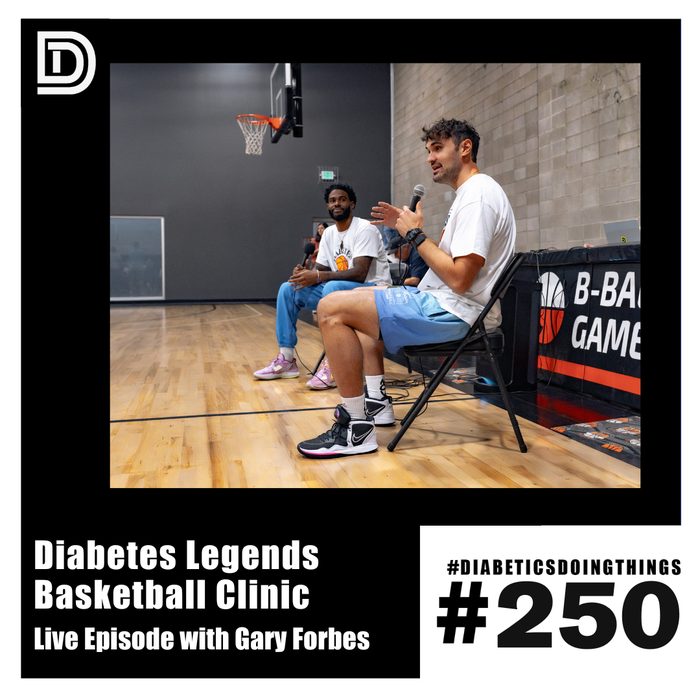
Diabetes Legends Basketball Clinic Live with Gary Forbes

Episode summary
Gary Forbes was diagnosed with type 1 diabetes at 19, after his freshman year at the University of Virginia. Diabetes runs in his family; his grandfather and father both died from complications. He became one of three players with type 1 diabetes to play in NBA history, suiting up for the Denver Nuggets and Toronto Raptors before playing professionally in Europe. At a live basketball clinic for kids with type 1 diabetes, Gary and host Rob Howe cover his diagnosis, hiding the condition early in his career, adjusting insulin after moving overseas, and testing blood sugar during games. Gary also talks about his book series, The Sole Survivors, about children with chronic health conditions who become superheroes, and shares stories of playing against Kobe Bryant and Steph Curry.
Key takeaways
- Gary Forbes was diagnosed with type 1 diabetes at 19, after his freshman year at the University of Virginia.
- Gary says he is one of only three players with type 1 diabetes to ever play in the NBA.
- After moving to play basketball in Italy, Gary kept having lows at practice until he changed his diet and lowered his daily Lantus dose from 20 units to about 10.
- Gary says he used to hide testing and injections in college but now wants people to see him manage his diabetes openly.
- Rob and Gary both recommend packing about 1.5 times your normal insulin and snack supply before any trip.
Show notes
Recorded live from Diabetics Doing Things first ever Diabetes Legends Basketball Clinic! Rob talks to Gary Forbes and takes questions from the kiddos covering a wide range of topics:
Gary is the last NBA player to have played with T1D (and was a huge inspiration to Rob!)
Tough diabetes days
The importance for everyone to share your story; you never know who you’ll impact
Gary’s book, The Sole Survivors about real-life superheroes, kids with chronic health conditions
Gary’s Olympian father
The power of having friends with diabetes
Playing with NBA legends like Kobe Bryant and Steph Curry
Managing diabetes while being an athlete
Special shoutout to Basketball Social House in Denver, Colorado where this episode was recorded. And a big thanks to the coaches, the Medtronic team, the campers, the parents, and everyone who helped out during this big day for Diabetics Doing Things!
We want to hear from you. Send those questions, comments, queries, and general diabetes concerns to THE MAILBAG at mailbag@diabeticsdoingthings.com!
Questions this episode answers
When was Gary Forbes diagnosed with type 1 diabetes?
He was diagnosed at 19, after his freshman year at the University of Virginia, with classic symptoms of constant thirst, frequent urination, and weight loss.
How many people with type 1 diabetes have played in the NBA?
Gary says he is one of three players with type 1 diabetes in NBA history, out of about 5,000 players total.
How did Gary Forbes manage insulin while playing basketball in Europe?
He kept taking the same insulin doses he used in the US despite different food in Italy and kept going low at practice, so he changed his diet and lowered his Lantus dose from 20 units to about 10 units a day.
What is Gary Forbes's book The Sole Survivors about?
It is a series about children with chronic health conditions, including type 1 diabetes, autism, leukemia, and cancer, who become superheroes and use their condition as a springboard for success.
Full transcript Searchable, with timestamps
Rob Howe: All right, guys, I just want to, again, thank you guys for being here today. Who had fun? All right. I love it. I love it. I have fun. I have fun. I had big fun. Okay. We're going to give away some prizes at the end of this for our knockout champion and our knockout runner up. But I wanted to share some time with you guys this morning because Gary and I both live with type 1 diabetes. Who has type 1 diabetes out here? Yeah, everybody, right? And everybody, and then we have some supporters, some siblings, some friends who've come along. So thank you guys for supporting. But what brought us here today is that we all love the game of basketball. And for me, when I was diagnosed, that's all I really cared about was was I gonna be able to still play basketball? So today, getting to see you guys out here, running up and down and having fun playing the game was awesome for me. So if I knew that this kind of thing was happening when I was 16, when I got diabetes, I would feel a whole lot better. So Gary is the, is the last person with diabetes to play in the NBA. The most recent person with type 1 diabetes to play in the NBA. There's been some other ones and there's some in the WNBA as well, but let's talk a little bit about sharing with our campers today about your diagnosis and, and how, you know, you, you learned about joining the type
Gary Forbes: one diabetes family. Well, diabetes unfortunately runs in, you know, my family, my grandfather passed away from it. My father recently last year passed away from diabetes complications. And I was diagnosed at the age of 19 after my freshman year in college at the University of Virginia. Had the, you know, the typical symptoms, you know, constant urination, just constant thirst, losing weight and things like that. You know, it was, it wasn't kind of really scary, I guess, because the way my father, you know, made it look, he had like an optimistic mindset or just the way he looked at this challenge, because it's pretty much a 24-hour challenge. He just made it, he always looked at the glass half full. So there was no real, oh, woe is me. Oh, I have diabetes. I can't do anything. I've never really had that mindset in my mind. I remember when I was, when the doctor came in with the test results and he told me that I was, you know, unfortunately type 1 diabetic. And he, I remember his words. He was like, you know, you may have to stop thinking about basketball and worry about your education. And, And, you know, I've always been, I guess, not, you know, going against the grain. So I didn't really pay attention to what the doctor said. I was just like, all right, I have diabetes. How do I still accomplish this goal? Because I have a dream to get to the NBA. And I just always felt that nothing was going to stop me. And, you know, thank God I had, you know, good people around me. I had great supporters, you know, great family members, great coaches, great staff that, you know, all helped me to get my dream.
Rob Howe: I love that. But I think everybody's told something different sometimes when we're diagnosed. But one thing that I was told was that anything that you want to do in your life, any dream that you have, you can do as long as you take care of your diabetes. So today, for me, over the years playing basketball, and I'm sure for you, I was usually the only person with diabetes in the gym. And so I know that sometimes when you're out at your school or you're playing on your AAU teams or you're just out with your friends, that you're the only person with diabetes. and sometimes you got to step out and you got to have a juice box or you got to get a snack or you got to dose some insulin. So today it was really cool for me to see you guys. It was really normal. When our devices are beeping, we go step out. That's not you doing anything wrong. That's just you living with diabetes. And so, you know, I think for me to be able to see this, like for you guys to be able to see that diabetes is challenging, but you can overcome it is a really important lesson for us to learn? Because I know that there were days along the way where, you know,
Gary Forbes: diabetes gets in the way. Right, right, right. I always, I mean, we talked about it on the podcast before. It's like diabetes is a 24-7, you know, condition. Like you can do the same thing every single day, eat the same thing, you know, test yourself and it'll be different numbers every single day. So sometimes that's, you know, that can, you know, mess with your head and, you know, get you, you know, down and about, you know, having this condition. But I will, I've always looked at it as a challenge that, all right, today I'm trying to be better than yesterday and getting better, eating the right things, exercising, or making sure my glucose numbers
Rob Howe: are at a good level. Yeah, that's right. It is 24-7. I had a tough diabetes day yesterday. Anybody else have a tough diabetes day recently? Yeah, I get it. I was right there with you yesterday traveling on the plane. Something that Gary knows, but I want to share with you guys. when I was in college, this is still, some of you guys were either really little or not even born yet, but I was in college in Colorado Springs and I was playing basketball. One of my teammates, Luke, is here right over here, shout out. And I was having a hard time. I wasn't playing that much. I was wondering whether I was going to keep playing basketball, whether that was going to continue to be part of my life. And Gary was playing for the Nuggets at the time. And this is why I think it's so important to share your story. So each one of you have a story with diabetes. And you got to share it for people to know. You got to tell people about it. Because I was wondering whether I was going to quit playing basketball or whether I was going to keep my career going. And I remember reading in the Denver Post a story about Gary playing in the NBA with type 1 diabetes. And me reading that at 20 years old, you know, now I get to, you know, this person who was a huge motivator for me to be able to continue to do what I love, which is the game. Now we get to have him here for you guys and we get to meet after all these years. So you never know when a story that you share, whether it's with your friends or at your school paper or just in your community, can reach somebody out there and maybe change their life. Because I went on, I got to go play basketball all over the world. Awesome. Great senior year with my teammates. And that wouldn't have happened if I hadn't have encountered that story from Gary. So just remember, each one of you guys has a story that's important. And it might be something today. it may be something way down the road, but you telling people and living out and showing your devices and being proud of who you are with diabetes can make a huge difference to somebody that you may not even know is that because you didn't know I was even, you know, 50 miles away.
Gary Forbes: No, I didn't know. And, you know, I think one of my mistakes that, you know, I look back on it today was not being open about it when I was in college because in 2008, you know, it wasn't really a lot of diabetes awareness as much as it is now. And, you know, I didn't want anybody to think, less of me is like, oh, he has diabetes or he can't do something. Because I was always, I never missed a practice, never missed a game. I did everything all the other players did. It's just that I had this health condition and I didn't want anyone to make any judgments or assumptions about what a diabetic can or can't do. So that was one of my challenges or mistakes, I think, was not being open about it. I always used to be scared to test myself in front of people or give myself injections in front of people. I used to go to the bathroom. now I'm I want people to ask questions about it I want people to see me testing I want people to see me giving myself an injection because unfortunately there's so many people in this you know world who have diabetes or suffer from these health conditions and you know now I'm also I'm kind of hype when I see people with the CGM on it's like oh man you're a diabetic and you know it's like we're a team we're like a tribe that's right it's cool to see everybody running around
Rob Howe: their devices on today. It was so cool to see that. It's always surreal for me to be able to be in the gym with all you guys wearing your CGMs and your devices. But you're sharing your story now, and you also have a news story that we're going to give you guys a copy of today. So before you leave, make sure that you guys get a copy of Sole Survivors. So why don't you tell us what we're
Gary Forbes: going to see from Sole Survivors? So Sole Survivors, I started thinking about it towards the end of my basketball career. It's like, all right, what am I going to do? I knew I had a purpose. I've been and unfortunate, you know, near, you know, death experiences with diabetes. Had a, you know, I was in a diabetic coma. I had, you know, a couple of seizures and things like that. But I've always had, I think I've just always had an optimistic mindset. There was a reason why I, you know, didn't, you know, pass away in these, you know, in these instances because I was here for a reason. And Sole Survivors is my purpose. Sole Survivors is a story about superhero, superhero children. It's kind of like a real life X-Men. Any of y'all know who X-Men are? So it's kind of like a real life X-Men where children with chronic health conditions like us, type 1 diabetes, autism, leukemia, mental health, cancer, but they're superheroes. So despite having this health challenge, they use this as their, you know, as their springboard for success. And they're trying to save the world. They're trying to look for, you know, a cure for all these different health challenges. And the second volume just recently released this past week. My goal is to have 46 volumes. So it's like eight, it's an eight chapter book. You know, we want to do merchandise. I had the shirt on today, if you guys see me. I do merchandise, toys, soon to be a cartoon. And yeah, hopefully you guys become super, super fanatics about it. And every year we have something. Yeah, I love it. I can't wait to
Rob Howe: see, you know, how it's going to continue to grow. And I think you guys are great examples. you all here with diabetes today, we're superheroes in your own right. And you just made me proud out here, you know, really working out and having fun together. Who made a friend with diabetes today? Anybody make a new friend today? That was my goal for you guys is to come in here and make a couple of new friends. Because I say it all the time, a friend with diabetes is a friend indeed, but actually it's like literally good for your health. All of the studies say that having a friend with diabetes makes your life with diabetes a lot better and easier.
Gary Forbes: Yeah, for sure. I mean, luckily I had my, like I said, my father, who's very, very adamant and educated on just health and wellness and just taking care of yourself. And he was an Olympian. Yeah, Olympic powerlifter, cyclist. So he did all the things that people back in the days probably said that a diabetic couldn't do. So having that example put me in this forefront to be, I guess, that example for you guys, being one of three players to ever play in the history of the NBA. There's only been 5,000 people to ever play in NBA history. And to be one of three, that's a very, I guess, a grand mark. And I want to not only just, it's not just about basketball, it's showing people about, you know, managing and living with diabetes.
Rob Howe: It's a very scary health condition, but it's very, very manageable. One of three, man. That's incredible. Okay, so we asked your parents for some questions prior to today's event. We got a couple of really good ones. And then we're going to turn over to you guys and ask a couple of questions that you might have for Gary about basketball and playing in the NBA. So the question that we got most common question from the parents was, what was it like managing diabetes and practices and games throughout your college and NBA career?
Gary Forbes: In college and and playing for the Nuggets and even the Raptors, I just had a very good medical team. They were always on top of me making sure I checked myself, having the glucose tablets, making sure I had my meds and going to the doctors on time. What was most challenging is when I went overseas, playing in Europe. You're kind of by yourself. There's no team doctors, really. You're kind of there on your own. And the food is different. I remember my first year in Italy, I was taking, I think, maybe 20 units of Lantus. This is when, this is my sliding scale. I used to take 20 units of Lantus and eight units of Humalog insulin for each meal. When I got overseas, you know, I'm eating the same exact things. Obviously, in Europe and these places, they don't cook with the, you know, same kind of stuff that they do here and all these different steroids and products and stuff like that. So I was taking the same amount of insulin and every single day at practice, I would have lows. I would, you know, after practice, I would be low, almost, you know, near passing out. So, you know, we had to make a change and about, you know, what I'm putting into my body. So like I have this analogy, it's like, all right, if you were driving a Porsche or a Bentley or one of these fast, expensive cars, you would put premium gas in it, right? You wouldn't put regular gas. So this is like a premium vehicle right here. So you want to put the best possible foods. You want to, you know, study about your own body. You only get one of these. You can't turn this back in and get a new one. Like you only get one of these. So it's really important to, you know, just be aware of everything that you're putting in your body, things that you think about, exercise and things like that. And, you know, I was able to come over here and when I got back to the United States, changed my diet. And, you know, now I'm only taking, I think, 10 units of Lantus per day and a sliding scale from like four to six units with each male.
Rob Howe: So it's like I'm doing a pretty good job of managing my diabetes right now. I love it. One of the other questions that we got is because there's so much travel, both in the NBA and when you're overseas. And traveling is a big part of life. And we want to go see new places. I got to come here. You got to come here today. So we're here to tell you that you can travel with diabetes. Yes. But what were some of the things that you had to do, like preparing for like a long road trip?
Gary Forbes: Obviously, you know, packing testers and making sure that I have all types of, you know, snacks and things like that has been many times where I've like forgotten my snacks or, you know, just let's say I've misplaced my tester and things like that. And those moments are very, you know, very scary and challenging. But, you know, thankfully I've made it out unscathed. But yeah, that's the that's mainly the thing. It's almost like you're pre-planning for, unfortunately, maybe something might happen. So just being on top of it and being just a step ahead, I guess.
Rob Howe: And for parents that are here, I typically, like if I'm going on a plane trip, I usually bring like one and a half of my normal. Like if I use two sites in a week or 100 units of insulin in a week, I usually multiply that by one for the trip just in case something goes wrong.
Gary Forbes: Always bring extra.
Rob Howe: Yeah, always be prepared. Okay, so I see we got questions here. So we're going to take a couple questions from you guys, and then I'm going to give you guys some prizes, and then we'll be able to wrap the first ever Diabetes Legends Basketball Clinic. But before we get to questions, so I see you guys here, I did want to thank our sponsors today. So we wouldn't be here at the Basketball Social House without Coach Matt. So thanks to Coach Matt and the Basketball Social House team. Did you guys have a fun time with the coaches today? Put you through some fun drills? All right, give it up for Basketball Social House. and Medtronic Diabetes Medtronic Diabetes has brought us here we got the logos on the t-shirts they made it possible for us to be here today at Basketball Social House we also have our folks from Skin Grip gave out some patches for you guys and you guys can take those home up here so if you wanted to we got some tapes on my sensors over here for you guys to take home and also the good folks from MannKind made this event possible we were planning big events at the beginning of this year and this is one of the ones we wanted to do. So I wanted to shout them out before we get to questions. But you, I saw your hand first. So what questions do you have for us? So the question, I'll read the question back so everybody at home can hear. So you asked if you're on a pump or on shots. Currently right now, I'm just
Gary Forbes: taking regular insulin shots. I'm planning to work with Medtronics to wear the CGM and wearing the, I mean, using the InPen. So I think the new technology is especially great. You guys have a huge head start and a great benefit of all this technology versus when, you know, my first time ever taking insulin, I was literally having a syringe and drawing it out. And, you know, almost, I was kind of like scared to just do that in front of people. Now you guys can easily do that with
Rob Howe: your phone and a little pen. And for those of you guys who wear tubed pumps, I wear a tube pump and I play basketball all the time with it. I just find a way to tuck it in my compression shorts, keep it, keep it close to me. Okay. I think you were question number two and then we had another, another one over here. So I'm trying to keep track. Y'all keep me accountable on questions.
Gary Forbes: What's your question? It was my overall in 2K. I think my rookie year, I think it was a 72 and my second and third year, I think I moved out to like a 74. It's all right. That's solid.
Rob Howe: It's solid. You know, right. Okay. This young man over here had a question. So he was, his question was asking when you started seeing the signs of diabetes.
Gary Forbes: It was after my freshman year I went home. After my freshman year of college, I went home for summer break. And during that week, at the time, I was 224 pounds. I remember my father was super adamant about me not drinking these Gatorade shakes that had 54 grams of sugar and another 22 grams of added sugar. So I wasn't really into, you know, carb counting and sugar counting and looking at the back of nutrition facts. Now, every time I pick up something, I look at the back of the nutrition label. But during that week when I was at home, I was, you know, constantly thirsty, constantly going to the bathroom. And every day I would lose like six pounds. So I always I was thinking I was like, all right, maybe I have to eat some more. So the next day I would just order a whole bunch of food thinking that I would be able to gain a weight back. by the end of the week, I was 198, pretty much the same weight that I came in in college. So I knew something was up. And, you know, when I got to the doctors and we did the tests and things like that, they told me, you know, what, you know, the inevitable that I was a type 1
Rob Howe: diabetic. I know those symptoms all too well. Same, very similar. Who else, who else peed a lot and lost a lot of weight before that they remember? Yeah. Yeah. We get it. Great. Okay. you had a question over here sorry i got you mid mid bite there take your time so our question was have you ever been playing basketball and not had your low snacks or any food on you
Gary Forbes: unfortunately very irresponsible yes i've had those uh instances where i've either eaten all my snacks and don't have enough or just didn't bring any thinking that that i'll be able to i'll check my sugar before i'm at like 160 i'm like oh i'm okay and then And next thing you know, I check my sugar an hour later. I'm at like 52 or something like that and wondering how that happened. So now I make it an automatic mission to always bring something with me. It's almost second nature that I have to bring something, some type of chocolate or a juice or things like that with me.
Rob Howe: Even if you just have some old gummy bears like I do in your gym bag and they maybe don't look as good, they still have sugar in them and they'll still help you out in a pinch. Okay, we can do two more questions. So I know I had you here and then we'll finish out with you right here. Okay. Your question was, how do you check blood sugar during games?
Gary Forbes: I had this One Drop. I don't know if you guys know that machine. I used the One Drop machine during, you know, during timeouts and things like that. I never, during games, I never really used to check it. I had a good system before games. I needed my, I wanted my sugar to be anywhere from like 150 to 170. And, you know, after the games, it would be like 120, 130. So it had a good, good range of, you know, kind of wiggle room. And yeah, that's, that's pretty much about it.
Rob Howe: Yeah. I think now both, both of us, when we were playing there, CGMs weren't very popular. They were still really old and so, and like, they weren't very good. So now with all the technology we have where we can see our sugars on our phones, I think a real, just for parents, again, I'm kind of the parents whisperer here today, talking with your trainers about pointing it's the direction thing okay working with your trainers at your school the national anthem is before every game in the u.s at any level so it's always a good chance to test your blood sugar and check it also halftime that was what i that was what i did my junior and senior year of college and yeah i think talking with your coaches and trainers and just making them aware again that's kind of being an advocate for yourself is just talking through and being open about your diabetes and say hey we've got this handled but these this is something that could potentially come up so that's that's good i think we great question by the way did you
Gary Forbes: ever play against kobe yeah i did we we beat them a couple of times so that's obviously one of my favorite players of all time played against pretty much every player that you guys know Steph Curry, LeBron, all those guys. Obviously, it was a dream come true to play against your idol and stepping on the same floor with him.
Rob Howe: That's awesome. I love seeing those photos. Gone too soon. Okay, well, this will be our last question here, and then we're going to get to some prizes. So this will be the last one. So, yeah, question was, what years did you play pro basketball?
Gary Forbes: Got into the NBA in 2010, and I retired four years ago. So like nine to ten years of playing pro basketball. That's a long career, man. That's a long, long time, long time.
Rob Howe: That's awesome. Okay. All right, well, we're going to cut the podcast, but we've got some prizes to give away.
About Gary
Gary Forbes is a former NBA player who suited up for the Denver Nuggets and Toronto Raptors after being diagnosed with type 1 diabetes at 19. He later played professionally in Europe and is the author of The Sole Survivors, a book series about children with chronic health conditions.