

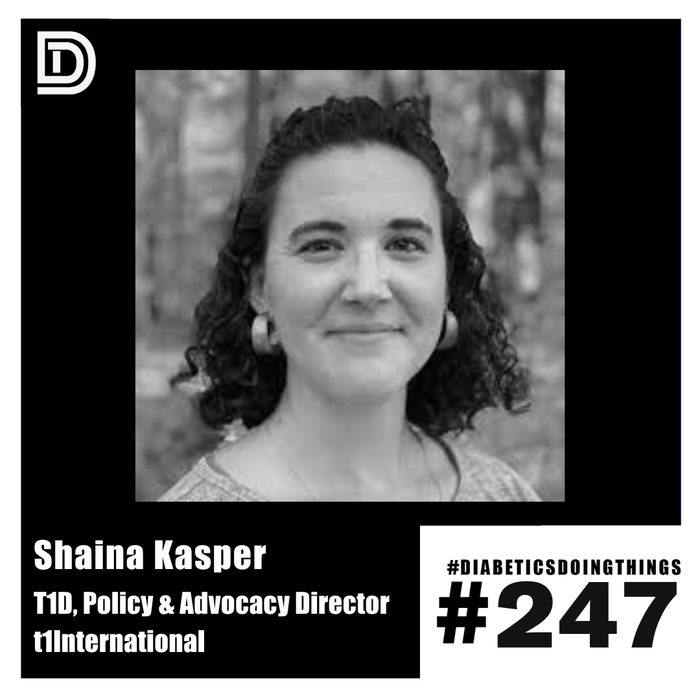
Shaina Kasper, T1D, Policy & Advocacy Director T1International


Episode summary
Shaina Kasper, Policy and Advocacy Director at T1International, talks about living with type 1 diabetes and working to lower insulin costs. Her sister's T1D diagnosis led her into a clinical trial that caught her own diabetes early. She later rationed insulin herself at a conference without realizing it at the time, which pushed her toward diabetes advocacy. She and Rob unpack why the $35 insulin copay caps announced by manufacturers have not reached many patients, the difference between voluntary coupon programs and real policy, and the Affordable Insulin Now Act. Shaina shares T1International's survey data on global rationing and describes the organization's work on state laws, price caps, and its upcoming 10-year summit.
Key takeaways
- Shaina says T1International's out-of-pocket cost survey found that globally one in four people with type 1 diabetes has rationed insulin, and she believes that number is undercounted.
- The $35 insulin copay caps touted in the news are voluntary manufacturer coupons, not law, so pharmacies can still fail to apply them.
- The Affordable Insulin Now Act, introduced by Senators Kennedy and Warnock, would extend a $35 copay cap to people with private insurance and those without insurance, not just Medicare.
- Shaina didn't realize until months later that grabbing an empty insulin box before a trip and stretching her pump reservoir to get home counted as rationing.
- T1International argues coupon cards and patient assistance programs are not a replacement for public policy, since manufacturers can end them at any time.
Show notes
Policy and Advocacy Director at T1International, Shaina Kasper, joins Rob and Eritrea on the show to discuss a wide range of topics, including:
What $35 dollar insulin really means for people living with diabetes
It’s been six months since insulin manufacturers announced that programs were being rolled out for co-pay caps but many patients are struggling to qualify for these benefits - whats going on?
Shaina’s sister T1D diagnosis which led to her being in a clinical trial that actually diagnosed her with T1D as well
How rationing insulin led Shaina to looking for a diabetes community
Accessibility being easier in countries like Canada, Mexico and Europe
Rationing insulin with diabetes is not rare. Globally 1 in 4 patients with diabetes has rationed insulin
Policies like Affordable Insulin Now Act being introduced by Sen. Kennedy of Louisiana brings up $35 insulin caps for people who have private insurance, not just Medicare
The biggest issue with copay cap policies is that they don’t always include private insurance, and it can create a reverse incentive for large manufacturers to raise cost of insulin because they know insurance will cover the difference
A price cap on insulin is the most important thing to help most people living with diabetes get access to these medications we need
If you have experience going into the pharmacy and are unable to get the lower priced insulin - write to your senator!
Most people believe that affordability problem around insulin has been solved, but were learning this isn’t the case
Coupon cards and insulin savings cards don’t always work; they’re not replacements for good public policy
T1International is working on expanding Alex Law’s at the state level to get emergency access to drugs and with expanding Kevin’s Law to expand past the 42 states who have accepted it
If you are interested in sharing your personal diabetes-rationing story, please reach out to T1International who can help guide you on how to to share your story with your Senator.
Learn more about the T1International #insulin4all Summit happening on September 30, 2023.
We want to hear from you. Send those questions, comments, queries, and general diabetes concerns to THE MAILBAG at mailbag@diabeticsdoingthings.com!
Questions this episode answers
What is the $35 insulin copay cap and who does it cover?
Since January 2023, Medicare beneficiaries pay no more than $35 a month per insulin dosage form. Shaina Kasper explains the proposed Affordable Insulin Now Act would extend that same cap to people with private insurance and people without insurance.
Why are some patients still paying more than $35 for insulin?
Shaina says the price cuts manufacturers announced in March 2023 for drugs like generic Humalog don't fully take effect until 2024, and the copay-reduction coupons are voluntary programs rather than law, so pharmacies don't always apply them correctly.
How common is insulin rationing among people with diabetes?
Shaina Kasper cites T1International's out-of-pocket cost survey, which found that globally one in four people with type 1 diabetes has rationed insulin, a figure she thinks is undercounted since many people don't recognize their own rationing.
What can someone do if they aren't getting the lower insulin price they were promised?
Shaina recommends writing to your senator about your pharmacy experience. T1International has a form on its website to help connect patient stories with their representatives.
Full transcript Searchable, with timestamps
Rob Howe: Hello, and welcome back to another episode of Diabetics Doing Things. We are telling the amazing stories of people with diabetes all over the world. And I'm very excited for today's interview because we, as we've talked about on previous episodes, Eritrea and I are not experts in policy or even health, and we don't provide medical advice on this podcast, but we get to bring in amazing experts who are well-versed in all things, both medical and then policy in today's conversation. So I'd really like to welcome Shaina Kasper from T1 International. She's the Policy and Advocacy Director at T1 International. And I'm very excited to talk a little bit about policy today and really dig into the big question that we're asking is, where is the $35 insulin? And so that's going to be kind of our headline for today's episode. But Shana, welcome to the show.
Shaina Kasper: Thanks so much for having me.
Rob Howe: It's great to connect with you. And a funny story just behind the scenes. So Liz, the founder of T1International and CEO of T1International, came on the show many years ago. I was like one of the first guests. And her episode was the first time I had experienced any sort of like podcast hiccups in terms of recording. So we had to take and record that episode again. so that she was like the first guinea pig that she was overseas that was the first like time you know time jump that we did that was over more than a couple of hours so lots of firsts for Liz and thank you to Liz for connecting us today yeah and I didn't know that that was yeah
Shaina Kasper: many years ago I think that I was re-listening in preparation and that was our third anniversary at T1I and now we are in our 10th year so we're having our 10-year summit coming right up
Rob Howe: later this month. That's exciting. Well, we will definitely want to include a link to that summit in the show notes. But let's get started like we usually do because you also live with type 1 diabetes. So Shaina, why don't you just tell us how you joined the type 1 diabetes family?
Shaina Kasper: Yeah. So I actually joined the movement years before I was diagnosed, when my little sister was diagnosed with type 1 diabetes and immediately started going to, you know, diabetes summer camp I've been having such like a robust and rich like diabetes community. And, you know, jumping ahead here, she's now a certified diabetes educator. So that's pretty cool. It's definitely a big part of our family. And but when she was diagnosed, I was put into a clinical trial that eventually led to the, you know, do drugs that have recently come out. but that I was found out that I had diabetes my first week of senior year when I went in for doing the trial and they said, actually, we can't do this because your blood sugar is too high. So I was really, really lucky that I got caught so, so early. And when I was first diagnosed, I went from the hospital to an Occupy Homes rally. and was really politicized already. And what I saw in a lot of the diabetes community that my sister was a part of is that they were being funded by pharma and that I didn't really see a home for me in a lot of that diabetes community. And it wasn't until I rationed insulin myself and that I really realized I needed to have more diabetes community in my life more than just my sister. And I then heard Liz on a podcast about T1 International. I was like, oh my gosh, this is the group that I've been looking for. And I have been on the team for about two years now at T1I.
Rob Howe: Well, and you had sent us a link about your diagnosis story on another podcast, America Dissected. And you mentioned that you had experienced rationing. And in that episode, you mentioned that that was sort of a light bulb moment for you, that you had not, you didn't really know that what you were experiencing was rationing. Could you talk a little bit about that story?
Shaina Kasper: Yeah, I was organizing on environmental health issues. So I was doing policy and advocacy on drinking water contamination and fossil fuel infrastructure. And I was at a conference away from home for the weekend and packed up my bag, threw in a vial of insulin for when I had to refill my pump. and when I went to go fill up my pump, I opened up the box and it was empty. I had accidentally put an empty box back in the fridge. So I like let everyone at the conference.
Rob Howe: That's the most relatable thing I've ever heard because I do that exact same thing. I've like now have to like remind myself to throw the boxes away.
Shaina Kasper: It's incredible. I was just like, how did I not check both? So wild. And yes, I went to the, you know, went to the conference organizers and said, you know, this is going to take me all day. This is going to take me hours and hours of being on hold with my doctor, with my insurance company. Like we've all been there. We've all been had to figure this out. And so I finally got my prescription sent over to a local pharmacy. I like walked in the, you know, all the way out there to go pick it up. I knew my insurance wasn't going to cover it because I'd already gotten the fill. I knew it was going to cost me hundreds of dollars to get one vial of insulin just to make it home. And when I handed over my credit card to get that filled up, it was declined. And I was just so frustrated and so burnt out by this whole process already that I said, you know what? It's only one more day of this conference. I can just pull out the dregs that are in my pump. I don't want to bother anyone. I don't want to like cause an issue. And I made it home. And that was really lucky. And really, I didn't realize until later how scary that actually was. Like it didn't really hit me until months later that that was not OK. Like, why did I not feel OK asking for help? Why did I not feel OK calling on like the diabetes community and needing to and didn't even realize that that was an experience that I was rationing until even I had started working in the with you and I and more directly in the diabetes community, because I was like, I'm not a person who rations insulin. That's not who I like. I have my shit together. I always get my prescriptions filled. And it's like, nope, that's that's, you know, even the best laid plans stuff goes wrong.
Rob Howe: That's right. And I think it's such a. You know, it's interesting because you said a couple of things there, like the first was like you didn't want to be a burden to other people when you really just like desperately trying to scramble to make sure that you're able to continue doing the bare minimum of like living. Right. So, you know, I think that's something that I know a lot of people feel myself as well as like so much of our lives with type 1 diabetes are normal and we don't feel like we, you know, and I think this is also something in the community that we've been reconciling and definitely at Diabetics doing things like even though we don't feel disabled most of the time, very much are living with a disability, very much identify and want to stand with our more disabled brothers and sisters to to say like, you know, know, hey, this is a disability is covered in the Americans with Disabilities Act. And just because we feel like it's not a burden on other people most times, like when we need help or when we need a little extra accommodation, you are not a burden. You like you are just doing your best to live. And I also think like that that other feeling of, well, I'm not I don't ration my insulin like I have my shit together. Right. And the idea that there should be this shame around having to ration or having making a simple mistake, like grabbing an empty box of insulin before you go on a trip or forgetting to pack extra insulin or only having enough in the vial that's not going to be able to carry you for the duration of that trip. Those are not things to feel ashamed about. I think they're just very normal. And unfortunately, in this country, and now I think it's a good point to shift over to some of the policy discussions that we're getting into. If we were in Canada, you could just walk into the pharmacy and pay cash over the counter for a pretty reasonable amount and get the insulin that you need. in Europe and many other countries, very similar. But in the U.S., we don't have that luxury. And so kind of getting into the overarching discussion of, you know, it's been a few months, almost six months since the insulin manufacturers announced before the U.S. Senate Health Education and Labor and Pensions Committee that they were rolling out programs for copay caps for, you know, what we would effectively call like $35 a month for your insulin. But many patients in the US have yet to see any actual impact on the price of their drug with even ones with commercial insurance who theoretically should qualify for those benefits. So what's going on? We've got these copay caps that nationally and in the media and all of our friends who follow policy who don't have diabetes are sending us all these links. And we're like, hey, congratulations. Insulin is cheap now. but we're not seeing the benefits yet of patients actually getting those discounts.
Eritrea Musa: Yeah.
Shaina Kasper: You asked like eight different questions there and I wanna, can I take a step back? I mean, we didn't even ask the question, but I wanna start just by saying that rationing is not rare, just to go back to what we were saying as well. And that we know, at T1 International, we run an out-of-pocket cost survey And that shows that globally, one in four patients with type 1 diabetes have rationed insulin. And that, for my own experience, when I filled out that survey, I didn't say I was rationing insulin. That number is probably really undercounted. And at T1 International, we have a goal that no one should be spending more than 5% of their country's per capita income on insulin and testing supplies. And so in the U.S., that is $222 a month. So that's less than the cost of one vial of any of the insulins that I use. That's less than the coinsurance for one month of Dexcom sensors for me. And I've got gold peer insurance, you know. And outside of the U.S., we see this, you know, one in four patients is rationing insulin as well. and in some countries that's as high as 50 or even 80 85 you know almost 90 percent of their per capita income is being spent on insulin and testing supplies so this is not a personal failure of rationing insulin it's really a structural and you know systemic problem and so that's really why at t1 international we're calling on insulin manufacturers to lower the list prices of all of their insulins. And so back in March, the big three insulin manufacturers did announce that they're lowering the list prices of some of their insulin starting at the end of this year, you know, for January of 2024. We need to make sure that lowered insulin prices are enforceable for everyone. So that's why globally, you know, we're calling on the WHO to set strong affordability and access goals for insulin and to support countries in providing, getting insulin to their residents who need it. And that's why in the U.S., you know, we are calling for regulation on these insulin price caps overall. So while these insulin manufacturers have announced that they're lowering some of these insulin prices, first of all, it's not for all insulins, but only for about half of the kind of main insulins on the market. So we really want to make sure that insulin prices are lowered for all insulins and for all patients. So a lot of the policies that have been discussed are copay caps and setting a cap on copays for insulin per dosage form per type is a really important, you know, first step. So for last year and starting in January of this year, January of 2023, all Medicare beneficiaries are able to receive insulin for $35 a month, you know, per, you know, insulin form and type. So that's, you know, for short-acting insulin and long-acting insulin for vials and pens, that can still add up to, you know, over a hundred dollars a month pretty easily, but that is a really important first step. And what we're now seeing some policies being introduced is the Affordable Insulin Now Act, which is being introduced by Senator Kennedy of Louisiana and Senator Warnock of Georgia. And that's at the $35 insulin copay cap per dosage form per type for people with private insurance, not just people who are in Medicare. And what's so exciting about this policy is that it also covers patients without insurance. That will go a really long way to supporting patients from rationing insulin due to cost. The biggest problem with these copay cap policies are that they don't usually apply for people without insurance or for people with high deductible plans. Those are the people most at risk for rationing. And they can also cause this reverse incentive of having these corporations raise the price of insulin because they know that insulin manufacturers will pay for that or insulin for insurance companies will pay for the difference between the list price of insulin and that copay price. So that's why we really want to make sure that there's a price cap on insulin. And so as you said, in March, these insulin manufacturers announced that they were going to lower the prices. And the first one that they were going to lower was the generic of Humalog, which is called Insulin Lispro. That was supposed to go, you know, right now it's around $80, although we've seen it in pharmacies for over $300. And they were going to lower that down to $25 starting May 1st. However, May 1st came around and I went to the pharmacy and I was going to get charged $150. You know, it's going to be about $90 with coupons. and other patients from around the country went to their local pharmacies and they were also not getting quoted $25 a vial. And so-
Rob Howe: That is the impetus for today's conversation, right? Which is we all saw, and all of our friends who don't have diabetes sent us all the links of all, let's celebrate the good news. And I think, like you said, it doesn't address the people who need the most help for the high deductible plans and the uninsured, but a common theme and even we thought about like something to celebrate is any legal and like political policy growth or I guess progress to lower insulin prices to patients is a good thing. But if that if patients actually aren't able to get it, then it doesn't really matter. So I think that's where when we were planning this conversation, we're like, okay, well, this was yes, we were like, hey, this is a small, this is a big victory in policy and progress. And for people who have private or commercial insurance, they're going to be able to get some of the insulin for $25 a month. And that's a victory. But then come to find out, myself included, like I'm going to check out, I have great insurance that I pay a lot of money for. And I still had to pay the same that I did prior to all of these Senate hearings. And so, you know, I asked my pharmacist and say they had no idea about these programs. And so I was like, okay, well, I need to have the experts here to talk about, A, what should patients who meet the criteria for these copay caps do if they're not getting them at the pharmacy? And B, what's causing, what's driving this? Seemingly, it's a law that was passed that should go all the way through and everyone should know about what's causing the issues for people not being able to get insulin at that cost. Yeah. So the insulin price reductions
Shaina Kasper: across the board don't go into effect until 2024. These kind of voluntary coupons to lower the co-pays for patients with private insurance, they're totally voluntary. So there's no place where you can send in a written complaint or to recognize that this isn't working for you, because these are voluntary programs by the manufacturers. And so that's why it's so important that we push for political change. And that's why we are advocating for this fall, Congress needs to pass policies that lower the price of insulin for patients. And the best way to do that is by setting a price cap, but recognizing that's not really an option that's really on the table right now politically. We're really pushing for getting insulin copay cap for patients with private insurance and for patients without insurance. And the time to do that is right now. We have a few more weeks left in this session before the holidays come in. And then it is 2024, which is an election year. And all of a sudden it gets a lot, a lot harder to pass meaningful policy besides these must pass bills. And so that's why we're calling on everyone. If you have experience going into the pharmacy and not hadn't been able to get access to these lower, you know, these promised lower prices, insulin's like, like I did and trying to get Insulin Lispro to, to, to write to your Senator, tell your senators what your experience is. Cause they definitely like every lobby meeting we're going to, we're having to explain like the very basics of what it's like to live with diabetes. And so they, a lot of folks think that this problem is solved and that we have gotten these commitments that we have lowered the price, the copay caps for insulin for patients with Medicare. Those are all really great things. And those are not impacting people who are most at risk of insulin rationing. The most patients in the U.S. still need more regulation in order to make sure that we're not going to be rationing
Rob Howe: insulin due to cost. You touched on something there that's very challenging for me because, you know, as a person who does a lot of communication, I'm a guy with a podcast. have been for a long time and I run a marketing agency. It really is difficult for me because, like you said, the narrative, the high level, like for the casual observer, they think that this problem is solved and that they're reading in CNN and they're reading in the Washington Post and the New York Times that the price of insulin has been capped. And this session and the manufacturers, now I understand in some ways now why those CEOs make as much money as they do because they are there to control stock price and to speak on PR talking points and sound really confident. And they did that. And I think that is a sort of I get in this doom loop of thinking of like, well, how can we, with our advocacy, with our patient voices, with our small community, how do we overcome these insurmountable, seemingly, insurmountable momentum in the public eye that our relatives and our friends are seeing? And they're celebrating for us. but the actual benefits have not even come close to trickling down to the people who need it most
Shaina Kasper: yet. Yeah. I think the most important, I think we, we, we can only hold onto so many facts in our brain at once. But what we know in communications is that sharing personal stories and sharing, just sharing stories in general are much more memorable. And so being able to, as patients, being able to have these experiences of going to the pharmacy and seeing that these things aren't working and asking those questions of why aren't these what I'm hearing in the news? Why is that not applying to me? And that's really the most important first step. And then being able to communicate that experience and that story to decision makers is the most important way to be able to drive policy change. You know, we can share all these numbers. You know, we can share that one in four patients is rationing insulin due to cost. We can share that Insulin Lispro was supposed to be $82 a vial. But when I went to the pharmacy, I was quoted much higher than that. And it's actually they committed to having it be $25 a vial. We have, you know, just so many of these different numbers that we can spit out. But that's not what changes hearts and minds. It's really about making sure that we share these personal stories. We want to know that, you know, sometimes sharing your rationing story or sharing that personal story can be really re-traumatizing. And that's not what we want to have happen either. If you are sharing your personal story, it should be a powerful and it should be empowering. It should be politicizing. And if, you know, we would love to, you know, connect with anyone if they're interested in in sharing their story with their senator in that way as well. Also, say at T1 International, we have a form that you can fill out. I was just going to ask. There you go. So you can, you know, sign up for our newsletter at T1International.com. And in that newsletter, we have all those links to all of our current actions. And right now we are trying to get folks to email their senators, sharing your personal story about why it's so important to pass policy to lower the set of copay cap for patients with private insurance and for patients without insurance.
Rob Howe: Yeah, I think that was the call to action that I wanted to make sure that we come across because I think people who are listening to this are like, okay, cool, where do I go? But there isn't always a clear path and every senator's website has a little bit of a different UX. and you know i so i'm glad that we can link to to that form that you guys have so that those individual stories can be told because i think you're right and and this is something i think i learned during the pandemic is you know when we as humans see large numbers or large statistics we don't associate them with people we just see them as you know just factoids and it's just it's kind of a weird you know part of our human evolution is that we just don't have the ability to see or to comprehend what is happening to a million people versus when we see, hey, this person has shared these stories. And I think that's why it's so impactful. Some of the stories that we've shared about and that T1 International shares about people who have rationed insulin and unfortunately lost their lives. And that becomes very tangible for people who don't even live with diabetes because they know somebody who does. And just living on those margins, like you said, we're all closer to rationing than we may think. And I think whether we're gainfully employed and have great insurance today, that's not guaranteed tomorrow. And I wanted to kind of use that as a point to transition because in our original questions, we were going to talk about some of the outside programs. We in Dallas, we were fortunate to be close by the Mark Cuban Cost Plus Drugs Company, and they have kind of been communicating different programs through us over the course of this year. And unfortunately, some of those continue to be rolled back or they're based on coupons that, you know, you were touching on earlier. There's no requirement from manufacturers to continue some of these patient assistance programs. And when they go and they announce that there, you know, will be LISPRO at a certain price, there's no, that's not forever. And, you know, even when patients have those coupons, they go to the pharmacy and they may not be active. So how can how can we, you know, as we're introducing these policies, price caps, obviously, you know, signed in by legislation will allow that to continue. But just something that as we see these programs, like they're not guaranteed, like we you know, there's no sense of accountability necessarily for the manufacturers to continue those programs.
Shaina Kasper: Yeah. Yeah, just to repeat what you said in a different way, manufacturer-sponsored cost-sharing programs without strong price-cutting measures and equitable insulin access, these are not answers to the insulin crisis. They are always time-limited. There is no guarantee that these programs will continue to exist long-term. Companies can and have ended them at any time, and this can just put patients at risk yet again after jumping through all these hoops. And so a lot of times these programs can have a really extensive paperwork and require the time and attention of healthcare professionals and prescribers who often don't get compensated for that time. And then this reliance on coupons and saving cards and patient assistance programs can think that we have this problem solved and can circumvent efforts to use more cost-effective generic or biosimilar drugs or really change policies to make sure that we are making insulin affordable and accessible to all. So, yeah, there's like three main types of manufacturer-sponsored cost-sharing programs for insulin. So the first one are these copay card programs, which have gotten tons of press the past few months. Because this is where the insulin manufacturers are saying anyone can use these copay cards to be able to, you know, with their private insurance to reduce that out-of-pocket payment. I don't know if you guys have tried them, but they're really easy to print out. They're less easy to use at the pharmacy counter and often just get denied depending on what the pharmacist's ability is to be able to use them. the insulin saving card programs can be used by some patients with private insurance whose plan doesn't cover a specific insulin or those without insurance and can reduce that amount for patients paying out of pockets you know like these these copay card programs and then patient assistance programs are often it's a much higher level of application needing to have a lot more information and providing a lot more uh material to the to these insulin manufacturers directly that information that's not protected under HIPAA laws, that is not necessarily confidential information. And these programs may provide insulin without out-of-pocket costs to some patients without insurance, but they, again, can be denied or just canceled at any time as well.
Rob Howe: And I think some of the stories that we've seen is just because you're approved for the program one time does not guarantee that you'll be approved for it again. And so, you know, for people who are unemployed for longer periods of time than they anticipated, it. Obviously, there's been so many people in a variety of industries that are laid off this year. And so, you know, whenever I see those numbers, 18,000 people laid off at Amazon, I think, okay, well, there's quite a few people in there that are going to need not just insulin, but also other medications that they're not going to be able to have coverage for immediately. And so, yeah, those patients programs, like you said, you know, it's been a long time since I had to go through the idea of potentially using one. And it's, significant amounts of paperwork. And also, again, kind of up to their standard as to whether you deserve, based on how much money you've earned previously or how much money you're currently earning, whether they will cover that or not. And to your point earlier, of wanting to reduce that cost to $222 a month based on the income per capita here in the United States, what we've seen And basically, you know, and again, this is not, you know, this research is subject to the public data that we're accessible to here at Diabetics Doing Things, that the estimates are more of like $9,500 per year of diabetes out-of-pocket costs, even for, and higher, as you were saying, like, so for people who are uninsured as well. And that includes things like CGM sensors and insulin pump supplies and test strips and glucometers. So, you know, it's not just the insulin price, but it's also all of the other things that go into a life with diabetes.
Shaina Kasper: Yeah, we know that living with diabetes is really expensive. And that's why these programs get used. We know that there is a need for, you know, we know that people are using these programs because it is too, it is often too expensive to like live and be able to thrive with diabetes. And just to say, these programs are not new. You know, no matter what the media has been saying, the media has really been touting these patient assistance programs kind of as the generic term for these three different types of programs for years. And since the big three insulin manufacturers have announced some of these price measures in March of 2023, some of these programs have lowered some of their prices. So, for example, Sanofi lowered their program from $99 a month to $35 a month starting in July. But others have remained the same. And as we said, you know, these can change at any time or just stop offering them altogether. other. And they're also often used to support just using the name brand or to even product hot patients over to more expensive insulins. So they might be cheaper in the short term, but then you have this prescription for this newer, more expensive insulin. And then you can't get the biosimilar or the generic when those are made available online as well. So we want to make sure that patients have access to the insulin that they need and the insulin that work best for their bodies. That's really why we need to make sure that we're not relying on websites or patient assistance or manufacturer-sponsored assistance programs, because those are really no replacement for good public policy to make sure that patients with diabetes can get access to all of the insulin and supplies and everything that we need to be
Rob Howe: able to survive and to achieve our dreams. You know, I think we've all, if you're involved in the diabetes community and probably many people themselves have all experienced an insurance company dictating which insulin that the insurance company thinks that you should take, whether or not you've taken a Novolog or a Humalog all of your life with diabetes. And for many people, they can't take one or the other because of the way their body responds. And so there was a great video on TikTok. The name of the creator is slipping my mind right now, but she was basically breaking down how to write a prior authorization. But again, that's like putting the benefit or putting the burden of proof on the patient to just prove that, yes, in fact, we still do have type 1 diabetes. And unless we've missed something, there has been no cure. And the insulin that you need to work for your body, patients and their providers need to be the ones that dictate that, not insurance companies. I do want to talk, we've mentioned the form that's on T1 International's to email senators and to tell your story to Congress. But these copay caps and the legislation that's been introduced as a result and the price caps that are coming are the result of continuous, passionate patient advocacy. So what can patients continue to do? We've got National Diabetes Awareness Month coming up. What can we do to continue to improve access for insulin for all?
Shaina Kasper: Yeah, T1 International, we have set a number of different goals in order to move towards this vision of insulin for all and to make sure that no one with diabetes is spending more than 5% of their country's per capita income on insulin and diabetes supplies. And what that looks like in the U.S. is we're working on price cap, you know, policies. We're working on patent reform. We're working on pharma taxes reform. And then at the state level, we have priorities of passing ALEC's laws, which are emergency access to insulin laws. We're working on Kevin's law, which is expanding pharmacist's scope of practice. And, you know, right now, 42 states have passed Kevin's laws of some court's order of another. So you can go to the pharmacy counter and make sure that you can get the access to this necessary drug, you know, regardless of kind of where your prescription is at at that moment.
Rob Howe: We had a Texas legislation discord back in 2020 that helped Texas pass Kevin's law. So that was really awesome.
Shaina Kasper: Yeah, that's awesome. And then, yeah, also working on public pharma, so public production and public manufacturing, of insulin, public PBMs, pharmacy benefit managers. It's really exciting work happening in California right now and other places. And then also on non-medical mid-year plan switching. So this is more of making sure that your formulary from your insurance doesn't say, oh, just kidding. You've been on this drug for however long you have. We're going to switch you to a different insulin because that doesn't usually work as a one-to-one trade-in very often. And so those are the, you know, campaigns that we're working on. And we really rely on our on our chapters, on our leadership, on our working groups at T1 International. So we've got 41 chapters in states across the country. We've got 21 countries across the globe working on these campaigns and building community together, building, you know, building our skills, building our our training for for doing effective advocacy and organizing. and building a network and building relationships among each other. So we also have a communities of color working group and we have a Families United for Affordable Insulin working group that's made up of loved ones who have lost folks due to insulin rationing to provide that kind of mental health support and to provide community in this like really challenging world and work that we're doing. And so, yeah, definitely want to encourage folks to check out that work if any of that sounds interesting. Also, we have our summit coming up on September 30th. And this is a one day, kind of all in, with presentations by all these working groups, by chapter leaders across the globe. And will be a really great opportunity to hear more about what's happening in the Insulin for All fight and lots of different ways and opportunities to get involved. And if folks are interested in signing up for that, it's t1international.com slash summit 2023.
Rob Howe: Awesome. You even stole my plug at the end. I was going to say, make sure you got to visit t1international.com. And congrats on 10 years, T1 International, Liz and the team. I know you guys continuing to grow and grow your impact as well. So I definitely want to... It's funny, like three years being on the podcast, all those years ago with that interview with Liz, we've been doing this a long time and there's a lot of work still to be done. So we're glad that we can do that together. I think, again, like the power of community. There's a lot of really exciting legislation coming up that we'll also link in the show notes, both on the state level and the national level. So for folks who are really interested in getting involved in policy and longtime listeners, we'll be happy to provide you guys and connect you with those resources. Shana, thank you for coming on the show. I think it was great to get to know you and kind of like even working back and forth via email over the past couple of weeks. You know, I'm just glad that we have people like you who are advocating for us on the policy side and, you know, continue to reach out if there's any way we can continue to support you guys' work at T1I International. And yeah, let's not let seven
Shaina Kasper: years pass between podcasts again. That's a long time. It is. I've just grown so much in that. I just like, I'm like, that is so incredible that that was three years into T1I and now we're 10 10 years in, and we've been able to grow. And we've been able to do that because of, you know, support from the community, both in their, you know, in our community, in the Insulin for All communities, volunteering and leadership and also in contributions, too. So I'll just, you know, make a plug there, too, if people want to contribute to T1 International, that would be amazing as well. We are totally pharma. We don't accept any funding from pharma. We're a totally independent 501c3 in the U.S. And so we do really rely on our community.
Rob Howe: Well, I want to give Liz and T1 International credit because when I had her on the podcast all those years ago, the biggest challenges in my life with diabetes were dealing with long lines at the pharmacy and the cost of prescription drugs and the cost of health insurance. And in that interview, she had brought up stories about patients in Syria who were literally walking across minefields to get syringes and test strips to be able to maybe test their insulin or test their blood sugar once a week. And so that gave me a shift in my global view of diabetes does not look the same for everybody. Yes, things need to dramatically improve here in the US, but there are people in Eritrea, for example, and not Eritrea, the co-host and producer, at Eritrea the country who don't live the same life with diabetes that we do here. And so it's important to take that global lens and the Global Summit, probably a great opportunity for folks who are interested in hearing what life is like for diabetes with diabetes for people across the world. So yeah, an awesome opportunity for you guys to learn more there. So again, congrats on 10 years and say hello to the rest of the T1 International team for us. This episode was produced by Eritrea Musa. It's published and syndicated by Ashley Bright and our partners at Exhale Creative creating the social media clips. We'll see you guys next time.
About Shaina
Shaina Kasper is the Policy and Advocacy Director at T1International. She has lived with type 1 diabetes since her senior year of high school, after her younger sister's T1D diagnosis led Shaina into a clinical trial that caught her own diabetes.