

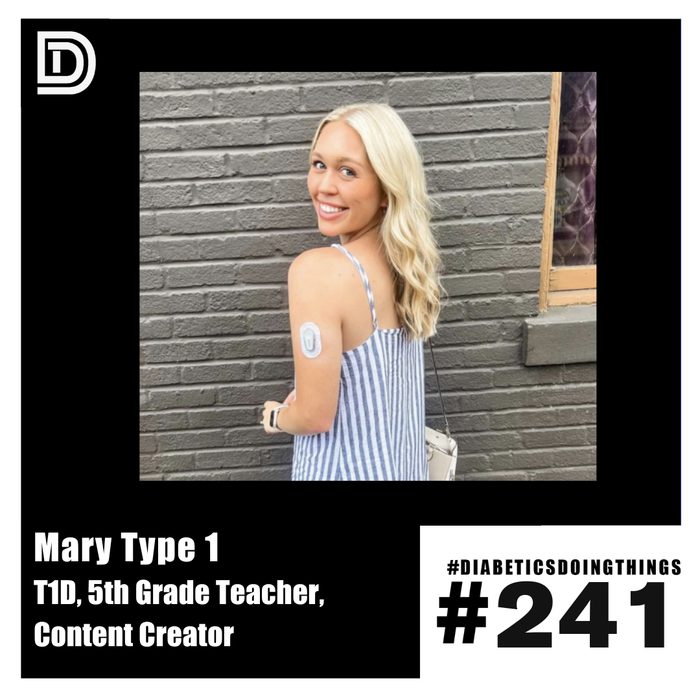
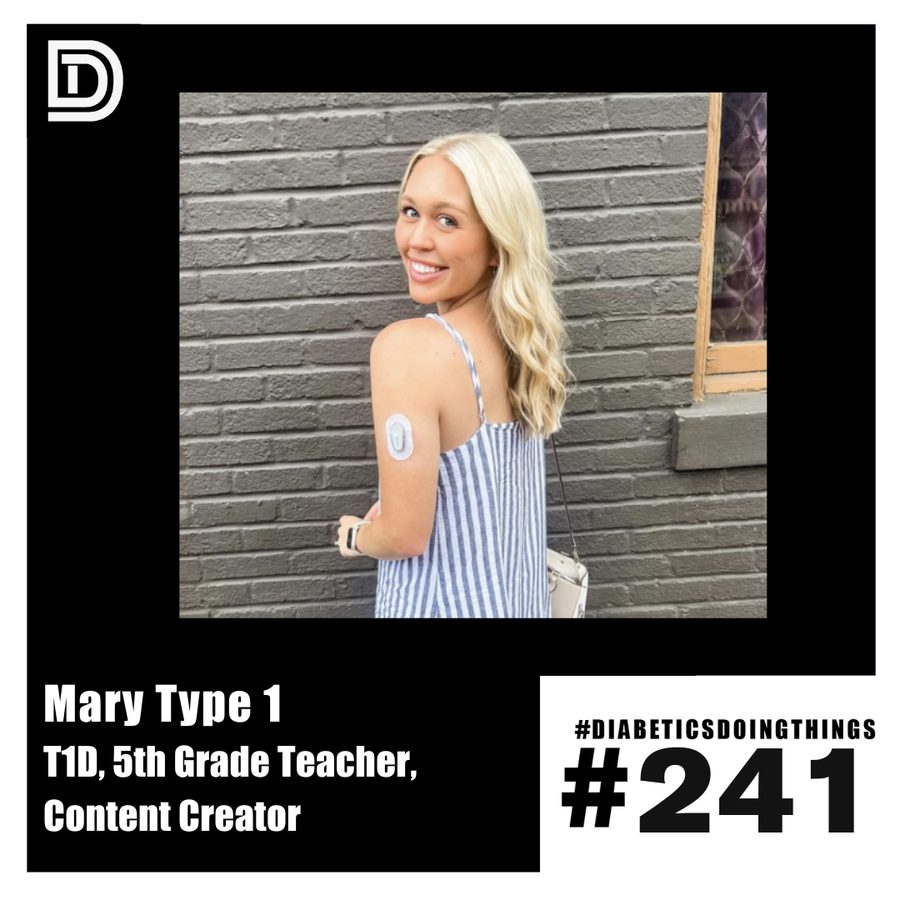
Mary Type 1, T1D, 5th Grade Teacher, Content Creator

Episode summary
Mary Anderson, known online as Mary Type 1, was diagnosed with type 1 diabetes in December 2018 during her senior year of college, after months of unexplained weight loss and fatigue she mistook for stress. She began student teaching two months later and learned to manage insulin pumps and a Dexcom while working alongside a supportive cooperating teacher. Two weeks after her diagnosis she joined Instagram to connect with other people with type 1, eventually building a large following under the handle @mary.type1. In this episode she talks with Rob and Eritrea about teaching while managing diabetes, keeping emergency supplies in her classroom, using the book Just Ask by Sonia Sotomayor to explain diabetes to students, and why 504 plans matter for kids with type 1 at school.
Key takeaways
- Mary lost 15 pounds in two weeks before her diagnosis and was sent home with insulin pens and almost no instruction on dosing.
- She keeps a labeled drawer of diabetes supplies, extra insulin, and low snacks in her classroom after once running out of insulin during the school day.
- On the second day of school, Mary reads her class the book Just Ask by Sonia Sotomayor to explain her diabetes in terms kids understand.
- Mary and Eritrea both recommend getting a 504 plan in place, since it legally requires schools to provide accommodations like extra bathroom breaks and keeping a phone connected to a Dexcom during tests.
- Mary says her following grew from her messaging other diabetic teachers for advice right after diagnosis to now having newly diagnosed teachers message her for help.
Show notes
We’re going Back to School with Mary Type 1! Mary was diagnosed with t1d right before jumping into her teaching career. In this episode, Rob, Eritrea, and Mary talk about:
Diagnosis as an adult and being sent home confused
Figuring out teaching and diabetes at the same time
Joining the DOC 2 weeks after diagnosis
Navigating a huge following and meeting people IRL
Teaching with diabetes and being prepared for anything!
Advice for parents with kiddos living with T1D
Follow Mary on Instagram and TikTok @mary.type1
We want to hear from you. Send those questions, comments, queries, and general diabetes concerns to THE MAILBAG at mailbag@diabeticsdoingthings.com!
Questions this episode answers
What is a 504 plan for students with type 1 diabetes?
Mary explains it's a legally binding document that requires school staff to be trained on type 1 diabetes and allows accommodations like extra bathroom breaks, eating when needed, and keeping a phone connected to a Dexcom during tests.
How was Mary Anderson diagnosed with type 1 diabetes?
She was diagnosed in December 2018 during her senior year of college after losing 15 pounds in two weeks and getting a blood sugar reading of 439, and was sent home with insulin pens and basic dosing instructions.
How does Mary explain diabetes to her elementary students?
She reads the book Just Ask by Sonia Sotomayor, which connects diabetes and other differences like ADHD or being in a wheelchair to everyday things kids understand, such as taking medicine to stay healthy.
What should parents do if their child isn't getting school accommodations for type 1 diabetes?
Mary recommends starting a conversation with the teacher or school nurse, who can point parents to a special education coordinator to set up a 504 plan.
Full transcript Searchable, with timestamps
Rob Howe: Hey everyone, Rob here. First of all, I just want to thank you for listening and supporting Diabetics Doing Things. We are going on eight years of recording this podcast, so your support means everything. We would not be here without you. Just wanted to call your attention to a few things that we're working on lately that are updates to Diabetics Doing Things. The first is we are throwing events, and you can find more about our events at DiabeticsDoingThings.com slash events. We launched our first event in April of 2023. It was a coffee house roastery tour and latte art class. And we have two very exciting events coming up in the fall of 2023, including our first ever, so our inaugural National Diabetes Awareness Month event. And those are going to be on diabeticsdoingthings.com slash events this month. So be sure to check those out. Also, if you have a question that you want Eritrea and I to answer on air, please email the mailbag at DiabeticsDoingThings.com. So that's mailbag at DiabeticsDoingThings.com. Your question will be answered on air during a special episode of the Rob and Eritrea show. So if you want to ask us a burning question and you want us to spend some time on it, please reach out to mailbag at DiabeticsDoingThings.com. All right, let's get back to the episode. Hello and welcome back to another episode of Diabetics Doing Things. We're telling the amazing stories of people with diabetes from all over the world. And I'm very excited to introduce our very special guest today. You know her as Mary Type 1. Mary Anderson, welcome to the show.
Mary Anderson: Hello, thanks for having me.
Rob Howe: Yeah, we're so excited to have you. And, you know, just a few weeks ago, we got to, we were right across the event floor from you in the Type 1 Tactical booth. So very excited to finally have you on the podcast.
Mary Anderson: I'm so excited.
Rob Howe: You don't know this, but I guess maybe Airtree told you, but we had, even back to last year, we were making a big list of our favorite diabetes creators and having them on the podcast, checking them off one by one. And you were the only one remaining at the top of the list. So we're finally finishing our projects from last year. So thank you. Very excited to have you on the show. So let's start where we always start. Let's talk about your diagnosis with type 1 diabetes. How did you come to join the type 1 baby family?
Mary Anderson: Yeah, I was diagnosed in 2018. It was my senior year of college and my whole fall semester, it was known as like a stressful semester in the education program. And it was like horror stories leading up to that semester that you just hear from people. So like, okay, going to be stressful. I know that it's fine. We'll make it through. And then that semester, I just remember getting sicker and sicker and just feeling awful. but I thought it was all just because of stress. My biggest red flag was the weight loss because I was sick. I went to my campus clinic and they took my vitals. They weighed me, all that. And then I was still sick about two weeks later. So I went back to a different doctor and they weighed me again. And I had lost 15 pounds between those two appointments, like two weeks apart. And I was like, okay, something's not right. But again, I was like, oh, it's just stress. I'll go home for winter break things will be fine and then I just kept feeling worse and worse all those classic symptoms so I finally went to my family doctor they did a bunch of tests they took her blood pressure they did EKG they did urinary analysis and finally they were like we need to prick your finger and I was like okay sure I don't know what's going on go ahead and then the nurse was like your blood sugar's 439 and my doctor just looked at me and he was like you're type 1 diabetic I was like I'm sorry what and so they went they grabbed two insulin pins the long acting and fast acting and they were like right we're gonna teach you how to give yourself shots of insulin you're gonna do this for the next week until you get in with endocrinology and you'll you know learn more about it there but here you go this was it I was like okay and then I went at home and I was like I don't know what I'm doing it was a whirlwind yeah well we have we know
Rob Howe: because we talked to so many people like as adults with diabetes we you know we don't get the consistent diagnosis experience right like you literally got handed your insulin and kind of sent on your way it's like hey check that's in a week and everything will be fine and like but so no like knowing all you know about diabetes now and like how much goes into your diabetes management. Like, what do you think about like, what was that first week like looking back?
Mary Anderson: It was crazy. So they gave me a scale of how much insulin I gave myself at meals before I went to see my endocrinologist for the first time. And I remember they said, if you eat a small meal, give yourself eight units, a medium meal, 10 units of insulin and a bigger meal like pizza, you know, give yourself 12 units. And that was all I had. And they were like, and then long acting, give yourself like 30 units a day. And I was like, okay, like I didn't, that those numbers meant nothing to me then. But looking back on it now, I'm like, oh my gosh, like a small meal, eight units. I'm like, that it just is crazy to me that I didn't have more lows than I did, but they called me pretty much every day until I got in with my endo to read my numbers. And they were like okay dial this back you know two units and do this adjustment here so but thinking back to that I'm like I don't know how I made it that's so much insulin if you think about that like a small meal like what is that an apple maybe a cup of coffee some oatmeal eight units seizure I know my normal breakfast was like scrambled eggs and like a little piece of toast I'm taking eight units for one little slice of bread I'm like oh my gosh I don't think they should say I've always
Rob Howe: been of the opinion that anybody who's diagnosed diabetes should not be sent home immediately that's always in my opinion jail immediately i don't i just don't think that it's right you guys
Mary Anderson: get this like horrific diagnosis especially like now we have access to our phones we can like google it i know this is anxiety no no i know and i went home and it was i kind of got home right around lunchtime and so i was like well they didn't tell me what i'm like allowed to eat like i don't know it's i have diabetes like what am i allowed to eat i don't they didn't say anything i'm like
Rob Howe: i'm just gonna make a sandwich i don't know what to do i was i was thinking we've been talking a lot at the agency about girl dinner and like you know like the trend of this little little snacks is like is that a small meal or is that a medium-sized meal but you know what's what how many units for a girl dinner you never know it is be it's like looking back and air tray i agree with you obviously like uh sending somebody home and i think it all it often happens to adults because you know with kids like there's the like really strong like pediatric endocrinology like you know background because kids don't take care of themselves obviously like they need to teach their parents too and so like you know kids will stay you know a couple days up to a week or even in some country like two weeks in the hospital where they teach you everything but adults are like no no just here's your insulin go home you know 8 10 12 and we'll see you in a week at the endo. Good luck. You know, especially like, you know, taking all that insulin, like early on, you're on your honeymooning, you know, your body's going through a whole lot, probably. And so, well, wild. Well, glad that that worked out for you. So let's kind of fast forward a little bit. You were, you know, talked about in your last semester in college getting diagnosed. So shortly after your diagnosis, like you, you know, became a teacher. So I guess what was that like making that transition, like obviously like being a newly diagnosed type 1 diabetic and then going into your career where like you now have, you know, I think Eritrea in our notes kind of put like one of the more like demanding, like you have to be very present. You have to be like very alert all the time. Like what was that like for you so shortly after being diagnosed? Yeah, well, I am
Mary Anderson: thankful for the timing of my diagnosis. So I was diagnosed in December and then I started student teaching in February. So I kind of had this month at home because I had moved back home for my student teaching and I had this month to kind of get my feet under me. And then going into student teaching, I was working under another teacher. So it was kind of like if I had something going on, I could kind of hand her the reins for a second while I go and like find an apple juice from my bag or that kind of thing. So it was nice to be able to figure out diabetes and teaching during my student teaching when I wasn't like the only person in the room. And that was also the same time I got my first pump and Dexcom. So I got to figure those settings out while I was in a classroom with another teacher. So I really was lucky to have that kind of grace period to figure both out together. So it made my first full year of teaching a little bit easier. I kind of got to
Rob Howe: figure out the you know course of things with another teacher it's amazing how like people even like that don't know anything about like diabetes can become your sort of like diabetes support like while you're like the importance of community and like having people around you whether they know about it or not like just to help you ease into a very very different like
Mary Anderson: very demanding lots of inputs lots of day-to-day management and a lifestyle yeah my cooperating teacher was phenomenal. I mean, she tried to learn everything with me and she'd be like, are you okay? Do you need anything? Do you need a second? Every time my Dexcom went off, cause I didn't know the settings and how to make it vibrate or not beep at me when I'm high and all that. She was like, okay, what do you need? Like, what can I do? So she was great to help me
Rob Howe: kind of figure it all out. We talked about this, like Airtree mentioned, like, you know, one of the things that people do now, we talk about this a lot because we were diagnosed like in the early 2000s. So like their Google, it's like weird to think of a time where like Google wasn't on your phone. But now like when people are diagnosed, like one of the first things that they do is get on the internet and, you know, learn about diabetes. They find people with diabetes and connect with them or, you know, look for people who do the things that they love to do. What was that journey like for you? Like, did you look for teachers with diabetes? Did you, you know, how was your, how did that like research process go? And then like, when did you sort of identify that you wanted to share your journey with diabetes publicly?
Mary Anderson: It was pretty soon after my diagnosis, actually. So my one of my really good friends, Beth, she and I went to college together. We were roommates. We studied abroad together. And she's type 1 and she's been type 1 since she was in elementary school. So when I lived with her, I knew about type 1. Thankfully, it's so at my diagnosis, I kind of had someone to go to and talk to you and learn from. And she had a diabetes account on Instagram that I had just followed just as a friend without diabetes at the time. Just like, oh yeah, like I'll follow along and see your journey. And so when I got diagnosed, I was like, wait, now I need to actually go back and really read through her stuff. And then I saw she was connecting with other diabetics on Instagram. And so I was like, you know what? I don't know what I'm doing. I'm gonna make an account and figure out and like find other people. So I think it's only two weeks after I was diagnosed that I made my Instagram account. And I just found as many people as I could just kind of like fell into a rabbit hole of going from this person to this person and then find this account. And I just started following so many people. I've tried to search for other teachers as well. And so I would DM a lot of like any type 1 teacher I could find. I'd be like, I just got diagnosed. I'm about to start teaching. Like, what do you do? Like, what are some tips and tricks? So, and I just kind of started sharing my day-to-day stuff. I was like, what do I do when this happens? Because I was just so new to it. And then somehow over the past few years, it has just switched from me trying to learn from other people to now I'm one helping other people. And I get newly diagnosed teachers messaging me. And it's so weird how it has just transformed over the last few years.
Rob Howe: it's cool though because then you get to be like the person that you would have found uh when you were diagnosed right like you know and sort of be that change that you want to see here treya what
Eritrea: do we say about friends with diabetes a friend with diabetes is a friend in bead so shout out
Rob Howe: and shout out best of babies you know i've seen her in your videos and and like obviously like having that background like even before you're diagnosed sharing your story with diabetes can help someone in the future. It's like, you don't even know that it's going to be, you know, one of your closest friends can benefit from you sharing your story. So I'm a big believer. Your story matters. You got to do it. You got to share it. And so shout out Beth for kind of making that journey a little bit easy for you, right?
Mary Anderson: I was like, oh, hold on. Oh yeah. She probably got sick of me that week after my diagnosis because every day I was like, they told me to do this. What do I do? And she's like, well, what's your insulin to carb ratio? And I was like, what does that mean? I don't know. Eight units. So she helped a lot that first week.
Rob Howe: I think I would have been mad at her. I would have been like, you gave me diabetes. I hate you.
Mary Anderson: I think as a joke, no, if I just got diabetes, I'm sure you didn't give anyone diabetes. But I mean, it's just such a coincidence. Like, what do you mean? One of my best friends has type 1. And now so do I. I was like, you're never going to believe this. But I'm now type 1 to you. So.
Rob Howe: So how has you guys' relationship changed? Like, obviously, you both now have diabetes, but like, especially early on, like being close friends already and then, you know, having something like this intimate and this personal to share with each other. Like, how did that come about?
Mary Anderson: I think it's honestly made us better friends because of it. She was a year ahead of me in college. So and she's a different major. So we never had classes together. And so we wouldn't see each other too much. We lived together for a year. while we were at college. So then she had graduated. And I feel like before my diagnosis, like we'd check in with each other my senior year, but it wasn't that often. And then when I was diagnosed, it was like constant and it gave us reasons to hang out and see each other. And I think honestly, it's just kind of bonded us a lot closer. So she'll be a bridesmaid at my wedding next year. So she's in charge of my diabetes for the day. That's like, you know what you're doing.
Rob Howe: how nice to just be able to pass that off to her it's like hey it's on you today we're working on it yeah okay so you talked about this already about how now you know you are you know newly diagnosed teachers are messaging you and you know you are sharing your story publicly you started that very soon after you were diagnosed you know for those who don't know like mary's one of the largest like tiktokers and diabetes creators on the internet and you know has i was trying to think of like a way to describe it like I feel like your videos probably have more views about diabetes than probably like almost anybody else so it's like you know being able to be one of those people who introduces diabetes and type 1 diabetes to people for the first time like what has that journey been like and like you know when when did that when did you realize like oh man like I really am like like reaching a whole lot of people like this is like starting to be like something that I really you know pursue not because obviously like you're still a teacher but you know creating content takes time and effort and energy and strategy and thought. So, you know, when did you really double down and like commit to, you know, being more for Mary type 1?
Mary Anderson: Yeah, it's still hard to wrap my head around it. I still am like, no, I'm just me. Like I'm nobody. Like people don't know who I am. And it really didn't hit until we were at Friends for Life. And I had so many people coming up being like, oh my gosh, I follow you. Like, it's so nice to meet you. Like it was just so weird to see people in person and people be like, I know you because I can look at a number on my phone, but it doesn't really mean anything until all of a sudden I'm like meeting people. But I feel like last year was the year I really kind of put in more effort and saw things taking off a lot more. I had a deal going on with Meta and like Facebook and Instagram and that kind of boosted my numbers a lot. And that was just really cool to see. And it's just, I don't know, it's just slowly kind of become more and more. And I get emails from different brands and it's like, oh my gosh, like this is happening. Like, it's just, I don't know. It's so surreal to me and hard to comprehend like the reach that I have.
Rob Howe: It's so cool though, like you said, like when you're in person and people can come up to you and especially like kids, like Friends for Life is such a cool place because there's like so many kids and teens and parents around. But that was the first time that I had been to the conference as well. So it was just neat to see like, you know, that connection, that in-person connection, because I think you, it's weird. I guess I've maybe shared this on the podcast before, but like Raquel, type 1 day, was the first person who ever recognized me in public. They're like, so she just saw me. We were at like the Jewish community center in Dallas and she was working out and I was playing a basketball game. And she's like, DM me, like, are you at the JCC in Dallas?
Mary Anderson: us and so it's like it's really weird like yeah like because i'm a normal person and don't feel like you know like a celebrity and so it's just like so strange like somebody that saw a video or a photo or a post like can then see you in person and it's like and really connect that way and now you know over the years like she went skydiving with me like so it was like you know we've done all these like different experiences and so being able to like see people in person and like build real relationships just from sharing, you know, diabetes content is really exciting. And it's really, you know, rare and new still, like so many people like haven't really experienced that. And it's rewarding too, to like hear people's, like when we were at Friends for Life, people come up to me and be like, you know, you really impacted my life. Like you're the reason I got on the tandem pump and you're the reason I got on a Dexcom and my A1C has dropped, you know, this by this much just because I've been following you and doing all these things. And I'm like, oh my gosh, like, I get just, it's crazy to hear, but it's so rewarding and so amazing to connect with people. And yeah, it's just wild to me. Still, I see Cole like, no, I'm nobody. And just me. Even my friends know, like they'll joke and you're like, oh, do you think people here follow you? And I'm like, no, like to Cole, we're not going to talk about it. Do you have a favorite
Rob Howe: video or like something that comes to mind or like favorite piece of content that you shared?
Mary Anderson: Oh, gosh, that's a good question. I don't know. My I feel like my classroom ones, I haven't done one in a while because it's kind of tricky to navigate. Like, you know, I'm doing diabetes, but then it's like if it's in the classroom, like I don't want to like cross a line. But I feel like all of those are just really fun. I'm seeing like kids reactions and just showing people like, yeah, I'm a teacher. Like sometimes I have to change my insulin pump during the school day. This is what it looks like really quick. Those are always fun.
Rob Howe: I think too, like that's a good transition because this episode, like we're getting ready for back to school and, you know, we're a lot of parents with type 1 and students with type 1 are kind of preparing to go back to school. So for you, like, I guess, A, like I know you shared some stories about other students of yours with type 1 or students in your schools with type 1 and the connections that you guys make. So tell me a little bit about like what that's like to be able to connect with students with type 1. And then, you know, how can you or what are your recommendations for parents and students who are getting ready to go back to school and what they need to do, you know, to make sure that their diabetes is taken care of, you know, before they go back.
Mary Anderson: yeah so I have not had a type 1 student in my class yet I'm like hopefully one day I will have one but last year there was a student at my school with type 1 and there was one day she was walking her younger sibling or younger cousin to his class and she passed by me and I was in the hallway greeting students coming in in the morning and I had my dexcom on my forearm and she saw it and she immediately stops and looks at me. She's like, are you diabetic? And I was like, yes. How'd you know? She's like, your Dexcom, here's mine. And she had a dress on, but she like pushed in so I could see the imprint on her stomach. And so every day she would come by and say hi. And she talked to me like, I'm getting an Omnipod soon. I'm so excited. I gave her little stickers to decorate her Dexcom because she had never seen them before. And I had a bunch like, here, take some stickers. her parents came in around parent teacher conference time and they actually came to my classroom to introduce themselves and they were like she's told us so much about you just awesome to meet someone else in the building with type 1 and the mom is also type 1 so it was fun to talk to them and connect so that was just really special to see her every day and be able to kind of talk diabetes and be like oh my blood sugar was crazy last night how's yours and she's like oh i'm good so that was really special to have that connection that's such a small thing but it makes a huge difference you know i i try to think of like put myself in you know the the shoes of like that mom with type 1 who i'm sure has a lot of like anxiety like parents parents and caregivers of kids with diabetes like every day in the back of their mind they're like worried about you know what could happen or have we prepared everything and like, is there enough influence in the reservoir or are there any test strips or, you know, is the meter, you know, the CGM going to expire today or whatever the case is. Like there's so many things to balance in your mind. So just to be able to have like that reassurance that there's somebody else on campus who knows what you're going through.
Rob Howe: Right. Yeah, what a huge advantage it is for that kid.
Mary Anderson: Yeah, and one of my best friends, she has taken the time to learn everything about type 1. Like she's phenomenal and she's also a teacher. but in a different district. And she texted me and she was like, I have a student with type 1 in my class this year. And I was like, oh, you're going to do great. Like, you know, so much like that student is so lucky to have you as their teacher just from what she's learned. So yeah, it's really special. But yeah, getting ready for back to school with diabetes is like a whole different beast. I feel like I have to prepare so much more because I personally make a whole kit of all my extra supplies to keep in my classroom, like low snacks, extra pump supplies, extra Dexcoms, glucagon. I put extra insulin in the clinic and I forgot that this past year. And I hit a bump in the road one day where I ran out of insulin and I didn't have an extra vial with me. And I had to go home in the middle of the school day to change my pump and go back, which was crazy so keep extra insulin in school because that was that was a rough day i think we've all been there right like where you're like at work or you're like like for me i was in an off-site
Eritrea: meeting and i got the low reservoir warning and i was like it was like right before lunch i was like great great timing today's lunch is going to be a little bit lower carb than i had planned on i don't know what it is about so backstory a lot of people don't know this about me but i used to be at a campus like Mary knows I told her at CWD but I used to do like teacher assisting because there was a moment of madness where I thought I wanted to be a teacher don't ask me I don't know why but I mean I'm sure Mary does it every day so it's very rewarding but it's also really hard like watching people in the field it's difficult there is something about being in a campus though that like the minutes turn like into hours so that's also why you have all those supplies do Do you keep any random ones in like random little places for yourself? Like easy access? Because you have fifth graders. So you can't like take your eyes off these people. Like they're wild. So like what are we working with here, Mary?
Mary Anderson: Thankfully, we don't switch classes. Like I'm in my room most of the day. So I have this giant, all the teachers in our classrooms have these giant wardrobes. And they have these nice little pullout drawers inside of them. And so I have a label maker. I labeled it diabetes supplies and I told my nurse at the school I was like if I if anything happens this is where all my supplies are and so I just shove everything in this drawer and so thankfully it's easy access if I'm teaching I can go in there real quick and grab something and then I keep some stuff in my teacher bag but other than that it's all in that little wardrobe so pretty quick to grab stuff except my students will be like oh do you need me to go get it I can go get it. I'm like, no, you're not. I do not touch the snacks. Last thing I need is you reaching in and you see a syringe or something like that. We're not doing that. I'll get everything.
Rob Howe: How do you approach like talking about your diabetes, like with your students? Is that something that you kind of talk about on day one when you're meeting them or, you know, just kind of educate them as like you're changing a site or changing a Dexcom or anything like that?
Mary Anderson: Yeah. So day one, I normally don't bring it up because it's just a crazy day in general. Like we just get them in, get them fed and send them home on day one. It's like nothing else happened. So normally the second day of school, I will introduce it. And I have this book, Just Ask by Sonia Sotomayor. And I love it. And it explains diabetes. It explains. But then it also has like autism, ADHD, being in a wheelchair, blind, deaf, like all these different things. And it connects those differences to just everyday kids. Like, oh, do you ever take medicine to stay healthy? So it kind of connects like taking insulin is like my medicine to stay healthy. Do you ever take medicine? Someone in your family ever give you medicine when you're six? The kids can kind of relate to it. So I normally read that whole book. And plus, all those differences are represented in my classroom anyway. So it's great for them, great for me. And so then I typically go back to the page with diabetes. I'm like, this page is extra special because this is, you know, personal to me. I have diabetes. So then I show them my pump and my Dexcom and kind of explain it. Sometimes it's a lot for them to take in. So all year long, they'll ask questions. And if I'm doing a, you know, pump change and they see it, they'll be like, wait, so what do you do again? What is your blood sugar? And so they like to kind of learn all year long. they always come up with crazy questions yeah like kids curiosity there's never never a dull
Rob Howe: moment with what they'll ask right so that's that's what's a great great way to do is the book like they can go back like they go back they go home they're like my teacher has this i have this it's so smart you're genius mary like i would not have thought to do that well also shout out you know the ultimate diabetic diabetic doing things sonia sotomayor like you know supreme court justice casually you know just casual right yeah we'll get it on the pod i'll read the book out loud on the pod it's gonna come on so let's make that up amazing you could do it just then so for you like giving like giving advice to people who reach out to you or even just like parents of students you know we have a lot of caregivers and parents who listen to the podcast so what advice would you have like for preparing your son or daughter or kid with diabetes to go
Mary Anderson: back to school? Like what's what's sort of on Mary type 1's checklist? Yeah, I feel like just having a good relationship and communication with teachers and the school nurse is like key because you're going to want to communicate because I have parents that will message me and be like, oh, you know, this was happening last night in our home. Like if, you know, Johnny seems a little bit sadder than usual or quiet, like this is why. So it helps me to know when things are going on at home and how that impacts student behavior. So I can be like, okay, they need a little more grace today. Like if you need some time to chill, like you take it. So I feel like with diabetes, you know, you have a night where your blood sugar is crazy. Like I come in and I feel like I'm hung over like from crazy blood sugars. Like it's exhausting. So if I had a student with diabetes, like I would want to know that day, like if they, you know, are going to be a little bit more tired than usual or if they're going to need extra bathroom breaks or water breaks throughout the day so i feel like communication and just having that open relationship between nurse parent and
Rob Howe: teacher is huge that's so interesting i think like you know just giving yourself context to what everyone's going through and like i think sometimes it can feel uncomfortable to share those moments like how often i think like there's the the stat is like people with diabetes lose on average like 30 minutes of sleep every day so when you start to think about like how many hours of sleep that is per year how many per 10 years you know like and i think especially for kids who like are resting and growing and like need you know need to you know that that extra rest or you know need that to be their best selves it does help so much just be able to tell like hey we're going through this or we had this difficulty last night um yeah it's really that's really strong i think I'm a huge communicator. Airtree knows it's like, that's like my thing I always talk about like in work. It's just like, you know, the best ability is availability and you got to communicate all the time. And so, yeah, I think that's a really, that's really, really strong advice. I think the, you know, there's some other things like Airtree has a question, I think about like not receiving, you know, services for kids with diabetes. Like, you know, what, what would you recommend? So go ahead and go ahead and ask the question, Airtree.
Eritrea: I'm not sure if I understand. that that's really it I mean the basically if you go to state school right you go to a school that's paid for by the government in any capacity there are services that you are allocated as a student and one of those services are 504 so it's like this whole file and information about you as a person who is disabled and how your teacher and the staff can help you but I so my campus was super low income and I worked at a lot of campuses like that and some of the kids just didn't know how to receive the services like they spoke English but their parents didn't or whatever and a lot of the parents didn't know how to navigate that. But it's been so long since I was at a campus. So I asked the expert, Mary, because we have her here today and she has diabetes. If you were a parent who wasn't receiving the services that you needed, where would you start to get those for your kiddo?
Mary Anderson: Yeah, so really like 504s, I would 100% recommend for a student with type 1. Because I mean, it is like a legally binding contract that says, You know, these staff members have to be educated and trained on type 1 diabetes and like the school legally has to allow these services. So if you don't have one, I would just start by opening up that conversation with a teacher and then they can kind of point parents in the right direction. You know, the special education coordinators are typically the ones that will kind of get the ball rolling and reach out to parents and say like, OK, this is what, you know, we need to start having some meetings and talk about, you know, what's going on. What are the accommodations and services that will benefit your child? so those are great because i mean that can allow for extra time on assignments it can allow for extra water breaks or bathroom breaks needing to eat whenever or wherever you are in the school day um and you know if you miss a day for really you know your blood sugar is super high and you're sick and you've got ketones you need to stay home or you have doctor's appointment like it can kind of allow for a little bit more excused absences in those cases. So I think they're huge. And especially with state testing, because I'm in grade levels where we have all these state tests at the end of the year. And so it can also allow like, you know, if you have a Dexcom, then you can keep your phone because normally it's phones are off. They are silenced. No one's allowed to have any kind of devices on them, but it can allow for like your pump or your phone for your Dexcom to connect, which is huge to be able to have access to those. So 504s are amazing, highly recommend. So either teachers or, I mean, even if you just call the school, they can point you in the right directions of who to talk to to get it started.
Rob Howe: I want to piggyback on that because I think it's important to, just important exercise as a person with diabetes or a caregiver with diabetes to just get into the practice of advocating for yourself via paperwork because, you know, I think we talk a lot about, you know, even on this podcast and, you know, in the diabetes community about all the things that people with diabetes can do. And the list is long. There's some pretty impressive accomplishments and, you know, shout out to people with diabetes who just really go above and beyond. But also the, you know, diabetes is protected under the Americans with Disabilities Act as a disability. And so I think that's something that even last week we were doing open enrollment for new insurance at my company. And, you know, there was a question, it's like, do you have any disability? And it was kind of duplicative because there's like another section that talks strictly just about diabetes. But like I went in, I was like, yes, I live with type 1 diabetes. And so I filled out all the things. And I think it's just a good exercise to advocate for yourself, because like you said, whether it's, you know, taking a state test and you're going to be testing all day and everybody else can't get on their phones, but you may need to step out or like the SAT or ACT, you may need to step out and treat a low blood sugar and you are protected to do that. And there are accommodations. It may feel uncomfortable. It may feel like everybody's looking at you. And I will just tell you like, yeah, it feels really difficult in the moment, but it will pass. Everybody's worried about themselves more than they are worried about you, even when you're, you know, in those challenging like young adult years. But But practicing, advocating for yourself early and often is just a really, really rewarding thing. You never know when you might be in a situation where you can't advocate for yourself or you're in like a really, you know, urgent situation where, you know, it's important for people to know that, you know, you need to be accommodated.
Mary Anderson: 100 percent. Advocacy is like the biggest thing. And especially with that 504, like it's legally binding. Like if people are not following it, then you can take legal action against it. But like you have to advocate for yourself. And when it comes to testing, it's like, you know, I always tell my students, if you hear me beeping, you have heard it, you know, all year long. You need to trust that I know what I'm doing. I don't need you to be like, oh, Miss Anderson, like I heard it. We've heard it all year long. Just know I'm just going to grab my juice and sip it. Don't let it, you know, distract you from doing what you need to do. The same thing with the student. It's like if they, you know, need to go out for breaks throughout the whole school year, then it's like hopefully those kids know like it is what it is just they've got it covered not it's going to be like a huge distraction and it shouldn't make anyone uncomfortable feel like
Eritrea: they need to go you know take care of their health i also think that kids with type 1 just need a little bit of extra love and care like yeah i just think that as a person who was a small child with diabetes i remember feeling like i was annoying teachers with like oh i need this i need that and if they wouldn't have known and there was a couple who didn't know and like were later sat down and were like no you can't tell her trash you can't go to the bathroom like that's not legally allowed stop doing that that file just helps so if you're a parent you don't know what that is like mary said reach out to your teacher reach out to your campus find out what you can do to get your kiddo the stuff that they need because that is a really crappy situation to be in as a little kid and to be like i can't go to the bathroom because i'm gonna get in trouble or I can't eat my snack and I'm gonna get in trouble and your parents not there so sometimes I even think that like kids with type 1 were kind of born into that advocacy role because you're by at your school by yourself like your parents are not there with you so yeah really important that we highlight that and I'm glad we got to talk about it because neither does that mean I was a
Mary Anderson: five before kid so yeah well I know it's weird for me because I didn't go to school with diabetes So it's like a whole different perspective for me. It's like I never had to go through it myself, but I know as a teacher, like if I was a parent, then it's what I would want for my child. There's just a stigma. It's weird. So this is the last thing I'll say about it.
Eritrea: When I was at a campus, I remember very distinctly once that there was a lady who told me and she didn't know I had diabetes. But I've always been the way that I am. I have the personality that I have. And she was like, you know what? You seem like you used to be a 504 kid. And I just looked at her and I was just like, is that supposed to be derogatory? that I have a disability. And she just looked at me like she had no idea. Like she found she messed around and found out that day. But there is a stigma around it. And that is so weird to me, like grownups bullying little kids. And that's a real thing. So I don't say that to scare parents. I don't say that to put them on the edge. But just like be aware that some people don't know anything about diabetes and don't understand why people are given accommodations and are like weirdly jealous about it. And that's them. And that's fine. But just set your kid up so that they have the resources that they need and the legal protection that they deserve at a campus
Rob Howe: when you're not around. I would go, I would even go further and say that most people don't know anything about diabetes. I think that's why diabetes creators are so important because, you know, you never know when some one individual story kind of cuts through, whether, you know, cuts through as a message or really resonates with somebody in a way that, you know, even if they had seen other videos or other information, like it just never connected with them before you know so i think i think diabetes awareness like we talk a lot about diabetes stigma on this podcast and in the community but for the most part like stigma is the only awareness about diabetes that most people have because they don't have someone in their life with diabetes and they haven't been diagnosed with diabetes and you know they don't encounter it they don't have a friend with diabetes and so you know advocating for yourself like you said you're you're not only i think we talk a lot about it in the community like kind of jokingly like full-time job and like you're managing and doing all the work of a pancreas, but you really are. And also you need a little bit of extra grace and a little bit of extra help. And you shouldn't like look down on yourself for that. I think like asking for help and it's a sign of strength, if not a sign of, you know, of weakness and you get better at it too. It's a practice skill. I think, you know, I think like starting with the 504 is great because then you have that legal binding document that protects you and you can kind of grow from there. It really does have that, that strong foundation and yeah shame on people who talk down to kids for for you know opting into
Mary Anderson: their like what they're legally able to do yeah i always hope that my students for what i teach them about diabetes that when they get older and they go into the world and they see you know insulin pumps and cgms that they'll just have that better understanding and acceptance and be like oh yeah like i have that teacher that had that you know so that's my hope but less stigma i try to teach them because they're always like, well, how did you get diabetes? And then, you know, they already, even third grade, they know the stigma behind, you know, oh, you ate too much sugar. And I'm like, nope, I'm going to stop you right here. We're going to talk about it. So hopefully they'll go into the world and make it a little bit better for us.
Rob Howe: It's kind of like each one teach one though, right? Like, you know, that's your chance, like diabetes awareness kind of happens one person to one person and, you know, they'll never forget it. So, you know, that's, you know, that's, I think, really important. Mary, I do want to ask you kind of like just, you know, what is what's something that you're looking forward to? Or like, what's something that, you know, going into next school year that you're, you know, hoping to accomplish for yourself or for your students? Or like, what's something that you have, you know, that's kind of down the horizon that you're looking forward to?
Mary Anderson: Well, I'm moving into a new grade level. So I've been in third grade the last four years. So it's just excited to teach a new age group learn some new content gotta you know learn that fifth grade math so i'm just excited for just a new change in what i've been teaching so i'm excited for that
Rob Howe: yeah that's really cool and yeah shout out to all more adults parents teachers out there doing that fifth grade math and beyond because that's i haven't i haven't had to think about that kind of math a long time but same i'm like oh multiplying and dividing decimals and fractions
Eritrea: oh i gotta i'm really a lot of it rob and i probably did math like in those old school like projectors remember those projectors rob where they would like write in i remember a transparency
Rob Howe: dude absolutely yeah dude those are so cool and y'all don't have those anymore if you're a kid listening to this that sucks for you i thought it was always so fun to be chosen to clean it and you get to turn it and clean off everything that was on there this is my thing about american
Eritrea: school yeah i loved american school i could hear from another country so it's like oh my gosh lockers oh my gosh they do this transparency oh my gosh so now when i think about teachers i'm like they don't have all the cool stuff that when i came to america yeah yeah we talk about it a lot like at
Rob Howe: the agency because like we're presenting on tv or over zoom and we've got like moving slides and videos and like cool like images and it's just like man like 25 years ago it was just like a transparency screen and somewhere with a marker you're like sketching it in real time it's like we come a long way oh yeah all these new fancy promethean boards i'm like this is like a giant
Mary Anderson: tablet in the front of my classroom like this is insane to me that's really cool it is well
Rob Howe: mary thank you so much for for coming on the podcast and uh spending time with us i know that our listeners are going to get a lot out of like the back of school vibe and you know how to prep obviously they can they can reach out to you on instagram or tiktok and mary type 1 and i'm just excited to meet you and like finally cross you off our our diabetes creator list like we completed we completed with us from 2022 so that was a big win for us just internally but you know thank you for all that you're doing for people with diabetes and and educating and and creating awareness and community. It's really cool to meet you and be a part of the diabetes community with you.
Mary Anderson: Thanks for having me. It was a lot of fun. And I'm sorry I missed the message to come on the podcast. And I saw it after Friends for Life. And people went, oh, I never responded.
Rob Howe: I'm glad we combined. Make it happen. I was making fun of her at Trey. I was like, she saw you. She's like, oh, this must be personal. It must be personal. She doesn't want you back. But now we got to, she's like, now I have to put up this pod. This girl's going to fight me. No, no, no. No, but no, first of all, thanks for coming. But also one last thing that I also want to make happen is Mary has a really great, my mom's a teacher, so I have a lot of love for teachers. And Mary has an Amazon wishlist out right now. So if you'd like to donate to her classroom, please check out her Instagram. The link is in her bio. And we'll also list it in our show notes because we want to give back to Mary's classroom and help teachers like her. Teachers are severely underpaid in this country and deserve all the flowers and recognition. And I cannot say that enough. So, yeah. And what a cool story, like if the diabetes community could, you know, be a helper to a teacher with diabetes and like, you know, what that goes and what that does for students. You know, I think like there's such a huge part of community. I don't know, like if listeners are avid elementary fans, but like, you know, how like that type of, you know, thinking and people who are not just teachers, but also creators are using that platform to create more opportunities for tomorrow's youth. So, I mean, if you can't get behind that, what can you support? You know what I mean?
Mary Anderson: right
Rob Howe: cool well thank you so much Mary and we'll include all those links in the show notes and we'll see you guys next
About Mary
Mary Anderson, known online as Mary Type 1, is a fifth grade teacher and diabetes content creator on Instagram and TikTok (@mary.type1) who was diagnosed with type 1 diabetes in 2018 during her senior year of college.