

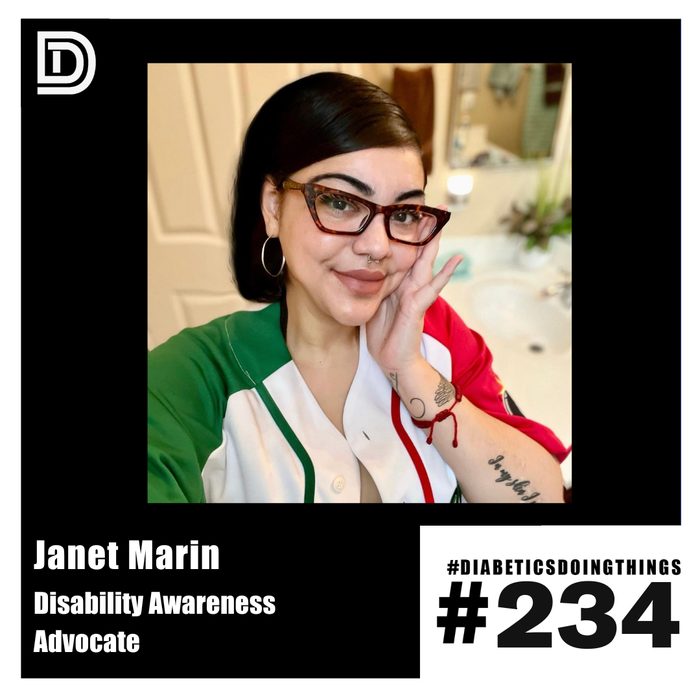
Janet Marin, Disability Awareness Advocate

Episode summary
Janet Marin was diagnosed with type 1 diabetes at age six and grew up translating her own medical care for her Spanish-speaking mother before interpreters were required. In her late teens her kidneys began failing and she developed vitiligo almost overnight. In 2017 she was diagnosed with gastroparesis after months of doctors telling her nothing was wrong. The condition left her stomach unable to absorb nutrition, leading to repeated hospitalizations, hallucinations from malnutrition, and a feeding tube. She also lives with neuropathy, diabetic retinopathy, and fibromyalgia. Janet talks about doctors blaming her for her complications, the loneliness of having type 1 diabetes alongside a rare disease, and the support she found in the chronic illness community.
Key takeaways
- Janet says a doctor told her she caused her own gastroparesis by not taking care of herself, which made her blame herself for years.
- Her stomach doesn't absorb nutrition even when she eats, which is why years of malnutrition eventually led to a feeding tube.
- Janet translated her own diabetes care for her Spanish-speaking mother starting at age six, before hospitals required certified medical interpreters.
- She developed vitiligo almost overnight, which her doctors linked to the stress on her body from failing kidneys and high blood sugar.
- Janet says she has never met another person who has both type 1 diabetes and a feeding tube.
Show notes
Janet Marin is an example of someone embracing themselves fully and living their best life. If you follow her on Instagram @jay_marinnn, you know that’s true. She is a T1D that also lives with gastroparesis, vitiligo, neuropathy, fibromyalgia, and is open about all of it along with her mental health journey. Rob and Eritrea talk to her about all of that and more:
T1D diagnosis at young age of six
Sick days and non-sick days when you live with chronic illness
Being bilingual and the translator between your doctors and your parents
Health equity and getting translators in the room to serve education in the language needed
Autoimmune responses like vitiligo
Gastroparesis diagnosis in 2017 and the lack of information around it
Gastroparesis flare-ups and the effects of malnourishment on her body
The support of the chronic illness online community especially around having a feeding tube
Advice for those newly diagnosed with a rare disease or a rare disease alongside T1D
The isolation that you can feel in these diagnoses or complications
Eradicating shame and guilt-causing language especially from healthcare professionals
We want to hear from you. Send your questions, comments, queries, and general diabetes concerns to THE MAILBAG at mailbag@diabeticsdoingthings.com!
Questions this episode answers
What is gastroparesis and how is it connected to type 1 diabetes?
Gastroparesis is a condition where the stomach muscles become paralyzed and stop moving food through normally. Janet Marin, who has lived with it since 2017, says it is a known complication of long-term type 1 diabetes and is considered a rare disease with few effective treatments.
Why did Janet Marin need a feeding tube?
Even when she ate nutritious food, her paralyzed stomach couldn't absorb any of it. After years of worsening malnutrition, hospitalizations, and hallucinations, she went on a feeding tube to keep her weight and nutrition stable.
What is vitiligo and what caused Janet's?
Vitiligo is an autoimmune skin condition where pigmentation attacks itself, leaving white patches. Janet's doctors said hers was triggered by extreme stress on her body at a time when her kidneys were failing and her blood sugar was poorly controlled.
How did language barriers affect Janet's diabetes care as a child?
Diagnosed at six in a Spanish-speaking household, Janet had to learn medical terms in English and translate them for her mother herself, since certified medical interpreters weren't required at her appointments until years later.
Full transcript Searchable, with timestamps
Rob Howe: Hello and welcome back to another episode of Diabetics Doing Things. We're telling the amazing stories of people with diabetes from all over the world. And I'm very excited to introduce our guest today because if you interact with her on Instagram, you know that she has a super, super fun outlook on life. And one of the things that we're really trying to focus on on the podcast here lately is to share the uncomfortable things about diabetes and the people who live with them and still are living their best lives. and still fully embracing themselves. So Janet Marin is our guest today. Janet, welcome to the podcast.
Janet Marin: Hi, thank you for inviting me. I feel so honored.
Rob Howe: Well, we are honored by you coming to hang out with us today.
Janet Marin: So thank you. I know you live with diabetes and are what we were looking for as a guest on this part of this series of the podcast. If somebody who lives with diabetes and who lives with other complications, then I know you live with gastroparesis as well. So before we get to that, I'd love to talk about your diabetes diagnosis. I know you've lived with type 1 for 21 years, but what do you remember from your early days of being diagnosed with diabetes? Well, I was diagnosed at six and I always tell people that I don't remember my life before diabetes. Like I was born that day. I remember the two weeks prior me getting diagnosis just because everybody around me were noticing the symptoms I mean I was fine I didn't think I was nothing was wrong but yeah like I was frequently using the bathroom you know drinking all the water eating like every 20 minutes and but I was like young so I didn't do I just went about my day and yeah it came to a point where I was kind of like losing so much weight and I had you know that weird fruity smell coming out of your mouth and that's when my parents were like yeah I think something's wrong the it was a Monday because I remember my dad was like you're not gonna go to school today you're gonna go to the doctor and I was like okay let's go and so we went and they immediately checked my blood sugar because of the symptoms and yeah it was like it wouldn't even read it just said hi and from the clinic Like, I got transported to the hospital. And I don't remember even being really sick, though, or feeling sick. I wasn't, like, vomiting or anything like that. So, yeah, my parents were crying. And I was like, why are you guys crying? I didn't understand the severity of it yet. Because, obviously, I was little. Yeah, and we went to the hospital. and they told us it was at the time it was called juvenile diabetes and so I was like what is diabetes I don't I don't even know that I thought it was just like a flu and it would go away but I was in the hospital for like a month and I missed a lot of school because even after that like my blood triggers have always been like crazy like ever since I've been diagnosed it was it just it's always been crazy like I've never had a good day or a good week where I'm like yeah today I'm so controlled it's always been crazy and oh I ended up you know going back to school and stuff and having to adjust to that and it was weird though because my parents never treated me like I was a sick person you know I just did what I needed to do and then I still didn't really understand what was happening like my parents didn't really explain like this is gonna be a forever thing so I just did what they told me to do and I think within like two years I was completely independent like doing my insulin shots checking my blood sugars and my parents would watch me but I wanted to do it myself yeah and growing up with diabetes I just thought it was normal like it was I I just did it until I started getting older and I noticed okay I'm the only one that's doing this and then that's when I was like I think yeah I think I'll have this forever but That was like when I was already like in high school and the only, and also because my parents never were like, you're sick or anything like that. So when people would be like, oh, you're sick. I'm like, no, I'm not. And then I, I mean, I thought I just had diabetes probably until I was like 19. That's when my complications started. The first thing that I experienced, I guess, when it comes to complications, it was my kidneys. My kidneys weren't giving out. They weren't working properly anymore. So they put me on like treatment for it. And I changed completely like my lifestyle. And I started taking my diabetes more serious, which was hard because all my friends were just like living life. And I had to be really like strict because obviously they were like, it's either you do it or you don't and your kidneys will be gone. And obviously I didn't want my kidneys to be gone. So I did everything possible to basically kind of like reverse it and everything that I did helped. And right now they're not like 100%, but they're a lot better. And I'm not on any kind of medication for my kidneys. But I have, you know, this other thing. I want to go back really quick. I'm sorry to interrupt you. I want to go back really quick because something you shared really resonated with me about like living with diabetes and not feeling sick. you know like yeah not feeling like the day-to-day maintenance and all of the carb counting and dosing and constant like diabetes distress that's on our minds doesn't always like register as sickness because it's so lifelong we know it's not going away so for us it becomes normal and it was so weird to me it was actually yesterday i was thinking about this because i was checking in my my whoop which is this app i use like a health tracker app and i had a couple weeks ago i had been sick and so i had checked the sickness box and and now i like unchecked it and i was like yeah like i'm not sick and then i was like yes i am like i'm always sick you know like so like that was an interesting thing to me of like you know like sick days like a regular for an abled person who doesn't live with a chronic illness like they have sick days and then non-sick days and for us like every day is a sick day it's just how many sicknesses are we piling on um yeah and it's such an interesting, I don't know, it was kind of like a mind blowing moment for me. Yeah, definitely. Yeah, I like I said, my parents never treated me like or anybody in my family really like treated me like if I was a sick person or even disabled or whatever. I didn't even know those words existed or chronically ill. Like I didn't know what that even meant when I was younger because I just went about my day. If I needed insulin, then I would take it. Then, you know, it wasn't a big deal. No one made a big deal out of it. I just did it. And I come from like a huge like Mexican family. So they just like did, they just let me do what I had to do. They didn't make it a big deal or anything. And up until like I was my mid-20s, I was like, okay, maybe I am chronically ill. Like I still didn't accept it. And I was in the hospital constantly. And I'm like, no, I'm not sick. Like, but that's just how I was raised. And I still think I still sometimes forget, like, that I have all these things because I'm like, but yeah, obviously now I accept it. And but it was kind of hard.
Eritrea: I think something I want to go back to. So you mentioned that you're Mexican. I also am a Mexican person. Oh, I love it. I I'm always like I read a blog that you wrote where you have to really like take charge of your control because of I mean, there's that language barrier sometimes with our parents. Yeah. So as somebody who is bilingual, how did you find yourself like facilitating some of your care with your parents?
Janet Marin: It was it was it was like really hard in the beginning because they have like they didn't know anything. And so my mom was a stay at home mom and my dad was, you know, always at work like all the time. So any doctor's appointments I went to or anything, it was with my mom. But my mom didn't speak English really well. I mean, even when I was younger, it was probably worse because our first language was Spanish. And I was barely like grasping to learn English the right way, too, because I was so little. I was six. So I kind of had to be like the translator to my mom because my mom was there, of course. And then they would tell me when I would go to the endocrinologist, like, you know, my A1C or whatever. And so, yeah, I had to figure out how to explain to her that what an A1C was in Spanish, you know, and or what they were telling me. And I'm like, that's a big word. I don't even know how to say that in Spanish. So it was really hard. It was really hard in the beginning because it was only like me and her. And we both were kind of like because we didn't know those big English words. We were still speaking very fluently Spanish and I still speak Spanish to her. fluent in it. And so it was hard until we had one of my cousins pretty much go to all of our doctor's appointments because she was better at English. And yeah, growing up, it was always my mom and then my cousin going to doctor's appointments with me. And eventually until I was older and probably in high school, that's when I started going alone with my mom because that could translate better but yeah it was it was weird because back then too they didn't really require a translator like throughout the years they started saying like oh you can't translate anymore we have to get like a translator who's went to school and stuff and i was like well i'm not lying to my mom but it's okay like if you guys some of us do some of us yeah like okay yeah i know i did a couple things no i'm glad i'm glad we can laugh about it because like yeah that i mean And that for sure happens. But at the same time, we're doing an event that we're doing in English and Spanish. And we're using the auto-generated captions for most of the translation. But there isn't a... The diabetes terminology and the medical terminology doesn't just translate over. And the way that we even explain things is written first in English or Latin. And so translating it over to Spanish. and then also translating in a way that actually makes sense to someone who's fluent in Spanish. Those are two different things. I'm glad to hear that now that mandate the translation, because that's just the information alone is so much of the battle and understanding how it all works and asking a six-year-old to be able to understand that. Yeah. That's what's an early age. There's no way that you're set up for success that way. Yeah, I actually, I'm sorry. No, no, go ahead. Go ahead. Go ahead. I that's how I started to like read a lot because I I read a lot of books but it all started because I was like well I need to learn these big words in in English and somehow find the same word in Spanish and make it all work because sometimes I would tell my mom things in Spanish and she was like I don't know I mean in English I'm sorry she's like I don't know what to say so I'll try to like describe it and it's it still happens to this day sometimes because i'll you know i'll get a new diagnosis and i'll tell her and she's like i don't know what she's just said so it still happens to this day but i'm better at it obviously because now i'm better at my english and it works and now i go to my doctor's appointments by myself so some that makes me think about how and this is
Eritrea: just like overall how i think in my brain but it's like people always forget that one of the socioeconomic barriers to access with diabetes is language so I think that when you're diagnosed as young as we were because you were six I was eight and our mom didn't speak English that great so it's like you're sitting there trying to do this but at the same time you're trying to also process what's happening to you yeah we can laugh about it but it is a bit there's some trauma there you know it's something that you have to unpack because it's like you are a child who is having to be put into the driver's seat basically with your parent and you're like okay we're gonna drive this car together and try not to crash and kill each other and that can be really really hard especially like you mentioned you were hospitalized a lot i resonate with that i was also in dk all the time because it's like we didn't know we didn't they didn't know what they were doing i didn't know what i was doing yeah and then we'd go to the appointments and i i'm almost sure that i'm part of the reason that we have to have translators now because i was a live kid yeah like 100 i was like oh no my agency was like 11 so i said what exactly so So I definitely feel what you're saying. And I just think it's important to point out because people forget that all the time. So I'm glad hair is evolving to include language because it's just it's it's paramount.
Rob Howe: Well, I'm sorry, go ahead. No, I was just going to say I've actually educated people like out in Spanish because they'll ask me kindly what I have on my arm. It's my Dexcom or my pump and they speak Spanish. and sometimes when I did have my vitiligo like flare up too much and they all they'll ask me like what is that you know and so I'll translate I'll translate in Spanish because they're asking me in Spanish so that's another reason why I started getting better at it too because like random strangers would ask me in Spanish and so I couldn't really say like I don't know so like I kind of educated myself more on that too because I'm like okay people are gonna ask me in Spanish and I don't know what to say. Well, it's one of those things that we don't, and when I say we, I feel like the English-speaking American diabetes community don't necessarily think about because we are not used to walking into places where we don't understand the language. And I think that's why travel is so important and visiting places outside of your comfort zone is so important because you realize like, oh, there's these entire communities that I don't understand where I'm outside of the norm. And what we've really discovered and are focusing on in some of our work with North Texas Food Bank is when we talk about health equity, it starts with information and just an education, like just being able to learn and access the right treatment methods and the right information on prescriptions and medication. That is the start of health equity because until we all have access to that, like we're not going to be able to dramatically affect outcomes for people across culture barriers. And so just having access, Like, you know, it's been only in the last five to 10 years that there's been any Spanish language board certified diabetes resources online. And like, you know, we've got self-driving cars, but we don't have Spanish translation for people with diabetes. So it's like, you know, there's a lot of, there's a lot of, a lot of room for growth, so to speak. And, you know, I, I'm, I'm glad that we can laugh about it too. But at the same time, like it really is a huge issue. and like what a great impact it makes when you're able to connect about your care in your you know first language yeah yeah and i feel comfortable sometimes talking spanish more uh but it is still difficult like translating like medical things in spanish just because we don't have like a dictionary to go to like what is the what is the boat right exactly i don't know i'm still looking for the word same same like we don't like you know you guys have books and all these things that you guys could kind of like fact check and we don't we kind of have to just wing it in a way because i don't i haven't found like a book or anything that's kind of like well this is what it means or you know any kind of translation or that or anything and i was like dang we're in 2023 and we don't have a book or anything i was like we need to change that and and like even just the name like diabetes is like it's just diabetes or diabetes right like it's like the same word just like well mexicans call it they call it you have sugar yeah oh yeah yeah so you know again just like even the one there's no one-to-one like translation you know like dictionary of diabetes across all these languages and you know we're making progress but i think that's something where you know back to health equity is access to information if you if you can't access any information or there isn't anything it's just auto translated from a browser or from a piece of technology that doesn't really translate it in a way that's culturally going to resonate like that's a real challenge a real real challenge yeah and i'm literally the only one in my family who has type 1 diabetes and sometimes when you know my older relatives like my tias get diabetes they'll call me crying like i have diabetes and i'm like what kind and they're like what do you mean what kind we don't have the same kind and so i'll have to explain to them like i'm sorry it's still like a shock any diabetes is a shock right no one wants to have it but yeah they're they don't know the difference and i'm like why doesn't a doctor tell them a difference i don't understand that's the thing too i'm like doctors are not saying type 1 or type 2 or tipo uno tipo dos and they don't like explain it they're like oh no mas tienes diabetes okay well we'll guide and so i'll have to explain it to them so i'm like at that point though it's like it's very similar to english like people like don't explain the difference between type 1 and type 2 very much either and like you know i think sometimes especially in those family scenarios like that can be where those sort of uncomfortable conversations happen right it's like you know there's just a lack of awareness and we as people who are chronically ill have to educate one-to-one with like every person who comes up who's you know genuinely curious or means well they're asking about you know a cgm or asking about a pump or something and like you know they they mean well but it does feel sometimes like they're encroaching on our personal space or it's like you know something that we kind of guard and hold like really close and i i i'm sorry no no good i've noticed that you know sometimes when you correct a person and it is in spanish they get like offended kind of in a way of like oh well you know more than me but i'm like no i'm just trying to like educate you like the one that you have isn't the same as the one I have you know so they kind of get offended sometimes I mean English and Spanish I've had both scenarios happen but I tried the best way to be like nice and not like come out aggressive with it because yeah some people do like take it the wrong way when I correct them like oh no that's not the one I have like that's the one your grandma has but I don't have that one it's like that TikTok sound when they're like because you got your degree and you know every damn thing. Yeah, exactly. That's how they make me feel. I mean, and I wear my, I used to not wear like my pump out or my CGM or whatever because I hated the questions. I hated having to repeat myself over and over that I'm diabetic and no, it's not the one that your grandma has or whatever. So it became like annoying and for a while I wouldn't show like my gadgets or anything. But now I mean, like I don't care. But it was like, I think I just got over just repeating myself over and over again because it happened all the time. And I also had my little Lego very... It had just came out. I had it everywhere. So then I would get even more stares. So yeah, I was just like... Everybody was staring at me. Well, I want to talk about that because you... When we were building this episode and kind of planning out having you on, And we were looking for somebody who lives with diabetes and gastroparesis. So I'd love to talk a little bit about gastroparesis. And I don't want you to have to do all of the education on that because we've had people on the, on the podcast with gastroparesis before, but we haven't dug into talking about it as much. And so like for those listening and who don't know, it's a medical condition that affects the normal movement of the muscles in your stomach. So like paralyzed muscles in your stomach, gastroparesis, gastroparesis and paralysis. So talk a little bit about sort of your treatment methods. And I think that you had just mentioned that like the vitiligo, is that what it's called or?
Eritrea: It's vitiligo.
Rob Howe: Oh, vitiligo. Yeah.
Eritrea: Which is different. I think that's like a skin. Yeah.
Rob Howe: Can you explain to us, to our ignorant listeners and to myself? That's like the least, like I don't even worry about vitiligo because it's not painful or anything, But vitiligo is like a skin condition and it's basically your skin pigmentation attacking itself. And when you get white spots all over your body, it's basically like not making your skin color. So basically it's like no kind of protection, you know. So it's just for my case, it's usually brought on by stress or something is going on in your body. And just like how, you know, type 1 diabetes attacks your pancreas, it's the same way. Your body is kind of like so much in stress that it's trying to attack something. And of course, it attacked my skin pigmentation. And I started getting spots, but it happened very rapidly. I had like a little one. And like by the next following week, I was like covered in them. Like every morning I would wake up and I would notice a new spot. And they were like really big and all over my face, my arms, my legs. and at first I thought it was eczema because that's what I've had all my life but my doctor's like I think you have vitiligo and I said what what is that what I don't even know what that is and that also happened around the time my kidneys were giving out and that's why they told me your body is in so much stress because of your kidneys and your diabetes not being well controlled as well my A1c wasn't great so they said that it was caused on by my diabetes But I mean, that's my case, obviously, but other people have different stories. But usually it's brought on by some kind of stress within your body. I got my A1C under control and everything and they kind of started to disappear. I have them randomly here and there. And like if you really notice or if you really stare at my face, I have some on my face still, but nothing compared to how I used to have it when I first got it. I'll have it forever because I still get little slots here and there when I do stress out. sometimes or my body is in a lot of stress and I'm in the hospital, I'll start getting them randomly, but not as much as I used to get them. And like, yeah, like before I was just super converted and I was a little bit darker than I am now. And when I got diagnosed with vitiligo, like my whole skin complexion went like lighter. And it's weird because if I show you a picture of myself as a kid, I'm like darker. Like I've always been on the darker side of, you know, the the color spectrum but now i'm like like probably like four shades lighter than what i was before so it's weird because i look at myself as a kid and i'm like wow i was really dark compared to myself now so yeah like it affects your whole body in a sense and it happened oh to me it happened super quick it was like overnight well i think and thank you for explaining that and you know i think it's part of you know the uncomfortable things about living with a chronic illness is that the stress that our bodies are under consistently opens us up to other autoimmune responses and other autoimmune reactions. Like you described it, it's just your skin basically doing what happened to our beta cells and our pancreases where they just are attacking each other until they're gone and they go away. And they often can flare up as well or have peaks and valleys. But thank you for sharing that. And I think too, I want to kind of steer us back as well to gastroparesis, which is also a very common complication and side effect of the life with diabetes as well. And so, you know, what I kind of want us, what our listener, what I want our listeners to focus on is as we're talking about these things that can be very uncomfortable for people with diabetes to hear that you also are still living your life with, you're living your life and you're letting your life shine along with these very heavy burden but it also allows you to be yourself and i think that's what i want people to focus on and it looks like we
Eritrea: lost our train but there she comes she's coming back she's back so tell us a little bit about
Rob Howe: your diagnosis with gastroparesis and and how you and your care team kind of built that plan for you and how you manage it.
Janet Marin: Okay. Yeah. I got officially diagnosed with gastroparesis 2017 in December. Prior to that, I've always had like a very weird sensitive stomach. So I was already dealing with like stomach problems. Like I got my gallbladder taken out when I was 18. So I've always like was very used to dealing with my stomach kind of acting up. but then it just started to become very severe to the point where like I would eat and I couldn't keep anything down the pain was just like unbearable I would end up in the hospital because obviously I couldn't eat my blood sugars were crazy I would end up in DKA and it was like a couple of months where I was just in and out of the hospital and they wouldn't tell me what was wrong like they would do tests on me and they were like everything is fine and I said well clearly something's not fine because I'm not okay. You know, and there was the last time that I had got admitted to the hospital, I was like super sick in the ICU and I couldn't even talk anymore. I was like super weak and they just couldn't tell me what was wrong. But obviously something was wrong and something, it was wrong with my stomach. So finally, I think, oh, my cousin had got like into it with the doctor that was taking care of me that day. And he kept saying, no, she's fine. She's fine. She's fine. Like nothing's wrong with her. And she's like, well, she's not fine. Like, I physically don't look fine. So they finally said, well, we haven't tried one test. And so they did an empty gastric test on me. And that's when, you know, you drink something and you lay under a machine and it takes pictures of your stomach and basically like your esophagus while your food's going down to see how fast your food goes down and how fast you digest your food. And that's when they found out that it was gastroparesis because my food wouldn't move at all. It was just in my stomach. And they basically were like, yeah, you have gastroparesis. And then they didn't really give me any information. I had no idea what gastroparesis was. I didn't even know it was a complication of being diabetic or, you know, having diabetes for so long. Like I did not know anything. They gave me a pamphlet, a very vague pamphlet. And they're like, yeah, you just have to change your, you know, your eating habits and, you know, you'll be fine. And I said, oh, okay, it sounds like just another thing that I have to deal with. But it was so much more severe than they told me. They never even talked about how bad it could get, nothing until I started going to doctors you know I had one gastroenterologist and he kind of just gave me medication for it none of the medication work and that's the thing with gastroparesis it's kind of like considered a rare disease and they don't have a lot of treatments for it and I think I tried like three of the treatments and that was literally it and the other treatment it was illegal in the United States because it affects your heart. And so I couldn't try that one because it wasn't legal here in the United States. Other than that, there wasn't any kind of cure for it or like treatment besides medication that didn't work for me. And basically the medication was kind of like to help me move, like contract my muscles in my stomach and to try to help me move my food, but it just didn't work at all and I didn't really like the gastroenterologist that I had so I went to another one and basically they said the same thing and they kind of the second one that I went to kind of blamed me for having gastroparesis and he was very rude to me he said because I asked him I said like is it going to be like this forever or is it going to get like you know worse like I just was asking simple questions like I really was an educator on it and he said well if you continue to not take care of yourself then it's gonna get worse and he said that's one of the reasons why you got it because you were how he said a really very he said kind of basically like you were dumb because you didn't take care of yourself growing up and I said well dang thanks and obviously you believe these things because these are professional doctors. Why wouldn't you? So I left that appointment kind of sad and I was like, I'm not going back to him. So I finally found another one and it's the one that I love. It was a female doctor and she helped me and still is trying to help me get better. I saw her because my primary care physician recommended me to her because she was talking about a gastric stimulator and maybe I would qualify for it because of my gastroparesis and the gastric stimulator is basically a stimulator a little machine that's placed in your stomach and it shocks it gives your stomach shocks so it could try to move your food and unfortunately I didn't really benefit from that either I'm already at my the highest voltage that they could put it on but my doctor doesn't want to remove it either because she doesn't know if I get it removed what if I get worse so she's like I'd rather just keep it in and what because what if it is doing a little bit of some work you know and I'm you know I was so sick before the stimulator but I still continued to be sick with the stimulator so that's why we we had that's how we found out that it wasn't really working for me but a lot of a lot of patients do have really good like you know experiences with that gastric, I mean that stimulator she's the only one who does it here in nevada in las vegas like no other doctor does it because they don't really see a lot of high success rates so they're kind of like i'm not going to waste my time to do it but my doctor is like super good at just going above and beyond to try to help me get somewhat better i've been going to her for i think i've had a gastroparesis for eight years now i've been going to her for five of the eight and she has gone like above and beyond for me but it's just still and I'm still pretty sick like I got I had to be placed on a feeding tube last September because I was so malnourished you know and another thing people probably don't know is like your stomach's not only paralyzed it doesn't absorb no nutrition at all so even if I have the most nutritious meal by mouth, it does nothing to me. I don't get any of the nutrition at all anymore. And that's one of the main reasons why people are placed on feeding tubes when you have gastroparesis, because even if you could eat by mouth, it's no use. You're not absorbing any of the nutrition. So eventually, you know, in the beginning, she told me about the feeding tube, but she told me, I don't think you need it yet. Like, you know, you still are holding your weight. You're still eating by mouth sometimes. so you're okay but then just gradually I started getting worse and worse I was in the hospital every month for more than a week because my gastroparesis flare-ups were extremely bad and I had to go to the hospital you know because when you throw up you lose a lot of magnesium and potassium and just things that you need to keep your heart pumping and so I constantly was in the ICU because I was like NDKA and I just was very, very sick. And I went as far as I could without a tube, but I just got extremely sick. And it was like, either you get the tube or you kind of die. Because I was at that point where I was fainting all the time because I was so malnourished. My hair was falling out. I started to hallucinate like really, really bad, which I I didn't even know that was a thing when you're about nourished. I was hallucinatingly crazy. And yeah, I was just getting really, really worse where I couldn't even walk on my own anymore. So yeah, like my parents took me to my doctor and she said, yeah, you need a feeding tube. And from the doctor's office, I went to the hospital because I was extremely sick. And yeah, I haven't had the best experience with my tube, but I definitely, I keep my weight on now and I still go through flare-ups but we're still trying to figure out how I could somehow get more independent with my life and stuff because it's pretty hard right now most most of my days I'm in bed because I'm in pain and nauseous it gets really bad like I get very light sensitive I get sound sensitive I have to be like in a pitch black room and I'm just like constantly throwing up and I have to be you know connected to my feeding pump 24 hours out of the day when I am in full flare-up when I'm not I just connect at night while I'm sleeping but yeah it's been quite a journey with gastroparesis it's very it's I I it's a horrible disease I don't even know how to explain it's just horrible and if people who haven't know how bad it is but I don't really I don't actually know anybody else who has type 1 diabetes and a feeding tube. Other people who have a feeding tube, they don't have type 1 diabetes. And I'm very grateful for, you know, the chronic illness community itself because they've helped me a lot with just my feeding tube. I was already part of the type 1 diabetes prior to that. But, you know, getting all these other complications, I found out like, wow, other people have all these complications, but not necessarily coming from type 1 diabetes. It's just other things that they have. but yeah like i haven't really met anybody who has it as bad as me because i feel like i have it so
Rob Howe: bad well i thank you first of all for sharing and being so open obviously you just in the 10 minutes of you explaining it like it sounds extremely heavy and difficult and yeah one of the things that i think was the driving force behind us doing this interview is if you casually looked at your social media profiles you would never know how much pain and struggle you're going through you would see a mostly normal you know seeming like really outgoing fun person who is doing what they want to do but we don't see and like i think that's i don't know there's a kind of like a viral graphic going around social media right now it's like you know what you see about someone and like the whole rest of their life and it's like a tiny circle and like this big thing and i think like people who are chronically ill and like you know shout out to the rare disease and the chronically ill community like even outside of diabetes like amazing community and just the strength that you see from people that you don't even know and like are dealing with diseases that i have no idea about i've never heard of before yeah and they're there they give their time like what little time they have that feels good to other people to help them inspire them and help them through so um you know i just want to say thank you again for for spending your time with us today to do that and you know just being a great example for you know people who are unfairly chronically ill and yeah you know still making making the best out of it and getting back to others and it really is an inspiration like inspiration isn't always like some amazing achievement like running a you know 100 mile marathon or you know you know winning the lottery oh and f for a day is like those are sure yeah but but you know sometimes just getting out of bed and like being able to make your you know be a good family member a good friend and like do what you want to do is going to make amazing thing to celebrate so thank you for for being so open about that oh you're welcome i think it's a hard topic to move forward from right i'm having a really hard time processing it like i can't imagine what you're going through and i never
Eritrea: want to center the ables because i feel like in this conversation we're the ables but it's like what a what a toll and what an amazing and what an incredible like i don't know it can be terrible and still be incredible like journey that you've been on now and i yeah i don't know i have so much
Rob Howe: respect like so much yeah you're just like going through three different doctors and like you know we you hear people's stories in chronic ill communities in the diabetes community about firing your endo and like going and finding new ones like that takes so much effort and like when your disease also takes away from your ability to go outside stand up like that that makes those things even more challenging and so yeah good good for you i'm so glad that you found a doctor who like treats you like a person yeah she's amazing it's just willing to try to help um you know i guess and I'm with you, Eritrea, and like i don't want to like move on too quickly or, you know, from, because it's so impactful.
Janet Marin: I could talk about it forever.
Rob Howe: Well, but that's, that's so great. And I, and I think like, that is why we wanted to have you on it because like, there's, I hope that there's someone here listening who would benefit from it. So like for that person who's listening or is either newly diagnosed or is dealing with complications, like what kind of advice would you, would you give them on how to, how to navigate the situation or what would you, what would you tell to yourself when you were first diagnosed with gastroparesis or any of the other rare diseases alongside your diabetes? Yeah, well, because I also have, I got diagnosed with gastroparesis and like within a week, I got diagnosed with neuropathy. And then like a couple of months after that, I got diagnosed with diabetic retinopathy, which is, you know, damaging your eyes. So my complications were like back to back to back. I had no time to process each one of them. I had to process them all together because it happened so quick. And then later on down the line, I got diagnosed with fibromyalgia. So it was just like so many diagnoses back to back. I couldn't even keep up with them. And it was frustrating because I just couldn't figure out like how to go about my gastroparesis. In general, my gastroparesis is the one that hinders my life the most and probably neuropathy now. sometimes I'm like I don't even want a new pancreas I kind of want a new stomach because it's just so hard to manage it especially managing it with type 1 diabetes you know I see my other friends who just have gastroparesis and I mean obviously gastroparesis is not easy to live with at all but they don't have to deal with having to watch their blood sugars like 24 7 like a hawk and I think that's where I try to find other people like that with me but I haven't really found anybody everybody that I do know who had gastroparesis doesn't have like one diabetes so I wish I could find someone kind of like me because it's it's lonely it's lonely and I guess if I had to give my own self-advice I would just say to be more patient with yourself and not so hard on yourself because in the beginning I blamed myself a lot for it because doctors would tell me that it was my fault so why wouldn't I blame myself for it so that was very hard for me to get over because I would constantly be very hard on myself and kind of just like hate myself in a way because I would say like man if I would have took care of myself a little bit better down the like you know back then then maybe I wouldn't be so sick now and that's another thing I don't think people talk about that, you know, if you don't take care of yourself properly, you know, with type 1 diabetes, whether you're doing it intentionally or not intentionally, you know, you're not going to see the consequences next week or next month. It's like years down the line. You know, I didn't take care of myself properly in high school and I'm dealing with complications now and I'm almost 30. So I don't think people realize. And that's another thing I wish people would tell, you know, newly diagnosed diabetics that the severity of the complications and whether you take care of yourself so that you could still have complications at the end of the day. But yeah, like I get messages sometimes from moms and asking me, like, how do I prevent my baby from having gastroparesis? And it's very hard to answer that question because even if you take care of yourself so well, you could still end up with gastroparesis and neuropathy and all the other complications that type 1 diabetes comes with. And I think that's something we don't talk about enough. Eritrea and I were talking about this in our most recent episode of our podcast where, especially with parents, and I think that question, I see both sides of it. I think that it's well-intentioned. But what we kind of came to in our episode is that diabetes is going to kill us one day regardless of how good to take care of ourselves. The doctor is going to sign, Like, you know, Rob Howe, hopefully age 95, he lived this great life and he died of complications from type 1 diabetes for 70 years, you know, and like that is just going to be part of that. And we're also all so different where you could have, you could have the best control in high school or throughout your young life and still get complications like neuropathy and gastroparesis because we're all different and our bodies respond differently. And I think, you know, we're, it's easy to say that we're all different and we all, and we all like to say that diabetes is not the same from one person to another, but complications are an uncomfortable part of that too, is that for some of us, we're more likely to get complications and there's no reason why. You know, like you said, in high school, you didn't care as much about your diabetes. Who among us is not guilty of that? And unfortunately for you, that's resulted in complications for you in your 30s. And like you said, it's not tomorrow. It's not the next week. It's further down the line. But when you're 16, you're not thinking about life when you're 32. You're not thinking about life when you're 50. You're just thinking about that day and trying to make it through your third period English class or make it through lunch without everybody pointing at you.
Janet Marin: Exactly.
Rob Howe: And so again, I just want to affirm to you, you being vulnerable and talking about the uncomfortable parts of living with complications, especially the questions from other people, especially the uncomfortable moments you know explaining to strangers or even to people that you love like in your family and you know i i think i actually know some people that i can maybe introduce you to that that live with diabetes and gastroparesis and i know it's not the same for everyone but when you were just saying how lonely you felt it just reminded me that of people that we've talked to from the podcast and from the community of who also felt lonely and then they found people with diabetes and they found people like them and i i i want to see if we can put you into some people who may be able to at least make you feel a little bit less lonely sometimes because of all the things that of all the things that we can't control one of the things that we can control collectively is being good community members being good friends and and supporting each other even when it's uncomfortable and so yeah you know i i want i want to thank you for having uncomfortable conversations with us and of course being that voice to people because I know that you sharing your story will make a difference for for someone else I mean I am affected dramatically today I feel like your tree is too and so I don't know I'm going to be cheering for you whatever you want to do so you know thank you thank you for being an awesome guest and for sharing your life publicly because otherwise we wouldn't have found you and wouldn't have been able to know and like hear your story so that takes courage and i just want to you know i'm always going to be a an advocate for people telling their story and opening up because i know the power that that can happen somebody else thank you i i'm sorry i'm getting
Janet Marin: this out are you rapping right now i'm trying i want to have another question
Rob Howe: because i have another i have another call but oh it's okay no you're fine this is important
Eritrea: don't ask it ask the way okay okay well i want to go back for a second when we're talking about the health care professionals that stood around instead of a bunch of shameful and guiltful stuff
Rob Howe: because can we fight like can we fight in the street for real like i mean i was ready to fight all the time but i mean i didn't want to go to jail i mean i just i wonder because you were
Eritrea: talking about how important how isolating it can be right so it's like imagine going to that doctor's office and the professional that you're here to get help from is like, I'll help you. But also, this is your fault. So overall, I know health care professionals do listen to our podcast and they're not the ones who are perpetuating this kind of verbiage or conversation. But it's really, really, really important for a part of the complications conversation to not be guilt and shame, because I think that's what it's even rooted in. Yeah. The parents who ask the question, it's like, yes, I don't want my kid to go through this pain. But also, is there something shameful about my parenting a child with diabetes who later has complications etc etc etc so with guilt and shame and those being so rooted in diabetes community it's just so important for us to eradicate it because it has no place here and it's not helpful like yeah it's not getting
Janet Marin: and i get it all the time still like my doctors don't do it to me because i chose my doctors specifically to have a great relationship with them because i see them more than i see my friends so my doctors don't do that now but even if I go to the to the hospital sometimes I get it from doctors there they're like I've gotten told like oh well you already have gastroparesis what more do you want like take care of yourself like so rude to the point where I'm like in tears and like I don't those words don't faze me anymore because I'm so used to hearing it but some some doctors are very very cruel and I I don't like it because like I could take it but what if the next person can't take it you know and that's what i think about all the time like i don't know doctors just need to watch how they you know say things and i could take it i'm strong enough but i think about people who can't like you know what if they're like very vulnerable and not in the right headspace and you say that and they blame themselves for reals and you know that's not healthy mentally at all. No. And I think, you know, there's a lot of work to be done. You know, there's something that I think about all the time is that not every person in a position is a good example of that. Not every doctor is a good doctor. Not every business person is a good business person, just like where people are people and it's on a spectrum. But I'm glad that there's at least more physicians leading the way on the respect for patients. And there's more papers being written in more studies about better outcomes when you treat patients without the shame, without the stigma. Eritrea works on that in her professional life, like on a huge stigma campaign that just advocates for people because we see how damaging it can be to have that rhetoric. So I totally agree. Yeah, there needs to be more changed. Janet, if people want to follow you, where should we point them? People want to connect with you. i actually only just have instagram and twitter i don't have tiktok or facebook for anything i just have instagram and twitter that's it and it's jay underscore marin, with three n's so you want to do i need to spell it out no we'll tag you in the show notes but yeah definitely give janet a follow and again i just want to thank you for for giving your time for being with us today and no i want to thank you guys you guys are amazing and super understanding when it came to me always canceling i get so much problems when that happens like you guys were amazing i literally thought you guys were gonna be like never mind we're just gonna never no we're not we're not like that we because we know we've been there there there's some times we're here trade i was like i ain't got it today dude that's good yeah you've got you got grace with us always and I'm so glad we made it happen. Yeah, thank you so much. You know, hopefully we'll do an event that you can come to sometime out in Las Vegas. Maybe that'll be coming sometime next year. Oh yeah, I would definitely go. Yeah, just let me know and if I'm not in the hospital, I'm there. Well, and if you are, we're coming to visit you so that's right. Bring the party to my room. Now we're talking. Right. Okay, Janet. Well, thank you so much. It was so nice to talk to you and And we'll let you know when this episode is going live and so that you can, you can check it out. But thank you so much. And it was so lovely to meet you in person or on Zoom. Right. We'll meet in person one day. Yes, we will. Yeah. Thank you so much for having me. All right. Bye. Bye. Bye.
About Janet
Janet Marin is a disability awareness advocate who was diagnosed with type 1 diabetes at age six. She also lives with gastroparesis, vitiligo, neuropathy, fibromyalgia, and diabetic retinopathy, and is open about her physical and mental health on Instagram.