

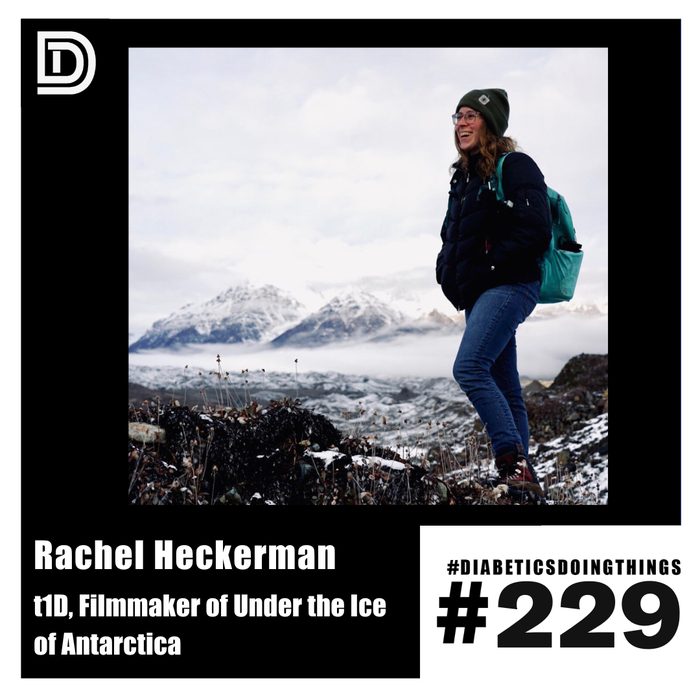
Rachel Heckerman, T1D, Filmmaker of Under the Ice of Antarctica

Episode summary
Rachel Heckerman, a videographer and photographer, returns to the show four years after her first appearance on the Tools of Type Ones series. She describes landing jobs as support staff at McMurdo Station in Antarctica, first for a full season and later for a shorter stint, and the long multi-flight journey to get there. Rachel talks through the fear of her insulin freezing on arrival, a Dexcom transmitter that failed twice from static and magnetism, and how she built confidence over two seasons by overpreparing with snacks, hand warmers, and backup supplies. She also explains how a scary blood sugar drop on a hike led her to the sea spider researchers she later filmed for her short documentary, Under the Ice of Antarctica.
Key takeaways
- Rachel says her Dexcom transmitter broke twice at McMurdo Station, likely from static buildup and the region's magnetism.
- She packed roughly six months of insulin and test strips for seven checks a day for a four-and-a-half-month season, planning for worst-case scenarios.
- A scary blood sugar drop on an early hike led her to the sea spider research team, which became the subject of her short film, Under the Ice of Antarctica.
- She kept her meter and phone warm with hand warmers tucked inside her jacket so they wouldn't freeze on outdoor hikes.
- Talking to other diabetics who do extreme outdoor activities helped her manage fear and stay calm during low blood sugar emergencies.
Show notes
Rachel Heckerman, from our Tools of Type Ones series in the very early days of the pod, is BACK! Rachel is a videographer, editor, writer, designer, photographer, and overall cool person. She produced a short film called Under the Ice of Antartica. It’s beautiful and you should check it out!
In this episode we get into:
How she got a job on a station in Antartica
The LONG journey to Antartica
Planning ahead and packing for diabetic emergencies
What living in Antartica is like
Adjusting to being in a new timezone with Diabetes
Having a Dia-buddy, even in Antartica
Enjoying the moment while being actively aware of your diabetes and not letting Diabetes stop you
Diabetes tech on a freezing tundra
We want to hear from you. Send your questions, comments, queries, and general diabetes concerns to THE MAILBAG at mailbag@diabeticsdoingthings.com!
Questions this episode answers
Does insulin freeze in Antarctica?
Rachel says her insulin didn't freeze even after riding in an exposed shuttle compartment for 45 minutes on her first trip, but she now keeps it with her at all times rather than risk it.
Why did her Dexcom transmitter fail in Antarctica?
Rachel suspects static electricity building up under her bed for months, combined with the region's strong magnetism, caused her transmitter to short-circuit twice.
How much diabetes supply do you bring to Antarctica?
Rachel brought about six months of insulin and enough test strips for seven checks a day, planning for her Dexcom or other supplies to fail.
What job did Rachel have at McMurdo Station?
She worked as a dishwasher, called a steward, a 54-hour-a-week job across six days that let her meet scientists and other staff across the station.
Full transcript Searchable, with timestamps
Rob Howe: Hello and welcome back to another episode of Diabetics Doing Things. Very special episode today. We have a return guest from the Tools of Type 1 series that we did at the beginning of 2019. She was guest number 15, episode number 15 on the Tools of Type 1 series. Rachel Heckerman, back on the pod. Welcome back to the show. Rachel Heckerman Hey, thanks for having me back. So good to finally talk to you one on one. I know. The Tools of Type 1 experiment was fun. I got to get a lot of really cool interviews from a lot of different people over a long period of time, but I missed being able to ask follow-up questions. I remember editing those episodes and being like, oh my God, I would have a question here, but it's all recorded. So yeah, I'm so happy that you're here for the live episode. And we've got a lot to talk about today. So first of all, how are you? Where are you calling from today? And what's going on? How's life? I am doing good, of course. Right before I jumped on this call, my blood sugar decided to be like, oh, let's start spiking right now. So I think it kind of knew that I was about to talk to two diabetics and it was like, okay, let's embarrass you by having higher blood sugar. But I'm good. I'm calling from New Jersey and I'm drinking some coffee and it is a good morning and it's so good to talk to you guys. It's so good to have you here. And I think, you know, especially to have you here kind of on your home turf. you know, with your life so intertwined with travel. And we're going to talk a lot about travel today. But I guess like between the last, there's been a few things that have happened in the last four years since you've been on the podcast, both for you personally and in the world at large. So I'd love to talk a little bit about your journeys to Antarctica. We're going to talk a lot about that at late today, but you recently got back from your second trip. So let's kind of rewind back to maybe 2019 and your first kind of trip to Antarctica and talk about that journey. And we can also talk about your amazing short film, Under the Ice of Antarctica, which I have shared when you released it earlier on the web. And it's such an amazing just visual and personal experience. And I even before this interview, I got hyped like watching up. My blood sugar also spiked when I was watching because I was, yes, we get to talk to Rachel Heckerman today about all of her awesome creative work. So so let's rewind back to like way back in 2019 or your first expedition down to Antarctica and how that came to be. Yeah, I actually heard about the whole program and stuff when I was working at my job in New York City. I did like a lot of design work and stuff. and essentially at that time it was when people realized they could start designing instagram stories and like editing them and posting them on just like their story i was doing i worked for a travel media company so i was doing this post about the history to the race in the south pole and i always kind of loved antarctica arctic stuff so i was super stoked to work on that and when i was doing that when i posted it this guy replied and he was like oh, funny, you're posting about the South Pole. I just got back from living there for an entire year. And I was like, that's insane. How do you do that? And I reached out to him personally, was like, please tell me everything you know on how to do that. And immediately applied to that job. And when I found out I'd gotten it, that's like the short story of it all, I freaked out. And basically, when you find out you're going down, you have to prepare in so many crazy ways because the journey is like very long and there's about four flights to get there. But yeah, I was so excited. I definitely was thinking though, like, this will be interesting with diabetes. Like I've never done anything like this crazy before. So how will I possibly, I guess I'm going to figure this out my own kind of thing. But yeah, it takes about like four flights to get there or sometimes three. But my first time, I think I flew from New Jersey to L.A., L.A. to Auckland, New Zealand, and then Auckland to Christchurch, New Zealand. And you essentially like wait there for it can be like three days. It can be like two weeks. Sometimes due to COVID, a lot of people that I knew like were there for 40 days before they could fly down, which was crazy. But that was all for like quarantining purposes and stuff. But yeah, after you get the go ahead, basically you're waiting on the weather and making sure the weather is good enough to fly down. But yeah, after about seven days, my first time we got the go ahead and then I got to go fly down to McMurdo and it was very cold. As you had probably said. Right. Like we say very cold. Right. And we live in Texas. So like cold for us can be like 30 degrees Fahrenheit. 45, man. 45. okay there you go 45 a little bit of humidity in the air for you know so for for those of us like and like watching your see your film hearing i think one of the scientists and researchers said like the water like or the temperature could be like negative like triple degrees below zero like you know like something crazy like so i i want to know like so for you like and i've seen your amazing photos of like getting on the plane and off the plane like and what how cold is it Especially for somebody who has grown up on the East Coast and knows what it's like. Nor'easters and winter cold in New York and in the Northeast is significant, but what is it like down there on the South Pole? So, crazily enough, the weather does fluctuate a lot from the start to the season to the end of the season. The start of the typical summer season is from October, and then the end of the typical summer season is the end of February. so that the temperature fluctuates like insanely from that time frame but like i think getting there it never was colder than like negative 13 degrees but it's the wind chill that's just it can make it like negative 40 and the wind is really crazy there like it can knock you over so when i arrived my first time i was so excited that i wasn't thinking and i just really was like I really want a photo of me in front of the plane, just like out in the terrain and everything. Then I forgot to like put my gloves on. So there's just like a photo of me and I'm just like posing, but I'm not wearing gloves. And I immediately got onto the shuttle to go to the station. And I was like, immediately in my head, like, I'm going to get frostbite. They're going to send me home. Oh, and I also, funny enough, like there's a spot where you put like all your luggage and stuff and I had put my luggage and I kept all my insulin with me in that bag and they put it basically like in this little section that's on the outside of the shuttle it's like a really big shuttle they call it like Ivan the Terra Bus but I didn't realize it was gonna be like 45 minutes of driving to the station because it goes really really slow it'd probably take about 10 minutes like normally but like with a regular car but it it takes a long time and the entire time I was like, my insulin is going to freeze. And I have frostbite, even though I didn't, but I was just like, my whole journey, like I was supposed to be like, you know, excited at taking it in. And of course the first thing on my mind is like, is my insulin going to freeze? Am I going to have to be sent home like immediately? So I was just panicked the whole time. So I didn't even get to like, take it all in the first time around. Definitely did not make that mistake. The second time I was like, that bag is coming with me onto the shuttle. It was fine. Like the insulin didn't freeze or anything but i it was just crazy how again diabetes can just take you out of the moment so fast i was gonna say like and you know just immediately clogs your brain with anxiety you're at this alcohol and all you can think about is is my insulin gonna make it is my insulin gonna be gonna be okay or am i gonna have to you know go home because of frostbite my
Atreya: finger it's kind of like oh like a much larger emergency if you're like i don't know i'm sure we'll get into it but geez i can't imagine my insulin freezing on the other side of the world or like running out of it or being in an emergency in right i was gonna say you can't just like call
Rob Howe: a pharmacy you know there's no there's no like walgreens that the shuttle can go pull you into and go you know refill that prescription so like what was that so before we get into like your life on the station how did you prepare for because it's a long journey you were there for many weeks if i remember correctly the first time i was there for four and a half months so i was there for pretty decent and then the second time I was there for four and a half weeks which was a lot shorter a lot easier to pack for packing diabetes wise I made sure I had at least like six months supply with me I had backup Dexcom supplies which I also would love to talk about that because both times I have been down to the ice my Dexcom transmitter has broke like broken twice so that has been an interesting thing to figure out why because I think there's many reasons why it breaks down there so yeah I always just like made sure that I had enough test strips even though I knew that I had my dex calm with me I was like I want to make sure I have test strips for at least seven tests a day for four and a half months in case the worst case scenario happens and like something breaks or like you know so I could lose something or you know because anything can malfunction down there so and yeah I guess basic like warm clothes and they outfit you with all the cold weather gear in New Zealand so you don't have to worry about like the big red jacket or anything they they let you borrow that while you're down there and then you return at the end of the season but yeah I think just making also to going through New Zealand you're only allowed to have like three months supply with you so I took the whole amount with me it's like kind of a risk you take but Nobody ever actually so far has checked that. But yeah, I think just over preparing, like I think I was like, what is the worst case scenario that can happen to me here? And how am I going to deal with that if that happens? Because like you guys were saying, it's not just like an easy like call the doctor and be like, oh, yeah, like this thing happened. Can you fix it? Yeah, cool. It's like that's yeah. You have to make sure you're taking care of yourself and thinking like five steps ahead just in case. So yeah, it's kind of like the worst case scenario of diabetes planning. Like you have to really think through what could go wrong, like all the different pieces and all of the different elements and then solve for that. You know, and we've talked about that on the podcast a number of times just going on trips, like making sure you bring maybe double or one and a half times of the supplies you need just in case. But, you know, multiply that to the, you know, the nth degree when you're going down to the South Pole. So, okay, let's go back to that first moment. You, your insulin is not frozen. You're, you don't have frostbite. So you're able to maybe breathe deeply and you get, you get, and you arrive at McMurdo station in Antarctica. What was that like? What, for, for those of us who've never been down there and will likely never go because only a small number of people ever make it down there. What's it like? When you step off that plane, it is just like pure white and it is just unlike anything I've ever seen before. but then it's really cool because you turn to your right and then there's just like this giant volcano called Mount Erebus there and it's the southernmost volcano in the world so you're just like okay whoa where am I and then it's just cold and you're with all these people that you only met like a couple days ago and you're just like all crammed on this like shuttle and you shuttle over to the station and you just see like you go you shuttle by this other research station called scott base it's new zealand's research station and it's just like all these like green lime green colored buildings and stuff and my favorite fun fact about that building is that the their sign is with comic sans so it's just very like new zealand to them to be like hi welcome to scott basically use comic sans anyway and then you keep shuttling and you just like look out and there's just like all these seals like laying around and they just look like sea slugs just like on the ice and stuff so essentially like McMurdo station is on an island called Ross Island so what you're looking out at is just like all sea ice that is frozen through the winter and by the end of the season it'll all melt out and sometimes that's like when the penguins start to come over and stuff is as the ice like breaks out and stuff and yeah you're just like looking off at all the ice and there's just like mountains in the background and you get to McMurdo and it kind of looks like a giant construction site to be honest it's definitely like kind of outdated looking but but yeah you're just it's so like at the beginning of the season it's like all frozen over and it's just like pristine white just like super beautiful and like I've never seen light that way before I don't even know how to explain it it's just so yeah otherworldly i would say but then it's funny because you're just like having this wow moment and then you like get to station they shuttle you off the shuttle and you go into this room and then you just sit for like two hours and seminars of just like here's how to not die in antarctica here's where your room is here's how like it works and everything operates blah blah blah and then they basically like here's your room key here's your room work starts at like 6 a.m tomorrow morning see you then kind of thing so you're just like what just happened to me kind of thing and you're also I guess like on diabetic terms like adjusting to just being in a new time zone to begin with but I don't know about you guys but like when I am on a completely new time zone my blood sugar is like all out of whack and stuff so trying to like get that back in order and not be sleep deprived and then know that you're gonna wake up the next day at like 6 a.m to start working you're just like okay this is a lot to taken and I'm going to try not to like overdo it because a lot of times people will go and they just immediately like want to go out on a hike and stuff and just like get out and go see things but for me I just wanted to be like I'm going to play this as safe as possible my first season I don't want to mess up anything I don't want to give them a reason to never invite me back so I'm going to just like take it easy kind of thing I love that and Atreya actually and I were talking recently on an episode where you know we were both traveling and going to different time zones and you know lack of sleep and time changes and jet lag and walking around more than we normally do or eating different things like always throws your blood sugar into a frenzy and what's interesting too is it happens to people who don't have diabetes they just don't know because their pancreas works so lucky them they get this experience here but you know talk to us a little bit about as well because i think when you shared like what life was like on station you were not brought there as a photographer creative like filmmaker you you know you had a very specific role on the station and like i imagine that that's true for many other of the folks who are down there is like your role on station is very is like community focused and like very like you know your your labor is like very simple potentially it's like survival focused and then you're there for your research or your extra projects and kind of your your spare time So like what was your job on station? Yeah. OK, so basically McMurdo Station is a research station. So a lot of different researchers from like all over come to do their research on station, off the field camps. And basically there's like a bunch of contract workers that are their support staff basically to keep the station running, essentially. And that can be anything from like shuttle drivers to stewards to janitors to like outfitting different like gear to people. And my job was steward, which basically means I was a dishwasher down there. It's like the easiest way you can get down there, get your foot in the door and get to go there. And also, I really liked it because I could go outside when I wanted to go outside. My job wasn't outside. I could choose that and stay warm on the inside. But yeah, the job is 54 hours a week. So it's six days a week. You get one day off a week. It's a lot of work. Still have wrist issues from it to this day, but it's a lot of fun because as a dishwasher, you're like working out on the floor and in the back of house, like washing the dishes, but you're also like restocking tea and cookies and replenishing the coffee and like wiping down the tables and stuff. And when you're out there for like food service, every person on station has to eat. So you get to meet just like everybody all the time. There's like penguin scientists and like scuba divers and just people that do the craziest stuff. They just like go out into the field. They're like flying out in helicopters, studying like ice cores that are like a million years old and like looking at the different layers of ice cores. and they just like come back and they just have lunch and everybody talks to everybody. And it's just like, it doesn't matter if you're like a dishwasher, like a penguin scientist, like people all talk to each other and everyone's kind of like equal to each other. And it's really interesting community down there. I really love. Well, it's so interesting because you're so isolated from the rest of the world, right? And there's so many different layers to getting there. So like, you know, once you're there, everybody, you know, seems like it's very collaborative and like community focused, like you said, and even like inside jokes, like the Kiwis using Comic Sans for their sign, you know, it's just sort of a inside, like, you know, you know, like very like, you know, small community because there aren't very many people down there total, if I'm not mistaken. It can fluctuate to a pretty big number. When I first got there, there was around 300 people on station. By the time I left, there was 1200 people on station. so there is like a big flux of people but yeah you definitely feel that too when you're working because suddenly you're like oh there are hundreds more dishes to do now than there were like a couple weeks ago you could like feel that you're like my wrist hurts so yeah there's like a million people out there right now I keep because I've been there and like it's so normal to me I guess at this point if I'm not explaining anything well enough please let me know because I definitely realized that sometimes I'm like, oh, yeah, this makes sense to me, but it might not make sense to like other people who haven't been there before. So please just cut in at any point. Ask questions, because sometimes I forget that I'm like, oh, yeah. Well, I with that in mind, I do have two questions for you, I think, because, again, like I'm just a huge fan of your work and your photography and your videography from that trip. And like, so I guess on your off days, like how did you plan your off days to go, you know, document and, you know, kind of build your sort of travel journal and, you know, make your film. I remember seeing like, you know, your stories would light up on Instagram and see like, oh, nice, sick, Antarctica content coming my way. And you had just amazing photos and videos of, you know, seals and penguins and an entire like film about sea spiders. like how did you your creativity and like curiosity like how did you find you know these these different stories to tell through your work i can actually thank diabetes for that because yeah what happened was my first i think it was like four days of me being there i was like okay cool i feel like calm enough i want to go like walk out there's a spot called like hut point where you can go see a bunch of seals and a lot of them had like just given birth so there's like baby seals like wiggling around out there and I was like oh I want to go see the seals and I went with my friend out there and my blood sugar had been like I think I had a moment it was like 270 or something and I had taken insulin like I normally would and then I was like okay hey, I'm going to like go on this hike. But basically I saw a big drop in my blood sugar that I wasn't comfortable with. And I was like, we need to go back right now kind of thing. And then I did a finger prick. I think my blood sugar said I was like 130 from like 270. And this happened in like 20 minutes. It dropped that fast. So it's just like all these things happened at once. And it was just like, wow, okay. Being a diabetic here is a lot more intense than I thought it was going to be. And that definitely changed my entire experience from that point forward. But how this ties into your question is that night or after that happened, I went back, I was feeling really defeated. I was just like, maybe this is stupid. Maybe I shouldn't be here. Maybe this is a really bad idea. And the next day was a day off. And I was like, I'm just going to sleep in. I'm going to take my time. I'm just going to go slow and like trying to overthink what just happened kind of thing and then I had the other thing where I had eaten so much out of fear that then my blood sugar went really high and then I like slept with high blood sugar all night and just like had like a diabetic hangover the next morning and I just was feeling really bad and I like woke up and I was like I was just gonna go get like lunch which is at like 11 a.m and I went down you have to like go to this hand washing station and stuff before you go into the the galley and there was this guy that was there and I had met him like two days before for like five seconds and he remembered me he's like oh hey Rachel what are you doing I was like I'm gonna get some lunch I was like oh do you mind if I like sit with you he was like yeah sure I did not know him like at all but he was a familiar face so I just was like yeah you know first day off don't know who I'm sitting with and he was like yeah yeah come sit with me so I sit down at his table and then like a bunch of other people sit down and he was like oh yeah I want to introduce you to everybody this is Amy and Graham and I'm Erin and like we work with sea spiders and like I scuba dive and then like this is Rob and Steve and like they're scuba divers here and like they just sat with me like uh and they were like yeah like have lunch with us and they I was just like how did I want to be sitting down at this like table with all these really cool people and they were just like asking me a bunch of questions and they're like oh it's your first season that's so exciting How are you liking it? They're like, oh, what are you up to today? And I was like, oh, it's my first day off. And they're like, what are you going to get up to today? I was like, I don't know. Maybe check out the library and like go on a walk or something. And they were like, well, at like one o'clock, if you want to come with us, we're going to like go down to like go out on the ice and like go dive. If you want to watch us like go dive. And I was like, yes. But I was so terrified from the day before that I almost didn't go because I just was like, didn't know what it entailed. and like I didn't know if I'd be like standing outside but at the last second I was like you know what like I'm just gonna go for it I'm gonna take a lot of snacks with me and I made sure I didn't take like a lot of insulin at that point and I just was like I'm gonna go I this is a good way to get over fear and it turned out it was totally fine it was like all indoors like basically there's just this hunt that's on the ice and it covers it's really warm in there They have like heater in there and you just go in there and there's just like a drilled hole in the ice. And that's basically all the scuba divers just like dive through that. And then they stay under there for like 40 minutes and they have a dive tender that stays up there just to make sure that nothing is malfunctioning or anything like that. So I got to spend like my day out with them and watch them like go dive through the ice and everything. And immediately from the terrible day I had before to the next day, I was just like, okay, I feel so much better. This place is amazing. These people are amazing. And basically, I formed a really good friendship with all those people. They were like so nice and so funny. And they got to see like their lab and the sea spiders in the labs. They study. They kind of like take them and like put them under microscopes and do different research on them. So they like got to show me all the different species of sea spider. and yeah I wound up sitting with them for lunch like all the time and I just got the idea because I had recorded video of them when I was down with them that one day not even thinking like what I would do with it I just was like oh this is really cool I'd love to have this for something and then over time after hearing their stories and just like their research a bit more I was like I don't think they realize how cool their work is because they're just talking about it so casually and I just was like people need to know about this more and I kind of just asked I was like well hey would you mind if I made like a video about your work and did some like interviews and stuff and the the PI of the project Amy was just like yeah of course and that's kind of how that whole thing happened it was all very serendipitous I had no intention to like make a video like that it just all was like really good luck and really good timing and just yeah right place right time and weirdly diabetes is the reason why that happened in that regard so thank you diabetes no kidding and i mean for those of you who are listening and want to see this short film we'll post it in the show notes it's called under the ice of antarctica and it is amazing it's it's short and impactful and just like you said you really do feel how warm and i don't know together the people are and like how they kind of like make fun of each other a little bit too like it just seems like a very like family unit you know just a really cool you know peek behind the scenes of like what it's like at the you know at the end of the world basically for people who are studying the earth and and you know creatures who are you know most of us would never even know about you even say it in your little kind of write-up on on your website it's like i didn't you didn't know about sea spiders and you didn't know what they were all about and then learning about like how you know for me was so fascinating was that the oxygen levels in the water down there make some of the creatures bigger i think so like learning about that i was like oh whoa okay that's wild and crazy and you know what a what a weird like cool experience to be able to have like a peek behind the scenes of this really incredible ecosystem uh you you mentioned your cgm transmitter was having problems and broke a couple times while you were down there my where my brain goes like is that because of like the magnetic field or something down there is just different or it's just not made for that like what what did you What did you learn about your diabetes technology down in Antarctica? Yeah, that was very scary. But weirdly, I think because I had mentally prepared, like, what is my worst case scenario? Like, and how will I deal with it kind of thing? I was freaked out, but I was actually like really calm, which I think was super helpful. My Dexcom, I had one that lasted the entire three months. so that was cool for the first three months i was totally fine and the last i think it was about um i think it was probably a month that i didn't have a functioning dexcom because i had switched over to a new one and it only lasted like a couple days when suddenly i heard like this really weird beeping from us that i had never heard before and i was like oh what's going on and it was just like transmitter failure and i was like oh my gosh this is not good and And yeah, essentially, I think there's so much static that is down there. Like, yeah, when you're putting out your bedspread for the first time, you just see like lightning everywhere. It's just like from all the static there is, it's just like shock. You get shocked all the time down there. And I think because, you know, on the Dexcom, how on the back there's just like the exposed metal so it can connect to your sensor. I think because it was sitting under my bed for three months it was just collecting like all this static essentially and I think probably when it got exposed in some way it short-circuited and went off and that is just one way I think that it potentially could have broken there's there's also a lot of magnetism because of the side of the planet that you're on and I think that can also affect it as well because I looked it up and it was just like yeah a giant magnet can like throw off your Dexcom and I was like well I like basically live on a giant magnet so I just thought that was kind of interesting to like learn about kind of the science behind like Dexcom and like kind of the science behind I felt like I was my own science experiment at McMurdo because it was just like every day it was like a learning lesson of how do I need to adjust like my habits and stuff to make sure that like my diabetes is accommodated. But from that point, I just use like finger pricks and stuff. And I definitely was a lot more strict with going outside. And I would definitely, if it involved like a little bit of risk, I was more like, you know what, I think for this season, I want to complete a full season with no issues and make sure like all of that is good to go. So yeah, there's no reason again for them to not have me back which was I think going back for the second season kind of felt like a lot of redemption towards my diabetes in a way because I was able to do a lot of things I had to say no to last time because the Dexcom broke and I think I also just I think my first season I had a lot of fear and I've talked to a lot of diabetics since I left the ice like Michael Shelver and this other woman who was like at base camp of Everest when an earthquake happened and she's type 1 diabetic and I just started asking all these people that do like really intense outdoor stuff with diabetes like their advice and just like how to work through fear and just staying calm in the moment and knowing that like when your blood sugar's low if you're eating food like eventually that food's gonna catch up to your system but like if you panic it's just gonna make it worse and that was like super helpful to me and the season was like so seamless i did this hike that was very scary to me to do last time because you're just walking like so long out there and i watched my blood sugar drop but i just was like it's fine stay calm there's these little things called apples they're like these little huts basically that you can go warm up in like on the way to this rock called Castle Rock. So I would just like take every chance I could to like go into the apple and like test my blood sugar and be like, okay, it's good. But you know, I'm just going to like eat more snacks now. So that was really exciting the second season because I came back with like perfect, perfect blood sugar. Like it didn't even go high, but it didn't go low. I was just like, this is amazing. And I just, you know, faced my fears this time around. But if I felt like, you know, something was just, if I was like, oh, my blood sugar is high and I took a lot of insulin already and somebody asked me to like go outside I like use my best judgment be like no given like my past experience and knowing how that operates I'm just not going to do that kind of thing so it's like using best judgment but that one long hike I definitely prepared for that like days in advance and was like being so meticulous like waking up and knowing that I was going to take like a lower dose of like my oh my god I've switched insulin so many times Basaglar like to lower my dosage of Basaglar so my blood sugar would run a tiny bit higher but since I was gonna be outdoors all day it'd probably be more like average so you know it's like planning ahead on those things and making sure that I'm being like smart and yeah so but it was it was cool to just be like to face the fear and be out there and be like okay I'm in the middle of nowhere it's dropping but I don't have to fear and then it working out so it sounds like a healthy
Atreya: fear like it just allows you to be more prepped and i guess i have one question because i'm just like oh yeah i also so actually i think i have two so i also wear a dexcom and i noticed you said so you went a whole month with just no transmitter no dexcom is it because your insurance will only give you the one extra transmitter right i only ever get i get two transmitters at a time and then once you're out like you're sol um and i'm assuming dexcom does not ship to antarctica like Like, you know how you can fill out the little form online? Like, will it just not ship all the way out there?
Rob Howe: Well, the one cool thing is that there is like a, it's like a military address. So sometimes things can actually get there really fast. But at that point, because I had like a month left, it was one of those things that by the time that it would have gotten to me, it was time for me to leave. So there wasn't, yeah, at that point I was like, yeah, I don't want to like then have it arrive and then me not be there. And then have like an important supply, just be sitting there kind of thing. So like, I'll just, thankfully they did send me one back to my house. So when I got home, it was there for me and they didn't give me any issues on that, thankfully. But that's awesome. Yeah. Cause that's not always the case as we know.
Atreya: And when, and like when you're leaning into that fear, I guess my, cause something that helps me, cause I travel a lot, but something that helps me not be so scared is like, I keep my Gvoke on me at all times. So I always have emergency glucose on just in case. and I feel like the whole time you're talking I'm like does she have emergency glucagon like what do we do so yeah so what is your preferred emergency glucagon and do you tell people around you like is that something that you're like hey just in case like how do you navigate that
Rob Howe: well thankfully that long hike that I did one of my friends was a doctor down there so that was like clutch just like perfect I was like okay cool well we got a doctor on board and then also there was a type 2 diabetic that was with us on that trip. So that was kind of cool because that was like, he gets it. We don't get maybe each other exactly, but we get it. And he was checking in on me and I was checking in on him the entire time. And then like my friend, Amy, who is the doctor, she was just like checking in, like, how do you feel? I brought extra candy for you. And so that I felt, I think another really important thing was anytime I went on a hike with somebody, I would always be like, I'm diabetic at any point in this hike. I might have to turn around. Are you willing to like turn back with me? And if they weren't and I'd be like, no, I'm totally fine. If you don't want to do that, I will find somebody else. I don't want to pressure you into feeling like this is your responsibility because it's my responsibility. But like, this is the reality. And I would prefer to go with somebody that like is good, like willing to go at my pace and like willing to turn around at any point kind of thing. So kind of mitigating that before I even left was super important. I've actually never fortunately had to use glucagon in my life, but I always have it on me as well. So, and I have like way too many snacks, like almost to the point where it was weighing down my bag. Cause I just was like, cause I, from previous experience of how it dropped so fast, I went through like the entire supply like, like that, you know? So for me, I'm like, okay, let me just pack like double that, maybe triple that. Just like an easy hike. And everybody else is like, I have a granola bar. I have a cliff bar and a banana. And I'm like, yeah, I have about like six cliff bars. Fuck. All these are like, but that's like not even, that's just part of the whole supply that I have for myself. Yeah, I almost go overboard, but I would rather do that than, especially out there. I don't want to be the one person getting sent home on an airplane on the way back. Yeah. Or medevac. That's so relatable for me because my first international tour when I was playing basketball was on U.S. military bases throughout the Middle East. And so I went from living in an apartment in Colorado Springs to immediately overseas living on military installations for four and a half weeks. and i also like so like on military outposts i'm not sure how it is at mcmurdo but like there's always little like snack stations or like mre stations so like yep i would always walk by one and be like well if i don't get snacks now i may not have a chance to get snacks later so i'd have this duffel bag with just with just like you know flip bars and m&ms and gatorade and it's just like like it started to expand and i was like wow i'm like really carrying face to base like 40 pounds worth the snacks and I was like well you never know this might be the last snacks I get so yeah I definitely understand that like scarcity mentality of snacks it kind of happens just well what if I need 10 Clif bars today you never know no that's exactly how it is and the other is a snack station and that is exactly the mentality that I have so I totally totally feel that yeah I definitely as I've gotten older I've just I think I the older I get the more snacks I pack because it's just like, I think the older you get, I think the older I've gotten, I think I've realized how fragile diabetes is. And I mean, it's made me more fearful in some ways, but in some ways it's made me even just more prepared. So I think it's a good thing. It's that healthy fear that you were explaining. So trying to stay ahead of it is important. I want to compliment you for being so open about sharing the fears, because I think it's so easy when we're talking about like going to the edge of the world or going to Antarctica or talking with people who, you know, experienced earthquakes on Everest with diabetes that we see it easy to position those people as like superheroes or like superhuman because of their ability to not be deterred by fear or anxiety. But to me, it was really nice to hear you talk about, yeah, the same anxieties that we have about going for a walk in the summer heat, you know, with the dogs, even for a short time with insulin on board happens in Antarctica and it's magnified because it's cold and because there's strangers around you you don't have your typical like community so I think it's really refreshing to hear that discussion and also that you still found a way to make it work for you and that you were open and transparent with your peers and friends there of like hey I'm dealing with this thing and and it's my top priority to be safe so if you can't get on board with that with me, then we should find a different group to go with. And that takes a lot of courage. So, uh, you know, advocating for yourself comes in many different forms, whether you're, you know, hiking the Castle Rock in Antarctica, or you're, you know, going for a walk in the neighborhood, you know, in Texas. So, you know, I think to me, it was just really refreshing to think like, you know, wherever you go, like we talk about this a lot, like diabetes goes with you and, uh, it can be a really slippery slope and a really fine line between being fine, totally fine and you know meeting an emergency situation so good for you for like opening up about that and you know so much of what we talk about on this podcast are amazing people doing incredible feats and like you but it's so cool to see the human side of that as well and just understand that you know whether you're at McMurdo station or whether you're in New Zealand or you're on a plane or you're packing for you know a trip for four months or four days diabetes goes with you and you can still go to those places and enjoy it and be present and experience that as long as you're prepared, as long as you are making sure that you're going to be safe. Yeah, I'm definitely open to saying that I am scared all the time. Like I am fearful and afraid and yeah, I have fear all the time, but I think it's just trying to feel it and be like, okay, let me use this as like a resource to get to the root of it. Like, why am I afraid? And oh, it's because of this. OK, like worst case scenario, what would I do in this situation? How do I like what basically how would I like work through this situation because of that fear? So it's it's it's kind of helpful in a way. It's just like feeling the fear and then doing it anyway kind of thing.
Atreya: But yeah, I think that's so important. I think it's not acknowledged enough. So I get I'm not sure people DM you, but I get DMs all the time. It's just like I'm scared of going through a security or I'm scared of what else I need to pack. So I think it's important that someone regular because like you seem very like a normal human being, Rachel. Like you just seem like someone that I'd go get coffee with or on the weekends or go to yoga with like one of my friends. But anyway, we just think I just think it's really great that you're just such a normal, cool person. Like you're not someone that I feel is so out of reach or touch where I'm like, who is this human being? that's like, you know, you're just you just seem like a normal person like me that went to Antarctica and handled it super, super well, even though you were scared or terrified or whatever. And I think it's important for people to know, like, you can do hard things even if you're afraid of your diabetes. And I think that's a big deal. The bigger deal that we're making it. I appreciate
Rachel Heckerman: that a lot. Yeah, I try not to definitely try not to like sugarcoat it. No pun intended, because because I feel like, yeah, I feel like if you're sugarcoating it, then somebody might wind up in a dangerous situation. If you're like, oh, it's like no big deal. You know, you're just like walk out and it's fine. And then if somebody, you know, if I were to tell that to somebody and then they're like, oh, I can do this. And then they go out and like have the same experience as me where they're just like terrified and stuff. And they're like, oh, well, she said it was like so easy and like so doable. And it's like, you know, I would never want to put that on somebody. And yeah, actually the diabetic that I met down there, it was really refreshing to just like talk about diabetes together and be like you get it oh my god somebody that like gets it and stuff and he was actually recently diagnosed the first time I had met him my first season and then like never got his contact and then I like ran into him again this this season and just hearing like how much he's learned in the time frame between his first season or not not his first season but my first season and my second season like was super interesting um because yeah and I definitely was just like, I think I had 10 more years of experience than him at that time, or no, maybe like 13 more years with diabetes than him. So I just was like, hey, you're doing this thing. Like, be careful, bring more snacks. Like, I almost felt like I was momming him a little bit being like, you're newly diabetic. So like, do this and this and this and this. And like, I feel like I was kind of like, be afraid, but like, not like, I was trying not to like, freak him out. But also So it's just kind of like be on top of this because like things can change so quickly outside. So yeah, just trying to be honest. But yeah, to have somebody else down there that just like got it and completely understands what you're going through to a T was like very nice, very, very nice. And you felt like some camaraderie where you're like, okay, I'm not doing this alone because sometimes you feel very alone. I definitely will say there would be times where friends would be like, oh, I want to like go on I'm gonna go do like Castle Rock like my first season like hey do you want to come with me and I was like no I don't really feel comfortable doing that like oh you'll be fine like just bring snacks and we'll like we'll take care of you and we'll watch you blah blah blah and I just was like I wish I could explain to you like how quick things can like change and that's when my Dexcom almost broke and stuff and was just like I wish I could explain to you like this situation a bit more where you can understand it and like why I feel uncomfortable doing it this time around kind of thing and people being like no no it's fine it's like it probably would have been fine but yeah i wish there's a lot of layers to somebody it's a lot of layers to like having an emergency
Atreya: because it's like i'm thinking it through my head right so it's like you're going to on this walk you have to stop in an apple if you feel low or you have to go back to an apple because like how do you test out in the chip the wind chill that you talked about earlier right like there is no stool to put your tester on you're like you know doing all this then it's like once you're low you You got to go into your pack, which I'm assuming is a huge thing, right? I don't know about you. If it was me, I think I would like tape the Clif bars to my body to keep them warm. Because I cannot imagine eating a frozen Clif bar when I'm low. Yeah. The trailer park. I am not interested in that. Yeah. Then you're burning calories. You're trying to bite through it. And you're just like. Yeah. That was going to be my next question. Because it's like it can't. I was like thinking. I was like. Because I was asking myself like. Is juice her low snack? It's like no way it's juice. Because then it's frozen. Can you. Are you eating frozen fruit gummies? Like, is it Clif Bars?
Rachel Heckerman: Like, is that the low snack? Like, what are we eating? I have Smarties, like the twistable Smarties and granola bars. But also another tip that I learned as well was because like sometimes my meter would freeze up. So I would put a hand warmer on the freezer or not on the freezer. I would put a hand warmer on my meter and then I'd keep my meter inside my jacket. So it's like my body warmth would keep it super warm. And then I'd keep my phone next to a hand warmer as well. So if I had to like take it out, just like check my Dexcom really quickly, I could just like put it right back in there and it would be warm. And then I would keep my like granola bars also not next to the hand warmer because then it would melt everything, but like keep it like in a pocket below it. So it'd be like kind of warm, but it wouldn't freeze. It was like, it's just like all, you know, like figuring out your pocket situation and what like makes sense. It's like, yeah, it's so many details, but once you have the details down, your confidence level is so much better. I think coming back this second season, the amount of confidence I had was so much higher than it was the first time. I just felt so much, yeah, so much better in that regard. Are you doing it again? I knew what I was doing. I am, actually.
Atreya: That makes me so happy.
Rob Howe: When are you planning to go again so we can make sure to watch your stories and move on? So this time I'll be going again from October to February. i'll be doing a similar job but this time i'm actually going to be working out at one of the field camps so which it's actually perfect because it's very diabetic friendly because i'll basically shuttle my way to like the the field camp and then the field camp is indoors so i'll basically be washing dishes all that stuff out in a field camp but it's for like a nasa project so technically I can say I'm working for NASA as a dishwasher. How cool is that? Which I'm excited about. And I think it's so cool. It's like, this is a good note for us to finish on because I think you were, you know, it was hard, I think, for Atreya and I even to think about like how much fear you were going into, in with at the beginning from day one of not wanting to, you know, have a diabetes issue that will prevent you from going back. And because you did that and you managed it, now you're going back for your third time and you, you know, you manifested that and planned it and executed it in a way that you really are making diabetes live on your terms. That has meant some sacrifices, like you said, like being able or having to say like decline going on a hike early on when your technology is not working. But the long term has prepared you to be back in a situation where now you're going to be a dishwasher for NASA back down in Antarctica again. So I want to do a couple of things because we're kind of coming up on time here. One, I just want to, thank you for being just an awesome like internet friend over the years and just you inspire me to be a better creative and more thoughtful and intentional and I just wanted to thank you and express gratitude for that and also for just being so open about your diabetes in spite of like all these amazing achievements and like amazing travel and amazing stories that it was such a cool perspective to see that yeah like even in the midst of all of this amazing experience like diabetes is very present and always goes with you and I know people are going to get a lot out of this episode so uh just thank you for being you and uh you know bon voyage on your next trip to Antarctica obviously you got a little time between now and then but we're obviously going to be following you very closely and and cheering you on from afar thank you so much yeah it's so great to talk to you guys and I know actually talk to you in person and and meet you Atreya yeah like it's been fun to follow like your podcast like over the years and stuff and yeah just have a conversation and it's it's so great to just talk to people that get it and to like say you can just say like one thing and you'll just be like yep yep i know what you're saying or like even just a hand gesture when you're like yep my blood sugar just when you're like yep you don't even explain it you're instantly sorry go ahead yeah it's rachel heckerman on instagram we're going to plug all of your links and website in the in the show notes but i want to i want to mirror that back to you what you just said those people in antarctica that you met my like newly diagnosed guy and a guy with type 2 diabetes, you were that person for them too. And they were able to explain things and you were able to make them clear for them. So I've said it before, I'll say it again. A friend with diabetes is a friend indeed. And even if you're at the end of the world, I think you never know how clutch a friend with diabetes can come. So Rachel, thank you again and have an awesome rest of your day. This was such a great way for us to start the day. And I cannot wait for this episode to hear. Oh, thank you.
About Atreya
Rachel Heckerman is a videographer, photographer, writer, and designer who worked as support staff at McMurdo Station in Antarctica. She produced the short film Under the Ice of Antarctica and first appeared on the podcast's Tools of Type Ones series.