

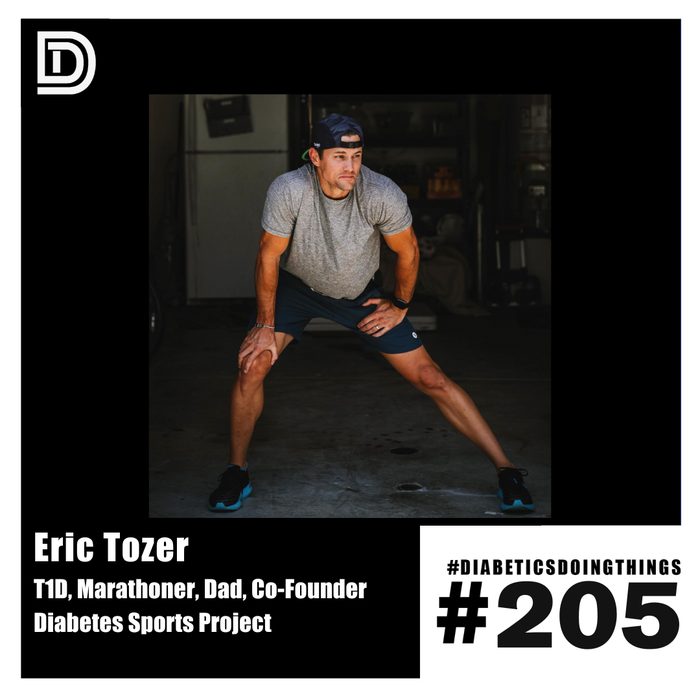
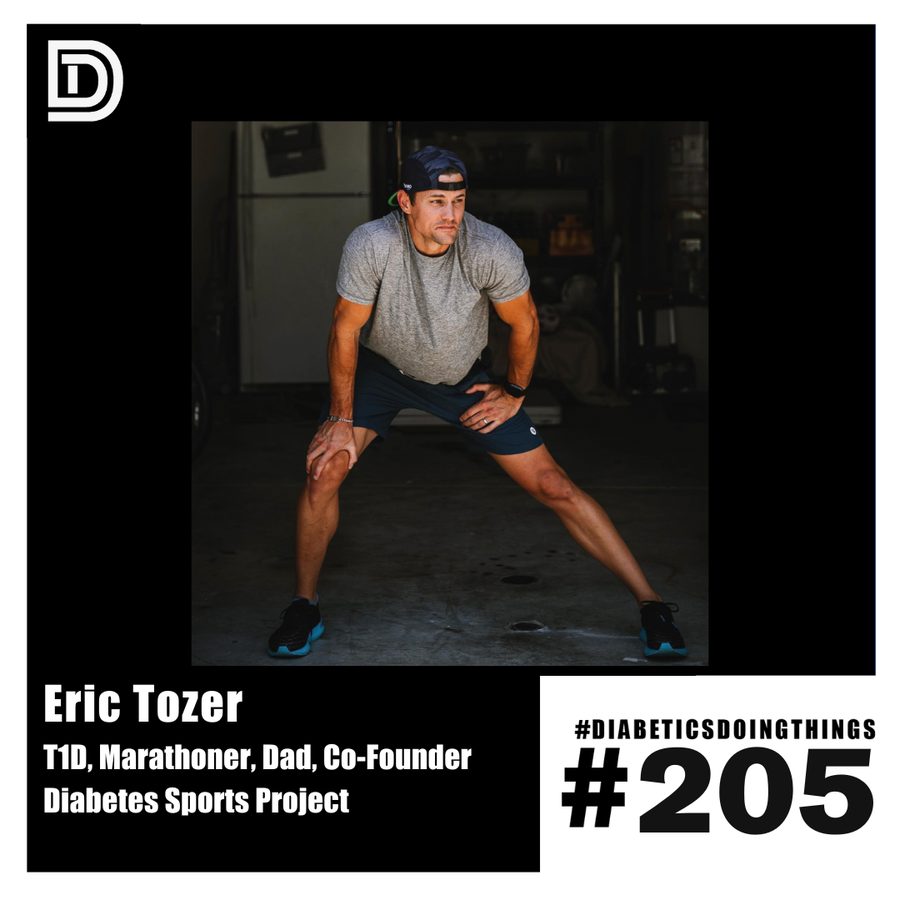
Eric Tozer, T1D Ultramarathoner, Father and Businessman

Episode summary
Eric Tozer, a type 1 diabetic ultramarathoner, father, and businessman, sits down with Rob Howe at the ADCES 2022 conference in Baltimore inside the MannKind booth. Eric was diagnosed at 22 after losing 20 pounds backpacking in Europe, with his mother spotting the signs at the airport. He talks through early scares including a nighttime seizure, becoming a diabetes coach to others for 15 years, and completing the 2019 World Marathon Challenge: seven marathons on seven continents in seven consecutive days. He shares a difficult year that included the suicide of a close childhood friend and a panic attack, and how community, his wife, and his daughters keep him grounded. He also details how Afrezza fits into his daily diabetes toolkit alongside a CGM.
Key takeaways
- Eric Tozer was diagnosed with type 1 diabetes in 2006 at age 22, after his mother noticed a 20-pound weight loss and suggested he get checked.
- In 2019, Eric completed the World Marathon Challenge: seven marathons on seven continents in seven consecutive days.
- Eric says he started using Afrezza years ago just for corrections because it works fast and clears his system quickly before workouts, and later added it at mealtimes too.
- Eric co-founded Diabetes Sports Project, a fully volunteer-run nonprofit with more than 150 type 1 athletes, to help newly diagnosed people see someone like themselves.
- Eric says one of his hardest years came after a close childhood friend died by suicide, which led to a panic attack, and he credits his wife and the diabetes community with getting him through it.
Show notes
A special new sponsored episode with the incredible Eric Tozer (@erictozer on Instagram)! Eric and I are both partnering with Afrezza Insulin to spread the word on how we use Afrezza in our Diabetes toolkit, and as part of the partnership, I got to sit down in the Mannkind booth with Eric and dig deep into his career as an athlete with T1D, where he finds his motivation and how he uses Afrezza.
This episode is really special. It’s rare that I get to sit down face to face with my guests and I’m super excited for you all to hear this one.
Included in the episode is:
Eric’s diagnosis story
Discussing Eric’s completion of the World Marathon Challenge in 2019
Parallels between marathons and managing Diabetes
How Eric handles his demanding physical and mental challenges as an athlete, businessman and father
How Eric has made Afrezza part of his Diabetes toolkit
And MORE
Please see additional important safety information, Full Prescribing Information, including BOXED WARNING, Medication Guide and Instructions for Use on Afrezza.com/Safety.
Important Safety Information
Afrezza can cause serious side effects including sudden lung problems and low potassium and is not for patients with chronic lung disease, such as asthma or COPD, or for patients allergic to insulin. Tell your doctor if you ever smoked, have ever had kidney or liver problems, a history of lung cancer, or if you are pregnant or breastfeeding. Most common side effects are low blood sugar, cough, and sore throat. Severe low blood sugar can be fatal. Do not replace long-acting insulin with Afrezza. Afrezza is not for use to treat diabetic ketoacidosis.
Questions this episode answers
What is the World Marathon Challenge and did Eric Tozer complete it with type 1 diabetes?
Yes. In 2019, Eric Tozer, who has type 1 diabetes, completed the World Marathon Challenge: running seven marathons on seven continents in seven consecutive days.
How does Eric Tozer use Afrezza in his diabetes management?
Eric says he started using Afrezza about seven years ago just for blood sugar corrections, since it works fast and clears his system quickly before training or races. He later began using it at mealtimes too.
When was Eric Tozer diagnosed with type 1 diabetes?
He was diagnosed in 2006 at age 22, shortly after returning from traveling in Europe, where he had unknowingly lost 20 pounds. His mother first suspected type 1 diabetes.
What is Diabetes Sports Project?
It's a nonprofit Eric Tozer co-founded, fully volunteer-run with no corporate financial backing, connecting over 150 athletes with type 1 diabetes so newly diagnosed people can find someone in their sport who looks and lives like them.
Full transcript Searchable, with timestamps
Rob Howe: This episode is sponsored by Afreza and MannKind Corp. as part of our ongoing 2022 collaboration. MannKind has paid Diabetics Doing Things for this placement, but the thoughts and opinions of hosts and guests are original and unfiltered. For more information about Afrezza and MannKind, please visit Afrezza.com. That's A-F-R-E-Z-Z-A dot com. We see additional important safety information, full prescribing information, including boxed warning, medication guide, and instructions for use on Afrezza.com slash safety. Welcome back to another episode of Diabetics Doing Things. We are telling the amazing stories of people with diabetes from all over the world. My very special guest today, Mr. Eric Tozer, a person with diabetes who has been all over the world and doing things in big ways. We're here at ADCES 2022 in Baltimore. Eric, man, it's good to see you.
Eric Tozer: It's great to see you as well. Thank you for having me. It's an honor to be on the podcast. I've heard so many of you over the years and known you for so many years, so it's nice to finally be here. And at this conference too, it's always fun to see kind of what's tip of the spear and what's happening in the industry. It's great. And I think also getting to interact with so many like CDCESs and HCPs, that's a big part of what we're doing. And this is in our partnership with Afrezza and MannKind. So thank you Afrezza and MannKind for your support on this and for making this happen. Yeah, certainly. What a great company. I know we both use it, so I'll probably dive into that but on the conference note i think it's it's inspiring encouraging as a type 1 to see just the countless cdc's dietitians endos right at all these various conferences to see what they're doing kind of behind the scenes that as a patient you know not a lot of patients here right and then kind of to see what the industry does it's inspiring and encouraging and exciting because
Rob Howe: there's so much happening so it's really fun yeah i i've been to a number of these over the years as I know you have. And I think for many patients, they probably wonder what happens or maybe even don't even realize that these meetings are happening. So like if you were going to give somebody a behind the scenes look at what's happening at these conferences, like what would
Eric Tozer: you say? Yeah. I, like you, I've been to and spoken at so many JDRF conferences or ADA, like the big kind of patient centered one, but these it's, it's, it's fun to see the kind of the next generation, the young docs, the young CDs that are so hungry and, and the, the, the, the ones that have been in the space for a long time, right? And to see kind of they're continuing to learn and continuing to stop by all the booths and see, hey, what's going on here? What's going on there? You guys just released this, you released that. So it's really fun to see that, you know, there's this army of people that we know as our diabetes team, right? Kind of your endos, your dieticians, et cetera. And they're continuously learning. And as I think we kind of, because we don't see that all the time, we see them every three months or whatever
Rob Howe: it is. And you kind of get that engagement, but, but yeah, it's exciting to see. And from a from just a product perspective. I mean, you know, I know the listener can't see us, but we're surrounded by every brand. Yeah, we're actually on the event floor right now, right in the middle in the MannKind booth. And, you know, it's interesting for me because when you're diagnosed, we're going to talk a lot about diagnosis and your story here soon, but they talk about the technology that's coming and they talk about the research that's coming. And you actually get to experience that here. And I think from a patient, like you said, there aren't that many patients here. So for us to be able to get behind the scenes and look at some of these posters and look at some of this technology, it really is encouraging that people who are diagnosed with diabetes today and in the future, they don't have to go through some of the hurdles that we had,
Eric Tozer: you know, close to 20 years ago. Yeah, yeah. Certainly happy to be a guinea pig and help however we can, but it's somewhat selfishly, it's fun to see, right? From my own education, I feel like I come away from these things having learned something new or a new technique or a new something that's coming out. And so, yeah, it's always fun to get out in the community in whatever aspect we can. Yeah. And I think, you know, you mentioned we've run into each other at
Rob Howe: conferences before and we were at a JDRF event at the end of 2019 and you were kind of on your press tour, so to speak, after the World Marathon Challenge, which I want to get into. But just to let you know, we went on a run that morning and that's one of my like big peak like diabetes celebrity like access moments. I was like, oh, like I got to go on a run with Eric Tozer in the same year, like on the World Marathon Challenge Tour. And I just want to thank you for that.
Eric Tozer: That was really cool. Just what a great time. Yeah. Thanks for saying that. That was a fun run. I mean, it was in Seattle. We went along the boardwalk there. And what a special view, too. I mean, gosh, it was, yeah, I probably won't be in that good shape ever again in my life. But to say you got me at my peak.
Rob Howe: Well, that's good. That means there's some for the rest of us, apparently.
Eric Tozer: Because I remember walking back, I was like, the amount of days where I've woken up before 6 a.m. to run five miles is pretty few and far between. So, yeah, glad that we got to share that. And a fun way about sports, too, right? Like, I love sports. I grew up playing every sport and played soccer in college. But it can unify people and bring people together. And obviously this is one-on-one, but like on a global scale, we've seen it, right? You look at something like the World Cup or the Olympics, right? But sports is such a fun way. I think we can learn so much and engage with each other in the type 1 space. You can see how it can bring people together and kind of accomplish something together and goal setting, all that kind of stuff.
Rob Howe: I couldn't agree with you more. This podcast is going to cover more than sports.
Eric Tozer: But I'm sure go for hours just talking about the benefits of competition. And for me, it taught me early how to fail and how to also pick yourself up and move forward. and that was a big part of early days with diabetes, I think I was better suited for that adversity
Rob Howe: because of my experience as an athlete.
Eric Tozer: A hundred percent. And it was also sort of the key, like diabetes management was my key to what I wanted, which was to be able to play sports at a high level. So yeah, I'm a big believer in the power of sports and the work that you guys do at Diabetes Sports Project. I might get into that a little bit today, but it's really inspiring for people like me and also for people who are younger coming up who want to pursue their dreams as athletes or even just be weekend warriors
Rob Howe: or whatever the case may be. it's inspiring yeah and i think that we as a and we'll dive into the actual questions but i think that we you know when i was diagnosed in 2006 i didn't know anybody i didn't know i was coming off of a college soccer career i didn't know what it meant what it didn't mean i didn't hardly knew type 1 from type 2 and so i think what's nice is that we have people like you people like me i mean there's countless others right fiona on the paddleboard and seb climbing and running across out where's Seb right now probably running across the continent somewhere he yeah I think hopefully he's taking a well-deserved break and you know Mark Andrews in the NFL and Jordan Morrison I mean we've got so many examples across sports and arts and music and movies and so I I hope and I think that the conversation is shifting to no longer the question being can I do this with type 1 but how do I do this with type 1 hundred percent and that one word shift is so powerful and And hopefully that's, you know, I take away from things like this, what you've been doing with this podcast and everything on social. And so it's fun to see. And I think people being diagnosed today are hopefully feeling a little bit better off than, you know, I was 16 years ago. You were when you were 16. So let's talk about it like 16 or, you know, 16 years of 2006. You were 22 years old coming off of a college soccer career. Talk to us about those early days in that diagnosis. What was that like?
Eric Tozer: Yeah, it was, I mean, I laugh about it now because I truly didn't know up from down. You know, it was, like I said, I didn't really know anybody with type 1. I lost 20 pounds in 2 while traveling abroad. So I was over in Europe. You know, thankfully, it didn't get much worse over there. And truly, I didn't, I was completely naive to it. I, you know, you're in a different setting. I didn't really. Walking around a lot. Walking around. Different routine. You know, jokingly, I thought it was the beers and croissants, but it was, you know, it was, there was something seriously wrong. but i had no idea and you know landed back in america and it was actually my mom who said on the spot at the airport she says you know because she hadn't seen me for for about a month and she's like saw this drastic 20 pound weight loss she's like i think you have type 1 and again no family history but just kind of you know she she had ran a preschool for a long long time and so she you know kind of was in tune with it and and a quick checkup a1c was in the 12s my blood sugar at the time and it was fasting was in the 500s. And the next week I was set to move across the country in a one bedroom apartment. You know, I kind of did everything you shouldn't have done. Thankfully, you know, good doctor team. And just, I think I go back to being an athlete in that competitor mindset, kind of learning and understanding how to win, how to lose, how to learn from both of those, not giving up all that kind of teamwork. I mean, you name it, but And that certainly got me through those early years because there was some scary moments looking back on it now. And knowing what I do know now compared to then was almost comical, but not comical because, you know, like you, you know, we know people who have had, you know, terrible things happen.
Rob Howe: Well, you know, it kind of is always in the back of our minds, right? Like this is a, you know, a disability, a debilitating disease that can really quickly go from stable to in a really bad situation for a number of reasons. And so it is scary to move across the country and be in a one-bedroom apartment a few weeks into diabetes and like sort of don't know what you don't know at that point.
Eric Tozer: Yeah, certainly. And, you know, fast forward, gosh, 18 months still, you know, learning. And I was played a bunch of basketball games after work. We were doing this basketball league thing with work and didn't understand the impact of exercise on blood sugar yet. And I was trying to get onto a CGM, but it wasn't being approved. Ended up checking my blood sugar before bed. It was fine. It was good. is like 120-ish and ended up, it was going down, but I didn't have that concept of blood sugar trends and effects of insulin. And at that point, there's no CGM as well. So it's like, you don't have that view and be able to look at that chart. Yes, exactly. And my wife ends up, you know, 2 a.m. or something to me having a seizure from a low blood sugar. Right. And so it's certainly a scary moment for her. I obviously didn't know what was going on, but I was approved for a CGM about a week later. There it is. You know, thankfully, you know, knock on wood, haven't had anything that serious since but it was just a reminder right we can have access to the docs and the tech and and but sometimes it's that conversational stuff too that helps of like because maybe you know clearly i didn't hear that from my endo at the time and and and so sometimes that's where community i feel like can be so powerful and and and i've spent gosh since then trying to help other people coach other people probably you know a few a week for call it 15 years to try to use my experiences, my highs and lows, if you will, to help others. And I see that
Rob Howe: more and more, which is super positive. I'm glad to hear you say that because I think as somebody externally looking at you and all of your accomplishments, you know, co-founder of Diabetes Sports Project, Ultra Marathon or World Marathon Challenge, you know, father, college athlete, like it's easy to say, oh, well, this guy's for sure got it all figured out. And so to hear you say, you know, hey, making a friend with diabetes, getting involved with the community really helped you. And now you're giving back to other people. You know, something I often say is like, you know, the quickest way to learn anything about diabetes is make a friend with diabetes. And fortunately, social media, for all its negatives, you know, in society, a lot of the positives are we can reach out and meet people that we otherwise wouldn't come in contact with. And I've seen that benefit. And, you know, we're here at these poster sessions, seeing the benefits of connection with people in social media, connecting with a friend with diabetes and learning about products that way. It's really impactful. So, you know, when you look back on kind of like your accomplishments as a person with diabetes and the time since you were diagnosed, like what kind of stands out to you as your, as your favorites or like the things
Eric Tozer: that you're most proud of? Yeah, it's been a, it's been a amazing 16 years. And you know, somebody asked me a while back, would I, would I take the diagnosis back if I could? I think anyone who said, you know, no, that would lie. Right. But what I've learned about myself, what I've accomplished, I think because of, because of type 1, right. I wouldn't have done the world marathon challenge I mean who knows right but I did it because of diabetes to you know and the relationships I formed and how it's impacted and taught me things about you know in my professional career or at home as a parent as a dad as a father you know as a husband it's taught me so much and I've learned so much and grown so much so much because of it so but you know from the kind of accomplishment standpoint I the world marathon challenge you know it's certainly something that I never thought I would have done ironically somebody had emailed me about it the first year that the race took place and he said you should do this and I laughed at him Wow planted that seed early yeah finding the seed and the irony is that the article was written about a guy Mike Wardian who had done the race and he's one of the best runners in the world and fast-forward two years later I was trying to find something that hadn't been done by somebody with type 1 and and and that would you know wouldn't be too much time away from family and work and all that kind of stuff. And it fit the bill. And so to do seven marathons on seven continents and seven consecutive days was, was, and, and I know you've talked, you've talked about it at length on other podcasts and other presentations. Like I don't
Rob Howe: want to spend too much time on it, but still, you just said it seven marathons, seven continents, seven consecutive days. You're like finishing a marathon, literally jumping on a plane and flying somewhere immediately after getting off the plane and immediately running a marathon. what's going through your mind as part of that like obviously you prepared and you can prepare
Eric Tozer: as much as possible but like when you're in it yeah what was that like yeah that's a great point right i trained as much as i could physically i knew my legs lungs heart has to be strong to run 184 miles or something over the course of a week and to be able to recover at 30 000 feet on an airplane i mean all those things and not to mention the type 1 component on top of it all but you know, I tie so much, I kind of, to me, there's a lot of correlations between type 1 and sports and this one kind of specifically, right? Because there's no end game for type 1. We have our every three month checkups. We have, you know, goals we want to hit personally, you know, and for me, I kind of looked at this 10 month journey, eight months of training as, you know, I'm not going to wait until the seventh marathon in Miami to have a win, if you will, Just like with type 1, I don't want to wait until my three month checkup to get that A1C checkup to get that A1C result to see if that's a win or not. There's countless opportunities along the way. So if I did a bunch of hill repeats and I did it successfully or the first time I hit 20 miles in training or the first time I hit 25 miles in training, I celebrated the heck out of those. Because one, why not? For me, it was a great win. It gives me the encouragement to keep going. and, you know, kind of keeps us motivated. And same with type 1. If I wake up in range, if I have a good post-meal blood sugar, if I get through a run or a workout and my sugars are steady, you better believe I'm celebrating all of those, even 16 years later, right? Because, A, it's not easy to do. And I think sometimes we lose sight of that as type ones because we do it 24 hours a day. Those little victories along the way help me, you know, training for the race. And then also within the race itself, there was little opportunities along the way to have kind of that, you know, whether it was in Dubai or in, you know, Perth or throwing up in Chile during the race and getting through it. Like I celebrate each of those little victories to kind
Rob Howe: of keep the motivation, keep the steam going and get to the end. I'm glad you said that because I think celebrating small wins is such a huge part of living a life well with diabetes because like you said, it's not going away. It's a long, it's a long journey. We've got a long way to go. Both of us still, you know, we're, you know, just short of two decades in for both of us. We're, we've got a long way to go. It's not going to be going anywhere anytime soon. And we've got to stay present with that. And I remember a few years ago, one of my first JDRF conferences I spoke at, a family came up to me afterwards and they said, you know, our son, we're here because of our son. He wasn't, wasn't interested in coming, but we're here to try to learn more of what we can do to help him. And I said, well, what's going on? And, and they said, well, two days out of the past two weeks, you know, an ambulance has had to come to our house in the morning because he was in, you or was having a seizure. And, you know, I said, Hey, what did you do on the days that he, the ambulance didn't come? Did you celebrate the ambulance not coming? Because that's a big win in this case. And, you know, for, for them in that moment, obviously there are things that they, you know, could do to help prevent that and, and, and work on, but it kind of just a light bulb moment came on for them. They're like, this is going to happen and it's okay. Like to get it wrong every now and then, but it's what you do after. And it's, it's those days where that doesn't happen or you do wake up in range and you say, okay, cool. I have all the things that have I've done up to this point. I've gotten me here. Let's not forget about all that work that goes into it. And I think that that's sort of the, the cliche is it's a marathon, not a sprint. And you obviously understand marathons like more intimately than many of us. So like the longevity of a life with diabetes, like what parallels do you find like in a race, a long, you know, 26.2 miles or training for, for a race, what parallels do you find with like running an ultra marathon or marathon and living with diabetes?
Eric Tozer: Yeah, I think there's the obvious physical, right? There's the physical element, preparation, mental preparation, emotional preparation for kind of everything you can expect and trying to prepare for the you can expect. You know, with type 1, you know, my little Viore bag's got, you know, my Fresco in it, it's got my driver's license, my keys, my sugar, my backup sugar. You know, kind of having the simple, there's simple things, right? but having that plan in place following and then learning from the kind of wins and losses i don't really like the word failure because i think it wasn't a jordan that said we never i never fail either win or i learn right and that i think is so true in type 1 in sports and life really i try to apply that and i try to teach that to our six and nine year old girls they we can always be learning and I think that's if you're not learning then complacency is a word that our soccer coach in college used and it was like the worst word in the world right you just don't be complacent because for so many reasons but I've applied tried to apply that my best I can to to to type 1 management and always be learning and that's why you know I I kind of made the diabetes management choices I I have and tried to you know continue to evolve as technology gets better as, you know, as, as we grow as an industry to, to, to always just improving. And I think people probably same with you, right? People look at me and maybe assume like, oh, he's perfect at type 1 way far from it.
Rob Howe: Right.
Eric Tozer: I mean, yeah, I just talked to the seizure, but every day there's issues, not every day. Some days there are some days there aren't more than others, but, but yeah, that kind of having a plan, I think also being, being, and this is something I've struggled with being vulnerable, to accept help, to accept guidance, coaching. I'm never against accepting coaching, but it's okay to not be okay. It's okay to have a bad day with type 1. And that's where I think community for me, at least plays like a huge role, right? Even just, even just a phone call or a text to a friend, a fellow type 1, there's things that you and I can relate to that even my wife and I, or, or, you know, my, my parents and I, right. We can't, there's just different wavelengths. And I think that that's a really powerful part of community that, that I
Rob Howe: know I certainly lean on. Well, yeah. I mean, you get to skip all the exposition. You don't have to explain why you're carrying the little bag with all of your stuff in it. And, you know, my, as my bag with my stuff in it sits over right over next years. Right. So we understand like, Oh, on the go, all those things have to have to go into it. And, you know, like being a competitor, I think sometimes I have to soften my edges a little bit as, and be a little nicer to myself too, because Because like you said, I kind of feel like a factory sometimes. It's like, it's been zero days since the last diabetes incident. You know, it's like, you're always, you try to keep that, get that number as high as you can, but you know, you're going to wipe it away at some point. And it's okay.
Eric Tozer: It is. And like, that's, that's the thing. Like people get so frustrated and I think we just stop and like give ourselves a pat on the back and be like, Hey, you're doing a good job because you're here. You're, you're alive. You're here. You're trying, especially at conferences like this, right. Or at a JDRF event or, you know, people that reach out and like, Hey, you're already a step ahead because you're trying and you want to get better. And that's, I think the hardest, because you can't teach that you can't make somebody want to get better. We can help them. And I know you do. And right. And so, so I think that's just that encouragement. I hope people are
Rob Howe: continuing to be. And to normalize it too. Yeah. You, you mentioned like being at a JDRF event. I think one time I ran into you and maybe Denver and you were about to go up and speak. You're like, God, my blood sugar has been high. Like this is like, I just hate, I have to go up there and give this talk. And if that happened to me, like not shortly after I was up on stage and I had to I asked somebody to throw me a juice box and a woman and her daughter came up to me afterwards and they said, it was so nice to see you in, in peril, you know, and just handle it and bounce back and like fix your low blood sugar in front of everybody to know that like, yeah, we're up here, we're on this podcast or at this conference, but we also will have low blood sugars. We will have high blood sugars. We'll, you know, forget to refill a prescription on time and have to figure it out on the fly. And so, yeah, you have to give yourself a little grace to just be a person.
Eric Tozer: Yeah. Yeah. So true.
Rob Howe: But also like you're, you're like me in a lot of ways. You have a lot of irons in the fire. You know, you're a husband, a father, a businessman, you volunteer and you work with people with diabetes, you're traveling and speaking and you live with diabetes. Like you have a ton of irons in the fire. Like, how do you, how do you find balance? What, what do you do that allows you to, you know, do all of these extra things?
Eric Tozer: I know it's maybe not an expectancy, but, um, my two kids really Harper and Charlotte, but they're six and nine as of this recording. And that's truly kind of why I do everything, is for them, to set an example for them, and the community as a whole, right? But obviously they're kind of my priority and my number one, along with Jenna Life. But the kind of discipline, preparation, I kind of can't turn it off, I guess. So I'm always doing something like you, right? And I think that there's that drive to just be the best version of myself. I don't see a world to me. Why not? Like, like if we're going to do something, do it well. Absolutely. I don't, I don't work that way. I'm not going to half-ass anything because if you do and you know, you get to the end of it and it didn't go the way you wanted, you would, I wouldn't want to second guess myself and go, well, what if I actually had actually tried a hundred percent? So whatever I do, I tried to give it my all. And that's why, you know, for 15 years now, I've helped coach people and never taken a penny for it. If I can, if my story can help somebody, great. If my successes are failures, that's why I started Diabetes Sports Project, right? It's to say, you know, now we've got 150 athletes plus around the world and fully volunteer based. We don't, you know, have any kind of financial backing from any of the big companies, which is good and bad, right? We are limited in how much we can do. but if those 150 collective stories can help answer somebody's questions or somebody newly diagnosed can go on there and see you know a basketball player a golfer a yoga instructor whatever it is and have that relatability of like i'm not alone that person's like me and they might not care about seven marathons but they might care about stand-up paddleboarding or whatever the sport is and or tennis right and they might see maddie and and and to have that I'm not alone there's somebody like me looks like me acts like me whatever it is I think that's really powerful and so and then I've had a you know 16 career in the kind of health care software health care finance space which is which has been wonderful and we help hospitals but it's yeah I don't really consider it all work I it's right it's something I'm I'm passionate about all of them and it's it's again I kind of take I credit being an athlete from an early age to
Rob Howe: any success that I have. I credit my wife big time too, because without her, none of it happens.
Eric Tozer: Yeah. Retweet that for sure. That's my foundation. Huge is like without, without that done and settled at home, like none of this is possible. Exactly. Right. I mean, she's at home with the kids right now and, and, you know, I'm across the country and, and they fully support it. Right. Her, my, the one quick story from them that I'll share from the world marathon challenge, it was actually after it happened, it's the St. Patrick's day party. So, you know, a month later and the dads are all standing around and my daughter Harper, our older, she was six at the time, walked by and they said, Hey, Harper, how cool your dad just did the seven marathon thing. Like, Oh my gosh, like how exciting. Like you must be so thrilled. What was your favorite part of it? And she stops. And I had never asked this question, so I didn't know what she was going to say. I hadn't coached her up on it. So she turns and she, you know, to these five grown men, she says, the impact that it has on other people with type 1 and those kids we all kind of shook our heads like holy crap like that's that's quite an answer and and for me it was like i mean i get goosebumps thinking about right because it's that next generation and i know you work a lot with kids but to see i think and i hope that the that the impact that you know people like yourself and and hopefully what i've been able to do has on the next gen the next wave of type ones or the next wave of just you know the youngsters coming up I think it will hopefully make for a brighter future
Rob Howe: and and as corny cliche as I might be that's that's a driving force for me too yeah but I think to know like to see because you didn't coach her on that answer you know she's perceptive enough to to to see the bigger picture to understand like the sacrifice of you know you being away and you going through all that training was for something bigger than just you it's not just the you know crossing the finish line at the end of it and the big welcome party, certainly that's a part of it. But it also is just like that seed that it might plant in some kids somewhere
Eric Tozer: with diabetes is okay. It expands your idea of what's possible. Exactly. And can you imagine like some eight year olds diagnosed and they go and see, you know, your basketball career or my marathon thing or, you know, whatever, Lauren Cox and that WNB, right? Like there's so many great examples. And so I think of like, okay, we didn't have those examples when we were diagnosed and we've come here, But what about some kid who's newly diagnosed and sees all the stories that they're going now? Like 20 years from now, what are we going to be talking about? They're like, hey, remember that kid? Like they went on to. I fully believe there's going to be some type 1 astronaut or somebody who said, okay, like this has been done.
Rob Howe: But what if I could push it a little bit further? And, you know, that's one of the big reasons why we kept the name Diabetics Doing Things. It started off as a working title. But when you're diagnosed, the first thing you look for is somebody with diabetes who does the thing that you love. or the thing that you want to do. And so for people like you, for people like Lauren Cox, for people, Seb, who are these amazing achievers in spite of a life with diabetes, it just gives me, it gets me hyped, first of all. And, you know, it's just this tight knit community of like, oh yeah, I know, not only did you accomplish this great thing that a very few people ever accomplished, but you also did it with diabetes. And that is, I don't know, nothing gets me more hyped than that. I could run through a wall, I'm ready to do that. Let's talk a little bit, like tactically. We live with diabetes, here we are. We're, we're at the diabetes conference. What's in your diabetes toolkit?
Eric Tozer: Like how do you on a day to day, like, how are you managing your type 1? Yeah, I love, I love talking about diabetes stuff and most people assume I work in the diabetes space. I don't, but because I talk about it so much, but I've worn a Dexcom CGM for gosh, 13, maybe more than 12 years, less than 14 years, somewhere in there. And I love it, right? That guidance from a CGM is everything. and it's such a great learning tool and there's it gives confidence and comfort and so that's been a staple i've used pens and pumps you kind of used everything in between i just the continuous advancement in that space is amazing it's kind of interesting like being able to live in the time where you know when i was diagnosed i'm sure it was the same way with you we were diagnosed very close close years you know only about a year apart like all the stuff they said was coming is already out yeah you know it's like it's here we're a hybrid closed loops you know we got diy
Rob Howe: I loop, we've got a Fresa different options that they said would be there when, you know, 15, 20 years ago. And now here we are. Yeah. Yeah. We're, we're living it. And, you know, we say, I've heard other people say, right. It's never been a better time to be diagnosed. Obviously, you don't want to be diagnosed, but, but the, the, the, the, now if we can, you know, kind of improve access and get it to everybody who, who, who can benefit from it, that's a, that's another subject. But, and I started using Afrezza, gosh, seven years ago. Okay, everyone, we're going to take a quick break and discuss some important safety information. Afrezza can cause serious side effects, including sudden lung problems and low potassium, and it's not for patients with chronic lung disease such as asthma or COPD, or for patients allergic to insulin. Tell your doctor if you ever smoked, have ever had kidney or liver problems, a history of lung cancer, or if you are pregnant or breastfeeding. Most common side effects are low blood sugar, cough, and sore throat. Severe low blood sugar can be fatal. Do not replace long-acting insulin with Afrezza. Afrezza is not for use to treat diabetic ketoacidosis.
Eric Tozer: Okay, that's the rest of the important safety information, so let's get back to the episode. Yeah, yeah, it was pretty early on. You know, we lived in Los Angeles, so we're near the headquarters of my endocrinologist had known about it for a while, and we started using it just for corrections because it starts working so fast. And as an athlete, she wanted, she, she was curious about kind of, because it's out of your system so fast as well. I don't have to worry about that, you know, 90 minute, two hour kind of tail from an injectable insulin if I'm going to be out exercising. So I can take a corrective dose if I need to before and before a training session or before race and you know, roughly an hour later, it's kind of out of my system. So we started using it as just corrections and now having seen the benefit and knowing how fast it can start to work, it's become also a mealtime in addition to corrections. And I love it.
Rob Howe: I feel like it's a secret weapon that I don't know why it's secret, but I'm, yeah, so I've been a big fan of it and continue to use it, you know, seven, six, seven years later. I totally agree. And I think, you know, that's one of the reasons why I agreed to work with MannKind on this. And it's why I'm here at this conference, because every time I encounter somebody in the diabetes community who uses it, they always have such positive things to say for all the reasons that you said, like fast acting out of your system quicker, using it for corrections or mealtime. But what I also encounter is people who ask about it. Maybe their doctor has never heard of it or their endo is not as comfortable prescribing it. And so for me to be able to be here as a patient and talk to HCPs and endos and CDCESs, about the benefits and how it works as a part of my diabetes toolkit was really important to me because like you said, access is a super important thing. And there's a lot of different elements that go into it. Cost, understanding and prescribing it from your HCP and working
Eric Tozer: with your care team and them having the confidence to be able to say, yeah, I think this is right for you. Yeah. Yeah. It was, it was a, it's kind of been a no brainer for me. And, and, you know, the only time I didn't use it is I just, you know, in switching insurances, but that's, you know, been able to get sorted out, but I, I, yeah, I've become a, you know, I want to use whatever's the best thing out there. Right. And, and if there's something that's better than what I'm currently using, you know, then I want to use it. My, my time, my kind of overnights were an issue. And so, you know, I, I, that's where you talk about, you know, the smart insulin pumps and that kind of automation during the night. I travel a lot for, for, for work. So if I'm on a plane, right. And kind of, as we were joking about, you can't, you know, do lunges up and down the aisle. People look at you funny if you're doing like, you know, down and backs on the plane, like more than one time, you'll start to get a little bit worried.
Rob Howe: Exactly. So, so yeah, I've, I've, it's, it's been a tool that is literally in my diabetes bag right there and, and will continue to be. So you're a guy, I think that a lot of people, including myself, look to, to her motivation or inspiration for all the reasons that we've talked about on this podcast. Like, where do you, where do you find your motivation? Like, you know, training for eight months, 10 months for the world marathon challenge is not an easy thing. There's a lot of repetition. You got to show up. That's, that's the first part. Like, how do you find that motivation? Like what gets you going?
Eric Tozer: What powers you to, to kind of go for those, those great heights? Yeah. I've always, I think, I think, and you know, check with my parents on this one, but I think I've been pretty self-motivated most of my life, not to say that I haven't needed help 1000%, right? I mean, this past year alone has been just a mentally kind of from a mental health perspective has been probably the most one of the most challenging. And that's where, you know, kind of your diabetes team, my diabetes team include, you know, my endocrinologist and CDs and dietitian. But but also most importantly, my my wife, my two kids, immediate family. Right. Kind of that support group is instrumental for me in getting through just the day to day stuff, whether it's type 1 or work or life or whatever it might be. And they're all, they're all equally inspiring to me. I mean, obviously my, my girls are, are everything. And my biggest points of inspiration, my wife, I mean, she works harder than pretty much anybody I know. And she's been in the nonprofit space for her whole career, just changing so many lives in ways that just amazes me every day. You know, when I brought the world marathon challenge thing to her, you know, she probably in her head batted an ad, but, but to me didn't, didn't skip a beat and knew, you know, the importance of it for me, not for me to have these medals on the wall. Cause they're not even on the wall. They're in the closet in a bag, you know, tucked in the corner, but for the diabetes community. Right. I mean, I've said it before. That's why I did it. Yeah. And that's so the motivation. Did I want to get up at three in the morning and start my run at four? So I was done before the girls woke up and could help, you know, still be a dad and be be present and do, you know, Saturday morning chocolate chip pancakes. Not always, but but, you know, there was so there's lots of pieces of motivation that kind of came together. Right. I mean, there's individuals out there. My my uncle has been a huge role model and influence. there's I could list 20 but but you know I'm really lucky also to have those pieces of motivation because I think you know we live in a major city and they're you know surrounded by people and lots of great examples but you know people out there in rural communities or or that don't have access to the same stuff we do and maybe they don't have a source of inspiration so you know hopefully you know I mean I'll keep doing it until they kick me off the stage and and and then I'll then I'll stop or if you know someone let someone else take their hands but I think that there's so many great points of motivation out there and and i'm continuously kind of inspired too by you know go to these talks and like you know you get the six-year-old who stands up and asks a question and you know like what they go through like that to me is as inspiring as as anything else as you know you know professional athlete or or musician or whatever it is but or the you know i met a gentleman in his late 80s who's had it for 50 years and i wouldn't have known if he hadn't told me because he looks completely as healthy as it can be. And that to me is incredibly inspiring
Rob Howe: to see, you know, knowing what he's been through the last call 50 years without the access to stuff we have. I mean, come on, that's amazing. I agree. I mean, I think, you know, it's been a while since I've been at a community event because of the pandemic, but you know, as those start to come back, meeting those people who have lived with diabetes for 50 plus, like I met a guy one time at a JDRF event in his nineties. And like you said, look totally normal. And it was just like, they're so excited to meet and see younger people with diabetes to hear stories because you know like we you know i've been thinking about this a lot more recently is if you or i were born at almost any other time in history we'd be dead yeah you know because there wasn't the technology and the science to know how to manage this condition and so we're really on borrowed time and what we get to do with that time to inspire others to connect with others people like these guys that we met who have lived with it for so long and are living well and done everything that they ever wanted to do on day one, they were told probably they wouldn't live past 20 or 30. And to see them hit those marks and exceed and not even just achieve, but just get to experience life and get to have a family or get to have a career or get to just wake up to another sunrise that, that is super, super, you know, empowering for me. And I want to spread that message for other people too, because I know that there are low moments, like literally and figuratively, you know, where you just don't feel like pushing that rock back up the hill, kind of like Sisyphus, you know, it's like, it's going to come back down. But I want to ask you something because you mentioned it earlier and, you know, Eric Tozer struggles with mental health, like mental burden, like talk a little bit about that. Like, how do you, I think it's so important for people like yourself to normalize what, you know, somebody who maybe isn't wanting to run the
Eric Tozer: world marathon challenge or who isn't as motivated to do that, like to be normal and to say, oh yeah, like this guy also feels that mental strain of life and of diabetes yeah i haven't talked about this a lot and and and kind of struggled with it but one of my best childhood friends took his own life we were walking out the door for new year's eve to go to our best friend's house and i got a phone call and our other good friend had let me know and it was you know it was four of us from preschool through elementary school and and you know we were basketball soccer t-ball i mean you name it we did it together right and it's a giant of a man he was he was he played football at Stanford right he's tight ends and just it was pretty amazing to see how somebody who was the star and you know he was the big man on campus in high school and you know I played soccer and and I was a kicker for the football team and and so just another opportunity for us to grow even closer but but he was the star but he always made everybody else around him feel like the star and that's something I'll never forget and that's something that I think will carry with me forever but um that was tough and and I I've never you know been so lucky I haven't had much loss in my life grandparents but I was too young to really kind of appreciate it or understand it and we've all lost so much this last two years right I mean gosh to have family still still with us is is kind of a miracle in its own right but so that's kind of how the year started and you know it kind of all I kind of didn't handle it didn't manage it didn't really know how to manage it what to do what not to do and grief is tough man yeah it was it was real and it ended up kind of having a a bit of a I don't know it's some sort of a panic anxiety attack yeah and it was really scary to to to be totally frank and and I mean again without my wife I probably wouldn't be you know here today so that was you know just another reason that that the kind of she's everything but and then And, you know, you just all the other stuff added on top of that. Right. I, you know, don't take too much time on it.
Rob Howe: No, I'm first of all, thank you for sharing it. I know it's difficult. And I think that's why it's important to have that vulnerability, especially as like, you know, they don't teach you in apex big men on campus, alpha male school to, you know, be able to open up and have these types of discussions. But I think it's so real and like humanizing to say, like, above all, you're Eric Tozer person, human, and you're going to encounter these difficult things. and it's still important to go back to that stuff, like celebrating the small wins, relying on friends and family, opening up and sharing because I know there's someone listening to this podcast who will have experienced something similar, maybe not the same type of loss, but is struggling to find their own way. And so to hear somebody like yourself, who we follow and get inspired by on a daily basis, it just makes you seem more human. And I don't know, I just appreciate it. I'm grateful that you were able to share that. And I know it's difficult too, like having up until a few years ago, I had not experienced great loss in my life as well. I was very fortunate. And then, you know, I lost my dad and, you know, to be able to open up and talk about that has been very difficult. And, you know, shout out my therapist, shout out Michelle for, you know, working together for the last three years and really helping me, you know, foundation for myself and my wife who has been so supportive in and out of, you know, all of my kind of ups and downs. I kind of have a poet's heart. I'm like way big highs and low lows, you know, and I just kind of like find a little balance in the middle. So yeah, thank you, man, for sharing that. And, you know, rest in peace to your friend and, you know, thoughts go out to his family. But man, it's so important to normalize that and say, you know, hey, we are humans. This is a long life. This is a marathon of life with diabetes. And there's going to be things that have nothing to do with diabetes that can set us off, you know, down negative paths. And it's important to, you know, rely on our support system and rely on each other. So thank you, man, for sharing that. Yeah. Yeah. It's been, it's, it's a journey, right? And it's, that's the beautiful part of it, right? I think that's, that's kind of the,
Eric Tozer: the life is a it's a gift and and and you know i think that's another kind of just motivating factor right just and i don't know why i'm so i'm 38 and you know plenty of life ahead but but i still i don't know why just have this like i don't want to leave anything on the table i don't want to not do it to the fullest like why not why not what's the alternative you're right i mean you can And that's kind of the beauty of it too, is we can decide. It's up to us. Nobody can decide if I'm going to do something within reason, right? It's up to me. I get to decide if I want to do the World Marathon Challenge. I get to decide if I want to do the best job I can at work or the worst job I can. Or I get to decide how to react when our six-year-old has a little meltdown, right? And so that power of like we get we're responsible for our own greatness is that's pretty amazing because, you know, on the flip side, you can decide if you want to sit on the couch all day and play video games. Cool. Great. Or sorry, I shouldn't say that. That's that's not fair because I love video games. If we want to be kind of the best version that we can be. And what does that mean? It might not mean running seven marathons. great i hope not right because there's people out there doing way cooler things in in science and technology and medicine and music and arts and i'm in awe by all of that like you know i had the chance to meet eric pasley who's a type 1 and an amazing country musician i'm just in awe of people that can have that creative ability to write music and he's a tremendous music writer um and and and and i i love that watching other people be great at things is is i'll just sit in whether it's sports or music or art or whatever i i i appreciate all that and i love it so man i i i do too i think you know for me you know we lost a an icon of greatness kobe bryant recently and you know i kind of i i'm what i mourn is we missed his later in life wisdom you know and we
Rob Howe: and we also you know the great bill russell just passed away and and we got this great second career of his to inspire and to kind of be a shepherd of sport and of competition. And, you know, what I remember about Kobe is how he would talk about, you know, we have a chance every day to wake up and be great. And that's really up to us. And it is really whatever greatness means to you. You know, I just, I love that, you know, what you're talking about is it's, you have these rare chances to do something. And I also have not shared this publicly much, but, you know, with an athlete like yourself, I'll share it. You know, when I got done with my college basketball career, I, you I had a really honest conversation with myself, with my dad, and with some of my teammates. And I was like, look, basketball is not the greatest thing. It's not the thing I was put on this earth to do best. I was pretty okay. But I have a chance to go try to go do something big. And if I don't do it now, I will not have a chance to do it later. I could see the clock ticking. And I was like, so I owe it to myself to find out how far we can. And I feel like I'll be able to get a job at a desk and do that really well for a long time. but getting a job on the court between those lines is, you know, the clock's ticking and I was fortunate enough to do it. And you know, that's one of the reasons why I'm here today. Like that, those decisions can put you on a path that you don't even realize. And they'll lead you to places that have nothing to do with the world marathon challenge, have nothing to do with playing against the Harlem Globetrotters, but they can open up ideas of where your life could lead. And yeah, I, you know, I felt like sharing that. I mean, that's, that's, you never know somewhere out, somebody out there listening to this, you know, Shout out to mankind for sponsoring it, for bringing us together. Who, you know, who knows what they're capable of? It could be, you know, art. It could be science. It could be just a personal relationship that, you know, they, they decided that, you know, I'm going to change something about myself today. I'm going to be the best version of myself that I can be. So thank you for sharing that. Yeah. And like, it's, it's, I feel like it sounds corny, right?
Eric Tozer: Be the best version of yourself. But like, it's so, it's cliche for a reason. I feel like, cause it's true. Right. Right. And when we talk about Kobe and gosh, what a human being and just competitive. I mean, the list goes on, right? But I think to your point, I loved that glimpse that we got to see post-career. The guy won an Oscar in like two years. Come on. Just get out of here. And we have two young girls. So the girl dad thing, like for me, hit hard. And I remember, I remember, you know, I think we probably all remember where we were when he passed away and just that terrible tragedy. And I remember like trying to talk to our girls about it. And, you know, they're they're young. So, you know, kind of doing it in a way that makes sense. But but also it was hard. It was just as a dad, a young dad and, you know, a girl dad like it's but I wear that with pride. And I think I've always been proud of being a dad. I've always wanted to be a dad. and couldn't be happier, you know, being a dad. But I love that Kobe kind of shined a spotlight on, here's this arguably one of the greatest ever to play the game of basketball. And he's seen, I mean, I never got to meet him, but it seems like he was most excited about his girls and the future for them and building a future not just for them but for all young women wanting to play sports or chase whatever their dreams are. And I love that. And I actually just had a suit made for a wedding and the inside liner, there was, you know, 25,000 options or whatever. And one of them was a black snake kind of print. And I immediately went to Kobe because like the black mamba. And so that's now inside my suit. And it's a suit, you know, it's kind of silly, right? But that mentality, I think, is something that I've grasped onto because someone's going to be the best ever. like I'm going to, or one of the best ever, like I'm going to get whatever I can learn, whatever I can pick up whatever I can from, from him or her. But yeah, gosh, what a, yeah. What a life. So I've been working on this question. I've been trying to, I've tried to get better at asking questions. We've been doing this podcast for seven years. So I thought of this one, so I'm
Rob Howe: workshopping it, but I'm really interested to hear your response. So imagine you could go back in time and write your younger self, a message on like a bathroom mirror. So like when, you know, sometimes, I don't know, everybody's bathrooms different. So I don't know, you know, the shower steams up and you could maybe see a message on the mirror what message would you write to your younger self my gosh great question and you've been doing a great job on podcast so give yourself thank you i'm trying there's you know there's a lot of competition out there now a lot of podcasters
Eric Tozer: a lot of people on there asking questions there's some great podcasts but you're doing an amazing job and doing such a great service for our community and i say our because it's it's it's It's our, you know, it's, it's such a group thing, but I feel like, I feel like I've done a, I mean, have I made mistakes? Thousand percent, way too many mistakes, but those are what I've learned from and, and have gotten me here today. And I, I'm lucky. I feel like to be able to say like life is pretty great. I feel like if I don't, I mean, I'm, I'm a white male in America, a straight white male in America. So I really can't complain about life. Yeah. Right. Right. But I think I would I would I've always had a service mindset, but I don't know that I and I did like big brother, big sister when I was younger. And so I feel like it's been there. But I think that in serving others and helping, I think greatness can come through that. And I think I can obviously only speak for myself, but I've become a better person because of it. And, you know, in teaching somebody maybe something else, you kind of learn yourself. And so I would I think I would I would tell my younger self to not shy away from that. You know, I grew up in a modest household and, you know, had kind of every intention of continuing soccer and going to play professionally and had a job offer. And kind of, you know, at the time it made, you know, it was the right call and financially it was the right call. and his entry-level job so don't you know yeah still working very hard but it was very much kind of about just trying to be secure financially and and that's important you know for everybody in their own kind of realm and their own way but i wish i had jumped at that chance like that window you talked about right i do somewhat regret i don't regret it because i have the most amazing family and i'm so fortunate but there's that unknown right of like you know could i have could I have kept playing and what you know what would that experience I think to be a professional athlete would be you know so much fun and to be able to do whatever it is that you love as your career would would would be would be an amazing opportunity not that I don't love selling financial improvement software at hospitals but yeah I think I would just encourage myself to to to to be more to be a little bit more confident in myself I I've struggled with being I was the shyest kid afraid to kind of kind of prop myself up even in times where i maybe should have fear of being sound you know kind of looking condescending you know like i'm full of myself or whatnot but but more of it is being you know take pride in what you accomplish because there's nothing wrong with that and nothing bad about being proud i tell it to my girls right you know you nailed a piano a recital or did well at ballet or did a great job at school, whatever it is, like celebrate those. And I didn't learn that until later. And I think that that's something that that kind of fuel that could have helped earlier on. Well, I'm telling you, man, I have seen you presenting to auditoriums of hundreds of people.
Rob Howe: I know you inspire thousands of people across the world. So, you know, you're maybe you were shy before, but that led you to, I mean, inspiring tons of people and like getting out, get outside your comfort zone. You give yourself some credit, too, man. And you've done amazing, amazing things and will continue to do them. Thank you.
Eric Tozer: I really sincerely appreciate that because I'm certainly my harshest, which I don't mind because, you know, I think it's trying to have a healthy balance of it. But yeah. Well, Eric, man, thank you for taking the time for this podcast.
Rob Howe: And thank you for all that you do for people with diabetes in the public light and behind the scenes. You know, we're talking about your coaching and inspiration for the next generation. I certainly appreciate it. And I know many, many other people do, too. So thank you, man. Yeah.
Eric Tozer: I'm right back at you, man. It's been a fun kind of parallel journey to watch you and so many others continue to, you know, kind of bring our community up as a whole. So I'm excited to see where, you know, what this next generation brings and where things go from here.
Rob Howe: Me as well, man. Thank you again.
Eric Tozer: Yeah, thanks for having me.
About Eric
Eric Tozer is a type 1 diabetic ultramarathoner, father of two, and businessman who completed the World Marathon Challenge (seven marathons on seven continents in seven consecutive days) in 2019. He co-founded Diabetes Sports Project, a volunteer-run nonprofit connecting athletes with type 1 diabetes.