

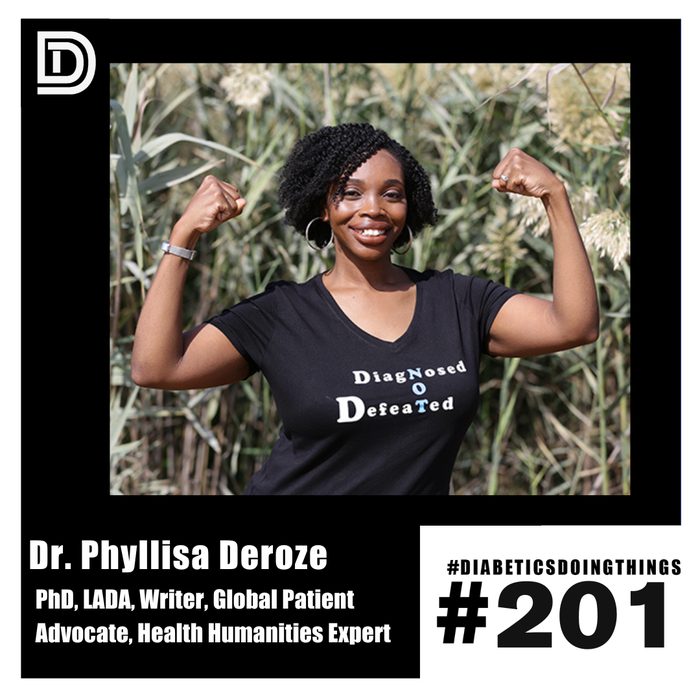
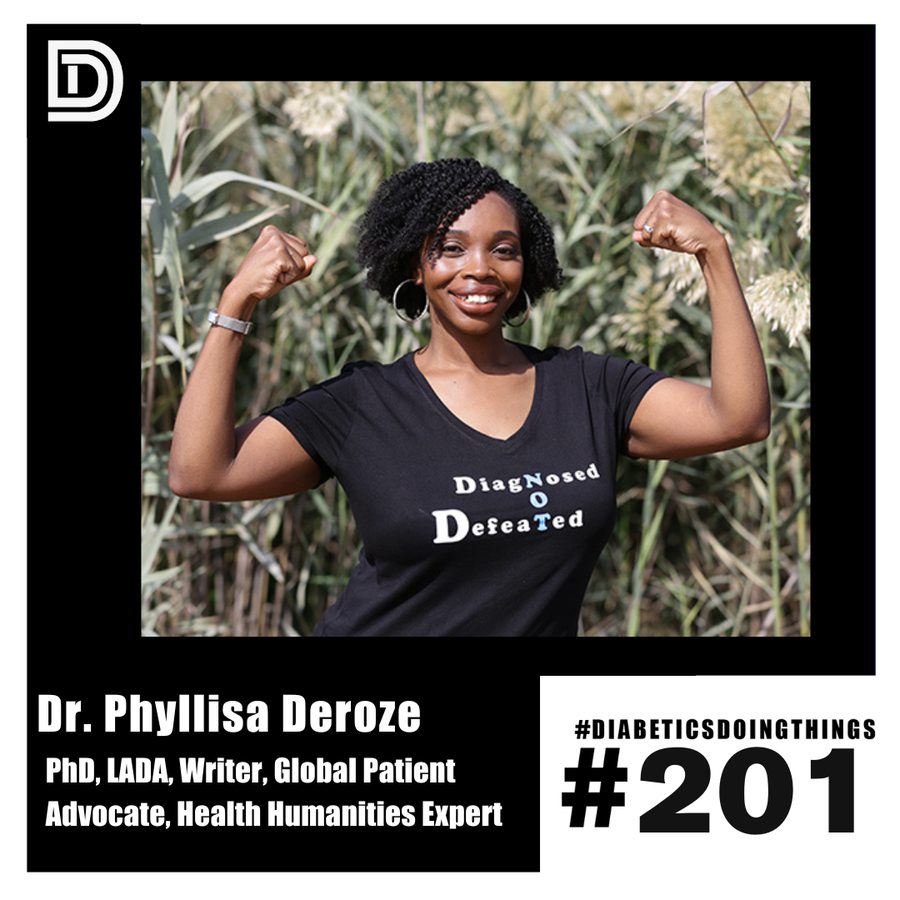
Dr. Phyllisa Deroze, PhD, LADA, Writer, Global Patient Advocate

Episode summary
Dr. Phyllisa Deroze returns to the show to talk about her diabetes story and advocacy. She was misdiagnosed with type 2 diabetes for eight years, including a first visit where a doctor told her she had an electrolyte issue, before two endocrinologists refused her requests for antibody testing. Her gynecologist finally ordered the test, which showed she has latent autoimmune diabetes in adults (LADA). She connects her case to a pattern among Black women, citing one endocrinologist who found LADA in 80 percent of the Black women in her practice. She talks about processing grief through crochet and documentary filmmaking, surviving a tornado that destroyed her home, her new children's book Diabetes Helpers, and the code word her family uses for severe lows.
Key takeaways
- Phyllisa says she asked for type 1 antibody testing for a year before two endocrinologists refused and she went into severe DKA.
- Her gynecologist ordered the test that finally confirmed she has LADA, not type 2.
- An endocrinologist in the New Orleans area told Phyllisa that about 80 percent of the Black women in her practice turned out to have LADA.
- Phyllisa processes grief through creative projects like crochet blankets and a documentary film.
- Her family uses the code word 'red reindeer' to signal a severe low blood sugar emergency.
Show notes
Dr. Phyllisa Deroze is back on the pod! She talks with Rob and Eritrea about:
Missed diagnosis, misdiagnosis, and the journey to being heard
Processing grief through creativity
Linguistic blaming and stigma of T2D
Pattern of POC LADA misdiagnosed as T2D
Honoring children and loved ones of diabetes with book, Diabetes Helpers
Using code words for low blood sugar
Founding Black Diabetic Info and Diagnosed But Not Defeated
Finding blessings in the burnout
Questions this episode answers
What is LADA (latent autoimmune diabetes in adults)?
Phyllisa explains it as a form of diabetes often misdiagnosed as type 2 that is confirmed through a type 1 antibody blood test, and that it can come with a slower onset of insulin dependence than type 1.
How did Dr. Phyllisa Deroze find out she actually had LADA instead of type 2 diabetes?
She asked her endocrinologist for antibody testing for a year and was refused twice. Her gynecologist eventually ordered the test, which came back positive for type 1 antibodies.
Why are Black women sometimes misdiagnosed with type 2 diabetes when they actually have LADA?
Phyllisa says she does not have a full answer, but she cites an endocrinologist who found LADA in about 80 percent of the Black women in her practice, and says stigma around noncompliance keeps many patients from getting tested.
What is the book 'Diabetes Helpers' about?
It is a children's book Phyllisa wrote with her daughter about kids who help a parent or relative manage diabetes, featuring one child whose grandfather has type 2, one whose brother has type 1, and one whose mother has LADA.
Full transcript Searchable, with timestamps
Rob Howe: What up, Diabetes Podcast fans? Man, we are back. It's been a little bit of a breather. We've got some episodes in the can, but they are waiting on approval from some of the sponsors. So thank you guys for being patient while this feed has been a little bit slow the past couple of weeks, but we're back and we're back in a big way. Dr. Phyllisa Deroze is our guest. She's a friend of the pod. She's been on the pod before and she's blackdiabeticinfo on Instagram.
Eritrea: Eritrea, what did you like about this episode? Oh, man. First of all, Phyllisa, she has a really soothing voice. So if you like ASMR, this is the episode for you. Dr. Deroze, she has a really interesting perspective, in my opinion, just because she's, everybody listening to the episode will definitely get into it. But as a person who was not just diagnosed once, twice, I think three times total right um and she comes from a background of a doctor informational data diabetes everything like super human brain person it was really interesting to hear her perspective from both sides as not just like a patient but also as an advocate and also as somebody who like takes part in clinical trials of maybe why so many people in this space who used to have type 2 have now developed LADA or type 1 or that diagnosis has changed um so this is a really good episode. I'm excited to hear what you guys think and for you guys to consume the amazingness
Rob Howe: that is Phyllisa. I mean, yeah, if you are a fan of difficult conversations with your doctor and advocating for yourself and learning how to go about that, uh, if you want to know more about latent autoimmune diabetes in adults and the antibody test, uh, if you want to talk about, uh, stigma around type 2 diabetes, uh, stigma around, uh, the black community and diabetes, and questions about how many people out there right now who think they're living with type 2 or actually living with LADA. We have those questions too. But Phyllisa brings some really amazing answers and I'm so encouraged by this episode. She also has a book out. It's coming out in November. You can get it pre-ordered on diabeteshelpers.com. The book is also called Diabetes Helpers. We've got a link to that in the show notes. So be sure to support your fellow community members because we've all got some diabetes helpers out there. I know me in particular. I think of, you know, my parents and my wife and my team of people who live around me. And Eritrea, I'm sure you feel the same.
Eritrea: I have my helpers, but I'm some cuter than others because these helpers are kids. So this one for sure, make sure you guys check it out and you sign up for the pre-order of the book.
Rob Howe: Definitely. And with that, please enjoy this episode with Dr. Phyllisa Deroze.
Jelana Deroze: My name's Joanne.
Rob Howe: Hello and welcome back to Diabetics Doing Things. We are telling the amazing stories of people with diabetes from all over the world. And I'm super excited to introduce our very special guest today. She's been on the podcast before as part of our More Than a Diabetic series, but this is her first solo episode and I'm so excited to have her in the mix. Phyllisa Deroze, welcome to the show.
Phyllisa Deroze: Hello. I'm so happy to be here.
Eritrea: Dr. Phyllisa. That's right. Oh, excuse me. I was like, get it together. I should have been
Rob Howe: Phyllisa Deroze, PhD. Yeah. And also founder of Black Diabetic Info, a blogger, Diagnosed, Not Defeated. And you know what? We're digging in today a lot of different things. We also have a new book project that we're going to tease out today as well. So, Phyllisa, where do you find
Phyllisa Deroze: the time that's the that's my first question I wonder that myself um but you know someone asked me that recently in a like a more serious way so I was like let me seriously think about it and um what I shared with this person was I escaped to creativity like that is what fuels me so I've completed a blanket that I crocheted I'm working on another one because my daughter was like where's my blanket too but like in the times when I need to go somewhere I go to creative things and that is that's where the time comes from like they were literally asking me and I was like yeah like I remember being very depressed, honestly, when one of my very favorite uncles passed away, which I have like a million uncles. So they're all my favorite uncles. Right. Um, but during that time I did a documentary, like a full length, one hour documentary. And that was how I processed my grief you know and this crochet blanket is how i process the grief of another favorite uncle who passed away last year so you know when people like oh my god you work you're a mom like how can you crochet blankets and it's like creativity is where i escape to it's so interesting to
Rob Howe: learn the things that give people fuel and like give people our safe spaces because you know often, like you said, like we're all busy with our regular lives. Everybody has their own way of spending their downtime, whether that's reading or projects or creative projects or a podcast like this one. And I relate to what you're sharing so much because, you know, after a long day, even like today, a long work day, pretty demanding. Here we are after hours recording this podcast, but I'm going to walk away from this, even though we're working, I'm going to walk away from this feeling better, more energized, more refreshed, because we're scratching that creative itch. We're digging into that community aspect. And, you know, for me, I love connecting with people. And so this is this is the best way for me to do that. So, Phyllisa, I would love to know, like, let's start with your diagnosis story, because I know from from what you've shared publicly with the community, it was a very traumatic experience and also recently has also been changed. So I'd love to talk. Let's start with diagnosis number one or misdiagnosis one and go from there.
Phyllisa Deroze: So what I'd like to say in terms of misdiagnosed, like the first thing I had was a misdiagnosis. So M-I-S-S-E-D, the first time I went to the doctor, they completely missed diabetes, told me I had an electrolyte issue and to drink Gatorade. Gatorade clearly sent me into DKA the following week. And I remember at that point losing all like trust in my physician at that point. Like clearly you missed something. Never once did that PCP mention diabetes. The first time I heard it was when I left her office without her permission I had to sign a paper saying that I was going to the emergency room against her orders which I still have because it's on my medical record wow um and it was at the ER and it was so casually said like how long did you have diabetes and like diabetes like what do you like I don't have diabetes news to me um and it was really unfortunate that that was like the first time I I heard diabetes I spent six days in the hospital there um looking at horrible pamphlets old tinged didn't have any emotional awareness uh to them at all so I didn't learn much about diabetes in the hospital and then the night that I was discharged I was discharged with a needle um I'm sorry insulin pins no needles and a glucometer which I know I'm dating myself when I say that because it's a blood glucose monitor um one of those without any strips and a bat so when I got home I was like where's the thing that goes on top of the insulin and I was like there's something that goes into this machine. So I was very ill-eclived. And at that point I was diagnosed with type 2 diabetes. And then I lived that way for, you know, eight long years. And I always want to say this because it's so super important to my story that 61 days later, after being discharged from the hospital, I lost my home in a tornado and I I was totally devastated like yeah whenever I say that it's like the wind is just sucked out of everything because that's that's how I felt I love to smile I love to laugh and honestly I didn't know if I would do any of those things ever again um so having these kind of two near-death experiences back to back is so vital to my diabetes advocacy because I'm not exactly sure why I survived um but I've kind of made the reason why I survived is to tell people my story and to help other people not have the same experience. So my diabetes advocacy is one of my purposes, um, cause I needed to like figure out what my, what one of my purpose, I don't believe that we have just one purpose. Um, I believe that we have
Rob Howe: I agree. I, I think we're too complex as beings to just exist for one thing. You know, we're not, we're fluid, we were multifaceted, we're multi hyphenate, you know, it's very difficult to describe a person. And I think, you know, that's kind of mirrors and makes diabetes much more complicated at times because people are so different. There isn't a one treatment option. There isn't a single right or wrong way to manage it because it has so many inputs. I want to come back to you, though, because I really, really relate and what you said really resonated with me about your purpose, why you survived, why you've lived. And I've been feeling like that a lot recently, too, is I think I took for granted that if we were born at any other time in history, basically, other than this past 80 to 100 years, we would be dead. But so, you know, in many ways, I and we are living on borrowed time. So what do we do with that time? And it's so inspiring to me when people like yourself say that my purpose is to give back to other people like me because it's just it's a it's a negative. It is a negative, you know, and it is a burden. But there is an opportunity to flip it into a positive and affect somebody else and reach out and grab someone's hand and say, you know, let me let me guide you and help you avoid
Phyllisa Deroze: some of the mistakes that I made. Yeah, for sure. Absolutely. So to kind of continue to the second diagnosis. So clearly I was misdiagnosed MIS here. And eight years later, being a part of the diabetes communities, especially the online ones, I learned about latent autoimmune diabetes in adults. And someone who was extremely active in the type 2 community online found out they had LADA and they have been misdiagnosed for seven years. And I mean, it was my Durbin and I was like, oh my gosh, if it could happen to Mike, maybe it happened to me. And so I kind of hit him up in his DMs, like, how'd you find out? And he shared with me, he got type 1 antibody testing. And so I thought, well, let me, you know, get type 1 antibody testing. I looked at my medical records and the bits and pieces that I had didn't share or show that I had it. So I asked my endo if I could have type 1 antibody testing to that. I was told, no, there's no need. I clearly have type 2 and we went on like this for a year um of being denied i even saw a second opinion because i was like i just want to be tested right to know yeah and um second opinion said no as well um just simply refused to to order the test and within within about 30 to 45 days after the second opinion denied me I went into extreme dka um and like I knew it like after you've gone into dka once you know it right your body starts smelling sweet you're losing weight you know people like oh you look good girl I'm like I'm
Rob Howe: in DKA girl. I look good. I feel terrible. I love it. It always makes me laugh when people share their stories and like the comments that they were getting from people in the days, weeks leading up to their diagnosis. Everyone thought I was looking so good. I was, you know, I was back, back to my, you know, my, my playing weight, as I would say, you know, just like really, really feeling like, and also just feeling so bad.
Phyllisa Deroze: Exactly. What does that say about us? But anyway, it's very interesting because every time in my adult life, I've reached the smallest I have been. It's been in DKA. So when people are like, oh, you need to lose weight, you might want to decode that because you know you could be very sick um and thin and so yeah i interestingly enough i ended up vomiting at friends for life publicly in the bathroom i was so embarrassed i at that point i was like well listen you are seriously in dka right like you're you know um at the diabetes conference right so you're and there I was thinking that I was the only type 2 at the friends for life conference and that was not the case so I asked my gynecologist actually to run tests because at this point I'm like no endocrinologist is running the test let me try my endocrinologist I meant my gynecologist so my gynecologist was like sure Phyllisa let's figure it out so she and I were on google trying to figure out the right code that she needed to put in i mean she was just so sweet because she listened to me and um in the end like within 10 days it came back like through the roof i'm positive for two type 1 antibodies um i i gave that paper to my endo because my gynecologist said
Rob Howe: give this to your endo oh what was that like what did you feel like doing that what a moment
Phyllisa Deroze: so let me tell you I know she gets in around eight well she you know she would get in around eight I got there at like seven because I know the cleaner people are there at seven and I slid it under her door with like a big post-it that said read this and so I was like it's gonna be the first thing she sees so that morning I got a call and it was pretty much like, you know, oh crap, call. Phyllisa, get in here now. You need insulin, stat, stop taking all the oral medications I've given you. So I do want to say in that year of me asking, like every three months when I saw my endo, she was just upping my medications, like upping these oral medications. And then I'm being told that type 2 diabetes is a progressive condition and this and that. meanwhile I know I'm eating low carb I know that I'm training for a 5k race like all like I mean I probably averaged like eight to ten 5ks in a year so I'm working out I'm exercising I'm doing my part but my blood sugar is increasing my a1c is increasing so I knew something was wrong which is why I was asking. And yeah, I had to go in. I went in and I can't remember exactly what she said because all I told myself, Phyllisa, do not leave the office until you ask specifically, why did you not grant my request to get tested? So she said this, that, and the other. And she was like, I'm going to take you to the diabetes educator. And so she stood up. I was like, I need you to sit back down. I need you to sit back down because I have to ask you this question. Like, I just have one question for you. And she said, sure. And I said, why did you not honor my request to be tested. And you know, I've been asking for a year. And she says, I'm really sorry. You're absolutely right. And I don't really have an answer, but I'm sorry. so that made me feel better because she at least acknowledged that but you know what made me feel fantastic is that she wrote that in my medical records she wrote Phyllisa had asked for type 1 antibodies testing for a year and I denied it because that is the truth and so then I was walked over to the diabetes educator I felt like it was a hazard for me to leave the building without knowing about diabetes without getting insulin it was like rolling out the red carpet so if you remember I shared with you when I was diagnosed with type 2, I left there, you know, pretty much thrown away like a unwanted stepchild. And then now the T1D diagnosis, it was like, do you understand insulin? Do you understand carb counting? Like it was night and day, um which also made me sad yeah um and then I began this journey of reading about diabetes all over again right and what I found most interesting is that I realized after reading things on T1D that I had never read in all the years because at this point it's been eight years since I'm reading diabetes, you know, pamphlets, booklets, educational material websites.
Rob Howe: And you're also like involved in the online diabetes community heavily and professionally at this point too. So like you're, you're experiencing a lot more diabetes than just
Phyllisa Deroze: your average person. Very true. I realized then that I had never, never, ever, not once read anything related to type 2 diabetes that said it's not your fault when most of the stuff that I had been reading for T1D started out that way you have T1D it is not your fault you have T1D there's nothing you could have done to prevent it You're like, it was linguistically a totally different world. Instantly meeting people at their emotional vulnerable state and nothing that I had ever read for T2D did that.
Rob Howe: So, I mean, as we look at stigma, so let's talk about stigma really quickly. It starts at diagnosis. It starts in the pamphlets. It starts in the rhetoric that your care team uses at diagnosis right then, right then in there, because it's your fault automatically, even if it's not, which we're learning, we've learned so much more. And I, and me personally, I've learned so much more about type 2 diabetes in the past two or three years. It seems like we really don't know that much about it still. And that there's a wild amounts of variants underneath T2D that are, that are genetic, that are not your fault, that are, you know, associated with your, you know, with your, with your body just attacking yourself, but it is more chronic than we think.
Phyllisa Deroze: And medications cause T2G and COVID causes T2G, like the list goes on.
Rob Howe: And, you know, right. So if you get COVID and it gives you T2D, is that your fault? You know, I think, again, it's just the language that we use to describe something that inherently nobody woke up and decided, you know what's on my vision board? Type 2 diabetes, baby. I'm heading down this path, and that's what I want. Yeah, that's really, really interesting to be able to see both sides of that yourself. And I think, too, what we're circling now here is also a pattern and a theme. and what's really interesting to me right now is that all of the type 2 bloggers and advocates that i've met on the internet in the past five six years all now have latent autoimmune diabetes in adults they were all misdiagnosed yeah yeah and i feel like the pattern take it a step further
Eritrea: the ones that are african-american yeah so it's like is there something there i feel like who's, Phyllisa, you're the perfect person to ask, right?
Rob Howe: Drop some black diabetic info because that's, this is, this is the big thing. I was, it's actually very poignant to me today as well because one of my buddies that I played basketball with on Saturdays, I have a basketball run. Then it's one of my favorite things. It's mostly mental health at this point. It's just where I go blow off steam and I love it. And my guys are great. And my buddy, Nate, who we're going to have on the podcast, a couple of years ago was diagnosed with type 2 diabetes. He's a black man in his forties, pretty good shape, I would say, but he had, you know, during COVID gained a little bit of weight, like many of us did. And the doctor just chalked it up to type 2 diabetes. No worries. Put him on the oral medication said, Hey, let's get your diet and exercise, right. And you should be okay. Well, turns out that he has latent autoimmune diabetes in adults. So that didn't work right. Uh, and I didn't even know that. And so it was, it was cool. I saw his Dexcom. I was like, Nate, why are you wearing a Dexcom? Uh, I, at first I thought he was like, you know, doing a metabolic health program or something. And he goes, Oh, he goes, I have, I have a lot of, and I said, really, I have a diabetes podcast. Let's talk about it. And so we, and we nerded out for like 10 minutes after that. Um, but again, and that's what we, that's what we came back to is that he said, I was a black man in my forties and I gained a little bit of weight and my doctor jumped right
Phyllisa Deroze: away to type 2 diabetes? Yep. I think it's definitely been interesting to me, but I have to say that I had a conversation with an endocrinologist recently. I had this conversation that works in Louisiana in the New Orleans area. And what this endocrinologist disclosed to me was that she's new to the area and she has never seen so much misdiagnosis. she said about 80% of the black women in my practice have latent autoimmune diabetes in adults
Rob Howe: and 80% yep sorry for yelling I don't know if that mic was too hot 80%
Phyllisa Deroze: yes and so what this tells me in terms of my like brain going around in circles is that how many of black and brown people have LADA and have physicians that don't understand that that are refusing to test for type 1 like I was fortunate enough to know that there is a test that I should get when I see my numbers are constantly elevating and that just tripling my oral meds is not it. But how many people don't know that? In addition to that, I have been looking around for studies on LADA and I have not, I'm looking for it. So if anybody who's listening to this podcast can forward me some studies, I greatly appreciate it. But I'm looking for studies on African-Americans with LADA. Now, I think that is an important study because we know that people who have LADA have the ability to delay the quick onset of type 1. So if you have a whole body of people who have the ability to delay the quick onset wouldn't you want to know what's going on there like how is that possible that you could come in contact with t1d and you know you're doing karate or are you going to wakanda land on it it's not coming to you for like a decade So what I have encountered was a lot of medical research that just says LADA and T1D have the same metabolic makeup and so there's no need to study. And that's problematic. In addition to that, I think about my relative. Like there is a relative in my family who had diabetes and went through what could have possibly been a very long honeymoon phase. But during that honeymoon phase, believed that God cured them. And so now there's this introduction of religious belief that says God cured me. and if God has cured you and you're in a honeymoon phase not remission of type 2 and so then you know you are going to at some point need insulin and when my relative needed insulin they refused to take it and they passed away from complications of diabetes and the fact that i will never know if they had ladder but understanding they very very well could have and how many other people who are black and brown could have ladder but are told you're not eating right you you're not exercising well labeled non-compliant yeah it's the soul food you're eating it's the that that that and that's how you end up with people saying you know what I don't care about diabetes because they feel as though they aren't getting it right when really they have antibodies that are going to make sure that they don't produce enough insulin.
Rob Howe: this has, you know, I try not to jump to the conclusions too much, but this, I think is something that in black and Brown communities. And I think, you know, I feel, I feel very torn when people talk about this as like a, an annoying thing that people without diabetes say to them was like, where they say, Hey, well, my grandmother, my grandfather had diabetes and they had complications or they had amputations or things that are really uncomfortable and we don't talk about too much in the online community because they're scary. And almost always those people were diagnosed as type 2, as T2D. But were they non-compliant or did they simply have the wrong medication? Did they simply have the wrong diagnosis in either their care team? Like you said, I really resonated with what you said because earlier about being in the community and knowing that there was an antibody test. Like that's a really rare group of people, even in the type 1 diabetes online community. I think it's a low percentage of people understand the antibody test. But then not only did you understand it, but your doctor, two doctors wouldn't administer the test. So you had to go around the system and had to work it and believe in yourself, even while experts were telling you no. So finally you get to the answer that you knew in your heart was something was wrong. I think you hit it exactly right. They just gave up on caring about diabetes because no one else seemed to care. And they kept telling him it wasn't a problem. How many people have we lost or who have lost tremendous quality of life because of lack of awareness, lack of access, and, and honestly, and misdiagnosis and misconceptions and stigma around noncompliance of diabetes. I, it makes me, I'm like, I'm like really amped up now. It makes me upset. And let's add, Dr. Deroze was asking.
Phyllisa Deroze: That's right. I have a PhD and I'm asking for tests and I'm denied. So what hope is there for someone who has lesser formal education, has maybe a dialect that's different, you know, than the person they're asking and the person that they're asking deems their speech to be subpar? I mean, you have all of this, right? Maybe they're even more obese than me and don't work out and don't keep, you know, their blood log. Like I was fortunate enough to be able to look at my own data after being told I checked my blood sugar too much. People with type 2 don't need to check their blood sugar that much. I've been told that by two different endocrinologists. And I would just say, I need to know what's going on in my body. And so because I had that data, I was able to see when I'm training for my 5Ks, at what point my blood sugar starts getting lower, at what point I need to have juice. Like I, this was like, I needed this data on my body. And once I could see that my blood sugar was not going down after a 5k race like it had been doing I knew something was wrong like we have a problem here my A1Cs are increasing and think about people who don't have that data think about people who don't even have a relationship with their endo where they
Rob Howe: could talk bad or don't even have an endo. Yep. And I think, you know, I, my, my relationship with doctors and I'm very fortunate. I was not misdiagnosed. So I have a different relationship than, than many people who are able-bodied and don't have chronic illnesses, but also different than, than many people with diabetes. I had this like trust that if there was something wrong, my doctor would know, uh, or if there was a test, they would recognize that. And people are so different. And, and also, you know, in our healthcare system, there's too many patients that doctors have to see. They don't have the time to spend. They don't have the time to learn. And, and, you know, everybody's the protagonist of their own story. So they come in looking for a solution for me. Uh, and, and yet not, and, and they kind of look at our, look at themselves in a vacuum. Most people are not connected to online diabetes resources. They're not followers of Dr. Deroze and understanding how to talk to their doctor about these different things. Uh, they're not listening to diabetes podcasts. They're just trying to increase their quality of life or even do the bare minimum that they need to do to get by. And that is so difficult because they're often labeled as noncompliant when they're really just humans trying to do what they're supposed to do and it's just not working. It's not connecting. Okay. So we've talked a lot about misdiagnosis. We've talked a little bit about Lada. I would love to talk about your new book,
Phyllisa Deroze: Diabetes Helpers. Oh, yes. So Diabetes Helpers has been formulating in my mind for about two and a half years. No, we aren't going anywhere. Okay, go ahead. You got to leave. Mommy's doing the interview. Fime la porte. Nancy. Jelana, Fime la porte. so diabetes helpers is a book that has been formulating in my mind for about two and a half years so i'm so thankful that it is now coming to light which is very very very important and the premise of it really started when I realized my daughter was old enough to acknowledge the technology that I was wearing and like my CGM and the first one I had was a FreeStyle Libre and you have to scan your arm and I have this video of her like maybe two years old scanning her arm. So these diabetes devices and diabetes management is not only a part of my world, but it's a part of her world. And it is the only version of me that she knows. She doesn't know a mommy pre-diabetes. And so I was looking for books, you know, children's books that would help me explain diabetes to her. And when I put in children's book and diabetes, the only thing I found was diabetes books where children have diabetes. And so diabetes helpers really is a movement and it honors children who are the helpers of people in their lives with diabetes. So my daughter is the main character, Joanna, and throughout the book, we get to follow her as she helps her mom with diabetes. And I'll show you one of the images that I have here. I think it's so cute because we're on evening walks and she rides her scooter with me. So you get to see I'm wearing my CGM. She's on her scooter. And throughout the book, we get to see her help her mom. But I wanted to make sure that this was not just a book about me and my daughter, that it was something that more people could relate to and, like I said, be a movement. So there are three diabetes helpers in this first book. There's Antonio, who helps his grandfather with type 2 diabetes. There's Grace, who helps her brother with type 1 diabetes. And then there's Delana who helps her mom who has latent autoimmune diabetes in adults. What I have come to my thinking and rationale, like we talked about earlier, while some communities don't acknowledge a difference between type 1 and LADA, we have a story and that story is unique. and so I think it's very important to bring awareness to that so these three characters are each talking about the ways in which they help their loved ones that's so relatable and
Eritrea: awesome I feel like the when you said the little boy Antonio helps his uh grandpa with his diabetes I know so many specifically like people of color children who've had to help their grandparents take their insulin shots and etc uh and my mind instantly goes to a co-worker of mine also who has a daughter uh she has like my co-worker has type 1 her daughter doesn't and her daughter like helps her with so much stuff and it's really cute so I can imagine so many people are going to feel seen and what a beautiful way to honor children who have to sometimes take responsibilities that are a little bit out of the scope of what being a child is, you know? Yeah.
Rob Howe: I think too, like children especially are so perceptive and maybe more perceptive than we realize at times. I'm reminded of a story. My friend Lindsay has lived with type 1 for 20 years and her son Brady, one time we were at a, we did perform comedy together at Dallas Comedy House and the boys were there for a family-friendly show. And one of the characters in the show was like a sad, kind of like grumpy character. And afterwards, Brady came up and asked the actor who was playing that character in the show if their blood sugar was low. And it was just the funniest, like very sweet, thoughtful thing. Cause like, it's normal to him. Like when mommy is grumpy and kind of down, like maybe her blood sugar is low. And it was just, I was so blown away by how perceptive a child can be in those, in those ways. I'm excited to, uh, to see diabetes helpers. And even, even in my own life, like, you know, my wife doesn't live with diabetes, but she helps me, you know, makes, uh, she's very sweet packing my, uh, my little blood sugar, uh, treats in my stasher bag. So, you know, cause I sometimes am forgetful. I've more often than not been out there in my little blood sugar bag is empty. So yeah, I mean, there's diabetes helpers all around us. Exactly. Yeah. I'm,
Phyllisa Deroze: I'm really excited about the project and seeing where it goes. And I have t-shirts and little pins and, you know, the book is going to be out. I'm aiming for November. So people who participate in the presale of the book, they will get their book before everybody else does. And it'll be autographed by both authors, Jelana Deroze and Dr. Phyllisa Deroze. And so, yeah, I'm looking forward to it. We have our website, diabeteshelpers.com, and that's where the pre-sale information is housed. And I do want to point this out too. This past Christmas, I had the most severe low and there were a couple of things that got me to that place one I saw an endo and they increased my insulin to carb ratio which I then forgot that it had been increased and then I didn't eat all of my food because it didn't taste it so like that was a horrible combination that caused me to have way too much insulin. And we had moved. And when we moved, no one took the time, hence me, I'm talking about, no one took the time to reinstate the rules of if I have severe hypo, where is the glucagon kit? So here I am in the midst of this hypo lake. I'm on the floor. Anytime And Phyllisa's on the floor without a blanket. She has a bad hypo. That is my thing. Like I'm laying out. And so I was laying out on my living room floor thinking, oh my gosh, I'm 42 with a straight arrow going down. I don't know how much time I have. Because at this point, I realized we don't have an emergency plan of like where to get the glucagon. And I don't have enough brain cells to explain where I put it. so fortunately I was able to get up give it to myself and I was one of those ones you shoot up your nose I shot it up my nose I screamed and then I like passed out I just remember later waking up freezing cold and then I had a horrible day the next day as well but the next day I had a group meeting in the house and I said if ever I say red reindeer this is what you need to like get so I'm I needed to make sure I didn't say that too loud too loud but like she knows if mommy says red reindeer get this little box that has my glucagon kit in it like glucose gel has some of everything some starbursts whatever but the thing is is like that's a part of her world right that there's a cold word that mommy will say when her blood sugar is really low and so just honoring like what kids and other family members you know have to go through just to be a part of your world, right? They, um, is what I'm hoping that diabetes helpers is this, that movement to honor our helpers in our lives. And, you know, I, I'm so
Rob Howe: grateful for the helpers in my life. You know, my parents, uh, when I was younger, uh, I think I'd probably take all of that, a lot of that for granted, what they went through and kind of devising and thinking of those worst case scenario things. And, uh, it is, uh, I love that red reindeer is the, is the code word, because that's, it's, it seems kind of fun at the same time, but it's like, Hey, it's also, you're never going to just say that. So when, when you hear it, you know, spring into action, let's make it happen. And yeah, you know, you never know as a kid, like being very young, having to have that conversation of, you know, mom or dad may be in really serious trouble one day and you may have to help them. So I'm so glad that there's, there's a book out there to help, uh, help the helpers and, and help the, uh, you know, create awareness on like, do you also have a plan? Do you have a diabetes helper in your life that can help you if, if you need to, uh, if it comes to that. So thank you so much for that. I can't wait to do it. We'll also include a link in the show notes so that folks can pre-register, uh, at diabetes helpers.com. And I think too, kind of, as we come to, uh, to a close of this interview, which, you know, I want to have you back as well, because I'm going to have my friend Nate on the podcast. We're going to do a lot of, we have some guests coming up who are all misdiagnosed. And I think there's just a tremendous amount of awareness that needs to be spread about latent autoimmune diabetes in adults. But, you know, we're kind of living in perpetual, unprecedented times. And you told us a little bit about how you cope with, you know, stress and grief by pouring into your creativity. but your blog was as diagnosed, not defeated. And how do you, how do you keep yourself not defeated on a regular basis? And what advice would you give to our listeners on how they can,
Phyllisa Deroze: how they can cope and keep going? So my motto diagnosed, not defeated. I came up with very early on in my diagnosis because I did feel defeated. I felt lost. The only person in my family with diabetes, literally there was no one in my cell phone that I could call and ask any diabetes related question to. So I was on a complete Island by myself crying almost every single day. I remember I was in a store and a woman said, Oh, your hair is nice. And I just like, I'm just crying to this stranger, which by the way, we're still friends today.
Rob Howe: Oh my gosh. That's awesome. because she just was like oh I was just complimenting your hair I was like I have diabetes
Phyllisa Deroze: um so like I needed something to like lash on and to tell myself every single day and that's what it was it was diagnosed not defeated diagnosed not defeated most of the stuff that I have created really has come from a void of things that I've needed I needed diagnosed, not defeated, like a motto, like something I could use to get me out of bed, something that I could use to help me get through my insulin injection, something that I could help get me through the fear of needles, something I could help me get through all of this, right? Like, and I would just say, diagnosed, not defeated, diagnosed, not defeated, like hyping myself up. A year later, when I founded Black Diabetic Info, it was because I spent a year looking for information that was diabetes related, but had like a cultural awareness. Like I wanted to know how do I eat grits? How do I eat collard greens? How do I eat briyani rice? Like I needed to figure all that out and I couldn't find it. So for me, it's about creating things that I need knowing that someone else needs it too so I don't hold diagnosed not defeated like my hashtag I don't use the hashtag like however you feel that you need it use it and it is that thing that gets me through and when I'm experiencing you know diabetes burnout which I feel like I deal with it every day I have micro diabetes burnout every single time my watch is like your blood sugar I feel that I'm like I'm gonna let it ride out a little bit right like these things um I take it one moment at a time I don't look at the the big picture I just say can I fix my blood sugar right now I'm not worried about tonight I'm not worried about like the other day like sometimes it's literally moment by moment um and feeding yourself positivity. Like there's this app out there. I like the app because you can change the personality of your diabetes information. And so it can be really polite. Hey, your blood sugar is 72 and going down. You might want to have some juice. Or you can change the personality to like, hey, you're 70 and going down. Don't you realize you have diabetes? Like it just has a little attitude. and so on the average day the attitude like brings me a little joy but if I'm not feeling good I'm like I can't take any attitude today I gotta move you to a different personality one that's more encouraging like hey your blood sugar is 70 won't you go get some juice please you know like so I I would say make your diabetes your diabetes. Understand that you don't have to smile with this condition every day. Some days you're just going to cry. Like, that is it. And some days are going to be good. Some days are not. And you just take it for what it is. And you move on. And when you move on, you're just thankful for that. And I have to say this, just the last thing. When I was diagnosed the first time, and then I lost my home in a tornado after that. So I was homeless. I didn't have any clothes. Like everything was gone. People said to me, you're blessed. And I was so angry. I was just so angry. I thought, how in the hell could this person look at me and say I'm blessed? I've been diagnosed with diabetes. I got to give myself insulin every single day. I don't have a home. I don't have shoes. You know, I still don't have purple shoes. I had purple shoes that day. I lost my home in the tornado. And I have never gotten purple shoes since. And I miss them. They were beautiful. But anyway, my point is, those were the only PR shoes that I had owned, the shirt, like, like almost everything. And so for someone to say I was blessed, I, it just angered me. And then one day when I was in the hotel where they put displaced people, I said, I'm going to see if I'm blessed. and I'm going to see if I can find one blessing I wasn't going to push it to two definitely not three but let me see if there's one blessing and the first blessing that I acknowledged was what I didn't share earlier was I had started my blog already by this time and it was going to be a diabetes cooking blog, like the Julia Julia version of diabetes. And so I had gone to the store and bought everything I needed for this blog post, doing a chicken recipe by Patti LaBelle. Cause I was like, she a diva. I'm a diva. I'm a star with her book. And on the way home, something straight from the heavens told me to turn into the store. I had no idea why I had everything I needed, but I know this voice came to me so strongly that I needed to obey. And it is because I obeyed that I was not home when that tornado blew. I literally got there so soon after it hit that my neighbor thought I was there. And so my first blessing was I could have been home when that tornado blew. And then I was done for the day of counting blessings and then I did it the next day I found one blessing and that is what pulled me out of one of the darkest places I have been in my life was knowing that I at least had one blessing in my day and so I would say to anybody like find that one blessing you know when you're in your darkest place like find that one blessing. Insulin is really expensive. And for someone to have the ability to have it, right? Like you have. And so just find that one blessing. That's what I would say
Rob Howe: to anybody because it helped me. You nailed it. And I think when you're at your lowest point, it can be really hard to find that blessing. But I hope that, I know that somebody listening to this podcast today, you could be that blessing for them and hearing your story. And I still maintain that it's air trade. And I were talking earlier this week. It's been a while since we recorded an episode with a guest. Um, and you know, we, we hit 200 episodes on this feed. We're going to push for 200 more, but we, we took a little time, uh, to kind of, you know, work on some other projects that we've got going, but it just reminds me of what I believe is the most important thing a person with diabetes can do, which is share their story. Not anybody else's share their own because there's somebody out there who needs that one blessing and needs to hear it from somebody like you. So Dr. Phyllisa Deroze, thank you so much for, for sharing your story, uh, for being that one blessing for somebody out there today, uh, and for continuing to give of your creative self, uh, for others and for this community. and I am better off for knowing you. And if you don't follow Phyllisa already, Black Diabetic Info on Instagram and diabeteshelpers.com, blackdiabeticinfo.com. You're making a change for people. And I hope this conversation continues to spread awareness about latent autoimmune diabetes in adults, which is its own version of diabetes is not the same as type 1, even though the antibodies are at least the same.
Phyllisa Deroze: yes i agree thank you so much for having me it is a pleasure i wish you both peace and love and happiness and 200 more episodes um you're doing a great job so thank you so much
About Phyllisa
Dr. Phyllisa Deroze is a writer and global patient advocate living with LADA. She founded Black Diabetic Info and writes the blog Diagnosed But Not Defeated, and she co-wrote the children's book Diabetes Helpers with her daughter.