

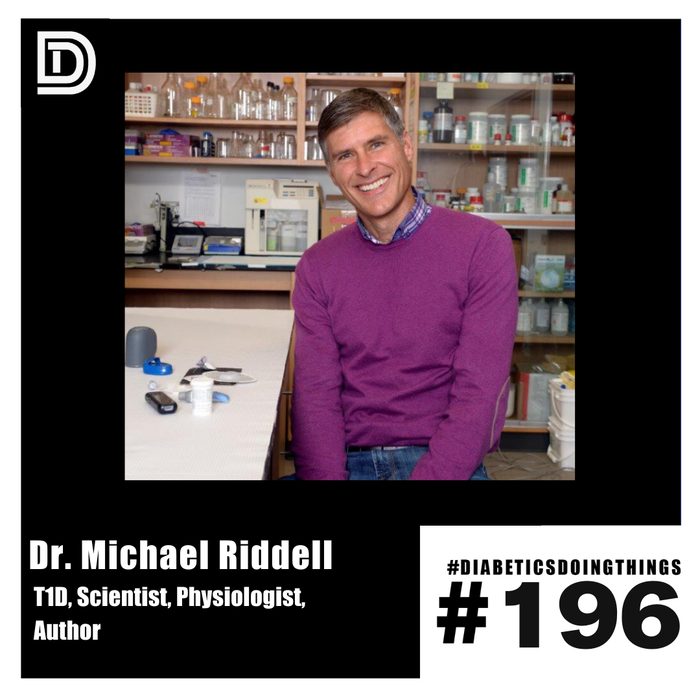
Dr. Mike Riddell, T1D, Scientist, Physiologist, Author


Episode summary
Dr. Mike Riddell has lived with type 1 diabetes since he was diagnosed at 14 in 1981. He is a professor at York University in Toronto and author of Getting Pumped, a book on exercise with diabetes built from years of collecting stories from athletes with type 1. Rob and Riddell talk about how blood sugar can rise or fall during sport depending on the activity, what his lab studies found about glucose and performance, and how continuous glucose monitors changed what scientists could prove. They cover insulin pumps, insulin on board, and glucagon options for athletes, plus what to pack in a kid's sports bag. Riddell also describes his current study pairing Garmin wearables with CGM data in young people with type 1 diabetes.
Key takeaways
- Riddell says blood sugar can rise during intense or anaerobic exercise from adrenaline and cortisol, not just drop the way it does with aerobic activity.
- His lab research found athletes' performance dipped when glucose fell below about 70-90 mg/dL or rose above about 140 mg/dL.
- Riddell recommends packing fast-acting carbs, slower-acting snacks, a spare infusion set, backup insulin, and glucagon for kids playing sports.
- He says tracking insulin on board and matching warmup type to a rising or falling blood sugar trend helps prevent lows and highs during competition.
- Riddell's team is recruiting 250 youth with type 1 diabetes for a study pairing Garmin wearables with CGM and food-photo data to learn why glucose response to exercise varies so much.
Show notes
Rob is joined by Dr. Mike Riddell, T1D and PHD scientist who focuses on exercise physiology and Diabetes.
In the episode, Rob and Dr. Riddell discuss:
Technological advances in insulin
Blood sugar and performance dips
Living with T1D for 40 years and being one of the first users of CGM
the future of diabetes and sports
his most recent studies and more!
Sign for the Type 1 Diabetes Exercise Initiative Pediatric Study.
Questions this episode answers
Does blood sugar always drop during exercise with type 1 diabetes?
No. Dr. Riddell says aerobic exercise tends to lower blood sugar, while anaerobic or high-stress activity often raises it because of adrenaline and cortisol.
What blood sugar range affects athletic performance?
Riddell's lab studies found reaction time and performance dipped when glucose dropped below about 70-90 mg/dL or rose above about 140 mg/dL.
What should go in a type 1 diabetic athlete's gym bag?
Riddell recommends fast-acting carbs like dextrose tablets, slower-acting snacks such as protein bars, a spare infusion set, backup insulin, and glucagon.
How can someone join Dr. Riddell's exercise study?
His team is recruiting youth with type 1 diabetes for the Type 1 Diabetes Exercise Initiative Pediatric Study, which uses a Garmin wearable alongside CGM and food-photo data; a sign-up link is in the show notes.
Full transcript Searchable, with timestamps
Rob Howe: Big episode for you guys today. Very excited to introduce my latest guest. Occasionally, especially pre-COVID, I got to run into some real game changers and breakthrough pioneers in the world of diabetes, especially on the science side. And Dr. Michael Riddell is definitely one of those people. And he and I just have a ton in common, just both professionally, personally, and specifically around sports and diabetes. Dr. Riddell has lived with diabetes. since 1981. And so he's lived with type 1 diabetes since that time, very familiar with the challenges, especially before technology was around of life with diabetes and exercise with diabetes specifically. He's the professor, full professor and graduate program director at the School of Kinesiology and Health Science at York University in Toronto. And I met him in 2019 at a JDRF summit in the Rocky Mountains in Colorado, Denver, Colorado. And we actually got to spend our first day there on site touring the Barbara Davis Center and seeing some of the amazing scientists that are doing amazing research for people with diabetes and awesome screening work as well at the Barbara Davis Center. So he and I talk a little bit about that. We also dig into my personal journey as a college athlete and things that I've learned about exercise and diabetes sort of trial and error that he and his team are currently working on studies for in both adults and in pediatrics. So we also have a link in the show notes to sign up if you meet the requirements. I'd encourage you to take a look if you're interested. They're still needing a lot of participants. I think about 100 participants are so in this pediatric study measuring diabetes with wearables. And they're working with Garmin and I believe with Dexcom as well on that. So real world exercising with diabetes and wearables and glucose variability, some really awesome study work. So you can be a part of that if you check out the link in the show notes. So again, really enjoyed this conversation with Dr. Mike. He and I are good buddies, and I'm really looking forward to continuing to work alongside him and tell you guys and share some of the amazing research that he and his team are doing up at York University. So please enjoy this amazing interview with the man who literally wrote the book, Getting Pumped, about exercise with diabetes, Dr. Michael Riddell. Hello, and welcome back to another episode of Diabetics Doing Things. We are continuing to tell the amazing stories of people with diabetes from all over the world. Really fun distinction today, all over the world. Our guest is calling in from Canada today. Dr. Michael Riddell,
Dr. Mike Riddell: welcome to the show, sir. Hey, Rob, thanks a lot for having me. Cheers here from Toronto,
Rob Howe: Ontario, Canada. It's exciting to cross the border virtually. Obviously, it's been some time since you and I met initially. And I got to say, it's not often that I have major jealousy of what's going on in a session while I'm giving a session, but you and I met at the Rocky Mountain JDRF summit, I guess back in 2019. And I remember in the middle of one of my presentations, just hearing cheering and like excitement. And I was like, Oh, what's going on down there? And I was like, Oh, Dr. Riddell is running sprints to raise his blood sugar and showing the entire crowd. So So you are, after that, I was like, man, I got to be more like Dr. Mike. Let's like, I got to adjust some of my stuff and make sure that my sessions are a little bit more lively.
Dr. Mike Riddell: Well, we became fast friends after that event because I hadn't met you in person before and I was so impressed by your presentation and your experiences and what you're doing for our community. You know, it just really inspires me and all the other type ones out there. Thanks so much, Rob.
Rob Howe: Well, of course, and thank you for the kind words. We also got to see a really cool research at the Barbara Davis Center in Colorado. So I would love to just shout them out there at Barbara Davis. They're doing some of the most breakthrough research in like beta cell development and insulin producing cells and screening for kids in Colorado with diabetes. So, you know, if you're, if you're out there listening from the Barbara Davis center, or you have a chance to get involved with them, highly encourage you to do so. Okay. So Dr. Riddell, I've been billing you within internally at diabetics, doing things like you are the man who literally wrote the book and I've got the book here in my hand, getting pumped, get wrote the book on exercise and diabetes. And obviously that's a, uh, an area that I've got a lot of experience with a lot of lived experience and a lot of trial and error over the years. Um, and I'd love to talk a whole lot more about that. But before that, one of the things that is always central to our show is bringing people with diabetes who also contribute to the world for other people with diabetes. So you're not just a researcher, uh, you are, you are living with type 1 and you were diagnosed when you were 14. So what were you like when you were diagnosed at 14? And then kind of where was diabetes in sport at the time of that diagnosis?
Dr. Mike Riddell: Well, I have to admit, though, I was a lousy academic student just before my diagnosis. I really didn't care much about schooling. I just loved playing basketball and hanging out with my friends. And that diagnosis, though, changed my life in several ways. in fact, for the better, because I started to kind of buckle down on my knowledge and I about metabolism and diabetes. And I was fascinated by exercise physiology, being someone who just loves sports so much. But, you know, that was a long time ago, we're talking like 1982 or something. So things were different for those of us who were diagnosed with diabetes back then. That's for sure.
Rob Howe: Well, yeah, you're talking about in 40 years. Like the I saw some conversations recently about what do you think are meaningful technological advancements in diabetes recently? And I was like, wow, really in the last 40 years, it's night and day difference between how you treat your diabetes today compared to when you were diagnosed almost 40 years ago.
Dr. Mike Riddell: It is night and day. And back then, I was testing my blood sugar either by a color-coded strip. You know how you test your urine and the color change would indicate if you had high sugar in It was the same with blood back then. There was no meter. Eventually meters came along and that helped. But I just was looking for kind of like a green color on my blood sugar test trip, which was quite kind of fun. We didn't focus on numbers as much back then, but we focused on taking our insulin as prescribed. And I think that for me was fascinating because physicians were prescribing insulin based on me being in a hospital bed for three or four days after diagnosis, not playing basketball, not eating what I normally ate. So I was just fascinated by how exercise could change my physiology to make me somehow much more insulin sensitive. And when I would meet other people who were active with type 1, I started to collect these stories and learn more and more. And that's really what the genesis of the book has been over the last several years, like meeting active athletes, or recreational people with diabetes, doing a little bit of research, of course, but learning from all the wild experiences that people have had with this disease, and still competing well.
Rob Howe: And, you know, you mentioned this already a little bit variability and like the different stories. And, and we know this, you know, we talk about it a lot at the podcast, like diabetes does not look the same for everyone. And, uh, as a result of that, neither does exercise and diabetes. And not only does it not look the same for everyone, regardless of what activity, but it also looks different based on the activity that they're doing. Um, so, you know, as, as you've, you know, been researching over the years and having these conversations with other athletes, uh, you know, what are some of the common variances that people with diabetes experience while they're exercising?
Dr. Mike Riddell: Well, when we talked to our physicians and nurses and dietitians about exercise, they'd always say it was a threat for low blood sugar. And that made sense, right? Because you'd be out playing basketball in the park and your blood sugar eventually would drop. But then I started to hear stories of other experiences where athletes were getting a rise in their sugar. And at the time, we didn't know as developing scientists what was causing that. But when we started to talk to athletes like Bobby Clarke, who played in NHL, or Chris Dudley, who played in the NBA, we started to learn that sometimes sugar would go up. And we, one of my supervisors, Dr. Vranic, who was a world-renowned diabetes expert, he started to look into other hormones, like the catecholamines and cortisol that can kind of push your sugar up. And that, for me, was just so eye-opening. I was learning so much. And of course, we were starting to do studies in the lab, you know, as a young graduate student, learning more about the different physiologies that different sports have. And over the years, I've learned so much and still have learned, still am learning about it.
Rob Howe: I'm glad you say still learning because I also, I feel like every, every time I do a different exercise or exercise a different time of day, before we, we jumped on the recording, we were talking about, you know, our sugars for the day. And, uh, you know, I worked out a little earlier today. So my sugars went up, uh, from my cortisol and some of just feet on the floor, you know, liver dump from the morning. Uh, and then now I'm coming back down. And so it's just like, it's always an experiment. And, uh, you know, for you in that initial research phase, as you're having these conversations, when did it become clear that this was something that would become a book and would become a resource for other athletes and people with diabetes who are looking for other experience to compare themselves to or learn from? You know, I was collecting stories
Dr. Mike Riddell: over the years and I was involved in various sports and exercise organizations. Like back in the day, there was an organization called the, the DESA Diabetes Exercise and Sports Association or the International Diabetic Athletes Association. This is in the, in the early nineties and late eighties. And we were collecting stories and learning, but then with the development of CGM, we could put data behind the stories. And that's when it became physiology. You know, that's when physicians and scientists started to realize that these stories were true. Athletes were talking about this, but there was really no evidence until CGM was developed. And that was eye opening. Like we just would sometimes test our blood sugar once or twice a day. We really didn't know what were the levers that caused it to go up or down. But with CGM and with eventually insulin pumps and new insulins, we could start to do the math and see what were the variables. And well, of course, we're still learning. Like we don't know all the variables. But I tell you, CGM really helped us. And better meters, more accurate meters, and people just recording their foods. And it's just been eye-opening for all of us.
Rob Howe: Well, and I think, you know, when we talk about data or big data or like making decisions on those things, we often like think of a big database or a big spreadsheet. And, you know, for people with diabetes, it's often very manual. And like you said, with CGM and in my own personal case, I always had, I assumed I knew what was going on with my blood sugar while I was playing basketball. But until I was able to wear a CGM for the first time in 2017, I never got to see the actual chart. And, you know, to me, it was almost a relief to see what I thought was happening was actually happening. And, and, you know, for, for me, just for the listeners, uh, when I play basketball, I get really excited. So my heart starts racing because, because I love it. And I'm also, you know, obviously physically active in that moment and all my senses are kind of firing. So my blood sugar goes up. I sort of have a heightened awareness. And then over the course of the game, it kind of levels out. Uh, and then after the game, it comes back down. So, uh, it's really, you know, when I was younger and sort of first experiencing this without a CGM, uh, I kind of had to just go on anecdotal kind of stories of, of other people of like, Hey, yes, your blood sugar is probably going to go up because of adrenaline or cortisol or both. Uh, and then it'll come down at the end afterwards because you'll be more insulin sensitive from the exercise.
Dr. Mike Riddell: And when you were playing basketball, did you ever kind of in the back of your mind, wonder if maybe your dips in performance, your miss free throws or something could have been sugar related, But then, you know, you can't blame everything on our sugars, can we? But CGM kind of gives us the confidence that, oh, maybe it's not sugar related. This is a bad free throw or it's the stress of the game or whatever. So it's been really interesting. I'd love to I'd love to hear, you know, how that really opened your eyes up on on that.
Rob Howe: You know, it was really interesting because you're right. In those moments, you have you think about like, oh, are my sugars OK? Or how do I feel? You know, is this the adrenaline from the game or the stress from the game? Or is this something diabetes related? and you know it became one of those things for me that i couldn't really control it in the moment so i had to do everything that i could to prepare and predict to you know with a certain level of confidence and kind of limit some of those variables so that i could control it as best that i could but you know if i'm being honest with you we can go watch all my game film and i could tell you whether my sugars were in range or out and the hardest part for me was when my blood sugars were elevated so above 180 and sometimes even higher you know due to the crazy stress and an adrenaline from playing college and pro sports, uh, especially in the middle of my college career, I switched from injections to, uh, to a pump. And so that, you know, took its own adjustments as well and playing with the pump disconnected and all these things at the time. Um, but when I, my blood sugar is high, my, my senses are less reliable. My, and it was mostly, uh, manifested through my hands. I was just not as good catching. I was finishing. And so, you know, I could look at some plays if we went back now and see, you know, that blood sugar was impacting my performance. And so I had to work with my team and, you know, a lot of trial and error, and it really took years, honestly, to get it right. And even when it was right, it wasn't exactly perfect. And so, you know, it was definitely those things like, you know, seeing it on CGM is so much better now. And now I have these great compression shorts that I can tuck my pump into on the hybrid closed loop. So, you know, my, my pumps making decisions for me while I'm playing. And I really love that experience. And, you know, I always laugh like, you know, 17 year old Rob would have really enjoyed not having to think so much during, uh, during competition.
Dr. Mike Riddell: One of the first studies I wanted to do as a, as a young grad student is try to get a young athletes with type 1 to get, to guess their glucose and see if it did affect their performance. And we had it, the kids were kind of blinded to what their blood sugars was. And actually the girls were better guessers of their blood sugar than the boys, believe it or not. And then one study that we did as a new professor at York University, we did a double-blind performance analysis where we looked at athletes with type 1. And we could see their performance would dip certainly when their blood sugar went below 90 or 70 for sure. And it also dipped, their performance dipped, when it went above 140 or so, which I think was really fun to learn. So it's like your experiences, but we had to kind of prove it and publish it.
Rob Howe: That's actually a pretty tight range. You know, when you're talking about blood glucose management, like, well, and it's variable,
Dr. Mike Riddell: like some do better at a higher number than others for sure.
Rob Howe: Sure.
Dr. Mike Riddell: I met a few kids who could score on a goalie if their blood sugar was, you know, in the sixties, they had no problem.
Rob Howe: So, you know, it's funny that you mentioned that I often find, you know, uh, if my blood sugar is around 75 or, you know, maybe 90 with a little bit of insulin on board, my physiology is just much more relaxed. And so sometimes that affects my performance as well. And so, you know, that's always the, you know, there's so many inputs, uh, you know, as an athlete, like so many different things that you have to do to get into your rhythm and everybody's so different. Um, but I'd love to know, you know, just talking about diabetes impact on performance, uh, just, I guess, broad strokes, you know, on these types of answers, like when your blood sugar is elevated or when your blood sugar is low, like what are some of the signs of like typical performance dips that you might see in an athlete if you're high or low?
Dr. Mike Riddell: we did some experiments that that definitely showed that your reaction time dipped when your blood sugar was high or low so your cognitive processing who you're passing to the the accuracy of the pass whatever sport you're playing is affected your speed your reaction time is affected other studies though in other labs have shown it's not perfect it's not uh impacted that much you could maybe be a little bit high but as long as you're not producing ketones not super high your endurance performance is actually pretty strong so i would say i would say reaction time a bit slow cognitive processing a bit slow but endurance like the ability to finish the race is still there as long as you're not like super high producing ketones then you know the wheels are off the cart at that point and and that becomes problematic although we've looked very carefully in the literature and we can see all sorts of physiologic decrements if you're if you're high all the time that's when you know that's when i worry because we've seen in animal studies and human studies that being high all the all the time depletes the glycogen stores it reduces the muscle mass it reduces the muscle strength it causes the capillaries to regress so we think that you know being high for you know a couple of minutes to an hour during a game is probably fine it's it's the athletes who are high all the time, but I worry that that's really going to deter their performance.
Rob Howe: Well, you know, speaking as an athlete who was diagnosed in the middle of a sports season, when I was in high school, I absolutely, I think, identify with all of those character traits, right? Like weight, seeing the weight loss. And those are the things that we see all the time with, with patients who are diagnosed with diabetes. But you know, as an athlete, I was, I remember that year was watching the NBA. And one of the narratives for a team I was watching is that a player was working his way into shape and, you know, he was losing weight as the season was going on. And so I thought that that's just what I was experiencing. Little did I know that when you're 16, you don't really experience it as much as when you're in your thirties, but, um, you know, you know, muscle mass loss, uh, you know, for me after I remember getting that first IV bolus of insulin at the hospital and being like, oh yeah, whatever that was, this is, this is what's wrong. Cool. I can leave now. I feel amazing. Um, and you know, within a week, my body sort of inflating and returning back to, you know, what, what I was more familiar with.
Dr. Mike Riddell: Right. Well, you know, insulin can cause weight gain, but, and you know, maybe that's not great for all athletes, but insulin also promotes muscle protein synthesis. And so your muscles get bigger, your muscles get stronger on insulin, particularly if you're exercising. And in fact, there's good evidence now that if you don't have enough insulin and your blood sugar is high, the muscles lose their mitochondrial efficiency. And these are the cells that are producing energy for us. Like these are the machinery of the cells that are damaged if we don't keep our sugars in good control, the mitochondria and other things have been published recently, like the muscles aren't repairing after injury as well. So, you know, we, we do still have these goals, realistic goals that we don't have to be out of a perfect A1C, but we need to do our best to try to keep our A1C in
Rob Howe: check or our time and range and check. What do you find? And I think you, you sort of answered this for yourself a little bit as well. Like you mentioned before getting diagnosed with diabetes, not really caring so much about school and that giving you a new lens. Um, do you see that as well with, with athletes? Uh, you know, we've had some folks on the pod who, uh, over the years were, were not very interested in sport or athletes and their diabetes diagnosis sort of reframed the way that they look at their body and the way that they look at performance and the way you know, what they fuel their body with and things like that. Um, you know, do you find that, uh, as an athlete, you know, you're, we're trained and told as athletes to, to know your body and listen to your body. Do you find that, you know, diabetes adds another layer to that? Or do you, have you worked with athletes that, you know, prior to their diagnosis, maybe weren't as concerned with the health, uh, or, you know, the science behind their performance and diabetes sort of
Dr. Mike Riddell: reframes that for them? I have met some, uh, athletes that I think that have learned more after their diagnosis of diabetes, like Chris Jarvis, for example, Olympic rower with type 1, world champion rower. He was a hell of a roar before he developed diabetes, but he was just as good after diagnosis because he learned so much about his physiology and about nutrition and metabolism. I don't think having diabetes is an advantage in sport, but I think the awareness that we get with the diagnosis, if we are committed to learning and trying hard is, is beneficial.
Rob Howe: Absolutely. Yeah, I totally agree. And I think there's few times when I think of diabetes as a gift, because many times it is a, is a terrible curse. Uh, however, you know, it does give, you know, for me, a young person diagnosed with diabetes, uh, at an early age, I was, I was forced to look at the length of my life and say, you know, I need to do things today that are going going to affect how I live 50 years from now. And that is fortunately for us living with diabetes today, an option is to live well laid into our lives with diabetes. And so, yeah, I think it's always interesting to see how that reframes for people, especially in sport and competition.
Dr. Mike Riddell: And I think all the elites who have type 1, think about their health more than the non-diabetic athlete does like Max Domi, who I know, well, he focuses hard on his health and fitness, as he focuses on his diabetes self-management, you know, uses an insulin pump like you do. There are the Team Novo Nordisk riders who all focus hard on keeping their glucose in check. And I've just been impressed really by meeting all these athletes like you. And that's why I kind of got into the space. I think I learned as much from you guys as I did from the studies that we did in lab, for sure.
Rob Howe: It's really cool to see that data. And I think this is a nice segue into the next question about like CGM, uh, and being able to review real data from, you know, elite athletes like Max Domi, who's like playing in the NHL right now. Um, and, you know, being able to look at that data set on a short basis and say, okay, well, here's an elite athlete, uh, or who is, you know, at peak performance relative to his sport. Uh, and also here are some of his glucose excursions that, and, and, you know, insulin excursions that we can look at and kind of make decisions on. So I guess how has that changed the game for you as a researcher? You know, obviously more data and more data points, like you mentioned earlier, but helping develop, you know, more broad stroke recommendations for athletes of all kinds.
Dr. Mike Riddell: Yeah, we've been using CGM. I was one of the first, you know, guinea pigs of CGM when Medtronic first invented the three-day blinded CGM. So I've been fascinated by CGM ever since the, you know, the, you know, 2000. The CGM devices are getting better. The data interface is better. They are teaching us so much about the physiology and about the insulin pharmacokinetics. Max has been kind enough to share his tracings of his good days and bad days. And I think we need to look not only at good days, but also at bad days and learn from them. we use them in all of our studies we have every single study i do now has relies heavily on cgm as a as a primary measurement and we've also done studies to look at whether exercise affects the accuracy of cgm which it does unfortunately a little bit but we still value it we're we're doing a study now where 500 individuals with type 1 are exercising at home or in the wild and we're using cgm and exercise wearables to gather this big data and try to learn from it but it's dizzying because the variability is so large and we really don't understand why it's so variable within an individual among individuals it's really quite frustrating we're starting to pull apart at that with you know with other collection of food photography and other hormones but it's just dizzying the more I see the less I think I know about this disease that I've been studying for
Rob Howe: 40 years you know I'm so glad that you're touching on this because as a person living with diabetes for a long period of time. Obviously we say it's a marathon, not a sprint. And things change and are wildly variant throughout our lives. And also there's so many different inputs that can affect one day to the next. So, you know, I've had folks on the pod who have said famously, if the definition of insanity is doing the same thing over and over, expecting a different result, that diabetes is the opposite of that. You do the same thing every day and you better expect it. You expect a different result. Yeah. And that's, and that's insane. Right. So, um, you know, for some, for someone who's out there listening and is frustrated with their, uh, you know, variables or variants in their blood sugar relative to exercise,
Dr. Mike Riddell: sounds like they're not alone. No, no, no, they're not alone. It's, it's about how you manage that emotion. I think it's like, do you, do you find that excursion fascinating or frustrating? And I think if you always find it frustrating, it can be really overwhelming with this disease because we can't explain it. Your physician can't explain it. I can't explain it. You can't explain it. You just kind of have to roll with it. You have to understand, well, what do I need to do now to bring it back down? Or what do I need to do now to bring it back up? Just try to learn. There is some reproducibility we know in our own response to exercise if we control all the variables. Like if we exercise in a fasted state at the exact same intensity, in the exact same time of our menstrual cycle for females, yada, yada, yada. But we don't, Like we don't live life like that. We live it way more spontaneously with way more variables. So it's about being nimble, understanding what to do to bring it back down, bring it back up and have reasonable goals for yourself. I meet lots of people who seem to really be preoccupied with, you know, keeping the sugar at 90 all the time. And, you know, you can look at tracings from non-diabetic athletes and you can see they're hitting 60, they're hitting 140 a lot. So let's not be too hard on ourselves when we see those
Rob Howe: excursions too. So, and I don't want to put you on the spot on this, but there's been a lot of development in metabolic health and a lot of tech companies that have come out for using CGM on people without diabetes to help measure their metabolic health and optimize them or whatever the headline is for these brands. So for you as a researcher, when you look at elite X, you know, the impact on blood sugar and blood glucose, uh, on people without diabetes, like what, what do you typically see? Do you typically see the same type of response? Uh, or, or how does that, how does that compare from people without diabetes compared to people with, well, you know,
Dr. Mike Riddell: people with diabetes, like you and I, our sugars have this huge range. And I was surprised to see that individuals who don't have diabetes, they have some wiggle, but it's nothing, nothing like you and I have when we live our lives. But they do have some wiggle. You know, the textbooks used to say that if you didn't have diabetes, you could expose yourself to a prolonged fast, you could do exercise, you could climb Mount Everest, you could do all this and your blood sugar would stay flat. Well, actually, that's not true because the CGM is showing us that there is some movement, but we're still kind of learning, like, we're still trying to understand, like, how much movement is acceptable? Is it good or bad to have movement? You know, what are the new boundaries for normal sugar? And that is just now starting to become realized. You know, I think it's one more interesting fact about ourselves. If even if you don't have diabetes, it's like, what is your cholesterol? I don't have heart disease, but you know, I want to know my cholesterol. I want to know my blood pressure. I don't, I don't have hypertension, but so maybe it's just one more variable that's, you know, if you if it's accurate, and not too expensive, interesting.
Rob Howe: Yeah, I agree. I think it's, you know, I see sort of both sides of it. And I'm interested in human performance and the evolution of that. And, you know, whatever inputs are necessary to help people live better lives longer term, I'm generally in favor of and I also think, you know, the narrative of these companies is raising more awareness about continuous glucose monitors will lead to greater access for people with diabetes, especially in this country. And I hope that that's true. And I hope that, uh, you know, blood glucose ranges, uh, you know, being in the mainstream will contribute positively to the lives of people with diabetes and that the jury's still out on that, but, um,
Dr. Mike Riddell: you know, I'm hopeful there. Yeah. Well, you think about kids who are on sports teams who feel, I don't know, unique because they have type 1, they're wearing a pump, they're wearing a sensor, they're kind of getting stigma around that. Maybe if more people kind of saw that, it wouldn't be such a stigma. And I do feel for those kids who are on a hockey team and they feel like they're the only person on the planet with this disease and their coaches don't fully understand it. And so, I don't know, I guess, like you said, it may be, there may be some good to this awareness.
Rob Howe: And, and, you know, also, I think, I think I've been that guy. The only, I never played on a team with another person with diabetes. I'm still holding out hope that one day I'll have a rec league team or a men's league team that I'll have somebody else with diabetes on there and we can just have that sort of inside connection.
Dr. Mike Riddell: I would fly down to Dallas and play.
Rob Howe: Hey, I'll come up to Toronto too. I mean, Toronto, great basketball city, amazing basketball community. Getting up there and playing some noon ball with you and the fellows at York University. I thoroughly enjoy that. So let's keep that. Let's put that on the bucket list on the stretch goals for us.
Dr. Mike Riddell: Okay, good, good.
Rob Howe: Okay, keep it on moving. So Getting Pumped, the book is primarily focused on people who are looking to be active wearing insulin pumps. And obviously, it's been a few years since it's been published. So in the book, you talk about five insights from pump users who exercise. So I'd love to know, for people out there wearing insulin pumps, whether it's a hybrid closed loop therapy or a DIY loop or just traditional insulin pump therapy, what are some of the things that people with pumps who are looking to exercise ought to keep in mind?
Dr. Mike Riddell: Well, I published the book in 2016 before closed loop was around in North America. And I've learned so much since then. I have to publish another book, I think, just since the development of hybrid closed loop, because it's a bit of a game changer. but but some of the learnings are the same whether you're on a standard pump or a hybrid closed pump you kind of need to know what type of exercise you're doing and many people think that exercise is just one thing and it doesn't differ but if you can understand that some forms of exercise aerobic activity that lasts for a long time causes the sugar to drop and some forms of exercise that are anaerobic in nature with adrenaline uh cortisol ketones they cause a sugar to rise. So you kind of have to be educated, like, what is it that I do? And can I use the type of exercise to manipulate my sugar, maybe even in the warmup? So for you as a basketball player, you don't want to go low during the game, but maybe you sometimes have a high blood sugar during the warmup. So for you doing an aerobic warmup might bring it down a little bit, but if your blood sugar is kind of on the lower side, maybe doing your interval sprints, you know your suicide runs or something so understanding that the different types of exercise changed the physiology a bit the second thing would be understanding iob and i didn't understand what insulin on board was until i wore a pump like i thought you know you take the insulin it goes in my leg and it's gone but actually no it's not it's like hanging around for hours after you take it and on your insulin pump you can start to learn that because sometimes the pump will say you've got two units of bolus still in your body acting and that tells me and should tell you that the risk for a drop in sugar is probably greater because you've got more insulin circulation so using that and trying to steer away from aerobic exercise when you have high levels of IOB which I'm sure you you know you've learned and maybe you like a little bit of IOB on board like you said just to manage that kind of balance between lows and highs that you might get with basketball So the next thing is to learn what is your reasonable target goal for your exercise. And then for me, it's like 125. If I could be 125, I'm happy, but I'm okay if I'm 140 and I'm okay if I'm 110. So set a goal and then try to use in the new pumps, the temporary targets or the excess targets to try to get closer to that goal. unfortunately when you know the medtronic pump or the tandem pump says your exercise targets 140 and you push that button you don't go to 140 right away in fact you might never get to 140 during a swim or a basketball game so then you have to kind of figure out well how am I going to try to get towards my goal I need to do that temporary basal setting a lot sooner before I even begin my run or my jog. So understanding how long it takes you to get to where you want to be and using the right kind of carbohydrates to help titrate that. So I learned pretty quickly that I could get away with a fast acting carbohydrate while I was doing endurance exercise and it would help titrate. But I didn't really get away with fast acting carbohydrates at other times of the day because it would just cause a surge of my blood sugar. So the whole carbohydrate insulin mix is complex and you have to learn what is working for you. Maybe you want to gravitate to a lower carb diet and try it. Maybe you want to gravitate to a higher carb diet for performance and try it. So you have to kind of understand, and I'm not going to prescribe that because I think it's, you know, people do well on both. So whatever, just, just make sure that your glucose is doing well too. So those are kind of the key, some of the kind of the key things are in the book and talking about macronutrients and insulin goals adjustments, insulin-based adjustments for different types of sports. And I tried to use case studies to help illustrate that in the book.
Rob Howe: And it is super relatable and really easy to read and really easy to say, oh, okay, well, here's this person, the type of exercise that they do, and here's how they prepare, and here's how they treat their diabetes. So you can find someone in the book that is at least at some measure close to your own athletic performance or-
Dr. Mike Riddell: Or you could write up your own experiences, send it to me, and then we'll put it in because there are no two athletes alike.
Rob Howe: Which I also think is really important for people is like, you know, as you try to normalize and, um, you know, we are very fortunate today to have diabetes communities that are connected via the internet because prior even really to 2015, 2016 time, uh, there's a lot of communities that were sort of niche, but they weren't really widespread. And so now like bringing people in to say, oh yeah, Hey, you're having a high, uh, high blood sugar during a high intensity exercise. That's super normal. Here's how some people deal with it. Or, Hey, I'm going low after a long run or a long aerobic bike ride or whatever the case may be. Okay, cool. Like here's how to prepare for that. Well, and that was not definitely,
Dr. Mike Riddell: that was not around in 1981 when I was diagnosed. There was, I thought I was the only person on the planet, but now it shows like yours, you listen to Chris Sherb or, you know, Gary Scheiner or any of the guests you've had on, you're like, Oh, that's exactly what happens to me. And then I think you feel that connection, which is what's so empowering about a show like yours as well.
Rob Howe: Thank you. Well, I appreciate it. And, um, and yeah, I mean, I think for me, it helps too, just to, just to hear people like yourself who are like, Oh yeah, you're not the only person that's having this challenge. Here's how we're approaching it, you know, clinically. And, you know, here's some things that you can learn from it. Uh, so to kind of answer your question and, and apply, you know, those, those insights that you were sharing with us to me and my own athletic performance. So, uh, in college, when I, I think I mentioned this earlier, I switched, uh, therapies, between my sophomore and junior year from multiple daily injections and long-acting basal to insulin pump therapy for the first time. And this is prior to CGM being widely accepted and also durable enough for athletes like myself to wear during competition.
Dr. Mike Riddell: And it's tricky because could you even wear the pump during your game? Like you could, really. I could have probably. Could you get away with it? But it's not accepted, right?
Rob Howe: It would not have worked great and it would not have been a comfortable thing. So I would disconnect. And, um, fortunately was able to, because, and shout out to my athletic trainer team, who I've, uh, uh, so in debt to for all the work that we, that we did together. And honestly, a lot of the science and trial and error, but we would keep the pump on through the warmup and good, uh, because, you know, that would lots of loud music and the fans and the, you know, adrenaline's going up that would generally send me really high. Um, and then I would test my, uh, my glucose and potentially give myself insulin, uh, if my sugars were high during the national anthem. So apologies to the United States, but I was testing my sugars during the anthem. Um, and that was something that we had to adapt because I was finding, and this is just the type of player that I am. Uh, maybe it just tells more about my personality than anything else is that, uh, I best when I'm really competitive, when I kind of get hit in the mouth, so to speak in, in competition and have to answer the call to like, oh, I'm going to have to really, this is a really demanding, you know, time for me as an athlete. And I welcome that competition. And I love that
Dr. Mike Riddell: challenge. You would have been a great boxer for sure. Right. Well, you know, there's maybe some
Rob Howe: chin issues there that we would have to work out. But yeah, you know, that competition, I sort of live for that. And I still do to a certain extent. But now in my recreational years, you know, I'm not living and dying with every possession like I was when I was 19 and I was in college. So what I had to learn was getting angry and getting ultra hyped up prior to, to competition was not the best way for me to keep my blood sugars in range. So I had to change a little bit of the music I listened to, like you said, had to warm up a little bit differently, depending on what my blood sugar was, maybe I put some insulin on board. And even still today, I prefer to go into competition fasted. Because that typically gives me less variables to control. Like you said, Like sometimes different times a day, carbohydrates behave differently. Uh, insulin on board behaves differently. And one thing that I found pretty frustrating was if my blood sugar was high and I gave a correction, uh, and then maybe the game was delayed 10 or 15 minutes and we had more time to spend warming up, my sugars would really plummet and start to come down. And so, you know, having to think about that and balance that in your mind while you're also thinking about competition is, is obviously not ideal. So, um, and we've talked a little bit about like high blood sugar performance versus low blood sugar performance. You know, my, my ideal range kind of like you is 125 to 140. I feel really good when I'm there. And if I can keep myself flat there, even though that's unlikely during the course of the competition, if my average or my mean of my blood sugars during that time is somewhere in that range, I'm generally going to be performing at a level that I'm happy with.
Dr. Mike Riddell: And, you know, we didn't back then when you were diagnosed that it sounds normal now, it sounds like reasonable now, but back then people weren't talking about that. They didn't talk about high blood sugars and exercise. I think you helped to bring it to light. Gary Hall Jr. Who was the Olympic swimmer. He really brought that light and his physician, Dr. Peters, you know, would show data that his Gary's bloodshake would skyrocket under that competition stress. And we're like, wow, that this is amazing. Like someone finally has documented this, proven it. And now trying to learn like, what's the mechanism and then how do you combat that? Like you learn. It's amazing.
Rob Howe: Well, and it's, it's really interesting to continue to learn, right? So, uh, you know, in the past year, like we discussed, I didn't play with my insulin pump on, but now, uh, you know, and thanks to a Wollico who is a company that we're going to continue to work with here at the, at the podcast, they, they make, uh, you know, for people who go on runs and need phone pockets or key pockets, uh, you know, and, and I think as, as people who are just living active lifestyles want to be able to carry their things on them, uh, that worked really well for me because what their little key pocket holds a, you know, a Medtronic or a tandem pump pretty easily. So, um, you know, during a game now I've, uh, you know, sometimes we'll get a higher, a high glucose alert while I'm at the free throw, you know, on the lining up on the free throw line, pop my pump out of the pocket and adjust it. But, um, you know, playing with a hybrid closed loop system and, you know, every five minutes, my, uh, my glucose is going into the pump and the pump is making decisions for me. And I'm, you know, again, not really having to, uh, make those decisions on my own. Uh, and, you know, typically has resulted in better performance and better pre and post game blood sugars, which, you know, I obviously am happy with. Oh, yeah. Kind of relieve some of that mental burden.
Dr. Mike Riddell: Yeah, I'm trying. I don't like to be a pump pusher, but I, you know, it took me 30 years to, you know, try an insulin pump and then I never went back. And all the companies are so darn good, whether it's Medtronic or Tandem or the new Omnipod Horizon, which is a closed loop system patch pump. So more athletes can wear it during their competition if they don't like tubing. So I think they're all amazing, but maybe not for everyone. But give it, you know, give it a try and see if it suits your lifestyle, suits your, you know, your sport. And I think it's great to try.
Rob Howe: It's nice to have options, right? And I think, you know, diabetes is so personal and, you know, your management is so personal and varies so much between one person to another. And, you know, like you said, all of the main medical device companies, Medtronic, Tandem, Omnipod, you know, integrating with the CGMs or with Dexcom and they're giving, you know, the technology also is continuing to really rapidly advance.
Dr. Mike Riddell: So, you know, I think there's new players, the new players all the time and research that are trying to look at different settings in the algorithm specifically for stress and exercise and different meal sizes. So I think that's probably where it's going in the future. maybe some additional sensors that can assess our physiology a bit better and then better inform the algorithms that are delivering insulin some of the research out of uva in virginia looks at even pattern recognition so it software could assess oh rob's biking to the basketball court we're gonna based on his analysis we're gonna give him a little bit more of a basal for the warm-up and then we're going to drop it because we know he plays basketball on Monday nights. So those types of almost futuristic algorithms are really showing proof of concept now, at least in the medical literature. I don't know when they'll be available for general use, maybe never, but at least they're showing that in publications. And glucagon too is another one where we've looked in laboratory studies on, you know, a little bit of glucagon delivered sub Q can really flatten out your sugar without requiring you to take carbohydrates at all. So there's all sorts of stuff that's coming. I think that that's going to be making it kind of exciting if you were diagnosed this year, rather than in
Rob Howe: 1981. Yeah, well, you know, it's really interesting. I think about that all the time, like the person's experience being diagnosed today, and even the narrative around that, hopefully, and I think there's a lot of work to be done and being done on stigma and, and misinformation about diabetes in general, but, uh, you're, you, you could get slapped a CGM on day one and, you know, never have to wonder, uh, what your blood sugar is, uh, you know, ideally, I mean, that's the ideal scenario, I think for sure. Um, lots of barriers to access that we need to address here, especially in this
Dr. Mike Riddell: country, but, um, in all countries, you're right. You're right. You know, but the, um, you know,
Rob Howe: at the same time, I think for, for me, as I think about the future and as I listened to, you know, some of the podcasts that I follow and some of the, you know, health and longevity doctors that I, that I listened to is they're looking to a future where you have some sort of AI technology that sits on top of this data set from a variety of wearables. And I think for me, whenever I hear things like that, uh, to help you make decisions, I'm like, Oh, well, I also have this wearable quote unquote, wearable of insulin pump and CGM data that can also contribute to that. And so I think, uh, you know, in the next decade, I think that we'll probably see rapid advancements in helping people with diabetes make decisions based on years and years and years of studies and data from people who have gone before them that'll help them solve problems that, you know, and solve, ideally solve them automatically that, uh, back in 1981 and 2005, we had to just
Dr. Mike Riddell: figure out on our own. It's an interesting conversation though, because like, what are your thoughts on autonomous cars? Like, should we learn how to drive before we are given an autonomous car or do we just not learn how to drive anymore? Like, I don't know. Do we still need diabetes classes and count carbs? I don't know. It's, it's a difficult conversation because, you know, my son has type 1, he was diagnosed at 14, just like I was. And I really like crammed the education down his throat, but did I need to, you know, I, you know, he's on a, he's on a tandem closed loop pump. He doesn't need to really think about it as much as I thought. So what do you think, Rob? Like, do we, you know, this is really
Rob Howe: interesting. I never thought of like what's minimum viable diabetes knowledge, you know? And like, I guess it wildly depends on your preferences. Right. But I mean, even still, like if you're on multiple daily injections today, you have options like in pen where, you know, you get the same data and like insulin on board timing and carb counting. And these, you know, lots of money, time and energy has been put into making these really useful and user and user experience is super intuitive. And yeah, I think about that a lot. Like what things that I have to learn and you and I have to learn early on that really don't apply
Dr. Mike Riddell: anymore. They don't apply, but we still make kids learn math, even though they have an iPhone or an Android phone that could do the math for them. So I don't know. We can't get too lazy with our knowledge. It's always, because I think the more we learn and try to educate ourselves, the better questions we formulate and the more we advance knowledge collectively.
Rob Howe: I agree. And I think I hope that the like, like you said, looking at numbers with curiosity, and and, and, you know, I think you have to have a certain level of knowledge to say, okay, well, my sugar is this today. What has gone? What what are the main factors that I should consider to asking why this is? And do I have any control over them? Or is this just how it's going to be today? So, you know, I used to talk about when people would ask me about, oh, like hydration is so important for blood sugar. And I'm like, yeah, it's very important for sport as well, but it's a, it's a day before night before conversation. If you're, if you're like, oh, I feel dehydrated. I better drink some water. That's probably too late for the immediate performance. So I feel the same way with like diabetes knowledge. We have to have a baseline, whether we use it every day or not just, you know, understanding the various inputs and you know, cause and effect, I think is just, you know, will really help, especially if you do something like I did a few years ago, jump in the pool with your insulin pump on and it just
Dr. Mike Riddell: immediately fails. Yeah. Well, and I think about all the mothers and fathers out there who have to think about their child's diabetes all the time. It's such a burdensome situation to be in. So if we can take some of the burden away, gosh, we should do that for them and for the patient.
Rob Howe: That's for sure. Yeah. I'm all in favor of the reduced mental burden to help people live well with diabetes, whether athletes or not. I think that's the next hill, big hill for us to climb, I think collectively. And I'm excited that the stuff that's coming out for that. Okay. So I got some rapid fire questions here for you before we talk a little bit about your new study and also we'll call to action and then we'll go to some user questions from Instagram and see what the, see what the community has for you. So rapid fire questions. So just, you know, first thing that comes to mind, what advice would you give to your 14 year old self if you were able to
Dr. Mike Riddell: transport yourself back and talk to yourself back then. Be kind, listen to other people, and don't pretend to know everything because it's a lifelong learning process. And sometimes when you're that age, you think you know everything and you don't listen to your parents, but man, just have your ears and eyes open, kid. I feel the same way. Sometimes I think when I,
Rob Howe: when I ask these questions, I'm like, you know, even if I could somehow go back and tell myself, Would I listen? Who knows? Hard to say. The next thing is you're currently on sabbatical. And that's a fascinating thing for me. And so I'd love to know how you prepare for a sabbatical. How many of these have you done? And what do you prioritize and learn about yourself
Dr. Mike Riddell: throughout those time periods? So a sabbatical is a term used to describe a year off of teaching if you're a professor. And in that year off of teaching and committee work and meetings, You can focus on your research. You can write a book if you want to. You can do workshops to improve some element of your professional development skills. But you can also have fun. Like you can work on your fitness and you can take up a hobby. I actually bought a lathe, like a woodworking lathe. And I just said, I want to try something different. And I want to learn something from scratch and use my hands. So I was so pumped for my sabbatical. You get one every seven or eight years. So they're kind of rare. And at one point I was going to go to Australia as a visiting professor, but COVID unfortunately shut that down for me. So I made use of my time at home by research, publications, writing, interviews, and working on my lathe and my basketball shots.
Rob Howe: I love it. And it sounds like you're like me. Anytime that you find an open block of time, you try to fill it with as much stuff as possible.
Dr. Mike Riddell: Absolutely. I don't sit around and read a lot of magazines or do crosswords. My wife does crosswords, but I cannot stand it. I just got to get out, get my hands on something, break something, fix it, whatever.
Rob Howe: I'm the same way. I got to be active, even if it's just my own attention deficit disorder or something. Yeah, me too. Just got to get out there doing it. So for you, do you find when you return, do you give yourself a, I don't know, how do you measure feeling like the sabbatical has done you good? Like, you know, do you find yourself over-indexing too much on projects or do you like, you know, break up time or how do you balance that?
Dr. Mike Riddell: I think that, you know, the sabbatical works. If you come back into that lecture room, you see the first year university students and you look at them in awe and excitement and say, like, I just want to thrive from your knowledge and I want you to thrive from my knowledge. Like, I think just reinvigorating to connect with students, young students who are going to be game changers. And I, I, that's when I know that sabbaticals work. If you walk in the classroom, you're like, oh God, I don't want to give this lecture again. You know, you need a sabbatical, I think.
Rob Howe: Oh, that's great advice. And yeah, I think, you know, there's so much, there's a lot of talk about mental burden and, and, uh, you know, with diabetes and burnout around diabetes. And I think professionally as well. So for me, you know, being about 10 years into my career now, uh, as an entrepreneur and a guy who loves doing all the things and love, you've got about four or five things
Dr. Mike Riddell: in the air. Like you're, you're doing marketing, you're doing podcast, you're doing charity work, like you're all over the place.
Rob Howe: You know, and, uh, it's nobody's fault except my own, which is always the hardest part. Right. But I, uh, yeah, I'm just, I've been more fascinated recently. And like people who are spending intentional time away from the profession and also, you know, allowing their mind to, to be curious and, and explore the things. So thank you for sharing with that. Um, back on the sort of diabetes and sport track as you and your colleagues are preparing for, you know, and looking at new studies, like, what do you think the future of diabetes in sport
Dr. Mike Riddell: looks like? I think that for me, there's a few things. I think I'd like to see additional hormones being used to control metabolism during exercise and sport. I think glucagon is one, but there are others. I think, uh, ways to make the body respond to hypoglycemia more effectively is, would be innovative. We've got some work in that domain as well, uh, trying to trigger the normal physiologic response when your blood sugar drops to be able to fight it off by producing other hormones. That's exciting. Exercise wearables is kind of cool and nifty trying to integrate exercise wearables with CGM so that your healthcare provider, you can kind of see what exercise is doing to your glucose and then automated insulin dose recommendations based on understanding the levers that are affecting our glucose is kind of cool. And that is neat because I get to work with all sorts of fascinating engineers and biostatisticians and clinicians and physiologists. And we learn a lot from each other. And that's been really, really fun for me in the last couple of years. And a cure, like, you know what, if there's a cure, like, well, whatever, we'll find something else to do with our time. So I do hope that a cure could be found for all of us and our kids who might be at risk. Yeah, I'm hopeful for that as well. I think,
Rob Howe: you know, it's one of those things where not in control of it. Uh, I'm looking forward to being surprised when it happens. And, uh, and you know, hopefully there's some conference for people who used to have diabetes so we can all, you know, go air, air our grievances from our old stories
Dr. Mike Riddell: about blood sugar checks that were done by color coded strips rather than a computer. I love it.
Rob Howe: Uh, you, you mentioned wearables. And so I know I'd love for you to plug your new study, and working on like exercise and real world people with diabetes and looking at glucose variability as it pertains to some wearables. So first of all, tell us about the study. And then also, I believe you still need some youth participants. Yeah, we just, we've completed a study in adults
Dr. Mike Riddell: with over 500 type 1 adults were exercising for us at home and in their usual environment. And they were, this study is called the Type 1 Diabetes Exercise Initiative. It's funded by the Helmsley Trust and run out of JAEB Center for Health Research in Tampa, Florida. We're learning a lot about why there is variability in responses to exercise and meals using all wearable data, food photography, analytics, CGM, of course, and pump downloads. Right now we're trying to recruit 250 active youth with type 1 diabetes, and we can certainly put a link on your website, Rob, to show what the study involves. But in a nutshell, we're sending out wearables, activity monitors. We're using a Garmin wearable for the pediatrics population, and we're monitoring their step count, their heart rate continuously. and using accelerometry we're getting a handle on on their energy expenditure and then of course looking at their cgm and information from either their uh insulin dosing via via pen needles or from closed loop systems or standard insulin pumps merging all that together as a large data set and looking at the key levers for blood sugar changes during exercise and we we're getting a handle on Only because it's a big study and we are looking at people exercising and doing all sorts of crazy things. And that's been really interesting. So we need more active youth with type 1 to sign up for the study. You get a Garmin wearable. You get to learn a bit more about your own unique physiology and a new app, a study app, where we do some food photography analytics. And we'll be presenting some of the adult data at an upcoming conference in Barcelona. I fly to Barcelona next week for the Diabetes Technology Conference and we'll be sharing some data there. And we've got some presentations at the American Diabetes Association on this research as well. So just wanted to say thanks to the Helmsley Charitable Trust for supporting that research and some of our other partners in Google Verily Health and Dexcom for their support as well.
Rob Howe: Excellent. And, uh, air Trey from our team who, uh, she couldn't be here today to, uh, for the interview, but she'll actually be at ATTD, uh, next week in Barcelona. So maybe I'll have her coordinate and meet up. And so you can, uh, link up, uh, across the pond. Uh, and yeah, it's so, it's so good now that, uh, you know, people are, can safely travel to, to events, uh, as well, kind of get back in the swing of things, excited to, uh, to kind of hit back the diabetes conference circuit here, uh, here shortly myself. So, uh, we will absolutely include a link and a call to action to our audience in the show notes to potentially sign up if they qualify for the study or interested in the study. And we'll include all the relevant information for things there. So with that, I think we can go to, I've got one good community question here sourced from Instagram. And this is from a parent of a type 1. And it says, hey, I'm going to send and pack my T1 kids bag for their sport going to school. What considerations or what things would you recommend having in there just to make sure that anything that may come up, they'll be able to handle?
Dr. Mike Riddell: I learned a lot about this from an athlete by the name of Sebastien Sasseville who would show pictures of his backpack when he would do pretty extreme things like desert races. and supplies were kind of critical for his success up Mount Everest, which was pretty incredible journey. So what Sebastian puts in his backpack and what I put in my backpack include lots of carbohydrate, like fast acting carbohydrate, I like Dextrose tablets, or gummy bears or something. And some slow acting carbohydrates, because it may be that you don't, your child doesn't need a big jump in their sugar, but more like a constant trickle of carbohydrate release. So some energy bars, protein bars are great to have in the backpack too. I sometimes if it's a trip away from home, I will bring my glucose meter or a spare glucose sensor. But I typically rely on my glucose sensor without my meter. So I don't have to ring my meter anymore, which is nice. Sometimes I will bring backup insulin if I'm not able to be close to home. And sometimes I'll, if what I'm packing to go to Barcelona, I'll actually take a long acting insulin by pen needle. So if my pump breaks, I can take long acting needle, long acting by needle. But I think for your child now, it's more about snacks and maybe an infusion set if the child's on a pump, because you know what it's like, Rob, when a set comes off, you got to have a set with you to, to put on if that kid knows how to put that set on. I now also take glucagon in my backpack, although I've never had to use it myself. I take the Baqsimi inhaled glucagon in my backpack. You can puff that up the nose, a Canadian invention, by the way. And that obviously can help bring the sugar up. But typically, it's given by another person. So it's always nice to have a vice principal or a teacher in the school who might be comfortable delivering it or a school nurse. Rob, what am I missing in the backpack? Would you recommend?
Rob Howe: No, I think you really hit all the elements and you even added some elements of like travel. For me, my sort of travel rule is if I'm going to be gone for one or two days, I bring enough supplies for three days, you know, and I make sure that I have a little bit extra either to make up for, you know, travel anomalies like delays and things like that, or, you know, site failures. You can never go wrong having an extra infusion set on hand, extra battery as well, just like little things that can that can go wrong. You know, I also I've been carrying Glucagon with me more in the past few years because of the innovation and products there as well. I carry the Gvoke pre-filled syringe. So quick, easy if I if I was ever in a dire situation and I actually have used it. So, you know, I've used Glucagon, I guess now three times in my life. And, uh, each time was mostly out of convenience, uh, or, you know, having a full stomach and a, in a really low blood sugar and not feeling like I could eat, uh, the carbs necessary to correct that. So if that's something that you want to do, definitely talk to your doctor about it, make sure that nurses or coaches or athletic trainers have that on, on hand. Um, but yeah,
Dr. Mike Riddell: I mean, I think really, I wish we had GVO in Canada. We don't have it yet, but I have done some research with that company. It's very exciting to see these mini dose pens being developed. And I think it's really innovative and simple to use, which is really neat. I can't wait
Rob Howe: till that comes to Canada to try. Well, yeah. And I mean, you mentioned it as well on the inhalable glucagon, like we can't understate the value of Canadian innovation in diabetes.
Dr. Mike Riddell: You know, we did discover insulin. Yeah. But yeah, so I think that's really it. And I think
Rob Howe: the general of thumb I use with anything related to diabetes is it's kind of like the Boy Scout model or the scouts model of like be prepared, uh, you know, try to get every scenario in there. And if you got diabetes is basically just adding one extra step to everything that you do, uh,
Dr. Mike Riddell: you know, for your life. So, and I don't know about you, Rob, but I didn't want to share that I had diabetes to anybody when I was diagnosed. And I think we have to get around that. We have to tell our teammates, we have to tell our coaches, we have to tell people that we trust because someone's going to have your back. You know, it's always good whether you don't have diabetes or do have diabetes, someone in the school ground has got to have your back if you get in trouble. And it's just one more thing to be able to share with, with, with another kid in
Rob Howe: the school or someone, you know, and it can be, it can be uncomfortable. And I think it can be difficult. It's very personal and it makes you feel different. And as you know, when you're, especially when you're a young kid or teenager, if you're different at all, that could be like the most devastating social thing to ever share. But like Rob, when you were dating a girl, did
Dr. Mike Riddell: you tell her right off the bat that you had diabetes or not? Uh, you know, the, the benefit
Rob Howe: of dating, I think is that typically dates happen around meals. So it was a really easy conversation to be like, Hey, I want to eat this meal. And so in order to do that, I've got to give myself, you know, test my blood sugar and give myself an injection or inject in my pump. Uh, unfortunately I, uh, you know, uh, I guess picked good dates and partners over the years and nobody ever really had an adverse reaction. And, uh, you know, I, I rely on my wife now, uh, who, you know, she's, she'll, she'll kind of sniff it out. She's like, are you, is your blood sugar off? Like you're acting very strange. And, you know, and then, you know, whether I'm defensive or whether I'm just a little bit out of it. Uh, so she's, she definitely helps me. And she's even on, uh, my Medtronic, uh, care link connects now. So she's, uh, you know, getting, getting to see the full behind the curtain thing. But I think, um, to your point though, about telling people and sharing, with your life with diabetes, with other people, it can be difficult. But I think sharing that burden and bringing somebody else in to help you, knowledge is really power there. And it can be the power that potentially saves your life in dire situations or in acute problems, but also somebody there to understand it. And my parents and I, when we were making college decisions and we were going on, I was fortunate to get recruited to a lot of places and we went on some official visits. And, um, you know, we decided to be open with that, with the training staff, because, you know, we were going to be there for four years and, you know, I was very confident in my ability to perform, but always wanted to make sure that that at the back of our mind, we were prepared for, uh, you know, what could potentially happen. So, uh, yeah.
Dr. Mike Riddell: And I think, and you're, you're such a role model of confidence and knowledge. I think that if we were all like you, when we went through high school and college, we would have, we would have been a bit more confident with their diabetes and not really worry so much about the stigma, but it can be really tricky for some people. If they don't have that confidence or they, you know, they're getting picked on a little bit because of it.
Rob Howe: Well, and, you know, I, I benefited greatly from my parents, first of all, and also from my care team, who, you know, really from the beginning told me that if I took care of myself, that there was pretty much nothing on the table from, or that would be off the table for me to do in my, athletic career. And for me, I view that as an opportunity. Like, oh, I can get myself and my body and my diabetes ready to perform and be my best self. And I believe that I was that kind of person. And I think to be an elite athlete, you got to have a little bit of hubris. And if you use it in the right way, it can go a long way for you. And so, yeah, I would encourage people who are listening to be confident, be who you are. And then ultimately, go back it up on the court of the field and just kick butt. Uh, and if you, if you do, if you're so good, they can't ignore you and be so good. They can't ignore you and your diabetes. They'll just go along with that. Excellent. Well said, well said. All right. Well, Dr. Riddell, man, I appreciate so much the conversations over the past few months. Uh, and I know this has been a long time coming, but, uh, you are, uh, you know, an inspiration for me, uh, in a, a absolute trailblazer for athletes with diabetes. And I'm looking forward to continuing, uh, to work with you and, uh, have these conversations and thank you so much for giving your time today.
Dr. Mike Riddell: You are very welcome, Rob. And it was a real honor and pleasure to spend some time with you virtually. I do look forward to us seeing each other again in person because you do so much for our community. Every time I see and talk with you, you just give me that energy I need to keep going. So thanks so much for all of it.
About Dr.
Dr. Michael Riddell has lived with type 1 diabetes since being diagnosed at 14 in 1981. He is a professor and graduate program director at the School of Kinesiology and Health Science at York University in Toronto, and author of Getting Pumped, a book on exercise with diabetes.