

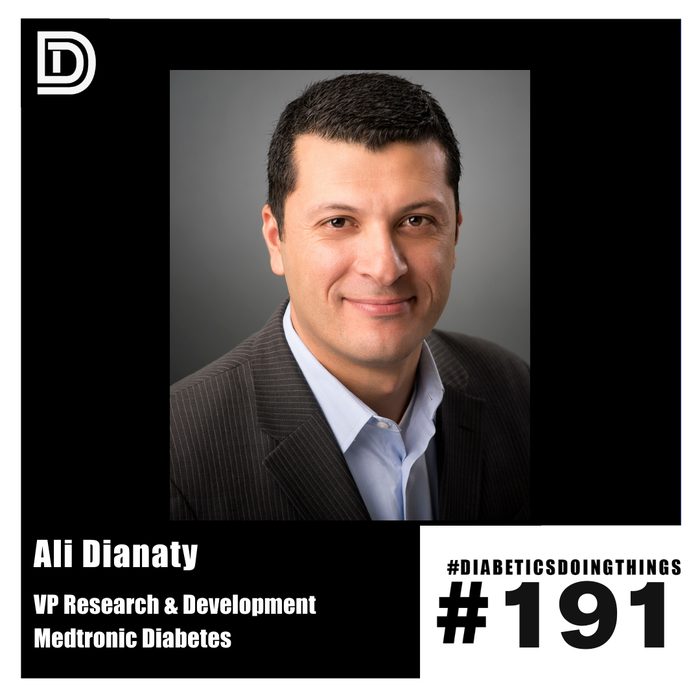
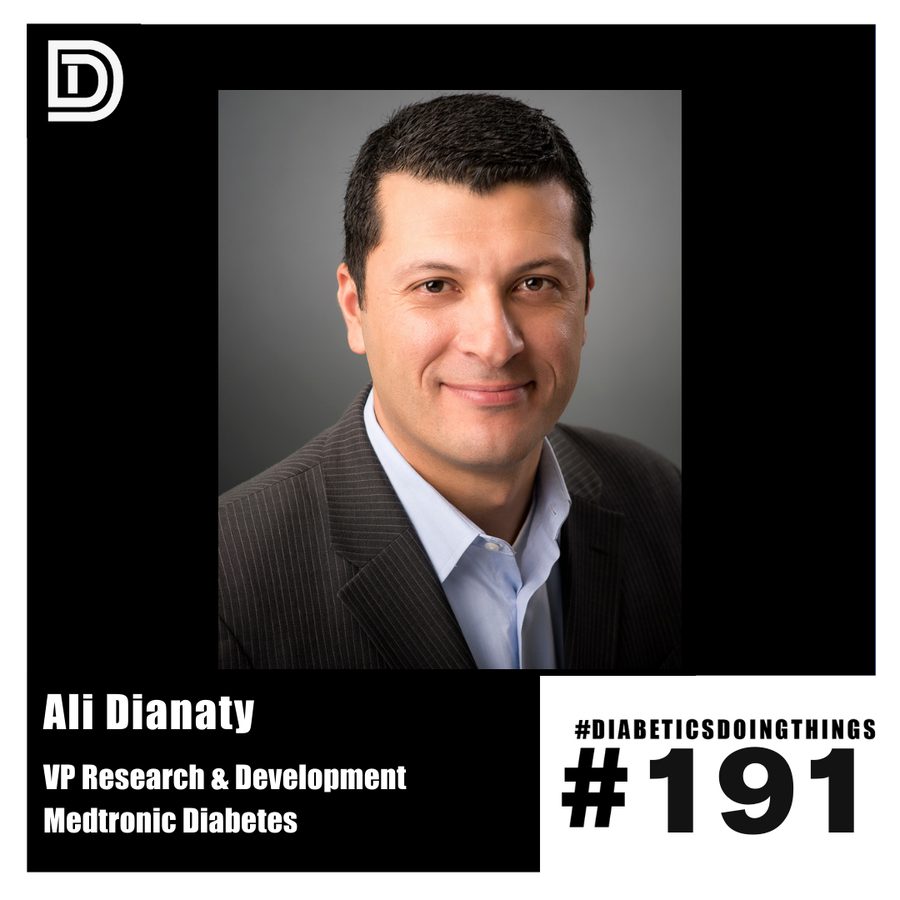
Ali Dianaty, VP Product Innovation, Medtronic Diabetes
Episode summary
Ali Dianaty is Vice President of Product Innovation and Operations at Medtronic Diabetes. He spent over 20 years in medical devices, working on rocket engine pumps and implantable cardiac devices before moving to insulin pumps about six years before this conversation. Rob and Ali walk through the regulatory path that takes a device like the 670G roughly 12 years to approve, why early Auto Mode exits were a safety tradeoff, and how Medtronic tests ideas like a quick-bolus button against what patients actually use. They cover Moore's Law and diabetes technology, gesture-based eating detection, dynamic carb ratios, and smaller pump and sensor hardware. Dianaty, who does not have type 1 himself, wears a CGM and a saline-filled pump to understand the experience, and shares the book Frugal Innovation as something that shapes how he prioritizes features.
Key takeaways
- Dianaty says one out of four meals gets missed by pump users on average, and skipping even a weekly lunch bolus can add a full point to A1C over time.
- Getting a complex system like the 670G approved took about 12 years, Dianaty says, because each component goes through its own development and safety cycle.
- Medtronic is testing watch-based gesture detection to recognize when someone is eating, so the system can flag or correct a missed bolus.
- Dianaty's long-term goals include dynamic, time-of-day carb ratios and smaller, more discreet pumps and sensors so people can forget they have diabetes.
- Dianaty, who is not type 1, wears a CGM and runs a saline-filled pump himself, and says several people on his team are type 1, to stay close to the patient experience.
Show notes
Rob is joined on the podcast by Ali Dianaty, Vice President, Product Innovation & Operations at Medtronic Diabetes.
Disclosure: This episode is sponsored by Medtronic, and Rob is a paid spokesperson for Medtronic.
In the episode, Rob and Ali discuss:
Ali’s background and what drew him to Medtronic Diabetes
Moore’s law and Diabetes technology
Medtronic’s product suite and “meeting patients where they are.”
Ali teaches Rob the concept of Frugal Innovation related to Diabetes
You even hear Ali admit he knows what it’s like to catch pump tubing on a doorknob!
If you’d like to connect with Ali, you can find him on LinkedIn here.
The MiniMed 770G system is for type 1 ages 2 and over. Prescription required. Individual results may vary. WARNING: Do not use SmartGuard Auto Mode for people who require less than 8 units or more than 250 units of insulin/day. For details, please visit http://bit.ly/770gRisks.
The MiniMed 670G system is for type 1 ages 7 and over. Prescription Required. WARNING: May not be safe under age 7 or using less than 8 units of insulin/day. For details, see http://bit.ly/670gRisks. Refers to Auto Mode. Some user interaction required. Individual results may vary.
Questions this episode answers
How long does it take to get a new Medtronic insulin pump system approved?
Ali Dianaty says a simpler update can take around three years, but a complex system like the 670G took about 12 years, since every component needs its own development and safety testing cycle.
Why did the Medtronic 670G exit Auto Mode so often?
Dianaty says that during an early, new period for hybrid closed loop technology, Medtronic built in Auto Mode exits as a safety measure, even though he acknowledges it frustrated users.
What does Ali Dianaty mean by frugal innovation?
He references a book on building successful products in places like India, and says it pushes him to focus on what a device truly needs to do well rather than adding complexity for its own sake.
Does Ali Dianaty have type 1 diabetes?
No. He says he is not type 1 but wears a CGM and uses a saline-filled pump himself, and notes several people on his team are type 1, to better understand what users go through.
Full transcript Searchable, with timestamps
Rob Howe: What's going on, everybody? Welcome back to Diabetics Doing Things. We have a very special sponsored episode for you today by Medtronic Diabetes with Ali Dianaty, who is the Vice President of Research and Development in Clinical and Regulatory Diabetes at Medtronic. I'm very excited for this episode and for you guys to get a little bit of insider information from Ali because we focus really strongly on the research and development and innovation elements of his job and his team's work at Medtronic. So really excited to dig into this with you guys. And this interview kind of spans the entire hybrid closed loop discussion, different product discussion, and where Medtronic is currently on the roadmap for patients. And really, we focus a lot on what the last 20 years of diabetes innovation has brought us because that's the amount of time I've been living with diabetes. And so someone who's diagnosed today is getting a very different experience than someone who was diagnosed 20 years ago. A reminder that I am a paid spokesperson for Medtronic, but my thoughts and opinions as voiced in this podcast are my own. All right. I hope you guys enjoyed this interview with Ali Dianaty. Welcome back to another episode of Diabetics Doing Things. We're telling the amazing stories of people with diabetes from all over the world. And this is actually our first live recording of 2022. So happy new year to everybody out there. Looking forward to some awesome content this year. My special guest today is Ali Dianaty, and he is the vice president of product innovation and operations at Medtronic Diabetes. And you guys know I am a Medtronic spokesperson. And so this podcast is part of that agreement. But Ali and I are going to dig into some really cool questions about technology and diabetes technology specifically and where it's headed and where we've come from. We've come a long way really recently. So Ali, welcome to the show. Thanks, Rob. I really appreciate being on. And I appreciate your time. I think that's one of the things that this podcast has given me that I really didn't expect is to get to bend the ear of inside industry folks who are powering the future of diabetes for people like me. So before we get into our questions that we've put in for the podcast today. I was kind of doing a little research on you and that's, that's my podcast host way. I always try to find the last interview that you've done so that I don't make that duplicative. And so I listened to you on the empowered patient podcast, which is a really cool podcast for just general patient news. And I think I'd like to put a little bit more of a diabetes patient angle on, on your interview today. You've been with Medtronic for the past about six years and you know, in that time, and we're going to talk about this a lot today, there's been some really significant advances in diabetes technology in that time. And I'd love to know, you know, just at a high level, what attracted you to this, the opportunity? And like, did you, was it surprising to you at the level of acceleration and research and development that has, that has taken place and that we've sort of undergone over the last five to six years?
Ali Dianaty: Absolutely. And believe it or not, that was one of the reasons why I made the jump. I actually have been in med device for a while and, you know, over 20 years. And because of that fact, where I was before was mostly an implantable product like pacemakers, neuromodulation, that kind of thing. And ironically, the thing that frustrated me more than anything was the fact that, you know, I'd go to a physician's office, meet patients that were using our technologies at the time. And, you know, they wouldn't even know what company it came from. Like they didn't have a brand. It was whatever the physician said was best for them. They would take and then not even think twice about it after that. It's just their pacemaker or their nurse device. And ironically, coming here, that was one of the attractions. Everybody that owns a Medtronic pump knows that it's a Medtronic pump and that brand means something. And that connection directly to the people that we're serving is super important to me. So folks like yourself who actively use our product day in and day out, having that connection and seeing the impact that we make is super important to me. So that's why I made the jump.
Rob Howe: Oh, thank you for that. And it's really interesting to think about from a consumer perspective. And I have talked about this at length previously. Yeah, that brand is with you. You wear a Medtronic pump or a Medtronic sensor or using a Medtronic app on your devices. is you interact with the brand quite a bit. And, you know, as patients, sometimes those interactions are solving really complex and difficult problems that, uh, you know, have plagued us many people for years. Some people who are just getting to know those problems associated with diabetes and to have somebody, uh, there with alongside you and like a technology alongside you really do build a partnership over a long period of time, lots of ups and downs,
Ali Dianaty: not just blood sugar related. Absolutely. And, you know, I, I take a lot of calls, from people that are having good days and bad days. And as a result of that, we incorporate what we learn into the product, of course, and try to make it better every day with it. And so there's a lot to it. And again, having that closeness is what makes the difference in my opinion. And so it's not just me, I'm translating that within our broader team as well and within the executive staff so that we maintain and improve that connection because that ultimately is what matters most.
Rob Howe: That's a really interesting perspective. And I had a question about your career in product innovation, research and development. Is that something that you've always been interested in? And did that really resonate with you as like a process of ongoing improvement? Is that sort of just a good fit for you? Or how did you end up in the R&D and product innovation world?
Ali Dianaty: Yeah, so ironically, it started when I was probably 11 or 12 years old. and my parents both worked. And so I usually ended up going to summer school. And what happened one summer was that there were no summer school availability where I lived. And so a cousin, my cousin gave me like a mini bike, if you would, like a lawnmower engine, a motorcycle that didn't work. And he said, hey, for your summer project, why don't you get this thing running? And so he helped me along with my dad. And as a result of that, you know, kind of became interested in mechanical things and the rest is kind of history. And so by virtue of just being bored one summer, it really did change my whole life as a result of becoming somebody that wanted to make things work. I mean, it's probably the best way to say it. And ironically, it started with probably the most famous pump out there, which is an engine. And my history has been in pumps along a lot of the way. So my first job out of college which happened to be working on pumps for rocket engines. And then from there, I probably worked on a pump we all carry, which is the human heart. And so I built a lot of technologies to help people that had arrhythmias and issues with their hearts. And then ultimately to come here to work on a different kind of thing for. So, yeah, it's been interesting to kind of live through that life over the last 35 years.
Rob Howe: You know, what's interesting, I have two thoughts on that. Uh, first I have to know, like what, what are the similarities between, uh, the pump on a rocket engine and the pump on an insulin pump, uh, you know, even at a high level. Um, but two, I think specifically in the diabetes world, I will never, ever, ever. I, I, the way I look at summer projects has changed because of diabetes, because like you're talking about a summer project, which influenced your entire career. And we just celebrated earlier this year, the 100th anniversary of the discovery of insulin, which, uh, for Dr. Frederick Banting and Charles Best was a summer project. Uh, so, you know, helping, uh, millions of people worldwide over a hundred years, uh, never underestimate a summer project. So back to the, back to the first question, like what, what does an insulin pump have in common with the pump on a rocket ship?
Ali Dianaty: Well, I mean, uh, believe it or not certain things that matter to both, um, you know, are applicable. So simple one is, you know, can't overpressure a, uh, a rocket engine pump and you definitely don't want to overpressure an insulin pump, right? Because that means something's plugged up and, you know, that not good, meaning that patients aren't going to get therapy. So that's one simple example. You're looking at both to make sure that you're not, you know, causing problems one way or another. The other is just the notion of materials. It matters, you know, what things are made out of in order to get the outcome that you want. And in both cases, that applies. And then last but not least is, you know, uh, performance, right. Uh, accuracy in the case of, uh, an insulin pump and more importantly, it's power and efficiency on, you know, rocket engine pump. And so a lot of those things kind of apply. Uh, so it's been, it's been interesting to correlate that's for sure.
Rob Howe: Yeah, that's a, and I appreciate you letting me put you on the spot with that question. Uh, I'm sure that that was not in, uh, our, our regular syndicated, like, uh, you know, question boxes, like how, what does the rocket ship have in common with an insulin pump? But, but thank Thank you. And I think let's, let's ride that, that momentum of, of a rocket ship to, you know, the, the comparison of the last five to 10 years in advanced insulin pump systems. Uh, we're living in this time where, you know, we, we finally have insulin pump systems that automate a lot of what people with diabetes, like myself, uh, had previously had to manage manually. Uh, and now even this month, I'll, I'll be celebrating four years on a hybrid closed loop system, uh, from Medtronic. And, you know, when I was diagnosed 17 years ago, this is what people and my care team were saying that was, was on the roadmap and would happen sometime. And so looking back almost 20 years, it's amazing to see how far we've come, but what are the next 20 years to look like for people with diabetes and in the diabetes technology space?
Ali Dianaty: Yeah, for sure. So, I mean, just taking even a step back and you mentioned it, I mean, knowing that insulin is, you know, just hit its hundredth anniversary. It's it's a pretty fast leap that we're making all the way up to where we are today. You know, and I don't know if you've ever had the chance to, you know, see, we have one in our museum in the office, but the first pump that was ever made the size of a backpack that someone had to carry and kind of, you know, roll through, you know, to make that work.
Rob Howe: I'm sorry to interrupt you, but I have seen it. And we've also had some folks on the podcast, both from Medtronic and just sort of out in the general world who tested the first pump. And I'll quote Dr. Gary Scheiner from one of our previous episodes. He was saying he went on a date with the first insulin pump just to see what it would be like. And he had to have a separate
Ali Dianaty: chair for the backpack portion. I bet he did. I bet he did. Yeah. So, I mean, seeing where that has come, you know, along with, you know, quite frankly, Medtronic's been at the forefront of a lot of advances, be it, you know, the first pump to connect to a CGM and get, you know, sensor augmented performance out of that, you know, to the first to, you know, stop insulin when people are low and, you know, create that threshold to spend as such. And then ultimately, you know, just seeing where we are with automated insulin dosing has been, you know, very, very, very, I'd say, fulfilling from someone that's in the middle of it. But on the other end, there is so much more that we can do. And because of that fact, you know, when I look out into the future, you know, there's a few things that have really created an environment for this to explode and do very, very well. One is just the notion of how good, you know, computer processing has become and the ability to carry basically something that could get you to the moon, you know, thinking about rockets and whatnot in your pocket. You know, what we have in our phones today are more capable than what got us to the moon. And so as a result, you know, we're using those kinds of things to our advantage, because when you really think about how and what we have today relative to what we could have in the future, there are a lot of gaps. And so today, you know, we know how much insulin is going into somebody's body. We know the information they provide to us, be it, you know, carb counts and the like. And then we know, you know, what the CGM reading is. But if we think about a healthy pancreas for one second, you know, it gets the benefit of all of our other senses. And that's something that we're trying to incorporate into our systems so that, you know, we can predict things more readily, just like, you know, uh, you know, in, in most people, when they start to smell food, uh, you know, insulin starts, you know, getting into their body or seafood for that matter. Um, and so we need to do things like that to get ahead of, uh, you know, the sugar that's, that's entering their bloodstreams. And so a lot of what we're trying to do is along those lines. Uh, so a simple, um, method, uh, that we're going after is, you know, the, the, the new, the newer watches that are out there, you know, have gestures capability within them. And really what I mean is that because of the accelerometer and whatnot that's in it, you know, we can actually see when people are putting food into their mouth. And just knowing that that is something that we could recognize is kind of a big deal because I'm sure in your own dosing, you know, if you don't get the bolus timing right, it changes, you know, your timing range pretty dramatically. And more importantly, you know, if someone forgets, um, all together, you know, that creates those bad days, um, that we're all trying to avoid. And so by virtue of just knowing that someone is eating, you know, that's actually a ton of information for us. Uh, and we're, we're trying to make sure that something like that, um, can get incorporated into the system. Uh, and then, and then go ahead.
Rob Howe: Oh yeah. I was going to say, I remember it's been a little while now, but, uh, when Sean Salmon came on the podcast. We talked a lot about what you're, what you're mentioning right now about the gestures and like being able to time the eating and, you know, the impact that he was telling me, and I'm paraphrasing was missing one lunchtime bolus, like once a week can have an entire point, uh, add an entire point to your A1C over a period of time. And so when we think about people with diabetes who are carrying a lot of mental burden, where, keeping a lot of their numbers and ratios, kind of balancing them in their head or whatever system that they use, having the technology be able to meet them and say, oh, hey, it looks like Rob didn't bolus. Now we can offer a correction bolus based on the numbers that we're seeing or the gestures that we're seeing. I mean, that is, even though it's a small feature, has a sprawling impact.
Ali Dianaty: No doubt. And it's interesting, based on looking at the population, of course, not everybody, that essentially one out of four meals is missed. And so if you think about that as something that we could solve for, it does become a big deal pretty quickly. And then, you know, the other thing that's important to note is that most people, you know, don't tend to underestimate their carb loads on purpose because, you know, no one wants to go hypo. And so with all of that in mind, you know, those are areas for improvement across the board for us that we constantly look at to make better. And that's why, you know, the notion of these prediction capabilities and, you know, using the information around us to make better decisions, you know, really will make an impact within the space. And that's where we're spending a ton of time and effort on not only the data and understanding what's actually happening, but then turning that into something that's actionable or even automatic for us to implement into the system.
Rob Howe: Totally. And thank you for that overview. I think, you know, for me, I've jotted down a couple of things and I want to go back a little bit. You talked about the importance of technology and computing power. When you were mentioning that, I thought of Moore's Law, which is the computing power doubles every 18 months relatively. And I think now that that timeframe is even shorter. We're seeing technology go forward at a rapid, rapid pace. And I think as a consumer, speaking for myself here, but I think many people have these sentiments. We're sort of spoiled by the timelines of big tech and Silicon Valley and emerging technology. when it comes to medical devices, it's not apples to apples. What can you tell us about the approval process that goes into a medical device by the time a patient puts their hands on a Medtronic product? How long has that been in that approval process and how long does that
Ali Dianaty: generally take? The approval process itself is actually pretty quick. Getting to an approval process is really what's hard. And a lot of that has to do with the fact that we look at every scenario that could possibly happen and make sure that, you know, the outcome of that will be safe, you know, for anybody that's wearing the technology. And there's a lot of things that could go wrong. And so as a result of that, you know, you have to mitigate them all or come up with a way or means to make sure that someone, you know, honestly can't hurt themselves. And, you know, we're fortunate to be talking to you in regards to, you know, you understand your diabetes management and, you know, have a lot of experience with it. But we also have to design this for people that don't, um, and make sure that, you know, that we have the coverage in there so that just in case they do make an error, um, for whatever reason, um, you know, just learning, you know, how to deal with their diabetes in the first place, um, that, you know, it's not, it's not going to create another bad day. Um, and so a lot of that work, uh, ends up being, thinking through all of the potential scenarios and then testing them to make sure that we can essentially accommodate whatever crazy things that could potentially happen. And believe me, I've seen a lot of crazy things. So that process, honestly, on something that is not very complex, you know, could take something like three years to get done, honestly. For something that is very complex, you know, we were talking really five to seven to get it done. So, you know, as an example, if you take what it took to get, you know, the 670, you know, out the door, you know, that was essentially a 12-year program to do that. And when you look at all of the components of it, you know, each component of it ended up being its own development cycle. So a simple one is, you know, deciding when to exit auto mode, as an example, and then what happens when that happens, like how to, how to think through that. So that's a really, you know, uh, I think tangible example, but you know, there are people behind the scenes that had to think through all of that and make sure it was safe. It did everything that it needed to do from a performance perspective. And then in any given scenario, um, you know, match up, um, to what was best for the patient. Um, and so, you know, that's, that's one simple thing. That's not even dosing the insulin yet. Um, and you know, that, that takes quite a bit of time and effort.
Rob Howe: No, it's funny. I should have given a trigger warning, uh, to people who might be, uh, triggered by the Auto Mode exit alert. If you have, uh, if you experienced the auto mode exit alert on the 670g, uh, fast forward, fast forward for this section. Um, just, uh, that's just a little funny, a funny thing for me. It's interesting.
Ali Dianaty: And mind you, it's, it's a good one. Uh, and you know, I appreciate it and understand it. And it's also one of the things that, you know, in our future technology that we've taken care of and made better. And, you know, again, this was new. And as a result of it being new, you know, we wanted to make sure that we never did anything wrong by people. And now in hindsight, I'm sure people, you know, are probably not happy about that. But in general, the intention was to make sure that in any given case, you know, we're keeping them safe. So the intentions, I think, were the right ones. How it ended up may not been, you know, always favored by people. But, you know, honestly, we were looking out for them and that's why, um, it is what it is.
Rob Howe: Well, and one of the things that I, I often talk about as well as like, uh, especially in the type 1 side and, and I've, I've done better over the years now of like, you know, speaking to diabetes in general, but on the type 1 side tend to get a lot of type a opinions, uh, there. So if you're, you know, uh, people with diabetes are, uh, no strangers to sharing their feedback. No, I want to talk, I want to talk a little bit like within, within that though. And like, and it's funny. And I, and I think, you know, when I see it online, people are so passionate about their care and like, when they really take ownership of that, I think that's part of the like sort of cycle that they get into. How do you guys, you know, internally, how do you and your teams at Medtronic think about that patient experience with diabetes tech? And for me, like I'll, um, I'll share a little personal anecdote. Like, um, I'm going to, I'm going to do another law here. Cause I'm a big law guy. So like Amara's Law is the, uh, the tendency to overestimate an impact in the short term and underestimate it in the longterm. And I found myself as I, you know, cause I'm celebrating a year on the 770G as we, at the time of recording and four years now with SmartGuard Auto Mode. And I remember early on at the release of the 670G, like how excited everybody was at the, you know, the first FDA approved hybrid closed loop system. And I think, you know, I, you know, as, as the optimist that I am, I was like, oh, this is going to solve all my problems. We're going to, this is going to be great overestimate in the short term. Uh, and then you get in there and you, you learn about the auto mode exit and you learn about the calibrations and get the hang of it. You start to learn, uh, and you get comfortable with it. And then you start to forget the long-term impact. You know, I'm testing my blood sugar less on my, you know, manual pricks. I'm, I'm calibrating my sensor and, you know, it's a lot of site changes and a lot of sensor. It does take management, but that long-term relationship and impact on my life at least is, is significant. And I know that many patients, uh, I'm sure feel the same way. So how do you guys internally make that connection to that reliance on technology and like, you know, during the life of a product when you're hearing from patients and customers, like, how do you take that and put that into action?
Ali Dianaty: Yeah, there's a few ways. First and foremost, I wear it. Even though I'm not a type 1, you know, I wear CGM all the time. and on top of that, as it relates to the pumps themselves, I do a saline all the time. And a lot of that has to do with just making sure that whatever I'm asking our customers to do that I'm willing to do myself. And my team feels the same way. And mind you, we have quite a few people within our team that are type ones. And so that also helps a ton also for sure. But that's first and foremost, you know, the best way, in my opinion, to get, you know, the real insight as to, hey, is this okay or not okay? And if I'm not willing to do it, you know, I can't expect others, you know, to be willing to do it. And so a lot of that goes into it on one end. The other is, you know, of course, we do market research and a ton of patient interviews, you know, to make sure that, again, going back to this notion of, you know, everybody's in a different place in their journey. And because of that fact, their experience, you know, is also directly correlated to where they are in their journey. And we have to also think through that, too. Um, so someone that is the, these type of A's that you had mentioned and what, what they want may not be directly correlated to someone that's newly diagnosed. Um, and so we got to think through the gamut of that also. And, you know, of course the best way to do that is to ask. Um, and so we do a lot of asking, um, and, you know, in, in, in thinking about that, um, you know, there's a lot of things that, you know, we have to make trade-offs on and, you know, you can make the argument that sometimes we don't do a good job on the trade-offs here and there. And then sometimes I think we do. And so our goal is to first and foremost, get the information, put it into action, and then, you know, create a product that people want and like. And then, you know, in some cases, you know, we have also found that, you know, people, when we first asked them the question, can't necessarily correlate it directly to their life because it's hypothetical. You know, the one that always kind of comes up through my years here is, why doesn't the device have a quick bolus button on it as an example? And the reason for that is every time we actually ask people, hey, would you like a quick bolus button? They say, yes, I would love to have one, right? Okay, and then we go and say, okay, here it is. How would you use it? And then we find out that they would never use it because they would want to pull out their pump or their phone or whatever, see where their CGM is at. And then based on that, decide what the bolus anyway. And so to have a button that, you know, is two units at a time, you know, kind of defeats the purpose because, you know, you're going to be looking at your pump anyway, or your phone anyway. And so it's things like that, that, you know, we're constantly, and I just use that as a simple example, but it's things like that, that, you know, if you don't ask the right questions, you know, you're not necessarily going to get the answers you want either. And so So we watch that very carefully, too, to make sure that as we go, you know, we're solving the right problem and the ultimate need that somebody has instead of their desire at the moment, if that makes sense.
Rob Howe: No, that does. And I think, you know, thank you for that, that clarification. And like, it's interesting. And I think something you mentioned a couple of times already is that the patient's relationship with technology and their relationship with diabetes varies so widely because of, we're not all diagnosed at the same time. There's not a uniform diagnosis experience. And, uh, you know, there's diabetes does not discriminate against lifestyle or age or, uh, you know, technology aversion or, you know, technology adoption. And something that I think a lot about is the customer journey or patient journey of someone with diabetes from day one to year 10 and to year 20. And like, what are their, you know, psychosocial responses in each one of those? And like, what are the key milestones in their, their journey with diabetes? And, um, you know, speaking of that journey, uh, Sean and, and the other Medtronic executives that I've had on over the years and yourself, you mentioned this already has been very vocal about meeting patients where they are in that journey. And how do you tie innovation to that promise? I know that there's been a lot of product innovation more recently and adding different products to the suite to give patients more options under the Medtronic banner. How do you guys follow through with that internally? And what does that look like to you guys?
Ali Dianaty: Yeah, I mean, I think there's a few things there to speak through. One is based off of the notion of meeting patients where they are. you know, it shouldn't be predisposed on our part that everybody will want to pump. You know, they probably don't. And I think the market is telling us that too. And so as a result, we're trying to make sure that, you know, from a product portfolio perspective, you know, we can provide them whatever they need in order to do what they would like to do with their diabetes management. So sure, on one end of the spectrum, we have automated insulin dosing, of course, and we'll continue to advance that. and we have been advancing that, especially as of right now in Europe and otherwise, but, and we can talk about that if you, if you like, but then, you know, all the way on the other spectrum, you know, many people don't know this, but we also, you know, sell a port and that port really is like an infusion set with a septum on it so that someone on MDI, you know, doesn't have to give themselves injections per se, you know, you know, three, four, five times a day. But But instead, you know, like an infusion set, put it on for three days and then use the port over that period of time. And then we kind of have everything in between. And so standalone CGM, you know, a smart pen integrated system with CGM and then, you know, a sensor augmented pump as well. And so our intention is to give people those options. And then based off of those options, you know, they can decide what works best for them and what they're comfortable with. and, you know, how much they would like us to help them. And so, you know, on top of that, though, you know, the question is, you know, on the extreme side, how much can we do safely and effectively? Breaking that down to really what the crux of it is, is, you know, my goal is to have people forget that they have type 1. And the way to do that is to make it very simple to wear as if it's not even there on their body. And it basically takes care of their, their diabetes needs. So, you know, I, I can see in the not so distant future, you know, a place where, you know, people are putting their insulin, you know, into a reservoir, you know, placing something on their body and they're, they're good to go. and, you know, it takes care of their needs with their diabetes. And so, you know, that means, you know, we have to do better with CGM. We have to do better with the form factors that we use for the pumps themselves and make them very easily wearable. You know, we have to make things smaller and more compact so that they don't feel like, you know, you're carrying, you know, a Walkman on your body, for lack of a better way of describing it. And probably maybe the iPod is more, I don't think they make those anymore, but nonetheless, something of that size wouldn't be okay. And then more importantly, then, you know, using, you know, Moore's law to your point and taking that computing power and turning it into, you know, automaticity for people so that, you know, we can do better. And so all of that's in play right now.
Rob Howe: it's really interesting to think about and and you know thank you for kind of showing where we've come in that roadmap and you know i think something that's really interesting that you've touched on multiple times really regarding technology but i think is also very cool and encouraging to me as someone who's lived with diabetes now for almost two decades the experience for somebody diagnosed today is a measure of at least 10x greater than the experience or you know the technology and experience of managing diabetes 15, 17 years ago for me. And like, to understand like that, like it's impossible to explain like all that went into that, to that new person, but also like, I think what gives me sort of hope and encouragement is to look back another 20 years from my diagnosis or another 50 years even, um, and see what people were going through, uh, a very short time ago in the re in the realm of like humans lifespans. a single generation ago, we were boiling syringes and injecting cow insulin and had a two-hour wait time for peeing on keto sticks. So we've come a long way. It's impossible to articulate to that to someone who's been diagnosed in 2022, that this really is a tremendous step forward. And I think that perspective is interesting. I love the idea of customization and personalization of, of settings within a singular device. Um, we talk a lot about on the podcast, diabetes doesn't look the same for everyone. Not all diabetes is created equal. You know, people are, are humans and their physiology interacts with diabetes in different ways based on so many different factors. It's, you know, the, it's the disease with too many inputs as they say. Uh, so to be able to have that customization and say, Hey, I would like to be more aggressive or my personality or my ideal on ideal diabetes management is very aggressive, or maybe it's not, maybe my target is a little bit higher. I like to ease into that. Uh, or, you know, I have, I think there is a lot of, uh, you've mentioned fear of hypoglycemia, uh, due to a higher, too much, too much insulin dose. Uh, so I think it's a very real, you know, thing for many people, many patients having the option is, is pretty incredible and looking forward to, uh, getting to experience that hopefully some, sometime soon. I, and I know like that is a sort of short-term goal. What can you share about long-term? You've talked a little bit about, you know, reducing size, like, you know, accessibility, like infusion sets, making things, you know, easier. What's, what's some of the long-term goals that you have sort of on your, on your roadmap or that you can share with us today? Yeah. So, so, I mean, maybe even starting with
Ali Dianaty: that notion of personalization, cause it's a good one. You know, we do know that, you know, every individual is different. You know, even the way that they react to food is different. I know for me, like when I wear CGM, the thing that scared the crap out of me more than anything was when I had a Jamba Juice and saw, you know, what happened. Yeah, it was a straight shock. And, you know, since then, I don't think I've allowed my kids to laugh at them ever since. it's um but you know truth be told the the the power of that is knowing what's happening and why it's happening and then making uh the inferences and then um adapting that to yourself um you know can make a huge difference in in in in the management of diabetes really can i mean something as simple as you know we kind of take it for granted but you know just take the idea of today, you probably have four or five carb ratios, you know, selected in your, in your device. Well, you know, the back to this notion of computing power, there's no reason why we can't have a dynamic carb ratio, you know, that, that changes by day by hour. And, you know, it would better handle your, your, your, your needs. And so I'm sure, you know, thinking through just basic things that could happen along those lines, right. You know, Monday through Friday, you have one schedule, Saturday, Sunday, you have a very dynamic one, probably. And being able to accommodate that well is important. And so those are the kinds of things that we're trying to build in to make personalized, because we know that, you know, the notion of people being predictable like that is unlikely, it's not real. And, you know, a healthy pancreas doesn't care. And so we shouldn't either. And so it's that kind of stuff that we're putting into the device to figure out and use, you know, the notion of the phone and otherwise to get smarter about it. So as an example, now you go to your favorite restaurant and, you know, I've done this enough times with my own CGM, right? But, you know, when you go to your favorite restaurant, it's very likely that you're ordering the same thing, right? And because of that fact, you know, the first time that the device and system would see it, you know, notice that you're here. This is what you're, you know, technically your carb load is. This is what your CGM graph look like. This is how you bolus. And, you know, everything's fine. Then the next time you come, you know, there's no reason why we can't use that information and provide an insight and say, hey, look, the last time you were here, this is what you did. And, you know, here is something that may be better. And you may want to try this. And if we see it often enough, maybe on the third or fourth, We're saying, hey, look, I think, you know, we got this handled for you. Would you like us to take care of it? You know, someone just says yes, and we're on our way, right? And so that's not a crazy notion, to be honest with you. And because of how things are set up these days with the notion of these sensors, location, time of day, I mean, you name it, all of these things are important things for us to use to help manage and to make things easier for people. And so, so that's one end of the spectrum for sure that we're spending a lot of time and effort in, you know, to make, to make the system better. But then the other is like I had mentioned, you know, the wear has got to get better too. And because of that, you know, we're doing quite a bit of work on not only on the sensors, but on the pumps too, you know, to make them more discreet, you know, easier to put under clothing. I know where I wear a pump and the number of times I've knocked it off of my body in a doorway. And, you know, it's frustrating. There's no doubt about it. And, you know, worse yet, you break the belt clip, pump lands on the ground and, you know, you ding it. And then, you know, that's frustrating too. And so it's those kinds of things that we honestly look at and try to make, you know, our products way more capable so that, you know, that those kinds of things don't frustrate people.
Rob Howe: So I want to thank you, Ali, for spending time with us today and really digging into, you know, a lot of really overarching questions and themes that people with diabetes have on a regular basis. And I know they're going to get a lot out of this. I plugged a question into our list that is a little bit more personal is that because I think I get a lot of questions and I personally have had a lot of questions over the years and I've benefited greatly from my relationship with Medtronic and getting to talk to people like you and various team members throughout the organization. And it's really opened up my eyes to a little bit more about the behind the scenes to help understand the medical technology world. So I'd love to know if you think of, if there's any books or journals or publications that you would recommend our listeners take up or listen to or read that can help them understand a little bit more about the medical technology world. Anything come to mind? Yeah. So the books that
Ali Dianaty: are out there on MedDevice are what I mean, if you want something to put you to sleep, you know, a book that I liked, mainly just because it makes you think differently about what matters and what doesn't, is called Frugal Innovation. And really what the context of the book was, was really trying to get products and services in places like India to be successful. and what needs to be true in order to make that happen. And the real reason why I like that was because it basically forces you to think about what matters and what doesn't. Because in many cases, we build and our engineers are famous for this. They have these great ideas and they just want to see them come to light, but forget about the fact that it creates complexity and doesn't necessarily always, a lot of times it does, deal and manage what needs to get managed directly for the customer. And so in my mind, I try to simplify things enough so that the primary things that need to get done get done well. And sure, we can have these bells and whistles as we need to, but at least for the construct of what needs to happen within that device is front and center. And we focus our attention on the stuff that matters most. and even though that's not the exact premise of the book, it forced me to think that way and remember that that's what matters. So, you know, in the case of our technologies, it's making sure that, you know, we do the best we can in keeping people safe first and foremost, but then more importantly, you know, getting them to forget that they have diabetes. And so that's the bottom line.
Rob Howe: No, it's really interesting. And thank you for that point. I think in the creative world, we talk about this internally at both of my companies, like there's no greater punishment than a great idea because then you got to follow through it. It sounds like that's what you and your innovation teams are actively experiencing. And I'll definitely check that out and I'll link it in the show notes as well to Frugal Innovation for those who might be interested in reading. Ali, thank you, man, for the time this morning, for being so giving in terms of digging into the questions. It was great to talk to you. Uh, I'm looking forward to, uh, to hang out with you, uh, more at, uh, subsequent Medtronic events. And if anybody wants to follow you, are you active on social media anywhere? Or, uh, you know, I know you occasionally appear. Okay.
Ali Dianaty: So I'm on LinkedIn. Um, and then, you know, I, I kind of ghost myself on, on everything else. Um, but, uh, I'm on LinkedIn. So yeah, they're, they're welcome to, to, to check out there.
Rob Howe: Awesome. Well, uh, Ali, again, thank you for your time. And, uh, yeah, thank you to Medtronic diabetes for making this possible. And just a reminder, I am a paid spokesperson for Medtronic, but the thoughts and opinions today are my own. So thank you guys so much for listening.
About Ali
Ali Dianaty is Vice President of Product Innovation and Operations at Medtronic Diabetes. He spent over 20 years in medical devices, including work on rocket engine pumps and implantable cardiac devices, before joining Medtronic's diabetes team.